Learning Source Descriptions for Data Integration
AnHai Doan, Pedro Domingos, Alon Levy
Department of Computer Science and Engineering
University of Washington, Seattle, WA 98195
{
anhai, pedrod, alon
}
@cs.washington.edu
ABSTRACT
To build a data-integration system, the application designer must specify a mediated schema and supply the descrip-tions of data sources. A source description contains a source schema that describes the content of the source, and a map-ping between the corresponding elements of the source schema and the mediated schema. Manually constructing these map-pings is both labor-intensive and error-prone, and has proven to be a major bottleneck in deploying large-scale data in-tegration systems in practice. In this paper we report on our initial work toward automatically learning mappings between source schemas and the mediated schema. Specif-ically, we investigate finding one-to-one mappings for the leaf elements of source schemas. We describe LSD, a sys-tem that automatically finds such mappings. LSD consults a set of learner modules – where each module looks at the problem from a different perspective, then combines the pre-dictions of the modules using a meta-learner. We report on experimental results of applyingLSD to five sources in the real-estate domain.
1.
INTRODUCTION
The rapid growth of information available online has spurred numerous research activities on developing data integration systems (e.g., [4, 8, 5, 7, 6]). A data integration system provides a uniform interface to a multitude of data sources: given a user query formulated in this interface, the system accesses and combines data from the sources to produce an-swers to the query.
To build a data integration system, the application designer begins by developing amediated schema that captures the relevant aspects of the domain of interest. Along with the mediated schema, the application designer needs to supply descriptions of the data sources. Asource description spec-ifies the semantic mapping between the schema of the data source and the mediated schema.
Constructing source descriptions is one of the key bottle-necks in creating data integration applications that query a large number of sources. Currently, source descriptions are created manually in a very labor-intensive and error-prone process. As data sharing on the WWW becomes perva-sive with the adoption of XML, the problem of reconciling schemas (DTDs, XML schemas) is only exacerbated. In this paper we report the first results of our work on using machine learning to (semi-)automatically compute
seman-tic mappings between schemas. The idea underlying our approach is that after a set of data sources have been man-ually mapped to a mediated schema, the system should be able to glean significant information from these mappings and to successfully propose mappings for subsequent data sources.
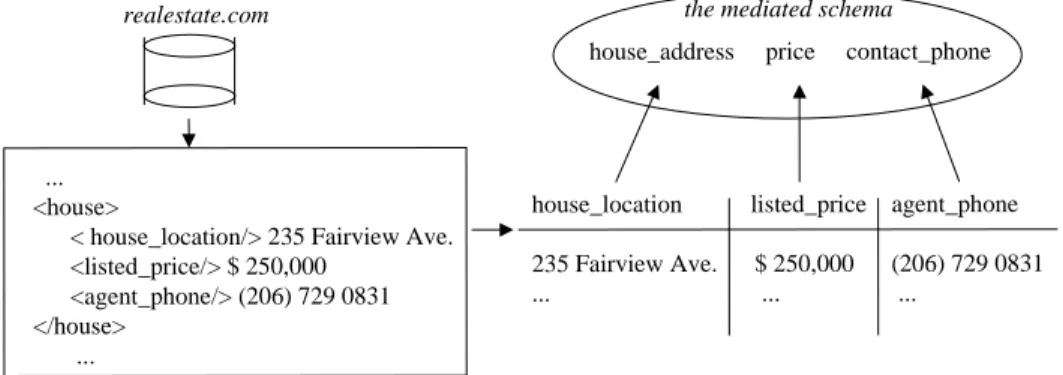
Example 1: Consider a data integration system that helps users find houses on the real-estate market. A mediated schema for this domain may contain elementshouse address, price, andcontact phone, listing the address of a house, the price, and the phone of the contact person, respectively (see Figure 1).
Suppose we have a sourcerealestate.com, for which we pro-vide the source description manually. Specifically, suppose the source contains the elementshouse location,listed price,
andagent phone(Figure 1), and the mapping specifies that
these elements match the elementshouse address,price, and
contact phoneof the mediated schema, respectively.
There are several things that a machine learning program can glean from such a mapping. First, if it looks at the data in the source, it now has many examples of home addresses, home prices and phone numbers, and it can therefore cre-ate recognizers for these elements. Second, the system can learn by looking at the names of the elements. For exam-ple, knowing that source element agent phonematches con-tact phone, it may hypothesize that the word “agent” (as well as “phone”) in an element name is indicative of that el-ement beingcontact phone. The system can also learn from the properties of the data. For example, small numbers tend to indicate numbers of rooms, not prices of houses. As an-other example, when the phone numbers of a given element have significant commonalities, the phone numbers are more likely to be the office phones of employees, rather than home phones. Finally, the program can learn from the proximity of elements. For example, in the real-estate domain it often happens that a long text field at the beginning of the house entry is the house description, or that agent phones tend to appear next to the name of the real-estate agency.
In general, there are many different types of information that a learner can exploit, such as names, formats, word frequencies, positions, and characteristics of value distribu-tion. Clearly, no single learner will be able to exploit effec-tively all such types of information. Hence, our work takes a multi-strategy learning approach. We apply a set of
learn-realestate.com
... <house>
< house_location/> 235 Fairview Ave. <listed_price/> $ 250,000
<agent_phone/> (206) 729 0831 </house>
...
house_location listed_price agent_phone 235 Fairview Ave. $ 250,000 (206) 729 0831 ... ... ...
house_address price contact_phone the mediated schema
Figure 1: Sourcerealestate.com returns data that is in its local schema, which then needs to be mapped to the mediated schema of the data integration system.
ers, each of which learns well certain kinds of patterns, and then the predictions of the learners are combined using a meta-learner. In addition to providing accuracy superior to any single learner, this technique has the advantage of being extensible when new learners are developed.
We describe the LSD (Learning Source Descriptions) system that we built for testing this approach, and our initial exper-imental results. The results show that with the current set of three learners, we already obtain predictive accuracy of 62-75% prediction in a fairly complex domain of real-estate data sources. Our work currently focuses on finding one-to-one mappings for the leaf elements of source schemas.
Learning Source Descriptions versus Wrapper Learn-ing: We emphasize that the learning problem we consider here is different from the problem of learning wrappers. Wrappers are programs that convert data coming from a source (say, in HTML format) into some structured rep-resentation that a data integration system can manipulate (e.g., XML). In wrapper learning, the focus is on extract-ing the structure from the HTML pages. By contrast, here the focus is on finding thesemantic mapping between the tags/attributes in the data source and those in the mediated schema. Hence, throughout the discussion we assume that the data in the source is already given to us in XML.
2.
THE SCHEMA-MATCHING PROBLEM
Schema Definition: We model a schema with a tree the nodes of which are XML tag names. Figure 2 shows a frag-ment of a mediated schema G and a fragment of a source schema M. We also refer to the nodes of the schema tree asschema elements. Each schema element has aname and values(also calledinstances). In a schema tree, element B being a child of element A simply means that an instance of Amay contain an instance of B. For example, in G the name of the schema element corresponding to the address of a house ishouse address, and its instances are text strings specifying the address, such as “123 Fairview Ave., Seat-tle, WA 98135” or “4028 13th Str.”. The former string contains an instance of elementcity (“Seattle”), while the latter does not. As such, our schema language can be con-sidered a simplified version of XML DTD, where parent = child1?child2?...childn?.
The Schema-Matching Problem: Given a
mediated-schema tree G and a source-mediated-schema tree M, both expressed in the above schema language, in general the schema match-ing problem is to find some mappmatch-ings between the two schemas. The simplest type of mapping is 1-1 mapping between a node in the source-schema tree and a node in the mediated-schema tree, such as the mappings shown in Figure 1 and mentioned in Example 1. More complex types of mapping include mappings from a node in a tree into several nodes in the other tree (e.g.,num bathroomsin one schema is the sum of num full bathrooms and num half bathrooms in the other), and mappings between a node in a schema and the values of another node in the other schema (e.g.,
handi-cap equippedwith values “yes/no” in one schema maps into
the value “handicap equipment available” ofamenitiesin an-other schema).
As the first step, we focus on finding all 1-1 mappings be-tween the nodes (elements) of the two schema trees. Specifi-cally, in this paper, we limit our investigations to finding 1-1 mappings for the leaf elements of source schemas. Matching source-schema elements at higher levels requires developing learning methods that deal with structures, a topic we are currently exploring.
3.
THE LSD APPROACH
We now explain in detail how our machine-learning approach works. In our discussion we shall use labels to refer to mediated-schema elements. We refer to the process of match-ing a source-schema element asclassifyingthe element and assigning to it a proper label.
The Learning Phase: Suppose we start with the real-estate mediated schema G shown in Figure 3.a. We create training data for the learning process by manually match-ing schema elements of source P with the elements of the mediated schema. Figure 3.c shows that source elementa has been matched with mediated-schema elementA, andb matched withB.
Next, we extract a set of house objects from source P. Fig-ure 3.d shows two extracted house objects in XML. We train the learners using the extracted data. Each learner tries to learn the mediated-schema elements A and B, so that when presented with an element from a new source, the learner can predict whether it is A, B, or neither.
house
house_location listed_price contact_info house
house_address price contact_phone
house_number street city state zip_code agent_name agent_phone (b)
(a)
Figure 2: Schema fragments for the real-estate domain: (a) mediated schema, (b) source schema.
Source schema P house a b Mediated schema G HOUSE A B a b A B <house> <a/> a1 <b/> b1 </house> <house> <a/> a2 <b/> b2 </house> L1 <a1,A> <b1,B> <a2,A> <b2,B> L2 <a,A> <b,B> L3 Extracted data Training data for
each learner
Matchings
(a) (b) (c)
(d) (e)
Figure 3: The learning phase forLSD.
Even though the goal of all learners is the same, each of them learns from a different type of information available in the extracted data. So each learner processes the extracted data into a different set of training examples. For exam-ple, learnerL1 may deal only withinstances, so it extracts
the instances a1, a2, b1, b2 and forms the training
exam-ples shown in Figure 3.e. Exampleha1, Ai means that if a
source element contains an instancea1, then that source
el-ement matches A.L1 can form this example because a1 is an instance of source elementa, and we have told it thata matchesA.
As another example, suppose learnerL2deals only with
ele-ment names. Then it forms two training examples as shown in Figure 3.e. Exampleha, Aimeans that if element name isa, then it matchesA.
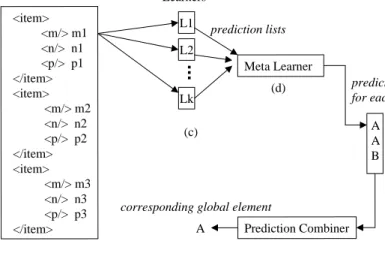
The Classification Phase: Once the learners have been trained, we are ready to perform schema matching on new sources. Suppose we would like to classify schema element mof source Q (Figure 4.a). We begin by extracting a set of house objects from Q. Figure 4.b shows three extracted house objects. Next, we consider each house object in turn. Take the first house object in Figure 4.b. From this house object we extract and send each learner appropriate infor-mation about schema elementm(Figure 4.c). Since learner L1 can only deal with instances, we send it instance m1;
since learner L2 can only deal with names, we send it the namem, and so on.
Each learner will return a prediction list{hA, s1i,hB, s2i}, which says that based on the data of the first house object, it predicts that schema elementm matches A with
confi-dence score s1, and matches B1 with scores2. The higher
the confidence score, the more certain the learner is in its prediction.
A meta learner then combines the predictions of all learners to form a final prediction (Figure 4.d). For example, the meta learner may predictA, which means that based only on data of the first house object, the learners, combined, think thatmmatchesA.
We proceed in a similar manner for subsequent house ob-jects. At the end of this process, we have obtained a predic-tion list formthat contain one prediction per house object (Figure 4.e). A prediction combiner then uses the list to predict a final matching result for elementm. For example, the list shown in Figure 4.e is{A, A, B}. Based on this list, the prediction combiner may decide thatmbest matchesA (Figure 4.f).
The Learners: In principle, any learner that can issue label predictions weighted by confidence score can be used. The current implementation of LSD has four modules: a nearest neighborWhirl learner, a Naive Bayesian learner, a name matcher, and a county-name recognizer.
The Whirl Learner classifies an input instance based on
the labels of its nearest neighbors in the training set [2]. It uses the TF/IDF similarity measure commonly employed in information retrieval. Whirl performs best on schema ele-ments whose values are verbose andtextual, such as house descriptions (free-text paragraphs), orlimitedbutuniquely indicative of the type of the element, such as color (red, green, yellow, etc).
L2 Lk L1 Learners Meta Learner A A B Prediction Combiner A prediction lists (b)
corresponding global element Source schema Q item m p (b) <item> <m/> m1 <n/> n1 <p/> p1 </item> <item> <m/> m2 <n/> n2 <p/> p2 </item> <item> <m/> m3 <n/> n3 <p/> p3 </item> prediction for each object (c)
(d)
(e)
(f) n
Figure 4: The classification phase for LSD.
The Naive Bayesian Learner exploits word frequencies [3], and works best when there are words that are strongly indicative of the correct label, by the virtue of their frequen-cies. For example, it works for house descriptions which fre-quently contain words such as “beautiful” and “fantastic” – words that seldom appear in other elements. It also works well when there are only weakly suggestive words, but many of them. It does not work well for short or numeric fields, such as color, zip code, or number of bathrooms.
The Name Matcher matches schema elements based on the similarity of their names, allowing synonyms. It also uses the TF/IDF similarity measure. This learner works well on unambiguous names (e.g., price or house location), and fails on names that are either ambiguous (e.g.,officeto indicate office phone) or too general (e.g.,item).
The County-Name Recognizer searches a database pulled from the Web to verify if an instance is a county name. This module illustrates how recognizers with a narrow and spe-cific area of expertise can be incorporated into our system.
The Meta Learner: The meta learner combines the pre-dictions of the base-level learners using a machine learning method calledstacking[14, 13]. InLSD, the meta learner is a linear discriminant machine. It uses the training data to learn for each combination of label and base-level learner a weight that indicates the relative importance of that learner for that label. Details of this learning process can be found in [13].
Then given an input instance, for each label the meta learner computes the weighted sum of the confidence scores that the base-level learners give for that label. It assigns the label with the highest weighted sum to the input instance.
The Prediction Combiner: This module uses the fol-lowing simple heuristic to assign label to a source-schema element Q: Let T be the set of instances of Q that have been labeled. Suppose the label associated with the highest
number of instances in T isL1, and the label with the next
highest number of instances is L2. If L1 is the label of at leastp% of instances in T, and|L1−L2| ≥q, wherepandq
are prespecified thresholds, then assign labelL1to Q.
Oth-erwise, report failure to assign label to Q. This heuristic is similar to the heuristic used in [12] for the same purpose.
4.
EXPERIMENTS
We have carried out preliminary experiments to evaluate the feasibility of our approach. We testedLSDon five real-estate sources that list houses for sale. Figure 5 shows the sources and their characteristics. These sources have a broad range of schema elements, from short ones such asnum bathrooms (numeric values) to very long ones such ashouse description (free-text paragraphs). They contain elements of special formats, such as phone number and email, as well as ele-ments whose successful classification requires knowledge be-yond what is available in the schema and data. Finally, they also contain elements that do not have 1-1 matchings in the mediated schema. In short, these five real-estate sources present a challenging test domain for schema-matching al-gorithms.
We started by extracting 300 house objects from each source. Next we performed ten experiments, in each of which we picked three sources for training and two sources for testing. The system is trained on data from the training sources, and tested on data from the remaining sources.
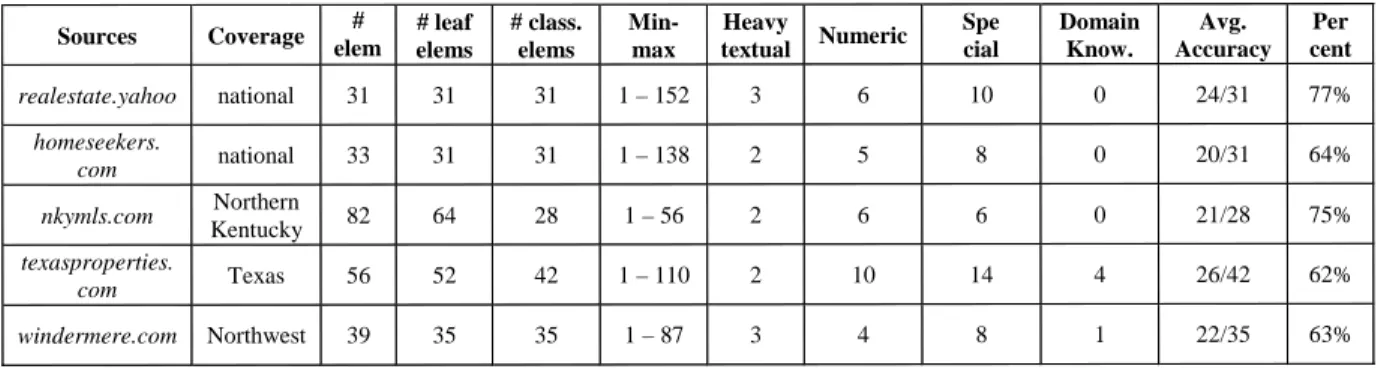
The last two columns of Figure 5 show the average accuracy rate for each source. For example the numbers 24/31 in the first row means that on average the system correctly classified 24 out of 31 classifiable leaf elements of source realestate.yahoo. (An element is classifiable if it has an 1-1 matching in the mediated schema.) This corresponds to a 77% classification accuracy.
The results show thatLSDperformed quite well on the five sources, with accuracies ranging from low 60% to high 70%. It is important to emphasize that 100% accuracy is unlikely to be reached, simply because it is difficult even for humans
Sources Coverage elem# s # leaf elems # class. elems Min-max Heavy textual Numeric Spe cial Domain Know. Avg. Accuracy Per cent realestate.yahoo national 31 31 31 1 – 152 3 6 10 0 24/31 77% homeseekers. com national 33 31 31 1 – 138 2 5 8 0 20/31 64%
nkymls.com KentuckyNorthern 82 64 28 1 – 56 2 6 6 0 21/28 75%
texasproperties.
com Texas 56 52 42 1 – 110 2 10 14 4 26/42 62%
windermere.com Northwest 39 35 35 1 – 87 3 4 8 1 22/35 63%
Figure 5: The characteristics and average classification accuracies of the five real-estate sources: # elems: number of source-schema elements;# leaf elems: number of leaf elements;# class. elems: number of leaf elements that are classifiable, i.e., having matching mediated-schema elements;Min-max:the minimal and maximal length of element instances, measured in words;Heavy textual:number of classifiable elements that are heavily textual;Numeric:number of classifiable elements that are numeric;Special:
number of classifiable elements that have special format (such as phone number);Domain Know.:number of classifiable elements that require domain knowledge to be successfully classified;Avg. Accuracy: number of correctly classified leaf elements/number of classifiable leaf elements;Percent: average accuracy, in terms of percentage.
to reach that accuracy level. So the questions we consider now are (a) how much higher accuracy we can obtain, and (b) how to achieve that degree of accuracy.
To answer these questions, we are currently identifying rea-sons that preventLSDfrom correctly matching the remain-ing 30-40% of the elements, and considerremain-ing extensions to help obtain higher accuracy. A major reason that causes LSDto fail on some elements is unfamiliarity with that el-ement type. For example, LSD could not match element
suburbbecause it has never seen the word “suburb” in the
name of an element before, nor did it recognize the instances of this element to be the names of the suburbs. This prob-lem could be handled by adding more recognizers. LSDalso did not do very well where there are only subtle or sub-jective distinctions, or no clear boundary among elements. For example, it failed to distinguish between lot descrip-tion and house descripdescrip-tion (both free-text paragraphs). A quick fix to this is to concatenate all the instances of an ele-ment together to form a mega docuele-ment, then classify mega documents instead of individual instances. We believe that concatenating instances may amplify the subtle distinction among elements to the extent that the current learners can distinguish them.
5.
RELATED WORK
Work on (partially) automating the schema matching pro-cess can be classified into rule-based and learner-based ap-proaches. Works in the rule-based approach include [10, 11, 1]. The Transcm system [10] performs matching based on thenameand structureof schema elements. Both schemas M and G are represented with tree structures with labeled nodes, a node X in M matches a node Y in G if X la-bel matches Y lala-bel (allowing synonymous lala-bels) and/or certain child nodes of X also match certain child nodes of Y. Therefore, in the case node X of M is a leaf element, Transcm’s work amounts to using only the name matcher to match X. TheArtemissystem [1] uses names, structures, as well as domain types of schema elements to match schemas. In general, existing rule-based systems utilize only informa-tion inherent in theschemas, whereas our approach exploits
both schemas anddata(i.e., values of schema elements), to perform matching.
Works in the learner-based approach include [9, 12]. The
Semint system [9] uses a neural-net learner. The ILA
sys-tem [12] matches schemas based on comparing objects that it knows to be the same in both the source and the medi-ated schema. BothILAandSemintemploy a single type of learner and therefore have limited applicability. For exam-ple,ILAworks only if sources share some objects and these objects can be identified. Object identification cannot be done effectively in the real-estate domain, where many bro-kerage firms go to great length to conceal house identity (by giving only a partial house address) to avoid being left out of the process. Another example is that the neural net of
Semintcannot deal effectively with textual elements.
How-ever, we note that learners that have been studied by works in this approach can be easily incorporated into our system. In fact, in the next version of LSD we intend to add the object-based learner ofILA.
6.
CONCLUSIONS AND FUTURE WORK
We aim to build data integration systems that can explore the Web, find relevant sources, add them to the systems, and automatically learn their descriptions. Towards this end, we have built LSD, a prototype system that uses machine learning to automatically match source schemas with the mediated schema. LSDemploys a diverse range of learners each of which draws knowledge from a different source. As such, LSDcan easily incorporate the previous approaches, and provides a broader range of applicability. We applied LSD to five sources in the real-estate domain. The exper-imental results demonstrate the feasibility and promise of our approach.
In this paper we have focused on finding 1-1 mappings for the leaf elements of source schemas. In the near future we would like to explore a range of learning issues. We plan to continue working on improvingLSD’s classification accu-racy. We want to add more learners to LSD and develop new methods to combine the learners effectively. We are
also interested in learning recognizers with narrow areas of expertise, which can be applied to many domains. We plan to investigate the impact of such recognizers on classification accuracy.
Next, we plan to work on incorporating domain knowledge such as semantic integrity constraints into the learning pro-cess. Real-world domains usually contain considerable amount of nested structure among elements. It is very important that we develop techniques to exploit such structure, so that we can effectively match elements higher up in source-schema trees. Finally, we shall also look at learning match-ings that are more complex than 1-1 matchmatch-ings, and consider extensions to the mediated schema. In particular, mediated-schema elements usually form a natural hierarchy of con-cepts. We would like to investigate how to exploit such hierarchies to improve learning.
7.
ACKNOWLEDGMENTS
This work is supported in part by ARPA/Rome Labs Grant F30602–95–1–0024, NSF grant IRI–9523649, NSF grant IIS-9978567, and a Sloan fellowship.
8.
REFERENCES
[1] S. Castano and V. D. Antonellis. A schema analysis and reconciliation tool environment for heterogeneous databases. InProc. of the Int. Database Engineering and Applications Symposium (IDEAS-99), pages 53–62.
[2] W. W. Cohen and H. Hirsh. Joins that generalize: Text classification using whirl. InProc. of the Fourth Int. Conf. on Knowledge Discovery and Data Mining (KDD-98), 1998.
[3] P. Domingos and M. Pazzani. Beyond independence: Conditions for the optimality of the simple Bayesian classifier. InProceedings of the Thirteenth
International Conference on Machine Learning, pages 105–112, Bari, Italy, 1996. Morgan Kaufmann. [4] H. Garcia-Molina, Y. Papakonstantinou, D. Quass,
A. Rajaraman, Y. Sagiv, J. Ullman, and J. Widom. The TSIMMIS project: Integration of heterogeneous information sources.Journal of Intelligent
Information Systems, 8(2):117–132, 1997.
[5] Z. G. Ives, D. Florescu, M. A. Friedman, A. Y. Levy, and D. S. Weld. An adaptive query execution system for data integration. InProc. of ACM SIGMOD Int. Conf. on Management of Data (SIGMOD), pages 299–310. ACM Press, 1999.
[6] C. Knoblock, S. Minton, J. Ambite, N. Ashish, P. Modi, I. Muslea, A. Philpot, and S. Tejada. Modeling web sources for information integration. In Proc. of the National Conference on Artificial Intelligence (AAAI), 1998.
[7] E. Lambrecht, S. Kambhampati, and
S. Gnanaprakasam. Optimizing recursive information gathering plans. InProceedings of the International Joint Conference on Artificial Intelligence (IJCAI), 1999.
[8] A. Y. Levy, A. Rajaraman, and J. Ordille. Querying heterogeneous information sources using source descriptions. InProc. of the Int. Conf. on Very Large Data Bases (VLDB), pages 251–262, 1996.
[9] W.-S. Li and C. Clifton. Semantic integration in heterogeneous databases using neural networks. In J. B. Bocca, M. Jarke, and C. Zaniolo, editors,Proc. of the 20th Int. Conf. on Very Large Data Bases (VLDB-94), pages 1–12, 1994.
[10] T. Milo and S. Zohar. Using schema matching to simplify heterogeneous data translation. InProc. of the 24th Int. Conf. on Very Large Data Bases (VLDB-98), pages 122–133, 24–27 Aug. 1998.
[11] L. Palopoli, D. Sacca, and D. Ursino. Semi-automatic, semantic discovery of properties from database schemes. InProc. of the Int. Database Engineering and Applications Symposium (IDEAS-98), pages 244–253. [12] M. Perkowitz and O. Etzioni. Category translation:
Learning to understand information on the Internet. InProc. of IJCAI-95, pages 930–936, 1995.
[13] K. M. Ting and I. H. Witten. Issues in stacked generalization. Journal of Artificial Intelligence Research, 10:271–289, 1999.
[14] D. Wolpert. Stacked generalization. Neural Networks, 5:241–259, 1992.