Focus on Faculty Development
IMPROVING INSTRUCTIONAL QUALITY
Focus on Faculty Development
December 2011
Printed on recycled paper ISBN 978-92-9092-519-4 Publication Stock No. RPS124228 Cataloging-In-Publication Data Asian Development Bank
Improving instructional quality: focus on faculty development. Mandaluyong City, Philippines: Asian Development Bank, 2011. 1. Higher education. I. Asian Development Bank.
The views expressed in this publication are those of the authors and do not necessarily reflect the views and policies of the Asian Development Bank (ADB), its Board of Governors, or the governments they represent.
ADB does not guarantee the accuracy of the data included in this publication and accepts no responsibility for any consequence of their use.
By making any designation of or reference to a particular territory or geographic area, or by using the term “country” in this document, ADB does not intend to make any judgments as to the legal or other status of any territory or area. ADB encourages printing or copying information exclusively for personal and noncommercial use with proper acknowledgment of ADB. Users are restricted from reselling, redistributing, or creating derivative works for commercial purposes without the express, written consent of ADB.
Note:
In this report, “$” refers to US dollars. Asian Development Bank
6 ADB Avenue, Mandaluyong City 1550 Metro Manila, Philippines Tel +63 2 632 4444
Fax +63 2 636 2444 www.adb.org
For orders, please contact: Department of External Relations Fax +63 2 636 2648
iii
Abbreviations iv Foreword v Preface vi Introduction 1 External Context 5Growing Concerns about Quality and Accountability 5
Shift toward Privatization 6
Increased Interinstitutional and Cross-National Competition 8 Implications: Relationship of External Context to Internal Efficiency 9 Components that Contribute to Internal Efficiency of Higher Education Institutions in Asia 10 Mission 11
Human and Physical Resources/Inputs 11
The Work of the University 16
Employment Systems 25
Institutional Culture 28
Summary: Internal Efficiency in Higher Education 30
Recommendations 31
Recommendation 1: Improve instructional quality by enhancing the capacity
of academic staff 31
Recommendation 2: Continue to focus and differentiate institutional missions within coordinated systems of higher education, and balance resource allocations
to support those goals 32
Recommendation 3: Develop university-based research efforts consistent with
individual institutional missions 32
Recommendation 4: Improve faculty incentive and evaluation systems 33 Recommendation 5: Strengthen the quality of private higher education 34
References 35
Higher Education in Dynamic Asia: Study Reports 39
iv
ADB Asian Development Bank HEI higher education institution
ICT information and communications technology Lao PDR Lao People’s Democratic Republic
PRC People’s Republic of China
THES Times Higher Education Supplement
UIS UNESCO Institute for Statistics
v
Quality education is essential for creating a sustainable human resource base upon which to build a country’s development. Asia is experiencing a growing need for skilled managers and professionals in a variety of fields. Investing in higher education will help developing Asian countries build high-income economies, with the innovation, knowledge, and technology needed to thrive in an interconnected, competitive world.
ADB has accumulated significant experience in providing support for improving education systems in its developing member countries. In response to the growing needs of these countries, ADB is boosting its support for higher education. The changing landscape of higher education requires new thinking and updated practices. Questions central to the issue include: What are the strategic and operational priorities for higher education in the region? How should support be targeted to achieve a high, sustainable impact? How can ADB best assist its developing member countries to substantially raise the quality of and expand access to higher education within a reasonable, yet ambitious, timeframe?
To provide insights into the kinds of changes demanded in higher education, ADB financed a major regional study drawing on the views of subject experts, higher education leaders, regional stakeholders, and participants of an international conference on higher education in Asia. Higher Education in Dynamic Asia is the result of this study. I am confident that it will provide valuable input into the process of higher education reform across Asia. It will also provide critical input into ADB‘s work in assisting the region to develop the full potential of its people.
Bindu N. Lohani
Vice-President (Knowledge Management and Sustainable Development) Asian Development Bank
vi
In many countries in developing Asia, higher education is rapidly expanding, a development that promises economic and social benefits for the countries involved. The challenge remains to increase the number of well-educated higher education graduates with the abilities and skills needed for employment; for citizenship; and for productive, relevant research—without a significant increase in the funding available for higher education. Improving the internal efficiency of HEIs will require the continuing commitment and efforts of government leaders, institutional leaders, and academic staff. Quick interventions are unlikely to have much impact, since HEIs are complex and often resistant to change. A wiser approach, likely to have more impact, will view HEIs as systems in which substantive, long-lasting change requires using multiple strategic approaches.
Using a systems approach, this volume begins with an examination of the external context affecting HEIs in Asia. The analysis then turns to a consideration of key elements of HEIs in Asia as complex organizations: the human and physical resources, including the academic staff who carry out the work of HEIs; key characteristics of the work of teaching, research, and service; the employment systems in higher education, including opportunities for professional development, evaluation processes, and incentive systems; and elements of institutional culture, including norms and values pertaining to autonomy and academic freedom, integrity, and collegiality.
Specific priorities for strengthening the internal efficiency of HEIs are identified, along with the rationale for their importance and recommendations for institutional actions. Recommendations also are made on how the Asian Development Bank and possibly other development partners can target their project support to help HEIs improve their internal efficiency. Recommendations underline the importance of improving instructional quality by enhancing the capacity of academic staff; continuing to focus and differentiate institutional missions within coordinated systems of higher education, and to balance resource allocations to support these goals; developing university-based research efforts consistent with specific institutional missions; and improving faculty incentive and evaluation systems. The recommendations would benefit private HEIs as well as public ones. In addition, to improve the internal efficiency of private HEIs in particular, specific recommendations are made for cultivating cross-institutional collaborative linkages of such HEIs.
PREFACE
vii
This publication, Improving Instructional Quality: Focus on Faculty Development, is one of the study reports emanating from the regional technical assistance on Higher Education in Dynamic Asia. It draws on material prepared by Ann E. Austin. Imelda Marquez provided administrative support, Stephen J. Banta provided editorial advice and inputs, and Dorothy Geronimo coordinated typesetting and publication. Many thanks to all for their contributions.
Jouko Sarvi
Practice Leader (Education Sector)
Regional and Sustainable Development Department Asian Development Bank
1
Introduction
H
igher education institutions (HEIs) are critically important to the well-being of the countries in which they are situated. In most nations in Asia, higher education is rapidly expanding, a development that promises economic and social benefits. At the same time, expansion is accompanied by challenges and issues that require innovative thinking and policy decisions, dedication from the academic staff and institutional leaders who carry out the work of the HEIs, and thoughtful wrestling with vexing challenges that have no easy solutions. This publication focuses on the internal efficiency of HEIs in Asia, examining their work; the efficiency and effectiveness of that work; and the problems, dilemmas, and barriers they are facing in fulfilling their missions. It also offers recommendations for ways in which governments and HEIs themselves can improve internal efficiency, as well as suggestions for the role that development agencies, such as the Asian Development Bank (ADB), might take in supporting such efforts.HEIs in Asia are situated in a dynamic environment in which they face an array of expectations. They must meet these expectations while holding costs down and keeping quality high. These expectations include
• offering support for the learning needs of a diverse student body as access to higher education expands;
• providing good teaching and offering up-to-date curricula that prepare graduates for the current labor market as well as for evolving workplace and societal needs;
• producing research that leads to innovation and economic growth in an international, competitive world market; and
• preparing citizens to understand their roles as leaders, citizens, and family members in diverse local and global societies.
Internal educational efficiency concerns both quality and cost-effectiveness. Internally efficient educational institutions optimally allocate and use available resources to improve the quality of education and increase the products of the educational process. Efficiency is greatest when the inputs to an educational organization maximize the outputs produced. Inputs relevant to internal efficiency include human and physical resources, such as facilities and equipment, while outputs refer to student learning outcomes and achievement (Hanushek 2001, Haddad and Jurich 2002, Tsang 2002). Qualitative internal inefficiencies may be lowered by such issues as weak preparation and teaching effectiveness of instructional staff, inappropriate or outdated curricula, inadequate availability of instructional materials and resources, and employment systems in which expectations and rewards are out of alignment. Quantitative internal inefficiency may be evident in low student completion rates, low student/instructor ratios, and low evidence of student achievement of intended learning outcomes.
The central argument of this publication is that the internal efficiency of HEIs in Asia is not sufficiently robust to enable nations’ goals to be fully met. In recent years, access has widened, resulting in significant enrollment growth. However, emphasis on access (maximizing the student flow) to higher education is not enough to ensure internal efficiency and the production of desired outcomes. The challenge remains to increase the quality and quantity of the products of higher education—well-educated graduates and productive, relevant research—without an infusion of higher levels of funding. In response to this challenge, a key priority for governments and HEIs should be enhancing instructional quality by improving the capacity of instructional staff. HEIs must not only provide wide access; they must offer those admitted a high-quality learning environment and produce graduates with the abilities and skills needed for employment and citizenship.
This publication also highlights four other priorities that will enhance internal efficiencies: • focusing and differentiating institutional missions within coordinated systems of higher
education, and balancing resource allocations to support those goals;
• strengthening university-based research efforts consistent with institutional missions; • improving faculty incentive and evaluation systems; and
• strengthening the quality of private higher education.
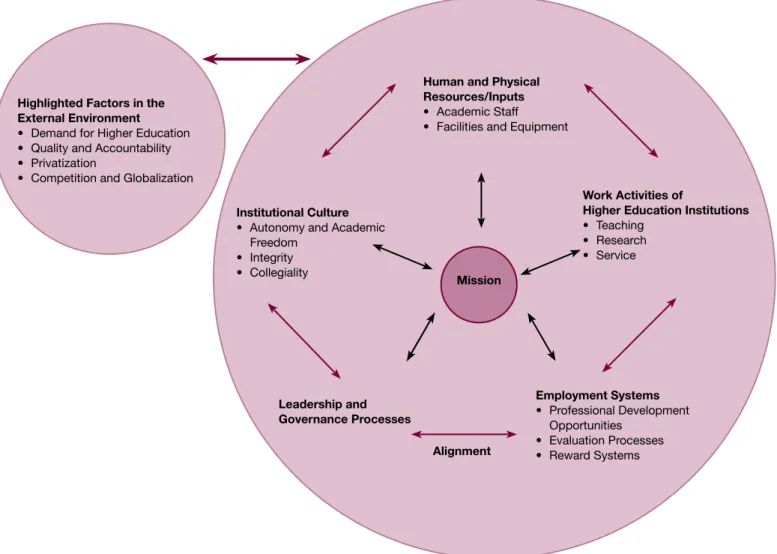
This publication takes a systems approach to analyzing HEIs as complex organizations, comprised of various subsystems, processes, and components (Weick 1976, Birnbaum 1988, Cohen and March 1991). As highlighted in Figure 1,1 the components of the organization addressed include (a) human and physical resources (inputs), including academic staff and facilities and equipment; (b) work activities of the institution, including the nature and process of carrying out teaching, research, and service; (c) employment systems, including opportunities for professional development, evaluation processes, and incentive and reward systems; and (d) institutional culture, including norms and values pertaining to autonomy and academic freedom, integrity, and collegiality. Leadership and governance processes, including administrative processes and internal institutional governance processes, also constitute a component of the organizational system; however, this component is discussed in depth in another publication. Figure 1 also shows how HEIs are situated within external contexts with factors that affect their internal efficiency and that impact the ways in which institutional outputs are valued and assessed. While acknowledging that the external environment includes a number of factors relevant to higher education (as discussed in another publication), this volume highlights four specific factors in the external environment with particular implications for internal efficiency: (a) demand for higher education, (b) quality and accountability, (c) privatization, and (d) competition and globalization.
As a prelude to discussing the internal efficiency of HEIs in Asia, one important caveat is in order. While the countries of Asia have distinct and noteworthy histories, cultures, and recent current events, this publication does not include an in-depth study of any country. The overall 1 This approach is informed by and adapted from Austin (1998a, 1998b), who discussed a conceptual framework for
organizational change; the multiframe model of organizational analysis of Bolman and Deal (1991), which highlights four frames (structural, human resources, political, and symbolic) as “lenses” through which to understand organi-zational issues; and the work of Eckel et al. (2001) and Kezar (2001), which explains various models for understand-ing organizational processes.
INTRODUCTION
3
purpose of these publications is to examine key trends and issues with relevance to many of the countries in the region. The specific target countries for this analysis are Cambodia, Indonesia, Lao People’s Democratic Republic (Lao PDR), Malaysia, Philippines, Sri Lanka, Thailand, and Viet Nam. At times in the analysis, it is useful to group some countries. Cambodia, Lao PDR, and Viet Nam are postconflict countries engaged in developing their HEIs within contexts of strong central government control. Indonesia, Malaysia, Philippines, Thailand, and, to some extent, Sri Lanka have more developed HEIs, with some degree of autonomy, and are positioned to have more presence at the current time in the international higher education landscape. The People’s Republic of China (PRC) and India, large countries engaged in huge expansion of their higher education systems, are mentioned from time to time for purposes of comparison but fall beyond the primary focus of this study. Many of the smaller countries in the region also have not been examined in depth for this publication.
Figure 1 Overview of Components of Internal Efficiency in Higher Education Institutions
Highlighted Factors in the External Environment
• Demand for Higher Education • Quality and Accountability • Privatization
• Competition and Globalization
Human and Physical Resources/Inputs
• Academic Staff • Facilities and Equipment
Institutional Culture
• Autonomy and Academic Freedom
• Integrity • Collegiality
Work Activities of
Higher Education Institutions
• Teaching • Research • Service Leadership and Governance Processes Employment Systems • Professional Development Opportunities • Evaluation Processes • Reward Systems Alignment Mission
The publication is organized in three parts:
• a brief discussion of three key trends in the external context relevant to internal efficiency (more extensive analysis of the external environment is provided in another publication), • analysis of key subsystems and components of HEIs and their relevance in regard to
internal efficiency, and
5
External Context
H
EIs function within a broad national and global context. The external environment affects the resources (inputs) available to the institution, the employment systems of the institution, and the culture within which the work is done. The external environment also frames the expectations for the outcomes or products of the university’s work—the kind of graduates a university should produce, the kind of research it should do, and the kind of roles it should play in society. One key development in the external context is the increasing demand for higher education as the economies of Asian nations grow and the numbers of young people increase. This publication argues that access and expansion must be coupled with attention to instructional quality in order to ensure that those who enter HEIs actually reach the educational outcome levels that such access is intended to achieve. In fact, some countries may need to reduce the pace of expanding access for a period of time in order to ensure that educational quality catches up with wider opportunity.In addition to the growing demand for higher education, three other trends in the external context merit specific attention in this publication, as each relates directly to internal efficiency: • growing concerns about quality and accountability,
• the shift toward privatization, and
• increased interinstitutional and cross-national competition coupled with the push for world-class universities.
Growing Concerns about Quality and Accountability
Accompanying the expansion of access to higher education are voices of concern about the quality of the learning experience that students encounter once they enter HEIs. Unemployment rates invite questions about internal efficiency and particularly about the quality of preparation students receive for the workplace. Examples are available from many countries throughout Asia. Countries such as PRC, Indonesia, and Thailand can claim that more than one-fifth of employees hold tertiary level degrees (World Bank Blog 2010). Nevertheless, employers lament that prospective employees do not have the attitudes and skills needed in a global economy. One estimate suggests that only about 10% of the 1.6 million engineers in the PRC have the qualifications appropriate for work in multinational companies (Hvistendahl 2009). In Sri Lanka, many graduates, particularly those from distance education and university external degree programs and those with arts and management degrees, cannot find jobs in the private sector. Reasons include insufficient English language and information technology skills and the inability to adapt well to work environments. Graduates end up working in public “make-work schemes,” unable to find jobs in the private sector (World Bank 2009). Similar reports about
higher education in Cambodia emphasize that rapid expansion has been coupled with a lack of quality control so that graduates do not have the skills needed in the workplace (Chealy 2006). While firm figures are elusive, estimates suggest that up to 90% of graduates from private institutions in Cambodia are unemployed 1 year after graduation or take jobs outside their fields; the comparable figure for graduates from public institutions is only 3% (Ford 2006). A way to summarize this problem is “not enough skilled workers, high rates of graduate unemployment, frustration all around despite high rates of economic growth” (World Bank Blog 2010). One hypothesis is that unemployment rates may be due to the low quality of tertiary education and insufficiently relevant curricula. Another is that graduates may have unrealistic expectations about labor market opportunities. Both may be true.
In response to these concerns, most countries have or are developing formal mechanisms to assess quality. Strategies include encouraging internal institutional programs to monitor and assess quality, and developing national standards; expected outcomes; and systems of assessment, measurement, and accreditation. A number of countries are developing national qualifications frameworks and are wrestling with strategies to honor diversity while upholding recognized standards of quality (UNESCO 2008). For example, in Cambodia in 2003, a royal decree established the Accreditation Committee of Cambodia. Despite some early problems, it has made progress, including defining minimum standards for all HEIs, mandating that all HEIs must be accredited to confer degrees, and recruiting external assessors (Chealy 2006, Ford 2006). In Malaysia in 2007, an act of Parliament established the Malaysian Qualifications Agency to serve as a national regulatory body and to provide accreditation, based on international standards, for certificates, diplomas, and degrees awarded by private universities (UNESCO 2008).
Shift toward Privatization
As demand for higher education increases, privatization is seen as a practical way to handle larger enrollments. In many institutions, public funding is not keeping pace with increasing enrollments (Rizvi et al. 2005). Several strategies are used in response. Many universities, even those that are public, now charge full or partial tuition recovery costs. Additional ways in which universities raise extra funds are by conducting research for industry, publishing textbooks and study guides, selling the professional services of academic staff, and levying special fees (Bray and Thomas 1998, cited in Welch 2007). Additionally, an emerging trend is the blurring between public and private HEIs as public institutions are urged to find more private sources to supplement their support from the government (UNESCO 2008: 3). The most noteworthy form of privatization, however, is the establishment of private HEIs.
Statistics from several countries provide examples of the shift toward privatization. Indonesia and Philippines (as well as India) now have more than 50% of their higher education enrollment in private institutions (UNESCO Institute for Statistics [UIS] Education Database [May, 2005], cited in Kapur and Crowley 2008). In Indonesia in 1975, private institutions numbered less than 400; by 1995, there were 1200, and by 2007, approximately 1800 (Indonesian Statistics 2002, cited in Welch 2007). Lao PDR, Malaysia, and Mongolia have 25%−50% of their students attending private institutions (UIS Education Database [May, 2005], cited in Kapur and Crowley 2008). In Malaysia, there were no private universities in 1995, while in 2008 there were almost
ExTERNAL CONTExT
7
600 (UNESCO 2008:2). Twinning arrangements with international HEIs (discussed in depth in another publication) are often part of the private sector arrangements in Malaysia. In Cambodia, the presence of private sector HEIs is quite new, but growth has been rapid and uncontrolled. By 2004, 83% of the total higher education enrollment was in private and fee-paying institutions, including both nonprofit and for-profit (Sloper 2004, cited in Chealy 2006). Some countries are still early to this trend. Private higher education is quite new in Sri Lanka, with most private institutions having fewer than 1000 students (World Bank 2009), and Viet Nam has little private higher education (UIS Education Database [May, 2005], cited in Kapur and Crowley 2008). Explanations for this increase in private higher education include claims that it can provide greater efficiency, more accountability, and opportunities for students to have more access and choice. Supporters assert that private higher education can be more responsive to market demands and, thus, can lower graduate unemployment rates; and that it increases competition and, thus, quality. An additional assertion is that private HEIs reduce the financial burden on governments for providing higher education (Wilkinson and Yussof 2005). Supporters of privatization in higher education see it “as a practical solution to the problems of increased demand” (Rizvi et al. 2005:29). These claims, however, are met with strong concerns and counterarguments.
The greatest concern—and one that is very relevant to this publication—pertains to quality. Asia has the majority of private HEIs in the world—but the private sector is lowest in the prestige order among academic institutions in the world. In most cases, the private sector provides access at the expense of quality (Altbach 2010). Some characterize private HEIs as “at best teaching shops” (Kapur and Crowley 2008:18). As discussed later in regard to faculty issues, many of the academic positions in private HEIs are not full-time. Overall, academic staff are less well credentialed than their counterparts in public education, and they are typically not concerned with knowledge creation. Furthermore, many private institutions are situated outside major living areas, perhaps one reason that they tend to be less well regulated than public universities. One result of less regulation is that they often have inadequate facilities, laboratories, and libraries (Welch 2007).
A second concern is that the private institutions undermine equity even as access expands. There are concerns that in some cases “poor students are seen to have access only to poor quality private higher education” (UNESCO 2008:6). Furthermore, private institutions, particularly those that are respected, often have high fees. In Indonesia, for example, the per capita income in poorer regions, where private institutions tend to be located, is about one-tenth of the per capita income in Jakarta. Whereas at public HEIs fees range from about $100 to $400, at private institutions the fees range from $100 to $1000 (and fees are only 15%−20% of the total costs) (World Bank 1996:3, cited in Welch 2007).
A third concern is that, with their orientation to the labor market, private institutions emphasize private benefits from higher education rather than the social benefits that could accrue from research productivity and attention to broad learning outcomes (Wilkinson and Yussof 2005). In short, critics note, privatization emphasizes knowledge as a marketable commodity rather than a social good (Lee 2003). However, the apparent attention to market demands does not necessarily result in high employment rates for graduates, due to skepticism about the quality of their credentials.
Overall, the growth of the private sector in higher education is a major development in response to demands for expansion of higher education. But while the impact and benefits of private HEIs vary by national context, there is widespread concern about the quality, efficiency, and effectiveness of the private sector.
Increased Interinstitutional and Cross-National Competition
At the same time that the rapid expansion of higher education and the trend toward privatization have raised concerns about quality, countries are experiencing heightened competition within the higher education sector. This competition can impact institutional quality and international efficiency in several ways.
Within a country, institutions compete for funding, qualified students, and physical resources. While competition might be expected to lead universities to focus on improving their internal efficiency, it can sometimes undermine quality. In Cambodia, for example, the considerable competition among private institutions is leading to the lowering of fees. This trend toward reduced revenue, coupled with inattention to applying regulations that would support quality, results in weak institutions, expressed in high unemployment of graduates (Ford 2006).
In the international context, countries race to create world-class universities to engage in cutting-edge research that contributes to economic growth, innovation, and international leadership. Garnering prestige in the international knowledge economy is a motivating factor. International rankings of universities report the results of the ongoing institutional competition for international recognition. The rankings published annually by the Times Higher Education Supplement (THES) and the Shanghai Jiao Tong University are followed closely. The stakes are high. For example, when the September 2005 posting of the THES rankings revealed that the top two Malaysian universities had fallen about 100 places, due to changes in the calculation system, the repercussions included a call for a royal commission to explore what had happened. Additionally, the Vice Chancellor of the University of Malaysia resigned (Salmi 2009).
Developing world-class universities is a formidable challenge. Altbach has summarized the situation: “everyone wants one, no one knows what it is, and no one knows how to get one” (Altbach 2004a, cited in Salmi 2009:4). Research on these elite institutions, however, highlights some essential ingredients. They need a critical mass of highly capable faculty members and students; top-notch facilities and resources that support high-level research; a range of disciplinary strengths; competitive remuneration for faculty; an environment that values meritocratic advancement, collaboration, and academic freedom; and government support for innovation and institutional autonomy (Salmi 2009, Altbach 2010, Levin 2010b).
Whether national resources are best directed toward the creation of world-class universities is a debatable question. While some countries can probably succeed in this goal if they focus their resources on specific institutions, it is not necessary for every institution to strive to be “class” (Levin 2010b). In his thorough analysis of the trend and aspirations toward world-class institutions, Salmi (2009) argues that a wiser strategy for some countries may be to focus the talents and resources in HEIs on local communities and their needs. In fact, he suggests, creating HEIs whose quality outpaces the level of opportunities open to graduates within the country may intensify the process of brain-drain to other countries.
ExTERNAL CONTExT
9
Certainly not all HEIs can be “world-class.” However, the press for status and ranking is part of the external environment affecting each institution’s internal efficiency. Some institutions may make decisions based on aspirations for higher status and ranking; others may struggle for resources to meet their missions in national contexts, whereas other institutions are targeted for special support.
Implications: Relationship of External Context to Internal Efficiency
The work internal to a university never occurs in a vacuum. The external environment creates expectations and conditions in which the institutional work occurs. Three trends in the external environment are particularly relevant to analysis of the internal efficiency of HEIs in Asia and identification of strategies to strengthen them: First, the dramatic increase in enrollment in recent years across Asia has created a situation wherein the quality of the learning experience does not match the promise associated with enrollment. Universities and their academic staff face large numbers of students with diverse learning needs. Employers are unconvinced of the quality of graduates’ qualifications. The time has come to improve instructional quality to match the successes of efforts to expand access. Second, the shift toward privatization is creating a large set of institutions where quality is compromised by low faculty credentials and commitment. These institutions must improve if they are to optimize their contributions to national education goals. Third, the competition among institutions is leading to cost-cutting strategies that can ultimately undermine educational quality and internal efficiency. Furthermore, international competition encourages countries to allocate substantial resources to a few institutions designated as research pillars, often at the expense of less prestigious institutions that carry the bulk of the teaching mission. As a set, these three trends in the external environment, as they affect HEIs, make analysis of internal efficiency both timely and important.
10
T
his chapter analyzes the internal efficiency of HEIs in Asia, guided by the conceptual framework presented in Figure 1. Each component of the framework is analyzed in regard to trends, themes, and concerns. Following the analysis of each component in the framework is a summary of implications for internal efficiency. (While leadership and governance processes constitute a key component in the framework presented in Figure 1, this component is discussed in another publication.)The information and analysis in this chapter are based on a review of the relevant literature as well as the discussion and analysis that occurred in a major regional workshop sponsored by ADB on the topic of “Faculty Development in Dynamic Asia.” That workshop, organized as part of the regional technical assistance on Higher Education in Dynamic Asia and held in June 2010, convened higher education leaders and academic staff from Cambodia, Lao PDR, Malaysia, Philippines, Sri Lanka, Thailand, and Viet Nam. Key issues raised in the workshop parallel the major themes in the literature on higher education in Asia (see Table 1). Specific points, examples, and conclusions that emerged in the workshop are indicated in various places throughout this analysis.
Table 1 Issues, Tensions, and Challenges of Concern regarding Faculty as a Key Resource
Topics of Concern
Primary
Recruiting and Retaining Highly Qualified Academic Staff Relationship of Teaching and Research
Opportunities for Professional Development Evaluation Processes
Additional
Quality of Facilities
Impact of Market Issues on Higher Education Academic Freedom
National Higher Education Policies Quality of Students
Note: The issues were identified and prioritized by higher education leaders and academic staff at a major workshop held at the Asian Development Bank in June 2010.
to Internal Efficiency of Higher
Education Institutions
COMPONENTS THAT CONTRIBUTE TO INTERNAL EFFICIENCY OF HIGHER EDUCATION INSTITUTIONS
11
In places throughout this chapter, countries are grouped to indicate similar circumstances. For example, Cambodia, Lao PDR, and Viet Nam are characterized by more central government control of higher education than the other countries, and, thus, issues concerning faculty autonomy are similar across these countries. On other issues, themes or trends play out across all the countries in similar ways, or groupings fall out differently.
Mission
At the center of the diagram depicting key system components in higher education organizations is institutional mission (see Figure 1). An efficient and effective HEI has a clear mission that is supported by the system components. Without a clear mission, an organization’s efficiency and effectiveness are compromised. A significant problem confronting HEIs in Asia is the array of conflicting expectations they face. These include pressures to provide higher education for more students and more diverse students, to prepare students for employment in both local and international labor markets, to develop internationally competitive research programs, to contribute to local and national economic development, to do more with fewer resources, to attract new sources of revenue, and to increase quality overall (Chapman 2009). In the face of such potentially conflicting pressures, effective institutions need to clarify their mission and priorities, and align the organizational subsystems and components so that all efforts work together to advance the mission.
Human and Physical Resources/Inputs
The resources of an HEI are its faculty, facilities, equipment, and working environment.
Academic Staff
The academic staff members of an HEI are its greatest resource. They carry out the mission of the institution and largely determine its quality. HEIs need academic staff with solid content knowledge; effective teaching and communication skills; and, if knowledge creation is part of the mission, some level of research competence. Yet, the rapid expansion of higher education in Asia has resulted in a great shortage of qualified academics, a development that seriously threatens quality.
Need for Pedagogical Expertise
The expansion of access to higher education has increased the need for talented and committed faculty members. Meeting the needs of a wide diversity of students with various learning styles requires faculty members with expertise in using an array of teaching skills. For example, with less-prepared students pursuing higher education, teachers must know how to handle students’ remedial needs. In a recent ADB-sponsored regional workshop concerning faculty work in higher education, participants expressed particular concern about the challenges of teaching unmotivated students. They lamented that students do not strive to meet academic expectations, neglect to read and to prepare for class, and follow a culture of passivity that apparently had been acceptable in their primary and secondary education (ADB 2010). In this context, teachers must understand what factors motivate learning and how to apply those motivators within their classrooms. Adults are particularly attracted to the open universities that educate large numbers of students as well as to the external degree programs offered
at many institutions. Adult students often have different approaches to learning than younger students, as well as many demands in their lives, including families and work, calling for their attention. Academic staff who teach adult students should be expert in using effective strategies particularly appropriate for the circumstances and learning needs of this population. Furthermore, teaching with technology or through distance learning requires creative teaching strategies that capture the interest of students across time and space. Viewed as an input into higher education, academic staff need to have the pedagogical expertise to support the learning needs of many different students.
Quality Concerns
Although the need is great for academic staff with excellent teaching skills, the academic profession in Asia varies with regard to faculty members’ qualifications. While there are a small number of well-qualified professors, often holding doctoral degrees from foreign universities, the great majority of academic staff have very modest credentials (Altbach 2003). Many are young, particularly those in the private institutions, and come to their academic work with little hands-on work experience. Many have little preparation as teachers. The inability of some to communicate in English is another concern, especially when countries are striving to prepare graduates to work effectively within internationally oriented workplaces.
Many faculty members hold only a bachelor’s degree. Those without advanced degrees have not had the opportunity to develop deep-level subject matter expertise or to be exposed to new developments in their fields, shortcomings likely to diminish the quality of their teaching. Furthermore, without specialized knowledge in their fields, as well as the research training that is part of advanced education, they are unprepared to engage in research.
Examples
• In Indonesia in the mid-1990s, within public HEIs, only 30% of the academic staff had degrees higher than the bachelor’s, while the comparable figure in private in-stitutions was 11% (World Bank 1996, cited in Welch 2007). In 1997, only 8.6% of academics in public institutions held doctorates, with a lower figure in private institutions (Buchori and Malik 2004).
• In Sri Lanka in 2009, 40% of academic staff held a doctorate, but the variation across institutions was considerable; in the newer institutions the figure was less than 30% (World Bank 2009).
• Malaysia requires that public university academic staff members have master’s degrees and has formulated a “medium-term” goal to raise to 75% the number of lecturers who have doctorates (World Bank 2009).
Recruitment, Retention, and Salary Issues
The lack of quality among academic staff is coupled with the difficulty of recruiting staff. While some status is associated with an academic position, salaries are typically not competitive, particularly in comparison with those in private firms and industry (Lee 2003). Academic staff members in Asia are generally part of the civil service system, which restricts salaries to specific scales that cannot compete with other sectors; furthermore, real income for civil servants can fall precipitously when inflation occurs. While academic staff members in Asia often receive compensation and benefits beyond salary, such as housing supplements, medical support,
COMPONENTS THAT CONTRIBUTE TO INTERNAL EFFICIENCY OF HIGHER EDUCATION INSTITUTIONS
13
and car loans, these incentives do not make up for noncompetitive salaries (Lee 2003). When salaries are low in comparison with remuneration in other professional settings, recruitment into the academic profession is difficult. Other opportunities are more attractive.
Examples
• In the Lao PDR, the salaries of university faculty, despite their greater qualifications, are only somewhat more than those of primary school teachers and slightly more than those of upper secondary teachers. Since they are members of the civil ser-vice, the government cannot adjust their salaries in the face of significant inflation such as occurred in 1998 (Chapman 2002).
• In Thailand, the move toward autonomous universities means that new faculty members are hired as “university personnel” rather than as civil servants, as was the earlier practice. While salary scales are designed to retain attractiveness, those hired recently into the university personnel system lament the greater benefits (such as lifetime health benefits) perceived to be associated with civil servant status (ADB 2010).
• In the Philippines, not only is initial recruitment into faculty work difficult; retaining staff is a related challenge. Many lecturers in mathematics, science, special educa-tion, English, and early childhood education are moving to the United States (US) to work in special education and basic education (ADB 2010).
• In Malaysia, departure from academic positions has risen. In 1990, attrition from the faculty ranks at Universiti Sains Malaysia was 7%, and in 2000, 27% (Lee 2003).
Given the challenges of finding and retaining qualified faculty, what options can institutions pursue? Three routes are typical: hiring their own graduates, seeking faculty members from overseas, and “borrowing” or hiring part-time academic staff. When an HEI hires its own graduates, the staff person knows the culture, expectations, and priorities. However, “in-breeding,” as this practice is called, carries liabilities. The practice limits the new ideas and creativity that often come into an institution with faculty members whose preparation and experience occurred elsewhere. In some countries, where norms of deference to seniors are deeply engrained in the culture, junior academics who studied under the senior staff are likely to hesitate to introduce alternative perspectives or to pursue new avenues of work (Lai and Lo 2007). While hiring from within may make easier the initial transition of a new staff person, the disadvantages have led many well-regarded and long-established universities in other parts of the world to develop informal norms that preclude hiring a graduate until he or she has developed a respected career at another institution.
Academics who have international credentials (especially from Europe, United Kingdom, or US) bring prestige and fresh ideas to a university. Thus, some universities seek expatriates, if they can afford them. While the “brain drain” to other countries has been a concern in Asia, many scholars who have studied overseas now find ways to stay connected with their home countries. Some choose to return permanently to help strengthen higher education at home; others remain abroad but serve as consultants, advisors, or visiting faculty members for short-term periods (Altbach 2003). These academics with international degrees often assume
the role of the “power elite” (Altbach 2003:7); they are respected and knowledgeable about both their own countries and higher education norms and practice overseas. However, while they bring new ideas as well as prestige to an institution, they also may be more oriented to research than teaching (a preference that may not align with actual faculty responsibilities). They also may be perceived as arrogant by colleagues who have not had international experience. Another problem is that expatriate faculty members hired on term appointments may express minimal institutional commitment. They may see their greater priorities as the enrichment of their own credentials in order to be competitive for other appointments elsewhere (Selvaratnam 1994, cited in Lee 2003).
The third source available for institutions seeking academic staff is hiring part-time faculty members or “borrowing” staff members who already hold positions at other institutions. This is a widespread practice in Asia that seriously undermines quality. The next section discusses the prevalence of outside employment for academic staff, which meets a need for institutions trying to fill empty positions while also addressing the interests of poorly remunerated academics seeking ways to enhance their incomes. However, while such an arrangement meets short-term individual and institutional needs, it also significantly undercuts the quality of academic work (teaching, research, institutional citizenship) both at the primary employing institution and at the institution making the part-time appointment. This problem of hiring part-time faculty is especially keen among private HEIs.
Outside Employment
Even when individuals are recruited to work in HEIs, their focus is often not solely on their primary place of employment. In response to inadequate compensation, many academic staff find employment elsewhere. Those working in public universities commonly moonlight at other institutions, often at the private HEIs.
Examples
• In Indonesia, “well over half” of public sector academic staff had second jobs teaching or in management at other HEIs, or took other outside employment (World Bank 1996:5, cited in Welch 2007:674).
• An arrangement at the National University of Lao PDR provides an interesting example of the way in which faculty work is combined with outside employment, in this case with the acknowledgement and agreement of the university (Chap-man 2002). Facing serious budget constraints that imperil the university’s ability to provide competitive compensation to its academic staff, National University allows faculty to consult or run private businesses out of the university. One form of this arrangement is that faculty members run private instructional programs in the evening in high-demand fields such as English language, for which they charge high tuition. Income from such activities is substantial and helps retain the instruc-tional staff. However, in doing this kind of “extracurricular work” and other forms of consulting, academic staff are less available for advising students who attend the university’s day programs, preparing for teaching their university courses, doing research, or participating in other aspects of university work.
Inadequate compensation in Asian universities is creating a trade-off with immense implications for institutional quality. The compensation for academic work is insufficient and noncompetitive
COMPONENTS THAT CONTRIBUTE TO INTERNAL EFFICIENCY OF HIGHER EDUCATION INSTITUTIONS
15
in most countries unless universities allow academic staff to take on outside employment. Yet the arrangement results in little time for faculty interaction with students, in short office hours, and in constrained time and attention for teaching preparation and other academic responsibilities.
Academic Staff at Private Universities
Problems of faculty shortages, insufficient qualifications, inadequate compensation, and low institutional commitment are even worse at private institutions than at public ones. While the private institutions help countries meet the rising demand for higher education, the quality they offer is typically low. Private HEIs hire many part-time lecturers to save costs and to manage in the face of shortages of qualified full-time academic staff (Lee 2003). Many of the part-time academic staff at private institutions are employed full-time as teachers elsewhere, often at public institutions. Others are senior academic staff who have retired from public universities, or individuals working full-time in industry or business. Typically, the faculty at private institutions are less qualified in terms of degree attainment than their counterparts at public institutions.
Examples
• With so many academic staff working multiple jobs and some even holding two full-time positions, it is hard to find accurate figures about the number of faculty at private HEIs (Welch 2007). However, figures from Malaysia suggest that the range in that country may go from 10%−20% at established institutions to 80%−90% part-timers at newer, smaller colleges (Lee 2003).
• In Viet Nam, the new institutions in provincial areas hire lecturers from state-owned universities. Regulations state that 30% of a university’s lecturers must be regu-lar staff on the institution’s payroll. However, universities cannot find enough staff to meet this standard, so they list “borrowed names” as part of their permanent faculty. A single lecturer might appear on the faculty lists at several universities (Chronicle of Higher Education 2008).
• Research shows that students learn more and are more likely to persist when they have opportunities to interact both formally and informally with their teachers (Astin 1977, Tinto 1993, Braxton 2000). Yet, when academic staff members are holding two or more positions, they cannot give much time to meeting with students, pre-paring their classes, engaging in continuing education, or developing even mod-est research programs. The fact that many faculty members, especially at private universities, have low academic credentials, constrained time, and multiple respon-sibilities raises challenges related to quality.
Facilities, Equipment, and Physical Working Environment
The availability and quality of physical resources are another input relevant to educational efficiency and quality. Some universities that are targeted to become internationally competitive provide working environments similar to those in well-resourced western countries. Overall, however, while there are some variations across countries and institutions, the quality of the physical infrastructure in HEIs in Asia, including facilities and equipment, is generally less favorable than is typical in universities in the northern hemisphere. Poor equipment and facilities and delayed maintenance compromise teaching and research quality (Altbach 2003, Welch 2007). Both public institutions and private ones often lack appropriate laboratories and
classroom spaces. In lower income countries especially, such as Cambodia, Lao PDR, and Viet Nam, science facilities tend to be limited and outdated, with courses sometimes taught without laboratory experience (ADB 2010).
Examples
• In Indonesia, a public institution had an agriculture program where fuel costs for operating equipment significantly constrained the hands-on learning time available to each student. In another case, students paid fees for each time they used the laboratories, in order to help pay for the purchase and maintenance of equipment (Bray and Thomas 1998:106, cited in Welch 2007).
• The engineering faculty in a private university in Indonesia borrowed major equip-ment expected to be in engineering classrooms from local firms when an external quality review was scheduled. Unfortunately for the students, this equipment was returned to the firms immediately after the review (Welch 2007).
Implications: Human and Physical Resources/Inputs
Internal efficiency requires talented faculty and appropriate physical resources. In terms of human resources, HEIs in Asia need more academic staff—and they need more qualified academic staff. As tertiary enrollment increases and diversifies, academic staff must have the knowledge and skills to teach in ways that support students who differ in ability, motivation, technology-related experience, and personal characteristics such as age and gender. Rewards and incentives are currently insufficient to attract and retain qualified staff, particularly when other appealing options are available. The pipeline for preparing, recruiting, and retaining qualified, committed academic staff is not functioning effectively to meet national needs. In terms of physical resources, the inadequacy of facilities, libraries, and equipment undermines the quality of the learning environment at many HEIs in Asia and increases the need for creative, flexible, and knowledgeable faculty members. Expanding enrollments exacerbate these concerns. Since an injection of financial resources to improve physical facilities is unlikely at most institutions, finding ways to enhance internal efficiency through strengthening the skills and abilities of the human resources—the academic staff—would be wise.
The Work of the University
The primary work of HEIs involves facilitating learning (teaching), creating knowledge (research), and applying expertise to societal issues (service). The quality of work carried out in each of these areas varies by country and institution. In Asia, teaching has been the primary focus at most institutions, but attention to research is increasing. Service to the community holds a distant third place but is becoming more important at some institutions. This section discusses the defining features of each of these areas of work within HEIs, as well as the challenges that relate to internal efficiency.
Facilitating Learning (Teaching)
HEIs address their mission to facilitate learning through several avenues: (i) their curricula; (ii) the teaching carried out by their academic staff; and (iii) the delivery, through which students gain access to learning environments.
COMPONENTS THAT CONTRIBUTE TO INTERNAL EFFICIENCY OF HIGHER EDUCATION INSTITUTIONS
17
Curricula
Concerns about the strength and relevance of the curriculum abound in countries in Asia. Enrollment statistics suggest that students believe that higher education will help them prepare for their futures. However, unemployment figures suggest a mismatch between the preparation of students and what employers actually want.
The first concern pertains to the topical areas in which students enroll. Enrollment is often greatest in the arts, commerce, management, and law. However, countries need scientists and technical experts to develop their economies. Rebalancing enrollments in the sciences versus the arts needs attention.
Examples
• In Indonesia, two-thirds of the students in private HEIs enroll in education and social sciences (including business), with much lower enrollments in sciences. In public institutions, the pattern is similar, although the underrepresentation of the sciences is not as great (Welch 2007). The government has responded to concerns that the supply of science and technology graduates was insufficient to meet market needs. Incentives have been offered for science and technology programs, and restrictions placed on the further expansion of social science programs (Nizam 2006). • In Malaysia, the majority of student enrollment in public institutions (attended by
almost three-quarters of higher education students) is in arts and sciences (38%) and economics and business (17%). About one-quarter of the enrollment within private institutions is in these areas. Information technology attracts 43% of the student enrollment in private institutions (Wilkinson and Yussof 2005).
A second concern among employers pertains to the skills that graduates bring to the workplace. Employers claim they want graduates with more “soft skills” such as communication and teamwork skills, good attitudes toward work, significant levels of English, and computer skills (World Bank 2009). These skills and attitudes are often the focus of liberal arts programs in other countries. How to balance education in the liberal arts with specific job skills development is an important question within HEIs in Asia (Kapur and Crowley 2008). Some countries are embarking on reform efforts to redirect and strengthen the undergraduate curriculum.
Examples
• The Royal Government of Cambodia is encouraging reform to better meet the needs of the marketplace. Beginning from the academic year 2005/06, all under-graduates have been required to take a “foundation year” of study focused on developing a broad knowledge base in four areas: arts and humanities, mathematics and sciences, social sciences, and foreign language (Chealy 2006).
• In Indonesia between 1998 and 2004, the government offered a Quality for Under-graduate Education project with opportunities for study programs to submit pro-posals for grants of up to $1.8 million to engage in 5 years of institutional program development (Nizam 2006).
A third curricular issue pertains to student mobility across HEIs. Pathways that enable students to build on credits accrued in one institution to enroll in another are not well developed (World
Bank 2009). Better articulation between programs and institutions would contribute to the development of a well-educated workforce. Some countries are developing credit systems that increase student mobility across their higher education systems, but the concept is relatively new, and progress is slow. Institutions must develop guidelines, train personnel who can manage credit systems, and learn to work together collaboratively (Chealy 2006).
Ensuring that educational preparation meets national needs is essential for optimizing the efficiency of HEIs. Currently, there is some imbalance among curriculum offerings, student enrollment, and marketplace needs. Countries are finding ways to analyze and address this problem, but it continues to require attention.
Teaching
Increasing student/faculty ratios. As demand for higher education increases, so too does the student/faculty ratio. Teaching a greater number of students, as well as more diverse students, means that academic staff have more work to do. Increases in class size also raise concerns about the quality of the learning experience, as students may have difficulty talking directly with the instructor or may feel less engaged, since they are part of a sizable group. Not only are student/faculty ratios increasing; academic staff are sometimes asked to fill teaching assignments beyond their areas of expertise (ADB 2010).
Example
• Indonesia provides one example (although Welch [2007] cautions about the difficulty of getting accurate figures in systems where staff hold multiple positions). Student/ faculty ratios in public institutions are rising even faster than in private institutions. The ratio in state institutions was 8.5:1 in 1989/90, 17.6:1 in 1994/95, and 19.0:1 in 1998/99 (Welch 2007).
Methods. Lectures, in which students have little opportunity to ask questions or interact, are the norm across classrooms in Asia (Altbach 2010). Contemporary research on optimal learning environments, however, emphasizes the value of active learning and student-centered learning, in which students discuss, debate, and grapple with ideas with each other and their teachers (McKeachie and Svinicki 2006). Even in large classes, teachers skilled in nurturing active learning can encourage students to engage thoughtfully with the material. Generally, however, these newer teaching methods are not incorporated into classes in higher education in Asia. However, in a recent regional workshop on faculty development, academic staff from Malaysia reported considerable interest in student-centered learning; in the same conversation, their colleagues from Indonesia reported variation in the extent to which student-centered learning is practiced in classrooms in their country. Other colleagues observed that the notion of “student-centered” has entered the jargon in educational circles in Asia but not the practice (ADB 2010).
The use of technology in education is increasing in Asia as in most parts of the world. While some institutions, such as the open universities, use technology extensively, academic staff overall still vary in their technology-related knowledge and skills. The ability to use technology is not the only issue; how to teach effectively with technology is another challenge. Effective teaching with technology requires new understandings about how learning occurs, how instructors and students can interact effectively in technology-mediated environments, and
COMPONENTS THAT CONTRIBUTE TO INTERNAL EFFICIENCY OF HIGHER EDUCATION INSTITUTIONS
19
how to motivate students even when a teacher is not physically present. The role of teacher also needs to shift toward coach and facilitator (Rizvi et al. 2005), which requires different assumptions about learning processes and different teaching skills than lecturing to a passive audience. Many faculty members, especially senior academic staff, are not yet adept in using information and communications technology (ICT) skills nor in strategies for using technology to enhance student learning (World Bank 2009).
Generalizations about technology use in higher education in Asia are hard to make. On the one hand, the region has seen a huge growth in e-learning and online learning, which is changing both distance and traditional education (UNESCO 2008). Overall, the use of ICT is considered cost-effective (Salmi 2002). On the other hand, Altbach (2003) has cautioned that in developing countries, many academic staff may not own or have easy access to technology. Some individuals may find Internet and technology access to be expensive both in absolute terms and in regard to disposable income (Kapur and Crowley 2008).
Educational Delivery
Distance learning. Distance learning is a major and expanding part of the tertiary landscape in Asia, where some countries, such as PRC, Indonesia, and Thailand, can boast some of the world’s largest distance HEIs (Salmi 2002, Altbach 2004b). These institutions, which have enrollments exceeding 100,000 students, use a variety of distance learning methodologies. One advantage is that distance learning provides education for students in locations where traditional tertiary institutions are not located. Adult students, and especially primary and secondary teachers needing further education, are particularly attracted to distance learning options, which provide flexibility and do not require them to leave their jobs or to move (Nizam 2006).
Distance learning is also appealing for its cost effectiveness. In fact, online instruction provides a 60% cost savings as compared with campus-based instruction, where physical facilities are necessary (Kejak and Ortmann 2003; Khan and Williams 2007, cited in Chapman 2009). Thus, distance learning offers many advantages to countries striving to educate large numbers of their population. At the same time, effective distance and online learning environments require academic staff knowledgeable concerning the challenges associated with this kind of learning, and skilled in approaches to optimize student learning outside traditional classrooms.
External degree programs and extension courses. Some universities, especially in Indonesia, Sri Lanka, Thailand, and Viet Nam, offer extension courses and external degree programs. These courses and programs tend to be of poor quality. They have lower entry standards, less demanding expectations on students, and no support services (Welch 2007, World Bank 2009). Lectures are the primary form of instruction. Students study on their own, and typically have little opportunity for tutorials, group discussion, or hands-on experiences. Students receive the same credential as others in the university but experience much lower academic standards. The university gets fees, the students get a degree, but quality is poor.
Example
• A study of external degree programs in Sri Lanka showed that 25% of students indicated they were not provided with lectures, and 70% reported no time spent in tutorial hours. Students also received little advising and no support services to help them with such study skills as note taking and writing (ADB 2006).
Graduate education. Overall, graduate education is not extensively developed in Asia, where most emphasis in tertiary education is on the undergraduate level (Altbach 2010). Excellent graduate education requires a critical mass of research-productive academic staff, and such groups of faculty are not found at most HEIs in Asia. Additionally, high-quality doctoral education in western universities involves informal interactions among faculty members and students, and considerable opportunities for graduate students to work independently. In contrast, graduate education in Asia is characterized typically by very formal relationships between the faculty and students, with few opportunities for informal interactions or for independent student work (Altbach 2010).
Although it is not yet well developed in most countries in Asia, leaders recognize that graduate education, particularly doctoral degree production, strengthens the research capacity of a country. The availability of high-quality doctoral education offers an alternative to sending students outside the country, which can result in “brain drain.” Doctoral programs also contribute to a community of scholars whose presence strengthens disciplinary knowledge available in the country to enhance the quality of teaching and to provide avenues for higher education-industry linkages.
Recognizing the benefits of high-quality doctoral education and current shortcomings in this area, some countries are working to develop the national research infrastructure needed to support doctoral education. On this issue, countries can be grouped. Several economies not within the primary focus of this report—Republic of Korea; Singapore; and Taipei,China—have such infrastructure in place, and the PRC is rapidly developing it. Among the focal countries for this report, Malaysia and Thailand still rely on sending their students abroad (Marginson and Van de Wende 2007). However, at a recent conference of the International Doctoral Education Research Network, held in Malaysia, a large group of doctoral supervisors convened for a lively discussion of effective approaches to doctoral education in the international context and ideas for improving local practice. The energy and commitment exhibited at this meeting suggested a dynamic environment for continuing development of graduate education in Malaysia. Other countries have a way to go. Sri Lanka offers graduate education in only a few universities; in fact, two universities, Colombo and Peradeniya, produce 61% of the graduate degrees (World Bank 2009). Cambodia, Lao PDR, and Viet Nam still have far to go in developing doctoral education.
Implications: The Nature and Quality of Teaching
Broad access to higher education needs to be coupled with high-quality instruction. Internal efficiency will be enhanced through review of curricula to ensure that the content of student learning focuses on those topics and learning outcomes most appropriate for national needs and the employment contexts that graduates will enter after graduation. In terms of delivery, distance learning and open universities offer immense possibilities for continuing to address the expanding demand for higher education. However, some programs, such as external degrees and extension courses, are compromising quality in exchange for income. Most important, however, in regard to the quality of teaching within HEIs are the skills and knowledge of academic staff as teachers. Academic staff need appropriate training to become adept at using effective teaching strategies, both within traditional classrooms and in technology-mediated contexts, that actively engage diverse students in achieving learning goals.
COMPONENTS THAT CONTRIBUTE TO INTERNAL EFFICIENCY OF HIGHER EDUCATION INSTITUTIONS
21
Creating Knowledge
Pressures to Do Research
The pressure to “do research” is felt throughout higher education in Asia. Even at institutions struggling with student enrollments and inadequate funding, faculty are being pressed to be active in research. As discussed earlier, one reason is that countries and their HEIs are concerned about finding a place in the worldwide ranking systems of universities. International prestige depends largely on research productivity, and rankings of universities give heavy weight to research.
A second reason is that national leaders see research as contributing to innovation, technical development, and productivity, which lead to economic growth (LaRocque 2007, Chapman 2009). Evidence suggests that university-based research done in high-income countries produces good results with regard to economic development. In middle-income and low-income countries, however, the lower quality of university-based research results in less impact (LaRocque 2007, Chapman 2009).
A third reason for universities to encourage research is to address specific country needs. In agriculture, for example, local research may be more relevant than research conducted in distant countries, since the research interests of technologically advanced countries may not focus specifically on technologies or applications that work within the local context (Pardey et al. 2006, cited in Kapur and Crowley 2008:14). For example, research on climate change may be more fully tailored to local questions and concerns if conducted by universities in countries most affected by particular problems.
Another reason for countries and universities to encourage research activity relates to doctoral education. A symbiotic relationship exists between institutional capacity to do research and the presence of doctoral education. Research activity provides the necessary context to train researchers. At the same time, the availability of doctoral students provides the capacity for universities to conduct research (Austin 2010). If nations in Asia are to increase their capacity to prepare academic staff at home, with less need to send talented young people abroad to study (opening the possibility that they may not return), they need to expand their capacity to produce doctoral students. Increasing research activity at selected institutions will contribute to this goal. Although some HEIs are trying to increase their involvement in research, more research investment in the Asian context is made in government laboratories and research institutes than in universities (Chapman 2009, Levin 2010a). Investment in applied research and development in Asia is greater than in basic science. One of the reasons that more research occurs within business and industry is concern about ensuring secrecy and protecting ownership. Whatever the reasons, however, the point is that universities are competing with the private sector to attract those scholars most prepared and interested in research activity (Chapman 2009).
Country Variations in Research Activity
Countries across Asia vary considerably in terms of their expenditures on research and how the pressure to do research plays out in their HEIs. Table 2 shows the variation in expenditures on research and development, the number of journal publications, and the level of human
capacity for research within selected Asian countries. Across countries, most private HEIs are not engaged in research at all (Chealy 2006). On this issue of research productivity, countries vary and can be grouped.
Malaysia and Thailand are making strides in their research activity, as evidenced in their publication levels of scientific and technical journals (Table 2). Malaysia, for example, is investing special research funding in four HEIs selected as research universities. In Thailand, some of the public universities are becoming autonomous universities, partly to provide an environment conducive to greater research competitiveness.
Cambodia, Lao PDR, Sri Lanka, and Viet Nam still have far to go in developing strong research cultures. Academic staff members are typically focused on teaching, although some institutions are instituting policies calling for research. Faculty feel pressured to do research to be promoted due to what some call the