Mandatory Access Control
H˚
akan Lindqvist
May 18, 2006
Master’s Thesis in Computing Science, 20 credits
Supervisor at CS-UmU: Jonny Pettersson
Examiner: Per Lindstr¨
om
Ume˚
a University
Department of Computing Science
SE-901 87 UME˚
A
Abstract
This thesis discusses the Mandatory Access Control security model, using both a theo-retical and a practical approach. Necessary basic security theory and theory concerning security policies are discussed. A formal policy algebra, based on set theory and logic, is discussed and used to specify a policy which is implemented using the SELinux security framework. The SELinux security framework is briefly discussed and its control model explained.
Contents
1 Introduction 1
2 Problem Description 3
2.1 Problem Statement and Goal . . . 3
3 Logic and set theory 5 3.1 Propositional logic . . . 5 3.1.1 Atomic propositions . . . 5 3.1.2 Operators . . . 5 3.1.3 Formulas . . . 7 3.1.4 Quantifiers . . . 7 3.2 Set theory . . . 8 3.2.1 Forming sets . . . 8
3.2.2 Special properties and operators . . . 8
3.2.3 Powerset . . . 9
3.2.4 Lattices . . . 9
4 Definitions and foundations of computer security 11 4.1 Fundamental components . . . 11
4.2 Fundamental properties of a secure system . . . 13
4.2.1 Availability . . . 13
4.2.2 Confidentiality . . . 13
4.2.3 Integrity . . . 14
4.3 Trust and assurance . . . 15
4.3.1 Trust . . . 15
4.3.2 Assurance . . . 15
4.3.3 Certification . . . 17
4.3.4 Trusted Computing Base . . . 17
4.4 Defining secure systems . . . 18
4.4.1 Protection states . . . 18
4.4.2 Definition of a secure system . . . 19
4.4.3 State transition control and the Access control matrix . . . 19
4.4.4 Protection states transitions . . . 20
4.5 When is a system secure? . . . 22
4.5.1 Is a system generally provably secure? . . . 22
4.5.2 A model for traceable transfer or rights . . . 22
4.5.3 Conclusions concerning secure systems . . . 23
5 Access Control 25 5.1 Definitions of access control specification levels . . . 25
5.2 Implications of different types of access control . . . 25
5.3 Real world examples . . . 26
5.3.1 UNIX System V/MLS Access Control . . . 26
5.3.2 SunOS . . . 26
6 Security Policies 27 6.1 Definitions used in security policy theory . . . 27
6.2 Security as a process . . . 28
6.3 Formulation of a security policy on an organizational level . . . 28
6.3.1 Organizational issues when defining a security policy . . . 29
6.4 Examples of security policy models . . . 29
6.4.1 The Bell–Lapadula Model . . . 29
6.4.2 Domain Type Enforcement . . . 30
6.4.3 Role Based Access Control . . . 31
7 A common security policy algebra 33 7.1 Motivations . . . 33 7.2 Algebra basics . . . 34 7.3 Syntax . . . 34 7.3.1 Syntax definition . . . 34 7.3.2 Operators . . . 35 7.3.3 Conflict resolution . . . 39 7.4 Semantics . . . 41 7.4.1 Convenient definitions . . . 41 7.4.2 Atomic policies . . . 42 7.4.3 Non–atomic policies . . . 42
7.4.4 Clarification of the semantics definition . . . 44
7.4.5 Discussion of the definition’s inconsistencies . . . 44
7.5 Examples . . . 45
7.5.1 A trivial example . . . 45
7.5.2 Combining access control specification for a user . . . 45
7.5.3 Conflict resolution with restriction and closing . . . 46
CONTENTS v
7.6.1 Observations on the algebra’s operations . . . 47
7.6.2 Simple multilevel security extension . . . 47
7.6.3 Example usage of the multilevel security extension . . . 48
7.7 Discussion . . . 49
8 Security Enhanced Linux 51 8.1 Pre–Linux history . . . 51
8.2 SELinux history . . . 52
8.3 Architectural overview, Flask and SELinux . . . 52
8.3.1 Major components . . . 52
8.3.2 Access decisions . . . 53
8.3.3 Files and persistent state . . . 53
8.4 SELinux LSM implementation . . . 54
8.4.1 The security module’s internal architecture . . . 54
8.4.2 Module initialization . . . 55
8.4.3 Module issues . . . 55
8.5 Policy support and its representation in SELinux . . . 56
8.5.1 Overview of the SELinux security model . . . 56
8.5.2 Policy languages . . . 58
8.5.3 Available SELinux policy configurations . . . 58
8.5.4 Multilevel security . . . 59
8.5.5 A short overview of SELinux configuration . . . 59
8.6 Concluding remarks and other technologies . . . 60
9 Reference implementation of a simple policy 61 9.1 Problem environment . . . 61
9.2 Informal policy description . . . 61
9.3 Formal policy description . . . 62
9.3.1 Formulation of the MLS restrictions . . . 63
9.3.2 Assignment of MLS authorizations . . . 63
9.3.3 Transforming the MLS extended policy into atomic form . . . 64
9.3.4 Closing the derived policy . . . 64
9.4 Implementing the policy under SELinux . . . 65
9.4.1 Installation of SELinux support . . . 65
9.4.2 Setting up the MLS environment . . . 66
9.4.3 Testing the reference implementation . . . 69
9.4.4 Problems with the policy implementation . . . 73
10 Comparing SELinux’ policy language to the policy algebra 75
10.1 Access restriction . . . 75
10.2 Access right association . . . 75
10.3 Ability to catch errors in the resulting policy . . . 76
10.4 Readability . . . 76 10.5 Conclusion . . . 76 11 Conclusions 77 12 Acknowledgements 79 References 81 A Source Code 85 A.1 Compilation configuration . . . 85
A.2 Home directory security context configuration . . . 86
A.3 File system security context configuration . . . 88
List of Figures
3.1 Operators in basic propositional logic, shown in order of precedence [Mor01] 6 3.2 Interpretation of logical operators [Mor01] . . . 6 3.3 A lattice of a few sets under the relation⊆ . . . 10
4.1 A pictorial explanation of secure and insecure states . . . 18 4.2 An access control matrix describing the access rights for two processes to
two files and each other. Adapted from Bishop [Bis03] . . . 19 8.1 Illustration of the SELinux control over a subjects rights assignment . . 57 9.1 Informal description of the strict Bell–Lapadula security policy . . . 62
Chapter 1
Introduction
Most, if not all, computer systems in use in the world today are insecure in some respect. Research has shown that the security technology currently deployed in the computer industry today is unable to provide a sufficient level of protection for most systems [Petb]. Acoording to [Petb] all systems use a security model that is inherently nearly impossible to secure: discretionary access control, or DAC. In that security model, the owner of an object in the system, such as a file, has full control of whom may access it. This open a wast amount of ways in which the system can be rendered insecure due to abuse, accidents or misconfiguration. It is argued in [Petb] that instead the mandatory access control, or MAC, security model should be used. In that model the right to access objects is left exclusively to the operating system and can not be circumvented by the users of the system. MAC implemented on an operating system level defines an access policy in a system that, if defined correctly, is impossible to circumvent, hence the argument is that it provides a greater level of protection.
With this as a motivation, this thesis will introduce basic definitions of security theory, such when a system may be considered secure, in Section 4. Then it is shown how it is possible to establish when a system in secure in Chapter 6 to 7. Finally an example on how established criteria can be implemented, following the criteria presented in Chapter 4.2.3, is presented in Chapter 9 using an existing technology. Hence, the larger part of the thesis will have a theoretical focus.
Chapter 2
Problem Description
2.1
Problem Statement and Goal
The main purpose of this thesis is to examine theMandatory Access Controlsecurity model, from both a theoretical and a practical perspective. To make this possible, the basic theory needed to understand the model will be investigated and briefly discussed. The theoretical approach should, if possible, discuss an algebra that can be used to express the security relations for any system. Such an algebra should be able to describe access restrictions as well provide an abstraction from real systems.
The theoretical survey should then be used to explore the relatively new SELinux MAC framework from the National Security Agency (NSA), an intelligence agency lo-cated in the USA. The framework should be used to implement a well defined security setup, defined with the help of the previously mentioned security algebra. The security configuration displayed using the framework need not be large, merely describe some important features, which based on current work are deemed important to display.
The theoretical and the practical approach should then be compared with respect to expressiveness to see if any of them is apparently more expressive than the other.
After reading the thesis, the reader should have a basic understanding of real world application of security.
Chapter 3
Logic and set theory
In the formal aspects of computer security theory, the most common tool is mathematics. More specifically, set theory is used to a large extent to express properties between entities in systems and their relations. This chapter will provide a very basic introduction to the topics set theory and the closely related field of propositional logic. All material presented is adapted from the book “Discrete and Combinatorial Mathematics” [Ral00] and “Mathematical Logic for Computer Science” [Mor01].
3.1
Propositional logic
Propositional logic, or more correctly propositional calculus, work with expressions with two possible values: trueorfalse. That is, each expression has only two possible values. How such expressions, and the fundamental parts that form them, will be presented below.
3.1.1
Atomic propositions
To assign any meaning to a logical expression, all parts of it must have a defined meaning. The assignment is done through the basic building blocks called atomic proposition. These are the sentences that can not be divided into any smaller compositions, and therefore have a fixed value of trueorfalse. How compositions of atomic propositions are made is defined in Section 3.1.3. It describes how to apply rules to build “formulas” using operators presented in the following section
3.1.2
Operators
Any expression in propositional logic can be subjected to an operator since the expres-sion only represents a value. The operators either directly affect the value that the expression evaluates to, or take the value and combine it with another value to form a new expression, which in turn gives a new value.
The operators that were described were unary and binary, respectively. Figure 3.1.2 presents relevant operators, in order of precedence.
The interpretation of an operator is easily represented with a truthtable, in which all possible of expression values that the operator uses and the outcome are presented.
Symbol Type Name Example
¬ Unary Negate ¬expr
∨ Binary Disjunction expr1 ∨expr2
∧ Binary Conjunction expr1 ∧expr2
→ Binary Implication expr1 → expr2
⊕ Binary Exclusive or expr1⊕expr2
↑ Binary Nor expr1 ↑ expr2
↓ Binary Nand expr1 ↓ expr2
↔ Binary Equivalence expr1 ↔ expr2
Figure 3.1: Operators in basic propositional logic, shown in order of precedence [Mor01]
Operator Expression Resulting value
¬ True False
False True
Operator Expression one Expression two Resulting value
∧ True True True True False False False True False False False False
Operator Expression one Expression two Resulting value
∨ True True True True False True False True True False False False
Operator Expression one Expression two Resulting value
→ True True True True False False False True True False False True
Operator Expression one Expression two Resulting value
⊕ True True False
True False True False True True False False False
Operator Expression one Expression two Resulting value
↑ True True False
True False True False True True False False True
Operator Expression one Expression two Resulting value
↓ True True False
True False False False True False False False True
Operator Expression one Expression two Resulting value
↔ True True True True False False False True False False False True
3.1. Propositional logic 7
The↔operator also hints of what is defined as logical equivalence; two expressions with the same value are considered to be logically equivalent. That is, one can exchange one for the other in some larger, nested, expression and the value of that expression does not change. The notion of nested, large, expression is the topic of the next section.
3.1.3
Formulas
In the previous section, the term “expression” was used extensively to provide context for the operators described. In propositional logic however, the more common term is “formula.”
A formula is defined as a syntactically correctly formatted set of operators and identifiers with respect to the following rules, where ::= is syntactic assignment (i.e. what a word can be replaced with, how to interpret the resulting formula is defined using Figure 3.1.2):
1. f ml ::= p, for any symbolpthat represents some value 2. f ml ::= ¬f ml 3. f ml ::= f ml ∨ f ml 4. f ml ::= f ml ∧ f ml 5. f ml ::= f ml → f ml 6. f ml ::= f ml ↔ f ml 7. f ml ::= f ml ⊕f ml 8. f ml ::= f ml ↑ f ml 9. f ml ::= f ml ↓ f ml
The reader should note that several of the rules are mutually recursive.
3.1.4
Quantifiers
Quantifiers are simple operators that express a count of symbols that holds some prop-erty. The two commonly used quantifiers are “for all”,∀, and “exists” (at least one),∃. How these are used is best illustrated with an example:
∀x(q→p)
The above formula is read as: “for allxfor which the expressionqimpliespis true.“
∃x(q→p)
The above formula is read as: “there exists at least onexfor which the expression
3.2
Set theory
Set theory is a mathematical way of grouping abstract objects, which may be logical representations of real objects, and describing relations between them.
This section will start out with the definition of what a set is, and then continue with some smaller elaboration on how objects inside a set may be ordered, forming structures such as a lattice.
3.2.1
Forming sets
A set is simply a grouping of several objects, using some criteria for the grouping. An intuitive set to use as an example is the set of natural numbers, which can be expressed with the use of logic:
N ={x| ∀xsuch that x is a non-negative integer}={0,1,2, . . .}
3.2.2
Special properties and operators
Since a set is an abstract way of grouping objects, some special characteristics have been associated with them to ensure proper interpretation. The more fundamental properties and operators are described below.
Union
A set is a collection of unique objects, that is, if you form a new set by combining two existing sets which both have some objectx, only onexwill be present in the new set. Such an action is called a union of two sets and is expressed here with an example:
{1,2,3} ∪ {1, a, a, b}={1,2,3, a, b}
Set equality
Normally a set is unordered, which means that two sets that have their members ordered in a different way, but consists of the same members are equal. An example:
{1,2,3}={1,3,2}
Subset
Sets are often partially equal. That is, they are partly made up of parts that are present in other sets. Two situations arise: they can either contain objects that all are present in some other set, or they can contain objects that are present in some other set and then some objects which are not present int the other set. These situations are called subset and proper subset respectively.
Two examples will make the distinction clear:
{1,2,3} ⊆ {1,2,3,4,5}
3.2. Set theory 9
{1,2,3, a, b, c} ⊂ {1,2,3,4,5}
The above depicts a subset relation.
Difference
Different sets may describe different groups of objects, which implicates that their set of members differ. To express the set of objects that forms the set of difference between two sets, the difference operator is used. The following examples should make the semantics clear:
{1,2,3, a, b, c} \ {q}={1,2,3, a, b, c}
{1,2,3, a, b, c} \ {1,2,3, a, b}={c}
{1,2,3, a, b, c} \ {1,2,3, a, b, c}={}=∅ Where∅is the empty set.
3.2.3
Powerset
A powerset describes all the possible ways to combinate the members of a set. As such, the powerset function maps a set to a collection of all subsets that belong to the original set. An example will clearify how the mapping works:
℘({a, b, c}) ={∅,{a},{b},{c},{a, b},{a, c},{b, c},{a, b, c}}
Note how the set equality makes the number of sets lesser than if the order of the elements in a set would matter.
3.2.4
Lattices
Lattices are a very important type of ordered sets, where an ordered set is a set in which the set’s members are internally ordered under some relation. Lattices commonly occurs in traditional security theory, and will be shortly revisited in the chapter onsecurity policies.
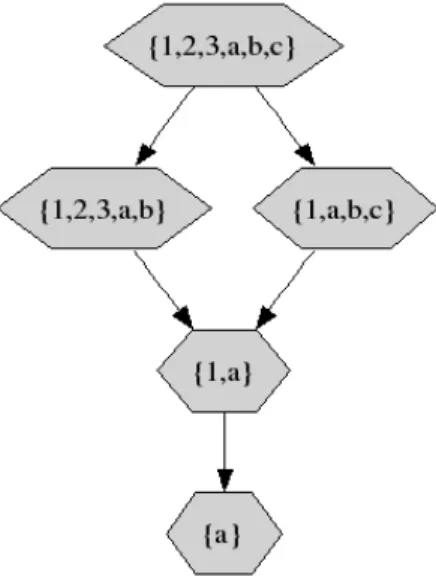
A lattice is a structure which has both a single upper and lower bound, and all other objects can be ordered using some relation between these two. For example, assume that the upper bound is the set: {1,2,3, a, b, c}, and the lower bound is the set: {a}. Figure 3.3 shows a resulting lattice under the relation⊆.
Chapter 4
Definitions and foundations of
computer security
Mathematical formalism is necessary for the discussion, and therefore there is a need for precise definitions of the entities that are discussed. The more general definitions used will be presented here, with a few examples to make the meaning of each of the definitions clear on an informal level. Unless explicitly stated, all definitions are adopted from [And01a, Bis03].
The discussion in the section on access control matrix constitutes the foundation for the theory of access control, a topic that will be discussed more in later chapters.
4.1
Fundamental components
The widest term used is that of asystem. It encapsulates the collection of all parts that make up a functional unit of some kind, for example a networked set of computer, their users, administrators, usage regulations and so forth. The definition of asystemis:
Definition 4.1.1. Asystemis an ordered set made up of, in this order: 1. Products or components
2. Operating system, communications and all things that make up an organisation’s infrastructure
3. Applications 4. IT staff
5. Internal users and management 6. Customers external users 7. The surrounding environment
Notice how the definition starts at the core of any organisation’s machine setup and works outwards, encapsulating components that are depending on the inner layers. This multilayer view of things is a common way of looking on security, and the importance of each layer will become clear in later chapters. One could say that the level of trust
decreases monotonically with each layer. The issue of trust is further elaborated upon in Section 4.2.3.
There are certain entities that issue actions upon other entities. Such an issuer of action is called asubject. The definition used is:
Definition 4.1.2. A subjectis a physical or legal entity in any role. Asubject sis part of a setS.
Note that this definition encapsulates many types of entities; any organization and persons that are interacting with the system both legally or in an illicit manner. That is, asubjectis any member of a system from layer 4 and out.
The parts of a system that subjects interact with may either be other subjects, or a passive component, called anobject.
Definition 4.1.3. Aobjectis a passive entity in a system, typically acted upon by a
subject.
The above definitions encapsulates many of the components on a low level in a computer system, such as hardware, files and data structures. A wider definition that encapsulates more entities, from several levels in Definition 4.1.1, is the notion of a
principal[And01a]:
Definition 4.1.4. Aprincipalis an entity that participates in a security system. This means that a principal includes, but is not limited to, subjects, objects, processes, a role and any equipment in the system. The difference between aprincipal
and an arbitrary entity is that a principal, by definition, interacts with a security
4.2. Fundamental properties of a secure system 13
4.2
Fundamental properties of a secure system
The basis of computer security issues are made up of three fundamental properties. They describe the accessibility of the system, the correctness of any manipulation of any object on the system and to what extent information considered sensitive is kept secret. The properties are calledavailability,integrityandconfidentialityand they will be described in turn below. The definitions are taken from [And01a, Bis03]. Each section will begin with a discussion, and proceed with the definition of the term.
4.2.1
Availability
One of the most basic aspects of a system is its availability. If a subject is unable to utilize the services provided, the service may just as well not exist.
Consider the use of remote surgery using a telesurgical system [Bro]; a surgeon is located at a remote site, possibly in another country, than that of the patient. It is of utmost importance that the responsiveness and accuracy of this system is fast and correct. If the service on either end would cease to respond, catastrophe may very well be the result. In this extreme example of availability, all parts of the resulting system used to perform the operation is of utmost importance to guarantee the wellbeing of the patient. Any interruption in theavailabilityof the system’s parts will make the
availabilityof the entire system to fail.
Definition 4.2.1. Let X be a set of entities and I be a resource. Then I has the property of availabilitywith respect toX if all members ofX can accessI.
Note the use of the word “entities” in the definition. This word gives the definition a bigger encapsulation than if the term subject would have been used. This means that any part of the system may judge upon whether some resource I is available or not; it need not be considered a subject to do so. Another, basic but important, thing to notice about this definition is that theavailabilityis defined with respect to some well defined setX, but no restriction to its definition is given.
4.2.2
Confidentiality
To keep data and its existence secret is a problem that many organisations put a sig-nificant amount of time and money into. To keep data confidential is a major concern to, for example, intelligence agencies and the military, where information is often made available to personnel on a “need to know” basis. Cryptography is an important part in the implementation of confidential systems.
A sensitive example of the use for confidentiality, are the medical records that are stored in medical databases. In these databases, information about ones emotional health, inherited genetical diseases, HIV status and more is stored. Most people consider this information to be very private and don’t want anybody but perhaps their doctor to know about it. This has good cause as many people have been harassed and fired upon that their medical information has been made public [Sch00].
Definition 4.2.2. Let X be a set of entities and let I be some information. Then I
has the property of confidentialitywith respect toX if no member ofX can obtain information aboutX.
4.2.3
Integrity
In most commercial environments, the integrity of information is more important than to protect it from illicit access, although that too is an important issue. Consider for example the importance of integrity in a bank’s transaction records or the contents of a gas station’s selling record.
There are two main categories of integrity–based mechanisms:
– detective integrity mechanisms
– preventive integritymechanisms
Detection mechanisms are used to detect any unauthorized modification to infor-mation. The mechanism may give a detailed report under which circumstances the information’sintegritywas affected: by whom and what part of the information that was affected, or it may just report that the data has been changed and mark the data as no longer trustworthy.
Prevention mechanisms try to maintain the integrity of any information by blocking any unauthorized attempts to modify it. This also includes the case when a user that has been authorized to modify some information in a certain way tries to alter it in an unauthorized manner.
Integritymay be one of the most important issues in today’s online world; Schneier [Sch00] means that “integrity is about a datum’s relation to itself over time,” and gives several examples of why it gets more and more important. He says that today it is very easy to forge an article so that it look genuine, like it came from some well respected magazine. This makes it much more difficult to distinguish false information from valid when obtained from an online source.
Schneier provides a specific example of this, concerning trading with stock: An employee of ParGain Technologies managed to post fake takeover announcements, which were designed to look like they came from the Bloomsberg news service. This had the effect of running the stock up by 30 percent before the truth was unveiled.
Definition 4.2.3. Let X be a set of entities and let I be some information. Then I
has the property of integritywith respect toX if all members ofX trustI.
Yet again, the word “entities” is used with respect to the well defined setX. As was previously noted, the term trust is defined in Section 4.3.1.
4.3. Trust and assurance 15
4.3
Trust and assurance
In order to implement security in a computer system, it is obvious that there must be one or more system components that can betrustedto be correct. One such technique will be discussed in this chapter: Trusted Computer Base. After the introduction to the notion of trust, the concept of assurance will be lightly touched upon.
4.3.1
Trust
Trust is probably one of the most important factors in real life: on a daily basis we
trustin that people will do what they are expected to do in different situations, such as not breaking the law and that everyone will try not to contradict social norms.
For security, it becomes the question [Bis03, Amo94]: ‘‘To what degree can I trust this system being secure?’’
Bishop [Bis03] provides a definition of trust which fully encapsulates the above ques-tion:
Definition 4.3.1. An entity istrustworthyif there is sufficient credible evidence lead-ing one to believe that the system will meet a set of given requirements. Trust is a measure of trustworthiness, relying on the evidence provided.
The definition also captures two key points: that trust is a subjective measure that is dependant on how much evidence of a system’s security is provided, and what kind of evidence it is.
So, for a system that has been designed and implemented to be secure, potential users of the system will have to be provided evidence for that any trust they might have for the system’s correctness is not misplaced.
This problem is especially true for all companies that sell software; only the trust that a company gets from their customers that they have a functionally correct and secure product will ensure continued investments in software from that company. This brings up the issue of assuring correctness, which is the topic of the following section.
4.3.2
Assurance
As was mentioned in the previous section, there is a need to provide convincing argu-ments that a product works as stated – that it functions as is claimed and that it is secure. Stated differently, the problem is to provide convincing proof of the system’s correctness.
Definition
The process of gathering evidence for the security, and correctness, of a system is called
assurance. The following definition provides a good starting point for the rest of the discussion [Bis03]:
Definition 4.3.2. Security assurance, or simply assurance, is confidence that an entity meets its security requirements, based on specific evidence provided by the appli-cation of assurance techniques.
The definition does not specify what kind of assurance techniques that should be employed, just that they should. The goal of the assurance techniques though are to eliminate all mistakes that can be done during the development of a system.
Problems and countermeasures
As was mentioned above, the goal of applying assurance is to reduce the occurrence of errors in the system. In that respect, assurance has very much in common with software engineering (see e.g. [Sha, Mar03, And01a]) in that it tries to eliminate as many problem factors as possible. The following list of errors and trouble sources is given in [Bis03] as issues in computer systems:
1. Requirement definition, omissions and mistakes 2. System design flaws
3. Hardware flaws
4. Software flaws, programming and compiler bugs
5. System use and operation errors and inadvertent mistakes 6. Willful system misuse
7. Hardware, communication or other equipment malfunction 8. Environment problem, natural causes and random events 9. Evolution, maintenance, faulty upgrades and decommissions
All of these sources of security issues are well known, and there are different as-surance techniques to counter most of them. Natural causes and random events are hard to counter though. The counter measures that are discussed below are adapted from [Bis03].
The first thing to assert correctness for is design. Correctness and completeness testing is an absolute necessity to ensure that the correct security measures are being taken and that they encapsulate the problem space. This kind of assurance deals with problems of type 1, 2 and 6.
Second, the implementation of the designed system must be checked, both hardware and software, which handles the problems listed under 3, 4 and 7. Moreover, this will also handle problems with maintenance, environmental problems and willful misuse (list items 6, 8 and 9) since the assurance should stretch to the deployment of the system.
To counter operational problems, operational assurance can handle the problems under list item 5. Techniques for doing this are, for example, monitoring and audit. These techniques will hopefully find flaws in the system as it is used and is in the maintenance phase, so that those errors can be dealt with [CSR].
Real world example: OpenBSD
As a real world example of how several of the above techniques are being used, the free POSIX–compatible systemOpenBSD1 is presented.
OpenBSDhas a very strong focus on security, and therefore has included a significant amount of well designed countermeasures to well known vulnerabilities such as buffer overflows and rights escalation.
One of the most impressive parts of theOpenBSDeffort is the thorough code audit the operating system, and its userland tools (i.e. tools used in application space as opposed
4.3. Trust and assurance 17
to kernel space, in which the operating system’s kernel operates), has undergone: the code is constantly checked for bugs and possible errors, which has uncovered a lot of bugs over the years [Ope].
The open nature of OpenBSDgives the discussion on design issues a natural solution in the project’s mailing lists, flaws in the software are tested for by test releases and actual use, maintenance is a constant factor due to the commitment of the community and the developers.
4.3.3
Certification
Although assurance at different levels while constructing a system is an obvious way of increasing the quality of the end product, different types of assurance techniques are likely to uncover different types of errors and flaws unequally well. To make it possible for someone not involved in the actual work on a system to judge on the process used for verification some common ground between different projects is needed. Certification is such an effort.
A certification is a formalized way of placing trust in a system by using a well defined set of assurance techniques. Different certifications will provide different levels of trust for asystembased on how the validation is performed.
For example, lower certification levels may require the use of software development methodologies and testing of the correctness of the system’s functionality compared to specification documents. On the other end of the scale are formal proof of the systems functionality, in which the entire system is subjected to mathematical proof for the correctness of each line of code.
An industry standard used extensively is the Common Criteria, which has seven levels of trust. The levels ranges from “no trust” to “Formally Verified Design and Tested” [Bis03, IAC]. Very few projects ever reach the higher levels of the criteria.
4.3.4
Trusted Computing Base
Previously in the chapter, the topics of assurance and certification have been discussed. As is easily understood, thorough verification of a piece of software’s correctness is time consuming. In commercial projects, cost also becomes an important factor.
For these reasons it is a good idea to minimize the code base that should be respon-sible for enforcing the security of the system, that is the mechanism that implements the system’s security policy.
A definition of the parts of a system that is responsible for implementing the mech-anisms is provided [Bis03]:
Definition 4.3.3. ATrusted Computing Base(TCB) consists of all protection mech-anisms within a computer system – including hardware, firmware and software – that are responsible for enforcing a security policy.
One important conclusion can be reached from this: if the TCBis small enough to be properly verified, using techniques such as assurance and certification conformance, and all policy dependant decisions in the system pass through the TCB, then the level of trust that can be placed in the system will be directly dependant on the results from the verification of theTCB.
The challenge is often to make the size of the TCB manageable for any form of verification. It will often include too many parts of an operating system’s kernel, and
therefore be of great size, to be practically feasible for any more formal type of correctness tests. It is not unusual that the entire memory management subsystem is a part of the
TCB[Amo94].
4.4
Defining secure systems
One important part of understanding the term “secure” is to understand exactly what that term means in this context. Consider for example the action of opening a file for writing and then writing some data to it. Two questions may come from this seemingly simple action: was the subject allowed to access and modify that subject, and can the system be considered secure after those actions?
Unless explicitly stated, the discussion below is adapted from [Bis03].
4.4.1
Protection states
To be able to analyze a situation in which the question of whether or not a system is secure, the system can be thought of as a state machine in which all components of the system makes up the definition of each state, and changes in any of these components constitutes a transition to another state. Obviously some of the machine’s states are undesirable to reach.
To formalize the discussion the notion of aprotection stateis introduced. LetP
be the set of protection states andQbe a subset of P, where∀q∈Qare the states that the system is authorized to enter, if the system is to be considered secure.
With the introduction of protection states, the problem is now reduced to defin-ing a method that will force the system to only make transitions between states that are in the setQ.
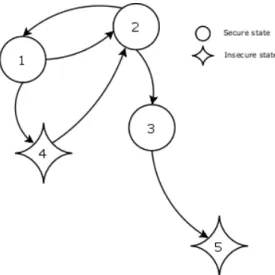
Figure 4.1: A five state situation. The directed arrows depict possible transitions. It is an insecure system since it may reach an insecure state
4.4. Defining secure systems 19
4.4.2
Definition of a secure system
The follow definition is very general in nature and is quite intuitively tied to the intro-duction of protection states above.
Definition 4.4.1. Asecure systemis a system that starts in an authorized state and cannot enter an unauthorized state.
This entirely encapsulates the example and the discussion in the preceding section; the transitions that would render the state machine describing the system entering an unauthorized state must be avoided if a system is to remain secure.
An example of states and transitions between them is depicted in Figure 4.1. In the figure, states labeled “1”, “2” and “3” are defined to be secure, while the states labeled “4” and “5” are defined to be insecure. The system described by these five states, and the possible transitions between them, is not to be considered secure since it is possible for the system to enter an insecure state.
4.4.3
State transition control and the Access control matrix
To solve the problem of which transitions can be allowed, some kind of decision sys-tem that takes into account the current context and the requested transition must be constructed. An appropriate model must be able to determine exactly what actions a specificsubjectis allowed to perform on anyobject.
A model that addresses these issues is a very intuitive model called the Access control matrix model, which exhaustively describes the rights that eachentityhave over all otherentities[Bis03].
The model partitions the entities of a system into two categories: the entities that must be protected and those that don’t. The entities that are considered relevant to the protection state of the system are placed into either a set of objects O or a set of subjectsS, that is processes and users. This makes it possible to associate all pair (s, o), wheres ∈ Sando ∈ O, with some set of rightsr ⊆ R, whereRis the set of all rights available in the system.
The right r is then captured in an access matrix A such that a[s, o] = r, where
a[s, o] ∈ A and by consequencea[s, o] ⊆ R.
file 1 file 2 process 1 process 2
process 1 read read, write, own read, write, execute, own
process 2 read, own read read read, write,
execute, own Figure 4.2: An access control matrix describing the access rights for two processes to two files and each other. Adapted from Bishop [Bis03]
The three sets can be used to describe set of protection states for the system using the triple (S, O, A). That is, as long as the identifiedsubjects, accessesobjects
accordingly to the rights given by theaccess matrixA, the system will never enter an unauthorized state.
For example, consider the access control matrix depicted in Figure 4.2. It describes exactly which rights “process 1” and “process 2” has with respect to the files “file 1”
and “file 2” and to each other. For example, “process 1” has no rights over “process 2,” while the later may read from “process 1.”
4.4.4
Protection states transitions
In the previous section, the access control matrix was introduced. If one assumes that such a matrix is made available, how can the actions necessary to work with objects
in a realistic way be done in a secure manner? Those actions will necessary include: creation, deletion, modification and rights modification or rights transfer for any object governed by the access matrix.
Bishop [Bis03] describes this as a series of state transitions, in which the protection system changes. More specifically, if a system starts in a state X0 = (S0, O0, A0),
and then transitions through a set of states X1, X2 . . . by the use of operations from
an operation set {τ1, τ2, . . .}, then those transitions necessarily change the contents
of the access matrix if the access rights of subjects are affected, or if objects are created or deleted. Obviously there is a need to define the operations in the operation set {τ1, τ2, . . .} in such way that the access control matrix won’t be modified to allow
system states that are considered insecure.
These operations may be defined as commands. The definition of the necessary commands has been well defined by previous work by Harrison (among others) [Har76], and those specifications will be used here. Some of the precise notations are adapted from Bishop [Bis03].
The context is such that before the execution of aprimitive commandthe system’s state can be described by the triple (S, O, A) and afterwards by the corresponding triple (S0, O0, A0). Special note should be given to the preconditions and postconditions of the aforementioned commands. The precondition presents the condition relative to the system’s state for the command to be able to execute, and the postcondition describes the changes done to the access system’s state.
1. Primitive command: enterr into a[s,o]
Precondition: The subject and object being considered exist in the access matrix
Postcondition: If the right already exist in that entry, the command will not affect the matrix, else the rightris added
2. Primitive command: deleter from a[s,o]
Precondition: The subject and object being considered exist in the access matrix
Postcondition: If the right does not exist in the access matrix, nothing happens, else it is removed
3. Primitive command: create subjects
Precondition: The subject must not exist as a subject or an object before the execution of the command
Postcondition: The subject is entered in the access matrix with previous entries having no rights in accessing the new entry. No access entries are added for the new subject either
4. Primitive command: destroy subjects
Precondition: The subject must exist in the access matrix
Postcondition: The subject is removed from the access matrix, and all entries corresponding to the access rights of others relating to the removed object are also removed
4.4. Defining secure systems 21
5. Primitive command: create objecto Precondition: No such object exists
Postcondition: Adds the object to the access matrix. Like thecreate subject
command it does not manipulate the access rights present in the matrix 6. Primitive command: destroy object o
Precondition: The object must exist in the access matrix
Postcondition: The object is removed from the access matrix and all rights in the access matrix relating to the object are also removed
Using these command the access matrix will always be modified in such way that the entries will be left in a consistent state.
However, to make use of these primitive commands to represent most real world systems, more preconditions must be evaluated before any of them are to be executed. For example, on most systems only the owner of a file may enter or remove rights of a file. Also, many operations group several primitive commands to do their job. A typical example of such an operation iscreating a file, which might do the following:
1. Does the user have the right to create contents in the directory of interest? 2. Create the file, which is aobject
3. Set the owner of the file to the creating user
4. Set default rights for everybody else on the newly createdobject
Such grouping must be done for all commands that is done by an operating sys-tem [And01b], typically such commands are called syssys-tem calls.
Considering this new tool, can we be sure that the system is secure? Is the transfer of rights between subjectsconcerning access to othersubjectsandobjectsdone in such a manner that no rights are leaked and possibly exploitable by a malicious user? This question is addressed in the next section.
4.5
When is a system secure?
In the previous sections the access matrix, and state transitions that modify it, was introduced. Now the goal is to determine just how such a transition can be made while ensuring that no rights are leaked in an inconsistent manner, enabling the system to enter an insecure state.
This section starts with a light introduction to whether or not an arbitrary system
may be proved secure. The result of such a proof presents the need for restriction of the transfer of rights in asystem. Such a restricted model for how rights are appropriately transferred within an access matrix, to ensure that thesystemdoes not enter an insecure state, is then presented.
4.5.1
Is a system generally provably secure?
A system’s security is in the general case, unfortunately, proven to be undecidable. Harrison and Ruzzo [Har76] proved this in 1976 by translating the actions of handling rights in an access control matrix to the state transitions of a Turing machine, and setting the fact that a right has been leaked in the access control matrix as the halting state.
Since it has been shown that a Turing machine can not be proven to reach its halting state, the problem is undecidable since it is non–traceable. (See e.g. [Sud97] for information about Turing machines and the halting problem.)
4.5.2
A model for traceable transfer or rights
Even though it has been proved generally impossible to assert security in system, a more controlled environment than the access control matrix most general form will make it possible to guarantee that a system will remain in a secure state. Sandhu demonstrated such a tool with the Schematic Protection Model (SPM) [Rav88], which is proven to be traceable. The non–traceability of the access control matrix is the focus of the problem of that model for general use.
SPM is made up of a few simple elements, which when instantiated properly, are able to emulate other protection models. One such model is the Take grant model
(see [Bis03] for an easy explanation of that model). SPMhas the following components: 1. A finite set of principal types partitioned into two sets, holding subject’s and
object’s type respectively
2. A finite set of rights, which is partitioned into two sets. One holding the inert rights (the rights that do not alter the system’s state) and another holding the control rights
3. A finite collection of links predicates. Used to determine if there is a connection between two subjects, based on their types, that can be used to copy a right 4. A filter function for each link predicate, which will either allow the copying of a
right or deny it
5. The operation for creating new subjects and objects
6. A rule that is associated with all operations that create any type of entity, that control which initial rights the created entity will be associated with
4.5. When is a system secure? 23
Note thatSPMas presented only describe a monotonically growing system.
Using this model, all rights are transfered using a well specified system of rules that are unconditionally applied to all operations by the links predicates and the filter functions. Sandhu demonstrates several models in his paper by instantiating the sets in the model’s component list appropriately, and gives a convincing argument that many models can be emulated bySPM, and as such be traceable [Rav88]. The fact thatSPMis so powerful and proven traceable, makes it clear that models that are either equivalent with or instanciable inSPMwill be secure.
4.5.3
Conclusions concerning secure systems
The above discussion made it clear that an unbound system is provably insecure, which can be proven by mapping the primitive operations for modifying an access matrix to a Turing machine.
The introduction of restrictive rules however, made it possible to limit the problem such that it became traceable and thus provably secure. The proof of concept provided was the Schematic Protection Model (SPM).
SinceSPMis traceable, it must follow that if a system that has a set of rules for access right transfer, which can be formulated with theSPM, its security is traceable. In other words, if you can express the system’s rules in SPM, it is traceable, and hence it can be proven secure; a finite number of operations are needed to ensure that the system never enters an insecure state.
Chapter 5
Access Control
In the discussion aboutsecure statesin Section 4.4.1, the core issue was transfer of rights. What those rights really describe are the rights any principal has to other
principals in a system. The transitions that were described take place as some
subjectaccess some resource in some way. Access controlis about regulating which resources that may be accessed and how.
This chapter will begin by defining the two levels that exist foraccess control. The distinction between them is very important since the implications from their specification create two entirely different models for how rights are controlled on a system. After the theoretical foundation has been presented, a few real world examples of the two models are presented, with the security implications and problems that have arisen in those system.
5.1
Definitions of access control specification levels
The specification level ofaccess controlcan be on either of two levels: The specifica-tion is up to asubjector it is handled by the operating system. The definition of each of these models follow, adapted from [Bis03].
Definition 5.1.1. If an individual subject can control the decision of an access control mechanism so that it allows or denies access to an object, that mechanism is a discretionary access control (DAC), also called an identity based access control(IBAC).
Definition 5.1.2. When a system mechanism controls access to anobjectand an in-dividualsubjectcannot alter that access, the control is amandatory access control
(MAC), occasionally called arule-based access control.
It is important to note that the use of one of these does not prohibit the use of the other. If both MACandDACare used, bothaccess control mechanisms must grant a
subject’sright to access anobject.
5.2
Implications of different types of access control
The implications of MAC and DAC access control mechanisms are more far reaching than one might expect. The most common by far in industry standard operating systems
today isDACin various forms and expressiveness. All variations of UNIX1support it, as
does Microsoft Windows2.
The main problem with DACis that it has too many dependencies for correctness. It depends on the correctness of the policy’s specification (cf. Chapter 6), the adminis-trators ability to assure that allobjectson the system have rights as specified and the correctness of all tools working with theobjects[Petb].
With MACthe main problem is the correct classification of subjects and objects
such that correct access rights are enforced. Another issue is the comprehensibility of the policy specification to the MAC mechanisms [Lee95, Ken96, Ray, Peta]. That the implementation specific specification of the policy can be hard to comprehend will become apparent in the chapter on SELinux (cf. Chapter 8).
5.3
Real world examples
The real world is always more complex than what mere theoretical work can express, many factors that pure theoretical settings do not need to worry about must be handled. The provided example of the MAC system is one such example, which is able to meet demands on the enhanced security mechanisms to integrate seamlessly with the existing binary software.
5.3.1
UNIX System V/MLS Access Control
The Unix System V/MLS [Amo94] combines bothDACandMACseamlessly. The discre-tionary part resides as is expected in settings associated with the files on the system, while the mandatory part of the access control resides as a part of the operating system’s kernel. The fact that the mechanism forMACresides as an isolated part of the kernel, and is used by system calls, minimizes the intrusion of enforcement code in user space, which is an important aspect.
It is important to note that the completeness of such an approach really depends on the completeness of the hooks inserted into the system. That is, that all parts of the system that change the system’s state, with respect to security, pass through theMAC
enforcement mechanism. Any relevant execution path that fails to do so will bring the system into an insecure state.
5.3.2
SunOS
Almost all UNIX–like operating systems use DAC as their primary access control
mechanism. The SunOS3 operating system is not an exception. This ensures it, among most existing operating systems today, a place among the implicitly insecure systems, as is argued in [Petb].
1UNIX is a registered trademark of The Open Group 2Windows is a registered trademark of Microsoft Corporation 3SunOS is a trademark of Sun Microsystems, Inc
Chapter 6
Security Policies
Upon a decision of constructing a secure system, or making an existing system secure, there are several issues that must be handled. First one will have to determine what is considered secure, what threats that have to be addressed and formulate the decisions that are reached in a way that is as unambiguous as possible [And01a, Bis03, Mar03]. Preferably this is done at the design phase upon the construction of the to be system. The goal in this phase is to identify the secure and insecure states that describe a secure system, as is defined in Definition 4.4.1. The identifications of threats to the system may be done in a formal manner using for example threat trees [Amo94, And01a].
This chapter will start with a presentation of the basic definitions needed to discuss the theory constituting the basis for security policies in a consistent manner. Then some general theory is presented and the chapter is finished with a discussion of security as a process and provide examples of three security policy models.
6.1
Definitions used in security policy theory
To be able to discuss the field of security policies exactly, it is necessary to introduce definitions of the terms used. First, it is important to know the difference between
policyandmechanism[Bis03].
Definition 6.1.1. Asecurity policyis a statement that partitions the states of the system into a set of authorized, orsecure, states and a set of unauthorized, ornon securestates.
Again, note the the use of states to define when a system is to be considered secure. Remember that the states referred to are some set of actual settings in a system that has been selected to represent its state, such as theobjectsthatsubjectsare accessing at a given time or the amount of processing power supplied to anentity.
Definition 6.1.2. Asecurity mechanismis an entity or procedure that enforces some part of the security policy.
Informally that translates to that a security policyis the specification of how a system should maintain a secure state, and what is considered a secure state, while a
security mechanismis a part of the actual implementation enforcing the specification. This is the same difference as in software development between the design and the implementation stages.
When a security policy is defined, it is usually tailored to the needs of a certain organization. Therefore different policies will have different focal points among the fundamental properties of a secure system (cf. Section 4.1). Many of the more traditional policy models focus on the integrity and/or the confidentiality of a system’s information. One such example is given in Section 6.4.1.
6.2
Security as a process
It is all too easy to see a “secure system” as a product. But the truth is that it is more correctly seen as a process. If the bugs discovered in software, and the security advisories that will follow upon these, are taken into account, one easily understands that no system will be perfect from its conception.
In previous chapters, formal security in the terms of states and assignment of access rights have been considered. In a real world problem, those issues often come down to the following steps (adapted from material presented in [Bis03, And01a]):
1. Determine which of the three categoriesintegrity,confidentiality
andavailability that are relevant for the system
2. Identify threats to the relevant categories, using for example threat trees
3. Formulate a policy that ensures that protects against the threats identified in the previous step
4. Check the policy’s completeness (cf. Section 4.2.3) 5. Implement the policy in the system
6. Verify the implementation (cf. Section 4.2.3)
This process may be iterated several times as new threats are identified, the policy is revised or that new rules are set by the management.
It may appear very simple to perform these steps, but it may require quite large amount of work to determine the threats present to a system in a real environment, which can be very different depending on who is using it, and then categorizing them in a consistent manner. Moreover, there is always the risk of formulating a policy that is either too restrictive or, on the converse, too non–restrictive.
6.3
Formulation of a security policy on an
organiza-tional level
In the previous section, the process of formulating a security policy and implementing was briefly described. This section will attempt to provide some insight to the problems that are introduced when a security policy should be formulated in an organization. As in most problem areas, communication is the most important aspect to consider. The arguments presented herein is in whole based on the organizational theories presented in [Dag98].
6.4. Examples of security policy models 29
6.3.1
Organizational issues when defining a security policy
As has been previously stated, the purpose of a security policy is to define what should and what should not be allowed in an organization. To ensure that this is properly done, the process of defining a security policy should incorporate information from all parts of an organization that will access a system. This is important to ensure that the formal restrictions that may be apparent on different levels of the organization are imposed by the formulated policy.
However, most organizations have an hierarchy that defines the responsibilities of a member and a related set of rules for how information should flow within that hierarchy. Such information may be the policy portions that a department wishes to include in a security policy. Hence, to ensure a correct and efficient formulation of a complex policy, the organization must have a good communication infrastructure.
That enough information from each part of an organization is crucial becomes appar-ent if one considers that the resulting policy should neither impose too much restrictions, since that will affect productivity in a negative way, or be too loose, which will render the policy ineffective.
The collected information should be given to a designated section within the orga-nization to formulate a resulting policy, which then can be implemented. Or course, a security policy can be implemented using a mixture ofsecurity mechanismsand rules that members of the organization are required to follow.
Another reason to request information from different section of an organization’s hierarchy is that it will at least give the members of the organization the impression of that they had a chance to influence what the policy will govern. This will lessen the resistance towards the policy once in place. It will also provide the management, which in the end is responsible for the results of the policy, information on how members of the organization feel about certain issues and what portions of the policy that might need well formulated motivations; rules that seem to be superfluous or counterproductive will be ignored whenever possible.
6.4
Examples of security policy models
The examples presented below range from very classical to more recently developed models. It is important to understand that these models do not make up a policy on their own, a system will need classification of its principals to make these work as intended.
6.4.1
The Bell–Lapadula Model
TheBell--Lapadula Model(BLP) [Bis03] is of traditional military orientation in that it is primarily concerned with maintaining the confidentiality of a system’s information. The central point in the BLPis that all objectshave associated security labels and that allsubjectshave a clearance level. By comparing the clearance with the security labels, access is granted or denied. Since the system clears of denies an access, the security model describes aMAC system. The clearance and security labels are typically made up of sets on the form:
An example might be:
(TOP SECRET, {EU, US})
for a document classed as “Top secret” and relevant to both Europe and the US. To understand the idea underlining the model, the dominateoperation is presented as it is adopted from Bishop [Bis03]:
Definition 6.4.1. The security level (L, C) dominates the level (L0, C0) iffL0≤Land
C0 ⊆C. A subject or object is said to dominate another subject or object if its associated security level dominates the other.
By using the dominate relation, properties can be defined such that only information that asubjecthas clearance to read can be accessed, and make downgrading of a piece of information’s security classification impossible. The two are:
Definition 6.4.2. Simple Security Condition (No read up)
A subjectS can only read anobject O iff S dominates O and S has discretionary access toO.
“Discretionary access,” means that the access rights associated with theobjectallow thatsubjectto access it (cf. Section 5.1 for more information about access control).
Definition 6.4.3. *–Property (No write down)
A subject S can write to an object O iff O dominates S and S has discretionary access toO.
This policy, if correctly enforced, will absolutely maintain the confidentiality of any data in a system. Bishop [Bis03] discusses this model to some length, as well as pre-senting a few of the more common critiques against it.
6.4.2
Domain Type Enforcement
In a system usingDomain Type Enforcement(DTE) for access control, an access decision to asubjector objectis based upon what domains the involvedsubjectshave, and which types the involvedobjectshave been assigned [Lee95, Ken96]. Accesses are also controlled by controlling which accesses over domain boundariessubjectsare allowed to make and which typessubjectsfrom a certain domain is allowed to access. Expressed in a more casual manner,subjectsare restricted in their access to a set of objectsof approved types.
A real world example of such a policy is given in both [Lee95] and [Ken96]. In [Lee95] examples of how the network security is hardened is given, and in [Ken96] a policy that hardens a system’s integrity and confidentiality against some well known attacks and some untrusted applications is presented.
That is, DTE is used to model which accesses are allowed on what is considered an appropriate type and domain classification of allprincipalsin a system. Exactly what policy it enforces depends on which transitions over domain boundaries that are allowed and from which domainssubjectsmay accessobjectsof different types and with which rights they may do so.
The principal ideas behind this have strong similarities with the Schematic Protection Model presented in Section 4.5.2 in that types of different kinds are associated with all entities in the system and access decisions are based upon those types and a set of rules for interpreting the context upon an access attempt.
6.4. Examples of security policy models 31
6.4.3
Role Based Access Control
An approach that has increased in popularity is to associate access rights to roles
instead of subjects. That is, a subject may assume several roles over time, and have access rights changed automatically as transitions are done. It is also possible to make Role Based Access Control (RBAC)–system [Rav96, Syl00] behave as systems using more traditional access control measures, such as pureIdentity Based Access Control(IBAC, cf. Definition 5.1.1).
In a common model named RBAC96 [Syl00], the following components are used to define roles and their associated access rights:
1. The set of users
The set of regular roles and the set of administrative roles
The set of regular permissions and the set of administrative permissions The set of sessions
2. A relation for assignment of rights to regular roles and another relation for assign-ment of rights to administrative roles
3. A relation for assignment of roles to users
4. A relation for assignment of administrative role to users 5. A partially ordered hierarchy of roles (i.e. like a lattice)
6. A partially ordered hierarchy of administrative roles (i.e. like a lattice) 7. A function that maps any session to a single user associated with that session.
Another function that maps a session to the set of roles and administrative roles associated with it at a given point in time. The associated set may change over time
8. A number of constraints that will be used to determine which values in the above mentioned sets that are allowed
The idea is to associate a user with a session, and then bind that session to a role, that may change over time, which will be used to associate the user with the rights that are appropriate.
By the introduction of a hierarchy of rules, the concept of inheritance can be used to make more powerful roles inherit the rules of less powerful ones. A typical example is the relation between an engineer and a project’s manager. The manager will both need to be able to access data that the engineer has access to as well as data that are of more administrative nature, which means that the rights that should be associated with the manager role encapsulates the rights that are associated with the engineer role. The presentations in [Rav96, Syl00] have many good examples and discussions on the topics briefly mentioned here.
To summarize,RBACmodels what rights can be given to whichsubjectby associating a certain role to it and which access rights that are to be allowed are associated with that role. The policy that it enforces is based upon those assignments.
One of the greater benefits of using this model is that it becomes very easy to change the rights associated with a particular user in the system, since the only action needed is to change the role that user has for the moment. For the same reason it becomes easy to appoint new people to new positions, since all access rights associated with the
tasks involved for a special position are associated with that position’s role, not with a particular user. This makes revoking rights for the user that previously had that role in the system and assigning them to the newly appointed a simple task, simply change the roles for each of them.
Chapter 7
A common security policy
algebra
The chapter on security policies (cf. Chapter 6) discussed the necessity to precisely define what is to be considered secure in a particular system. That chapter also mentions a few example policy models, one of which whereBell--Lapadula. The exact formulation of that model makes it clear that it is desirable to have an algebra that would be able to express many different security models as an actual policy.
The purpose of this chapter is to introduce one such algebra which has been developed by Wijesekera and Jajodia [Dum03a]. The algebra builds upon the well understood set theory and propositional logic, as well as recent work in the field of theoretical computer security. The algebra is very general and has the potential to be expressive enough to work with several implementations of policy enforcement mechanisms. In particular, the algebra will be used to specify an example policy in Chapter 9, which will be implemented using the SELinux security framework.
It should be noted that although the algebra presented is developed with a DAC
system as the expectedaccess controlmodel, the power it lends to the user is useful in aMACbased system as well (cf. the discussion of MACand DACin Chapter 5).
All content in this chapter is adapted from [Dum03a] unless stated otherwise. It should be noted that the definitions in the section on the algebra’s semantics and syntax differ slightly from the original due to apparent mistypings in the original definitions. More information on this issue is presented at the same time as the aforementioned definitions. Some finer points on what appears to be either conventions or mistakes made by the authors of [Dum03a] will be discussed in its own section after the syntax and semantics of the algebra have been presented.
7.1
Motivations
As was mentioned above, it is desirable to use an algebra when specifying a security policy. Using a mathematically sound algebra will ensure that the policy specification can be unambiguously specified, and that its correctness can be verified.
Another, but at least equally strong reason, is that two separate policies that are expressed using the same algebra may more easily be combined in such a way that the resulting policy is compliant with the restriction imposed by the policies that were
![Figure 3.2: Interpretation of logical operators [Mor01]](https://thumb-us.123doks.com/thumbv2/123dok_us/9443388.2424568/16.892.285.609.456.928/figure-interpretation-of-logical-operators-mor.webp)