Regional and Thematic Papers
on Research Management
2009–2013
Research contract
management
Gretha Cronje, Alweri Enslin,
Sarita Groenewald, Cornelia Malherbe,
Mark Mulder and Sinazo Peter
RIMI4AC stands for the Improvement of Research
and Innovation Management Capacity in Africa
and the Caribbean for the Successful Stimulation
and Dissemination of Research Results.
The RIMI4AC project ran from 2009 to 2013,
and aimed to strengthen the two research
and innovation management associations in
southern and West Africa, SARIMA and WARIMA,
while supporting the establishment of similar
associations in Central Africa, East Africa, and
the Caribbean, namely, CARIMA, EARIMA and
CabRIMA.
In the process, the RIMI4AC project provided
training to members of the regional
associations, and established an information and
communications network, including customised
websites that provide resources and support for
research managers and administrators.
This document is one of a series of five
papers published on themes related to
research management practice, provision and
development in Africa and the Caribbean. For
a list of the other papers in the series, see the
back cover of this document.
The RIMI4AC project ran from 2009 to 2013,
and was funded by the European Union’s Africa,
Caribbean and Pacific Science and Technology
Programme (ACP S&T).
Contents
Abstract 3
1. Introduction 4
Objectives 4
2. The Research Grants and Contracts Office 5
Human resources structure 5
Delegation and responsibilities 6
3. Technology Transfer Office 8
4. Standard operating procedures for administration 9
Contracts management database 9
Database specifications 9
Maintenance 10
Research and research-related contracts 10
Presentation of research contracts 12
Procedural clearance of research contracts 13
Signing and approving contracts 13
Research grants 14
Proposal/pre-contractual/pre-award phase 16
Contractual/award phase 17
Post contractual/post-award phase 17
5. Types of contract and risk assessment 18
Determining the required agreement/contract 19
How to determine the type of agreement/contract you will need 19
Types of contract 19
Risk assessment 23
Legal and contractual aspects of risk assessment 24
6. Relevant legislation and policies 29
Full economic cost 29
Direct cost 29
Indirect cost 29
Budget template 30
Guidelines for implementing an FEC policy 30
Material Transfer Agreements 31
Confidentiality 31 Definition of material 31 Publication rights 32 IP rights 32 Types of material 32 Ethics 33 Permits 33
Indigenous knowledge and biodiversity 33
Genetically modified organisms 34
Intellectual property rights 34
Ownership 35
Access rights 35
Research ethics 36
Policies (general outlines) 36
IP policy 36
Ethics policy 36
Conflict of interest policy 37
FEC policy 37
Research contract management policy 37
Formulating policies 39
Appendix 1: Risk–benefit analysis template 39
About the authors at the University of Stellenbosch 43
The papers in this series 45
Tables
Table 1: Key staff members in the Research Grants and Contracts Office 5 Table 2: Designated signing authorities for contracts 7 Table 3: Differences between research contracts and research grants 9
Table 4: Compliance matters 18
Table 5: Types of research agreement used by higher education institutions 22 Figures
Figure 1: The research contract management process 11 Figure 2: The grant application and grant management process 15
As part of the EU-funded project on Research Management (RIMI4AC), we have developed a Best Practice Manual that will provide an overview of what is generally regarded as best practice for research contract management at Stellenbosch University. We believe that this manual will also be of value to the wider higher education community.
According to an international survey regarding contract management, contractual risk assessment is recognised as a major area of concern and is seldom a reliable process. In addition to this, insufficient human resources and systems were identified as two major obstacles to effective and efficient contract management. Another concern is that most institutions do not know what the cost penalties within the contract involve, or what the potential exposure to legal liability is.1
This manual considers the pillars of effective research contract management, including compliance, risk assessment, human resources and finance-related issues, and clarifies the roles and
responsibilities involved in each, to ensure effective research contract management.
Abstract
Collaboration with external industry partners and other research institutions, either within the framework of research projects or grants, or through the provision of scientific services, is a very effective way for a university to create and/or transfer knowledge, technology and expertise. Industries benefit, not only from the use of the university’s facilities and access to intellectual property (IP) created specifically for them, but also from the fact that innovative outputs increase their competitive advantage. The university generally benefits through publication rights and the training of highly skilled human resources, as well as the development of commercially beneficial innovations. Applying the full economic cost principle further allows the university to recover the greater proportion of the true costs of the research which provides sustainability for on-going research activity, including on-going investment in research infrastructure.
It is advisable and usually necessary to enter into formal agreements or contracts with industry and with public and private organisations that support scientific research. These contracts are legal agreements between the client and the university (legal person/entity) through which the university (via its researcher) agrees to conduct research under the specific conditions set out in the contract. The client usually funds a specific project rather than a broad area of research; requires progress reports on specified dates; requires that the research project be completed on the agreed date and often would like to protect IP arising from the research. Therefore, it is essential that researchers undertaking contract research should be confident that all conditions in the contract can be met and that the budget in the proposal is adequate to meet the objectives of the proposal.
To assist researchers in these matters, a dedicated Research Grants and Contracts Office (RGCO), and Technology Transfer Office (TTO) (or a combination of the two) should be in operation at the university. Specific policies and standard operating procedures for the administration of research and research-related contracts, and national and international grant agreements, should be in place to ensure consistency in the internal and external functions of the Research Grants and Contracts Office.
Objectives
The main objectives of this Best Practice Manual are:
• To provide practical guidance on implementing a research contract management system, including: - the establishment of a Research Grants and Contracts Office and
- the development of specific research-related policies.
• To provide standard operating procedures for the effective administration of research and research- related contracts, including:
- information on different types of research contracts; - performing risk–benefit analyses of research contracts and - establishing a contract database.
• To provide practical guidelines for the implementation of research policies.
2. The Research Grants and Contracts Office
Human resources structure
The role of the Research Grants and Contracts Office (RGCO) is to provide services to help researchers form collaborative networks with industry by negotiating agreements, protecting and managing IP, and fostering innovation. The primary responsibilities of the office are to:
• Review, negotiate and arrange for the signing of all the university research and research-related contracts and agreements.
• Assist in the development of research-related policies.
• Develop standard agreements.
• Identify and minimise risk in undertaking contract research.
• Provide advice and training to the research community and faculty on all risks associated with the contract.
• Provide advice and training in matters relating to IP management, protection and commercialisation.
• Provide advice and training in grant writing, budgeting, ethics and ethical approval.
• Provide information on funding opportunities.
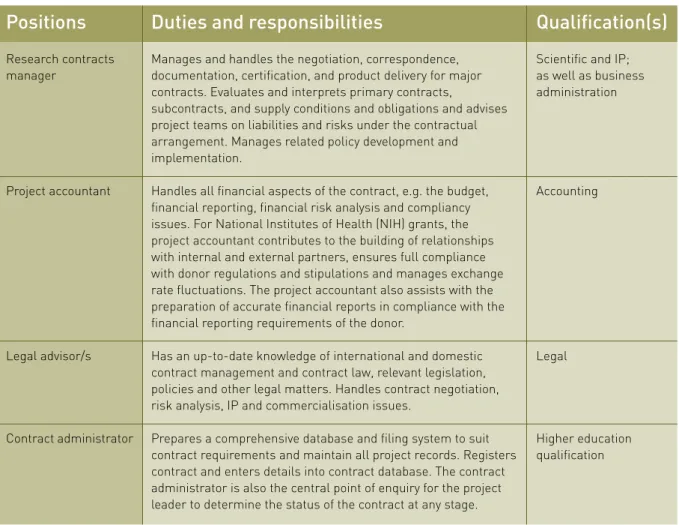
The key positions in the RGCO, and the responsibilities of each, are summarised in the table below. Table 1: Key staff members in the Research Grants and Contracts Office
Qualification(s)
Scientific and IP; as well as business administration Accounting Legal Higher education qualificationDuties and responsibilities
Manages and handles the negotiation, correspondence, documentation, certification, and product delivery for major contracts. Evaluates and interprets primary contracts,
subcontracts, and supply conditions and obligations and advises project teams on liabilities and risks under the contractual arrangement. Manages related policy development and implementation.
Handles all financial aspects of the contract, e.g. the budget, financial reporting, financial risk analysis and compliancy issues. For National Institutes of Health (NIH) grants, the project accountant contributes to the building of relationships with internal and external partners, ensures full compliance with donor regulations and stipulations and manages exchange rate fluctuations. The project accountant also assists with the preparation of accurate financial reports in compliance with the financial reporting requirements of the donor.
Has an up-to-date knowledge of international and domestic contract management and contract law, relevant legislation, policies and other legal matters. Handles contract negotiation, risk analysis, IP and commercialisation issues.
Prepares a comprehensive database and filing system to suit contract requirements and maintain all project records. Registers contract and enters details into contract database. The contract administrator is also the central point of enquiry for the project leader to determine the status of the contract at any stage.
Positions
Research contracts manager Project accountant Legal advisor/s Contract administratorThe exact job titles, job decriptions and quantities of staff will vary between universities. However, our operational experience at Stellenbosch University suggests that these types of position should be present in the RGCO.
At Stellenbosch University, the RGCO works closely with the Technology Transfer Office, which handles the commercialisation of IP rights (IPR). At some insititutions, this IP rights division forms part of the RGCO. The skills that are required in a Research Grants and Contracts Office thus include financial, legal, scientific, business and administrative skills.
Universities should draw on the available expertise within their broader university to assist them with assessing proposals, budgeting, and negotiating contracts. In cases where universities cannot afford to establish formal RGCOs, they can still benefit from the function of an RGCO if they allow groups of staff with different areas of expertise (and from different departments) to form a virtual RGCO. A person within the Research Grants and Contracts Office could therefore provide a one-stop service to researchers by facilitating the negotiation, approval and signing of a research contract. During this process this person could then acquire expertise on the specific contract from their Faculty of Law (for legal advice), their Division of Finance (for financial advice on auditing, taxes, insurance requirements, budgeting and so on) and other scientists in other faculties as needed.
Where a few universities are in close proximity, it might be worthwhile for them to assist one another in starting up a small research contracts group with the above-mentioned expertise, and both finance and benefit from this group collectively.
Delegation and responsibilities
At the outset, it is important that the institution and its employees understand that the institution is a legal entity and that a formal delegation process should be formalised and approved by the institution’s Council. For example, at Stellenbosch University, the Council approved that all research-related contracts are signed by the Vice Rector (Research), thus appointing that person as the authorised legal representative of the institution. The person occupying that position has the authority to further delegate signing authorities to specific senior employees.
At Stellenbosch, the Vice Rector (Research) can delegate signing authority directly to the following specific senior positions: departmental chairs, directors and deans. (Deans are also allowed to delegate signing authority to departmental chairs and directors). All these positions have authority to evaluate the merits of each research contract in terms of the goals of the institution, and the potential risks of the project. Their evaluation must take into account the risk management and insurance policy of the institution. In addition, the value of the contract is usually (but not strictly) taken into account when delegating signing authority. Table 2 shows a rough outline of the signing authority structure according to the value of the contract.
Table 2: Designated signing authorities for contracts
In order to finalise any research contract, a declaration letter must be prepared. The objective of the declaration letter is to provide a guarantee from the Dean that the financial and operational risk of the faculty is fully and explicitly cleared and accepted at the relevant responsibility level(s), e.g. by directors on behalf of the institutes. The declaration letter must also provide a guarantee that there are sufficient (resource) reserves in the concerned institute.
The letter is prepared by the RGCO and sent to the project leader, who is responsible for its completion and delivery to the Dean, and for ensuring that it is returned to the RGCO. The declaration letter must be signed by all three positions (the dean of the faculty, the departmental chair or institute director, and the principal investigator).
The persons who sign the declaration letter and submit it to the RGCO confirm that the project:
• Can be executed in their environment, i.e. that they understand the legal and operational consequences of contract breach or non-delivery, and that they accept full responsibility and accountability for complying with the contractual terms.
• Fits in with the scope of research of the environment.
• May involve the staff of the environment.
• May make use of the facilities / infrastructure of the environment (if applicable).
• Has addressed, or will address all actual or potential conflict of interest situations appropriately. The declaration letter is not part of the contract between the university and the client and is used only for internal management. Contracts can only be finalised by the RGCO after receipt of the fully signed declaration letter.
Position of signing authority
Value of contract
• Vice Rector (Research) > ZAR500,000The Vice Rector (Research) can designate signing authority to all three positions listed below, for contracts up to the values shown.
• Dean ≤ ZAR500,000
The Dean can designate signing authority to both positions listed below, for contracts up to the values shown.
• Departmental chair ≤ ZAR150,000 • Directors of the institutes ≤ ZAR150,000
Technology transfer contributes directly to technological innovation by supplying industries with new technologies that have commercial potential. Institutional Technology Transfer Offices (TTOs) should facilitate the commercial exploitation of IP emanating from the university’s faculty members and students.
The main functions of a TTO are to:
• Prevent premature disclosure of ideas to maximise competitive advantage.
• Promote the understanding and protection of IP.
• Establish the feasibility of ideas and identify commercialisation opportunities.
• Register and patent usable innovations.
• Facilitate licensing.
• Assist in publicising and applying the research output to industry.
• Provide management expertise in the areas of technology evaluation, contract negotiation, IP management, and new enterprise development.
A technology transfer officer should have a legal, scientific and financial background, a broad
understanding of technology management, business, innovation, IP and licensing issues, and applicable legislations.
This section will cover the standard operating procedures for the administration of research and research-related contracts.
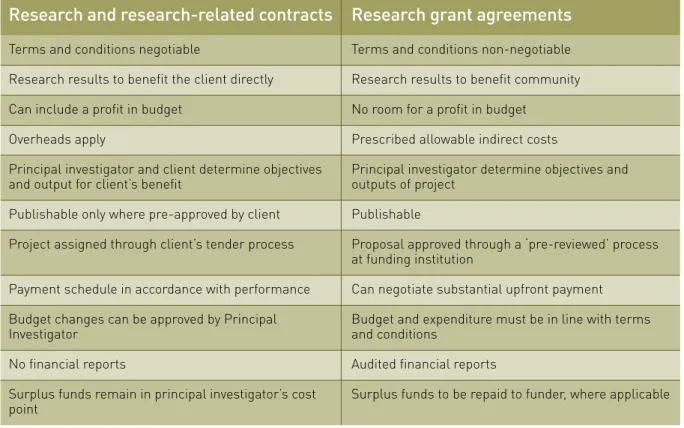
The two main types of research agreement with financial implications that are entered into by higher education institutions are (1) research and research-related contracts and (2) research grants (agreements). Reseach contracts generally tend to be with industrial, private or public partners, while grant agreements tend to be with national and international donor bodies. It is very important to distinguish between these two types of agreement. The main differences between them are summarised in Table 3.
Table 3: Differences between research contracts and research grants
Contracts management database
For proper administration of research contracts, it is essential that a contracts management database (CMD) is developed. This database should be an easy-to-use online tool that contains all the relevant information about all the university’s research contracts. The information should be easy to access (and update) by approved persons. Note that if a web database is not viable, then a simple Excel spreadsheet could serve the same purpose.
Database specifications
The contracts management database must contain as standard, the following information for each
4. Standard operating procedures for administration
Research and research-related contracts
Terms and conditions negotiableResearch results to benefit the client directly Can include a profit in budget
Overheads apply
Principal investigator and client determine objectives and output for client’s benefit
Publishable only where pre-approved by client Project assigned through client’s tender process Payment schedule in accordance with performance Budget changes can be approved by Principal Investigator
No financial reports
Surplus funds remain in principal investigator’s cost point
Research grant agreements
Terms and conditions non-negotiable Research results to benefit community No room for a profit in budgetPrescribed allowable indirect costs
Principal investigator determine objectives and outputs of project
Publishable
Proposal approved through a ‘pre-reviewed’ process at funding institution
Can negotiate substantial upfront payment Budget and expenditure must be in line with terms and conditions
Audited financial reports
contract/agreement:
• Contract number, which is used as reference number. • Date of registration.
• Name of principal investigator.
• Names and contact details of parties /clients.
• Department and faculty in which the contract work/reserach will take place. • Type of contract.
• Contract amount, budget and currency.
• Status (i.e. in process, pending, signed by institution, signed by client and so on). • Project title.
• Start and end dates.
• Cost centre number and indication whether the full economic costing has been applied or not. • Comments of the contract officer (serves as a workflow).
• Jurisdiction.
• IP arrangements and information, such as existing patent numbers. • Authorisation/ name of person who signed.
Maintenance
The university should decide internally on a minimum duration for keeping all hard-copy records of contracts and related correspondence. Ideally (and here at Stellenbosch University) hard-copy records are kept indefinitely, rather than only for the formal duration of the contract period.
The university must put in place measures to restrict access to the contracts management database. It is recommended that access is restricted to persons within the RGCO. In some cases, ‘read only’ rights can be provided to senior members within the Finance Division. It is especially important to have restrictions in place if your university’s information is stored in an Excel document. Where possible, the document should not be copied onto removable disks. In addition, staff who have access to the contracts management database must be aware of, and comply with, any confidentiality agreements stated in the contracts.
Research and research-related contracts
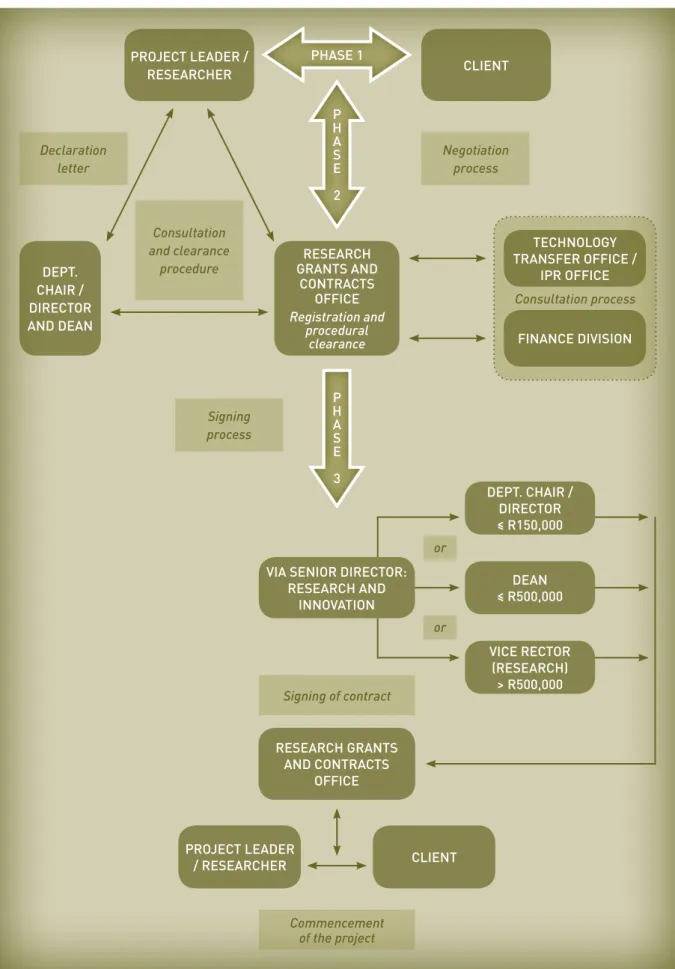
The registration, negotiation and signing of research and research-related contracts are described here. The process comprises three phases before the project can commence (see Figure 1): 1. Presentation of research contracts.
2. Procedural clearance of contracts. 3. Signing and approving contracts.
PROJECT LEADER / RESEARCHER PHASE 1 P H A S E 2 P H A S E 3 Declaration letter Negotiation process Consultation process Consultation and clearance procedure Signing process Signing of contract Commencement of the project or or DEPT. CHAIR / DIRECTOR AND DEAN TECHNOLOGY TRANSFER OFFICE / IPR OFFICE DEPT. CHAIR / DIRECTOR ≤ R150,000 DEAN ≤ R500,000 VICE RECTOR (RESEARCH) > R500,000 VIA SENIOR DIRECTOR:
RESEARCH AND INNOVATION RESEARCH GRANTS AND CONTRACTS OFFICE PROJECT LEADER / RESEARCHER CLIENT FINANCE DIVISION RESEARCH GRANTS AND CONTRACTS OFFICE Registration and procedural clearance CLIENT
Presentation of research contracts
This phase involves the negotiation process between the client and the project leader. Aspects that are negotiated include the contract specifications and the budget.
The contract
The project leader (researcher/principal investigator) identifies opportunities for research contract presentations, or the university is approached by an external party (client) to do a project presentation. A standard contract is sent to the client. If the client prefers to use an alternative contract, it should be sent directly to the research contracts manager, who will manage the internal operation. The contract is registered on the contracts management database and a contract number is allocated to it. The RGCO will attempt to finalise some of the contractual sections, while the extent of the project is negotiated between the project leader and the client.
Whether a principal investigator identifies opportunities for research contract presentations, or the university is approached by an external party (client) to do a project presentation, in both cases the RGCO is repsonsible for sending out a standard university ‘contract document’ to the client. A contract document contains the standard terms, agreements and responsibilities for would-be contracts between the university and a third party. These terms, agreements and responsibilities may be negotiated and changed as part of the contract agreement process.
If the client prefers to use an alternative, or their own ‘contract-document’ as the basis for the would-be contract, then the client will would-be asked to send this contract-document directly to the manager of the RGCO. All contract-documents (whether university or client) must be sent directly to the manager of the RGCO.
It is important to note that continuous internal communication as well as continuous communication with the client are important success factors in the negotiations.
The contract budget
The budget of the contract must include cost calculations, price estimations and overheads, or indirect cost calculations. The principal investigator is responsible for determining the cost of the research – this should be based on a full-cost approach where applicable.
At Stellenbosch University, the RGCO provides a template which can be used to calculate costs, price estimations and overheads or indirect costs. The RGCO recommends the use of this template, especially in cases where the client, without any prescribed terms from the government, intends to negotiate with the university about ownership of the IP. In these cases, great care should be taken to ensure that the calculation of the cost is determined on a full-cost basis.
Consultation with the Finance Division
The RGCO (in consultation with the principal investigator) is responsible for clearing the following issues (which are not limited to the list below) with the Finance Division:
• Tax.
• Insurance.
• Reimbursement of remaining funds after the project has ended. • Specific audit requirements as stipulated by the client.
Final perusal of the research contract by the principal investigator and the RGCO
The principal investigator must ensure that all information required, e.g. the appendices, project extent (project description, project plan, project milestones and financial budget) are completed in full and are attached to the contract. The principal investigator must ensure that the necessary ethical clearance is granted to all projects where it is a requirement. The principal investigator consults with the departmental chair, director and dean about the extent, risks and coverage of risks of the project.
Final perusal of the research contract by the departmental chair, director, dean or Vice Rector (Research)
Depending on the value of the would-be contract, the departmental chair, the director, the dean or the Vice Rector (Research) will evaluate the merits of the contract in terms of the goals of the university and the potential risks of the project. The evaluation will also take into account the risk-management and insurance policy of the university.
Procedural clearance of research contracts
The RGCO evaluates all research and research-related contracts on a risk-analysis basis. The process involves compiling and assessing a complete matrix of the potential risks for each contract, including the nature, value and duration of the contract, established milestones, as well as financial risks
regarding exchange rates, insurance, technical aspects, reputation, confidentiality, legal considerations, jurisdiction and termination. During this assessment it is crucial to ensure that IP is protected
timeously and strictly in accordance with the university’s IP Policy, which lays the foundation for the future commercialisation of research outputs by the Technology Transfer Office and/or IP Rights Office. It is equally crucial to ensure compliance with the financial requirements stipulated by the financial policies of the university. Consultation with the Technology Transfer Office and/or IP Rights Office and the Finance Division takes place where applicable, as well as with the relevant research environments. Contracts are negotiated and finalised for signature once the risk evaluation is completed.
The contract administrator is the central point of enquiry for the project leader or principal investigator to determine the status of the contract at any stage. As far as possible, the procedural clearance of standard contracts should be completed within five work days.
Signing and approving contracts
Once the research contract has met the requirements of the procedural clearance process, the signing and approval process takes place as follows.
The contract is signed. The research contracts manager provides the Vice Rector (Research), deans and departmental chairs/directors with up-to-date information about the procedural clearance process which has been followed, as well as any potential risks that need to be highlighted again. The contracts are then signed according to the delegated signing authorisation as outlined in Table 2.
by signing research contracts unless they are officially delegated to do so by the University Board. After the contract has been signed, it is handed to the RGCO, who notify the Finance Division (Budget Control) to open a cost centre so that no invoicing can take place before a contract number has been allocated. This is a very important aspect to ensure that no research contract work is performed in the absence of a contract, as the risks involved in doing so are potentially very high.
The signed contract is dispatched to the client and a copy returned. The RGCO keeps a preliminary copy of the contract for safekeeping and sends the original signed contract to the client, with the request that they return one fully signed contract to the university for the university’s records and audit purposes. The RGCO ensures that the original signed contract is in safekeeping and a copy of the contract is provided to the project leader/prinicpal investigator and the dean.
The research project begins, along with project management and administration. Income and expenses are accounted for according to the financial policy of the university and financial statements are compiled in accordance with the client’s requirements, including the comparison of real cost and budget, taking into account the percentage of completion of the project. The project leader takes responsibility for the execution of the proposed research according to the agreed output criteria. The RGCO monitors the state (percentage completed) of contracts on a regular basis and, on an ad hoc basis, determines the extent to which the university clients are satisfied with the execution of the research contract.
Research Grants
The grant application and grant management process is described here. A typical research grant life cycle has three phases:
1. Proposal/pre-contractual/pre-award. 2. Contractual/award.
3. Post-contractual/post-award.
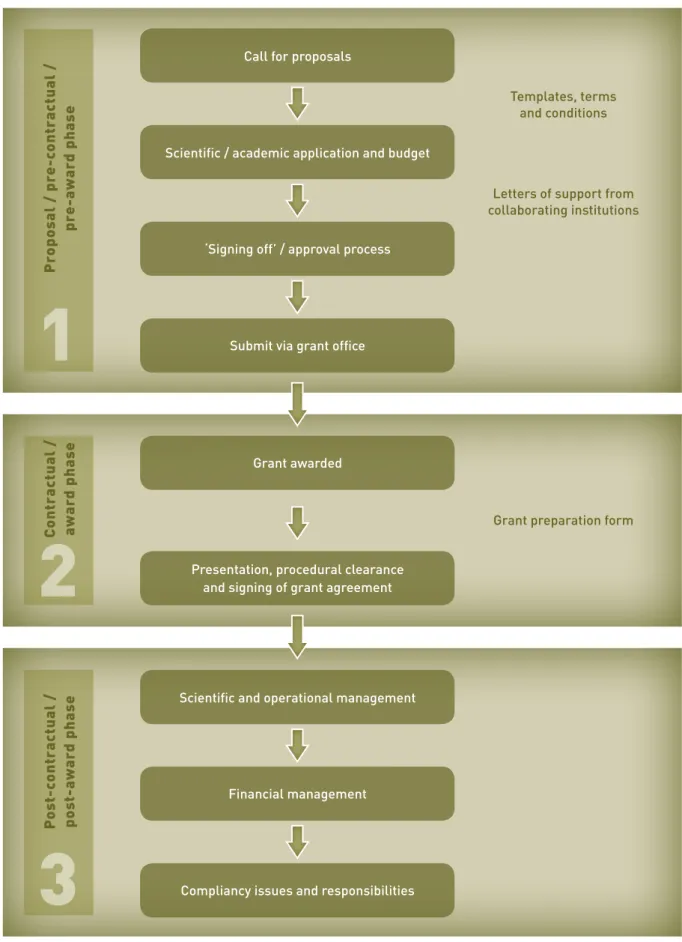
The grant application and management process is illustrated in Figure 2 and the phases are described below.
Figure 2: The grant application and grant management process
Call for proposals
Templates, terms and conditions
Letters of support from collaborating institutions
Grant preparation form
Scientific / academic application and budget
Scientific and operational management ‘Signing off’ / approval process
Financial management Grant awarded Submit via grant office
Compliancy issues and responsibilities Presentation, procedural clearance
and signing of grant agreement
Pr oposal / pr e-c ontr actual / pr e-awar d phase
1
2
3
Contr actual / awar d phase P os t-c ontr actual / pos t-awar d phaseProposal/pre-contractual/pre-award phase Application process
Several public funding agencies, foundations or other non-profit organisations such as the National Institutes of Health (NIH), the United States Agency for International Development (USAID), the European Union (EU), the Wellcome Trust, the Bill and Melinda Gates Foundation (BMGF), fund research projects. They post their calls for proposals on the internet or send it to the RGCOs at universities. Most of these calls request the submission of research proposals in specific research areas or themes and normally contain the purpose of the programme, the eligibility criteria, the funded activities, the grant amount and duration, and the deadline for the submission of proposals. Some funding agencies will only consider applications from consortiums.
When a researcher shows interest in a specific funding opportunity, the instructions and policies of the funding institution have to be studied, as each funding agency has their own application templates, terms and conditions. The scientific or academic application, including the budget, can then be prepared by the researcher, who will act as the principal investigator or project leader. The budget should correspond with the project work plan and motivation. Letters of support from collaborating institutions should be obtained where applicable. As is the case with research and research-related contracts, an internal process for ‘signing off’ or approval of applications should be followed to verify that the project is in line with the priorities of the faculty. Several funding agencies make use of electronic application forms that are submitted on the internet. Even in these cases, the submission should be submitted via the RGCO at the university. Where a consortium is involved, the final proposal is submitted by the consortium leader. Usually a letter of support from each consortium member will be required prior to final submission.
Budgeting
The project leader must determine the cost of the research, on a full-cost basis where applicable. A template for the calculation of costs, price estimations and overhead or indirect cost calculations can be used. A full-cost budget includes both direct and indirect costs.
Examples of direct costs include personnel costs (at least the minimum basic remuneration level), the cost of equipment, running costs, and costs related to consumable materials, audits, additional insurance (required by some funding agencies), travel, conferences, workshops, seminars, or any other direct cost related to the project and bursaries. Indirect costs vary between insitutions and include overheads such as the departmental and faculty overheads, income overheads and the space and facilities overheads of the university. Indirect costs can normally be budgeted for from funding institutions.
The time span between submission of the grant application and the approval of the grant can be up to 12 months, plus another few months for the effective start of the project. The principal investigator should therefore make provision in the budget for cost and salary increases. For budgets submitted for foreign grants, the local currency should be converted to the relevant foreign currency and a conservative exchange rate should be used.
Submission
To submit an application as the ‘prime recipient’ usually requires that an institution formally register on the database of the funding agency and/or undergo a due diligence audit before being registered. Contractual/award phase
The same procedural clearance process that is followed for research and research-related contracts, is followed for grant agreements. The funding agency provides a grant agreement to be signed in order to ensure that the university complies with the terms and conditions of the funder. The funding agency usually does not claim IP (but may require royalties) and each funding agency provides their own contract template. Other contractual agreements that may be required together with the grant agreement or accession to grant agreement, include a non-disclosure agreement, a consortium agreement and/or an IP agreement.
The principal investigator should take note of the following important risks that could be associated with grant agreements: exchange-rate risks, payment terms, reporting requirements and additional auditing requirements at extra cost.
Some funding institutions request that a grant preparation form is signed prior to the issue of a grant agreement. This form indicates the university’s intention to enter into the agreement. Only the delegated authority may sign these forms. Internal approval should be obtained by way of a signed declaration letter before the grant preparation form is signed.
Post contractual/post-award phase
After the grant has been awarded, several aspects of the grant have to be managed. During this post-contractual phase, special attention has to be paid to the following:
• Scientific and operational management – the principal investigator has contractual responsibilities, including on-time scientific and financial reporting.
• Financial management – the budgeted versus actual costs, claims, tax, financial reporting and auditing should be managed by the project accountants and regular meetings should be held with the principal investigators.
• Compliancy issues and responsibilities – complying with the funder’s regulations and policies is very important for both the university and the principal investigator. Time sheets, activity reports and external financial reports should be prepared and submitted on time. The principal investigator should also take note of allowable and non-allowable costs, auditing requirements, the submission of audited statements, interest repayments and exchange-rate risk management.
There are several types of research contract that are used by higher education institutions. Before a contract can be signed, a thorough risk–benefit analysis should be performed. The risk of a contract is compared to its related benefits and the question of whether a risk is acceptable, is addressed. As part of the risk assessment, all relevant compliance issues should be considered. It is important to be knowledgeable on all relevant national and international legislation (i.e. the IPR Act, Biodiversity Act, National Health Act, contract law, and so on). It is equally important to ensure that research contract-related policies are developed and implemented to support the best-practice approval process and to ensure that such policies are easily accessible to researchers.
It is also the RGCO’s responsibility to ensure that the institution’s vision and mission is taken into consideration, as well as the academic footprint when a contract is reviewed. Further considerations should include specific terms of a contract, such as auditing and reporting requirements.
There are two main types of compliance that require attention: regulatory compliance and institutional compliance. Regulatory compliance includes a consideration of ethical, financial and IP compliance. Institutional compliance requires a consideration of the institution’s policies, vision and mission. Table 4: Compliance matters
5. Types of contract and risk assessment
Regulatory compliance
Ethical
In research, ethical clearance for the use of human subjects, human blood and tissue, animals, radioactive material, genetically modified organisms, indigenous plants and interaction with humans, is often required. This is regulated by legislation such as the:
• Human Tissue Act No. 65 of 1983, RSA
• National Environmental Management: Biodiversity Act No. 10 of 2004, RSA • National Health Act No. 61 of 2003, RSA
• Animal Health Act No. 7 of 2002, RSA
• Medicines and Related Substances Control Act No. 101 of 1965, RSA
• Fertilizers, Farm Feeds, Agricultural Remedies and Stock Remedies Act No. 36 of 1947, RSA • Genetically Modified Organisms Act No. 15 of 1997, RSA
The responsibility for the review lies with the institution’s Ethics Committee. The RGCO of an institution needs to liaise with the Ethics Committee, to ensure that the research done will comply with legislation in this regard.
Financial
Where a contract has a financial value, the RGCO needs to liaise with the Finance Division, to ensure compliance with Acts such as the:
• Value-Added Tax Act No. 89 of 1991, RSA
• Income Tax Act No. 58 of 1962, RSA
IP compliance
Where IP is involved, the RGCO needs to liaise with the institutions’ Technology Transfer Office where applicable, to ensure compliance with the:
• Copyright Act No. 98 of 1978
• Patents Act No. 57 of 1978 • Trade Marks Act No. 194 of 1993
• Plant Breeders’ Rights Act No. 15 of 1976
Determining the required agreement/contract
How to determine the type of agreement/contract you will need
A very effective way for a university to transfer knowledge, technology and expertise is through direct co-operation with industry partners and other research institutions, either within the framework of research projects or grants, or by providing scientific services. It is advisable and usually necessary to enter into formal agreements with industry and with public and private organisations that support scientific research. In drawing up such agreements, it is essential to specify, by means of a contract, the following elements of the project:
• Detailed work plan, time line and milestones. • Budget, funding and payment schedules.
• IP rights with regard to research results and patents. • Scientific publications.
• Confidentiality of shared or exchanged information. • Responsibilities of the respective parties.
There are several types of research contract, each with a specific purpose and use, and the terminology can vary between organisations. Research contracts are sometimes referred to as ‘consultation
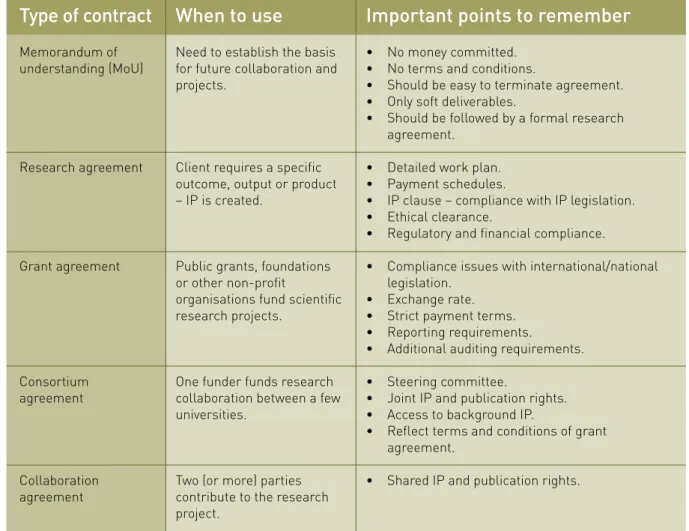
contracts or service level agreements’, ‘grant agreements’, ‘funding agreements’ or ‘collaboration agreements’. Described below are some of the most common types of research agreement. Table 5 contains a summary of the types of agreement.
Types of contract
Memorandum of Understanding (MoU)
Memorandums of Understanding are used to establish the basis for future research projects. They are binding agreements that agree on general clauses for future contracts, but usually without payment terms and a contract amount. A Memorandum of Understanding should be followed by a formal research agreement.
Research agreement
This is the most common form of contract and suits several research purposes, for instance funding
Institutional compliance
The institution’s policies, vision and mission
An institution needs to develop and implement policies to reflect the vision and mission of the institution that are in line with national and provincial legislation. Such policies include a:
• Research contract management policy
• IP policy
• Financial management policy • Ethics policy
agreements and collaboration agreements. The client requires a specific outcome, output or product, and IP is usually created. The agreement will be for a specific time period, and have a specific project budget and work plan. The terms of the research agreement include ownership of IP as well as terms regarding completion of the work. The institution should have a standard research contract. Researchers should maintain the right to publish their scientific results.
Grant agreement
These are research-related contracts for scientific research projects supported by public grants, foundations or other non-profit organisations such as the NIH, USAID, the European Union, Wellcome Trust, etc. The funding agency usually does not claim IP (but may require royalties) and has its own templates containing specific terms and conditions. Some funding institutions request a grant preparation form to be signed prior to the issue of a grant agreement. The university should ensure that compliance with the financial and contractual terms of the research-grant agreement is feasible.
Consortium agreement
When collaborators work together on a research project, the agreement usually involves the collaborating universities or institutions, with a single funder. The consortium leader takes responsibility for the agreement and organises meetings/telecons with the members, in order to finalise the contract. All the consortium partners (their researchers and legal representatives) have to agree on the terms and conditions of the consortium agreement. It can thus take up to a few months to finalise a consortium agreement.
Collaboration agreement
These agreements are used where two (or more) parties contribute to the research project through scientific participation or other contributions, such as background IP. Collaboration agreements allow for IP to be shared and set terms regarding commercialisation and joint publication.
Service level agreement (SLA)
A service level agreement is a negotiated agreement between two parties where one is the client and the other is the service provider. The SLA records a common understanding of the deliverables, completion criteria, schedule for delivery of services, priorities, responsibilities and fees. The service provider will provide their IP as background material for the work. New IP or publications are unlikely to arise from the work.
Consultation agreement
Consultation agreements are used when expertise, advice and work on a particular field is being provided. Consultations are generally a fee-for-service type of arrangement and the use of a service level agreement is recommended.
Analytical test contract
This contract is used when the university is the provider of analytical tests. A standard service level agreement is used and the details of the analytical tests, time line and costs are specified.
Clinical trial agreements
A clinical trial is a research study designed to test the safety or effectiveness of drugs, devices, treatments or preventive measures on humans. The protocal in the agreement is almost always provided by the client, and it is crucial that the principal investigator adheres strictly to the protocol throughout the process of the clinical trial study.
Confidentiality or non-disclosure agreement (NDA)
A non-disclosure agreement must be signed when a client approaches the university for the exchange or sharing of confidential information as the forerunner to a potential project. The other instance in which a confidentiality agreement must be enforced, is as part of a research contract. Both the client and the university’s confidential information should be protected by a non-disclosure agreement. A standard confidentiality agreement can be used. Universities could also enforce an internal, student/staff non-disclosure agreement to ensure that the student or researcher complies with the confidentiality agreement.
Material transfer agreement (MTA)
This is used when the university is receiving or supplying tangible research materials (any tissue, cells, or other biological or other proprietary materials required for a research project). Specific ethical and import or export permit requirements must be considered. The rule of thumb is that the the supplier of the material compiles or provides the MTA. See Table 5 for more details.
Subcontract
A subcontract is used when a research contract is already in place and a different external party needs to be subcontracted to assist with the project, or to provide a specific portion of the deliverables. The university can also be subcontracted by another institution to perform specific tasks or services. When drafting a subcontract where the university contracts external services in order to complete its obligation to the client, the principal agreement between the client and the university should be used as a basis to draft the subcontract. Relevant clauses from the principal agreement, to which the subcontracter must adhere, should be reflected in the subcontract. A back-to-back agreement is therefore recommended.
Licensing agreement
Owners of IP rights are free to allow others to exercise their rights. Permission to exercise a right is known as a ‘licence’. A licensing agreement is a written contract whereby the owner of a copyright, know-how, patent, servicemark, trademark, or other IP, allows a licensee to use, make, or sell copies of the original. Such agreements usually limit the scope or field of the licensee, and specify whether the licence is exclusive or non-exclusive and whether the licensee will pay royalties or a lump-sum payment in exchange. Licensing agreements are mainly used in the commercialisation of a technology. One of three different types of licence may be granted:
• An exclusive licence, in terms of which only the licensee is entitled to use the rights licensed.
• A sole licence, which is similar to an exclusive licence except that the licensor also has the right to use the rights licensed.
• A non-exclusive licence, in terms of which the licensor retains the right to license other third parties to simultaneously use the rights licensed.
Intellectual property (IP) agreement
An IP agreement, also called an ‘intellectual property transfer agreement’, or ‘intellectual property assignment agreement’, is a written contract between the university and a client or collaborator for the assignment (purchase and sale) of intellectual property rights. The IP being assigned or purchased can consist of copyrights, trademarks and/or patents. The agreement specifies the rights and responsibilities of each institution concerning IP that may be created during the term of the collaboration. The rights may be associated with IP that is created jointly by the collaborating researchers, as well as IP that is created independently by each. As opposed to a license agreement, the purchaser or assignee in an IP agreement takes total and exclusive ownership and control of the IP rights and is free to use those rights however he or she wishes. In most cases, the IP clauses within a research agreement will be sufficient. However, when it is not possible for the parties to reach agreement on the exact arrangements at the time of negotiating the research agreement, the parties will agree to enter into a separate IP agreement should IP be created during the course of the project. Table 5: Types of research agreement used by higher education institutions
When to use
Need to establish the basis for future collaboration and projects.
Client requires a specific outcome, output or product – IP is created.
Public grants, foundations or other non-profit
organisations fund scientific research projects.
One funder funds research collaboration between a few universities.
Two (or more) parties contribute to the research project.
Important points to remember
• No money committed.• No terms and conditions.
• Should be easy to terminate agreement. • Only soft deliverables.
• Should be followed by a formal research
agreement.
• Detailed work plan. • Payment schedules.
• IP clause – compliance with IP legislation. • Ethical clearance.
• Regulatory and financial compliance. • Compliance issues with international/national
legislation.
• Exchange rate. • Strict payment terms. • Reporting requirements.
• Additional auditing requirements. • Steering committee.
• Joint IP and publication rights. • Access to background IP.
• Reflect terms and conditions of grant
agreement.
• Shared IP and publication rights.
Type of contract
Memorandum of understanding (MoU) Research agreement Grant agreement Consortium agreement Collaboration agreement Continued...When to use
Higher education institution is the service provider, or subcontracts a party to perform the work or services required by the client. Usually involves consultation service/analytical testing. Research institution tests the safety and/or effectiveness of drugs, devices, treatments and preventive measures on humans.
Confidential information is shared between the university and the client.
University is receiving or supplying biological or other proprietary materials.
University allows a licensee to use, make, or sell copies of the original IP.
IP is assigned to a client or collaborator.
Important points to remember
• Upfront payment should be negotiated. • Limit liability to the contract amount.• Link payment terms to milestones – payments
always after deliverables.
• Where the university subcontracts other parties,
enforce the same.
• Terms and conditions as in the main agreement. • Ethical clearance.
• Compliance with protocol. • Informed patient consent.
• Malpractice and non-fault insurance, if so
required.
• Opt-out clause (patient must be protected). • Term not to be excessive.
• Five exceptions present?
• Student/staff NDA sent and signed?
• Ownership of background IP to remain so vested. • Should be reciprocal.
• A clear description of the type of material. • Project description (what will it be used for?) • Ethical clearance.
• Import/export permits.
• Non-transferable to third parties. • Not to be used for commercialisation. • Definition of the IP.
• Is it an exclusive, sole or non-exclusive licence? • Protect the university’s interests.
• Compliance with relevant IP legislation. • Definition of the IP that is being assigned. • Joint IP rights.
• Compliance with relevant IP legislation.
Type of contract
Service level agreement (SLA) Clinical trial agreements Confidentiality or non-disclosure agreement (NDA) Material transfer agreement (MTA) Licensing agreement IP agreementRisk assessment
It is crucially important to compile a complete matrix of the potential risks for each contract in order to assess the risks and perform a thorough risk–benefit analysis. Risks that should be considered include the nature, value and term of the contract, established milestones, and financial risks related to the exchange rate, insurance, technical aspects, reputation, confidentiality, legal considerations, jurisdiction and termination. Special care should be taken to ensure that IP is protected timeously and strictly in accordance with the university’s IP Policy, which lays the foundation for the future
commercialisation of research outputs by the Technology Transfer Office or IP Rights Office. It is equally important to ensure compliance with the financial requirements stipulated in the financial policies of the university. Consultation with the Technology Transfer Office / IP Rights Office and the Finance
Division may be necessary, as well as consultation with the relevant research environments. Contracts are negotiated and finalised for signature by reason of the risk evaluation.
Legal and contractual aspects of risk assessment Confidentiality
‘Confidential information’ means any information a party discloses that has been marked as confidential or is identified as confidential by the party at the time of disclosure; the terms and conditions of an agreement including all materials, technologies, inventions, know-how, research strategies, trade secrets and material embodiments thereof; and the logic, coherence and methods of use or implementation of any of the aforementioned that a party has created, acquired, or has rights in, and anything derived from any of the above.
It is advisable to avoid being bound to contracts with a duration exceeding five years, as managing a confidentiality agreement within higher education institutions is relatively high risk. Care should be taken to ensure that the agreement is mutually applicable – this can be seen as a test of fairness. What applies to the higher education institution should also apply to the client. Note that there is a difference between a non-disclosure agreement (NDA) and a confidentiality clause in a contract. A non-disclosure agreement is usually signed when pre-contractual negotiations require sharing of confidential
information, whereas a confidentiality clause in a research or other agreement, relates to information received during the contract term. Further care should be taken to define what is to be considered as ‘not confidential’. This relates to information that is already in the public domain; information that was in the recipient’s possession before disclosure; information that is independently developed by the recipient; information received from a third party who was entitled to disclose, and information that is made known due to operation of law or a court order.
It is useful and advisable to arrange that confidential information is marked ‘confidential’ by the disclosing party so that not all information is expected or assumed to be confidential, as this will cause the recipient to always be at risk of breaching confidential information. An example of a confidentiality clause in a comprehensive research agreement could be:
Confidentiality
• General. Each Party (‘the Recipient’) must treat and hold as confidential all Confidential
Information which it may receive from the other Party (‘the Discloser’) or which becomes known to it during the term of this Agreement.
• Confidentiality obligations. The Recipient agrees that in order to protect the proprietary interests of the Discloser in its Confidential Information, unless the Discloser has expressly agreed
otherwise in writing, the Recipient will not and will ensure that its Personnel does not at any time, whether during this Agreement or thereafter, use or disclose to any third party any
Confidential Information of the Discloser other than as allowed in terms hereof. Without limiting the aforesaid, the Recipient shall:
• notify the Discloser of all persons to whom the Discloser’s Confidential Information is to be disclosed by the Recipient or who are to be granted access to the Discloser’s Confidential Information before those persons are permitted access to the Discloser’s Confidential Information;
Continued... Publication
• The Client recognises that under the academic policies of the HEI, the results of research work must be publishable and agrees that the Researchers engaged in the Research shall be permitted to present at symposia, national or regional professional meetings and to publish in journals, theses or dissertations, or other methods of reporting of their own choice, methods and results of the Research.
• if required by the Discloser, arrange for any persons who are permitted access to the Discloser’s Confidential Information to give a written confidentiality undertaking to the Discloser to be bound to the terms of this clause;
• ensure that its Personnel and any other person that it permits to access the Discloser’s Confidential Information comply with the provisions of this clause;
• ensure that, upon request by the Discloser, any materials containing Confidential
Information furnished to the Recipient will be returned or otherwise disposed of as the Discloser may direct, provided that in the event the Recipient is instructed to dispose of or destroy such materials, the Recipient shall provide the Discloser with an acceptable certification of such destruction.
• Use of Confidential Information. The Recipient may disclose the Discloser’s Confidential
Information only to its Personnel on a ‘need to know basis’ and such Personnel may be permitted to use the Discloser’s Confidential Information only to the extent reasonably required for the pursuit of the Research and for such other purposes as may be expressly authorised by the Discloser in writing.
• Exceptions. The aforegoing obligations shall not apply to any information which:
• can be demonstrated to have been lawfully in the public domain at the time of disclosure or subsequently and lawfully becomes part of the public domain by publication or otherwise; or
• is disclosed pursuant to a requirement or request by a regulatory authority (including NIPMO), by any court of competent jurisdiction or by operation of Law, provided that the Recipient gives as much notice of such impending disclosure as is reasonably possible and provide the Discloser with all reasonable assistance in preventing and/or limiting such disclosure.
• Remedies. The Recipient agrees that, in the event of a breach or threatened breach of this clause, the Discloser is entitled to seek injunctive relief or specific performance, in order to obtain immediate remedies. Any such remedy shall be in addition to and not in lieu of any other remedies available at Law, including monetary damages.
Publication
In most cases a client sponsoring research will request to review and approve a proposed scientific publication. The purpose of submitting the proposed publication to the client, is to protect confidential information or prevent possible infringement of IP. As it is one of the responsibilities of a higher education institution to publish research in scientific journals, the institution should stringently avoid being forced by the client not to publish. Instead, the institution should be at pains to allow a client to review the proposed publication (or abstract for a conference etc.) while retaining the right to publish. The following clause could serve this purpose:
Reputation/publicity
The purpose of a publicity clause is to prevent the client from using the university’s name or logo for own publicity or marketing purposes. Written permission should be formally required when the higher education institution’s name or logo or trademark is used. An example of such a clause:
Insurance
The client may require specific insurance to be taken out, or a certificate of insurance, or a specified minimum amount to be insured for a specific period. Specific types of insurance include professional liability, clinical trial, and public liability insurance. Budget considerations should be taken into account. If the specific required insurance is not covered by the university’s insurance policies, the project carries the costs, such as the cost of additional cover for students conducting research in the field.
Limitation of liability
Limit the institution’s liability to the contract amount if possible (in some cases a funding agency requests a limitation of liability to the contract amount, plus interest). As far as possible, negotiate to exclude consequential or indirect costs or damages, such as loss of income due to defective service. However, some clients will enforce a much higher limitation of liability than the institution is willing to allow. In such cases, try to negotiate for a higher liability only in cases of breach, wilful default and gross negligence. However, avoid minimum liability towards the Client but where negotiations are unsuccessful apply the higher liability only to breach, wilful default and gross negligence. A preferred clause would be:
• The HEI may publish or allow the publication of research results or data, in whatever medium concerning the Research, provided that this does not affect the protection of Intellectual Property Rights. The Client shall be given 30 (thirty) days prior written notice of any planned publication. If, before the end of this period, the Client so requests, a copy of the planned publication shall be provided to the Client within 30 (thirty) days after receipt of such request. The Client may require the removal of any or all of its Confidential Information from a planned publication in order to protect its proprietary rights and interests and the Researchers will be required to comply with any such requirement prior to publication. The Client may object to the planned publication within 30 (thirty) days after receipt thereof. The planned publication shall be suspended until the end of this consultation period. In the absence of any objection within the above-mentioned period, it is deemed that the Client agrees to the publication.
Limitation of liability
The University’s total aggregate liability is limited to the total project costs for any and all injuries, losses, damages and expenses. In no event shall any party be liable for any indirect or consequential damages including, but not limited to loss of profits, revenues, contracts, or the like.
Publicity
The Client will not use the name of the University, nor of any member of the University’s staff, nor the University’s logo or trademark, in any publicity, advertising or news release without prior written approval.
Warranties
Where faced with a clause in a contract reading: ‘The University shall be liable for any violation of rights of third parties in respect of patents and/or copyrights’, the university will be extremely vulnerable to a lawsuit. Warranties should instead be clearly defined. Blanket warranties such as in the example above, i.e. that IP is unencumbered by third parties, is often difficult or impossible to prevent. Do not warrant research results in a contract. Rather, use the phrase ‘reasonable endeavours,to deliver research results’. As an example, a preferred clause would be:
Breach/termination
In many contracts breach and termination is dealt with in the same clause, and as one matter. However, when faced with reality this might pose problems, as there might be good reasons to terminate a contract, without any breach having taken place.
In the case of breach, a formal notice of breach should be given to the party that is deemed to be in breach. A reasonable time (10–30 days) should be provided to remedy this breach. When termination is required, grounds for termination should be stipulated, e.g. ‘breach of a material term’, or ‘the key personnel has resigned and the University is not able to take the project further’, and so on. Termination without breach should occur only when mutually agreed between the parties and with a reasonable notice period. Care should be taken when phrases such as ‘may be terminated at the sole discretion of’ or ‘at any time’ is written into the clause.
It is advisable to indicate in the contract that when there is termination without breach, non-cancellable obligations (such as salaries etc.) will be refunded by the client. At least a three-month written notice period is recommended for termination without breach.
Any clause indicating that the client or funding agency can cancel the project at their sole discretion and expect repayment of funds plus interest (without breach), must be renegotiated by the university.
Jurisdiction
Jurisdiction determines which country’s law applies in the case of a dispute and where the matter will
be heard. It is preferable to negotiate to use institution’s country of origin as the jurisdication. However, very often funding agencies or clients will only allow their own country’s jurisdiction. This is a risk that should be flagged with the university’s insurers. Alternatives to enforcing a specific country as the jurisdiction, is to keep jurisdiction silent, or to indicate that it will be the country of the defendant. Another option is to choose a neutral jurisdiction, such as Belgium when dealing with a UK client.
Conflict of interest
Conflict of interest is not always directly addressed in a contract, although some funding institutions are very strict on declaration of any financial conflict of interest. No funds from EU, NIH or USAID may flow back into the pockets of researchers.
Warranties
The University shall use reasonable endeavours to ensure that it will not infringe on any intellectual property rights or other rights of any third party.
However, care should be taken that researchers do not use their position at the university to influence the award or conclusion of a contract between the university and another individual or company by virtue of their association with, or interest in, that company or individual; for example, where the researcher is a director of the subcontracting company and so on. The university should therefore have a conflict of interest policy that is adhered to at all times.
Payment terms
Payment terms are often neglected in contracts. The contract amount or the amounts of the tranches/ installments should be clearly indicated, as well as the dates/conditions on which payments will be made. If the university is a subrecipient or subcontracted under a prime agreement between the client
and his or her main client, the payment to the university for research or services should ideally not be conditional on the client’s receiving funds from their main client. Alternatively, if the contract is terminated earlier due to a shortage of funding, the client should pay the expenses/fees already incurred and committed to by the university.
When being subcontracted, or when subcontracting another party for portions of the work, it is essential to make use of a ‘back-to-back’ agreement, so as to ensure that all parties fulfil the requirements of the main funder/client.
When the university pays a subcontractor, try to minimise the upfront payment with the balance paid to the subcontractor on receipt of deliverables. When the university is receiving payment as a subcontractor, try to maximise upfront payment with the balance paid on receipt of deliverables. It is important to note that in many cases, one cannot reclaim expenses incurred before the contract is signed.
Intellectual property
Section 6 gives more detailed information regarding the IP rights issues that should be addressed. Relevant legislations, as well as the institutional policies should be considered when negotiating IP rights ownership with the client.
When a research report is the deliverable to the client for the exclusive use of the client, then a distinction should be made between what is confidential and what can be published as part of an academic thesis or dissertation, or in a scientific publication. Usually the client becomes the owner of the copyright in the report, while the university retains the right to use the content or the raw data for research and training purposes.