Magisterarbeit
Titel der Magisterarbeit
“Pension System Reform”
Verfasser
Petr Kratochvíl
angestrebter akademischer Grad
Magister der Sozial- und Wirtschaftswissenschaften
(Mag. rer. soc. oec.)
Wien, im März 2012
Studienkennzahl lt. Studienblatt: 066 913
Contents
Introduction 3
1 Introduction to Pension Systems 5
1.1 Objectives of Pension Systems . . . 5
1.2 Classification of Pension Systems . . . 6
1.2.1 Public and Private Pension Systems . . . 6
1.2.2 Defined-contribution and Defined-benefit Schemes . . . 7
1.2.3 PAYG and FF Schemes . . . 8
1.3 Simple Model of a Pension System . . . 9
1.4 Various Risks For Pension Systems . . . 10
1.4.1 Political Risks . . . 11
1.4.2 Demographic Risks . . . 12
1.4.3 Longevity Risks . . . 13
1.4.4 Macroeconomic Risks . . . 13
2 Pension System in the Czech Republic 15 2.1 Historical Overview . . . 15
2.2 Current Pension System . . . 16
2.2.1 Mandatory PAYG Scheme . . . 16
2.2.2 Voluntary FF Scheme . . . 18
2.3 Motivation for the Reform . . . 20
2.3.1 Demographic scenario . . . 20
2.3.2 Financial Sustainability of the Current Public System . 22 2.4 Main Reasons for the Reform . . . 25
3 Pension System Reform and Pareto Efficiency 27 3.1 PAYG Scheme as an Efficient Scheme . . . 28
3.1.1 Open versus Closed Economy Models . . . 30
3.2 Possibility of Pareto Improvement . . . 31
3.3 Conclusions from the Debate . . . 34
4 Political Economy of the Pension Reform 37
4.1 Favourable Conditions for Reforms . . . 38
4.1.1 Pre-existing Conditions and Probability of the Reform 39 4.1.2 Interest Groups . . . 41
4.2 Political Economy and Modelling the Reform . . . 42
4.3 Conclusions . . . 44
5 The Central European Experience With Pension Reforms 46 5.1 Historical Overview . . . 46
5.1.1 Hungary and Poland Before 1989 . . . 47
5.1.2 First Years After 1989 . . . 47
5.2 Pension Reform in Hungary . . . 49
5.2.1 Early Reforms . . . 49
5.2.2 The New Pension System . . . 51
5.2.3 The End of the New Pension System . . . 53
5.3 Pension Reform in Poland . . . 55
5.3.1 Early Reforms . . . 55
5.3.2 The New Pension System . . . 55
5.3.3 Conclusions . . . 57
5.4 Pension Reform in Slovakia . . . 58
5.4.1 Early Reforms . . . 58
5.4.2 The New Pension System . . . 59
5.4.3 Evolution of the New System . . . 60
5.5 Lessons from CEE countries . . . 62
6 Pension Reform in the Czech Republic 64 6.1 The New Pension System . . . 64
6.1.1 Political Background . . . 64
6.1.2 The First Pillar Reforms . . . 65
6.1.3 The Second Pillar Reforms . . . 67
6.2 Objections Against the New System . . . 70
6.3 Evaluation . . . 72
Conclusions 74
References 76
Introduction
Over the past decades the population has changed a lot. Due to to many cir-cumstances such as technological and economic growth or progress in medical sciences, people live much longer nowadays. This brings up many challenges for the current society. One of them being the problem of pension systems.
This thesis aims at bringing contribution to the discussion about pension system reform by exploring the theoretical basis of the reform and identifying problems in the reform implementation. There are three main topics of this thesis:
• Problem identification
• Theory presentation
• Solution implementation
Firstly, in chapters 1,2, we identify the problem. We define objectives of pension systems, classify the most important types of pension systems, and show how they work. We present also the basic way how to model a pension system and point out the main risks of different pension system types. Afterwards, we take the Czech Republic as an example of a country experiencing difficulties with pension system. We describe the evolution of the Czech system and show what are the main problems and how will they evolve in the near future. At the end of Chapter 2 we present main reasons for the reform.
Secondly, in chapters 3,4, we present the theoretical background of the pension system reform. We discuss the Pareto efficiency problem and present conditions under which the pension system reform might be Pareto-efficient. We also outline the political economy of the reform. Using a study describing the reform implementation in Latin America and transition economies, we identify the most crucial variables, such as pre-existing conditions or influence groups, which have an impact on the possible success of the reform.
Hungary, Poland and Slovakia and we evaluate their reforms. We identify the most crucial mistakes that were made and draw lessons out of them. These lessons have to be followed if the pension system reform in the Czech Republic should be successful. Finally, we discuss the current Czech reform and main objections against it. At the very end of Chapter 6 we evaluate the Czech reform and predict how the new system will work in the near future.
Chapter 1
Introduction to Pension
Systems
In this introductory chapter we start with the main objectives of pension systems and reasons of their existence. Then we introduce basic concepts of different pension systems and economic tools which are used to model this environment, the so called overlapping generations models (OLG models). This we use later when analysing different pension schemes and the transition between them. At the end of this chapter we mention various risks the different pension schemes face.
1.1
Objectives of Pension Systems
Individuals are not economically active lifelong and therefore they have to secure an income after they retire. This could be essentially done on a private basis without any state intervention. Individuals could save or invest part of their income while they are economically active in order to use when they are older.
The problem one faces when deciding how much should one save or invest during his active years in order to be able to consume in retirement is caused by many uncertainties in the real world. First uncertainty is how long one is going to live. Living too long could cause outliving one’s savings. This can be solved by an insurance provided by a private company, because although it is almost impossible to predict longevity of a particular individual, the prediction of longevity of a sufficiently large group of people is much eas-ier. Such private company can than provide insured people with annuities knowing the average life expectancy.
gov-ernment intervention. Barr and Diamond (2006) identify two sets of reasons why this approach is insufficient in the real world. The first set of reasons consists of existence of many imperfections, such as imperfect information, missing markets or numerous distortions in the economy. The second set consists of other government’s objectives which could be easily accomplished through the pension system, such as fighting poverty or redistribution. An example of fighting poverty would be paying pensions to those people who were not able to safe enough for their retirement. This could be also an example of redistribution. However, we can find redistribution which is not primarily poverty fighting such as redistribution towards married couples with children or towards war veterans.
As a result, pension system is nowadays a very complicated multi-purpose framework which influences the whole economy. Therefore its setting is cru-cial.
1.2
Classification of Pension Systems
Because the problem of shifting wealth (consumption) from one’s productive middle age to one’s higher age has to been solved in every society, some type of pension system exists in every country. In this section we would like to define the most common schemes.
1.2.1
Public and Private Pension Systems
As mentioned above the main purpose of a pension system is to ensure con-sumption smoothing. This could be done both on public or private basis. In developed economies people usually finance their consumption at higher age from both systems (pillars1). Nevertheless the proportion of public and
private system differs substantially among different countries.
The public pension system is usually state-organized, i.e. the state is responsible for both contribution collection and pension payments. This system is in most countries mandatory. Main reasons for this is individual myopia and possible insurance market failures. We distinguish two types of state-organized pensions (often a state pension consists of both types):
• Flat-rate pension - every pensioner is provided with an equal pension
independent of former income.
1If there are more systems from which people get pensions from we refer to these
• Earnings-related pension - every pensioner is provided with a pension which is related to former income (usually a minimum pension is defined here).
According to Bezdˇek (2000a), all OECD countries except from Australia, Ire-land, the Netherlands, and New Zealand have some type of earnings-related pension, using usually defined-benefit pay-as-you-go schemes (see later).
On the other hand, in most countries there exists a possibility to use a private pillar, which is very often subsidized from the government. This pillar can be organized in many ways:
• Private pension funds: these funds are usually under strict
governmen-tal supervision and are usually allowed to invest mainly into low-risk assets such as government bonds. These funds administer individual pension accounts, i.e. the future payments are related to former sav-ings, and insured people are provided either with an annuity when they retire or they are allowed to withdraw the whole amount at once.
• Employer-sponsored occupational scheme: depending on a country these
schemes are administered either directly by employers, or could be or-ganized by financial institutions in case of small enterprises, or on the other hand, could be organized jointly on professional basis. Employer-sponsored occupational schemes are historically much older than any other type of the private pillar.
• Other possibilities: such as personal savings or individual life insurance.
The first two saving schemes in private pillar can be both mandatory or voluntary, the third one (personal savings, individual life insurance) is voluntary.
1.2.2
Defined-contribution and Defined-benefit Schemes
Before discussing the differences between the pay-as-you-go system and the funded system we introduce another classification of pension systems which describes how closely the benefits of the system are related to one’s previous contributions. We distinguish following approaches:
• Defined-contribution scheme
• Defined-benefit scheme
In a defined-contribution scheme (DC scheme) insured persons pay fixed contribution, usually a fixed fraction of their income. The benefit they get when they retire is not guaranteed and depends, for example in case of private pension funds, on the return on investment. Therefore the possible benefit from this scheme can vary a lot.
On the other hand, in a defined-benefit scheme (DB scheme) one has a guaranteed future pension, generally a fixed fraction of former income, the so-called replacement ratio. The formula used to compute the pension can take into account not only the former income throughout the whole productive years, but also the highest former income or the last income one had before one retired. Sometimes it takes into account the length of the service as well. Although in this scheme people pay a regular contribution which is usually defined as a fraction of income, like in the DC scheme, the crucial difference is that here the sponsor (which could be the state or the employer, for instance) ensures that the insured persons get their guaranteed benefit after they retire. In other words, the sponsor’s contribution ensures the balance of the DB scheme and he is the one who takes the risk.
The last approach is the notional defined-contribution scheme (NDC scheme). This scheme mimics the DC scheme insofar as it pretends every person had an individual account, even though these accounts are fictive and do not match any real funds. This scheme is used in pay-as-you-go schemes and each contributor pays a fixed fraction of his income as a contribution which is credited to his fictive personal account. This account pays a notional in-terest which is set up by the government (the notional inin-terest rate does not equal the market interest rate). When one retires, the account balance is converted into an annuity.
We would like to point out that both the DC scheme and the NDC scheme could incorporate some redistribution for example through determining a minimal guaranteed pension.
1.2.3
PAYG and FF Schemes
Speaking about pension systems and pension system reform, the essential division is the one between a pay-as-you-go scheme (PAYG scheme) and a fully funded scheme (FF scheme). We will start with introducing both extreme cases and, later on, show that in reality a middle approach is often taken.
A PAYG scheme is based on intergenerational solidarity and is usually run by the state (although we can find PAYG schemes run by employers). In this scheme, the current retired population receives pensions which are paid from contributions of the current working population. This scheme has
to be mandatory in order to safeguard future payments, i.e. to be able to promise future pensions for the current working population. There are no investments in this scheme and it works fully on a redistributional basis.
In a FF scheme, on the other hand, contributions of current working population are invested into assets and the return on these is credited to one’s personal account. In retirement, the insured persons are paid either an annuity or some other way of payment is used (sometimes a one-time withdrawal is possible). In this scheme there is no redistribution and one’s pension fully depends on one’s savings. The FF scheme is the most usual scheme used in private superannuation schemes, however, it is sometimes used also in public schemes.
The FF scheme is a DC scheme, i.e. there is a defined contribution one has to pay, but the benefit is not guaranteed and depends on many exogenous variables such as the rate of return. The pure PAYG scheme is, on the other hand, a DB scheme, because pensions are guaranteed as far as the legislation is not changed. Nevertheless the PAYG scheme can be organized as a NDC scheme and than there is no strict guarantee of the future pension amount either.
1.3
Simple Model of a Pension System
After defining the most important divisions among pension schemes we would like to point out the main characteristics of the PAYG and FF schemes, some of which we will analyse more thoroughly in the next chapters. We will start with introducing the way how a pension system is modelled using an OLG model. In this subsection we start with a simplified one, just to be able to show the main differences between a PAYG and a FF scheme (see Rosner 2003 or Ribhegge 1999).
In this OLG model people live for two periods. In the first period they work, in the second they just consume (using only savings they have made in the first period in case there is no public pension system). In each period there are only two generations alive - one is working and one is retired. We will assume everybody dies at the same age having consumed all his savings, i.e. leaving no bequests.
Let’s start with a PAYG scheme. In this scheme contributions have to equal pensions in every period t:2
NtwWtbt=NtrPt, (1.1)
where Ntw and Ntr stand for the working population and for the retired pop-ulation in the period t, respectively. Wt is the real wage, bt the rate of
contribution and Pt the pension paid in the period t.
Let’s assume the population is constantly growing at raten and the real wage is constantly growing at rate w:
Ntw+1 = (1 +n)Ntw, Wt+1 = (1 +w)Wt.
Now we can define a rate of return i of the PAYG scheme as follows:3 1 +i= Pt+1
Pt
= (1 +n) (1 +w)bt+1
bt
. (1.2)
From this equation we see that if we keep the rate of contributionbtconstant,
we have i ≈ n+w, for low enough values of n and w. In other words each generation gets approximately (n+w)-times more on pensions than they have paid on contributions.
In the case of the FF scheme the rate of return equals the rate of interestr. Each generation invests a fraction bt of its income Wt and gets in the next
period the pension Pt+1:
Pt+1 = (1 +r)Wtbt.
Therefore, if we want to decide which pension scheme is more suitable we compare rates of returns of both schemes. Aaron’s condition (Aaron 1966) states if
n+w > r (1.3)
the PAYG scheme is to be preferred. However, in the long term, according to the macroeconomic theory we should have an equality, i.e. n+w=r.
This result does not mean, because of the transformation costs, that whenever n+w > rholds or vice versa we should change the pension scheme accordingly. We will discuss this matter in detail in Chapter 3.
1.4
Various Risks For Pension Systems
In the Section 1.1 we have mentioned possible risks one faces when securing an income for the retirement. In this section we would like to specify these risks and discuss them with relation to the PAYG and to the FF scheme. From the following text it will also be clear why a multi-pillar system is
recommended in order to minimize every possible risk.4 According to B¨ orsch-Supan and Reil Held (1997) and Holzmann (1997) we discuss the following risks: political, demographic, family, longevity and macroeconomic risks.
1.4.1
Political Risks
With a political risk we mean those political actions which can substan-tially change the amount of future pensions. Neither of these two schemes is resistant to this risk. A legislation can be easily changed which affects both schemes. We are experiencing, for example, continual small parametric changes of PAYG schemes in many countries which directly influence current pensions. As an example of this we can mention abolishing the minimum replacement rate in Austria in 1984 which substantially decreased women’s pensions (Rosner 2003).
Table 1.1: Pensions in Austria
Year 1983 1984 1985 1986 1987 1988 1989 1990
Pension of women
as percentage 58.8 59.0 56.4 51.7 49.7 49.4 49.1 50.2
of pension of men
Source: Rosner (2003).
Pension funds, on the other hand, may be misused or in extreme cases nationalized - recall the very recent Hungarian case. It is assumed that political risk is bigger in case of PAYG schemes, because goals of governments (and governments themselves) are constantly changing. These political risks are much smaller in case of pension funds as far as in developed countries the property rights are guaranteed.
4The World Bank recommends a five pillar framework with following pillars: a
non-contributory zero pillar to ensure a protection against poverty (for example a flat-rate pension); a mandatory first pillar based on a PAYG scheme; a manda-tory second pillar based on an individual savings account (FF scheme); a voluntary third pillar taking all possible forms such as individual savings or employer-sponsored scheme; a non-financial fourth pillar such as family support, social programs or
as-sets such as house ownership. See The World Bank Pension Conceptual
Frame-work, available at http://siteresources.worldbank.org/INTPENSIONS/Resources/395443-1121194657824/PRPNoteConcept Sept2008.pdf.pdf.
1.4.2
Demographic Risks
The demographic risk is nowadays very often discussed and is often used by politicians to give a reason why the transition from a PAYG scheme to a FF scheme (or to a mixed scheme) is inevitable. Although this opinion is in political discussions often not doubted at all, economists have shown that the transition from a PAYG to a FF scheme does not solve the adverse demographic problem.
As Barr (2000) argues, we can show this as follows. In the first case, we assume the real output is staying the same despite of the adverse demographic development. Let’s assume the generation t is twice as big as the following generation t + 1, but the output does not change and hence the real per
capita wage doubles, i.e. Wt+1 = 2Wt. Recalling the equation describing the
PAYG scheme from previous section
NtwWtbt=NtrPt,
we see that in this case, in spite of lowering the replacement ratio Pt
Wt, the real pension Pt stays the same. This case does not pose any risk to a FF scheme
either because higherper capita output (and higher real wages) ensures that the demand of the current working population for assets stays the same and therefore the current pensioners have real pensions they expected.
The problem arises when the output growth does not offset the adverse demographic development. Let’s assume again that Nt = 2Nt+1, with the
overall output staying the same Wt = Wt+1. From the equation describing
the PAYG scheme we see that either the future pension has to be halved
Pt+1 = P2t or the contribution rate has to be doubled bt+1 = 2bt, in order to
keep the pension level the same Pt+1 =Pt. Both policies are not sustainable
in long-term since they would lead at the end to having no public pensions at all.
Unfortunately, this problem cannot be directly solved by transforming the PAYG scheme into a FF scheme, because supply of assets the current old generation would like to sell in order to finance its consumption exceeds the demand of the smaller current working population. Therefore the future real pension is also under the funded scheme considerably lower than expected (due to higher prices and/or lower rate of interest - capital is less scarce with respect to the working force).
As we have shown, the problem lies not in demographic, but in the low output: “PAYG and funding are both mechanisms for organizing claims on future output; since demographic change generally affects that output, it
The solution to population ageing lies not in funding per se but in output
growth.” (Barr and Diamond (2006)).
1.4.3
Longevity Risks
The longevity risk has been already mentioned. Everybody faces a risk of living too long and outliving one’s savings. This risk does not exist in PAYG schemes at all. In a FF scheme where one is paid an annuity, on the other hand, there is a moral hazard and an adverse selection problem.
An individual faces a moral hazard because he can, to a certain extend, influence how long he is going to live (e.g. people with a healthy life style live longer). Unfortunately the seller of the annuity (an insurance company) knows only the average longevity and therefore offers an annuity based on information it has about the whole generation and not about the particular individual.
The second risk (adverse selection problem) refers to the fact that people with shorter expected longevity are not going to buy annuity based on average longevity. Because of this, the expected longevity of those willing to buy an annuity is higher and therefore insurance companies have to adjust (raise) the price of the annuity. After that also the expected average longevity of those willing to buy thenew annuity raises and the insurance company has to adjust the price once more. This goes ad infinitum. Theoretically this could lead, as Bezdˇek (2000a) points out, to a situation where there is nobody offering annuities.5 This problem could be solved by a compulsory purchase of an annuity for all insured persons.
1.4.4
Macroeconomic Risks
There are various kinds of macroeconomic risks. Generally speaking, FF schemes are much more subject to these risks because of their nature. One of the most discussed are the capital market risks (variation in the rate of return, inflation or exchange rate fluctuations). These risks can be mitigated by investing into low risk assets, inflation-indexed bonds or into assets in the same currency area where we want to consume later it the retirement.
Another possible macroeconomic risks are negative output shocks or un-employment. Also these risks are bigger for a FF than for a PAYG scheme. In case of a negative output shock, an unfunded system could be exposed to
5On the other hand Brown (2002) shows that based on utility even for low-income
groups buying an annuity is favourable if the administrative cost are sufficiently low. This is due to the fact that the threat of outliving one’s savings is severe, even though the
lower revenues, but impacts on individuals can be mitigated. As well as in the case of unemployment where it leads to lower contributions to the sys-tem, but in the short-term the pension system can be subsidized from other taxes.
As the last note, we would only like to point out that even though these risks influence the funded scheme much more than the unfunded scheme these risks can be in contrast to the main risks of the unfounded scheme (e.g. political risks) diversified. One can invest in different assets in different currencies, but in the PAYG scheme one cannot mitigate the political risk, for example.
Chapter 2
Pension System in the Czech
Republic
In the previous chapter we have defined the basic concepts of pension schemes. In this chapter we introduce the pension system in the Czech Republic and argue why a reform is necessary.
2.1
Historical Overview
In the description of the Czech pension system we start with a very short overview of its history (M¨uller 2000). Like in other countries the first pension system in the territory of the present Czech Republic was intended only for civil servants (started in 1771). Afterwards other professional groups were also slowly granted a pension scheme: miners in 1854, manual workers in 1906. In 1924 the Manual Workers’ Social Insurance Act established the fourth pension scheme providing all employed people with an old-age pen-sion. This pension system was a FF scheme, financed both by employers and employees and a state subvention is provided. Pensions had a flat-rate basis and a earnings-related part. It is worth noting that in those days pensioners became their pensions first at the age of 65. The last notable change before the World War II was the foundation of the fifth scheme in 1929, providing means-tested pensions which were tax financed.
After communists taking the power in 1948 the National Insurance Act was introduced putting a PAYG scheme into practice. The pension system was part of the state budget and from the year 1952 onwards it has been financed through a wage tax. There were three groups of workers according to the importance of the sector they work in for the state, each group get-ting a different pension (advantaging workers in heavy industry). In 1956
the age of retirement was lowered to 60 (55) for men (women) and in 1964 the age of retirement for women was linked to the number of children - 53 years for women with five children or more, 57 years for women without chil-dren. Apart from this there were not many changes of the system during the communist era.
After the velvet revolution in 1989 no big pensions system reform took place. In 1990 the Czech Social Security Administration ( ˇCSSZ,Cesk´ˇ a spr´ava
soci´aln´ıho zabezpeˇcen´ı) was founded as a part of the Ministry of Labour and
Social Affairs which was responsible for the pension system administration. The state pension persists to be a PAYG scheme. Contributions are paid by both employers and employees. The pension system was extended to cover also the self-employed and the system was made homogeneous by cancella-tion of former professional privileges, such as for example those for miners, and it relates benefits more closely to previous earnings and the length of the contributory period. In 1991 the Pension Act introduced the pension indexation to the retail price index (during the communist era there was no indexation). In 1994 the existence of private pension funds was enabled. The participation in these funds was voluntary and state subsidized.
2.2
Current Pension System
In order to be able to discuss the pension system reform in the Czech Re-public, we have to firstly describe the current system and offer predictions about most important variables influencing it. We start with the description in this section and the prognosis will follow in the next section.1
2.2.1
Mandatory PAYG Scheme
The Czech pension system has nowadays (in year 2011) two pillars. The first pillar is a mandatory public PAYG scheme which covers almost the whole population and which is uniform (there are no special schemes for differ-ent professions). The second pillar is a voluntary private state-subsidized FF scheme. The public scheme offers four types of pensions:
• Old-age pensions - 74% of total pension system expenditure in 2009,2
• Disability pensions - 18%,
1The information about the current pension system is taken from the Ministry of
Labour and Social Affairs of the Czech Republic, http://www.mpsv.cz.
• Survivors’ and Children’s pensions - 8%.
Our main focus in this thesis is of course on the old-age pension. The contribution rate into the public scheme is now 28% of the gross wage (6.5% is paid by the employee himself and 21.5% is paid by the employer).
Originally one received the regular old-age pension if one has contributed into the system at least for 25 years and has reached the age of retirement or has contributed for 15 years and was 65 years old. The age of retirement is nowadays 62 years for men and 55-60 years for women depending on how many children they have raised. Women are retiring one year earlier for each child raised, i.e. at the age of 60 in case they had no children and at the age of 55 in case they have raised 5 children or more).
But these system parameters are continuously being changed and in 2018 the mandatory contribution period into the system in order to qualify for the regular old-age pension will be 35 years and reaching the retirement age or 20 years but being 5 years older than the retirement age. The retirement age is also being continuously increased and in 2033 it should be 65 years for men and 62-65 years for women (64 if they have raised 2, 63 if 3 and 62 if 4 or more children). There also exists a possibility for earlier retirement in case one has contributed at least for 25 years to the system and one is not more than 3 years younger than the official retirement age (for those whose retirement age is above 65 years this condition is extended to 5 years). In the case of earlier retirement the pension is lowered.
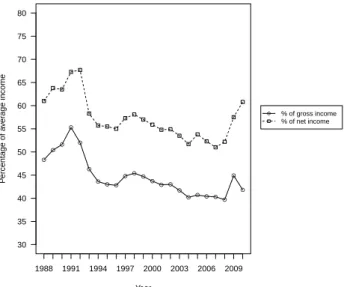
The current old-age pension consists of two components, a flat-rate and an earnings-related component. The flat-rate component is 2,170 CZK and the earnings-related component at least 770 CZK per month (the current living wage in the Czech Republic is 2,020 CZK). The earnings-related component is influenced not only by one’s income, but also by the contribution period. The current average old-age pension (the second quarter of 2010) is 9,839 CZK3 which is 42% of the current average gross wage. This ratio between old-age pensions and wages is decreasing in long term as shown in the following table (we have experienced a reverse trend in last years because of the economic crisis which has influenced wages, but not old-age pensions):
Figure 2.1: Relationship between pensions and wages ● ● ● ● ● ● ●● ● ●●● ● ●● ● ●●●●● ● ● 1988 1991 1994 1997 2000 2003 2006 2009 30 35 40 45 50 55 60 65 70 75 80 Year P ercentage of a v er
age income ● % of gross income % of net income
Source: CZSO, own computations.
In order to secure certain living standards for pensioners pensions are automatically annually valorized. Only in the case when annual inflation rate is below 2% or above 5% a special approach is taken.
The goal of securing certain living standards is accomplished as the ratio of retired people under the poverty threshold is smaller than it is in the whole population. Below the threshold of 60% of median income there is 8% of the whole population, but only 4% of those older than 60 years, 4.4% of those older than 65 years and 6.6% of those older than 75 years.4
2.2.2
Voluntary FF Scheme
As mentioned above, since 1994 the existence of private pension funds (FF, DC scheme) was enabled. This scheme is opened to everybody older than 18 years, who has a permanent residence either in the Czech Republic or in any EU member state and is contributing either to the public pension system or to the public health insurance system. Every person, once he decides to participate on this pension scheme, is obliged to contribute at least 100 CZK per month. The state subsidy is at least 50 CZK and at most 150 CZK per month (in case one contributes more than 500 CZK per month). These
contributions can also be paid by the employer. Another form of subsidy of this pension scheme is a tax relief and a relief on pension system and health insurance contribution for its contributors.
At this moment (year 2011) there are 10 private pension funds which are regulated by the Ministry of Finance of the Czech Republic. This pillar is widely used and at the end of the year 2009, 4,447,252 persons were partic-ipating. This makes 58% of the population in productive age. The average annual per capita contribution in 2009 was slightly bellow 9,500 CZK with the following average distribution of sources of contributions:
Figure 2.2: Distribution of contributions into private pension funds
66%
20%
14%
Contributions from individuals Contributions from employers State subsidy
Source: CZSO, own computations.
If we express the individual private pension fund contribution in terms of average wage we get that people save within pension funds in long term approximately 2% of their income.5 This amount is considered as too low in
order to generate decent future pension and it will be shown later why and how people should be motivated to save more.
Pension funds in the Czech Republic are investing mainly in bonds - 84% (out of which 83% are government bonds), to a lesser extent they invest into other financial assets such as shares (5%). The valuation of investments in pension funds in the long term is rather low and did not exceed the infla-tion rate in many years in a row (2007,2008,2009). In 2010 the valuainfla-tion if corrected for inflation was 0.3-0.5%. This low valuation is also due to the fact that pension funds are obliged to have non-negative annual nominal val-uation. This condition is about to be cancelled according to the proposed pension system reform.
2.3
Motivation for the Reform
In the previous text we have described the current old-age pension system in the Czech Republic. In this section we would like to provide the reader with reasons why the reform of the current pension system is necessary. In the next chapters we will afterwards discuss how feasible is this reform.
2.3.1
Demographic scenario
One of the main exogenous variables that influence every pension system is the ratio between economically active and retired population. The retired population is always somehow dependent on the active population regardless of the particular pension scheme adopted (as shown in Chapter 1). Therefore in times when the population is getting older and the dependency ratio6 is
growing we have to adapt the pension system. In the 21st century almost every developed country is facing this problem and the Czech Republic is not an exception:
6Dependency ratio is in the of case pension systems a ratio of retired people and
economically active people. Generally the dependency ratio is a ratio of not economically active (i.e. dependent) and economically active population (i.e. independent, productive).
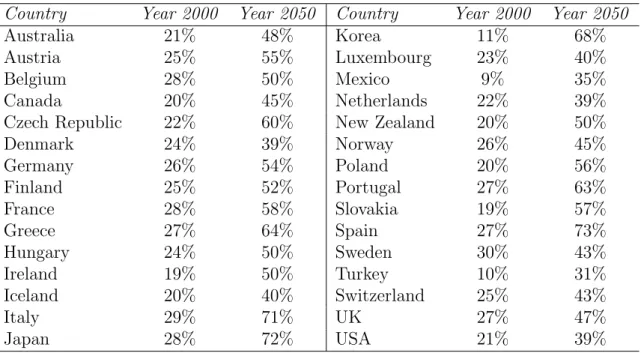
Table 2.1: Old age dependency ratio in developed countries (65+ in % 20-64)
Country Year 2000 Year 2050 Country Year 2000 Year 2050
Australia 21% 48% Korea 11% 68%
Austria 25% 55% Luxembourg 23% 40%
Belgium 28% 50% Mexico 9% 35%
Canada 20% 45% Netherlands 22% 39%
Czech Republic 22% 60% New Zealand 20% 50%
Denmark 24% 39% Norway 26% 45% Germany 26% 54% Poland 20% 56% Finland 25% 52% Portugal 27% 63% France 28% 58% Slovakia 19% 57% Greece 27% 64% Spain 27% 73% Hungary 24% 50% Sweden 30% 43% Ireland 19% 50% Turkey 10% 31% Iceland 20% 40% Switzerland 25% 43% Italy 29% 71% UK 27% 47% Japan 28% 72% USA 21% 39% Source: OECD.
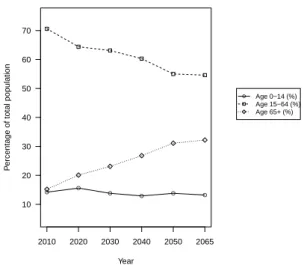
As we see from the table, the dependency ratio is going to grow signifi-cantly over the following years in all listed countries. The average dependency ratio in OECD countries in this time period will more than double-up (from 22% to 47%). If we concentrate on the Czech Republic, using 2009 Czech Statistical Office forecast and its middle scenario up to the year 2065,7 we get
the following results: While the number of population stays approximately the same - 10.4 million in 2009 and 10.7 million in 2065 (this slight popula-tion growth will be due to the imigrapopula-tion), the age structure of the society will change a lot as shown in the following figure:
7This forecast works with three scenarios: low, middle and high. In the low scenario
one expects very low level of fertility and low level of migration, in high scenario it is vice versa. In this thesis we present only the middle scenario.
Figure 2.3: Distribution of age groups in years 2010-2065 in the Czech Re-public ● ● ● ● ● ● 2010 2020 2030 2040 2050 2065 10 20 30 40 50 60 70 Year P
ercentage of total population
● Age 0−14 (%) Age 15−64 (%) Age 65+ (%)
Source: CZSO.
This change of the age structure of the population does not affect only the amount of pensioners whom a pension has to be paid (the number of people in the oldest age group (65+) grows from 1.6 million in 2010 to 3.4 million in 2065)8, but it also affects the amount of the contributors (the number of people in productive age will sink from 7.4 million in 2010 to 5.8 million in 2065).
2.3.2
Financial Sustainability of the Current Public
System
The pension system reform is proposed mainly due to the fact that the cur-rent public PAYG scheme is not financially sustainable in the long run and therefore cannot secure future decent living conditions for the contemporary young generation. In this subsection we would like to present the financial balance of the public pension system and also its future projections.
Between the years 1993 and 1996 the pension system had surpluses. This has changed in 1997 and till 2004 the system was in deficit. Main reasons for this change is lowering the contribution rate from 27.2% to 26%. Also the
system of public pension indexation was amended stating that the annual pension indexation should equal at least the inflation and one-third of the increase of the real wage which has lead to higher system expenditures. In 2004 the contribution rate was raised to 28% which lead to financial con-solidation of the system and we have seen surpluses for many consecutive years.
There were other important changes that were introduced in 2004 and have helped with financing the pension system. One of them was the re-striction of the possibility of early retirement - even though one received lower pension if retiring earlier, this possibility was very popular and widely used mainly because of a very high unemployment rate among older people (according to Bezdˇek (2005) in 2003 45% of all new pensioners have retired earlier). The other change that was introduced was raising the minimal pen-sion system contribution base9 for self-employed which has also led to higher
system contributions. This contribution base is in case of self-employed still much lower than in case of employees (in 2004 the base for self-employed was only 30.8% of the base for employees). This affects the pension system a lot because of the increasing amount of self-employed in the system.
In the last years, contributions into the pension system were not sufficient mainly due to higher unemployment. The adverse demographic problem also influences the pension system balance, but in the short term issues like higher unemployment or changes in the contribution rate are much more relevant. The financial balance of the pension system in the last years is presented in the following chart:
9The contribution base is a part of earnings of the self-employed that serves as a basis
Figure 2.4: Financial Balance of the Public Pension System ● ● ● ● ● ● ● ● ● ● ● ● ● ● ● ● ● ● 1993 1995 1997 1999 2001 2003 2005 2007 2009 −2.0 −1.5 −1.0 −0.5 0.0 0.5 1.0 1.5 2.0 Year P ercentage of real GDP ● Balance (% of GDP)
Source: CSSZ, M¨uller (2000), Bezdˇek (2005), own computations.
Because of the upcoming pension system reform in the Czech Repub-lic there has been several studies predicting the future financial balance of the pension system. All these studies predicted big deficits of the pension system account mainly because of the ageing of the population. In 2004 a committee of experts was set up in order to assess the pension system reform proposals of the main political parties in the Czech Republic (those which were represented at that time in Chamber of Deputies) and also the so called basic scenario which has shown prospects of the pension system without any reform.10
The committee predicted11 a long term annual deficit of the pension
sys-tem of about 5% of the GDP. This would mean an overall deficit of 110% of GDP in 2065 and 260% in 2100. The replacement ratio would decrease from 42% in 2005 to 38% in 2100. These predictions did not assume that the pen-sion system is totally rigid and the annual penpen-sion indexation and changes in the pension calculation (mainly changes of the pension system contribu-tion base) were taken into account. The committee also assumed that the government bond interest rate stays the same over the examined time period - if we allow for higher interest rate over the time, which is reasonable, the deficit of the pension system would be significantly higher.
10At this point we are going to present only the results of the basic scenario, because
the parties’ proposals were not taken into account after 2004.
11See the Final Report (2005) of the committee. Source: Ministry of Labour and Social
These results were confirmed later in 201012 when discussing the pension system reform once more after taking no significant action after presenting the findings of the first committee in 2005. The main message of the new committee is the same as the one back in 2005 - the current public pension system is not financially sustainable in the long term. This second committee predicted annual system deficit of about 4% of the GDP after 2050 and overall debt of 100% of the GDP in 2065. The slight change in predictions is on one hand due to parametric reforms which has been put through and updated demographic scenario (both improving prospects of the current system) and as well as due to the financial crisis (leading to change of prospects of the system in the short term, but not influencing it significantly in the long term). Also other authors came to the same result that the public pension system is financially unsustainable in the long term. Marek (2007) for example estimates that in 2050 the annual system deficit is going to be almost 9% of the GDP and the overall debt 155% of the GDP. He tries to estimate the financial balance for longer time period and according to his study in 2150 the annual deficit is going to be almost 16% of the GDP and the overall deficit 2,526% of the GDP.
2.4
Main Reasons for the Reform
In previous sections we have shown that the current pension system in the Czech Republic is not financially sustainable in the long run if we take de-mographic and macroeconomic trends into account. This is one of the main reasons why the reform is necessary. This financial balance problem leads not only to the impossibility of guaranteeing sufficient pensions for future old generations, but it is also intergenerationally very unjust as long as the current expenditures of the system have to be paid by future generations.
Another important goal of the pension system reform is the diversification of pension funding. According to the Final Report - PES (2010) in the year 2008 the pension from the public pension system formed 94% of the income of Czech pensioners. This is a very risky situation, because almost all pensioners depend on one pillar. In the first chapter we have discussed various risks to different pension schemes and in this current situation in case of lowering public pensions for example due to lack of funds, pensioners would find themselves in a very critical situations without having almost any possibility to find a compensatory source of income.
12See the Final Report - PES (2010). Source: Ministry of Labour and Social Affairs of
Another topic to discuss when discussing the reform is also the problem of the intragenerational redistribution. The Czech public pension system was very egalitarian, for example in 1998 approximately 50% of all pensions were in ±10% interval from the average pension (Bezdˇek 2000b). That has led to a Ruling of the Constitutional Court in April 2010 stating that the pensions ought to be more earnings-related, which has forced the government to change the way how to compute the pension in order to agree with the Ruling (the so called Small Pension Reform).
The problem of intragenerational redistribution and egalitarian public PAYG schemes is well known and many authors pointed this out (see for ample Cubeddu 1998). On the other hand some authors argue that there ex-ists a positive correlation between one’s lifelong earnings and one’s longevity and therefore there exists no intragenerational redistribution (see for example Mitchell and Zeldes 1996).
Chapter 3
Pension System Reform and
Pareto Efficiency
In this chapter we would like to start discussing the pension system reform. Firstly, we introduce theoretical concepts of this transition and afterwards we discuss some practical problems. We start with Pareto efficiency discussion in this chapter and then in the next chapter we present the political economy debate.
In Chapter 1 we presented the Aaron’s condition stating when the FF scheme is more efficient than the PAYG scheme - if r > n+w, i.e. when the real interest rate exceeds the sum of the population growth rate and the real wage growth rate.1 Even though if this condition is satisfied, it does not directly imply that the transition from a PAYG to FF scheme is efficient. The reason for this is the existence of transition costs which are not inconsiderable.
In this section we discuss the possibility of Pareto improving transition from the PAYG to the FF scheme. With a Pareto improving transition we mean a transition where no generation (present or future) is worse off and at least one generation is better off.
We start in this chapter with an article from Breyer (1989) in whose model the Pareto improving transition from PAYG scheme to FF scheme is not possible. Afterwards we present Homburg’s model (Homburg 1990) where he shows that if certain conditions are met the transition could be Pareto improving. In conclusion we compare these two approaches.
1However as it was already mentioned in Chapter 1r=n+wshould hold in the long
3.1
PAYG Scheme as an Efficient Scheme
In his seminal paper Friedrich Breyer (1989) asks the question whether it is possible after the pension scheme has been changed to compensate the first generation of pensioners for their loss without making any future generation worse off than under the PAYG scheme. He presents two models: an open economy, and an closed economy model. He shows that in both cases the transition from a PAYG to a FF scheme is not Pareto improving. We are going to present only the first model, but at the end of this section we also mention results of the second model (for the closed economy).
In the open economy model (as well as later in the close economy model) an OLG model with 2 generations is applied. We use the same notation as in the Chapter 1. We assume that the population growth rate is exogenous and constant. We further assume that only one good exists and every worker is endowed with an income of one unit of this good. Capital markets are perfect in this model and the interest rate is constant and exogenous. Re-garding the notation we have to distinguish now between the contribution into the PAYG scheme (bP AY G
t ) and the contribution into the FF scheme
(bF Ft ). Furthermore we have to distinguish between pensions paid from the PAYG scheme (PP AY G
t ) and pensions paid from the FF scheme (PtF F) which
are defined as follows:2
PtP AY G+1 = (1 +n)bP AY Gt+1 , PtF F+1 = (1 +r)bF Ft .
We define discounted lifetime consumption (which is the same as discounted lifetime income) for an agent in period t as
Vt= 1−bP AY Gt +
(1 +n)bP AY G
t+1 +ψt+1
1 +r , (3.1)
where 1−bP AY G
t is the consumption in the periodt andψt+1 is a government
subsidy per pensioner which is paid as a compensation for the pension system reform. We do not have to express the FF scheme payments, because they do not change the lifetime consumption Vt. The last thing we have to define
is the government debt which exists due to these compensations:
Dt+1 = (1 +r)Dt+ (1 +n)ψt+1. (3.2)
After these definitions we can compare two following situations. In the first situation (let’s call this situation A), only the PAYG scheme with a
2Note that both expressions are the same as in the Chapter 1, but in Breyer’s model
constant contribution rate bP AY G exists (bP AY G = bP AY Gt ,∀t). In this plan, which is set up in period t = 1, there are no government subsidies, i.e. ψt=
0,∀t. Agents of generation t = 0 have the following lifetime consumption (note that they did not pay any contributions into the pension system, but they receive pensions from it, because they are pensioners in period t= 1):
V0A= 1 + 1 +n 1 +r ·b
P AY G
,
and agents of other generations (t≥1) have following lifetime consumption:
VtA≥1 = 1−bP AY G+1 +n 1 +r ·b P AY G = 1 + 1 +n 1 +r −1 ·bP AY G.
In the second situation (let’s call this situationB) we introduce a FF scheme and compensate the first generation (generation 0) for not having a PAYG scheme using a government subsidyψ1. Let’s assume that the population growth rate
is smaller than the interest rate (g < r). Because of this compensation the following holds: V0B= 1 + ψ1 1 +r = 1 + 1 +n 1 +r ·b P AY G =VA 0 (3.3) ⇒ψ1 = (1 +n)·bP AY G.
Paying this subsidy causes a government debt which has to be paid by future generations. Because of the condition g < r future generations can afford paying off this debt while getting the same pension as in plan A. The crucial question is, whether the debt can be paid off in a finite time horizon. This would make those future generations, who do not have to pay off this debt better off, while making no generation worse off, because all generations get at least the same pension as they would get in plan A.
The lifetime consumption for future generations is
VtB≥1 = 1 + ψt+1 1 +r = 1 + 1 +n 1 +r −1 ·bP AY G =VtA≥1. ⇒ψt+1= (n−r)·bP AY G,∀t≥1.
Now we examine if the government debt DB under the pension plan B can be paid off. In the period t the debt is equal to
DBt = (1 +r)t−1·N0·bP AY G· " 1 +n+ (n−r)· t−1 X 1 +nτ# ,
where the first part of the term is equal to the original debt in the periodt = 1 and the second part of the term is equal to the sum of all compensations to the following generations. TheN0stays for the size of the original population.
After several steps (see Appendix A.1) we get that the per capita govern-ment debt remains constant over the time:
DB t Nt = D B t N0·(1 +n)t =bP AY G. (3.4)
This means that the government debt is never paid off, i.e. no future gener-ation can be made better off under the plan B compared to plan A without making any generation worse off. Therefore this transition from the PAYG to FF scheme is not Pareto better even though we have assumed that the rate of return of the FF scheme is higher than the rate of return of the PAYG scheme.
In the closed economy model, which is also an OLG model with two generations, the worker’s income and the interest rate are both endogenous. Furthermore, in this model, after the transition from PAYG to FF scheme is pursued, it is not possible to compensate the first retired population for its lost without making any future generation worse off compared to their possible gains from the original PAYG scheme. Even though if we assume that the FF scheme is more effective - Breyer shows that the FF scheme leads to higher per capita production in every period - the transition is not Pareto improving.
3.1.1
Open versus Closed Economy Models
When modelling the pension system reform the question of whether an open or closed economy model is more appropriate arises. We are aware of the fact that a transition to a FF scheme (or to a mixed scheme) influences the domestic interest rate to some extent. This effect is of course much stronger in case of big economies such as Germany than in case of smaller ones such as the Czech Republic.
In this thesis, nevertheless, we use mainly open economy models. As B¨orsch-Supan, Ludwig and Winter (2005) have shown in their paper the closed economy models are doing much worse in modelling the pension sys-tem reform compared to the open economy models due to neglecting effects of international capital mobility. “To the extent that capital is internation-ally mobile, population aging will induce capital flows between countries, and these capital flows will modify the effects of population aging and pension
especially within the EU the international mobility of capital is rather high and therefore it is more appropriate to use open economy models.
3.2
Possibility of Pareto Improvement
The article of Friedrich Breyer caused a wide discussion and one of the replies was the article of Stefan Homburg. Homburg argues that Breyer’s conclusion about Pareto efficiency is due to the setting of his model and that it does not correspond to reality. The main flaw of Breyer’s model is the modelling of pension system contributions as lump-sum taxes. Therefore Homburg’s model takes contributions as flat-rate taxes on labour income and pensions themselves as lump-sum payments. This setting corresponds much better to reality. Recall the fact that in the Czech pension system there is one pension system contribution rate, which is basically a labour income tax. On the other hand, pensions can be viewed as lump-sum transfers regardless of the Ruling of the Constitutional Court in 2010 and the Small Pension Reform, because strong intragenerational redistribution prevails.
Homburg (1990) presents also an OLG model with two generations. As well as Breyer, he considers small open economy, i.e. wages3 w
t and rate of
interest r are exogenous. The interest rate and the size of the population are assumed to be constant. The member of each generation solves following maximization problem while he is young:
max c1 t,c2t+1,lt U c1t, c2t+1,1−lt , (3.5)
with following constraints
c1t +st=wt·lt·(1−bP AY G),
c2t+1 = (1 +r)·st+PtP AY G+1 ,
where c1
t (c2t+1) stays for the consumption of generationt in its first (second)
period, st stays for savings and lt denotes one’s labour supply, i.e. (1−lt)
denotes one’s leisure. The sum of one’s labour supply and leisure is normal-ized to one. The utility functionU(·) is assumed to be strictly monotonically increasing, strictly quasi-concave and has second derivatives. Goods are as-sumed to be normal.
In the first step, Homburg shows that the PAYG scheme is not Pareto efficient, i.e. it is possible to make one generation better off without making any worse off using, as he calls it, capital reserve system cum government
debt (CRCD). This system is an optimal solution to following optimization problem:
max
b,Pt+1,Dt
Vt(b, Pt+1), (3.6)
with the following constraints
b·wt·lt=bP AY G·wP AY Gt ·lP AY Gt −Dt,
Pt+1 =PtP AY G+1 −(1 +r)·Dt,
Pt+1 ≥0.
Note that we have to distinguish between wages and labour supplies in both cases (i.e. between the case with the original PAYG scheme and the case when CRCD is put into practice), because these are determined by the ex-isting pension scheme. The first condition secures that in the period t the retired generation gets its pension payment PP AY G
t =bP AY Gt ·wtP AY G·lP AY Gt
which is paid either by taxing the current working population or by a gov-ernment debt. The second constraint secures, that the debt Dt is repaid by
the generation t. And this constraint, together with the last one secures that the government debt ((1 +r)·Dt) is never bigger than the implicit debt of
the PAYG scheme (PtP AY G+1 ).
If we combine the first and the second constraint we get the following condition:
Pt+1−(1 +r)·b·wt·lt =PtP AY G+1 −(1 +r)·b P AY G·
wP AY Gt ·ltP AY G. (3.7) This condition secures that the government policy (government choosesb, Pt+1, Dt)
does not change one’s lifetime income. The following holds
PtP AY G+1 >(1 +r)·bP AY G·wP AY Gt ·ltP AY G,
when the growth rate is bigger than the interest rate, i.e. wP AY Gt+1 ·lP AY Gt+1
wP AY G t ·lP AY Gt
>
(1 +r). Homburg calls this generation a winner. If the opposite holds, he calls the generation aloser. Proving the following propositions (see Appendix A.2 for proofs):
1. Given the generationt is a winner, the optimal government policy is to
set b∗ = 0.
2. Given the generation t is a loser, the optimal government policy is to
set Pt∗+1 = 0.
3. Given the generation t is neither a winner nor a loser, the optimal
4. The PAYG scheme, i.e. bP AY G >0∧PtP AY G+1 >0, is never optimal.
we conclude that the PAYG scheme is not an efficient pension system in this model. This result is due to the existence of distorting income tax in the PAYG scheme. By creating a government debt and cancelling the income tax as well as the lump-sum pension, agents are better off due to cancelling the excess burden which was caused by the labour-leisure choice distortion.
We ask the reader to note, and it will be emphasized later, that this conclusion does not mean at all that we should abolish the PAYG scheme as whole and replace it by the FF scheme. In this model we did not include possible risks of both schemes which were mentioned in Chapter 1. Moreover, when we discuss pension systems also other than economic arguments should be taken into account - for example some redistribution towards people with low income, which could be seen as socially just even if it is not efficient from the economic point of view.
We have shown that the PAYG scheme is not optimal. The last step is to show that even if the PAYG scheme already exists, it is efficient to convert the pension system to FF scheme. As well as Breyer also Homburg assumes4 that the interest rate exceeds the growth rate and therefore every
generation is aloser except from the first one. He shows that the government debt used to compensate the first generations will be paid off in finite time and all generations afterwards will be gaining from this transition while past generations are not affected.
We introducebt for contribution rates used in the transformation period5
and we show that bt is bigger thanb∗t (the contribution rates of the CRCD),
but smaller than bP AY G. It can be shown (for the proof see Appendix A.3) that the following holds:
Given that the interest rate exceeds the growth rate and some PAYG scheme
already exists there are sequences(bt),(Pt) = (P1P AY G,0,0, ...)and(εt)≥ε >
0 such that bt·wt·lt=bP AY G·wP AY Gt ·l P AY G t − PP AY G t+1 1 +r +εt·w P AY G t ·l P AY G t , (3.8) Vt(bt,0) =Vt(bP AY G, PtP AY G+1 ),∀t≤T. (3.9)
In addition such T exists and it holds that Dt= 0,∀t≥0.
In such a setting generations alive till the debt is paid off are not affected, while generations alive after the debt is paid off are gaining. The reform can
4This assumption cannot hold in the long term.
5With atransformation periodwe mean the period which starts with the pension system
be also set in such a way that all generations are gaining, i.e. setting the contribution rate between bt and b∗t.
3.3
Conclusions from the Debate
We have presented two views on the Pareto efficiency of the pension system reform. Together with other authors (see e.g. Hirte (2003) or B¨orsch-Supan (1998)) we conclude that the pension system reform can be Pareto improving if efficiency gains are included. Feldstein (1996) computed the dead-weight loss induced by a PAYG scheme in the USA and got the result of annual loss of 1% of the GDP which could be according to Sund´en (2002) even higher in case of European countries due to higher contribution rates. If there are no efficiency gains on the other hand, the higher return of the FF scheme is just used to pay off the government debt used to compensate the first generations and no generation gains anything without any other generation loosing.
Nevertheless, it is worth noting that this debate on Pareto improving pension system reform has not one commonly accepted conclusion. According to B¨orsch-Supan (1998), in the US literature the above mentioned opinion about Pareto efficiency caused by efficiency gains is prevailing. Feldstein and Samwick (1997), even though they propose such a transition to FF scheme, in which the first generations are net losers, also present a possibility of Pareto improving reform. But they do not recommend it, because their original proposal leads to higher net welfare gain compared to the Pareto efficient reform.
This is of course also a relevant approach to the reform (maximizing the overall profit instead of everybody’s individual gain), but if we do not set the reform in such a way that even the present generation who is a net loser does not think that the reform iscorrect (orjust), the reform could be blocked in the political process.
This is due to the fact that the current generation (those who possibly do not sympathize with this reform, because they often loose) is involved in the political decision making process in contrast to those net winners of the reform who are not born yet. Galasso and Profeta (2002) actually comment the political economy models of US social security system reform as follows:
“Although there may be gains from moving to a funded, or mixed system, no social security reform would obtain the required majority, due to transition costs that would have to be imposed on the current (voting) generations.”
On the other hand, many authors do not think that the pension system reform can be Pareto improving. Fenge (1995) shows that a PAYG scheme with intragenerational fairness (contributions are proportional to wages while
pensions are lump-sum payments) is Pareto efficient. In such setting a Pareto improving transition to FF scheme is possible only if (i) the difference in income within one generation is small or/and (ii) the distorting effect of pension system contribution is strong.
Brunner (1996) presents a slightly different model. In his setting there are two representative agents of each generation who differ according to their abilities and therefore according to their income levels. He argues that try-ing to reduce the dead-weight loss caused by the PAYG scheme leads to intragenerational redistribution and therefore cannot be Pareto efficient.
As B¨orsch-Supan (1998) sums up: “It is only possible to resolve this discussion between the advocates of the transformation prevailing among the
US authors and those who are indecisive using empirical results.”6
3.4
Recommendations
According to the results presented in this chapter, we recommend the pen-sion system transition from the PAYG scheme to a mixed scheme. The PAYG scheme such as it is now is not sustainable in the long run. More-over the Czech Republic has one of the highest contribution rates in Europe which leads to high inefficiencies and a transition to the FF scheme would be welfare improving. In addition, a partial switch to a founded scheme would presumably lead to higher savings and investments which would help the overall economic situation in the long run.
Nevertheless we do not think that a pure FF scheme is desirable. One of the main goals of the reform should be also a diversification of possible risks (which has been discussed in Chapter 1), which could not be accomplished by switching to FF scheme only, and replacing the PAYG scheme risks by the FF scheme risks. Moreover the PAYG scheme is a vital tool of government’s social policy, especially for fighting poverty among older people.
This proposal of switching to a mixed pension system would of course mean that pensions of the current old generation have to be secured. In the past years there were suggestions to use the then gains of privatisation to cover the costs of the anticipated pension reform. Unfortunately, these resources were consumed and therefore an increase of the value added tax is being proposed recently. It could be also possible to fund the reform using a government debt, but the current government refused this possibility.
One could argue therefore (which is a common argument against the pen-sion system reform), that the current generation would have a double burden
- financing pensions of the current pensioners (via pension system contribu-tions and via higher value added tax) and at the same time saving for their own pensions. But it has to be said that this double burden was a common thingall over the history and therefore it is not an argument against the re-form. As Sinn (1999) points out the past generations had to bear a double
burden as well - financing pensions of the then retired generation and
simul-taneously raising up their children (and thereby securing their own future pensions). So nowadays, where there are many families without children, people have to invest in real capital instead of to the human capital (rais-ing children) and therefore they carry the same double burden as previous generations did.
Chapter 4
Political Economy of the
Pension Reform
Before we assess the proposed pension system reform in the Czech Republic and compare it to pension system reforms in other countries, we will discuss this topic from yet another point of view. In this chapter we present the findings of political economy.
In Chapter 2 we have shown why the current pension system in unsustain-able if no reforms are taken. In Chapter 3 we have discussed the possibility of a reform which is Pareto efficient. It turned out that, according to many authors, this possibility exists if certain assumptions are fulfilled. Neverthe-less, such a big reform as the pension system reform cannot be enforced by some social planner. It has to go through democratic procedures and there-fore there is a possibility that even the best reform1 could be rejected. This
is due to the fact that each system has its beneficiaries and if they are pow-erful enough they can block the reform in order to maintain their benefits. Katharina M¨uller (2000) writes: “Pension systems have long been considered particularly difficult to reform, as they tend to create powerful clientele.”
As an example let us consider the following case.2 Assume that the age of
the median voter is sufficiently high, i.e. in extreme case he is already retired or near to the retirement age. Than he would presumably vote for every proposal which increases his pension even though it would mean increasing the contribution rate - if he is already retired, he does not mind about the increased contribution rate and if he is sufficiently near the retirement age, the gains from higher pension in the near future would outweigh the current higher contribution rate.
1With abestreform we mean a reform which maximizes the welfare of the whole society.
Ribhegge (1999) presents a slightly different example when he shows that even when the rate of return of the PAYG scheme is always lower than the interest rate, i.e. every generation is a loser, it is possible that each generation would be in favour of continuous increasing of the contribution rate. As he puts it: “[...] the more unstable the PAYG system becomes, the larger becomes the pressure to increase pension payments.”
In his example pensions are increased in the first period by 4X which leads to higher contribution rate for the current working population, which opposes this proposal. But if the government promises this generation that its future pension would be increased by 2· 4X they would probably vote for this proposal. This would also lead to increasing the contribution rate once more in the future, but in order to gain the approval of the third generation the government promises that its pension would be increased by 3· 4X and therefore they would not oppose this proposal. At the end, this PAYG scheme can be set in such a way that its rate of return is bigger than the interest rate and therefore every generation is a winner. This system can work as long as voters think that their future pensions are not at risk. When they stop believing that, the whole system breaks down - this is be basically the well-known Ponzi-scheme.
Using these two examples, we have shown that because of the political system and because of the power of particular interest groups it is possible that even a bad reform proposal3 could be put into force. Therefore, in this chapter we would like to present what are the most important variables which influence the type of an enforceable pension system reform.
4.1
Favourable Conditions for Reforms
In modern societies it is not sufficient only to present a good reform proposal which is authorized by a group of experts. In order to be able to implement it one has to be able to persuade the majority of voters of the proposal’s advantages. According to James and Brooks (2001) we present in this section which conditions are likely to make the implementation of the pension system reforms easier. In their paper they are addressing three main questions:
• The connection between political and economical forces and the prob-ability of a reform.
• The connection between these forces and the nature of the reform (for example the public-private mix).
3With abad reform proposal we mean a proposal which leads for example to a system
• How to overcome resistance of interest groups.
We present these results and we assess afterwards the current situation in the Czech Republic.
4.1.1
Pre-existing Conditions and Probability of the
Reform
James and Brooks, in order to asses the probability of the pension system reform, have used the following analysis. The dependent variables were
prob-ability of structural reform and private sector share. With the first variable
they mean a probability of a reform of a PAYG scheme, leading to estab-lishing either a private funded pillar or changing the PAYG scheme from DB to NDC scheme. The second variable describes how big is the part of one’s benefits coming from the privately managed pillar.
The independent variables of the analysis are implicit pension debt,
gov-ernment spending,explicit debt,level of domestic savings,pre-existing funded
plans and effective number of political parties