Executive pay and performance: The moderating effect of CEO power and governance structure
Collins G. Ntima, Sarah Lindopb, Dennis A. Thomasb, Hussein Abdoua
; and Kwaku K. Opongc
aDepartment of Accountancy and Finance
University of Huddersfield Business School University of Huddersfield
Huddersfield, UK
bSchool of Management and Business
Aberystwyth University Aberystwyth, UK
cDepartment of Accounting and Finance
Adam Smith Business School University of Glasgow
Glasgow, UK
Corresponding author. E-mail: [email protected]. Tel: +44 (0) 148 447 1038. Fax: +44 (0) 148 447 3148. Mailing address: Financial Ethics and Governance Research Group, Department of Accountancy and Finance, University of Huddersfield Business School, University of Huddersfield, Queensgate Campus, Huddersfield, HD1 3DH, UK.
Executive pay and performance: The moderating effect of CEO power and governance structure
Abstract
This paper examines the crucial question of whether chief executive officer (CEO) power and corporate governance (CG) structure can moderate the pay-for-performance sensitivity (PPS) using a large up-to-date South African dataset. Our findings are three-fold. First, when direct links between executive pay and performance are examined, we find a positive, but relatively small PPS. Second, our results show that in a context of concentrated ownership and weak board structures; the second-tier agency conflict (director monitoring power and opportunism) is stronger than the first-tier agency problem (CEO power and self-interest). Third, additional analysis suggests that CEO power and CG structure have a moderating effect on the PPS. Specifically, we find that the PPS is higher in firms with more reputable, founding and shareholding CEOs, higher ownership by directors and institutions, and independent nomination and remuneration committees, but lower in firms with larger boards, more powerful, and long-tenured CEOs. Overall, our evidence sheds new important theoretical and empirical insights on explaining the PPS with specific focus on the predictions of the optimal contracting and managerial power hypotheses. The findings are generally robust across a raft of econometric models that control for different types of endogeneities, pay, and performance proxies.
Keywords: executive pay; corporate performance; corporate governance; CEO power, endogeneity, South Africa.
Introduction
Agency theory has recommended a number of different mechanisms, including incentive alignment (pay) and monitoring (corporate governance - CG) for addressing agency conflicts in modern companies, in which there is a separation between ownership and control (Jensen & Meckling, 1976; Lee et al., 1995; Sanchez-Marin & Baixauli-Soler, 2014; Ntim et al., 2015). However, while the overall aim for designing executive pay contracts is to converge the interests of managers and shareholders, such incentive contracts could themselves result in additional agency conflicts (Bonache & Fernandez, 1997; McKnight & Tomkins, 1999; Ding et al., 2006; Balafas & Florackis, 2014). Not surprisingly, the pay-for-performance sensitivity (PPS) literature is underpinned by two sharply contrasting incentive alignment theories: optimal contracting theory (OCT) and managerial power hypothesis (MPH) (Murphy, 1985, 1999; Gomez-Mejia et al., 1987; Bebchuk et al., 2002; van Essen et al., 2015). The OCT posits that when properly designed, executive pay and incentive contracts can serve as powerful tools through which performance can be improved by minimising agency problems and closely aligning the interests of managers and owners (Jensen & Murphy, 1990; Romero & Cabrera, 2001; Cho et al., 2014); hence predicting a strong positive PPS. By contrast, the MPH suggests that managers typically have great power to determine their own pay, and that they use that power to expropriate shareholders’ wealth (Bebchuk & Fried, 2003, 2004; Bloom et al., 2003; Tien & Chen, 2012); thus expecting the PPS to be relatively small.
The results of a good number of past papers that have investigated the association between director pay and performance suggest a positive, but relatively small PPS (Frydman & Saks, 2010; Goergen & Renneboog, 2011; Pepper et al., 2013), with some suggesting that performance (firm size) can explain as low (high) as less than 5% (over 40%) of the differences in executive pay (Tosi et al., 2000; Reddy et al., 2015). However, whilst these appear to provide support for the MPH (Bebchuk & Weisbach, 2010; Frydman & Jenter, 2010; Blanco & Golik, 2015), it is quite apparent from the analyses of previous studies that a number of other reasons may also account for their evidence of relatively small PPS (Conyon, 1997; Gomez-Mejia & Wiseman, 1997; Berrone et al., 2008; DeVaro & Fung, 2014; Sanchez et al., 2010).
First, within the MPH, two distinct agency problems arise when setting executive pay arrangements: primary and secondary (Ding et al., 2014, 2015; Guo et al., 2015). The primary (first-tier) agency problem relates to the power that CEOs may have in setting their own pay, and in rigging the director selection process so that the independence of the board is compromised (Morse et al., 2011). The secondary
(second-tier) agency problem concerns the apparent conflict of interests faced by directors in deciding both their own pay and that of the CEO. With compromised boards, the CEO will have extra power to influence the re-appointment, as well as the incentive contracts, of the current directors (Bebchuk & Weisbach, 2010). This can engender a culture of mutual-favour or reciprocity, whereby an overly generous CEO pay arrangement is approved by the board in return for favourable pay packages for the directors, and thereby equally leading to excessive rent extraction. However, and whilst the first-tier agency problem has been widely investigated, the effect of the second-tier agency conflict on the PPS has seldom been investigated (Core et al., 1999, 2003).
Second, and of close relevance to our study, existing studies that have investigated the PPS by employing changes in pay and performance have also often done so by examining direct links between pay and performance without accounting for the effect of both incentive alignment (pay) and monitoring (CG) mechanisms (Main et al., 1996; Tosi et al., 2000). Further and while a limited number of past researchers have taken into account the role of CG when estimating the PPS (Chahine & Goergen, 2011; Conyon & He, 2011, 2012), they have mostly done so by examining direct effect of CG on the PPS without considering any potential interactions that may exist between monitoring and incentive alignment mechanisms (Lin, 2005; Chen et al., 2011). By contrast, studies assessing the extent to which CEO power and CG features may affect the PPS are rare (Cornett et al., 2009; Finkelstein et al., 2009; Li & Srinivasan, 2011; Wowak et al., 2011). A major methodological implication is that failing to a sufficiently complex model of the PPS, that simultaneously examines the effects of both incentive alignment and monitoring mechanisms, can result in endogenous relationships (Larcker & Rusticus, 2010; Gil-Alana et al., 2011). Existing studies, however, have mainly explored direct links between pay and performance, and thus critically failing to address potential endogeneities that may arise from the joint use of incentive alignment and monitoring mechanisms when estimating the PPS, and we argue that this may also explain the small PPS.
Finally, similar to most developing countries, South African firms face unique governance challenges in comparison with their developed counterparts. Concentrated ownership (La Porta et al., 1999), weak investor protection (La Porta et al., 2000), ineffective board structures (Dharwadkar et al., 2000; Peng et al., 2008), inactive external governance mechanisms (Young et al., 2008; Claessens & Yurtoglu, 2013), and consequently, lower market valuation of public corporations (La Porta et al., 2002), are easily observable. In fact, past studies (e.g., Conyon & Murphy, 2000; Firth et al., 2006, 2007) suggest that executive pay
varies around the world because of variations in country-specific contextual factors, such as national culture, governance mechanisms, legal framework and ownership structures. This notwithstanding, previous papers have been conducted mainly in developed countries in which contextual such factors are relatively the same (Mehran, 1995; Zheng, 2010). By contrast, the PPS may arguably be different in less developed and emerging economies where there are considerable differences in the contextual factors, such as those articulated above. Therefore, examining the PPS in less developed and emerging economies, in which there is scarcity of studies may provide new insights on this relationship.
Consequently, the current research aims to offer both extensions to, and new insights on, existing studies by resolving weaknesses inherent in them. First, we investigate the extent to which the PPS can be moderated by CEO power and CG qualities over a ten-year period. This finding makes a contribution to existing research by demonstrating that the PPS differs depending on CEO power and CG structures. Second, given the separate agency conflicts that can arise from incentive contracts, we distinctively and explicitly examine both the effects of the primary (CEO pay) and secondary (all executive directors’ pay) agency problems on the PPS. Our findings contribute to the literature by indicating that in a context of concentrated ownership and weak board structures; the second-tier (monitoring power and opportunism of other directors) agency conflict is stronger than the first-tier (CEO power and opportunism) agency problem. Finally, the current findings make a contribution to existing studies by showing that the PPS for both the CEO and all executive directors is generally small, but relatively strong in better-governed firms.
The rest of the paper is structured as follows. The following sections review existing research, outline the research design, report the empirical analyses, and provide a conclusion.
Theory, prior empirical literature and hypotheses development
In modern corporations, ownership tends to be diverse, whereas the firm is controlled and managed by a small set of professional executives (Berrone et al., 2008; Ntim et al., 2015). This generates a classic agency conflict, where opportunistic managers are assumed to have a higher tendency to operate against the interests of shareholders. Different mechanisms, including incentive alignment (pay) and monitoring (CG) have, therefore, been suggested to motivate managers to pursue an objective of maximising values for shareholders (Jensen & Meckling, 1976). A major way of aligning the interests of owners and managers is to design appropriate pay incentives (Morse et al., 2011; Pepper et al., 2013), and this is the main idea
underlying a number of executive pay and governance reforms that have been embarked upon worldwide (Cadbury, 1992; King, 2002). Discernibly, the crucial question, as to whether such executive pay incentives are effective in improving performance has equally generated a considerable theoretical and empirical literature (See Murphy, 1999; Gomez-Mejia & Wiseman, 1997; Tosi et al., 2000; Core et al., 2003; Finkelstein et al., 2009; Frydman & Jenter, 2010; Chen et al., 2011; van Essen et al., 2015 for insightful reviews).
Theoretically, there are two major contrasting views: OCT and MPH (Murphy, 1985; Bebchuk & Fried, 2003). On the one hand, the OCT views executive pay contracts as free market product arising from independent negotiations between strong corporate boards and executives, leading to executive pay packages that efficiently bring together the interests of managers and owners (Jensen & Murphy, 1990; He et al., 2014). As a result, the OCT expects a tight link between pay and performance (PPS) (Dong et al., 2010; Upneja & Ozdemir, 2014).
On the other hand, the MPH suggests that executive pay packages often results from negotiations between dependent boards and influential managers, leading to the creation of managerial incentive deals that rather encourages divergence of managerial interests from those of shareholders instead of converging them (Bebchuk et al., 2002; Sapp, 2008). Meanwhile, it should be noted that excessive managerial power can create two distinct agency conflicts. A first-tier agency conflict relates to the ability of the CEO to manipulate director appointment in order to gain control over board decisions that can facilitate excessive rent extraction (Gomez-Mejia eta al., 1987). A second-tier agency problem arises because directors may reward a CEO with an excessively high pay in return for a similar and reciprocal support from the CEO (Core et al., 2003; Morse et al., 2011). Due to the assumption that powerful managers determine their own pay (Bebchuk & Fried, 2003, 2004), the MPH expects a small, but not necessarily negative PPS, as it is possible for managers to be paid for ‘luck’ (i.e., for improved performance outside executive control, such as general improvement in the broader macro-economic and political environment) (Bertrand & Mullainathan, 2001).
Past studies relating to the PPS have two observable characteristics: (i) their findings are generally mixed; and (ii) they have been conducted mainly in developed countries, especially in British and American firms (Gomez-Mejia eta al., 1987; Hubbard & Palia, 1995; Main et al., 1996; Zheng, 2010; Balafas & Florackis, 2014; Kale et al., 2014; Kuo et al., 2014). The findings of most of the existing papers
indicate that the PPS is comparatively small, albeit the relationship is reported to be tighter among American firms compared with their British counterparts (Conyon & Murphy, 2000; Tosi et al., 2000). For example, using a sample of 1,049 American firms between 1974 and 1976, the findings of Jensen and Murphy (1990) suggested that the PPS is positive. Also, using a sample of 60 British firms over the 1981-1989 period, Main et al. (1996) found a similar positive PSS, but was smaller in comparison those reported by American researchers. Whilst this appears to provide support for the MPH, pioneering British and American research has observable weaknesses – a limited number of control measures, and in particular, governance variables, which can possibly influence both the direction and magnitude of the resulting PPS.
In order to address the problem of limited control variables, especially governance ones, British (Benito & Conyon, 1999; Dong & Ozkan, 2008; Balafas & Florackis, 2014) and American (Mehran, 1995; Core et al., 1999; Dong, 2014; Upneja & Ozdemir, 2014) researchers that followed the pioneering researchers included a large number of control variables, especially governance variables in estimating the PPS, but have still provided evidence that suggests that the PPS is essentially small. However, the main problem with these studies is that they fail to account for possible endogeneities that can emerge from the joint application of both managerial incentives (pay) and monitoring (CG) mechanisms by corporations in resolving the agency conflict. These studies have also mostly examined the PPS for CEOs rather than other executive directors. Thus and arguably, the observably small PPS found by previous researchers may be accounted for by these limitations (Dong, 2014; van Essen et al., 2015).
Noticeably, small, but gradually increasing number of non-British and American researchers have found evidence of positive PPS (Cho et al., 2014; Ding et al., 2015). Discernibly, the PPS reported by non-British and American researchers are, on average, higher than those reported by non-British and American researchers, and therefore, suggests that the PPS is seemed to be determined by both firm-level features and country-specific contextual factors. In particular, contextual differences in the effectiveness of board and ownership structures, legal, regulatory and enforcement environment, and markets (e.g., capital, control, labour, product and services) can explain the differences in the level of PPS that is observed across different countries (Li & Srinivasan, 2011; Wowak et al., 2011; Sanchez et al., 2010; Sanchez-Marin & Baixauli-Soler, 2014). In the Britain and America, for example, ownership is often widely held within a fairly strong internal governance structures, and cultural, legal, regulatory and enforcement environment. This renders the external (governance) market for capital, corporate control, and labour highly active, and
thereby serving as additional effective check on managerial capacity to expropriate corporate resources through excessive pay.
By contrast, in most developing countries, such as South Africa, ownership is usually held by a few block holders who usually dominate decisions (e.g., board appointments), and thereby weakening the ability of the board to effectively monitor managers. Concentrated ownership also renders external governance mechanisms, such as corporate control inactive, and thereby placing minority shareholders’ interest at risk of expropriation by majority shareholders. In fact, and as an example of the case of research context potentially accounting for differences in the level of PPS that is observed, Sapp (2008 found positive and larger PPS for 416 Canadian firms from 2000 to 2005 in comparison with those found by American and British researchers. Similarly, larger positive PPS has been reported by Kaplan (1994), Kang and Shivdasani (1995), Angel and Fumas (1997), Cheng and Firth (2005) and Merhebi et al. (2006), employing German, Japanese, Spanish, Hong Kong and Australia companies, respectively, compared with those reported by American and British researchers.
In addition, and of immediate importance to this study is that the findings of studies that have been conducted in less developed and emerging economies are qualitatively similar to those found by non-American and British researchers of findings a positive and larger PPS. For example, Conyon and He (2012) found positive and larger PPS for a sample of 2,104 Chinese firms from 2000 to 2010 compared to those found by American and British researchers. Indeed, the findings of research conducted in China by Firth et al. (2006, 2007), Kato et al. (2006), Buck et al. (2008), Conyon and He (2011) and Ding et al. (2015), along with those executed by Jones and Kato (1996), Kumar and Kaura (2002), and Cho et al. (2014) in Bulgaria, India, and Taiwan, respectively, are largely in line with those reported by non-American and British researchers. Therefore, given that the international evidence is broadly consistent with the predictions of the MPH, our first hypothesis is that:
H1a: The PPS is positive.
As previously explained and within the MPH, two distinct agency problems arise when setting executive pay arrangements: primary and secondary (Bebchuk et al., 2002). A first-tier agency conflict relates to the ability of the CEO to manipulate director appointment in order to gain control over board decisions that can facilitate excessive rent extraction (Gomez-Mejia eta al., 1987). A second-tier agency problem arises because directors may reward a CEO with an excessively high pay in return for a similar
and reciprocal support from the CEO (Morse et al., 2011). Whilst the first-tier agency problem has been widely acknowledged and investigated (Frydman & Jenter, 2010), the effect of the second-tier agency conflict on the PPS has seldom been investigated (Core et al., 2003). Thus, and given the separate agency conflicts that can arise from incentive contracts, we distinctively and explicitly examine both the effects of the primary (CEO pay) and secondary (all executive directors’ pay) agency problems on the PPS. We expect that in firms with powerful CEOs and weak monitoring (board and ownership structures) mechanisms, incentive contracts will be generously favourable to their CEOs, and therefore a weak PPS, as predicted by the MPH. However, in firms with strong governance, we expect that greater and closer managerial monitoring will help improve the PPS even in the face of suboptimal CEO incentive contracts, as predicted by OCT. We make similar predictions for the pay of all executive directors, but given the strategic and influential role of the CEO, the PPS for the CEO is expected to be larger than that of all executive directors.
We seek to test this proposition in South Africa where recent CG and executive pay reforms that have been pursued arguably render it interesting context to do so. Indeed, the publication of the first King Report on CG for South Africa (King I) in 1994 was an important part of a number of efforts directed at enhancing CG standards in South Africa firms (Armstrong et al., 2006). Specifically, the first King Report placed crucial emphasis on the need to have effective boards of directors (Ntim et al., 2012a, b). With specific regard to directors’ pay, the first King Report recommended that the remuneration committee is responsible for its design, implementation and administration (see Table 1). The first King Report, however, did not clearly specify how the remuneration committee need to be composed of in order to enhance its independence, and crucially, the form, extent and medium of disclosing information relating to director pay (see Table 1; Ntim et al., 2015). Further and although the first King Report recognised the importance of board sub-committees, it failed to recommend the establishment of a nomination committee (see Table 1) that would have nominated new independent directors for appointment to corporate boards (Ntim et al., 2013). Arguably, this weakened the power of the remuneration committee, and the board to effectively monitor executive incentive contracts under the first King Report.
Insert Table 1 about here
South Africa witnessed a number of bankruptcies of number of companies in the 1990s, such as the Nedbank Corporation (Sarra, 2004). These corporate failures were generally believed to have been caused
at least partly by governance weaknesses in South African companies. Meanwhile there were major global corporate failures, especially in Britain and America, which were believed to have also at least partly been caused by ineffective governance practices in companies. Consequently, the first King Report was reviewed and replaced with a second King Report on CG in South Africa in 2002 with the aim of further improving governance practices in South African firms. In general, the second King Report sought to further develop and extend good governance practices that were recommended by the first King Report. Observably, and unlike the first King Report, a separate section (Section 2.5) devoted to addressing executive pay issues was contained in the second King Report.
First and most noticeably, the second King Report suggests that the remuneration committee should be composed entirely by independent directors (see Table 1; Armstrong et al., 2006). Second, to improve the independence of the director selection process, the second King Report explicitly suggested the establishment of an independent nomination committee. In terms of membership, the second King Report suggested that the committee should be chaired by (i) an independent director and (ii) more than 50% of its membership should be independent directors. Third, and unlike the first King Report, the second King Report explicitly specifies how executive pay should generally be structured, consisting of a fair mix of cash and equity-based incentives that is competitive in order to recruit, reward and hold on to managers with the right level of skill and competence, who will be capable of delivering excellent performance for the company (see Table 1). Additionally, it suggests that corporate boards should consider the suggestions and opinions of CEOs, when deciding on the pay packages of other executive directors, but that a CEO should not play any direct part in decisions relating to her/his own pay.
Fourth, in addition to the remuneration committee and board, the second King Report sets an expectation that owners of shares in corporations, especially large share owners will take active part in deciding the pay of executives. An important improvement on the first King Report is the requirement that director pay be voted on by all share owners at an annual general meeting, whereby the chair of the remuneration committee is expected not only to consult the views of the major institutional shareholders when setting director pay, but to also attend annual general meeting in order to answer any pertinent questions that share owners may have (see Table 1). In effect, the second King Report presumes that encouraging greater shareholder activism (i.e., having “say-on-pay”), including potential outrage from institutional owners and the general public, can help in restraining executive pay.
Fifth, and different from the first King Report, the second King Report explicitly indicates the exact items, frequency and medium of disclosing information relating to director pay (see Table 1; Malherbe & Segal, 2003). Specifically, the second King Report required corporations to fully disclose individual managers, non-executive and independent director’s remuneration packages, providing the breakdown in terms of salaries, fees, pension contributions, bonuses, restraint payments, share options and all other benefits in the annual report. Overall, and in comparison with the first King Report, the second King Report is comprehensive in terms of focus and scope, and strengthens the independence and monitoring power of the remuneration committee, board and shareholders. However, it should also be noted that some of the proposals, such as the suggestion for the remuneration committee to seek the views of the CEO when setting the pay packages of other executive directors, could themselves potentially give rise to extra agency conflicts (second-tier agency conflict).
Apart from the governance and executive pay reforms that have been pursued in South Africa as articulated above, and distinct from British and American companies, the share ownership structure of companies is significantly concentrated, often through complicated pyramidical share ownership mechanisms (La Porta et al., 1999; Malherbe & Segal, 2003). In addition, implementation, compliance and enforcement of corporate regulations in South Africa has traditionally been weak. These contextual factors render the corporate control market inactive, and thereby exacerbating agency conflicts, such as managerial expropriation of shareholder wealth through overly generous pay packages (Sarra, 2004). In this setting, it is arguable to expect that the first-tier agency problem to be weaker than the second-tier agency problem in the form of smaller PPS relating to the executive directors compared with that of CEOs, and therefore, our next hypothesis is that.
H1b: The second-tier agency conflict is expected to be stronger than the first-tier agency problem.
The moderating effect of CEO Power and CG structure on the PPS
As previously explained, although a limited number of studies have examined the direct effect of CG on the PPS (Core et al., 1999; Cornett et al., 2009; Sanchez et al., 2010; Conyon & He, 2011, 2012; Reddy et al., 2015; van Essen et al., 2015), studies examining the moderating (joint) effect of CG and especially CEO power on the PPS even within a developed corporate setting are rare (Li & Srinivasan, 2011; Wowak et al., 2011). Thus, this section seeks to make a number of new contributions to the extant literature by
briefly ascertaining whether governance mechanisms and CEO power moderate the PPS within a developing corporate context.
The effect of CEO Power on the PPS
Prior studies have identified a number of CEO power attributes, including CEO age, duality, founding status, ownership, power, reputation and tenure, which can have important implications for CG, performance and the PPS (Conyon, 1997; Lippert and Porter, 1997; Benito & Conyon 1999; Lin, 2005; Sapp, 2008). We, therefore, focus on the effect of these seven (CEO age, duality, founding status, ownership, power, reputation and tenure) CEO power attributes on the PPS in the current study. From an MPH perspective, powerful CEOs, as represented by role duality and long-tenure, for example, may have greater control over the board and the pay-setting process, which can impact negatively on the PPS (Cornett et al., 2009). Theoretically, CEO role dualityis considered detrimental because it vests more power and control in the CEO, which can generate extra agency problems, including granting CEOs greater freedom to engage in suboptimal pay practices (Conyon & He, 2011, 2012). In contrast, separating the two roles can improve monitoring by reducing the concentration of power in CEOs, which can facilitate an objective assessment of a CEO’s performance (Conyon, 1997), and thereby improving the PPS.
With respect to CEO reputation, Sanchez-Marin and Baixauli-Soler (2014) suggest that one of the results of increased public recognition and reputation (e.g., positions in peer rankings and wining of awards/prizes) of CEOs is that it facilitates non-performance induced increases in their pay packages, which can impact negatively on the PPS. Moreover, long-tenured and older CEOs are perceived to have greater experience and skill that can guarantee firm competitiveness and success (Sanchez et al., 2010), and are therefore, often offered higher pay packages that are not necessarily linked to their performance than their younger and less experienced colleagues, which can also impact negatively on the PPS. By contrast, increased commitment (OCT view) that is often displayed by founding, reputable and high shareholding CEOs can have a positive effect on the PPS (Wowak et al., 2011). Further, founding and shareholding CEOs, for instance, often offer a number of advantages, including possessing expert, in-depth and firm-specific knowledge about corporate strategy and operations that reduces information asymmetry between boards and managers, holding concentrated and long-term ownership, and having large non-financial attachments and social interests to protect (e.g., emotional, psychological and reputational capital). Thus,
the greater pecuniary and non-pecuniary interests that founding CEOs often have in their corporations can provide them with greater incentive and ability to engage in closer monitoring of managers, and thereby leading to improved PPS.
The empirical literature is broadly consistent with the view that ensuring a balanced distribution of power at the top reduces the influence that CEOs may have over the pay setting processes and institutions, which can impact positively on the PPS (Lippert & Porter, 1997; Benito & Conyon 1999). For example, using 865 US listed firms from 2000 to 2005, Chhaochharia and Grinstein (2009) report that the level of CEO pay is greater in companies with CEO role duality than their counterparts with separate chairman and CEO positions. Conyon (1997), Core et al. (1999), Lin (2005) and Sapp (2008), for samples of British, Taiwanese and Canadian listed companies, respectively, have reported similar findings. With reference to founding status, Li and Srinivasan (2011) report a higher PPS for firms with serving founder CEOs than those that are not. Similarly, Sanchez-Marin and Baixauli-Soler (2013) report higher PPS for firms with CEOs with high reputation for performance than those that are not. In contrast, other studies report a lower PPS for firms with more powerful (e.g., having higher peer rankings), older and long-tenured CEOs (Bertrand & Mullainathan, 2001; Cornett et al., 2009; Wowak et al., 2011). With respect to South Africa, the second King Report states explicitly that there should checks and balances such that too much power is not concentrated in one person, including the recommendation that the posts of chairman and CEO should not be held by the same individual in order to permit a clear division of responsibilities at the head of the company. This suggests that the second King Report recognises balance of power within top management as a good CG practice and, therefore our second hypothesis is that:
H2: CEO power has a moderating effect on the PPS.
The effect of ownership structure on the PPS
An important CG mechanism that can moderate the PPS is ownership structure of the firm (van Essen et al., 2015). The extent to which the board is able to effectively monitor executives will depend on the level of ownership concentration/distribution (e.g., block, director and institutional shareholdings) and the type of influence that may be exerted by these owners, especially major shareholders (Wowak et al., 2011; Sanchez-Marin & Baixauli-Soler, 2014). Consequently and in this study, we examine the extent to which these three ownership structures (block, director and institutional shareholdings) can have a moderating
effect on the PPS. For example, greater monitoring that is often associated with concentrated shareholding structure can act as an effective alternative incentive alignment mechanism that is able to effectively restrain executive pay and improve the PPS (Cheng & Firth, 2005; Ding et al., 2015), although concentrated ownership can also have costs implications for minority shareholders, including entrenchment and extraction of private benefits. Block shareholders can, for instance, connive with executives to engage in fraudulent activities, such as ‘tunnelling’, or expropriate firm assets in the form of high pay at the expense of minority shareholders (Conyon & He, 2011, 2012), which can impact negatively on the PPS. This is more likely to be a problem in South Africa where corporate share ownership has traditionally been held by a small number of of very large firms often with the shares held in complex structures and pyramids (Ntim et al., 2012a, b). Similarly and due to their larger shareholdings, institutional share owners can apply greater pressure on managers to act in their best interests on a number of issues such as, deciding the appropriate executive pay (Sapp, 2008). Institutional shareholders also enjoy knowledge and information advantages over individual or less-informed investors, which can facilitate greater activism and managerial monitoring that can impact positively on the PPS (Hartzell and Starks, 2003; Ding et al., 2015). Also, the alignment of interest that is often associated with director ownership can have a positive effect on the PPS (Morck et al., 1988; Li & Srinivasan, 2011).
Empirically, the evidence is largely in line with the prediction that the presence of a large shareholder enhances managerial monitoring, reduces executive pay and improves the PPS (Kang & Shivdasani, 1995; Lin, 2005; Mehran, 1995; Ozkan, 2011). For example, Core et al. (1999) report that block ownership reduces the likelihood of CEOentrenchment, which impacts positively on the PPS for a sample of 205 American companies. In a similar vein, Bertrand and Mullainathan (2001), Sapp (2008), and Conyon and He (2011), respectively, found that American, Canadian and Chinese companies with high levels of ownership concentration reward their CEOs less in comparison with their counterparts with dispersed share ownership structure.
With respect to institutional ownership, Hartzell and Starks (2003), Sapp (2008), and Ozkan (2011), respectively, found that American, Canadian and British firms with high levels of ownership institutions reward their CEOs less in comparison with their counterparts with less levels of share ownership by institutions. In contrast, the findings of Zheng (2010) report that shareholdings by institutions has no effect on CEO pay using a sample of American companies. However, and as previously discussed,
the second King Report encourages institutional share owners to get involve in determining executive pay in South African companies, including being directly consulted for their views. A major implication of this is that institutional shareholders in South Africa can exert their influence on executive pay not only through voting, but also with a direct voice (i.e., have “say-on-pay”) on the remuneration committee/board. Further, Li and Srinivasan (2011) and Sanchez-Marin and Baixauli-Soler (2013) report that director ownership impacts positively on the PPS. Thus, and given the inherent pervasiveness of block, institutional and director shareholdings in South Africa (Ntim et al., 2012a, b; 2015), our third hypothesis is that:
H3: Ownership structure has a moderating effect on the PPS.
The effect of board structure (effectiveness) on the PPS
Boards of directors play crucial roles in modern public corporations. These may include monitoring, disciplining and compensating corporate executives in order to ensure that they operate in the best interest of share ownership (Beiner et al., 2006; Finkelstein et al., 2009), but their effectiveness is usually influenced by the way they are structured (e.g., size, composition, committees and meetings) (Cornett et al., 2009; Sanchez et al., 2010). Hence and in this study, we assess the moderating effect of these five board structures (board size, board meetings, proportion of NEDs, independent remuneration committee, and independent nomination committee) on the PPS. For instance, increased coordination and communication challenges often related to having larger boards can impair their monitoring efficacy, and this may be manifested in the form of excessive managerial pay (Core et al., 1999; Ozkan, 2011). By contrast, as boards become smaller, their ability to hold frank discussions and engage in more effective managerial monitoring improves and, therefore, smaller boards can be expected to enhance the PPS. Similarly, non-executive directors (NEDs)have more incentives to effectively monitor CEO pay, not only because they are less subject to CEO influence, but also have reputations to protect in the labour market (Core et al., 1999; Conyon and He, 2011).
Others suggest that executive pay decisions should be delegated to independent NEDs because they are better able to make unbiased judgments about the performance of the CEO and, in turn, decisions regarding firing, hiring and pay (Ozkan, 2011). Also, Cornett et al. (2009) suggest that increased managerial monitoring associated with regular board meetings can impact positively on the PPS. Further, in most listed firms, the independent remuneration and nomination committees are the primary mechanism for
monitoring and setting executive pay (Conyon, 1997; Bebchuk et al., 2002). Thus, their absence can exacerbate agency conflicts by giving CEOs more power to award themselves pay rises, which are not congruent with shareholders’ interests (Benito and Conyon, 1999; DeVaro & Fung, 2014). Thus, and in theory, establishing these committees can improve the PPS by reducing the influence that CEOs have in setting their own pay. However, and to the extent that powerful CEOs can handpick members of the board and remuneration committee, their monitoring effectiveness will depend on the independence of the remuneration committee’s members from the CEO (Chhaochharia & Grinstein, 2009). As director independence depends heavily on the nominating authority (Vefeas, 1999), in companies that do not have independent nomination committee, whereby director selection is dominated by their CEOs, the effectiveness of the remuneration committee in setting optimal CEO pay may be seriously undermined (Bebchuk & Fried, 2003; Conyon & He, 2011, 2012). Therefore, the presence of an independent remuneration committee largely depends on the presence of an independent nomination committee, and consequently, the ability of the remuneration committee to effectively monitor CEO pay.
The empirical evidence largely suggests that effective board structures can have positive effect on the PPS (Cornett et al., 2009; Li & Srinivasan, 2011; Wowak et al., 2011; Sanchez et al., 2010). For example, Core et al. (1999), Sapp (2008), Ozkan (2011), and Conyon and He (2011), respectively, found that larger American, British, Canadian and Chinese boards pay their CEOs higher than their smaller counterparts, and thus larger boards tend to have a negative effect on the PPS. The empirical evidence relating to NEDs is, however, mixed. Core et al. (1999), Li and Srinivasan (2011), Ozkan (2011), and Conyon and He (2011), respectively, report that American, British and Chinese firms with more NEDspaid their CEOs more than those with smaller NEDs; leading to a lower PPS, while the findings of Cheng and Firth (2005), Lin (2005), and Chhaochharia and Grinstein (2009) suggest that Hong Kong, Taiwanese and American firms with higher proportion of independent directors pay their CEOs less compared with their counterparts with lower proportion of outside directors; and thereby resulting in a higher PPS, respectively. Other studies (Mehran, 1995; Fernandes, 2008; Sapp, 2008) report that the presence of NEDs has no impact on CEO pay and the PPS. Also, Cornett et al. (2009) report that the number of board meetings has a positive effect on the PSS. Finally, the empirical evidence is generally consistent with these theoretical predictions relating to the effect of nomination and remuneration committees on the PPS (Benito & Conyon 1999; Sun & Cahan, 2009). For example, and consistent with Vefeas (1999), Chhaochharia and Grinstein
(2009) document that American firms that have established a nomination committee tended to, on average, appoint new directors with the ability to engage in high quality monitoring executives and contribute to quality board decision-making. Similarly, Conyon (1997), Sapp (2008) and Conyon and He (2011, 2012) find that the level of CEO pay is significantly lower and the PPS significantly higher in companies with independent remuneration committees.
In the South African case, the second King Report recommends that corporate boards should consist of majority independent outside directors, suggesting that increasing the number of NEDs is viewed as a positive CG development. The second King Report, however, fails to indicate to companies how many directors should their boards consist of. It instead outlines an overriding principle that every corporate board needs to ascertain whether it has the appropriate mix directors in terms of skills, experience, demography, gender and ethnicity in order to make its work effective, and thereby suggesting that board size is viewed to be a vital governance structure by the second King Report. Further, the second King Report requires that the remuneration committeeand nomination committeeto be established, consisting of independent NEDs, and including the chairpersons. This suggests that the second King Report considers the two committees as good governance mechanisms. Moreover, the second King Report suggests that regular board meetings is a mark of conscientious board, and as such recommends that boards should meet as frequently as possible, at least four times in a year. Put together, it can be argued that the second King Report expects these board structures (board size, meetings, independent NEDs, nomination committee and remuneration committee) to impact on the PPS, and therefore our final hypothesis is that:
H4: Board structure has a moderating effect on the PSS.
Research design Data considerations
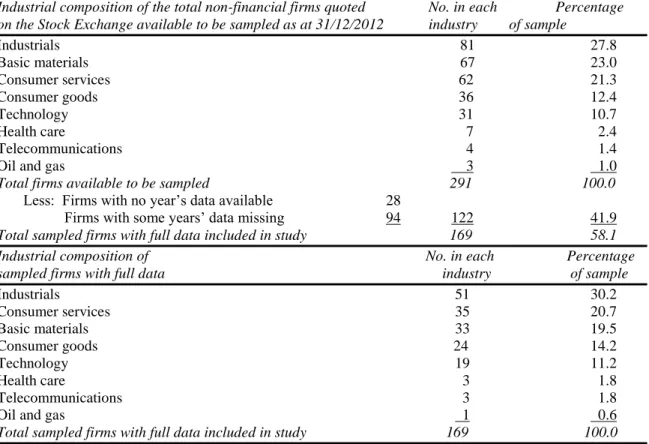
As summarised in Table 2, due to capital structure and regulatory reasons, we excluded 111 financials and utilities from the total sample of 407, and thus we draw the sample from all 291 non-financial companies quoted on the South African stock exchange as at 31/12/2012. The data employed was collected from two different sources. In the first place, data relating to the pay of executives and governance structures was collected from annual reports of the sampled companies. The annual reports were collected from the Perfect Information Database. Distinct from past researchers that have collected data only on
CEO pay (Jensen & Murphy, 1990; Kale et al., 2014), the pay data relating both CEOs and lower placed executive directors was extracted from the annual reports. This permitted us to explicitly test both the primary and secondary agency problems. Second, accounting, stock market and financial data was collected from DataStream. We set two main criteria for companies included in our final sample. First, the company’s annual report from 2003 to 2012 (for pay and governance data) and accounting, financial and stock data from 2002 to 2011 needed to be available in Perfect Information Database and DataStream
respectively. This data collection structure permitted us to estimate ex-ante PPS. We imposed these sample selection criteria for the following reasons. In the first place, the pay and CG data was manually collected, which was very labour intensive and therefore, we restricted the final sample to companies which had continuous years data available. In the second place, and in line with the suggestions of past research (Core et al., 1999; Jimenez-Angueira & Stuart, 2015), this criteria helped us to meet the conditions of balanced panel data analysis with its well documented advantages. Third, as suggested by Wowak et al. (2011), investigation of a 10-year data, which possesses both time-series and cross-sectional characteristics can be helpful in determining as to whether the cross-sectional relationship between pay and performance that has been determined also holds over-time. As a final criterion, the sample starts in 2002 due to lack of data in the Perfect Information Database/DataStream on South African firms before this year, and importantly due to the fact that the second King Report was implemented in this particular year. The data collection began in 2012, and therefore the data collection ends in that year as the year when the most recent data was available on the firms in our final sample. As contained in Table 2 (after excluding 122 firms with no or some years data missing), the final sample made up of a total of 169 companies over 10 firm-years (i.e., 1,690 observations) from 8 industrial sectors that satisfied our sample selection criteria for the empirical analysis.
Insert Table 2 about here
Variables: Pay, performance, CEO/CG characteristics, interaction and control variables
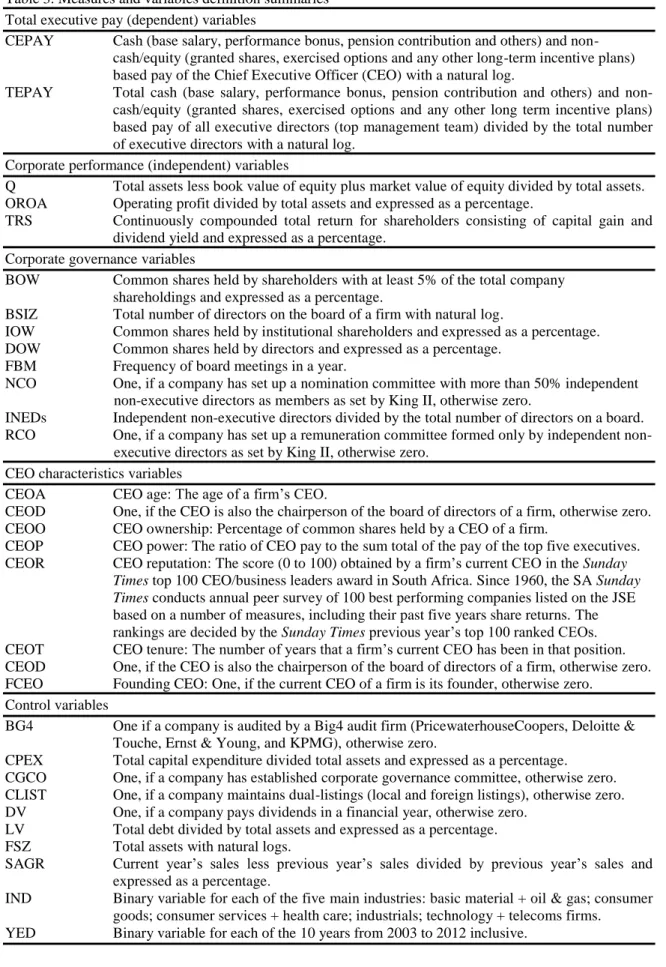
We classify our variables into seven main types and full definitions of all the variables used are presented in Table 3. First, and following a well-established line of research (Murphy, 1985; Jensen & Murphy, 1990; Conyon & He, 2011), total pay of all executives (TEPAY) and the CEO (CEPAY) are our main dependent variables. Second, our main performance proxy is the widely used total return for
shareholders (TRS), but as a robustness check, we also employ operating return on assets (OROA) and Tobin’s Q (Q) as alternative accounting and market-based performance measures, respectively. The third group consists of CEO power proxies, including CEO age (CEOA), CEO duality (CEOD), CEO ownership (CEOO), CEO power (CEOP), CEO reputation (CEOR), CEO tenure (CEOT) and founding CEO (FCEO). The fourth group consists of board structure variables, including board size (BSIZ), percentage of independent non-executive directors (INEDs), frequency of board meetings (FBM) and the presence of independent remuneration (RCO) and nomination (NCO) committees, whilst the fifth group is made up ownership structure variables, including block ownership (BOW), director ownership (DOW) and institutional ownership (IOW). Sixth, and to test for the moderating effect of CEO power/CG features on the PPS, we create an interaction variable between each of our monitoring CEO power/CG structure and performance (e.g., P*CEOA, P*BOW, and P*BSIZ). Finally, and to attenuate potential omitted variables bias (Petersen, 2009), we include an extensive number of control variables (see Table 3).
Insert Table 3 about here
Empirical analyses and discussion Descriptive statistics
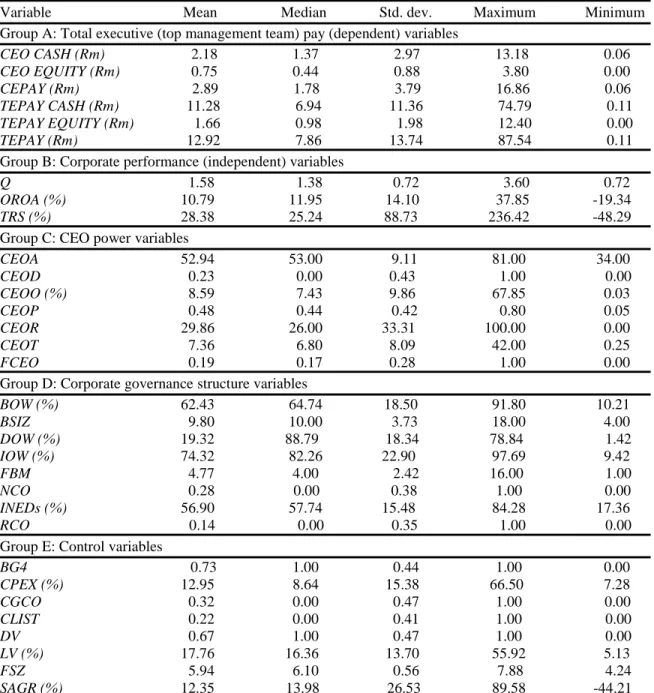
Table 4 presents summary descriptive statistics in terms of executive pay, performance, CEO, CG and control variables, and are reported in Groups A, B, C, D and E, respectively. The table suggests wide variation in the distribution of TEPAY and CEPAY values. CEPAY, for example, has a minimum value of R0.06 million and a maximum of value of R16.86 million with a mean of R2.89 million. Observably, and in spite of the second King Report’s recommendation that equity-based pay should form the substantial portion of executives’ pay with the aim of closely converging the interests of shareholders and executives, cash pay remains a bigger part of total executive pay in South African corporations. For example, the mean total equity-based pay of all executives (TEPAY EQUITY) of R1.66 million is only about 13% of the mean total pay (TEPAY) of R12.92 million.
Insert Table 4 about here
Similarly the values of the performance, CEO, CG and control variables, overall suggests that there are wide variations in our sample. For instance, and similar to the results of Mehran (1995), TRS spans between -48% and 236% with a mean of 28%, suggesting that a clear majority of companies included in our final
sample reported a profit. The median CEOA is 53, ranging from 34 to 81 years, whilst the average CEOT is 7, ranging from 3 months to 42 years. About 19% of our CEOs are founders, whilst about 23% doubles-up as CEOs and chairpersons. The average CEO is powerful (CEOP), with his/her pay accounting for 48% of all the other executives put together. These findings are roughly comparable with those reported by Cornett et al. (2009), Li and Srinivasan (2011) and Wowak et al. (2011) for American CEOs. The median BSIZ of 10 is smaller compared with the 13 that Core et al. (1999) reported for a sample of American companies, whilst the mean of 57% INEDs is similar to the 62% that Lee et al. (2008) reported for a sample of American firms. The average IOW of 74% is similar to the 63% that Zheng (2010) reported for a sample of American companies, whilst the mean BOW of 62% is significantly larger compared with the 20% that Ozkan (2011) reported for a sample of British companies. Observably, only 14% of our sampled companies have established a RCO, which is significantly less compared with the 66% that Brown and Caylor (2009) reported for a sample of American firms.
Insert Table 5 about here
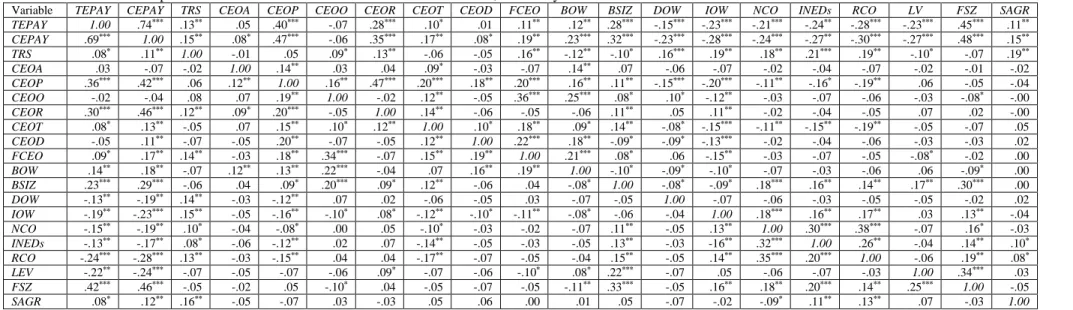
Table 5 presents the correlation matrix for the variables with the view to testing for the presence of any multicollinearities. However, as a sensitivity check, we present both the Pearson’s parametric and Spearman’s non-parametric coefficients and, observably, the magnitude and direction of both coefficients are essentially the same and thus, indicating that any residual abnormal distribution behaviour in the dataset may not statistically harmful. Noticeably, apart from the predicted high correlation between TEPAY and
CEPAY,the bivariate correlations among all the other variables are largely small and thus, suggesting that any remaining multicollinearities may not be statistically harmful. Observably, the TRS, CEOP, CEOR,
CEOT, FCEO, BOW and BSIZ are positivelyassociated with TEPAY, whilst DOW, IOW, NCO, INEDs and
RCO are negatively related to TEPAY. Additionally, there exist significant associations among the TEPAY,
CEPAY, TRS, CEO, CG and the control variables used.
Multivariate regression analyses
Estimating the PPS
We conduct multiple regression analyses in order to empirically test our hypotheses. Fixed-effects regressions have the benefit of incorporating undiscernible company-specific heterogeneities, such as corporate culture, firm complexity, and managerial quality (Conyon & He, 2011). Following prior research
(Wowak et al., 2011; Li & Srinivasan, 2011), we adopt a lagged structure with median (in order to account for the observable large pay differentials) fixed-effects to estimate ex-ante PPS using Jensen and Murphy (1990) style first difference approach. Consequently, we begin the empirical regressions with a simple fixed-effects model defined in this form:
1 1 1 10 1 1 1 0
it it it i i it itTRS
CONTROLS
TEPAY
(1)where: TEPAY refer to the key dependent variable; TRS is the main independent variable; CONTROLS is the control variables included and δ refers to the company-specific fixed-effects, made up of a vector of the mean-differences of all time variant variables.
Table 6 contains a fixed-effects regression of the PPS, with results reported for three models for both all executive directors’ pay and CEO pay consisting of cash, non-cash and total as the dependent variables. First, the main aim of designing managerial incentives contracts is to align the interests of owners and managers. However, such contracts, could themselves, create primary agency problems, whereby powerful CEOs may use their influence to expropriate corporate resources. To investigate this first-tier agency conflict that exists between CEOs and shareholders, we examine the sensitivity of TRS to CEPAY. The coefficient of TRS on CEPAY in Model VI of Table 6 is statistically significant and positive. However, and consistent with prior studies the PPS is relatively small at 0.095, and thereby provides support for H1a that the PPS for CEOs is positive, but relatively small. For example, Conyon (1997) and Ozkan (2011) found that the sensitivity between TRS and CEO pay is 0.061 and 0.095 for samples of British companies, respectively. In a similar vein, Hubbard and Palia (1995), Hartzell and Starks (2003), Cornett et al. (2009), and Li and Srinivasan (2011), respectively, reporta PPS of 0.099, 0.093, 0.098 and 0.021 for samples of American firms. Our evidence also seems to provide support for the MPH, which suggests that in poorly-governed firms, powerful CEOs tend to use their influence to design suboptimal incentive contracts that facilitates rent extraction, leading to small PPS.
Insert Table 6 about here.
Secondly, a second-tier agency conflict arises, whereby a suboptimal CEO pay package is approved by directors for a dominant CEO in return for some form of reciprocity from the CEO. To examine this secondary agency problem that occurs between directors and shareholders, we investigate the link between
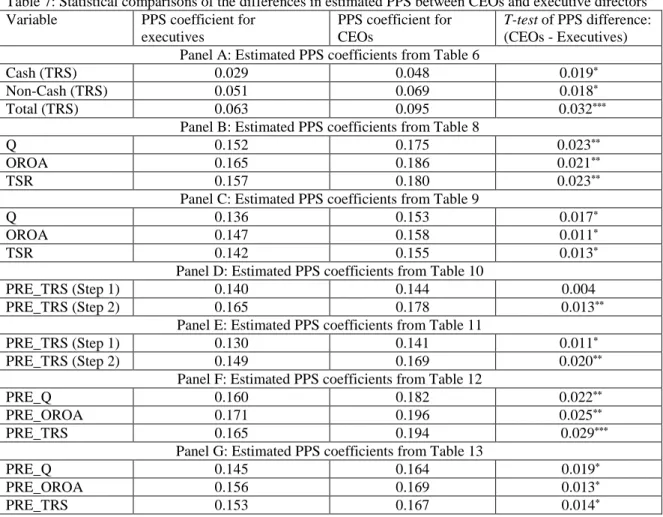
Model III of Table 6 is statistically significant and positive, but similarly small at 0.063, and thereby providing new support for H1b. The economic meaning of this finding is that directors tend to reward powerful CEOs with overly generous pay packages in exchange for favourable director incentive terms from the CEO (Core et al., 2003; Morse et al., 2011). This can result in a culture of reciprocity in expropriating share owners wealth, and thereby equally leading to relatively small PPS. This conflict can particularly be exacerbated in South Africa where, under the second King Report proposals, the remuneration committee is required to seek the opinion of the CEO when deciding the pay of other executives. As a more direct and comparative test of the first- second-tier agency problems, we compare and test (see Table 7) the statistical significance of the estimated PPS coefficients between CEOs and all executive directors reported in Tables 6 and 8 to 13. As contained in Table 7, with the exception of the PPS coefficient reported in Panel D, step 1, the difference between CEOs and executives of all our estimates are statistically significant and positive, indicating that the PPS for CEOs is almost always significantly higher than that of all executive directors. This provides additional empirical support for H1b, as well as offers a new contribution to the existing research by suggesting that in a corporate setting of poor CG mechanisms and high levels of block shareholdings; the second-tier (monitoring power and opportunism of other directors) agency conflict is stronger than the first-tier (CEO power and opportunism) agency problem.
Insert Table 7 about here.
Third, our evidence so far suggests a positive, but relatively small PPS. Our total executive pay proxies are, however, made up of cash and equity-based pay. Therefore, to examine which component contributes most to the PPS, we re-estimate equation (1) by iteratively substituting TEPAY and CEPAY with their cash and non-cash alternatives, respectively. The respective coefficients of TRS on Cash and Non-cash-based payin Models I and II for TEPAY, as well as those in Models IV and V for the CEPAY in Table 6 are all statistically significant and positive. Noticeably, and on average, the PPS appears stronger for equity-based than for cash-based pay. This offers empirical support for the suggestions of the second King Report and the results of past researchers (Jensen & Murphy, 1990; Main et al., 1996; Ozkan, 2011), who found a higher PPS for CEO non-cash pay than CEO cash pay. The economic relevance of this evidence is that the structure rather than the level of pay seems to be more effective in influencing the PPS.
Fourth, and on comparative basis, the findings in Table 6 also indicate that irrespective of the pay measure used, the relationship between TRS and CEPAY seems to be stronger than that between TRS and
TEPAY. This provides empirical support for the results of Mehran (1995) and Sapp (2008) for samples of American and Canadian firms, respectively. One reason is that CEOs carry out strategic and bigger roles with a greater chance of being sacked if corporate performance turned out to be poor compared with their managerial counterparts placed at lower levels (Kang & Shivdasani, 1995; Dong, 2014; Guo et al., 2015). As a result, there is an expectation that CEOs will be paid higher, as well as their pay will be linked more closely to corporate performance as a reward for the additional risks and responsibilities that they generally assume compared with their lower placed colleagues.
The moderating effect of CEO power and CG structure on the PPS
Our evidence so far suggests a positive, but relatively small PPS, which appears to provide support for the MPH. Central to the MPH, is the assumption that CEO commitment/CG is weak, which results in poor managerial monitoring and suboptimal incentive contracts. However, in better-governed firms with more committed CEOs, closer managerial monitoring can improve the PPS even if executive incentive contracts are somehow suboptimal. This suggests a complex modelling of the PPS, which takes into account the joint effect of both incentive alignment (executive pay) and monitoring (CEO power/CG structure) mechanisms on the PPS. Therefore, and in this sub-section, we distinctively investigate whether CEO power/CG structure can moderate the PPS with a fixed-effects regression model specified as follows:
1 1 1 10 1 1 7 1 1 7 1 1 1 0
it • it it l l it k k it j j itit
TRS
CEO
INT
CONTROLS
TEPAY
(2)where CG refers to the CEO power proxies, including CEOA, CEOD, CEOO, CEOP, CEOR, CEOT,
FCEO and INT refers to their respective interaction variables, namely P*CEOA, P*CEOD, P*CEOO,
P*CEOP, P*CEOR, P*CEOT and P*FCEO. Everything else remains the same as defined in equation (1). We also re-estimate equation (2) by replacing the CEO power proxies with their CG counterparts.
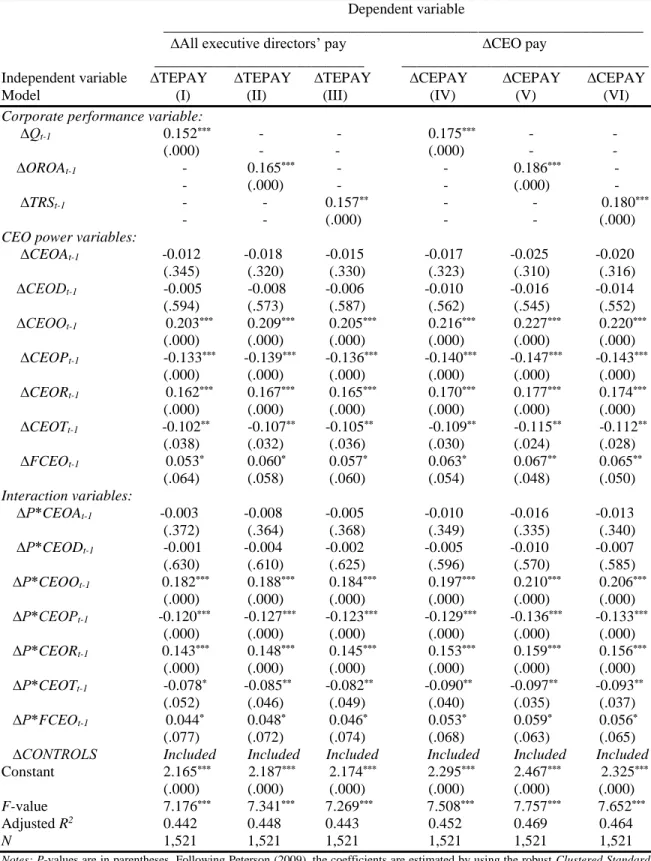
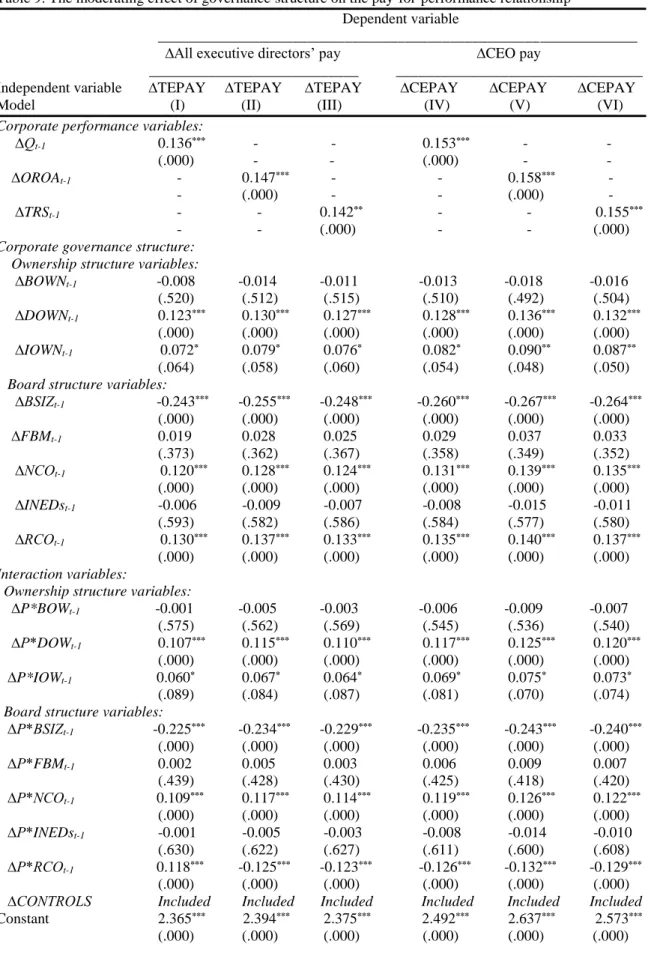
Thus, Tables 8 and 9 contain fixed-effects regression results examining the moderating effect of CEO power and CG mechanisms on the PPS, respectively. Models I to III in both tables report results relating to
TEPAY for the Q, OROA and TRS performance proxies, respectively, whilst Models IV to VI do similarly for the CEPAY alternative. First, and consistent with the findings in Models III and VI in Table 6, the coefficients of the TRS on TEPAY and CEPAY in Models III and VI in both tables are, respectively, statistically significant and positive. However, and most importantly, it is easily discernible that,
irrespective of the executive pay proxy employed, the PPSs have considerably improved. This implies that CEO power and CG qualities appear to significantly moderate the PPS, a result which also seem to provide support for the OCT. For example, the PPS between TRS and CEPAY has improved from 0.095 in Model VI in Table 6 to 0.180 (0.155) in Model VI of Table 8 (9). While these statistically significant differences (p-value <.01) are not significantly different in comparison with those found by previous researchers (Buck et al., 2008; Conyon & He, 2011), it at least indicates that permitting for the presence of joint interactions among TEPAY, CEPAY, TRS, CEO power and governance structures leads to an increase in the PPS. Also, and on comparative basis, it is apparent from Table 8 (9) that the increase in the PPS is higher for CEPAY
than for TEPAY. This is again consistent with our previous explanation that emphasised the strategic nature of the CEO role.
Insert Table 8 about here. Insert Table 9 about here
Second, and with specific reference to the interaction variables, the findings reported in Table 8(9) generally provide evidence of a moderating effect of CEO power (CG structure) on the PPS, which is largely consistent with the predictions of the OCT, as well as our hypotheses. Specifically, the coefficients of P*CEOC, P*CEOO, P*CEOR and P*FCEO on TEPAY or CEPAY in Models III and VI of Table 8 are statistically significant, providing support for H2. Similarly, the statistically significant and positive effect of P*BOW and P*DOW on TEPAY or CEPAY in Models III and VI of Table 9 provides support for H3, whereas the statistically significant effect of P*BSIZ, P*NCO and P*RCO on TEPAY or CEPAY in Models III and VI of Table 9 provides support for H4. Observably, our evidence contributes to a small, but gradually increasing number of international studies that suggest that board, CEO power and ownership structures can have a moderating effect on the PPS (Cornett et al., 2009; Finkelstein et al., 2009; Li & Srinivasan, 2011; Wowak et al., 2011; Sanchez-Marin & Baixauli-Soler, 2014).
Additional analyses
We conduct a number of additional analyses to further examine the robustness of our results. First, we check the robustness of our results by re-regressing equation (2) using Q and OROA as alternative performance proxies to the TRS. The results presented in Models I and II relating to TEPAY based on the Q
qualitatively the same as those of the TRS in Models III and VI in the same tables, suggesting that our findings are robust to these alternative performance proxies.
Second, and so far we have estimated the PPS by taking into consideration the predictors, moderators and instruments simultaneously. One limitation of this approach is that it makes it difficult to assess the contributions of each category of variables. Therefore, and to ascertain the contributions of each category of variables to the estimated PPS, we employ a two-step multilevel1 (hierarchical) regression
approach. Specifically, at the first step, we regress the instruments and predictors (governance and instrumented variables) on the compensation; and at the second step, we include the moderators (moderating variables) as additional explanatory variables. The results of our hierarchical (multilevel) regressions reported in Tables 10 and 11, respectively, for CEO power and CG structure suggest positive and statistically significant effect of PRE_TRS on TEPAY and CEPAY, respectively, and therefore implying that our results are fairly insensitive to estimating a hierarchical regression. However, the findings show that our moderating variables have some explanatory power, accounting roughly for between 8% and 12% (∆R2) of the variations in the estimated PPS.
Insert Table 10 about here Insert Table 11 about here
Third, our sample period extends over the 2007/2008 global financial crisis. Thus, to ascertain whether executive pay differs over the period, we split the sample into two: pre- (2002 to 2006); and post- (2007 to 2012) 2007 financial crisis periods, and re-estimate equation (1), by including an additional dummy variable (D_FINCRISIS), which takes the value of 1 if the financial year is post-2007 (2007 to 2012) and 0 if the financial year is pre-2007 (2002 to 2006). Our full results, (which for brevity not reported here, but available on request), suggest a significant and positive coefficient (0.16) on the D_FINCRISIS. The economic interpretation of this evidence is that executive pay has increased in the pre-2007 period by about 16% (8%) in nominal (real – adjusted for 5% SA annual inflation rate) terms.
Insert Table 12 about here. Insert Table 13 about here
Finally, and to address causality and/or endogeneities that may arise from potential omitted variables bias, we employ the extensively applied two-stage least squares (2SLS) statistical technique. However, to
make sure that the 2SLS technique is appropriate, and following past studies (Beiner et al., 2006; Larcker & Rusticus, 2010), we first conduct the Durbin-Wu-Hausman exogeneity test to test for the existence of an endogenous association between TRS and TEPAY or CEPAY. The null hypothesis of no endogeneity is rejected at the 1% level when the test is applied to equation (2), and we therefore, conclude that the 2SLS
technique is appropriate and that our fixed-effects results may be misleading and as such, requiring further investigation that follows.
The findings of several past studies (Beiner et al., 2006; Brown and Caylor, 2009) suggest that CEO power and CG structure variables do affect performance, and as such, in the first-stage, we assume that TRS
will be determined by 7 CEO power and 8 CG structure mechanisms, as well as the 10 control variables. Therefore, the first-stage model to be estimated is specified as:
it• it k k it j j it
CG
CEO
CONTROLS
TRR
10 1 15 1 0_
(3)Consistent with our predictions, the results, (which for brevity are not fully reported here, but available upon request), suggest statistically significant effect of the CEO power, CG structure and control variables on the TRS. Therefore, we re-regress equation (2) specified as:
it it it l l it k k it j j it
it
PRE
TRS
CEO
INT
CONTROLS
TEPAY
10 1 7 1 7 1 1 0ˆ
_
(4)where everything remains the same as defined in equation (2) except that we use the predicted TRS
(PRE_TRS) from equation (3) as instrument for TRS. The 2SLS results reported in Models III and VI of Tables 12 and 13, respectively, for CEO power and CG structure suggest positive and statistically significant effect of PRE_TRS on TEPAY and CEPAY, respectively, thereby implying that our results are fairly robust to potential causality and/or endogeneity problems that may arise from omitted variables. Additionally, the 2SLS results based on Q and OROA performance alternatives contained in Tables 12 and 13 remain positive and statistically significant, suggesting further that our findings are not significantly sensitive to potential causality and/or endogeneity problems.
Summary and conclusion
This study examines the crucial question of whether chief executive officer (CEO) power and governance (CG) mechanisms can moderate the pay-for-performance sensitivity (PPS) using a sample of
169 South African publicly quoted companies from 2002 to 2012. This coincides with a period during which the South Africa authorities introduced CG reforms that incorporated the presumption that executive pay will be closely tied to corporate performance. This permits us to distinctively examine the joint effects of incentive alignment (pay) and monitoring (CEO power and CG structure) mechanisms on the PPS us