Specification of Deep Beams Affect the Shear Strength Capacity
Yousif Jabbar Lafta1,2* Kun Ye11. School of Civil Engineering and Mechanics, Huazhong, University of Science and Technology, Wuhan, 1034 Luoyu Road, Wuhan 430074, china
2. Department of Civil Engineering, University of Basra, Basra, Iraq Abstract
Reinforced Concrete Deep beams researches have attracted attentions of professionals and academics due to the wider use of this type of structures in construction projects; because of characteristics in transferring significant amount of load. Ultimate strength of deep beams has been a great challenge because of the complexity to Evaluation for this structural member. However, code provisions for capacity of beam equations are conservative. Essentially influencing parameters are Loading and Supporting Conditions, horizontal and vertical web reinforcement, shear span-to-depth ratio, load and support bearing plates, distribution of the reinforcement along depth of the deep beam‘s web, tension reinforcement and compressive strength. Least influencing parameters are bottom cover, side cover, width of the beam, distribution of vertical stirrups in the web, and aggregate size, presence the web openings. The effect of above factors on the shear capacity and behavior of RC deep beams have been reviewed.
Keywords: Deep beams, D-region, Loading condition, Shear strength, Reinforcement distribution, Failure mode.
1. Introduction
A major challenge in a tall building structure is to reach suitable column free space in the lowermost story either for storing or parking . To achieve sufficient residence room size as a design for architectural in the upper stories. Its terminal level rests on the transmission girder which acts as a point load. In concept of wide shear strength, deep beam are recommended as transmission, deep horizontal girder supporter which is mostly fails in shear rather than flexure. This member transfers load through loading face to supports in the diagonal direction. It is categorized as member with small span-to-depth ratio. Reinforced concrete deep beams are commonly used as load distributing structural element, Pile caps, foundation walls, corbel, shear wall structures that resist lateral forces, floor diaphragms, supporting strip footings or raft slabs, and off-shore structure (Teng, Ma et al. 2000) . RC deep beams essentially used in high rise structures and long span bridges due to their convenience and economic efficiency Brackets.
2. Definition of RC Deep Beams
Reinforced concrete(RC) beams with shear span / depth ratio not exceeding 2.0 for simply supported to 2.5 for continues beams may be classified as deep beams (Nawy 1985) . The ACI Building code 318-14(Committee, Institute et al. 2014) defines deep beams as members loaded on one face and supported on the opposite face so that compression struts can develop between the loads and the supports, and have either: (a) Clear spans,ln,
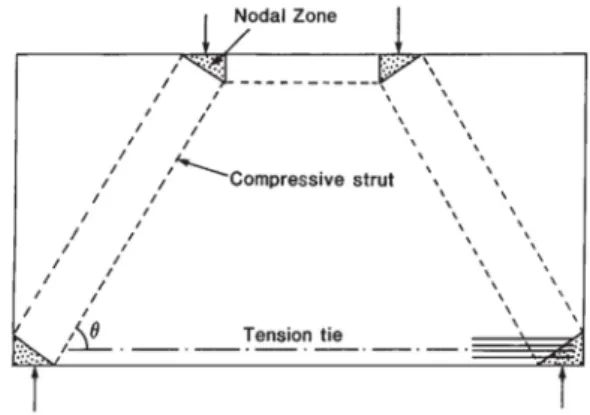
equal to or less than four times the overall member depth; or (b) Regions with concentrated loads within twice the member depth from the face of the support. IS 456-2000 code (Standard 2000) defines deep beam as a beam has ratio of effective span-to-overall depth (l/h) less than: 2.0, for simply supported beam; 2.5, for a continuous beam. In RC beams, Regions where the shear span (distance from the support horizontally towered the load) is less than twice the depth of the beams are defined as D-regions, D refers to disturbed or deep and it is Controlled by arch action (ACI-318)(Committee, Institute et al. 2008) as shown in figure 1.
3. Behavior of RC deep beams
The behavior of deep beams is different from that of common flexural members; the strength of deep beams is mainly controlled by shear rather flexure when sufficient amounts of tension reinforcement are used (Oh and Shin 2001), and they are classified as non-flexural members, in which the plane sections do not remain plane in bending(Rao, Kunal et al. 2007). Elastic behavior is characterized of deep beams before cracking. After cracking major redistribution of stresses and strains, significant effects of vertical normal stress and shear deformation takes place therefor strength of the beams must be estimated using the nonlinear analysis (Nawy 1985), (Rao, Kunal et al. 2007)and (Ramakrishnan and Ananthanarayana 1968). The high shear strength is an important specific of such beams; that is because of internal arch action mechanism which is quite deferent from beams of normal proportion (Kalyanaraman, Rayan et al. 1979, Nilson and Winter 1987). Tied arch as a characteristic of deep beams will be formed after appears of diagonal cracking, even though diagonal tension failure mode occurs in the slender beams, deep beams carry the additional loads after diagonal cracking due to the behavior of strut and tie which transmissions the load directly to the support through concrete compression struts. The tension reinforcement actions as a tie. Horizontal compression in concrete and the tension in the main reinforcement have to equilibrate the load, adequately anchored of tension bars must be provided to prevent anchorage failure. Also the deep beams are categorized as disturbed regions, in which the nonlinear distribution of strain. However, the bending elementary concept for simple beams may not be appropriate for deep beams even under linear elastic assumption. It is found that using ordinary bending theory of flexure will yield erroneous values of all the stresses throughout the beam section because this theory does not account for vertical normal stresses induced by the applied loads and supports nor for the deformations(Barry and Ainso 1983). A deep beam is actually a vertical plate loaded in its own plane. The stress or strain distribution across the depth of the beam is not a straight line, and the position of the neutral axis shifts downward after significant levels of straining, the variation is chiefly dependent on the feature ratio of the beam Figure 2. (Kong 2006). Failures usually due to crushing or splitting in diagonal compressive strut, which is close related to a splitting test of concrete cylinder. It has been shown that the concept of the compressive force path can provide a realistic description of the causes of failure in deep beams (Kotsovos 1983, Kotsovos 1988). The shear strength of deep beams is a function of many factors such as concrete compressive strength, main and web reinforcement, slenderness (shear span/depth ratio), End anchorage of the main bars, loading and supporting conditions. These are generally considered to represent deep beam behavior. The ACI building Code 318-14(Committee, Institute et al. 2014) recommends taking in to account the nonlinearity of strain distribution and lateral buckling in the design of deep beams. Also it based on D-region behavior.
4. Loading and Supporting Conditions
Simply supported deep beams may be classified according to loading and supporting conditions into directly loaded deep beams (forces are applied on the top or compression face of the beam and reactions are act under side face of the beam) and indirectly loaded deep beams (loads are applied via shear on the sides of the members) (Fereig and Smith 1977) in which the load other than direct load and include load applying away from centroid of the member (Heywood, Pritchard et al. 2014) as shown in Figure 3-a. Indirectly loaded rectangular and flanged deep beams have lower shear strength than directly loaded deep rectangular beams this has been attributed to the lower effect of tied arch action in indirectly loaded R.C deep beams (Kalyanaraman, Rayan et al. 1979) .Compartion the ultimat load capacity of concrete deep rectangular and T- beam (Kalyanaraman, Rayan et al. 1979) and (Yousif and Kun 2015) concluded that the deep beam with T- section exhipit high ultimate load capacity than rectangular. To improve the load-carrying capacity of indirectly loaded deep beams, (Paul 1978) conclude that sufficient hanger or suspension reinforcement at the position of the load and good anchoring in the compression zone should be provide as showed in figure 3-b. ACI building Code 318-14(Committee, Institute et al. 2014) conclude that where the deep beam subjecting to the load through the bottom or the sides of beam the strut – and- tie method should be applied to design the reinforcement to internally transfer the load to the top of such beam and distribute them to adjacent support .
Figure2. Distribution of horizontal stress in beams with various spans to depth ratio
Figiure 3-a. Directly and Indirectly Loading Figiure 3-b. Hanger Reinforcement 5. Mechanisms of Shear Transfer
Shear is transmitted from one plane to another in various ways in reinforced concrete members. The behavior, including the failure modes, depends on the method of shear transmission. According to the ACI-ASCE committee 426 (426 1973)Report, the main types of shear transfer mechanisms as illustrated in Figure 4. are:
5.1 Shear transfer by concrete shear stress (Vc)
This occurs in uncracked members or in the uncracked portions of structural members. The interaction of shear stresses with tensile and compressive stresses produces principal stresses which may cause inclined cracking or a crushing failure of the concrete.
5.2 Interface shear transfer (Aggregate interlock) (Va)
The shear force must be transferred across a definite plane or surface where slip may occur. If the plane under consideration is an existing crack or interface, failure usually involves slippage or relative movement along the crack or plane. If the plane is located in monolithic concrete, a number of diagonal cracks occur across the interface and failure involves a truss action along the plane. Physical explanation of this mechanism is that, in normal density concrete, the aggregate protruding from the crack surface provides resistance against slip. In light weight and high strength concrete, although the cracks go through the aggregate, it is still have the ability to transfer shear, therefore, the term “Friction” or “Interface Shear” is more appropriate than aggregate interlock to describe this mechanism of shear transfer.
5.3 Dowel action of longitudinal reinforcement (Vd)
If the reinforcing bars cross a crack, shearing displacements along the crack will be resisted, in part, by a dowelling force in the bar. Normally, dowel action is not very significant in beams without stirrups, because the maximum shear in a dowel is limited by the tensile strength of the concrete cover supporting the dowel. Dowel action may be significant in beams with large amounts of longitudinal reinforcement distributed in more than one layer(Ramirez, French et al. 1998).
5.4 Tied-Arch action
This is not a shear mechanism in the sense that it does not transmit a tangential force to a nearby parallel plane. However, arch action does permit the transfer of a vertical concentrated force to a reaction in a deep member and thereby reduces the contribution of the other types of shear transfer. Tie force of main reinforcement to develop a horizontal reaction component at the base of the arch. Such manners is to result from the fact that the force sustained by the tension reinforcement of a deep beam at its ultimate limit state is constant throughout the beam span (De Paiva and Siess 1965). Arch action occurs not only outside the outermost cracks but also between diagonal tension cracks. Part of the arch compression is resisted by dowel forces and therefore splitting cracks may develop along the bars. It was found that stirrups close to the base of diagonal cracks can provide support to the arches. Figure 5. illustrate the arch action.
5.5 Residual tensile stresses across cracks
The basic clarification of residual tensile stresses is that when cracks in concrete appear, the clean break does not happen. Small parts of concrete bridge the crack and stay to transfer tensile force up to crack widths in the range from 0.05 to 0.15 mm. there is an important descendent (softening) branch has been known when the peak tensile stress is reached for some time (Evans and Marathe 1968).
5.6 Shear reinforcement (Vs)
In addition to the shear carried by the stirrup itself, when an inclined crack crosses shear reinforcement, the steel may contribute significantly to the capacity of the member by increasing or maintaining the shear transferred by interfaces shear transfer, dowel action, and arch action. Thus, shear reinforcement restricts the widening of inclined cracks in beams and thus slows the decrease of interfaces shear transfer quite effectively.
Figure 4. Components of Shear Force Over Crack Plain Figure 5. Arch Action Details 6. Modes of failure
6.1 Flexural failure:
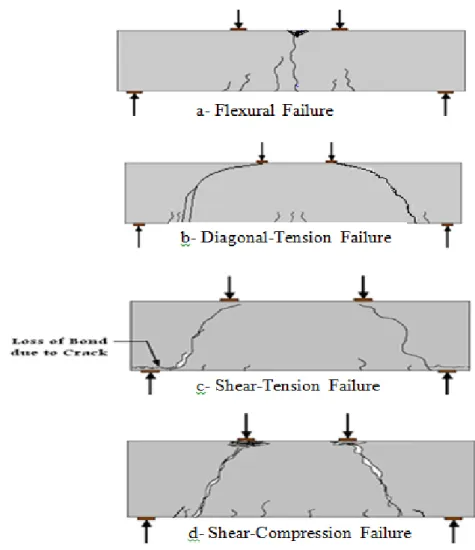
Low percentage of tension steel and fails by yielding of reinforcement at a section of maximum moment as shown in Figure 6. a.
6.2 Diagonal-Tension failure:
Always in the range of a/d above 2, and sometimes at lower a/d values, the diagonal crack starts from the last flexural crack and turns gradually into a crack more and more inclined under the shear loading, as noted in (Figure 6. b). Such a crack does not proceed immediately to failure, although in some of the longer shear spans this either seems almost to be the case or an entirely new and flatter diagonal crack suddenly causes failure. More typically, the diagonal crack encounters resistance as it moves up into the zone of compression, becomes flatter, and stops at some point. Further load; the tension crack extends gradually at a very flat slope until finally sudden failure occurs. The more inclined lower crack will open back, at least to the steel level, and the failure will start at the crack nearer the a/2 (Ferguson, Breen et al. 1988)
6.3 Shear-Tension failure:
A curved tensile crack in a region of combined moment and shear may also one of two additional modes of failure. A secondary crack may propagate backward along the longitudinal reinforcement from the inclined crack, perhaps because of dowel action in the longitudinal reinforcement. This crack will cause a loss of bond, as the main reinforcement begins to slip, the wedging action of the bar deformations contributes to a splitting of the concrete and a further propagation of the crack, resulting in an anchorage failure of the longitudinal steel as shown in Figure 6. C. (426 1973).
6.4. Shear-Compression failure:
The vertical compressive stress under the load reduce the possibility of further tension cracking, and the vertical compressive stresses over the reaction likewise limit the bond splitting and diagonal cracking along the steel. Alternatively, a large shear in short shear spans may initiate approximately a 45° crack (called a web-shear crack) across the neutral axis before a flexural crack appears. Such a crack crowds the shear resistance into a small depth and leads to increasing stresses, and then tends to be self-propagating until stopped by the load or reaction. With either start, a compression failure finally occurs adjacent to the load. Such a failure can be expected to occur when the shear span (a) is less than four times the beam depth, or possibly a little less for very high strength concrete. When shear span is small, the increased shear strength may be significant, with the ultimate shear over twice as much for a = 1.5d as for a = 3.0d. The width of the critical crack, if there is no crack control steel, becomes large as the load increases, sometimes over 3 mm. The concrete above the upper end of the inclined crack fails by crushing in this mode of failure as shown in Figure 6. D. (Ferguson, Breen et al. 1988). Other failure types such as anchorage failure and local crushing failure close to loads or supports are also possible. Such premature failures prevent the development of the full capacity of the beam and can be eliminated by appropriate detailing (Ferguson, Breen et al. 1988).
Figure 6. Typical Failures in Slender and Short Beams 7. Factors affecting the bearing capacity of deep beams
7.1 Concrete Compressive Strength Effect
The concrete compressive strength plays a special role in structural behavior of RC deep beams. Figure 7. shows the relation between the compressive strength of concrete and nominal shear strength, the nominal shear strength increase when compressive strength of concrete is high(Mphonde and Frantz 1984). Vecchio et al.(Vecchio and Collins 1993) noticed that the effect of Compression softening on cracked Compression zoon in reinforced concrete showed lower strength and stiffness than uniaxial compressed concrete which influences the ductility, element strength and load-deflection curve. Moreover, the coefficient of strength reduction for the main strut decreases with the angle of inclination of the strut (Matamoros and Wong 2003).
Figure7. Concrete Compressive Strength Effect
7.2 Tension Reinforcement
Increase in ultimate load will obtained when the Tension Reinforcement amount will increase Figigure 8a. , and increase in number of cracking. On the other hand obtain decreasing the ductility Figure 8b. , width and length of the crack. The use of more tension reinforcement amount caused less deflection after elastic stage. If the tension reinforcement percentage is less the code conditions demand the strut not formation. Otherwise the compression failure achieved with providing high tension steel capacity (Mohammadhassani, Jumaat et al. 2012)
(a) (b)
Figure8. Effect of main reinforcement (a) shear capacity and (b) Ductility
7.3 Shear Reinforcement 7.3.1 Vertical Reinforcement
The use of Minimum reinforcement needs to avoid splitting in struts to failure. No perfect consent about the character of transverse reinforcement in struts of bottle shaped in ACI code. (Tan, Kong et al. 1997) reported that the most favorable pattern was the orthogonal web reinforcement; it was the most effective in increasing the beam stiffness, restricting the diagonal crack width development and in increasing the ultimate shear resistance. For deep beams with a/h= 1.0, the vertical web steel has greater effect on restraining the diagonal crack width and increasing the ultimate shear resistance of HSC deep beams than the horizontal web steel of the same steel ratio.
7.3.2 Horizontal Reinforcement
horizontal reinforcement in the web of deep beams used near bottom faces of beams have been saw by (Smith and Vantsiotis 1982) to be more effective. The increase of percentage web reinforcement give rise to increase in shear strength (Madan, Kumar et al. 2007) Both horizontal and vertical web reinforcement are effectiveness in the shear capacity ofdeep beams. but the horizontal shear reinforcement observed by (Arabzadeh, Aghayari et al. 2011) is the mosteffectual when aligned perpendicular to major axis of diagonal crack . providing of shear reinforcement in the middle of the shear span can develop the ultimate capacity of shear strength in deep beam(Aguilar, Matamoros et al. 2002). On the other hand ACI Committee 2008 (Committee, Institute et al. 2008) conclude that the vertical shear reinforcement is more effective in providing shear strength in deep beamsthan the horizontal shear reinforcement. The Minimum percentage of shear reinforcement suggested by
(Birrcher, Tuchscherer et al. 2013) for serviceability and strength is 0.30%. In deep beams with opening in the shear span vertical shear reinforcement showed by (Campione and Minafò 2012) is ineffective and only the existence of horizontal shear reinforcement rises load carrying capacity by about 20%.
7.4 Effect of Aggregate Interlock
(Walravena and Lehwalter 1994) observed that the Shear strength resistance of deep beams is independent size effect as the contribution of aggregate interlock is negligible in predict the shear capacity. Then no important influence of the type of aggregate, maximum diameter of particle and grading curveon the shear strength.
7.5 Effect of Length of Bearing or Loading Plates
A CCT (Compression-Compression-Tension) node or CCC (Compression-Compression-Compression), tri-axially confined bysurrounding concrete, can be achieved bearing stresses much higher than that of concrete compressive strength. (Tuchscherer, Birrcher et al. 2010) observed no proof ofreduction in shear strength when the length of support or load- bearing plate was reduction.
7.6 Effect of Effective Span-to-Depth Ratio and Effect of Shear Span-to-Depth Ratio
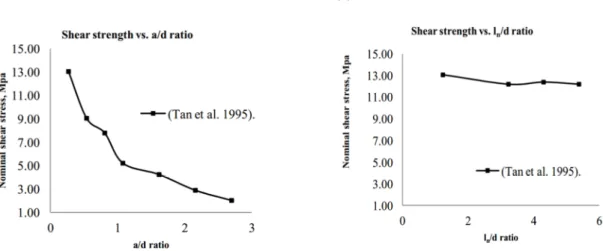
Normalized shear strength and reserve strength have been reduced when the a/d ratio increases. The same behavior shown by (Andermatt and Lubell 2013) for concrete deep beams reinforced by fiber , where the fibers used as a tension reinforcement and shear reinforcement shown by. (Madan, Kumar et al. 2007), In ratio of shear span-to-depth greaterthan 1.0 and increasing the effective span-to-depth ratio the behavior of flexural was dominated. (Tan, Kong et al. 1995). Even though the a/d ratio increases, shear failure mode appears to be Accompany with flexure and with high l/d ratio the flexure failure mode was predominant. (Shin, Lee et al. 1999) conclude that the failure modes are shear tension or shear compression is determined byshear span-to-depth ratio. Figure 4a, b. Shows that shear span -to-span-to-depth ratio is highlyinfluencing factor of shear strength in deep beams. In Figure 9a. There is an asymptotic reduction in the shear strength when ratio of shear span-to-depth is increase.
(a) (b)
Figure 9. (a) Effect of shear span-to-depth ratio and (b) influence of span-to-depth ratio on shear strength of deep beams.
7.7 Influence of Concrete Cover
The steel reinforcement must be covered by minimum thickness of concrete for protect reinforcement bars from environmental influences to prevent the corrosion; provide thermal isolation; to protect the reinforcement from fire and to give reinforcement bars adequate embedding to enable the bars to stress without slipping. (Rahal 2006) reported the effect of side concrete cover thickness on shear strength of concrete beams as shown in figure 10.
Figure. 10 Effect of side cover on the shear strength of beams
7.8 Size Effect of Reinforced concrete Deep Beams
Size effect observed by (Tan and Cheng 2006) have been governed by strut geometry and shear reinforcement spacing and diameter. (Zhang and Tan 2007) postulated the geometry of Strut andboundary conditions as influencing factors. Uncracked of concrete depth resist the shear stress on the other hand shear transfer inthe cracked portion is negligible. Haphazardness of material strength, interface shear transmission and unintentional out of planes deflection are the numbers of reasons specified to size effect (Tan and Cheng 2006). Incorporating size-effect, models are proposed (Rao and Sundaresan 2012) , (Zhang and Tan 2007) , (Tang and Tan 2004) , (Rao and Injaganeri 2011), (Rao and Sundaresan 2014) . the Reducing of overall size of high strength concrete deep beams with the same ratio results in a linear reduction in ultimate strength is observed by (Doh, Yoo et al. 2012).
(b) Breadth Effect on the Shear Capacity
Figure11. Effect of the Size on the Shear Strength of RC Deep Beam 8. Deep Beams with Opening
deep beams may need to be created the Web openings to hold for utilities such as air conditioning ducts or electronic cables or pipe line However, existence of openings induce geometric discontinuity in the deep beams, which only enhance the difficulty of nonlinear distribution of stress within the depth of deep beams (Guan and Doh 2007). It was conclude that the ultimate shear strength depends on the opening size and opening location in the web of deep beams compared with critical load pathway, due to the reduction of concrete mass acting in compression strut along the critical load pathway and the opening acting as a centre of stresses for propagation of shear crack around it (Kong and Sharp 1977). The design equations derived by (Kong, Robins et al. 1970), (Kong, Sharp et al. 1978), (Kong and Sharp 1973)and (Kong and Sharp 1977) for lightweight and normal reinforced concrete deep beams with and without web
openings to estimate the ultimate shear strength are:
For solid beam and
For beam with opening
(Yoo, Doh et al. 2013) Conducted that test on high strength reinforced concrete deep beams with varied web openings. Using published data and test results and derives the design equations expressed as:
For opening situated with flexural zone; and
For opening situated with rigid zone
Notation of size and location information’s using by (Kong and Sharp 1977), (Yoo, Doh et al. 2013) showed in figure 12. However, empirical design equations are derived using test results and further verification is demand using additional tool such as FEM used by (Doh, Yoo et al. 2012). These include more comparative and parametric trainings when changing of locations and web opening sizes. It was conclude by (Doh, Yoo et al.
situated closer with the top of the deep beam. And ultimate strength becomes lower when a web opening is situated closer to diagonal load pathway. When a web opening size is extended in the horizontal and, or vertical direction the decrease of ultimate strength is less when the opening size is adjusted horizontally compared with vertically.
Figure.12 Notation for location and size of opening 9. Conclusion
Shear strength capacity of deep beams is the important reason behind the growth of the use of deep beams. In general the equations of code requirements for RC deep beam capability are conservative. Behavior and ultimate shear capacity of RC deep beams influenced by several factors. load and support conditions, horizontal and vertical web reinforcement, shear span-to-depth ratio, load and support bearing plates, distribution of the reinforcement along depth of the deep beam‘s web, tension reinforcement and compressive strength. Least influencing parameters are bottom cover, side cover, width of the beam, distribution of vertical stirrups in the web, and aggregate size; existence the openings in the web the shear strength of deep beams has been change with different geometric configurations. The main remarks of conclusion:
1. Deep beams with high compressive strength exhibit high shear strength capacity.
2. Increase the Tension Reinforcement amount will increase in number of cracking as well as ultimate load. On the other hand decreasing the ductility and reduce the deflection.
3. Increase the vertical web Reinforcement amount will increase ultimate load capacity and restraining the diagonal crack.
4. Horizontal web reinforcement less effect on ultimate capacity than vertical reinforcement. Existence of horizontal shear reinforcement has significant effect on the capacity of deep beam with opening. 5. If the ratio of effective span to depth increases the ultimate shear strength of deep beam is decrease for
the same amount of longitudinal steel.
6. Reducing of overall size of high strength concrete deep beams with the same ratio results in a linear reduction in ultimate strength.
7. Classical elastic theory of bending is not appropriate to problems including deep beams. The stress pattern is nonlinear and deviates considerably from those derived by Bernaulli and Navier.
8. The existing of web opening inside the shear span caused the significant reduction in the shear strength capacity of deep beams.
9. Very few studies were provided to investigate the behavior of indirectly loaded concrete deep beams. References
426, A.-A. C. (1973). The shear strength of reinforced concrete members. ACI Journal Proceedings, ACI. Aguilar, G., A. B. Matamoros, G. J. Parra-Montesinos, J. A. Ramirez and J. K. Wight (2002). "Experimental
evaluation of design procedures for shear strength of deep reinforced concrete beams." ACI Structural Journal 99(4).
Andermatt, M. F. and A. S. Lubell (2013). "Behavior of Concrete Deep Beams Reinforced with Internal Fiber-Reinforced Polymer—Experimental Study." ACI Structural Journal 110(4).
Arabzadeh, A., R. Aghayari and A. R. Rahai (2011). "Investigation of experimental and analytical shear strength of reinforced concrete deep beams." International Journal of Civil Engineering 9(3): 207-214.
Barry, J. and H. Ainso (1983). "Single-span deep beams." Journal of Structural Engineering 109(3): 646-663. Birrcher, D. B., R. G. Tuchscherer, M. Huizinga and O. Bayrak (2013). "Minimum web reinforcement in deep
Campione, G. and G. Minafò (2012). "Behaviour of concrete deep beams with openings and low shear span-to-depth ratio." Engineering Structures 41: 294-306.
Committee, A., A. C. Institute and I. O. f. Standardization (2008). Building Code Requirements for Structural Concrete (ACI 318-08) and Commentary, American Concrete Institute.
Committee, A., A. C. Institute and I. O. f. Standardization (2014). Building Code Requirements for Structural Concrete (ACI 318-14) and Commentary, American Concrete Institute.
De Paiva, H. and C. P. Siess (1965). "Strength and behavior of deep beams in shear." Journal of the Structural Division 91(5): 19-41.
Doh, J.-H., T.-M. Yoo, D. Miller, H. Guan and S. Fragomeni (2012). "Investigation into the behaviour of deep beam with web openings by finite element." Computers & concrete 10(6): 609-630.
Evans, R. and M. Marathe (1968). "Microcracking and stress-strain curves for concrete in tension." Materials and Structures 1(1): 61-64.
Fereig, S. and K. Smith (1977). Indirect loading on beams with short shear spans. Journal Proceedings. Ferguson, P. M., J. E. Breen and J. O. Jirsa (1988). "Reinforced concrete fundamentals."
Guan, H. and J.-H. Doh (2007). "Development of strut-and-tie models in deep beams with web openings." Advances in Structural Engineering 10(6): 697-711.
Heywood, R., R. Pritchard and P. Shaw (2014). "Assessment OF Bridges–Challenging the Structural Engineering Profession."
Kalyanaraman, V., M. A. Rayan and H.-Y. Pao (1979). "Shear tests of deep beams with flanges." Journal of the Structural Division 105(12): 2760-2766.
Kong, F.-K., P. J. Robins and D. F. Cole (1970). Web reinforcement effects on deep beams. ACI Journal Proceedings, ACI.
Kong, F. and G. Sharp (1973). "Shear strength of lightweight reinforced concrete deep beams with web openings." Structural Engineer 51(R&D Rept.).
Kong, F. K. (2006). Reinforced concrete deep beams, CRC Press.
Kong, F. K. and G. R. Sharp (1977). "Structural idealization for deep beams with web openings." Magazine of Concrete Research 29(99): 81-91.
Kong, F. K., G. R. Sharp, S. C. Appleton, C. J. Beaumont and L. A. Kubik (1978). "Structural idealization for deep beams with web openings: further evidence." Magazine of Concrete Research 30(103): 89-95. Kotsovos, M. (1983). "Effect of testing techniques on the post-ultimate behaviour of concrete in compression."
Materiaux et construction 16(1): 3-12.
Kotsovos, M. (1988). "Compressive force path concept: Basis for ultimate limit state reinforced concrete design." ACI Structural Journal 85(1): 68-75.
Madan, S., G. R. Kumar and S. Singh (2007). "Steel fibers as replacement of web reinforcement for RCC deep beams in shear." Asian Journal of Civil Engineering (Building and Housing) 8(5): 479-489.
Matamoros, A. B. and K. H. Wong (2003). "Design of simply supported deep beams using strut-and-tie models." ACI Structural Journal 100(6).
Mohammadhassani, M., M. Z. Jumaat, M. Jameel, H. Badiee and A. M. Arumugam (2012). "Ductility and performance assessment of high strength self compacting concrete (HSSCC) deep beams: An experimental investigation." Nuclear Engineering and Design 250: 116-124.
Mphonde, A. G. and G. C. Frantz (1984). Shear tests of high-and low-strength concrete beams without stirrups. ACI Journal Proceedings, ACI.
Nawy, E. G. (1985). "Reinforced Concrete: A Fundamental Approach (Prentice-Hall International Series In Civil Engineering And Engineering Mech."
Nilson, A. and G. Winter (1987). Design of Concrete Structures, McGrawHill, Inc.
Oh, J.-K. and S.-W. Shin (2001). "Shear strength of reinforced high-strength concrete deep beams." ACI Structural Journal 98(2).
Paul, I. S. (1978). Behaviour of indirectly loaded reinforced concrete thin-wall ribbed panels, Concordia University.
Rahal, K. N. (2006). "Shear behavior of reinforced concrete beams with variable thickness of concrete side cover." ACI structural journal 103(2): 171.
Ramakrishnan, V. and Y. Ananthanarayana (1968). Ultimate strength of deep beams in shear. ACI Journal Proceedings, ACI.
Ramirez, J. A., C. French, P. Adebar, J. Bonacci and M. Collins (1998). "Recent approaches to shear design of structural concrete." Journal of Structural Engineering 124(12): 1374.
Rao, G. A. and S. Injaganeri (2011). "Evaluation of size dependent design shear strength of reinforced concrete beams without web reinforcement." Sadhana 36(3): 393-410.
Rao, G. A., K. Kunal and R. Eligehausen (2007). Shear strength of RC deep beams. Proceedings of the 6th International Conference on Fracture Mechanics of Concrete and Concrete Structures.
Rao, G. A. and R. Sundaresan (2012). "Evaluation of size effect on shear strength of reinforced concrete deep beams using refined strut-and-tie model." Sadhana 37(1): 89-105.
Rao, G. A. and R. Sundaresan (2014). "Size Dependent Shear Strength Of Reinforced Concrete Deep Beams Based On Refined Strut-And-Tie Model." Journal of Frontiers in Construction Engineering 3(1): 9-19.
Shin, S.-W., K.-S. Lee, J.-I. Moon and S. Ghosh (1999). "Shear strength of reinforced high-strength concrete beams with shear span-to-depth ratios between 1.5 and 2.5." ACI Structural Journal 96(4).
Smith, K. and A. Vantsiotis (1982). Shear strength of deep beams. ACI Journal Proceedings, ACI.
Standard, I. (2000). "Plain and reinforced concrete–code of practice." New Delhi: Bureau of Indian Standards. Tan, K.-H., F.-K. Kong, S. Teng and L. Guan (1995). "High-strength concrete deep beams with effective span
and shear span variations." ACI Structural Journal 92(4).
Tan, K.-H., F.-K. Kong, S. Teng and L.-W. Weng (1997). "Effect of web reinforcement on high-strength concrete deep beams." ACI Structural Journal 94(5).
Tan, K. and G. Cheng (2006). "Size effect on shear strength of deep beams: Investigating with strut-and-tie model." Journal of structural engineering 132(5): 673-685.
Tang, C. and K. Tan (2004). "Interactive mechanical model for shear strength of deep beams." Journal of Structural Engineering 130(10): 1534-1544.
Teng, S., W. Ma and F. Wang (2000). "Shear strength of concrete deep beams under fatigue loading." ACI Structural Journal 97(4).
Tuchscherer, R., D. Birrcher, M. Huizinga and O. Bayrak (2010). "Confinement of deep beam nodal regions." ACI Structural Journal 107(6).
Vecchio, F. J. and M. P. Collins (1993). "Compression response of cracked reinforced concrete." Journal of Structural Engineering 119(12): 3590-3610.
Walravena, J. and N. Lehwalter (1994). "Size effects in short beams loaded in shear." ACI Structural Journal 91(5).
Yoo, T. M., J. H. Doh, H. Guan and S. Fragomeni (2013). "Experimental behaviour of high‐strength concrete deep beams with web openings." The Structural Design of Tall and Special Buildings 22(8): 655-676. Yousif, J. L. and Y. Kun (2015). "Structural Behavior of Deep Reinforced Concrete Beams Under Indirect
Loading Condition." International Journal of Civil, Structural, Environmental and Infrastructure Engineering Research and Development 5(4): 53-71.
Zhang, N. and K.-H. Tan (2007). "Size effect in RC deep beams: Experimental investigation and STM verification." Engineering Structures 29(12): 3241-3254.