Particle Filter based Probabilistic Forced Alignment
for Continuous Gesture Recognition
Necati Cihan Camgoz
University of Surrey
Guildford, UK
[email protected]Simon Hadfield
University of Surrey
Guildford, UK
[email protected]Richard Bowden
University of Surrey
Guildford, UK
[email protected]Abstract
In this paper, we propose a novel particle filter based probabilistic forced alignment approach for training spatio-temporal deep neural networks using weak border level annotations.
The proposed method jointly learns to localize and recog-nize isolated instances in continuous streams. This is done by drawing training volumes from a prior distribution of likely regions and training a discriminative 3D-CNN from this data. The classifier is then used to calculate the posterior distribution by scoring the training examples and using this as the prior for the next sampling stage.
We apply the proposed approach to the challenging task of large-scale user-independent continuous gesture recogni-tion. We evaluate the performance on the popular ChaLearn 2016 Continuous Gesture Recognition (ConGD) dataset. Our method surpasses state-of-the-art results by obtaining0.3646
and0.3744Mean Jaccard Index Score on the validation and test sets of ConGD, respectively. Furthermore, we partici-pated in the ChaLearn 2017 Continuous Gesture Recognition Challenge and was ranked 3rd. It should be noted that our method is learner independent, it can be easily combined with other approaches.
1. Introduction
In recent years, Deep Learning [17] methods have obtained state-of-the-art performance for various spatio-temporal computer vision tasks, such as, Gesture Recognition [30], Action Recognition [5], Video Captioning [29], Lip Reading [9], and Sign Language Recognition [25]. How-ever, due to their hierarchical structure and high number of parameters, deep neural networks are prone to over-fitting [33]. To be able to generalize, they need vast amounts of data. Furthermore, classical network architectures and loss functions require strongFrame Level Annotations[26], or in other words a label for each time-step. Unfortunately, annotating spatio-temporal data is a laborious task and most
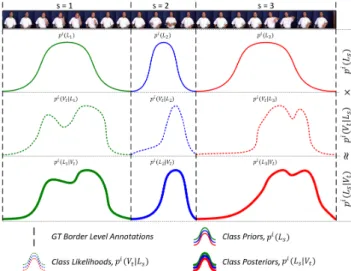
Figure 1. Posterior estimation using our prior assumptions and class likelihoods extracted from a 3D-CNN.
spatio-temporal datasets lack these strong annotations. Al-though some large datasets have frame level annotations [14], the majority provide a variety of weak annotations. To overcome these challenges and to train deep spatio-temporal neural networks using weakly annotated data, researchers have proposed several approaches.
For isolated recognition tasks such as Isolated Gesture [10] and Action Recognition [23], most datasets provide
Instance Level Annotationsthat is a single label for each video clip which does not contain any temporal localisation. To train deep networks using instance level annotations, re-searchers [11, 21, 27, 28] frequently assign the provided instance labels to all time steps and train neural networks using Cross Entropy Loss [17]. However, identifying every part of a sequence with the same label can cause class am-biguity as different stages of a sequence can have different spatio-temporal features.
For continuous recognition tasks, datasets with weak an-notation commonly provide Sequence Level Annotations
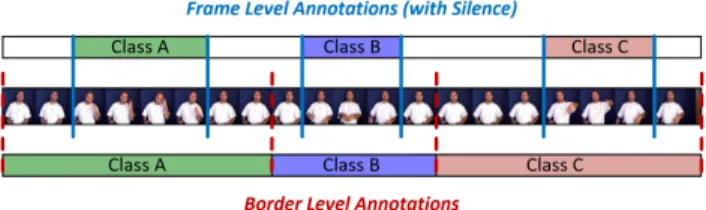
Figure 2. Difference between Strong Frame Level Annotations and Border Level Annotations.
that have a sequence of labels for each video that has the temporal ordering information [15]; orBorder Level Annota-tionswhich are the boundaries between instances in the time domain [31].
Sequence Level Annotationsare frequently used for tasks where the order of labels provides additional or complemen-tary information. Such applications include Continuous Sign Language Recognition [4] and Video Captioning [7]. To be able to train spatio-temporal deep networks using sequence level annotations, researchers adopted sequence-to-sequence learning methods from other fields, namely Connectionist Temporal Classification [18] from Speech Recognition [19] and Encoder-Decoder Networks [8] from the field of Neural Machine Translations [1].
Compared to the Frame Level Annotations,Border Level Annotationsare more weakly supervised but easier to anno-tate (See Figure 2). However, using these weak frame level annotations can cause the aforementioned class ambiguity problem. Furthermore, this ambiguity is exacerbated as the annotated regions include the silence and the transition be-tween instances. To localize instances in the time domain and to remove silence and transition regions from training samples, researchers have proposed to use forced alignment that has been widely used in speech recognition [12].
Forced alignment has been applied to various vision appli-cations. In [24], Koller et al. propose a CNN-HMM hybrid that learns to localize and recognize hand shapes. They first train a CNN using weak frame level annotations. Then using the trained network they reassign, or in other words align, their frame labels. In a more recent study [25], they extend their method and apply it to Continuous Sign Language recognition to train CNN-HMM hybrids from sequence level annotations.
Inspired by the success of forced alignment approaches, we propose a novel probabilistic forced alignment method to address the weakly supervised training of spatio-temporal deep neural networks. Our method learns to probabilisti-cally localize and recognize isolated instances in continu-ous streams using a particle filter based approach. We use weak border level annotations to build distributions for each isolated instance that represent our prior assumption of im-portance over the time domain. We then train a 3D-CNN weighted by these distributions. We evaluate our prior
distri-butions by extracting likelihoods of training samples using the trained network and update our prior assumption. We repeat this iterative process until the continuous recognition performance of our network has converged. Compared with a classical forced alignment method, our approach is more robust against errors in early stages due to its probabilistic nature.
We apply the proposed method to the continuous gesture recognition problem and evaluate its performance on the challenging large-scale user-independent ChaLearn 2016 Continuous Gesture Recognition (ConGD) dataset [31]. Our method was able to surpass continuous recognition perfor-mance of the state-of-the-art [3]. We also participated in the ChaLearn 2017 Continuous Gesture Recognition Challenge, ranking 3rd place [30].
The rest of the paper is structured as following: In Section 2 we describe each step of the proposed method in detail. In Section 3 we share our experimental setup and implemen-tation details. Then we report our results on ConGD and compare the performance of our approach with the state-of-the art methods. Finally, we conclude our paper in Section 4 by discussing our findings and the future work.
2. Methodology
In this section we present a novel particle filter based probabilistic forced alignment technique that jointly learns to localize and recognize isolated instances in continuous streams using border level annotations. Given a video that contains multiple isolated occurrences, our method proba-bilistically divides the video into segments and classifies each segment using a 3D Convolutional Neural Network (3D-CNN).
While training we use border level annotations of con-tinuous streams and build probability distributions of labels over frames for each isolated instance. To be able to segment isolated samples, or in other words to localize the silences between occurrences in a continuous stream, we introduce a silence class for which we also build probability distributions for each segment. We then train a 3D-CNN weighted by these distributions that learns to distinguish these classes. When the network is trained we use its output to update the probability distributions for the next iteration.
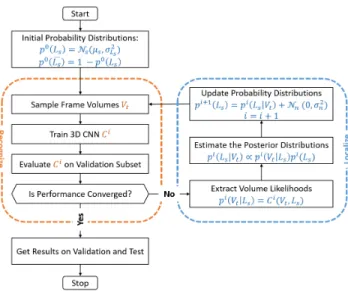
This process of updating distributions and retraining a 3D CNN is repeated until our network’s recognition performance has converged. This iterative update process gives the pro-posed method the ability to localize the most representative regions in a weakly supervised manner. An overview of our method can be seen in Figure 3.
2.1. Building Initial Distributions
To create the initial approximate probability distributions we use the border level annotations and divide the training
Figure 3. An overview of our iterative alignment procedure.
set into isolated instance segments. We calculate the stan-dard deviation of segment lengths,σl, for each classl. We
then propose an initial normal distribution,p0(Ls), for each
segmentsas:
p0(Ls) =Ns(µs,(σl/2)2) (1)
whereµsandLsare the centre frame and the class labellof
segments, respectively.p0(L
s)is our prior assumption of
a frame being discriminative for the present class,Ls, in a
given segments.
We also propose the inverse distribution,p0(Ls), for each
segment as:
p0(Ls) = 1−p0(Ls) (2)
which is the prior assumption of a frame being in the silence or transition region between instances of other classes. In other words being discriminative for the silence class. As an example, given a continuous stream with three isolated instances, our suggested prior distributions can be seen in Figure 4.
2.2. Training 3D Convolutional Neural Networks
Using our prior assumptions,pi(L
s)andpi(Ls), we now
train our recognition system. We stochastically draw frames from each segmentsaccording to these distributions. For each frame,Ft, we create a frame volume,Vt, by
concatenat-ing neighbourconcatenat-ing frames whereFtis in the centre. Therefore,
Vtrepresents the spatio-temporal changes aroundFt. We
then train a 3D Convolutional Neural Network (3D-CNN),
Ci, using these volumes, which learns discriminative
spatio-temporal features to distinguish between the target classes and the silence class.
We used the 3D CNN architecture proposed by Tran et al. [28], which has eight 3D Convolution, five 3D Pooling and
Figure 4. Initial Prior Distributions over an example video with three segments.
three Fully Connected layers. Our network architecture can be seen in Figure 5. We re-initialize the last fully connected layerf c8which has|l|+ 1output units that corresponds to each class and the silence class.
During training we feed the stochastically selected vol-umes,Vt, from all the segments to the network and fine-tune
the network, Ci, using Cross Entropy Loss [17] and the segment labels,Ls. We run the optimization forIiterations
and take snapshots of the weights everyKsteps. We then select the best performing model from these snapshots by evaluating its continuous gesture recognition performance on a validation set, which we will be describing in detail in Section 2.4.
2.3. Particle Filter based Probabilistic Forced
Alignment
We continue our alignment procedure by including new evidence from recognition. By feeding a frame volume,
Vt, to the network,Ci, we estimate its likelihood of being
discriminative for the classLsof their respective segments.
We obtain the likelihood,pi(Vt|Ls), by taking the softmax
of the corresponding output unit as:
pi(Vt|Ls) =Ci(Vt, Ls) = efi(Vt,Ls) X l efi(Vt,l) (3)
where functionfi(V, l)is the value produced by thelthoutput unit, which corresponds to classl, in the last fully connected layer,f c8, of the 3D-CNN ,Ci, for the inputV.
Using the estimated likelihood distributions,pi(V t|Ls),
we update our prior assumptionspi+1(L
s)of each segment
s. First, we calculate the posterior distributionpi(L
s|Vt)as:
pi(Ls|Vt)∝pi(Vt|Ls)pi(Ls) (4)
∝Ci(Vt, Ls)pi(Ls) (5)
wherepi(V
t|Ls)andpi(Ls)are the estimated likelihood and
our prior assumption for a segments, respectively. A visu-alization of our posterior estimation can be seen in Figure 1.
Figure 5. Our 3D Convolutional Neural Network Architecture
Then we update our prior assumption for the next iteration as:
pi+1(Ls) =pi(Ls|Vt) +Nn(0, σn2) (6)
where Nn is Gaussian noise with σn standard deviation.
Using the updated prior distributions,pi+1(L
s), we retrain a
new 3D-CNN,Ci+1, initializing from the previous weights,
Ci:
Ci+1=ReTrain(Ci, pi+1(Ls)) (7)
This alignment (Section 2.3) and retraining a 3D-CNN (Sec-tion 2.2) procedure is repeated until the network’s continuous recognition performance (Section 2.4) converges.
2.4. Prediction: Segmentation and Classification
We propose a two stage prediction approach for recogniz-ing isolated instances in continuous streams. Our method first splits a given video into multiple segments (which do not necessarily correspond to the ground truth segmentations) and then classifies each segment using the likelihoods ex-tracted from a 3D CNN. This re-segmentation allows our method to handle unlabelled instances.
Given a video ofTframes we initially create frame vol-umes,Vt, for each frame,Ft, by concatenating
neighbour-ing frames. We then extract likelihoods of these volumes
p(V1:T|l)for each class,l, using a 3D CNN,Ci. lcan be
either one of the classes or the silence class. Using the ex-tracted likelihoods we probabilistically split the video into multiple isolated segments. This is done by localizing silence regions using the silence class likelihoodpi(V
1:T|Ls)over
frames. Assuming there are silence or transitions between instances, we segment the video clip where the silence class likelihood in a region is higher than any other class.
Once the video is divided into segments, we use the extracted class likelihoods to predict the most prominent class in each non-silence segment,Lpred
s , as: Lpreds = argmax l Ts X t pi(Vt|l) (8)
whereTsis the number of frames in a given segmentsand
pi(V
t|l)is the likelihood of frame volumesVtbelonging to
the classl. We then expand the segment level predictions into border level annotations and evaluate it against the ground
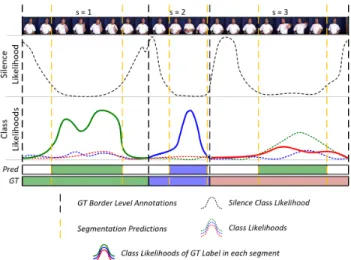
Figure 6. Recognition: Segmentation and Classification (GT = Ground Truth Labels, Pred = Our Predictions). In this example, ,we were able to successfully localize and recognize first two segments (s = 1 and s = 2) while failing to recognize the third segment (s = 3).
truth using the Mean Jaccard Index Score. A visualization of our recognition procedure can be seen in Figure 6.
3. Evaluation
To evaluate the effectiveness of the particle filter based probabilistic forced alignment approach we conducted ex-periments on the popular ChaLearn Continuous Gesture Dataset (ConGD) [31], featured in the 2nd round of the ChaLearn 2017 Continuous Gesture Recognition Challenge. The dataset was formed by re-annotating the ChaLearn 2011 Gesture Dataset [20] to enable evaluation of user-independent recognition. ConGD contains 47,933 gesture samples be-longing to 249 gesture classes performed by 21 subjects. A summary of the dataset can be seen in Table 1. It is currently the largest continuous user-independent gesture recognition dataset surpassing other large gesture recognition datasets, such as ChaLearn 2014 [14] (which has 13,858 samples of 20 gesture classes), both in the number of samples and the number of classes.
We implemented our method using the Caffe [22] distri-bution developed by Tran et al. [28] that supports the use of 3D Convolution and Pooling layers. The code to reproduce our results is publicly available1.
Figure 7. Recognition results on a validation sample (ConGD Validation Set Sample ID: 001/00012) Partition Name # of Samples # of Sequences # of Subjects
Train 30,442 14,134 17 Validation 8,889 4,179 2 Test 8,602 4,042 2 All 47,933 22,355 21
Table 1. Summary of ChaLearn 2016 ConGD Dataset
To train our 3D-CNNs we have used Stochastic Gradient Descent [2] with a learning rate oflr= 10−3, a momentum
ofm = 0.99and a batch size of 45. The networks were initialized with the pre-trained weights provided by Camgoz et al. [3] which was the previous state-of-the-art on the ConGD dataset. We re-initialized the last fully connected layer of our 3D-CNNs for each alignment iteration using the Xavier initialization method [16].
We trained our networks for 40,000 steps (roughly 3 epochs) for each alignment iteration. We take snapshots of 3D-CNN weights every 1,000 steps. We then evaluate the continuous gesture recognition performance as described in Section 2.4 to determine the best performing model. Due to large number of models (40 for each alignment iteration), we used a subset of the ConGD validation set to speed up the evaluation process. The same validation subset has been used for all alignment iterations. The best performing model is then used to perform continuous recognition on the validation and test sets of ConGD.
To approximate the prior distributions we stochastically chose twenty frames from each segment, ten for the class present in the segment and ten for the silence class. For each frame we create a frame volume by concatenating the neighbouring 16 RGB frames. After each iteration we keep half of the samples which have the highest posteriors and re-sample the remainder using stationary sampling. We used five frames asσn.
We iterated our method 3 times and evaluated its perfor-mance on the validation set. As can be seen in Table 2 our method’s recognition performance generally improves over iterations. We believe the fluctuations over the iterations is re-lated to the number of samples we have used to approximate
the importance distributions. Using more samples would yield a lower variation and more smooth change over the iterations, while slowing the training and alignment steps of our method. Even though we selected the best performing model for each iteration by evaluating them on a validation subset, the change in the performance was also reflected on the full validation set, indicating good generalization. After three iterations, the recognition performance has not completely converged and further iterations may improve the performance.
Iteration Validation Subset MJI Validation MJI
0 0.3743 0.3544
1 0.3996 0.3646
2 0.3998 0.3634
3 0.4048 0.3806
Table 2. Performance evaluation of the proposed method over iterations. (MJI: Mean Jaccard Index)
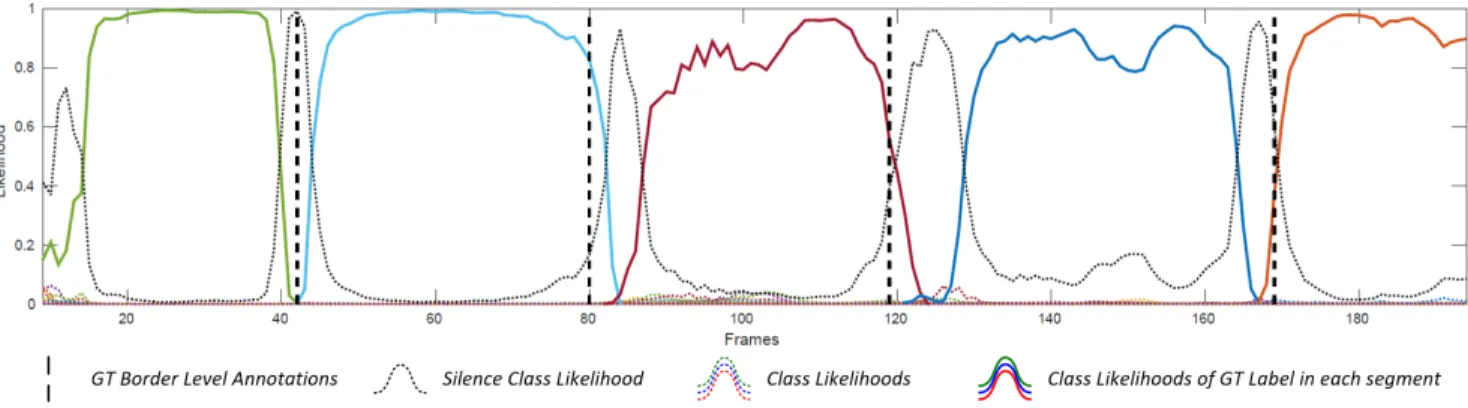
The recognition performance of a ConGD validation sam-ple using our best performing model can be seen in Figure 7. Given a sample with 5 isolated instances, our method was able to correctly recognize all of them. Furthermore, it man-aged to localize where the gestures are more accurately than the “ground truth” annotations. In addition, there was low inter-class ambiguity in gesture segments, indicating that the introduction of the silence class did not cause class confusion.
When compared with the previous state-of-the-art [13], our method with a single alignment step was able to sur-pass performance on both the validation and the test set by 6.3284% and 18.97044% relative Mean Jaccard Index score respectively (See Table 3). With two additional alignment steps our method gained 4% more relative Mean Jaccard Index score over the state-of-the-art on the validation set. However, we could not report our results on the test set as the labels are withheld. Furthermore, our method yielded more balanced performance between validation and test set, indicating better generalization. We also submitted our recog-nition results from the first iteration to the 2nd round of the ChaLearn 2017 Continuous Gesture Recognition Challenge
and were ranked third. As our method is learner independent, it could easily be integrated to other approaches from the challenge.
Method Validation MJI Test MJI
Baseline [31] MFSK 0.0902 0.1464
Wang et al. [32] IDMM + CNN 0.2403 0.2655
Chai et al. [6] CNN + RNN 0.2655 0.2869
Camgoz et al. [3] 3D-CNN 0.3429 0.3147
Ours (Challenge) 3D-CNN + Alignment 0.3646 0.3744
Ours (Best) 3D-CNN + Alignment 0.3806 N/A
Table 3. Comparison with the state-of-the-art methods (MJI: Mean Jaccard Index)
4. Conclusion
In this paper we proposed a particle filter based proba-bilistic forced alignment approach to address the weakly supervised training of deep spatio-temporal neural networks. Using the proposed method we trained 3D-CNNs to simulta-neously localize and recognize isolated instances in continu-ous streams.
We applied our approach to the difficult task of continuous gesture recognition and evaluated its performance on the challenging ChaLearn 2016 Continuous Gesture Recognition dataset. Through our experiments, we have seen the effective-ness of the proposed probabilistic forced alignment approach as it has iteratively improved the recognition performance by8.1485%relative Mean Jaccard Index Score compared to training with a naive prior distribution. Our method was able the surpass the previous state-of-the-art [3], which also used a 3D-CNN based learning, by obtaining0.3806Mean Jaccard Index Score on the validation set. We also partici-pated in the ChaLearn 2017 Continuous Gesture Recognition challenge and were ranked third [30]. However, our method is independent of the learning algorithm and could easily be used with other approaches.
As future work we would like to apply our method to other spatio-temporal tasks such as Continuous Sign Language Recognition and extend our framework to incorporate mul-tiple modalities. It would also be interesting to investigate parallel alignment of these modalities.
References
[1] D. Bahdanau, K. Cho, and Y. Bengio. Neural Machine Trans-lation by Jointly Learning to Align and Translate. In Inter-national Conference on Learning Representations (ICLR), 2015.
[2] L. Bottou. Large-Scale Machine Learning with Stochastic Gra-dient Descent. InInternational Conference on Computational Statistics (COMPSTAT). 2010.
[3] N. C. Camgoz, S. Hadfield, O. Koller, and R. Bowden. Using Convolutional 3D Neural Networks for User-Independent Continuous Gesture Recognition. InInternational Conference on Pattern Recognition (ICPR) Workshops, 2016.
[4] N. C. Camg¨oz, S. Hadfield, O. Koller, and R. Bowden. Sub-unets: End-to-end hand shape and continuous sign language recognition. IEEE International Conference on Computer Vision (ICCV), 2017.
[5] J. Carreira and A. Zisserman. Quo Vadis, Action Recognition? A New Model and the Kinetics Dataset.arXiv:1705.07750, 2017.
[6] X. Chai, Z. Liu, F. Yin, Z. Liu, and X. Chen. Two Streams Recurrent Neural Networks for Large-Scale Continuous Ges-ture Recognition. InInternational Conference on Pattern Recognition (ICPR) Workshops, 2016.
[7] K. Cho, A. Courville, and Y. Bengio. Describing MultiMedia Content using Attention-based Encoder-Decoder Networks.
IEEE Transactions on Multimedia, 17(11):1875–1886, 2015. [8] K. Cho, B. van Merrienboer, C. Gulcehre, D. Bahdanau, F. Bougares, H. Schwenk, and Y. Bengio. Learning phrase representations using rnn encoder–decoder for statistical ma-chine translation. InConference on Empirical Methods in Natural Language Processing (EMNLP), 2014.
[9] J. S. Chung, A. Senior, O. Vinyals, and A. Zisserman. Lip Reading Sentences in the Wild. InIEEE Conference on Computer Vision and Pattern Recognition (CVPR), 2017. [10] J. Duan, J. Wan, S. Zhou, X. Guo, and S. Li. A Unified
Frame-work for Multi-Modal Isolated Gesture Recognition. InACM Transactions on Multimedia Computing, Communications, and Applications (TOMM),(under review, round 2), 2017. [11] J. Duan, S. Zhou, J. Wan, X. Guo, and S. Z. Li. Multi-Modality
Fusion based on Consensus-Voting and 3D Convolution for Isolated Gesture Recognition.arXiv:1611.06689, 2016. [12] S. Dupont and J. Luettin. Audio-Visual Speech Modeling
for Continuous Speech Recognition.IEEE Transactions on Multimedia, 2(3):141–151, 2000.
[13] H. J. Escalante, V. Ponce-L´opez, J. Wan, M. A. Riegler, B. Chen, A. Clap´es, S. Escalera, I. Guyon, X. Bar´o, P. Halvorsen, et al. Chalearn Joint Contest on MultiMe-dia Challenges Beyond Visual Analysis: An Overview. In
IEEE International Conference on Pattern Recognition (ICPR) Workshops, 2016.
[14] S. Escalera, X. Bar´o, J. Gonzalez, M. ´A. Bautista, M. Madadi, M. Reyes, V. Ponce-L´opez, H. J. Escalante, J. Shotton, and I. Guyon. ChaLearn Looking at People Challenge 2014: Dataset and Results. InECCV Workshops (1), pages 459–473, 2014.
[15] J. Forster, C. Schmidt, O. Koller, M. Bellgardt, and H. Ney. Extensions of the Sign Language Recognition and Transla-tion Corpus RWTH-PHOENIX-Weather. InInternational Conference on Language Resources and Evaluation (LREC), 2014.
[16] X. Glorot and Y. Bengio. Understanding the Difficulty of Training Deep Feedforward Neural Networks. In Proceed-ings of the Thirteenth International Conference on Artificial Intelligence and Statistics, pages 249–256, 2010.
[17] I. Goodfellow, Y. Bengio, and A. Courville.Deep Learning. MIT press, 2016.
[18] A. Graves, S. Fern´andez, F. Gomez, and J. Schmidhuber. Con-nectionist Temporal Classification: Labelling Unsegmented Sequence Data with Recurrent Neural Networks. In Interna-tional Conference on Machine Learning (ICML), 2006.
[19] A. Graves, A. Mohamed, and G. Hinton. Speech Recognition with Deep Recurrent Neural Networks. InIEEE Interna-tional Conference on Acoustics, Speech and Signal Processing (ICASSP), 2013.
[20] I. Guyon, V. Athitsos, P. Jangyodsuk, and H. J. Escalante. The ChaLearn Gesture Dataset (CGD 2011).Machine Vision and Applications, 25(8):1929–1951, 2014.
[21] S. Ji, W. Xu, M. Yang, and K. Yu. 3D Convolutional Neural Networks for Human Action Recognition. IEEE Transac-tions on Pattern Analysis and Machine Intelligence (PAMI), 35(1):221–231, 2013.
[22] Y. Jia, E. Shelhamer, J. Donahue, S. Karayev, J. Long, R. Gir-shick, S. Guadarrama, and T. Darrell. Caffe: Convolutional Architecture for Fast Feature Embedding. InProceedings of the 22nd ACM international conference on Multimedia, pages 675–678. ACM, 2014.
[23] W. Kay, J. Carreira, K. Simonyan, B. Zhang, C. Hillier, S. Vi-jayanarasimhan, F. Viola, T. Green, T. Back, P. Natsev, et al. The Kinetics Human Action Video Dataset.arXiv:1705.06950, 2017.
[24] O. Koller, H. Ney, and R. Bowden. Deep Hand: How to Train a CNN on 1 Million Hand Images When Your Data is Continuous and Weakly Labelled. InIEEE Conference on Computer Vision and Pattern Recognition (CVPR), 2016. [25] O. Koller, S. Zargaran, and H. Ney. Re-Sign: Re-Aligned
End-to-End Sequence Modelling with Deep Recurrent CNN-HMMs. InIEEE Conference on Computer Vision and Pattern Recognition (CVPR), 2017.
[26] Y. LeCun, Y. Bengio, and G. Hinton. Deep Learning.Nature, 521(7553):436–444, 2015.
[27] K. Simonyan and A. Zisserman. Two-Stream Convolutional Networks for Action Recognition in Videos. InAdvances in Neural Information Processing Systems (NIPS), 2014. [28] D. Tran, L. Bourdev, R. Fergus, L. Torresani, and M. Paluri.
Learning Spatiotemporal Features with 3D Convolutional Networks. InIEEE International Conference on Computer Vision (ICCV), 2015.
[29] S. Venugopalan, M. Rohrbach, J. Donahue, R. Mooney, T. Dar-rell, and K. Saenko. Sequence to Sequence-Video to Text. In
Proceedings of the IEEE international Conference on Com-puter Vision (ICCV), 2015.
[30] J. Wan, S. Escalera, A. Gholamreza, H. J. Escalante, X. Bar´o, I. Guyon, M. Madadi, A. Juri, G. Jelena, L. Chi, and X. Yil-iang. Results and Analysis of ChaLearn LAP Multi-modal Isolated and Continuous Gesture Recognition, and Real versus Fake Expressed Emotions Challenges. InIEEE International Conference on Computer Vision (ICCV) Workshops, 2017. [31] J. Wan, Y. Zhao, S. Zhou, I. Guyon, S. Escalera, and S. Z.
Li. Chalearn Looking at People: RGB-D Isolated and Con-tinuous Datasets for Gesture Recognition. InIEEE Confer-ence on Computer Vision and Pattern Recognition Workshops (CVPRW), 2016.
[32] P. Wang, W. Li, S. Liu, Y. Zhang, Z. Gao, and P. Ogunbona. Large-scale Continuous Gesture Recognition Using Convolu-tional Neutral Networks.International Conference on Pattern Recognition (ICPR) Workshops, 2016.
[33] C. Zhang, S. Bengio, M. Hardt, B. Recht, and O. Vinyals. Understanding Deep Learning Requires Rethinking General-ization. 2017.