Total Factor Productivity, Saving Rate and
Learning-by-Doing in Growth Process
Cuong Le Van , Tu-Anh Nguyeny
March 19, 2009
Abstract
In transitional stage saving rate play an important role in output growth rate as proposed by Krugman. Accumulationists are also right as claiming that learning-by-doing play an important role in TFP growth in NIEs. However, using a CES production technology we can show that the growth model based purely on learning-by-doing is constrained by la-bor growth rate. If the latter is constant in the long-run, then the growth can not be sustained.
Keywords: Optimal growth model, learning-by-doing, saving rate, De-veloping country.
JEL Classi…cation: D51, E13, E21
1
Introduction
The roles of capital accumulation and technological progress in economic growth are not new stories in the literature. The Solow (1956) based on the classical assumption of diminishing returns to capital, states that without continuing im-provement of technology per capita growth must eventually cease. The essential factor for economic growth, namely technological progress, is however, exoge-nous to the model. This shortcoming inspires scholars such as Romer (1986, 1987, 1990), Lucas (1988), Rebelo (1991), Grossman and Helpman (1991), Aghion and Howitt (1992) and many others to develop new "endogenous" growth models which provide more insight into the Solow’s residual. The en-dogenous growth models by taking human capital accumulation, learning-by-doing, research and development (R&D), and knowledge spillover in economic
CNRS, University Paris 1, PSE, CES
growth into account are able to generate long-term per-capita growth endoge-nously.
Recently, the spectacularly rapid growth of many Asian economies, espe-cially the East Asian newly industrialized economies (NIEs) gave rise to a broad and diversi…ed literature aiming at explaining the reasons for such a long lasting period of expansion (Kim and Lau [1994, 1996], Krugman [1994], Rodrik [1995], Worldbank [1993], Young [1994, 1995]). All these economies have experienced rapid growth of their physical capital stock and very high rate of investment in human capital.
On one hand, the supporters of the accumulation view stress the impor-tance of physical and human capital accumulation in the Asian growth process. Accordingly, the main engine of "miracle growth" in NIEs is simply, very high investment rates. Young [1994, 1995], Kim and Lau [1994, 1996] found that the postwar economic growth of the NIEs was mostly due to growth in input factors (physical capital and labor) with trivial increase in the total factor productiv-ity. Moreover, the hypothesis of no technical progress cannot be rejected for the East Asian NIEs (Kim and Lau [1994]). Consequently, accumulation of phys-ical and human capital seems to explain the lion’s share of the NIEs’ growth process. Krugman [1997] wrote that Larry Lau and Alwyn Young works sug-gested that Asian growth could mostly be explained by high investment rates, good education and the movement of underemployment peasants into the mod-ern sector. Economists who take this point implicitly assumed that adoption and mastering new technology and other modern practices could be done easily by trade.
"Accumulationists seem to believe that the state of technological knowledge at any time is largely codi…ed in the form of blueprints and associated documents and that, for a …rm to adopt a technology that is new to it but not to the world, primarily involves getting access to those blueprints" (Nelson and Pack, 1998). Accordingly, any economies could have experienced high rates of growth like NIEs if they could a¤ord similar investment rates. Krugman’s [1994] in-terpretation of these results is very pessimistic since, in his opinion, the lack of technical progress will inevitably bound the growth engine of East Asian NIEs as a result of the diminishing returns a¤ecting capital accumulation.
On the other hand, the supporters of endogenous growth theory pinpoint productivity growth as the key factor of East Asian success. According to these authors, Asian countries have adopted technologies previously developed by more advanced economies (assimilation view) and "the source of growth in a few Asian economies was their ability to extract relevant technological knowledge from industrial economies and utilize it productively within domestic economy" (Pack [1992]). They admit that high rates of investment into physical and
human capital is necessary to achieve high economic growth rate. However, as stressed by Nelson and Pack (1998) there is nothing automatic in learning about, in risking to operate and, in coming to master technologies and other practices that are new to the economy. These processes require searching and studying, learning, and innovating to master modern technologies and new practices. Thereby, the economy enhances its stock of knowledge and e¢ ciency. Implicitly, they suggest that technological progress exists and does play a crucial role in NIEs’economic growth.
Empirically, Collins and Bosworth [1996] or Lau and Park [2003] show Total Factor Productivity (TFP) gains actually matter in Asian NIEs growth and that future growth can be sustained. For these authors, learning-by-doing in process of physical accumulation play an essential role in TFP growth in these economies.
In this paper we prove that Krugman’s view is correct in the short and mid terms. But in the long term, TFP is the main factor of growth. In this sense, Solow is right and his 1956 model is basically a long term growth model. Speci…cally, in transitional stage the high saving rate induces high growth rate of output however, in the long-run the impact of saving rate on output growth rate will vanish out.
On the other hand, assimilationists are also right as claiming that learning-by-doing play an important role in TFP growth in NIEs. We also show, however, that the growth model based purely on learning-by-doing is constrained by labor growth rate. If the latter is constant in the long-run, then the growth can not be sustained. Therefore, despite learning-by-doing generating TFP growth the long run growth essentially requires in-house capacity to generate technological progress.
Finally, if the structure of the economy is not elastic, in the sense that it is not easy to switch from a labor-intensive technology to more capital-intensive technologies and vise versa, then saving plays a crucial role in economic growth. The economy may fall into poverty trap if saving rate is too low or the pop-ulation grows too fast, regardless how e¤ective the knowledge accumpop-ulation (learning-by-doing and spilling-over) is.
The organization of the paper is as follows. The general basic neoclassical model is presented in section 2. In section 3 we use standard Solow model to prove that high investment rate improve growth rate in short-term however this e¤ect vanish in long-term. In section 4, CES production function is used to take into account process of knowledge accumulation through learning-by-doing and the spillover in economic growth process. The last section summarize main results of the paper.
2
The Basic Neoclassical Model
In this section we set out the basic model of capital accumulation that will use in our analysis. The standard constant return to scale is de…ned as follows:
Yt=F(At; Kt; Lt) (1)
Where Yt is output, Ktis physical capital, Lt is labour input, At is a
pa-rameter of technological progress. The production function, if At and Lt are
constant, has positive and diminishing returns to the reproducible factor Kt:
Mathematically, @Yt
@KT >0;
@2Yt
@Kt@Kt <0:
We follow Sollow (1956) to assume that saving (net investment) is a …xed fraction s of income; the capital stock depreciates at a …xed rate ; and the labor growth rate is constant at n. With these assumptions the transitional dynamics of the model is given by following program:
Ct+St = Yt=F(At; Kt; Lt) (2a)
St = sYt; s is the exogenous saving rate
Kt+1 = Kt(1 ) +sYt (2b)
Lt = L0(1 +n)t
Ct; St; Yt; Kt; It; Ltdenote respectively the consumption, the saving, the
out-put, the capital stock, the investment and the labour at period t. The labour force grows with an exogenous raten: At denotes the technological level in the
economy at timet. The growth rate of At is assumed to be identical with the
growth rate of the Total Factor Productivity (TFP).
In the following section we use Solow model to show that in short run invest-ment rate or physical capital accumulation do have strong e¤ect on economic growth. However, in long-run economic growth is neutral to investment rate but positively contingent on rate of technological change.
The accumulating knowledge through learning-by-doing as mentioned in Atkinson and Stiglitz (1969) and Nelsons and Pack (1998) is modelized in a CES production function in section 4.
3
Exogenous TFP: The Solow Model
In this section we use Cobb-Douglas functional to consider a simple intertem-poral growth model for a closed economy.
The Total Factor Productivity (TFP) is assumed to grows at a constant rate . It is easy to solve the model given above. Actually, we have
8t; Kt+1= (1 )Kt+saKtL1t (1 + )
t (4)
We can easily check that there exists a Balanced Growth Path (BGP) with rate
g
(1 +g) = (1 +n)(1 + )11
On the BGP, we have Kt =Ks(1 +g)t; 8t; where Ks = gsa+ 1 1
L0. Given
K0 >0, the path generated by equation (4) satis…es
Kt
(1 +g)t !K s
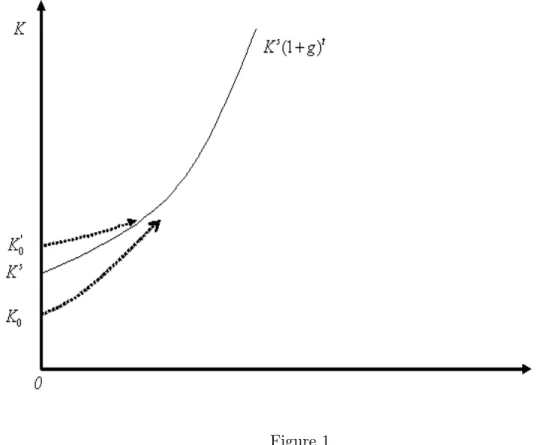
In other words, the pathfKtgtconverges to the steady stateKs(1+g)tas shown
in …gure 1. It is interesting to notice that the rate of growth g is positively related to the rate of growth of the TFP.
Figure 1 From (4) we have:
8t; Kt+1 = (1 )Kt+saKtL10 (1 + )
t(1 +n)t(1 ) (5)
and fKtgconverges tofKs(1 +g)tgwhereg is growth rate of capital stock
and output at steady state and1 +g= (1 +n)(1 + )11 andKs= [ sa
g+ ]
1 1 L
Notice that in Cobb-Douglas technology as de…ned in (3) the growth rate of output is identical as growth rate of capital. Let us de…ne this growth rate as follows:
t=
Kt
Kt 1
From equation (5) we have:
Kt
Kt 1
(1 ) =saL10 (1 + )t 1(1 +n)(t 1)(1 )Kt 11 (6)
t (1 ) = (1 + )(1 +n)1 t 11[ t 1 (1 ] (7) Lemma 1 Let'( ) = [ (1 )] 1 with >0 then'( )is increasing with
:
Proof:
'0( ) = 1+ [ (1 )]( 1) 2 = 2[ + ( 1) + (1 )(1 )] = 2[ + (1 )(1 )>0]
It is easy to check that
K1=saK0L10 + (1 )K0 (8)
2 =sa(1 + )K1 1L 1
1 + 1 (9)
The equation (9) shows that better rate of technological progress ( is higher) or better saving rate (s) will bring about a higher growth rate for period 2 ( 2). Using Lemma (1) and equation (7) we can show that the growth rate is
not only improved in period 2 but for all latter periods. Put it di¤erently, an economy with higher rate of technological progress not only has higher growth rate at steady state but also has higher growth rate in transitional period.
More interestingly, as we have shown saving rate is neutral to growth rate in the long-run, however in transitional stage Lemma (1) and equation (7) show that an increase of saving rate does accelerate 2 then growth rate of all period
afterward. In other words, saving rate contribute e¤ectively in transitional periods, however the in‡uece of saving rate on growth must eventually vanish in the long-run.
Now let us consider two economies which are identical in everything, except for rates of technological progress and rates of saving (investment). The rates of
technological progress and rates of saving in these two economies are( ; s)and
( 0; s0) respectively. We assume that < 0 and s > s0. It is obvious that: t
!1 +gand 0t!1 +g0andg < g0:Therefore there exists a pointT in time such that t< 0t;8t T: In other words, in short run the impact of higher saving
rate may be superior to the impact of better productivity ( t > 0t) however
in the long run the better productivity always dominates in economic growth process.
Figure 2
If the economies initially operate below the steady state level (i.e. K0 <
Ks) we prove that the economy with higher rate of technological progress also converges faster to its own steady state than the other.
Let us de…ne t = Kt
Ks(1+g)t as speed of convergence, then 0 < t <1 and t!1ast! 1.
De…ne K^t= (1+Ktg)t from equation (5) we have:
t+1= 1 1 +g " (1 ) t+saL10 t 1 (Ks)1 (1 +n)1 (1 + ) (1 +g)1 t# Since 1 +g= (1 +n)(1 + )11 and Ks= [ sa g+ ] 1 1 L 0 then t+1 = 1 1 +g[(1 ) t+ (g+ ) t] (10)
Take partial derivative equation (10) byg we get:
@ t+1 @g = 1 (1 +g)2 1 t 1 + @ t @g 1 1 +g + g+ 1 +g 1 t (11)
We can see that the …rst part of the LHS of equation (11) is positive since 0< <1hence 1 1 >0:Therefore if @ t @g >0then @ t+1 @g >0:Recall that 0 = KK0s = h K0 sa g+ i 1 1 L0 and then @ 0 @g >0:By induction we have @ t+1 @g >0;8t
0;which means that the economy whose rate of technological progress is higher (then higherg) will converge faster to its own steady state.
It is easy to check that 1is negatively related tos, the equation (10) implies that t is negatively related to saving rate (investment rate) s for all t. The higher saving (investment) rate helps economy grow faster but converge slower to its own steady state.
Remark 1 1. In short and medium term (transitional stage), the saving rate (hence capital accumulation) does matter for growth rate. A permanent increase in saving rate not only raises the level of steady state but also increases the economic growth rate in transitional period.
2. In development process, the rate of technological progress is dominant factor in long run. An economy with lower saving rate but higher growth rate of productivity than other can always overrun her contestants in long run.
3. The economy with higher rate of technological progress will converge faster to their own steady states; grow faster not only in steady state but also in transitional period. This result is consistent with …ndings of King and Rebelo (1993), who run simulations with neoclassical growth models and conclude that the transitional dynamics can only play a minor role in explaining observed growth rates. Furthermore, higher saving rate helps economy grow faster but converge slower to its own steady state.
4. The model also …gures out the reason why there is no convergence in economic growth among developing economies (Barro and Sala-i-Martin 2004). The divergence in technological progress and investment rate among develop-ing economies are factors which induce the divergence in development process among developing world.
4
Endogenous TFP: Learning-by-Doing
Atkinson and Stiglitz (1969) advocates that if a …rm switch from one tech-nique (say, labour-intensive) to another one (e.g. capital-intensive), it requires a technological progress. Because the switching requires new knowledge to lo-calize the technique; new knowledge to maneuver the production process; new knowledge to reorganize the production etc.. Nelson and Pack (1998) explores further this ideas by arguing that the switching from labour-intensive economies
to capital-intensive economies, as NIEs have done, can not be seen as simply "moving along production function". They admit, on the one hand, that de-veloping economies can import technologies from developed economies. On the other hand, they argue further, only a small portion of what one needs to know to employ a technology is codi…ed in the form of blueprints; much of it is tacit which requires an uncertain process of, searching and studying, learning-by-doing and using, restructuring production activities. In short-run this process, as proposed by Atkinson and Stigliz (1969) may be costly, however in long-run, it indeed improves knowledge stock and technological level of the economy. The e¤ectiveness of this process is not automatic but contingent on e¤orts and e¤ectiveness of learning-by-doing, of the restructuring of production activities, of searching and studying , and many other factors. However these analyses (Collins and Bosworth [1996], Nelson and Pack (1998) or Lau and Park [2003] etc.,) are essentially qualitative and thus the process of learning-by-doing seems to be insu¢ ciently deliberated. Some important questions are still open: Whether is merely learning-by-doing su¢ cient to sustain growth in long run? Whether the impact of saving rate on growth vanish in the presence of learning-by-doing?
In this section we endogenize the process of learning-by-doing in a CES model to give answers to above mentioned questions. The CES technology is used to take into account the e¤ectiveness of structural change in the economy during growth process. The production function is presented in the following equation. Yt= [ Ktr+ (1 )G(Kt)Ltr] 1 r (12) WhereG(Kt) = ( 1 ifKt 1 Kt ifKt>1
In this model we assume that:
(i) Stock of knowledge is accumulated through learning-by-doing and using. It works through each …rm’s investment. Speci…cally, an increase in a …rm’s capital stock requires …rm to accumulate new knowledge of using, localiz-ing and work organizlocaliz-ing. As a result this increases the …rm’s stock of knowledge.
G(Kt) is a function of knowledge accumulation in this process.
(ii) This process of knowledge accumulation takes place only when capital stock is large enough (Kt > 1). When the capital stock is too small,
capital accumulation is newtral to knowledge accumulation.
(iii) The knowledge accumulated can be internalized within the …rm and then externalized to the whole economy through spillover e¤ect to increase the total stock of knowledge of the economy as a whole.
learning-by-doing and spillover determined by parameter which we call TFP co-e¢ ecient. We assume that, this process complies with law of diminishing return, i.e. 0< <1:The higher ;the more e¤ective the knowledge accumulation is, and then the faster technological level improves. The manigtude of depends on the concentration and linkages of industries in the economy, the e¤ectiveness of on-job training,etc.,.
(v) When Kt <1; then Yt = [ Ktr+ (1 )Ltr]
1
r and it is clear that
Kt+1 = sYt is an increasing function of Kt without bound. Thus there is a
point in timeT; KT >1:For the purpose of this paper we can assume without
loss of any generality, that K0 >1:Accordingly the production function takes
following forms
Yt= [ Ktr+ (1 )(KtLt)r]
1
r (13)
Lt labour used in production, is assumed to grow at constant rate n. We
de…ne r = 1; where is elasticity of substitution between K and L. As common in literature we assume that 1 > r > 1: The higher r, then the higher which implies that the structure of the economy is more ‡exible; it is easier to switch from a labor-intensive technology to more capital-intensive technologies and vise versa. Wherer = 0;the production function (13) becomes a Cobb-Douglas technology with increasing return to scale.
Lemma 2 The production function (13) possesses all properties of a general production function.
Proof: First, It is clear that whenKt!0;thenYt!0;and whenKt!+1;
thenYt!+1:
Second we claim that Y(K) is a concave function with respect to K. Let us de…ne
h(K; Lt) = + (1 )K( 1)rLrt (14)
It is easy to check that r@h(K;Lt)
@K <0and Y0(K) =h(K; Lt) 1 r r ( h(K; Lt) + )>0 (15) @2Y @K2 = 1 r @h(K; Lt) @K [h(K) 1 r r + (1 r)(1 )h(K) 1 2r r ]<0
Hence, the production function (13) satis…es all properties of a general pro-duction function. Furthermore with propro-duction function (13) the economy in long run will converge to its Balance Growth Path (BGP). This property is presented in the following proposition.
Proposition 1 Assume that (1+n) 1 1 1+ s r >
(i) There exists a balanced growth path (BGP) fKt = Ks(1 +g)tg where
1 +g= (1 +n)11 and Ks is a steady state of capital stock which, capital path
{Ktg asymptotically converge to.
(ii) In transitional stage the growth rate of capital stock and output monoton-ically converges to the steady state rate: gy =gk=g= (1 +n)11 1
Proof: (i) Let us de…ne alternative path of capital fK^t : ^Kt = (1+Kgt)tg. From equation (2b) we have: ^ Kt+1= 1 1 +gK^t+ s 1 +g h ^ Ktr+ (1 ) ^Ktr (1 +g)rt( 1)(1 +n)rtLr0i 1 r (16)
Replace 1 +g= (1 +n)11 into equation (16) we have: ^ Kt+1= ( ^Kt) = 1 1 +g ^ Kt+ s 1 +g h ^ Ktr+ (1 ) ^Ktr Lr0i 1 r Let de…ne: ( ^K) = 1 1 +g + s 1 +g h + (1 ) ^Kr( 1)Lr0i 1 r (17)
(a) if r > 0 then the assumption (1+n)
1 1 1+ s r > is equivalent to s 1r < g+ :We have: ( ^ K !0; then ( ^K)!+1 ^ K !+1; then ( ^K)! 11+g +s 1 r 1+g <1
(b) if r < 0 then the assumption (1+n)
1 1 1+ s r > is equivalent to s 1r > g+ :We have: ( ^ K !0; then ( ^K)! 1+1 g+ s 1 r 1+g >1 ^ K !+1; then ( ^K)! 11+g <1
Hence there always existsKssuch that (Ks) = 1:() (Ks) =Ks:Notice
that ( ^K)is a concave function, then Ks is unique positive steady state of the capital path fK^t : ^Kt= (1+Ktg)tg:RepalceKs in both sides of equation (16) we have Ks= 2 6 6 6 4 (1 )Lr0 (1+n) 1 1 1+ s r 3 7 7 7 5 1 r(1 ) (18)
Figure 3
Hence, in long-run capital stock path {Ktgwill converge to the BGPfKt =
Ks(1 +g)tg:The growth rate of capital stock at steady state:
g= (1 +n)11 1 (19)
At the steady state the growth rate of output is neutral to saving rate while positively related to TFP coe¢ cient, :
Hence, in long-run capital stock path {Ktgwill converge to the BGPfKt =
Ks(1 +g)tg:The growth rate of capital stock at steady state:
g= (1 +n)11 1 (20)
At the steady state the growth rate of output is neutral to saving rate while positively related to TFP coe¢ cient, :Without learning-by-doing and spill-over the output growth rate conincides with the growth rate of labor, meaning output per capita is constant. It is noteworthy that ifn = 0 then in long-run the growth will be ceased regardless how high TFP coe¢ cient is.
(ii) Figure 3 shows that if K0 < Ks; then K^t monotonically increases to
Ksand if K0 > Ks then K^t monotonically decreases to Ks: This property
implies that: if K0 < Ks: 1 +gt= Kt Kt 1 = (1 +g) K^t ^ Kt 1 >1 +g;8t >0: (21) if K0 > Ks : 1 +gt= Kt Kt 1 = (1 +g) K^t ^ Kt 1 <1 +g;8t >0: (22)
Where gt is growth rate of capital stock in transitional stage which can be
presented in another form:
gt= Kt Kt 1 1 =s[ + (1 )Kt( 11)rLrt 1]1r (23) Accordingly, we have: gt+1+ s r g t+ s r = (1 )Kt( 11)rLrt 1 1 +n (1 +gt)1 r 1 (24) From (21) we know that if K0 < Ks; then gt > g;8t > 0 ) (1+1+gt)n1 < 1;8t >0:Therefore, it can be infered from equation (24) thatgt+1 < gt;8t >0:
In other words the growth rate of capital stock decreases monotonically to its steady state.
By the same token, if K0 > Ks;then growth rate of capital stock increase
monotonically to its steady state.
Now let us de…negyt be the growth rate of output at periodt. From Equation (23) we have: gyt + 1 = Yt Yt 1 = Yt Kt Yt 1 Kt 1 Kt Kt 1 = (gt+ 1) +gt+1 +gt (25) It can be shown from the monotony ofgt and equation (25) that:
( If K0 < Ks:gt+1+ 1<1 +gyt < gt+ 1 If K0 > Ks:gt+1+ 1>1 +gyt > gt+ 1 8 t >0 Then: ( If K0 < Ks:gty < g y t 1 If K0 > Ks:gty > gt 1 8 t >0
From part (i) we know that gt and gt+1 both converge to g in long-run,
thereforegty also monotonically converges to its steady stategy =g:
Remark 2 If the structure of the economy is less elastic (r <0) in the sense that it is not easy to switch from a labor-intensive technology to more capital-intensive technologies and vise versa, then saving play a crucial role in transi-tional stage. In this case, if saving rate is too low or the population grow too fast the economy will be fallen into a poverty trap which commonly mentioned in development literature as "vicious cycle of poverty".
Indeed, when saving is small enough, we have: (1+n)
1 1 1+
s
r
< . From (17) we learn that ( ^K) is decreasing and as K^ ! 0; then ( ^K) ! (11+g +
s 1r
1+g)<1 which implies that ( ^K) <1;8t :Accordingly fKtg is decreasing and
converges to zero. We will have the same result if the population growth rate, n; is too high.
Figure 4
Hence, if the strutrure of the economy is not elastic, the economy whose either saving rate is low nor the population growth rate is high, will fall into poverty trap, regardless how e¤ ective the knowledge accumulation is.
Lemma 3 Let us de…negt(s) = KKtt(1s()s) 1and (s) = KKt(s)+C
t 1(s)+C
:If @(gt(s)+1)
@s >
0;then 0(s)>0 where C is a positive and constant number. Proof: Indeed, @(gt(s)+1) @s >0 implies that Kt 1(s)Kt0(s) Kt(s)Kt0 1(s) and Kt0(s)>0;8t >0 (26) since Kt(s) =K0 t Q i=1 (1 +gi(s)):
If <0; from (26) we have(Kt 1(s)) and KKtt(1s()s) both deacrease with
swhich further implies thatKt(s) Kt 1(s) decreases too. Mathematically, we have @(Kt(s) Kt 1(s))
We have: 0(s) = 2 (Kt(s)Kt 1(s)) 1(K t 1(s)Kt0(s) Kt(s)Kt0 1(s) ) Kt 1(s) +C (27) + C@ Kt(s) Kt 1(s) @s (28)
Both components of the RHS of equation (27) are negative which indicates that 0(s)<0 if <0:
By the same token we can prove that if > 0 then 0(s) > 0:Therefore
0(s)>0 in general.
Now let us consider two economies which are identical in everything, except for TFP coe¢ ecient and rates of saving. The TFP coe¢ ecient and rates of saving in these two economies are ( ; s) and ( 0; s0) respectively. We assume
that < 0 and s > s0:In the following proposition we show that in short
run the impact of higher saving rate may be superior to the impact of better productivity (gty > gty0)however in the long run the better productivity always dominates in economic growth process.
Proposition 2 In transitional stage: @gt
@s > 0 and @gyt
@s > 0 and in long-run @g
@ >0
Proof: First we show that dgt
ds >0;8t >0: From (23) we have: g1 =sY0+ 1 ) @g1 @s >0 and K1(s) sK10(s) = (1 )K0 >0
Suppose that we have Kt(s) sKt0(s) > 0 and @g@st > 0 we prove that @gt+1
@s >0;8t 1:
Indeed, from equation (23) we have:
@gt+1 @s = (h(Kt; Lt)) 1 r +s(h(K t; Lt)) 1 r 11 r @h(Kt; Lt) @Kt @Kt(s) @s = (h(Kt; Lt)) 1 r 1 + (1 )K( 1)r 1 t Lrt Kt (1 )s @Kt(s) @s >0
By the principle of induction we have @gt
@s >0,8t 1:This result also implies @Kt
@s >0;8t >0:
Second, we claim that @g y t
Actually we have: (1 +gty)r = K r t + (1 )K r t Lrt Kr t 1+ (1 )K r t 1Lrt 1 = (1 +g)r K^ r t + (1 ) ^K r t Lr0 ^ Ktr 1+ (1 ) ^Ktr1Lr0 = (1 +g)r ^ Kt ^ Kt 1 !(1 )r ^ Ktr r+ (1 )Lr0 ^ Ktr 1r+ (1 )Lr 0 (29) Notice that 1 +gt = KKtt(1s()s) = (1 +g) ^ Kt(s) ^
Kt 1(s) .From …rst part of this proof
we know that K^t(s) ^
Kt 1(s)
increases with s:
Applying lemma (3) into equation (29) we have:
( (1 +gty)r increases withs ifr >0 (1 +gyt)r decreases with sifr <0 Equivalently we have @g y t @s >0;8t >0:
In addition the equation (18) also indicates that @Kss >0, the economy with higher saving rate converges to higher steady state.
Hence in transitional stage the economy with higher saving rate may enjoy higher growth rate of output, gyt > gty0:However, in the long run gty ! g and
gty0 !g0 whereg < g0 (since < 0). Therefore there exists a pointT in time such thatgyt > gty0;8t T:
Remark 3 The main results of this section are:
1. In the long-run the growth rate depends positively on: the e¢ ciency in accumulating knowledge, (e¤ ectiveness of learning-by-doing, of spillover of knowledge and experience,etc., ); the growth rate of labour forcen.
2. If the labour force is constant the economy that based on importing tech-nology and accumulating knowledge through learning-by-doing can not sustain its growth in long-term even though its process of knowledge accumulation is highly e¤ ective (high ).
3. Saving rate does not a¤ ect the growth rate at steady state, however, the economy with higher saving rate grows faster in transitional stage and converges to a higher level of staedy state. In other words Krugman is right when he ascribes the high growth rate in NIEs to high rate of saving.
4. Assimilationists are right when argue that TFP play a non-trivial role in growth process thanks to importing new technology and learning by doing. However in the long run the learning-by-doing growth model is contrained by growth rate of labor force. If the labor force is constant in the long run then
the economy can not sustain its growth. In this sense, learning by doing is insu¢ cient for growth in long run. To sustain growth other forms of TFP accelerating such as investment in human capital, new technology (Bruno at el (2008), Le Van at el (2008), etc.,) is needed.
5
Conclusion
Krugman’s view is correct in the sense that high saving rate play an important role in NIEs "miracle" growth rate and without TFP growth these miracles will be disappeared soon.
On the other hand, accumulationists are also right as claiming that learning-by-doing and spill-over play an important role in TFP growth in NIEs. The ef-fectiveness of learning-by-doing and spill-over on growth depend on factors such that the concentration and linkages of industries in the economy, the e¤ective-ness of on-job training,etc., and this factors vary from economy to economy. We also show, however, that the growth model based purely on learning-by-doing is constrained by labor growth rate. If the latter is constant in the long-run, then the growth can not be sustained. Therefore, despite learning-by-doing generat-ing TFP growth, the long run growth essentially requires in-house capacity to generate technological progress. The latter, in its turn requires investment in human capital and R&D. In short, learning-by-doing can not replace the role of human capital and technological capacity.
Finally, if the structure of the economy is not elastic, in the sense that it is not easy to switch from a labor-intensive technology to more capital-intensive technologies and vise versa, then saving plays a crucial role in economic growth. The economy may fall into poverty trap if saving rate is too low or the pop-ulation grows too fast, regardless how e¤ective the knowledge accumpop-ulation (learning-by-doing and spilling-over) is.
References
[1] Aghion, P. and P. Howitt (1992), "A Model of Growth Through Creative Destruction", Econometrica, 60, 323-351.
[2] Arrow K.J., H.B. Chenery, B.S Minhas, and R.M. Solow, (1961), "Capital-Labor Substitution and Economic E¢ ciency", The Review of Economics and Statistics, Volume XLIII, No 3, 225-250.
[3] Atawell, P., Technology Di¤usion and Organizational Learning: the Case of Business Computing,Organizational Science, 3(1), 1-19, 1992.
[4] Atkinson, B. and J. E. Stiglitz (1969) "A New View of Technological Change", The Economic Journal, 79, No 315, 573-578.
[5] Azariadis, C, and A. Drazen (1990), "Threshold Externalities in Economic Development",The Quarterly Journal of Economics, 105, 501-526. [6] Barro, R. Determinants of Economic Growth. A Cross-Country Empirical
Study, MIT Press, Cambridge, 1997.
[7] Barro, R. and J. W. Lee (2000), "International Data on Educational At-tainment: Updates and Implications," Working Paper No. 42, Center for International Development (CID), Havard University.
[8] Barro, R. and Sala-i-Martin, X., Economic Growth, McGraw Hill, New York, 1995.
[9] Bruno, O., C. Le Van and B. Masquin, "When does a developing country use new technologies, Economic Theory, forthcoming.
[10] Carsey, B. M. and X. Sala-i-Martin (1995), "A Labor-Income-Based Mea-sure of the Value of Human Capital: An Application to the United States," NBER Working paper No. 5018, National Bureau of Economic Research, Cambridge.
[11] Cass, D.,(1965), "Optimal Growth in an Aggregative Model of Capital Accumulation",Review of Economic Studies, 32.
[12] Ciccone, A and Matsuyama, K., (1996), "Start-up Costs and Pecuniary Externalities as Barriers to Economic Development", Journal of Develop-ment Economics, 49, 33-59.
[13] Collins, S. and B. Bosworth, (1996), "Lessons from East Asian Growth: Accumulation versus Assimilation",Brookings Papers on Economic Activ-ity.
[14] Dechert, W.D. and Nishimura, K., (1983)"A Complete Characterization of Optimal Growth Paths in an Aggregated Model with a Non-Concave Production Function", Journal of Economic Theory, 31, pp. 332-354. [15] Dollar, D., (1993) "Technological Di¤erences as a Source of Comparative
Advantage",The American Economic Review, 83, 431-435.
[16] Grossman, G. and E. Helpman (1991),Innovation and Growth in the Global Economy, The MIT press, Cambridge, Massachusetts..
[17] Kim, J., and Lau, L., (1994), "The Sources of Economic Growth in the East Asian Newly Industrial Countries",Journal of Japanese and International Economics, 8.
[18] King, R.G. and S. Rebelo, (1993) "Transitional Dynamics and Economic Growth in the Neoclassical Model", The American Economic Review, 83, 908-931.
[19] Kumar, K.B.(2003) "Education and Technology Adoption in a Small Open Economy: Theory and Evidence," Macroeconomic Dynamics, 7, pp. 586-617.
[20] Krugman, P., (1994), "The Myth of Asia’s Miracle", Foreign A¤ airs, 73, 62-78.
[21] Krugman, P. (1997), "What Ever Happened to the Asian Miracle?", For-tune, Aug. 18.
[22] Lau, L. and J. Park, (2003), "The Sources of East Asian Economic Growth Revisited", Conference on International and Development Economics in Honor Henry Y. Wan, Jr., Cornell University, Ithaca, September 6-7. [23] Le Van, C. and Dana, R.A., (2003), Dynamic Programming in Economics,
Kluwer Academic Publishers.
[24] Le Van, C., L. Morhaim and Ch-H. Dimaria, (2002), "The discrete time version of the Romer model", Economic Theory, 20, pp. 133-158.
[25] Le Van, C. and C. Saglam, H., (2004), "Quality of Knowledge Technology, Returns to Production Technology, and Economic Development", Macro-economic Dynamics, 8, 147-161.
[26] Le Van, C., T. A., Nguyen, M. H. Nguyen, and T. B. Luong, (2008), "New Technology, Human Capital and Growth for Developing Countries", working paper.
[27] Lucas, R.E. Jr. (1988), "On the Mechanics of Economic Development,"
Journal of Monetary Economics, 22, 1 (July), pp. 3-42.
[28] Maddison, A. (1987), "Growth and Slowdown in Advanced Capitalistic Economies", Journal of Economic Literatures, 25, 647-98.
[29] Nelson, R. and H. Pack (1998), "The Asian Miracle and Growth Theory",
Policy Research Working Paper, 1881, The Worldbank.
[30] Ramsey F.(1928), "A Mathematical Theory of Saving," Journal of Eco-nomic Theory, 38, pp. 543-559.
[31] Rebelo, S., (1991), "Long-run Policy Analysis and Long-run Growth",
Journal of Political Economy, 99, 500-521.
[32] Rodrik, D., (1995),"Getting Interventions Right: How Korea and Taiwan Grew Rich", Economic Policy, 20
[33] Romer, P.M. (1986), "Increasing Returns and Long Run Growth",Journal of Political Economy, 94, 1002-1037.
[34] Romer, P.M. (1987), "Growth based on Increasing Returns Due to Spe-cialization", American Economic Review, 77, 56-62.
[35] Romer, P.M. (1990), "Endogenous Technological Change",Journal of Po-litical Economy, 98, S71-S103
[36] Solow, R., A Contribution to the Theory of Economic Growth,The Quar-terly Journal of Economics, 70, 65-94, 1956.
[37] Solow, R., (1957), "Technical Change and the Aggregate Production Func-tion", Review of Economics and Statistics, 39, 312-320.
[38] Verspagen, B. (1991), "A New Empirical Approach to Catching up or Falling behind," Structural Change and Economic Dynamics, Vol. 2, No. 2, pp. 359-380
[39] World Bank, (1993),The East Asian Miracle: Economic Growth and Pub-lic PoPub-licy, Oxford University Press, Oxford.
[40] Young, A., (1994) "Lessons from East Asian NICs: a Contrarian View",
European Economic Review, 38, 964-973, 1994
[41] Young, A., (1995), "The Tyranny of Numbers: Confronting the Statistical Realities of the East Asian Growth Experience",The Quarterly Journal of Economics, 110, 641-680.