Research Papers
ECIS 2018 Proceedings
11-28-2018
Competition between platform ecosystems: a
longitudinal study of MOOC platforms
Hannes Rothe
Freie Universität Berlin, [email protected]
Karl Täuscher
Universität Bayreuth, [email protected]
Rahul C. Basole
Georgia Institute of Technology, [email protected]
Follow this and additional works at:
https://aisel.aisnet.org/ecis2018_rp
This material is brought to you by the ECIS 2018 Proceedings at AIS Electronic Library (AISeL). It has been accepted for inclusion in Research Papers by an authorized administrator of AIS Electronic Library (AISeL). For more information, please [email protected].
Recommended Citation
Rothe, Hannes; Täuscher, Karl; and Basole, Rahul C., "Competition between platform ecosystems: a longitudinal study of MOOC platforms" (2018).Research Papers. 134.
Twenty-Sixth European Conference on Information Systems (ECIS2018), Portsmouth,UK, 2018
Research paper
Rothe, Hannes, Freie Universität Berlin, Berlin, Germany, [email protected]
Täuscher, Karl, Universität Bayreuth, Germany, [email protected]
Basole, Rahul C., Georgia Institute of Technology, USA, [email protected]
Abstract
The last decade has seen a rise in software-based platforms that engender entirely new ecosystems. In newly emerging platform markets, platforms compete for partners and customers in a rapidly changing environment. Yet, extant research mostly studies platforms' supply-side and demand-side strategies in relatively established platform markets. By combining a market-level and platform-level perspective, our research aims to develop a holistic understanding about the interdependencies between business model decisions, market evolution, and performance outcomes of platforms in emerging markets. We focus on the novel context of Massive Open Online Course (MOOC) platforms, analyzing longitudinal data for 35 MOOC platforms and their ecosystems. To account for the multi-level perspective, our re-search applies an innovative mixed-methods approach that combines qualitative methods with quanti-tative measures and visualizations derived from network analysis. Our findings suggest that platforms in new markets converge towards common business models as market leaders imitate the business model innovations of its smaller competitors to manifest their market position. Based on these analyses, we derive four propositions on how the dynamics of a platform’s business model and ecosystem position affect each other and the platform’s market performance.
Keywords: Digital Platform, Platform Ecosystem, Business Model Innovation, Massive Open Online Course, Network Analysis.
1
Introduction
Advances in digital technologies have led to a rise in software-based platforms (Evans and Gawer, 2016; McIntyre and Srinivasan, 2017). As software allows for scalable architectural design and efficient inter-actions between participants (Sanchez and Mahoney, 1996; Tiwana, 2008, 2014), such platforms have enabled the emergence of entirely new markets (Cennamo, 2016). Often, platforms lead to the founda-tion and evolufounda-tion of new ecosystems, i.e., “the alignment structure of the multilateral set of partners that need to interact in order for a focal value proposition to materialize” (Adner, 2017). As an increasing number of platforms enters these new markets, platforms increasingly compete for both supply-side partners (i.e., complementors) and demand-side users. Thus, we are interested in the dynamics between platforms that align competing ecosystems and therefore lead to competition between entire ecosystems. When making strategic or technological decisions, platform managers increasingly need to account for consequences at both the platform and ecosystem level. Understanding and anticipating the competitive dynamics between platforms and their ecosystems therefore has important implications for successful platform management (Basole et al., 2015; Evans and Gawer, 2016). The understanding has particular relevance for platform managers who make complex decisions with long-term consequences on whether a platform can sustainably succeed in its market (Cennamo and Santalo, 2013).
While many research streams are interested in platform competition, there is a lack of understanding of the dynamics between competing digital platforms and ecosystems. Research that aims to explain het-erogeneity in platform performance (McIntyre, 2011; e.g., Cennamo and Santalo, 2013) generally focuses either on strategic or technological factors at platform-level (e.g., level of platform openness),
Twenty-Sixth European Conference on Information Systems (ECIS2018), Portsmouth, UK, 2018 2 or the size and dynamics of the demand-side network (e.g., role of network effects). Platform ecosystem research (e.g., Tiwana, 2015) and research on ecosystems (e.g., Adner and Kapoor, 2010) mostly focuses on dynamics within one (platform) ecosystem. Related literature streams include ‘two-sided markets’, concerned with particular phenomena such as the credit card market (Rysman, 2007; Rochet and Tirole, 2014), product-based ‘innovation platforms’ (Piezunka, 2011; Evans and Gawer, 2016), or ‘industry platforms’ (Cusumano and Gawer, 2002; Gawer and Cusumano, 2008, 2014; Adner and Kapoor, 2010). While each of these streams provides important insights into the different aspects of platform competi-tion, there remains a dearth of understanding about how different system levels (platform and tem) interdepend and mutually affect each other over time in an environment with competing ecosys-tems. In particular, we observe that very few studies have clarified the relationships between a platforms’ firm-level decisions and the evolution of their ecosystems. To reduce this knowledge gap, our research combines a platform-level perspective with an ecosystem perspective. To capture broad insights at the platform-level, we use the business model concept, which represents the logic of how a firm creates, delivers, and captures value (Teece, 2010). This research aims to explore the relationship between dy-namics in platforms’ business models and ecosystems. Thus, we ask:
How do new platform ecosystems emerge? How can changes in ecosystem position and business models explain differences in platform performance?
Our study aims at contributing to the emerging cross-disciplinary platform literature by presenting the findings of a longitudinal mixed-methods study. To explore the interdependencies between platform ecosystems and business models, we empirically focus on massive open online course (MOOCs) plat-forms. Network visualization of the ecosystems over time supports our understanding of the emergence of platform ecosystems in a first step (Basole et al., 2015; Evans and Basole, 2016). Quantitative cen-trality measures derived from network analysis enables us to assess relative positions of platforms and partners. Finally, we select a representative set of multiple cases for in-depth qualitative analysis. The context is highly relevant to IS scholars, as the MOOC development can be considered a model case for how software-based platforms with innovative business models can create social value at large scale (Porter, 2015). From a business model perspective, the context is highly interesting as MOOC platforms continue to experiment with different business models (Wulf et al., 2014) and compete for key ecosys-tem actors. Developed with the vision to deliver world-class education to millions of learners, MOOCs have been considered one of the most important innovations of the education industry in the last century (Porter, 2015; Belleflamme and Jacqmin, 2016). Each ecosystem is aligned around a central value prop-osition (Adner, 2017). In the case of MOOC ecosystems, the value propprop-ositions are co-created by the MOOC platform and its ecosystem partners. MOOC platforms, such as Coursera, Udacity and edX, provide the technological platform for universities and other knowledge providers to efficiently create educational content and deliver it to learners around the world. For this purpose, they provide a modu-larized architecture and advanced pedagogical technologies such as automated quiz assessments to offer online educational services (Rothe and Steier, 2017). Each MOOC platform has a business model, through which it creates, delivers, and captures value. The business model of each MOOC platform specifies the type of partner organizations with whom the platform intends to deliver the value proposi-tion. While universities originally represented the only type of partners for MOOCs, businesses and other non-university institutions now equally present important partners. Partner organizations generally contribute to the delivery of the value proposition by creating educational content. As the number and size of MOOC platform ecosystems has risen rapidly, MOOC platforms directly compete for some com-mon customer segments. To develop propositions on the factors and strategies that might drive success in this competitive environment, our study focuses on (1) the evolution of 27 MOOC platform ecosys-tems, i.e. the dynamics in the competition between ecosysecosys-tems, and (2) the business models of individual MOOC platforms. This multi-level approach can open various insights into how these two levels mutu-ally interdepend and how they can explain performance outcomes of individual MOOC platforms. Rooted in this context, our goal is to provide theoretically informed empirical insights (Gibbert and Ruigrok, 2010) that may help us generate novel propositions on the interplay between platform ecosys-tems and business models.
Twenty-Sixth European Conference on Information Systems (ECIS2018), Portsmouth, UK, 2018 3
2
Theoretical Foundations
2.1
Platforms & Platform Ecosystems
The use of the term ‘platform’ has recently proliferated in management research across a variety of domains (Boudreau, 2010; Eisenmann, Parker and Van Alstyne, 2011; Casadesus-Masanell and Hałaburda, 2014; Gawer and Cusumano, 2014; Muzellec, Ronteau and Lambkin, 2015; Parker, Van Alstyne and Choudary, 2016). Related studies are built on diverse understandings and definitions of platforms (Gawer, 2014). In our research, we define platform ecosystems as organizations that (a) offer a scalable and modular technological architecture, (b) create value by managing and governing inde-pendent ecosystem partners, and (c) the existence of network effects between these ecosystem partners and the platform’s customers. Based on these characteristics, platforms have an inherent incentive to rapidly grow the number of third parties, including partners and customers (Gawer and Cusumano, 2014).
Platforms that constitute the epicentre of entire value creation ecosystems have strong incentives to grow rapidly. Related IS research mostly addresses the co-evolution between platform providers and directly related third parties (Tiwana, Konsynski and Bush, 2010; Tiwana, 2015). Developer platforms, for in-stance, benefit from a third-party’s knowledge about users and usage, which are regularly unanticipated (Tiwana, Konsynski and Bush, 2010). Third-parties extend a platforms array of functions (Huang et al., 2009; Ghazawneh and Henfridsson, 2011) and are therefore critical for enabling a platform’s value proposition. Literature on business ecosystems suggests that an increase in the number and intensity of participants in its ecosystem further improves the focal firm’s bargaining power (Brandenburger and Nalebuff, 1996). As previous research suggests, platforms that engage with their partners more actively in value co-creating activities, may also experience superior growth and competitive performance. Given the multiple benefits of attracting and engaging a large ecosystem, we expect those MOOC plat-forms to succeed that gain an initial ecosystem size advantage, i.e. the number of partners that co-create the value with the platform.
2.2
Competition Between Platforms
Our understanding of what causes digital platforms to succeed in competitive environments is still lim-ited. One literature stream strongly focuses on the role and consequences of network effects on platform competition. A main theoretical proposition, discussed as the winner-takes-all (WTA) hypothesis – sug-gests that in platform markets with specific characteristics, one platform will eventually dominate the market (Noe and Parker, 2005; Eisenmann, 2006; Lee, Lee and Lee, 2006). Platforms in WTA markets are therefore expected to engender a virtuous circle of increased growth, market share and profitability. The hypothesis is of high practical relevance, as platform managers often strive for rapid network growth and market leadership, accepting substantial losses over many years (Libert, 2016). As a consequence of these characteristics, platforms require novel perspectives and tools to effectively manage them (Parker, Van Alstyne and Choudary, 2016). In digital environments, scholars start to investigate the validity of the WTA hypothesis. However, given the high transparency of network size and other drivers of WTA effects, recent research suggests that these market environments are generally supportive for the WTA effect (Parker, Van Alstyne and Choudary, 2016). Empirical research has confirmed the im-pact of network size on platform adoption (Clements and Ohashl, 2005; Armstrong, 2006; Boudreau, 2012). Yet, a review of empirical research on platforms suggests that the impact of network size is over-estimated in many contexts (McIntyre and Srinivasan, 2017). It also plays down the role of cooperation between joint partners of competing platform ecosystems (Basole et al., 2015). Research has only begun to explore the factors that determine the degree of network effects and WTA dynamics (McIntyre and Chintakananda, 2014). Based on the WTA hypothesis, we can expect that the MOOC platform with the largest network of learners, i.e., platform participants on the demand-side, might develop an increasingly dominant market position.
Twenty-Sixth European Conference on Information Systems (ECIS2018), Portsmouth, UK, 2018 4 Another related research stream has focused on exploring how a platform’s strategic decisions affect its growth and performance. Rooted primarily in economics, this literature stream focuses on specific stra-tegic, tactical, and operational decisions, including pricing (Hagiu, 2009), openness (Boudreau, 2008, 2010; Casadesus-Masanell and Hałaburda, 2014; Gawer, 2015), and competitive strategies (Hagiu, 2014). While the research has yielded important insights on the impact of specific strategic decisions and firm performance (Noe and Parker, 2005; Iansiti and Zhu, 2007; Zhu and Iansiti, 2012; Cennamo and Santalo, 2013), existing literature rarely considers a platform’s choices and consequences systemi-cally. In this vein, the business model can provide a suitable perspective that helps to represent and analyse a platform’s strategic choices holistically.
2.3
Business Models
The business model (BM) has become an increasingly popular unit of analysis to explain differences in firm performance (Weill et al., 2005; Zott and Amit, 2007, 2008; Aversa et al., 2015; Aversa, Furnari and Haefliger, 2015). In fact, the business model has been conceptualized as a source of competitive advantage (Chesbrough, 2007; Zott and Amit, 2013). Although research on business models has evolved in distinctive streams (Massa, Tucci and Afuah, 2017), researchers agree on key characteristics of the concept itself (Zott, Amit and Massa, 2011). Among others, scholars converge to the understanding that the business model emphasizes “a system-level, holistic approach towards explaining how firms ‘do business,’ (Zott, Amit and Massa, 2011, p. 407), that “captures the essence of the cause-effect relation-ships between customers, the organisation and money” (Baden-Fuller and Mangematin, 2013). The con-ceptualizations imply that the success of a business model does not only depend on the choice and com-bination of individual business model elements but on the fit between the business model and the firm’s environment (Zott and Amit, 2007). This understanding has motivated researchers to explore how busi-ness models fit and interdepend on other strategic decisions (Zott and Amit, 2008; Visnjic, Wiengarten and Neely, 2016). The business model thus represents a highly suited concept to explore platforms dy-namics as it provides a systemic and complementary unit of analysis. In addition, it is complimentary with the concept of business ecosystems (Adner, 2017) in that it is also aligned around a value proposi-tion. In this context, value propositions outline how a product or service delivers value to customers or customer groups (Osterwalder, 2004; AI-Debei and Avison, 2010; Zott and Amit, 2013).
This research follows the business model understanding of Teece (2010), who describes business models as “the design or architecture of the value creation, delivery and capture mechanisms employed” (p. 191). Following this definition, business model research often considers value creation, value delivery and value capture as three dimensions that holistically explain to core logic of a business (Zott and Amit, 2013). Business model research in IS and innovation management is therefore interested in identifying common business model elements that constitute these dimensions (Chesbrough and Rosenbloom, 2002; Hedman and Kalling, 2003; Osterwalder, 2004) and understanding the competing choices for these ele-ments in a particular context (Timmers, 1998; Rappa, 2004; De Reuver, Bouwman and Haaker, 2009; Veit et al., 2014). The value creation dimension refers to the mechanisms that describe ‘what the com-pany does’ by expressing the firm’s key resources, activities and processes (Johnson, Christensen and Kagermann, 2008). For platforms, this includes the main architectural technology (e.g., purely web-based or mobile app) and how the platform integrates supply-side participants (Täuscher and Laudien, 2017). The value delivery dimension describes elements that define what, how, and to whom value is generated, including the type of customer segments that the marketplace primarily connects (Consumer-to-Consumer (C2C); Business-(Consumer-to-Consumer (B2C); Business-to-Business (B2B)). The value capture di-mension describes how the firm intends to transform the created and delivered value into revenues and profits (Teece, 2010). In platform business models, typical revenue model options include commission, subscription, or advertising models (Täuscher and Laudien, 2017). As we focus on two-sided platforms, managers can further decide whether to monetize demand-side participants, supply-side participants, and/ or a third party (Parker, Van Alstyne and Choudary, 2016). Recently, business model research has shifted from describing such elements in isolation towards exploring common configurations of business model elements (Bouncken and Fredrich, 2016) to uncover the linkage between value creation, delivery, and capture.
Twenty-Sixth European Conference on Information Systems (ECIS2018), Portsmouth, UK, 2018 5
3
Method
3.1
Mixed-Methods Approach
This research applied a two-phased mixed methods research approach. Mixed method approaches com-bine qualitative and quantitative research to generate holistic knowledge about an under-researched phe-nomenon (Teddlie and Tashakkori, 2003). Given the limited theoretical foundations for competition between platform ecosystems, an exploratory, mixed-methods approach seems highly suitable to gener-ate novel insights (Creswell and Clark, 2007). While the first research phase aims at investigating the evolution of competing MOOC platform ecosystems, the second phase focuses on the level of the busi-ness models of MOOC platforms.
3.2
Network Analysis and Visualization
Given the inherent complexity of ecosystems, we followed a data-driven approach of network analysis and visualization (Basole et al., 2015). Our dataset focuses on platforms that offered MOOCs during the period between 2012 and 2016. The data we study was accessed from class-central.com, a leading meta-site that provides monthly updates on newly available MOOCs. The chosen period, March 2012 to April 2017, corresponds primarily to the period for which the meta-site provides data. As most of the studied platforms were founded after 2010, the period is suited to study the dynamics after the pioneering plat-forms had overcome the initial challenge of attracting early users and partners (which is beyond the scope of our study). The crawled data allow us to observe a population of 6,351 MOOCs, 35 MOOC platforms, and 1,025 partners. The panel is slightly unbalanced, as some platforms entered the market after 2012. We used several checks to test the robustness of the dataset by cross-checking the names of MOOCs and partners with other meta-sites and the individual platforms themselves. After data selection and cleansing, we modeled MOOC platforms and partners as single nodes and depict joint MOOC of-ferings as edges. Each edge was weighed by the amount of joint online courses. In addition to the net-work visualization, the edges and nodes allow us to calculate and compare key characteristics of the competing platform ecosystems. We analysed different network indicators to assess attributes related to position of nodes in the ecosystems. We selected eigenvector centrality as a metric for relative power in the network. A platform with higher levels of eigenvector centrality is likely to have a large ecosystem and tends to have relationships to partners with rich experience in offering MOOCs on other platforms as well. In order to assess the uniqueness of partners in an ecosystem, we assessed a node’s ability to span structural holes by measuring its betweenness centrality. A platform with high betweenness cen-trality gains uniqueness from partners that solely offer MOOCs on this platform.
3.3
Multiple-Case Study
To generate novel insights into the ‘how’ and ‘why’ of competitive outcomes of different platform eco-systems, we subsequently conduct a longitudinal, multiple-case study (Eisenhardt, 1989). The case study aims to uncover the commonalities and differences in the business models of these MOOC platforms, both within and across cases. Multiple-case study research is a suitable approach to gain an understand-ing about causality and to gain rich insights into a rather new and under-researched phenomenon (Eisenhardt and Graebner, 2007). From the initial sample, we selected four MOOC platforms, following suggestions of traditional case study literature (Yin, 1981). Based on network analysis of the ecosystems of all identified MOOC platforms, we selected four platforms with high ecosystem size and network centrality. To ensure homogeneity in organizational and institutional aspects, we focused on MOOC platforms that are primarily English speaking and were founded by universities or their faculty. To identify potential changes in the business models of case platforms, we combined different secondary sources. Similar to the data collection process on MOOC platform data from Rothe and Steier (2017), we collected historic case information through the ‘wayback-machine’ of internetarchive.com. The ‘wayback-machine’ captures and stores a website’s historic versions. Thus, it allowed us to gather his-toric data about each case firm’s value proposition, MOOC supply, content-wise focus, and ecosystem
Twenty-Sixth European Conference on Information Systems (ECIS2018), Portsmouth, UK, 2018 6 partners. We triangulated the data with news articles identified on start-up databases such as crunch-base.com and venturebeat.com, mobile data from appannie.com, website usage data from alexa.com, and research papers on MOOCs (Fischer, 2014; Porter, 2015). To derive propositions on platform per-formance, we further gathered performance data for each of the platforms via the API of Matter-mark.com, a commercial information provider on technology firms. In addition, the authors conducted interviews with investors and managers of online education platforms in the San Francisco Bay Area to gain an initial understanding of their key business model choices. Qualitative data gathering and analysis was conducted from October 2015 to November 2017.
Case study research recommends the use of a set of central constructs to systematically study the phe-nomena of interest (Eisenhardt and Graebner, 2007). As the second research phase aims to explore the MOOC platforms’ business models, our analysis was guided by the business model construct. To sys-tematically document the business model choices of platforms, we developed a codebook based on the business model framework by Täuscher and Laudien (2017). We used this framework as it applies the business model understanding of Teece (2010) – distinguishing between the value creation, value deliv-ery, and value capture dimension – to capture the common business model choices of digital platforms. We slightly adapted the framework to the context of MOOCs. These business model choices subse-quently guided our analysis of the combined data. Combined, the two research phases allow for a com-prehensive understanding of the dynamics at the level of platforms’ ecosystems and business models.
4
Results
4.1
Evolution of the MOOC Platform Market
Table 1 shows that the MOOC market grew rapidly within the observation period in terms of competing platforms and complementors. At the end of the period, the market seems to reach maturity as growth rates slow down. The market further increased in density as each platform attracted – on average – more partners and each partner joined more platforms. This is depicted by the network degree of a node, which represents its number of relations (edges) to other nodes. One reason is a natural growth, as each new partner is by definition added to a platform in the ecosystem. It is worth noting, that a large majority of partners offers MOOCs exclusively on one platform, i.e. does not engage in multihoming.
Figure 1 represents the results of our network visualization. The network visualization for 2013 demon-strates that Coursera had developed a size-based ecosystem advantage during initial market emergence. Visualizations of the subsequent years suggest that Coursera continued to attract the largest number of partners; yet, competitors like edX and FutureLearn seemingly decreased this size advantage. In com-bination with the mean and median values of platforms' direct relationships (degrees), we observe that half of the platforms attracted 12 or less partners, while the three leading platforms attracted more than 100.
Figure 1 further shows that the market initially consisted of several isolated platforms with a small number of exclusive partners and no ties to other platforms. In the visualization, a partner that delivers MOOCs on two different platforms leads to an (indirect) tie between these platforms. The visualization suggests that by 2016, almost all platforms form indirect ties with other platforms. In 2016, 156 partners collaborated with at least two platforms; twelve of them even with four different.
2012 2013 2014 2015 2016
Number of platforms 7 23 (+229%) 29 (+26%) 33 (+14%) 35 (+6%)
Number of partners 31 245 (+690%) 497 (+103%) 779 (+57%) 978 (+26%)
Degree platforms (median / mean) 3 / 5.71 4 / 11.91 6 / 20.14 9 / 28.15 12 / 34.14
Degree partners (median / mean) 1 / 1.29 1 / 1.12 1 / 1.18 1 / 1.19 1 / 1.22
Twenty-Sixth European Conference on Information Systems (ECIS2018), Portsmouth, UK, 2018 7
Figure 1 Network visualization of MOOC ecosystems using a small multiples approach
Network analysis allows us to derive insights into the positional attributes of each platform. In combi-nation with network visualization (see Figure 1) and macro-level metrics (i.e., network degree), individ-ual centrality measures further our understanding of network dynamics (Lima, 2007). Centrality measures mirror the relative 'importance' or 'visibility’ of a node (Grewal, Lilien and Mallapragada, 2006). Metrics, such as betweenness and Eigenvector centrality, specifically consider the influence of other actors’ connectedness in a network (Singh, Tan and Mookerjee, 2011). For this reason, they are particularly suitable to capture the influence of structural differences of platforms' ecosystems during market emergence. To provide a size-adjusted measure of a platforms' positional attribute, we calculated betweenness centrality as a (normalized) path-based centrality measure, strongly associated with span-ning the boundaries of dense structures (clusters) in a network (Freeman, 1977). Betweenness centrality assesses the probability of a node (i) to lie on a shortest path between two other nodes (j and k). For every constellation in the network, the probabilities are summed and normalized. To illustrate the use-fulness of this measure, we provide an example from the perspective of Stanford University. Stanford, from where two of the largest MOOC platforms (Coursera and Udacity) emerged, showed a high net-workdegree (6) in 2016, which means it offered courses on six different MOOC platforms. Yet, there
2013 2014
2015 2016
Twenty-Sixth European Conference on Information Systems (ECIS2018), Portsmouth, UK, 2018 8 were nine universities exhibiting lower degrees, but higher betweenness centrality (Stanford: 0.014). For instance, Tomsk State University, a university in Russia, had merely a degree of 2, but a higher betweenness centrality (0.025) than Stanford. As it offers courses on Coursera and Iversity, Stanford was one of the very few partners that connected these platforms. Table 2 represents these metrics for the selected case study platforms.
We also analysed each platform's Eigenvector centrality to further incorporate platforms' indirect ties. Eigenvector centrality has been introduced as a good indicator for relative power of nodes in a network (Bonacich, 1987). Eigenvector centrality considers direct and indirect relations between nodes (Bonacich, 2007). For this purpose it is modelled as a recursive function (Newman, 2008) which con-siders the centrality of a neighbour (j) as an input to centrality measurement of a focal node (i). We use two partners which co-created MOOCs to illustrate this metric. (1) Google had a rather low betweenness centrality in 2016 (0.004), a network degree of three and held a relatively high eigenvector centrality of about 0.05. It offered courses on Coursera, Udacity, and some are independent of any platform (‘inde-pendent’). (2) IBM operated in a similar field of ICT. Therefore, their interests in MOOCs may have overlapped. Nonetheless, IBM had a higher betweenness centrality in 2016 (0.035), a lower degree of two and a lower eigenvector centrality (0.035). IBM co-created MOOCs with Coursera and OpenClass-rooms. As a result, IBM established a rare connection between both platforms. The analysis of partner’s Eigenvector centrality supports our finding that power distribution is highly skewed to a few MOOC platforms and partners. In the following, we turned towards these platforms and analyse their ecosystems as well as their business model more closely. Figure 1 shows a network visualization of the MOOC platform ecosystems over the years 2013 to 2016. Notably, Coursera held the most central position, which illustrates its very high Eigenvector centrality. A color-code illustrates the ecosystem partners (red: universities, blue: other institutions). We learned from the visualization that more partners, includ-ing private or public enterprises, tend to be integrated over time. Platforms, such as Udacity or Canvas Network largely enhance these kind of partnerships.
4.2
Multiple-Case Study
4.2.1 Ecosystem Evolution
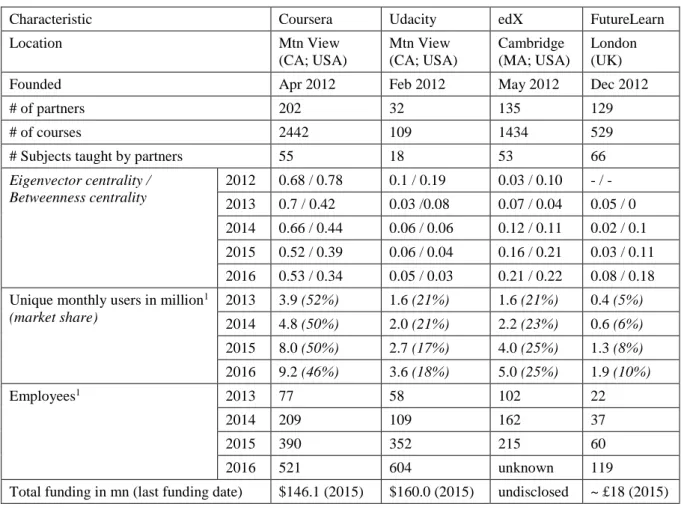
Based on findings of the ecosystem analysis, we focused on a subset of four comparable MOOC plat-forms (see Table 2). All four platplat-forms were among the pioneers in the MOOC markets and were founded as university spin-offs. All platforms started with a social mission: delivering free access to high-quality university content for learners around the world. Three of the platforms are based in the United States. FutureLearn is located in the United Kingdom. The selection considered also the fact that these two countries accounted for 23 of the world’s 25 highest-ranked universities at that time. Overall, the similar institutional conditions in their initial years provide us with a particularly insightful sample that allows us to derive novel insights into how platforms' agentic behaviour affects their ecosystems and market performance. Table 2 lists the platform ecosystems' degrees (# of partners), eigenvector centrality and betweenness centrality. In addition, we provide the total number of MOOCs and the num-ber of different subjects for each platform, as of April 2017. Coursera exhibits the largest Eigenvector centrality among all platforms, it has developed the largest ecosystem and offers the most courses. How-ever, its eigenvector centrality decreased. EdX and FutureLearn developed the second and third-largest ecosystem, measured in the number of partners. Both platforms have increased their Eigenvector cen-trality, with edX continuously increasing its influence in the network. Udacity had a rather small number of partners. Yet, its Eigenvector centrality surpassed that of Future Learn until 2016.
4.2.2 Market Performance of Case Platforms
Data on the network and employee growth provided indications for the platforms’ market success. As private technology firms, the platforms did not publish any financial data; yet, we assumed that a plat-form’s employee growth follows an increased financial performance. All platforms have grown consid-erably over time. In 2013, Coursera started with dominant network of users, capturing more than half of the market share of the selected platforms. While no other platform has added more additional learners
Twenty-Sixth European Conference on Information Systems (ECIS2018), Portsmouth, UK, 2018 9 between 2013 and 2016 (more than 5 million), its market share decreased. Future Learn, on the other hand, doubled its market share during the three years. Udacity has lost its market share. At the same time, it has become the largest platform in terms of employees and market valuation. With venture funding of more than $160 million, it is currently valued at more than a billion dollars. This is surprising as other platforms have attracted more learners during the time and developed larger ecosystems. For the subsequent analysis, we aimed to uncover business model decisions that might provide explanations for such potential contradictions between the performance of the platforms’ ecosystems and their market performance. For instance, we explored: Which business model allowed Coursera to gain a dominant ecosystem position and how did the large network size affect subsequent business model dynamics? Which business model enabled FutureLearn to double its market size during the observation period? How did Udacity’s business model enable the platform to capture large value (funding, firm growth), despite a relatively small ecosystem and user base?
Characteristic Coursera Udacity edX FutureLearn
Location Mtn View (CA; USA) Mtn View (CA; USA) Cambridge (MA; USA) London (UK)
Founded Apr 2012 Feb 2012 May 2012 Dec 2012
# of partners 202 32 135 129
# of courses 2442 109 1434 529
# Subjects taught by partners 55 18 53 66
Eigenvector centrality / Betweenness centrality 2012 0.68 / 0.78 0.1 / 0.19 0.03 / 0.10 - / - 2013 0.7 / 0.42 0.03 /0.08 0.07 / 0.04 0.05 / 0 2014 0.66 / 0.44 0.06 / 0.06 0.12 / 0.11 0.02 / 0.1 2015 0.52 / 0.39 0.06 / 0.04 0.16 / 0.21 0.03 / 0.11 2016 0.53 / 0.34 0.05 / 0.03 0.21 / 0.22 0.08 / 0.18
Unique monthly users in million1
(market share) 2013 3.9 (52%) 1.6 (21%) 1.6 (21%) 0.4 (5%) 2014 4.8 (50%) 2.0 (21%) 2.2 (23%) 0.6 (6%) 2015 8.0 (50%) 2.7 (17%) 4.0 (25%) 1.3 (8%) 2016 9.2 (46%) 3.6 (18%) 5.0 (25%) 1.9 (10%) Employees1 2013 77 58 102 22 2014 209 109 162 37 2015 390 352 215 60 2016 521 604 unknown 119
Total funding in mn (last funding date) $146.1 (2015) $160.0 (2015) undisclosed ~ £18 (2015)
1Average over all months in the year. The figure in brackets represents the share of users among the selected platforms
Table 2 Characteristics, platform ecosystem dynamics, growth of selected platforms
4.2.3 Business Models of Case Platforms
A first observation was that the platforms made similar choices for the majority of business model ele-ments in the beginning of the observation period. This applied to all three business model dimensions (value creation, value delivery, and value capture). For each case, the platforms originally created value through a web-based platform (platform type / customer channel), on which they delivered videos of university lectures to learners (key activity). Later on, they added mobile apps to their portfolio. Faculty members of universities lectured the MOOCs, initially. Regarding the value delivery dimension, all platforms primarily targeted individuals, with a key focus on university students. Also, the platforms offered rather similar value propositions, evidenced by their key slogans at the time (end of 2012): “take
Twenty-Sixth European Conference on Information Systems (ECIS2018), Portsmouth, UK, 2018 10 the world's best courses, online, for free” (Coursera), “Take great online courses from the world's best universities” (edX), and “Learn. Think. Do. Higher Education for Free” (Udacity). Platforms offered their courses initially for free to learners. Over time, technological advances led to further changes in business model elements. In addition, feedback from early MOOC learners changed the style of MOOC didactics, as they shifted from (university-inspired) courses with fixed start dates towards shorter, more interactive and on-demand courses.
While the case platforms started with similar business models, their subsequent development diverged throughout our study period. Overall, we found three dominant business models that the platforms adopted at varying times. Differences in these business models mostly affected six business model ele-ments. A first business model, Premium Services, builds on the Freemium business model pattern (Huang, 2016; Voigt and Hinz, 2016). In the business model, the platforms aimed to upsell learners with additional Premium Services. As such, the business model was associated to the value proposition of academic credentials and higher employability. Typically, the platforms sold verified certificates of course completion to learners and charged a commission fee of less than $100 per completed MOOC. Coursera developed a model in which students paid a higher fee if a university formally accepts credits earned through a MOOC with a formal exam. Platforms shared revenues with their partners. For in-stance, Coursera shared 6 to 15 percent of gross revenues with its partner universities (Pearson, 2015). The business model was highly compatible with the MOOC platforms’ social missions as it maintained free access to course content. Yet, it allowed leveraging the reputation of platforms themselves and their ecosystem partners. While the certificates were originally awarded for participating in a course, plat-forms shifted subsequently to offering entire course bundles, that included final assignments and there-fore certify a certain level of acquired knowledge.
The second business model, Professional Degrees. The business model is centered on providing a full-scale qualification for entering a professional career. Thus, the value proposition promises tangible ben-efits for the customers current or prospective career (e.g. “be in demand”), rather than efficient access to high-quality knowledge. To ensure the learning outcome, the offering contains frequent course as-signments, group projects, and tutoring services. Labeled as Nanodegrees (Udacity), Specializations (Coursera), or xseries (edX), the platforms provided structured certification programs over longer peri-ods. For instance, Udacity’s Nanodegrees lasted from 6-12 months, each teaching the necessary skills that will qualify learners for entry-level jobs as data scientist, app developer, or machine learning engi-neer, among others. To create and deliver the respective learning experience, the platforms collaborated with businesses and other institutions outside academia. For instance, Udacity formed partnerships with technology firms like Google, Facebook, or Salesforce to create Nanodegree courses. In the business model, the platforms charged a monthly subscription fee from learners.
A third business model, Corporate Training, targets businesses and thus competes in the large market for corporate employee training. The value proposition focuses on access to world-class-expertise. For instance, Udacity’s respective product page presented the question: “How many of your employees learned data analysis from the data scientists at Facebook?". Coursera equally focused on superior ex-pertise through its slogan: “With access to the best content from our 150+ global university partners, you can create Learning & Development Programs that map to your company's evolving needs”. The different slogans revealed how each of the MOOC platforms aimed to differentiate itself by leveraging the unique expertise of its ecosystem partners. The platforms generally offered a subscription model, in which the customers pay a fixed monthly fee per ‘seat’. Usually, the pricing per seat decreased with the overall company size. Next, we will compare when the platforms launched their business models.
4.2.4 Business Model Innovation
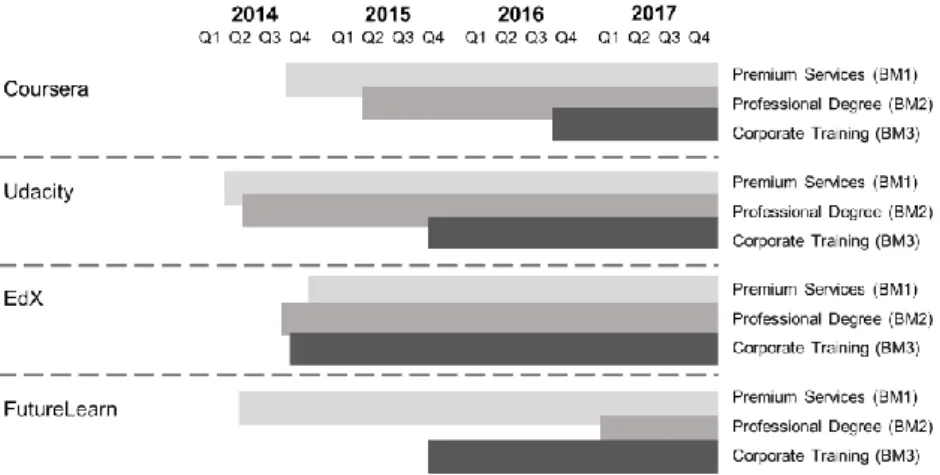
Each of the platforms adopted these business models at different points in time. Figure 2 graphically represents the timeline of when the four platforms launched each of them. Interestingly, among the four platforms, Coursera was the last or second-to-last in launching the business models. From December 2012 to July 2014, Coursera had focused on targeting recruiters. The platform provided them access to its best learners and charged, in turn, a commission fee for successfully hired Coursera students. Only
Twenty-Sixth European Conference on Information Systems (ECIS2018), Portsmouth, UK, 2018 11 later did the platform start to monetize learners directly through Premium Services. Coursera introduced
Professional Degrees and Corporate Training after competing platforms had already successfully launched the business models.
Udacity pioneered the Premium Services business model, in which it offered students the opportunity to buy verified certificates. Similar to Coursera, Udacity targeted online learners with the value proposition of “Learn. Think. Do. Higher Education for Free”. Early on, Udacity started to actively co-create MOOCs in-house. To create high-quality courses, the company made major investments in recording and production infrastructure, payed renowned faculties from top universities to teach the material, care-fully scripted the lectures around embedded assignments and larger projects. By early 2014, however, founder Sebastian Thrun announced that Udacity would shift from teaching university-level courses to training learners for careers in technology firms (Rothe and Steier, 2017). As such, it started targeting professionals aiming to advance or change their careers with the value proposition of “Stand out. Get that ideal job. Get that promotion. Stand out by learning in-demand tech skills form the best companies in Silicon Valley” (Udacity, 2014). Among the observed platforms, Udacity’s shift towards Professional Degrees represents the largest business model innovation as the platform aligned entirely new ecosystem partners (technology firms), change its key activities (e.g. hiring tutors), and develop a new revenue model (subscription model) (Rothe and Steier, 2017). By the end of 2016, about 58% of its ecosystem partners are companies. Interestingly, Udacity later adopted the recruiting business model that Coursera had abandoned earlier. With the model, it matched talented students with recruiting companies, charging companies a fixed fee per successfully recruited student.
FutureLearn, as the leading MOOC platform in the United Kingdom, collaborated primarily with Euro-pean universities and institutions, including the British Council, the British Library, and the British Mu-seum. While Future Learn was an early adopter of Premium Services and Corporate Training, it launched Professional Degrees late. As such, its main value proposition focused on learning rather than career advancement (“What would you like to learn?”) for a long time. In 2015, the platform also ex-perimented with offering exams at physical locations, but encountered limited interest from customers. EdX started with a similar value proposition as Coursera (“Take great online courses from the world's best universities”), but shifted its value proposition towards superior flexibility in 2015 (“Learn anytime, anywhere.”). The platform initially experimented with a different approach to capturing value, as it charged universities for creating courses. The platform charged universities, and other organizations, for using their state-of-the-art learning technology and for potentially assisting them with the creation of MOOCs. They charged universities a commission fee for selling courses via an edX platform. If edX assisted in the course creation, universities had to pay an initial service fee as well as a fixed fee each time the course would be offered (Casadesus-Masanell and Kim, 2015). EdX added a Professional De-grees shortly after Udacity had pioneered the business model. Around the same time, they were the first MOOC provider to launch the Corporate Training business model. Next, we will discuss how the dif-ferences in platform business models might explain the platforms’ observed market performance.
Twenty-Sixth European Conference on Information Systems (ECIS2018), Portsmouth, UK, 2018 12
5
Discussion
Based on our empirical insights, we develop four propositions regarding the interdependence of business model innovation, market evolution, and performance of platforms in emerging markets. Competitive strategy research mostly studies platform competition in relatively mature platform markets, such as the market for video game consoles (Venkatraman and Lee, 2004; Zhu and Iansiti, 2012; Cennamo and Santalo, 2013). In the emergent market for MOOCs, Coursera was the most central platform and held largest market share. However, while Coursera’ ecosystem continuously expanded, its centrality and size advantage decreased as more competitors entered the market and its partners joined competing platforms. Switching costs are relatively low for digital consumption goods such as MOOCs and eco-system partners could easily participate in different ecoeco-systems (multi-homing) (Eisenmann, Parker and Van Alstyne, 2011). Partner exclusivity is regularly an important determinant for platform’s success (Cennamo and Santalo, 2013). However, as the decreasing betweenness centrality of Coursera indicates, MOOC platforms hardly sustained partner exclusivity. Additionally, digital consumption goods offer-ings are highly transparent on competing platforms, even if the goods are not necessarily accessible (Benlian, Hilkert and Hess, 2015). Hence, the benefits from increased network size diminish over time. Thus, we propose:
Proposition 1: Superior ecosystem size, i.e. the number of ecosystem partners and their frequency of value co-creating activities, provides platforms with an initial competitive advantage.
In mature markets, platforms, consumers, and partners have already developed common understandings about the legitimacy of business models in the market. In contrast, our analysis of a newly emerging market shows high levels of uncertainty and dynamic changes in platforms' approaches to value creation, delivery, and capture. Further, our study shows that platforms initially experimented with different busi-ness models, but eventually converged towards three common busibusi-ness models. This dynamic is sup-ported by the evolutionary view on business models (McGrath, 2010; Bohnsack, Pinkse and Kolk, 2014), signalling that firms in newly emerging markets experiment with business models in a trial-and-error process until they find the most effective one. This dynamic suggests that an innovative business model in a transparent and highly dynamic market does not provide platforms with a sustainable com-petitive advantage. While the innovator might bear the associated risk, all platforms reap the benefits. Our data shows that Coursera did defend its central ecosystem position by late adoption of successful business models by competitors. Thus, we propose:
Proposition 2: Platforms with an initial ecosystem advantage can compete sustainably by imitating business models that have been successfully implemented by other platforms.
Our findings further provided insights into the link between platforms' business model innovation and performance outcomes. Our analysis of performance metrics suggests that Udacity's radical business model innovation allowed the platform to overcome its disadvantages in ecosystem size and centrality. The change in Udacity’s value proposition – from efficient access to knowledge towards tangible career benefits – caused a shift in Udacity’s ecosystem. While Udacity had seemingly lost the competitive battle for university partners, it targeted an entirely new type of partners: technology firms. In the fol-lowing, Udacity has seemingly entered an uncontested space in which it could rapidly develop a com-petitive advantage. The insights from the Udacity case suggest that business model innovation has a positive effect on platform performance if it allows the platform to enter a less contested partner or customer space. Furthermore, despite applying a me-too business model, Future Learn was able to dou-ble its market share by focusing on European partners. Finally, the analysis of betweenness centrality has shown how edX maintained a distinctive position by securing unique ties to a few powerful partners. Thus, we propose:
Proposition 3: Platforms with a small network size can overcome ecosystem disadvantages through business model innovation, if they are able to align ecosystem partners around a unique value proposi-tion or a unique market segment.
Twenty-Sixth European Conference on Information Systems (ECIS2018), Portsmouth, UK, 2018 13 The research aimed at uncovering the interdependencies between changes in a platforms’ ecosystem and business model. Previous research presented various desirable consequences of business model innova-tion, including an enhanced strategic flexibility (Bock, Opsahl and George, 2010; Bock et al., 2012; Schneider and Spieth, 2014), the ability to respond appropriately to high environmental volatility (Pohle and Chapman, 2006; Amit and Zott, 2010), or an increased organizational resilience (Carayannis et al., 2014; Carayannis, Sindakis and Walter, 2015). However, research does not provide many insights into how changes at the business model level might affect a firm’s environment. In our business model anal-ysis, we have identified several linkages between a platform’s business model change and a resulting shift in the ecosystem. In particular, our data provides support for the hypothesis that innovative business model allow the focal firm to capture (at least temporarily) a Schumpeterian innovation rent in form of higher willingness-to-pay and customer loyalty (Amit and Zott, 2001). After Udacity’s business model innovation, it took, however, more than a year until effects on the platform’s performance could be observed. The fact that Udacity subsequently garnered the largest valuation among the case firms pro-vides further evidence that Udacity's ecosystem-changing business model innovation may create a strong competitive advantage for the venture. Thus, we can suggest:
Proposition 4: Innovating a platform’s business model influences the position and characteristics of the platform’s ecosystem. As the platform needs to adjust new ecosystem partners and/or align existing ecosystem partners around its new value proposition, positive effects on platform performance occur after a substantial delay.
6
Conclusions
This research contributes to the literature on platforms by studying platform behavior and performance outcomes in an emerging platform market. Our mixed-methods approach allowed for multi-faceted in-sights into how competing MOOC platforms interdepend in developing their business models and eco-systems. By integrating a market- and platform-level perspective, we provide a new way of theorizing about platform competition. Our approach allowed us to derive novel propositions about how competing platforms' behavior depends on the market's development stage and the behavior of a platform's com-petitors. Contrary to the reviewed literature on mature markets (e.g., Noe and Parker, 2005; Eisenmann, 2006; Lee, Lee and Lee, 2006; Parker, Van Alstyne and Choudary, 2016), we did not find evidence for winner-take-all dynamics at the level of platforms in the emerging MOOC market. The mixed-methods approach and complementary business model perspective allowed us to reveal that digital platforms with an initial ecosystem advantage can maintain a strong market position over the medium-term hori-zon even if it imitates the business models of its competitors. However, our study revealed that platforms might overcome initial platform disadvantages through business model innovation that lead to ecosys-tem differentiation. Focusing on an emerging market, we observed the process of experimenting with different platform business models, which converged towards three dominant business models over time. We further introduce a distinction between business model innovation that will lead to structural changes in the platform's ecosystem and those that do not. Taken together, we propose that the link between business model innovation and platform performance will thus depend on the market's devel-opment stage, the platform's ecosystem advantage (market position), and the nature of the business model innovation.
This research is not without limitations. Our findings may not be generalizable to all types of emerging platform markets due to the specific characteristics of MOOCs. As digital experience goods, consumers in the MOOC market display a highly heterogeneous demand, and may deliberately test several plat-forms as they can judge a good's quality only after consumption (Reinstein and Snyder, 2005). The large share of free MOOCs – in combination with relatively low switching costs between platforms – provides consumers with further incentives for multi-homing. Together, these characteristics are associated with low winner-takes-all dynamics (Eisenmann, Parker and Van Alstyne, 2011). In markets with stronger winner-take-all characteristics, platforms may face more challenges to overcome an initial ecosystem disadvantage.
Twenty-Sixth European Conference on Information Systems (ECIS2018), Portsmouth, UK, 2018 14
References
Adner, R. (2017) ‘Ecosystem as Structure’, Journal of Management, 43(1), pp. 39–58. doi: 10.1177/0149206316678451.
Adner, R. and Kapoor, R. (2010) ‘Value creation in innovation ecosystems: How the structure of technological interdependence affects firm performance in new technology generations’, Strategic Management Journal, 31(3), pp. 306–333. doi: 10.1002/smj.821.
AI-Debei, M. M. and Avison, D. (2010) ‘Developing A Unified Framework Of The Business Model Concept.’, European Journal of Information Systems, 19(3), pp. 359–376. doi: 10.1057/ejis.2010.21. Amit, R. and Zott, C. (2001) ‘Value creation in e-business’, Strategic Management Journal, 22(6–7),
pp. 493–520. doi: 10.1002/smj.187.
Amit, R. and Zott, C. (2010) ‘Business Model Innovation: Creating Value in Times of Change’, IESE Business School Working Paper n. 870, 3(5), pp. 0–15. doi: 10.1016/j.lrp.2009.07.004.
Armstrong, M. (2006) ‘Competition in two-sided markets’, The RAND Journal of Economics, 37(3), pp. 668–691. doi: 10.1111/j.1756-2171.2006.tb00037.x.
Aversa, P., Furnari, S. and Haefliger, S. (2015) ‘Business model configurations and performance: A qualitative comparative analysis in Formula One racing, 2005-2013’, Industrial and Corporate Change, 24(3), pp. 655–676. doi: 10.1093/icc/dtv012.
Aversa, P., Haefliger, S., Rossi, A. and Baden-Fuller, C. (2015) ‘From business model to business modelling: Modularity and manipulation’, Business models and modelling, 33(October), pp. 151– 185. doi: 10.1108/S0742-332220150000033022.
Baden-Fuller, C. and Mangematin, V. (2013) ‘Business models: A challenging agenda’, Strategic Organization, 11(4), pp. 418–427. doi: 10.1177/1476127013510112.
Basole, R. C., Russell, M. G., Huhtamäki, J., Rubens, N., Still, K. and Park, H. (2015) ‘Understanding Mobile Ecosystem Dynamics: a Data-Driven Approach’, ACM Transactions on Management Information Systems, 6(2), p. 6.
Belleflamme, P. and Jacqmin, J. (2016) ‘An economic appraisal of MOOC platforms: Business models and impacts on higher education’, CESifo Economic Studies, 62(1), pp. 148–169. doi: 10.1093/cesifo/ifv016.
Benlian, A., Hilkert, D. and Hess, T. (2015) ‘How open is this platform? The meaning and measurement of platform openness from the complementors’ perspective’, Journal of Information Technology. Springer, 30(3), pp. 209–228.
Bock, A. J., Opsahl, T. and George, G. (2010) ‘Business Model Innovation and Strategic Flexibility: Effects of Informal and Formal Organization’, Annual Meeting of the Academy of Management - Dare to care: Passion and Compassion in Management Practice & Research 6-10 August Montreal, Canada.
Bock, A. J., Opsahl, T., George, G. and Gann, D. M. (2012) ‘The Effects of Culture and Structure on Strategic Flexibility during Business Model Innovation’, Journal of Management Studies, 49(2), pp. 279–305. doi: 10.1111/j.1467-6486.2011.01030.x.
Bohnsack, R., Pinkse, J. and Kolk, A. (2014) ‘Business models for sustainable technologies: Exploring business model evolution in the case of electric vehicles’, Research Policy, 43(2), pp. 284–300. doi: 10.1016/j.respol.2013.10.014.
Bonacich, P. (1987) ‘Power and Centrality: A Family of Measures’, American Journal of Sociology. The University of Chicago Press, 92(5), pp. 1170–1182. Available at: http://www.jstor.org/stable/2780000.
Bonacich, P. (2007) ‘Some unique properties of eigenvector centrality’, Social Networks. Elsevier, 29(4), pp. 555–564.
Boudreau, K. (2008) ‘Does opening a platform stimulate innovation? effects on modular and systemic innovation’, Organization, (West 2003), pp. 1–33. doi: http://dx.doi.org/10.2139/ssrn.913402. Boudreau, K. (2010) ‘Open Platform Strategies and Innovation: Granting Access vs. Devolving
Control’, Management Science, 56(10), pp. 1849–1872. doi: 10.1287/mnsc.1100.1215.
Boudreau, K. (2012) ‘Let a Thousand Flowers Bloom? An Early Look at Large Numbers of Software App Developers and Patterns of Innovation’, Organization Science, 23(5), pp. 1409–1427. doi:
Twenty-Sixth European Conference on Information Systems (ECIS2018), Portsmouth, UK, 2018 15 10.1287/orsc.1110.0678.
Bouncken, R. B. and Fredrich, V. (2016) ‘Business model innovation in alliances: Successful configurations’, Journal of Business Research, 69(9), pp. 3584–3590. doi: 10.1016/j.jbusres.2016.01.004.
Brandenburger, A. M. and Nalebuff, B. J. (1996) ‘Co-Opetition’, Industrial Marketing Management, p. 304.
Carayannis, E. G., Grigoroudis, E., Sindakis, S. and Walter, C. (2014) ‘Business Model Innovation as Antecedent of Sustainable Enterprise Excellence and Resilience’, Journal of the Knowledge Economy, 5(3), pp. 440–463. doi: 10.1007/s13132-014-0206-7.
Carayannis, E. G., Sindakis, S. and Walter, C. (2015) ‘Business Model Innovation as Lever of Organizational Sustainability’, Journal of Technology Transfer, 40(1), pp. 85–104. doi: 10.1007/s10961-013-9330-y.
Casadesus-Masanell, R. and Hałaburda, H. (2014) ‘When does a platform create value by limiting choice?’, Journal of Economics and Management Strategy, 23(2), pp. 259–293. doi: 10.1111/jems.12052.
Casadesus-Masanell, R. and Kim, H. (2015) Couresera: revised 2015. Available at: http://www.hbs.edu/faculty/Pages/item.aspx?num=45248.
Cennamo, C. (2016) ‘Building the value of next-generation platforms: the paradox of diminishing returns’, Journal of Management. SAGE Publications Sage CA: Los Angeles, CA, p. 149206316658350.
Cennamo, C. and Santalo, J. (2013) ‘Platform competition: Strategic trade-offs in platform markets’,
Strategic Management Journal, 34(11), pp. 1331–1350. doi: 10.1002/smj.2066.
Chesbrough, H. (2007) ‘Business model innovation: it’s not just about technology anymore’, Strategy & Leadership, 35(6), pp. 12–17. doi: 10.1108/10878570710833714.
Chesbrough, H. and Rosenbloom, R. S. (2002) ‘The role of the business model in capturing value from innovation : evidence from Xerox Corporation ’ s technology spin-off companies’, Industrial and Corporate Change, 11(3), pp. 529–555. doi: 10.1093/icc/11.3.529.
Clements, M. T. and Ohashl, H. (2005) ‘Indirect network effects and the product cycle: Video games in the U.S., 1994-2002’, Journal of Industrial Economics, pp. 515–542. doi: 10.1111/j.1467-6451.2005.00268.x.
Creswell, J. W. and Clark, V. L. P. (2007) Designing and conducting mixed methods research.,
Designing and conducting mixed methods research.
Cusumano, M. A. and Gawer, A. (2002) ‘The Elements of Platform Leaderhsip’, MIT Sloan Management Review, (Spring), pp. 51–58. doi: 10.1371/journal.pone.0015090.
Eisenhardt, K. M. (1989) ‘Building theories from case study research’, Academy of Management Review, 14(4), pp. 532–550. doi: 10.5465/AMR.1989.4308385.
Eisenhardt, K. M. and Graebner, M. E. (2007) ‘Theory building from cases: Opportunities and challenges’, Academy of Management Journal, 50(1), pp. 25–32. doi: 10.5465/AMJ.2007.24160888. Eisenmann, T. (2006) ‘Internet companies’ growth strategies: Determinants of investment intensity and long-term performance’, Strategic Management Journal, 27(12), pp. 1183–1204. doi: 10.1002/smj.567.
Eisenmann, T., Parker, G. and Van Alstyne, M. (2011) ‘Platform envelopment’, Strategic Management Journal, 32(12), pp. 1270–1285. doi: 10.1002/smj.935.
Evans, P. C. and Basole, R. C. (2016) ‘Revealing the API Ecosystem and Enterprise Strategy via Visual Analytics’, Communications of the ACM, 59(2), pp. 26–28. doi: 10.1145/2856447.
Evans, P. C. and Gawer, A. (2016) ‘The rise of the platform enterprise: a global survey’, The Center for Global Enterprise. The Center for Global Enterprise, (January), pp. 1–30.
Fischer, G. (2014) ‘Beyond hype and underestimation: identifying research challenges for the future of MOOCs’, Distance Education, pp. 149–158. doi: 10.1080/01587919.2014.920752.
Freeman, L. C. (1977) ‘A set of measures of centrality based on betweenness’, Sociometry. JSTOR, pp. 35–41.
Gawer, A. (2014) ‘Bridging differing perspectives on technological platforms: Toward an integrative framework’, Research Policy, pp. 1239–1249. doi: 10.1016/j.respol.2014.03.006.
Twenty-Sixth European Conference on Information Systems (ECIS2018), Portsmouth, UK, 2018 16 Gawer, A. (2015) ‘What Drives Shifts in Platform Boundaries : An Organizational Perspective’, in
Druid Summer Conference15, pp. 1–34. doi: 10.5465/AMBPP.2015.13765abstract.
Gawer, A. and Cusumano, M. A. (2008) ‘How companies become platform leaders’, MIT Sloan management review. Massachusetts Institute of Technology, 49(2), p. 28.
Gawer, A. and Cusumano, M. A. (2014) ‘Industry platforms and ecosystem innovation’, Journal of Product Innovation Management, 31(3), pp. 417–433. doi: 10.1111/jpim.12105.
Ghazawneh, A. and Henfridsson, O. (2011) ‘Micro-strategizing in platform ecosystems: a multiple case study’, in Thirty Second International Conference on Information Systems. Shanghai,.
Gibbert, M. and Ruigrok, W. (2010) ‘The “‘What’” and “‘How’” of Case Study Rigor: Three Strategies Based on Published Work’, Organizational Research Methods, 13(4), pp. 710–737. doi: 10.1177/1094428109351319.
Grewal, R., Lilien, G. L. and Mallapragada, G. (2006) ‘Location, location, location: How network embeddedness affects project success in open source systems’, Management Science. INFORMS, 52(7), pp. 1043–1056.
Hagiu, A. (2009) ‘Two-sided platforms: Product variety and pricing structures’, Journal of Economics and Management Strategy, 18(4), pp. 1011–1043. doi: 10.1111/j.1530-9134.2009.00236.x.
Hagiu, A. (2014) ‘Strategic Decisions for Multisided Platforms’, MIT Sloan Management Review, 55(2), pp. 71–80. Available at: http://sloanreview.mit.edu/article/strategic-decisions-for-multisided-platforms/.
Hedman, J. and Kalling, T. (2003) ‘The business model concept: Theoretical underpinnings and empirical illustrations’, European Journal of Information Systems, 12(1), pp. 49–59. doi: 10.1057/palgrave.ejis.3000446.
Huang, H.-C. (2016) ‘Freemium business model: construct development and measurement validation’,
Internet Research, 26(3), pp. 604–625. doi: 10.1108/IntR-03-2014-0064.
Huang, P., Ceccagnoli, M., Forman, C. and Wu, D. J. (2009) ‘When do ISVs join a platform ecosystem? Evidence from the enterprise software industry’, in ICIS 2009 Proceedings. Phoenix, Arizona, USA, p. 161.
Iansiti, M. and Zhu, F. (2007) ‘Dynamics of platform competition: Exploring the role of installed base, platform quality and consumer expectations’, in ICIS 2007 Proceedings, p. 38. Available at:
https://www.scopus.com/inward/record.uri?eid=2-s2.0-84871158327&partnerID=40&md5=c6dd685afc4ba3b3d973c896c0131996.
Johnson, M. W., Christensen, C. M. and Kagermann, H. (2008) ‘Reinventing Your Business Model Reinventing Your Business Model -’, Harvard Business Review, (December), pp. 1–10. doi: 10.1111/j.0955-6419.2005.00347.x.
Lee, E., Lee, J. and Lee, J. (2006) ‘Reconsideration of the Winner-Take-All Hypothesis: Complex Networks and Local Bias’, Management Science, 52(12), pp. 1838–1848. doi: 10.1287/mnsc.1060.0571.
Libert, B. (2016) The network imperative : How to survive and grow in the age of digital business
models, How to survive and grow in the age of digital business models. Lima, M. (2007) Visual complexity. Princeton Architectural Press.
Massa, L., Tucci, C. L. and Afuah, A. (2017) ‘A Critical Assessment of Business Model Research’,
Academy of Management Annals, 11(1), pp. 73–104. doi: 10.5465/annals.2014.0072.
McGrath, R. G. (2010) ‘Business models: A discovery driven approach’, Long Range Planning, 43(2– 3), pp. 247–261. doi: 10.1016/j.lrp.2009.07.005.
McIntyre, D. P. (2011) ‘In a network industry, does product quality matter?’, Journal of Product Innovation Management, 28(1), pp. 99–108. doi: 10.1111/j.1540-5885.2010.00783.x.
McIntyre, D. P. and Chintakananda, A. (2014) ‘Competing in network markets: Can the winner take all?’, Business Horizons, 57(1), pp. 117–125. doi: 10.1016/j.bushor.2013.09.005.
McIntyre, D. P. and Srinivasan, A. (2017) ‘Networks, platforms, and strategy: Emerging views and next steps’, Strategic Management Journal. Wiley Online Library, 38(1), pp. 141–160.
Muzellec, L., Ronteau, S. and Lambkin, M. (2015) ‘Two-sided Internet platforms: A business model lifecycle perspective’, Industrial Marketing Management, 45(1), pp. 139–150. doi: 10.1016/j.indmarman.2015.02.012.