How Much Energy Does It Take
to Make a Gallon of Ethanol?
David Lorenz • David Morris
Revised and Updated
August 1995
How Much Energy Does It Take To Make A Gallon of Ethanolwas originally authored by David Morris and Irshad Ahmed and published in December 1992.
The Institute for Local Self-Reliance (ILSR) is a nonprofit research and educational organization that provides technical assistance and information on environmentally sound economic development strategies. Since 1974, ILSR has worked with citizen groups, governments and private businesses in developing policies that extract the maximum value from local resources.
Institute for Local Self-Reliance 1313 5th Street SE, Suite 306
Minneapolis, MN 55414 Phone: (612) 379-3815
Fax: (612) 379-3920 Web Site: http://www.ilsr.org © 1992, 1995 Institute for Local Self-Reliance
One of the most controversial issues relating to ethanol is the question of what environmentalists call the “net energy” of ethanol production. Simply put, is more energy used to grow and process the raw material into ethanol than is con-tained in the ethanol itself?
In 1992, ILSR addressed this question. Our report, based on actual energy consumption data from farmers and ethanol plant operators, was widely disseminated and its methodol-ogy has been imitated by a number of other researchers. This paper updates the data in that original report and addresses some of the concerns that some reviewers of the original report expressed.
Our analysis again concludes that the production of ethanol from corn is a positive net energy generator. Indeed, the numbers look even more attractive now than they did in 1992. More energy is contained in the ethanol and the other by-products of corn processing than is used to grow the corn and convert it into ethanol and by-products. If corn farmers use state-of-the-art, energy efficient farming techniques and ethanol plants integrate state-of-the-art production process-es, then the amount of energy contained in a gallon of ethanol and the other by-products is more than twice the energy used to grow the corn and convert it into ethanol.
As the ethanol industry expands, it may increasingly rely on more abundant and potentially lower-cost cellulosic crops (i.e. fast growing trees, grasses, etc.). When that occurs, the net energy of producing ethanol will become even more attractive.
Three subordinate questions must be addressed to esti-mate the energy inputs and outputs involved in making ethanol.
1. How much energy is used to grow the raw material?
2. How much energy is used to manufacture the ethanol?
3. How do we allocate the energy used in steps one and two between ethanol and the other co-products pro-duced from the raw material?
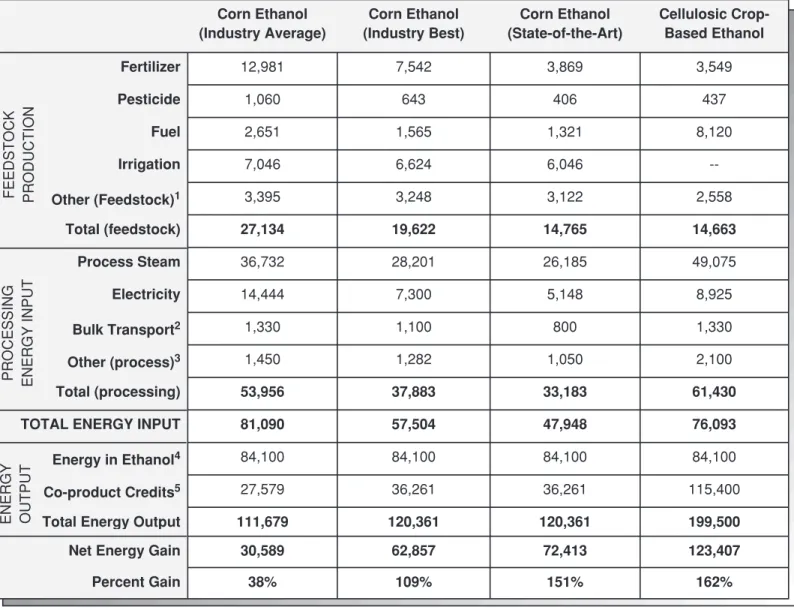
Answers to these three questions are presented in Table 1, which is divided into three sections that parallel the three questions: feedstock energy; processing energy; co-product energy credits. All energy inputs and outputs in this report are on a high heat value basis.1
We focus on corn because corn accounts for over 90 per-cent of the current feedstock for ethanol production in the U.S. and because corn-derived ethanol has been at the center of the controversy about the energetics of ethanol.
The data in Table 1 are presented from four different per-spectives:
The first column presents the energetics of ethanol based on the current energy efficiency of corn farming and ethanol production. Assuming the national average for energy used in growing corn and for energy used in the manufacture of ethanol, about 36,732 more BTUs, or 38 percent more energy is contained in the ethanol and other products produced in the corn processing facility than is used to grow the corn and make the products. In other words, the net energy ratio is 1.38:1.
The second column presents the energetics of ethanol based on the assumption that the corn is grown in the state with the most efficient corn farmers and the ethanol is made in the most energy efficient existing ethanol production facil-ity. In this case, over two BTUs of energy are produced for every one BTU of energy used. The net energy ratio is 2.09:1. The third column presents the energetics of ethanol based on the assumption that corn farmers and ethanol facil-ities use state-of-the-art practices. This is a best-case and hypothetical scenario. If farmers and industry were to use all the best technologies and practices the net energy ratio would be 2.51:1.
The data for the first three columns has been gathered from actual farming and ethanol production facilities. The data in the fourth column on the energetics of cellulosic crop-derived ethanol is more hypothetical since as yet no ethanol produced on a commercial scale is from cellulose. Feedstock production data assumes that a short rotation woody crop, 1 • Institute for Local Self-Reliance
How Much Energy Does It Take
to Make a Gallon of Ethanol?
such as a hybrid poplar, is used and processing energy data is taken from biomass-based ethanol facilities in the planning stages. The net energy ratio is 2.62:1.2
The reader can “mix and match” components from Table 1. For example, if an average efficiency corn farm provided the feedstock for the most efficient ethanol plant, the entire
process would use 27,134 BTUs in the growing of corn plus 37,883 BTUs for the processing into various products for a total of 65,017 BTUs. With the lower co-product credits of 27,579 BTUs in column one, the total energy output would be 111,679 BTUs and the net energy increase is thus 46,662 BTUs. In this case the energy output/input ratio comes to 1.72.
1 Includes energy for average drying, seed, lime, on-farm electricity, machinery, and bulk crop transportation.
2 Bulk transport of ethanol is primarily by truck except for large plants that employ more energy efficient rail transportation.
3 Process (other) includes energy required for local delivery transportation of ethanol, energy for process water, herbicides, and other minor plant energy needs like waste water recycling and treatment.
4 High heat value. See Note 1, pg. 8, for a complete explanation of high versus low heat value.
5 Co-product energy credits for corn-based ethanol in wet-milling are from corn oil, 21% protein feed, 60% gluten meal, and carbon dioxide. In dry-milling, corn processing to ethanol produces corn oil, distillers dry grain with solubles (DDGS), and carbon dioxide. Credits for cellulose-based ethanol are primarily for the energy content of lignin by-product as a boiler fuel when ethanol is made from wood. Greater quantities of lignin are produced when ethanol is made from virgin wood than from wood waste streams such as sulfite liquor from paper mills. Lignin refined further into phenolic chemicals can contribute more toward energy credits available to ethanol.
SOURCES:Bhat, M. G., et. al., "Energy in Synthetic Agricultural Inputs: Revisited," Oak Ridge Nat'l Laboratory, 1993;Energy in World Agriculture, Volume 6:"Energy in Farm Production," Fluck, R. C. (ed.), Elsevier Publishing, 1992; Hohmann, N., and C. M. Rendleman, "Emerging Technologies in Ethanol Production," U.S. Department of Agriculture, ERS, 1993; Institute for Local Self-Reliance, Minneapolis, MN; Katzen, R., et. al., "Ethanol from Corn - State-of-the-Art Technology and Economics," Presented at National Corn Growers Association Corn Utilization Conference V, 1994; Turhollow, A. F., and R. D. Perlack, "Emissions of CO2 from Energy Crop Production," Oak Ridge Nat'l Laboratory, 1991; "Agricultural Resources and Environmental Indicators," U. S. Department of Agriculture, ERS, Washington, DC, 1994; "Agricultural Chemical Usage: Field Crops Summary (1991-1993)," U. S. Department of Agriculture, ERS, Washington, DC, 1992-1994; Purdue University Cooperative Extension Service, West Lafayette, Indiana, 1995; Wood, P., "New Ethanol Process Technology and Costs of Production," PSI Process Systems, Inc., 1992; "1993 Irrigation Survey,"Irrigation Journal, January/February, 1994.
Table 1. Energy Used to Make Ethanol from Corn and Cellulose (BTUs per Gallon of Ethanol)
N E T G A IN 12,981 1,060 2,651 7,046 3,395 27,134 36,732 14,444 1,330 1,450 53,956 81,090 84,100 27,579 111,679 30,589 38% 7,542 643 1,565 6,624 3,248 19,622 28,201 7,300 1,100 1,282 37,883 57,504 84,100 36,261 120,361 62,857 109% 3,869 406 1,321 6,046 3,122 14,765 26,185 5,148 800 1,050 33,183 47,948 84,100 36,261 120,361 72,413 151% 3,549 437 8,120 --2,558 14,663 49,075 8,925 1,330 2,100 61,430 76,093 84,100 115,400 199,500 123,407 162% Fertilizer Pesticide Fuel Irrigation Other (Feedstock)1 Total (feedstock) Process Steam Electricity Bulk Transport2 Other (process)3 Total (processing)
TOTAL ENERGY INPUT
Energy in Ethanol4
Co-product Credits5
Total Energy Output
Net Energy Gain
Percent Gain Corn Ethanol (Industry Average) Corn Ethanol (Industry Best) Corn Ethanol (State-of-the-Art) Cellulosic Crop-Based Ethanol F E E D S T O C K P R O D U C T IO N E N E R G Y O U T P U T P R O C E S S IN G E N E R G Y IN P U T
This is a complicated question because of the wide vari-ations in farming practices and farming conditions.
Corn is grown in a variety of ways and in a variety of cli-matic and soil conditions. All of these affect the amounts and kinds of energy used.
For example, the single largest component of on-farm use is for nitrogen fertilizer, representing about 40 percent of all energy used in corn planting, cultivation and harvesting. The use of nitrogen fertilizer varies dramatically. Corn plant-ed in rotation with soybeans or other legumes uses much less fertilizer than corn grown continuously.3
Corn farmers nationwide make 1.3-2.2 applications of nitrogen per year. Those who monitor the existing nitrogen in the soil before additional applications are able to reduce nitrogen fertilizer rates by up to 25 percent without affecting yields.4
The National Research Council notes, “Within a given
region for a specific crop, average production cost per unit of output on the most efficient farms are typically 25 percent less, and often more than 50 percent less, than the average cost on less efficient farms.” The study concluded that in 1987 the most efficient Minnesota corn farms used about 40 percent less fertilizer and pesticide per bushel than the least efficient farm.5
A Missouri study of 1,000 farms concluded that a 40 per-cent reduction in nitrogen applications is possible even among farmers using corn/soybean rotation systems if they adopt alternative growing techniques.6
Large farms tend to use continuous corn planting and higher nitrogen fertilizer applications. Smaller farm opera-tions tend to rotate corn and soybeans or other legumes, low-ering nitrogen fertilizer applications. From year to year large variations might occur even on the same farm due to weath-er conditions. Pennsylvania nitrogen fweath-ertilizweath-er use, for
exam-3 • Institute for Local Self-Reliance
1. H
OW MUCH ENERGY IS USED TO GROW THE CORN
?
1 The average energy required to produce, package, transport, and apply nitrogen fertilizer is 27,605 BTUs per pound. Phosphorus fertilizers contain 6,170 BTUs per pound, and potash fertilizers 5,215 BTUs per pound.
2 Acre (corn) to Gallon (ethanol) conversion is based on average corn crop yields of 120 bushels per acre and 2.55 gallons of ethanol per bushel for average conversion, and 2.60 and 2.65 for best-existing and state-of-the-art productions, respectively.
3 The national average for nitrogen application (1991) was 123 pound per acre. South Dakota achieved the lowest state average application of 73 pounds per acre while retaining yields comparable to other states.
4 Conservation no-till systems and fuel efficiency of newer macinery accounts for the difference between these entries.
Table 2. Agricultural Energy Use For Corn Production in the United States
SOURCES:Bhat, M. G., B. C. English, A. Turhollow, and H. Nyangito, "Energy in Synthetic Agricultural Inputs: Revisited," Oak Ridge Nat'l Laboratory, 1993;Energy in World Agriculture, Volume 6, "Energy in Farm Production," Fluck, R. C. (ed.), Elsevier Publishing, 1992; "Agricultural Resources and Environmental Indicators," U. S. Department of Agriculture, ERS, Washington, DC, 1994; "Agricultural Chemical Usage: Field Crops Summary (1991-1993)," U. S. Department of Agriculture, ERS, Washington, DC, 1992-1994; Purdue University Cooperative Extension Service, West Lafayette, Indiana, 1995; "1993 Irrigation Survey,"Irrigation Journal, January/February, 1994.
123 47 55 3.00 5.85 (gal.) -3,395,415 289,990 286,825 324,512 811,337 2,156,200 1,038,790 8,303,069 11,096 948 937 1,060 2,651 7,046 3,395 27,134 73 37 21 1.92 3.52 (gal.) -2,015,165 228,290 109,515 200,668 488,189 2,026,828 1,013,527 6,082,182 6,459 732 351 643 1,565 6,624 3,248 19,622 38 15 17 1.2 3.03 (gal.) -1,048,990 92,550 88,655 129,246 420,231 1,850,020 992,947 4,622,638 3,299 291 279 406 1,321 6,046 3,122 14,764 Nitrogen Phosphorus Potash Pesticide Fuel Irrigation Other Total Energy lbs/acre (corn) BTU/acre (corn) BTU/gal (ethanol) lbs/acre (corn) BTU/acre (corn) BTU/gal (ethanol) lbs/acre (corn) BTU/acre (corn) BTU/gal (ethanol)
ple, ranged from 113 pounds per acre in 1988 to over 140 pounds in 1989 and 1990 to 76 pounds in 1993.
Our conclusions related to on-farm energy use are con-tained in Table 2, Agricultural Energy Use for Corn Production in the United States. This Table is the basis for the Feedstock Production data in Table 1.
The national average for nitrogen fertilizer application for corn production from 1991-1993 was on average 123 pounds per acre7. South Dakota farmers used the least amount. South Dakota is the ninth largest producer of corn in the United States with a 1991 production of 240.5 million bushels. The state has approximately 20,000 mostly small farms that primarily rely on corn/soybean rotations. South Dakota has traditionally been below the national average in nitrogen fertilizer application. In 1989 it used 131 pounds per acre, dropping to 71 pounds in 1991 and 70 pounds in 1993. Aside from fertilizers, energy is used for farm vehicles and for crop drying, seed corn production, on-farm electrici-ty, bulk crop transportation and for crop irrigation. The use of irrigation, in particular, makes a significant difference in the energetics of corn. Only 16 percent of all corn grown in the U.S. comes from irrigated farms. Thus, in the first column of Table 1 under “Irrigation” we have assigned a weighted average of 16 percent in our calculations.8
The average farm uses about 5.85 gallons of diesel fuel per acre. Estimates for best-existing fuel consumption are based on no-till cultivation techniques.
The state-of-the-art column assumes that farmers use low input agricultural practices and new hybrid varieties, like Pioneer Hi-Bred International’s new tropical corn.
Although the state of the art column is intended to rep-resent a hypothetical best-case, we have identified at least one farmer who has already achieved similar results. Since 1987, the Thompson farm located in Central Iowa, has been using 35 percent less energy than the national average, while achieving yields 30 percent above the national average. Its total energy input is about 5 million BTUs per acre of corn compared to our state-of-the-art estimate of 4.6 million BTUs and the national average of 8.4 million BTUs. Translated into energy input per gallon of ethanol, the Thompson farm con-tributes about 16,800 BTUs per gallon of ethanol produced compared to our State-of-the-Art figures of 14,800 BTUs per gallon.9
Our conclusion is that, for corn production, farmers use 27,134 BTUs per gallon of ethanol. The most energy-efficient farms use 19,622 BTUs while the state-of-the-art is 14,764 BTUs per gallon. For comparative purposes, we also include the energy used to raise hybrid poplar, 14,663 BTUs per gal-lon of ethanol produced.
2. H
OW MUCH ENERGY IS USED TO MAKE THE ETHANOL
?
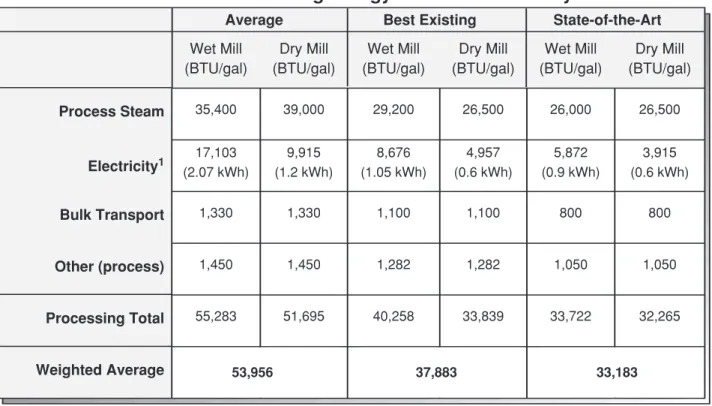
The data in Table 1 for ethanol production are contained in the section titled Processing Energy Input. They are based on the weighted average of both wet and dry milling opera-tions that produce at least 10 million gallons per year.10 Table 3 presents these energy requirements for both wet and dry mills. The data is taken from actual plant operations as of early 1995.
The modern motor fuel grade ethanol industry is only 18 years old. Early plants were very inefficient. Indeed, in 1980 a typical ethanol plant all by itself consumed more energy than was contained in a gallon of ethanol. Some plants used as much as 120,000 BTUs to produce a gallon of ethanol that contained only 84,100 BTUs of energy.
In the last decade many ethanol plants have become much more energy efficient. In 1980, for example, ethanol plants used 2.5 to 4.0 kWh of electricity per gallon of ethanol produced. Today they use as little as 0.6 kWh. The majority of ethanol producers still purchase electricity from outside
sources, but newer facilities generate electricity from process steam within the plant.
In the late 1970s, ethanol plants did not recover waste heat. Today they do. Old energy intensive rectification and solvent extraction systems required 12,000 BTUs per gallon of ethanol produced. Newer molecular sieves need only 500 BTUs.11 Larger producers have been using molecular sieves for several years. Now smaller plants (20 million gallons per year and less) are starting to incorporate them.
Best-existing and state-of-the-art ethanol plants can achieve energy reductions through a combination of these technological innovations. Molecular sieves reduce distilla-tion energy significantly; low cost cogeneradistilla-tion facilities pro-duce process steam and electricity; and semi-permeable membranes efficiently remove co-products from the process water to reduce the energy requirements of drying.
Wet mills, which account for 63 percent of all ethanol cur-rently produced, extract higher value co-products than dry
mills. Co-products from wet mills include corn oil, 21 per-cent protein feed, 60 perper-cent gluten meal, germ, and several grades of refined starches and corn sweeteners. In dry milling, co-products can include corn oil and distillers dry grain with solubles (DDGS), which is used as animal feed. Carbon dioxide is a fermentation by-product of both milling processes.
Dry mills derive the DDGS co-product from the process water after fermentation occurs. It then requires a significant amount of energy to dry this co-product into a saleable form. Wet mills derive the majority of the co-products before fer-mentation through mechanical separators, centrifuges, and screens. All told, wet mills require 60 percent more electrical energy than dry mills on average, while requiring 10 percent less thermal energy. These differences are related specifically to the processing of the co-products, and are illustrated in the “Average” column in Table 3.
An integrated, relatively small-scale dry mill could avoid drying energy requirements for co-products. Reeve Agri-Energy in Garden City, Kansas, operates a 10 million gallon per year plant that feeds wet DDGS to its cattle. This opera-tion uses only about 33,000 BTUs to produce a gallon of ethanol. However, a limited number of locations exist with a sufficient number of nearby livestock to justify such an oper-ation, and it would probably not be economical for larger dry milling operations to adopt such practices.
A wider number of wet mills, on the other hand, may be able to achieve the energy use levels noted in the best exist-ing wet mill category in Table 3.
We conclude that the ethanol industry, on average, uses 53,956 BTUs per gallon to manufacture ethanol. The best existing plants use 37,883 BTUs per gallon. Next generation plants will require only 33,183 BTUs per gallon of ethanol produced.
5 • Institute for Local Self-Reliance
1 The majority of motor fuel grade ethanol from corn in the United States is produced by the Archer Daniels Midland company, which operates highly efficient and integrated plants that cogenerate their electricity and steam. Several other larger facilities also use cogeneration. Such facilities are deigned to satisfy the heat requirement of the operation; electricity is produced essentially as a by-product. Based on data from such facilities, we estimate that 6,525 BTUs are required to produce 1 kWh in cogeneration facilities, accounting for approximately 50 percent of all ethanol produced. The majority of ethanol plants purchase electricity from coal-generated power plants, which require approximately 10,000 BTUs to produce 1 kWh. Electricity in state-of-the-art facilities is assumed to be produced via cogeneration.
Sources: Conway, R. K., et. al., "An Analysis of the Total Energy Requirements for Ethanol Manufacture from Corn," U.S. Department of Agriculture, Office of Energy, 1994; Hohmann, N, and C. M. Rendleman,"Emerging Technologies in Ethanol Production," U.S. Department of Agriculture, ERS, 1993; Institute for Local Self-Reliance, Minneapolis, MN; R. Katzen et. al., "Ethanol from Corn - State-of-the-Art Technology and Economics," Presented at National Corn Growers Association Corn Utilization Conference V, 1994; Wood, P., "New Ethanol Process Technology and Costs of Production," PSI Process Systems, Inc., 1992.
Table 3. Ethanol Processing Energy Use for Wet and Dry Mills
35,400 17,103 (2.07 kWh) 1,330 1,450 55,283 39,000 9,915 (1.2 kWh) 1,330 1,450 51,695 29,200 8,676 (1.05 kWh) 1,100 1,282 40,258 26,500 4,957 (0.6 kWh) 1,100 1,282 33,839 26,000 5,872 (0.9 kWh) 800 1,050 33,722 26,500 3,915 (0.6 kWh) 800 1,050 32,265 Process Steam Electricity1 Bulk Transport Other (process) Processing Total Weighted Average Wet Mill (BTU/gal) Dry Mill (BTU/gal) Wet Mill (BTU/gal) Dry Mill (BTU/gal) Wet Mill (BTU/gal) Dry Mill (BTU/gal)
Average Best Existing State-of-the-Art
If we add the amount of energy currently used in grow-ing corn on the average farm to the amount of energy used to make ethanol in the average processing plant today, the total is 81,090 BTUs per gallon (Table 1, Column 1). Under the best-existing practices, the amount of energy used to grow the corn and convert it into ethanol is 57,504 BTUs per gallon. Ethanol itself contains 84,100 BTUs per gallon. Thus even without taking into account the energy used to make co-products, ethanol is a net energy generator.
But an analysis that excludes co-product energy credits is inappropriate. The same energy used to grow the corn and much of the energy used to process the corn into ethanol is used to make other products as well. Consequently, we need to allocate the energy used in the cultivation and production process over a variety of products. This can be done in sev-eral ways.
One is by taking the actual energy content of the co-products to estimate the energy credit. For example, 21 per-cent protein feed has a calorie content of 16,388 BTUs per pound. The problem with this method is that it puts a fuel value on what is a food and thus undermines the true value of the product.
Another way to assign an energy value to co-products is based on their market value. This is done by adding up the
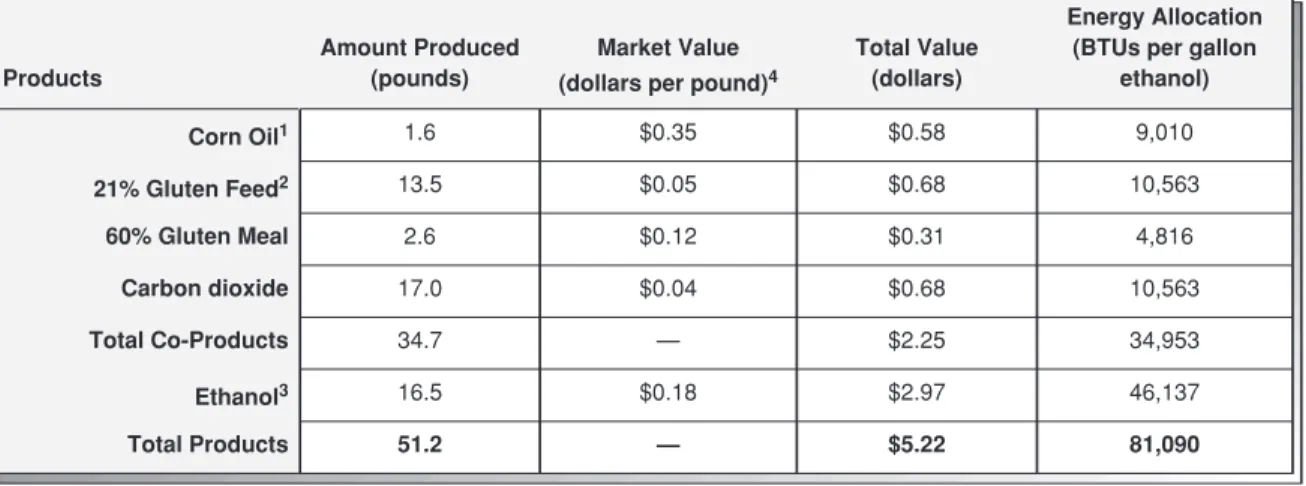
market value, in dollars, of all the products from corn pro-cessing, including ethanol, and then allocating energy credits based on each product’s proportion of the total market value. For example, Table 4 shows the material balance and energy allocation based on market value for a typical wet milling process. Here the various co-products account for 43 percent of the total value derived from a bushel of corn, and thus are given an energy credit of 36,261 BTUs per gallon of ethanol. The replacement value method is a third way to deter-mine co-product energy credits. Using this approach, we determine the nearest competitor to corn products and cal-culate how much energy it would require to raise the feed-stock and process it into that product. For example, it requires 1.6 pounds of soybean oil to replace 1.6 pounds of corn oil. The energy required to raise the soybeans and extract the oil comes to 13,105 BTUs. The nearest feeding equivalent to the 13.5 pounds of 21 percent corn protein feed is 13.45 pounds of barley. The energy required for growing the barley and drying it is 1,816 BTUs per pound, which translates into 7,188 BTUs per gallon of ethanol equivalent. The carbon dioxide replacement value is based on the ener-gy intensity of other fermentation processes that produce it as a by-product. Carbon dioxide has no actual energy value because it is not classified as a food (caloric value) or a fuel
3. H
OW DO WE DIVIDE THE ENERGY USED AMONG THE PRODUCTS PRODUCED
?
1.6 13.5 2.6 17.0 34.7 16.5 51.2 $0.35 $0.05 $0.12 $0.04 — $0.18 — $0.58 $0.68 $0.31 $0.68 $2.25 $2.97 $5.22 9,010 10,563 4,816 10,563 34,953 46,137 81,090 Corn Oil1 21% Gluten Feed2 60% Gluten Meal Carbon dioxide Total Co-Products Ethanol3 Total Products Amount Produced (pounds) Market Value (dollars per pound)4
Total Value (dollars)
Energy Allocation (BTUs per gallon
ethanol) Products
1 The market value for corn oil presented here is for refined oil. Crude corn oil has a market value of 27 cents per pound. 2 The 21% protein feed includes 1.0 to 1.5 pounds of germ meal that is produced during the extraction of corn oil from germ. 3 Average ethanol yield is 2.55 gallons per bushel with a 6.6 pounds per gallon density. A gallon of ethanol currently sells for $1.20.
4 All market value data is based on 1992 information. While prices for these commodities normally fluctuate dramatically, the data presented represent average values.
SOURCES: Corn Refiners’ Association, Washington, D.C., 1992; National Corn Growers Association, Saint Louis, Mo., 1992;Chemical Marketing Reporter, 1992.
Table 4. Market Value Method for Allocating Energy for Corn Wet Milling
(combustion value). However, the majority of the carbon dioxide produced in ethanol fermentation is captured and sold, and it is therefore necessary to include this co-product energy credit.
Table 5 provides a comparative overview of all three methodologies. The first two rows are based on corn prod-ucts. The third row is based on non-corn equivalents.
The last column in Table 5 shows the variation depend-ing on which methodology is used. For Table 1 we chose to use the replacement value energy estimates, which come to 27,579 BTUs per gallon.
We have chosen a higher value of 36,261 BTUs per gallon for the best-existing and state-of-the-art cases. Each of the
co-products produced with ethanol competes with and replaces a variety of alternate products. For example, 21 percent corn protein meal competes with conventional feed products like hay, grain straw, soybean protein, barley, etc, many of which are not clearly defined in terms of energy value. Currently 21 percent corn protein competes with all of these and partially replaces all of them. If it were to completely replace barley alone, it would have a higher energy credit. The higher ener-gy credits in the second and third columns of Table 1 are based on analyses of potential products that have a higher energy replacement value and that are currently only partial-ly replaced by corn-ethanol co-products.
7 • Institute for Local Self-Reliance
9,960 9,347 13,105 3,404 4,996 2,827 16,388 10,959 7,187 — 10,959 4,460 29,752 36,261 27,579 Actual Energy Value
Market Energy Value
Replacement Value1
Corn Oil 60% Gluten Meal 21% Protein Feed Carbon Dioxide
Total Co-Products Method
1 Replacement value of corn oil is based on a one-to-one replacement of soybean oil. 13.5 pounds of 21% protein gluten feed is replaced by 13.45 pounds of barley (on a protein equivalent basis) with an energy value of 1,817 BTUs per pound of barley for production and drying. The carbon dioxide replacement value is based on the energy intensity of other fermentation processes that produce it as a by-product. There is no actual energy value for carbon dioxide since it is not classified as a feed or a fuel.
SOURCES: Macgregor, C.A., “Directory of Feeds and Feed Ingredients,” W.D. Hoard & Sons, Milwaukee, Wisconsin, 1989;Handbook of Energy Utilization in Agriculture, D. Pimentel (ed.), CRC Press, Boca Raton, Florida., 1980;CRC Handbook of Chemistry and Physics, D. Lide (ed.), CRC Press, Boca Raton, Florida., 1992; Ahmed, I.rshad, David Morris, John Decker,How Much Energy Does It Take To Make a Gallon of Soydiesel, Institute for Local Self-Reliance, Washington, DC, January 1994.
Table 5. Co-Product Energy Credit Methodologies for Corn Wet Milling
(BTUs per Gallon of Ethanol)
4. C
ONCLUSION
Assuming an average efficiency corn farm and an aver-age efficiency ethanol plant, the total energy used in growing the corn and processing it into ethanol and other products is 81,090 BTUs. Ethanol contains 84,100 BTUs per gallon and the replacement energy value for the other co-products is 27,579 BTUs. Thus, the total energy output is 111,679 BTUs and the net energy gain is 30,589 BTUs for an energy output-input ratio of 1.38:1.
In best-existing operations, assuming the corn is grown on the most energy efficient farms and the ethanol is pro-duced in the most energy efficient plants, the net energy gain would be almost 58,000 BTUs for a net energy ratio of 2.09:1. Assuming state-of-the-art practices, the net energy ratio could be as much as 2.51:1. Cellulosic crops, based on current
data, would have a net energy ratio of 2.62:1.
There are circumstances where ethanol production would not generate a positive energy balance. For example, one could assume corn raised by the least energy efficient farmers, those who use continuous corn planting and irriga-tion, being processed by ethanol plants that do not use cogen-eration and other energy efficient processes. In this case ethanol production could have a negative energy balance of about 0.7:1. However, a relatively small amount of ethanol is produced in this manner, possibly less than 5 percent.
We think it reasonable to look at least to columns one and two for the answer to our initial question. Based on industry averages, far less energy is used to grow corn and make ethanol than is contained in the ethanol. Moreover, we think
it is a safe assumption that as the ethanol market expands, new facilities will tend to incorporate state-of-the-art pro-cessing technologies and techniques so that each new plant is more energy efficient than the one before. It is less certain that farmers will continue to become more energy efficient in their operations because of the many variables involved. Nevertheless, it does appear that growing numbers of farm-ers are reducing their farm inputs and that this trend will continue.
A final word about cellulose. If annual ethanol sales expand beyond 2 billion gallons, cellulosic crops, not starch, will probably become the feedstock of choice. The data in the last column suggest a very large energy gain from converting
cellulosic crops into ethanol. Cellulosic crops, like fast grow-ing tree plantations, use relatively little fertilizer and use less energy in harvesting than annual row crops. The crop itself is burned to provide energy for the manufacture of ethanol and other co-products. Amajor co-product of cellulosic crops is lignin, which currently is used only for fuel but which potentially has a high chemical value. Were it to be processed for chemical markets, the net energy gain would be even greater.
Our conclusion is that under the vast majority of condi-tions, the amount of energy contained in ethanol is signifi-cantly greater than the amount of energy used to make ethanol, even if the raw material used is corn.
NOTES
1 The difference between high and low heat values represents the heat contribution of the condensation of water during combustion. When ethanol is burned, for example, it produces heat and water vapor. As the water vapor condenses it gives off additional heat. Ethanol has a low heat value(LHV) of 76,000 BTUs/gallon, an estimate which more accurately represents the heat content of the fuel in conventional combustion engines. Ethanol has a high heat value of 84,000 BTUs/gallon. In the United States the energy content of fuels conventionally is expressed on a high heat value(HHV) basis. Interestingly, in Europe LHVs are used. The use of either basis does not affect the conclusions of our analysis such as long as the same heat values are used for all inputs and outputs. 2 The estimate of the net energy gain from cellulosic crop-based ethanol is considered conservative. We believe that as this industry
develops, the same learning curve that occurred in the starch based ethanol industry will occur in the cellulosic based ethanol industry, fostering a much more positive net energy gain for ethanol production from cellulose.
3Agriculture Chemical Usage: Field Crops Summary. U.S. Department of Agriculture. Economic Research Service. Washington, D.C. 1992-1994.
4 Bosch, D. J., K. O. Fuglie, and R. W. Keim, Economic and Environmental Effects of Nitrogen Testing for Fertilizer Management, U.S. Department of Agriculture, Economic Research Service, 1994.
5Alternative Agriculture. Committee on the Role of Alternative Farming Methods in Modern Production Agriculture. Board on Agriculture. National Research Council. National Academy Press. Washington, D.C. 1989.
6 Research conducted by the Department of Agricultural Economics. University of Missouri-Columbia, Columbia, Missouri. 7 Testing indicates that one acre of corn absorbs approximately 90 lbs of nitrogen fertilizer in one growing season. All of the estimates
for fertilizer usage in this report assume synthetic fertilizer inputs. The difference between corn’s nitrogen requirements and the fertilizer requirements indicated represent the reductions possible via the alternative growing strategies mentioned specifically in the text. These include rotations with leguminous crops, and the use of naturally occurring forms of nitrogen, such as animal waste. 8 Previous studies have included other components in the on-farm analysis. One included the amount of solar energy used in pho-tosynthesis. Another included the embodied energy of farm machinery, that is, the energy used to make the machinery. We have decided not to include energy inputs which are acquired at no cost, like sunlight. Also we have not included embodied energy because the estimates are subject to a very high degree of uncertainty.
9 Personal conversation with Richard Thompson, November, 1992.
10 About 95 percent of the motor fuel grade ethanol in the United States is produced from 10 million gallon per year facilities or larg-er. Although there are a number of facilities of smaller scale, the vast majority of those will quickly expand production, if com-mercially successful.
11 DeSplegelaere, T.J. “Energy Consumption in Fuel Ethanol Production for a Corn Wet-Milling Process”, paper presented at IBIS 1992 Fuel Ethanol Workshop. Wichita, Kansas. June 9-11, 1992.