Essays on Banking and Corporate Finance in Developing Countries
byTodd A. Gormley B.A. Economics
Michigan State University, 2001
Submitted to the Department of Economics in Partial Fulfillment of the Requirements for the Degree of
Doctor of Philosophy in Economics at the
MASSACHUSETTS
INSTITUTE OF TECHNOLOGY
June 2006
© 2006 Todd A. Gormley. All rights reserved.
The author hereby grants to MIT permission to reproduce and to distribute publicly paper and electronic copies of this thesis document in
whole or in part in any medium now known or hereafter created.
Signature of A uthor: ... ... ... ... Department of Economics May 15, 2006
Certified by: ... .J... ...
LV
\ lDaron
Acemoglu
Ch s P. Kindleberger Professor of Applied Economics Thesis Supervisor Certified by: ... ...- ... ...
Simon Johnson Ronald A. Kurtz Professor of Entrepreneurship
Thesis Supervisor Accepted by: .A ccep ted by : ... oo...o... ' o,...·...
Peter Temin Elisha Gray II Professor of Economics Chairman, Department Committee on Graduate Studies
Essays on Banking and Corporate Finance in Developing Countries
by
Todd A. Gormley
Submitted to the Department of Economics on May 15, 2006 in Partial Fulfillment of the Requirements for the Degree of Doctor of Philosophy in Economics
ABSTRACT
This dissertation consists of three essays that examine banking and corporate finance in developing countries. Specifically, it explores the theoretical and empirical implications of open capital markets, foreign bank entry, and the role of bond markets during banking crises.
Chapter 1 analyzes the impact of opening capital markets using a theoretical model that incorporates both foreign and domestic lenders in the presence of asymmetric information. The model suggests that when foreign lenders are limited in their ability to obtain information about entrepreneurs, they may engage in cream-skimming by only targeting the largest, most profitable firms. This cream-skimming can induce a reallocation of credit that may either increase or decrease overall net output of the open economy. The consequences of this credit reallocation depend on the type of financial opening and the quality of domestic institutions.
Chapter 2 examines the entry of foreign banks as a specific case of opening capital markets. I estimate the impact of entry using variation in the location of foreign banks
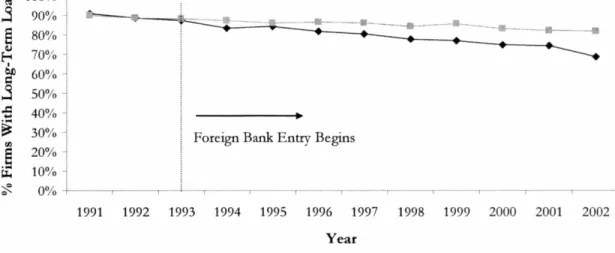
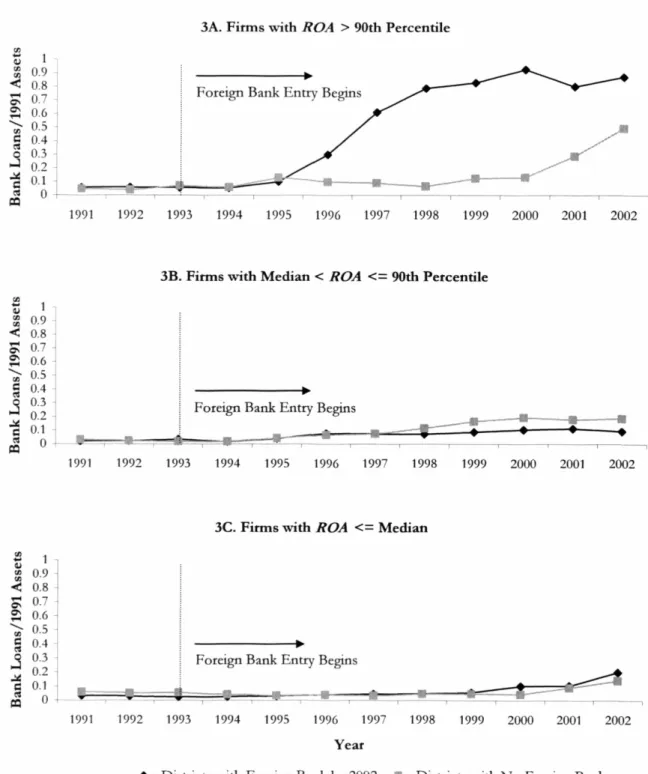
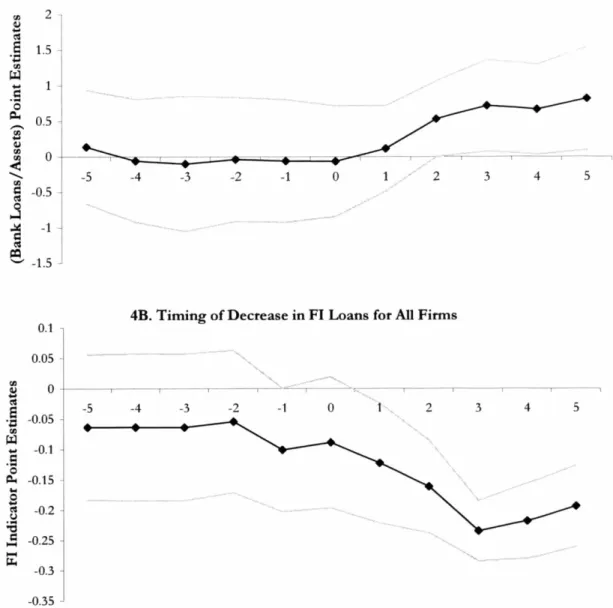
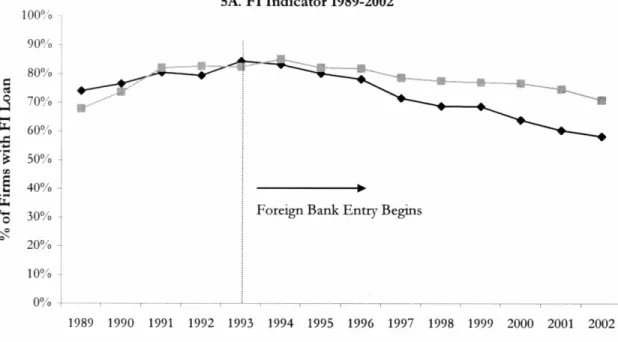
established in India following a policy change in 1994. The estimates indicate that the 10 percent most profitable firms received larger bank loans, but that on average, firms were 7.6 percentage points less likely to have a loan after entry. The decline in loans was uncorrelated with firms' profitability and driven by a decrease among group-affiliated firms. The reallocation is
consistent with the presence of asymmetric information, and similar estimates are obtained using the location of pre-existing foreign firms as an instrument for the location choice of new banks.
Chapter 3, co-authored with Simon Johnson and Changyong Rhee, uses a quasi-natural experiment in Korea after the 1997-98 financial crises to assess bond markets in emerging economies. Evidence confirms that bond markets can develop quickly during a banking crisis and act as a 'spare tire' even when almost all previous private finance flowed through the banking system. However, access to bonds was feasible only for the largest firms, and there is no evidence that bond finance was better directed than bank finance. Firms with weaker pre-crisis corporate governance were no less likely to obtain bond financing.
Thesis Supervisor: Daron Acemoglu
Title: Charles P. Kindleberger Professor of Applied Economics
Thesis Supervisor: Simon Johnson
Acknowledgements
First and foremost, I thank my advisors Daron Acemoglu and Simon Johnson. I have benefited immensely from their encouragement and guidance.
I must also thank Abhijit Banerjee and Ricardo Caballero for their valuable advice over the past few years, and I'm grateful for my conversations with other MIT faculty, especially, Olivier Blanchard and Peter Temin.
I have also had the privilege of working with a number of students who contributed in many ways to this dissertation and to my experience at MIT. In particular, I thank Michael Anderson, Shawn Cole, Dave Matsa, Guy Michaels, Gerard Padr6 i Miquel, Marek Pycia, Sarah Siegel, and Amir Sufi.
I also thank Kalpana Kochhar and the IMF for providing me access to the Prowess dataset, and Abhiman Das for his help with the data published by the Reserve Bank of India. I also thank the National Science Foundation for financial support.
Finally, I thank my parents Patrick and Diana. Words cannot express my thanks for all of their support.
Contents
I n t r o d uctio n ...9
1 Open Capital Markets in Emerging Economies: The Social Costs and Benefits of Cream-Skimming ... 13
1.1 The Basic Model ...17
1.1.1 Agents and Technology ...17
1.1.2 Timing of Events ...20
1.1.3 Financial Contracts and Strategies ...20
1.2 Analysis of the Closed Economy ...23
1.3 Analysis of the Open Economy ...26
1.4 Empirical Implications and Policy Analysis ...29
1.5 Model without Full Commitment ...32
1.6 Robustness and Extensions ...39
1.6.1 Syndicated Loans ...39
1.6.2 Allowing for varying X and R ...40
1.6.3 Overlapping Generations and Dynamic Implications ...41
1.7 Concluding Remarks ... 41
1.8 Appendix ... 43
References ... 53
2 Banking Competition in Developing Countries: Does Foreign Bank Entry Improve Credit Access? ... 55
2.1 Description of Policy Change ...59
2.2 Data Description ...61
2.3 Empirical Strategy and Identification Assumptions ...64
2.4 OLS Estimates ...67
2.4.1 Impact on Total Long-Term Loans ...67
2.4.2 "Direct" versus "Indirect" Effects ...69
2.5 Robustness Checks & IV Estimates ...71
2.5.1 Testing for Pre-Trends ...72
2.5.2 IV Estim ates ...73
2.5.3 Additional Robustness Checks ...75
2.6 Alternative Specifications ...77
2.6.1 Group versus Non-Group Firms ...77
2.6.2 Total Sales and Bankruptcy ...79
2.6.3 Borrowing from Other Firms ...79
2.7 Conclusion ... 80
2.8 Data Appendix - Determining Firm Location within Prowess . ...82
Tables and Figures ...86
3 Corporate Bonds: A Spare Tire in Emerging Markets? ... 105
3.1 South Korea's Financial System ...109
3.1.1 External Finance through 1997 ...109
3.1.2 The Bond Market before 1998 ...110
3.1.3 External Finance in 1998 ...111
3.2 Identification Strategy ...113
3.3 Data Description ...114
3.3.1 Chaebol Membership ...115
3.3.2 Financial Flows: Bonds, Loans, and Equity ...116
3.3.3 Profits ... 117
3.3.4 Corporate Governance ...117
3.3.5 Additional Controls ...119
3.4 Results and Interpretation ...120
3.5 Robustness Checks ...121
3.5.1 Equity Finance in 1999 ...121
3.5.2 Banking After the Crisis ...122
3.5.3 Alternative Samples ...123
3.5.4 Alternative Measures ...124
3.5.5 Within Chaebol Allocation of Finance ...124
3.6 Conclusion ... 125
References ... 127
Introduction
In recent years, the development of financial markets in most emerging economies has
accelerated, but the path of development has varied greatly. Some developing countries open their
domestic financial markets to foreign capital inflows, while others attempt to create new internal
markets via bonds, equity, etc. Moreover, the theoretical and empirical implications of these changes
remain relatively unexplored. In this thesis, I examine some of these financial developments by
exploring the theoretical implications of open capital markets, and the empirical evidence pertaining
to foreign bank entry and domestic bond markets in emerging economies.
In the first chapter, "Open Capital Markets in Emerging Economies: The Social Costs and
Benefits of Cream-Skimming", I construct a theoretical model that incorporates both foreign and
domestic lenders in the presence of asymmetric information. The model suggests that when
institutional, geographical, or cultural barriers limit foreign lenders' ability to obtain information
about entrepreneurs, foreign lenders will engage in cream-skimming by only targeting the largest,
most profitable firms. This cream-skimming can induce a reallocation of credit that may either
increase or decrease overall net output of the open economy relative to the closed economy.
Profitable and large domestic projects are more likely to be financed in the open economy; negative
net present value (NPV) projects are less likely to be financed; and when information asymmetries are
large, informationally opaque entrepreneurs with positive NPV projects are also less likely to be
financed. This drop in credit to 'opaque' entrepreneurs can occur if domestic lenders are ill-equipped
to cost-effectively identify borrowers' types. The model suggests the type of financial opening and
the quality of domestic institutions matter, and that change in the distribution of credit may be an
In the second chapter, "Banking Competition in Developing Countries: Does Foreign Bank
Entry Improve Credit Access?", I examine the entry of foreign banks as a specific case of opening
capital markets. I estimate the impact of entry using variation in the location of foreign banks
established in India following a policy change that took place in 1994. The estimates suggest that the
10 percent most profitable firms received larger bank loans, but that on average, firms were actually
7.6 percentage points less likely to have a long-term loan. The decline in the availability of loans
appears uncorrelated with firms' profitability and is driven by a decrease in domestic bank loans to
group-affiliated firms, where information asymmetries are likely more severe. The timing of this loan
reallocation coincides with foreign bank entry, and similar estimates, though less precise, are obtained
using the presence of pre-existing foreign-owned firms as an instrument for the location choice of
new foreign banks. The empirical evidence of this chapter is consistent with the theoretical
predictions of chapter 1 that foreign financial entry may have distributional consequences on
domestic credit allocations in the presence of asymmetric information.
In the third chapter, "Corporate Bonds: A Spare Tire in Emerging Markets?", co-authored
with Simon Johnson and Changyong Rhee, we analyze the internal growth of domestic bond markets.
In bank-dominated financial systems with weak investor protection, bond markets could potentially
help (a) broaden the access to external finance, (b) reduce the power of large firms and politicians
over the financial system, and (c) soften the impact of banking-related crises by acting as a 'spare tire'.
However, theory suggests the heavy reliance on banks in emerging markets is not without foundation
as bank deposits are an attractive contract when property rights are not well protected. This raises
the question: Can bond markets develop in these emerging economies where banks have always
dominated, and would they work better than banking contracts? This chapter offers some relevant
evidence from a quasi-natural experiment in Korea after the crisis of 1997-98. Evidence from Korea
during and after 1998 confirms that bond markets can develop quickly even in countries where
through issuing bonds was feasible only for the largest firms. Moreover, there is no evidence that
bond finance was better directed than bank finance. Firms with weaker pre-crisis corporate
governance were no less likely to obtain bond financing in the post-crisis years, and direct ex-post
Chapter 1
Open Capital Markets in Emerging Economies:
The Social Costs and Benefits of Cream-Skimming
Prior to the East-Asian financial crisis, the benefits of open capital markets in emerging
economies were widely praised. Open capital markets were presumed to increase risk sharing, lower
the cost of capital, and alleviate domestic liquidity constraints. Greater competition from foreign
lenders was also thought to improve the allocation of credit and corporate governance of
entrepreneurs in emerging economies. As a result, many less-developed countries (LDCs) liberalized
their capital controls during the 1980s and the early 1990s, resulting in significant financial inflows.
By 1995, capital inflows averaged five percent of GDP for both developed and LDCs.1
Following the East-Asian financial crisis, however, many questioned the presumed benefits of
financial globalization.2 In particular, Rodrik (1998) found no positive correlation between open
capital markets and economic performance across roughly 100 countries. This evidence (or lack
thereof) spurred an enormous literature studying the effect of capital controls. Subsequent empirical
studies, however, have generated very little consensus regarding the effect of capital account
openness on economic growth and investment. For example, Edwards (2001) finds a positive
correlation between capital account openness and economic performance, but only for more
developed economies. Arteta, Eichengreen, and Wyplosz (2001) find similar evidence, but note it is
"decidedly fragile", while Edison, Levine, Ricci and Slok (2003) find no effect of financial
I See Bosworth and Collins (1999), pp. 149.
integration.3 More recent research focusing on the specific impact of foreign participation in
domestic equity markets and foreign bank entry also reaches differing conclusions.4
A primary argument for the inconclusive evidence is that open capital markets increase
countries' economic volatility and exposure to financial crises. Such volatility can be particularly
problematic in emerging economies with inadequate institutions. Subsequently, it is thought that
policies limiting the risks of financial instability will ensure the benefits of open capital markets are
realized. Particular emphasis is given to the mismatching of short-term foreign liabilities and
long-term domestic assets that can expose domestic inlong-termediaries to financial panics by international
lenders or large exchange rate fluctuations.5 The presumption that foreign lenders' entry otherwise
improves the domestic credit access remains largely unquestioned.
This chapter addresses this continued presumption directly by assessing whether open capital
markets necessarily increase output in emerging economies, even in the absence of increased financial
volatility. Standard financial theories that incorporate information asymmetries demonstrate that
credit may be rationed in equilibrium (Stiglitz and Weiss 1981), and that greater competition among
lenders may increase credit rationing (Petersen and Rajan 1995). Such models imply that by
increasing competition from foreign lenders, opening capital markets may actually reduce credit and
output in emerging economies, where the lack of information about borrowers and the absence of
protection for lenders make information asymmetries particularly acute.
To illustrate this point, I develop a theoretical model of financial competition between
foreign and domestic lenders that includes information asymmetries between entrepreneurs and
lenders. The model extends on existing theory by directly incorporating the differences between
foreign and domestic competition and by allowing lenders to differ in their access to funds and
3 See Eichengreen (2001) for a more detailed review of the literature.
4 For example, Bekaert, Harvey and Lundblad (2006) and Henry (2000) find positive correlations between equity market liberalization and economic performance, while Detragiache, Tressel and Gupta (2005) and Gormley (2006) find foreign bank entry to be negatively related to domestic credit.
5 See Stiglitz (2000), Agenor (2003), Kaminsky and Schmukler (2003) and Eichengreen and Leblang (2003) for a more in-depth review of the relation between open capital markets, short-term debt, and financial volatility.
information about borrowers. The primary assumption driving the model is that foreign lenders have
access to credit at a lower cost, but less access to information about domestic borrowers.
Making use of this variation, the model demonstrates that changes in the distribution of
credit may be a more important aspect of financial globalization's impact than overall changes in
economic output and investment. The theory suggests that large, profitable domestic projects are
more likely to be financed in the open economy, and negative net present value (NPV) projects are
less likely. This redistribution from low to high return projects can increase total factor productivity
and net output in the opening economy. However, foreign lenders' entry can also reduce credit
access for smaller or informationally opaque entrepreneurs with positive NPV projects. This drop in
credit to 'opaque' entrepreneurs decreases net output and can occur if domestic lenders are
ill-equipped to cost-effectively identify borrowers' types. Thus, the effect of opening capital markets on
overall investment or net output is ambiguous when information asymmetries are large.
The intuition of these theoretical findings is straightforward. Lenders face a range of
potential projects to finance, but lack information on borrower quality. When costs of screening
entrepreneur quality are sufficiently high for domestic lenders, a competitive equilibrium may occur
where lenders pool all borrowers rather than invest in costly screening technologies. Relative to the
first-best allocation without information asymmetries, a pooling equilibrium over-finances low-return
entrepreneurs and under-finances high-return entrepreneurs. The entrance of foreign lenders can
break this pooling equilibrium. Using their lower cost of funds, foreign lenders can undercut
domestic lending rates for the most profitable entrepreneurs. Through this 'cream-skimming',
foreign competition alleviates the under-financing of high-return projects but also reduces the quality
of projects being pooled by domestic lenders. This decrease in borrower quality increases incentives
for domestic lenders to invest in screening technologies which reduces the number of negative NPV
projects financed. However, if screening is costly, domestic lenders may instead exit some sectors of
lenders will find it profitable to operate in these sectors, and such exits are more likely for industries
or entrepreneurs that are more informationally opaque.
The theory provides a number of testable hypotheses regarding changes in the distribution of
credit following a financial opening. First, foreign entry is likely to coincide with 'cream-skimming'
behavior by foreign lenders and a reduction of credit by domestic lenders. Gormley (2006) finds
evidence of exactly this following the entry of foreign banks in India during the 1990s. Second, the
model provides predictions regarding the distributional impact of various types of capital market
liberalization. Types of openness that yield a smaller informational gap between domestic and foreign
lenders or allow domestic lenders access to international capital markets will exhibit less
'cream-skimming' and a smaller likelihood that credit access is impaired for informationally opaque
entrepreneurs. Third, local institutions that reduce lenders' costs of overcoming information
asymmetries will mitigate 'cream-skimming' and adverse distributional outcomes. To the author's
knowledge, no direct empirical studies of the latter two hypotheses exist.
The theoretical findings are related to various strands of the existing literature. The analysis
of competitive financial market equilibria in the presence of imperfect information is similar to the
analysis of insurance markets by Rothschild and Stiglitz (1976). Regarding the differences between
foreign and domestic lenders, Detragiache, Gupta and Tressel (2005) find a similar outcome of
cream-skimming by foreign banks and an adverse affect on credit access for 'soft' information
entrepreneurs. In their model, however, foreign banks screen 'hard' information at a lower cost than
domestic banks but screen 'soft' information at a higher cost. Another paper that highlights the
potential distributional effects of opening capital markets is Trzcinka and Ukhov (2005). Using an
international asset-pricing model, they find that foreign entry may have an adverse effect on domestic
investors who purchase risky assets to hedge endowment income.
The remainder of the chapter proceeds as follows. Section 1 provides the basic setup and
equilibrium, and Section 3 describes the open economy equilibrium that follows the introduction of
foreign competition. Section 4 analyzes the empirical and policy implications of the model. Section 5
extends the model to a repeated game without full commitment, and Section 6 discusses the
robustness of the models' implications and possible extensions. Finally, Section 7 concludes.
1.1 The Basic Model
1.1.1 Agents and Technology
There are two types of agents: entrepreneurs and lenders. All agents are risk-neutral, and
because of limited liability, no entrepreneur can end up with a negative amount of cash.
The real sector consists of four types of entrepreneurs, i {Z,A,B,C}, and a continuum
6iof each type, where 9A + 0B + Oc = 1. The first type, Z, receive zero projects to implement, while
the remaining three types each have the ability to implement one project of size I {1, 2}, where
A > 1. If implemented, the project yields a verifiable return RI > r I, where r is the exogenous
international cost of capital. All entrepreneurs have zero wealth and must borrow the complete
amount I from lenders. Entrepreneurs that receive financing from a lender may choose action
q E {0,1}, where q = 1 indicates the project is undertaken and q = 0 indicates the project is not. The
action q is observable to lenders, and q = 0 is the only possible action for entrepreneurs of type Z.
Of the entrepreneurs with projects, there will be one type that lenders always want to
finance, C (the 'cream'), another type they never want to finance, B (the 'bad'), and a third type that
they only want to finance for small projects, A (the 'average'). This is formally established by having
the three types differ in their ability to implement projects successfully. If financed, the 'cream'
always succeed with probability 1, regardless of project size, while 'bad' entrepreneurs only succeed
with probability p. Projects that only succeed with probability p have a negative net expected return
smaller project of size 1 with certain success, while larger projects only succeed with probability p.
Therefore, the economy's expected net output is maximized when 'cream' entrepreneurs are financed
for projects of size A, 'average' entrepreneurs for projects of size 1, and 'bad' entrepreneurs are not
financed. This is the first-best allocation of credit.
For simplicity, it is assumed there are relatively more 'average' entrepreneurs than 'cream' in
the economy, such that 0A > c .6 Moreover, to eliminate some uninteresting pooling equilibria in
both the closed and open economies, the following assumptions are made:
(R-r')iA(1 t > r)A(l
r*
-pR O B(r* - pR) (2) iz > ))(2)p(R-r*)
Assumption (1) ensures that the number of 'bad' entrepreneurs is sufficiently high to exclude
equilibria where lenders can profitably pool 'bad' and 'average' entrepreneurs together. Assumption
(2) ensures that the mass of entrepreneurs without projects, tz, rules out financial contracts that pay
a positive amount to 'bad' entrepreneurs that abandon their low-return projects. This contract will
not exist in equilibrium (and in reality) since all entrepreneurs without projects would also need to be
paid this positive amount, thus rendering the contract unprofitable.7
The financial sector consists of many perfectly competitive domestic and foreign lenders
willing to extend capital in the amount of I E {1, Al}. Without the costly screening of entrepreneurs,
lenders are unable to identify an entrepreneur's type, thus providing the source of information
asymmetry in the model. Lenders, however, may invest in screening technology, S e {0,1}, where
S = 1 implies the investment is made. Investment in the screening technology allows lenders' to
perfectly identify an entrepreneur's type.
Domestic lenders differ from foreign lenders in two key ways. First, the domestic lenders
6 All subsequent findings are robust to dropping this assumption so long assumption (1) is modified to also include
O > Oc(R - r)/(r- pR) such that it is never profitable for lenders to pool 'bad' and 'cream' entrepreneurs.
have access to an unlimited supply of domestic funds at opportunity cost, r, while foreign lenders'
have access to an unlimited supply of international funds at opportunity cost, r', where r < r. The
higher domestic cost of capital seems reasonable given the poor access to international markets and
the weak deposit collection technologies of many domestic lenders in emerging economies.8
The second difference is that foreign lenders find it more costly to screen borrowers because
of distance, cultural, or institutional barriers. Specifically, domestic lenders can screen at cost C per
borrower while foreign lenders must payC* > C .9 Mian (2006) finds distance barriers are an
important informational cost for foreign banks in Pakistan, while Stein (2002) demonstrates that the
greater hierarchical structure of foreign banks relative to domestic banks also likely makes it more
costly for foreign banks to obtain the 'soft-information' necessary to screen entrepreneurs effectively.
Foreign lenders' access to cheap international capital provides a competitive advantage, but
the higher screening cost implies this advantage is largest when the per-unit cost of screening is low.
Hence, the information asymmetry will induce what might be perceived as 'cream-skimming'
behavior by foreign lenders which will have a competitive advantage in providing credit to the
entrepreneurs that implement larger projects. Specifically, the following assumptions are made:
.C' C
r +<r+-<R
(3)
2
2
R<r*+C* (4)
Assumptions (3) and (4) are what distinguish foreign lenders from domestic lenders. The
first inequality in equation (3) ensures it is always feasible to screen larger projects in the economy
and that the international cost of capital is sufficiently low to offset foreign lenders' disadvantage in
8 One concern about this assumption is that governments in emerging economies often provide subsidized funds to domestic lenders such that their direct cost of funds is less than the cost of capital on international capital markets. However, privileged access to funds does not necessarily imply a lower cost of funds. Domestic lenders typically have much higher non-interest costs than international lenders. For example, the average wage bill of domestic banks is twice as large as the average wage bill of foreign banks in India. By sidestepping local unions, foreign banks in India employ one-seventh the number employers per unit of assets (Hanson 2003).
9 The model would also be robust to assuming the foreign banks incur the same cost of screening, but receive a lower quality signal of a of entrepreneur's type than domestic banks.
screening larger projects relative to domestic lenders. The international cost of funds may not,
however, be low enough to provide the foreign lenders an advantage in financing smaller projects,
where the unit cost of screening is higher. In fact, equation (4) states that foreign lenders'
per-unit cost of screening smaller projects is too high to profitably screen and finance these projects. It
may still be feasible, however, for domestic lenders to screen and finance the smaller projects because
of their lower screening cost, depending on whether r + C < R.
1.1.2 Timing of Events
There is no discounting between periods, and the timing of events is as follows:
t = 0: entrepreneurs discover their type, i
t = 1: lenders offer financial contracts F, entrepreneurs choose contracts, if any
t = 2: lenders choose investments in the screening technology, S
t = 3: lenders provide financing capital, I
t = 4: entrepreneurs receiving capital make investment decision, q
t = 5: project outcomes are realized, financial contracts are settled
1.1.3 Financial Contracts and Strategies
Let Fj represent the menu of contracts offered by lender j, where FJ.' denotes a financial
contract from lender j of size I {1, 2} and type k {O,Z,A,B,C} . When k = 0, the contract is unscreened, but for k • 0, the contract is only available to a firms where screening reveals i = k. Each type of contract is a mapping of observables into a payment for the entrepreneur? Specifically,
FI.k: {0,1} x {0,RI} -- IR+
The first argument, q , indicates whether the project is undertaken by the entrepreneur, and the
10 This mapping spans the universe of potential contracts. Thus, the concept of 'lender' used in this paper is very general and encompasses banks, stockholders, etc. However, equilibrium financial contracts where a project is actually implemented can always be replicated by a pure debt contract. For this reason, all future references will be made regarding pure debt contracts. See Appendix A for more details.
second argument, Y, is the observed output on the project. Each type of contract maps into a
non-negative payment since entrepreneurs have no initial wealth and cannot receive a non-negative payment.
Entrepreneurs that want a contract of type k 0, must first submit themselves to the screening process, which maps into that contract. Specifically, the screening technology is given by
Tj: {Z,A,B,C} x {0,1} x {Z,A,B,C} -* Fj u 0
The first argument is type of contract, k, requested by the entrepreneur where k • i is allowed. The second argument is the lenders' screening decision, S. and the third argument is the entrepreneur's
true type, i. It is possible for the screening process to yield no financial contract for the
entrepreneur. Specifically, the screening technology of each lender j is designed to work as follows:
Tj(k,S = 0,.) Fk Tj(k,S= 1,i k) = F'
Tj(k,S= l, ik)={Fj'i}u0
If an entrepreneur that submits requests a contract of type of k 0 and lender j's
screening reveals the true type is in fact i = k, the entrepreneur receives FI'A as promised. However,
if screening reveals that i k, then the entrepreneur receives the contract designated for type i, and
if no such contract was offered, the entrepreneur receives no contract. Finally, if lender j does not
actually screen, than the entrepreneur still gets the screened contract, F.
In the basic model discussed here, I will assume that lenders can fully commit to their
financial contracts in a two key ways. First, lenders will always screen financial contracts of type
k 0O. This eliminates lenders from deterring 'bad' borrowers by declaring all contracts will be screened, but not actually screening them. Second, lenders can fully commit the initial terms of any
contract, FI'A, and the initial menu of contracts, F . This eliminates the possibility for renegotiation
between lenders and entrepreneurs after screening reveals an entrepreneurs' type. Combined with
type. These full commitment assumptions greatly simplify the basic analysis, but are not critical to
the main findings. With a few extensions on the basic model, it can be shown that full commitment
by lenders is an equilibrium strategy in a repeated game. This is shown in Section 5.
Let f(i) designate the contract choice of entrepreneur of type i, where f(i) = 0 is allowed.
Entrepreneur i's investment decision is given by q(i), and an entrepreneurs' strategy consists of its
contract choice and investment decision. A strategy configuration in this economy consists of the
set of contracts Fj for each j E L, and {f(i),q(i
f(i))}
for each i E .11 Entrepreneurs actions are limited in thatf(i) F, where F is the set of all F 's and q(i I f(i)) E {0,1}. For convenience,the dependence of action q on f(i) will be suppressed in the main text when it will cause no
confusion. The equilibrium concept used is Subgame Perfect, and a strategy configuration will be an
equilibrium if each lender j E L is maximizing expected profits and each entrepreneur i is
maximizing its expected utility given the strategies of all other agents.
The expected utility of an entrepreneur i with a financial contract can be written as:
u: Fx{0,1} R+
where the first argument denotes the financial contract accepted, and the second is the choice to
implement, q. Given the above setup, the expected utility of a contract is
u(FI'k,q = O li) = FI k(0,.)
u(FI k,q =
11i)
=p(i I)FI
k(1, RI)+ (1- p(i
I))Fk(1,O)
(5)
where p(i I) is the probability of success for an entrepreneur of type i with a project of size I.
Likewise, the expected profits of lender j for a given financial contract,
r : {Z,A, B,C} x {0,1}
-* [-r(j), - C(j),(R - r(j))
A]
,
is a function of an entrepreneur's type, i, and investment decision, q. The losses are limited below
I
Because the entrepreneur's self-declaration of type, k(i), is uniquely determined by the choice f(i), it is not a separate argument of the strategy profile for each entrepreneur.by the largest amount of capital lender j would ever extend, i, at opportunity cost r(j).
C(j) represents the cost of screening for lender j. It is then easily shown that at t = 1 when financial contracts are offered, that
;rj (i,q = 01 F ' ) = -F.' (0,.) - C(j)S
(6)
;r (i,q
=I F'S) = [p(i I)R - r(j)]I-u(Fk,q
=I I i)-C(j)S
where S = 0 for k = 0 and equals 1 otherwise.Finally, let z(F, F) be the set of entrepreneur types that accept the contract offer F when the
set of available financial contracts is F. i.e. i E X(F, F) if and only if f(i) = F. And for
clarity, f(i) = 0 is assumed the default choice of entrepreneurs when no available financial contract
provides a positive expected return such that u (f(i),q(i)) = 0 Vf(i) • 0 and q(i I f(i)). Given this, the economy's equilibrium is defined as:
Definition of Equilibrium: A strategy configuration, {f(i),q(i I f(i))} for each i E and
F implied by F. for each j E L, constitutes an equilibrium if and only if,
1. Given F,each ieE choosesf(i)EF and q(ilf){O,1} to maximize u(f,qli).
2. Each j E L chooses Fi to maximize ,(,F))ri (i,q(i) I Fj where q(i) and
i E
X(F,F)
are given by condition 1, and l(FF)r(iq(i) l Fj)di = O1.2 Analysis of the Closed Economy
In the closed economy, the set of lenders, L, consists of only domestic lenders. It is shown
that either a pooling or separating equilibrium can exist depending on whether the domestic cost of
screening, C, exceeds some threshold, C, defined by equation (7).
C
-(R
-r)
- R
r
7)
7
J
When the cost of screening does not exceed this value, a separating equilibrium occurs in
which 'cream' entrepreneurs will be financed for large projects, 'average' entrepreneurs for small
projects if r + C < R, and 'bad' entrepreneurs are never financed. However, when screening is costly,
all entrepreneurs will be pooled on the smaller project using a financial contract that does not screen
applicants. The 'cream' entrepreneurs will be unwilling to obtain financing for the larger project and
the 'bad' entrepreneurs will be financed. Hence, the first-best allocation is achieved only when the
information asymmetry (captured by C > O0) is sufficiently small. The existence of these two closed
economy allocation are stated formally in Proposition 1.
Proposition 1.
1. If C > max{C,r- pR} and r"' - r / (1-(1 - p)) < R, there exists an equilibium in
which a number n k 2 domestic lenders offer thefollouingfinandial contract to entrepreneurs:
PF0
(q,y)={R-rPa if q
=1,Y=R}(qY r ={ otherwise
All entrepreneurs of tpe i {A,B, C} acceptfinancefrom a randomly chosen lender and choose q(i Pl'°) = 1. Off the equilibnum path (ie. when F • F"o), all entrepreneurs choose with equal probabikty among contracts thatgive the same utility.
2. If C < C, there exists an equilibrium in which a number n k 2 domestic lenders offer the
followingfinandal contract to entrepreneurs:
FA.c( y) {A(R-r
c) ifq=1,Y=RA
0
~
otherwise
uwhere rc = r + C/ A, and all entrepreneurs of type i = C acceptfinancefrom a randomly chosen domestic
lender and choose q(C I A'c) = 1. And if r + C < R, domestic lenders also offer thefinandal contract
1,A(q,
fr1A(q R r
y) = -ifq=1,Y=Ri
where rA
= r + C, and all entrepreneurs of tpe i = A acceptfinancefrom a randomly chosen domestic
lenderand choose q(A I FP1A) = 1. If r +C > R, f(A) = 0, and f(B) = 0 always. Offthe
equilibrium path, all entrepreneurs choose with equalprobabiliy among contracts thatgive the same utiliy. The allocations described here are the only equilbrium allocations.
A proof of Proposition 1 is found in the appendix, but the intuition is straightforward. When
the cost of screening, C, is high, a lender that foregoes screening and pools all borrowers on the
small project can offer the best return to 'cream' entrepreneurs. In this case, all firms will choose to
accept a cheap (but small) unscreened contract making a pooling equilibrium possible. The pooling
equilibrium, however, will only exist if domestic lenders can profitably pool all borrowers, which is
true when r / (1 -(1 - P)O9 ) < R, and there does not exist any other contract capable of enticing 'cream' entrepreneurs away from the unscreened contract. This is true for C > max{C,r - pR} .12
This pooling contract and allocation of credit is the unique equilibrium when C > max{C,r - pR}.
When C < C, however, perfectly competitive domestic lenders can always offer 'cream'
entrepreneurs a screened contract that induces them to take the larger project rather that be pooled
with all other entrepreneurs. When the 'cream' select this larger contract, the pooled contract
becomes unprofitable since it is never feasible to pool just 'average' and 'bad' entrepreneurs. Thus,
the 'average' will only be financed in this separating equilibrium if domestic lenders can profitably
offer them a screened contract. This will only occur for r + C < R. This allocation of credit to
'average' and 'cream' entrepreneurs is the unique equilibrium allocation when C < C .13
12 If C < C < r- pR, the competitive closed economy has no equilibrium. In this case, a pooling equilibrium cannot exist because lenders could always profitably deviate by offering to screen and finance 'bad' entrepreneurs willing to forego implementing their project. However, this deviation cannot itself be an equilibrium because any individual lender could further increase profits by dropping the contract. See Appendix B, Part 6 for more details. The non-existence of an equilibrium is true only when 09, is sufficiently small; otherwise, r- pR < C and an equilibrium exists.
13 However, it is not the unique equilibrium contract. For example, a financial contract that pays
Fi'~ (q = 1, Y = 0) > 0 but is otherwise identical is also an equilibrium contract. Since Y = 0 occurs with probability
The pooling equilibrium, where C > C, provides an intriguing starting point from which to
analyze the effect of opening capital markets. In the separating equilibrium, there is no room for
improving the allocation of credit if 'average' firms are being financed, while the pooling equilibrium
always fails to achieve the first-best. Funds diverted away from 'bad' entrepreneurs towards larger
projects for 'cream' entrepreneurs would increase net output. This 'over-financing' of 'bad' firms and
'under-financing' of 'good' firms is a standard criticism of emerging economies. Moreover, the
pooling equilibrium is most likely to occur when the cost of screening is high, which is also a
common characteristic of emerging economies. Empirical evidence also suggests this is a reasonable
starting point due to the lack of screening done by domestic lenders in many emerging markets.14
Given this, I will now analyze the impact of allowing foreign lenders to enter the closed economy
which exhibits a pooling equilibrium.
1.3 Analysis of the Open Economy
In the open economy, the set of lenders, L, now consists of both domestic lenders and
foreign lenders. I will express financial contracts from foreign lender j as Fj .
Similar to the closed economy, the open economy equilibrium depends on the cost of
screening borrowers, though it now depends on both the international and domestic cost of
screening. Foreign entry has no effect on the equilibrium allocation of credit if foreign lenders' cost
of screening domestic entrepreneurs is prohibitively expensive, such that C* > C where
C-
A(R
-r)
-(R
-(P ) (8)But when the foreign cost of screening is sufficiently low, such that C < C, foreign lenders' will
enter by 'cream-skimming' the best borrowers away from domestic lenders. This can break a closed
economy pooling equilibrium and induce an output increasing reallocation of credit from 'bad' to
14 For an example involving banks in India, see Banerjee, Duflo and Cole 2003. Gormley, Johnson and Rhee (2006) also provide suggestive evidence that Korean bond holders did not screen their investments in 1998.
'cream' entrepreneurs. This 'cream-skimming' by foreign lenders, however, may reduce the ability of
'average' entrepreneurs to obtain financing for their positive NPV projects as stated in Proposition 2.
Proposition 2. If C < C, there exists an equilibrium in the open economy in which a number n 2 foreign lenders offer thefollouingfinancial contract to entrepreneurs:
FAc(q Y)=k(R-
r)
if q
=1,Y=RA
0
~
othenrwise
where rc = r + C
/S
and all entrepreneurs of jpe i = C acceptfinance from a randomly chosen foreign lender and choose q(CI
R"'C) = 1. And if r + C < R, a number n 2 domestic lenders offerA(Y)
R-r
A if
q =1,Y=R
p.1A (q, y) = otherwise
A
where r = r + C and all entrepreneurs of Ope i = A acceptfinancefrom a randomy chosen domestic
lender and choose q(A
I
FPA) = 1. If r +C > R, f (A) = 0, andf (B) = 0 always. Off theequilibrium path, all entrepreneurs choose with equalprobabiky among contracts thatgive them the same
utility. This is the only equilibrium allocation when C < C.
A formal proof of Proposition 2 can be found in the appendix, but the effect of foreign
lenders' entrance is straightforward. When foreign lenders' cost of capital is sufficiently low, foreign
lenders may be able to induce 'cream' entrepreneurs in a domestic pooling equilibrium to undertake
larger projects by offering them more competitive contracts for larger projects. They can accomplish
this despite their higher cost of screening because of their lower cost of funds. Specifically, the cutoff
value of screening in the open economy will be more relaxed than that of the closed economy, such
that C < C if A > 1/[1- (1- p)OB]. Therefore, when C < C < C, the economy may switch from a closed economy pooling equilibrium to an open-economy separating equilibrium.
entrepreneurs that only implement projects of size 1 with certain success. Their resulting high
per-unit cost of screening prevents foreign lenders from profitably financing these entrepreneurs, and
'average' firms will continue to rely on domestic lenders. But, the fraction of entrepreneurs
approaching domestic lenders with positive net present value (NPV) projects is now lower because of
foreign lenders' cream skimming, and by assumption (1), the remaining fraction of 'bad'
entrepreneurs is sufficiently high that pooling the 'average' and 'bad' entrepreneurs is not feasible.
So, in order for domestic lenders to finance the 'average' entrepreneurs in this open economy
equilibrium, C must be sufficiently low that the domestic lender can profitably screen 'average'
entrepreneurs given their cost of funds, r. This will only be possible when R > r + C holds. So long as both the domestic and foreign costs of screening is sufficiently low, the open
economy will reflect the first-best equilibrium in terms of the projects being financed - 'cream'
entrepreneurs are financed for the largest project, 'average' entrepreneurs are financed for the smaller
project, and 'bad' entrepreneurs are not financed. This is true despite foreign lenders' higher cost of
screening, C > C. However, if information asymmetries are large and the domestic cost of
screening is high, such that R < r + C, foreign lenders' targeting of 'cream' entrepreneurs may induce domestic lenders to exit the market entirely. In this case, the entrance of foreign lenders increases the
size of 'cream' projects being implemented at the cost of some 'average' entrepreneurs being shut out
along with the 'bad' entrepreneurs. While 'average' entrepreneurs do have positive NPV projects,
they will not be financed if both domestic and foreign lenders' are unable to effectively screen them.
If 'average' entrepreneurs no longer receive financing, the overall impact of opening capital
markets on net output is unclear. This is stated formally in Proposition 3:
Proposition 3: In an economy that switches from the closed economy pooling equilibrium to the open economy separating equilibrium, net output always increases f R > r + C. Othenvise, net ouput will decline when
A formal proof of Proposition 3 is in the appendix, but the intuition is straightforward.
When R > r + C, net output increases since the reallocation of finance away from 'bad' entrepreneurs
to larger 'cream' projects always increases net output. However, when R < r + C, the opening of
capital markets also decreases net output from 'average' entrepreneurs. If this loss, (R - r), is
sufficiently large, overall net output will be lower in the open economy.
1.4 Empirical Implications and Policy Analysis
The model thus provides a relatively simple explanation as to why foreign lenders' entry may
not necessarily increase overall output in the opening economy. In emerging economies with
significant costs to screening projects, the initial domestic allocation of credit may fail to achieve the
first-best allocation because domestic lenders choose to pool risks rather than invest in costly
screening technologies. While foreign lenders may be even less effective at screening domestic
entrepreneurs because of institutional, cultural, or distance barriers, their access to low cost
international funds may allow them to more cost effectively finance large, profitable projects.
Therefore, their entry can increase the financing of profitable and very large projects, thus increasing
output. At the same time, investment may be declining for other borrowers with positive NPV
projects if domestic lenders lack the ability to screen them out from the negative NPV projects. The
overall effect on net output is unclear. The reallocation from 'bad' to 'cream' entrepreneurs increases
net output, but if 'average' entrepreneurs are no longer financed, this can reduce overall output. The
theory suggests that the lack of positive correlation between opening capital markets and overall
output and investment could be explained by these adverse distributional effects.
Moreover, the theory also lends itself to numerous empirical tests. First, the model indicates
foreign lenders would be more likely to target the largest, most profitable entrepreneurs of the
domestic economy because it is only with these entrepreneurs they can economize on their higher
'cream-skimming' behavior of foreign lenders in emerging economies, and Gormley (2006) finds direct
evidence of such 'cream-skimming' by foreign banks in India during the late-1990s. Second, the
incentive to 'cream-skim' and the potential adverse affect on some entrepreneurs with positive NPV
projects is more likely in sectors of the opening economy where screening is particularly costly to do.
For example, industries or types of entrepreneurs that are naturally more costly to screen are more
likely to exhibit a reallocation upon foreign entry. Third, the potential adverse effect on the 'average'
borrower is more likely in such sectors, and when foreign lenders engage strictly in 'cream-skimming'.
Comparative analysis on the cost of screening also suggests some interesting hypotheses. For
example, consider allowing the cost of screening to be a function of physical distance between lender
and entrepreneur, d, and 'institutional distance', r, where Cd(d,r )> 0 and C,(d,r) > 0. For
domestic lenders, d = r = 0, while international lenders face some positive institutional and geographical distances, d, r* > 0. The greater the physical distance and 'institutional distance' a
foreign lender is from the opening economy, the higher its screening cost relative to domestic lenders.
Now consider the variety of different openings emerging economies may implement in
practice. The first is to allow direct capital inflows such that foreigners can purchase bonds and
stocks of domestic entrepreneurs. This is probably the easiest for foreign lenders to do in that it does
not require any physical shift in location away from their home country. However, because the
foreign lenders remain abroad, the initial physical distance, d', and institutional distance, r remain
unchanged. A second option for opening is to also allow foreign lenders to establish a physical
presence in the country, such as in a de novo foreign bank branch, but not allow the foreign bank to
purchase domestic banks.15 The shift in location of the foreign lender away from its home country
reduces the physical distance to d = d = 0, but the institutional distance, r' > 0, remains. A third option is to allow foreign lenders to acquire domestic banks. This option would tend to reduce both
15 This type of liberalization may be preferred by governments in emerging economies as it forces foreign lenders to
establish a physical presence without divesting the govemrnment's ability to implement social policy through government controlled domestic banks.
physical and institutional distance of the foreign lender, though the lower 'institutional distance',
* may still be positive, such that v' > > 0.16
While grossly simplified, the basic model suggests that emerging economies should always
attempt to reduce the 'distance' of foreign lenders, whether it is physical or institutional. If it were
the case that C(d' ,r*) > C > C(0, r) > R - > C(0, f*), then allowing foreign lenders to only purchase domestic bonds and stocks would have no effect on a domestic economy caught in the
pooling equilibrium. Allowing them physical entry alone, however, will result in a reallocation of
credit, but foreign lenders will be limited to 'cream-skimming' and 'average' borrowers may be worse
off if domestic lenders find it unprofitable to screen them. Allowing foreigners to purchase domestic
lenders, however, could reduce the 'distance' cost sufficiently enough that they no longer
'cream-skim', and the first-best allocation of credit is achieved.'7 Syndicated lending, where foreign lenders
provide capital directly to domestic lenders, may also increase the likelihood of achieving the
first-best allocation. This is discussed in greater detail in Section 6.
In this basic setup, restrictions on foreign lenders ability to establish a physical presence or
acquire domestic lenders will only increase the likelihood that the benefits of 'opening' will be limited
to but a few of the largest, most profitable domestic entrepreneurs. The smaller the 'distance' gap,
the less likely foreign lenders will simply 'cream-skim' and the less likely that the 'average' domestic
borrower will be worse off in the open economy.
Moreover, if institutional or cultural distance decline with time, t, such that d r'(t) / dt < 0,
then one might expect the amount of 'cream-skimming' done by foreign lenders to fall over time.
16 Purchasing a domestic lender's assets may not necessarily transfer all local knowledge and information to the new
foreign owner. Empirical evidence of foreign bank acquisitions in Argentina suggests the foreign lender is still less likely to finance smaller entrepreneurs (Berger, Klapper and Udell 2001). Moreover, Stein (2002) implies the greater hierarchy of such entities will limit their ability to use 'soft information'.
17 However, allowing foreign lenders to acquire domestic financial assets could also be very costly if
C(O, f) > R - r' > C(O,O) . In this case, the foreign lender will still find it too costly to screen average borrowers, but the domestic lender may not. Therefore, transferring domestic assets to the foreign lender can actually increase the likelihood of 'average' entrepreneurs being rationed out of the market by reducing the amount of assets held by the
Thus, their initial entrance may be accompanied by a rise in credit allocated to the largest, most
profitable entrepreneurs while all other borrowers find themselves suddenly rationed by domestic
lenders inadequate at screening the remaining pool of projects. As time of exposure increases,
however, and institutional distance, r, declines, foreign lenders will be more able and likely to target
the 'average' borrowers recently shunned by ineffective domestic lenders.
Opening capital markets may also be beneficial if foreign lenders possess better screening
technology, such that C (d* , r*) > C(0,0) > C (0,0). If their entry allows domestic lenders to adopt or
acquire the foreign screening technology, then opening capital markets may have another benefit in
reducing the cost of screening for domestic banks, increasing the likelihood of achieving the first-best
equilibrium where 'average' entrepreneurs are not rationed out of the credit market.18
1.5 Model without Full Commitment
In the basic model, I make the assumption that lenders can perfectly commit to screen
projects and fully commit the initial terms of any contract, F"'4, and initial menu of contracts, F.
This full commitment assumption was important in two key ways. First, it eliminated the possibility
that lenders would renege on their commitment to screen. In the basic model, lenders always have an
incentive to choose S = 0 since entrepreneurs never misrepresent their type in equilibrium. Second,
after lenders invest in the screening technology, their optimization problem changes. At time t = 3,
the cost of screening is sunk and the firms' type is known. Because of this, a lenders' initial contract
may no longer be optimal, and the threat to refuse financing an entrepreneur caught misrepresenting
its type is not credible. For example, financing the 'average' entrepreneur caught misrepresenting its
type would allow a foreign lender to recoup some of its initial loss, and renegotiation of the initial
contract could benefit both the lender and entrepreneur. Therefore, 'average' entrepreneurs should
know foreign lenders' threat to provide zero financing is not credible.
18 Levine (1996) argues that domestic banks may benefit directly by adopting the technologies of foreign banks and foreign banks may encourage the development of better auditing agencies, thus decreasing screening costs for all.
To address these weaknesses of the basic model, I now extend the model to a repeated game
and do not make any assumptions regarding lenders' ability to commit. It will then be shown that a
full commitment strategy by lenders can be derived as an optimal equilibrium strategy without
affecting any of the main findings of the more basic model.
The initial assumptions regarding agents remain the same as before. The timing of the model
is also similar, except that the game is now repeated and allows for renegotiation of contracts after
firms' types becomes known. Within in each time-period t, there is a stage game broken in six
sub-periods, s, where at:
= 0: entrepreneurs discover their type, i
s = 1: lenders offer financial contracts F, entrepreneurs choose contracts, if any
s = 2: lenders choose investments in the screening technology, S
s = 3: lenders renegotiate new contract, F, provide financing, I
s = 4: entrepreneurs receiving capital make investment decision, q
s = 5: project outcomes are realized, financial contracts are settled
There is no discounting between sub-periods, but there is discounting between time-periods.
Lenders will be long-lived in that they expect to play the game for an infinite amount of periods in
the future, while entrepreneurs are short-lived and only play for one period. At the start of each
period, t, a new continuum 1 + 0zof entrepreneurs is born. The discount rate between time periods
for each lender j is simply the inverse of their opportunity cost of funds, 1 / r(j).
The feasible set of actions and contracts for entrepreneurs remain the same as before, but
now lender j is allowed to renege on its commitment to screen contracts at s = 2 and allowed to
renegotiate screening contracts at s = 3 after firms' types become known.'9 Lenders are allowed to
offer any renegotiated contract to the entrepreneur, but it is only accepted if the new contract
19 There is never any incentive to renegotiate unscreened contracts since no actions are made and no new information is learned between s = 1 and s = 3 for lenders of entrepreneurs accepting this type of contract.
represents a pareto improvement for both the lender and entrepreneur. Given this, entrepreneurs'
decisions regarding the financial contract at s = 1 will need to incorporate a lender j's optimal
decision on screening investment at s = 2 and incentives to renegotiate a screening contract at s = 3.
Let F (j) be the set of contracts initially offered by lender j during the stage game at time
t . As before, Fj.R, will designate a financial contract of size I {0,1} and type k {O,Z,A,B,C}
offered by lender j during the stage game at time t. Then, I will define F,. as the renegotiated
contract offered at s = 3. Again, a contract is a mapping of observables into a payment for the
entrepreneur, and the screening technology remains the same as before.
Let f, (i) designate the initial contract choice of entrepreneur of type i, during the stage game
at time t where
f,
(i) = 0 is allowed, and let , (i) represent the contract agreed upon afterrenegotiation. If no renegotiation occurs, f, (i) = f,(i). Entrepreneur i's investment decision during
the stage game at time t is given by q, (i). As before, an entrepreneurs' strategy consists of its
contract choice and investment decision.
Lender j's screening decision during the stage game at time t is given by S, (j), and a
lenders' strategy consists of the initial set of contracts it offers, its screening decision, and
renegotiated set of contracts. As before, all actions in the stage game will be perfectly observable to
all agents. Therefore, each agent will condition its optimal decision based on actions taken by other
agents in previous sub-periods of the stage game.
Moreover, each agent in the stage game at time t will have perfect knowledge of the history
of actions taken by all lenders prior to period t. I will define a, as the actions of lender j during
the stage game at time t where a, = {F,(j),S,(j),F,(j)}, and a, = Ua., . Therefore, the history jeL
histories, ht,, and assume that h = 0 . Since agents have knowledge of lenders' past actions, they will
also condition their decisions in the stage game at time t based on the lenders' history.
Entrepreneurs' knowledge of a lenders' history will be crucial in allowing lenders to establish a
'reputation' of following through on their initial financial commitments.
A strategy configuration in this economy consists of {f(i ht),q(i f(i),ht)} for each i E
h, E H, Vt and{F,(j
I
h,),S, (j X,(F,,F,),h,),F,(j Xz,(F,,F,),i,h,)}_ for each j E L and , E H,.As before, X,(Ft, F,) is the set of entrepreneur types in period t that accept the contract
offer F, when the set of available financial contracts is F,. Entrepreneurs actions are limited in
that f,(i) E F,, where F, is the set of all F,(j) 's, and q {0,1}. Lenders actions are limited in that S(j) E {0,1}. Since all agents actions at time t are a function of history, h,, I will suppress this notation in subsequent text.
The expected utility of entrepreneurs at time t can again be written as:
a,: F,x{O,1}-> R+
where the first argument denotes the financial contract. The second argument is the choice to
implement, q. Given the above setup, the expected utility of a contract is
u,(F,",q = 01 i) = F,"' (0, (9)
u, (F", q = 11 i) = p(i I)F,*
k(1,RI)
+ (1- p(i I I))F,/ (1, 0)where p(i I) is the probability of success for an entrepreneur of type i with a project of size I.
The expected future returns for lender j,
or: {0,1} x {Z,A,B,C} x {0,1} -> [-r(j)2 - C(j),(R -r(j))A],
is a function the lender's screening decision, S(j), and an entrepreneur's type, i, and decision, q.
The losses are limited below by the largest amount of capital a lender would ever extend, 2A, at opportunity cost r(j) for lender of type j. It is then easily shown, that: