2014
Prepared By
Minakshi Tikoo, PhD, MBI
Darcé Costello, EdD, MPH,
MBA
Evaluating Connecticut’s Health Information
Technology Exchange
Physician Survey Report
Prepared for
Connecticut Department
of Public Health
About the Authors
Minakshi Tikoo, PhD MBI, is a health service researcher, a biomedical informatician, and the Director of Evaluation in Biomedical Informatics Center at the Connecticut Institute for Clinical and Translational Science, University of Connecticut Health Center. Darcé Costello, EdD, MPH, MBA is a Clinical Research Associate II at the University of Connecticut Health Center.
Acknowledgements
The authors would like to acknowledge and thank all the physicians who participated in the survey. We would also like to acknowledge Carl L. Zimmerman, PhD Senior GIS Analyst at Tufts University who prepared the maps for this report.
About the Funding
This work was supported by Award Number 90HT0043/01 from the Office of the National Coordinator for Health Information Technology.
Suggested Citation
Tikoo M, Costello D. Evaluating Connecticut's Health Information Technology Exchange: Physician
Survey Report. Farmington, CT: University of Connecticut Health Center; 2014.
Table of Contents
Executive Summary ... vi
Introduction ... 1
Background ... 1
Health IT and Quality of Care ... 1
EHRs and the Health Information Technology for Economic and Clinical Health Act ... 2
Potential benefits associated with EHR use ... 5
EHR adoption rates among physicians as reported by national surveys ... 8
EHR adoption rates as reported by state surveys ... 9
Variables associated with physicians’ adoption of EHRs ... 10
Physician characteristics ... 10
Physician beliefs ... 10
Practice characteristics ... 10
Most commonly used EHR functions ... 11
Barriers to EHR adoption ... 11
HIE and quality of care ... 11
Interoperability ... 12 Summary ... 13 Methodology ... 15 Study design ... 15 Survey instrument ... 15 Survey administration ... 15 Analytic sample ... 18 Analytic approach ... 18 Results ... 19 Respondent characteristics ... 19
Computerized systems use ... 23
Acquisition and implementation of EHR system ... 32
Twelve month period prevalence of EHR implementation ... 33
Factors associated with EHR adoption ... 33
EHR system provider ... 34
Effects of EHR system on clinical practice ... 34
Satisfaction with EHR system ... 37
EHR system integration and certification standards ... 40
Centers for Medicare and Medicaid EHR incentive programs ... 40
Incentives for EHR adoption ... 42
Barriers to EHR adoption ... 44
Health information exchange and personal health records ... 46
Location of Physicians in Connecticut ... 50
Discussion ... 53
Physicians’ use of HIT ... 53
Physicians’ attitudes toward EHR systems ... 53
Incentives and barriers related to EHR adoption ... 54
Physician and practice characteristics related to EHR adoption ... 55
Health information exchange and personal health records ... 56
Limitations ... 57
Conclusion... 58
Endnotes ... 59
Appendix A ... 66
Physician Postcard ... 66
Baseline survey instrument ... 68
Follow-Up survey instrument ... 77
Appendix B ... 87
Physician survey administration protocol ... 87
Appendix C ... 93
Logistic regression analyses ... 93
List of Tables
Table 1. Summary of potential EHR benefits for providers and patients ... 6
Table 2. EHR adoption by physicians in Connecticut, Massachusetts, Nebraska, South Dakota, and Washington ... 9
Table 3. Physician characteristics ... 20
Table 4. Practice characteristics ... 21
Table 5. Patient visit and payment characteristics ... 22
Table 6. Physician practices’ use of computerized systems ... 24
Table 7. Available functions of computerized systems related to patient information ... 25
Table 8. Available functions of computerized systems related to order entry management... 26
Table 9. Available functions of computerized systems related to results management ... 27
Table 10. Available functions of computerized systems related to public health reporting ... 27
Table 11. Available functions of computerized systems related to continuity of care ... 28
Table 12 Available functions of computerized systems related to patient-centered practice ... 29
Table 13. EHR system acquisition and implementation ... 32
Table 14. EHR system provider... 34
Table 15. Effect of EHR system on quality of care ... 35
Table 16. Effect of EHR system on delivery of care ... 36
Table 17. Effect of EHR system on communication ... 37
Table 18. Satisfaction with EHR system ... 37
Table 19. EHR system integration and certification standards... 40
Table 20 EHR incentive program qualification ... 40
Table 21. Medicaid EHR incentives ... 41
Table 22. Medicare EHR incentives ... 42
Table 23. Effect of policy changes on decision to implement an EHR system ... 43
Table 24. Financial barriers related to EHR adoption ... 44
Table 25. Organizational barriers related to EHR adoption ... 44
Table 26. Legal or regulatory barriers related to EHR adoption ... 45
Table 27. Technology barriers related to EHR adoption ... 46
Table 28. Perceptions and use of health information exchange and personal health records ... 48
List of Figures
Figure 1. Comparing U.S. with six other countries on health quality ... 2
Figure 2. Funding distribution under HITECH Act ... 3
Figure 3. Number of EHR/Health Information Exchange (HIE) meta-analysis references that were reviews written between 1996 and 2013 ... 5
Figure 4. Number of EHR/HIE meta-analysis references found for meta-analyses written between 1996 and 2013 ... 6
Figure 5. Physician survey Round 1 flow diagram ... 16
Figure 6. Physician survey Round 2 flow diagram ... 17
Figure 7. Use of each clinical function within physicians’ current computer systems (2011 Cohort 1, N=616 and 2013 Cohort 2, N=202) ... 30
Figure 8. Use of each clinical function within physicians’ current computer systems (2011 Baseline sample, N=264 and 2013 Follow-Up sample, N=264) ... 31
Figure 9. Comments from physicians who were satisfied/neutral about their EHR system ... 38
Figure 10. Comments from physicians who were dissatisfied with their EHR system ... 39
Figure 11. Physicians’ comments about the Connecticut Health Information Exchange ... 47
Figure 12. Reasons why physicians support adoption of PHRs for patients ... 49
Figure 13. Reasons why physicians would not support adoption of PHRs for patients ... 50
Executive Summary
In 2010, the Connecticut Department of Public Health (DPH) entered into a Cooperative
Agreement with the Office of National Coordinator for Health Information Technology (ONC), to create and implement a State Health Information Exchange (HIE). DPH received an award of $7.3 million to initiate and sustain HIE activities in the state of Connecticut.1,2 The Health
Information Technology Exchange of Connecticut (HITE-CT), a quasi-public agency, was
created by Public Act 10-117, "An Act Concerning Revisions to Public Health Related Statutes and the Establishment of the Health Information Technology Exchange of Connecticut," Sec. 82-90,96 (codified at CGS §19a-750(c)(1)), by the 2010 Connecticut General Assembly and Governor Rell. HITE-CT received $4.3 million over the course of three years to create and implement an HIE
infrastructure and facilitate exchange activities in the state.Additionally,DPH contracted with
the University of Connecticut Health Center (UCHC) to evaluate the ongoing development and implementation of Connecticut’s Health Information Exchange (CT-HIE).
This report summarizes the results of 1,346 responses (880 from the 2011 survey and 466 from the 2013 survey) representing 1,082 unique physicians. Six hundred sixteen physicians
completed a survey during the first distribution only (2011 Cohort 1), 202 physicians completed a survey during the second distribution only (2013 Cohort 2), and 264 physicians completed surveys at both points (2011 Baseline and 2013 Follow-Up). The goal of the physician survey was to measure the rate of EHR adoption, extent of interoperability, and assess the knowledge and attitudes of physicians toward the creation of a Heath Information Exchange. These surveys provide valuable insight into what the physicians in Connecticut think about Connecticut’s efforts in the HIT and HIE space, inform us about the level of EHR adoption, and report on the challenges associated with implementing HIT solutions.
Even though Connecticut did not have an operational statewide Health Information Exchange (CT-HIE) as of March 14, 2014, this report does demonstrate that physicians are increasingly adopting EHRs and participating in the EHR incentive program. The current rate of EHR adoption is between 53-62%, which is lower than the national average of 78%.
Key Findings
Physician Characteristics
• 2 out of 3 physicians were male.
• Age ranged from 29 to 88 with an average age in the mid-fifties.
• 8 out of 10 physicians were white and 9 out of 10 were non-Hispanic/Latino.
• Years of practicing medicine ranged from 1 to 56 years with a mean of over 20 years.
• 1 in 2 physicians reported they had “a lot” of computer experience.
Practice Characteristics
• Almost 6 out of 10 physicians were certified in a primary care specialty.
• 1 in 2 physicians reported working at a single practice site and 40-50% of physicians
were from small (up to 3 physicians) practices.
• 7 out of 10 physicians saw the majority of their patients in an outpatient primary care
setting and 1 in 2 characterized their practice as a single specialty group or partnership.
• 95% of physicians who participated in this survey were not affiliated with the Veteran’s Administration health care system.
• 9 out of 10 physicians saw more than half of their patients at their main practice site.
Around 50-60% of physicians reported up to 100 patient visits at their main practice site during the past week.
• A third or more of physicians received more than half of their patient revenues from
private insurance payments.
Technology Infrastructure
• Most physicians reported some form of high-speed Internet access, with cable or digital
subscriber line (DSL) being the most prevalent type of service.
• Fewer than 1 in 5 physicians said they needed additional Internet access at any of their
practice sites.
Computerized Systems Use
• The majority of physicians reported their practice used at least some electronic billing,
with the proportion of practices using electronic billing exclusively increasing significantly over time from 2011 to 2013.
• In 2011, 41% of the Cohort 1 physicians used EHR systems compared with 59% of the
2013 Cohort 2 physicians.
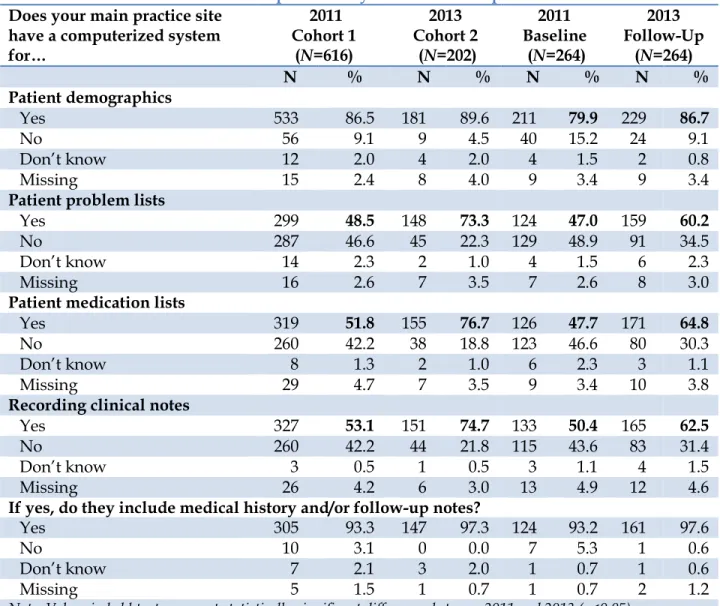
• 8 out of 10 physicians had a computerized system that gathered patient demographics.
The proportion of physicians with computerized systems which gathered other patient health information (e.g., record lists of patients’ health problems and medications, record clinical notes) increased significantly between 2011 and 2013 for both sub-samples.
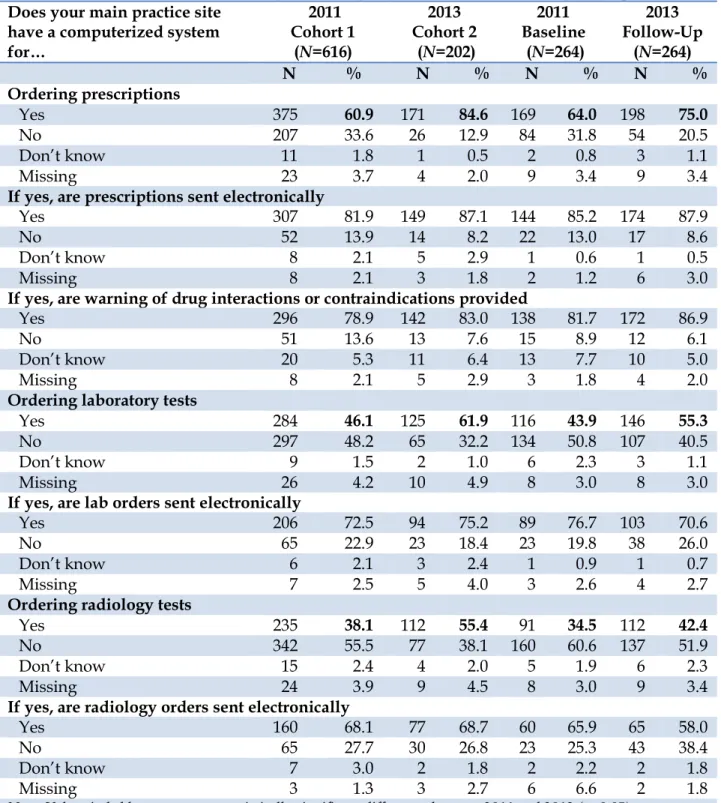
• In terms of order entry management (e.g., ordering prescriptions, lab, or radiology tests),
there was a similar pattern of significant increases in prevalence between 2011 and 2013 for both sub-samples.
o By 2013, 83-87% of physicians whose computerized systems allowed them to
order prescriptions said their systems provided warnings of drug interactions or contraindications.
o Over 85% said they used their systems to order prescriptions electronically.
o At least 7 out of 10 physicians reported they had computerized systems that
allowed them to view lab results and around half were able to use their systems to view imaging results. More than half of physicians said electronic images were returned to their systems.
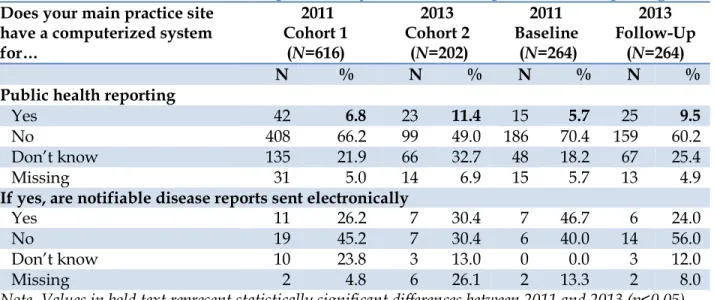
• Relatively few physicians have computerized systems that enable public health
reporting, although the proportions increased significantly in both sub-samples: from 6-7% in 2011 to 10-11% in 2013.
• Support for creating or receiving documents related to continuity of care was also
relatively uncommon (6-26%), but tended to increase from 2011 to 2013.
• Computerized systems that generated reminders for guideline-based interventions and
screenings increased significantly from around 25% in 2011 to 33-41% in 2013.
• Over a third of physicians reported that their computerized systems were capable of
providing patients with electronic copies of health information and clinical summaries of visits.
• The proportion of physicians who reported using each clinical function of their
computerized system “most or all of the time” increased over time. For the 2011 baseline and 2013 follow-up samples, the prevalence of five clinical functions increased by 10 or more percentage points: medication lists (37% to 51%), record clinical notes (39% to 50%), order radiology tests (20% to 31%), and patient problem lists (35% to 45%).
Acquisition and implementation of EHR systems
• In the 2011 survey, 38-40% of physicians said their practice had fully implemented an
EHR system compared with (53-62%) in 2013.
• Of those physicians whose practices had acquired or were in the process of
implementing their EHR system, around one half expected to have completed their implementation within the next 12 months.
• Between 20-30% of physicians whose practices were in the process of implementing or
had fully implemented their EHR system said they had been using the system for more than five years.
• During 2013, 57.2% of physicians reported their main practice site had
fully-implemented EHR systems and 13.3% were in the process of implementing an EHR.
• Allscripts was the most commonly used system in both 2011 and 2013.
Factors Associated with EHR Adoption
• In 2011, the odds of EHR adoption were higher among physicians who reported they
had “a lot” of computer experience, and those who worked in larger practice groups.
• In 2013, the odds of EHR adoption were higher among primary care (versus specialty
care) physicians and those who worked in larger practice groups.
Effects of EHRs on Clinical Practice
• Between 36% to 52% of physicians felt that their EHR system had a positive effect and
38-51% of physicians felt that their EHR system had no effect on the quality of clinical decisions.
• 8 in 10 physicians said that their EHR system had a positive effect on timely access to
medical records.
• More than half of physicians said their EHR system had a positive effect on preventing
medication errors. Notably, few physicians felt their EHRs had a negative effect on quality of care.
• Between 64-74% of physicians reported that their EHR system had a positive effect on
prescription refills.
• EHR systems appeared to have limited effects on the delivery of preventive and chronic
disease care meeting practice guidelines.
• Relatively few physicians felt their EHR had a negative effect on the delivery of care.
• The majority of physicians indicated that their EHR system had improved
communication with other providers. But 4 in 10 physicians said their EHR system had no effect on their communication with patients.
• More than half of physicians whose practices had fully-implemented EHR systems were
satisfied their systems.
Certification standards and Centers for Medicare and Medicaid Incentive Programs
• 3 in 10 physicians said that their EHR was integrated with a hospital system.
• 8 in 10 physicians said their system met federal certification standards.
• Over a third of physicians did not know if they qualified for the Centers for Medicare
and Medicaid EHR incentive programs.
• Incentives for adoption of EHRs
o Around half of physicians said that incentives and additional payments would
have a major positive effect on the decision to adopt an EHR system.
o Around 40% of physicians felt that legal protection from personal liability in the
event of privacy and security breaches would have a major positive effect on EHR adoption decisions.
o More than half of physicians felt that certification standards could have a major
or minor positive effect on the decision to adopt an EHR.
o Around 20% of physicians said that the decision to adopt an EHR could be
motivated by legal liability arising from not using the latest technology.
• Barriers to adoption of EHRs
o EHR-related costs were seen as a significant barrier by the majority of physicians.
o Around half of physicians cited uncertainty about the return on their investment
in an EHR as a major barrier to adoption.
o Concern about having the capacity to undertake all phases of EHR
implementation (i.e., to select, contract, install, and implement an EHR system) was mentioned by 37-47% of physicians.
o Between 30% and 37% of physicians mentioned physician resistance as a major
barrier to EHR adoption.
o Physicians appeared relatively unconcerned about legal barriers to EHR
adoption. Between two-thirds and three-quarters of physicians said concerns about inappropriate disclosure of patient information, illegal record tampering, or legal liability resulting from patients’ access to medical records were minor barriers or not barriers at all to EHR adoption.
o 9 in 10 did not think that adoption would be constrained by concerns about the
legality of a hospital-donated EHR.
o Finding an EHR system that meets providers’ needs was mentioned as a barrier
by more than half of physicians. Between 41-46% of physicians expressed concerns that the EHR system would become obsolete.
Health Information Exchange and PHRs
• 60-64% of physicians were not familiar with the Connecticut Health Information
Exchange (CT-HIE).
• 3 out of 4 physicians had not heard of Connecticut’s Regional Extension Center (REC)
(eHealthConnecticut) and the majority (63-73%) had not used REC services.
• The majority of physicians’ write-in comments echoed the lack of awareness of the
CT-HIE. Other comments suggested physicians were interested in learning more about the CT-HIE or looking forward to using it when it is established.
• Support for adoption of patient personal health records (PHRs) was divided, with 40%
of physicians expressing support and 30-40% saying they did not know if they
supported PHRs. Physicians offered a variety of reasons for supporting PHRs related to improvements in health care quality, safety, efficiency, and patient empowerment. Reasons given for lack of support for PHRs included concerns about privacy and security, lack of interest or technology skills, perceived lack of benefit to patients, and cost (both in terms of time and money).
Locations of physicians by EHR adoption
Introduction
Background
More than a decade ago, the Institute of Medicine (IOM) published two reports describing the United States’ lack of quality health care and the alarming proportions of patient morbidity and
mortality attributable to medical errors.3 Within these reports, the IOM made specific
recommendations for improving the quality of health care, proposing strategies for advancing the health care system by focusing on the six aims of quality health care: safety, effectiveness,
patient-centeredness, timeliness, efficiency, and equity.3 The IOM report also identified seven
challenges related to the achievement of good quality health care: re-engineered care processes, effective use of information technologies, knowledge and skills management, development of effective teams, coordination of care across patient-conditions and service sites over time, and making change possible.
Effective use of health information technologies (HITs) in medicine should play a critical role in achieving better and cost-effective care. HIT can provide an infrastructure to measure indicators that allow us to determine when we have reached our goal of “quality healthcare for all.” For improved measurement we need better data in digital form. To this end, there has been an increase in the number of health providers collecting health data electronically in the past two decades; the goal has been to replace paper-based processes with electronic ones. This switch to electronic data storage and processing has resulted from advances in security, falling hardware prices, and exponential increases in processing speed and data storage. In the early stages of HIT, it was assumed that most of the challenges of delivering quality health care would be addressed by implementing electronic health records (EHRs); this assumption over-estimated EHRs’ actual impact. Now we know that the mere adoption of HIT solutions will not improve services in the absence of policies focused on improving
quality of care.4 In summary, the EHR should be thought of as a tool to facilitate informed
discussions about how new programs can be designed to improve health outcomes and address issues of equity and disparities.
Concurrently, the Healthy People 2000, 2010 and 2020 initiatives have focused on addressing disparities and utilizing HIT to identify the social determinants associated with disparities as well as eliminating disparities and improving health of all groups. One of the proposed goals
of Healthy People 20105 was that each person should have access to his or her health
information by 2012. This goal was not achieved, though substantial progress is being made toward adoption of EHRs at the practitioner level.
Health IT and Quality of Care
According to the 2011 World Bank data, the United States (US) has a population of 311.6 million with a Gross Domestic Product (GDP) of 14.99 trillion US dollars and a life expectancy of 79
years.6 Health care expenditures constitute 17.9% of the GDP and we were spending $8,608 per
capita in 2011. Every year healthcare spending is a larger part of the GDP than the year before.
Concern about people’s experience with health care and the related expenses are well documented. Still people continue to experience poor quality of care in the US despite the highest per capita expenditure on the delivery and management of health care. For instance,
only one in two people receive recommended care7 and medical errors are the fifth leading
cause of death in the United States.8 A World Health Organization (WHO) report ranked the US
health system 37th in quality of care among 191 countries that were ranked, with France being
ranked No. 1.9
A majority of US health care consumers are dissatisfied with their levels of access to their physicians and to their medical records; 57% of respondents with Internet access wanted to email their doctors but were unable to, and 75% wanted access to their own medical records but
were unable to access them.10,11 The US, despite spending the most money on a per capita basis,
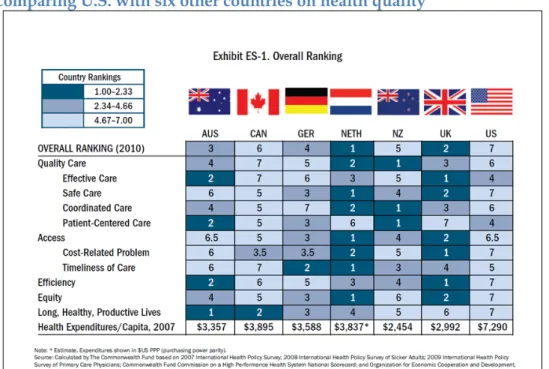
was ranked seventh overall (Figure 1) out of seven countries for patient safety,
patient-centeredness, efficiency, and equity in a study comparing it with Australia, Canada, Germany,
New Zealand, and the United Kingdom.12
Figure 1. Comparing U.S. with six other countries on health quality
Source: The Commonwealth Fund Report, 201012
EHRs and the Health Information Technology for Economic and Clinical Health
Act
The slow uptake of EHRs over the last two decades was mainly believed to be due to the high costs associated with purchase and implementation of these technologies. The US government decided to step in and incentivize the use of EHRs for a few professional groups that deliver health care. These incentives were part of the American Recovery and Reinvestment Act of 2009 (ARRA). The EHR incentive program is being administered by the Centers for Medicare and
Medicaid (CMS) to eligible professionals (EPs), eligible hospitals (EHs), and critical area hospitals (CAHs) for adoption of certified EHRs and demonstration of meaningful use of these
EHRs.13 Whereas, the Office of the National Coordinator for Health Information Technology
(ONC) is entrusted with the implementation of the Health Information Technology for
Economic and Clinical Health (HITECH) Act. The mere adoption, implementation, or upgrade of certified electronic health records can benefit physicians who see Medicaid and Medicare patients by at least $21,250 and $18,000 and up to $63,759 and $44,000 respectively. The ONC has invested about $20 billion to implement the HITECH Act (
Figure 2
).14-17The ONC made funds available to all states through multiple initiatives, such as the Health Information Technology Extension Program, State Health Information Exchange (HIE) Cooperative Agreement Program, and Community College Consortia to Educate Health Information Technology Professionals Program.
The Health Information Technology for Economic and Clinical Health (HITECH) Act seeks to improve American health care delivery and patient care through an
unprecedented investment in health information technology. The provisions of the HITECH Act are specifically designed to work together to provide the necessary
assistance and technical support to providers, enable coordination and alignment within and among states, establish connectivity to the public health community in case of emergencies, and assure the workforce is properly trained and equipped to be meaningful users of certified Electronic Health Records (EHRs). These programs
collaboratively build the foundation for every American to benefit from an EHR as part
of a modernized, interconnected, and vastly improved system of care delivery.18
Figure 2. Funding distribution under HITECH Act
The Health Information Technology Extension Program goal is to increase the rate of EHR adoption among EPs through provision of technical assistance. Similarly, via the HIE program, states are expected to build infrastructure and mechanisms that support the exchange of health information among physicians’ offices, hospitals, laboratories, pharmacies, registries, etc., and assist the EPs to qualify for EHR incentive program. The HIE initiative funds 56 Health
Information Exchanges covering all states. One metric indicative of HIE success is the rate of change in the EHR adoption rate among physicians and another is the demonstration of their ability to exchange summary documents with another provider, the state, or a regional HIE among providers over the course of this four-year initiative. In the first year of the HIE
cooperative agreements, states worked to establish a baseline for existing rates of EHR adoption and by the end of the four-year ONC grant the expectation is that the health information is flowing between health care entities to improve care delivery.
One advantage of the HITECH Act is that the HIT industry has had to work collaboratively to develop and adopt certification standards to realize the goal of inter-operability across platforms. Initially, HIT systems were implemented in the absence of defined standards. This led to the development of many proprietary solutions that were unique to the specific
agencies or programs. As HIT standards are being established for the health industry, many specialty providers (e.g., behavioral health, long-term-care, and nurses) continue to struggle with their unique needs and government mandates regarding medical records. These
providers are unable to access the funds made available through the HITECH Act to eligible providers and hospitals. Consequently, the difficulty of designing systems that easily
connect with each other and exchange data seamlessly, still remains as the greatest challenge to interoperability and patient care.
Much has been written about the advantages of using EHRs19-23 and HIEs24-26 and their resulting
benefits to improving quality of care, patient safety, and efficiency of delivering care. Much has
also been written about the continued challenges associated with EHRs.27-32 ONC defines EHRs
as “…at their simplest, digital (computerized) versions of patients' paper charts. EHRs are real-time, patient-centered records. They make information available instantly, ‘whenever and wherever it is needed.’ And they bring together in one place everything about a patient's health.”
EHRs can:
• Contain information about a patient's medical history, diagnoses, medications,
immunization dates, allergies, radiology images, and lab and test results
• Offer access to evidence-based tools that providers can use in making decisions
about a patient's care
• Automate and streamline providers' workflow
• Increase organization and accuracy of patient information
• Support key market changes in payer requirements and consumer expectations
One of the key features of an EHR is that it can be created, managed, and consulted by
authorized providers and staff across more than one health care organization.33
Potential benefits associated with EHR use
The ONC website has provided a great deal of guidance and insight into what is seen as
certified EHR technologies34 and CMS has provided evolving guidance on what “meaningful
use” of EHRs means.35 Despite the much discussed potential benefits of EHR implementation,
conclusive evidence is still lacking in what is seen as an indisputable case for return on investment (ROI) and improved patient outcomes as a result of EHR implementation. Much has been written about the benefits of EHRs, electronic medical records (EMRs), and computerized patient records in the published peer-reviewed and gray literature. Given that health data have been captured electronically for at least three decades, we believe that there should be sufficient evidence to ascertain whether or not implementing EHRs leads to
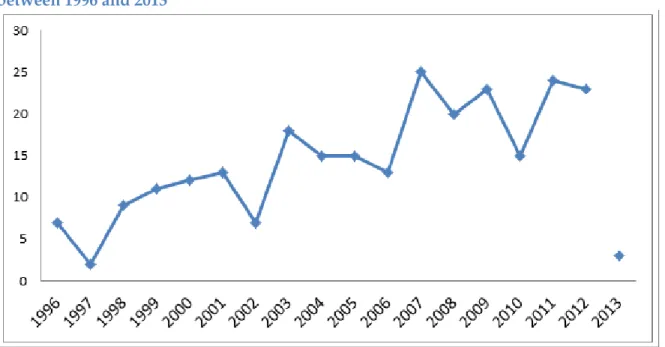
improved system or patient outcomes. Since the implementation of the HITECH Act, there has been a doubling of the adoption of EHRs among physicians and hospitals. But, it is still difficult to establish a causal relationship between implementation of EHRs and better patient or system outcomes. The last few years have seen a tremendous increase in the number of review,
systematic review, and other kinds of review articles that focus on the potential benefits of EHRs (refer to Figure 3 and Figure 4).
Figure 3. Number of EHR/Health Information Exchange (HIE) meta-analysis references that were reviews written between 1996 and 2013
Note: The 2013 data point is only for the first three months of data 0 500 1000 1500 2000 2500 5
Figure 4. Number of EHR/HIE meta-analysis references found for meta-analyses written between 1996 and 2013
Note: The 2013 data point is only for first three months of data
The number of studies that conclude with a statement on the potential benefits of EHRs far exceed studies that report conclusive evidence that supports the EHR benefits. We
summarize the many potential benefits associated with adoption and use of EHRs on health care quality in Table 1.
Table 1. Summary of potential EHR benefits for providers and patients36
Benefits of EHRs for providers Benefits of EHRs for patients
Accurate and complete information about
patient’s health Create an avenue for communication
The ability to quickly provide care Reduced need to fill out the same
forms at each office visit
The ability to better coordinate care they give Reliable point-of-care information
and reminders notifying providers of important health interventions A way to share information with patients and
their family caregivers Convenience of e-prescriptions electronically sent to pharmacy Quick access to patient records from inpatient
and remote locations for more coordinated, efficient care
Patient portals with online interaction for providers Enhanced decision support, clinical alerts,
reminders, and medical information Electronic referrals allowing easier access to follow-up care with specialists
Performance-improving tools, real-time quality reporting
Legible, complete documentation that facilitates accurate coding and billing
0 5 10 15 20 25 30 6
Benefits of EHRs for providers Benefits of EHRs for patients
Interfaces with labs, registries, and other EHRs Safer, more reliable prescribing by flagging dangerous drug interactions, verify medications and dosages, and reduce the need for potentially risky tests and procedures.
Access experts for rural health care providers by sharing best practices and allowing for
specialized care through telemedicine Standardization of data, order sets, and care plans helping to implement common treatment of patients using evidence-based medicine Better integration among providers by improved information sharing
Convenient, faster, and simpler disease management
Population management trended data and treatment and outcome studies
Viewable and up-to-date medication and allergy lists
Order entry at point of care or off-site
A key goal of EHRs is to simplify care providers’ jobs and to facilitate better client care using centrally-available electronic information. If individuals can carry a portable EHR when seeking treatment, then care providers will be able to provide and coordinate appropriate treatment. This portability assumes a level of inter-operability between systems that has not yet been realized.
Despite the advances in the HIT field and many articles espousing the advantages of EMRs, the evidence of the advantages of EHR/EMR adoption is mixed. For instance, Zhou
concludes that there was no difference in performance on 18 quality measures representing
six disease conditions between physicians who used EHRs and non-users of EHRs.37 In
addition, adoption rates are relatively low. Only 4% of the physicians have an extensive,
fully-functional electronic system, while 13% report having some basic system.38
Some of the advantages of EHR adoption found in the peer-reviewed literature are centered on the themes of accuracy, quality, reduced costs, and task automation. Advantages include:
• Accurate medication lists, legible notes and prescriptions, immediately available
charts, enhancement of health care delivery, facilitation in decision-making, and the ability to reduce medication errors via alerts delivered by the use of inpatient
computerized physician order entry systems (CPOEs).20
• The ability to mine text information for improved and appropriate billing, thus
increasing revenues.21
• Communication across providers resulting from the implementation of summary
patient records.19
• The potential for improving the quality of care and physicians’ and practices’
efficiency due to increased access to stored medical information, with the concomitant ability to conduct outcome studies.39
• The ability to calculate prevention costs using standardized measures.22
• The ability of nurses to spend more time with clients.23
• Savings from preventing adverse drug events were estimated at $4.64 billion in the
US VA system.40
• Use of HIT to provide access to health information for emergency medical
professionals.41
• Reminders generated based on patient medical history can improve quality of care.42
On the other hand, many challenges and barriers to the adoption of EMRs and EHRs have been identified despite the early enthusiasm by practitioners and significant public
expenditures on facilitating adoption. These challenges include:
• Limited evidence that the EMR improves quality of care.30 Screening and sending
results electronically to primary care physicians (PCPs) EMRs had little impact on three- and six-month clinical outcomes or on process measures for treating
depression.32
• The use of an EMR during primary care was insufficient for insuring high-quality
care. Practices not using the EMR were more likely to meet guidelines for process,
treatment, and intermediate outcomes.29
• Costs, complex systems, lack of data standards, privacy concerns, and legal barriers
hinder adoption.27
• Dysfunctional communication patterns, distribution of formal and informal
decision-making power, and internal conflicts.28
• The high cost and complexity of quality improvement.31
EHR adoption rates among physicians as reported by national surveys
Few national studies are available that have reviewed the adoption rates of EHRs amongphysicians. According to one national study, 4% of the physicians reported having an extensive,
fully-functional EHR and 13% reported having a basic system.38 In December 2010, the Centers
for Disease Control and Prevention (CDC) released statewide results of EHR adoption rates,
based on a mailed supplement to the National Ambulatory Medical Care Survey (NAMCS).43
This supplement was started in 2008. The CDC study reports that 48% of office-based
physicians use an EHR, 22% use a basic system, and 7% use a fully-functional EHR. Both these studies have a limitation that at the time of these surveys there were no certification standards for EHRs.
EHR adoption rates were significantly higher in 2010 and 2011 when compared with 2009.44 A
2011 national study reported a 57% EHR adoption rate among office-based physicians.45 This
rate is even higher among family physicians at 68%.46 Fewer than 2% of solo or
two-physician practices reported a fully functional EHR compared with 13% of two-physicians from 11+ groups.47
A 2014 update puts these numbers at 78% for office-based physicians using any EHR and 48%
using a Basic EHR.48 These numbers have increased substantially since the implementation of
the HITECH Act and the EHR Incentive Program being administered by CMS. For the
providers and hospitals to be eligible for incentives, at a minimum, they have to have acquired certified EHRs based on the criteria laid out in the Federal Register notice.
The rates of EHR adoption vary greatly by state, with 21% in New Jersey to 83% in North
Dakota.48 According to this report, 30% of Connecticut’s physicians had adopted a basic EHR.
Currently, NAMCS data are the only state-level estimates available that systematically record EHR adoption rates, though not certified EHR adoption rates. However, there are two
limitations that impact the applicability and usefulness of the NAMCS data. First, the
supplement questionnaire does not ask the key question about whether or not the EHR in use is
certified.14 Second, the EHR adoption questions were asked at the practice level and not at the
physician level. This distinction is important because the incentives being promoted by CMS are at the physician level and not at the practice level.
EHR adoption rates as reported by state surveys
State surveys tend to report different rates of EHR adoption than the NAMCS survey (Table 2).
According to a 2008 study,49 HIT has varying levels of adoption among Connecticut providers.
Office technologies, including practice management applications and electronic billing, are the
two most utilized technologies with 65% and 78% adoption among practices, respectively.49 On
the clinical side, electronic lab is the most utilized technology, with 63% practice adoption;
however, only 26% of practices use an EHR.50 According to 2010 NAMCS estimates for
Connecticut, 48% of office-based physicians use an EHR and 15% report having a basic EHR
system,43 while another 2008 study puts this number at 26%51 and a 2012 study puts this number
at 36%.52
A 2007 survey administered to office-based physicians in Nebraska and South Dakota yielded
an EHR adoption rate of 30%53 compared with the 53% and 45% reported in 200943 and 54% and
58% in 2013 by NAMCS for office-based practices for Nebraska and South Dakota
respectively.48 A 2009 survey of medical practices in the state of Washington yielded a rate of
58% and this rate did not vary by practice location54 compared with the 63% reported in 200943
and 61% in 2013 by NAMCS for office-based practices.48
Table 2. EHR adoption by physicians in Connecticut, Massachusetts, Nebraska, South Dakota, and Washington
State/year State Survey report 2010 NAMCS 2014 NAMCS
CT/2011 36% 48% 30% Massachusetts/2007 37% 77% 71% Nebraska/2007 30% 53% 54% South Dakota/2007 30% 45% 58% Washington/2009 58% 63% 61% 9
Variables associated with physicians’ adoption of EHRs
Physician characteristics
There are some contradictory results reported in the literature associating physicians’
characteristics and adoption of EHRs. Women were more likely to use EHRs than men55,56
though Bramble53 reported no such difference. Physicians with education in addition to a
medical diploma55 and postgraduate education in a relevant clinical condition57 were more
likely to have a positive attitude toward HIT. Younger physicians were more likely than older
physicians to use EHRs.53,58,59 There was no association between race, ethnicity, and EHR use.
Specialists were 44-94% less likely to adopt EHRs than general practitioners,44 specifically
family medicine/general practitioners were more likely to adopt EHRs in comparison to psychiatrists, dermatologists, pediatricians, ophthalmologists, and general surgeons,44,60 while
Menachemi59 did not find any association between specialty and increased EHR adoption.
Physicians serving higher volumes of elderly patients were less likely to adopt EHRs61 whereas
rates were no different among physicians serving more than 40% black or Hispanic patients.62
There is regional and state variability in EHR adoption rates,46,48 with western states more likely
to have higher rates of adoption.38 Physicians who had more years of experience in using
computers and technology had positive attitudes toward adoption.55,58,63
Physicians practicing in a multi-specialty group that adopted an EHR (represented by having at least 6-months of pre- and post-implementation visit volume and charge data) had an average increase of nine monthly patient visits per month whereas the patient visit volumes remained
unchanged for non-adopters.64 Similar results were found for average monthly charges.
Length of time using an EHR was not associated with physician performance on quality measures.37
Physician beliefs
Physicians who had positive views about the effects of computer systems on healthcare65
and/or positive attitudes towards the EHR system,66 reported a positive attitude toward
adoption of EHRs. Physicians’ perceived management support,53,58,67 provider involvement,67-69
and receipt of adequate training53,67,70 were positively associated with adoption whereas
perceived lack of usefulness67 and provider autonomy67 were negatively related with EHR use.
Self-reported ease of use of EHRs, pre-implementation satisfaction, and stress were associated
with post-implementation satisfaction with EHR adoption.56 Users ranked ease of use as the
primary reason that motivates them to continue using the EHR, whereas perceptions about ease
of use and usefulness were the prime motivators for nonusers to adopt EHRs.71 Thirty percent
of physicians believed that EHRs create new opportunities for error, however only 2% believed
that their EHRs had created more errors than they prevented.72 No EHR has satisfactorily met
all physicians’ needs; physicians maintain that EHRs continue to impact workflow and team
communication negatively.73
Practice characteristics
Physicians in group practices,46 single-practice,59 multi-specialty,44 or practices of more than
seven physicians,74 those that were hospital-based,74 and practices that are involved in training
medical students,46,74 or associated with HMOs44,46 were more likely to use an EHRs. Physicians
who were assisted by highly skilled autonomous staff were able to demonstrate greater gains in
productivity after adoption of EHRs than physicians without such staff.75 Additionally,
practices that demonstrated higher levels of uniform use of EHR features and EHR-enabled communication patterns were likely to have within-practice communication patterns that were
represented by mindfulness and respect for members in the practice.76 Small group practices
are projected to be the least likely to adopt EHRs. Ford77 estimates that 47% of physicians in
small practices will have implemented an EHR by 2014.
Physicians who treated larger proportions of Medicare patients59,63 and those who had greater
proportions of private insurance78 were more likely to adopt EHRs, though in an earlier paper
Menachemi78 reported there was no difference in EHR adoption rates among physicians with
high percentage of Medicare patients. Percentage of Medicaid patients in the practice was not
associated with increased use of EHRs59 though in an earlier paper Menachemi78 reported that
physicians with high percentage of Medicaid patients were less likely to use an EHR. Practices
that involved physicians in the selection and implementation of EHRs68,69 and practices
involved in quality improvement56,58 were more likely to report positive attitude toward
adoption.
Practice location (i.e., rural versus urban) had no association with EHR adoption.46 Medically
underserved areas,46 health professional shortage areas,46 and being an international medical
graduate46 were negatively associated with adoption of EHRs.
Most commonly used EHR functions
Integrated EHRs come with many useful features, such as e-prescribing, ordering and
reviewing labs, the ability to communicate securely with the patient, and sending information to a PHR. Although the most commonly used function is electronic prescribing. Among a group of Massachusetts physicians’ the rate of e-prescribing increased from 20% in 2005 to 43% in
2007.79 A 2007 article lists the following as the most commonly used EHR functions by
physicians: 85% had the ability to view lab results, 84% were able to document the visits, 47%
were able to order labs, and 44% were able to transmit prescriptions to a pharmacy.74
Physicians using EHRs were more likely to be aware of and engaged with PHRs.80 Currently,
the EHRs are being used with basic functionality to meet minimum requirements. One can hypothesize that the true meaningful use of EHRs is even lower than the current estimates, which represent minimum functionality.79,81
Barriers to EHR adoption
EHR usability82 and return on investment83 are significant concerns among physicians as they
evaluate EHR adoption. Smaller practices were more likely to report financial barriers47,54 and
concerns about future obsolescence as a concern.47
HIE and quality of care
Most HIEs aim to reduce medical errors, improve patient safety, and reduce costs by creating seamless information systems. Yet, as mentioned earlier in the report, the current quality of US
health care is unimpressive. Only one in two people receive recommended care.7 Medical errors
are the fifth leading cause of death in the United States.8 Preventable medical errors include
adverse events, temporary injuries, death, and permanent disabilities. It is believed that widespread adoption of HIE has the potential to result in cost savings, to decrease medical errors, and to improve overall health.84,85 Kadry, Sanderson, & Macario86 summarized why they
believe that of the 400 HIEs that were initiated in the last decade only 143 remain active today. The authors list multiple factors that played a role in HIE failure, ranging from infrastructure challenges to technical issues, none of which incorporate the role for the patient.86
One metric indicative of HIE success is the percent of physicians who successfully exchange summary documents with another provider, the state, or a regional HIE. As a first step to establishing HIEs, most states are establishing Health Information Service Providers (HISPs) and Security/Trust Authority (STA), which require a complete and accurate list of practicing physicians in each state. As a result, in the first year of the HIE cooperative agreements, states have been working to create provider directories and third party certificate issuing authorities to build an infrastructure that is minimal yet sufficient to support simple point-to-point exchange of health information among providers in a secure manner. The exchanges that are mature and were operational before this funding were (a) the Delaware Exchange which focused on the exchange of lab results and added e-prescribing and (b) the Indiana exchange which focused on exchange of summaries and information between hospitals. In the second year of the grant, most states were asked to focus on point-to-point exchange (Direct Protocol) rather than the “query-based” HIEs that had been proposed initially. Everyone realized quickly how difficult it was to reach the goal of interoperability, which is critical for data flow and seamless exchange.
Interoperability
Today providers use fax, mail, and email to exchange healthcare information within and across organizations, providers, and patients. The Direct messaging protocol aims to improve this exchange by making it faster, less expensive, and more secure.
Interoperability “is the ability of two or more health care information systems to exchange
information and to use the information that has been exchanged (pg. 174).”87 Interoperability
can be defined as the ability of two disparate systems to communicate information meaningfully. There are three aspects of meaningful exchange,
• technical: the sender and receiver must have a trusted mechanism to exchange
messages
• process: they should be able to structure and format the content of the message,
and
• semantic: ability to understand the meaning in the same fashion (usually driven
by use of standard terminology).
To accomplish secure exchange of messages containing health information, ONC started the Direct Project in 2010. The aim of this project was to specify “…a simple, secure, scalable, standards-based way for participants to send authenticated, encrypted health information directly to known, trusted recipients over the (public) internet” (pg. 4).88 It was clear that ONC
was interested in using the existing infrastructure to make exchange of health information easy and achievable. First, the project scope was well defined and focused only on the transport, and not on structure or content of the message. Second, the policy and standards-making were left to the federal or other appropriate organizations. Third, the project was focused on simple health care scenarios that happen every day in coordinating patient care. Fourth, the focus was on a “push” rather than a “pull” system. Last, the group wanted to develop a messaging capability that could be used by providers that had certified EHRs, modular EHRs, or no EHR.
“The Direct Project establishes standards and documentation to support simple scenarios of pushing data from where it is to where it's needed, in a way that will
support more sophisticated interoperability in the future.”88
Currently, most states have shifted their HIE efforts to focus on enabling systems to use Direct messaging protocol. This is being implemented in many different ways. One way states are making Direct available to their providers is by making the HISP maintain the Direct addresses and take the responsibility of also maintaining the certificates that accompany direct messages. Another way the providers can use Direct is through the use of EHRs that have integrated the Direct message functionality into their product so that it is a seamless way for the provider to send secure messages without ever having to leave their system. Last, Direct messaging
protocol is available to providers who do not have EHRs but would like to coordinate care and exchange health information with other providers in a simple and secure manner.
The content that was initially intended for exchange was the Continuity of Care Document (CCD), or discharge summaries or clinician notes. Direct does not push the use of HL7 standard as there has been a slow adoption of HL7 version 3, though most states have the capability to receive and send HL7 version 2.5.1 messages to exchange relevant public health data with the state lab and the CDC.
In the last year, states have increasingly pushed for the exchange of lab and prescription data for exchange using Direct messages, which was not the intent of the Direct project.
E-prescribing has a high adoption across the country and systems are interoperable mainly because of the monopoly of Surescripts that is present in all states and has an adoption rate between 60-90% depending on the states. In the case of e-prescribing interoperability has been achieved but only because everyone is using one system. This does not really fit the definition of interoperability as there are not two types of systems exchanging information.
In the case of lab exchange, the story is slightly different because the two big players in this space, mainly LabCorp and Quest Diagnostics, were unable to negotiate an agreement with ONC that would allow states access to state level data on the volume of lab results being exchanged electronically. Some states are proposing to use Direct to exchange lab information using HISP and a certificate authority. A few states such as Florida, West Virginia, North Carolina, and Alaska are piloting the process of using Direct to exchange lab data. Some of these pilots involve manual data entry because the content of the message is in Adobe portable document format (PDF) and not structured data. Finally, last year when Google decided to stop offering its personal health record services, people could use the Direct messaging protocols to
send their Google Health profile directly to a Microsoft HealthVault account.89
Summary
Much has been written about the benefits of EHRs, EMRs, and computerized patient records in the published peer-reviewed and gray literature. Since the implementation of the HITECH Act, there has been a doubling of the adoption of EHRs among physicians and hospitals. However, it is still difficult to establish a causal relationship between implementation of EHRs and better patient or system outcomes.
Even though establishing HIEs with querying capabilities is a gold standard, many states are struggling to sustain all activities related to the actual exchange of information. The HIE
cooperative agreements are ending and many states that have implemented HIEs are finding it hard to sustain their efforts. The ONC, together with the states, is re-thinking the capabilities and capacities for HIEs and concluding that before pushing for the gold standard, it may be meaningful to start with ensuring that all providers can exchange summaries and other relevant documents and communicate with each other (also called point-to-point communication) to coordinate patient care. Most agree that this simple exchange capability should definitely come before querying functions and population-based analytics. Currently, the ONC is advocating the use of Direct messaging to ensure reliable, secure, and safe delivery of sensitive health information using existing infrastructure and technologies. At the writing of this report all
states except two (Washington and Idaho) intend to implement the Direct protocol.90
Despite the publication of over 75,000 articles and 30,000 reviews since the early 1990s on the topic of HIT and improvement of care, a definitive answer about the value of EHR
implementation has not been found. The jury is still out on the fundamental efficacy of EHR adoption for improving the quality of care to patients.
Meaningful electronic exchange amongst physicians, laboratories, pharmacies, and HIE has the potential to improve patient-care experience and health outcomes. The goal of the physician survey was to measure the extent of interoperability, assess the knowledge and attitudes of physicians toward the creation of Heath Information Exchange. These findings will help inform stakeholders about the level of health IT adoption and provide insight into the challenges associated with adoption of EHRs from the physician perspective, so that these viewpoints can be taken into consideration as the HIE initiative moves forward. The information obtained from this research will be instrumental in characterizing the HIT landscape within Connecticut. Currently, there is limited knowledge of physician attitudes towards and adoption of HIT and this survey represents a critical step towards obtaining that knowledge.
Methodology
Study design
We conducted a two-wave panel survey91 of Connecticut physicians’ attitudes toward and use
of health information technology and exchange. Licensed physicians who currently practiced in Connecticut were eligible to participate. The study was approved by the University of
Connecticut Health Center Institutional Review Board.
Survey instrument
The survey items were drawn from an instrument used in a national study conducted by
DesRoches and colleagues.38 Additional questions pertaining to Connecticut’s health
information exchange, whether or not the physician practiced in Connecticut, federal EHR incentive programs, and the availability of specific EHR functions were added by the principal investigator. The University of Connecticut Health Center Institutional Review Board approved the final surveys. Please see Appendix A for copies of the survey instruments.
Survey administration
Details regarding the survey protocol are found in Appendix B. In summary, physicians
licensed to practice in Connecticut received a postcard containing a brief set of survey questions and a request for contact information to allow the University of Connecticut Health Center research team to send them two subsequent in-depth surveys over the course of the evaluation period (please see Appendix A for a copy of the postcard). Physicians who returned the
postcard and indicated they currently practiced in Connecticut received the survey by the administration method they had requested (i.e., web-based, mailed paper survey, telephone or in-person interview). Two rounds of data were collected by the research team. The first round (using the “baseline” version of the survey instrument) took place between June 27, 2011 and April 25, 2013. The second round (using the “follow-up” version of the survey instrument) took place between July 1, 2013 and February 19, 2014.
Figure 5 and Figure 6 summarize the flow of survey participants for the two data collection rounds, beginning with the initial list of licensed physicians and concluding with the physicians who responded to the surveys.
Figure 5. Physician survey Round 1 flow diagram
Initial Physician List
18,642 De-Duplication of Raw Physician Data
Physicians Not Flagged As Potential Duplicates
14,347 Sets of Matched Physicians2,115
De-Duplicated Physicians
16,462 Physicians Excluded Due to Retirement, etc.
Died
44 No Longer Practice in CT5,828 Retired233 Unknown if Practices in CT30
Target Physician Population
10,327 Physician Postcard Responses
Returned Due to Invalid Address
1,311 Physician Responded 3,192 No Response 11,959 Response Rates: Unduplicated Physicians: 19.4% Target Physician Population: 30.9% Postcard Exclusions: No Survey Sent
Physician Died
3 Physician Retired164 Physician No Longer Practices in CT649 Refused Survey91
Unknown if Physician Practices in CT
30 Physician Specified No Survey Method9
Physician Practices in CT and Wants Survey
2,246 Round 1 Physician Survey Responses
Physician Responded to Round 1 Survey
943
Round 1 Physician Survey Response Rate 42.0%
Figure 6. Physician survey Round 2 flow diagram
De-Duplication of Round 1 and Round 2 Physician Data
De-Duplicated Physicians
21,427
Physicians Excluded Due to Retirement, etc.
Died
50 No Longer Practice in CT6,165 Retired296 Unknown if Practices in CT55
Target Physician Population
14,861
Physician Postcard Responses
Returned Due to Invalid Address
610 Physician Responded462 No Response7,386
Postcard Exclusions: No Survey Sent
Physician Died
0 Physician Retired26 Physician No Longer Practices in CT12 Refused Survey89
Unknown if Physician Practices in CT
5 Physician Specified No Survey Method9
Physician Practices in CT and Wants Survey
321
Round 2 Physician Survey Responses
Physician Responded to Round 2 Survey
548
Round 2 Physician Survey Response Rate 25.3%
Round 2 DPH Licensure List
18,284 Round 2 DSS Medicaid List10,169
Undup. DPH List
10,360
Survey Sent to Round 1 Postcard/Survey Respondent
1,846 Survey Sent to Round 2 Postcard Respondent321
Postcard Sent (No Postcards Sent to Physicians w. Round 1 Postcard)
8,458
Response Rates:
Unduplicated Physicians: 2.16% Target Physician Population: 3.11%
Round 1 Physician List
16,462
Undup. DSS List
10,169 Undup. Round 1 List16,462
Round 2 Lists Only
4,965
Round 1 and Round 2 Lists
13,158
Round 1 List Only
3,304
Analytic sample
Survey data were collected using REDCap (Research Electronic Data Capture), a secure web-based application hosted at the University of Connecticut Health Center. A total of 1,492 surveys were recorded in REDCap. We set aside 146 surveys: 52 duplicate surveys, 41 surveys submitted by physicians who no longer practiced in Connecticut, 20 surveys that could not be matched to postcard mailings, 18 surveys that were missing most or all of the survey data, 8 surveys submitted by physicians who indicated they did not see patients, 4 surveys from retired physicians, and 3 test surveys. The analytic sample included the remaining 1,346 participants (880 from the 2011 round and 466 from the 2013 round of the survey).
Analytic approach
Descriptive statistics were used to summarize the distributions of the survey variables. We examined change in the proportions of physicians reporting whether various functions were available in their main practice site’s computer systems using chi-squared and Fisher’s exact tests when comparing the 2011 and 2013 cohorts, and using Bhapkar’s test (an approximation of the Stuart-Maxwell test) when comparing the 2011 and 2013 baseline and follow-up groups. We identified factors associated with the presence of an EHR system (defined as either being in the process of implementation or having a fully-implemented EHR system) using chi-squared and Fisher’s exact tests. Factors that were significantly associated (p<.05) with the presence of an EHR in the bivariate analyses were then included in multivariable logistic regression models. Factors used in our models included demographic characteristics (sex, age, years practicing medicine, practice specialty, and computer experience), practice characteristics (number of physicians in the practice, practice type) and perceived barriers to EHR adoption (amount of capital needed to acquire and implement an EHR system, concern about inappropriate
disclosure of patient information, and concern about illegal record tampering). We used SAS 9.4 for all statistical analyses.
We analyzed physicians’ responses to open-ended survey questions asking them to comment about their EHR system, the Connecticut Health Information Exchange, and reasons why they would or would not support the widespread adoption of personal health records for patients as follows. First, we coded each comment to extract key words that represented the main point of the comment. Second, we identified common themes or concepts expressed in the recoded
statements. Finally, we generated a “word cloud” (also known as a “tag cloud”) using Wordle92
to display the frequency with which physicians mentioned the common themes or concepts.
Results
Respondent characteristics
A total of 880 surveys were completed in the first distribution of survey (2011) and 466 surveys were completed in the second distribution of the survey (2013). Six hundred sixteen physicians completed a survey during the first distribution only (2011 Cohort 1) and 202 physicians completed a survey during the second distribution only (2013 Cohort 2). Two hundred and sixty-four physicians completed surveys at both points (2011 Baseline and 2013 Follow-Up). We compared the physicians who completed a survey (1,082 unduplicated physicians from the 2011 and 2013 survey distributions) to those who completed a postcard but did not complete a survey (2,521 unduplicated physicians) using the subset of characteristics that were collected by both the postcard and the survey (gender, age, race, ethnicity, type of practice, method of health record storage, and sources of patient revenue). Physicians who completed a survey
(“respondents”) differed from physicians who did not complete a survey (“non-respondents”) in several ways. In terms of demographic characteristics, respondents were younger
(t(2186)=5.78, p < .0001) and less likely to be Black/African American or other/multiracial than
non-respondents (𝑋2(2, N=3289)=7.59, p=.02). Respondents were more likely than
non-respondents to work in single-specialty partnerships or groups and less likely to work in multi-specialty partnerships or groups (𝑋2(2, N=3024)=10.41, p=.006). Respondents were more likely
than non-respondents to store patients’ health records using a paper-based system (𝑋2(1,
N=3603)=133.72, p<.0001), a DIMS system (𝑋2(1, N=3603)=88.37, p<.0001), or an EHR (𝑋2(1,
N=3603)=103.73, p<.0001). Finally, respondents reported a lower percentage of their patient revenue came from Medicare (𝑋2(3, N=2416)=96.19, p<.0001), Medicaid (𝑋2(3, N=2331)=50.69,
p<.0001), or from self-paying patients (𝑋2(3, N=2082)=104.42, p<.0001). However, a third or
more of the data on patient revenue was missing, so these apparent differences should be interpreted with caution.
In order to simplify the presentation of the results, we summarize our discussion of the
following measures across each sub-sample (i.e., Cohort 1, Cohort 2, Baseline and Follow-Up), except in instances where the sub-sample results differed markedly.
As shown in Table 3, around two-thirds of the physicians were male. Age ranged from 29 to 88 across the sub-samples and the average age was mid-fifties. The majority of physicians were white and non-Hispanic/Latino. More than half of the physicians were certified in a primary care specialty. Years of practicing medicine ranged from 1 to 56 years, although most physicians reported 10 or more years in practice. Around half of the physicians reported they had “a lot” of computer experience.
Table 3. Physician characteristics 2011 Cohort 1 (N=616) 2013 Cohort 2 (N=202) 2011 Baseline (N=264) 2013 Follow-Up (N=264) Physician Characteristics N % N % N % N % Age 29-39 80 13.0 27 13.4 22 8.3 16 6.1 40-49 123 20.0 28 13.9 47 17.8 46 17.4 50-59 196 31.8 64 31.7 86 32.6 76 28.8 60-69 133 21.6 49 24.3 73 27.6 75 28.4 70+ 47 7.6 18 8.9 26 9.9 40 15.1 Missing 37 6.0 16 7.9 10 3.8 11 4.2 Gender Male 409 66.4 126 62.4 180 68.2 179 67.8 Female 175 28.4 65 32.2 75 28.4 78 29.6 Missing 32 5.2 11 5.4 9 3.4 7 2.6 Ethnicity Hispanic/Latino 17 2.8 7 3.5 9 3.4 10 3.8 Not Hispanic/Latino 555 90.1 178 88.1 236 89.4 243 92.0 Missing 44 7.1 17 8.4 19 7.2 11 4.2 Race White 488 79.2 156 77.2 230 87.1 228 86.4 Black 10 1.6 4 2.0 1 0.4 2 0.8 Other 57 9.3 22 10.9 16 6.1 15 5.7 Missing 61 9.9 20 9.9 17 6.4 19 7.2
Years practicing medicine
1-9 110 17.9 34 16.8 33 12.5 31 11.7 10-19 142 23.0 43 21.3 58 22.0 48 18.2 20-29 181 29.4 56 27.7 79 29.9 82 31.1 30+ 151 24.5 56 27.7 82 31.1 96 36.4 Missing 32 5.2 13 6.4 12 4.5 7 2.6 Specialty1 Primary care 349 56.7 130 64.4 157 59.5 157 59.5 Non-primary care 244 39.6 68 33.7 103 39.0 103 39.0 Missing 23 3.7 4 2.0 4 1.5 4 1.5 Computer experience A lot 334 54.2 111 54.9 137 51.9 128 48.5 Some 237 38.5 79 39.1 100 37.9 112 42.4 A little 36 5.8 8 4.0 24 9.1 21 7.9 None 4 0.7 1 0.5 2 0.8 2 0.8 Missing 5 0.8 3 1.5 1 0.4 1 0.4
1Primary care specialties included Family Medicine, Internal Medicine, Obstetrics and Gynecology, Pediatrics, and Preventive Medicine. Non-primary care specialties included Allergy and Immunology, Anatomic Pathology, Anatomic and Clinical Pathology, Anesthesiology, Colon and Rectal Surgery, Dermatology, Emergency Medicine, General Surgery, Neurological Surgery, Neurology, Neurosurgery, Ophthalmology, Oral and Maxillofacial Surgery, Orthopaedic Surgery, Other, Osteopathic Manipulative Medicine, Osteopathic Neuromusculoskeletal Medicine, Otolaryngology, Pathology, Physical Medicine and Rehabilitation, Plastic Surgery, Psychiatry, Radiation Oncology, Radiology, Thoracic Surgery, Urology
Around one half of the physicians reported working at a single practice site and 40-50% of physicians were from small (up to 3 physicians) practices (Table 4). Over two-thirds of
physici