
Gururaj P Mahajan
MOBILE VOICE BASED SERVICES
FOR AGRICULTURAL
EXTENSION SERVICES
at the Bottom of the Pyramid
Faculty of Information Technology and Communication Sciences Master’s Thesis April 2019
ABSTRACT
Gururaj P Mahajan: MOBILE VOICE BASED SERVICES FOR AGRICULTURAL EXTENSION SERVICES at the Bottom of the Pyramid (BoP)
Master’s Thesis Tampere University Computer Science April 2019
The rapid technological advancements and innovations in mobile phone technology has connected the entire global population, still majority of the people across globe are not connected with the internet and providing information to this unreached masses is a major challenge. However the mobile phones are the best medium to reach this mass population and voice is the best medium to provide information to this entire unreached population. This population includes farming community across the world. We chose to rural India as our case study. Further we conducted research and field study in order to understand how the voice based services helps to disseminate agricultural information to the unreached farmers, especially to illiterate farmers.
This research is the result of joint multi-disciplinary and first of its kind Indo-Finnish collaboration of University of Tampere, Finland, University of Agricultural Sciences Dharwad, India and IBM Research Lab, India. Together we conducted, empirical field study during year 2011, by interviewing participants in surrounding villages of University of Agricultural Sciences Dharwad. While there were no such previous attempts being made for the agricultural extension service in the part of India, Dharwad region, situated Northern Karnataka, this field study is first of its kind. It is evident from our research field study that, the illiterate farmers were comfortable and very quickly able to use our voice-site prototype and all participants unanimously appreciated and accepted our research efforts and all of them acknowledged our Raitarind Raitara Dhwani (voice-site prototype). This shows that the dissemination of agricultural extension information services and mobile voice based services through mobile phone using spoken web as platform are acceptable to the farming community.
Keywords: mobile phones, voice based services, agriculture extension services, Bottom of the Pyramid
Table of Contents
List of Abbreviations ... 1
1. Introduction ... 3
2. Theoretical Background ... 6
2.1. Information Society Development ... 6
2.2. Information and Communication Technologies for Development (ICT4D) ... 8
2.3. Bottom of the Pyramid (BoP) ... 10
2.4. Defining the Context of Development ... 12
2.4.1. Agriculture as a part of Indian Economy ... 12
2.4.2. The importance of ICT technology ... 15
2.4.3. Literacy as a main challenge ... 15
2.4.4. Voice-based services and the spoken web ... 16
3. Methodological Choices ... 19
3.1. Action Research as a research approach ... 19
3.2. Description of the empirical field research ... 20
3.2.1 Exploratory Analysis and Location of the field study ... 20
3.2.2 Co-designing with farmers ... 23
3.2.3 Adoption Discussion ... 23
3.2.4 Ethnographical Approach ... 24
3.3. Design Research ... 24
3.3.1 SWAicons ... 24
3.3.2 Description and structure of prototype ... 25
3.4. Evaluation ... 27
3.4.1 Field Study – Testing of Prototype in the fields ... 27
3.4.2 Field Study Process ... 28
3.4.3 Demographics and Interviews ... 29
3.4.4 Major outcomes of the field study ... 31
5. Conclusion ... 35
Figures
Figure 1. Estimated mobile-cellular subscriptions 2018, ITU
Figure 2. Changing ICT4D issues over time. Readiness, availability, uptake and impact
Figure 3. The World Economic Pyramid
Figure 4. The Commercial Infrastructure at the Bottom of the Pyramid
Figure 5. Farming Life Cycle
Figure 6. Spoken Web
Figure 7. Action Research Process
Figure 8. Menu Structure for voice site
Figure 9. Voice-site prototype (Adobe Flash Version)
Figure 10. Farmwoman and farmer are using voice-site demo during field study
Tables
Table 1. Age group wise classification of participants
Table 2. Education wise classification of participants
List of Abbreviations
BoP Bottom of the Pyramid
ICT Information and Communication Technologies
ISD Information Society Development
ITU International Telecommunication Union
ICT4D Information and Communication Technologies for Development
TRAI Telecom Regulatory Authority of India
AR Action Research
UTA University of Tampere
UASD University of Agricultural Sciences Dharwad
IRL IBM Research Lab
SW Spoken Web
Foreword
I sincerely thank both Prof. Mikko Ruohonen and Prof. Markku Turunen from Tampere University (formerly University of Tampere), Finland, for their great support, inspiration, mentorship and guidance.
I sincerely thank all the participants, who participated in this field study and provided their valuable suggestions and feedback.
I sincerely thank, Prof. Dr. L. Krishna Naik, (the then) Director of Extension, UAS Dharwad, India, Prof. S. Devendrappa, Head of Krishi (Agriculture) Community Radio Station (KCRS), UAS Dharwad, India and special thanks to the ladies staff members of KCRS, who provided great help in interviewing farmwomen during field study.
I sincerely thank, Mr. Nitendra Rajput, Mr. Amit Nanavati and Mr. Saurabh Srivatsava from IBM Research Lab, New Delhi, India for their great technical support and guidance.
I sincerely thank, Prof. Himadri Das, IMI New Delhi, India, for his great support and guidance.
I sincerely thank both my dad Mr. Pandurang Krishnaji Mahajan and my mom Mrs. Vidya Pandurang Mahajan for their great love, support, guidance and motivation.
Finally, I thank my wife Mrs. Upama Gururaj Mahajan, for her great support, love and motivation.
I thank one and all, who directly or indirectly helped during this thesis work.
1. Introduction
Over the last two decades, with the rapid technological advancements and innovations in Information and Communication Technologies (ICT), have not only changing our ways of communication and sharing the information. According to ITU (International Telecommunication Union) ITU MIS [2018], there are more than 7 billion mobile cellular subscribers across the globe.
However, despite of the world wide mobile phone connectivity, according to ITU MIS [2018], only 51.2 percent of world's population is connected with internet, and the remaining 48.8 percent of world's population is still not connected with the internet. Hence the major challenge is how to empower and provide access information to this unreached population.
The mobile phone medium is the best medium to reach this mass population and voice is the best medium to provide information to this entire unreached mass population. This motivated us to conduct research to in order to understand how mobile voice based services through mobile medium, disseminate information to this unreached population. This population includes farming community across the world.
We chose to rural India as our case study. Further we conducted research and field study in order to understand how to voice based service helps to disseminate agricultural information to the unreached farmers, especially to illiterate farmers.
This research is the result of joint multi-disciplinary and first of its kind Indo-Finnish collaboration of University of Tampere (UTA), Finland, University of Agricultural Sciences Dharwad, India (UASD) and IBM Research Lab, India (IRL). Together we conducted, empirical field study [Ruohonen et al., 2013a], during year 2011, by interviewing participants in surrounding villages of University of Agricultural Sciences Dharwad. While there were no such previous attempts being made for the agricultural extension service in the part of India, i.e. Dharwad region, situated Northern Karnataka, this field study is first of its kind. The research team explored further knowledge in this rural part of Karnataka, India.
The research field study addresses following research questions
1. How to disseminate the agricultural information services through mobile phones using spoken web as a platform to the unreached farming community?
2. How does voice based services through mobile phones using spoken web are acceptable to the farming community or not especially to the illiterate farmers?
We adopted ethnographically oriented Action Research method for this field study, conducted across surrounding villages of UAS Dharwad. The IBM Research lab provided spoken web platform for creating Raitarind Raitara Dhwani (meaning farmers to farmer voice in local Kannada language) voice-site prototype for field study, the UAS Dharwad provided the audio content from their community radio station. The results of this research and field study are documented in this thesis.
This thesis is divided broadly into five chapters. The first chapter, introduction, gives overall scenario of the thesis.
The second chapter describes the theoretic background about Information Society Development (ICT4D), and Information and Communication Technology for Development. This chapter further sheds light on Bottom of the Pyramid. This chapter further explains about the context of development from rural India point of view like importance of agriculture as part of Indian economy and also emphasizes on the importance of technology in providing voice based service to farmers using mobile telephone medium. In addition this chapter highlights the literacy as challenge and gives technical discussion of voice based services and spoken web.
The third chapter presents the details about methodological choices, like action research as a research process. Further it describes empirical research, which includes details of exploratory analysis and location of the field study, co-designing with farmers, adoption discussion and ethnographical approach. This chapter further describes about design research, which explains about spoken web auditory icons and gives description and structure of the prototype of voice-site to be tested in the field study. In addition it
also highlights evaluation like testing prototype in the fields, and gives details about demographics, interviews and major outcomes of the field study.
The fourth chapter describes about further research and how mobile voice based services could be further used in other areas such as Agriculture, Banking and Microfinance, Primary Healthcare, Entertainment and Education.
2. Theoretical Background
2.1. Information Society Development
Since ancient times to till date, the term information has been the integral part of our lives and over a last two decades, with the rapid technological advancements and innovations in Information and Communication Technologies (ICT), have not only changing our ways of communication and sharing the information, but also helping to build the new generation of information societies across the globe. Information society is modern society, empowered with modern ICT-based digital services that plays greater role, in providing opportunities and new ways to humanity in order to achieve overall human development, Karvalics [2007].
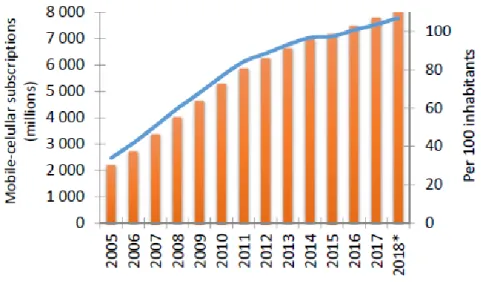
Figure 1. Estimated mobile-cellular subscriptions 2018, ITU
According to Measuring Information Society Report 2018 ITU MIS [2018], there are more than 7 billion mobile cellular subscribers across the globe as shown in the figure 1. Further it is evident from these statistics that the entire global population is now almost connected by mobile phone medium. However over the period of 13 years
(right from 2005 to 2018), the total mobile cellular subscribers across the world have increased from 2 billion to more than 7 billion. This stupendous growth of more than 5 billion new mobile cellular subscribers, itself reveals the ubiquitous adoptability and universal acceptability of the mobile phone medium across the globe. Therefore, the mobile phone medium is playing principal role in pioneering the new generation global information society.
However, despite of the world wide mobile phone connectivity, there is only 51.2 percent of world's population ITU MIS [2018] connected with internet, and the remaining 48.8 percent of world's population is still not connected with the internet. This is the huge divide is commonly known as the digital divide OECD [2001], that refers to gap between those who are connected with internet and the others not connected with the internet.
In order to minimize this digital divide gap, many case studies and research works have been conducted across the globe especially in developing countries. Donner [2008] mentions about such 200 studies conducted across the developing world in order to fill the digital divide. The Donner [2008] broadly discusses these studies into two ways, the first one discusses about the acceptance and usability of the mobile phone, and the second one describes about the socio-economic development achieved by using mobile phones.
Further Donner [2008] discusses about ‘leapfrogging’. This is the concept especially in the developing world, where earlier large number of people didn‟t had opportunity to use computers, are now directly using mobile phones (without prior technical expertise), in order to get desired information and are connected with rest of the world through mobile phone medium.
In addition Donner [2008] discussed that, the first time mobile phone subscribers are experiencing this remarkable power of mobile medium and this medium has helped masses to gain socio-economic development. Thus the mobile phone medium will play an important role fill the digital divide and also helps in creating a vibrant information society.
2.2. Information and Communication Technologies for Development (ICT4D)
ICT4D stands for Information and Communication Technologies for Development. Heeks [2008] describes ICT4D, as a new unique and emerging area, wherein ICT technologies play a central role in order to achieve socio-economic development.
The fast technological advancements and innovations across ICT, provides greater connectivity and ample of opportunities for the development across the globe, especially for the unreached masses especially poor people across the Bottom of the Pyramid. Hence, the ICT4D emphasizes effective use of ICT for socio-economic development of the poor at the BoP and to bridge the digital divide.
The ICT4D acts as a potential platform for the dissemination of services such as education, health, agriculture and governance etc., in order to achieve inclusive development throughout world.
Figure 2. Changing ICT4D issues over time – readiness, availability, uptake and impact modified from Heeks [2008]
Keeping this larger objective into consideration, many ICT4D related projects are running across the world especially in developing world in collaboration with companies, governments, NGOs and other such organizations.
Further Heeks [2008] classifies ICT4D chronologically into four phases as shown in the figure2.
Readiness phase: The readiness phase focuses on creating ICT infrastructure and framing the policies for its effective implementation. This ICT infrastructure acts as platform for effective dissemination of information unreached population across globe, especially economically poor across the globe. This digital outreach will create the awareness among these unreached communities and provides them opportunity to utilize ICT technology for their socio-economic empowerment. This further helps to fill the digital divide.
Availability Phase: The availability phase focuses on, once ICT infrastructure is ready and available for using them it should to be utilized for effective digital services to the unreached communities especially poor and they should use these services for their socio-economic development.
Uptake Phase: The uptake phase focuses on effective implementation and scaling of ICT infrastructure according to the needs of the users especially poor and make useful for them. The user centric digital services designed according to their will increase usability and helps them to achieve socio-economic development.
Impact Phase: The impact phase focuses how effective utilization of ICT infrastructure in order to provide greater developmental opportunities to the end users. The ICT provides greater connectivity for exchange information in the form of voice or data, helping the unreached community, especially poor, to enhance their socio-economic activities over mobile phone, in order to achieve the socio-socio-economic development.
Therefore, the ICT4D will help to connect next billions people, especially socio-economically poor at BoP, and still they do not have access to internet and modern ICT tools. The ICT4D for this community is very essential, and it will digitally empower
them with modern ICT skillsets and latest information and will help to bridge the digital divide.
2.3. Bottom of the Pyramid (BoP)
According to Prahalad and Hart [2001], there are over 4 billion poor people across the world (see the figure 3 below) in the tier 4 of this world economic pyramid and their per day income is less than 1 dollar per day, this is generally known as the Bottom of the Pyramid.
Further, according to Karnani [2007] the BoP population is economically poor. This poverty just cannot be measured in economic terms, it much broader, for example poor people get very limited or no opportunity for modern education and sometimes because of poverty they also suffer from other factors such as social and cultural exclusion from the society.
Figure 3. The World Economic Pyramid Prahalad and Hart [2001]
Further according to Prahalad & Hart [2001] the commercial infrastructure for BoP markets includes four phases as shown in Figure 4.
Creating buying power phase: In this phase, the emphasis is given on creating buying power for the economically weaker BoP poor community. For example by giving credit to the poor and these credits in turn help them to generate livelihood and improves the buying power.
Figure 4. The Commercial Infrastructure at the Bottom of the Pyramid, Prahalad and Hart [2001]
Shaping aspirations phase: In this phase, the emphasis is given on shaping the aspirations of economically weaker section of BoP. The novel innovative and sustainable services or the products, those are useful and help to improve their livelihood for BoP segment, must be implemented through proper consumer education. Such novel services helps to improve the socio-economic development of BoP population.
Tailoring local solutions phase: This phase focuses on localization of the products or services that are focussed on BoP segment. These products or services must be tailored and customized according to the needs of local market, social and cultural needs of BoP community. These localized products or services created as the local requirements helps to create value, in terms of wealth and empowers the BoP community. For example creating mobile voice based services for the economically poor farmers section of BoP. These voice based services [Das et al. 2011] are in local dialect and language as per the needs and requirements of the local farming community.
Improving access phase: The final phase focuses, on improving the access in terms of products delivery systems and communication links to the BoP population segment. Because as this vast BoP population resides in remote areas like in villages and reaching out to this vast population is challenging task. The modern ICT communication links helps to reach out this vast population. For example, BoP farmer who is economically weak, and who is looking for updated agricultural information [Das et al. 2012], can use his mobile phone to access to the mobile voice based agricultural extension service in order to get the desired agricultural information.
The mobile phone medium provides greater connectivity across BoP and also provides great opportunities for the mobile voice based services across to BoP population Ruohonen et al. [2013a]. These mobile voice based services, empowers the BoP population with latest ICT skills and in turn improvising their socio-economic status.
Our research focus is on rural India BoP population, next we present our case study about mobile voice based services for agricultural extension services to BoP farmers especially to the economically poor farmers residing in rural India.
2.4. Defining the Context of Development
2.4.1. Agriculture as a part of Indian Economy
India is one of the fastest emerging economies not only in Asia but also across the world. India is known for its great cultural heritage, diversity, languages including multi dialects, landscape and diaspora. Further, according to the India Census India Profile [2011], India's population is approximately 1.21 billion (1,210,569,573), it includes urban population 377,106,125 i.e., 31 percent of total population and rural population 833,463,448 i.e., approx. 69 percent of the total population.
This huge rural population is distributed across length and breadth of 640,000 villages reaching the remotest corners of rural India. Thus connecting this large rural population for the dissemination of information is difficult and challenging. However, the mobile phone medium has now connected entire rural India. This mobile phone medium provides opportunity to disseminate information to rural India.
Over past few decades, irrespective of higher economic growth, the poverty still remains the main challenge in India, so in order to eradicate this poverty both at urban and rural level, the Government of India, has introduced many reforms and to measure this poverty, it has introduced Below the Poverty Line (BPL) mechanism. Further according to the Public Information Bureau [PIB], there are total 302 million BPL people across India. In addition, out of this total BPL population, 221 million BPL people are residing in rural India and remaining 81 million BPL people are from urban India. Hence, the majority of BPL are rural poor people living in the remotest villages across rural India and are largely dependent on agriculture.
Agriculture is the main source of income for this vast rural population, it has contributed 14.7 percent of GDP for the year 2010-11 Economic Survey [2011] and in addition the agriculture provided directly or indirectly accounted 58 percent of total Indian employment. The rural economy is completely dependent on agriculture and providing food security for over a billion people is a challenging task. Over the last few decades, including green revolution, the Government of India has been giving huge support to enrich the agriculture sector in order to achieve food security.
The climatic condition of India is very diverse and soil is fertile to grow different varieties of crops in different parts of the country. In addition, the culture and language also makes agriculture multifaceted. Traditionally and culturally, in India the agricultural knowledge transferred from generation to generation. Hence the farmers have gained farming skills from their ancestors i.e. from parents, relatives or elders. However, due to the advancements in modern agriculture production system, which includes new varieties of crops, farm mechanization, globalization, export, value addition techniques, market and weather information, hence the agriculture has become more knowledge intensive.
Therefore, farming community is in need of the updated information service. The farmer is in need of updated and timely information and support in different stages of farming namely production, processing and marketing (see figure 5) [Das et al. 2012].
Production phase: The production phase is very important phase of agriculture it begins right from preparing the ground, sowing seeds, giving proper nutrients and adopting proper irrigation method. In addition, the crop must be protected from the
pests, weeds and diseases, so proper management of these pests, weeds and diseases is very important to get great yield.
Figure 5. Farming Life Cycle [Das et al. 2012]
Processing phase: The processing phase is equally important phase, once the crop is grown, the next very necessary step is processing and the crop should be properly harvested. Then the harvested crop should be stored in proper storage areas.
Marketing phase: The Marketing phase is the final phase, which provides local, national and international agricultural produce market information to the farming community. Based on these market inputs, the farmer decides where to sell his agricultural products.
The traditional Indian Agricultural Extension Education System demands more human resource and infrastructure. Hence it is difficult to reach out millions of farmers with the help of human resources. In addition the farmers are in need of real time updated agricultural information and improved agricultural technologies.
In recent years, with the greater connectivity of mobile phone medium, most of the farmers are having access to the mobile phones. Both literate and illiterate farmers
Production Cultivation materials and practices Yield Crop protection Pest Management Disease Management Weed Management Processing Harvesting Post Harvesting Storage Marketing Market price information Local agri-market information
are skillful in using mobile phones. Providing voice based agriculture extension services, on mobile platform is the best way to reach out millions of farmers.
2.4.2. The importance of ICT technology
Over the last two decades, the Government of India‟s reformations in telecom sector has resulted in great growth of telecommunication infrastructure in India. This resulted in overall mobile connectivity across length and breadth of India.
According to TRAI‟s (Telecom Regulatory Authority of India) recent telecom subscription data TRAI [2019], the number of mobile phone connections in India is 1161.81 million (more than 1 billion) with 650.49 million connections in urban India and 511.32 million connections in rural India. This mobile phone platform connects this huge rural population under a single platform.
This platform lays the strong foundation for disseminating agriculture information services form of voice to farmers, and in turn helps to attain sustainable human development in rural India.
2.4.3. Literacy as a main challenge
According to the India Census Literacy Rates [2011], the 67.77 percent rural population are literate and the remaining 32.23 percent of rural population are illiterate. In recent years, both literates and illiterates are using mobile phones extensively for spoken communication.
However, the text-based information services (such as mobile text messages based agro advisory services to the farmers) are not helpful for illiterate farmers. In addition the voice based or spoken communication is most popular in rural areas.
Hence in order to reach out and disseminate information to these rural illiterate farmers, voice based services empowered with content in local dialect are the best medium to disseminate agricultural information services.
2.4.4. Voice-based services and the spoken web
Despite of the popularity of internet and other text-based services, still the voice or speech medium of communication is popular in both developed and developing world. Furthermore in recent years the voice-based services are popular in many countries. These voice-based services widely used in providing information about transportation services such as train, flight and bus, [Das et al. 2012].
The typical type of such voice-based services are IVR (Interactive Voice Response) systems [Das et al. 2012], where in the voice instruction are easy to follow and the navigation is done by pressing the numbers from the dialpad. These IVRs have their limitations in providing the information, firstly voice information requires more data storage and secondly these systems are time consuming, because users need to press many a times the buttons to navigate the information many levels in these systems.
Hence there was a need for the new type of voice based services [Das et al. 2012], which can be used by even the illiterate people and furthermore the population which still not connected with the internet can also utilize these new voice based services.
Spoken web is designed by IBM and is one of such examples of new voice based services, which addresses the needs of the illiterate and other users who are not connected to internet.
Spoken Web:
The Spoken Web is also known as world wide telecom web [Agarwal et al. 2010], which is similar to world wide web, but here in the voice information is stored in the form of voice sites, similar to websites which store information in the form of text.
Spoken web allows users to create, host and navigate voice content. This empowers users especially who are illiterates to have access to updated voice information. These voice sites can be accessed just by dialling from a mobile phone or even from a basic landline telephone.
Figure 6. Spoken Web [Agarwal et al. 2010]
As shown in the figure 6, the user can make phone call to the voice site, in turn then this phone call connects to the voice site, the voice site allows user to connect further voice sites.
Spoken web is a voice-driven system that provides a unique feature to host voice content local language and dialect. Hence, it is easier for the rural population to explore such new voice based services as content is in their local language and dialect.
Avaaj Otalo, [Patel et al. 2010], is a voice-site provides agricultural information in local Gujarati language dialect and allows farmers navigate through, answers to questions asked by the farmers regarding farming. In this system the farmers are also allowed to post their questions to the farming experts, so that later experts can post their replies, those in turn can be accessed by the farmers.
In another pilot 'voiAvatar', [Kumar et al. [2008], voice-site designed especially for the artisans such as plumbers, carpenters and electricians. This voice-site provides opportunity to these artisans to have their own voice-site or similar to personal websites.
Further, spoken web not only provides voice-driven information to the illiterate people, it also helps visually impaired persons to have access to the audio content of voice-site. A pilot study, [Rajput et al. 2008] with semi blind and completely blind people describes that, without prior computer skills, these visually impaired persons were able to access and navigate voice site easily, in order to explore information stored in the form of voice.
These pilot studies and their results shows that, the Spoken web is the best medium to provide voice based information services to the underprivileged people such as illiterates and people who still don‟t have access to the internet.
DIAGNOSING
Identifying or defining a problem
SPECIFYING LEARNING
Identifying general findings
ACTION PLANNING Considering alternative courses of
action for solving a problem
EVALUATING
Studying consequences of an action
ACTION TAKING
Selecting a course of action
3. Methodological Choices
3.1. Action Research as a research approach
Järvinen [2004] mentions that while creating or constructing a new artefact, first it should be assessed in order to understand its usefulness. He further describes that, both creating and usefulness of artefact, are inter-related and belongs to the same method. Hence the research method, which follows such attributes, is known as Action Research (AR).
Figure 7. Action Research Process [Susman and Evered 1978]
The figure 7 explains the process of Action Research [Susman and Evered 1978] this is repeated and continuous process, which includes five phases as follows.
Diagnosing Phase: This is the beginning phase in which the requirements and usefulness of artefact are assessed thoroughly and then the problem is defined.
Action Planning Phase: Once the problem is defined, then in order to solve the problem the required and different actions should be planned alternative actions should be documented thoroughly.
Action Taking Phase: Based on the action plan, the best possible action will be selected in this phase.
Evaluating Phase: The selected action must be analysed and evaluated thoroughly for all possible consequences of action selected.
Specifying Learning Phase: Based on outcome of evaluating phase, the general findings are identified in this phase.
3.2. Description of the empirical field research
3.2.1 Exploratory Analysis and Location of the field study
We adopted ethnographically oriented Action Research for field study conducted in Indian Villages. While there were no such previous attempts being made for the agricultural extension service in the part of India, i.e. Dharwad region, situated Northern Karnataka, this field study is first of its kind. The research team explored further knowledge in this rural part of Karnataka, India.
This research is the result of joint multi-disciplinary and first of its kind Indo-Finnish collaboration of University of Tampere (UTA), Finland, University of Agricultural Sciences Dharwad, India (UASD) and IBM Research Lab, India (IRL). Together we conducted an empirical field study [Ruohonen et al., 2013a], during year 2011, by interviewing participants in surrounding villages of University of Agricultural Sciences Dharwad. This Indo-Finnish consortium research work continued over the years in agriculture, education and healthcare, see Sharma et al. [2019].
Karnataka is one of the largest states in India. Karnataka is situated in southern part of India known for its cultural heritage, tourism, western ghats, ancient architectures and much more. According to India Census Karnataka State Profile [2011], Karnataka‟s population is 61,095,297.
Kannada is the official language in Karnataka. Kannada is classical language and one of the oldest languages in the world. Bangalore is the capital of Karnataka, also known as Silicon Valley Capital of India and it hosts most of the Information
Technology companies such as Nokia, Infosys, Wipro, TCS, IBM, Honeywell, Accenture and SAP.
Agriculture is the main source of income in rural Karnataka and there are variety of crops which are grown in the state such as paddy, sugarcane, ragi, wheat, sorghum, cotton, chilli, groundnut, sunflower, cereals, millets, pulses and oilseeds. Due to advancement in agriculture production system such as new varieties, mechanization, globalization, export and value addition techniques, the agriculture has become more knowledge intensive.
Thus by considering the prime importance of Agriculture, the Indian Government has established Agricultural Universities in all the states of India and these Agricultural Universities are the main source of information dissemination to the farming community. Agricultural Universities are helping to bridge the gap between Farming Community and the Government. The Agricultural Universities provides best support and guidance to the farming community.
In Karnataka there are four Agricultural Universities and they are University of Agricultural Sciences Bangalore, University of Agricultural Sciences Dharwad, University of Agricultural Sciences Raichur and University of Agricultural Sciences Shimoga.
University of Agricultural Sciences Dharwad is one of the leading Agricultural Universities in India and it is situated in Dharwad city, in northern part of Karnataka state. The UASD is well connected with the farming community. This University is best known for its openness and willingness for fast adaptation, implementation of new technologies in order reach wide farming community.
University of Agricultural Sciences Dharwad, [UASD 2013] has its jurisdiction spread across seven districts of North Karnataka region, namely Bagalkot, Belgaum, Bijapur, Dharwad, Gadag, Haveri, and Uttar Kannada. The UASD has connected with thousands of farmers across all these districts by providing them great support to them. These districts include rich variety in soil types, different agro-climatic zones, landscape (including both rain-fed and irrigated farmland) and different farming situations incl. The major crops grown across these districts are such as sorghum, cotton, rice, pulses, chilli, sugarcane, groundnut, sunflower, wheat and safflower.
The UASD work is distributed mainly in three wings, research, education and extension studies. The research wing is dedicated for the agricultural research related crops and allied areas. The agricultural education has the educational programmes and teaching includes studies at bachelor, masters and doctoral level studies. The agricultural extension is dedicated to provide lab to land information to the farmers. They provide information to the farmer from seed to spoon, i.e. at all stages of production, processing and marketing of agricultural products.
The Directorate of Extension at UASD has strong rapport with the farming community. The Directorate of Extension, UASD works to transform the best agricultural practices, research work and agricultural technologies created by its staff to the farming community. In order to accomplish bridge between UASD and farming community they have adopted several modern communication media such as Television.
UASD are one of the pioneers, who implemented the usage of ICT in agriculture and they have deployed around 200 agricultural information kiosks across all districts of UASD jurisdiction. These agricultural information kiosks are stand-alone text and image based system and information to these kiosks is uploaded through CDs. UASD has also established Community Radio for the farming community around its campus in Dharwad, known as Krishi (means Farming in local Kannada language) Community Radio Station (KCRS), which broadcasts programme everyday on agriculture.
Despite of adopting all these new media for communication, UASD are still not reaching entire farming community. The traditional Indian Agricultural Extension Education System demands more human resources, infrastructure and it is not possible humanly to reach out millions of farmers.
However, the farmers are in need of real time updated, improved agricultural technologies at right place. Today most of the farmers are having access to the mobile phones. Both literate and illiterate farmers are proficient in using mobile phones. Providing agriculture extension services in the form of voice-based services, on mobile platform is the best way to reach out millions of farmers.
In order to further explore how to reach this entire farming community over phone medium, the research consortium, UASD, UTA and IRL together conducted field study using spoken web technology in this region.
3.2.2 Co-designing with farmers
The UASD is working in close association with farming community and providing agricultural extension services to them since from its inception. This University has dedicated community radio KCRS station, situated in Dharwad campus and has coverage radius of 12 kilometres.
The KCRS broadcasts various programs on different aspects agriculture, animal husbandry and other allied sectors for 6 hours i.e., 3 hours in the morning and 3 hours in the evening, because these are the most suitable timings for the farming community.
These programs also includes the programmes recorded by farmers such as interview with farmers and farmer success stories. The content is very popular among the farming community in the surrounding villages of UAS Dharwad campus. Hence the research team decided to take content from KCRS in order to design the farmer centric design voice-site-prototype.
3.2.3 Adoption Discussion
The KCRS has conducted a survey among the farming community regarding the programs broadcasted from them. The survey suggested following are the popular programmes such as Krishi Chintana (meaning Farming Contemplation in local Kannada language), this programme includes suggestions of progressive farmers and retired scientists in the form of interviews and discussions are based upon on actual farmers‟ agricultural experience, and the duration of this programme is 5 minutes to maximum 10 minutes.
Hence we adopted these radio programmes for our voice-site-prototype and these programs are popular among farming community. This is done in order to create farmer centric prototype, as they already had the understanding of the content from the programs of KCRS and they are associated with KCRS since from its inception.
3.2.4 Ethnographical Approach
The research team included the members who had local ethnographical expertise including language and cultural understanding of this region. In addition the UASD provided the guidance and helped to get associated with farmers.
The UASD faculty and supporting staff including ladies staff who knew local language and culture, this helped in interviewing farmwomen. They also participated in ethnographical field study and they have been associated with farmers from many years, hence it was very helpful for the research team to carry out ethnographical field study.
This kind of approach and support from local staff helped us to understand farming community needs and requirements in order to design farmer centric voice-site-prototype using spoken web technology.
3.3. Design Research
3.3.1 SWAicons
The Spoken Web is also known as world wide telecom web [Agarwal et al. 2010], which is similar to world wide web, but here in the voice information is stored in the form of voice sites, similar to websites which store information in the form of text.
According to the Srivastava et al. [2012], SWAicons, stands for Spoken Web Auditory Icons, are the special sounds such as simple beep or background music.
Further these SWAicons helps users to classify and identify the different sections of the spoken web voice site. Hence, we incorporated these SWAicons in our prototype, following section explains the prototype.
3.3.2 Description and structure of prototype
KCRS has been broadcasting various radio programmes to the farming community since from its inception. The audio content was in local Kannada dialect and the content comes from the popular programmes, selected based on the survey conducted by KCRS among local farming community.
Hence we adopted content from these programmes for the voice-site-prototype. The prototype was named as 'Raitarind Raitara Dhwani' [Ruohonen et al., 2013a], (meaning from farmers to farmers voice in local Kannada language), as this name is in local Kannada language, which makes farmers to understand and remember this voice-site-prototype. The Raitarind Raitara Dhwani a voice-site-prototype included content from following programmes [Ruohonen et al., 2013a].
Krishi Chintana: Krishi Chintana (meaning "Farming Contemplation" in local Kannada language), this programme includes suggestions of progressive farmers and retired scientists in the form of interviews and discussions are based upon on actual farmers agricultural experience, and the duration of this programme is 5 minutes to maximum 10 minutes.
Pakshika Salahegalu: Pakshika Salahegalu (meaning "Suggestions to the farmers” in local Kannada language), this programme provides suggestions to farmers, twice a month on various issues concerned with issues such as plants protection, dairy, animal husbandry, horticulture and home science.
Market forecast: This programme provides the updates related to current market conditions of farm products.
Weather forecast: This programme provides the updates about local weather.
Varada Basanna: Varada Basanna (meaning "Weekly discussion programme” in local Kannada language), this is weekly programme is aimed to provide adequate information related to health issues of animal such as cows and buffalos. Basanna means the name of the character in this programme and it has become very popular name among listeners of this programme. This programme is in colloquial language and broadcasted weekly once on one particular current veterinary topic.
Figure 8. Menu Structure for the voice site
The Raitarind Raitara Dhwani voice-site-prototype menu structure was designed in keeping the standards of spoken web and speech interface design as shown in the figure 8. The level 1 of voice-site menu structure starts with welcome message (including the name of the voice-site). Further at level 2 of voice-site menu structure, there are five sections namely Krishi Chintana, Pakshika Salahegalu, Market Update, Weather Update and Varada Basanna.
In addition, at level 3 of voice-site menu structure, the Krishi Chintana has three sub sections namely farming experience, organic farming and integrated farming. Further these three sections include the interviews of the farmers. Finally at level 3 of voice-site menu structure, both Pakshika Salahegalu and Varada Basanna have sub sections that include different episodes. This shows the depth and the complexity of the voice site.
The Raitarind Raitara Dhwani, voice-site-prototype was designed using Adobe Flash installed on touch screen mobile phone as shown in the figure 9. There were two types of this voice-site-prototype, i.e., one is with background music and another one without background music Srivastava et al. [2012].
Figure 9. Voice site prototype (Adobe Flash Version)
The participants used keypad (of touch screen mobile phone) input for the navigating voice site. Further, participants pressed numbers and special characters such as '#' and '*' for accessing voice contents stored in the different sections of the voice site as shown in the voice-site menu structure, see figure 8.
3.4. Evaluation
3.4.1 Field Study – Testing of Prototype in the fields
The main purpose of this field study was, how to disseminate agricultural extension information services through mobile phones using spoken web as a platform. Further to experiment whether such voice based services through mobile phones using spoken web is acceptable to farming community or not. In addition we also wanted to test the use of SWAicons [Srivastava et al. 2012].
This empirical field study [Ruohonen et al., 2013a], was conducted during year 2011, by interviewing participants in surrounding villages of University of Agricultural Sciences Dharwad. The participants were both farmers and farm women. In order to the first-hand information and accurate results we visited participants in their villages.
3.4.2 Field Study Process
The field study was conducted as explained in the following steps,
1) To begin with the detailed introduction and purpose of the field study was explained to the participant.
2) Next the detailed description and details about Raitarind Raitara Dhwani voice-site-prototype were described to the participant.
3) Finally the detailed demo of the voice-site was demonstrated to the participant.
Figure 10. Farmwoman and farmer are using voice-site demo during field study (Photos taken by Gururaj Mahajan)
Later, in the field study we conducted following steps 1) Noted the demographical details of the participant.
2) Requested participants to use the voice-site-prototype (as shown in the Figure 10)
3) Observed how the participant was using the voice-site demo and took the feedback from the participant.
3.4.3 Demographics and Interviews
The field study and interviews were conducted with total 51 participants (see appendix 1). These participants were small to medium farmers and farmwomen, situated in the villages surrounding UASD main campus in Dharwad, within the radius of 50 kilometres.
Age Group (in years) Male Female
18 – 30 19 6
30-40 8 6
40 and above 8 4
Total Participants 35 16 The Total Number Participants 51
Table 1. Age group wise classification of participants
Out of the 51 participants (see table 1), 35 were male participants and remaining 16 were female participants. Further out of 35 male participants, 19 were from the age group 18-30, 8 were from the age group 30-40 and remaining 8 were in the age group 40 and above. In addition out of 16 female participants 6 were from the age group 18-30, 6 were from the age group 30-40 and remaining 4 were in the age group 40 and above. The majority of the participants are from the age group of 18-30, nearly total 25 participants (19 male and 6 female) in this group.
Graduates Literates Semiliterate or Illiterate Number of participants 5 10 36
The Total Number Participants 51
Further out of 51 farmers (see table 2), 5 farmers were college graduate literates, 10 were literates and remaining 36 farmers i.e. nearly 70 percent of total participants are either illiterate or semiliterate (few years of primary education). This is the target class we are focussing in this field study.
In order to know further demographical details about participant and to know more insights, about how they are utilizing the mobile phone to attain agricultural information, the following questions were asked to participants.
1) Give your demographical details such as age, gender, education, landholding and crops grown.
2) Do you own mobile phone? Is the mobile phone is always with you or it is shared among the family members?
3) What is the primary source of getting any information on Agriculture? What are other sources of getting agricultural information?
4) Have you used voice based service like IVR before?
Later while collecting the feedback following questions were asked to participants. 1) Do you like this voice based service?
2) Do you like the prototype with music or without music? 3) Would you like to pay subscription amount if any introduced?
Finally the profiles of all 51 participants were created as shown in the table 3. To know complete details and feedback of the participants, see appendix 1.
Participant No Age Gender Education Landholding Crops grown
Do you own mobile phone? Is the mobile phone is always with you or it is shared among the family members?
What is the primary source of getting any information on Agriculture? What are other sources of getting agricultural information?
Have you used voice based service like IVR before?
3.4.4 Major outcomes of the field study
All the 51 participants appreciated our efforts and all of them liked our approach of voice based service using spoken web voice-site and they mentioned specifically that the content in local dialect helped them to understand content in this Raitarind Raitara Dhwani voice-site-prototype clearly [Ruohonen et al., 2013a] and following are major outcomes of the field study.
Majority of participants mentioned to us that they have received the agricultural education either from their ancestors or from friends. Radio and television are the most commonly used sources get new agricultural information.
Most of the participants own a mobile phone and some participant use a mobile phone from their family member. Most of them are aware of IVR (Interactive Voice Response) services. The participants use them mostly for downloading ringtones for their mobile phones and to check the talk-time currency available on their mobile phone. The participants also use IVR to access agricultural information from the agricultural help lines.
Most of the participants use mobile phone technology as social medium in order to transfer the agricultural information to their friends and relatives. One of the senior participant, expressed to us in this context that “I use mobile phone technology to transfer my agricultural information to the upcoming generation, so that they use these agricultural methods to get good yield and to attain sustainable agriculture”
Out of 51 participants 46 participants mentioned to us that they cannot pay for this service, they preferred that these kinds of services should be given free of cost. These participants are mostly marginal, small and medium farmers. However, 5 participants who are large farmers agreed that they are willing to pay small subscription charges for this service provided they are really very worthy.
Most of the farmers liked Raitarind Raitara Dhwani voice-site-prototype with music, upon asking why they liked service with music, they replied “The background music helps them to concentrate and understand content clearly”.
It is noticed that some of the illiterate participants did not notice the background music. These participants were more focussed on listening to the content of voice-site-prototype.
Most of the participants had their own mobile phones and as they were familiar in using them. Hence these participants were comfortable in using this voice-site-prototype.
The participants who don‟t own mobile phones, they have used the mobile phones owned by their family members. These participants were also comfortable while using the voice-site-prototype.
For the illiterate users, the initial guidance was needed, because they didn‟t knew about special characters such as „#‟ and‟ *‟. But after the initial guidance and introduction, these participants were comfortable in using this voice-site-prototype.
One of the participant said “It‟s not possible for them to listen KCRS programmes during morning or evening broadcasting hours. Because as they are busy in farms. So now with this Raitarind Raitara Dhwani voice-site-prototype, they can access content easily over mobile phone and can listen to their favourite programmes from any place and during any time”.
4. Further Research
Based on our excellent feedback from current field study and with encouraging results, it is clearly evident that the voice-based service deployed across spoken web provides ample of opportunities to disseminate agricultural information to the unreached farmers.
Later based on this field study, our research consortium has started research project „RuralVoice‟ [Ruohonen et al. 2012], which is examines on how provide voice-based services rural India, in the following focussed areas such as Agriculture, Banking and Microfinance, Primary Healthcare, Entertainment and Education.
Agriculture:
Agriculture is the main source of income in rural India and it is evident from our field study that, the farmer is in need of real-time and updated information regarding agriculture such as market prices of agricultural commodity, weather, seeds, fertilizers and agricultural equipments. Hence providing update information over mobile phone is vital to the farmers.
Banking and Microfinance:
There are over 640,000 villages in India and it is not feasible for banks to have their branches in all of the villages. Hence the accessibility to banks especially in rural India is biggest challenge. Hence the providing rural people access to banks and micro finance institutions for transaction is necessary in rural India.
Primary Healthcare:
In rural India, the primary healthcare infrastructure is not good. To consult doctor, rural people must travel either to next village or to nearest town because of scarcity of doctors. Hence the rural people are in need of good primary healthcare advice and access to doctor consultation services. The mobile voice based service plays huge role in providing quality healthcare advises Ruohonen et al. [2013b] to remotest village areas.
Entertainment:
The music and movies are popular and part of life in rural India. In general rural people like to listen music from movies, local folklore etc., radio is the best source for them to listen music. They would like to listen to music and wish to see movies of their choice.
Education:
Education has played significant role shaping India‟s growth story in globalization. The education in urban areas is very good, while still there are no schools in remotest part of rural India. Despite government has built schools in rural India, still more schools are required. The rural people are in need of quality education, including skill based education especially in the sectors such as agriculture.
Hence providing better educational opportunities to rural India will help people to gain skillset and knowledge. The mobile voice based services [Ruohonen et al. 2013c] plays huge role in rolling our quality education in rural India.
Thus the rural India ample of opportunities in order to provide voice based service in the areas such as Agriculture, Banking and Microfinance, Primary Healthcare, Entertainment and Education.
5. Conclusion
The main aim of research field study was to investigate how mobile voice-based service helps the unreached farmers to get the agricultural information through mobile phone medium using the spoken web platform. Further the focus was to address following research questions
1) How to disseminate agricultural information services through mobile phones using spoken web as a platform to the unreached farming community?
2) Does these voice based services through mobile phones using spoken web is acceptable to farming community or not?
It is evident from our field study, it is clear that, even though the some of the participants did not have formal schooling, they were also comfortable and very quickly able to use this service. In addition all the 51 participants unanimously appreciated and accepted our efforts and all of them liked our approach of voice based service using spoken web Raitarind Raitara Dhwani voice-site-prototype.
The participants also mentioned specifically that as the content is in local dialect helped them to understand content in Raitarind Raitara Dhwani voice-site-prototype clearly. This proves that the dissemination of agricultural extension information services and voice based services through mobile phone using spoken web as platform is acceptable to the farming community.
In addition, most of the participants mentioned to us that they cannot pay for this this kind of voice-based service, they preferred that these kinds of services should be given free of cost. These participants are mostly marginal, small and medium farmers. However, 5 participants who are large farmers agreed that they are willing to pay small subscription charges for this service provided they are really very worthy. This input helps to build successful business model, while implementing mobile voice based services to the users.
Thus it is evident and concludes from our research that the content in local dialect through spoken web platform, makes the mobile voice based-services acceptable to the farming community and this proves that voice medium is the main and acceptable in rural India. Further these mobile voice based services could be explored and applied into further areas such as Banking and Microfinance, Primary Healthcare, Entertainment and Education.
References
[Agarwal et al., 2010] Agarwal, S.K., Jain, A., Kumar, A., Nanavati A.A., Rajput, N., 2010, “The Spoken Web: A Web for the Underprivileged”, SIGWEB Newsletter Summer.
[Das et al., 2011] Das, H., Ruohonen, M. & Mahajan, G., Delivering Interactive Voice based Services through Mobile Phones to Rural India‟s Bottom of the Pyramid. Presented at the 2011 Conference of the Euro-Asia Management Studies Association conference, Gothenburg, Sweden.
[Das et al., 2012] Das, H., Ruohonen, M., Turunen, M., Linna, J., & Mahajan, G., Ecosystem for Delivering Voice-based Agricultural Information Services to Rural India, Presented at the 2012 Conference of the Euro-Asia Management Studies Association conference 31.10-3.11.2012., Abstracts book at
http://www.eamsa.org/wp/wp-content/uploads/2015/10/xxfbxbbf.pdf?PHPSESSID=4f5760dd09eee27dd9fd35a6 aa63ff73
[Donner 2008] Donner J., Research Approaches to Mobile Use in the Developing World: A Review of the Literature, The Information Society, 24: 140-159, 2008. [Economic Survey 2011] Economic Survey 2011, Govt. of India Economic Survey
2012-13, Ministry of Finance Govt. of India. http://indiabudget.nic.in/es2012-13/echap-08.pdf
[Heeks 2008] Heeks R., ICT4D 2.0: The Next Phase of Applying ICT for International Development, Computer (Volume: 41, Issue: 6), June 2008, IEEE Computer Society.
[India Census 2011] India Census 2011, India Profile, The Registrar General & Census Commissioner, India, New Delhi, Ministry of Home Affairs, Government of India.
http://censusindia.gov.in/2011census/censusinfodashboard/stock/profiles/en/IND_ India.pdf
[India Census 2011] India Census 2011, Literacy rates, The Registrar General & Census Commissioner, India, New Delhi, Ministry of Home Affairs, Government of India.
http://censusindia.gov.in/2011census/censusinfodashboard/stock/downloads/Profil es_6/PDF/IND_6.pdf
[India Census 2011] India Census 2011, Karnataka State Profile, The Registrar General & Census Commissioner, India, New Delhi, Ministry of Home Affairs,
Government of India.
http://censusindia.gov.in/2011census/censusinfodashboard/stock/profiles/en/IND0 29_Karnataka.pdf
[ITU MIS 2018] ITU MIS, International Telecommunication Union, Measuring the Information Society Report [2018]. https://www.itu.int/en/ITU-D/Statistics/Documents/publications/misr2018/MISR-2018-Vol-1-E.pdf
[Järvinen 2004] Järvinen P., 2004, Action Research, On Research Methods Book, 124-126, Opinpaja, Tampere.
[Karnani 2007] Karnani, A., The Mirage of Marketing to the Bottom of the Pyramid: How The Private Sector Can Help Alleviate Poverty. California Management Review 2007 49(4), pp. 90-111.
[Karvalics 2007] Karvalics László Z, 2007 Network for Teaching Information Society (NETIS Project), Information Society Research Institute, Budapest, March-May 2007. http://www.ittk.hu/netis/doc/ISCB_eng/02_ZKL_final.pdf
[Kumar et al., 2008] Kumar A., Rajput N., Agarwal S.K., Chakraborty D. and Nanavati A.A., 2008, “Organizing the Unorganized - Employing IT to Empower the Under-privileged”, WWW 08: Proceedings of the 17th International World Wide Web Conference, Beijing, China.
[OECD 2001] OECD, 2001, Understanding the digital divide, OECD, 2001. http://www.oecd.org/dataoecd/38/57/1888451.pdf
[Patel et al., 2010] Patel N., Chittamuru D., Jain A., Dave P. and Parikh T.S., 2010, “Avaaj Otalo – A Field Study of an Interactive Voice Forum for Small Farmers in Rural India”, ACM Conference on Human Factors in Computing Systems (CHI 2010), USA.
[PIB] PIB, Public Information Bureau, Government of India. http://pib.nic.in/newsite/erelease.aspx?relid=44102
[Prahalad and Hart 2001] Prahalad C. K., & Hart S. L., The Fortune at the Bottom of the
Pyramid, strategy + business issue 26, 2001.
http://www.stuartlhart.com/sites/stuartlhart.com/files/Prahalad_Hart_2001_SB.pdf [Rajput et al., 2008] Rajput, N., Agarwal, S., Kumar, A., Nanavati, A.A., 2008, “Alternative Information Web for Visually Impaired Users in Developing Countries”, ASSETS‟08, October 13-15, Halifax, Nova Scotia, Canada.
[Ruohonen et al., 2012] Ruohonen, M., Turunen, M., Hakulinen, J., Mahajan, G., Linna, J., Kumar, V., Das, H., Nanavati, A. & Rajput, N., Puhepohjaisten matkapuhelinpalvelujen kehittäminen Intian maaseudulla. Futura 31 (2012) : 2, 7. artikkeli. http://doria17-kk.lib.helsinki.fi/handle/10024/89294
[Ruohonen et al., 2013a] Ruohonen, M., Turunen, M., Mahajan, G., Kumar, V., Linna, J., Das, H., (2013) Mobile Voice-based Educational Services for Rural India: Project RuralVoice, In Ley, T., Ruohonen, M., Laanpere, M. & Tatnall, A. (eds) OST´12, AICT 395, IFIP International Federation of Information Processing, Springer. pp. 3-11. https://link.springer.com/chapter/10.1007%2F978-3-642-37285-8_1
[Ruohonen et al., 2013b] Ruohonen, M., Turunen, M. & Nykänen, P. (2013) Voice-based Mobile Service Innovations for Primary Healthcare in Rural India; Research in Progress. FIIB Business Review (FBR) 2(3), July – August, pp. 60-71. ISSN 2319-7145.
[Ruohonen et al., 2013c] Ruohonen, M., Turunen, M., Hakulinen, J., Linna, J., Nanavati, A. & Rajput, N., (2013), E-Inclusion Innovation for Rural India: Mobile Voice and Tablet Based Educational Services. Presented in Torun, Poland and published in Reynolds, N. & Webb, M. (eds) (2013) WCCE 2013 10th IFIP World Conference on Computers in Education, Torun, Poland July 1-7, 2013, Vol. 2, Nicolaus Copernicus University Press, ISBN 978-83-231-3093-2, pp. 218-227. [Sharma et al., 2019] Sharma, S., Linna, J., Hakulinen, J., Kallioniemi, P., Turunen, M.
& Ruohonen, M. (forthcoming 2019) “Building rural renaissance and suburban development with interactive technology solutions in India”. Chapter in the book by Tatnall, A. (ed) Encyclopedia of Education and Information Technologies, Springer.
[Srivastava et al., 2012] Srivastava S., Rajput N., Mahajan G. 2012. SWAicons: Spoken Web Audio Icons – Design, Implications and Evaluation, In Proceedings of the ACM 2012 conference on Computer Supported Cooperative Work Companion. pp. 211-214.
[Susman and Evered 1978] Susman G.I. and Evered, 1978, An assessment of scientific merits of action research, Administrative Science Quarterly 23, 582-603.
[TRAI 2019] TRAI, Telecom Regulatory Authority of India, Telecom Subscription Data
as on 31st March, 2019.
https://main.trai.gov.in/sites/default/files/PR_No.40of2019.pdf
[UASD 2013] UASD, 2013, University of Agricultural Sciences, Karnataka, India. www.uasd.edu
Appendix 1: Participant profiles
Participant No 1
Age 28
Gender Male
Education 10 th Standard (High School Level Education)
Landholding 30 acres
Crops grown Potato, soya bean, ground nut
Do you own mobile phone? Is the mobile phone is always with you or it is shared among the family members?
Yes the participant owns the mobile phone and it is used for personal purpose.
What is the primary source of getting any information on Agriculture? What are other sources of getting agricultural information?
The participant learnt farming from his father and he gets agricultural information directly from my friends.
Have you used voice based service like IVR before? Yes, the participant has used the IVR.
Participant No 2
Age 54
Gender Male
Education 10 th standard (High School Level Education)
Landholding 4 acres
Crops grown Paddy, Sugarcane, Sorghum, Wheat Do you own mobile phone? Is the mobile phone is always with you or it is shared among the family members?
Yes the participant owns the mobile phone and it is shared among family members. What is the primary source of getting any information on Agriculture? What are other sources of getting agricultural information?
The participant learnt agriculture from self experience and gets more agricultural information over phone from others.
Have you used voice based service like IVR before? No
![Figure 2. Changing ICT4D issues over time – readiness, availability, uptake and impact modified from Heeks [2008]](https://thumb-us.123doks.com/thumbv2/123dok_us/910038.2617329/12.892.129.759.658.1022/figure-changing-issues-readiness-availability-uptake-impact-modified.webp)
![Figure 3. The World Economic Pyramid Prahalad and Hart [2001]](https://thumb-us.123doks.com/thumbv2/123dok_us/910038.2617329/14.892.121.786.644.831/figure-world-economic-pyramid-prahalad-hart.webp)
![Figure 4. The Commercial Infrastructure at the Bottom of the Pyramid, Prahalad and Hart [2001]](https://thumb-us.123doks.com/thumbv2/123dok_us/910038.2617329/15.892.254.642.143.527/figure-commercial-infrastructure-pyramid-prahalad-hart.webp)
![Figure 5. Farming Life Cycle [Das et al. 2012]](https://thumb-us.123doks.com/thumbv2/123dok_us/910038.2617329/18.892.143.755.229.602/figure-farming-life-cycle-das-et-al.webp)
![Figure 6. Spoken Web [Agarwal et al. 2010]](https://thumb-us.123doks.com/thumbv2/123dok_us/910038.2617329/21.892.111.785.137.596/figure-spoken-web-agarwal-et-al.webp)
![Figure 7. Action Research Process [Susman and Evered 1978]](https://thumb-us.123doks.com/thumbv2/123dok_us/910038.2617329/23.892.141.748.421.790/figure-action-research-process-susman-evered.webp)


