A STUDY OF THE DEVELOPMENT OF
ACCOUNTING IN VIETNAM
A Thesis Submitted
In Fulfillment of the Requirements for the Degree of
Doctor of Philosophy
THANH MINH VO BUI
Master of Business Administration
Bachelor of Business
School of Accounting
College of Business
RMIT University
DECLARATION
I certify that except where due acknowledgement has been made, the work is that of the author alone; the work has not been submitted previously, in whole or in part, to qualify for any other academic award; the content of the thesis is the result of work which has been carried out since the official commencement date of the approved research program; any editorial work, paid or unpaid, carried out by a third party is acknowledged; and, ethics procedures and guidelines have been followed.
Thanh Minh Vo Bui August 2011
ACKNOWLEDGEMENTS
The researcher would not have been able to embark on this research program without the assistance and support by a number of people.
First of all, I would like to thank all the interviewees in this study for their interest, willingness, valuable time and knowledge in support of this research. Their participation was greatly appreciated. I would also like to thank the staff of the National Archival Centre in Vietnam for their invaluable support and assistance.
Secondly, I wish to record my appreciation to my current principal supervisor, Associate Professor Prem Yapa, for his guidance and support in supervising my research.
I would also like to thank my second supervisor, Professor Barry J. Cooper, for his support, patience, understanding, supervising and helping me through this program. Professor Cooper was originally my principal supervisor when I commenced this research program. During the transition of changing of principal supervisor after he left RMIT University, Professor Cooper accommodated me in his busy schedule to enable his continued supervisory support in relation to this thesis. I am very grateful for his support, advice and guidance.
My thanks go to the RMIT Research and Innovation Portfolio, the RMIT School of Accounting (College of Business) and RMIT International University Vietnam for their financial support in the research program from 2005 – 2010.
I would also like to thank the administrative staff of the School of Accounting and the Business Research Office (Office of the Pro Vice-Chancellor, College of Business) for their assistance in administrative matters relating to my research.
My appreciation is also directed to Dr Nguyen Xuan Thu, who inspired and encouraged me to undertake this project, and for his advice and support, especially in the early days of my research program.
Last, but most importantly, I would like to extend my greatest appreciation to my parents, my parents-in-law, and my husband – Kym, for supporting and accompanying me throughout the many years of this challenging academic journey. Their love, understanding, support and sacrifices helped make this research work possible.
TABLE OF CONTENTS
Abbreviation ... 18
Chapter 1Introduction ... 21
1.1 Background and context of the research ... 21
1.2 Rationale for the research... 22
1.3 Research questions ... 24
1.4 Scope and significance of the research ... 25
1.5 Limitations ... 26
1.6 The organisation of the thesis ... 27
Chapter 2 Literature review ... 29
2.1 - The definition of a profession and professionalisation and approaches to the study of the professions ... 29
2.1.1 The professions ... 29
2.1.2 Professionalisation ... 33
2.2 - A review of the literature on the professionalization of accounting ... 38
2.2.1 The State, the Market and the Community ... 40
2.2.2 State regulation, self-regulation and state-professional relationship ... 42
2.2.3 Globalisation and domestic economy ... 47
2.2.4 Socio-historical typology of professions, professionalization as a resistance .... 48
2.3 - Other professions ... 48
2.4 - Vietnam in brief and prior studies on accounting... 50
2.5 - Summary and defining the research gaps ... 56
Chapter 3 Theoretical and Methodological Framework ... 58
3.1 Introduction ... 58
3.2 Theory and theorisation………...60
3.2.1 Laughlin and “middle-range” theory ... 60
3.2.2 Llewellyn and five levels of theorising ... 63
3.2.3 Post-colonial studies ... 65
3.3 Methodological approaches ... 66
3.4 Theoretical framework of prior research ... 69
3.5 Theoretical and methodological framework ... 72
3.6 Research questions ... 74
3.8 Summary ... 83
Chapter 4 The development of accounting prior to 1986. ... 834
4.1 Introduction ... 84
4.2 The historical background... 84
4.3 Period 1: French domination 1858 – 1945 ... 87
4.3.1 The political and economic context ... 87
4.3.2 Education policy under French rule ... 89
4.3.3 Accounting practice under French rule ... 90
4.4 Period 2: From 1945 – 1975 (socialist North Vietnam – Democratic Republic of Vietnam (DRV) and capitalist South Vietnam – Republic of Vietnam (RVN) ... 98
4.4.1 War time from 1945 – 1954 ... 98
4.4.2 North Vietnam (DRV) accounting 1954 – 1975 (the socialist economy) ... 103
4.4.2.1 The political and economic context ... 103
4.4.2.2 Accounting practice ... 105
4.4.3 Accounting in South Vietnam from 1954 – 1975 (the capitalist economy)... 125
4.4.3.1 The political and economic context ... 125
4.4.3.2 Accounting practice ... 126
4.5 Period 3: From 1975 – 1985 (the Socialist Republic of Vietnam) ... 133
4.5.1 The political and economic context ... 133
4.5.2 Accounting practices and development ... 139
4.5.2.1 The second Five-Year Plan (1976 – 1980) ... 139
4.5.2.2 The third Five-Year Plan (1981 – 1985) ... 145
4.6 Summary ... 149
Chapter 5 Accounting development in the transition economy from 1986 to 1997 ... 1503
5.1 Introduction ... 153
5.2 The political and economic context ... 154
5.3. Accounting development ... 158
5.3.1 SOE reform and accounting practice ... 159
5.3.2 Factors underpinning accounting reforms in Vietnam ... 165
5.3.2.1 The diversification of business operations and ownership ... 165
5.3.2.2 The changes in the government’s role in macro-economic management ... 166
5.3.2.3 The commencement of internationalisation of economic activities ... 167
5.3.3 Accounting regulations ... 167
5.3.3.2 The 1989 Charter for Organisation of State Accounting ... 172
5.3.3.3 The new accounting system in 1995 ... 173
5.3.4 Accounting organizations and association ... 192
5.3.4.1 Chief Accountant’s Club (CA’s Club)... 192
5.3.4.2 Governmental accounting organizations ... 198
5.3.4.3 Vietnam Accounting Association (VAA) ... 201
5.3.5 Securities market development ... 205
5.3.6 Foreign direct investment (FDI) – Private sector ... 206
5.4 Professional accounting training for practitioners ... 214
5.5 The role of donors and foreign accounting firms (the Big Six) ... 216
5.6 Auditing activities ... 219
5.7 Summary ... 222
Chapter 6 The development of accounting from 1998 to 2010 ... 227
6.1 Introduction ... 227
6.2 The political context: The change in the political leadership structure ... 227
6.3 Economic conditions ... 230
6.3.1 The diversification of business operations ... 230
6.3.2 The expansion of internationalisation of economic activities ... 232
6.3.3 The continued changes of the government’s role in macro-economic management ... 234
6.4 Accounting development ... 235
6.4.1 Vietnamese accounting regulators ... 238
6.4.2 Vietnamese Accounting Standards (VAS) ... 238
6.4.3 Accounting regulation - Law on Accounting in 2003 ... 240
6.4.4 Auditing activities ... 245
6.4.5 Vietnamese Standards of Auditing ... 248
6.4.6 Vietnamese accounting bodies ... 248
6.4.7 Vietnamese CPAs ... 254
6.4.8 Foreign professional accounting bodies ... 273
6.4.8.1 ACCA, representing the British interest in the accounting profession ... 273
6.4.8.2 CPA Australia ... 278
6.5 Professional accounting training for practitioners ... 283
6.5.1 Domestic training for accounting practitioners ... 283
6.5.1.1 Chief accountants training ... 284
6.5.2 Joint accounting programs with foreign partners ... 289
6.5.2.1 ACCA program in Vietnam ... 289
6.5.2.2 CPA Australia program in Vietnam ... 292
6.6 Summary ... 296
Chapter 7Summary and conclusion ... 299
7.1 Introduction ... 299
7.2 Summary of the research ... 299
7.3 Key findings ... 299
7.4 Significance of the study ... 326
7.5 Suggestions for future research ... 327
7.6 Conclusion ... 328
References list ... 331
LIST OF TABLES
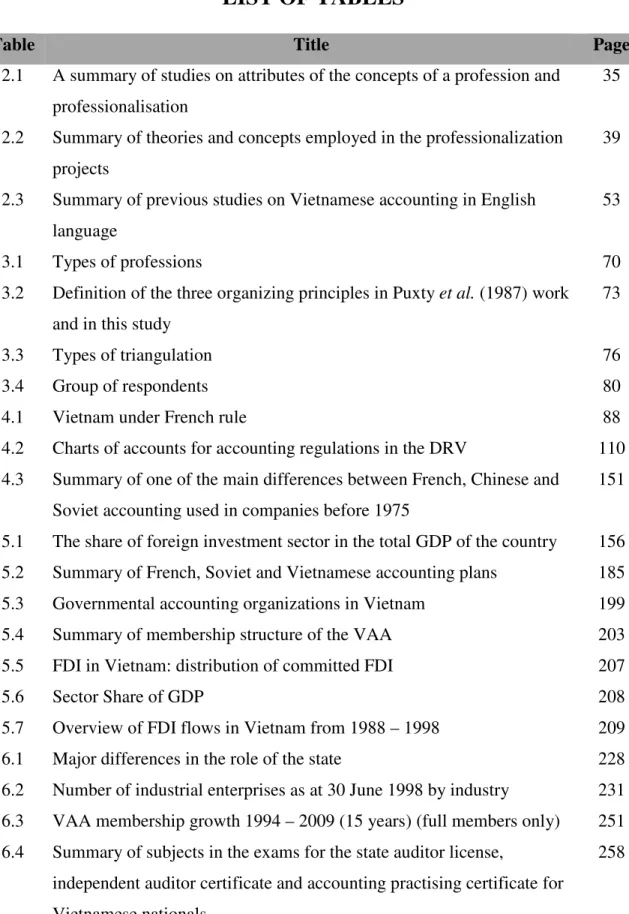
Table Title Page
2.1 A summary of studies on attributes of the concepts of a profession and professionalisation
35
2.2 Summary of theories and concepts employed in the professionalization projects
39
2.3 Summary of previous studies on Vietnamese accounting in English language
53
3.1 Types of professions 70
3.2 Definition of the three organizing principles in Puxty et al. (1987) work and in this study
73
3.3 Types of triangulation 76
3.4 Group of respondents 80
4.1 Vietnam under French rule 88
4.2 Charts of accounts for accounting regulations in the DRV 110 4.3 Summary of one of the main differences between French, Chinese and
Soviet accounting used in companies before 1975
151
5.1 The share of foreign investment sector in the total GDP of the country 156 5.2 Summary of French, Soviet and Vietnamese accounting plans 185 5.3 Governmental accounting organizations in Vietnam 199 5.4 Summary of membership structure of the VAA 203 5.5 FDI in Vietnam: distribution of committed FDI 207
5.6 Sector Share of GDP 208
5.7 Overview of FDI flows in Vietnam from 1988 – 1998 209 6.1 Major differences in the role of the state 228 6.2 Number of industrial enterprises as at 30 June 1998 by industry 231 6.3 VAA membership growth 1994 – 2009 (15 years) (full members only) 251 6.4 Summary of subjects in the exams for the state auditor license,
independent auditor certificate and accounting practising certificate for Vietnamese nationals
Table Title Page 6.5 Exemptions of certain tests to Vietnamese nationals 260 6.6 Tasks transferred by the MoF to the VAA and the VACPA 268 6.7 Institutions authorized to organize chief accountant training course 286
6.8 Chief accountant training course content 287
7.1 Summary of French, Soviet and American influence on accounting in Vietnam in the transition economy 1986 – 1997
LIST OF FIGURES
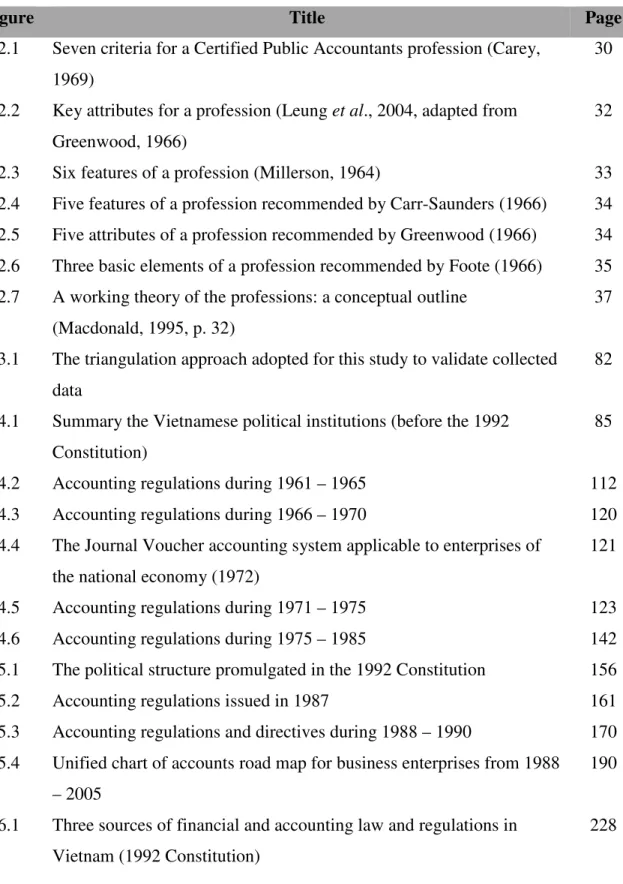
Figure Title Page
2.1 Seven criteria for a Certified Public Accountants profession (Carey, 1969)
30
2.2 Key attributes for a profession (Leung et al., 2004, adapted from Greenwood, 1966)
32
2.3 Six features of a profession (Millerson, 1964) 33 2.4 Five features of a profession recommended by Carr-Saunders (1966) 34 2.5 Five attributes of a profession recommended by Greenwood (1966) 34 2.6 Three basic elements of a profession recommended by Foote (1966) 35 2.7 A working theory of the professions: a conceptual outline
(Macdonald, 1995, p. 32)
37
3.1 The triangulation approach adopted for this study to validate collected data
82
4.1 Summary the Vietnamese political institutions (before the 1992 Constitution)
85
4.2 Accounting regulations during 1961 – 1965 112 4.3 Accounting regulations during 1966 – 1970 120 4.4 The Journal Voucher accounting system applicable to enterprises of
the national economy (1972)
121
4.5 Accounting regulations during 1971 – 1975 123 4.6 Accounting regulations during 1975 – 1985 142 5.1 The political structure promulgated in the 1992 Constitution 156
5.2 Accounting regulations issued in 1987 161
5.3 Accounting regulations and directives during 1988 – 1990 170 5.4 Unified chart of accounts road map for business enterprises from 1988
– 2005
190
6.1 Three sources of financial and accounting law and regulations in Vietnam (1992 Constitution)
LIST OF CHARTS
Chart Title Page
4-I Major events in Vietnam during French rule 1858 – 1945 and war years 1945 – 1954
101
4-II Major events in the DRV and the RVN accounting development during 1954 – 1975
131
4-III Major events of accounting development in the SRV from 1975 – 1985 147 5-I Major events of accounting development in the SRV from 1986 – 1997 224 6-I Major events in the development of Vietnamese accounting from 1998
– 2010
LIST OF DIAGRAMS
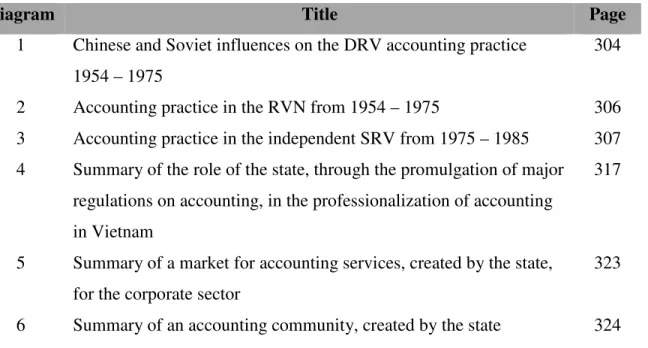
Diagram Title Page
1 Chinese and Soviet influences on the DRV accounting practice 1954 – 1975
304
2 Accounting practice in the RVN from 1954 – 1975 306 3 Accounting practice in the independent SRV from 1975 – 1985 307 4 Summary of the role of the state, through the promulgation of major
regulations on accounting, in the professionalization of accounting in Vietnam
317
5 Summary of a market for accounting services, created by the state, for the corporate sector
323
ABSTRACT
This is an historical study on the development of accounting in Vietnam, by examining the role of the state in the evolving professsionalisation of the accounting profession in the colonial and post-colonial periods. The Vietnamese accounting profession has been defined by the state, given that the development has been led by the state and subject to state regulations.
In this research, accounting practice during French colonial rule is examined. This is then followed by an examination of the accounting development in the post-colonial periods and the role of the state in this development, reflected through accounting regulations and the law. Using the sociology of the professsions theoretical framework and the work of Puxty et al. (1987), which recognizes the State, Market and Community principles, this study aims to understand the factors underpinning the professionalisation of accounting in Vietnam.
Three following research questions addressed in this study include:
1.
How have external factors, such as the influence of the French, the United States, China and the Soviet Union, contributed to the development of the accounting profession in Vietnam?2.
How has the internal environment in Vietnam, including the impact of political and economic policies, contributed to the development of the accounting profession in Vietnam?3.
What is the predominant model of the accounting profession adopted in Vietnam in 2010?The main findings from the study include the following. Despite French rule for more than eighty years, the development of the accounting profession in Vietnam in the colonial and post-colonial periods was not initiated nor influenced by the French, or the Americans. This is a distinctive difference in the development of the accounting profession between Vietnam, as an ex-French colony, compared to that which occurred in most ex-British colonies.
Between 1954 and 1975, the country was divided into two, with different political, economic and accounting systems. The Democratic Republic of Vietnam (DRV), namely North Vietnam, followed the Chinese accounting model subsequent to its liberation from the French in 1954. Due to political conflicts with China, the DRV then selectively adopted the Soviet Union accounting model from the mid 1960s until the unification of the country in 1975. Accounting in South Vietnam, namely the Republic of Vietnam (RVN), remained influenced by French rules after 1954.
From 1975 – 1985, the country was unified and proclaimed as the Socialist Republic of Vietnam (SRV). The SRV government took central planning and administrative direction of the socialist economy; therefore, the state was also the market and community, as articulated in Puxty et al. (1987) model, during this time. As a result, accounting was highly regulated, and was created as a tool to facilitate centralized economic planning and control.
Accounting in Vietnam in this period was influenced by Soviet accounting, through technical assistance such as sending Soviet accounting specialists to work with Vietnamese accounting counterparts on the existing accounting system, and by training assistance such as having Vietnamese students study in the Soviet Union. However, the state continued its dominant role in the development of accounting practice across the country, and continued being the market and community for accounting.
The Vietnamese accounting system during 1986 – 1997 was a selective system, with some elements of the French, Soviet and American influence. The government drew from experience of Western and other socialist countries and took the essence of the French, Soviet and the American systems to determine its own specialised, accounting system, which was considered by the government to be appropriate in the conditions of the transition from the failed centrally-planned economy to a market-oriented economic system. This also reflects the state’s direction as set out in the 1992 Constitution. The
mixed accounting model in the case of Vietnam is seen to be appropriate for the country during the transition period.
The accounting and auditing legal frameworks have since 1998 continued to be improved towards providing a transparent system to meet the requirements of the socialist-oriented market economy. Twenty-six Vietnamese accounting standards (VASs) and thirty-seven Vietnamese standards of auditing have been issued by the MoF, which are in line with IFRSs, with modifications to suit Vietnam’s conditions and requirements. In addition, the Law on Accounting was passed by the National Assembly in 2003 as the highest legal document governing the nation’s accounting and auditing activities during the economic integration period.
It is argued in this study that the Vietnamese Communist Party (VCP)/State has played a dominant role in the development of accounting in the country in the post-colonial periods, by regulating accounting practice. The case of Vietnam, therefore, differs to that in most other Southeast Asian countries, due to the direct involvement of the VCP, through accounting regulations and avoidance of non-socialist principles. The Vietnamese experience suggests that the state, led by the VCP, has followed its own path as a socialist country, by directing and playing an influential role in the development, practice and training of the accounting profession, in order to facilitate achievement of the state’s political and economic policies. This was achieved in spite of Vietnam’s colonial heritage, unlike the path followed in many other former colonies.
The accounting associations in Vietnam, the VAA and VACPA, have been established and dominated by the state, as the country moves towards economic integration. By legislation, the State, through the MoF, maintains its monopoly in the accounting and auditing certification, practice and the regulatory process. The implementation of the Vietnamese CPA exams and the existence of the professional code of ethics support the existence of an accounting profession in Vietnam. In addition, the membership of the VAA to IFAC and the AFA in 1998 and of the VACPA to CAPA in 2010, is another important and significant event in the development and professionalization of accounting
in Vietnam. These developments are indicative of the recognition of the existence of the accounting profession in Vietnam, and the VACPA as a professional accounting body in the Asia-Pacific region.
Abbreviation
ACCA Association of Chartered Certified Accountants ACPA Australasian Corporation of Public Accountants
AFA
ASEAN Federation of AccountantsAICPA American Institute of Certified Public Accountants AMA American Medical Association
AOS Accounting, Organizations and Society APEC Asia – Pacific Economic Commission ASC Accounting Society of China
ASEAN Association of South-East Asian Nations
ASOSAI Asian Organisation of Supreme Audit Institutions BICPA Brunei Institute of Certified Public Accountants BTAs Bilateral Trade Agreements
CAPA Confederation of Asian and Pacific Accountants CICPA Chinese Institute of Certified Public Accountants CIMA Chartered Institute of Management Accountants CMEA Council for Mutual Economic Assistance CPAs Certified Public accountants
DAP Department of Accounting Policy and Auditing DRV Democratic Republic of Vietnam
Doi Moi Economic renovation program commenced in 1986 EAS Enterprise Accounting System
ECSAFA Eastern, Central and South African Federation of Accountants EURO-TAPVIET European Union Assistance Project
FDI Foreign direct investment FIEs Foreign-invested enterprises French PCG French Plan Comptable General
GATS General Agreement on Trade and Services GSO General Statistic Office
IAS International Accounting Standards IASB International Accounting Standards Board IASC International Auditing Standards Committee
ICAEW Institute of Chartered Accountants of England and Wales ICAJ Institute of Chartered Accounts of Jamaica
ICASL Institute of Chartered Accountants of Sri Lanka
ICATT Institute of Chartered Accountants of Trinidad and Tobago ICPAK Institute of Certified Public Accountants of Kenya
IFAC International Federation of Accountants IFRS International Financial Reporting Standards IIAV Incorporated Institute of Accountants, Victoria
INTOSAI International Organisation of Supreme Audit Institutions JICPA Japan Institute of Certified Public Accountants
JVs Joint venture enterprises
LA Vietnamese Law on Accounting in 2003
MACPA Malaysian Association of Certified Public Accountants MIA Malaysian Institute of Accountants
MoF Ministry of Finance MoHA Ministry of Home Affairs
MPDF Mekong Project Development Facility MPI Ministry of Planning and Investment NCA National Council for Accountancy
OECD Organisation for Economic Cooperation and Development PGC Plan Comptable Général
RMIT Vietnam RMIT International University Vietnam RVN Republic of Vietnam
SAA Society of Accountants and Auditors SAV State Audit of Vietnam
SOEs State-owned enterprises SRV Socialist Republic of Vietnam T&T Trinidad and Tobago
TRIPs Trade-Related Aspects of Intellectual Property Rights TRIMs Trade-Related Investment Measures
TTACACA Trinidad and Tobago Association of Chartered Accountants and Certified Accountants
TTACCA Trinidad and Tobago Branch of the Association of Certified and Corporate Accountants
UNCTAD United Nations Conference on Trade and Development VAA Vietnam Association of Accountants and Auditors VACPA Vietnam Association of Certified Public Accountants VCP Vietnamese Communist Party
VIC Incorporated Institute of Accountants VPA Vietnam People’s Army
WB World Bank
Chapter 1 Introduction
1.1 Background and context of the research
Geographically, Vietnam is a country with clear borders and with two large river systems dominating the country, the Red River in the North and the Mekong Delta in the South. Although the nation comprises a number of ethnic groups, each with its own culture and language, Vietnamese is the national language. The country has a long history and a well-educated population (Narayan and Godden, 2000; Narayan et al., 2000).
Politically, Vietnam is a one-party socialist state. The dominating force in Vietnam is the Communist Party. It is controlled by a politburo, and is prescribed a ‘leading role’ by the Constitution. The legislature is the 498-member National Assembly, Quoc Hoi, directly elected every five years by universal suffrage. It meets twice a year and elects a state president, to head a council of state, and a council of ministers, headed by the prime
minister, which forms the government.
(http://encyclopedia.farlex.com/Vi%C3%AAtnam, accessed 20 September 2009).
Economically, Vietnam suffered from a great deal of hardship in its struggle for political independence during the wars against the French and the US, combined with a period of isolation for nearly a half century until 1975 when the War ended. Vietnam's post-war economy from 1976 to 1980 was stagnant (Murray, 1977). After thirty years of full-scale war ending in 1975, Vietnam’s economic performance was seriously hampered by the failures of its foreign policy and command economic management, the collapse of the former Soviet Union and the U.S.-led trade and investment embargo (Tran-Nam and Pham, 2003).
Than and Tan (1993) noted that new developments in political, social and economic spheres took place in Vietnam from the latter part of the 1980s and that Doi Moi (economic renovation) marked a new stage in the economic development of the country, since its aim was to transform the country from a failed command and control economy to a market-oriented one. Vietnam has since opened its doors to the West and has implemented its market-oriented economy policy for more than two decades. Under this
open-door policy, Vietnam’s economy has arguably become much healthier and more sustainable. Foreign direct investment (FDI) has played an important role in the social and economic development of Vietnam. In the World Investment Prospects Survey 2009-2011 conducted and released by the United Nations Conference on Trade and Development (UNCTAD), Vietnam is in the top 15 most attractive economies for FDI in the world (UNCTAD, 2009). The attracted FDI in the first quarter of 2011 was estimated to reach US$187.5 million (Ministry of Planning and Investment, 2011).
Amongst the many fundamental changes in policies including the abandonment of the subsidised economy, the change in accounting practice has represented a major change in the government’s direction since the commencement of the open-door policy and economic renovation in Vietnam in 1986. Given the influx of foreign investment, together with Vietnam’s aim to integrate into the world economy, qualified accountants and auditors are in high demand. In 2007, the country had 136 auditing companies that provided over 20 services for customers (Vietnam News Agency, 2007). This number has increased to 155 auditing companies in 2010 (Investment Magazine, 2011). According to the Ministry of Finance of Vietnam, the number of professional auditing firms and auditors in Vietnam will need to increase ten fold by 2012 to meet demand (Vietnam Investment Review, 2002) and the number of professional auditors in the country needs to increase drastically to 3,000 by 2010 to meet demand (Vietnam News Agency, 2007). However, there were only 1,500 auditors in 2009 and according to a senior official of Vietnam Association of Accountants and Auditors (VAA), the country will need 7,000 CPAs in the next 10 years (Bui, 2009).
1.2
Rationale for the research
Vietnam was a French colony from the mid 19th century for more than eighty years. The country is now following the Western accounting profession because of its commitment to a market economy and international economic integration, as well as the increased FDI resulting from the implementation of the open-door policy and economic renovation commenced in the late 1980s. As a result, the state-controlled accounting profession in
Vietnam has developed rapidly since the implementation of the open-door policy since 1986.
The vital role of, and the high demand for, the establishment of a strong accounting profession in Vietnam has been evidenced by a number of developments, including:
• the signing of a Memorandum of Cooperation between the Vietnamese Ministry of Finance (MoF) and the ACCA – the Association of Certified Chartered Accountants – in December 2003, to operate a Joint Examination Scheme which provides Vietnamese participants with access to an internationally recognised qualification;
• In 2006, the inclusion of the two local variants on Vietnamese taxation and legislation in the Joint Examination Scheme, which provides more opportunity for Vietnamese students to become accounting and auditing professionals and who meet both the Vietnamese and international requirements;
• the agreement between the Vietnam Association of Certified Public Accountants and Auditors (VACPA) and CPA Australia in May 2006 on mutual recognition of qualifications. Accordingly, CPA Australia members who are Vietnamese citizens and foreigners will be granted a Certificate of Auditors of Vietnam and recognised as a Vietnam CPA if they meet certain requirements; and
• the admission of Vietnam to the World Trade Organisation (WTO) in January 2007.
Objective of this study
There is limited academic research published regarding the professionalisation of accounting in non-English speaking countries. In particular, where these countries operate under a socialist-oriented market economy, the role of accountants and their professionalisation process have been relatively under-explored. Therefore, this study seeks to contribute to the existing literature on the sociology of the professions by
examining the role of the state in the development of the accounting profession in Vietnam.
In this research, accounting practice during French colonial rule will be examined. This is then followed by an examination of the accounting development in the post-colonial periods and the role of the state in this development, reflected through accounting regulations and the law. It does so by using relying on the sociology of professions literature and in particular the Puxty et al. (1987) work which recognizes the State, Market, and Community principles to understand the factors underpinning the development of accounting in Vietnam.
The triangulation approach defined and explained by Denzin (1978a, 1978b) and Krefting (1991) is used for data analysis in this study. Data collected from the archival records was validated by semi-structured interviews with key government officials of the MoF, and the examination of newspapers and other official reports including academic articles.
1.3
Research questions
In order to examine the development of the accounting profession in Vietnam, and the role of that development, the research questions are as follows:
1.
How have external factors, such as the influence of the French, the United States, China and the Soviet Union, contributed to the development of the accounting profession in Vietnam?2.
How has the internal environment in Vietnam, including the impact of political and economic policies, contributed to the development of the accounting profession in Vietnam?3.
What is the predominant model of the accounting profession adopted in Vietnam in 2010?1.4
Scope and significance of the research
The research program focuses on key government officials in selected ministries, that is, Ministry of Finance and Ministry of Planning and Investment (MPI), in Vietnam; and representatives of accounting associations and international professional organisations in Vietnam.
This thesis is a study of the development of accounting in Vietnam, taking into account the historical changes of accounting regulation on the development of the accounting profession corresponding to the history of Vietnam. This study examines how historically the government in Vietnam influenced and effectively controlled the development of the accounting profession. It does so by investigating, based on archival records, the development of Vietnamese accounting as controlled and regulated by the State. The study also considers the interplay with the French colonial influence, which did not prove not to be a dominating factor as occurred in other colonized countries and, as such, makes a contribution to the literature.
The duration of the study covers the period from the mid 19th century to 2010 (more than 150 years). This historical study aims to contribute to the literature on the sociology of the professions and should therefore be of interest to accounting policy makers in Vietnam and should also be of interest to those researchers interested in the professionalization of accounting in developing countries.
The significance of the research indicates that, despite French rule for more than eighty years, the development of the accounting profession in Vietnam in the colonial and post-colonial periods was not initiated nor influenced by the French, or the Americans. This is a distinctive difference in the development of the accounting profession between Vietnam, as an ex-French colony, compared to most ex-British colonies.
It is argued in this study that the Vietnamese Communist Party (VCP)/State plays a dominant role in the development of accounting in the country in the post-colonial periods. The case of Vietnam, therefore, differs to that in most other Southeast Asian
countries due to the direct involvement of the VCP, through accounting regulations and their avoidance of non-socialist principles.
1.5
Limitations
It is important to acknowledge the limitations associated with this study.
Firstly, this study focuses on accounting for the state-owned and foreign-invested enterprises (FIEs), in different periods of time and the role of the state in the development of the accounting profession in Vietnam. The study examines accounting practice and development from the French domination until 2010 and the existing structure of the organization of the accounting profession in Vietnam. Therefore, issues associated with the evaluation and assessment of an accounting system, such as Vietnamese accounting and auditing standards, accounting in state agencies and bodies, the role of the Big 4 and accounting in small and medium-sized enterprises are not addressed in this study.
Secondly, the role of the state, through the MoF, in professional training for accountants and auditors to enable them to be qualified to practice is the focus of the study; hence academic accounting education provided by Vietnamese universities is not examined in this research.
Thirdly, there were a limited number of participants in this research who can recall accounting practice in the country before 1975. Most of those who were involved in accounting or bookkeeping during French rule are living overseas or are now aged.
Fourthly, there is a limited record of financial and accounting documents maintained in the National Archival Centre of Vietnam, due to the war and poor storage conditions. In addition, most of the records and documents were moved to France under an agreement between the two governments.
Fifthly, to help understand the role of the state in accounting development in Vietnam, a majority of interviewees are key government officials and policy makers who have been involved in the policy-making process and/or played a key role in the development of accounting in state-owned and foreign-invested enterprises.
Last but not least, Vietnam is a socialist country, and various issues, as raised in Chapters 5 and 6, are politically sensitive, and may have adverse repercussions. Therefore, they have not been discussed in detail in this thesis, as they were not deemed as necessary and were not the focus of this study.
1.6
The organisation of the thesis
The study is organized into seven chapters.
This Chapter gives an introduction on the background and context of the research, rationale for the research, research questions and the expected research outcomes.
Chapter 2 presents a review of prior studies on the professionalization of accounting, to provide a background understanding of factors underpinning the development of the accounting profession, and identifies deficiencies in the existing literature.
Chapter 3 provides the theoretical and methodological framework for the study, and outlines the research questions, methodology and methods, and the data collection method.
Chapter 4 investigates the development of accounting in Vietnam prior to 1986. Three periods will be examined in this Chapter: period 1 from the French domination in 1858 until 1945 subsequent to the French withdrawal; period 2 from 1945 to 1975, as the country was divided into two from the 17th parallel; and period 3 from 1975 to 1985, when the country was politically independent and the building socialism was commenced in a centrally-planned economy.
Chapter 5 examines the accounting development from 1986 to 1997, when the country was in a transition from a centrally-planned economy to a market-oriented economy,
subsequent to the launch of the economic renovation (Doi Moi) program. The discussion in this Chapter includes the examination of major accounting regulations such as the Ordinance on Accounting and Statistics in 1988, the Charter for Organisation of State Accounting in 1989, and the new accounting system in 1995. In addition, professional accounting training for accountants is also included.
Chapter 6 discusses the development of accounting from 1998 to 2010, when the country is integrated with the world economy and accounting reforms have been undertaken. The key accounting regulation discussed in this Chapter is the Law on Accounting promulgated in 2003. In addition, the Vietnamese Accounting Standards and Auditing Standards are briefly mentioned and professional accounting training programs are also included in this Chapter.
Chapter 7 provides a summary of key findings and the conclusion of the study. Suggestions for future search are also included in this Chapter.
Chapter 2: Literature review
From the earliest times, in any society that used a form of taxation, or calculated numbers of stocks, or reckoned the value of articles of trade or goods, some form of accounting was necessary (Linn, 1996, p. 6).
This Chapter provides a review of previous research on the sociology of professions, to help identify the developments and deficiencies in earlier studies and the justification for this study. It then forms the basis for the research questions outlined in the preceding Chapter. More specifically, this Chapter is organised as follows. The first section presents a review of previous studies on the definition of a profession and professionalization and the approaches to the study of the professions. The second section depicts a review of the literature on the professionalization of accounting under different themes. As it will be helpful to briefly review other professions, this forms the third section. The fourth section provides a brief introduction about Vietnam and prior studies on accounting in Vietnam. The final section provides a summary of the Chapter and defines the research deficiencies.
2.1 - The definition of a profession and professionalisation and approaches to
the study of the professions
2.1.1 The professions
Yee (2001) reviewed numerous studies on the sociology of professions and theories of professionalisation and found that consensus on how a profession should be defined has not yet been reached. Sociological investigations also show that it was not an easy task to analyse the concept of a profession, as remarked by Millerson (1964, p. 1):
Of all sociological ideas, one of the most difficult to analyse satisfactorily is the concept of a profession. Perhaps three basic problems account for the confusion and uncertainty. Firstly, there is the semantic confusion, resulting from wide and excessive use of the word. Secondly, there are the structural limitations enforced by attempts to devise fundamental characteristics of a profession. Thirdly, there is
the adherence to a static model, rather than an appreciation of the dynamic process involved in professionalism.
As such, there have been a number of approaches to the study of the professions and professionalization which will now be discussed.
Seven criteria which distinguish professions from other pursuits were presented by Carey (1969), who argued that, based on these criterion, certified public accountants can fairly claim to be the only true profession in the field of finance and management. The criteria are (1) a body of specialised knowledge; (2) a formal educational process; (3) standards governing admission; (4) a code of ethics; (5) a recognised status indicated by a license or special designation; (6) a public interest in the work that the practitioners perform; and (7) recognition by them of a social obligation (p. 3) as illustrated in Figure 2.1.
Figure 2.1: Seven criteria for a Certified Public Accountants profession (Carey, 1969)
Moore (1970) suggested that professionalism should properly be regarded as a scale rather than a cluster of attributes, and that attributes commonly noted have differing values. Thus, he examined the professional by defining the following characteristics: occupation, calling, organisation, education, service orientation, and autonomy.
CPA profession A specialised knowledge body A formal education process A public interest in the work performed by practitioners A recognised status A code of ethics Standards governing admission Recognition by them of a social obligation
In studying the professions, Johnson (1972) examined two broad types of approaches, namely ‘trait’ and ‘functionalist’ models of the professions. The trait model, claimed by Greenwood (1966), targeted the formulation of a list of “attributes” representing the ‘common core of professional occupations’; whereas, the functionalist approach highlighted “four essential attributes” of professional behaviour which is alleged to be functional to either the wider social system or to specific professional-client relationship. These included attributes such as (1) a high degree of generalised and systematic knowledge; (2) primary orientation to the community interest rather than to individual self-interest; (3) a high degree of self-control of behaviour through codes of ethics internalised in the process of work socialisation and through voluntary associations organised and operated by the work specialists themselves; and (4) a system of rewards (monetary and honorary) that is primarily a set of symbols of work achievement and thus ends in themselves, not means to some end of individual self-interest’ (McKinlay, 1973, p. 65). However, the trait and functionalist approaches have major weaknesses in that ‘they are essentially ahistorical and asocial explanations of the nature and significance of treating particular occupations as professional; they offer an understanding of the nature of professions only in terms of current practices arising from the so-called needs of society; variations between societies and over time are ignored’ (Robson and Cooper, 1990, p. 368).
In sharing similar views, Yee and West (2003) argued that while applied broadly within the context of accounting and some other occupations, “a profession” is a particularly Western concept with peculiarly British origins. In addition, the significance of such status and the process of “professionalisation” by which it is acquired, remain beset by lingering definitional uncertainties. Thus, ‘attempts to articulate the sociology of professions will remain inconclusive while they fail to embrace key aspects of the sociology of the societies in which particular professions are located’ (Yee and West, 2003, p. 9).
In essence, there are trait and attribute approaches to the study of professions. Willmott (1986) observed that the “functionalist” and “interactionist” perspectives were dominant before the early 1970s, and followed by the emergence of a “critical” perspective, which
draws heavily upon the work of Weber and Marx. In the functionlist perspective, as explained by Willmott (1986), professions were regarded as “…integrated communities whose members undertake highly skilled tasks that are crucial for the integration and smooth operation of society” (Willmott, 1986, p. 557). Whereas, the interactionist approach studies professions as “…interest groups that strive to convince others of the legitimacy of their claim to professional recognition” (Willmott, 1986, p. 557).
I am not going to use all of these approaches. As the accounting profession in Vietnam is state-controlled, this study is based on trait interpretation to examine the role of the state in the development of the accounting profession.
The term of a profession defined in the Macquarie Dictionary, as reviewed by Leung, Dellaportas and Cooper (2004), is ‘a vocation requiring knowledge of some department of learning or science, especially one of the three vocations of theology, law and medicine’. As described by Leung et al. (2004, p. 1.4), a profession should display the following key attributes:
(a) a systematic body of theory and knowledge; (b) an extensive education process for its members; (c) an ideal of service to the community;
(d) a high degree of autonomy and independence; (e) a code of ethics for its members;
(f) a distinctive ethos or culture;
(g) the application of professional judgement; and (h) the existence of a governing body.
2.1.2 Professionalisation
Millerson (1964) defined professionalisation as ‘the process by which an occupation undergoes transformation to become a profession’ (p. 10). In his study, Millerson (1964) identified six essential features of a profession which were later on adopted by Yee (2001) as follows:
(a) A profession involves a skill based on theoretical knowledge. (b) The skill requires training and education.
(c) The professional must demonstrate competence by passing a test. (d) Integrity is maintained by adherence to a code of conduct.
(e) The service is for the public good. (f) The profession is organized.
These features are illustrated in Figure 2.3 as follows: A profession A systematic body of theory and knowledge Members’ extensive education process Service to the community A high degree of autonomy and independence Members’ code of ethics A distinctive ethos or culture The existence of a governing body Application of professional judgement
Figure 2.2: Key attributes for a profession (Leung et al., 2004, adapted from Greenwood, 1966)
In addition, professionalisation was also defined by Carr-Saunders (1966) from a historical perspective as ‘….the acquisition of specialised skill and training among members of an occupation, the establishment of minimum fees or salaries, the formation of professional associations, the formulation of professional codes of ethics, and the establishment and enforcement of minimum qualifications for entrance into professional practice’ (p. 43). This is shown in Figure 2.4 below.
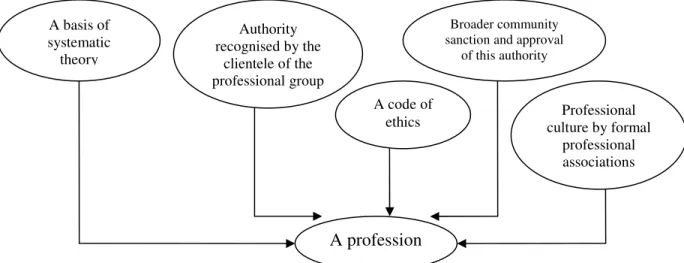
Similarly, Greenwood (1966, p. 9) offered another ‘set of attributes’ of a profession, namely (1) a basis of systematic theory; (2) authority recognised by the clientele of the professional group; (3) broader community sanction and approval of this authority; (4) a code of ethics regulating relations of professional persons with clients and with
A profession The acquisition
of specialised skill and training
The establishment of minimum fees
or salaries
The establishment and enforcement of minimum qualifications to practice The formulation of professional codes of ethics The formation of professional associations A profession A skill based on theoretical knowledge
The skill requires training and education A service for public good A professional competency A code of conduct The profession is organised
Figure 2.3: Six features of a profession (Millerson, 1964)
colleagues; and (5) a professional culture sustained by formal professional associations. The following Figure 2.5 provides a summary of these attributes:
However, in a book edited by Vollmer and Mills (1966), Foote (1966, pp. 43-44) described ‘in a condensed manner’ the basic elements of professionalisation into three categories, which are (a) the acquisition of a specialised technique supported by a body of theory; (b) the development of a career supported by an association of colleagues; and (c) the establishment of community recognition of professional status, as summarised in the Figure 2.6 below.
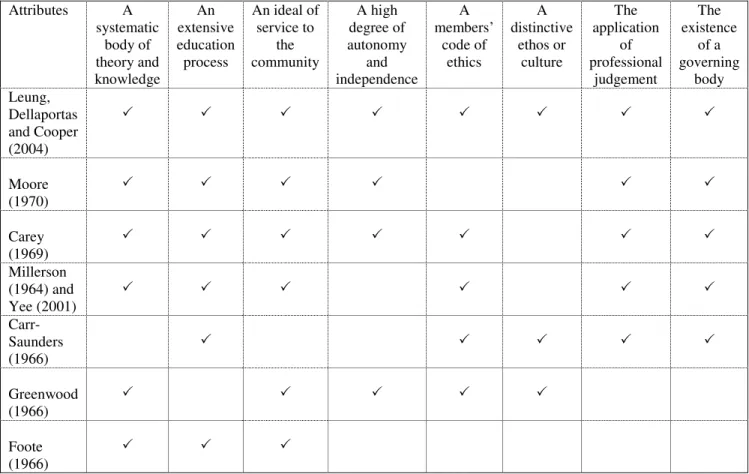
In summary, previous studies by researchers on the concepts of a profession and professionalisation are listed in the Table 2.1 below.
A profession The acquisition of a specialised technique supported by a body of theory The development of a career supported by an association of colleagues The establishment of community recognition of professional status A profession A basis of systematic theory Authority recognised by the clientele of the professional group Broader community sanction and approval
of this authority
A code of
ethics culture by formal Professional professional associations
Figure 2.5: Five attributes of a profession recommended by Greenwood (1966)
Table 2.1 – A summary of studies on attributes of the concepts of a profession and professionalisation Attributes A systematic body of theory and knowledge An extensive education process An ideal of service to the community A high degree of autonomy and independence A members’ code of ethics A distinctive ethos or culture The application of professional judgement The existence of a governing body Leung, Dellaportas and Cooper (2004) Moore (1970) Carey (1969) Millerson (1964) and Yee (2001) Carr-Saunders (1966) Greenwood (1966) Foote (1966)
Of these attributes of a profession described in the literature, the concern relating to the accounting profession in Vietnam is whether it has some or all of these attributes and how the development of the accounting profession differs from that in Western countries and other ex-colonies.
The full role-set of the professional, observed by Jackson (1970), was a combination of all of these elements: experience, apprenticeship, and most importantly sets of attributes appropriate to the different audiences of laymen and other professionals, assistants and competitors. Concerned primarily with the definition of occupational activities in response to the demands of the structural situation of the occupation itself, Harries-Jenkins (1970, p. 58) elaborated a definitive list of the elements of professionalisation, which consists of ‘six constituent elements’ deriving twenty-one sub-elements that characterise professionalisation. Further, Vollmer and Mills (1966, p. 46) argued that professionalisation ‘cannot be understood without taking into account certain aspects of
the larger society in which it takes place’. They concluded that ‘the process of professionalisation is inextricably linked to the kind of society in which it takes place – to its political form, its cultural norms, and its social structure, as well as its stage of technological development’ (p. 62).
Larson (1977) examined how professions organised themselves to attain market power. She defined professionalisation as '… the process by which producers of special services sought to constitute and control a market for their expertise' (1977, p. xvi), and '...a collective assertion of special social status and as a collective process of upward social mobility' (1977, p. xvi). She argued that market control and social mobility were the two dimensions of the professional project (1977, p. xvii). Following Larson’s (1977) work, a working theory of the professions was developed in MacDonald’s (1995, p. 32) work shown in Figure 2.7 as follows.
Figure 2.7: A working theory of the professions: a conceptual outline (Macdonald, 1995, p. 32)
Siegrist (1990) argued that the ‘professionalisation process is also relative to a specific society and to a particular historical period’ (p. 178). He observed the professionalisation process in Europe that…
In the case of the bureaucratic centralised states of continental Europe, the process of professionalisation was initiated by kings, princes, patricians and states, who attempted to influence the behaviour of barristers, clergymen and, to a lesser extent, also of medical practitioners, by issuing codes of ethical conduct. By the eighteenth or early nineteenth century, the function and operational realm of these occupational groups were state-regulated (Siegrist, 1990, p. 181).
This model of a professionalisation process which is controlled by the state aligns with the models of the development of the accounting profession in countries such as China and Vietnam, where the state plays a dominant role in the development of the accounting profession. West (2003, p. 25) argued in his study that ‘the twentieth century witnessed a persistent effort by sociologists to forge greater understanding of what professions are and what roles they play’. West also remarked that ‘the importance of the understanding of the initial professionalisation of accounting transcends the time-frame from which it originates’ (2003, p. 56).
2.2 - A review of the literature on the professionalization of accounting
There has been much academic debate and research on the professionalization of accounting in Western countries (Willmott, 1986; Puxty et al., 1987; Chua and Poullaos, 1993, 1998; Caramanis, 1998, 1999,2002, 2005; to name a few) and then extended to non-English speaking countries such as France (Ramirez, 2001) and Belgium (Beelde, 2002, 2003).
As noted by Yee (2001), one of the earliest studies of the professionalisation process that incorporates a sociological perspective is the Willmott (1986) study on the organisation and development of the accountancy profession in the UK. In his study, professionalisation is perceived as a strategy of collective social advancement. The
relationship of the professions with powerful others such as the market and the state is one of the conditions for the success of the professionalisation process. Subsequently, a number of studies on the professionalisation of accountants in Scotland in the UK has also been undertaken by Walker (1991, 1995, 2004), and Walker and Shackleton (1995). Consistent with Willmott’s (1986) interpretation, Walker’s argument, noted by Yee (2001, p. 6), is that ‘…the organisation of the profession can only be understood in the context of the underlying social, economic and political circumstances’.
In the professionalization projects during the last five decades, there are various theoretical perspectives employed to understand the transformation of the accounting profession, drawing from the sociology of the professions which focused on an attempt to develop and improve our sociological knowledge (Calhoun et al., 2007, p. 1). Specifically, theories are expanded to further understand the development of the profession such as functionalist, interactionist, and critical theories. In addition, several concepts and theories (as shown in Table 2.2) have emerged from the latter sociological studies such as social closure and cultural factors (MacDonald, 1995; Sakagami et al., 1999; Ramirez, 2001; Caramanis, 2005; Yapa, 2006, 2010); market-state-community (Streeck and Schmitter, 1985; Puxty et al., 1987; Hao, 1999); state-profession relationship (Bougen, 1997; Ballas, 1998); imperialism, gender, ethnicity, race and the profession (Hammond and Streeter, 1994; Hammond, 1997; Annisette, 1999, 2000, 2003, 2010; Bakre, 2005, 2006; Sian, 2006, 2007, 2010; Richardson, 2010; Carnegie and Parker, 1999a, 1999b; Carnegie and Edwards, 2001; Carnegie, Edwards and West, 2003; Susela, 2010; Yapa, 2010); class-status-party system (Chua and Poullaos, 1998; Xu and Xu, 2003; Caramanis, 2005; Bakre, 2010); hegemony (Tinker, 1984; Goddard, 2002; Yee, 2009); and globalization and the profession (Caramanis, 2002). These are summarised in the following table:
Theories and concepts
Grand theory The sociology of professions
Interactionist Critical theory Substantive theory and
concept
Neo Weberian concept State, market, community Marxist concept
Other concepts (eg. hegemony)
Neo Weberian concept: social closure and cultural factors; class-status-party system; state-profession relationship; imperialism, gender, ethnicity and race and profession
Table 2.2 Summary of theories and concepts employed in the professionalization projects
Some key papers which are relevant to this study will be examined in the following sections.
2.2.1 The State, the Market and the Community
In their study, Streeck and Schmitter (1985) identified (as shown in Table 2.2) three respective and distinctive guiding principles of social order under a critical perspective: the State (or the Bureaucracy), the Market and the Community, which could be labelled as hierarchical control, dispersed competition and spontaneous solidarity respectively. Their study also suggested the existence of a fourth principle, the Association or organisational concertation, in contrast to the fore-mentioned three guiding principles.
Willmott (1986) conducted a study to provide a perspective for understanding professional associations as political bodies developed to defend the interests and preserve the scarcity of their members’ labour, by including a consideration of professionalization, as well as an examination of the institutions of the market and the state in the UK. In addition, the study traced the history of the professional bodies, focusing on the competition between the major associations as well as the economic and political contexts of their emergence, merger and failed integration. The findings
challenged the technical, political neutral self-understanding of the profession and thus sought to contribute to a debate on whether the profession was in a socialised position in relation to the market and the state, in a way that could enable it to adequately gauge and safeguard the public interest.
By critically using the Streeck and Schmitter (1985) work, Puxty et al. (1987) examined (as shown in Table 2.2) the regulations as an expression of the combination of the three organising principles of the State, the Market and the Community, to compare the mode of accounting regulation in four capitalist countries: the Federal Republic of Germany, the UK, Sweden and the US. In respect of the fourth principle – the Associative model of social order in the Streeck and Schmitter (1985) work, Puxty et al. (1987) argued that they believed that it would be better to understand it as an outcome of the intersection of State, Market and Community, rather than as an independent factor. Thus, the roles of accountancy in regulating economic and social activities in society, and the manner in which the institutions of accountancy were regulated, were themselves the focus of their study. Their findings highlighted the significance of contradictions within and between the organising principles of advanced capitalism and sought to display the regulation of accounting as a medium and outcome of the articulation of these contradictions.
Adopting the same theoretical framework (as shown in Table 2.2) as that of Puxty et al. (1987), Seal et al. (1996) analysed the collective mobility project of accountants and auditors in the Czech Republic, a socialist country, as they had attempted to possess new areas of economic activity brought about through the post-1989 transition in the Czech society. They did so by examining a changing balance between the guiding principles of the State, the Market and the Community, within which Czech accountants and auditors were visualised as pursuing the twin and related strategies of constituting a professional market and identifying themselves in the regulatory power of the state. Their findings suggested that, as the key to professional credibility in an unregulated market was professional reputation, the ambivalent policy of the Czech government had made it easier for the multinational accounting firms with reputations built up over decades in mature capitalist societies (the Big Six) to invade the potential domain of Czech auditing and accounting professionals. In addition, Bougen (1997) examined the 1988 Spanish
Audit Law, with particular focus on the relationships between auditing and the Spanish state, to illustrate the imminent capacity for the movement of these connections and to consider some of the mechanics of such moving relationships.
Using the same theoretical framework as Puxty et al. (1987), Hao (1999) examined the changing balance, over time, between the State, the Market and the Community, as principles in the organisation and regulation of accountancy practitioners in China during the twentieth century, with particular focus on the post-1978 period, when China adopted the policy of openness to the outside world. The study argued that while the balance between the State, the Market and Community is shifting, the State maintains quite a degree of influence over Chinese accountancy through its control of Chinese accountants.
The findings suggested that although foreign influence played a larger role than the local community and market forces in the re-emergence and development of the CPA profession in China, the Chinese state had sought to direct and supervise foreign influence. By passing government decrees, the re-emergence of the CPA profession and the formation of the Chinese Institute of Certified Public Accountants (CICPA) arose, without passing through the stage of spontaneous development experienced by professional associations in the UK in the nineteenth century. More importantly, the Chinese experience provided a strong contrast with the case of the Czech Republic, where the government adopted laissez-faire principles more comprehensively and more rapidly. It is noted that the study on Chinese accounting provides empirical support for the study on Vietnamese accounting.
It is also observed that the three organising principles in the Puxty et al. (1987) study – the State, the Market and the Community, which were identified as providing modes of regulation – are appropriate to examine the professionalization of accounting in Vietnam, a country where the state plays a dominant role in the development of accounting, through laws and regulations. Therefore, the Puxty et al. (1987) work is deemed appropriate to be used as the theoretical framework in this study.
Miller (1990) argued that a concern with the interrelations between accounting and the state was integral in a number of studies of accounting change. The focus of Miller’s (1990) study was on the changes which took place in accounting and the state in the reign of Louis XIV from 1661 – 1683 in France, when private enterprise accounting and other practices of government were revamped. The findings suggested that it was important to examine the interrelations of accounting and the state, rather than viewing these two phenomena as linked only by external relations with each other.
Chua and Poullaos (1993) conducted a study to analyse an attempt by Victorian accountants to attain a Royal Charter from 1904 – 1906, focusing on the profession – state relations to develop a more comprehensive understanding of professionalization endeavours. The shifting constraints on and opportunities available to key players in state agencies and accounting associations were tracked. Their findings suggested that the outcome of the Victorian Charter attempt was not seen as being “optimal” in any way, even from the viewpoint of the Colonial Office. No particular grounds were found to believe that their decision was guided by an intention to protect the interests of a ruling capitalist class.
In their study, Carnegie and Napier (1996) looked at an emphasis on the importance of perceiving accounting as a social practice to be understood in the context in which it operates, as a phenomenon local in both space and time. They argued that new accounting historians were more likely to see accounting as an instrument of power and domination than as a value-free body of ideas and techniques for putting into effect and monitoring contracts freely entered into between equals. Issues raised were whether accounting should continue to permeate so many aspects of life as we enter the twenty-first century, the need for understanding how accounting has come to be mobilised, its rationales and rationalisations and those who use it and are affected by it, all being just as important as introducing and developing more functional techniques of recording and measurement (Carnegie and Napier, 1996).
Napier (2006) reviewed 30 years of historical accounting research and summarised themes in the new accounting history, in which he observed a number of studies in the
journal Accounting, Organisations and Society (AOS) on accounting history literature. The new accounting history examined closely three of the principal themes of historical research published in AOS: accounting, power and knowledge; accounting’s professionalisation projects; and new understandings of accounting’s roles in representing the economics. Important studies on the professionalisation of accounting reviewed by Napier (2006) included those on the sociology of the professions (Willmott, 1986), and on the relationships between professional accountancy and the state, mainly in the UK (Puxty et al., 1987; Cooper et al., 1989; Robson et al., 1994). In addition, in the study of Shackleton and Walker (1998), Walker (1991, 1995, 2004), and Walker and Shackleton (1995, 1998), the interface of professional bodies with each other and with the state were analysed through a detailed examination of public records, professional archives and secondary sources.
Studies of the accountancy profession in Australia examined market closure (Chua and Poullaos, 1993, 1998; Poullaos, 1993, 1994) and the emergence and decline of professional bodies (Carnegie, 1993). Professional ethics (Preston et al., 1995), the self-regulation of the professional bodies in the UK accounting profession from the state (Sikka and Willmott, 1995), and the recognition of the diversity of accounting practice and the social and economic roles of accountants (Matthews et al., 1998; Armstrong, 1987; Hopper and Armstrong, 1991) were also studied.
The emergence of the auditing profession in Greece and how it was used by the state to further its strategic interests during the late 1940s and early 1950s were examined by Ballas (1998). The findings demonstrated that auditing was perceived as an instrument of both economic and political control as well as a legitimising device of the Greek government at the time. The overall argument was that the professionalization project for auditors was initiated by the Greek state because auditing was perceived as an effective instrument of social management to establish its authority rather than as an instrument to serve the needs of capital, of business enterprises, or the profession itself.
Aiming to throw further light on how the state-profession nexus impacted on the early professionalization of accounting, Chua and Poullaos (2002) investigated the emergence