C E N T E R F O R S U S T A I N A B L E S H A L E D E V E L O P M E N T , I N C .
I N I T I A L CE R T I FI C AT I O N
A U D I T R EP O R T S U M M A R Y
C O N S O L E n e rgy In c.
F e b r u a r y 2 4 , 2 0 1 5
Company
CONSOL Energy Inc.
Address
1000 CONSOL Energy Drive Canonsburg, PA 15317
AUDITING FIRM INFORMATION
Lead Auditor
John Stangline
Abbreviation
JS
Auditor(s)
Dane Kennedy
Ron White
Spencer Pizzani
Abbreviation
DK
RW
SP
Water Performance
Standards Audited:
Standard 1- 8.3
Start Date of
Audit
11/10/2014 End Date of Audit
11/15/2014
Air Performance
Standards Audited:
Standard 9 - 15.4
Start Date of
Audit
11/10/2014 End Date of Audit
11/15/2014
Field/Office Auditor
Days
16
Offsite
Auditor Days
8
Total Auditor
Days
24
Scope of Certification:
These standards apply to unconventional exploration, development,
and gathering activities including site construction, drilling, hydraulic
fracturing and production in the Appalachian Basin. These regional
standards consider geology, topography, population density,
infrastructure, surface water, ground water and other issues of
particular concern in the Appalachian Basin.
Accordingly, until such time as the scope of these standards may
be amended, these standards and the CSSD evaluation and
certification process will be limited to Operators’ unconventional
activities in the Appalachian Basin.
SUMMARY
CONSOL Energy Inc. applied for certification to the Center for Sustainable Shale Development’s
(CSSD) Performance Standards on October 3, 2014. Pursuant to certification requirements and
on behalf of the CSSD, Bureau Veritas Certification (BVC) conducted an audit of CONSOL
Energy’s CNX Gas operations within the Appalachian Basin. BVC’s audit team was comprised
of four auditors that met CSSD’s auditor requirements including having the requisite oil & gas
industry, environmental (air and water) and Appalachian Basin expertise.
The audit was conducted for conformance to the CSSD Performance Standards (version 1: August
19, 2013, revised Performance Standard 1: December 9, 2014) and in accordance with the
requirements of the CSSD Verification Protocol (version 1: September 27, 2013) and Guidance
for Auditors (August 19, 2013).
A scoping meeting was held on October 28-29, 2014 to review the geographical and operational
scope of CONSOL Energy’s activities in the Appalachian Basin and to determine the appropriate
set of certification audit sites. The Documentation and Data Management Audit was performed by
the audit team at 1000 CONSOL Energy Drive Canonsburg, PA on November 10 and 11, 2014.
The field verification portion of the audit was performed over the period of November 12, 2014 to
November 15, 2014 at 29 locations in Pennsylvania (Greene, Washington, Jefferson, and Indiana
Counties), Ohio (Noble County) and West Virginia (Marshall, Barbour Counties) with each site
being visited by at least two BVC auditors.
The verification process included audit observations, interviews with responsible management,
planning and operating individuals, documentation review and site visits. Where necessary and
appropriate, the auditors requested explanations of operating procedures and reviewed working
documents to demonstrate the level of conformance to the standards. Over the course of the audit,
the auditors reviewed approximately 250 records and documents and interviewed 31 employees
(16 office based, 15 field personnel) to determine conformance with the performance standards.
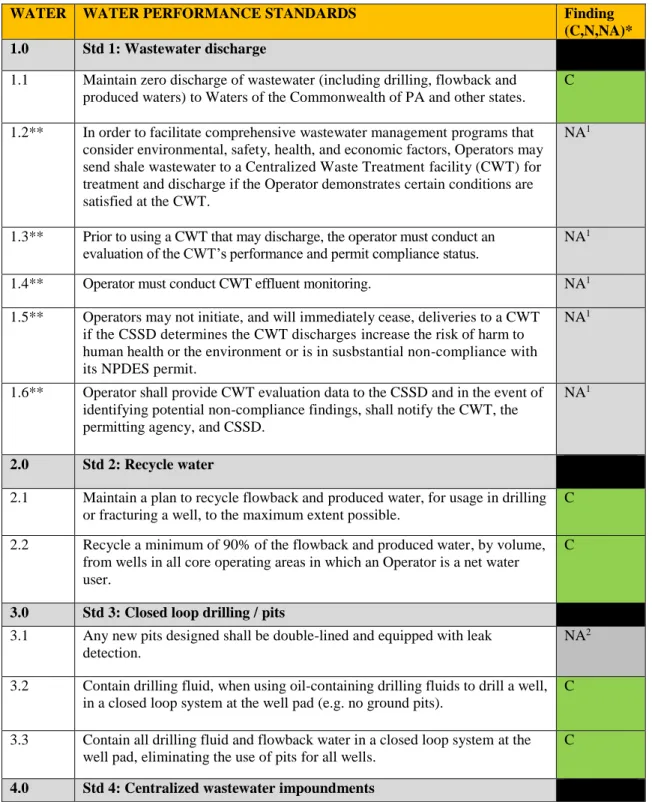
Table 1, titled “CSSD Certification – CONSOL Energy Audit Summary Scorecard” summarizes
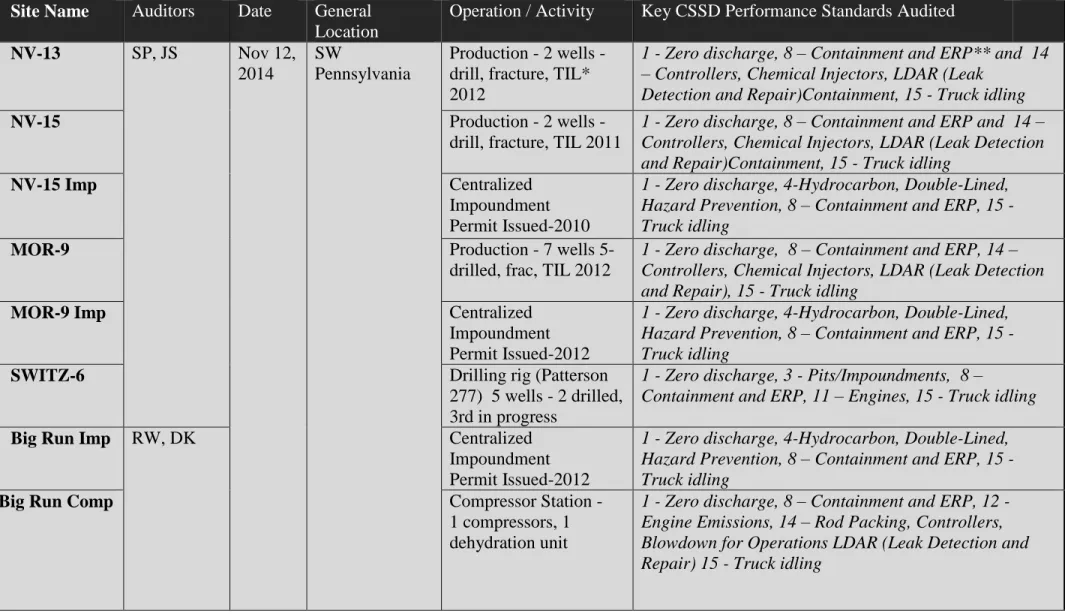
BVC’s audit findings with respect to each performance standard. Table 2, titled “CSSD
Certification – Field Verification Visits CONSOL Energy” outlines the CONSOL Energy
locations and associated operations visited for observation and verification of conformance to the
CSSD Performance Standards. The sites selected include a cross section of CONSOL Energy’s
operations and geographic locations throughout the Appalachian Basin that were active during
the audit “operational window” as required by CSSD’s Verification Protocol. The standards
identified in Table 2 for each site are a sample of the areas of field observation and verification
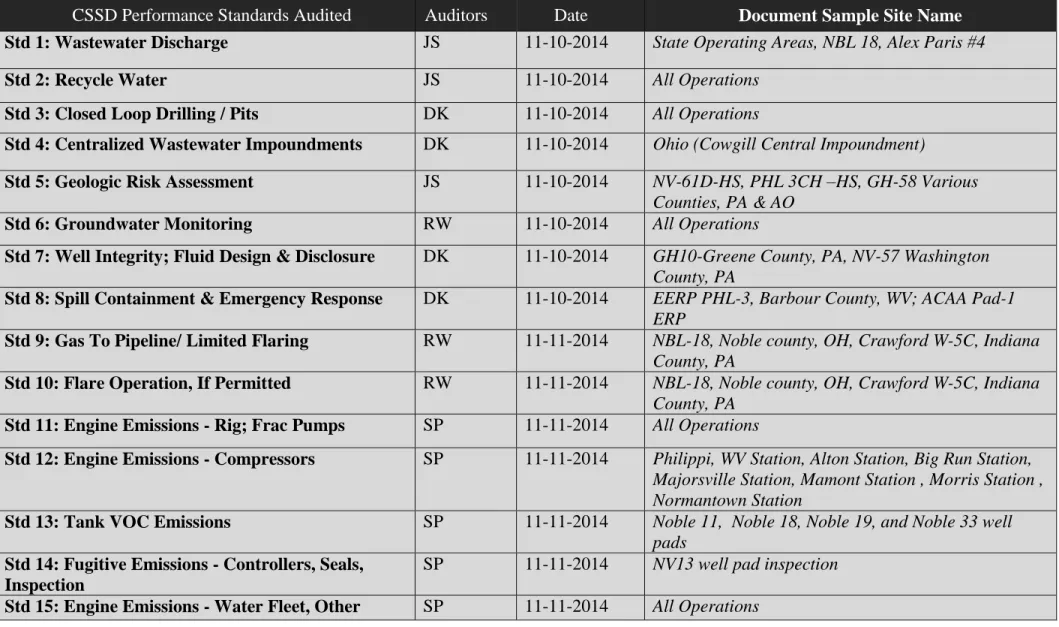
addressed by the audit team. Table 3, titled “CSSD Certification – Documentation and Data
Management Audit: CONSOL Energy” outlines CONSOL Energy’s relevant documents and
records reviewed to determine conformance to the CSSD Performance Standards.
Table 1: CSSD Certification
CONSOL Energy Audit Summary Scorecard
1CONSOLEnergy does not send shale wastewater to a Centralized Waste Treatment facility 2CONSOL Energy has not installed any new pits in the past three years and no new pits are planned
WATER WATER PERFORMANCE STANDARDS Finding
(C,N,NA)* 1.0 Std 1: Wastewater discharge
1.1 Maintain zero discharge of wastewater (including drilling, flowback and produced waters) to Waters of the Commonwealth of PA and other states.
C
1.2** In order to facilitatecomprehensive wastewater management programs that consider environmental, safety, health, and economic factors, Operators may send shale wastewater to a Centralized Waste Treatment facility (CWT) for treatment and discharge if the Operator demonstrates certain conditions are satisfied at the CWT.
NA1
1.3** Prior to using a CWT that may discharge, the operator must conduct an evaluation of the CWT’s performance and permit compliance status.
NA1
1.4** Operator must conduct CWT effluent monitoring. NA1
1.5** Operators may not initiate, and will immediately cease, deliveries to a CWT if the CSSD determines the CWT discharges increase the risk of harm to human health or the environment or is in susbstantial non-compliance with its NPDES permit.
NA1
1.6** Operator shall provide CWT evaluation data to the CSSD and in the event of identifying potential non-compliance findings, shall notify the CWT, the permitting agency, and CSSD.
NA1
2.0 Std 2: Recycle water
2.1 Maintain a plan to recycle flowback and produced water, for usage in drilling or fracturing a well, to the maximum extent possible.
C
2.2 Recycle a minimum of 90% of the flowback and produced water, by volume, from wells in all core operating areas in which an Operator is a net water user.
C
3.0 Std 3: Closed loop drilling / pits
3.1 Any new pits designed shall be double-lined and equipped with leak detection.
NA2
3.2 Contain drilling fluid, when using oil-containing drilling fluids to drill a well, in a closed loop system at the well pad (e.g. no ground pits).
C
3.3 Contain all drilling fluid and flowback water in a closed loop system at the well pad, eliminating the use of pits for all wells.
C
4.0 Std 4: Centralized wastewater impoundments *C = Conformance with the standard
NC = Non-conformance with the standard NA = Not applicable
4.1 Ensure that free hydrocarbons are removed from the water prior to storage; new impoundments must be double-lined with an impermeable material, equipped with leak detection; and take measures to reasonably prevent hazards to wildlife.
C
5.0 Std 5: Geologic risk assessment
5.1 Establish an Area of Review, prior to drilling a well, which encompasses both the vertical and horizontal legs of the planned well; conduct a comprehensive characterization of subsurface geology , including a risk analysis; and conduct a thorough investigation of any active or abandoned wellbores within such area of review or other geologic vulnerabilities (e.g., faults) that penetrate the confining layer and adequately address identified risks.
C
6.0 Std 6: Groundwater monitoring
6.1 Develop and implement a plan for monitoring existing water sources and demonstrate that water quality and chemistry measured during a pre-drilling assessment are not impacted by operations.
C
6.2 Conduct periodic monitoring for at least one year following completion of the well and monitoring must be extended if results indicate potentially adverse impacts on water quality or chemistry by operations.
C
6.3 Develop and implement an investigative and corrective action plan if
monitoring establishes a possible link between an Operator’s activities and of contamination of a water source
C
6.4 Conduct additional monitoring in the event a well is re-stimulated. C
7.0 Std 7: Well integrity; fluid design & disclosure
7.1 Design and install casing and cement to completely isolate the well and all drilling and produced fluids from surface waters and aquifers and prevent vertical movement of fluids in the annulus.
C
7.2 Do not use diesel fuel in the hydraulic fracturing fluids. C
7.3 Publically disclose the chemical constituents intentionally used in well stimulation fluids.
C
7.5a Work toward use of more environmentally neutral additives for hydraulic fracturing fluid.
C
7.5b Perform mechanical integrity tests when refracturing an existing well. C
8.0 Std 8: Spill containment & emergency response
8.1 Design each well pad to minimize the risk that drilling related fluids and wastes come in contact with surface waters and fresh groundwater.
C
8.2 Develop and implement an emergency response plan and ensure local responders have appropriate training and equipment to respond to an emergency at the well.
C
8.3 In the event of spill or release, beyond the well pad, immediately provide notification to the local governing body and any affected landowner.
3 CONSOL Energy has not purchased or replaced any existing lean-burn engines in the Appalachia Basin
AIR AIR PERFORMANCE STANDARDS 9.0 Std 9: gas to pipeline/ limited flaring
9.1 Direct all pipeline-quality gas during well completion of development wells, and re-completion or workover of any well into a pipeline for sales.
C
9.2 Any gas not captured and put in the sales pipeline may not be vented and must be flared (in accordance with Standard No. 10).
C
9.3 Acceptable reasons for sending gas to a flare and not directing gas into the sales line include: (a) Low content of flammable gas and (b) for safety reasons.
C
9.4 Circumstances unacceptable for sending gas to flare, instead of directing it into a sales line, are: (a) lack of a pipeline connection except for wells that are designated as either exploratory or extension wells; (b) inadequate water disposal capacity; and (c) undersized flow back equipment, lack of flow back equipment or lack of equipment operating personnel.
C
9.5 Document any upset or unexpected condition that leads to flaring of gas and maintain records of description of the condition, the location, date, and quantity of gas flared.
C
9.6 Exploratory well verification C
10.0 Std 10: Flare operation, if permitted
10.1a Use raised/elevated flares or an engineered combustion device with a reliable continuous ignition source, which have at least a 98% destruction efficiency of methane. Pit flaring is not permitted.
C
10.1b Flaring may not be used for more than 14-days on any development well and no more than 30-days on any exploratory or extension wells. If flaring continues beyond 30-days for an exploratory or extension well, document the extent of additional flaring and reasons requiring flaring beyond the 30-days.
C
10.1c Flares shall be designed for and operated with no visible emissions, except for periods not to exceed a total of five minutes during any two consecutive hours.
C
11.0 Std 11: Engine emissions - rig; frac pumps
11.1a-e Dedicated horizontal drill rig (non-road) diesel - average emissions must be equivalent to Tier 2 non-road diesel engine standards or better. All horizontal drill rig diesel non-road equipment must use Ultra-Low Sulfur Diesel fuel (15 ppm of sulfur) at all times.
C
11.2a-b Dedicated frac pump diesel engines - average emissions must be equivalent to Tier 2 non-road diesel engine standards or better. All frac pump diesel engines must use Ultra-Low Sulfur Diesel fuel (15 ppm of sulfur) at all times.
C
12.0 Std 12: Engine emissions - compressors
12.1 Existing compressor engines greater than 100 horsepower may not emit more than 1.5 grams of NOx per horsepower-hour.
C
12.2 Any new, purchased, replacement, reconstructed, or relocated lean-burn engines greater than 100 horsepower may not emit more than 0.5 g/hp-hr for NOx; 2.0 g/hp-hr for CO; 0.7 g/hp-hr for VOCs.
4 CONSOL Energy has not purchased or replaced any existing rich-burn engines in the Appalachia Basin 5 CONSOL Energy does not own or operate any centrifugal compressors with wet seals in the Appalachia Basin 6 Initial certification audit preceded the effective date of the standard.
12.3 Any new, purchased, replacement, reconstructed, or relocated rich-burn engines greater than 100 horsepower may not emit more than 0.3 g/hp-hr for NOx; 2.0 g/hp-hr for CO; 0.7 g/hp-hr for VOCs.
NA4
13.0 Std 13: Tank VOC emissions
13.1 All individual storage vessels at the well pad with VOC emissions equal to or greater than 6 tpy must install controls to achieve at least a 95% reduction in VOC emissions.
C
14.0 Std 14: Fugitive emissions - controllers, seals, inspection
14.1 Change rod packing at all reciprocating compressors (both existing and new), including those at the wellhead, either every 26,000 hours of operation or after 36 months.
C
14.2 All pneumatic controllers must be low – bleed, with a natural gas bleed rate limit of 6.0 scfh or less or zero bleed when electricity (3-phase electrical power) is on-site.
C
14.3 Replace worn out wet seals on existing centrifugal compressors with dry seals.
NA5
14.4 Implement a directed inspection and maintenance program (DIM) for equipment leaks from all existing and new valves, pump seals, flanges, compressor seals, pressure relief valves, open-ended lines, tanks and other process and operation components that result in fugitive emissions. Monitor weekly (OVA) and annually (FLIR). Once significant leaks are detected, they are required to be repaired in a timely manner.
C
14.5 Eliminate VOC emissions associated with the prevention of well-bore freeze-up.
C
14.6 Pressurize compressors when they are off-line for operational reasons to reduce blowdown emissions.
C
15.0 Std 15: Engine emissions - water fleet, other
15.1 80% of all trucks used to transport fresh water or well flowback water must meet U.S. EPA’s Final Emission Standards for 2007 and Later Model Year Highway Heavy-Duty Vehicles and Engines for particulate matter (PM) emissions.
C
15.2 By September 24, 2015, 95% all trucks used to transport fresh water or well flowback water must meet U.S. EPA’s Final Emission Standards for 2007 and Later Model Year Highway Heavy-Duty Vehicles and Engines for particulate matter emissions.
NA6
15.3 All on-road vehicles and equipment must limit unnecessary idling to 5 minutes, or abide by applicable local or state laws if they are more stringent.
C
15.4 All on-road and non-road vehicles and equipment must use Ultra-Low Sulfur Diesel fuel (15 ppm of sulfur) at all times.
Table 2: CSSD Certification – Field Verification: CONSOL Energy
The field verification includes observing equipment, operations and facilities; interviewing responsible persons; and reviewing necessary
and appropriate field documents and physical evidence relevant to determining conformance with applicable standards.
Site Name
Auditors
Date
General
Location
Operation / Activity
Key CSSD Performance Standards Audited
NV-13
SP, JS
Nov 12,
2014
SW
Pennsylvania
Production - 2 wells -
drill, fracture, TIL*
2012
1 - Zero discharge, 8 – Containment and ERP** and 14
– Controllers, Chemical Injectors, LDAR (Leak
Detection and Repair)Containment, 15 - Truck idling
NV-15
Production - 2 wells -
drill, fracture, TIL 2011
1 - Zero discharge, 8 – Containment and ERP and 14 –
Controllers, Chemical Injectors, LDAR (Leak Detection
and Repair)Containment, 15 - Truck idling
NV-15 Imp
Centralized
Impoundment
Permit Issued-2010
1 - Zero discharge, 4-Hydrocarbon, Double-Lined,
Hazard Prevention, 8 – Containment and ERP, 15 -
Truck idling
MOR-9
Production - 7 wells 5-
drilled, frac, TIL 2012
1 - Zero discharge, 8 – Containment and ERP, 14 –
Controllers, Chemical Injectors, LDAR (Leak Detection
and Repair), 15 - Truck idling
MOR-9 Imp
Centralized
Impoundment
Permit Issued-2012
1 - Zero discharge, 4-Hydrocarbon, Double-Lined,
Hazard Prevention, 8 – Containment and ERP, 15 -
Truck idling
SWITZ-6
Drilling rig (Patterson
277) 5 wells - 2 drilled,
3rd in progress
1 - Zero discharge, 3 - Pits/Impoundments, 8 –
Containment and ERP, 11 – Engines, 15 - Truck idling
Big Run Imp
RW, DK
Centralized
Impoundment
Permit Issued-2012
1 - Zero discharge, 4-Hydrocarbon, Double-Lined,
Hazard Prevention, 8 – Containment and ERP, 15 -
Truck idling
Big Run Comp
Compressor Station -
1 compressors, 1
dehydration unit
1 - Zero discharge, 8 – Containment and ERP, 12 -
Engine Emissions, 14 – Rod Packing, Controllers,
Blowdown for Operations LDAR (Leak Detection and
Repair) 15 - Truck idling
Site Name
Auditors
Date
General Location Operation / Activity
Key CSSD Performance Standards Audited
Bowers
RW, DK
Nov 12,
2014
Central/SW
Pennsylvania and
West Virginia
Production- 4 wells -
drill, frac, TIL 2013
1 - Zero discharge, 8 – Containment and ERP, 14 –
Controllers, Chemical Injectors, LDAR (Leak
Detection and Repair) 15 - Truck idling
Marchand
Production- 1 well -
drill, frac, TIL 2014
1 - Zero discharge, 8 – Containment and ERP, 14 –
Controllers, Chemical Injectors, LDAR (Leak
Detection and Repair) 15 - Truck idling
Crawford
Production- 7 wells -
drill, frac, TIL 2014
1 - Zero discharge, 8 – Containment and ERP, 14 –
Controllers, Chemical Injectors, LDAR (Leak
Detection and Repair) 15 - Truck idling
NV-61
JS, SP
Nov 13,
2014
Drilling rig (Patterson
331) 5 wells - 2 drilled,
3rd in progress
1 - Zero discharge, 3 - Pits/Impoundments, 8 –
Containment and ERP, 11 – Engines, LDAR, 15 -
Truck idling
NV-34
Completions- 11 wells
drilled 2014, Fracture in
progress
1 - Zero discharge, 3 - Pits/Impoundments, 8 –
Containment and ERP, 14 – Controllers, Chemical
Injectors, LDAR (Leak Detection and Repair), 15 -
Truck idling
Morris
Comp
Compressor Station -
0 compressors, 1
dehydration unit
1 - Zero discharge, 8 – ERP, 12 - Engine Emissions,
14 – Rod Packing, Controllers, Blowdown for
Operations LDAR (Leak Detection and Repair) 15 -
Truck idling
GH-56
Post Drill- 6 wells,
Drilled 2014
1 - Zero discharge, 3 - Pits/Impoundments, 8 –
Containment and ERP, 11 – Engines, 15 - Truck
idling
Majorsville
Compressor
Compressor Station -
4 compressors, 2
dehydration unit
1 - Zero discharge, 8 – Containment and ERP, 12 -
Engine Emissions, 14 – Rod Packing, Controllers,
Blowdown for Operations LDAR (Leak Detection
and Repair) 15 - Truck idling
ACAA Pad 1
RW, DK
1 - Zero discharge, 8 – Containment and ERP, 14 –
Controllers, Chemical Injectors, LDAR (Leak Detection
and Repair), Blowdown
15 - Truck idling
ACAA Pad 2
Post Drill- 6 Vertical
Wells Drilled
1 - Zero discharge, 8 – Containment and ERP, 11 –
Engines, 15 - Truck idling
Site Name
Auditors
Date
General
Location
Operation / Activity
Key CSSD Performance Standards Audited
NV-57
JS, SP
Nov 14,
2014
SW
Pennsylvania
Production - 8 wells -
drill, frac, TIL 9/14
1 - Zero discharge, 8 – Containment and ERP, 11 –
Engines, 14- Controllers, Chemical Injectors, LDAR,
15 - Truck idling
NV-2 Imp
Centralized
Impoundment
Permit Issued-2013
1 - Zero discharge, 4-Hydrocarbon, Double-Lined,
Hazard Prevention, 8 – Containment and ERP, 15 -
Truck idling
NV-55
Production - 7 wells -
drill, frac, TIL 5/14
1 - Zero discharge, 8 – Containment and ERP, 11 –
Engines, 14- Controllers, Chemical Injectors, LDAR,
15 - Truck idling
PHL-13
DK, RW
West Virginia
Production - 13 wells -
drill, frac, TIL 5/14
1 - Zero discharge, 8 – Containment and ERP, 11 –
Engines, 14- Controllers, Chemical Injectors, LDAR,
15 - Truck idling
PHL-1 Comp
Compressor Station -
4 compressors, 1
dehydration unit
1 - Zero discharge, 8 – Containment and ERP, 12 -
Engine Emissions, 14 – Rod Packing, Controllers,
Blowdown for Operations LDAR (Leak Detection and
Repair) 15 - Truck idling
PHL-3
Drill Rig (Patterson
278) - 4 Wells, 1
drilled
1 - Zero discharge, 3 - Pits/Impoundments, 8 –
Containment and ERP, 11 – Engines, LDAR, 15 - Truck
idling
PHL-10
Production - 6 wells -
drill, frac, TIL 9/14
1 - Zero discharge, 8 – Containment and ERP, 11 –
Engines, 14- Controllers, Chemical Injectors, LDAR,
15 - Truck idling
AUD-7
Production - 1 well -
drill, frac, TIL 8/14
1 - Zero discharge, 8 – Containment and ERP, 11 –
Engines, 14- Controllers, Chemical Injectors, LDAR,
15 - Truck idling
Site Name
Auditors
Date
General
Location
Operation / Activity
Key CSSD Performance Standards Audited
NBL-34
RW, DK
Nov 15,
2014
Ohio
Completions- 4 wells
drilled 2014, Fracture
in progress
1 - Zero discharge, 3 - Pits/Impoundments, 8 –
Containment and ERP, 13 – Tanks, 14 – Controllers,
Chemical Injectors, LDAR (Leak Detection and
Repair), 15 - Truck idling
NBL-16
Production (Wet gas) -
2 wells - drill, fracture,
TIL 8/14
1 - Zero discharge, 8 – Containment and ERP, 13 – Tanks,
14 – Controllers, Chemical Injectors, LDAR (Leak Detection
and Repair)
15 - Truck idling
NBL-19
Production (Wet gas) -
3 wells - drill, fracture,
TIL 6/14
1 - Zero discharge, 8 – Containment and ERP, 13 – Tanks,
14 – Controllers, Chemical Injectors, LDAR (Leak Detection
and Repair)
15 - Truck idling
* TIL – Turn-in-Line – indicates bringing the well online for natural gas production. ** ERP – Emergency Response Plan