
c
⃝2014. The Korean Astronomical Society. All rights reserved. http://jkas.kas.org
P
ERIOD
V
ARIATION
S
TUDY
O
F
T
HE
N
EGLECTED
A
LGOL
E
CLIPSING
B
INARY
S
YSTEM
V346 C
YGNIUS
Magdy Hanna
National Research Institute of Astronomy and Geophysics (NRIAG), Helwan, Cairo, Egypt;magdyh [email protected]
Received February 24, 2014; accepted April 7, 2014
Abstract: We present the first period variation study for the Algol eclipsing binary V346 Cyg by
constructing the (O−C) residual diagram using all the available precise minima times. We conclude that
the period variation can be explained by a sine–like variation due to the presence of a third body orbiting
the binary in about 68.89±4.69 years, together with a long-term orbital period decrease (dP/dt =
−1.23×10⁻⁷day/yr) that can be interpreted to be due to slow mass loss from the δ–Scuti primary
component. The sinusoidal variation may also be explained by using the the Applegate (1992) mechanism involving cyclic magnetic activity due to star–spots on the secondary component. The present preliminary solution needs more precise photometric observations to be confirmed.
Key words: binaries: close; eclipsing; Algol; semi-detached — stars: triple — stars: individual: V346 Cyg
1. INTRODUCTION
The system V346 Cyg (HIP 100198, TYC 2684-1000-1,
α2000 = 20h19m24s.7244, δ2000 = +36◦ 20
′
24.2092,
π = 2.57 (mas), and Sp. type A5 according to the
SIMBAD database) is an eclipsing binary system. Its changeability was discovered by Beljawsky (1932), and confirmed by Parenago (1933) who determined the first three photographic times of minimum and suggested its Algol type configuration. Florja (1934) monitored the system visually covering the time interval from Aug 8, 1932 to Aug 31, 1933. From the observations, he derived 10 minima times and obtained the first linear ephemeris:
HJD(Min.I) = 2 427 300.411 + 2d.74322·E . (1)
Florja also combined his visual observations to those photographic minima given by Parenago and deduced the linear ephemeris:
HJD(Min.I) = 2 427 300.411 + 2d.743358·E . (2)
According to this ephemeris, he also obtained the first (mean) visual light curve for V346 Cyg.
The first photographic light curve was observed by Petrow (1946) who used the linear elements of Florja (1934) and deduced the linear elements:
HJD(Min.I) = 2 435 686.7191 + 2d.7432997·E . (3)
The system was recorded as a semi-detached Algol eclipsing binary by many authors (e.g., Brancewicz & Dworak 1980; Budding et al. 2004; Samus et al. 2004; Kim et al. 2005; Soydugan et al. 2006a,b), while it was mentioned as a detached system by the current SIMBAD database.
Corresponding author: M. A. Hanna
The system was partially observed photometrically in the B-passband by Kim et al. (2005). They used 2K CCD camera attached to 1.0m telescope of the Mt. Lemmon Optical Astronomy Observatory. Their ob-servations were performed for six nights in November 2004, about 2 hours per night. They obtained some parts of the phase diagram, combined them to a
pri-mary minimum of depth 1m.7, used the light curve
so-lution of Surkova & Svechnikov (2004) and considered the semi-detached Algol binary configuration to apply the Wilson & Devinney (1971) code. They then
con-cluded that the primary component of V346 Cyg hasδ
Scuti character.
As V346 Cyg is of maximum magB = 11.8, and a
relatively short period P = 2.d743310 (Brancewicz &
Dworak 1980), Budding (1984) has listed it among a relatively neglected group of binaries. Since then, many observers have monitored this system and determined about 20 photoelectric (pe) and CCD minima times. Later, the general properties of V346 Cyg were given by Soydugan et al. (2006b) and are listed in Table 1. They deduced that the system is an eclipsing binary with pulsating component and A5+G4IV Sp. Type.
The aim of the present paper is to discuss the possible mechanisms that could be causing the changes in the period of V346 Cyg and to determine the LITE due to the presence of a third body, as well as to apply the Applegate mechanism to test the magnetic activity which is nearly a common characteristic among late– type low–mass stars similar to our sun.
2. PERIODVARIATIONSTUDY
No period variation studies of this system have been conducted till now. An essential method to study the period variation in eclipsing binary systems is the
anal-ysis of the O−C diagram, by the use of minima times
determined throughout the observational history of the 99
Table 1
Physical Parameters of V346 Cyg in literature
M1/M⊙ M2/M⊙ R1/R⊙ R2/R⊙ L1/L⊙ L2/L⊙ T1(K) T2(K)
Surkova & Svechnikov (2004) 1.86 0.56 2.21 3.01 - - -
-Soydugan et al. (2006b) 2.34 1.83 3.75 4.74 61.76 38.94 8353 6620
binary. For this purpose, a total of 71 minima times are gathered and listed in the self-explanatory Table 4.
We construct the O−C diagram (Figure 1) by using
Kreiner’s (2004a) light elements:
HJD(Min.I) = 2 435 686.7191 + 2d.7432997·E . (4)
For minima time detection, we used the last 18 pho-toelectric and CCD minima of Table 4 (the upward branch of Figure 1) starting from JD 24 48500.6600, and obtained the new linear ephemeris:
HJD(Min.I) = 2 435 686.42843+2d.743347163·E , (5)
with standard deviation SD=0.0039, and regression r
= 0.955. All the linear elements given by various au-thors, together with the linear elements obtained in this work are listed in Table 2.
The (O−C) diagram of V346 Cyg (Figure 1) shows
a sine-like variation which is usually attributed to be a result of light time effect (LITE) caused by the pres-ence of a third body orbiting the binary system, or it may be a result of cyclic magnetic activity due to star spot(s) on the late G4 Sp. type secondary component of the binary. Beside this, the semi-detached Algol type configuration usually suggests a transfer of matter from the less massive evolved component to the more mas-sive primary one. However, this does not agree with the system under study as we shall see below.
To analyze the O−C diagram we use the standard
approach (Mayer 1990) assuming that the time of min-ima follow a quadratic ephemeris and are modulated by LITE (Irwin 1959). The time of mid eclipse is com-puted as follows: Min.I = J D0+P·E+Q·E2+ a12 sini c × (6) [ 1−e23 1 +e3 cosν sin (ν+ω3) +e3 sinω3 ] ,
where e3, ω3, ν, a12 sini and c are the eccentricity,
longitude of the periastron, true anomaly of the binary orbit around the center of mass of the triple system, projected semi-major axis, and the speed of light, re-spectively. We used the weighted least squares com-puter programme written by Zasche et al. (2009). We exclude the first three photographic (pg) minima (listed
in Table 4) due to the big gap (≈ 34 years) between
them and the other data. We gave weights 1, 3 and 10 for visual (v), pg, and photoelectric (pe) &CCD min-ima, respectively.
The quadratic ephemeris of the minima is captured by the first three terms of Equation (6), and shown
−0.08 −0.06 −0.04 −0.02 0 0.02 0.04 0.06 O−C (days) 1900 1920 1940 1960 1980 2000 2020 2420000 2430000 2440000 2450000 2460000 −0.03 −0.02 −0.01 0 0.01 0.02 O−C (Period) −8000 −6000 −4000 −2000 0 2000 4000 6000 8000 −0.04 −0.02 0 0.02 Epoch −0.01 0 0.01
Figure 1. Raw O−C diagram for V346 Cyg based on Kreiner’s ephemeris (upper panel). The individual observa-tions are shown as dots. The size of the dot is proportional to the statistical weight assigned to the minima (visual - 1; photographic - 3; photoelectric & CCD measurement - 10). The lower panel represents the residuals after the subtrac-tion of the solusubtrac-tion.
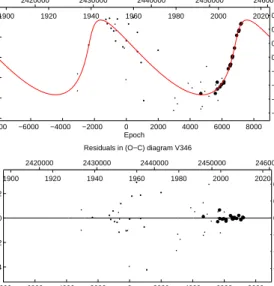
by the dashed line in Figure 1, while the solid line fit represents the LITE. The lower panel in Figure 1 shows the residuals after the subtraction of the solution.
2.1. Mass Loss
Many semi-detached Algol binary systems exhibit ei-ther long–term parabolic increase or decrease in their orbital periods during their evolution depending on whether the process of matter transfer is conservative or non-conservative; for examples see Hanna & Amin
(2013). However, in case of binaries that show
or-bital period decrease many authors, e.g., Kreiner et al. (1994b) and Pribulla (1998) have attributed such orbital period decrease to non–conservative mass loss from the primary component.
As one can see from the obtained quadratic term co-efficient of Equation (6) (see Table 2 or 3), there is a decreasing parabolic long–term evolution of the or-bital period represented by the dashed line in Figure
1. It may be identified as a period decrease caused
by slow mass loss dP/dt = −9.27×−10 day/cycle (=
−1.23×10⁻⁷day/yr ≃ 1 Second/Century) from the
more massive δScuti pulsating primary component.
2.2. Third Body Hypothesis
TheO−Cresiduals show a sine-like variation with an
amplitude≃0d.068±0.01. This value is above the lower
limit, 0d.030, suggested by Frieboes-Conde and Herczeg
(1973) for detecting a third component orbiting a close binary system. Anyhow, the LITE due to the presence of the third body is clearly visible in the upper panel of
Table 2
The ephemerids of V346 Cyg found by different authors
JD+240000 Period Quadratic term Cubic term Reference
27300.41100 2.743220 Florja (1934)
27300.41100 2.743358 Florja (1934)
27300.40000 2.743370 Petrow (1946)
33283.62879 2.7432956 −1.51×10⁻⁸ 0.10×10⁻¹¹ Wood & Forbes (1963)
35686.71910 2.7432997 Kreiner (2004a)
52500.39800 2.743305 Kreiner (2004b)
35686.63000 2.7433200 Paschke & Br´at (2013)
35686.42843 2.743347163 Present work†
35686.73570 2.743316124 −4.6371×10⁻¹⁰ Present work‡
†Light elements from the last 18 pe and CCD minima times. ‡Light elements obtained from the solution approach of section IIa.
−8000 −6000 −4000 −2000 0 2000 4000 6000 8000 −0.06 −0.04 −0.02 0 0.02 0.04 Epoch O−C (days) 2420000 2430000 2440000 2450000 2460000 O−C diagram V346 after subtraction of parabola
−0.02 −0.015 −0.01 −0.005 0 0.005 0.01 0.015 O−C (Period) 1900 1920 1940 1960 1980 2000 2020 −8000 −6000 −4000 −2000 0 2000 4000 6000 8000 −0.04 −0.02 0 0.02 Epoch (O−C)−(O−C) LITE (days) 1900 1920 1940 1960 1980 2000 2020 2420000 2430000 2440000 2450000 2460000
Residuals in (O−C) diagram V346
−0.015 −0.01 −0.005 0 0.005 0.01 O−C (Period)
Figure 2.LITE solution made after the removal of a parabola (upper panel) and residuals (lower panel) for V346 Cyg.
Figure 2 after the removal of the parabola. The residu-als are residu-also presented in the lower panel of Figure 2. In this analysis we have considered the physical parame-ters obtained by Soydugan et al. (2006b) (see Table 1). The final solution of the orbital parameters are listed in Table 3. The solution shows a third body of mass
M3= 1.45 M⊙ that can be observed photometrically.
2.3. Magnetic Activity
Magnetic activities seen in low–mass late–type stars may produce cyclic period variation because of their rapid rotation and outer convective layers (Richards & Albright 1993). Changes of the magnetic field tribution result in changes of angular momentum dis-tribution. Gravitational quadrupole coupling produces changes in the internal structure of the active star which results in a period variation.
Zavala et al. (2002) studied the cause of period
changes for the Algol binary WW Cyg whose orbital period undergoes a 56 yr cyclic variation with an
am-plitude ≈ 0.02 days. In their study they rejected the
hypotheses of mass transfer, mass loss, apsidal motion, and the gravitational influence of an unseen companion as causes for these changes. They invoked the Apple-gate (1992) model which involves variations of the sub-surface magnetic field. Such subsub-surface magnetic field may be compared to solar activity cycles. The model can give a plausible explanation of the observed cyclic period variations of such late type active stars.
Star-spots are expected to be present on the cooler member i.e., the secondary less massive star (Sp. Type G4IV) was considered as the active component when applying the Applegate (1992) mechanism. For more details about the mechanism see Applegate and Pat-terson (1987), Applegate (1992) and references therein. To compute the amplitude of the period oscillation of V346 Cyg shown in Figure 1, one could use the following equation (Rovithis-Livaniou et al. 2000),
∆P=A
√
2[1−cos(2πPe/Pcycle)], (7)
as ∆P = 2.33×10⁻⁵ withPcycle= 25162 days. Thus,
the rate of period variation is found to be ∆P/P =
8.491×10⁻⁶ ≃ 10−5, which is in agreement to the
amplitude proposed by Lanza and Rodon`o (1999) for
Algols.
Following Lanza & Rodon`o (2002),
∆P
P =−9
∆Q
M a2 , (8)
the variation in the quadrupole moment can be
esti-mated to be ∆Q= 4.7×1051g·cm2 for the secondary
evolved late type component; where M is the mass of
the active star and the separationabetween both
com-ponents can be determined with the Kepler’s third low,
a= [74.5·P2(M1+M2)]1/3 . (9)
Assuming conservation of the orbital angular
momen-tum, Lanza and Rodon´o (1999, 2004) have argued
that magnetic variation could be detectable if the
quadrupole moment ∆Qis of the order 1051−1052g cm2
for Algol–type binaries, which indicating that the
ob-tained ∆Qvalue of the secondary component of V346
Cyg is a typical value for the close binaries. Therefore, the magnetic activity proposed by Applegate is a pos-sible mechanism to explain the cyclic variation of V346
Table 3
A light–time effect solution and the corresponding ephemeris of the binary system V346 Cyg
Parameter Unit Value
P3 (period) [yr.] 68.89±4.69
A(semi-amplit.) [day] 0.068±0.0119
e3 (eccentricity) 0.692±0.25
ω3 long. preias. pass. [deg] 22.187±33.3
T0 (Time of periastron passage) [HJD] 24 29458.878±2362.53
a12sini (projection of semi–major axis) [AU] 8.305±2.68
f(M3) [M⊙] 0.1208±0.079
M3,min [M⊙] 1.450±0.46
a3 angular distance of 3rd component [mas] 77.410
J D0 [HJD] 24 35686.73357±0.00292
Pbinary [day] 2.743303847±(2.13×10⁻⁶)
Q (×10−10) [day] −4.6371±0.0146
Sum of the square residuals∑(O−C)2 [days2] 0.0180
Cyg. However, it is worth pointing out that the conser-vative angular momentum assumption for the system is in contrast to the result obtained in section IIa which concerns the loss of matter out of the system. In addi-tion, magnetic activity cycle of about 70 years is con-siderably longer than expected in such low mass solar type stars in comparison to our sun.
2.4. δScuti Light Time Effect
Soydugan et al. (2006a) performed a study by con-sidering a sample of 20 eclipsing binary systems with
δ–Scuti type primaries. They discovered that there is a
possible linear relation among the pulsation periods of the primaries and the orbital periods of the system
gov-erned by Ppuls = 0.020(2)Porb−0.005(8). It is clearly
seen that the longer the orbital period systems have longer pulsational periods. Also, they indicated and re-ported that the orbital motion of the pulsating compo-nent around the center-of-mass of the binary produces a light time effect, hence the observed period of variation will decrease and increase. They suggested that this ef-fect is very small for the short period systems. However,
more similar systems with δ–Scuti component have to
be studied in order to confirm their new detection.
3. DISCUSSION
Pribulla (1998) derived the efficiency of mass transfer and mass outflow in close binaries. He concluded that, in case of conservative mass transfer the relative period change is ∆P P = 3(1−q2) q × ∆m m , (10)
where q is the mass ratio and m is the total mass
M1+M2. And, if the matter is being transferred from
the less to the more massive component, the period in-creases and the efficiency of the mass transfer is
α= 3(1−q
2)
q , (11)
i.e., the efficiency of this process is zero if the mass ratio is unity. In other words, the efficiency of transfer-ring matter from the less to the more massive compo-nent monotonically decreases for increasing mass ratio. Accordingly, for V346 Cyg in which high mass ratio
(q= 0.78, Soydugan et al. 2006b) is seen, the efficiency
of the transfer of matter from the secondary to the pri-mary massive star is low.
AδScuti variable (sometimes termed dwarf Cepheid)
is a variable star which exhibits variations in its lumi-nosity due to both radial and non-radial pulsations of the star’s surface. Recent infrared and radio
observa-tions show that the prototypical Cepheid,δ Cephei, is
undergoing mass loss (Marengo et al. 2010; Mathews et al. 2012). Neilson (2013) reported that this result was surprising and raises important questions about the role pulsation and mass loss in these stars. It is worthy to note that this result has been obtained for classical
Cepheids. However,δ Scuti stars are, in general, main
sequence or slightly evolved post main-sequence stars
with masses between 1.4 and 3 M⊙. They are located
near the bottom part of the classical Cepheid instability strip and are burning hydrogen either in a convective core, or in a shell outside the H-depleted core (Guzik 2000; Soydugan et al. 2006a). This may be explana-tion for the coefficient of the quadratic term in Equaexplana-tion (6) being negative implying the unexpected direction of flow of matter (from the primary to the secondary less massive component which filling its Roche lobe). The interpretation of this contradiction may be due to:
1. Inaccuracy in specifying the evolutionary status of this system and the system is not specifically semi-detached, i.e., the secondary component is pre-contact its Roche lobe limit and the matter
es-cape from the system isotropically from theδScuti
primary component obeying the non–conservative assumption case. Also, in his catalogue of classical Algol–Type binaries, Budding (1984) reported
that the high mass ratioqsd= 0.78 for V346 Cygni
Table 4 Times of minima HJD K E (O−C) Ref. HJD K E (O−C) Ref. (+2400000) (+2400000) 14431.400 pg -7748 0.01336 [1] 48478.725 vis 4663 -0.00616 [7] 14933.270 pg -7565 -0.14420 [1] 48489.688 vis 4667 -0.01644 [7] 15162.400 pg -7481.5 -0.08142 [1] 48500.660 V Hipp 4671 -0.01772 [7] 26930.119 v -3192 0.16644 [2] 48511.618 vis 4675 -0.03300 [7] 26951.988 v -3184 0.08888 [2] 48744.801 vis 4760 -0.03220 [7] 26982.198 v -3173 0.12236 [2] 49194.717 vis 4924 -0.02068 [7] 26990.400 v -3170 0.09440 [2] 49482.788 vis 5029 0.00172 [7] 27270.240 v -3068 0.11576 [2] 49899.740 vis 5181 -0.03092 [7] 27281.230 v -3064 0.13248 [2] 50999.8057 ccd 5582 -0.03654 [7] 27300.412 v -3057 0.11124 [2] 51054.675 vis 5602 -0.03364 [7] 27303.156 v -3056 0.11192 [2] 51054.680 vis 5602 -0.02864 [7] 27311.376 v -3053 0.10196 [2] 51323.526 ccd 5700 -0.02800 [7] 27314.112 v -3052 0.09464 [2] 51364.6687 ccd 5715 -0.03510 [7] 29220.776 pg -2357 0.15124 [3] 51460.673 vis 5750 -0.04700 [7] 32172.598 pg -1281 0.16092 [4] 50999.8057 ccd 5582 -0.03654 [7] 32408.518 pg -1195 0.15540 [4] 51054.675 vis 5602 -0.03364 [7] 32800.816 pg -1052 0.15864 [4] 51054.680 vis 5602 -0.02864 [7] 33069.65 pg -954 0.14728 [4] 51323.526 ccd 5700 -0.02800 [7] 33508.576 pg -794 0.14208 [4] 51364.6687 ccd 5715 -0.03510 [7] 33744.507 vis -708 0.14756 [5] 51460.673 vis 5750 -0.04700 [7] 33848.736 pg -670 0.13040 [4] 51806.3419 ccd 5876 -0.03642 [7] 33928.302 vis -641 0.14012 [5] 52061.47091 ccd 5969 -0.03617 [8] 34158.751 pg -557 0.15024 [4] 52143.776 vis 5999 -0.03068 [7] 35091.447 pg -217 0.11744 [4] 52456.5073 (-Ir) 6113 -0.03786 [9] 35346.573 vis -124 0.11468 [5] 52475.7118 ccd 6120 -0.03660 [7] 35626.359 vis -22 0.08204 [6] 53232.8748 ccd 6396 -0.02992 [7] 35686.750 pg 0 0.12000 [4] 53531.8979 ccd R 6505 -0.02870 [10] 36070.829 pg 140 0.13420 [4] 53553.8434 ccd R 6513 -0.02976 [10] 36899.313 pg 442 0.13556 [7] 53655.3472 pe (-Ir) 6550 -0.02880 [11] 37582.362 pg 691 0.09788 [7] 53921.4536 pe (-Ir) 6647 -0.02444 [11] 37582.381 pg 691 0.11688 [7] 53932.4276 pe V 6651 -0.02372 [12] 38232.514 pg 928 0.08304 [7] 53981.8076 V 6669 -0.02348 [7] 38671.405 pg 1088 0.04284 [7] 54302.7813 ccd 6786 -0.01822 [7] 41151.400 pg 1992 0.07656 [7] 54681.3689 BVR 6924 -0.00878 [13] 43820.573 vis 2965 -0.00080 [7] 55018.7984 ccd 7047 -0.00764 [7] 44053.766 vis 3050 0.01000 [7] 55084.6388 ccd 7071 -0.00692 [14] 44470.742 vis 3202 0.00136 [7] 55375.4342 pe (-Ir) 7177 -0.00344 [15] 46330.720 vis 3880 0.00840 [7] 55479.6802 V 7215 -0.00360 [7] 47002.824 vis 4125 -0.00100 [7]
References: [1] Parenago, P. P. 1933, PZ, 4, 134 [2] Florja, N. 1934, PZ, 4, 383 [3] Petrow, A. A. 1946, PZ, 6, 207 [4] Whitney, B. S. 1959, AJ, 64, 258 [5] Szczepanowska, A. 1956, AcA, 6, 144 [6] Szczepanowska, A. 1959, AcA, 9, 46 [7] Paschke, A., & Br´at, L. 2013 [8] OEJV, Brno Contr., 34, 2007 [9] Agerer, F., & H¨ubscher, J. 2003, IBVS, 5484 [10] Cook, J. M., et al. 2005, IBVS, 5636 [11] H¨ubscher, J., et al. 2006, IBVS, 5731 [12] Diethelm, R. 2007, IBVS, 5781 [13] Sipahi, E., et al. 2009, IBVS, 5904 [14] Samolyk, G. 2010, JAAVSO, 28, 1 [15] H¨ubscher, J., & Monninger, G. 2006, IBVS, 5959
2. Data is not enough and more minima times are needed.
3. Mass transfers from theδ Scuti primary pulsating
star to the secondary component, even if partial.
4. CONCLUSIONS
The period variation study of V346 Cyg leads us to the following conclusions:
1. The nonexistence of the apsidal motion in the sys-tem V346 Cyg is confirmed by the 0.5 secondary minimum phase position (see, Florja 1934).
2. If the secular period decrease exists, it needs mass flow (in the case of conservative mass transfer) from the more massive primary component, fill-ing its Roche lobe, to the less massive secondary component. This is not valid for the system config-uration as recorded by various authors. (e.g., Kim et al. 2005; Soydugan et al. 2006a,b). Instead one
may consider mass transfer and/or loss from theδ
Scuti primary component.
3. Beside the secular decrease due to mass transfer and/or loss from V346 Cyg, the sine-like variation
seen in theO−Cdiagram may also be attributed
(a) LITE due to the presence of a third body of
mass 1.45 M⊙ orbiting the binary with about 69
years period and orbital eccentricity e3≃0.69,
(b) a magnetic activity cycling due to star spots on the late type secondary star, or
(c) LITE due to the orbital motion of the pulsating component around the center-of-mass of the binary suggested before by Soydugan et al. (2006). How-ever, this cause seems to be disfavoured until new evidence is obtained supporting their new detec-tion.
Finally, it can be concluded that theO−C residual
diagram shows a long term orbital period decrease su-perimposed on a sine–like variation behavior which may be interpreted as a result of periodic or cyclic variation due to the presence of a third body or star spots on the late type secondary star, respectively. However more precise minima times and high dispersion spectroscopic observation are needed in order to confirm the results obtained for this elusive Algol V346 Cyg.
ACKNOWLEDGMENTS
This paper has made use of the STDF N5217, ASRT and Kottamia Center of Scientific Excellence for
As-tronomy and Space Sciences (KCSE ASSc). We
ac-knowledge using NASA ADS and the O-C gateway database. Thanks go to Dr. Petr Zasche for the use of his program concerning the determination of the LITE due to the third body.
REFERENCES
Applegate, J. H., & Patterson, J. 1987, Magnetic Activ-ity, Tides, and Orbital Period Changes in Close Binaries, ApJ, 322, L99
Applegate, J. H. 1992, A Mechanism for Orbital Period Modulation in Close Binaries, ApJ, 385, 621
Beljawaky, S. 1932, Neun Neue Ver¨anderliche Sterne im
Cygnus, PZ, 34, 23
Brancewicz, H. K., & Dworak, T. Z. 1980, A Catalogue of Parameters for Eclipsing Binaries, AcA, 30, 501
Budding, E. 1984, A Catalogue of Classical Evolved Algol-Type Binary Candidate Stars, BICDS, 27, 91
Budding, E., Erdem, A., C¸ i¸cek, C., Bulut, I., Soydugan, F., Soydugan, E., Bakis, V., & Demircan, O. 2004, Catalogue of Algol Type Binary Stars, A&A, 417, 263
Florja, N. 1934, Die Systemkonstanten der Neuen Bedeck-ungsveranderlichen AZ Vulpeculae und V346 Cygni und der Lichtwechsel von V360 Cygni, PZ, 4, 283
Frieboes-Conde, H., & Herczeg, T. 1973, Period Variations of Fourteen Eclipsing Binaries with Possible Light-Time-Effect, A&AS, 12, 1
Guzik J. A. 2000, Introduction to Asteroseismology of d Scuti Stars, vsea conf., 544, 213, in Ibanoglu C., ed., NATO Sci. C, Mathematical and Pysycal Sciences, Vari-able Stars as Essential Astrophysical Tools. Klouwer, Dordecht.
Hanna, M. A., & Amin, S. M. 2013, Orbital Period Variation Study of the Algol Eclipsing Binary DI Pegasi, JKAS, 46, 15
Irwin, J. B. 1959, Standard Light–Time Curves, AJ, 64, 149 Kim, S.-L., Lee, J. W., Kang, Y. B., Koo, J.-R., & Mkr-tichian, D. E. 2005, Discovery of a Short-Periodic
Pulsat-ing Component in the Algol-Type EclipsPulsat-ing Binary Sys-tem V346 Cyg, IBVS, 5628
Kreiner, J. M. 2004a, Up-to-date Linear Elements of Eclips-ing Binaries, AcA, 54, 207
Kreiner, J. M. 2004b, Physical Parameters of Components in Close Binary Systems: III, AcA, 54, 299
Lanza, A. F., & Rodon´o, M. 1999, Orbital Period
Modu-lation and Quadrupole Moment Changes in Magnetically Active Close Binaries, A&A, 349, 887
Lanza, A. F., & Rodon`o, M. 2004, Magnetic Activity and Dynamics of Close Binaries, AN, 325, 393
Mayer, P. 1990, Eclipsing Binaries with Light-Time Effect, BAICz, 41, 231
Marengo, M., Evans, N. R., Barmby, P., Matthews, L. D., Bono, G., Welch, D. L., Romaniello, M., Huelsman, D., Su, K. Y. L., & Fazio, G. G. 2010, An Infrared Nebula
Associated withδCephei: Evidence of Mass Loss?, ApJ,
725, 2392
Matthews, L. D., Marengo, M., Evans, N. R., & Bono, G.
2012, New Evidence for Mass Loss fromδCephei from H
I 21 cm Line Observations, ApJ, 744, 53
Neilson, H. R. 2014, Pulsation and Mass Loss Across the HR Diagram: From OB Stars to Cepheids to Red Super-giants, Proceedings IAU Symposium, No. 301, 205
Parenago, P. P. 1933, Best¨atigung der von Balanowsky,
Bel-jawsky und Neujmin Entdeckten Ver¨anderlichen Sterne,
PZ, 4, 134
Petrow, A. A. 1946, V346 Cygni, PZ, 6, 207
Paschke, A., & Br´at, L. 2013, Sekce pozorovatelu prom-ˇ
enn´ych hvˇezd, http://var.astro.cz/ocgate
Pribulla, T. 1998, Efficiency of Mass Transfer and Outflow in Close Binaries, CoSka, 28, 101
Richards, M. T., & Albright, G. E. 1993, Evidence of Mag-netic Activity in Short-Period Algol Binaries, ApJS, 88, 199
Rovithis-Livaniou, H., Kranidiotis, A. N., Rovithis, P., & Athanassiades, G. 2000, Study of the Period Changes of X Trianguli, A&A, 354, 904
Samus, N. N., Durlevich, O. V., et al. 2004, Combined Gen-eral Catalog of Variable Stars (GCVS4.2, 2004 Ed.) Soydugan, E., Ibanoglu, C., Soydugan, F., Akan M. C., &
Demircan O. 2006a, The Connection between the Pulsa-tional and Orbital Periods for Eclipsing Binary Systems, MNRAS, 366, 1289
Soydugan, E., Soydugan, F., Demircan, O., & Ibanoglu, C.
2006b, A Catalogue of Close Binaries Located in the δ
Scuti Region of the Cepheid Instability Strip, MNRAS, 370, 2024
Surkova, L. P., & Svechnikov, M. A. 2004, Semi-Detached Eclipsing Binaries (Surkova+ 2004), yCat, 5115, 0 Wilson, R. E., & Devinney, E. J. 1971, Realization of
Ac-curate Close Binary Light Curves: Application to MR Cygni, ApJ, 166, 605
Wood, D. B., & Forbes, J. E. 1963, Ephemerides of Eclipsing Stars, AJ, 68, 257
Zasche, P., Liakos, A., Niarchos, P., Wolf, M., Manimanis, V., & Gazeas, K. 2009, Period Changes in Six Contact Binaries: WZ And, V803 Aql, DF Hya, PY Lyr, FZ Ori, and AH Tau, NA, 14, 121
Zavala, R. T., McNamara, B. J., Harrison, T. E., et al. 2002, The Origin of Cyclic Period Changes in Close Binaries: The Case of the Algol Binary WW Cygni, AJ, 123, 450

![Table 4 Times of minima HJD K E (O − C) Ref. HJD K E (O − C) Ref. (+2400000) (+2400000) 14431.400 pg -7748 0.01336 [1] 48478.725 vis 4663 -0.00616 [7] 14933.270 pg -7565 -0.14420 [1] 48489.688 vis 4667 -0.01644 [7] 15162.400 pg -7481.5 -0.08142 [1] 48500.6](https://thumb-us.123doks.com/thumbv2/123dok_us/655378.2579024/5.892.158.741.176.825/table-times-minima-hjd-ref-hjd-ref-vis.webp)
