JPAR
A Holistic study of the eclipsing binary EQ Tau
M. M. Elkhateeb
*,1,2and M. I. Nouh
1,2E-mail: [email protected]
1Department of Astronomy, National Research Institute of Astronomy and Geophysics, 11421 Helwan, Cairo, Egypt 2Department of Physics, College of Science, Northern Border University, 1321 Arar, Saudi Arabia
We present a new BVR light curves of the system EQ Tau carried out in the period from March to April 2006 using a 50-cm F/8.4 Ritchey–Chretien telescope (Ba50) of the Baja Astronomical Observatory (Hungary), and 512 × 512 Apogee AP-7 CCD camera. The observed light curves were analyzed using the 2004 version of the Wilson-Devinney code. The results show that the more massive component is hotter than the low massive one by 100 K. A long term orbital period study shows that the period increases by the rate 8.946 (±0.365) x10-11 days/cycle. Evolutionary state of the system has been investigated and showed that, the primary component of the system is located nearly on the ZAMS for both the M-L and M-R relations. The secondary component is close to the TAMS track for M-L and above the M-R relations.
Key Words: Eclipsing binaries, contact, period variation, orbital solution, evolutionary status
INTRODUCTION
The variability of the system EQ Tau (G2, V=12.04, P=0.341349) was discovered by Tsesevich (1954). The system was included to the AAVSO list of eclipsing, while the first period was calculated by Whitney (1972), while the first CCD light curve was carried out in R band by Benbow and Mutel (1995). The system was monitored by Buckner, Nellermoe and Mutel (1998), and Nelson (2001).
The first reliable spectroscopic elements of the system were estimated by Rucinski et al. (2001). Successive observations were carried out from 2000 to 2002 in BV band pass by Pribulla and Vanko (2002), and Vanko et al. (2004). They combined the calculated photometric elements resulting from their observations with published spectroscopic elements to yield the absolute parameters of the system. Light curves asymmetry was noted by Yang and Liu (2002) through their BV observations and they adopted the first spot model for the system EQ Tau. Many photometric studies were applied for the system light curve by Hrivnak et al. (2006), Yuan and Qian (2007) and Alton (2006, 2009). Recently, during the work in the present analysis, Li et al. (2014) presents a new light curve analysis for the system.
In the present paper, we use the Wilson-Devinney (WD) code to estimate the physical parameters of the contact binary EQ Tau and to study its evolutionary status. A long term orbital period study was performed using O-C method and a possible connection between the light curve variation and the period change of the system was studied
OBSERVATIONS
Observations of EQ Tau were carried out on five nights from March to April 2006 in B, V and R band pass using a 50-cm F/8.4 Ritchey–Chretien telescope (Ba50) of the Baja Astronomical Observatory (Hungary), and 512 × 512 Apogee AP-7 CCD camera. Table (1) lists the coordinates of the variable, the comparison and the check stars. It’s clear that the comparison and check stars are close to the variable and they were in the same field, thus the extinction corrections can
Journal of Physics and Astronomy Research
Vol. 1(3), pp. 015-034, November, 2014. © www.premierpublishers.org, ISSN: XXXX-XXXX
Research Article
A Holistic study of the eclipsing binary EQ Tau Elkhateeb and Nouh 015
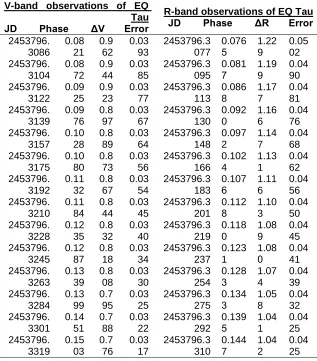
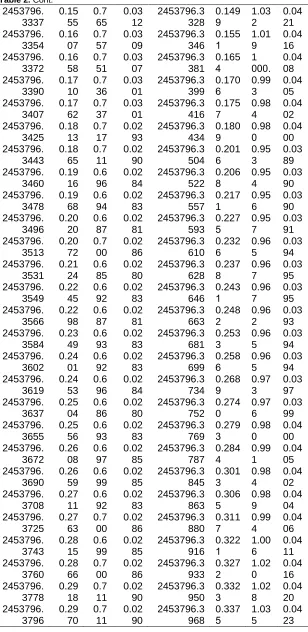
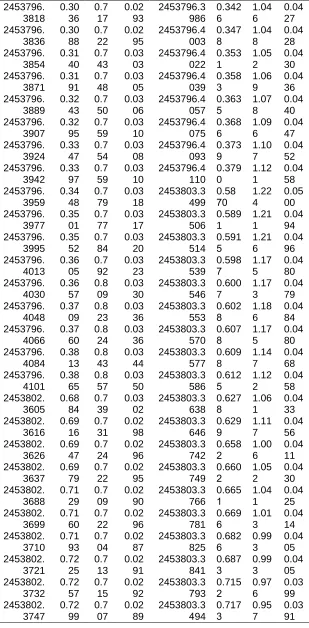
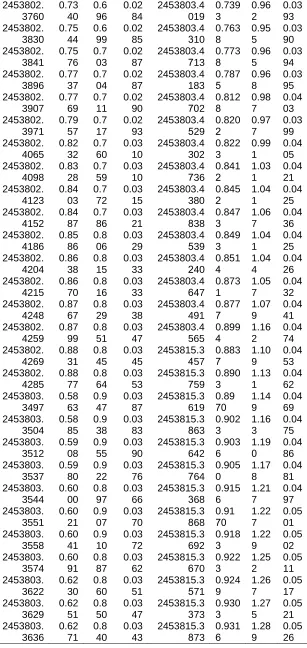
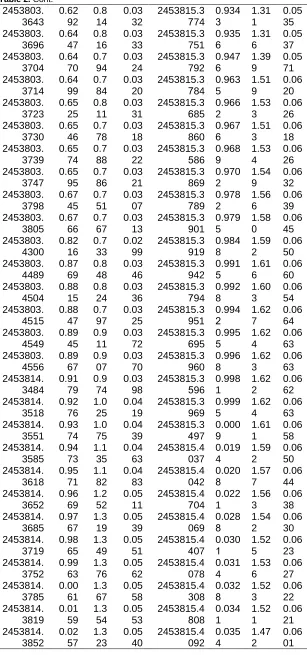
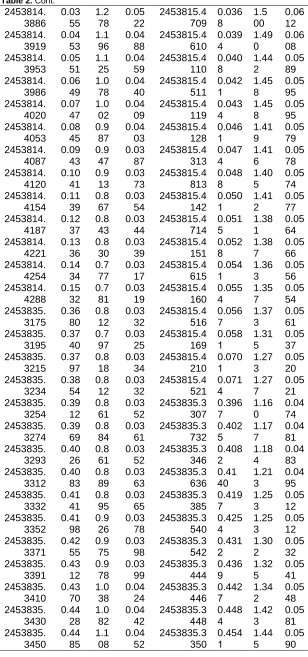
be ignored. The observed images were analyzed by the photometry software AIP4WIN (Berry and Buruell 2000) which is based on aperture photometry, including bias and dark subtraction and flat field correction. A complete light curves were obtained only in V and R filters. A total of 649 individual observations were obtained in VR band pass (252 in V and 397 in R), which covered a complete light curves in V and R bands, as displayed in Figure (1). The individual observations in both bands are listed in Table 2, with the magnitude difference (the variable minus the comparison). The phases were calculated using the ephemeris of Kreiner et al. (2000):
Min I = 2440203.4343 + 0.d341347947 * E. (1)
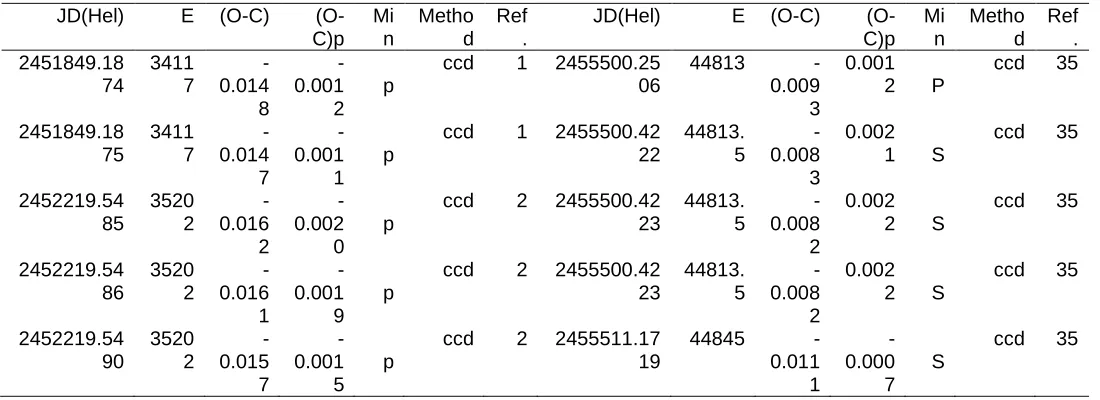
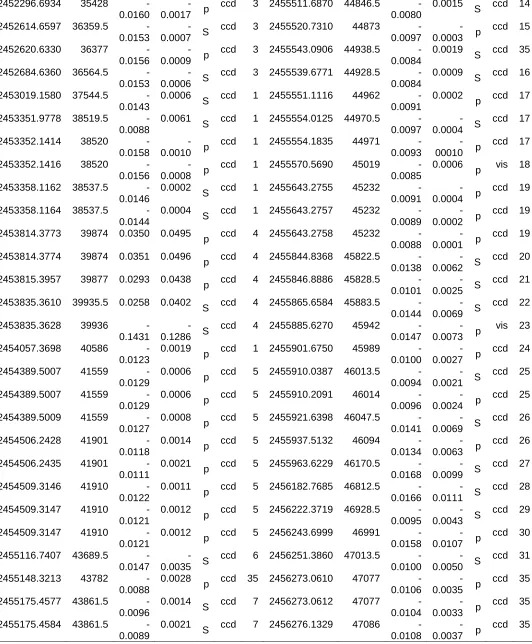
From the present observations, the times of three primary light minima were calculated using the Minima V2.3 Package (Nelson 2006) based on the Kwee and Van Worden (1956) fitting method. The calculated minima are shown in Table (3) and together with all published photoelectric and CCD minima in Table (4).
Table 1. Coordinates of EQ Tau, comparison, and the check stars
Star Name (2000.0) δ (2000.0) V B-V
EQ Tau 03h48' 16.0'' +22o 17' 30.0'' 11.1
8
0.86
Comparison (TYC 1260-575-1) 03h48' 16.5'' +22o 17' 29.7'' 10.3 2
1.15
Check (GSC 01260-00800) 03h48' 17.4'' +22o 22' 43.0'' 8.19 0
1.05
Table 2. CCD Observations of EQ Tau in VR band.
band observations of EQ
-V
Tau JD Phase ΔV Error
and observations of EQ Tau b
-R
JD Phase ΔR Error
2453796. 3086
0.08 21
0.9 62
0.03 93
2453796.3 077
0.076 5 1.229
0.05 02 2453796.
3104
0.08 72
0.9 44
0.03 85
2453796.3 095
0.081 7
1.19 9
0.04 90 2453796.
3122
0.09 25
0.9 23
0.03 77
2453796.3 113
0.086 8
1.17 7
0.04 81 2453796.
3139
0.09 76
0.8 97
0.03 67
2453796.3 130
0.092 0
1.16 6
0.04 76 2453796.
3157
0.10 28
0.8 89
0.03 64
2453796.3 148
0.097 2
1.14 7
0.04 68 2453796.
3175
0.10 80
0.8 73
0.03 56
2453796.3 166
0.102 4
1.13 1
0.04 62 2453796.
3192
0.11 32
0.8 67
0.03 54
2453796.3 183
0.107 6 1.116
0.04 56 2453796.
3210
0.11 84
0.8 44
0.03 45
2453796.3 201
0.112 8
1.10 3
0.04 50 2453796.
3228
0.12 35
0.8 32
0.03 40
2453796.3 219
0.118 0
1.08 9
0.04 45 2453796.
3245
0.12 87
0.8 18
0.03 34
2453796.3 237
0.123 1
1.08 0
0.04 41 2453796.
3263
0.13 39
0.8 08
0.03 30
2453796.3 254
0.128 3
1.07 4
0.04 39 2453796.
3284
0.13 99
0.7 95
0.03 25
2453796.3 275
0.134 3 1.058
0.04 32 2453796.
3301
0.14 51
0.7 88
0.03 22
2453796.3 292
0.139 5 1.041
0.04 25 2453796.
3319
0.15 03
0.7 76
0.03 17
2453796.3 310
0.144 7
1.04 2
Table 2. Cont. 2453796. 3337 0.15 55 0.7 65 0.03 12 2453796.3 328 0.149 9 1.03 2 0.04 21 2453796. 3354 0.16 07 0.7 57 0.03 09 2453796.3 346 0.155 1 1.019
0.04 16 2453796. 3372 0.16 58 0.7 51 0.03 07 2453796.3 381 0.165 4 1 . 000 0.04 08 2453796. 3390 0.17 10 0.7 36 0.03 01 2453796.3 399 0.170 6 0.993
0.04 05 2453796. 3407 0.17 62 0.7 37 0.03 01 2453796.3 416 0.175 7 0.98 4 0.04 02 2453796. 3425 0.18 13 0.7 17 0.02 93 2453796.3 434 0.180 9 0.98 0 0.0400 2453796. 3443 0.18 65 0.7 11 0.02 90 2453796.3 504 0.201 6 0.95 3 0.03 89 2453796. 3460 0.19 16 0.6 96 0.02 84 2453796.3 522 0.206 8 0.954
0.03 90 2453796. 3478 0.19 68 0.6 94 0.02 83 2453796.3 557 0.217 1 0.95 6 0.03 90 2453796. 3496 0.20 20 0.6 87 0.02 81 2453796.3 593 0.227 5 0.957
0.03 91 2453796. 3513 0.20 72 0.7 00 0.02 86 2453796.3 610 0.232 6 0.96 5 0.03 94 2453796. 3531 0.21 24 0.6 85 0.02 80 2453796.3 628 0.237 8 0.96 7 0.03 95 2453796. 3549 0.22 45 0.6 92 0.02 83 2453796.3 646 0.243 1 0.96 7 0.03 95 2453796. 3566 0.22 98 0.6 87 0.02 81 2453796.3 663 0.248 2 0.96 2 0.03 93 2453796. 3584 0.23 49 0.6 93 0.02 83 2453796.3 681 0.253 3 0.96 5 0.03 94 2453796. 3602 0.24 01 0.6 92 0.02 83 2453796.3 699 0.258 6 0.965
0.03 94 2453796. 3619 0.24 53 0.6 96 0.02 84 2453796.3 734 0.268 9 0.97 3 0.03 97 2453796. 3637 0.25 04 0.6 86 0.02 80 2453796.3 752 0.274 0 0.97 6 0.03 99 2453796. 3655 0.25 56 0.6 93 0.02 83 2453796.3 769 0.279 3 0.98 0 0.04 00 2453796. 3672 0.26 08 0.6 97 0.02 85 2453796.3 787 0.284 4 0.99 1 0.04 05 2453796. 3690 0.26 59 0.6 99 0.02 85 2453796.3 845 0.301 3 0.98 4 0.04 02 2453796. 3708 0.27 11 0.6 92 0.02 83 2453796.3 863 0.306 5 0.98 9 0.04 04 2453796. 3725 0.27 63 0.7 00 0.02 86 2453796.3 880 0.311 7 0.99 4 0.04 06 2453796. 3743 0.28 15 0.6 99 0.02 85 2453796.3 916 0.322 1 1.006
0.04 11 2453796. 3760 0.28 66 0.7 00 0.02 86 2453796.3 933 0.327 2 1.02 0 0.04 16 2453796. 3778 0.29 18 0.7 11 0.02 90 2453796.3 950 0.332 3 1.028
A Holistic study of the eclipsing binary EQ Tau Elkhateeb and Nouh 017
Table 2. Cont.
2453796. 3818 0.30 36 0.7 17 0.02 93 2453796.3 986 0.342 6 1.04 6 0.04 27 2453796. 3836 0.30 88 0.7 22 0.02 95 2453796.4 003 0.347 8 1.048
0.04 28 2453796. 3854 0.31 40 0.7 43 0.03 03 2453796.4 022 0.353 1 1.05 2 0.04 30 2453796. 3871 0.31 91 0.7 48 0.03 05 2453796.4 039 0.358 3 1.069
0.04 36 2453796. 3889 0.32 43 0.7 50 0.03 06 2453796.4 057 0.363 5 1.07 8 0.04 40 2453796. 3907 0.32 95 0.7 59 0.03 10 2453796.4 075 0.368 6 1.09 6 0.04 47 2453796. 3924 0.33 47 0.7 54 0.03 08 2453796.4 093 0.373 9 1.10 7 0.04 52 2453796. 3942 0.33 97 0.7 59 0.03 10 2453796.4 110 0.379 0 1.12 1 0.04 58 2453796. 3959 0.34 48 0.7 79 0.03 18 2453803.3 499 0.58 70 1.22 4 0.05 00 2453796. 3977 0.35 01 0.7 77 0.03 17 2453803.3 506 0.589 1 1.21 1 0.04 94 2453796. 3995 0.35 52 0.7 84 0.03 20 2453803.3 514 0.591 5 1.21 6 0.04 96 2453796. 4013 0.36 05 0.7 92 0.03 23 2453803.3 539 0.598 7 1.175
0.04 80 2453796. 4030 0.36 57 0.8 09 0.03 30 2453803.3 546 0.600 7 1.17 3 0.04 79 2453796. 4048 0.37 09 0.8 23 0.03 36 2453803.3 553 0.602 8 1.186
0.04 84 2453796. 4066 0.37 60 0.8 24 0.03 36 2453803.3 570 0.607 8 1.17 5 0.04 80 2453796. 4084 0.38 13 0.8 43 0.03 44 2453803.3 577 0.609 8 1.14 7 0.04 68 2453796. 4101 0.38 65 0.8 57 0.03 50 2453803.3 586 0.612 5 1.12 2 0.04 58 2453802. 3605 0.68 84 0.7 39 0.03 02 2453803.3 638 0.627 8 1.061
0.04 33 2453802. 3616 0.69 16 0.7 31 0.02 98 2453803.3 646 0.629 9 1.11 7 0.04 56 2453802. 3626 0.69 47 0.7 24 0.02 96 2453803.3 742 0.658 2 1.006
0.04 11 2453802. 3637 0.69 79 0.7 22 0.02 95 2453803.3 749 0.660 2 1.05 2 0.04 30 2453802. 3688 0.71 29 0.7 09 0.02 90 2453803.3 766 0.665 1 1.041
0.04 25 2453802. 3699 0.71 60 0.7 22 0.02 96 2453803.3 781 0.669 6 1.01 3 0.04 14 2453802. 3710 0.71 93 0.7 04 0.02 87 2453803.3 825 0.682 6 0.993
0.04 05 2453802. 3721 0.72 25 0.7 13 0.02 91 2453803.3 841 0.687 3 0.99 3 0.04 05 2453802. 3732 0.72 57 0.7 15 0.02 92 2453803.3 93
Table 2. Cont. 2453802. 3760 0.73 40 0.6 96 0.02 84 2453803.4 019 0.739 3 0.96 2 0.03 93 2453802. 3830 0.75 44 0.6 99 0.02 85 2453803.4 10 3 0.763 8 0.95 5 0.03 90 2453802. 3841 0.75 76 0.7 03 0.02 87 2453803.4 13
7 0.7738 0.965 0.03 94 2453802. 3896 0.77 37 0.7 04 0.02 87 2453803.4 183 0.787 5 0.96 8 0.03 95 2453802. 3907 0.77 69 0.7 11 0.02 90 2453803.4 2
70 0.8128 0.987 0.04 03 2453802. 3971 0.79 57 0.7 17 0.02 93 2453803.4 29 5 0.820 2 0.97 7 0.03 99 2453802. 4065 0.82 32 0.7 60 0.03 10 2453803.4 302 0.822 3 0.99 1 0.04 05 2453802. 4098 0.83 28 0.7 59 0.03 10 2453803.4 36 7 0.841 2 1.03 1 0.04 21 2453802. 4123 0.84 03 0.7 72 0.03 15 2453803.4 380 0.845 2 1.041
0.04 25 2453802. 4152 0.84 87 0.7 86 0.03 21 2453803.4 38 8 0.847 3 1.06 7 0.04 36 2453802. 4186 0.85 86 0.8 06 0.03 29 2453803.4 39
5 0.8493 1.04 1 0.04 25 2453802. 4204 0.86 38 0.8 15 0.03 33 2453803.4 40 2 0.851 4 1.04 4 0.04 26 2453802. 4215 0.86 70 0.8 16 0.03 33 2453803.4 47
6 0.8731 1.05 7 0.04 32 2453802. 4248 0.87 67 0.8 29 0.03 38 2453803.4 491 0.877 7 1.07 9 0.04 41 2453802. 4259 0.87 99 0.8 51 0.03 47 2453803.4 565 0.899 4 1.162
0.04 74 2453802. 4269 0.88 31 0.8 45 0.03 45 2453815.3 57 4 0.883 7 1.10 9 0.04 53 2453802. 4285 0.88 77 0.8 64 0.03 53 2453815.3 59
7 0.8903 1.13 1 0.04 62 2453803. 3497 0.58 63 0.9 47 0.03 87 2453815.3 619 0.89 70 1.14 9 0.04 69 2453803. 3504 0.58 85 0.9 38 0.03 83 2453815.3 63
8 0.9023 1.16 3 0.04 75 2453803. 3512 0.59 08 0.9 55 0.03 90 2453815.3 642 0.903 6 1.19 0 0.04 86 2453803. 3537 0.59 80 0.9 22 0.03 76 2453815.3 64
7 0.9050 1.17 8 0.04 81 2453803. 3544 0.60 00 0.8 97 0.03 66 2453815.3 68 3 0.915 6 1.21 7 0.04 97 2453803. 3551 0.60 21 0.9 07 0.03 70 2453815.3 68
8 0.9170 1.227 0.05 01 2453803. 3558 0.60 41 0.9 10 0.03 72 2453815.3 692 0.918 3 1.22 9 0.05 02 2453803. 3574 0.60 91 0.8 87 0.03 62 2453815.3 70
6 0.9223 1.252 0.05 11 2453803. 3622 0.62 30 0.8 60 0.03 51 2453815.3 71 5 0.924 9 1.26 7 0.05 17 2453803. 3629 0.62 51 0.8 50 0.03 47 2453815.3 73
A Holistic study of the eclipsing binary EQ Tau Elkhateeb and Nouh 019
Table 2. Cont.
2453803. 3643 0.62 92 0.8 14 0.03 32 2453815.3 74
7 0.9343 1.311 0.05 35 2453803. 3696 0.64 47 0.8 16 0.03 33 2453815.3 751 0.935 6 1.31 6 0.05 37 2453803. 3704 0.64 70 0.7 94 0.03 24 2453815.3 792 0.947 6 1.39 9 0.05 71 2453803. 3714 0.64 99 0.7 84 0.03 20 2453815.3 84
7 0.9635 1.51 9 0.06 20 2453803. 3723 0.65 25 0.8 11 0.03 31 2453815.3 85
6 0.9662 1.53 3 0.06 26 2453803. 3730 0.65 46 0.7 78 0.03 18 2453815.3 860 0.967 6 1.513
0.06 18 2453803. 3739 0.65 74 0.7 88 0.03 22 2453815.3 86
5 0.9689 1.534 0.06 26 2453803. 3747 0.65 95 0.7 86 0.03 21 2453815.3 869 0.970 2 1.54 9 0.06 32 2453803. 3798 0.67 45 0.7 51 0.03 07 2453815.3 89 7 0.978 2 1.56 6 0.06 39 2453803. 3805 0.67 66 0.7 67 0.03 13 2453815.3 901 0.979 5 1.58 0 0.06 45 2453803. 4300 0.82 16 0.7 33 0.02 99 2453815.3 919 0.984 8 1.59 2 0.06 50 2453803. 4489 0.87 69 0.8 48 0.03 46 2453815.3 942 0.991 5 1.616
0.06 60 2453803. 4504 0.88 15 0.8 24 0.03 36 2453815.3 94
7 0.9928 1.60 3 0.06 54 2453803. 4515 0.88 47 0.7 97 0.03 25 2453815.3 951 0.994 2 1.627
0.06 64 2453803. 4549 0.89 45 0.9 11 0.03 72 2453815.3 95 6 0.995 5 1.62 4 0.06 63 2453803. 4556 0.89 67 0.9 07 0.03 70 2453815.3 960 0.996 8 1.62 3 0.06 63 2453814. 3484 0.91 79 0.9 74 0.03 98 2453815.3 96
5 0.9981 1.62 2 0.06 62 2453814. 3518 0.92 76 1.0 25 0.04 19 2453815.3 969 0.999 5 1.62 4 0.06 63 2453814. 3551 0.93 74 1.0 75 0.04 39 2453815.3 97
4 0.0009 1.611 0.06 58 2453814. 3585 0.94 73 1.1 35 0.04 63 2453815.4 037 0.019 4 1.59 2 0.06 50 2453814. 3618 0.95 71 1.1 82 0.04 83 2453815.4 042 0.020 8 1.577
0.06 44 2453814. 3652 0.96 69 1.2 52 0.05 11 2453815.4 04 7 0.022 1 1.56 3 0.06 38 2453814. 3685 0.97 67 1.3 19 0.05 39 2453815.4 069 0.028 8 1.542
0.06 30 2453814. 3719 0.98 65 1.3 49 0.05 51 2453815.4 07 4 0.030 1 1.52 5 0.06 23 2453814. 3752 0.99 63 1.3 76 0.05 62 2453815.4 078 0.031 4 1.53 6 0.06 27 2453814. 3785 0.00 61 1.3 67 0.05 58 2453815.4 08
3 0.0328 1.523 0.06 22 2453814. 3819 0.01 59 1.3 54 0.05 53 2453815.4 08
J. Physics Astron. Res. 020
Table 2. Cont.
2453814. 3886 0.03 55 1.2 78 0.05 22 2453815.4 09
7 0.0368 1.500 0.0612 2453814. 3919 0.04 53 1.1 96 0.04 88 2453815.4 10 6 0.039 4 1.49 0 0.06 08 2453814. 3953 0.05 51 1.1 25 0.04 59 2453815.4 110 0.040 8 1.442
0.05 89 2453814. 3986 0.06 49 1.0 78 0.04 40 2453815.4 11 5 0.042 1 1.45 8 0.05 95 2453814. 4020 0.07 47 1.0 02 0.04 09 2453815.4 119 0.043 4 1.45 8 0.05 95 2453814. 4053 0.08 45 0.9 87 0.04 03 2453815.4 128 0.046 1 1.419
0.05 79 2453814. 4087 0.09 43 0.9 47 0.03 87 2453815.4 13
3 0.0474 1.41 6 0.05 78 2453814. 4120 0.10 41 0.9 13 0.03 73 2453815.4 13
8 0.0488 1.405 0.05 74 2453814. 4154 0.11 39 0.8 67 0.03 54 2453815.4 142 0.050 1 1.412
0.05 77 2453814. 4187 0.12 37 0.8 43 0.03 44 2453815.4 14 7 0.051 5 1.38 1 0.05 64 2453814. 4221 0.13 36 0.8 30 0.03 39 2453815.4 151 0.052 8 1.38 7 0.05 66 2453814. 4254 0.14 34 0.7 77 0.03 17 2453815.4 15 6 0.054 1 1.36 3 0.05 56 2453814. 4288 0.15 32 0.7 81 0.03 19 2453815.4 160 0.055 4 1.35 7 0.05 54 2453835. 3175 0.36 80 0.8 12 0.03 32 2453815.4 16
5 0.0567 1.37 3 0.05 61 2453835. 3195 0.37 40 0.7 97 0.03 25 2453815.4 169 0.058 1 1.315
0.05 37 2453835. 3215 0.37 97 0.8 18 0.03 34 2453815.4 210 0.070 1 1.27 3 0.05 20 2453835. 3234 0.38 54 0.8 12 0.03 32 2453815.4 21
5 0.0714 1.277 0.05 21 2453835. 3254 0.39 12 0.8 61 0.03 52 2453835.3 307 0.396 7 1.16 0 0.04 74 2453835. 3274 0.39 69 0.8 84 0.03 61 2453835.3 32
7 0.4025 1.177 0.04 81 2453835. 3293 0.40 26 0.8 61 0.03 52 2453835.3 346 0.408 2 1.18 4 0.04 83 2453835. 3312 0.40 83 0.8 89 0.03 63 2453835.3 36
6 0.4140 1.213 0.04 95 2453835. 3332 0.41 41 0.8 95 0.03 65 2453835.3 385 0.419 7 1.25 3 0.05 12 2453835. 3352 0.41 98 0.9 26 0.03 78 2453835.3 40
5 0.4254 1.25 3 0.05 12 2453835. 3371 0.42 55 0.9 75 0.03 98 2453835.3 42 5 0.431 2 1.30 2 0.05 32 2453835. 3391 0.43 12 0.9 78 0.03 99 2453835.3 444 0.436 9 1.32 5 0.05 41 2453835. 3410 0.43 70 1.0 38 0.04 24 2453835.3 46
4 0.4427 1.342 0.05 48 2453835. 3430 0.44 28 1.0 82 0.04 42 2453835.3 48
4 0.4484 1.42 3 0.05 81 2453835. 3450 0.44 85 1.1 08 0.04 52 2453835.3 50
A Holistic study of the eclipsing binary EQ Tau Elkhateeb and Nouh 021
Table 2. Cont.
2453835. 3469
0.45 42
1.1 13
0.04 54
2453835.3 52
3 0.4598 1.48 0 0.0604 2453835.
3489
0.46 00
1.1 12
0.04 54
2453835.3 542
0.465 6
1.49 4
0.06 10 2453835.
3508
0.46 57
1.2 07
0.04 93
2453835.3 56
2 0.4713 1.521 0.06 21 2453835.
3528
0.47 14
1.2 33
0.05 03
2453835.3 581
0.477 0
1.57 8
0.06 44 2453835.
3548
0.47 72
1.2 09
0.04 94
2453835.3 60
1 0.4828 1.581 0.06 45 2453835.
3567
0.48 29
1.2 92
0.05 28
2453835.3 659
0.499 9
1.58 3
0.06 46 2453835.
3626
0.50 01
1.3 17
0.05 38
2453835.3 67
9 0.5057 1.573 0.06 42 2453835.
3665
0.51 15
1.3 00
0.05 31
2453835.3 69
9 0.5114 1.570 0.0641
0 0.4 0.8 1.2
-0.2 0.2 0.6 1
Phase
1.6 1.2 0.8
1.8 1.4 1 0.6
(V
-C
)
m
ag
V
R
Figure 1. Light curves of EQ Tau in V and R filters.
Table 3. Light minima of EQ Tau.
HJD Error Min Filter
2453814.3773 ±0.0002 I V
2453814.3774 ±0.0005 I B
2453815.3957 ±0.0003 I R
2453835.3610 ±0.0014 II V
2453835.3628 ±0.0004 II R
Orbital Period Behavior
Alton (2006) estimated a very slow orbital period increase with a rate of 0.021 sec/year. Hrivnak et al. (2006) studied the period variation using the list of minima collected by Pribulla and Vanko (2002). They noted that the periodicity adopted by Pribulla and Vanko (2002) was based on older visual data of Tsesevich (1954) and photographic minima of Whitney (1972) from 1959 to 1962, while the period behavior based on photoelectric and recent photographic data showed a constant trend. They re-analyzed the period stability using high quality timings of minima of photoelectric observations together with their observed minima covering the interval from 1989 to 2005. Their results showed that the period of the system EQ Tau was constant around 1974 instead of cyclical variation.
A cyclical behavior for the orbital period of the system EQ Tau was announced again by Yuan and Qian (2007) with a periodic variation of period 48.5 yr based on all published minima covering 64 yr. Alton (2009) showed that the period increased by 0.015 sec/yr over the interval from 2000-2009. From the previous orbital period studies of the system EQ Tau, it’s clear that the trend of period behavior depend on the quality of the collected minima and the covered interval. In the present paper we used an updated list of published minima from the literatures together with that listed in the web site (http:J//astro.sci.muni.cz/variables/ocgate/) and our new observed minima, which produced a complete set of data. A total of 264 timings of minima covered the interval of 59 years (~ 63130 revolutions) from 1954 to 2013 were used to follow the long term behavior of the system EQ Tau by means of (O-C) diagram.
Linear ephemeris of Kreiner et al. (2000) (Eq. 1) was used to determine the calculated “C” values of the eclipse timings, listed in Table (4). Some collected uncertain minima were discarded in order to estimate accurate results. The (O-C) values were represented in Figure (2) versus the integer cycle E, where no distinctions have been made between primary and secondary minima. Scattering of some minima in the (O-C) diagram may be resulted from the variation in the observed light curves, which leads to non-asymmetry and also uncertainty in the calculated minima. Any mean light elements estimated by the linear best fit for all residual points are not suitable to estimate the times of minima in future. As the O-C diagram shows two ascending and similar descending branches, we are going to divide the (O-C) variation into four sections Ei – Ei-1, i = 1, 2, 3, 4. The period behavior in each section was represented by linear fit with corresponding change in the period ∆p, which were listed in Table (5) together with the standard deviations SD, correlation coefficient r and the residual sum of squares. Results in Table (5) reveal that the period of the system EQ Tau shows two intervals of increase and decrease, which looks like a periodic behavior. This behavior may be interpreted as caused by the presence of magnetic activity cycle and/or mass transfer mechanism. The general trend of the (O-C) diagram can be represented by a fifth degree polynomial with residual sum of squares = 0.0014 and correlation coefficient = 0.918 as:
Min I = 2440203.4314 + 0.341349197 * E – 4.4731*10-11 * E2 - 1.7186*10-15 *E3
+ 6.4851*10-20 * E4 – 4.4607*10-25 * E5 (2)
Eq. 2 represents a new light element for the system EQ Tau which shows a period increases with rate dP/dE = 8.946 (±0.365) x 10-11 days/cycle or 9.566 (±0.391) x 10-8 days/year or 0.83 (±0.033) seconds/century. The (O-C)p residuals were calculating using polynomial ephemeris (Eq. 2) and listed in Table (4) and displayed in Figure(3).
Table 4. Times of minimum light for EQ Tau.
JD(Hel) E (O-C)
(O-C)p Mi
n
Metho d
Ref .
JD(Hel) E (O-C)
(O-C)p Mi
n
Metho d
Ref . 2451849.18
74
3411 7
-0.014 8
-0.001 2
p
ccd 1 2455500.25
06
44813
-0.009 3
0.001
2 P
ccd 35
2451849.18 75
3411 7
-0.014 7
-0.001 1
p
ccd 1 2455500.42
22
44813. 5
-0.008 3
0.002
1 S
ccd 35
2452219.54 85
3520 2
-0.016 2
-0.002 0
p
ccd 2 2455500.42
23
44813. 5
-0.008 2
0.002
2 S
ccd 35
2452219.54 86
3520 2
-0.016 1
-0.001 9
p
ccd 2 2455500.42
23
44813. 5
-0.008 2
0.002
2 S
ccd 35
2452219.54 90
3520 2
-0.015 7
-0.001 5
p
ccd 2 2455511.17
19
44845
-0.011 1
-0.000 7
S
A Holistic study of the eclipsing binary EQ Tau Elkhateeb and Nouh 023
Table 4. Cont.
2452296.6934 35428
-0.0160
-0.0017 p
ccd 3 2455511.6870 44846.5
-0.0080
0.0015
S ccd 14
2452614.6597 36359.5
-0.0153
-0.0007 S
ccd 3 2455520.7310 44873
-0.0097
-0.0003 p
ccd 15
2452620.6330 36377
-0.0156
-0.0009 p
ccd 3 2455543.0906 44938.5
-0.0084
0.0019
S ccd 35
2452684.6360 36564.5
-0.0153
-0.0006 S
ccd 3 2455539.6771 44928.5
-0.0084
0.0009
S ccd 16
2453019.1580 37544.5
-0.0143
0.0006
S ccd 1 2455551.1116 44962
-0.0091
0.0002
p ccd 17
2453351.9778 38519.5
-0.0088
0.0061
S ccd 1 2455554.0125 44970.5
-0.0097
-0.0004 S
ccd 17
2453352.1414 38520
-0.0158
-0.0010 p
ccd 1 2455554.1835 44971
-0.0093
-00010 p
ccd 17
2453352.1416 38520
-0.0156
-0.0008 p
ccd 1 2455570.5690 45019
-0.0085
0.0006
p vis 18
2453358.1162 38537.5
-0.0146
0.0002
S ccd 1 2455643.2755 45232
-0.0091
-0.0004 p
ccd 19
2453358.1164 38537.5
-0.0144
0.0004
S ccd 1 2455643.2757 45232
-0.0089
-0.0002 p
ccd 19
2453814.3773 39874 0.0350 0.0495
p ccd 4 2455643.2758 45232
-0.0088
-0.0001 p
ccd 19
2453814.3774 39874 0.0351 0.0496
p ccd 4 2455844.8368 45822.5
-0.0138
-0.0062 S
ccd 20
2453815.3957 39877 0.0293 0.0438
p ccd 4 2455846.8886 45828.5
-0.0101
-0.0025 S
ccd 21
2453835.3610 39935.5 0.0258 0.0402
S ccd 4 2455865.6584 45883.5
-0.0144
-0.0069 S
ccd 22
2453835.3628 39936
-0.1431
-0.1286 S
ccd 4 2455885.6270 45942
-0.0147
-0.0073 p
vis 23
2454057.3698 40586
-0.0123
0.0019
p ccd 1 2455901.6750 45989
-0.0100
-0.0027 p
ccd 24
2454389.5007 41559
-0.0129
0.0006
p ccd 5 2455910.0387 46013.5
-0.0094
-0.0021 S
ccd 25
2454389.5007 41559
-0.0129
0.0006
p ccd 5 2455910.2091 46014
-0.0096
-0.0024 p
ccd 25
2454389.5009 41559
-0.0127
0.0008
p ccd 5 2455921.6398 46047.5
-0.0141
-0.0069 S
ccd 26
2454506.2428 41901
-0.0118
0.0014
p ccd 5 2455937.5132 46094
-0.0134
-0.0063 p
ccd 26
2454506.2435 41901
-0.0111
0.0021
p ccd 5 2455963.6229 46170.5
-0.0168
-0.0099 S
ccd 27
2454509.3146 41910
-0.0122
0.0011
p ccd 5 2456182.7685 46812.5
-0.0166
-0.0111 S
ccd 28
2454509.3147 41910
-0.0121
0.0012
p ccd 5 2456222.3719 46928.5
-0.0095
-0.0043 S
ccd 29
2454509.3147 41910
-0.0121
0.0012
p ccd 5 2456243.6999 46991
-0.0158
-0.0107 p
ccd 30
2455116.7407 43689.5
-0.0147
-0.0035 S
ccd 6 2456251.3860 47013.5
-0.0100
-0.0050 S
ccd 31
2455148.3213 43782
-0.0088
0.0028
p ccd 35 2456273.0610 47077
-0.0106
-0.0035 p
ccd 35
2455175.4577 43861.5
-0.0096
0.0014
S ccd 7 2456273.0612 47077
-0.0104
-0.0033 p
ccd 35
2455175.4584 43861.5
-0.0089
0.0021
S ccd 7 2456276.1329 47086
-0.0108
-0.0037 p
Table 4. Cont.
2455175.4594 43861.5
-0.0079
0.0031
S ccd 7 2456276.1333 47086
-0.0104
-0.0033 p
ccd 35
2455175.4594 43861.5
-0.0079
0.0031
S ccd 7 2456276.6458 47087.5
-0.0099
-0.0052 S
ccd 32
2455175.6270 43862
-0.0110
0.0001
p ccd 7 2456290.6423 47128.5
-0.0087
-0.0040 S
ccd 33
2455175.6286 43862
-0.0094
0.0017
p ccd 7 2456291.4953 47131
-0.0091
-0.0044 p
ccd 34
2455186.3807 43893.5
-0.0097
0.0013
S ccd 8 2456301.0512 47159
-0.0109
-0.0040 p
ccd 35
2455192.6950 43912
-0.0104
0.0006
p ccd 9 2456301.0514 47159
-0.0107
-0.0038 p
ccd 35
2455219.3202 43990
-0.0103
0.0005
p ccd 8 2456301.0514 47159
-0.0107
-0.0038 p
ccd 35
2455259.5991 44108
-0.0105
0.0002
p ccd 10 2456301.0516 47159
-0.0105
-0.0036 p
ccd 35
2455453.4850 44676
-0.0102
-0.0004 p
ccd 8 2456301.2223 47159.5
-0.0105
-0.0035 S
ccd 35
2455460.3146 44696
-0.0075
0.0031
p ccd 35 2456301.2223 47159.5
-0.0105
-0.0035 S
ccd 35
2455460.3147 44696
-0.0074
0.0032
p ccd 35 2456301.2224 47159.5
-0.0104
-0.0034 S
ccd 35
2455480.4519 44755
-0.0098
-0.0002 p
ccd 11 2456301.2225 47159.5
-0.0103
-0.0033 S
ccd 35
2455485.7443 44770.5
-0.0083
0.0013
s ccd 12 2456549.5516 47887
-0.0118
-0.0091 p
ccd 36
2455498.8846 44809
-0.0099
-0.0003 p
ccd 13 2456556.5502 47907.5
-0.0109
-0.0082 S
ccd 36
2455499.3979 44810.5
-0.0086
0.0010
S ccd 8 2456592.3899 48012.5
-0.0127
-0.0103 S
ccd 37
2455500.2505 44813
-0.0090
0.0011
p ccd 35 2456613.7242 48075
-0.0127
-0.0105 p
ccd 38
2455500.2505 44813
-0.0094
0.0011
p ccd 35 2456619.8641 48093
-0.0170
-0.0149 p
ccd 39
References: 1-.Yuan and Qian (2007); 2- Lehky (2009); 3- Hrivnak et al. (2006); 4- Present work; 5- Smelcer (2007); 6- Menzies (2009); 7- Agerer (2011); 8- Parimucha (211); 9- Diethelm (2010); 10- Samolyk (2010); Moschner (2012); 12- Samolyk (2010); 13- Diethelm (2011); 14- Poklar (2010); 15- Nelson (2011); 16- Simmon (2010); 17- Itoh (2010); 18- Stephan (2011); 19- Smelcer (2011); 20- Samolyk (2011); 21- Diethelm (2012); 22- Menzies (2011); 23- Stephan (2011); 24- Nelson (2012); 25- Shiokawa (2011); 26- Samolyk (2011); 27- Sabo (2012); 28- Menzies (2012a); 29- Parimucha (2013); 30- Menzies (2012b); 31- Hubscer (2013); 32- Menzies (2012c); 33- Diethelm (2013); 34- Vincenzi (2012); 35- Li et al. (2014); 36- Magris (2013); 37- UMA (2013); 38-Nelson (2013); 39-Samolyk (2013).
Table 5. Period behavior for the system EQ Tau
Parameters
Intervals (2400000+) 1
to E 0 E 30647 - 34389
2 to E 1 E
34389 –
43483
3 to E 2 E
43483
-52185
4 to E 3 E
52185 -
56301
ΔE (day) 3742 9094 8702 4116
Period (day) 0.341345116 0.341348869 0.341346785 0.341348580
ΔP (day) -2.831x 10⁻⁶ 9.220x 10⁻⁷ -1.162x 10⁻⁶ 6.327x 10⁻⁷
ΔP/P -8.293x 10⁻⁶ 2.701x 10⁻⁶ -3.404x 10⁻⁶ 1.854x 10⁻⁶
ΔP/ ΔE (d/cycle) -7.566x 10⁻¹⁰ 1.014x 10⁻¹⁰ -1.335x 10⁻¹⁰ 1.537x 10⁻¹⁰
Epoch (2400000+) 40203.3664 40203.4278 40203.4582 40203.3933
SD 0.00165 0.00269 0.00265 0.00116
R 0.99790 0.88708 0.94931 0.89122
Residual sum of
square
0.000003 0.00015 0.00032 0.00026
A Holistic study of the eclipsing binary EQ Tau Elkhateeb and Nouh 025
-20000 0 20000 40000 60000
-30000 -10000 10000 30000 50000
Integer cycle (E) -0.02
0 0.02
-0.03 -0.01 0.01 0.03
(O
-C
)
Figure 2. Period behavior of EQ Tau
-40000
-20000
0
20000
40000
60000
Integer Cycle (E)
-0.01
0
0.01
-0.015 -0.005 0.005 0.015
(O
-C
)p
Figure 3. Calculated residuals from the polynomial ephemeris
Light Curve Variation
The historical survey of the published light curves for the system EQ Tau since its discovery showed asymmetry and distortions at maximum phases, which seem to be referred to surface inhomogeneities of the components. The primary maximum (Max I) is brighter than the secondary one (Max II), which known as O’Connell effect, and appears in many eclipsing binaries which may refer to hot or cool regions on either components. Observations by Yang and Liu (2002) showed a typical O’Connell effect and a primary maximum brighter than secondary one by 0.03 mag., while Pribulla and Vanko (2002) showed maximum difference of about 0.017. Observed light curves by Hrivnak et al (2006) displayed a flat-bottom in the secondary minimum which indicates that the cooler component was eclipsed totally and showed a maximum differences (O’Connell effect) of about ~ 0.03 mag. Alton (2006, 2009) observed an apparent asymmetry at Max I and linked it to hot or dark spot on either components facing the observer.
Using our observations together with all published light curves, the light levels (Max I, Max II, Min I, and Min II) were estimated. The amplitudes (depths) of the primary Ap(mag(Min I – Max I)) and secondary As(mag(Min II – Max I)), and
the magnitude difference between both maxima (O’Connell effect) Dmax(mag(Max I – Max II)) and minima Dmin(mag(Min I – Min II)) have been calculated for each light curve and listed in Table (6), while displayed in Figure(4). The behavior of the parameters Dmax, Dmin, Ap,and Asshowed a wave-like variation as periodic function. This behavior may be interpreted by a periodic effect of some physical mechanism (i.e. magnetic activity, and/or mass transfer). It’s clear that both the period change behavior and light curve parameters (Dmax, Dmin, Ap,and As) of the system EQ Tau showed a periodic variation which may be referred to the presence of magnetic activity cycles in more massive components and/or mass transfer mechanism. A future sequence series of observations for the system EQ Tau are needed in order to follow this periodic variation.
Table 6. Light curve parameters for EQ Tau
JD Date Dmax
(mag)
min D (mag)
p A (mag)
s A (mag)
Ref . 245184
9
2000.8 0.0040±0.000 2
0.0640±0.002 6
0.6860±0.028 0
0.6220±0.025 4
1
245194 1
2001.0 8
-0.0290±0.001 2
0.0840±0.003 4
0.7160±0.029 2
0.6320±0.025 8
1
245207 2
2001.5 0.0170±0.000 7
0.0740±0.003 0
0.6780±0.027 7
0.6040±0.024 7
2
245224 0
2001.9
-0.0300±0.001 2
0.1100±0.004 5
0.7700±0.031 4
0.6600±0.026 9
3
245263 9
2003
-0.0350±0.001 4
0.1000±0.004 1
0.7750±0.031 6
0.6750±0.027 6
4
245335 5
2005
-0.0490±0.002 0
0.0690±0.002 8
0.7070±0.028 9
0.6380±0.026 1
1
245377 0
2006.1
-0.0400±0.001 6
0.0350±0.001 4
0.4450±0.0 182
0.4100±0.0
167 5
245382 1
2006.3 0.0030±0.000 1
0.0545±0.002 2
0.6855±0.028 0
0.6310±0.025 8
6
245451 4
2008.1
-0.0450±0.001 8
0.0280±0.001 1
0.4850±0.019 8
0.5130±0.020 9
7
245550 0
2010.8
-0.0250±0.001 0
0.0016 0.0400±
0.0302 0.7400±
0.7000±0.028 6
8
245630 1
2013.1
-0.0250±0.001 0
0.0700±0.002 9
0.0302 0.7400±
0.6700±0.027 4
8
A Holistic study of the eclipsing binary EQ Tau Elkhateeb and Nouh 027
2000 2002 2004 2006 2008 2010 2012 2014
Date
-0.04 0 0.04
-0.06 -0.02 0.02
Dm
a
x
a
2000 2002 2004 2006 2008 2010 2012 2014
Date
0 0.04 0.08 0.12
0.02 0.06 0.1
Dm
in
b
2000 2002 2004 2006 2008 2010 2012 2014
Date
0.4 0.6 0.8
0.3 0.5 0.7 0.9
Ap
c
2000 2002 2004 2006 2008 2010 2012 2014
Date
0.4 0.5 0.6 0.7 0.8
As
d
Figure 4 Variations of Dmax, Dmin, Ap, and As,for the system EQ Tau in V filter
Variation of the brightness difference between both maxima (Dmax) and minima (Dmin) (Fig. 6. a, b.) can be represented by a fitting as seen in Eq. 3 and 4 respectively as:
Dmax = -0.0210 + 0.0356 *COS (2.2417*t – 150.7340) (3) Dmin = 0.0525 + 0.2886*COS (0.5131*t – 2.9724) (4)
Behavior of the amplitude (depth) of the primary Apand secondary As(Fig. 6. c, d) can be represented by a sinusoidal fit
as seen in Eq. 5 and 6 respectively as:
Ap = 0.6230 + 0.1723 *COS (0.6870*t – 345.4671) (5) As = 0.5617 + 0.1249 *COS (0.6905*t – 352.2458) (6)
Light Curve Modeling
Although the system EQ Tau was discovered since 1954 (60 years ago) it didn’t take sufficient interest in observation and light curve modeling. The first photometric solution was published by Pribulla and Vanko (2002) based on photoelectric observations in BV band pass. Although the asymmetry was clear in the observed light curves, they ruled out any spotted solution due to the low quality of their observations. A series of photometric solution were announced by Yang and Liu (2002), Vanko et al. (2004), Hrivnak et al. (2006), Alton (2006 and 2009), Yuan and Qian (2007) and Li et al. (2014).
Because of the clear asymmetry in all published light curves of the system EQ Tau, the previous photometric solutions are in agreement with the presence of spot(s) on either or both system components. The only difference was the type of the spot(s) (hot or cool) and their distribution on the star’s surface.
(according to the system spectral type G2 (Popper 1980), g, A, x1 = x2). The adjusted parameters are the inclination i and temperature T2 of the secondary component, the surface potentials Ω1 = Ω2, the mass ration q (M2/M1), and the monochromatic luminosity L1 of star 1 (the relative luminosity of star 2 was calculated by the stellar atmosphere model). The accepted model reveals modified parameters which are listed in Table (7) with their formal errors estimated by the fit and represented in Figure (5). It’s clear that the accepted model included three hot spots (two on the primary component and only one on the secondary, also the more massive component is hotter than the low massive one by ∆T ~ 100 K. Based on the calculated parameters a three dimension geometric structure of the system EQ Tau was constructed using the software package Binary Maker 3.03 (Bradstreet and Steelman 2002) (Figure (6)). The absolute physical dimensions were calculated and are listed in Table (8) together with all published parameters calculated by previous photometric solutions.
Table 7. Photometric solution EQ Tau.
Parameter Element
) 0 (
i 82.04±0.85
2 = g 1
g 0.5
2 = A 1
A 0.32
) 1 / M 2
q (M 0.4453±0.0014
2 = Ω 1
Ω 2.7399±0.0047
in
Ω 2.7691
out
Ω 2.5001
(K)
1
T 5800 Fixed
(K)
2
T 5701±5
pole
1
r 0.4291±0.0002
side
1
r 0.4580±0.0003
back
1
r 0.4874±0.0005
pole
2
r 0.2962±0.0006
side
2
r 0.3097±0.0007
back
2
r 0.3460±0.0013
Spot parameters for star 1
: Spot A
) deg ( latitude
-Co 135.3±5.524
Longitude (deg) 146.7±5.989
Spot radius (deg) 9.100±0.372
Temp. factor 1.100±0.045
: Spot B
) deg ( latitude
-Co 122±4.981
Longitude (deg) 75±3.062
Spot radius (deg) 11.24±0.459
Temp. factor 1.35±0.055
Spot parameters for star 2
) deg ( latitude
-Co 118±4.817
Longitude (deg) 97.7±3.989
Spot radius (deg) 15.3±0.625
Temp. factor 1.43±0.058
2 ) C -O
A Holistic study of the eclipsing binary EQ Tau Elkhateeb and Nouh 029
0 0.4 0.8 1.2
-0.2 0.2 0.6 1
Phase
0.2 0.4 0.6 0.8 1
0.3 0.5 0.7 0.9
No
rm
ali
ze
d
Fl
ux
V
R
Figure 5.Observed light curves (filled circles), and the synthetic curves (solid line)
Table 8. Physical parameters of EQ Tau.
Parameter Ref
. )
⊙
M ( 1
M M2(M⊙) R1(R⊙) R2(R⊙) L1(L⊙) L2(L⊙) log T1 log T2
1.320±0. 054
0.590±0. 024
1.160±0. 047
0.820±0. 034
1.350±0. 055
0.640±0. 026
3.763±0. 154
3.758±0.
153 1
1.217±0. 05
0.537±0. 022
1.139±0. 047
0.786±0. 032
1.370±0. 056
0.649±0. 027
3.768±0. 154
3.767±0.
154 2
1.280±0. 052
0.570±0. 023
1.170±0. 048
0.810±0. 033
1.390±0. 057
0.630±0. 026
3.763±0. 154
3.758±0.
153 3
1.230±0. 05
0.540±0. 022
1.140±0. 047
0.790±0. 032
1.330±0. 054
0.610±0. 026
3.763±0. 154
3.760±0.
154 4
1.214±0. 05
0.541±0. 022
1.136±0. 046
0.787±0. 032
1.310±0. 054
0.600±0. 025
3.763±0. 154
3.756±0.
153 5
Reference: 1- Yang and Liu (2002), 2- Vanko et al (2004), 3- Hrivnak et al. (2006), 4- Yuang and Qian (2007), 5- This Paper
Phase 0.68 Phase 0.2
DISCUSSION AND CONCLUSION
New BVR CCD observations were carried out for the system EQ Tau which added a new five minima. We have used all published times of minima from 1954 to 2013 (~ 59 yr) ~ 63130 revolution, together with our new minima to study the long term orbital period behavior of the system EQ Tau. The period shows increase with a rate of dP/dE = 8.946 (±0.365) x 10-11 days/cycle or 9.566 (±0.391) x 10-8 days/year or 0.83 (±0.033) seconds/century. Long term stability of the light curves of the system EQ Tau shows a periodic change in the magnitude difference between both maxima
Dmax(t) (O’Connell effect) and minima Dmin(t), the amplitude (depths) of the primary Ap(t) and secondary As(t). A synchronous variation in both orbital period and light curve parameters Dmax(t), Dmin(t), Ap(t)and As(t)for the system EQ Tau may be interpreted by the presence of magnetic activity cycle and/or mass transfer mechanism. A photometric solution of the observed light curves by means of W-D code showed that the more massive component is hotter than the low massive one by ~ 100K.
We used the physical parameters listed in Table (8) to investigate the current evolutionary status of EQ Tau. In Figures (7) and (8), we plotted the components of EQ Tau on the mass–luminosity (M-L) and mass–radius (M-R) relations along with the evolutionary tracks computed by Girardi et al. (2000) for both zero age main sequence stars (ZAMS) and terminal age main sequence stars (TAMS) with metalicity
z
0.019
. Figure (9) displays the position of the components of EQ Tau on the effective temperature – luminosity diagram of Ekstrom et al. (2012). As it is clear from the figures, the primary component of the system is located nearly on the ZAMS for both the M-L and M-R relations. The secondary component is close to the TAMS track for M-L and above the M-R relations.To locate components on the Teff-luminosity relation for single stars, we used for this purpose, the non-rotated evolutionary models of Ekström et al. (2012) in the range 0.8–120 M⊙ at solar metalicity (z = 0.014). We used the tracks for the masses
0.9 M⊙, 1 M⊙ and 1.1 M⊙. The highly poor fit of the secondary and the fair fit of the primary reflect the contact nature of the
system.
The mass-effective temperature relation (M–Teff) relation for intermediate and low mass stars (Malkov, 2007) is displayed in Figure (10). The location of our mass and radius on the diagram revealed a good fit for the primary and poor fit for the secondary components. This gave the same behavior of the system on the mass-luminosity and mass-radius relations.
-1
-0.5
0
0.5
1
log M/M
-4
-2
0
2
4
-3
-1
1
3
5
lo
g
L
/L
Primary Secondary
ZAMS TAMS
A Holistic study of the eclipsing binary EQ Tau Elkhateeb and Nouh 031
-1 -0.5 0 0.5 1
log M/M -0.75
-0.25 0.25 0.75 1.25
lo
g
R
/R
Primary
Secondary
ZAMS TAMS
Figures 8. The position of the components of EQ Tau on the mass– radius diagram. The filled circle denotes the primary and the open circle represents the secondary.
3.5
3 .6
3.7
3.8
3.9
log T
eff
-1
0
1
2
3
-0.5
0.5
1.5
2.5
lo
g
L
(L
)
Primar y Secondary
0.9 M
1.1 M
1 M
-1
0
1
2
-1.5 -0.5 0.5 1.5
log M / M
-0.4
0
0.4
0.8
1.2
lo
g
T
/
T
Primary
Secondary
Figure 10. Position of the components of EQ Tau on the empirical mass-Teff relation for low-intermediate mass stars by Malkov (2007).
ACKNOWLEDGEMENTS
This research has made use of the NASA’s ADS, AAVSO data base and the available on-line material of the IBVS. Our sincere thanks to Dr. Tibor Hegedus and Dr. Biro Barna from Baja Astronomical Observatory, Hungary for their kind help during the observations.
REFERENCES
Agerer R (2010). BAV-Results of Observations – Photoelectric Minima of Selected Eclipsing Binaries and Maxima of Pulsating Stars, IBVS, 5959.
Alton K (2006). A Backyard CCD Photometric Study of the Neglected W UMa Binary EQ Tauri, Open European J. Var. Stars, 39, 1.
Alton K (2009). A Multi-year Multi-passband CCD Photometric Study of the W UMa Binary EQ Tauri, JAAVSO, 37. Applegate J (1992). A mechanism for orbital period modulation in close binaries, ApJ 385, 621.
Benbow W, Mutel R (1995), Eclipse observations of EQ Tau, IBVS, 4187.
Berry R, Burnell J 2000. The handbook of astronomical image processing, Published by Willmann- Bell, Inc.
Bradstreet D, Steelman D (2002). Binary Maker 3.0 - An Interactive Graphics-Based Light Curve Synthesis Program Written in Java, AandA_S, 201, 7502.
Buckner M Nellermoe B, Mutel R (1998). Eclipse timing observations of three close binaries, IBVS, 4559 Diethelm R (2010). Timings of Minima of Eclipsing Binaries, IBVS, 5920.
Diethelm R (2011). Timings of Minima of Eclipsing Binaries, IBVS, 5960. Diethelm R (2012). Timings of Minima of Eclipsing Binaries, IBVS, 6011. Diethelm R (2013). Timings of Minima of Eclipsing Binaries, IBVS, 6042.
Ekström S, Georgy C
,
Eggenberger P, Meynet G,
Mowlavi N,
Wyttenbach A, Granada A, Decressin T, Hirschi R, Frischknecht U, Charbonnel C, Maeder A (2012). Grids of stellar models with rotation. I. Models from 0.8 to 120 M⊙ atsolar metallicity (Z = 0.014), AandA, 537, 146.
A Holistic study of the eclipsing binary EQ Tau Elkhateeb and Nouh 033
Hilditch R, King D (1986). Contact and near-contact binary systems. IV - RT Scl and AQ TUC, MNRAS, 223, 581.
Hrivnak B, Lu W, Eaton J, Kenningm D (2006). Light-Curve Study and Physical Properties of the Contact Binary EQ Tauri, AJ, 132, 960.
HÜBSCHER J (2013). BAV-Results of observations - Photoelectric Minima of Selected Eclipsing Binaries and Maxima of Pulsating Stars, IBVS, 6084.
Itoh H (2010). http://astro.sci.muni.cz/variables/ocgate/ocgate.php?star=EQ+Tauandsubmit=Submitandlang=en
Kallrath J Milone E F Terrell D, Young AT (1998). Recent Improvements to a Version of the Wilson-Devinney Program, ApJ, 508, 308.
Keskin V (1989). Light changes of the close binary system CN Andromedae ApandSS, 153, 191.
Kreiner J Kim C Nha I (2000). An Atlas of O-C Diagrams of Eclipsing Binary Stars. WydawnictwoNauk. Akad. Pedagogicznej P 2108.
Kwee K, Van Woerden H (1956). A method for computing accurately the epoch of minimum of an eclipsing variable BAIN, 12, 327.
Lehky M (2009). B.R.N.O. Contributions #36, Times of minima, OEJV, 107, 1B.
Li L, Zhang F, Han Z (2002). Period and Light-Curve Changes in AP Leonis, PASJ, 54, 73.
Li K, Qian S, HU S, HE J (2014). The Triple Binary Star EQ Tau with an Active Component AJ, 147, 98. Lucy L (1967). Gravity-Darkening for Stars with Convective Envelopes Z Astrophys., 65, 89.
Magris M (2013). http://astro.sci.muni.cz/variables/ocgate/ocgate.php?star=EQ+Tauandsubmit=Submitandlang=en. Malkov O Yu (2007). Mass-luminosity relation of intermediate-mass stars, MNRAS, 382, 1073.
Menzies K (2009). www.aavso.org/data-download Menzies K (2011). www.aavso.org/data-download. Menzies K (2012a). www.aavso.org/data-download. Menzies K (2012b). www.aavso.org/data-download..
Moschner W (2012c). BAV-Results of observations -Photoelectric Minima of Selected Eclipsing Binaries and Maxima of Pulsating Stars, IBVS, 6010.
Nelson R (2001). CCD Minima of Selected Eclipsing Binaries in 2000, IBVS, 5040. Nelson R (2006). http://members.shaw.ca/bob.nelson/software1.htm
Nelson R (2009). http://members.shaw.ca/bob.nelson/software1.htm.
Nelson R (2011). CCD Minima for Selected Eclipsing Binaries in 2010, IBVS, 5966. Nelson R (2012). CCD Minima for Selected Eclipsing Binaries in 2011, IBVS, 6018. Nelson R (2013). CCD Minima for Selected Eclipsing Binaries in 2013, IBVS, 6092.
Parimucha S ,Dubovsky P, Vanko M, Pribulla T, Kudzej I, Barsa R (2011). Minima Times of Selected Eclipsing Binaries, IBVS, 5980.
Parimucha S ,Dubovsky P, Vanko M (2013). Minima Times of Selected Eclipsing Binaries, IBVS, 6044.
Poklar R (2010). http://astro.sci.muni.cz/variables/ocgate/ocgate.php?star=EQ+Tauandsubmit=Submitandlang=en. Popper D (1980). Stellar masses, Ann. Rev. Astron. Astrophys. 18 (115). A.N.Cox (Springer), p.143.
Pribulla T, Vanko M (2002). Photoelectric photometry of eclipsing contact binaries: U Peg, YY CrB, OU Ser and EQ Tau Astronomical Institute Slavic Academy of sciences, 32, 79.
Qian S, Ma Y (2001). Period Studies of Some Neglected Close Binaries: EP Andromedae, V724 Aquilae, SS Comae, AM Eridani, FZ Orionis, BY Pegasi, EQ Tauri, and NO Vulpeculae PASP 113, 754.
Rucinski S (1969). The Photometric Proximity Effects in Close Binary Systems. I. The Distortion of the Components and the Related Effects in Early Type Binaries Acta Astron. 19, 125.
Rucinski S, Mochnacki S, Ogloza W, Stachowski G (2001). Radial Velocity Studies of Close Binary Stars. V. Astrn. J., 122, 1974.
Sabo R (2012). www.aavso.org/data-download..
Samolyk G (2010). http://astro.sci.muni.cz/variables/ocgate/ocgate.php?star=EQ+Tauandsubmit=Submitandlang=en? Samolyk G (2011). www.aavso.org/data-download.
Samolyk G (2012). http://astro.sci.muni.cz/variables/ocgate/ocgate.php?star=EQ+Tauandsubmit=Submitandlang=en Samolyk G (2013). http://astro.sci.muni.cz/variables/ocgate/ocgate.php?star=EQ+Tauandsubmit=Submitandlang=en Shiokawa K (2011). http://astro.sci.muni.cz/variables/ocgate/ocgate.php?star=EQ+Tauandsubmit=Submitandlang=en Simmon N (2010). http://astro.sci.muni.cz/variables/ocgate/ocgate.php?star=EQ+Tauandsubmit=Submitandlang=en Smelcer L (2007). http://astro.sci.muni.cz/variables/ocgate/ocgate.php?star=EQ+Tauandsubmit=Submitandlang=en Smelcer L (2011). http://astro.sci.muni.cz/variables/ocgate/ocgate.php?star=EQ+Tauandsubmit=Submitandlang=en Stephan C (2011). http://astro.sci.muni.cz/variables/ocgate/ocgate.php?star=EQ+Tauandsubmit=Submitandlang=en Tsesevich V (1954). Izv. Astron. Obs. Odessa, 4, 3.
Van Hamme W (1993). New limb-darkening coefficients for modeling binary star light curves, AJ 106, 2096.
Vanko M Parimucha T Pribulla T, Chochol D 2004. New Parameters of the Contact Binary Systems YY CRB and EQ Tau, Baltic Astronomy, 13, 151.
Vincenzi M (2012). http://astro.sci.muni.cz/variables/ocgate/ocgate.php?star=EQ+Tauandsubmit=Submitandlang=en. Whitney B 1972. The period of EQ Tau, IBVS, 633.
Wilson R Devinney E (1971). Realization of Accurate Close-Binary Light Curves: Application to MR Cygni, ApJ, 166, 605.
Wilson RE (1990). Accuracy and efficiency in the binary star reflection effect, ApJ, 356, 613. Yang Y, Liu Q (2002). A Photometric Study of the Contact Binary EQ Tauri, Astron. J 124, 3358.
Yuan J, Qian S (2007). Variation of the period and light curves of the solar-type contact binary EQ Tauri, MNRAS, 381, 602.
Accepted 10 November, 2014.
Citation: Elkhateeb MM, Nouh MI (2014). A Holistic study of the eclipsing binary EQ Tau. Journal of Physics and Astronomy Research, 1(3): 015-034.