
ORIGINAL ARTICLE
Efficient incremental density-based algorithm
for clustering large datasets
Ahmad M. Bakr
*, Nagia M. Ghanem, Mohamed A. Ismail
Faculty of Engineering, Computer and Systems Engineering Department, Alexandria University, Alexandria, Egypt Received 4 November 2014; accepted 20 August 2015
Available online 12 October 2015
KEYWORDS Incremental clustering; Density-based clustering; Document clustering; Information retrieval
Abstract In dynamic information environments such as the web, the amount of information is rapidly increasing. Thus, the need to organize such information in an efficient manner is more important than ever. With such dynamic nature, incremental clustering algorithms are always pre-ferred compared to traditional static algorithms. In this paper, an enhanced version of the incre-mental DBSCAN algorithm is introduced for increincre-mentally building and updating arbitrary shaped clusters in large datasets. The proposed algorithm enhances the incremental clustering pro-cess by limiting the search space to partitions rather than the whole dataset which results in signif-icant improvements in the performance compared to relevant incremental clustering algorithms. Experimental results with datasets of different sizes and dimensions show that the proposed algo-rithm speeds up the incremental clustering process by factor up to 3.2 compared to existing incre-mental algorithms.
2015 Faculty of Engineering, Alexandria University. Production and hosting by Elsevier B.V. This is an open access article under the CC BY-NC-ND license (http://creativecommons.org/licenses/by-nc-nd/4.0/).
1. Introduction
Data clustering [1] is a discovery process that groups set of objects in disjoint clusters such that the intra-cluster similarity is maximized and inter-cluster similarity is minimized. The resulted clusters can explain characteristics of the underlying data distribution which can be used as a foundation for other data mining and analysis techniques. Data clustering is used in a wide range of applications. For example, in marketing, clustering is used to find group of customers with similar
behaviors[2]. In biology, it is used to find similar plants or ani-mals given their features[3]. In search engines, clustering is used to group similar documents to facilitate user search and topics discovery [4], while in networks, clustering is used in analyzing and classifications of network traffic[5]. Given the number of clustering applications, there are challenges associ-ated with the clustering process. Such challenges include the choice of a suitable clustering algorithm, the choice of best rep-resentative features of objects and the choice of appropriate distance/similarity measure[6]. Other challenges include deal-ing with outliers[7], ability to interpret clustering results (selec-tion of cluster’s representative and cluster summariza(selec-tion)[8] and dealing with huge number of dimensions and distributed data[9].
Due to data overwhelming, new challenges have appeared for traditional algorithms that were implemented before. One challenge is the ability to perform incremental update of the * Corresponding author. Tel.: +20 1004102280.
E-mail addresses: [email protected] (A.M. Bakr), nagia. [email protected] (N.M. Ghanem), [email protected] (M.A. Ismail).
Peer review under responsibility of Faculty of Engineering, Alexandria University.
H O S T E D BY
Alexandria University
Alexandria Engineering Journal
www.elsevier.com/locate/aejwww.sciencedirect.com
http://dx.doi.org/10.1016/j.aej.2015.08.009
1110-01682015 Faculty of Engineering, Alexandria University. Production and hosting by Elsevier B.V. This is an open access article under the CC BY-NC-ND license (http://creativecommons.org/licenses/by-nc-nd/4.0/).
clusters upon any change in the dataset. Traditional algo-rithms require existence of the whole dataset before running the algorithm. However, in many online applications where the time factor is essential, traditional algorithms are not fea-sible. As a result, algorithms that can perform incremental updates to the clusters are always preferred in dynamic envi-ronments. In such algorithms, objects are processed one at a time and incrementally assigned to their prospective clusters while they progress with minimized overload. Along with incremental process, incremental clustering algorithms face other challenges such as finding the best way to determine the most suitable cluster that next object will be assigned, and also once an object is assigned to a cluster, this assignment may change in the future as new objects are added or removed from the dataset (which is also known as The Insertion Order Problem[10]).
In this paper, an incremental density-based clustering algo-rithm is introduced for incrementally building and updating clusters in the dataset. The proposed algorithm enhances the clustering process by incrementally partitioning the dataset to reduce the search space of the neighborhood to one partition rather than the whole dataset. For each partition, the proposed algorithm maintains an incremental DBSCAN algorithm to detect and update dense regions at the partition with new objects. Finally, to identify the final natural number of final clusters, the algorithm employs a merging step to merge dense regions in different partitions. Experimental results show that the proposed algorithm speeds up the incremental clustering process with a factor up to 3.2 compared to relevant existing incremental clustering algorithms. The main contribution of this work can be summarized in enhancing the incremental DBSCAN algorithm by limiting the search space to partitions instead of the whole dataset which speeds up the clustering pro-cess. The proposed algorithm is proved to perform better than the existing incremental DBSCAN especially in large datasets with higher number of dimensions.
The rest of the paper is organized as follow: Section2 dis-cusses related work; Section3presents the proposed algorithm in detail; Section4presents the experimental results with other algorithms as well as the evaluation metrics and the datasets; finally Section5concludes a summary of the proposed work with potential future work.
2. Related work
Clustering is unsupervised classification of data into groups or clusters. Existing clustering algorithms can be classified into different classes. Centroid-based algorithms such as K-means [11], PAM [12], BIRCH[13], and CLARANS[14]are simple and fast to converge to local optimum; however they have lim-itations of predefining the number of clusters and dealing with clusters of different sizes and shapes. Hierarchical-based algo-rithms include single linkage, CURE[15]and Chameleon[16] can deal with different shapes and sizes of clusters and less sus-ceptible to initialization and outliers; however they suffer from two main limitations: firstly they can never undo what were done (e.g. whenever two clusters are merged, they will always be merged) and secondly their high complexity which makes them slow to converge. Density-based algorithms such as DBSCAN[17], SSN[18]and OPTICS[19]overcome the diffi-culty of detecting arbitrary shaped clusters by extracting high
dense regions (clusters) separated by low dense regions. Density-based algorithms can detect noise objects as they are not reachable from any of the generated clusters and hence noise has less effect of density based algorithms.
In dynamic environments where data are changing fre-quently overtime, clustering algorithms are required to perform the necessary updates incrementally in an efficient manner. Many incremental clustering algorithms were developed to cope with the dynamic nature of the data. Tzortzis and Likas[20] proposed a kernel K-means as an extension of the standard K-means that incrementally identifies nonlinearly separable clusters based on kernel based clustering. Widyantoro and Ioerger [21] proposed an incremental hierarchical clustering algorithm that works in a bottom-up fashion such that a new instance is placed in the hierarchy and a sequence of hierarchy restructuring is performed only in regions that have been affected by the presence of the new instance. Mary and Kumar [22]proposed an incremental density-based algorithm that can detect clusters with arbitrary shapes and handle updates in an incremental manner. Hammouda and Kamel[23]proposed an incremental similarity-histogram based algorithm where the similarity histogram is a concise statistical representation of the set of pair-wise document similarities distribution in the clus-ter and objects are added to a clusclus-ter only if they enhance its sim-ilarity histogram (keeping the distribution of similarities skewed to the right of the histogram). As the incremental DBSCAN algorithm[24]is used at one of the stages of the proposed algo-rithm, more details are introduced in the next subsection.
2.1. Incremental DBSCAN algorithm
Incremental DBSCAN algorithm is density-based clustering algorithm that can detect arbitrary shaped clusters. While sta-tic DBSCAN[17]is applied to static datasets in which the exis-tence of all objects is required before running the algorithm, incremental DBSCAN[24]works by processing objects as they come and update/create clusters as needed. Given two param-eters Eps and Minpts:
Definition 1. The Eps neighborhood of an objectpis donated byNEps(p), is defined byNEps(p) = {q|dis(p,q)6Eps}.
Definition 2. An object p is directly density-reachable from objectqifp2NEps(q) and |NEps(q)|PMinpts (i.e.qis a core
object).
Definition 3. An objectpis density-reachable from an objectq if there is a chain of objects p1,p2,. . .,pn such that pi+1 is
directly density reachable frompiandp1=pandpn=q.
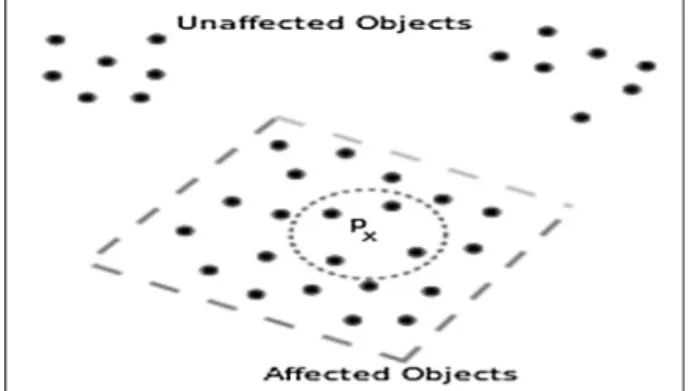
Due to the density-based nature of the incremental DBSCAN algorithm, the insertion or deletion of an object affects only the objects within a certain neighborhood (Fig. 1). Affected objects are potentially the objects that may change their cluster membership after insertion/deletion of an objectpand they are defined as the objects in theNEps(p)
plus all other objects that are density reachable from objects in NEps(p). The cluster memberships of all other objects are
not affected.
Assuming thatD is the objects space, following the inser-tion of an objectp, defines:
UpdSeedins= {q|qis a core object,$q0:q0is a core object in
D[{p} but not inD and q2NEps(q0)}. For the UpSeedIns,
there are four cases to consider.
If UpSeedInsis empty, thenpis considered as a noise object.
If UpSeedInscontains core objects which did not belong to a
cluster before the insertion ofp, thenpcreates a new cluster with these objects.
If UpSeedIns contains core objects that belong to exactly
one cluster, thenpjoins this cluster.
If UpSeedInscontains core objects that are members of
sev-eral clusters, then p merges all these clusters into one cluster.
Similarity, after deletion of some object p, defines: UpseedDel= {q|q is a core object in Dn{p}, $q0:q0 is a core
object in D but not in Dn{p} and q2NEps (q0)}. For the
UpSeeddel, there are three cases to consider.
If UpseedDelis empty, thenpis just removed.
If UpseedDel contains objects that are density-reachable
from each other, then deletion ofpcauses some of objects inNEps(p) to be noise (i.e. lose their cluster membership).
If the objects in UpseedDel are not directly
density-reachable from each other, then these objects belong to one cluster c before the deletion of p, so a check should be performed whether these objects are density connected by other objects in the former clusterc. Depending on such density connections, the clustercmay be split or not.
3. Proposed algorithm
Fig. 2 shows the different stages of the proposed algorithm. Initially, the algorithm requires defining of K partitions before operating. The algorithm considers the first K objects to be centroids of the K partitions are long as the distances between them are larger than Eps. For the subsequent objects, the algo-rithm incrementally partitions the dataset to eliminate the scal-ability problem of scanning the entire search space for finding the neighborhood of the new inserted object. Following assign-ing the new object to its nearest partition, the algorithm creates/updates dense regions in this partition according to
the incremental DBSCAN algorithm[24]. After that, the algo-rithm incrementally merges the dense regions of different par-titions based on a given connectivity measure to create/update the possible final clusters. Finally, the algorithm labels outliers and removes noise to produce the final clusters. Experimental results show that the proposed algorithm speeds up the cluster-ing process with a factor up to 3.2 compared to relevant incre-mental clustering algorithms.
Algorithm 1 introduces the details of the proposed algo-rithm for incrementally creating and updating clusters.
Algorithm 1: Incremental creating/updating clusters Input: Set of new objectsP, centroids
Output: create/update clusters after insertions ofP 1: M List of object that may change their centroids 2:D List of updated dense regions
3:ForeachpiinPdo 4: c nearest_centroid (pi) 5: M update_centroids (pi,c) 6: AddpitoM 7:end for 8:ForeachriinMdo 9: cn rinew_centroid 10: co riold_centroid
11: Apply incDbscanDel to removerifromco 12: Apply incDbscanAdd to insertritocn
13: Add updated dense regions toD(step 11 and 12) 14:end for
15:ForeachdiinDdo
16: ForeachdjinDandi–jdo
17: Ifinter_connectivty (di,dj) >amerge 18: merge(di,dj)
19: end if 20: end for 21:end for
3.1. Incremental partitioning of dataset
Incremental partitioning for objects is needed to reduce the search space for object’s neighborhood. Given a new object p, the neighborhood is determined by scanning objects of the nearest partition rather than the entire dataset (search space). The partitioning algorithm divides the dataset into a prede-fined number of partitions and assigns the objectpto the par-tition with the nearest centroid (line 4). Although several incremental partitioning algorithms can be used at this stage such as[25] and other partitioning algorithms, the proposed algorithm uses the partition algorithm in[26]for the following reasons. First, due to the dynamic nature of the dataset, old objects may change their positions after the insertion of new objects; thus, the partitioning algorithm should be able to detect the existing objects that became closer to other centroids after insertion of new objects (line 5). Second, it provides what is called ‘‘stability”; the partitioning algorithm reaches stability by utilizing a learning rate that decays with time so that objects are consistently assigned to centroids and the centroids are changing with a very small tolerance. The result of the parti-tioning stage is finding the nearest centroid for the new object pin addition to updating positions of current centroids with respect to the employed learning rate.
3.2. Incremental DBSCAN of partitions
Incremental DBSCAN algorithm[24]is used to update dense regions in partitions. A dense region can be defined as a set of objects that can form a final cluster or be part of a final clus-ter. Given the new objectp, the insertion module of DBSCAN (incDbscanAdd) is used to find a dense region at the nearest partition that the objectpcan join. For the old objects which changed their partitions, the deletion module (incDbscanDel) is used to remove them from their old dense regions and inser-tion module (incDbscanAdd) adds them to their new dense regions (lines 8–14). The goal of this stage is updating dense regions in different partition with the changes occurred in the partitioning stage.
3.3. Incremental merging of dense regions
To form the final set of clusters, an additional stage is needed to merge dense regions of different partitions. The number of final clusters is less than or equal the number of dense regions of the dataset. Given two regions A and B in two different par-titions, A is merged to B if the inter-connectivity IE(A, B) is greater than a predefined threshold a merge (lines 17–19). Fig. 3explains the idea of the inter-connectivity between two dense regions. Assume there is an imaginary edge between two borders objects in two different dense regions if the dis-tance between these objects is less than the Eps defined by the incremental DBSCAN algorithm, then the inter-connectivity between dense regions A and B is defined as IE (A, B) where
IEðA;BÞ ¼ Nab ðNaþNbÞ=2
ð1Þ whereNaandNbare the number of edges that connect boarder
objects in regions A and B respectively andNabis the number
of edges that connect boarder objects from dense region A and to objects in dense region B.
3.4. Noise removal and outlier labeling
A final step is needed to eliminate noise from the dataset. The proposed algorithm is able to detect and eliminate the noise where noise objects are neither classified objects (not assigned to a cluster) nor reachable from any core objects in the clus-ters. However, objects whose distance to any cluster is less than Eps are considered as outliers and they are labeled by the label of the nearest cluster.
Fig. 4shows an illustrative example for applying the pro-posed algorithm on 2D dataset. Fig. 4.1 shows the dataset before applying the proposed algorithm. After incrementally partitioning objects, centroids started to take final positions as shown inFig. 4.2. While every partition maintains an incre-mental DBSCAN, dense regions started to appear more obvi-ously inFig. 4.3and finally, merging dense regions and noise removal are applied as shown inFig. 4.4.
4. Evaluation
The proposed algorithm is evaluated against two incremental clustering algorithms: incremental version of DBSCAN [24] and incremental similarity-histogram based clustering algo-rithm (specific for documents clustering)[23]. The experiments are performed on (Core i5, 6 GB RAM) machine and baseline algorithms are implemented by authors of this paper for accu-rate comparisons. Six datasets with different number of objects and dimensions are used to evaluate the proposed algorithm as shown inTable 1. The first three datasets are used to evaluate the proposed algorithm with the incremental DBSCAN algo-rithm [24]while the last three datasets (textual datasets) are used to evaluate the proposed algorithm with incremental similarity-histogram based clustering algorithm [23]which is designed originally for document clustering.
4.1. Evaluation metrics
F-Measure is used to evaluate the accuracy of the final clusters based on precision and recall while the speedup factor is used to compare the running times of the algorithms.
F-Measure is commonly used in evaluating the effectiveness of clustering and classification algorithms. It combines the precision and recall ideas in information retrieval. The F-Measure for classi and clusterjis given by the following formula:
Fði;jÞ ¼2Precði;jÞ Recallði;jÞ
Precði;jÞ þRecallði;jÞ ð2Þ And the overall F-Measure for cluster algorithm quality is given by the following formula where N is the total number of the data points andciis a candidate cluster.
Figure 3 Interconnectivity between two regions.
F¼X
l
i
jcij
N maxfFði;jÞg ð3Þ
While the speedup factor is defined as the ratio of the base-line algorithm to the run time of the proposed algorithm. Speedup¼Tcompared
Tproposed
ð4Þ
4.2. Comparison with the incremental DBSCAN algorithm In order to compare the proposed algorithm with the incre-mental DBSCAN [24], same values of Eps and MinPts are used in the experiment to show the effect of the enhancement. However, for the proposed algorithm, there are two parame-ters that can affect its performance:
1. The number of partitions (in the incremental partitioning stage).
2. The value of a merge (in the incremental dense regions merging stage)
Fig. 5shows that the speedup factor (the ratio between exe-cution time of the incremental DBSCAN[24]to the proposed algorithm) increases with the increase of the number of parti-tions as the search space is reduced. However, as the number of partitions increases, the overhead of partitioning and merg-ing also increases after which this overhead leads to decreasmerg-ing in the speedup of the proposed algorithm.
Fig. 6shows that the proposed algorithm has a comparable accuracy with the incremental DBSCAN algorithm.
As a result, the proposed algorithm maintains a nearly same accuracy with incremental DBSCAN algorithm; however the proposed algorithm has an advantage for the running time with a factor up to 3.2.
Table 2 shows the best speedup factors of the proposed algorithm relative to the incremental DBSCAN algorithm for different datasets.
Table 3shows the parameters used to conduct the experi-ments for the different numerical database. The table shows values for Eps, MinPts, number of partitions and Alpha merge.
4.3. Comparison with the incremental similarity-histogram based clustering (SHC) algorithm
Incremental similarity-histogram cluster (SHC) algorithm[23] aims to cluster documents where the similarity histogram is a concise statistical representation of the set of pair-wise docu-ment similarities distribution in the cluster and objects are
Figure 5 Speedup factor for the numerical datasets for different partitions.
Figure 4 An illustrative example.
Table 1 Datasets.
Dataset Classes Num of objects Type
Open digits 10 5620 Num, 64 dimensions Pen digits 10 11,000 Num, 15 dimensions
SCC 10 600 Num, 60 dimensions
UW-CAN 10 314 Textual
4 Universities 7 8282 Textual
added to a cluster only if they enhance its similarity histogram (i.e. keeping the distribution of similarities skewed to the right of the histogram).
The proposed algorithm is a general purpose clustering algorithm that can operate on any type of data. In this case, the proposed algorithm is evaluated with text data. Fig. 7 shows the speedup factor of the proposed algorithm compared to SHC algorithm. It shows that the proposed algorithm speeds up the clustering process to a factor up to 2.4.
Fig. 8shows the F-Measure of the proposed algorithm to SHC algorithm. Although SHC gives a slightly better accuracy in UW-CAN dataset, the proposed algorithm gives higher accuracy in 4 Universities and 20 News Groups dataset.
Table 4shows the parameters used to conduct the experi-ments for the different textual database. The table shows values for Eps, MinPts, number of partitions and Alpha merge. Table 5 shows the best speedup factors of the proposed algorithm relative to the SHC algorithm for different datasets. 5. Discussion
An enhanced version of incremental DBSCAN algorithm is proposed in this paper. The proposed algorithm speeds up the clustering process by limiting the search space to partitions instead of the whole dataset. The proposed algorithm is proved to perform better than the existing incremental DBSCAN especially in large datasets with higher number of dimensions. It is clear that for the textual datasets the speedup factor increases proportionally with the size of the dataset. Given that the average size of documents is comparable in all textual datasets, the proposed algorithm tends to perform better on large datasets.
Table 4 Parameters used to conduct the experiments to obtain best performance for textual datasets.
Dataset Eps MinPts # partitions Alpha
UW-CAN 20 12 20 0.15
4 Uni 30 6 50 0.23
News Group 15 11 30 0.1
Table 2 Speedup factor between the proposed algorithm and incremental DBSCAN.
Open digits Pen digits SCC
1.85 1.3 3.2
Figure 7 Speedup factor for the textual datasets for different partitions.
Figure 8 F-Measure for the proposed algorithm and SHC algorithm.
Figure 6 F-Measure for the proposed algorithm and incremental DBSCAN algorithm.
Table 3 Parameters used to conduct the experiments to obtain best performance for numerical datasets.
Dataset Eps MinPts # partitions Alpha
Open digits 16 2 40 0.1
Pen digits 30 10 45 0.2
The proposed algorithm proves efficiency in clustering large datasets especially with objects of high dimensions. Numerical datasets with different dimensions show that the speedup fac-tor increases with the increase of data dimensions of the objects being clustered. This is expected due to the usage of divide-and-conquer in dataset partitioning which leads to fewer calculations to cluster different objects.
6. Conclusion and future work
In this paper, an incremental density-based clustering algo-rithm is introduced to incrementally build and update clusters in datasets. The algorithm incrementally partitions the dataset to reduce the search space to each partition instead of scanning the whole dataset. After that the algorithm incrementally forms and updates dense regions in each partition. Following identifying possible dense regions in each partition, the algo-rithm uses an inter-connectivity measure to merge dense regions to form the final number of clusters. Experimental results show that the proposed algorithm has a comparable accuracy compared to related incremental clustering algo-rithms. However, the proposed algorithm has significant improvements on the runtime with a speedup factor of 3.2. The proposed algorithm is also proved to perform better in large datasets with higher dimensions compared to related algorithms.
Other possible enhancements to the proposed algorithm are planned for future work. Probably a major enhancement is designing the algorithm to work in a parallel manner. Given the independence of the partitions, incremental DBSCAN for each partition can be applied in parallel. It is expected that the parallel version of the proposed algorithm will achieve bet-ter performance with comparable accuracy.
References
[1] A. Nagpal, A. Jatain, D. Gaur, Review based on data clustering algorithms, in: IEEE Conference on Information & Communication Technologies (ICT), April 2013, pp. 298–303. [2] W. Yu, G. Qiang, L. Xiao-Li, A kernel aggregate clustering
approach for mixed data set and its application in customer segmentation, in: International Conference on Management Science and Engineering ICMSE, Oct 2006, pp. 121–124. [3] Z. Nafar, A. Golshani, Data mining methods for protein–
protein interactions, in: Canadian Conference on Electrical and Computer Engineering, CCECE, May 2006, pp. 991–994. [4] Ahmad M. Bakr, Noha A. Yousri, Mohamed A. Ismail,
Efficient incremental phrase-based document clustering, in: International Conference on Pattern Recognition ICPR, Nov 2012, pp. 517–520.
[5] S. Nithyakalyani, S.S. Kumar, Data aggregation in wireless sensor network using node clustering algorithms a comparative study, in: IEEE Conference on Information & Communication Technologies (ICT), April 2013, pp. 508–513.
[6]S. Hyuk Cha, Comprehensive survey on distance/similarity measures between probability density functions, Int. J. Math. Models Methods Appl. Sci. 1 (2007) 300–307.
[7] C. Bahm, K. Haegler, N.S Maller, C. Plant, CoCo: coding cost for parameter-free outlier detection, in: The 15th ACM SIGKDD Conference on Knowledge Discovery and Data Mining, June 2009, pp. 149–158.
[8] D. Wang, S. Zhu, T. Li, Y. Chi, Y. Gong, Integrating clustering and multi document summarization to improve document understanding, in: The 17th ACM CIKM Conference on Information and Knowledge Management, Oct 2008.
[9] H.-P. Kriegel, M. Pfeifle, Effective and efficient distributed model-based clustering, in: Proceedings of the 5th International Conference on Data Mining (ICDM’05), 2005, pp. 285, 265. [10] K.M. Hammouda, M.S. Kamel, Efficient phrase-based document
indexing for web document clustering, in: IEEE TransKnowledge and Data Eng., vol. 16, no. 10, Oct. 2004, pp. 1279–1296. [11] Zhe Zhang, Junxi Zhang, Huifeng Xue, Improved K-means
clustering algorithm, in: Congress on Image and Signal Processing CISP, vol. 5, May 2008, pp. 169–172.
[12] L. Li, J. You, G. Han, H. Chen, Double partition around medoids based cluster ensemble, in: International Conference on Machine Learning and Cybernetics, vol. 4, July 2012, pp. 1390– 1394.
[13] H. Du, Y. Li, An improved BIRCH clustering algorithm and application in thermal power, in: International Conference on Web Information Systems and Mining (WISM), vol. 1, Oct 2010, pp. 53–56.
[14]R.T. Ng, J. Han, CLARANS: a method for clustering objects for spatial data mining, IEEE Trans. Knowl. Data Eng. 14 (5) (2002) 1003–1016.
[15] S. Guha, R. Rastogi, K. Shim, CURE: an efficient clustering algorithm for large databases, in: Proceedings of the ACM-SIGMOD International Conference Management of Data (SIGMOD’98), Oct 1998, pp. 73–84.
[16]G. Karypis, H. Eui-Hong, V. Kuma, Chameleon: hierarchical clustering using dynamic modeling, Computer 32 (8) (1999) 68–75. [17] M. Ester, H. Kriegel, J. Sander, X. Xu, A density-based algorithm for discovering clusters in large spatial databases with noise, in: Proc. 2nd International Conference on Knowledge Discovery and Data Mining, Oct 1996, pp. 226–231. [18] Z. Wang, Y. Hao, Z. Xiong, F. Sun, SNN clustering kernel technique for content-based scene matching, in: 7th IEEE International Conference on Cybernetic Intelligent Systems, Sept 2008, pp. 1–6.
[19] E. Achtert, C. Bhm, Aˆ H. Kriegel, P. KrA˜ger, I. Maller-Gorman, A. Zimek, Detection and visualization of subspace cluster hierarchies, in: Advances in Databases: Concepts, Systems and Applications, Lecture Notes in Computer Science, 2007, pp. 152–163.
[20]G. Tzortzis, A. Likas, The global kernel K-means algorithm for clustering in feature space, IEEE Trans. Neural Netw. 20 (July) (2009) 1181–1194.
[21] D. Widyantoro, T. Ioerger, J. Yen, An incremental approach to building a cluster hierarchy, ICDM Proceedings IEEE International Conference on Data Mining, June 2002, pp. 705–708. [22]S.A.L. Mary, K.R.S. Kumar, A density based dynamic data clustering algorithm based on incremental dataset, J. Computer Sci. 8 (5) (2012) 656–664.
[23] K.M. Hammouda, M.S. Kamel, Incremental document clustering using cluster similarity histograms, in: IEEE/WIC Proceedings International Conference on Web Intelligence, Oct. 2003, pp. 597–601.
[24] M. Ester, H.P. Kriegel, J. Sander, M. Wimmer, X. Xu, Incremental clustering for mining in a data warehousing environment, in: Proceedings of the 24th VLDB Conference, Institute for Computer Science, University of Munich, Germany, New York, USA, Aug 1998.
Table 5 Speedup factor between the proposed algorithm and SHC algorithm.
UW-CAN 4 Universities News Group
[25] G. Tzortzis, A. Likas, The global kernel K-means clustering algorithm, in: IEEE International Joint Conference on Neural Networks IJCNN, June 2008, pp. 1977–1984.
[26] S. Young, I. Arel, A fast and stable incremental clustering algorithm, in: Seventh International Conference on Information Technology: New Generations (ITNG), April 2010, pp. 204–209.

![Fig. 5 shows that the speedup factor (the ratio between exe- exe-cution time of the incremental DBSCAN [24] to the proposed algorithm) increases with the increase of the number of parti-tions as the search space is reduced](https://thumb-us.123doks.com/thumbv2/123dok_us/662722.2579928/5.892.118.760.83.389/speedup-incremental-dbscan-proposed-algorithm-increases-increase-reduced.webp)

