AD9393
Rev. 0
Information furnished by Analog Devices is believed to be accurate and reliable. However, no responsibility is assumed by Analog Devices for its use, nor for any infringements of patents or other rights of third parties that may result from its use. Specifications subject to change without notice. No license is granted by implication or otherwise under any patent or patent rights of Analog Devices.
One Technology Way, P.O. Box 9106, Norwood, MA 02062-9106, U.S.A.
Tel: 781.329.4700 www.analog.com
Fax: 781.461.3113 ©2009 Analog Devices, Inc. All rights reserved.
FEATURES
HDMI interface
Supports high bandwidth digital content protection RGB to YCrCb 2-way color conversion
1.8 V/3.3 V power supply 76-ball BGA package
RGB and YCrCb output formats Digital video interface
HDMI 1.2a, DVI 1.0 80 MHz HDMI receiver
Supports high bandwidth digital content protection (HDCP 1.1)
Digital audio interface
HDMI 1.2a-compatible audio interface
S/PDIF (IEC60958-compatible) digital audio output Multichannel I2S audio output (up to 8 channels)
APPLICATIONS
Portable low power TV HDTVProjectors LCD monitor
FUNCTIONAL BLOCK DIAGRAM
08 04 3-00 1 DATACK DE VSYNC HDMI RECEIVER SPDIF 8-CHANNEL I2S SCLK LRCLK HDCP HSOUT D[23:0] VSOUT DE CO L O RS P A CE CO NV E RT E R R/G/B 8 × 3 OR YCrCb AD9393 SCL SDA Rx1+ Rx1– Rx2+ Rx2– RxC+ RxC– RTERM MCL MDA DDC_SCL DDC_SDA Rx0+ Rx0– HSYNC DCLK Y C rC b R G B SERIAL REGISTER AND POWER MANAGEMENT MCLK Figure 1.
GENERAL DESCRIPTION
The AD9393 offers a High-Definition Multimedia Interface (HDMI™) receiver integrated on a single chip. Support is also included for high bandwidth digital content protection (HDCP). The AD9393 contains a HDMI 1.2a-compatible receiver and supports HDTV formats (up to 720p or 1080i) and displays resolutions up to XGA (1024 × 768 @ 75 Hz). The receiver features an intrapair skew tolerance of up to one full clock cycle. With the inclusion of HDCP, displays may now receive encrypted video content. The AD9393 allows for authentication
of a video receiver, decryption of encoded data at the receiver, and renewability of that authentication during transmission as specified by the HDCP 1.1 protocol.
Fabricated in an advanced CMOS process, the AD9393 is provided in a space-saving 76-ball, surface-mount, Pb-free, ball grid array (BGA) and is specified over the −10°C to +80°C temperature range.
Comparable Parts
View a parametric search of comparable parts
Documentation
Data Sheet
• AD9393: Low Power HDMI Display Interface
Design Resources
• AD9393 Material Declaration • PCN-PDN Information • Quality And Reliability • Symbols and Footprints
Discussions
View all AD9393 EngineerZone Discussions
Sample and Buy
Visit the product page to see pricing options
Technical Support
Submit a technical question or find your regional support number
TABLE OF CONTENTS
Features ... 1
Applications ... 1
Functional Block Diagram ... 1
General Description ... 1
Revision History ... 2
Specifications ... 3
Electrical Characteristics ... 3
Digital Interface Electrical Characteristics ... 4
Absolute Maximum Ratings ... 5
Explanation of Test Levels ... 5
ESD Caution ... 5
Pin Configuration and Function Descriptions ... 6
Design Guide ... 8
General Description ... 8
Digital Inputs ... 8
Serial Control Port ... 8
Output Signal Handling ... 8
Power Management ... 8 Timing ... 9 HDMI Receiver ... 9 DE Generator ... 9 4:4:4 to 4:2:2 Filter ... 9 Audio PLL Setup ... 10
Audio Board Level Muting ... 11
Output Data Formats ... 11
2-Wire Serial Register Map ... 12
2-Wire Serial Control Register Details ... 22
Chip Identification ... 22
BT656 Generation ... 24
Color Space Conversion ... 25
2-Wire Serial Control Port ... 31
Data Transfer via Serial Interface ... 31
Serial Interface Read/Write Examples ... 32
PCB Layout Recommendations ... 33
Power Supply Bypassing ... 33
Outputs (Both Data and Clocks) ... 33
Digital Inputs ... 33
Color Space Converter (CSC) Common Settings ... 34
HDTV YCrCb (0 to 255) to RGB (0 to 255) (Default Setting for AD9393) ... 34 HDTV YCrCb (16 to 235) to RGB (0 to 255)... 34 SDTV YCrCb (0 to 255) to RGB (0 to 255) ... 34 SDTV YCrCb (16 to 235) to RGB (0 to 255) ... 35 RGB (0 to 255) to HDTV YCrCb (0 to 255) ... 35 RGB (0 to 255) to HDTV YCrCb (16 to 235)... 35 RGB (0 to 255) to SDTV YCrCb (0 to 255) ... 36 RGB (0 to 255) to SDTV YCrCb (16 to 235) ... 36 Outline Dimensions ... 37 Ordering Guide ... 37
REVISION HISTORY
SPECIFICATIONS
ELECTRICAL CHARACTERISTICS
VDD, VD = 3.3 V, DVDD = PVDD = 1.8 V, unless otherwise noted.
Table 1.
Parameter Temp Test Level Min Typ Max Unit
DIGITAL INPUTS (5 V Tolerant)
Input Voltage, High (VIH) Full VI 2.6 V
Input Voltage, Low (VIL) Full VI 0.8 V
Input Current, High (IIH) Full V −82 μA
Input Current, Low (IIL) Full V 82 μA
Input Capacitance 25°C V 3 pF
DIGITAL OUTPUTS
Output Voltage, High (VOH) Full VI VDD − 0.1 V
Output Voltage, Low (VOL) Full VI 0.4 V
Duty Cycle, DCLK Full V 45 50 55 %
Output Coding Binary
THERMAL CHARACTERISTICS
θJA Junction-to-Ambient V 59 °C/W
DIGITAL INTERFACE ELECTRICAL CHARACTERISTICS
VDD = VD =3.3 V, DVDD = PVDD = 1.8 V, unless otherwise noted.Table 2.
Parameter
Test
Level Conditions Min Typ Max Unit
DC DIGITAL I/O Specifications
High-Level Input Voltage (VIH) VI 2.5 V
Low-Level Input Voltage (VIL) VI 0.8 V
High-Level Output Voltage (VOH) VI VDD − 0.1 V
Low-Level Output Voltage (VOL) VI VDD − 0.1 0.1 V
DC SPECIFICATIONS
Output High Level IV Output drive = high strength 36 mA
IOHD (VOUT = VOH) IV Output drive = low strength 24 mA
Output Low Level IV Output drive = high strength 12 mA
IOLD (VOUT = VOL) IV Output drive = low strength 8 mA
DCLK High Level IV Output drive = high strength 40 mA
VOHC (VOUT = VOH) IV Output drive = low strength 20 mA
DCLK Low Level IV Output drive = high strength 30 mA
VOLC (VOUT = VOL) IV Output drive = low 15 mA
Differential Input Voltage, Single-Ended Amplitude IV 75 700 mV
POWER SUPPLY
VD IV 3.15 3.3 3.47 V
VDD IV 1.7 3.3 347 V
DVDD IV 1.7 1.8 1.9 V
PVDD IV 1.7 1.8 1.9 V
Power—54 MHz, YCrCb 422, CSC Disabled 485 mW
Supply Current (Worst Pattern)1
IVD V 95 mA
IVDD V 18 mA
IDVDD2 V 51 mA
IPVDD V 26 mA
Power—74.25 MHz, RGB, CSC Disabled 593 mW
Supply Current (Worst Pattern)1
IVD V 109 mA IVDD V 38 mA IDVDD V 66 mA IPVDD V 26 mA Power-Down Power VI 130 mW AC SPECIFICATIONS
Intrapair (+ to −) Differential Input Skew (tDPS) IV 0.4 tBIT
Channel-to-Channel Differential Input Skew (tCCS) IV 0.6 tPIXEL
Low-to-High Transition Time for Data and Controls (DLHT) IV Output drive = high; CL = 10 pF 1000 ps
IV Output drive = low; CL = 5 pF ps
Low-to-High Transition Time for DCLK (DLHT) IV Output drive = high; CL = 10 pF 1000 ps
IV Output drive = low; CL = 5 pF ps
High-to-Low Transition Time for Data and Controls (DHLT) IV Output drive = high; CL = 10 pF 1000 ps
IV Output drive = low; CL = 5 pF ps
High-to-Low Transition Time for DCLK (DHLT) IV Output drive = high; CL = 10 pF 1000 ps
IV Output drive = low; CL = 5 pF ps
Clock-to-Data Skew3 (t
SKEW) IV −0.5 +2.0 ns
Duty Cycle, DCLK3 IV 45 50 %
DCLK Frequency (fCIP) VI 20 80 MHz
1 Worst-case pattern is alternating black and white pixels. 2 DCLK load = 10 pF, data load = 5 pF.
ABSOLUTE MAXIMUM RATINGS
Table 3.Stresses above those listed under Absolute Maximum Ratings may cause permanent damage to the device. This is a stress rating only; functional operation of the device at these or any other conditions above those indicated in the operational section of this specification is not implied. Exposure to absolute maximum rating conditions for extended periods may affect device reliability.
EXPLANATION OF TEST LEVELS
I 100% production tested.II 100% production tested at 25°C and sample tested at specified temperatures.
III Sample tested only.
IV Parameter is guaranteed by design and characterization testing.
V Parameter is a typical value only.
VI 100% production tested at 25°C; guaranteed by design and characterization testing.
ESD CAUTION
Parameter Rating VD 3.6 V VDD 3.6 V DVDD 1.98 V PVDD 1.98 V Digital Inputs 5 V to 0.0 VDigital Output Current 20 mA
Operating Temperature Range −25°C to +85°C
Storage Temperature Range −65°C to +150°C
Maximum Junction Temperature 150°C
AD9393
TOP VIEW (Not to Scale)
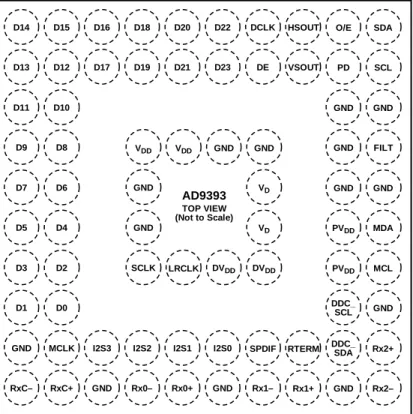
PIN CONFIGURATION AND FUNCTION DESCRIPTIONS
D14 D15 D16 D18 D20 D22 DCLK HSOUT O/E SDA
D13 D12 D17 D19 D21 D23 DE VDD VDD GND GND GND VD GND VD SCLK LRCLK DVDD DVDD VSOUT PD SCL
GND MCLK I2S3 I2S2 I2S1 I2S0 SPDIF RTERM DDC_SDA Rx2+
RxC– RxC+ GND Rx0– Rx0+ GND Rx1– Rx1+ GND Rx2– D11 D10 GND GND D9 D8 GND FILT D7 D6 GND GND D5 D4 PVDD MDA D3 D2 PVDD MCL D1 D0 DDC_SCL GND A 1 2 3 4 5 6 7 8 9 10 B J K C D E F G H 08 04 3-0 02
Figure 2. Pin Configuration Table 4. Complete Pin List
Pin No. Mnemonic Description Value
Inputs
B9 PD Power-Down Control. Power-Down Control/Three-State Control. The function
of this pin is programmable via Register 0x26[2:1].
3.3 V CMOS Digital Video Data Inputs
K5, K4, K8, K7, J10, K10 Rx0+, Rx0−, Rx1+, Rx1−, Rx2+, Rx2−
Digital Input Channel x True/Complement. These six pins receive three pairs of transition minimized differential signaling (TMDS ) pixel data (at 10× the pixel rate) from a digital graphics transmitter.
TMDS
Digital Video Clock Inputs
K2, K1 RxC+, RxC− Digital Data Clock True/Complement. This clock pair receives a TMDS clock at
1× pixel data rate.
TMDS Outputs
B6, A6, B5, A5, B4, A4, B3, A3, A2, A1, B1, B2, C1, C2, D1, D2, E1, E2, F1, F2, G1, G2, H1, H2 D[23:0] Data Outputs. In RGB, D[23:16] = Red[7:0] D[15:8] = Green[7:0] D[7:0] = Blue[7:0] See Table 6 VDD
A7 DCLK Data Output Clock. This is the main clock output signal used to strobe the
output data and HSOUT into external logic. Four possible output clocks can be selected with Register 0x25[7:6]. These are related to the pixel clock (½× pixel clock, 1× pixel clock, 2× frequency pixel clock, and a 90° phase shifted pixel clock). They are produced by the internal PLL clock generator and are synchronous with the pixel clock. The polarity of DCLK can also be inverted via Register 0x24[0].
VDD
A8 HSOUT HSYNC Output Clock (Phase-Aligned with DCLK). Horizontal sync output. A
reconstructed and phase-aligned version of the HSYNC input. Both the polarity and duration of this output can be programmed via serial bus registers. By maintaining alignment with DCLK and data, data timing with respect to horizontal sync can always be determined.
Pin No. Mnemonic Description Value
B8 VSOUT VSYNC Output Clock (Phase-Aligned with DCLK). Vertical Sync Output. The
separated VSYNC from a composite signal or a direct passthrough of the VSYNC signal. The polarity of this output can be controlled via the serial bus bit (Register 0x24[6]).
VDD
A9 O/E Odd/Even Field Output for Interlaced Video. This output identifies whether the
current field (in an interlaced signal) is odd or even. The polarity of this signal is programmable via Register 0x24[4].
VDD
References
D10 FILT Connection for External Filter Components for Audio PLL. For proper operation,
the audio clock generator PLL requires an external filter. Connect the filter shown in Figure 6 to this pin. For optimal performance, minimize noise and parasitics on this node. For more information, see the PCB Layout
Recommendations section.
PVDD
Power Supply1
E7, F7 VD HDMI Terminator Power Supply (3.3 V). These pins supply power to the HDMI
terminators. They should be as quiet and filtered as possible.
3.3 V
D4, D5 VDD Digital Output Power Supply (1.8 V to 3.3 V). A large number of output pins (up
to 27) switching at high speed (up to 80 MHz) generates many power supply transients (noise). These supply pins are identified separately from the VD pins,
so output noise transferred into the sensitive circuitry can be minimized. If the AD9393 is interfacing with lower voltage logic, VDD can be connected to a
lower supply voltage (as low as 1.8 V) for compatibility.
1.8 V to 3.3 V
F9, G9 PVDD PLL Power Supply (1.8 V). The most sensitive portion of the AD9393 is the
clock generation circuitry. These pins provide power to the clock PLL and help the user design for optimal performance. The user should provide quiet, noise-free power to these pins.
1.8 V
G6, G7 DVDD Digital Logic Power Supply (1.8 V). These pins supply power to the digital
logic.
1.8 V C9, C10, D6, D7, D9, E4,
E9, E10,
F4, H10, J1, K3, K6, K9
GND Ground. The ground return for all circuitry on chip. It is recommended that the
AD9393 be assembled on a single solid ground plane, with careful attention to ground current paths.
0 V
Control
A10 SDA Serial Port Data I/O for Programming the AD9393 Registers. The I2C address is
Address 0x98.
3.3 V CMOS
B10 SCL Serial Port Data Clock for Programming the AD9393 Registers. 3.3 V CMOS
HDCP
H9 DDC_SCL HDCP Slave Serial Port Data Clock for HDCP Communications to Transmitter. 3.3 V CMOS
J9 DDC_SDA HDCP Slave Serial Port Data I/O for HDCP Communications to Transmitter. The
I2C address is Address 0x74 or Address 0x76.
3.3 V CMOS
F10 MDA Master Serial Port I/O to EEPROM with HDCP Keys—I2C Address is 0xA0. 3.3 V CMOS
G10 MCL Master Serial Port Data Clock to EEPROM with HDCP Keys. 3.3 V CMOS
Audio Data Outputs
J7 S/PDIF S/PDIF Digital Audio Output. VDD
J6 I2S0 I2S Audio (Channel 1, Channel 2). Channel 0 and Channel 1 Audio Output. V
DD
J5 I2S1 I2S Audio (Channel 3, Channel 4). Channel 2 and Channel 3 Audio Output. V
DD
J4 I2S2 I2S Audio (Channel 5, Channel 6). Channel 4 and Channel 5 Audio Output. V
DD
J3 I2S3 I2S Audio (Channel 7, Channel 8). Channel 6 and Channel 7 Audio Output. V
DD
J2 MCLK Audio Master Clock Output for S/PDIF Data. VDD
G4 SCLK Audio Serial Clock Output for I2S Data. V
DD
G5 LRCLK Data Output Clock for Left and Right Audio Channels. VDD
Data Enable
DESIGN GUIDE
GENERAL DESCRIPTION
The AD9393 is a fully integrated solution for receiving DVI/ HDMI signals and is capable of decoding HDCP-encrypted signals through connections to an external EEPROM. The circuit is ideal for providing an interface for HDTV monitors or as the front end to high performance video scan converters. Implemented in a high performance CMOS process, the interface can capture signals with pixel rates of up to 80 MHz. The AD9393 includes all necessary circuitry for decoding TMDS signaling including those encrypted with HDCP. Included in the output formatting is a color space converter (CSC), which accommodates any input color space and can output any color space. All controls are programmable via a 2-wire serial interface. Full integration of these sensitive mixed signal functions makes system design straight forward and less sensitive to the physical and electrical environment.
DIGITAL INPUTS
The digital control inputs (I2C) on the AD9393 operate to 3.3 V
CMOS levels. In addition, all digital inputs except the TMDS inputs (HDMI/DVI) are 5 V tolerant. Applying 5 V to them does not cause any damage. The TMDS input pairs (Rx0±, Rx1±, Rx2±, and RxC±) must maintain a 100 Ω differential impedance (through proper PCB layout) from the connector to the input where they are internally terminated (50 Ω to 3.3 V). If additional ESD protection is desired, using a low capacitance ESD protection varistor offers 8 kV of protection to the HDMI TMDS lines.
SERIAL CONTROL PORT
The serial control port is designed for 3.3 V logic. However, it is tolerant of 5 V logic signals.
OUTPUT SIGNAL HANDLING
The digital outputs operate from 1.8 V to 3.3 V (VDD).
POWER MANAGEMENT
To determine the correct power state, the AD9393 uses the activity detect circuits, the active interface bits in the serial bus, the active interface override bits, the power-down bit, and the power-down ball. There are three power modes: full power, auto power-down, and power-down.
Table 5 summarizes how the AD9393 determines which power mode to use and which circuitry is powered on/off in each of these modes. The power-down command has first priority and the automatic circuitry second priority. The power-down ball (Ball B8—polarity set by Register 0x26[3]) can drive the chip into two power-down options. Bit 2 of Register 0x26 controls these two options. Bit 0 controls whether the chip is powered down or the outputs are placed in high impedance mode. Bit 7 to Bit 4 of Register 0x26 control whether the outputs, Sony/ Philips digital interface (S/PDIF), or Inter-IC Sound bus (I2S or
IIS) outputs are in high impedance mode or not. See the 2-Wire Serial Control Register Detail section for the details.
Table 5. Power-Down Mode Descriptions
Mode
Inputs
Power-On/Comments Power-Down1 Auto PD Enable2
Full Power 1 X Everything
Auto Power-Down 1 1 Serial bus, sync activity detect, band gap reference
Power-Down 0 X Serial bus, sync activity detect, band gap reference
1 Power-down is controlled via Bit 0 in Register 0x26. 2 Auto power-down is controlled via Bit 7 in Register 0x27.
TIMING
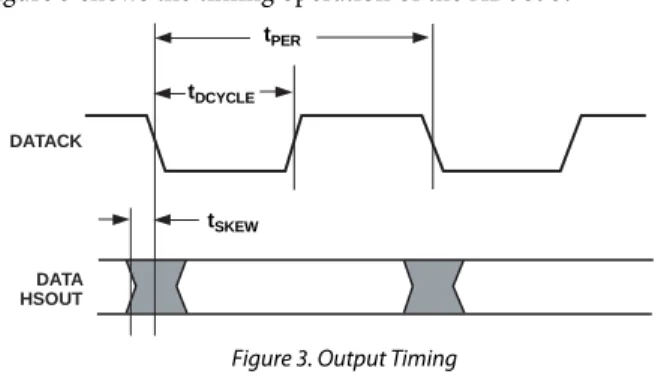
The output data clock signal is created so that its rising edge always occurs between data transitions and can be used to latch the output data externally.
Figure 3 shows the timing operation of the AD9393.
tPER tDCYCLE tSKEW DATACK DATA HSOUT 08 04 3-0 03
Figure 3. Output Timing
HDMI RECEIVER
The HDMI receiver section of the AD9393 allows the reception of a digital video stream (which is backward compatible with DVI and able to accommodate video of various formats (RGB, YCrCb 4:4:4, 4:2:2)). The receiver also allows up to eight channels of audio. Infoframes are transmitted carrying information about the video format, audio clocks, and many other items necessary for a monitor to utilize fully the information stream available. The earlier digital visual interface (DVI) format was restricted to an RGB 24-bit color space only. Embedded in this data stream were HSYNCs, VSYNCs, and display enable (DE) signals; but no audio information. The HDMI specification allows trans-mission of all the DVI capabilities, but adds several YCrCb formats that make the inclusion of a programmable color space converter (CSC) a very desirable feature. With this feature, the scaler following the AD9393 can specify that it always wishes to receive a particular format, for instance, 4:2:2 YCrCb, regardless of the transmitted mode. If RGB is sent, the CSC can easily convert that to 4:2:2 YCrCb while relieving the scaler of this task.
In addition, the HDMI specification supports the transmission of up to eight channels of S/PDIF or I2S audio. The audio
infor-mation is separated into packets and transmitted during the video blanking periods along with specific information about the clock frequency. Part of this audio information (audio infoframe) tells the user how many channels of audio are being transmitted, where the channels should be placed, information regarding the source (make, model), and other data.
DE GENERATOR
The AD9393 has an on-board generator for DE, for the start of active video (SAV), and for the end of active video (EAV), all of which are necessary for describing the complete data stream for a BT656-compatible output. This signal alerts the following circuitry, which are displayable video pixels.
4:4:4 TO 4:2:2 FILTER
The AD9393 contains a filter that allows it to convert a signal from YCrCb 4:4:4 to YCrCb 4:2:2 while maintaining the maximum accuracy and fidelity of the original signal.
Input Color Space to Output Color Space
The AD9393 can accept a wide variety of input formats and either retain that format or convert to another. Input formats supported are
• 4:4:4 YCrCb 8-bit
• 4:2:2 YCrCb 8-, 10-, and 12-bit
• RGB 8-bit
Output modes supported are
• 4:4:4 YCrCb 8-bit
• 4:2:2 YCrCb 8-, 10-, and 12-bit
• Dual 4:2:2 YCrCb 8-bit
Color Space Conversion (CSC) Matrix
The CSC matrix in the AD9393 consists of three identical processing channels. In each channel, three input values are multiplied by three separate coefficients. An offset value for each row of the matrix and a scaling multiple for all values are also included. Each value has a 13-bit, twos complement resolution to ensure the signal integrity is maintained. The CSC is designed to run at speeds up to 80 MHz supporting resolutions up to 720p at 60 Hz. With any-to-any color space support, formats such as RGB, YUV, YCrCb, and others are supported by the CSC.
The main inputs, RIN, GIN, and BIN, come from the 8-bit or
12-bit inputs from each channel. These inputs are based on the input format detailed in Table 30 to Table 52. The mapping of these inputs to the CSC inputs is shown in Table 6.
Table 6. CSC Port Mapping
Input Channel CSC Input Channel
R/Cr (D[23:16]) RIN
Gr/Y (D[15:8]) GIN
One of the three input channels is represented in Figure 4. In each processing channel, the three inputs are multiplied by three separate coefficients marked a1, a2, and a3. These coefficients are divided by 4096 to obtain nominal values ranging from −0.9998 to +0.9998. The variable labeled a4 is used as an offset control. The CSC_MODE setting is the same for all three processing channels. This multiplies all coefficients and offsets by a factor of 2CSC_MODE.
The functional diagram for a single channel of the CSC (as shown in Figure 4) is repeated for the remaining G and B channels. The coefficients for these channels are b1, b2, b3, b4, c1, c2, c3, and c4. ×2 2 1 0 a1[12:0] a2[12:0] a3[12:0] RIN[11:0] GIN[11:0] BIN[11:0] + ×4 CSC_MODE[1:0] a4[12:0] ROUT[11:0] + 1 4096 × 1 4096 1 4096 + × × × × × 0 8043-00 6
Figure 4. Single CSC Channel
A programming example and register settings for several common conversions are listed in the Color Space Converter (CSC) Common Settings section.
For a detailed functional description and more programming examples that are compatible with the AD9393, refer to the AN-795 Application Note, AD9880 Color Space Converter User's Guide.
AUDIO PLL SETUP
Data contained in the audio infoframes (among other registers) defines for the AD9393 HDMI receiver not only the type of
audio, but also the sampling frequency (fS). The audio
info-frame also contains information about the N and CTS values used to recreate the clock. With this information, it is possible to regenerate the audio sampling frequency. The audio clock is regenerated by dividing the 20-bit CTS value into the TMDS clock, then multiplying by the 20-bit N value. This yields a multiple of the sampling frequency of either 128 × fS or 256 ×
fS. It is possible for this to be specified up to 1024 × fS.
SINK DEVICE SOURCE DEVICE
*N AND CTS VALUES ARE TRANSMITTED USING THE AUDIO CLOCK REGENERATION PACKET. VIDEO CLOCK IS TRANSMITTED ON TMDS CLOCK CHANNEL.
128×fS N VIDEO CLOCK 128×fS TMDS CLOCK N* CTS* DIVIDE BY N CYCLE TIME COUNTER REGISTER N ÷CTS × N 08 04 3-0 07
Figure 5. N and CTS for Audio Clock
To provide the most flexibility in configuring the audio sampling clock, an additional PLL is employed. The PLL characteristics are determined by the loop filter design (see Figure 6), the PLL charge pump current, and the VCO range setting. CP 8nF CZ 80nF RZ 1.5kΩ FILT PVDD 0 80 43 -0 08
Figure 6. PLL Loop Filter Detail
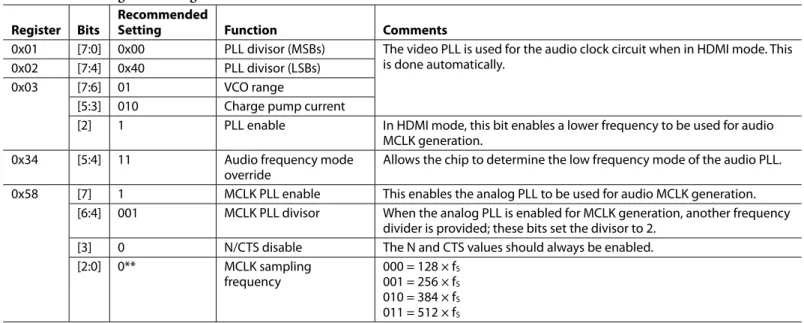
To fully support all audio modes for all video resolutions up to 1080i, it is necessary to adjust certain audio-related registers from their power-on default values. Table 7 describes these registers and gives the recommended settings.
Table 7. Audio Register Settings
Register Bits
Recommended
Setting Function Comments
0x01 [7:0] 0x00 PLL divisor (MSBs) The video PLL is used for the audio clock circuit when in HDMI mode. This
is done automatically.
0x02 [7:4] 0x40 PLL divisor (LSBs)
0x03 [7:6] 01 VCO range
[5:3] 010 Charge pump current
[2] 1 PLL enable In HDMI mode, this bit enables a lower frequency to be used for audio
MCLK generation.
0x34 [5:4] 11 Audio frequency mode
override
Allows the chip to determine the low frequency mode of the audio PLL.
0x58 [7] 1 MCLK PLL enable This enables the analog PLL to be used for audio MCLK generation.
[6:4] 001 MCLK PLL divisor When the analog PLL is enabled for MCLK generation, another frequency
divider is provided; these bits set the divisor to 2.
[3] 0 N/CTS disable The N and CTS values should always be enabled.
[2:0] 0** MCLK sampling frequency 000 = 128 × fS 001 = 256 × fS 010 = 384 × fS 011 = 512 × fS
AUDIO BOARD LEVEL MUTING
The audio can be muted through the infoframes or locally via the serial bus registers. This can be controlled with Register 0x57, Bits[7:6].
AVI Infoframes
The HDMI TMDS transmission contains infoframes with specific information for the monitor such as:
• Audio information
• Two channels to eight channels of audio identified
• Audio coding
• Audio sampling frequency
• Speaker placement
• N and CTS values (for reconstruction of the audio)
• Muting • Source information • CD • SACD • DVD • Video information
• Video ID code (per CEA861B)
• Color space
• Aspect ratio
• Horizontal and vertical bar information
• MPEG frame information (I, B, or P frame)
• Vendor (transmitter source) name and product model
This information is the fundamental difference between DVI and HDMI transmissions and is located in the read-only registers Register 0x5A to Register 0xEE. In addition to this information, registers are provided to indicate that new information has been received. Registers with addresses ending in 7 or F beginning with Register 0x87 contain the new data flags (NDF)
information. All of these registers contain the same information and all are reset when any of them are read. Although there is no external interrupt signal, it is very easy for the user to read any of the NDF registers to see if there is new information to be processed.
OUTPUT DATA FORMATS
The AD9393 supports 4:4:4, 4:2:2, double data-rate (DDR), and BT656 output formats. Register 0x25[3:0] controls the output mode. These modes and the pin mapping are illustrated in Table 8.
Table 8. Output Formats1 Port
Bits D[23:0]
23 22 21 20 19 18 17 16 15 14 13 12 11 10 9 8 7 6 5 4 3 2 1 0
4:4:4 Red/Cr [7:0] Green/Y [7:0] Blue/Cb [7:0]
4:2:2 CbCr [7:0] Y [7:0] DDR 4:2:2 ↑ CbCr ↓Y, Y
4:4:4 DDR DDR ↑ G [3:0] DDR ↑ B [7:4] DDR ↑ B [3:0] DDR 4:2:2 ↑CbCr [11:0]
DDR ↓R [7:0] DDR ↓G [7:4] DDR 4:2:2 ↓Y, Y [11:0]
4:2:2 to 12-bit CbCr [11:0] Y [11:0]
2-WIRE SERIAL REGISTER MAP
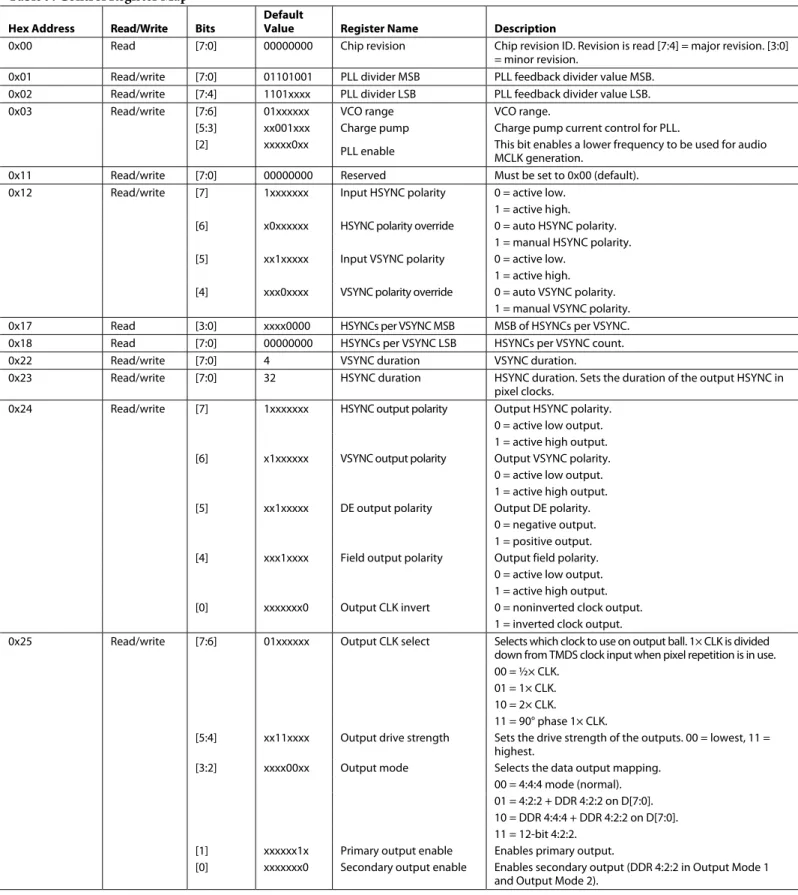
The AD9393 is initialized and controlled by a set of registers that determines the operating modes. An external controller is employed to write and read the control registers through the 2-wire serial interface port.
Table 9. Control Register Map
Hex Address Read/Write Bits
Default
Value Register Name Description
0x00 Read [7:0] 00000000 Chip revision Chip revision ID. Revision is read [7:4] = major revision. [3:0] = minor revision.
0x01 Read/write [7:0] 01101001 PLL divider MSB PLL feedback divider value MSB. 0x02 Read/write [7:4] 1101xxxx PLL divider LSB PLL feedback divider value LSB.
0x03 Read/write [7:6] 01xxxxxx VCO range VCO range.
[5:3] xx001xxx Charge pump Charge pump current control for PLL.
[2] xxxxx0xx
PLL enable This bit enables a lower frequency to be used for audio MCLK generation. 0x11 Read/write [7:0] 00000000 Reserved Must be set to 0x00 (default).
0x12 Read/write [7] 1xxxxxxx Input HSYNC polarity 0 = active low. 1 = active high. [6] x0xxxxxx HSYNC polarity override 0 = auto HSYNC polarity.
1 = manual HSYNC polarity. [5] xx1xxxxx Input VSYNC polarity 0 = active low.
1 = active high. [4] xxx0xxxx VSYNC polarity override 0 = auto VSYNC polarity.
1 = manual VSYNC polarity. 0x17 Read [3:0] xxxx0000 HSYNCs per VSYNC MSB MSB of HSYNCs per VSYNC. 0x18 Read [7:0] 00000000 HSYNCs per VSYNC LSB HSYNCs per VSYNC count.
0x22 Read/write [7:0] 4 VSYNC duration VSYNC duration.
0x23 Read/write [7:0] 32 HSYNC duration HSYNC duration. Sets the duration of the output HSYNC in pixel clocks.
0x24 Read/write [7] 1xxxxxxx HSYNC output polarity Output HSYNC polarity.
0 = active low output.
1 = active high output. [6] x1xxxxxx VSYNC output polarity Output VSYNC polarity. 0 = active low output. 1 = active high output. [5] xx1xxxxx DE output polarity Output DE polarity.
0 = negative output. 1 = positive output. [4] xxx1xxxx Field output polarity Output field polarity.
0 = active low output. 1 = active high output. [0] xxxxxxx0 Output CLK invert 0 = noninverted clock output.
1 = inverted clock output.
0x25 Read/write [7:6] 01xxxxxx Output CLK select Selects which clock to use on output ball. 1× CLK is divided down from TMDS clock input when pixel repetition is in use. 00 = ½× CLK.
01 = 1× CLK. 10 = 2× CLK.
11 = 90° phase 1× CLK.
[5:4] xx11xxxx Output drive strength Sets the drive strength of the outputs. 00 = lowest, 11 = highest.
[3:2] xxxx00xx Output mode Selects the data output mapping. 00 = 4:4:4 mode (normal). 01 = 4:2:2 + DDR 4:2:2 on D[7:0]. 10 = DDR 4:4:4 + DDR 4:2:2 on D[7:0]. 11 = 12-bit 4:2:2.
[1] xxxxxx1x Primary output enable Enables primary output.
[0] xxxxxxx0 Secondary output enable Enables secondary output (DDR 4:2:2 in Output Mode 1 and Output Mode 2).
Hex Address Read/Write Bits
Default
Value Register Name Description 0x26 Read/write [7] 0xxxxxxx Output three-state Three-state the outputs.
[5] xx0xxxxx S/PDIF three-state Three-state the S/PDIF output.
[4] xxx0xxxx I2S three-state Three-state the I2S output and the MCLK output.
[3] xxxx1xxx Power-down ball polarity Sets polarity of power-down ball. 0 = active low.
1 = active high.
[2:1] xxxxx00x Power-down ball function Selects the function of the power-down ball. 0x = power-down.
1x = three-state outputs.
[0] xxxxxxx0 Power-down 0 = normal.
1 = power-down.
0x27 Read/write [7] 1xxxxxxx Auto power-down enable 0 = disable auto low power state. 1 = enable auto low power state.
[6] x0xxxxxx HDCP A0 Sets the LSB of the address of the HDCP I2C. Set to 1 only for a second receiver in a dual-link configuration. [5] xx0xxxxx Clock test Must be written to 0.
[4] xxx0xxxx BT656 EN Enables EAV/SAV codes to be inserted into the video output data.
[3] xxxx0xxx Force DE generation Allows use of the internal DE generator—not the DE transmitted over TMDS.
[2:0] xxxxx000 Interlace offset Sets the difference (in HSYNCs) in field length between Field 0 and Field 1.
0x28 Read/write [7:2] 011000xx VSYNC delay Sets the delay (in lines) from the VSYNC leading edge to the start of active video.
[1:0] xxxxxx01 HSYNC delay MSB HSYNC delay MSB of Register 0x29.
0x29 Read/write [7:0] 00000100 HSYNC delay LSB Sets the delay (in pixels) from the HSYNC leading edge to the start of active video.
0x2A Read/write [3:0] xxxx0101 Line width MSB Line width MSB of Register 0x2B.
0x2B Read/write [7:0] 00000000 Line width LSB Sets the width of the active video line in pixels. 0x2C Read/write [3:0] xxxx0010 Screen height MSB Screen height MSB of Register 0x2D.
0x2D Read/write [7:0] 11010000 Screen height LSB Sets the height of the active screen in lines. 0x2E Read/write [7] 0xxxxxxx CTRL EN Allows CTRL[3:0] to be output on the I2S data pins.
[6:5] x00xxxxx I2S output mode 00 = I2S mode.
01 = right-justified.
10 = left-justified.
11 = raw IEC60958 mode.
[4:0] xxx11000 I2S bit width Sets the desired bit width for right-justified mode.
0x2F Read [6] x0xxxxxx TMDS sync detect Detects a TMDS DE.
[5] xx0xxxxx TMDS active Detects a TMDS clock.
[4] xxx0xxxx AV mute Gives the status of AV mute based on general control packets.
[3] xxxx0xxx HDCP keys read Returns 1 when read of EEPROM keys is successful. [2:0] xxxxx000 HDMI quality Returns quality number based on DE edges.
0x30 Read [6] x0xxxxxx HDMI content encrypted This bit is high when HDCP decryption is in use (content is protected). The signal goes low when HDCP is not being used. Use this bit to allow copying of the content. The bit should be sampled at regular intervals because it can change on a frame-by-frame basis.
[5] xx0xxxxx HDMI HSYNC polarity Returns HDMI HSYNC polarity. [4] xxx0xxxx HDMI VSYNC polarity Returns HDMI VSYNC polarity.
[3:0] xxxx0000 HDMI pixel repetition Returns current HDMI pixel repetition amount. 0 = 1×, 1 = 2× … The clock and data outputs are automatically decimated by this value.
Hex Address Read/Write Bits
Default
Value Register Name Description
0x34 Read/write [5:4] xx00xxxx Audio setup Must be written to 0b11 for proper operation. [3] xxxx0xxx Upconversion mode 0 = repeat Cr and Cb values.
1 = interpolate Cr and Cb values. [2] xxxxx0xx CrCb filter enable Enables the FIR filter for 4:2:2 CrCb output. [1] xxxxxx0x CSC_ENABLE Enables the color space converter (CSC). The default
settings for the CSC provide HDTV-to-RGB conversion. Sets the fixed point position of the CSC coefficients, including the A4, B4, and C4 offsets.
0x35 Read/write [6:5] x01xxxxx CSC_MODE 00 = ±1.0, −4096 to +4095.
01 =±2.0, −8192 to +8190. 1x = ±4.0, −16,384 to +16,380. [4:0] xxx01100 CSC_COEFF_A1 MSB MSB of Register 0x36.
0x36 Read/write [7:0] 01010010 CSC_COEFF_A1 LSB Color space converter (CSC) coefficient for equation: ROUT = (A1 × RIN) + (A2 × GIN) + (A3 × BIN) + A4
GOUT = (B1 × RIN) + (B2 × GIN) + (B3 × BIN) + B4
BOUT = (C1 × RIN) + (C2 × GIN) + (C3 × BIN) + C4
0x37 Read/write [4:0] xxx01000 CSC_COEFF_A2 MSB MSB of Register 0x38. 0x38 Read/write [7:0] 00000000 CSC_COEFF_A2 LSB CSC coefficient for equation:
ROUT = (A1 × RIN) + (A2 × GIN) + (A3 × BIN) + A4
GOUT = (B1 × RIN) + (B2 × GIN) + (B3 × BIN) + B4
BOUT = (C1 × RIN) + (C2 × GIN) + (C3 × BIN) + C4
0x39 Read/write [4:0] xxx00000 CSC_COEFF_A3 MSB MSB of Register 0x3A. 0x3A Read/write [7:0] 00000000 CSC_COEFF_A3 LSB CSC coefficient for equation:
ROUT = (A1 × RIN) + (A2 × GIN) + (A3 × BIN) + A4
GOUT = (B1 × RIN) + (B2 × GIN) + (B3 × BIN) + B4
BOUT = (C1 × RIN) + (C2 × GIN) + (C3 × BIN) + C4
0x3B Read/write [4:0] xxx11001 CSC_COEFF_A4 MSB MSB of Register 0x3C. 0x3C Read/write [7:0] 11010111 CSC_COEFF_A4 LSB CSC coefficient for equation:
ROUT = (A1 × RIN) + (A2 × GIN) + (A3 × BIN) + A4
GOUT = (B1 × RIN) + (B2 × GIN) + (B3 × BIN) + B4
BOUT = (C1 × RIN) + (C2 × GIN) + (C3 × BIN) + C4
0x3D Read/write [4:0] xxx11100 CSC_COEFF_B1 MSB MSB of Register 0x3E. 0x3E Read/write [7:0] 01010100 CSC_COEFF_B1 LSB CSC coefficient for equation:
ROUT = (A1 × RIN) + (A2 × GIN) + (A3 × BIN) + A4
GOUT = (B1 × RIN) + (B2 × GIN) + (B3 × BIN) + B4
BOUT = (C1 × RIN) + (C2 × GIN) + (C3 × BIN) + C4
0x3F Read/write [4:0] ***01000 CSC_COEFF_B2 MSB MSB of Register 0x40. 0x40 Read/write [7:0] 00000000 CSC_COEFF_B2 LSB CSC coefficient for equation:
ROUT = (A1 × RIN) + (A2 × GIN) + (A3 × BIN) + A4
GOUT = (B1 × RIN) + (B2 × GIN) + (B3 × BIN) + B4
BOUT = (C1 × RIN) + (C2 × GIN) + (C3 × BIN) + C4
0x41 Read/write [4:0] xxx11110 CSC_COEFF_B3 MSB MSB of Register 0x42. 0x42 Read/write [7:0] 10001001 CSC_COEFF_B3 LSB CSC coefficient for equation:
ROUT = (A1 × RIN) + (A2 × GIN) + (A3 × BIN) + A4
GOUT = (B1 × RIN) + (B2 × GIN) + (B3 × BIN) + B4
BOUT = (C1 × RIN) + (C2 × GIN) + (C3 × BIN) + C4
0x43 Read/write [4:0] xxx00010 CSC_COEFF_B4 MSB MSB of Register 0x44. 0x44 Read/write [7:0] 10010010 CSC_COEFF_B4 LSB CSC coefficient for equation:
ROUT = (A1 × RIN) + (A2 × GIN) + (A3 × BIN) + A4
GOUT = (B1 × RIN) + (B2 × GIN) + (B3 × BIN) +B4
BOUT = (C1 × RIN) + (C2 × GIN) + (C3 × BIN) + C4
0x45 Read/write [4:0] xxx00000 CSC_COEFF_C1 MSB MSB of Register 0x46. 0x46 Read/write [7:0] 00000000 CSC_COEFF_C1 LSB CSC coefficient for equation:
ROUT = (A1 × RIN) + (A2 × GIN) + (A3 × BIN) + A4
GOUT = (B1 × RIN) + (B2 × GIN) + (B3 × BIN) + B4
Hex Address Read/Write Bits
Default
Value Register Name Description 0x47 Read/write [4:0] xxx01000 CSC_COEFF_C2 MSB MSB of Register 0x48. 0x48 Read/write [7:0] 00000000 CSC_COEFF_C2 LSB CSC coefficient for equation:
ROUT = (A1 × RIN) + (A2 × GIN) + (A3 × BIN) + A4
GOUT = (B1 × RIN) + (B2 × GIN) + (B3 × BIN) + B4
BOUT = (C1 × RIN) + (C2 × GIN) + (C3 × BIN) + C4
0x49 Read/write [4:0] xxx01110 CSC_COEFF_C3 MSB MSB of Register 0x4A. 0x4A Read/write [7:0] 10000111 CSC_COEFF_C3 LSB CSC coefficient for equation:
ROUT = (A1 × RIN) + (A2 × GIN) + (A3 × BIN) + A4
GOUT = (B1 × RIN) + (B2 × GIN) + (B3 × BIN) + B4
BOUT = (C1 × RIN) + (C2 × GIN) + (C3 × BIN) + C4
0x4B Read/write [4:0] xxx11000 CSC_COEFF_C4 MSB MSB of Register 0x4C. 0x4C Read/write [7:0] 10111101 CSC_COEFF_C4 LSB CSC coefficient for equation:
ROUT = (A1 × RIN) + (A2 × GIN) + (A3 × BIN) + A4
GOUT = (B1 × RIN) + (B2 × GIN) + (B3 × BIN) + B4
BOUT = (C1 × RIN) + (C2 × GIN) + (C3 × BIN) + C4
0x4D Read/write [7:0] 00110110 TMDS PLL Control1 Must be written to 0x3B. 0x4E Read/write [7:0] 00110110 TMDS PLL Control2 Must be written to 0x6D. 0x4F Read/write [7:0] 00110110 TMDS PLL Control3 Must be written to 0x54.
0x50 Read/write [7:0] 00100000 Test Must be written to 0x20 for proper operation. 0x56 Read/write [7:0] 00001111 Test Must be written to 0x0F (default) for proper operation. 0x57 Read/write [7] 0xxxxxxx AV mute override A1 overrides the AV mute value with Bit 6.
[6] x0xxxxxx AV mute value Sets AV mute value if override is enabled.
[3] xxxx0xxx Disable video mute Disables mute of video during AV mute.
[2] xxxxx0xx Disable audio mute Disables mute of audio during AV mute.
0x58 Read/write [7] 0 MCLK PLL enable MCLK PLL enable—uses analog PLL.
[6:4] 0 MCLK PLL_N MCLK PLL_N [2:0]—this controls the division of the MCLK out of the PLL: 0 = /1, 1 = /2, 2 = /3, 3 = /4 …
[3] 0 N_CTS_DISABLE Prevents the N/CTS packet on the link from writing to the N and CTS registers.
[2:0] 0 MCLK FS_N Controls the multiple of 128 fS used for MCLK out.
0 = 128 × fS, 1 = 256 × fS, 2 = 384 × fS, 7 = 1024 × fS.
0x59 Read/write [6] 0 MDA/MCL PU This disables the MDA/MCL pull-ups.
[5] 0 CLK term O/R Clock termination power-down override: 0 = auto, 1 = manual.
[4] 0 Manual CLK term Clock termination: 0 = normal, 1 = disconnected. [2] 0 FIFO reset UF This bit resets the audio FIFO if underflow is detected. [1] 0 FIFO reset OF This bit resets the audio FIFO if overflow is detected. [0] 0 MDA/MCL three-state This bit three-states the MDA/MCL lines.
0x5A Read [6:0] 0 Packet detected These seven bits are updated if any specific packet has been received since last reset or loss of clock detect. Normal is 0x00.
Bit Data Packet Detected
0 AVI infoframe.
1 Audio infoframe.
2 SPD infoframe.
3 MPEG source infoframe.
4 ACP packets.
5 ISRC1 packets.
6 ISRC2 packets.
Hex Address Read/Write Bits
Default
Value Register Name Description
0x5E Read [7:6] 0 Channel status Mode = 00. All others are reserved.
[5:3] 0 PCM audio data When Bit 1 = 0 (linear PCM):
000 = two audio channels without pre-emphasis. 001 = two audio channels with 50 μs/15 μs pre-emphasis. 010 = reserved.
011 = reserved.
[2] 0 Copyright information 0 = software for which copyright is asserted. 1 = software for which no copyright is asserted. [1] 0 Linear PCM identification 0 = audio sample word represents linear PCM samples.
1 = audio sample word used for other purposes.
[0] 0 Use of channel
status block
0 = consumer use of channel status block. Audio Channel Status
0x5F Read [7:0] 0 Channel status
category code
Per HDMI
0x60 Read [7:4] 0 Channel number Per HDMI
[3:0] 0 Source number Per HDMI
0x61 Read [5:4] 0 Clock accuracy Clock accuracy.
00 = Level II. 01 = Level III. 10 = Level I. 11 = reserved. [3:0] 0 Sampling frequency 0011 = 32 kHz. 0000 = 44.1 kHz. 1000 = 88.2 kHz. 1100 = 176.4 kHz. 0010 = 48 kHz. 1010 = 96 kHz. 1110 = 192 kHz.
0x62 Read [3:0] 0 Word length Word length.
0000 = not specified. 0100 = 16 bits. 0011 = 17 bits. 0010 = 18 bits. 0001 = 19 bits. 0101 = 20 bits. 1000 = not specified. 1100 = 20 bits. 1011 = 21 bits. 1010 = 22 bits. 1001 = 23 bits. 1101 = 24 bits.
0x7B Read [7:0] 0 CTS[19:12] Cycle time stamp. This 20-bit value is used with the N value to regenerate an audio clock. For the remaining bits, see Register 0x7C and Register 0x7D.
0x7C Read [7:0] 0 CTS[11:4] See Register 0x7B
0x7D Read [7:4] 0 CTS[3:0] See Register 0x7B
Read [3:0] 0 N[19:16] 20-bit N used with CTS to regenerate the audio clock. For remaining bits, see Register 0x7E and Register 0x7F.
0x7E Read [7:0] 0 N[15:8] See Register 0x7D
0x7F Read [7:0] 0 N[7:0] See Register 0x7D
AVI Infoframe
Hex Address Read/Write Bits
Default
Value Register Name Description
0x81 Read [6:5] 0 Y[1:0] Y[1:0] indicates RGB, 4:2:2, or 4:4:4.
00 = RGB.
01 = YCrCb 4:2:2. 10 = YCrCb 4:4:4.
[4] 0 Active format information
status
Active format information present. 0 = no data.
1 = active format information valid.
[3:2] 0 Bar information B[1:0].
00 = no bar information.
01 = horizontal bar information valid. 10 = vertical bar information valid.
11 = horizontal and vertical bar information valid.
[1:0] 0 Scan information S[1:0]. 00 = no information. 01 = overscanned (television). 10 = underscanned (computer). 0x82 Read [7:6] 0 Colorimetry C[1:0]. 00 = no data. 01 = SMPTE 170M, ITU601. 10 = ITU709.
[5:4] 0 Picture aspect ratio M[1:0].
00 = no data.
01 = 4:3.
10 = 16:9.
[3:0] 0 Active format aspect ratio R[3:0].
1000 = same as picture aspect ratio. 1001 = 4:3 (center).
1010 = 16:9 (center). 1011 = 14:9 (center).
0x83 Read [1:0] 0 Nonuniform picture scaling SC[1:0].
00 = no known nonuniform scaling. 01 = picture has been scaled horizontally. 10 = picture has been scaled vertically.
11 = picture has been scaled horizontally and vertically. 0x84 Read [6:0] 0 Video identification code VIC[6:0] video identification code—refer to CEA EDID short
video descriptors.
0x85 Read [3:0] 0 Pixel repeat PR[3:0] specifies how many times a pixel has been
repeated.
0000 = no repetition (pixel sent once). 0001 = pixel sent twice (repeated once). 0010 = pixel sent three times.
1001 = pixel sent 10 times. 0xA to 0xF reserved.
0x86 Read [7:0] 0 Active line start LSB This represents the line number of the end of the top horizontal bar. If 0, there is no horizontal bar. Combines with Register 0x88 for a 16-bit value.
0x87 Read [6:0] 0 New data flags New data flags. These eight bits are updated if any specific data changes. Normal (no NDFs) is 0x00. When any NDF register is read, all bits reset to 0x00. All NDF registers contain the same data.
Bit Data Packet Changed
0 AVI infoframe.
Hex Address Read/Write Bits
Default
Value Register Name Description
0x88 Read [7:0] 0 Active line start MSB Active line start MSB (see Register 0x86).
0x89 Read [7:0] 0 Active line end LSB This represents the line number of the beginning of a lower horizontal bar. If greater than the number of active video lines, there is no lower horizontal bar. Combines with Register 0x8A for a 16-bit value.
0x8A Read [7:0] 0 Active line end MSB Active line end MSB. See Register 0x89.
0x8B Read [7:0] 0 Active pixel start LSB This represents the last pixel in a vertical pillar bar at the left side of the picture. If 0, there is no left bar. Combines with Register 0x8C for a 16-bit value.
0x8C Read [7:0] 0 Active pixel start MSB Active pixel start MSB. See Register 0x8B.
0x8D Read [7:0] 0 Active pixel end LSB This represents the first horizontal pixel in a vertical pillar-bar at the right side of the picture. If greater than the maximum number of horizontal pixels, there is no vertical bar. Com-bines with Register 0x8E for a16-bit value.
0x8E Read [7:0] 0 Active pixel end MSB Active pixel end MSB. See Register 0x8D.
0x8F Read [6:0] 0 New data flags New data flags (see Register 0x87).
0x90 Read [7:0] 0 Audio infoframe version Per HDMI
0x91 Read [7:4] 0 Audio coding type CT[3:0]. Audio coding type.
0x00 = refer to stream header. 0x01 = IEC60958 PCM.
0x02 = AC3.
0x03 = MPEG1 (Layer 1 and Layer 2). 0x04 = MP3 (MPEG1 Layer 3). 0x05 = MPEG2 (multichannel).
0x06 = AAC.
0x07 = DTS.
0x08 = ATRAC.
[2:0] 0 Audio coding count CC[2:0]. Audio channel count. 000 = refer to stream header. 001 = two channels. 010 = three channels. 111 = eight channels.
0x92 Read [4:2] 0 Sampling frequency SF[2:0]. Sampling frequency.
000 = refer to stream header. 001 = 32 kHz. 010 = 44.1 kHz (CD). 011 = 48 kHz. 100 = 88.2 kHz. 101 = 96 kHz. 110 = 176.4 kHz. 111 = 192 kHz.
[1:0] 0 Sample size SS [1:0]. Sample size.
00 = refer to stream header. 01 = 16 bits.
10 = 20 bits. 11 = 24 bits.
0x93 Read [7:0] 0 Maximum bit rate Maximum bit rate (compressed audio only). The value of this field multiplied by 8 kHz represents the maximum bit rate.
0x94 Read [7:0] 0 Speaker mapping CA[7:0]. Speaker mapping or placement for up to eight channels. See Table 24.
0x95 Read [7] 0 Down-mix DM_INH: down-mix inhibit.
0 = permitted or no information. 1 = prohibited.
[6:3] 0 Level shift LSV[3:0]: level shift values with attenuation information. 0000 = 0 dB attenuation.
0001 = 1 dB attenuation. . . .
Hex Address Read/Write Bits
Default
Value Register Name Description
0x96 Read [7:0] 0 Reserved.
0x97 Read [6:0] 0 New data flags New data flags (see Register 0x87).
Source Product Description (SPD) Infoframe
0x98 Read [7:0] 0 Source product description
(SPD) infoframe version
Per HDMI
0x99 Read [7:0] 0 Vender Name Character 1 Vender name character 1 (VN1) 7-bit ASCII code. The first of eight characters naming the product company.
0x9A Read [7:0] 0 VN2 VN2.
0x9B Read [7:0] 0 VN3 VN3.
0x9C Read [7:0] 0 VN4 VN4.
0x9D Read [7:0] 0 VN5 VN5.
0x9E Read [7:0] 0 VN6 VN6.
0x9F Read [6:0] 0 New data flags New data flags (see Register 0x87).
0xA0 Read [7:0] 0 VN7 VN7.
0xA1 Read [7:0] 0 VN8 VN8.
0xA2 Read [7:0] 0 Product Description
Character 1
Product Description Character 1 (PD1) 7-bit ASCII code. The first of 16 characters that contains the model number and a short description.
0xA3 Read [7:0] 0 PD2 PD2.
0xA4 Read [7:0] 0 PD3 PD3.
0xA5 Read [7:0] 0 PD4 PD4.
0xA6 Read [7:0] 0 PD5 PD5.
0xA7 Read [6:0] 0 New data flags New data flags (see Register 0x87).
0xA8 Read [7:0] 0 PD6 PD6. 0xA9 Read [7:0] 0 PD7 PD7. 0xAA Read [7:0] 0 PD8 PD8. 0xAB Read [7:0] 0 PD9 PD9. 0xAC Read [7:0] 0 PD10 PD10. 0xAD Read [7:0] 0 PD11 PD11. 0xAE Read [7:0] 0 PD12 PD12.
0xAF Read [6:0] 0 New data flags New data flags (see Register 0x87).
0xB0 Read [7:0] 0 PD13 PD13.
0xB1 Read [7:0] 0 PD14 PD14.
0xB2 Read [7:0] 0 PD15 PD15.
0xB3 Read [7:0] 0 PD16 PD16.
0xB4 Read [7:0] 0 Source device This is a code that classifies the source device. Information code 0x00 = unknown.
0x01 = digital STB. 0x02 = DVD. 0x03 = D-VHS. 0x04 = HDD video. 0x05 = DVC. 0x06 = DSC. 0x07 = video CD. 0x08 = game. 0x09 = PC general.
0xB7 Read [6:0] 0 New data flags New data flags (see Register 0x87).
MPEG Source Infoframe
0xB8 Read [7:0] 0 MPEG source infoframe
version
0xB9 Read [7:0] 0 MB[0] MB[0] (lower byte of MPEG bit rate in hertz). This is the
Hex Address Read/Write Bits
Default
Value Register Name Description
0xBD Read [4] 0 Field repeat FR—new field or repeated field.
0 = new field or picture. 1 = repeated field.
[1:0] 0 MPEG frame MF[1:0]. This identifies whether frame is an I, B, or P picture.
00 = unknown.
01 = I picture. 10 = B picture. 11 = P picture.
0xBE Read [7:0] 0 Reserved.
0xBF Read [6:0] 0 New data flags New data flags (see Register 0x87).
0xC0 Read [7:0] 0 Audio content protection
packet (ACP) type
Audio content protection packet (ACP) type. 0x00 = generic audio.
0x01 = IEC60958-identified audio. 0x02 = DVD audio.
0x03 = reserved for super audio CD (SACD). 0x04 to 0xFF = reserved.
0xC1 Read [7:0] 0 ACP Packet Byte 0 ACP Packet Byte 0 (ACP_PB0).
0xC2 Read [7:0] 0 ACP_PB1 ACP_PB1.
0xC3 Read [7:0] 0 ACP_PB2 ACP_PB2.
0xC4 Read [7:0] 0 ACP_PB3 ACP_PB3.
0xC5 Read [7:0] 0 ACP_PB4 ACP_PB4.
0xC6 Read [7:0] 0 ACP_PB5 ACP_PB5.
0xC7 Read [6:0] 0 New data flags New data flags (see Register 0x87).
0xC8 Read [7] 0 ISRC1 continued International standard recording code (ISRC1) continued. This indicates an ISRC2 packet is being transmitted. [6] 0 ISRC1 valid 0 = ISRC1 status bits and PBs not valid.
1 = ISRC1 status bits and PBs valid.
[2:0] 0 ISRC1 status 001 = starting position.
010 = intermediate position. 100 = final position.
0xC9 Read [7:0] 0 ISRC1 Packet Byte 0 ISRC1 Packet Byte 0 (ISRC1_PB0).
0xCA Read [7:0] 0 ISRC1_PB1 ISRC1_PB1.
0xCB Read [7:0] 0 ISRC1_PB2 ISRC1_PB2.
0xCC Read [7:0] 0 ISRC1_PB3 ISRC1_PB3.
0xCD Read [7:0] 0 ISRC1_PB4 ISRC1_PB4.
0xCE Read [7:0] 0 ISRC1_PB5 ISRC1_PB5.
0xCF Read [6:0] 0 New data flags New data flags (see Register 0x87).
0xD0 Read [7:0] 0 ISRC1_PB6 ISRC1_PB6.
0xD1 Read [7:0] 0 ISRC1_PB7 ISRC1_PB7.
0xD2 Read [7:0] 0 ISRC1_PB8 ISRC1_PB8.
0xD3 Read [7:0] 0 ISRC1_PB9 ISRC1_PB9.
0xD4 Read [7:0] 0 ISRC1_PB10 ISRC1_PB10.
0xD5 Read [7:0] 0 ISRC1_PB11 ISRC1_PB11.
0xD6 Read [7:0] 0 ISRC1_PB12 ISRC1_PB12.
0xD7 Read [6:0] 0 New data flags New data flags (see Register 0x87).
0xD8 Read [7:0] 0 ISRC1_PB13 ISRC1_PB13.
0xD9 Read [7:0] 0 ISRC1_PB14 ISRC1_PB14.
0xDA Read [7:0] 0 ISRC1_PB15 ISRC1_PB15.
0xDB Read [7:0] 0 ISRC1_PB16 ISRC1_PB16.
0xDC Read [7:0] 0 ISRC2 Packet Byte 0 ISRC2 Packet Byte 0 (ISRC2_PB0). This is transmitted only when the ISRC bit continues (Register 0xC8, Bit[7]) is set to 1.
0xDD Read [7:0] 0 ISRC2_PB1 ISRC2_PB1.
0xDE Read [7:0] 0 ISRC2_PB2 ISRC2_PB2.
0xDF Read [6:0] 0 New data flags New data flags (see Register 0x87).
0xE0 Read [7:0] 0 ISRC2_PB3 ISRC2_PB3.
0xE1 Read [7:0] 0 ISRC2_PB4 ISRC2_PB4.
Hex Address Read/Write Bits
Default
Value Register Name Description
0xE3 Read [7:0] 0 ISRC2_PB6 ISRC2_PB6.
0xE4 Read [7:0] 0 ISRC2_PB7 ISRC2_PB7.
0xE5 Read [7:0] 0 ISRC2_PB8 ISRC2_PB8.
0xE6 Read [7:0] 0 ISRC2_PB9 ISRC2_PB9.
0xE7 Read [6:0] 0 New data flags New data flags (see Register 0x87).
0xE8 Read [7:0] 0 ISRC2_PB10 ISRC2_PB10.
0xE9 Read [7:0] 0 ISRC2_PB11 ISRC2_PB11.
0xEA Read [7:0] 0 ISRC2_PB12 ISRC2_PB12.
0xEB Read [7:0] 0 ISRC2_PB13 ISRC2_PB13.
0xEC Read [7:0] 0 ISRC2_PB14 ISRC2_PB14.
0xED Read [7:0] 0 ISRC2_PB15 ISRC2_PB15.
2-WIRE SERIAL CONTROL REGISTER DETAILS
This section describes certain register details. Note that not all registers are discussed in this section.
CHIP IDENTIFICATION
0x00—Bits[7:0], Chip Revision
An 8-bit value that reflects the current chip revision.
0x17—Bits[3:0], HSYNCs per VSYNC MSB
These bits are four MSBs of the 12-bit counter that reports the number of HSYNCs per VSYNC on the active input. This is useful in determining the mode and aid in setting the PLL divide ratio.
0x18—Bit[7:0], HSYNCs per VSYNC LSB
These bits are eight LSBs of the 12-bit counter that reports the number of HSYNCs per VSYNCs on the active input.
0x23—Bits[7:0], HSYNC Duration
These bits are an 8-bit register that sets the duration of the HSYNC output pulse. The leading edge of the HSYNC output is triggered by the internally generated, phase-adjusted PLL feedback clock. The AD9393 then counts a number of pixel clocks equal to the value in this register. This triggers the trailing edge of the HSYNC output, which is also phase-adjusted. The power-up default is 32.
0x24—Bit[7], HSYNC Output Polarity
This bit sets the polarity of the HSYNC output. Setting this bit to 0 sets the HSYNC output to active low. Setting this bit to 1 sets the HSYNC output to active high. The power-up default setting is 1.
0x24—Bit[6], VSYNC Output Polarity
This bit sets the polarity of the VSYNC output. Setting this bit to 0 sets the VSYNC output to active low. Setting this bit to 1 sets the VSYNC output to active high. The power-up default is 1.
0x24—Bit[5] DE Output Polarity
This bit sets the polarity of the display enable (DE). 0 = DE output polarity is negative. 1 = DE output polarity is positive. The power-up default is 1.
0x24—Bit[4], Field Output Polarity
This bit sets the polarity of the odd/even field output signal on Ball A7. 0 = active low = even field; active high = odd field. 1 = active high = odd field; active high = even field. The power-up default setting is 1.
0x24—Bit[0], Output CLK Invert
This bit allows inversion of the output clock as specified by Register 0x25, Bits[7:6]. 0 = noninverted clock. 1 = inverted clock. The power-up default setting is 0.
0x25—Bits[7:6], Output CLK Select
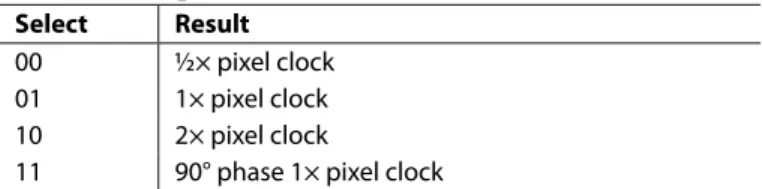
These bits select the clock output on the DCLK ball. They include ½× clock, a 2× clock, a 90° phase shifted clock, or the normal pixel clock. The power-up default setting is 01. See Table 10.
Table 10. Output Clock Select
Select Result
00 ½× pixel clock
01 1× pixel clock
10 2× pixel clock
11 90° phase 1× pixel clock
0x25—Bits[5:4], Output Drive Strength
These two bits select the drive strength for all the high speed digital outputs (except the VSOUT, HSOUT, and O/E). Higher drive strength results in faster rise/fall times and in general makes it easier to capture data. Lower drive strength results in slower rise/fall times and helps to reduce EMI and digitally generated power supply noise. The power-up default setting is 11. See Table 11.
Table 11. Output Drive Strength
Output Drive Result
00 Low output drive strength
01 Medium low output drive strength
10 Medium high output drive strength
11 High output drive strength
0x25—Bits[3:2], Output Mode
These bits choose between four options for the output mode. 4:4:4 mode is standard RGB; 4:2:2 mode is YCrCb, which reduces the number of active output pins from 24 to 16; 4:4:4 is double data rate (DDR) output mode; and the data is RGB mode that changes on every clock edge. The power-up default setting is 00. See Table 12.
Table 12. Output Mode
Output
Mode Result
00 4:4:4 RGB mode
01 4:2:2 YCrCb mode + DDR 4:2:2 on D[7:0] (secondary)
10 DDR 4:4:4 DDR mode + DDR 4:2:2 on D[7:0] (secondary)
0x25—Bit[1], Primary Output Enable
This bit places the primary output in active or high impedance mode. The primary output is designated when using either 4:2:2 or DDR 4:4:4. In these modes, the data on the red and green output channels (D[23:8]) is the primary output, whereas the output data on the blue channel (D[7:0], DDR YCrCb) is the secondary output. Double data rate 0 = primary output is in high impedance mode. 1 = primary output is enabled. The power-up default setting is 1.
0x25—Bit[0], Secondary Output Enable
This bit places the secondary output in active or high impe-dance mode. The secondary output is designated when using either 4:2:2 or DDR 4:4:4. In these modes, the data on the blue output channel (D[7:0]) is the secondary output and the output data on the red and green channels (D[23:8]) is the primary output. Secondary output is always a DDR YCrCb data mode. 0 = secondary output is in high impedance mode. 1 = second-ary output is enabled. The power-up default setting is 0.
0x26—Bit[7], Output Three-State
When enabled, this bit puts all outputs in a high impedance state. 0 = normal outputs. 1 = all outputs in high impedance mode. The power-up default setting is 0.
0x26—Bit[5], S/PDIF Three-State
When enabled, this bit places the S/PDIF audio output pins in a high impedance state. 0 = normal S/PDIF output. 1 = S/PDIF pins in high impedance mode. The power-up default setting is 0.
0x26—Bit[4], I2S Three-State
When enabled, this bit places the I2S output pins in a high
impedance state. 0 = normal I2S output. 1 = I2S pins are in
high impedance mode. The power-up default setting is 0.
0x26—Bit[3], Power-Down Ball Polarity
This bit defines the polarity of the input power-down ball. 0 = power-down ball is active low. 1 = power-down ball is active high. The power-up default setting is 1.
0x26—Bits[2:1], Power-Down Ball Function
These bits define the different operational modes of the power-down ball. These bits are functional only when the power-power-down ball is active; when it is inactive, the part is powered up and functioning. 0x = the chip is powered down and all outputs are in high impedance mode. 1x = the chip remains powered up, but all outputs are in three-state outputs mode. The power-up default setting is 00.
0x26—Bit[0], Power-Down
This bit is used to put the chip in power-down mode. In this mode, the power dissipation is reduced to a fraction of the typical power (see Table 2 for exact power dissipation). When in power-down, the HSOUT, VSOUT, DCLK, and all 24 of the data outputs are put into a high impedance state. Circuit blocks that continue to be active during power-down include the voltage references, sync detection, and the serial register. These blocks facilitate a fast start up from power-down. 0 = normal operation. 1 = power-down. The power-up default setting is 0.
0x27—Bit[7], Auto Power-Down Enable
This bit enables the chip to go into low power mode, or seek mode if no sync inputs are detected. 0 = auto power-down disabled. 1 = chip powers down if no sync inputs are present. The power-up default setting is 1.
0x27—Bit[6], HDCP A0
This bit sets the LSB of the address of the HDCP I2C. Set this bit
to 1 only for a second receiver in a dual-link configuration. The power-up default is 0.
0x27—Bit[5], Clock Test
BT656 GENERATION
0x27—Bit[4], BT656 EN
This bit enables the output to be BT656-compatible with the defined start of active video (SAV) and the end of active video (EAV) controls to be inserted. These require specification of the number of active lines, active pixels per line, and delays to place these markers. 0 = disable BT656 video mode. 1 = enable BT656 video mode. The power-up default setting is 0.
0x27—Bit[3], Force DE Generation
This bit allows the use of the internal DE generator in DVI mode. 0 = internal DE generation disabled. 1 = force DE generation via programmed registers. The power-up default setting is 0.
0x27—Bits[2:0], Interlace Offset
These bits define the offset in HSYNCs from Field 0 to Field 1. The power-up default setting is 000.
0x28—Bits[7:2], VSYNC Delay
These bits set the delay (in lines) from the leading edge of VSYNC to active video. The power-up default setting is 24d.
0x28—Bits[1:0], HSYNC Delay MSB and 0x29—Bits[7:0], HSYNC Delay LSB
These 10 bits set the delay (in pixels) from the HSYNC leading edge to the start of active video. The power-up default setting is 0x104.
0x2A—Bits[3:0], Line Width MSB and 0x2B—Bits[7:0] Line Width LSB
These 12 bits set the width of the active video line (in pixels). The power-up default setting is 0x500.
0x2C—Bits[3:0], Screen Height MSB and 0x2D—Bits[7:0] Screen Height LSB
These 12 bits set the height of the active screen (in lines). The power-up default setting is 0x2D0.
0x2E—Bit[7], CTRL EN
When set, this bit allows CTRL[3:0] signals decoded from the DVI to be output on the I2S data pins. 0 = I2S signals on I2S
lines. 1 = CTRL[3:0] output on I2S lines. The power-up default
setting is 0.
0x2E—Bits[6:5], I2S Output Mode
These bits select between four options for the I2S output: I2S,
right-justified, left-justified, or raw IEC60958 mode. The power-up default setting is 00. See Table 13.
Table 13. I2S Output Select I2S Output Mode Result
00 I2S mode
01 Right-justified 10 Left-justified
11 Raw IEC60958 mode
0x2E—Bits[4:0], I2S Bit Width
These bits set the I2S bit width for right-justified mode. The
power-up default setting is 24 bits.
0x2F—Bit[6], TMDS Sync Detect
This read-only bit indicates the presence of a TMDS DE. 0 = no TMDS DE present. 1 = TMDS DE detected.
0x2F—Bit[5], TMDS Active
This read-only bit indicates the presence of a TMDS clock. 0 = no TMDS clock present. 1 = TMDS clock detected.
0x2F—Bit[4], AV Mute
This read-only bit indicates the presence of AV mute based on general control packets. 0 = AV not muted. 1 = AV muted.
0x2F—Bit[3], HDCP Keys Read
This read-only bit reports if the HDCP keys were read successfully. 0 = failure to read HDCP keys. 1 = HDCP keys read.
0x2F—Bits[2:0], HDMI Quality
These read-only bits indicate a level of HDMI quality based on the DE (display enable) edges. A larger number indicates a higher quality.
0x30—Bit[6], HDMI Content Encrypted
This read-only bit is high when HDCP decryption is in use (content is protected). The signal goes low when HDCP is not being used. Use this bit to to allow copying of the content. Sample the bit at regular intervals because it can change on a frame-by-frame basis. 0 = HDCP not in use. 1 = HDCP decryption in use.
0x30—Bit[5], HDMI HSYNC Polarity
This read-only bit indicates the polarity of the HDMI HSYNC. 0 = HDMI HSYNC polarity is active low. 1 = HDMI HSYNC polarity is active high.
0x30—Bit[4], HDMI VSYNC Polarity
This read-only bit indicates the polarity of the HDMI VSYNC. 0 = HDMI VSYNC polarity is low active. 1 = HDMI VSYNC polarity is high active.
0x30—Bits[3:0], HDMI Pixel Repetition
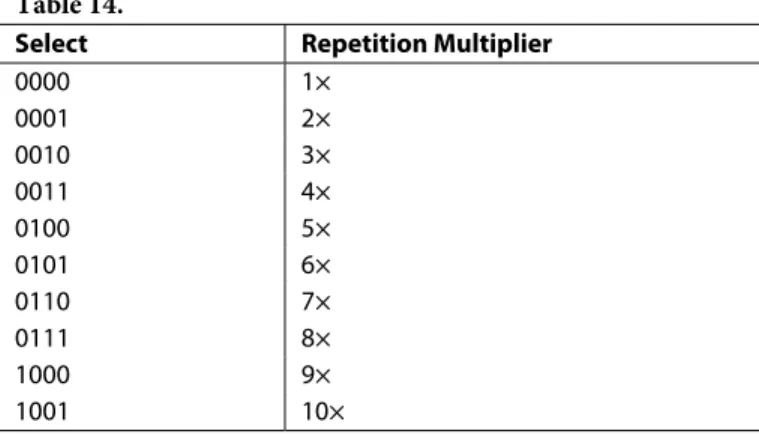
These read-only bits indicate the pixel repetition on HDMI. 0 = 1×, 1 = 2×, 2 = 3×, with a maximum repetition of 10× (0x9). See Table 14.
Table 14.
Select Repetition Multiplier
0000 1× 0001 2× 0010 3× 0011 4× 0100 5× 0101 6× 0110 7× 0111 8× 1000 9× 1001 10×
0x34—Bit[5:4], Audio Setup
This bit must be written to 0b11 for proper audio operation.
0x34—Bit[3], Up Conversion Mode
0 = repeat Cb and Cr values. 1 = interpolate Cb and Cr values.
0x34—Bit[2], CrCb Filter Enable
Enables the FIR filter for 4:2:2 CrCb output.
COLOR SPACE CONVERSION
The default power up values for the color space converter coefficients (Register 0x34 through Register 0x4C) are set for ATSC RGB-to-YCrCb conversion. They are completely programmable for other conversions.
0x34—Bit[1], CSC_ENABLE
This bit enables the color space converter. 0 = disable color space converter. 1 = enable color space converter. The power- up default setting is 0.
0x35—Bits[6:5], CSC_MODE
These two bits set the fixed-point position of the CSC coefficients, including the A4, B4, and C4 offsets.
Table 15. CSC Fixed Point Converter Mode
Select Result
00 ±1.0, −4096 to +4095
01 ±2.0, −8192 to +8190
1x ±4.0, −16,384 to +16,380
0x35—Bits[4:0], CSC_COEFF_A1 MSB and 0x36— Bits[7:0], CSC_COEFF_A1 LSB
Register 0x35[4:0] form the five MSBs of the Color Space Conversion Coefficient A1. These bits, combined with the eight LSBs of Register 0x36 form a 13-bit, twos complement coefficient, which is user programmable. The equation takes the form of:
ROUT = (A1 × RIN) + (A2 × GIN) + (A3 × BIN) + A4 GOUT = (B1 × RIN) + (B2 × GIN) + (B3 × BIN) + B4 BOUT = (C1 × RIN) + (C2 × GIN) + (C3 × BIN) + C4
The default value for the 13-bit A1 coefficient is 0x0C52.
0x37—Bits[4:0], CSC_COEFF_A2 MSB and 0x38— Bits[7:0], CSC _COEFF_A2 LSB
Register 0x37[4:0] form the five MSBs of the Color Space Conversion Coefficient A2. Combined with the eight LSBs of Register 0x38, these bits form a 13-bit, twos complement coefficient that is user programmable. The equation takes the form of:
ROUT = (A1 × RIN) + (A2 × GIN) + (A3 × BIN) + A4 GOUT = (B1 × RIN) + (B2 × GIN) + (B3 × BIN) + B4 BOUT = (C1 × RIN) + (C2 × GIN) + (C3 × BIN) + C4
0x39—Bits[4:0], CSC_COEFF_A3 MSB and 0x3A— Bits[7:0], CSC_COEFF_A3 LSB
The default value for the 13-bit A3 is 0x00000.
0x3B—Bits[4:0], CSC_COEFF_A4 MSB and 0x3C— Bits[7:0], CSC_COEFF_A4 LSB
The default value for the 13-bit A4 is 0x19D7.
0x3D—Bits[4:0], CSC_COEFF_B1 MSB and 0x3E— Bits[7:0], CSC_COEFF_B1 LSB
The default value for the 13-bit B1 is 0x1C54.
0x3F—Bits[4:0], CSC_COEFF_B2 MSB and 0x40— Bits[7:0], CSC_COEFF_B2 LSB
The default value for the 13-bit B2 is 0x0800.
0x41—Bits[4:0], CSC_COEFF_B3 MSB and 0x42— Bits[7:0], CSC_COEFF_B3 LSB
The default value for the 13-bit B3 is 0x1E89.
0x43—Bits[4:0], CSC_COEFF_B4 MSB and 0x44— Bits[7:0], CSC_COEFF_B4 LSB
The default value for the 13-bit B4 is 0x0291.
0x45—Bits[4:0], CSC_COEFF_C1 MSB and 0x46— Bits[7:0], CSC_COEFF_C1 LSB
The default value for the 13-bit C1 is 0x0000.
0x47—Bits[4:0], CSC_COEFF_C2 MSB and 0x48— Bits[7:0], CSC_COEFF_C2 LSB
The default value for the 13 bit C2 is 0x0800.
0x49—Bits[4:0], CSC_COEFF_C3 MSB and 0x4A— Bits[7:0], CSC_COEFF_C3 LSB
The default value for the 13-bit C3 is 0x0E87.
0x4B—Bits[4:0], CSC_COEFF_C4 MSB and 0x4C— Bits[7:0], CSC_COEFF_C4 LSB
The default value for the 13-bit C4 is 0x18BD.
0x58—Bit[7], MCLK PLL Enable
This bit enables the use of the analog PLL.
0x58—Bits[6:4], MCLK PLL_N
These bits control the division of the MCLK out of the PLL. See Table 16. Table 16. MC


![Table 26. MF[1:0] Frame Type 00 Unknown 01 I (picture) 10 B (picture) 11 P (picture)](https://thumb-us.123doks.com/thumbv2/123dok_us/702625.2586901/30.918.75.455.697.907/table-mf-frame-type-unknown-picture-picture-picture.webp)