Designing and Optimizing Matching Markets
Irene Lo
Submitted in partial fulfillment of the requirements for the degree
of Doctor of Philosophy
in the Graduate School of Arts and Sciences
COLUMBIA UNIVERSITY
© 2018
Irene Lo
ABSTRACT
Designing and Optimizing Matching Markets
Irene Lo
Matching market design studies the fundamental problem of how to allocate scarce resources to individuals with varied needs. In recent years, the theoretical study of matching markets such as medical residency, public housing and school choice has greatly informed and improved the design of such markets in practice. Impactful work in matching market design frequently makes use of techniques from computer science, economics and operations research to provide end–to-end solutions that address design questions holistically. In this dissertation, I develop tools for optimization in market design by studying matching mechanisms for school choice, an important societal problem that exemplifies many of the challenges in effective marketplace design.
In the first part of this work I develop frameworks for optimization in school choice that allow us to address operational problems in the assignment process. In the school choice market, where scarce public school seats are assigned to students, a key operational issue is how to reassign seats that are vacated after an initial round of centralized assignment. We propose a class of reassignment mechanisms, the Permuted Lottery Deferred Acceptance (PLDA) mechanisms, which generalize the commonly used Deferred Acceptance school choice mechanism and retain its desirable incentive and efficiency properties. We find that under natural conditions on demand all PLDA mechanisms achieve equivalent allocative welfare, and the PLDA based on reversing the tie-breaking lottery during the reassignment round minimizes reassignment. Empirical investigations on data from NYC high school admissions support our theoretical findings. In this part, we also provide a framework for optimization when using the prominent Top Trading Cycles (TTC) mechanism. We show that the TTC assignment can be described by admission cutoffs, which explain the role of priorities in determining the TTC assignment and can be used to tractably analyze TTC. In a large-scale continuum model we show how to compute these cutoffs directly from the distribution of preferences and priorities, providing a framework for evaluating policy choices. As an application of the model we solve for optimal investment in school quality under choice and find that an egalitarian
distribution can be more efficient as it allows students to choose schools based on idiosyncracies in their preferences.
In the second part of this work, I consider the role of a marketplace as an information provider and explore how mechanisms affect information acquisition by agents in matching markets. I pro-vide a tractable “Pandora’s box” model where students hold a prior over their value for each school and can pay an inspection cost to learn their realized value. The model captures how students’ decisions to acquire information depend on priors and market information, and can rationalize a student’s choice to remain partially uninformed. In such a model students need market information in order to optimally acquire their personal preferences, and students benefit from waiting for the market to resolve before acquiring information. We extend the definition of stability to this partial information setting and define regret-free stable outcomes, where the matching is stable and each student has acquired the same information as if they had waited for the market to resolve. We show that regret-free stable outcomes have a cutoff characterization, and the set of regret-free stable out-comes is a non-empty lattice. However, there is no mechanism that always produces a regret-free stable matching, as there can be information deadlocks where every student finds it suboptimal to be the first to acquire information. In settings with sufficient information about the distribution of preferences, we provide mechanisms that exploit the cutoff structure to break the deadlock and approximately implement a regret-free stable matching.
Contents
List of Figures v
List of Tables vii
1 Introduction 1
1.1 Simplifying Frameworks for Optimization in School Choice . . . 3
1.2 Mechanisms for Matching with Incomplete Information . . . 5
2 School Choice 6 2.1 The School Choice Model . . . 7
2.2 Policy Goals and Design Objectives . . . 9
2.3 Mechanisms . . . 11
2.4 Optimization and Operations in School Choice . . . 15
I Simplifying Frameworks for Optimization in School Choice 17 3 Dynamic Matching in School Choice: Efficient Seat Reassignment after Late Cancellations 18 3.1 Reassignment in Matching Markets . . . 22
3.1.1 Current Reassignment Systems in School Choice . . . 22
3.1.2 Related Literature . . . 23
3.2.1 Mechanisms . . . 28
3.3 Main Results . . . 35
3.3.1 Axiomatic Justification of PLDA Mechanisms . . . 39
3.4 Intuition for Main Results . . . 42
3.5 PLDA for a Discrete Set of Students . . . 49
3.5.1 Discrete Model . . . 49
3.5.2 PLDA Mechanisms & Their Properties . . . 49
3.6 Empirical Analysis of PLDA Mechanisms . . . 55
3.6.1 Data . . . 56
3.6.2 Simulations . . . 56
3.6.3 Results . . . 58
3.6.4 Strategy-proofness of PLDA . . . 62
3.7 Proposals & Discussion . . . 63
4 The Cutoff Structure of Top Trading Cycles in School Choice 66 4.1 Prior Work on TTC . . . 69
4.1.1 Practical Implications . . . 70
4.2 TTC in School Choice . . . 72
4.2.1 The Discrete TTC Model . . . 72
4.2.2 Cutoff Characterization . . . 74
4.2.3 The Structure of TTC Budget Sets . . . 76
4.2.4 Limitations . . . 79
4.3 Continuum Model and Main Results . . . 80
4.3.1 Model . . . 80
4.3.2 Main Results . . . 82
4.3.3 Consistency with the Discrete TTC Model . . . 88
4.3.4 Proper budget sets . . . 91
4.4.1 Tracking the State of the Algorithm through the TTC Pathγ . . . 94
4.4.2 Determining the Algorithm Progression through Trade Balance . . . 96
4.4.3 Interpretation of Solutions to the Trade Balance Equations . . . 98
4.4.4 When a School Fills its Capacity . . . 102
4.4.5 Comparison between Discrete TTC and Continuum TTC . . . 103
4.5 Applications . . . 107
4.5.1 Optimal Investment in School Quality . . . 107
4.5.2 Design of TTC Priorities . . . 117
4.5.3 Comparing Mechanisms . . . 119
4.6 Discussion . . . 124
II Mechanisms for School Choice with Incomplete Information 127 5 The Information Acquisition Costs of Matching Markets 128 5.1 Prior Work . . . 131
5.2 Model . . . 133
5.2.1 Stability with Costly Information Acquisition . . . 135
5.2.2 Regret-Free Stable Outcomes . . . 136
5.3 The Structure of Regret-Free Stable Outcomes . . . 139
5.4 Mechanisms . . . 142
5.4.1 Direct Mechanisms . . . 143
5.4.2 Choice-Based Mechanisms . . . 144
5.5 Implementing Regret-Free Stable Matchings . . . 145
5.5.1 All You Need are Cutoffs . . . 146
5.5.2 Regret-Free Choice-Based Mechanisms and Information Deadlock . . . 148
5.5.3 Regret-Free Learning . . . 154
Bibliography 163
Appendices 172
A Appendix for Chapter 3 172
A.1 Definitions and Notation . . . 173
A.2 Proof of Theorem 3.1 . . . 173
A.3 Proof of Theorem 3.3 . . . 179
A.4 Proof of Theorem 3.4 . . . 198
B Appendix for Chapter 4 203 B.1 Omitted Proofs for Section 4.3 . . . 204
B.2 Omitted Proofs for Section 4.4 . . . 230
B.2.1 Derivation of Marginal Trade Balance Equations . . . 230
B.3 Omitted Proofs for Applications (Section 4.5) . . . 233
C Appendix for Chapter 5 246 C.1 Regret-Free Mechanisms in Extensive Form . . . 247
C.1.1 General Mechanisms . . . 247
C.1.2 Choice-Based Mechanisms . . . 248
C.1.3 Accept-Watilist-Reject Mechanisms . . . 249
C.2 Examples demonstrating Impossibility of Regret-Free Stable Mechanisms . . . 251
C.2.1 Direct One-Shot Mechanisms . . . 251
C.2.2 Impossibility of Student-Optimal Regret-Free Stable Mechanisms . . . 252
C.3 Estimating Regret-Free Stable Cutoffs . . . 254
C.3.1 Continuity and Convergence of Market-Clearing Cutoffs . . . 254
C.3.2 Omitted Proofs for Section 5.5 . . . 255
C.3.2.1 Example 5.2 . . . 255
List of Figures
3.1 Running DA with a reversed lottery eliminates the cascade of reassignments. . . 21
3.2 Timeline of the two-round mechanism design problem . . . 27
3.3 An example of type equivalence and the order condition. . . 40
3.4 Number of reassigned students for various PLDA mechanisms. . . 59
4.1 An example economy and its TTC budget sets. . . 76
4.2 The schools that enter a student’s budget set because of her priority at a single school. 79 4.3 The TTC path, cutoffs, and budget sets for an example economy. . . 86
4.4 Intuition for the TTC path. . . 95
4.5 Visualizing assigned and unassigned students. . . 97
4.6 Example of a graph representation for the trade balance equations. . . 99
4.7 Illustration of the gradient field and TTC path for an example economy. . . 101
4.8 Three TTC paths and their cutoffs and allocations for an example discrete economy. 105 4.9 The valid directions for the continuum embedding of the example discrete economy. 106 4.10 The effect of an increase in the desirability of a school for two schools. . . 109
4.11 The effects of changing the desirability of a school for the logit economy. . . 111
4.12 Budget sets and welfare for investment in schools with equal capacity. . . 114
4.13 Budget sets and welfare for investment in schools with unequal capacity. . . 116
4.14 The range of possible TTC cutoffs in an example economy. . . 119
4.15 Illustration of economy showing the difference between the TTC and the Clinch and Trade mechanisms. . . 123
A.1 Constructing the permutationP forn= 2 schools. . . 185 B.1 Illustration of sets of students offered seats and assigned seats. . . 206
List of Tables
3.1 Centralized PLDA simulation results: 2004-2005 NYC high school admissions. . . 59 3.2 Decentralized PLDA simulation results: 2004–2005 NYC high school admissions. . . 61 4.1 The relationship between the discrete and continuum TTC processes. . . 103
Acknowledgements
First and foremost, I would like to acknowledge the numerous coauthors and collaborators involved in the work in this dissertation. Chapter 3 is based on the paper “Dynamic Matching in School Choice: Efficient Seat Reassignment after Late Cancellations”, which is joint work with Itai Feigenbaum, Yash Kanoria and Jay Sethuraman. Chapter 4 is based on “The Cutoff Structure of Top Trading Cycles in School Choice”, which is joint work with Jacob Leshno. Chapter 5 is based on“The Information Acquisition Costs of Matching Markets”, which is joint work with Nicole Immorlica, Jacob Leshno, and Brendan Lucier. This dissertation would not have been possible without all of their contributions.
Special acknowledgements and gratitude are due to my advisors Jay Sethuraman and Jacob Leshno, who took me under their wings and taught me how to grow and mature as a researcher. To Jay, for being an eternal fountain of simplifying insight, sage advice and moral support. To Jacob, for the countless hours spent mentoring and challenging me, and for surreptitiously trying to turn me into an economist. You have both been instrumental in helping me shape my research agenda and I couldn’t have asked for better mentors through my academic journey.
I am greatly indebted to the other members of my thesis committee, Garud Iyengar, Yash Kanoria and Yuri Faenza, for their feedback, and to others who have provided invaluable advice and mentorship throughout my years as a Ph.D. student. To Yash, for being an incredibly efficient collaborator, encouraging mentor and proactive supporter, and for essentially being an advisor to me. To Maria, for encouraging me to pursue a Ph.D. at Columbia and showing me that one can brandish technical prowess with humility and grace. To Nicole and Brendan, for being the best mentors at the best internship and ushering me into the algorithmic game theory community with
open arms. To Vineet, Adam, Omar, Carri, Costis, Yeon Koo for their encouragement and patient guidance during my job market year. To Ward, Don, Karl and Cliff, for their efforts in educating us and for introducing me to the world of operations research. To all the wonderful IEOR staff, especially Jaya, Krupa, Liz, Kristen and Jenny, for their tireless behind-the-scenes support and warm friendship.
I owe much of the beauty, joy and laughter in my Ph.D. experience to my fellow Ph.D. students at Columbia and beyond. I am thankful to Itai, for contributing so much to my experience at Columbia as a collaborator, officemate, and friend. To Allen, for bringing the light of community and friendship to our department and for always believing in me. To Jonathan, for the years of jokes and friendship and for always helping me keep my mathematical mind alive. To Diana, Ha Eun and Jay, for being not only fellow Ph.Ds but also warriors in prayer and precious sisters in Christ. To Chun, Antoine and Gonzalo, for blazing the trail ahead of me. To Daniel, Will, Joann and Vashist, for turning a potentially stressful year into a fun and rewarding adventure and being the best job market buddies I could have asked for. To Kira and Rediet, for shaping my academic experience so powerfully through MD4SG and for being inspirational leaders and magnificent friends. To Francois, Octavio, Mike and all the other students in Columba IEOR. I look forward to being peers for years to come!
I am deeply grateful to my family and friends, and everyone who has been a part of my wonder-ful support network. To Alexa, Lauren, Yiyi and all my brothers and sisters in Christ at EPC and Bridges, for your years of loving accountability and patient prayer. To George, for your transconti-nental journeys to support me in person, for being my rock in a year of uncertainty and transition, and for teaching me sacrificial love through putting my needs and wants above your own. To my parents, for supporting me in my move halfway across the world, for giving me space to make mistakes and pursue my passions, and for always believing in me, unconditionally loving me and challenging me to be the best version of myself.
Finally, I am thankful to my Lord and God, from whom comes all knowledge and truth, by whom there will be no more want and through whom all things are being made anew. To God be the glory.
Chapter 1
Introduction
The allocation of scarce resources is a fundamental societal problem. Whether we are assigning tenants to public housing, medical supplies and donations to recipients, or children to schools and foster care, many of the important problems in modern-day society involve distributing a limited supply of goods to human beings with varied and competing needs. As such, the effective design of assignment processes requires not only operational and algorithmic tools, but also a sensitivity to economic incentives and societal influences. Indeed, in many of these applications we wish to assign goods to strategic users who have private information about their preferences, while accom-modating societal aversions to using money to redistribute goods and incentivize behavior. The field of matching market design harnesses rigorous techniques from computer science, economics, and operations research to address such issues in a holistic manner.
In this dissertation, I develop tools for optimization in market design by studying matching mechanisms for school choice. In the school choice problem, cities seek to incorporate student preferences when assigning students to seats in public schools. As many school districts have fewer seats at desirable schools than students wishing to attend those schools, school choice is a socially important problem that exemplifies many of the challenges in matching market design. It is also a setting where theoretical solutions can be validated using data, and insights from theory have had direct and substantial impact. Since a market design approach to school choice was first proposed by Abdulkadiroğlu and Sönmez (2003), academics and practitioners have together
developed algorithms for centralized school seat assignment with better incentive properties and efficiency than their prior counterparts (Abdulkadiroğlu et al., 2017a). This literature proposed two incentive compatible mechanisms, Deferred Acceptance (DA) and Top Trading Cycles (TTC), and characterized the trade-off between their guarantees for efficiency and equity. The work in this dissertation joins a growing operations literature that quantifies operational tradeoffs in the school choice problem and provides simple policy levers for optimizing school district objectives (Arnosti, 2015; Ashlagi and Nikzad, 2016; Ashlagi and Shi, 2014, 2015; Shi, 2015).
I believe that an operations research perspective can bring two significant contributions to the sphere of market design. The first is practical: as a discipline that trains its students both in mathematical theory and solving real-world problems, we can furnish simplifying mathematical frameworks for market structures that are of practical relevance and help policymakers discern how decisions affect outcomes. The second is tactical: weaving together tools from combinatorial optimization and game theory, we can propose algorithms that incentivize strategic users to provide useful information for achieving desirable outcomes. Accordingly, in my dissertation I have sought to further our theoretical understanding of both DA and TTC in ways that provide clear operational insights, and have proposed new algorithms for school choice with desirable properties. In doing so, I address operational problems in the implementation of school choice, such as reducing congestion when reassigning students to vacated seats after late cancellations, deciding how to invest in school quality, and designing market mechanisms to minimize the cost that students must incur to learn their preferences. In order to provide solutions with practical relevance, I also corroborate my findings with data from school systems, as well as with personal interactions with parents, principals, and school district administrators.
1.1
Simplifying Frameworks for Optimization in School Choice
As market design theory increasingly shapes the design and operations of real-life marketplaces, it is important for designers to provide simple policy levers that practitioners can use to optimize platform objectives. In Chapter 3 we provide a framework for addressing a key operational issue in school choice – reassigning seats that are vacated after an initial round of centralized assignment. Every year around 10% of students assigned a seat in the NYC public high school system eventually do not attend a public school in the following year, opting instead to attend private or charter schools, and their vacated seats can be reassigned. Practical solutions to the reassignment problem must be simple to implement, truthful and efficient. We propose and axiomatically justify a class of reassignment mechanisms, the Permuted Lottery Deferred Acceptance (PLDA) mechanisms, which generalize the commonly used Deferred Acceptance (DA) school choice mechanism to a two-round setting and retain its desirable incentive and efficiency properties. We also provide guidance to school districts as to how to choose the appropriate mechanism in this class for their setting.
Centralized admissions are typically conducted in a single round using Deferred Acceptance, with a lottery used to break ties in each school’s prioritization of students. Our Permuted Lottery Deferred Acceptance mechanisms reassign vacated seats using a second round of DA with a lottery based on a suitable permutation of the first-round lottery numbers. We demonstrate that under natural conditions on aggregate student demand for schools, the second-round tie-breaking lottery can be correlated arbitrarily with that of the first round without affecting allocative welfare, and hence the correlation between tie-breaking lotteries can be chosen to attain other objectives. Using this framework, we show how the identifying characteristic of PLDA mechanisms, their permutation, can be chosen to control reallocation. In most school choice systems across the United States, seats vacated after the initial round are reassigned using decentralized waitlists that create significant student movement after the start of the school year, which is costly for both students and schools. We show thatreversing the lottery order between rounds minimizes reassignment among all PLDA mechanisms, allowing us to alleviate costly student movement between schools without affecting the efficiency of the final allocation. Empirical investigations based on data from NYC high school
admissions support our theoretical findings.
In Chapter 4, we provide a framework for optimization when using the Top Trading Cycles (TTC) school choice mechanism. While TTC has attractive properties for school choice and is often considered by school systems, the commonly used combinatorial description of the mecha-nism obfuscates many of these properties, and the mechamecha-nism has essentially not been adopted in practice. Moreover there is little guidance in the literature as to how to design the inputs to TTC, such as schools’ priorities for students, to optimize a school district’s objectives. Drawing on ideas from general equilibrium theory, we show that the TTC assignment can be described by admission cutoffs. These cutoffs parallel prices in competitive equilibrium, with students’ priorities serving the role of endowments. In a continuum model these cutoffs can be computed directly from the distribution of preferences and priorities, providing a framework that can be used to evaluate policy choices.
We characterize the TTC assignment in terms of cutoffs pij for every pair of schools (i, j). A student is able to attend a school iif for any school jher priority at j meets the cutoffpij. We use a novel formulation of TTC in terms oftrade balance equations in order to provide a procedure for computing these cutoffs as solutions to a system of differential equations. Using this procedure, we provide closed form solutions for the TTC assignment under a family of distributions, and derive comparative statics. For example, we show that increasing the desirability of a school may result in admitting students with lower priority. Our formulation also gives an alternative to current simulation techniques for evaluating the impact of policy decisions on school assignment and student welfare. As an illustration, we use our framework to solve for optimal investment in school quality under the TTC assignment for a parametrized economy, and show that choice incentivizes a welfare-maximizing school district to invest more equitably in all schools instead of just in the best schools. Our formulation can be used to better design TTC priorities, optimize the use of TTC and empirically compare TTC with other assignment mechanisms, and we hope that it will inspire future work in all these directions.
1.2
Mechanisms for Matching with Incomplete Information
One of the essential roles of a marketplace is to communicate information about supply and demand. Market design affects not only how goods and services are allocated to recipients, but also the information that must be acquired in order to do so. In Chapter 5 we study how school choice mechanisms affect the information acquisition costs borne by students. In a matching model where students pay a cost to learn their preferences, we show that traditional school choice mechanisms that do not account for costly information acquisition can lead to information deadlocks, where it is strictly optimal for every agent to wait for other agents to provide additional market information before paying the cost to learn their own preferences. To overcome this problem, we propose mechanisms that learn sufficient information about aggregate student demand to approximate the optimal outcome.
In our “Pandora’s box” model, school priorities are known, and students have a prior over their cardinal utilities for each school and can pay a cost to see the actual values. We definestability under incomplete information, where an outcome, consisting of a matching and acquired information, is stable if any student who has higher priority at a given school than a student assigned to that school either (1) knows her value for that school and prefers her current assignment, or (2) does not know her value for that school and is not willing to pay the cost to learn it. In settings with costly information acquisition students need information about their possible matches to optimally acquire information, and may benefit from waiting for the market to resolve before acquiring information. We refine the set of stable outcomes to the set of regret-free stable outcomes, under which the information acquired by students is as if they acquired information optimally after knowing the preferences and information acquisition processes of all other students. We characterize the set of regret-free stable outcomes using cutoffs and show they have a lattice structure. However, without information about student priors, it can be impossible to compute a regret-free stable matching. In settings with sufficient information about student preferences, we propose mechanisms that use the cutoff structure to approximately implement a regret-free stable matchings.
Chapter 2
School Choice
The goal of every school district is to provide each student with admission to a desirable school. However, in most districts, seats at good schools are a scarce resource and a decision has to be made as to which students are able to secure the most coveted seats. Historically, most schools districts have adopted neighborhood schooling policies, where students attend schools in their residential area. This results in students from wealthier families attending the most desirable schools, as they are the ones who are able to afford property in the neighborhoods of these schools. Increasingly, in cities across the United States students are assigned to schools via choice-based systems, where students are able to express their preferences over and be assigned to schools beyond their residential area. Such systems provide more equitable access to opportunity for students from all socio-economic backgrounds, and can improve efficiency by matching students to the schools that provide the educational experience that is best for them. However they also require more sophisticated assignment processes in order to ensure that students’ true preferences are elicited and that the assignment process is equitable and efficient.
The mechanism design approach to school choice was first formulated by Balinski and Sönmez (1999) for college admissions, and by Abdulkadiroğlu and Sönmez (2003) for K-12 admissions. These papers took the view that school choice is an assignment problem where the inputs, each student’s preferences, are private information that can be strategically reported by agents in order to affect the assignment outcome, and proposed centralizedmechanisms, assignment algorithms with
strategic input, for computing desirable assignments. This initiated a rich and growing theoretical literature on the design of suitable mechanisms for a single round of centralized school assignment, and also led to significant academic input in the redesign of school choice systems across the US. Academics have worked closely with school authorities to redesign school choice systems in New York City (2003), Boston (2005), New Orleans (2012), Denver (2012), and Washington DC (2013), implementing centralized mechanisms that appear to outperform the uncoordinated and ad hoc assignment systems that they replaced (see, e.g. Abdulkadiroğlu et al., 2017a). I provide brief summaries of the works most relevant to the optimization of quantitative objectives in school choice, and point the interested reader to recent surveys by Abdulkadiroğlu (2013) and Pathak (2011) for more comprehensive overviews of the literature.
2.1
The School Choice Model
The model for the school choice problem first introduced by Abdulkadiroğlu and Sönmez (2003) can be summarized as follows. A finite set of studentsS must be assigned to seats at a finite set of schoolsC. Each students∈ S haspreferencessfor the school they attend, which are strict ordinal
rankings over the subset of schools that they find acceptable. Each school i ∈ C has priorities, a weak ordinal ranking i over the set of eligible students. Some schools give priority to students
according to strict preferences formed using test scores or admissions portfolios, and other schools give priority to students based on coarse criteria, such as priority for living in the neighborhood or for having a sibling attending the school. In the canonical school choice model, it is assumed that all students know their preferences and that these preferences do not depend on the preferences of other students or the schools attended by other students. The goal of the school choice problem is to design amechanism M that takes as input school prioritiesand reported student preferences
r and outputs an appropriate assignment µ:S → C of students to schools.
In this dissertation, we will often consider the following continuum formulation of the school choice problem, which was proposed by Azevedo and Leshno (2016). A set S of students must be assigned to seats at a finite set of schools C = {1,2, . . . , n}. Each student s ∈ S has a type
θ =θ, pθ which encodes both the student’s ordinal preferences θ over schools as well as the
schools’ prioritiespθ ∈[0,1]Cfor the student. We may think ofpθcas the percentile rank of a student of typeθin the school’s priority ordering. A continuum economy is given byE= (C,Θ, η, q) where q={qc}c∈C is the vector of capacities of each school, andη is a measure over the space of student
types Θ. Anassignment is a mapping µ: Θ → C ∪ {∅}from students to schools. The goal of the school choice problem in the continuum setting is again to design a mechanism M that takes as input school prioritiespand reported student preferencesrand outputs an appropriate assignment
of students to schools.
The continuum model deviates from the standard model in a way that captures two salient features of the school choice problem. While traditional matching problems are often classified as either two-sided (e.g. hospital residency matching (Roth and Peranson, 1999), which view both residents and hospitals as strategic) or one-sided (e.g. housing allocation (Abdulkadiroğlu and Sönmez, 1999), which view only the tenants as strategic), the school choice problem lies somewhere in the middle, as it takes input from agents on both sides of the market with the goal of providing assignments that are efficient and equitable from the student perspective. The continuum model visually emphasizes the focus on student outcomes by considering schools’ priorities as properties of students, rather than of schools, and invites us to view school priorities as a design lever for achieving what the mechanism designer believes is a desirable assignment for students. In addition, the continuum model of Azevedo and Leshno (2016) captures a setting where the number of students is much larger than the number of schools.1 In doing so, it implicitly assumes that students are non-atomic and that any single student misreporting their preferences does not affect outcomes for any other students, a simplifying assumption that allows us to provide clean intuition and high-level insights for design. There is now a growing literature that uses continuum models in market design (see, e.g. Avery and Levin, 2010; Abdulkadiroğlu et al., 2015; Ashlagi and Shi, 2015; Che et al., 2015; Azevedo and Hatfield, 2015) .
1
This is contrast with e.g. Che and Tercieux (2015, 2018), which study the properties of TTC in a large market where the heterogeneity of items grows as the market gets large.
2.2
Policy Goals and Design Objectives
Since the academic study and design of school choice systems was initiated by Balinski and Sön-mez (1999); Abdulkadiroğlu and SönSön-mez (2003), there have been remarkable levels of collaboration between academics and practitioners in redesigning school choice systems. This has given us signif-icant insight into the desirable qualities of school choice assignments and assignment mechanisms, a few of which I highlight below. More detailed discussions of the first-order issues in school choice in practice can be found in Pathak (2016), as well as in papers about the redesign processes in New York (Abdulkadiroğlu et al., 2005a), Boston (Abdulkadiroğlu et al., 2005b) and New Orleans (Abdulkadiroğlu et al., 2017c) .
Clear Incentives
One of the clear themes that has emerged in the redesign of school choice systems is the importance of providing the correct incentives for students to tell the truth. When redesigning the Boston school choice system, officials at Boston Public Schools (BPS) strongly advocated for selecting a non-manipulable mechanism on the grounds that it would equalize the opportunity to access schools BPS (2005):
“[A] strategy-proof algorithm ‘levels the playing field’ by diminishing the harm done to parents who do not strategize or do not strategize well. [...] [T]he need to strate-gize provides an advantage to families who have the time, resources, and knowledge to conduct the necessary research.”
When we presented our class of reassignment mechanisms (Chapter 3) to practitioners, one of the first questions we received from officials at BPS and the New York City Department of Education alike was whether the mechanisms were manipulable by students. Similarly Clark medalist Parag Pathak, who was involved in the redesign of dozens of school choice systems including those at New York City and Boston, echoes the sentiment that manipulability erodes equity and trust, saying “the idea that a manipulable mechanism frustrates participants and creates inequities for sincere participants is a theme that I have seen in cities other than Boston”(Pathak, 2016). Thus
motivated, most of the theoretical literature on school choice has focused on providing mechanisms that incentivize students to truthfully report their preferences.
Definition 2.1. A mechanism is strategy-proof if it is a dominant strategy for each student to report her true preferences, i.e. for all students s, for all preferences −s of other students and
priorities p, students (weakly) prefers her assignment under truthful reporting to her assignment under any misreport r.
Equity and Fairness
As suggested in the previous section, another key attribute of commonly-used school choice mecha-nisms is that they are perceived to be fair. While definitions of equity and fairness in market design are nascent, one partial notion of fairness that was proposed in Abdulkadiroğlu and Sönmez (2003) has proved to be enduring in practice. An assignmenteliminates justified envy orrespects priorities if, when two students both wish to attend a given schooli, the student with higher priority at school iis given precedence. In the school choice literature, in line with prior work in two-sided matching markets, this has also been termed stability.
Definition 2.2. An assignmentµisstable orrespects prioritiesif for every student s∈ S and school i ∈ C and such that student s prefers i to her assignment i s µ(i), the school i is full of
students with higher priority than s i.e. (i) η(µ(i)) = qi, and (ii) ps
0
i ≥ psi for all s0 ∈ µ−1(i). A
mechanismM is stableorrespects priorities if it always produces a stable assignment.
In a one-sided assignment setting, stability provides a rationale for the assignment: students who are not assigned to a school have insufficient priority for being assigned to that school. In a two-sided matching setting, a stable mechanism incentivizes schools and students to adopt the matching proposed by the mechanism, as students and schools cannot Pareto improve their outcomes by assigning students outside of the system. Hence in school choice, in addition to providing some measure of fairness, a stable mechanism also eliminates justifiable challenges to the outcome of the mechanism and helps prevent unraveling of the market.
Efficiency
Finally, one of the primary aims of school choice is to increase student welfare by allowing het-erogeneous students to choose the schools that best suit their educational needs. Hence from an optimization perspective one of the most natural criteria for a school choice mechanism is that it produces an efficient assignment. Two desirable notions of efficiency commonly put forth in the literature are as follows.
Definition 2.3. An assignment µ is non-wasteful if no student desires an unused seat over her own, i.e. if isµ(i) then η µ−1(i)
=qi.
Definition 2.4. An assignmentµisfeasibleif the number of students assigned to a school does not exceed its capacity,η µ−1(i)
≤qi∀i. A feasible assignmentµ isPareto efficient (for students)
if there is no feasible assignment µ0 that weakly improves outcomes for all students and strictly improves for at least one, i.e. there is no feasible assignment µ0 such that µ0(s) sµ(s) for some
s∈ S and µ0(s0)s0 µ(s0)∀s0∈ S.
While the notion of Pareto efficiency has many proponents in the theoretical literature, in prac-tice school districts have tended to emphasize other notions of efficiency, such as the proportion of students being assigned to their (reported) first choice school. Further discussion on the impor-tance of efficiency in practice can be found in Chapter 4, in Abdulkadiroğlu et al. (2017c), and in a number of empirical papers (see e.g. Abdulkadiroğlu et al. (2009)).
2.3
Mechanisms
An ideal school choice mechanism would embody all the desirable properties of strategy-proofness, stability and efficiency. However, it is well known that there is no mechanism that is both stable and Pareto efficient (see e.g. Gale and Shapley (1962); Roth (1982)). The two main mechanisms proposed by the theoretical literature, Deferred Acceptance (DA) and Top Trading Cycles (TTC), represent two extremes in the tradeoff between these properties: both mechanisms are strategy-proof, and DA is stable while TTC is Pareto efficient. Moreover, DA implements the student-optimal stable assignment (Gale and Shapley, 1962), and TTC minimizes the violations of priorities
required to achieve an efficient outcome (Abdulkadiroğlu et al., 2017c). I describe both mechanisms and their qualitative properties, and also provide some background as to how they can be tuned to optimize quantitative outcomes.
Deferred Acceptance (DA)
The Deferred Acceptance mechanism for school choice is based on the Gale-Shapley Deferred Ac-ceptance algorithm for one-to-one stable matching Gale and Shapley (1962), and was one of the two mechanisms first proposed by Abdulkadiroğlu and Sönmez (2003) for school choice. It takes as input student preferencesS and strict school priorities and runs via student proposals as follows.2
In step 1, each student applies to their most-preferred school. A school with a capacity ofq tenta-tively assigns a seat to each of the q highest-ranked eligible applicants and rejects any remaining applicants. In each subsequent step, students who are not tentatively assigned apply to their most-preferred school that has not yet rejected them. A school with a capacity of q tentatively assigns a seat to theq highest-ranked students who have applied to the school inany step and rejects any remaining applicants. The algorithm runs until there are no new student applications, at which point it terminates and assigns each student to her tentatively assigned school seat.
The Gale-Shapley Deferred Acceptance mechanism has many desirable properties for school choice. Dubins and Freedman (1981) and Roth (1982) proved that it is strategy-proof for students, and Gale and Shapley (1962) demonstrated that it always finds thestudent-optimal stable matching µ∗, which satisfies the property that every student s (weakly) prefers to their assignment µ∗(s) under µ∗ to their assignment µ(s) under any stable matching µ. DA also admits the following description via admissions cutoffs:
Definition 2.5 (Deferred Acceptance (Azevedo and Leshno, 2016)). The Deferred Acceptance mechanism is a function DAη (s, ps)s∈Smapping student preferences and strict school priorities into an assignmentµ, defined by a vector of cutoffsC∈Rn
+ as follows. Each studentsis assigned
to her most-preferred school as per her preferences, among those where her priority exceeds the cutoff:
2
µ(s) = max
s ({i∈ S :p
s
i ≥Ci} ∪ {n+ 1}). (2.1)
Moreover, Cis market-clearing, namely
η(µ(i))≤qi for all i∈ S, with equality ofCi >0. (2.2)
The cutoff characterization simplifies the description of the outcome of Deferred Acceptance and elucidates the role of priorities in determining the outcome. It has also been instrumental in providing methods for empirical and counterfactual analysis of school systems (see, e.g. Agarwal and Somaini, 2018; Abdulkadiroğlu et al., 2017b; Fack et al., 2015). In addition, the cutoff char-acterization has been used to provide frameworks for optimization when the mechanism of choice is Deferred Acceptance. Shi (2015) uses the cutoff description of Deferred Acceptance to provide a method for optimizing the design of priorities via a reduction to an assortment planning problem, and Ashlagi and Shi (2014) employs the cutoff characterization to design optimal correlations in tie-breaking lotteries when the goal is the increase community cohesion in school seat assignment. In Chapter 3 we define a class of reassignment mechanisms based on running two rounds of Deferred Acceptance, show that they have a similar cutoff characterization, and use it to show the effect of cross-round correlations in tie-breaking lotteries on allocative efficiency and reassignment.
Top Trading Cycles (TTC)
The Top Trading Cycles mechanism for school choice is based on the Top Trading Cycles algorithm for housing allocation, first proposed in Shapley and Scarf (1974) and attributed to David Gale. It is also one of the two mechanisms first proposed by Abdulkadiroğlu and Sönmez (2003) for school choice. It runs in discrete steps as follows. In step 1, each student points to their most-preferred school, and each school points to their top priority student. Some number of cycles in the pointing graph (there is at least one) are selected, students in the cycles are assigned to the school they are pointing to, and schools in the cycles decrease their remaining capacity by 1. In each subsequent step, each unassigned student points to their most-preferred school, each school
with positive residual capacity points to their top priority remaining student, and more cycles are selected and students assigned. The algorithm runs until either all students are assigned or there are no seats with remaining capacity.
TTC also has many desirable properties for school choice. It is simple to verify that it always results in a Pareto efficient assignment, and Abdulkadiroğlu and Sönmez (2003) and Roth and Postlewaite (1977) demonstrated that it is strategy-proof for students. As a result, TTC has been considered for use in a number of school choice systems (see, e.g. Abdulkadiroğlu et al., 2005b). However, TTC has not been widely adopted for school choice.3 Pathak (2016) hypothesizes that this may be due to a lack of a simple explanation for TTC that emphasizes its desirable properties, and a lack of understanding of the role of priorities in TTC. For example, a report from Boston Public Schools states BPS (2005):
“The Top Trading Cycles Algorithm allows students to trade their priority for a seat at a school with another student. This trading shifts the emphasis onto the priorities and away from the goals BPS is trying to achieve by granting these priorities in the first place.”
In Chapter 4 we provide a cutoff characterization of the TTC mechanism that emphasizes that it is strategy-proof and elucidates the role of priorities in the TTC allocation. This allows us to reframe the primary choice between DA and TTC as follows: DA sacrifices some student welfare but strictly respects priorities, and TTC uses priorities to guide the selection of an efficient allocation. Our cutoff characterization also lays the framework for designing TTC priorities to achieve desirable outcomes.
Other Mechanisms
Several variants of DA and TTC have also been suggested in the literature. Kesten (2006) studies the relationship between DA and TTC, and shows that they are equivalent if and only if the priority structure is acyclic. In subsequent work Kesten (2010) also proposes the Efficiency Adjusted
3The only instances where TTC was implemented for school choice are in the San Francisco school district and
Deferred Acceptance, which relaxes the justified envy condition to improve efficiency. Morrill (2015b) suggests the Clinch and Trade mechanism, which differs from TTC in that it identifies students who are guaranteed admission to their first choice and assigns them immediately without implementing a trade. Hakimov and Kesten (Forthcoming) introduce Equitable TTC, a variation on TTC that aims to reduce inequity. All these mechanisms provide intermediate alternatives to DA and TTC in the tradeoff between efficiency and stability
2.4
Optimization and Operations in School Choice
There is a growing operations literature on designing the school choice process to optimize quanti-tative objectives. In the Boston school choice system (which uses the Deferred Acceptance mech-anism), Ashlagi and Shi (2014) consider how to improve community cohesion in school choice by correlating the lotteries of students in the same community, and Ashlagi and Shi (2015) show how to maximize welfare given busing cost constraints.
Several papers also explore how school districts can use rules for breaking ties in school priorities as policy levers. Most school choice systems turn weak school priorities into strict school priorities using the same tie-breaking lottery across all schools before running DA, resulting in a mechanism known as DA-STB. Arnosti (2015); Ashlagi and Nikzad (2016); Ashlagi et al. (2015) show that DA-STB assigns more students to one of their top k schools (for smallk) compared to DA using independent lotteries at different schools, and Abdulkadiroğlu et al. (2009) empirically compare these tie-breaking rules. A concrete design recommendation of Ashlagi and Nikzad (2016) is that in order to improve the efficiency of the assignment “popular” schools should use single tie-breaking to break ties, which is the tie-breaking rule used in our work. Erdil and Ergin (2008) also exploit indifferences to improve allocative efficiency. Similarly, when using TTC in a setting with weak priorities, Ehlers (2014) shows that any fixed tie-breaking rule satisfies weak efficiency, and Alcalde-Unzu and Molis (2011), Jaramillo and Manjunath (2012) and Saban and Sethuraman (2013) give specific variants of TTC that are strategy-proof and efficient.
Most of the existing literature on school choice is essentially static and considers a model where all students know their preferences, submit them to a centralized system and are assigned in a single round. In Chapter 3 we address the problem of designing reassignment mechanisms and after-markets, a clear operational issue where a systematic market design approach can have significant welfare benefits (see, e.g. Narita, 2016; Pathak, 2016). In Chapter 4 we consider how the choice of a school choice mechanism can also affect how policy decisions outside of the school choice system, such as investment in school quality, impact student welfare. In Chapter 5 we consider a setting where students do not know their preferences and must exert effort to learn them, and explore how sequential matching mechanisms can be designed to reduce unnecessary costly learning. These works illustrate the benefits of an operations research approach, which can consider the detailed constraints of the market and provide practical solutions and overarching insights.
Part I
Simplifying Frameworks for
Optimization in School Choice
Chapter 3
Dynamic Matching in School Choice:
Efficient Seat Reassignment after Late
Cancellations
In public school systems throughout the United States, students submit preferences that are used to assign them to public schools. As this occurs fairly early in the school year, students typically do not know their options outside of the public school system when submitting their preferences. Consequently, a significant fraction of students who are allotted a seat in a public school eventually do not use it, leading to considerable inefficiency. In the NYC public high school system, over 80,000 students are assigned to public school each year in March, and about 10% of these students choose to not attend a public school in September, possibly opting to attend a private or charter school instead.1 Schools find out about many of the vacated seats only after classes begin, when students do not show up to class; such seats are reassigned in an ad hoc manner by the schools using decentralized procedures that can run months into the school year. A well-designed reassignment process, run after students learn about their outside options, could lead to significant gains in overall welfare. Yet no systematic way of reassigning students to unused seats has been proposed
1In the 2004–2005 school year, 9.22% of a total of 81,884 students dropped out of the public school system after
in the literature. Our goal is to design an explicit reassignment mechanism run at a late stage of the matching process that efficiently reassigns students to vacated seats.
During the past fifteen years, insights from matching theory have informed the design of school choice programs in cities around the world. Although there is a vast and growing literature that explores many aspects of school choice systems and informs how they are designed in practice, most models considered in this literature are essentially static. Incorporating dynamic considerations in designing assignment mechanisms, such as learning new information at an intermediate time, is an important aspect that has only recently started to be addressed. Our work provides some initial theoretical results in this area and suggests that simple adaptations of one-shot mechanisms can work well in a more general setting.
We consider a two-round model of school assignment with finitely many schools, where students learn their outside option after the first-round assignment, resulting in vacant seats which can be reassigned. In the first round, schools have weak priorities over students, and students submit strict ordinal preferences over schools. Students receive a first-round assignment based on these preferences via Deferred Acceptance with Single Tie-Breaking (DA-STB), a variant of the standard Deferred Acceptance mechanism (DA) where ties in school preferences are broken via a single lottery ordering across all schools. Afterwards, students may be presented with better outside options (such as admission to a private school), and may no longer be interested in the seat allotted to them. In the second round, students are invited to submit new ordinal preferences over schools, reflecting changes in their preferences induced by learning their outside options. The goal is to reassign students so that the resulting assignment is efficient and the two-round mechanism is strategy-proof and does not penalize students for participating in the second round. As a significant fraction of vacated seats are reassigned only after the start of the school year, a key additional goal is to ensure that the reassignment process minimizes the number of students who need to be reassigned.
We introduce a class of reassignment mechanisms with desirable properties: the Permuted Lottery Deferred Acceptance (PLDA) mechanisms. PLDA mechanisms compute a first-round as-signment by running DA-STB, and then a second-round asas-signment by running DA-STB with a permuted lottery. In the second round, each school first prioritizes students who were assigned to it
in the first round, which guarantees each student a second-round assignment that she prefers to her first-round assignment, then prioritizes students according to their initial priorities at the school, and finally breaks ties at all schools via a permutation of the (first-round) lottery numbers. Our proposed PLDA mechanisms are based on school choice mechanisms currently used in the main round of assignment, and can be implemented either as centralized PLDAs, which run a central-ized second round with updated preferences, or as decentralized PLDAs, which run a decentralized second round via a waitlist system that closely mirrors current reassignment processes.
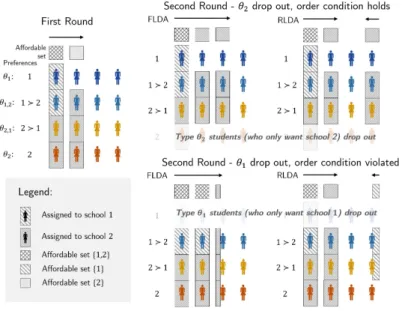
Our key insight is that the mechanism designer can design the correlation between tie-breaking lotteries to achieve operational goals. In particular,reversing the lottery between rounds minimizes reassignment without sacrificing student welfare. Our main theoretical result is that under an intuitiveorder condition, all PLDAs produce the same distribution over the final assignment, and reversing tie-breaking lotteries between rounds implements the centralized Reverse Lottery DA (RLDA), which minimizes the number of reassigned students. We axiomatically justify PLDA mechanisms: absent school priorities, PLDAs are equivalent to the class of mechanisms that are two-round strategy-proof while satisfying natural efficiency requirements and symmetry properties. In a setting where all students agree on a ranking of schools and there are no priorities our results are very intuitive. By reversing the lottery, we move a few students many schools up their preference list rather than many students a few schools up, thereby eliminating unnecessary cascades of reassignment (see Figure 3.1). Suprisingly, however, our theoretical result holds in a general setting with heterogeneous student preferences and arbitrary priorities at schools. The order condition can be interpreted as aggregate student preferences resulting in the same order of popularity of schools in the two rounds. Our results show that if student preferences and school priorities produce such agreement in aggregate demand across the two rounds, then reversing the lottery between rounds preserves ex ante allocative efficiency and minimizes reassignment.
We empirically assess the performance of RLDA using data from the New York City public high school system. We first investigate a class of centralized PLDAs that includes RLDA, rerunning DA using the original lottery order (termed Forward Lottery Deferred Acceptance or FLDA), and rerunning DA using an independent random lottery. We find all these mechanisms provide
Figure 3.1: Running DA with a reversed lottery eliminates the cascade of reassignments.
There are 6 students with identical preferences over schools, and 6 schools each with a single priority group. All students prefer schools in the order 1 2 · · · 6. The student assigned to school 1 in the first round leaves after the first round; otherwise all students find all schools acceptable in both rounds. Running DA with the same tie-breaking lottery reassigns each student to the school one better on her preference list, whereas reversing the tie-tie-breaking lottery reassigns only the student initially assigned to6from her least preferred to her most preferred school.
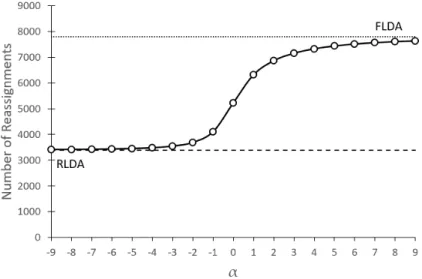
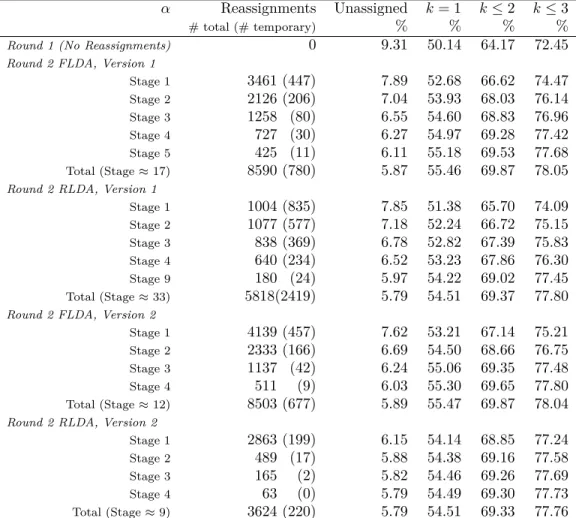
similar allocative efficiency, but RLDA reduces the number of reassigned students significantly. For instance, in the NYC data set from 2004–2005, we find that FLDA results in about 7,800 reassignments, and RLDA results in about 3,400 reassignments out of a total of about 74,000 students who remained in the public school system, i.e. less than half the number of reassignments under FLDA. The gains become even more marked if we compare with current practice: RLDA results in less than 40% of the 8,600 reassignments under decentralized FLDA with waitlists.2
To better evaluate the decentralized waitlist systems currently used in practice, we also em-pirically explore the performance of decentralized FLDA and RLDA as a function of the time available to clear the market. We find that the timing of information revelation can greatly impact the allocative efficiency and the congestion of decentralized waitlist systems. If, as in Figure 3.1, congestion is caused by students taking time to vacate previously assigned seats, then reversing the lottery increases allocative efficiency during the early stages of reassignment and decreases the congestion in the system. However, if congestion is caused by students taking time to decide on offers from the waitlist, then these findings are reversed. In both cases, for reasonable timescales the welfare gains from centralizing the reassignment are substantial.
2A decentralized version of FLDA is used in most cities and in NYC kindergarten admissions. It was also used in
NYC high school admissions until a few years ago, when the system abandoned reassignments entirely, anecdotally due to the excessive logistical difficulties created by market congestion. See Section 3.1.1 for more details.
3.1
Reassignment in Matching Markets
3.1.1 Current Reassignment Systems in School Choice
Schools systems in cities across the US, including in New York, Boston, Washington DC, Den-ver, Seattle, New Orleans, and Chicago, use similar centralized processes for admissions to public schools. Students seeking admission to a school submit their preference lists over schools to a central authority by December through March, for admission starting the subsequent fall. Each school may have priority classes of students, such as priority for students who live in the neigh-borhood, priority for siblings of students who are already enrolled at that school, or priority for students whose families have low income. An allocation of seats to students is produced by using the student-proposing Gale-Shapley Deferred Acceptance algorithm with single-tiebreaking. Students must register in their assigned school by April or early May.
In March and April students are also admitted to private and charter school via processes run concurrently with the public school assignment process. This results in an attrition rate of about 8-10% of the seats assigned in the main round of public school admissions. Some schools account for this attrition by making “over offers” in the first round and accepting more students than they have seats for (see, e.g. Szuflita). However, such oversubscription of students is usually conservative, due to hard constraints on space and teacher capacity.3 As a result, most schools have unused seats at the end of the first round that can be reassigned to students who want those seats, and many schools find out about these vacant seats only after the start of the school year.
Reassignments in most school choice systems, such as in New York kindergarten, Boston, Wash-ington DC, Denver, Seattle, New Orleans, and Chicago, are performed using a decentralized waitlist system. Students are put on waitlists for all schools that they ranked above their first-round assign-ment, in the order of the first-round priorities (after tie-breaking).4 Students who do not register by the deadline are presumed to be uninterested and their seats are offered to waitlisted students in sequence, with further seats becoming available over time as students receive new offers from
3Capacity constraints are binding in most schools. Most states impose maximum class sizes and fund schools based
on enrollment after the first 2-3 weeks of classes, which incentivizes schools to enroll as many students as permissible.
4
outside the system. The seats previously occupied by students who were reassigned are also offered to students on the waitlists. Students offered seats by the waitlist system usually have several days to a week to make a decision, and are only bound by the final offer they choose to accept.5 Overall, this typically results in a “huge slow round robin” (Szuflita) of reassignment that continues all summer until classes begin, and in some cities (e.g. NYC, Boston, and Washington DC) up to several months after classes begin.
Our proposed class of mechanisms may be viewed as a generalization of these waitlist systems as follows. Waitlists are PLDA mechanisms where 1) the second round is implemented in a de-centralized fashion as information about vacated seats propagates through the system, and 2) the tie-breaking lotteries used in the second round are the same as those used in the first round. We show that permuting the tie-breaking lottery numbers before creating waitlists provides a class of reassignment mechanisms that, given sufficient time to clear the market, result in similar eventual allocative efficiency while allowing the designer additional flexibility for optimizing other objectives.
3.1.2 Related Literature
There is a vast literature on dynamic matching and reassignments. The reassignment of donated organs has been extensively studied in work on kidney exchange (see, e.g. Roth et al., 2004; An-derson et al., 2015, 2017; Ashlagi et al., 2017). Reassignments due to cancellations also frequently arise in online assignment settings such as kidney transplantation (see, e.g. Zenios, 1999; Su and Zenios, 2006) and public housing allocation (see, e.g. Kaplan, 1987; Arnosti and Shi, 2017). An important difference is that these areonline settings where agents and objects arrive over time and are matched on an ongoing basis. In such settings matches are typically irrevocable, and so optimal assignment policies account for typical cancellation and arrival statistics and optimize for agents arriving in the future (see, e.g. Dickerson and Sandholm, 2015). In our setting the matching for the entire system is coordinated in time, and we improve welfare by controlling both the initial
5
Students who have accepted an offer off the waitlist of one school are allowed to accept offers off the waitlists of other schools. Since registration for one school automatically cancels the student’s previous registrations, such an action would automatically release the seat the student accepted from the first school, making that seat available to other students on the waitlist.
assignment and subsequent reassignment of objects among the same set of agents.
Another relevant strand in the reassignment literature is the work of Abdulkadiroğlu and Son-mëz on house allocation models with existing tenants (or housing endowments) (Abdulkadiroğlu and Sönmez, 1999). Our second round can be thought of as school seat allocation where some agents already own a seat and we wish to reassign seats to reach an efficient assignment. There are also a growing number of papers that consider a dynamic model for school admissions (see, e.g. Compte and Jehiel, 2008; Combe et al., 2016). A critical distinction between these works and ours is that in our model, the initial endowment is determined endogenously by preferences, and so we propose reassignment mechanisms that are impervious to students manipulating their first-round endowment to improve their final assignment. We also exploit indifference to minimize reassignment, a direction which is not explored in these works.
A number of recent papers, such as Dur (2012a); Kadam and Kotowski (2014); Pereyra (2013), focus on the strategic issues in dynamic reassignment. and also propose using modified versions of DA in each round. These works develop solution concepts in finite markets with specific cross-period constraints and propose DA-like mechanisms that implement them. In recent complementary work Narita (2016) analyzes preference data from NYC school choice, observes that a significant fraction of preferences are permuted after the initial match, and proposes a modified version of DA with desirable properties in this setting. We similarly propose PLDA mechanisms for their desirable incentive and efficiency properties. In addition, our large market and consistency assumptions allow us to uncover considerable structure in the problem and provide conditions under which we can optimize over the entire class of PLDA mechanisms.
Our work also has some connections to the queueing literature. The class of mechanisms that emerges in our setting involves choosing a permutation of the initial lottery order, and we find that the reverse lottery minimizes reassignment within this class. This is similar to the choice of a service policy in a queueing system (e.g. FIFO, LIFO, SRPT etc.), whereby a particular policy is chosen in order to minimize cost functions such as expected waiting time (see, e.g. Lee and Srinivasan, 1989). “Work-conserving” service policies such as these result in identical throughput but different expected waiting times, and we similarly find that different PLDA mechanisms differ
in the number of reassignments even when they have identical allocative efficiency. Our continuum model parallels fluid limits and deterministic models employed in queueing (Whitt, 2002), revenue management (Talluri and Van Ryzin, 2006), and other contexts in operations management.
3.2
Model
We consider the problem of assigning a set of students S to seats in a finite set of schools C =
{1, . . . , n}. Each student can attend at most one school. There is acontinuum6 of students with an associated measureη: for any (measurable) subsetS ⊆ S, we letη(S) denote the mass of students in S. The outside option is n+ 1 ∈ C/ . The capacities of the schools are q1, . . . , qn ∈ R+, and
qn+1 =∞. A set of students of η-measure at most qi can be assigned to schooli.
Each student submits a strict preference ordering over her acceptable schools, and each school partitions eligible students into priority groups. Each student has a type θ = (θ,ˆθ, pθ) that
encapsulates both her preferences and school priorities. The student’s first- and second-round preferences, respectively θ and ˆθ
, are strict ordinal preferences over C ∪ {n+ 1}, and schools before (after) {n+ 1} in the ordering are acceptable (unacceptable). The student’s priority class pθ encodes her priority pθi at school i. Each school i has ni priority groups. We assume that
schools prefer higher priority groups, students ineligible for schoolihave prioritypi =−1, and that
pi ∈ {−1,0,1, . . . , ni−1}. Eligibility and priority groups are exogenously determined and publicly
known.
Each student s = (θs, L(s)) ∈ S also has a first-round lottery number L(s) ∈ [0,1]. We
sometimes use the notation (s,ˆs
, ps) as a less cumbersome alternative to (θs
,ˆθs, pθs). We let Θ be the set of all student types, so thatS = Θ×[0,1] denotes the set of students. For eachθ∈Θ we let ζ(θ) =η({θ} ×[0,1]) be the measure of all students with type θ.
We assume that all students have consistent preferences, defined as follows.
6
Our continuum model can be viewed as a two-round version of the model introduced by Azevedo and Leshno (2016). Continuum models have been used in a number of papers on school choice; see Agarwal and Somaini (2018); Ashlagi and Shi (2014); Azevedo and Leshno (2016). Intuitively, one could think of the continuum model as a reasonable approximation of the discrete model when the number of students is large, although we do not establish a formal relationship between the discrete and continuum models, as that is beyond the scope of this work.