133
COLLECTION OF USEFUL PLANTS IN GREENHOUSES BOTANICAL
GARDEN OF THE UNIVERSITY OF CRAIOVA
CRUCERU SONIA, BORUZ VIOLETA, ARICIU SEVASTIŢA
University of Craiova, “Al. Buia” Botanical Garden,
C-tin Lecca Street, No. 26, Craiova, Dolj County
e-mail: [email protected]
Keywords: useful plants, greenhouses, Botanical Garden
ABSTRACT
Botanical Gardens are responsible for ensuring optimum plant growth and to
present them to the public.
This paper presents data on useful plants from different geographical regions grown
in greenhouses of the Botanical Garden of the University of Craiova. Are presented the
data on taxonomic classification, origin, use, part(s) used. These species are edible fruit
gives us: Persea americana (Avocado), Eriobotrya japonica (Japanese medlar), which
provides textile plants: Boehmeria nivea (Ramie), plants used in food: Manihot esculenta
(Cassava), Olea europaea (Olive), Citrus spp., plants with stimulant, aromatic and
therapeutic properties: Coffea arabica (Coffee tree), Piper nigrum (Black pepper), Vanilla
planifolia (Vanilla), Cinnamomum camphora (Camphor tree), Myrtus commmunis (Myrtle),
many of species entered the plants fail to reach flowering and fruiting.
INTRODUCTION
From the great variety of exotic plants cultivated in the Botanical garden
greenhouses Craiova much help create a unique exotic ambience for visitors, but many of
the plants are considered useful plants because they may have different uses: provide
edible fruits: Avocado (Persea americana), Japanese medlar (Eriobotrya japonica),
Psidium (Psidium cattleyanum), citrus known and large economic weight. Optimal growth
and development found here which provides textile plants: Ramie (Boehmeria nivea),
Hemp palm (Trachycarpus fortunei), plants with stimulant properties: species of the genus
Coffea, aromatic and medicinal plants: Camphor tree (Cinnamomum camphora),
Cardamom (Elettaria cardamomum), Pepper (Piper nigrum), Laurel (Laurus nobilis),
Vanilla (Vanilla planifolia).
Botanical Gardens are responsible for ensuring optimum plant growth and
development and to make them known to the public.
MATERIAL AND METHOD
Useful plants Botanical Garden greenhouses collection are obtained from the
international exchange of seeds which institution he made with botanical gardens on all
continents, multiplying the number of specimens in the collection is done mostly by seeds
harvested from their own copies of the bloom and fructify in conditions in our greenhouses.
The plants are found in tropical and subtropical plants greenhouse and
conservatory with succulents planted on the ground or in pots.
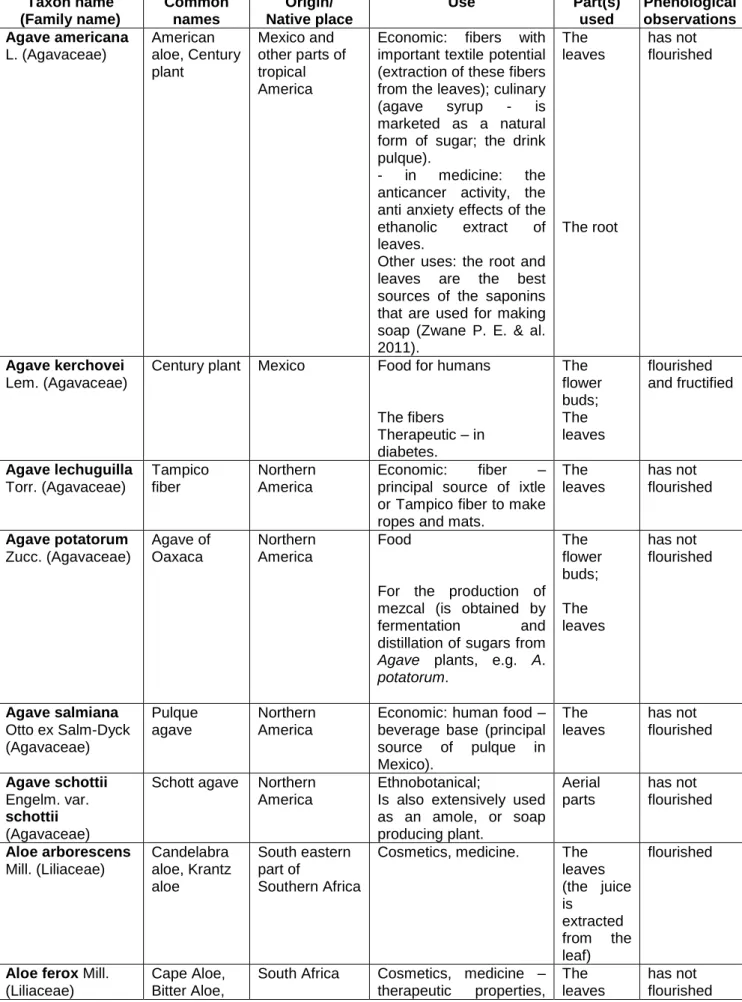
The taxons are presented in alphabetical order, in table are given taxon name,
common name, origin, use, part(s) used, phenological observations.
The nomenclature is presented according to international databases (The Plant List,
GRIN).
RESULTS AND DISCUSSIONS
134
Table 1
The useful plants identified in the collection greenhouses
Taxon name (Family name) Common names Origin/ Native place
Use Part(s)
used Phenological observations Agave americana L. (Agavaceae) American aloe, Century plant Mexico and other parts of tropical America
Economic: fibers with important textile potential (extraction of these fibers from the leaves); culinary (agave syrup - is marketed as a natural form of sugar; the drink pulque).
- in medicine: the anticancer activity, the anti anxiety effects of the ethanolic extract of leaves.
Other uses: the root and leaves are the best sources of the saponins that are used for making soap (Zwane P. E. & al. 2011). The leaves The root has not flourished Agave kerchovei Lem. (Agavaceae)
Century plant Mexico Food for humans
The fibers Therapeutic – in diabetes. The flower buds; The leaves flourished and fructified Agave lechuguilla Torr. (Agavaceae) Tampico fiber Northern America
Economic: fiber – principal source of ixtle or Tampico fiber to make ropes and mats.
The leaves has not flourished Agave potatorum Zucc. (Agavaceae) Agave of Oaxaca Northern America Food
For the production of mezcal (is obtained by fermentation and distillation of sugars from Agave plants, e.g. A. potatorum. The flower buds; The leaves has not flourished Agave salmiana Otto ex Salm-Dyck (Agavaceae)
Pulque agave
Northern America
Economic: human food – beverage base (principal source of pulque in Mexico). The leaves has not flourished Agave schottii Engelm. var. schottii (Agavaceae)
Schott agave Northern America
Ethnobotanical;
Is also extensively used as an amole, or soap producing plant. Aerial parts has not flourished Aloe arborescens Mill. (Liliaceae) Candelabra aloe, Krantz aloe South eastern part of Southern Africa
Cosmetics, medicine. The leaves (the juice is
extracted from the leaf)
flourished
Aloe ferox Mill. (Liliaceae)
Cape Aloe, Bitter Aloe,
South Africa Cosmetics, medicine – therapeutic properties,
The leaves
135
Red Aloe,Tap Aloe
food supplements.
Aloe vera (L.) Burm. f. (Liliaceae)
Indian Aloe, True Aloe, Barbados Aloe.
Northern Africa - In the cosmetics (shampoos, soaps, shaving cream, face creams etc.); alternative medicine industries; dietary supplement. The leaves, juice of the leaves flourished Boehmeria nivea (L.) Gaudich. (Urticaceae)
Ramie Western and central China
The textile Strain has not flourished
Cereus jamacaru DC. (Cactaceae)
Queen of the night, Mandacaru
Brazilian northeast
Food
In construction, for making doors, windows, boards and laths (de Lucena et al. 2013) Medical properties Fruit Wood Root flourished and fructified Cinnamomum camphora (L.) J. Presl (Lauraceae)
Camphor tree
China oriental, Japan
Pharmaceutical Leaves and shoots
not blooming
Citrus aurantium L. (Rutaceae)
Bitter orange Southeast Asia Food, cosmetics Fruit flourished and fructified Citrus japonica
Thunb. (Rutaceae)
Kumkuat China Food Fruit flourished and fructified Citrus limon (L.)
Burm. f. (Rutaceae)
Lemon Asia Food Fruit flourished and fructified Citrus sinensis (L.) Osbeck (Rutaceae) Sweet orange
Asia Food Fruit flourished and fructified
Coffea arabica L. (Rubiaceae)
Coffee tree Ethiopia Stimulating and therapeutic
Seeds flourished and fructified Coffea stenophylla G. Don (Rubiaceae) Highland coffee Guinea, Ivory Coast
Stimulating Seeds not
blossoming
Cyperus textilis Thunb.
(Cyperaceae)
Papyrus wild South Africa The textile Strain flourished
Elettaria
cardamomum (L.) Maton
(Zingiberaceae)
Cardamom, Nutmeg
Southeast Asia Spice Strain not
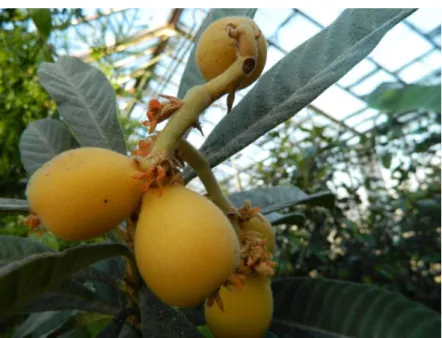
blossoming Eriobotrya japonica (Thunb.) Lindl. (Rosaceae) Loquat, Japanese mosmon
China, Japan Food Fruit - (Fig. 1)
flourished and fructified
Laurus nobilis L. (Lauraceae)
Laurel Mediterranean Flavoring, therapeutic Leaves and fruit not blossoming Majorana hortensis Moench (Lamiaceae) Sweet marjoram Asia- Temperate Economic:
The aromatic herb Food additives: flavoring Essential oils therapeutic Leaves Aerial parts flourished and fructified Manihot esculenta Crantz (Euphorbiaceae) Manioc, Tapioca Brazil, Paraguay
Food Tuber flourished and fructified
Musa x sapientum subsp. seminifera (Lour.) Baker (Musaceae)
Wild banana Southeast Asia Food Fruit flourished and fructified
136
L. (Myrtaceae) –Fig. 2
Europe, North Africa
Fruit blossoming
Olea europaea L. (Oleaceae)
Olive Mediterranean Food, medical Fruit flourished and fructified Opuntia cochenillifera (L.) Mill. (Cactaceae) Prickly Pear, Cockineal Nopal cactus
Mexico Fodder plant
Feeding (serves as a food for humans)
The stem
Fruit
flourished and fructified
Opuntia ficus-indica (L.) Mill. (Cactaceae) Smooth prickly-pear, Tuna cactus, Indian-fig prickly-pear Mexico, much of Latin America, South Africa and the Mediterranean area
Economic:
- human food – beverage base, it is also used in local cuisine, for cakes, candies, juices, jellies soups, salads, stews, risottos or cooked with rice, beans and meat; - the fruit is considered one of the best among all the Cactaceae, being also commercialized as “figo da India” (de Lucena et al. 2013); Juice are a good source of sugar, vitamins and minerals; is a important natural food alternative. Medical;
Cosmetics: body lotion, shampoo, creams etc.; As a natural food colorant becose containing betalain pigments. Fruit The cladodes, The fruit flourished and fructified Pelargonium graveolens L’Hér. (Geraniaceae)
Rose geranium
Africa Economic:
Cosmetics (essential oils used in perfumery), aromatherapy, culinary, food additives – flavoring, medicines Leaves Stems Flowers flourished and fructified Pelargonium odoratissimum (L.) L’Hér. (Geraniaceae)
Apple geranium, Sweet-scent pelargonium
Southern Africa Economic:
cosmetics (essential oils used in perfumery), aromatic, culinary. Leaves Stems flourished and fructified Pelargonium peltatum (L.)L’Hér. (Geraniaceae)
Hanging geranium, Ivy geranium
Southern Africa Medical properties Leaves flourished and fructified
Pelargonium radens H. E. Moore (Geraniaceae) Multifid-leaf pelargonium, Rasp-leaf pelargonium
Southern Africa Medical properties
In perfumery Leaves (extract from fresh leaves) Flowers flourished and fructified Pelargonium tomentosum Jacq. (Geraniaceae) Peppermint geranium
Southern Africa Medical, culinary, aromatic: potential as essential oils (for peppermint-scented oils)
Leaves flourished and fructified
Persea americana Mill. (Lauraceae)
Avocado Central and South America
137
Phoenixdactylifera L. (Arecaceae)
Persimmon North Africa, Canary Islands
Food Fruit flourished
Phormium tenax J. R. Forst. & G. Forst. (Agavaceae)
New Zealand- flax, Harakeke
New Zealand The fibres for the production or rope, sacking;
Medical properties
Leaves
Root (the juice of the root)
has not flourished
Piper nigrum L. (Piperaceae)
Black pepper India, Malaysia Spice, pharmaceutical Fruit not
blossoming Piper longum L.
(Piperaceae)
Green pepper
India Spice, pharmaceutical Fruit not
blossoming Polianthes
tuberosa L. (Agavaceae)
Tuberose Probable origin Mexico, today only cultivated
Economic: cosmetic uses - essential oil used in perfumery, the most expensive perfume oil
The flowers
flourished and fructified
Psidium cattleyanum Sabine (Myrtaceae)
Guajava Brazil Food Fruit flourished and fructified
Rosmarinus officinalis L. (Lamiaceae)
Rosemary Africa Asia- Temperate Europe
Economic:
Food additives: flavoring Arhomatic: essential oils Bee plants: honey production therapeutic
Leaves
Aerial parts
flourished and fructified
Simmondsia chinensis (Link) C. K. Schneid.
(Simmondsiaceae)
Jojoba Arizona, California, Mexico
Cosmetic, pharmaceutical
Seeds not
blossoming
Trachycarpus fortunei (Hook.) H. Wendl.
(Arecaceae)
Chinese windmill palm
China,
Northern India
Fibers Strain not
blossoming
Vanilla planifolia Andrews
(Orchidaceae)
Vanilla Mexico, Central America
Food, cosmetic Fruit not
blossoming
Yucca aloifolia L. (Agavaceae)
Daggerplant, Spanish-dagger
Northern and Southern America
Medical Leaves (extract) The flowers
has not flourished
Yucca
guatemalensis Baker
(Agavaceae)
Bluestem yucca, Giant yucca
Northern and Southern America
Food (cooked – the flowers are used as ingredients in recipes due to their bitter taste)
The flowers The buds
138
Fig. 1. Eriobotrya japonica (Thunb.) Lindl.
Fig. 2. Myrtus communis L.