Chapter
3
Settlement Strategy
21-44
3.1 Settlement Hierarchy 3.2 Housing3.3 Rural Settlement Strategy 3.4 Urban Settlement Strategy
3 Settlement Strategy
3.1 Settlement Hierarchy
This Chapter will identify the different Service Centres throughout the County, their areas of influence and their strategic roles for the future. This will assist in ensuring that a network of viable service centres is maintained throughout the County. The Settlement Strategy will inform population growth allocation and infrastructural investment decisions in establishing and maintaining this network.
The Plan recognises that there are different categories of settlements throughout the County from the large Hub towns to small villages. All have complementary roles to play in the future growth and prosperity of the County. In recognition of this, a Settlement Hierarchy for the County is developed consisting of the Hub towns, Regional/District Towns, Villages, small Villages/development nodes.
The strategic aims of the Settlement Strategy are
to:-Ensure the sustainable development of •
the Linked Hub towns of Tralee-Killarney to fulfill roles identified in the National Spatial Strategy and South West Regional Planning Guidelines
Ensure the sustainable development of •
the Regional/District Towns so they can act as adequate service and employment centres for the surrounding hinterland and Manage development outside the Linked •
Hub and larger Towns in a manner which is sustainable and that ensures the viability of rural communities but does not give rise to long-term problems such as climate change and water quality
Facilitate the provision of a suitable range •
of house tenure, type and size having regard to the demographic distribution and structure of the population throughout the County
Facilitate the sustainable future
•
development of infrastructure into those settlements where there is demand.
A strong network of settlements is important for sustaining healthy population levels and enhancing quality of life. The functional relationships between the different types of settlements also need to be clearly understood. Urban Sprawl on the edge and environs of the Hub towns (and on the edges of settlements) should be discouraged and a clear character distinction between built-up areas and the open countryside should be maintained. A clear strategy for the sustainable development of the towns and urban areas is important for the County to achieve its full economic potential. The towns and other main areas will play an important role in delivering jobs and services to the rural areas around them.
Settlements can be planned to encourage public transport provision. The settlement structure of County Kerry is highly dependent on car use as a consequence of its highly dispersed nature. This is likely to continue to be the case even though a high level of dependence is undesirable on social, environmental and economic grounds. However, significant change, leading to an increase in public transport, can be achieved by adopting a ‘plan-led’ approach.
The settlement strategy as a whole proposes the concentration of new residential development in designated settlements instead of a continuation of a general dispersal of growth. The general thrust of the Settlement and Spatial Strategy will improve the conditions for the operation of public transport throughout the County.
The Settlement Hierarchy takes into account the census of Population 2011 and those settlements that have available capacity in the wastewater treatment units, or, are on a
3 Settlement Strategy
priority list for wastewater treatment units and other environmental considerations.
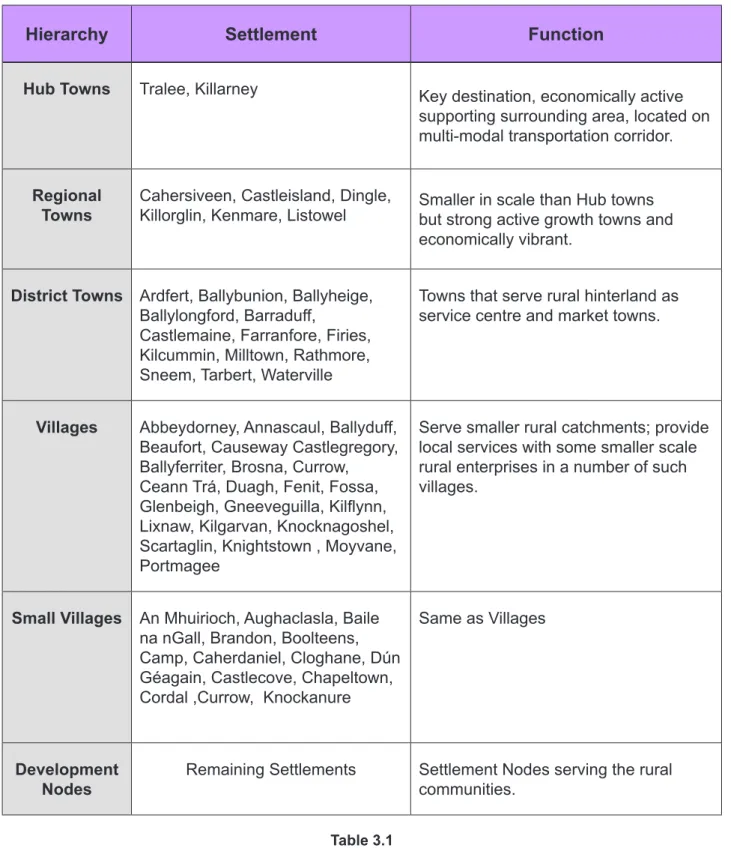
The Settlement Hierarchy for County Kerry is outlined in Table 3.1 below. This hierarchy is consistent with that set out in the south west RPGs and provides a brief summary of the role of the towns in each level of the hierarchy.
Hierarchy Settlement Function
Hub Towns Tralee, Killarney Key destination, economically active supporting surrounding area, located on multi-modal transportation corridor. Regional
Towns Cahersiveen, Castleisland, Dingle, Killorglin, Kenmare, Listowel Smaller in scale than Hub towns but strong active growth towns and economically vibrant.
District Towns Ardfert, Ballybunion, Ballyheige, Ballylongford, Barraduff,
Castlemaine, Farranfore, Firies, Kilcummin, Milltown, Rathmore, Sneem, Tarbert, Waterville
Towns that serve rural hinterland as service centre and market towns.
Villages Abbeydorney, Annascaul, Ballyduff, Beaufort, Causeway Castlegregory, Ballyferriter, Brosna, Currow, Ceann Trá, Duagh, Fenit, Fossa,
Glenbeigh, Gneeveguilla, Kilflynn,
Lixnaw, Kilgarvan, Knocknagoshel, Scartaglin, Knightstown , Moyvane, Portmagee
Serve smaller rural catchments; provide
local services with some smaller scale rural enterprises in a number of such villages.
Small Villages An Mhuirioch, Aughaclasla, Baile na nGall, Brandon, Boolteens, Camp, Caherdaniel, Cloghane, Dún Géagain, Castlecove, Chapeltown, Cordal ,Currow, Knockanure
Same as Villages
Development
Nodes Remaining Settlements Settlement Nodes serving the rural communities.
Table 3.1 Settlement Hierarchy
3 Settlement Strategy
The key element of the Core Strategy and Settlement Strategy is to continue to focus growth into the Hub and towns and to relate growth of the smaller towns and villages to the availability of infrastructure such as water and waste water.
It is recognised that rural areas play an essential role in this settlement structure by developing sustainable development nodes within rural communities.
The provision of infrastructural services etc. in these areas, will be considered in accordance with the proper planning and sustainable development of the area.
The overall aim for development nodes in rural areas is to ensure that they retain their rural service centre function and develop sustainably as attractive locations for residents and visitors and that any future development preserves their existing character.
The aims of the Settlement Hierarchy are
to:-General
Ensure the sustainable development of the •
Linked Hub and Key Towns in the County. Manage development outside these towns •
in a way that ensures the viability of rural communities while ensuring environmental protection through the implementation of the objectives and Development Guidance document of this Plan. Linked-Hub of Tralee-Killarney
Support the sustainable development of •
the Linked Hub of Tralee-Killarney in order to meet the population target by 2021. Ensure that the towns are centres of •
sustainable economic growth to attract and support a wide range of services and amenities and deliver a high quality of life.
Regional Towns
Promote and facilitate the growth and •
sustainable development of the towns towards achieving their population targets.
Facilitate the provision of an
•
appropriate and sustainable range of social and physical infrastructure,
facilities and services, including
retail and commercial and enterprise development to serve the inhabitants of the towns and their rural hinterlands.
District Towns
Support the sustainable development •
and growth of the towns to the population targets set out below.
Villages, Nodes & Rural Areas
Support the sustainable development of the •
countryside and rural villages in the County. Overall Housing using Objectives
3.1.1 Population Distribution
The distribution of projected population growth throughout the County is in accordance with the Core Strategy and the Settlement
Hierarchy set out in Table 3.1 - Section 3.1.
The population growth targets are allocated to the County’s four Municipal Areas as set out below in Tables 3.2-3.5. It is recognised that population growth is usually employment led and is reliant on the availability of services and infrastructure. Consequently, the spatial distribution of population growth is supported by development polices related to employment, housing, retail, environment and the level of social and physical infrastructure as set out in the relevant chapters of this development plan.
The distribution of the population targets within each Municipal area will reflect the need to focus development in towns, in a sustainable manner, to create the critical mass necessary to support the existing level of services and to generate demand for new services commensurate with the functions of each settlement.
3 Settlement Strategy
The distribution of the population targets to each Municipal area is outlined in Table 2.3, Chapter 2 - Core Strategy. Within each
Municipal area a minimum of 60% of the
targeted projected population growth will occur within the main towns. The remaining 40% is distributed to smaller settlements and rural areas. This will secure the development of vibrant towns and villages capable of servicing rural communities and will accommodate locally generated demand for housing in rural areas. In distributing population growth outside the district town there will be an emphasis on sustainable development in smaller settlements.
The population growth is allocated to each settlement based on the percentage population that each settlement has relative to the overall population of that area.
Tralee
Municipal Area Census Pop AllocationGrowth
Tralee 20,814 2,969 Ardfert 800 185 Fenit 527 122 Total - 3,276 Remainder of area - 204 Area Total - 3,480 Table 3.2
Population Allocation Tralee Municipal Area
Killarney
Municipal Area Census Pop AllocationGrowth
Killarney 12,740 1,781 Castleisland 2,513 237 Rathmore 778 74 Fieries 491 46 Barraduff 370 35 Kilcummin 368 35 Farranfore 200 19 Total - 2,227 Remainder of area - 298 Area Total - 2,525 Table 3.3
Population Allocation Killarney Municipal Area
Listowel
Municipal Area Census Pop AllocationGrowth
Listowel 4,205 314 Ballybunion 1,354 101 Ballyheigue 628 47 Tarbert 551 42 Ballylongford 418 31 Total - 534 Remainder of area - 356 Area Total - 890 Table 3.4
3 Settlement Strategy
South and West Kerry Municipal
Area
Census
Pop AllocationGrowth
Kenmare 2175 173 Killorglin 2082 166 Dingle 1965 157 Cahersiveen 1168 93 Milltown 838 67 Waterville 465 37 Sneem 258 21 Castlemaine 187 15 Total - 728 Remainder of area - 485 Area Total - 1213 Table 3.5
Population Allocation South & West Kerry Municipal Area
3.1.2 The Zoning of Land for Residential Development
Kerry County Council has zoned land for residential purposes in each of the following Functional Area Local Area
Plans:-Castleisland FALAP 2009-15 • Kenmare FALAP 2010-16 • Killorglin FALAP 2011-2017 • Dingle FALAP 2012-2018 •
Cahersiveen, Waterville & Sneem FALAP •
2013-19
Listowel/Ballybunion FALAP 2013-2019 •
Tralee/Killarney Hub FALAP 2013-2019 •
These will be replaced by local area areas for the four Municipal Districts during the lifetime of the plan.
The amount of land to be zoned within municipal areas will reflect the targeted population growth within the area over the lifetime of the plan (2015-2021). It is important that zoning is carried out in a logical and informed manner which will provide for the long-term sustainable development of the settlements and of the County as a whole. The following criteria will be used in deciding the extent and location of proposed zonings in the County.
Need and Policy Context
•
Ensure that the amount of land zoned for development does not exceed the calculated requirements of the Core Strategy for the County or the targets set out in the South West Regional Planning Guidelines 2010-2022.• Focus the supply of zoned land only in the main settlements of the Municipal/ Functional Areas both where the infrastructure is available, and where it can be accommodated in a more balanced and cost effective manner.
Sequential Approach
• Ensure that land use zonings promote the sustainable development of compact, livable, pedestrian/cyclist-friendly settlements, with a defined and healthy commercial/retail core.
• Ensure that zonings extend outwards from the centre of an urban area (i.e. ‘leapfrogging’ to more remote areas should be avoided).
• Ensure that residential zoned areas are contiguous to existing zoned development lands.
Capacity of Water, Drainage and Roads
Infrastructure
• Ensure that the zoning of land is dependent on the availability of sustainable water, drainage and roads infrastructure.
3 Settlement Strategy
Supporting Infrastructure and
Facilities
• Ensure that consideration is given to
the future availability of or the capacity to provide, supporting infrastructure.
Physical Suitability
• Ensure that the form and location of
land zonings offers the best “value for money” in terms of efficient use of existing infrastructure, while minimising the need for costly new infrastructure.
• Ensure that the Flood Risk Management
considerations and assessment
requirements are complied with.
Environmental and Heritage Policy,
including Conservation of Habitats and other sensitive areas
• Ensure that River Basin Management
Plans, Groundwater Vulnerability Maps and potential impacts on landscapes, built and natural heritage sites (including Natura 2000 sites) are taken into consideration when zoning lands. 3.1.3 Housing Land Requirement
The quantum of residential land required over the period of this development plan is calculated using population targets, household sizes and the proposed density of development.
The population growth target for the entire County for the period 2015-2021 is 8,108. The average household size is predicted to be 2.6 persons per unit. The proposed density, in accordance with the regional guidelines, is 12 units per hectare and 21 units per hectare in the towns of Tralee, Killarney and Listowel. In accordance with the Development Plans Guidelines for Planning Authorities (DoEHLG 2007) an additional headroom of 50% is included in the land requirements to allow for the provision of competition, the avoidance of market monopoly and the non availability of zoned lands.
Table 3.6 below sets out the total land
requirements and housing units required between 2015 and 2021, taking into account the population targets, household size, and density. The total number of residential units required to meet housing requirements, resulting from population growth for the County is 3,118 units and the corresponding residential zoned land requirement of 235.75 hectares.
When calculating the amount of proposed zoned residential lands in the Local Area Plans the number of existing vacant dwellings in unfinished estates in each settlement will be taken into consideration as it is the policy of Kerry County Council to seek the completion of these estates.
3 Settlement Strategy
Municipal Area Settlements Population Allocation 2015-21 Housing Requirement Housing Land Requirement (Ha)* Tralee Tralee Ardfert Fenit Rural 2,969 185 122 204 1,142 70 46 77 81.50 8.75 5.75 Killarney Killarney Castleisland Rathmore Fieries Barraduff Kilcummin Farranfore Rural 1,781 237 74 46 35 35 19 298 685 91 28 18 15 13 7 115 49.00 11.50 3.50 2.25 2.00 1.50 0.75 Listowel Listowel Ballybunion Ballyheigue Tarbert Ballylongford Rural 314 101 47 42 31 356 122 39 18 16 12 138 15.25 12.75 2.25 2.00 1.50 South &West Kerry KenmareKillorglin
Dingle Cahersiveen Milltown Waterville Sneem Castlemaine Rural 173 166 157 93 67 37 21 15 485 66 63 60 36 26 14 8 6 187 8.25 8.00 8.00 4.50 3.25 1.75 1.00 0.75 Total County 8,108 3,118 235.75 Table 3.6 Core Strategy Table (*Includes 50% headroom)
3 Settlement Strategy
3.2. Housing
Aim: To facilitate the provision of high quality residential developments to all households, in accordance with the County’s settlement hierarchy, in sustainable residential environments.
3.2.1 Housing Policies
The Council has a dual role as the Planning and Housing Authority. Through its statutory powers as a Planning Authority, the Council regulates and manages private housing development through the development management procedures as set out in the Planning and Development Acts. In its role as the Housing Authority, the Council provides dwellings for households in need of accommodation who are unable to provide such accommodation through their own resources and assists other agencies that contribute to the housing requirements of the County.
This Chapter sets out the policies and objectives for the provision of housing in the County and the creation of sustainable communities. The Housing Strategy included in Volume 5 is underpinned by all national policies and legislation and is applicable for the same timeframe as the Development Plan. It is in accordance with the core strategy and the settlement strategy set out in the Development Plan.
The overall aim of Housing Policy is to enable every household to have available an affordable dwelling of good design, suited to their needs, in a quality environment and, as far as practicable, at the tenure of their choice. This also refers to households with specific needs, e.g. older people or those who have a disability, either physical or intellectual. The Housing Strategy acknowledges the need to meet the housing requirements of those who are homeless and to provide suitable accommodation for Travellers who are
indigenous to the area.
It is a policy of Kerry County Council
to:-Encourage and foster the creation •
of attractive mixed use sustainable communities which contain a variety of housing types and tenures with supporting community facilities, public realm and residential amenities.Require a high standard of design in all new residential schemes that are built in a style and scale that is appropriate to the landscape setting.
Integrate new housing into the existing •
social and urban fabric of the County’s settlements detailed in the settlement hierarchy.
Promote rainwater harvesting and energy •
efficiency both during the construction phase and during the lifetime of residential development by sensitive design and layout taking into account topography, orientation and surrounding features. Recognise the need for people with •
special needs to enjoy a decent living environment in the County and to support local communities, health authorities and other agencies involved in the provision of facilities to people with special needs including supporting the voluntary sector in the development of housing for people with special needs.
Support the concept of independent living •
for older people and people with disabilities and ensure where possible that housing for such groups is integrated with mainstream housing in their existing communities. Such housing shall generally be located close to existing or proposed community and convenience retail facilities, where possible.
Pay special attention to the needs of older •
people on low incomes in substandard, privately rented accommodation when planning and allocating accommodation for older people.
Provide appropriate accommodation for •
3 Settlement Strategy
Travellers.
Support proposals for day/resource •
centres for people with special needs within, or close to towns villages and neighbourhood centres, subject to normal planning requirements.
Ensure that all new housing is designed in •
a way that is adaptable and flexible to the changing needs of the homeowner, and has regard to the Department of Environment, Community and Local Government ‘Quality Housing for Sustainable Communities – Best Practice Guidelines for Delivering Homes Sustaining Communities (2007). Support a sequential approach to •
residential development in which the first choice location for new housing is within the built up area of towns and villages maximising under-utilised and brownfield lands within and adjoining town and village centres in the first instance and thereafter moving sequentially outwards.
Facilitate consultation with approved •
Voluntary and Co-operative Housing Associations on an ongoing basis in order to identify and agree opportunities for their participation in the provision of all social housing delivery options.
Housing
It is an objective of the Council
to:-HS-1 Reserve sufficient lands at
appropriate locations to facilitate and implement the Housing Strategy and its policies in a sustainable manner.
HS-2 Facilitate the housing needs of people
in their local communities through actively providing / assisting the provision of housing in settlements and as single rural houses as
identified in the Settlement Strategy.
HS-3 Ensure, that arrangements for the
provision of Social Housing are made having regard to the current Housing Strategy in accordance with Part V of the Planning & Development Act 2010 as amended.
HS-4 Have regard to and promote
increased residential densities in the towns and other appropriate locations in accordance with the ‘Sustainable Residential Development in Urban Areas’ Guidelines 2009 (DoEHLG).
HS-5 Promote integration of social
housing and ensure a housing
mix within developments in
order to promote a socially balanced and inclusive society. HS-6 Provide adequate levels of social
and affordable housing to ensure all sectors of society have access to housing (including a range of accommodation types for members of the travelling community, the homeless, people with disabilities
and ethnic minority groups)
HS-7 Address the issue of
Unfinished Housing Estates in the County by implementing the
guidance manual Managing and
Resolving Unfinished Housing
Developments (DoECLG 2011).
HS-8 Ensure that all new multiple
residential development(s) take place within the development boundary of the settlements/ villages.
3 Settlement Strategy
HS-9 Support the development of
housing for special needs, including the concept of independent living for older people and people with a disability and ensure where possible that housing for such groups is integrated with mainstream housing.
3.2.2 Accommodation for Travellers
Kerry County Council recognises the distinct requirements of the Travelling Community in relation to the provision of accommodation and other facilities, the socio-economic issues relevant to the Travelling Community and the link between adequate accommodation, employment, health and education.
Kerry County Council acknowledges that the travelling community is a separate ethnic
minority in Ireland. There are approximately
247 Traveller families living in County Kerry. The requirements on Kerry County Council under the Housing (Traveller Accommodation) Act 1998 ensure that significant steps will be taken to provide appropriate accommodation for Travellers within the County.
Housing
It is an objective of the Council
to:-HS-10 Implement the Traveller
Accommodation Programme
2014-18 in order to provide
appropriate accommodation
for the Travelling Community.
3.2.3 Accommodation for the Elderly
The elderly have specific housing needs relating to access, medical care, security and personal safety. The location of housing is an important issue for older people particularly
those who live alone and are reliant on public transport and local services. Dwellings and other residential facilities catering specifically for older people should be located in close proximity to convenience shops, community facilities and public transport nodes. The ‘semi supported’ or ‘assisted living’ concept is considered a suitable option for many older people as it enables them to live relatively independently in their own homes. For those who wish to continue to live independently, it is important that the opportunity exists to trade down or downsize in the area in which they live.
Housing
It is an objective of the Council
to:-HS-11 Provide and facilitate the provision
of suitable accommodation in appropriate locations to meet the needs of the elderly and to encourage the provision of a range of sustainable housing options for elderly persons in central, convenient and easily accessible
locations and to integrate
such housing with mainstream
housing where possible.
HS-12 Ensure that granny/family flats are
integral to the existing dwelling house, capable of being reintegrated to the main house, and subordinate to the main dwelling house.
3.2.4 Accommodation for People with Disabilities
In considering housing for people with disabilities, location and accessibility are critical, particularly to those with a mobility related disability. The importance of access to public transport, local community services and
3 Settlement Strategy
facilities is a significant factor for a mobility-impaired person in improving quality of life. In terms of house design, compliance with part M of the Building Regulations, expands options available to people with a disability.
Housing
It is an objective of the Council
to:-HS-13 Provide and facilitate the provision of
accommodation to meet the needs of those with disabilities through the provision and/or adaptation of suitable accommodation at appropriate locations.
3.2.5 Housing Stock and Capacity/ Vacancy
The 2011 census recorded 26.4% of houses were vacant on census night, which would account for 19,932 dwellings. The location of the vacant units within the County requires identification and monitoring to plan and manage the supply of housing to match need. It is evident from analysis undertaken that there is a widespread distribution of vacant properties in both the urban centres and across rural County Kerry. A flexible approach to the reuse of such buildings will be considered. Potential uses such as community facilities, educational, craft or commercial uses could be considered subject to development management standards being met.
Occupancy/Vacancy A Occupied by usual resident(s) of the
household 53,088
B Occupied by visitors only (Number) 665
C Unoccupied - residents temporarily absent 1,275
D Unoccupied - vacant house 9,860
E Unoccupied - vacant flat 1,657
F Unoccupied - vacant holiday home 8,202
G Total housing stock ( A+B+C+D+E+F ) 74,747
Vacancy rate (D+E+F) /
G (%) 26.4
Figure 3.1
3 Settlement Strategy
Housing
It is an objective of the Council
to:-HS-14 Monitor the number of vacant
residential units throughout the County to inform policy making
HS-15 Ensure that housing developments
are completed to a standard that is in accordance with the Council’s Taking in Charge Policy for Private housing Developments, through the planning enforcement process, collection of bonds and development contributions.
3.3
Rural Settlement Strategy
AIM: To sustainably manage the development of rural parts of the County; support the creation of employment opportunities for those living and working in the rural area; sustain established rural communities and conserve the qualities of the rural environment.
County Kerry is essentially a rural County with circa 60% of the population recorded in the 2011 census as living in the rural area, which is much higher than the national average (38%). The countryside however is a finite resource and is a valuable asset both environmentally and economically. It is critical that the asset is protected and enhanced.
It is the policy of the Council
to:-Enhance the vitality and viability of the rural
•
towns and villages, to strengthen their role as rural service centres and protect existing community uses and services in the villages. Maintain a stable population base
•
in the rural areas with a strong network of villages and small towns.
Protect sensitive landscapes and
•
other environmentally sensitive areas from unsustainable development.
3.3.1 Rural Area Types and Settlement
There is a tradition of dispersed settlement patterns in the countryside, however it is apparent that the recent rate of housing construction and scale of dispersed rural housing is unsustainable and is uneconomical in terms of infrastructure provision and quality of life.
It is the policy of the Kerry County Council to ensure that future housing in rural areas
complies with the Sustainable Rural Housing
Guidelines for Planning Authorities, 2005
(DoEHLG) and this will be achieved through greater emphasis on the
following:-Establishing that there is a genuine
(a)
housing need for permanent
occupation.
Giving priority to the reduction of
(b)
residential vacancy rates in the Rural
Areas Under Strong Urban Influence
and Stronger Rural Areas in preference to new residential development.
The replacement, renovation or
(c)
modification of existing structures in rural areas for residential use.
Encouraging people who wish to reside
(d)
in the countryside to live in existing settlements or development nodes where there are services available.
3 Settlement Strategy
Rural Housing
It is an objective of the Council
to:-RS-1 Ensure that future housing in all rural
areas complies with the Sustainable Rural Housing Guidelines for
Planning Authorities 2005
(DoEHLG) and the Development Guidance document of this Plan.
RS-2 Require the design of rural
housing to have regard to the “Building a House in Rural Kerry; Design Guidelines” (KCC, 2009).
RS-3 Give favourable consideration
to the sustainable development
of permanent places of
residence on vacant sites within existing cluster developments.
RS-4 Ensure that the provision of
rural housing will protect the landscape, the natural and built heritage, the economic assets and the environment of the County.
RS-5 Ensure that future housing in all
rural area complies with the EPA’s
2009 Code of Practice: Wastewater
Treatment and Disposal Systems
Serving Single Houses (p.e < 10).
RS-6 Ensure that all permitted
residential development in
rural areas is for use as a primary permanent place of residence. In addition such development shall be subject to the inclusion of an Occupancy Clause for a period of 7 years.
3.3.1.1 Identifying Rural Area Types
The Sustainable Rural Housing Guidelines (2005) stress the importance of “evidence based” research and analysis being carried out into population and development trends in rural areas. This analysis should include the identification of the location and extent of the rural area types set out in the National Spatial Strategy.
The Planning Authority has carried out an assessment in accordance with the approach outlined in these
Guidelines:-Analysis and mapping of the data on •
planning applications for one off rural housing submitted since 2005 (applications lodged, granted, refused etc.).
Analysis of housing development using •
the An Post Geo Directory.
Analysis of Census data on population and •
household trends. (2002-2006-2011). This data provides information on population change, population density, planning application numbers and distribution of one off houses granted permission.
An analysis of this data identifies three of the four different types of rural areas. From the analysis carried out, the areas under strong urban influence, stronger rural areas and structurally weaker rural areas have been identified and are shown on Map 3.1(pg.36).
The following text summaries the
characteristics of these areas and the settlement objectives pertaining to them.
3 Settlement Strategy
AREA 1
Rural Areas under Strong Urban Influence These are areas which exhibit characteristics such as proximity to the immediate environs or close commuting catchment of the Hub Towns and larger towns, rapidly rising population, evidence of considerable pressure for development of housing due to proximity to such urban areas, or to major transport corridors with ready access to the urban area, and pressures on infrastructure such as the local road network.
Rural Areas under Strong Urban
Influence
It is an objective of the Council
to:-RS-7 Ensure that favourable
consideration is given to individual one – off house developments for immediate family members (sons, daughters or favoured niece/nephew) on family farms and land holdings; subject to compliance with normal planning
criteria and environmental
protection considerations.
RS-8 Give priority to the completion
of unfinished dwellings and the occupation of vacant units in preference to new residential development for persons who are an intrinsic part of the rural community in which they are proposed, subject to compliance with normal planning criteria and environmental
protection considerations
RS-9 Facilitate the housing
requirements of the rural
community as identified while directing urban generated housing into the towns and villages.
AREA 2
Stronger Rural Areas
In these areas population levels are generally stable within a well-developed town and village structure and in the wider rural areas around them. This stability is supported by a traditionally strong rural/agricultural economic base. The key challenge in these areas is to maintain a reasonable balance between development activity in the extensive network of smaller towns and villages and housing proposals in wider rural areas.
Stronger Rural Areas
It is an objective of the Council
to:-RS-10 Facilitate the provision of dwellings
for persons who are an intrinsic part of the rural community in which they are raised, subject to compliance with normal planning
criteria and environmental
protection considerations.
RS-11 Consolidate and sustain the
stability of the rural population and to promote a balance between development activity in urban areas and villages and the wider rural area.
AREA 3
Structurally Weaker Areas
These areas generally exhibit characteristics such as persistent and significant population decline over an average of two census periods (2002-06-11). These areas have low population density averages and few planning application numbers. Many of these areas, by virtue of their location and topography are isolated. In these areas, the challenge is to stop sustained population and economic decline with a focus on both key villages and rural areas.
3 Settlement Strategy
Structurally Weaker Areas
It is an objective of the Council
to:-RS-12 Accommodate demand for
permanent residential development as it arises subject to good sustainable planning practice in matters such as design, location, waste water treatment and the protection of important landscapes and environmentally sensitive areas.
AREA 4
Rural Areas With Distinctive Clustered Settlement Patterns
These are rural areas which feature distinctive clustered settlement patterns in the traditional clochan/cluster form. Such settlements are a feature of the Corca Dhuibhne Gaeltacht, but they can also be found in relatively small numbers throughout the County. It is intended that these types will be identified as they exist through the Local Area Plan process.
3 Settlement Strategy
3.3.2. Development in Amenity Areas
As outlined in Section 3.3 and in accordance with Objective RS-4 the protection of the landscape is a major factor in developing policies for rural areas. It should be noted that the landscapes and scenery are not just of amenity value but constitute an enormous economic asset. The protection of this asset is therefore of primary importance in developing the potential of the County.
Therefore in addition, to the type of rural areas defined in Section 3.3.1, this Plan also identifies areas which due to their landscape characteristics need an additional policy response. While all landscapes have an amenity value certain landscapes are more sensitive to development than others.
It is important to note that these designations primarily relate to impact on landscape. Other environmental considerations will also have to be taken into account when formulating and assessing development proposals, including the potential for impact on flood risk management, biodiversity, water quality and road safety.
Where there is an overlap between the Rural Area types and the Amenity Areas
the policies relating to the Amenity areas shall take precedence.
3.3.2.1 Rural General
These areas constitute the least sensitive landscapes throughout the County and from a visual impact point of view have the ability to absorb a moderate amount of development without significantly altering their character. Residential development in these areas shall be regulated in accordance with the provisions of Section 3.3.1 and objectives RS-1 to RS-4 and Table 3.7 below.
3.3.2.2 Secondary Special Amenity
Areas of Secondary Special Amenity constitute sensitive landscapes which can accommodate a limited level of development. The level of development will depend on the degree to which it can be integrated into the landscape. Residential development in these areas shall be regulated in accordance with the provisions of Section 3.3.1 and Table 3.7 below.
The following provisions shall apply:-Individual residential home units shall be •
designed sympathetically to the landscape and the existing structures and shall be sited so as not to have an adverse impact on the character of the landscape or natural environment.
Any proposal must be designed and •
sited so as to ensure that it is not unduly obtrusive. The onus is, therefore, on the
applicant to avoid obtrusive locations.
Existing site features including trees and hedgerows should be retained to screen the development.
Any proposal will be subject to the •
Development Management requirements set out in this plan in relation to design, site size, drainage etc.
3.3.2.3 Prime Special Amenity
Prime Special Amenity areas comprise of the outstanding landscapes throughout the County. Rugged mountain ranges, spectacular coastal vistas and unspoilt wilderness areas are some of the features within this designation.
The County enjoys both a national and international reputation for its scenic beauty. It is imperative in order to maintain the natural beauty and character of the County, that these areas be protected.
It is the policy of the Council that development in relation to Prime Special Amenity areas shall
3 Settlement Strategy
outlined in Section 3.3.1 and Table 3.7 below. For dwellings located on family lands the onus will be on the applicant to satisfy the Planning Authority, with supporting documentation in relation to length of tenure etc.
The following Principles shall
apply:-The new dwelling shall be located •
adjacent to, or a suitable location as close as possible to, the existing farm structure or family home. Individual residential home units shall be designed sympathetically to the landscape, the existing structures and sited so as not to have an adverse impact on the character of the landscape or natural environment. Existing site features including trees and hedgerows shall be retained to form a part of a comprehensive landscaping scheme. Any proposal must be designed and •
sited so as not to adversely impact on the visual and scenic amenities of the area. The onus is, therefore, on the applicant to avoid obtrusive locations. Any proposal will be subject to •
the Development Management
requirements set out in this plan in relation to design, site size, drainage etc.
Relevant supporting documentation
•
will require to be submitted.
Subject to the provisions of sections 3.3.4 and 3.3.5, all residential development in rural areas will be for the use as a primary permanent place of residence. In addition it shall be subject to the inclusion of an occupancy clause for a period of 7 years.
Prime
SPecial
amenity
Farm Family member engaged in agriculture or horticulture.
Secondary
SPecial
amenity
SonS and daughterS oF the traditional landowner, or a Favoured niece or nephew, the land having been in the ownerShip oF the Family For in exceSS oF 10 yearS while being the location oF the principal Family reSidence.
Or
the applicant Shall demonStrate agenuineruralemploymentneed.
Or
the applicantS Family Shall have lived in the immediate locality prior to Jan 2003 with the applicant having been reared in the locality. rural
General
the propoSed dwelling Shall be uSed aS a permanent place oF reSidence.
Table 3.7
Amenity Zoning Settlement Policy
3.3.3 Ribbon Development on Approach Roads
Undesirable ribbon development on the approaches to settlements should be avoided in order to protect the fabric of settlements by restricting development on the outskirts of towns and villages. Provision will be made for farmers, members of farm families and people that have spent substantial parts of their lives as part of the established rural community building their first home.
3 Settlement Strategy
3.3.4 Holiday / Second Homes
For the purpose of this policy, the term Holiday Home shall refer to all dwellings / residential units / second homes, which are not occupied as the primary place of residence.
The County has experienced extreme pressure for holiday / second homes in recent years, particularly in visually sensitive landscapes. It is apparent from the Census 2011 that the level of holiday homes in some areas far exceeds the local indigenous population. The overall result of this sporadic one-off development is an incremental deterioration of the visual and in some cases, the ecological qualities of the landscape.
In order to underpin the basis for sustainable long-term economic development of the County, particularly in the rural areas, holiday home developments shall be concentrated in and adjacent to existing towns, villages and settlements thereby minimising the impact on the open landscape. Such developments should respect the existing fabric of the settlement, both in scale and design. The level and scale of development permitted shall relate to the availability of infrastructure and services and the scale of the existing settlement.
One-off holiday / second homes will not be
permitted in rural areas. The replacement,
renovation and restoration of existing premises will be considered and encouraged where appropriate.
There is a long established tradition of people who have family ties to rural areas in the County and who return on a frequent basis for weekends, holidays or longer periods. It is considered that these people have established a need for a dwelling in the area.
Consequently, objectives RS-13, RS- 14 &
RS-15 will not apply
to:-(a) A person who is either a son/daughter of a
landowner who was reared in the area.
(b) Additionally, in the context of the promotion
of agri-tourism, consideration will be given to units of holiday accommodation on agricultural holdings which will remain an integral part of the land holding. These units shall be sited within or adjacent to the existing farm complex.
Holiday & Second Homes
It is an objective of the Council
to:-RS-13 Ensure that holiday / second
homes are not permitted in the rural landscape.
RS-14 Ensure that holiday / second homes
shall be located in established settlements, villages or towns.
RS-15 Ensure that individual holiday
home units shall be designed and sited so as not to have an adverse impact on the character of the entire settlement, village, town or natural environment.
3.3.5 Renovation and Restoration of Existing and Vacant Buildings Situated in Rural Areas.
The Planning Authority shall give positive consideration to the renovation and restoration of existing structures and to the completion of derelict and vacant buildings in the rural countryside for use as permanent primary residences and as holiday home
3 Settlement Strategy
related to the specific location and condition of the structure and the scale of any works required to upgrade the structure to modern standards.
Replacement of an existing dwelling house will also be considered where the renovation or restoration of the building is not feasible for structural reasons. The Planning Authority will require a Structural Engineers Report to support this position.
In Prime Special Amenity Areas, however, the renovation or restoration will be confined to dwellings which are to be occupied by a person as their primary place of residence and who are sons and daughters of traditional landholders, the landholding having been in the applicant’s or applicant’s family’s ownership for a period in excess of ten years while being the location of the principal family residence.
The following provisions shall
apply:-The structure to be restored/renovated •
shall constitute an identifiable dwelling, with the walls being generally intact.
In the case of refurbishment and extension •
proposals, the scale and architectural treatment of proposed works shall be sympathetic to the character of the original structure and the surrounding area including adjoining or nearby development.
Restored or renovated dwellings shall be located where safe access, acceptable wastewater disposal arrangements can be put in place and where specific development objectives outlined in the County Development Plan are not contravened. Where necessary surveys on protected species may need to undertaken in order to assess the impact of restoration and renovations on these protected species.
The Planning Authority will also consider the limited conversion of outhouses and other structures attached to country houses or
other heritage structures where acceptable conservation practice is observed in line with the other policies and objectives of this Plan, where relevant protected species have been assessed and where acceptable site suitability has been established in terms of access, car parking, open space, wastewater disposal and of maintaining the setting and amenities of the main structure.
Any proposal will be subject to the Development Management requirements set out in this Plan.
Restoration & Renovation
It is an objective of the Council
to:-RS-16 Give favourable consideration to
applications for the conversion and reuse of existing traditional farm buildings or rural houses. These properties should be structurally intact and exhibit essential physical characteristics of a dwelling house.
RS-17 Resist the demolition and
replacement of traditional or vernacular rural housing, whose
character merits retention.
3.3.6 Vacant and Incomplete Dwellings in Rural Areas
There are a considerable number of vacant or incomplete one-off houses in rural areas due to the economic downturn and lack of availability of finance. It is a priority of the Council to see the completion and occupation of these dwellings. In order to ensure that these houses are occupied during the lifetime of the Plan, the Council will consider a relaxation of
3 Settlement Strategy
the “occupancy criteria” for such houses in the following
circumstances:-The owner can satisfy the Planning •
Authority (in confidence) that financial difficulties exist which require the disposal of the house.
The intended purchaser can satisfy the •
Planning Authority that the house will be used as a permanent place of residence. The purchaser does not own a house •
already.
The sale does not give rise to unsustainable •
travel, i.e. the purchaser must be within a reasonable distance from place of work. This policy will only apply to fully and •
partially complete houses. Furthermore the sale should not give rise to a subsequent application for another house on the same land holding.
3.4 Urban Settlement Strategy
AIM: To support and enhance the role of towns, to protect their diversity, economic vitality and environmental attributes, which are important for the identity and distinctiveness of towns. To create quality urban places where people want to live, work, visit and socialise, by applying the principles of urban design to the planning and management of urban areas.
3.4.1 Role of the Settlements
Concerns have been raised about the impact of rapid development and expansion on the character of smaller towns and villages through poor urban design and particularly the impact of large housing estates with a standardized urban design approach on the character of towns and villages that have developed slowly and organically over time.
The Local Area Plans for each Municipal Area will give guidance on the scale, character, layout and design appropriate to each town and on the timely delivery of both physical
and social infrastructure required for the town to achieve its target population and develop in a sustainable manner.
It is the policy of this Council to prioritise the sustainable development of the main towns in the County to achieve their target populations and enhance their capacity to attract new investment in employment, services and public transport for the benefit of their own populations and that of their rural hinterlands. Many of the settlements in the County contain areas where flood risk management needs to be taken into consideration when formulating or assessing development proposals. Guidance in relation to this is contained in the ‘Natural Environment and Flood Risk Management’ Chapter of this document and in the ‘Development Management Guidance’.
Urban Housing
It is an objective of the Council
to:-US-1 Ensure that future housing in urban
areas in the County is located on lands zoned for residential use. In towns and villages residential development shall be located in town/village centres or immediately adjacent to town/village centres
(based on the sequential
approach); on serviced lands; and in accordance with the Development Guidance document of this Plan.
US-2 Ensure that any new development
in villages and development nodes respects the scale and character of the existing settlement.
3 Settlement Strategy
3.4.2 Sustainable Residential Communities
It is recognised that the creation of sustainable communities requires more than the provision of housing. While the overall quality of the housing environment is critical, sustainability must also extend beyond the physical environment to embrace the concept of stable, integrated communities.
The Guidelines on Sustainable Residential Development in Urban Areas DoEHLG (2009), identifies sustainable neighbourhoods as areas where an efficient use of land, high quality urban design and effective integration in the provision of physical and social infrastructure combine to create places people want to live in. In planning for future development through the Local Area Plan process and in assessing future development proposals the Council will seek to implement and promote the series of aims, outlined in these Guidelines.
Housing
It is an objective of the Council
to:-US-3 Ensure that all new development
within the County supports the
achievement of sustainable
residential communities. The Council will have regard to the provisions of the Guidelines
on Sustainable Residential
Development in Urban Areas
and the accompanying
Urban Design Manual.
US-4 Promote development which
prioritises and facilitates walking, cycling and public transport use in a sustainable manner, both within individual developments and in the wider context of linking developments together and providing connections to the wider area, existing facilities and public transport nodes. The Guidelines also provide guidance on the appropriate scale of development in towns and villages. Any proposal for development in towns and villages should have due regard to these Guidelines.
3.4.3 Urban/Settlement Regeneration
The 2011 census indicated decreasing population numbers in the urban core areas of both Tralee and Killarney; this is similar to the national trend. In the more remote areas of the County, which tend to have a weak urban fabric of towns and villages and a wide dispersal of housing in the agricultural hinterland, the inherent problems of the current settlement pattern are emphasised. To counterbalance these effects, a very strong network of inter-dependent settlements must be promoted throughout the County in a proactive way. It is the policy of the Council to recognise and emphasise the potential for greater residential and commercial use within the historic cores of the towns and villages where many opportunities for intensification of residential uses exist.
3 Settlement Strategy
Regeneration & Renovation
It is an objective of the Council
to:-US-5 Encourage and stimulate the
sustainable re-development and renewal of the town and village cores.
US-6 Support the sustainable
development of infill sites in towns and villages and encourage the use of upper floors of retail premises as residential accommodation as a means of providing additional housing
and revitalising settlements.
3.4.4 Urban Design
As the majority of future population growth will need to be accommodated in urban areas, it is critical that the Hub towns and the other main towns of the County are in a position to sustain balanced regional development by attracting people and investment.
The quality of the urban environment on offer in these urban areas is critical in this regard and urban design has a key role to play in creating and maintaining successful places. The defining qualities of successful urban places include a pride of place, ease of movement, quality of the public realm and inclusivity.
Housing
It is an objective of the Council
to:-US-7 Ensure that all new urban
development is of a high design quality and supports the achievement of successful urban spaces and sustainable communities. The Council will have regard to the provisions of the Guidelines on Sustainable Residential Development in Urban Areas and the accompanying
Urban Design Manual.
US-8 Provide additional guidance,
including principles and policies, on urban design issues at a local level. Where appropriate Local Area Plans will provide additional guidance in the form of design briefs for important, sensitive or large scale opportunity & development sites.
US-9 Require the submission of design
statements with all applications
for residential development.
3.4.5 Village Design & Enhancement
Kerry County Council has sought to improve the overall appearance of the County’s towns and villages in recent years through Pride of Place Initiatives, Tidy Towns Initiatives and through policies contained within Local Area Plans and through effective development management and enforcement.
It is the policy of the Council to work closely with local communities in implementing village design plans that have been prepared in a public consultation process whilst ensuring that such plans are consistent with adopted
3 Settlement Strategy
Local Area Plans and development objectives contained in the County Development Plan. There is need to improve village design in the smaller rural settlements and retail centres. The role of urban design in creating sustainable communities with particular reference to design and layout of housing schemes needs to be promoted. It is an objective, in conjunction with Local Area Plans to produce indicative village design statements in order to encourage sympathetic design of new buildings into established villages or village nuclei.
There is a need to create an overall urban design framework for the (re)development of settlements within the County and the potential for non-statutory guidance – such as design briefs and village design statements – to supplement the Local Area Plans for the County.
Village Design & Enhancement
It is an objective of the Council
to:-US-10 Facilitate and support the
implementation of Village Design Statements and other community led projects, in a sustainable manner, to enhance village environments that have been prepared through a public consultation process.
US-11 Produce indicative village
design statements in order to encourage sympathetic design of new buildings into established