NBER WORKING PAPER SERIES
INCONSISTENT REGULATORS: EVIDENCE FROM BANKING
Sumit Agarwal David Lucca Amit Seru Francesco Trebbi Working Paper 17736 http://www.nber.org/papers/w17736
NATIONAL BUREAU OF ECONOMIC RESEARCH 1050 Massachusetts Avenue
Cambridge, MA 02138 January 2012
The authors would like to thank John Cochrane and Randy Kroszner for detailed comments. We also thank Gadi Barlevy, Paul Beaudry, Matilde Bombardini, Richard Crump, Doug Diamond, Gene Fama, Mark Flannery, Gary Gorton, Bev Hirtle, Cathy Lemieux, Thomas Lemieux, Anna Paulson, Raghuram Rajan, Uday Rajan, Rich Rosen, Jesse Shapiro, Robert Vishny, and Luigi Zingales, as well as seminar participants at Chicago Booth Finance, Chicago Booth Microeconomics, the Chicago Fed, NY Fed, SFU, and UBC for useful discussions. Caitlin Kearns, Tanya Mann, and Justin McPhee provided outstanding research assistance. The views expressed in this paper are those of the authors and do not necessarily reflect the views of the Federal Reserve Bank of Chicago, Federal Reserve Bank of New York, the Federal Reserve System, or the National Bureau of Economic Research.
NBER working papers are circulated for discussion and comment purposes. They have not been peer-reviewed or been subject to the review by the NBER Board of Directors that accompanies official NBER publications.
© 2012 by Sumit Agarwal, David Lucca, Amit Seru, and Francesco Trebbi. All rights reserved. Short sections of text, not to exceed two paragraphs, may be quoted without explicit permission provided that full credit, including © notice, is given to the source.
Inconsistent Regulators: Evidence From Banking
Sumit Agarwal, David Lucca, Amit Seru, and Francesco Trebbi NBER Working Paper No. 17736
January 2012, Revised January 2012 JEL No. G21,G28
ABSTRACT
US state chartered commercial banks are supervised alternately by state and federal regulators. Each regulator supervises a given bank for a fixed time period according to a predetermined rotation schedule. We use unique data to examine differences between federal and state regulators for these banks. Federal regulators are significantly less lenient, downgrading supervisory ratings about twice as frequently as state supervisors. Under federal regulators, banks report higher nonperforming loans, more delinquent loans, higher regulatory capital ratios, and lower ROA. There is a higher frequency of bank failures and problem-bank rates in states with more lenient supervision relative to the federal benchmark. Some states are more lenient than others. Regulatory capture by industry constituents and supervisory staff characteristics can explain some of these differences. These findings suggest that inconsistent oversight can hamper the effectiveness of regulation by delaying corrective actions and by inducing costly variability in operations of regulated entities.
Sumit Agarwal
Federal Reserve Bank of Chicago 230 South LaSalle Street
Chicago, IL 60604 [email protected] David Lucca
Federal Reserve Bank of New York 33 Liberty Street
New York, NY 10045 [email protected]
Amit Seru
Booth School of Business University of Chicago
5807 South Woodlawn Avenue Chicago, IL 60637
and NBER
[email protected] Francesco Trebbi
University of British Columbia 1873 East Mall
Vancouver, BC, V6T1Z1 Canada
and NBER
1
1. Introduction
At least since Pigou (1938), economists have been interested in effective regulatory design. A critical element of this design involves assessing how regulatory institutions themselves affect the implementation of regulations. This is a complex question, as it often entails understanding the interactions among several regulatory agencies with overlapping jurisdictions, as well as the degree to which they are consistent in implementing the rules. Several anecdotes suggest that inconsistent oversight by regulators could hinder regulatory effectiveness, none clearer than the demise of Washington Mutual Bank (WaMu), a $300 billion thrift and the sixth largest US bank at the time of its failure.1 According to a formal congressional investigation, WaMu’s failure – the largest bank failure in US history – was, to a large extent, due to delayed corrective action that resulted from inconsistent oversight by its regulators, the Office of Thrift Supervision (OTS) and the Federal Deposit Insurance Corporation (FDIC).2 Despite the relevance of this issue, little systematic evidence exists on whether there is differential implementation of regulation by regulators – in banking or other industries – its drivers, or its consequences. We attempt to fill this gap by analyzing supervisory decisions of US banking regulators.
The current regulatory structure in US banking provides a convenient laboratory for studying the issue of regulatory inconsistency because it involves dual supervision of institutions – i.e., supervision by both state and federal regulators. Using a natural experiment to circumvent the issue of banks self-selecting into different regulatory environments, we provide evidence of inconsistent implementation of identical rules by federal and state regulators. This inconsistency arises due to differences in the institutional design and incentives of these regulators. Furthermore, we show that this inconsistency may be costly, as it induces variability in bank operations, and that it may hamper the effectiveness of regulation by delaying corrective action. Inconsistent implementation of regulation by state and federal regulators relates broadly to the debate on effectiveness of dual regulatory structure that has taken place in several industries, including banking (see Scott 1977; Dixon and Weiser 2006). The fallout from the recent financial crisis has triggered massive regulatory reform in banking (see Brunnermeier et al. (2009)). However, most of these reforms have targeted activities that should be regulated, while the discussion on reforming the current dual structure of supervision in banking has been less active. This paucity of discussion is not due to the lack of arguments for and against the current
1
More anecdotes on ineffective regulation due to inconsistent supervision by US state and federal banking regulators are available in Committee on Banking, Housing, and Urban Affairs (1994). There are also abundant examples of regulatory impediments due to inconsistencies between state and federal regulators in other industries (see for example Lane (2004) for securities regulation, Dixon and Weiser (2006) for telecommunication regulation and Esworthy (2008) for regulations on pollution control).
2
Absent a deal between the FDIC and JP Morgan Chase to take over WaMu’s assets, this failure would have exhausted the entire Deposit Insurance Fund. More detail on the tussle between the OTS and FDIC in the run up to WaMu’s failure in September 2008 is available in the Office of Inspector General (2010) and the congressional investigation report (Committee on Homeland Security and Governmental Affairs (2011)).
2
regulatory structure.3 On the one hand, proponents argue that informational advantage of state supervisors coupled with broader perspective of federal supervisors enhances the nature of decision making. In addition, having competing supervisors allows for lower political interference, giving banks the choice of picking the less “tyrannical” regulator and a more efficient allocation in the sense of Tiebout (1956). On the other hand, critics suggest that such a complex supervisory structure may create coordination and informational problems between entities. It may also produce regulatory inconsistencies and result in a “race to the bottom” in terms of regulatory laxity. Lack of empirical evidence validating or refuting these claims has implied that the debate on the effectiveness of the current regulatory structure has been muted and largely informed by anecdotes.
The lack of empirical evidence stems from two main difficulties. First, it is hard to find comparable metrics of behavior across the myriad of dimensions affected by different regulators overseeing different firms, in particular complex entities such as banks. To overcome this issue, we rely on the easy-to-compare results of safety and soundness on-site examinations by regulators, which are crucial micro-prudential supervisory tools. These examinations culminate in the assignment of a CAMELS rating, which summarizes the conditions of the bank on a numerical scale. Second, and perhaps more challenging, it is difficult to tell if a bank picked the supervisor more suited to actions it intended to undertake or the regulator itself changed the actions taken by a bank. More precisely, a bank’s regulatory setting is not random, rather it is determined endogenously through a charter choice, and thus, driven by observable and unobservable bank characteristics.
Our identification strategy exploits a legally determined rotation policy that assigns federal and state supervisors to the same banks at exogenously predetermined time intervals. This allows us to circumvent the issue of banks sorting into different regulatory settings. The policy on alternating examinations was introduced in the Riegle Act of 1994 and subsequent regulatory provisions with the goal of reducing administrative requirements for insured depository institutions (that is, eliminating the burden of facing both federal and state examination in the same year). The law assigns state chartered commercial banks to fixed 12-month or 18-month rotations between state and federal supervisors. In particular, the rotation involves state regulators and the FDIC for non-member banks (NMBs) and state regulators and the Federal Reserve (Fed) for state member banks of the Federal Reserve System (SMBs). SMB and NMB entities combined cover a substantial portion of the US banking industry, about 30 percent in terms of total assets and 80 percent in terms of the number of commercial banks.4
3
See House Committee on Banking and Currency.(1965), Scott (1977), Butler and Macey (1987). 4
Unfortunately, this excludes interesting subsamples, such as national banks, primarily overseen by the Office of the Comptroller of the Currency (OCC) and thrifts, overseen by the Office of Thrift Supervision until 2011:Q1, and currently by the OCC. We discuss the applicability of our results to this set of banks in Section 6.
3
The central contribution of this paper lies in its empirical design and it is best understood by this simple example. Consider a bank (B) that can be supervised by either a state regulator (S) or by a federal regulator (Fed). An ideal experiment assessing differences in supervisory decisions would assign B to both S and Fed simultaneously and consequently track differences in their actions. Our empirical design mimics this ideal experiment closely. In particular, S and Fed are alternatively assigned to B every t periods, with t predetermined by our policy instrument and not chosen by B. This allows us to compare supervisory decisions within the same bank and estimate causal effects as if we were evaluating the effect of S and Fed on B concurrently. Given that the assignment of regulators is governed by a predetermined policy instrument, we are able to track not only the nature of supervisory decisions of S and Fed regarding B, but also the consequences of these decisions on bank B’s actual operations.
In our main tests we use unique data to assess the difference in supervisory activities of federal and state regulators. These activities involve examining depository institutions to evaluate safety and soundness conditions. The process culminates in a compliance report for each bank, whose assessment is summarized by a CAMELS rating, an acronym for its six components: capital adequacy, asset quality, management and administration, earnings, liquidity, and sensitivity to market risk. We identify a systematic effect of supervisor identity on these ratings. Federal supervisors are significantly more likely to downgrade CAMELS ratings for the same bank relative to state supervisors (and, in the case of the Federal Reserve, they are also more cautious in upgrading these ratings). These effects are larger for Fed-state supervised SMBs when compared with FDIC-state supervised NMBs. In addition, the tougher stance by federal regulators is subsequently mimicked by their state counterparts, which do not appear to systematically overturn federal decisions. These results are quantitatively large, as federal supervisors appear twice as likely to downgrade relative to state supervisors. We also examine which of the subcomponents of the rating are responsible for these effects and find that the effects are present for all subcomponents.
Next, we examine if banks respond to the heightened threat of a downgrade stemming from a federal supervisor by changing their operations. We find evidence of substantial changes in banking operations following federal supervision. In particular, banks report higher capital ratios, a drop in their profitability, and a worsening of their asset quality, as measured by the ratio of delinquent and nonperforming loans, in presence of federal regulators. We interpret these results as reflective of the supervisory authority being used by federal regulators in making a bank take corrective actions to address the problems highlighted in the examination. Interestingly, several of these effects are also detectible as the federal supervisory cycle, whose timing is pre-determined, approaches. This evidence suggests that banks also undertake "window dressing" in anticipation of tougher federal regulators. These results are consistent with an earlier literature on the informational value of bank examinations in inducing corrective adjustments of a bank’s
4
books (Berger and Davies, 1998; Gunther and Moore, 2003) and complement it by showing that these effects are evident in a cleanly identified empirical setting.
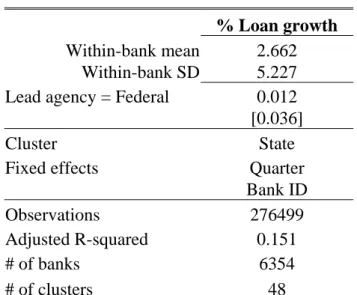
We further examine whether the more lenient supervision behavior displayed by state regulators is costly. We find that states with more lenient state regulators relative to their federal counterparts also have higher bank failure rates and problem-bank rates (i.e., rates of banks close to failing) in our sample period. Although, it is difficult to assess whether a less lenient supervisory stance is good or bad, this analysis does suggest that there are adverse consequences of state regulators’ leniency. When evaluating the downside of stringency, we do not find support for the hypothesis that tougher regulators constrain supply of new loans.
We end our analysis by showing that there is substantial regional heterogeneity in the leniency of state regulators relative to their federal counterparts and by examining reasons behind these differences. One reason for a softer stance by state supervisors could be that they may be “captured” by the constituents they oversee. In particular, since banks only pay assessment fees to state regulators (Blair and Kushmeider (2006)), it is possible that state supervisors maintain a more lenient stance to ensure that banks do not shift out of a given state in search of another state with even softer state regulators. We find some suggestive evidence supporting this conjecture. The federal-state difference in supervisory downgrades increases with the size of the bank that is being supervised. This should be expected, as state supervisors may care more about bigger banks since assessment fees are proportional to bank size. We also find evidence that supervisory staff characteristics may explain some cross-state differences. Although our evidence is far from conclusive, we view it as a reasonable first attempt at systematically investigating and quantitatively assessing the sources of heterogeneity across federal and state regulators.
Overall, while the paper falls short of providing a definitive answer as to whether the US dual supervisory system is optimal, to our knowledge it is the only paper that clearly documents inconsistent implementation of the same set of rules by different regulators within this system. This is a consequential finding, since inconsistencies between regulators can delay corrective regulatory actions (e.g., the case of WaMu) and induce variability in bank operations. Moreover, inconsistent implementation may potentially reduce the transparency of bank balance-sheets for agents in the economy who are unaware of the source of this variability, as the exact alternation schedule of regulators for each bank is not known to the public. As shown in Caballero, Hoshi, and Kashyap (2008), lack of timeliness of corrective banking actions as well as opaque balance-sheet information can be costly and can adversely impact real allocations. Importantly, these adverse effects are present in our sample regardless of whether the inconsistency between federal and state regulators is a result of deliberate design or an unplanned feature of the current regulatory structure. In other words, delays in taking corrective action and reduction in
5
transparency of balance-sheets can be costly whether, loosely speaking, a possible "bad cop/good cop" implicit arrangement between federal and state regulators we uncover is intended or not.5
Our work is broadly related to several strands of the economics and finance literature. First, it is most directly related to work on regulatory design. The issue of the design of regulation spans from its early public interest roots to the Chicago theory of Stigler (1971) and Peltzman (1976), who argued that regulation is often captured by the industry it is meant to regulate and is designed primarily for insiders’ benefit, to the rent seeking theory of regulation (e.g. Shleifer and Vishny (1999).6 Most of this work (including in the context of banking) debates the pros and cons of different regulatory structures, but provides surprisingly little systematic empirical evidence. Our work contributes to this literature by highlighting systematic regulatory inconsistencies and tracing their consequences – that is, their effects on banks' behavior.
Second, and more relevant to the issue of regulatory inconsistencies, this paper speaks to a relatively established literature (mostly concerning industrial organization) that focuses on regulatory consistency and regulatory uncertainty.7 Not unlike our paper, this literature also studies some sources of regulatory inconsistencies (e.g. elected versus appointed regulators (Besley and Coate (2003)) as well as their consequences (e.g. differential firm productivity). Third, this paper is connected to studies on regulatory arbitrage (Rosen, 2003; Rosen, 2005; Rezende, 2011) that suggests that banks actively shop for regulators who are likely to be softer on them through different channels such as charter changes, mergers with other banks, supervisory ratings, or changing their location of incorporation. Other work in this area (Kane, 2000; Calomiris, 2006) also discusses changes in regulatory standards (constituting a "race to the bottom") due to competition between regulators (on account of "regulator shopping" by those regulated). In general, this arbitraging behavior by banks may induce a potentially sizeable selection bias in examining the effects of regulatory actions. Our empirical design circumvents this issue and provides causal estimates of the influence of regulators.8
5
The Riegle Act was predominantly motivated by red tape reduction, in no part of its text does it appear focused on the creation of a deliberate optimal mix of more and less lenient regulators. Our personal discussion of the matter with several supervision and regulation experts also appears to strongly support the view that this is not an aforethought feature of the regulatory structure. In addition, to the best of these practitioners’ knowledge, although inconsistent implementation conforms to their priors, no specific gain (e.g. extra information conceded by the bank) is commonly recognized as originating from such out-of-step behavior of the federal and state regulators.
6
The public interest roots go back as far as Pigou (1938). For a comprehensive review of the public interest theory see Laffont and Tirole (1993), which also focuses on a modern take on regulation, encompassing the role of
asymmetric information. Also related is the work on banking regulation by Dewatripont and Tirole (1994); Boot and Thakor (1993); and Hellman, Murdock and Stiglitz (2000) among the others. The issue of centralized versus decentralized regulation, often discussing state versus federal regulation in the US context, has received theoretical attention in Martimort (1999), Laffont and Martimort (1999), and Laffont and Pouyet (2004) among the others. 7
See Brennan and Schwartz (1982a, b); Viscusi (1983); Prager (1989); and Teisberg (1993). 8
The literature on regulatory shopping and a race to the bottom extends beyond banking. For instance, there is literature on international trade that provides evidence that firms shop for the least stringent regulator. Similarly, there is a growing literature on shopping of rating agencies by issuers of mortgage backed securities (e.g., Bolton, Frexias and Shapiro, 2011).
6
Finally, our work complements the empirical literature on the effects of banking regulation and supervision. Such work encompasses studies on the role of regulation and supervision in well-established banking and financial sectors of developed economies (Jayaratne and Strahan, 1996; Berger and Hannan, 1998; Kroszner and Strahan, 1999), as well as in developing financial sectors across the globe.9
The rest of the paper is organized as follows. In Section 2, we discuss the structure of US banking supervision and the data. Then, in Section 3, we highlight our empirical strategy. Next, in Section 4, we report our main results and robustness checks. In Section 5, we explore the likely sources of the differences in regulatory behavior reported. We discuss the wider applicability of our findings in Section 6 and Section 7 concludes.
2. US Banking Regulation, Alternating Supervision, and Data
2.1 An Overview of US Banking Regulation
The US banking industry has evolved into a complex and fragmented system that reflects America's historical tension between centralizing and decentralizing political forces. Since the National Bank Act of 1863, commercial banks have had to deal with a dual supervisory system, under which they are chartered and supervised both by federal and state-level entities.10 This system has often been praised by policymakers as playing a key role in financial innovation, as federal and state regulating bodies compete with one another and thus trim unnecessary rules (Scott, 1977). In addition, commentators have argued that state regulators can leverage their local knowledge to improve their supervisory decisions. At the same time several policy makers and commentators have criticized the dual system for the resulting fragmentation of the banking sector and for the risk of a “competition for laxity” generated among bank regulators (for example Fed Chairman Arthur Burns, 1974). This latter issue has been actively debated in the past –most recently around the Gramm-Leach-Bliley Act of 1999– and has again resurfaced in the aftermath of the 2008-09 crisis (see Senator Dodd’s speech in Senate Banking Committee hearing in September, 2009).
In the current system banks can choose between a state and national charter. With a state charter, they can also decide whether or not to be members of the Federal Reserve System. The three different types of commercial bank charters correspond to three different primary federal regulators: the Office of the Comptroller of the Currency (OCC), instituted in 1863; the Federal
9
The literature on the latter is vast. See Beck et al. (2000); Barth et al. (2004) among the others. 10
Prior to 1863 state commercial banking was the primary form of banking. Commercial banks are the predominant form of depository institutions in the United States and are the focus of this paper. The other two main classes of depository institutions are savings banks (also known as thrifts because they historically offered only savings accounts), which generally specialize in real estate lending and credit unions which are cooperative financial institutions. Among other types of depository institutions in the United States are the following: Edge corporations, branches and the branches and agencies of foreign banks.
7
Deposit Insurance Corporation (FDIC), instituted in 1933; and the Federal Reserve System (Fed), instituted in 1913. Federally chartered banks, also known as national banks (NA) are primarily supervised (and chartered) by the OCC. State banks are supervised by their chartering state banking departments, in conjunction with the Federal Reserve, if they are members of the Federal Reserve System (as we stated before, these banks are called state-member banks, SMBs). Otherwise, state banks are supervised by their respective chartering state banking departments along with the FDIC, since these banks are not a member of the Federal Reserve System (i.e., these banks are referred to as non-member banks, NMBs as we explained earlier). In general, the regulator that is in charge of regulating and supervising an entity is also a function of its line of business. Figure 1 depicts the structure of supervision and regulation for US commercial banks and thrifts.
Until recently different charters implied notable differences in permissible activities as well as regulatory requirements. For example, through the early 1980s non-member banks were not subject to reserve requirements (according to the Depository Institutions Deregulation and Monetary Control Act of 1980), their lending limits could differ significantly across states, their ability to branch interstate differed, and the list of activities (e.g. providing insurance) that they were permitted was quite diverse. However, over the years, many of the differences across requirements and charters have disappeared as regulatory and charters have converged. Many commentators believe that the main drivers of charter choice now are direct regulatory costs and the bank’s perception of the regulator’s accessibility.11 Small banks tend to prefer state charters, as applications are streamlined and supervisory fees are lower (Blair and Kushmeider (2006)). Larger banks, especially those that aim at branching inter-state, tend to prefer national charters (see, e.g., Bierce (2007)).12 As of the first quarter of 2011, about 1,350 NAs accounted for 70 percent of all commercial bank assets; about 800 SMBs accounted for about 15 percent of all banks assets, and around 4,200 NMBs accounted for the remaining 15 percent of all assets. Banking micro-prudential supervision in the United States relies on two main pillars: off- and on-site monitoring. Off-site monitoring requires all depository institutions to file quarterly “Reports of Condition and Income”, or Call Reports. Regulators use Call Reports to monitor a bank’s financial conditions between on-site examinations. On-site “safety and soundness” examinations are used to verify the content of Call Reports and to gather additional in-depth information regarding the safety and soundness of the supervised entity as well as its compliance with regulations. In an on-site examination, supervisors read additional documents from the bank, review and evaluate its loan portfolio, and meet with the bank’s management. Supervisors
11
Office of Inspector General (2002). For a cautionary tale concerning the OTS "accessibility" see Cyran (2009) and Office of Inspector General (2010). In our sample for analysis, state banking departments often mention higher "accessibility" among the main advantages of a state charter versus a national one. (See for example.
http://www.banking.state.tx.us/corp/charter/benefits.htm ) 12
See Rosen (2003) for possible determinants of charter changes. Blair and Kushmeider (2006) discuss the funding of supervisors.
8
comment on areas that must be improved; and depending on the bank’s condition, they also discuss with management the need for informal or formal supervisory actions. Informal actions are established through a commitment from the bank to solve the deficiencies identified in the form of a memorandum of understanding or a bank board resolution. Formal actions are more severe. They include cease-and-desist orders, suspensions or removals of banks’ senior management, and terminations of insurance.
These examinations culminate in the assignment by a team of examiners of a CAMELS rating, which, summarizes the conditions of the bank (broken down into six components—for capital adequacy, asset quality, management, earnings, liquidity, and sensitivity to market risk). Ratings for each of the six components and the final rating are on a 1 to 5 scale, with the lower numbers indicating fewer/and or lesser regulatory concerns. Banks with a rating of 1 or 2 are considered to present few (if any) significant regulatory concerns, whereas those with 3, 4, and 5 ratings present moderate to extreme levels of regulatory concerns.
Not only are these ratings the central summary measure of banking supervision that is easily comparable, they are also relevant for several important policy decisions. In particular, CAMELS are used to determine decisions such as how high to set insurance premiums on deposit insurance by the FDIC, whether to lend credit to financial institutions by the Fed (lender of last resort), whether to make licensing, branching and merger approvals, and whether to allow banks to participate in government programs, like Troubled Asset Relief Program (TARP) and small business lending programs.
2.2 Alternating US Banking Supervision: Policy and Coverage
Since the Federal Deposit Insurance Corporation Improvement Act of 1991 federal bank supervisors are required to conduct on-site examinations every 12 months, unless their assets fall below a minimum threshold, in which case the exams are conducted every 18 months. This threshold has changed over time and since 2007 stands at $500 million for SMBs and NMBs (FRB (2008) and FDIC (2002)).13 Federal supervisors had begun coordinating with state banking departments so that they could share examination results since the 1980s. Section 349 of the Riegle Community Development and Regulatory Improvement Act of 1994 required the Federal Financial Institutions Examination Council (FFIEC) to issue guidelines for determining the acceptability of state examination reports as substitutes for federal examinations.
The aim of these rules was to reduce the regulatory burden on state chartered banks under dual supervision system, by substituting a federal examination with a state examination. The rules were issued in Federal Financial Institutions Examination Council (1995) and the Federal Reserve Board and the FDIC made a formal nationwide state/federal supervisory agreement with the Conference of State Bank Supervisors (CSBS), a national organization of participating state
13
9
bank regulators.14 Since the issuance of Federal Financial Institutions Examination Council (1995), acceptable state reports became eligible substitutes for federal reports; that is, after the FFIEC rules were issued, federal and state regulators could take turns every 12 months (or 18 months for smaller banks) examining state chartered banks.
As noted previously, the FFIEC rules established that each federal regulator independently determines whether to accept the state examination results based on the type of reports produced by the state examiners, as well as measures of minimum state banking department budgets and the state banking department’s accreditation by the CSBS. The FDIC/Fed cooperative agreements cover the vast majority of states. As of 1995, both federal agencies separately had already entered into informal and formal arrangements, or working agreements, with most state banking departments, determining the types of banks that would be examined on an alternating independent basis or on a joint examination basis, among other matters.15 While our results are quite insensitive to the choice of the starting period after the FFIEC guidelines of 1995 were issued, we do lack a precise date on which the policy starts operating. We conservatively allow for a one year breaking-in period and begin our analysis as of 1996:Q1 to ensure that idiosyncrasies in initial program implementation would disappear (e.g., the federal regulators could have preferred to let stronger banks start the rotation program first, allowing less robust institutions to join the rotation program later on). By 1996:Q1 rotations of supervisors across the vast majority of states are pervasive in the data. Our sample ends in 2011:Q1.
Alternating examinations are not available for a subsample of banks. Only banks that at the most recent examination were assessed to have a composite CAMELS rating of either 1 or 2 are part of the alternating program. Only SMBs with an asset size of less than $10 billion are part of the program. In our sample of analysis, we focus on SMBs satisfying these criteria, since only for such banks is the supervisory rotation policy predetermined. The FDIC conducts alternating independent exams only for NMBs with an asset size of less than $250 million, representing more than 80 percent of all NMBs. Bank examinations of larger NMBs are run on a joint basis with the state examiner—in such cases, a mix of state and FDIC examiners participates in the on-site visits. However, even in the case of joint NMB examinations, only one agency is the “lead agency” in assigning the CAMELS. We include such joint examinations in our sample, but our results are unaffected when excluding NMBs above $250 million.
14
These rules are summarized in Federal Deposit Insurance Corporation (2002) and Board of Governors of the Federal Reserve System (2008)—two manuals for commercial bank examinations.
15
Formal agreement dates by states are staggered over our sample period. According to Federal Deposit Insurance Corporation (2004), all state banking departments with the exception of seven had signed formal cooperative agreements by 2004, with the number falling to four by 2007. In 2004, the state banking departments without formal agreements with federal regulators were in Alaska, Montana, Nevada, New Hampshire, Rhode Island, South Dakota, and South Carolina. See http://www.csbs.org/development/accreditation/Pages/default.aspx . See also Rezende (2010) for a discussion.
10
We further filter the sample by excluding: targeted examinations as well as exams where all subcomponents of the CAMELS rating are not scored or available. We also exclude concurrent examinations because of their exceptional nature relative to the routine safety and soundness examinations which are our focus. Even when meeting all the preceding criteria for inclusion in our alternating supervision sample, we observe a small fraction (about 10 percent) of banks that do not display any rotation during our sample period. These banks with no signs of supervision rotation do not show up systematically within the sample—and they are spread out across states and over time. These banks appear to be mostly certain types of depository institutions with peculiar purposes (e.g. Industrial Loan Companies (ILCs)) or de novo banks. Since these banks do not satisfy our condition for identification that requires exogenous rotation of regulators, we exclude them from our sample. We note, however, that our results are unaffected by including these specific banks in our analysis.
2.3 Data and Descriptive Statistics on Rotation
We use a unique dataset, the National Information Center of the Federal Reserve System, covering the time period from 1996 through 2010, of all on-site examination of safety and soundness conducted by banking regulators. The data contain detailed information about financial information of depository institutions, regulated and select non-regulated institutions, as well as other institutions that have a regulatory or reporting relationship with the Federal Reserve System. The key data for the purposes of this study are unique bank identifiers, the examiner identity (e.g. FDIC, Fed, States, OCC, and Office of Thrift Supervision (OTS)), the exam date, and most importantly the composite CAMELS rating and its components. In contrast to several papers that have explored the determinants of supervisory ratings at the bank holding level (e.g. Berger, Davies and Flannery, 1998), we employ the ratings at the level of the commercial bank, which is the entity level at which we observe the examiner rotations.
We merge this information with balance sheet measures of bank profitability, profitability and asset quality from Call Reports. Our main Call Reports variables are: Tier1 risk-based capital ratio, leverage ratio (Tier1 capital as a share of total risk-unweighted assets), return on assets, share of non-performing loans to total loans, and the delinquency rate of the loan portfolio. Delinquent loans include loans 30+ days past due and loans in nonaccrual status, and nonperforming loans are 90+ delinquent and loans in nonaccrual status. In some of our analysis we will also dissect delinquency and nonperforming loans for various asset classes in a bank’s portfolio (e.g., commercial real estate, residential real estate, and commercial and industrial loans).
Importantly for our analysis, we define a supervisory cycle as the time between when a regulator conducts its on-site examination and when the alternate regulator examines the bank, with the time period lasting either 12 or 18 months depending on the bank’s asset size (as discussed in Section 2.2). In our regressions, we use this definition to assess the relationship between changes
11
in supervisor identity and CAMELS ratings as well as bank variables. Because the CAMELS rating does not change between exams, doing so captures how supervisory rating changes across different regulators. Bank balance sheet variables, instead, can vary each quarter. This implies that using our definition of supervisory cycle in this analysis compares the average effect on a variable across quarters following a federal or a state examination. We revert to this issue in Section 4.2.
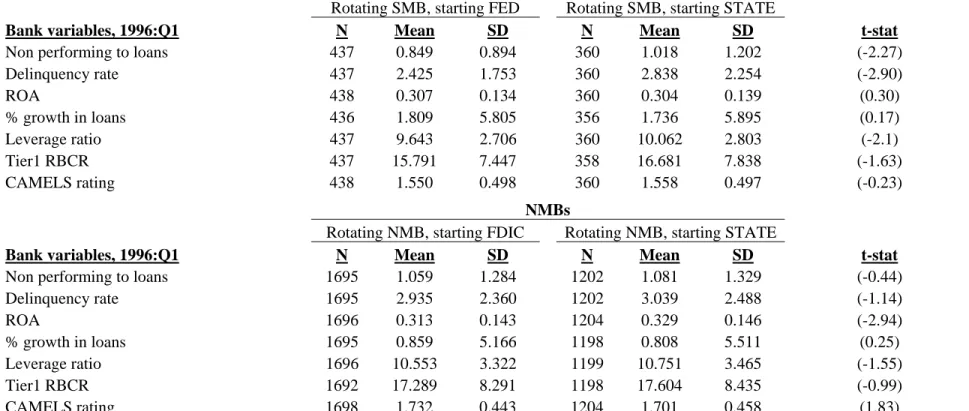
Summary statistics for our sample of rotating banks as of 1996:Q1 appear in Table 1. We present the descriptive statistics on CAMELS ratings, as well as bank balance-sheet measures such as delinquencies, non-performing loans, and ROA for both SMBs and NMBs split up by whether they were assigned to federal or state regulators at the start of our sample. These statistics provide sample moments that will be useful for interpreting the magnitude of our regression coefficients.
We provide the length of duration between supervisory rotations in Table 2. A vast majority of banks display supervisory rotations between two and eight quarters. This description matches well the regulatory restriction of four-quarter to six-quarter rotations discussed earlier. In particular, NMBs are subject to less frequent examinations and rotations, about one every 18 months. This is in line with the guidelines discussed earlier since NMBs tend to be smaller banks (mean assets size of NMBs in our sample in 1996:Q1 is $95 million). Being larger, SMBs are subject to standard 12-month rotations in most cases (mean assets size of SMBs in our sample in 1996:Q1 is $160 million). We investigate the reasons for shorter rotation spells and find that they are mostly accounted for by institutions that exit our sample because of the large wave of bank mergers that occurred over the past 15 years. The relaxation of intrastate and interstate branching regulation (culminating in the Riegle-Neal Act of 1994) and the Gramm-Leach-Bliley Act of 1999 were primary facilitators of this M&A wave, a trend that we find is unrelated to the timing of the supervisory rotation cycle.16
Regulation spells may also be shorter because of banks switching charters or relocating their operations (Rosen (2005)). These instances are fairly limited in the data, and similar to M&A activity, we find relocations and charter switches to be unrelated to the timing or identity of the supervisor in rotation cycles. We also occasionally find idiosyncratic cases of longer rotation cycles, but their exclusion does not affect our results in any substantive way. Discussions with senior executives in supervision and regulation suggested that most of these idiosyncrasies might be due to staffing issues, both at the state and federal level.17 Often a longer-than-expected
16
Prior research has investigated the reasons for this trend and found it to be reflective of the weakening of small bank special interests vis-à-vis large banks in light of the introduction of new technologies in lending and deposit-taking. For a complete discussion see Kroszner and Strahan (1999).
17
Examples included instances when the examiner assigned to a specific bank was on leave or vacation at the predetermined exam time and when the assigned examiner was still involved with on-site examinations at another institution.
12
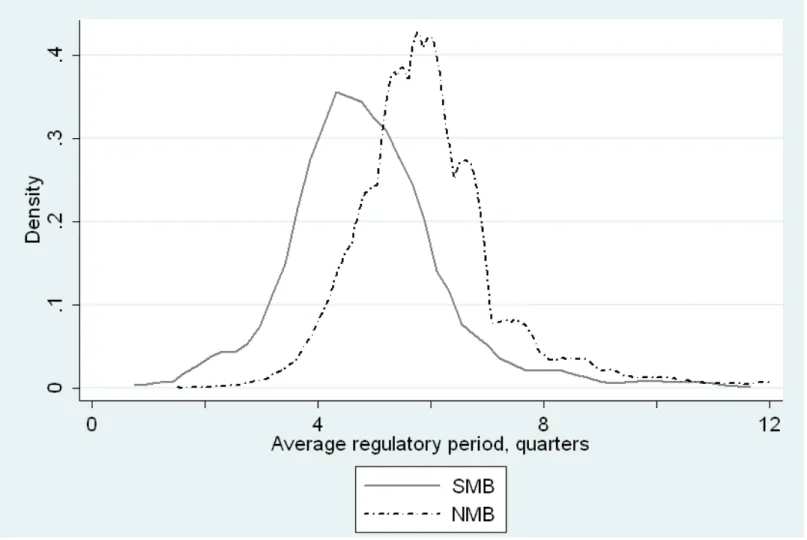
rotation time with one regulator would be offset by a subsequent shorter rotation time with the alternating regulator; this tendency to rebalance the rotation times would be in line with regulatory restrictions. Figure 2 reports the kernel densities of the rotation spells graphically, illustrating compliance to the rotation profiles required by law for SMBs and NMBs. Our interviews with experts in banking supervision and regulation confirmed a strict implementation of the rotation policy that is consistent with this pattern.
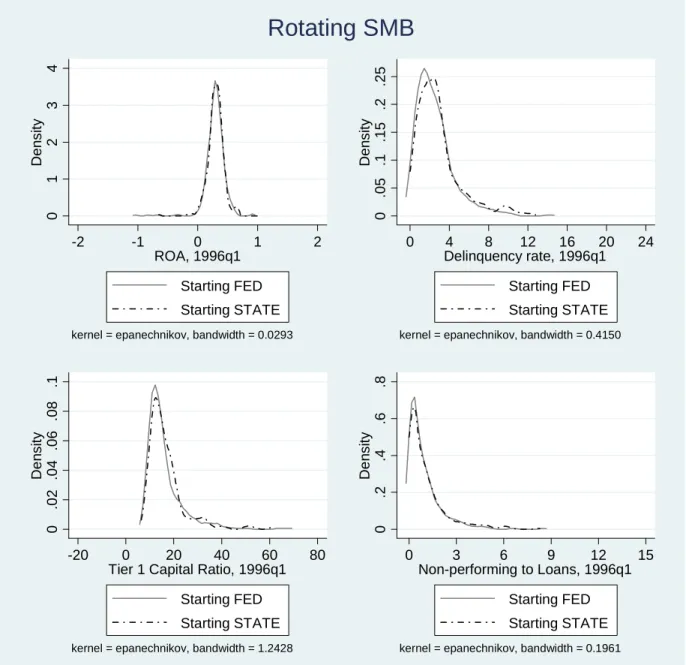
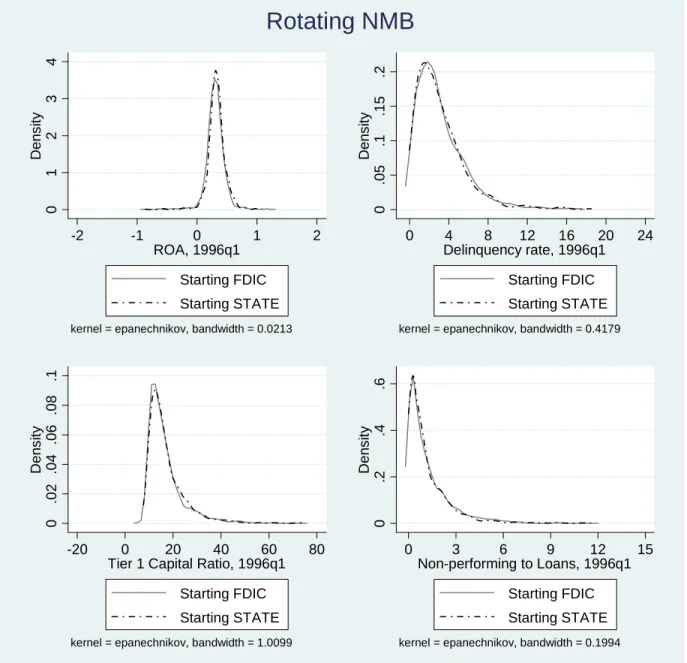
Finally, Table 1 also allows us to investigate the nature of assignment of banks to state versus federal regulators at the inception of the rotation policy. It reports t-tests for differences in means across federally and state regulated banks involved in the rotation process as of the first quarter of 1996. Broadly, we find that banks assigned to state regulators versus federal look similar in the cross-section at inception. We fail to reject equality of means in the vast majority of the controlling variables. Occasionally, Table 1 reports some differences along certain dimensions, indicating potential deviations from pure random assignment. In the SMB sample, we reject the equality of means for ROA alone; in the NMB sample we reject the null of equality of means for nonperforming loans, delinquency rates, and leverage. These cross-sectional differences are, however, quantitatively small. Figures 3 and 4 plot the kernel densities for characteristics of banks assigned to federal and state supervisors as of 1996:Q1 and confirm this to be the case – the difference in the two densities are barely noticeable along any dimension. We find similar evidence after exploring successive dates right after 1996:Q1 as well. No variable displays systematic consistent breaks across banks assigned to federal versus state regulators. We do not report these results for brevity's sake. As we will elaborate in the next section, our identification strategy relies on predetermined within-bank variation of regulators and not on which regulator was assigned at the inception of the rotation policy. Nevertheless, the quasi-randomized nature of assignment of initial supervisors across banks lends further support to our empirical design. 3. Identification Strategy
We now present our empirical model and describe our identification strategy. To keep the identification as transparent as possible, consider a regulatory outcome variable of interest Yit (e.g. the composite CAMELS rating) to be linearly determined by a vector of characteristics of bank i at quarter t, Bit, and by the characteristics of the supervisor Sit at quarter t according to the following equation:
,
where we include bank-specific fixed effects and quarter fixed effects . Let us consider within-bank/within-quarter deviations from averages to partial out the fixed effects. Representing these within deviations with lower-case variables and dropping bank-quarter indexes, we focus on the following equation:
13
, (1)
where plays the role of classical measurement error deviations. In general, vector s may include regulator-specific characteristics, such as the competence of its team of examiners, the structure of its budget, the role of assessment fees and the degree of political pressure on the regulator. However, for simplicity's sake, let us assume that s is scalar, indicating the change in the identity of the regulator.
Vector b may include variables endogenously set by the bank and can be split into observables,
b1, such as changes in the bank's ROA, capital ratios and liquidity levels, or changes in the structure of the market the bank operates in, and unobservable shocks, b2, such as shifts in the management’s composition. Let us further assume | 0 to maintain the exposition strictly focused on the selection problem.
We can rewrite equation (1) as:
. (2)
Importantly, note that in equation (2) the unobserved error component becomes . As we will argue, the structure of the error term can create bias in identification of and if banks self-select into regulatory settings. The nature of the problem is very similar to matching bias in empirical contract theory, as for instance studied by Ackerberg and Botticini (2002).18 In empirical matching models that achieve identification, one needs to account for the principal-agent matching equation, which in this context translates into modeling a regulator-bank selection equation.
To illustrate the bias due to self-selection by banks, let us assume that the decision of choosing supervisor s by bank with characteristics b is linear:
, (3)
where u represents the idiosyncratic variation in the selection of a specific regulator. Equation (3) approximates how banks sort into specific regulatory environments depending on the type of the supervisor (Rosen(2005)). An example of equation (3) would be the choice by Countrywide Financial Corp. to become a thrift in 2007. As discussed in the Financial Crisis Inquiry
18
A main difference in our paper is our focus on selection issues arising both in changes and in levels, as opposed to selection arising in levels only. This excludes the possibility of using panel variation as a source of identification in our setting, while it is occasionally employed in matching models. See Ackerberg and Botticini (2002) for a discussion.
14
Commission Report(2011, p. 174), Countrywide moved under OTS oversight because of the increased scrutiny on property appraisals under OCC and adverse views on Option ARMs voiced by the Fed (both the OCC and the Fed were Countrywide’s previous regulators).
Equation (3) is also the source of the selection bias that would arise in the standard fixed-effects panel estimation of the parameter vector of interest [1,] in (2). That is, by regressing y on b1 and s, both coefficients would be biased and inconsistently estimated due to , 0. In our empirical setup, the identification is based on the availability of a policy p guaranteeing that, within a set of SMBs and NMBs with rotating regulators, equation (3) does not hold. Instead, the assignment of a new regulator is predetermined by the policy rule:
, (4)
where the following orthogonality condition holds:
| 0 . (5)
The error term, , accounts for idiosyncratic shocks that may introduce variation in the implementation of the rotation policy, as discussed in the case of Figure 2. These include random events such as conflicting meeting schedules or other factors that lead to temporary unavailability of examiners. Our sample conditioning in (5) requires that we only examine depository institutions for which the regulator’s identity is predetermined. Conditional on the bank being a SMB or NMB, under (4) and (5) fixed-effects panel estimation of the parameter vector of interest [1,] in (2) is unbiased and consistently estimated.
In principle, under (4) and (5), it is also possible to identify the effect of supervisor s on subsequent bank behavior b1itself:
, (6)
where represents idiosyncratic error deviations in bank behavior. More precisely, can be consistently estimated, since (4) breaks the simultaneity of b and s implied by (3). Section 4.2 discusses in detail the effect of s on the bank’s response outcomes.
In Section 4.1 we will exploit only within-bank information and rely on the predetermined nature of the assignment rule p to obtain consistent estimates of the total effect of changing a regulator. The total effect includes both the direct structural parameter in equation (2) and any indirect effect that regulation has on CAMELS rating by altering bank behavior (illustrated by equation
15
(6) for instance). To see this clearly, replace (6) in (2). The reduced-form regression we estimate is equivalent to:
(7)
Here, the total effect of changing a regulator is and it is consistently estimated in our setting. The advantage of estimating equation (7) rather than equation (2) is that it captures in a single estimate all the channels through which s matters for CAMELS rating: the direct effect and the indirect effect . More importantly, relative to estimating equation (2), estimating equation (7) does not suffer from potential misspecification problems due to the possible omission of relevant elements of the vector .
4. Empirical Results
4.1 Differences in Supervisory Ratings
In this section, we exploit the predetermined assignment of regulators to SMBs and NMBs to assess the effect of a supervisor’s identity on the rating obtained by a depository institution. We start by investigating the nature of the differences in CAMELS ratings that state and federal regulators assign by estimating equation (7).
Table 3 reports the results for our sample of SMB institutions, supervised alternately by Fed and state regulators. Table 4 follows a similar structure and reports results for our sample of NMB institutions, supervised alternately by FDIC and state regulators. We present results for both the composite CAMELS rating and for each of its six subcomponents. This allows us to detect possible deviations across the various dimensions scored, since state supervisors might emphasize different safety and soundness components relative to their federal counterparts. All our standard errors are clustered at the state level in order to correct for both between-bank-within-state and within-bank serial correlation in the error term.
Column (1) in Tables 3 and 4 presents the results for composite CAMELS ratings in a fixed-effects regression and shows that a dummy variable for the presence of a federal regulator as the lead agency supervising the bank is positive and statistically significant. These results appear extremely consistent and homogenous across CAMELS rating components, as shown in Columns (2) through (7) of both tables, and suggest that federal regulators systematically assign higher CAMELS ratings to a bank. Recall that higher CAMELS scores indicate worse
assessments of the bank, implying that federal regulators are unambiguously tougher than state regulators across all safety and soundness components. We conduct several robustness tests, but our results remain stable (e.g., dropping the 5 percent tails of the distribution of banks along dimensions such as Tier1 capital ratios (reported in Appendix Table 1) and asset size (unreported).
16
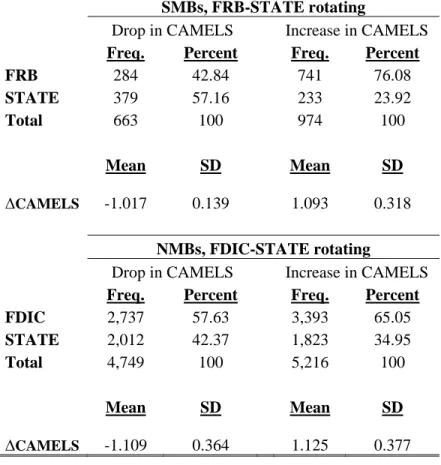
To gauge the economic magnitudes of our findings in the panel regressions presented in Tables 3 and 4 we need to account for the high persistence of the CAMELS ratings. CAMELS ratings do not vary frequently for a bank and rating changes most likely incorporate substantial information. One sensible approach is to compare our within-bank coefficient estimates around the rotation with the within-bank standard deviation of the CAMELS rating (or its components) provided in the tables. As can be observed from Column (1) in both the tables, the effects are very large. In particular, the effect of a switch from a state regulator to the Fed is about a third of the within-SMB standard deviation. Similarly, the switch from a state regulator to the FDIC results in about a fifth of the within-NMB standard deviation. The impact of switching to a federal regulator is the largest for the Management and the Sensitivity to risk components of the CAMELS rating. Another (more intuitive) way of displaying the magnitudes of the results in Tables 3 and 4 is to analyze simple raw frequencies of changes in CAMELS ratings around the rotation. In other words, conditional on observing a change in the CAMELS rating—in essentially all cases equal to one notch in magnitude in our data—we can ask which agency is more likely to downgrade (i.e., reporting a CAMELS increase) or upgrade (i.e., reporting a CAMELS drop). The results of this simple tabulation exercise are reported in Table 5 for both SMBs and NMBs. The difference between state and federal regulators is striking. Both Fed and FDIC are about twice as more likely than their state counterparts to downgrade a commercial bank. For SMBs, 76 percent of the downgrades originate from the Fed and only 24 percent from the state regulator. For NMBs, 65 percent of the downgrades originate from the FDIC and only 35 percent from the state regulator. Notably, the Fed is also less likely to upgrade relative to the average state regulator (only 43 percent of SMB upgrades are Fed-originated), although the FDIC is more likely to upgrade than the state regulator (58 percent of NMB upgrades are FDIC-originated). Hence, while the Fed appears unambiguously more stringent than its average state counterpart, the FDIC displays more stringency in downgrading only.
In addition, state regulators do not appear to completely counteract federal regulators' activity. The frequency of federal regulators' downgrades is substantially higher than the frequency of state regulators' upgrades. Raw frequencies indicate that state regulators' assessments appear to mostly stabilize around federal regulators' assessments instead. Finally, federal regulators consistently display: a) a similar degree of stringency across all subcomponents of the CAMELS ratings, as reported in Appendix Table 2; b) no differential behavior for banks that eventually end up in the problem bank list (defined as banks with CAMELS ratings of 4 or 5); and c) no evident difference in stringency as a function of the final CAMELS rating (not reported for brevity's sake).19
19
Appendix Table 3 reports the same decomposition of CAMELS rating increases (bank downgrades) and CAMELS rating increases (bank upgrades) as Table 5, but limited to banks that end up in the future as problem banks. State regulators are only slightly more likely to downgrade a problem bank (29 percent for SMB, 38 percent for NMB) relative to what they do in the case of the average bank in Table 5 (24 percent for SMB, 35 percent for NMB) vis-à-vis federal regulators.
17
We confirm that the results of simple tabulations in Table 5 are statistically significant and robust by employing specifications that condition on bank and quarter fixed effects. Table 6 presents results from a linear probability model where the dependent variable is 1 for a CAMELS rating decrease and 0 otherwise in columns (1) and (2) and the dependent variable is 1 for a CAMELS rating increase and 0 otherwise in columns (3) and (4). The higher propensity of a downgrade to originate from a federal regulator is robust to the inclusion of bank and quarter fixed effects and very precisely estimated. With the admitted caveat of a large frequency of zeros in these regressions (due to the serial correlation in the CAMELS ratings discussion earlier), magnitudes in these specifications suggest effects of the order of 10-25 percent within-bank standard deviations. In contrast, the propensities to upgrade are an order of magnitude smaller. A final caveat is in order. Regressions involving regulatory outcomes, such as the CAMELS rating regressions presented in this section, could potentially suffer from the omission of dynamic interactions between regulators. Our estimates could be affected by the omission of expectations of federal regulators about subsequent behavior of state regulators. For instance, federal regulators could decide to preemptively downgrade the rating in expectation of a more lenient future cycle under state regulators, even if conditions do not warrant it yet. No direct evidence of dynamic interaction appeared obvious in our extensive checks in the data. For example, a downgrade by a federal regulator did not appear to predict either an upgrade or a downgrade by the state supervisor in charge of the following examination cycle. While our choice of exclusion of future/alternative regulators’ characteristics from equation (1) was based on such evidence, it is, however, important to discuss the likely econometric issues arising from such an omission. Under a more general statistical model where these dynamic effects were at play, the structural parameter vector of interest [1,] in (2) would be consistently recoverable from the data only if information on the exact nature of the dynamic interaction across regulators became available. Nonetheless, absent such information, the estimated coefficients on b1 and s would still represent consistent reduced-form equilibrium effects of bank behavior and the supervisor’s identity. We limit ourselves to such an interpretation here.
4.2Do Supervisors Affect Bank Behavior?
Are changes in the identity of a regulator detectable along explicit dimensions of bank behavior? In this section, we investigate banks’ short-term response to the heightened threat of a downgrade stemming from a federal supervisor documented previously. This is an important step in the assessment of the potential real economic consequences of regulatory idiosyncrasies on overseen entities. We employ information from Call Reports to formally test this proposition along three main dimensions of bank operations: regulatory capital, profitability, and asset quality.
18
More specifically, we employ within-bank variation to assess whether the Fed and FDIC effectively impose more stringent capital and liquidity conditions on depository institutions than the average state supervisor. Our specification mirrors equation (7) with now the dependent being bank balance sheet variables rather than CAMELS ratings. As discussed above, it is important to reiterate that we define a supervisory cycle as the time between when a regulator conducts its on-site examination and when the alternate regulator examines the bank. This allows us to track actions undertaken by banks following the examination. Since bank variables can potentially change every quarter, our specification now compares the average effect on a variable across quarters following a federal or a state examination.
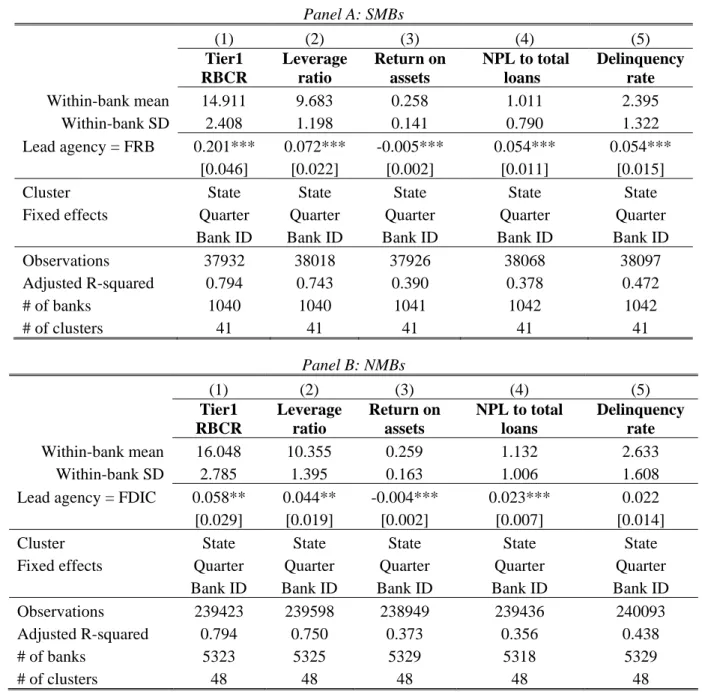
One may reasonably conjecture that, in addition to imposing stricter ratings, federal regulators may impose more stringent capital allocations, i.e., higher capital imposition (such as higher Tier1 RBCR) and better governance, i.e., explicit booking of past delinquent and nonperforming loans, all at the expense of returns (i.e., resulting in lower ROA).20 The data support the view that bank behavior is affected in ways consistent with this conjecture.
Panel A in Table 7 reports empirical evidence for the SMB sample and Panel B for the NMB sample. The rotation from a state regulator to a federal regulator (Fed or FDIC) unambiguously produces an increase in Tier1 RBCR and the regulatory leverage ratio (defined as Tier1 capital divided by total risk-unweighted assets in Call Reports), a drop in ROA, and an increase in delinquent and nonperforming loans booked by the depository institution. All coefficients of interests are precisely estimated, with the exception of delinquency rates in the NMB sample. Given the short-term nature of the changes due to the length of the rotations, the economic magnitudes of these estimates are reasonable with effects ranging between 3 percent and 8 percent of a within-bank standard deviation per extra quarter of federal regulator oversight. We further analyze the nature of bank asset portfolio and components of ROA that are affected by the stricter governance imposed by federal regulators. In particular, in Appendix Table 4 we analyze the nature of delinquencies and non-performing loans when we break the loan portfolio of banks into real estate loans – commercial and residential – and commercial and industrial loans (C&I). We find that the change in delinquency and non-performing loans documented in Table 4 is mainly driven by a change in real estate loans (both commercial and residential), while there is only limited variation in C&I loan quality around rotations. In addition, we also examine the components of ROA that contribute to its change in Table 7. We find that increases in the provision for loan loss and non-interest expenses largely contribute to this change.21 We interpret
20
Capital ratios can be influenced through changes in the allowance for loan and lease losses. There is a large literature that documents bank discretion in booking losses on its loan portfolio and the factors that influence such behavior. For instance, see Caballero, Hoshi and Kashyap (2008) for Japanese banks and Kane (1989) and Kroszner and Strahan (1996) for US banks.
21
Salaries are the main component of non-interest expense. An increase of salaries expenses is consistent with the bank taking corrective actions on its risk assessment by hiring new and/or more skilled staff.
19
these results as reflective of federal regulators using their supervisory authority (through formal or informal actions as discussed in Section 2.1) to make banks take corrective actions for the problems highlighted in their examinations.
There is an important remark to be made about the quantitative interpretation of these bank behavior results. Effects in Table 7 should be considered downward-biased estimates of the direct effect of federal regulators on bank behavior. The reason is the nearly-deterministic nature of the rotation rule, which allows banks to preemptively respond to changes in S.
More formally, equation (6) which describes the effect of a supervisor on bank behavior needs to also account for the expectation of future rotations. To show the exact nature of the problem, we present a simple formalization where only the identity of the current regulator and the identity of the regulator in the following examination cycle matters. In particular, let us assume:
, (6’)
where the prime represents the next rotation period when the new regulator takes over. This clearly imposes a dynamic structure not captured by (6). Making use of the condition 1 , the behavioral response by the bank becomes:
.
In the simple dynamic setting (6’), regressing observed bank behavioral variables b1 on the current regulator’s identity s will likely produce biased estimates of the structural parameter of interest . Intuitively, anticipation of the future rotation cycles may dampen the response of a bank to the regulator currently supervising it.
One alternative to solve this estimation problem would be to rely on strong structural assumptions of the type (6’) and consistently estimate the structural parameters ( and in this case) while assuming the model is correct. It is difficult, however, to find explicit guidance on the exact nature of the dynamic response of a bank to future supervision, making results from this exercise model-dependent. An alternative, more reliable, approach is to limit the interpretation of the estimated coefficient on s in equation (6) to the reduced-form equilibrium effect of the underlying dynamic model and to recognize that we are focusing on a reduced-form effect, such as -, and not on directly. Importantly, given the predetermined nature of s, such reduced-form coefficients remain consistently estimated even in presence of anticipatory effects. In Table 8 we further highlight this point econometrically by running a close equivalent to specification (6’). This specification includes a dummy indicator equal to 1 if the lead agency in the (current) quarter t is federal and 0 otherwise (similar to Table 7 Panel A and Panel B). More
20
importantly, these specifications also include two additional indicator variables: one that takes a value 1 if a federal supervisor replaces the current state supervisor at quarter t+1 (0 otherwise) and another that takes a value 1 if a federal supervisor replaces the current state supervisor at t+2
(0 otherwise). If the coefficients on these additional dummies display the identical sign as the effect of having a federal supervisor in the current quarter, one may conclude that there is evidence of anticipatory action on the part of the bank. To understand why, suppose that at time
t=0 a bank expects to be required to increase its Tier1 capital by a federal regulator scheduled to examine it on site two quarters after. Since raising Tier1 capital on a short notice may be costly, the bank is likely to attempt to raise it ahead of the regulatory switch, which would help make the bank’s adjustment to the new regulator go more smoothly. This may induce the bank to increase its Tier1 capital not only at period t= 2, when the new regulator actually comes in, but possibly also at t= 1 and t= 0, even if the current regulator has no particular concerns about Tier1.
Panel A and Panel B of Table 8 display the dynamics of anticipating changes on account of a switch from state supervision to federal supervision by SMBs and NMBs, respectively. Anticipatory motives are evident in Tier1 RBCR, leverage ratio, and non-performing loans and delinquencies among SMBs expecting Fed to supervise them in next cycle or two; additionally, such motives appear in ROA of SMBs and NMBs scheduled for federal supervision.22
4.3Is Lenient Supervision Costly?
This section presents a first attempt at assessing whether more lenient behavior displayed by state regulators – their lower willingness to initiate downgrades across banks in our sample (and higher willingness to initiate upgrades for SMBs) – can be interpreted as a desirable feature. On the one hand, excessive regulatory strictness may stifle innovation of the banking sector, thereby hampering growth of the corporate sector, as some have argued. On the other hand, excessive regulatory leniency may be the telltale sign of regulatory capture and lead to excessive risk-taking, as others have contended (see Scott (1977) for a discussion of both views). Both arguments have been reiterated in the debate around regulatory failures during the build-up to the 2008–09 financial crisis. However, to our knowledge there is no empirical evidence systematically evaluating either of these claims. Here we take a step in this direction and provide a tentative assessment of the issue.
We start by examining the correlation between the strictness of federal regulators relative to their state counterparts–henceforth, the ‘federal-state spread’–and an outcome that is considered unambiguously negative within financial markets: bank failures. Such failures hamper the proper functioning of the financial system and can stall real economic activity (Calomiris and Gorton,
22
Notice that this econometric approach is not needed when studying CAMELS ratings. The reason is that CAMELS ratings can only change in the quarter of the on-site examination conducted by the new regulator.
21
1991).23 Notice that it is not obvious whether the relative leniency of a state regulator would manifest itself in a higher failure or problem-bank rate in that state. On the one hand, even if state regulators are lenient, corrective actions by federal regulators –if implemented– should improve the health of a bank and reduce its chances of failure. On the other hand, it might be the case that state regulatory laxity slows down corrective actions by the Fed or FDIC, thereby increasing the chances of a bank failing in that state.
We use data on bank failure rates and problem-bank (i.e., banks close to failing) rates over our sample period to conduct our analysis.24 To streamline the presentation of the results and gain statistical power, we pool federal regulators together in this and the following sections.25 Panel A of Table 9 presents the results using the baseline specification of Table 3 and 4 and using the composite CAMELS rating as the dependent variable. The federal agency indicator in Table 9 is interacted with whether or not the state is above or below the cross-state median in terms of bank failure rate (column 1) and problem-bank rate (column 2). The coefficients suggest that, for banks in our sample, federal regulators always imposes higher CAMELS ratings than the state regulator (hence, the state is more lenient on average), but the federal regulator does this even more so in states with high bank-failure rates and high problem-bank rates. The null hypothesis that there are no differences in coefficients across the two groups is rejected statistically in chi-square tests for both bank failure rate (p=0.001) and problem-bank rate (p=0.014).
We find qualitatively similar results in Panel B of Table 9 where we estimate a cross-sectional regression of bank-failure rates in a given state on the federal-state spread for the CAMELS rating that is estimated over the entire sample period. In column (1), we report the results for all the states in our sample. The federal-state spread is positively associated with the bank-failure rate in that state. In other words, states where bank-failure rates are high are also those where state regulators appear less willing to apply strict ratings relative to their federal counterparts. The economic magnitudes suggested by the coefficients are large – a one standard deviation movement in the federal-state spread (0.07) is associated with about 40 percent increase in the bank failure rates relative to the mean rate across states. In column (2), we restrict our sample to states with more than 20 banks to improve the precision of our estimated federal-state spread. The results become both quantitatively and statistically stronger. For the sake of completeness, we also conduct the cross-sectional analysis using the problem-bank rate as the dependent variable and find results that are qualitatively similar (unreported for brevity's sake).
23
While bank failures are an important element in banking supervision and frequently discussed in the context of banking crises, policymakers are also interested in ensuring that credit is allocated efficiently in the economy. For instance, if policymakers wanted, they could eliminate banking failures through a very high reserve requirement; however, this would substantially affect credit allocation.
24
Problem banks are identified using the criterion employed by regulators; i.e., banks that have composite CAMELS ratings of 4 and 5, as defined in the FDIC problem bank list.
25
There are also legal constraints we face in trying to explore the heterogeneity of effects across different federal agencies.