Rational kernels for Arabic Root Extraction and
Text Classification
q
Attia Nehar
a,*, Djelloul Ziadi
b, Hadda Cherroun
a aLaboratoire d’informatique et Mathe´matiques, Universite´ A.T. Laghouat, Algeria bLaboratoire LITIS – EA 4108, Normandie Universite´, Rouen, France
Received 9 April 2015; revised 8 November 2015; accepted 8 November 2015 Available online 19 December 2015
KEYWORDS N-gram; Arabic; Classification; Rational kernels; Automata; Transducers
Abstract In this paper, we address the problems of Arabic Text Classification and root extraction using transducers and rational kernels. We introduce a new root extraction approach on the basis of the use of Arabic patterns (Pattern Based Stemmer). Transducers are used to model these patterns and root extraction is done without relying on any dictionary. Using transducers for extracting roots, documents are transformed into finite state transducers. This document representation allows us to use and explore rational kernels as a framework for Arabic Text Classification. Root extraction exper-iments are conducted on three word collections and yield 75.6% of accuracy. Classification experi-ments are done on the Saudi Press Agency dataset and N-gram kernels are tested with different values ofN. Accuracy and F1 report 90.79% and 62.93% respectively. These results show that our approach, when compared with other approaches, is promising specially in terms of accuracy and F1.
Ó2015 The Authors. Production and hosting by Elsevier B.V. on behalf of King Saud University. This is an open access article under the CC BY-NC-ND license (http://creativecommons.org/licenses/by-nc-nd/4.0/).
1. Introduction
Text Classification (TC) is a machine learning-based task. It aims to automatically sort a set of documents into one or more
classes from a predetermined set (Sebastiani and Ricerche, 2002). Applications of TC include many domains, such as arti-cle indexing, Web information searching, mail spam detection, and even automatic assessment systems.
In this work, we enhance the root extraction technique, intro-duced by authors in a previous paper (Nehar et al., 2012), and we asses its performance in the context of Arabic Text Classifica-tion (ATC). Indeed, root extracClassifica-tion method introduced in Nehar et al. (2012)gives a set of possible roots. Our new root extraction approach chooses the best root based on a statistical study of character occurrences in the Arabic roots corpus Experiment and comparison are con-ducted to assess performances against standard stemmers. Our root extraction technique transforms documents into finite state transducers. Then, rational kernels (Cortes et al., 2004), which qThis work is supported by the MESRS – Algeria under project
8/U03/7015.
* Corresponding author.
E-mail addresses: [email protected] (A. Nehar), djelloul. [email protected] (D. Ziadi), [email protected]
(H. Cherroun).
Peer review under responsibility of King Saud University.
Production and hosting by Elsevier
King Saud University
Journal of King Saud University –
Computer and Information Sciences
www.ksu.edu.sa
www.sciencedirect.com
http://dx.doi.org/10.1016/j.jksuci.2015.11.004
1319-1578Ó2015 The Authors. Production and hosting by Elsevier B.V. on behalf of King Saud University. This is an open access article under the CC BY-NC-ND license (http://creativecommons.org/licenses/by-nc-nd/4.0/).
are language/task independent methods, are used as a frame-work to do ATC. This allows the use of different distance mea-sures or kernels, like N-grams kernels, with the aim of identifying the suitable value forN.
The rest of this paper is organized as follows. Section4 pre-sents the two main types of stemming, namely: light stemming and root extraction (or heavy stemming) techniques. In Sec-tion 5, we recall some notions on weighted transducers and rational kernels. We present, in Section6our new root extrac-tion approach, then we explain how to use raextrac-tional kernels as a framework for ATC. Experiments and results are reported and interpreted in Section7.
2. Related work
Due to the increased availability of Arabic documents in digi-tal form and the complexity of the Arabic language, Arabic Text Classification (ATC) has increasingly begun to receive attention. Significant work has been conducted to improve per-formance of ATC systems (El Kourdi et al., 2004; Syiam et al., 2006; Duwairi, 2007; Althubaity et al., 2008; Hadi et al., 2008; Mesleh, 2008; Gharib et al., 2009; Kanaan et al., 2009; Khreisat, 2009; Alsaleem, 2011; Hadni et al., 2013; Hmeidi et al., 2014).
In general, an ATC system consists of three steps: 1.Preprocessing step: text is normalized by removing
diacrit-ics, punctuation marks, stopwords, special characters, num-bers and all non-letter characters.
2.Features extraction: text is transformed into a vectorial form by extracting a set of features. For example, (Khreisat, 2009) performed features extraction by using N-gram technique, while (Syiam et al., 2006) relied on stem-ming. In addition, terms weighting and feature reduction techniques could be used to enhance performance. 3.Learning step: in this step, the goal is to teach the system
how to classify Arabic text documents. Many supervised algorithms were used: Support Vector Machines (Alsaleem, 2011; Gharib et al., 2009; Mesleh, 2008), K-Nearest Neighbours (Hadi et al., 2008; Syiam et al., 2006, Naive BayesAlsaleem, 2011; El Kourdi et al., 2004; Hadi et al., 2008). Most techniques rely on similarity measures over extracted features to determine whether two documents are similar.
In the first step, elements that add nothing to the meaning of documents are removed from the text. The second step aims to represent documents in a vectorial form by extracting a set of features from the documents. The Bag of Words (BOW) was by far the simplest way to represent documents in a vectorial form. All the words are used to index a vector representing occurrences of words in a document. Many improvements of the BOW were proposed to enhance ATC systems, including feature selection, dimension reduction, terms weighting and stemming. The BOW is a word level representation. In Khreisat (2009), N-gram technique with a character level is used. Stemming is used to reduce dimensionality. Several stem-ming techniques are proposed (Buckwalter, 2004; Al-Nashashibi et al., 2010). Authors of Khoja and Garside (1999)designed a dictionary based root extraction technique
that reports good results, but the dictionary have to be kept up-to-date. The root extraction technique developed in Al-Serhan et al. (2003) gets the three-letter roots for Arabic words without relying on any language resources such as pattern files or roots dictionary.
In Arabic language, surface words could be classified to root family classes, i.e, words that are derived from the same root but do not have the same sense. Reducing seman-tically distinct words to the same root can lead to classifica-tion performance decrease. In order to avoid this, light stemming is applied in TC systems (Aljlayl and Frieder, 2002). Light stemming consists of removing a small set of prefixes and/or suffixes, without trying to consider infixes, or detecting patterns. Due to this strategy, light stemming results in a large number of features compared with root extraction.
In the third step, most algorithms depend on distance met-rics to evaluate the similarity (or dissimilarity) between docu-ments using feature vectors. The quality of the classification system is related to the used distance measure.
3. Challenges and linguistic issues in ATC and root extraction Arabic Text Classification faces many challenges. The first important challenge is related to Arabic morphological analy-sis, which is a crucial tool for ATC systems. Indeed, the pro-cess of Text Classification depends on the content of documents, a massive number of features can lead to poor per-formance in terms of accuracy and time. Arabic is lexically a very rich language, important number of surface words can be generated from one stem or root. Treating all surface words will end up with a very large number of features, one solution is to use morphological tasks, like stemming and root extrac-tion. The second challenge concerns the semantical level of Arabic language, Text Classification is sensitive to expressions meaning. The morphological richness and orthographic ambi-guity, due to optional diacritization, can lead to a large num-ber of homographs and homonyms (Habash, 2010). Synonyms are also widespread in Arabic language. The third challenge is the lack of publicly available free Arabic corpora for evaluat-ing ATC systems. Much work was done on manually obtained datasets. This lack should be fulfilled over time with standard and benchmark corpora. In the next paragraphs we will give more details about these challenges.
Morphological analysis is the study of internal word struc-ture (Habash, 2010). Morphologically, the Arabic language is the most complicated and rich language. Many words can be formed using the same root, a few patterns, and a few affixes. One of the challenges in a root extraction is that words in Modern Standard Arabic are free of diacritics, which makes them more ambiguous. For instance, the two words ( , He wrote) and ( , Books) are originated from the same root but has different meanings when vocalized. Furthermore, unvowelled words can lead to more important ambiguity. Lets take the two words: ( , Ripen) and ( , Qualify). These words originated from two different roots ( and respec-tively) though have the same orthography.
Multiple affixes and clitics can appear in a word, due to agglutinative nature of Arabic, sometimes giving word-forms
is translated to a whole sentence in English. For example, the Arabic word ( ) is translated to (Shall we compel you to accept it).
Roots with geminate or weak radicals need specific rules when analyzed. For the first type of roots, one of the doubled letters is removed in the word-form, the root recovery algo-rithm needs to handle this case. For example, the word ( , She pulls) is generated from the root ( ). For the latter type of roots, things are more complicated. Weak root radicals ( ) change into a vowel or are deleted depend-ing on their vocalic environment (Habash, 2010). The main difficulty when extracting roots is deciding whether a word is generated from weak roots. The word ( , The develop-ment) is generated from the root ( ), we can notice that the letter ( ) doesn’t appear in the word.
Spelling mistakes are common in the Arabic documents. Obvious errors can be handled easily by modern analysis tools. However, non obvious errors can cause ATC systems to be less effective. This type of errors can be hard to identify if the mis-spelled word happens to be a valid word. For example, the misspelled word ( , I mean) for which the first letter was deleted, remains a valid Arabic word ( , Go to).
Broken plurals, broken feminine and many other peculiar-ities of Arabic language are complicating factors of morpho-logical analysis.
4. Stemming approaches
As part of ATC systems, stemming is applied to reduce dimen-sionality of the feature vectors. Root extraction (commonly called heavy stemming) transforms each surface Arabic word in the document, into its root. However, light stemming, reduces word by removing prefixes and suffixes.
4.1. Root extraction
There are several root extraction techniques used as a part of ATC systems. It can be grouped into two types: (i) Root extraction using a dictionary, where the dictionary of Arabic word roots is needed. (ii) Root extraction without dictionary, where roots are determined without relying on any pattern or root files.
One of the earliest works is due to Khoja and Garside (1999). This heavy stemmer attempts to locate and remove the longest prefix and longest suffix from a word, then checks a list of verb and noun patterns to determine whether the remainder could be a known root with a known pattern applied. This tool relies on many linguistic resources including a list of all diacritic and punctuation characters, definite arti-cles and stop words. This heavy stemmer reports good results, but the dictionary has to be maintained.Taghva et al. (2005) implement a root extraction method that shares many features with the Khoja stemmer except for the use of root dictionary. Al-Serhan et al. (2003), developed a statistical based algorithm, it extracts the three-letter roots for Arabic words without need-ing any additional lneed-inguistic resources such as patterns or root pattern files. Word roots are extracted by assigning ranks and weights to letters that compose a word. Consonants were assigned a weight of zero and different weights were assigned to all affixes that can be formed from the letters grouped in
the word ( ). The algorithm chooses the three letters having the least products (weightrank) as root letters. Weights and ranks are assigned to letters using a little bit infor-mation on language (Al-Serhan et al., 2003). In other works (Ghwanmeh et al., 2009; Harmanani et al., 2006; Momani and Faraj, 2007), a rule-based approach was used. For instance, (Harmanani et al., 2006) proposed a method in which roots are extracted based on a set of language dependent rules that are interpreted by a rule engine. More recent works tend to use all available resources (roots file, patterns file and rules) to extract roots (Hadni et al., 2013; Yaseen and Hmeidi, 2014; Al-Kabi et al., 2015). This tendency to use all available resources indicates that root extraction is yet a challenging task. 4.2. Light stemming
In Arabic language, most surface words are built from roots and by applying patterns on these roots to derive words. Even they share the same root ( ), the two words: ( ) which meansschooland ( ) which meansa study, do not have the same meaning. Thus, stemming can affect the mean-ing of words. Light stemmmean-ing (Aljlayl and Frieder, 2002; Darwish, 2002) attempts to improve the TC performance while conserving the words meaning. InAljlayl and Frieder (2002), the basis of the algorithm involves several rounds through the text, that attempt to find and remove the most recurrent prefixes and suffixes from a word. Other works focus on the repercussion of light stemming on the efficacy on information retrieval (IR) (Kanaan et al., 2008; Larkey et al., 2007). They conclude that light stemming has a positive effect on Arabic IR. However, the main drawback is that light stemming leads to a lot of features. In this work, we focus on the effect of root extraction on Arabic Text Classification systems.
5. Weighted transducers and rational kernels
Before we describe our ATC and stemming framework, let’s give in what follows, some preliminaries on Weighted trans-ducers and rational kernels.
Transducers are a generalized form of finite automata. Indeed, each transition is assigned with an output etiquette (label) in addition to the familiar input etiquette. Output eti-quettes are assembled along a path to form an output sequence as with input etiquettes.Weighted transducersare finite-state transducers with transitions carrying some weight in addition to the input and output etiquettes. The weight of a pair of input and output stringsðx;yÞ is computed by summing the weights of the paths labeled withðx;yÞ. The following gives definition of weighted transducers (Berstel, 1979; Cortes et al., 2007).
Definition 5.1. A weighted finite-state transducer Tover the semiringðK;;;0;1Þis given by:
T¼ ðR;D;Q;I;F;E;k;qÞwhereRis a finite input alphabet,
Dis a finite output alphabet,Qis a finite set of states,I#Qthe set of initial states, F#Q the set of final states, E#Q ðR[ fgÞ ðD[ fgÞ KQ a finite set of transi-tions,k:I!Kthe initial weight function, andq:F!Kthe final weight function
For a pathpin a transducer,p½pdenotes the origin state of that path,n½pits destination state andw½pgives the summa-tion of the weights of its arcs. We denote byPðI;x;y;FÞ, the set of paths from the start statesIto the final statesFlabeled with input stringxand output stringy. A transducerTisregulated if the output weight affected byTto any pair of input-output stringsðx;yÞgiven by:
sTtðx;yÞ ¼ p2PðI;x;y;FÞkðp½pÞ w½p q½n½p ð1Þ is well-defined in K. If PðI;x;y;FÞ ¼£ then sTtðx;yÞ ¼0. Fig. 1shows an example of a simple transducer, with an input stringx: and an output stringy: . The sole possible path in this transducer is the singular set :Pðf0g;x;y;f4gÞ.
Regulated weighted transducers are closed under the fol-lowing operations called rational operations:
Thesum(orunion) of two weighted transducersT1andT2is defined by:
8ðx;yÞ 2RR;sT1T2tðx;yÞ ¼sT1tðx;yÞ sT2tðx;yÞ ð2Þ Theproduct(orconcatenation) of two weighted transducers
T1 andT2 is defined by: 8ðx;yÞ 2RR;sT1T2tðx;yÞ
¼ x¼x1x2;y¼y1y2sT1tðx1;y1Þ sT2tðx2;y2Þ ð3Þ The composition of two weighted transducers T1 andT2 with matching input and output alphabetsR, is a weighted transducer denoted byT1T2 when the sum:
sT1T2tðx;yÞ ¼ z inRsT1tðx;zÞ sT2tðz;yÞ ð4Þ is well-defined inKfor allx;y2R.
Rational kernels are a general family of kernels, based on weighted transducers, that extend kernel methods to the anal-ysis of variable-length sequences or more generally weighted automata. Let X and Y be non-empty sets. A function K:XY!R is said to be a kernel over XY. Cortes et al. (2004)give a formal definition for rational kernels:
Definition 5.2. A kernelKoverRDis said to be rational if there exists a weighted transducer T¼ ðR;D;Q;I;F;E;k;qÞ over the semiringKand a functionu:K!Rsuch that for all x2Randy2D:
Kðx;yÞ ¼uðsTtðx;yÞÞ ð5Þ Kis then said to be defined by the pairðu;TÞ.
6. Framework for Arabic Root Extraction and TC
In the next section we clarify how to employ transducers to extract roots. First, Arabic patterns, prefixes and suffixes are modeled by simple transducers, then, a root extraction trans-ducer is constructed using these simple ones by applying rational operations like concatenation, union and composi-tion. Then, we show how to use rational kernels as a frame-work to do ATC.
6.1. Extracting roots by transducers
Arabic language, which is a Semitic language, is unlike other languages in many aspects, such as syntactical, morphological and semantic aspects. It is a very inflectional language and one of the key properties is that words, for the most part, are cre-ated from roots by following certain patterns and adding pre-fixes and sufpre-fixes. For instance, the Arabic word (Partnership) is built from the three-letters root and using the pattern , then prefix and suffix (which is used to denote female gender) are added. This results in the measure (seeTable 1). Notice here that the letter denotes the first letter of the three-letter root, denotes the second one and denotes the third one.
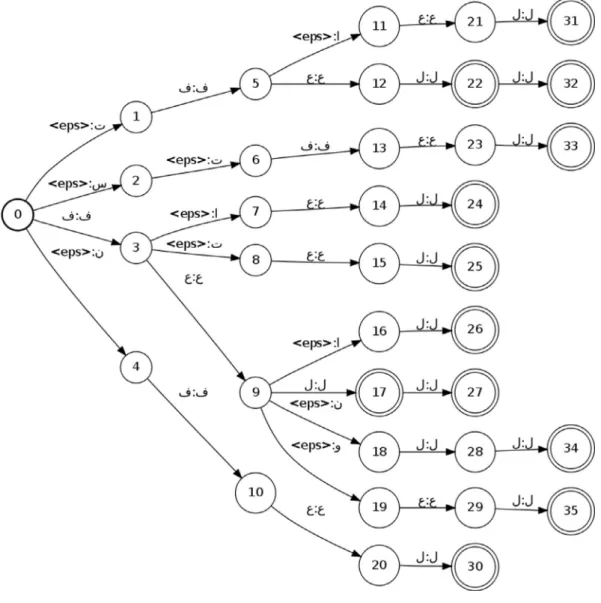
Measures are used to construct a root extraction trans-ducer. Fig. 1 shows the example of the measure .. This transducer (Tm1) will be employed to get the three-letter root of any surface Arabic term fitting with this measure, through the use of composition operation (4). We denote by Tterm, the transducer that maps any term to itself, i.e., the sole possi-ble path is the unique path given by: Pðf0g;term;term;figÞ (Fig. 2shows transducer associated to the Arabic word ). When composing two transducers, the result is a transducer as well.
ðTwordTm1Þðterm;yÞ ¼ X z2R
Ttermðterm;zÞ Tm1ðz;yÞ
Since the only possible string matching z isz¼term, we conclude that:
ðTtermTm1Þðterm;yÞ ¼Ttermðterm;termÞ Tm1ðterm;yÞ As we haveTtermðterm;termÞ ¼1, so:
ðTtermTm1Þðterm;yÞ ¼Tm1ðterm;yÞ
Iftermfits with the measure, the resulting transducer will give the rootyassociated toterm.
Fig. 1 Example of a transducer.
Table 1 Measures for the 3-letter root and
built words.
In Arabic language, there are 4 verb prefixes ( ), 12
noun prefixes ( ) and
more than 20 suffixes:
When taking into account diacritics, the number of patterns can exceed three thousand (to our knowledge). As we don’t consider diacritics in our work, patterns are greatly less (not more than two hundred), and many of which are not employed in the con-text of Modern Standard Arabic (MSA). Indeed, the patterns ( ) will result in only one pattern ( ) after removing diacritics. For illustration,Tables 2 and 3show examples of noun and verb patterns.
We will follow the following steps, to build the stemming transducer, which will enable us to consider all measures:
1. Construct all noun prefixes (resp. verb prefixes) transducer; 2. Construct all noun patterns (resp. verb patterns)
transducer;
3. Construct all noun suffixes (resp. verb suffixes) transducer; 4. Concatenate noun transducers (resp. verb transducers)
obtained in 1, 2 and 3.
5. Sum the two transducers obtained in step 4.
Table 2 Examples of noun patterns.
Table 3 Examples of verb patterns.
Steps one and three are quite similar. A transducer for each prefix (resp. suffix) is built, then, the union of these transducers is formed. The resulting transducer represents the prefixes (resp. suffixes) transducer (see Figs. 4 and 5). In step 2, we build one transducer per noun pattern. The chosen noun pat-terns are the most used ones in the context of MSA. Then, the union of these transducers gives the transducer of all noun pat-terns. Transducer of all verb patterns is built in the same man-ner (Fig. 3). In the fourth step, transducers from previous steps are concatenated. The final transducer is attained by the sum operation of the two transducers from the fourth step.
The resulting transducerTstemmeris so large that it cannot be represented graphically, it includes more than 400 states. This transducer can extract the root of any grammatically correct Arabic word, i.e, a word that fits with some Arabic measure. In addition, it can give us a morphological knowledge about the word, since we do not perform any optimization operation on this transducer (minimization or determination). We can take advantage of this information to enhance performance of classification system. However, the resulting stemmer will not be able to correctly stem Arabic words having a weak con-sonant root. This kind of words could be handled with the use of phonological rules, which is not supported in this work.
How to deal with non-determinism?
The composition ofTstemmerwith any given word transducer Twordgives a transducer which may include many paths, hence, many possible roots. Indeed, an Arabic word could match with more than one measure at the same time. Let’s take the word (win). This Arabic word matches with, at least, two mea-sures: and giving the roots and respec-tively. Thus, the use ofTstemmer leads to a set of one or more possible stems. The correct stem belongs to the set of possible stems. To cope with this situation, root extraction transducer must be weighted. Many schemes are possible. We use a
bigram window probabilities technique to affect a score to a given root. The technique is based on a statistical study of letter frequencies in the Arabic roots corpus This corpus contains more than 10 thousand three letter roots. The score is affected to a given root by calculating the probability of letter occurrences in dif-ferent positions. Lets¼c1c2c3be a three letter root.ScoreðsÞis calculated by:
ScoreðsÞ ¼P1ðc1;c2Þ P2ðc2;c3Þ
whereP1ðc1;c2Þis the probability to have the letterc2 in the second position preceded byc1, andP2ðc2;c3Þis the probability to have the letterc3in the third position preceded byc2. Thus we consider the correct root is the one that has the best score sbest:best¼ArgðMaxfScoreðsÞs2 fPossiblerootsggÞ.
One may be wondering why patterns are more important than dictionaries. This is for two reasons. First, dictionaries are generally very large and need to be maintained. Second, patterns are fixed and limited. They represent the creative energy of Arabic language. Indeed, patterns fit most current Arabic words and they are allowed to create all future words needed for civilization and scientific terminology purposes
( , 2011).
6.2. Rational kernels for Arabic Text Classification Our ATC system is structured as follows:
1. Preprocessing step.
2. Feature extraction: we feed the previous transducer (Tstemmer) by words of the documents obtained from step 1. This will produce a transducer per word. The concatena-tion of these transducers will represent the document in the next step.
3. Learning step: Rational kernels are used to measure dis-tance between documents (Cortes et al., 2004; Cortes et al., 2007), and SVM is used to do classification. Consider a set of documentsS¼ fd1;d2;. . .;dNg, a docu-mentdiconsists of a sequence of words:wi1wi2. . .wim. Applying our root extraction transducer on each word ofdi and right concatenate results will transform this document into a finite state transducer Tdi. Transducers obtained from the whole
set of documents will be packaged into an archive file (far) to be treated by the learning algorithm (Fig. 9). String kernels, which are kernels defined over pairs of string, can be extended to transducers. They are typically represented by weighted finite-state transducers, to measure distance between docu-ments.Fig. 6shows an example of string kernels (for sake of simplicity, we take N-grams with N¼2 and alphabet
R¼ fa;bg) represented by weighted finite-state transducer T2grams. Let Tdi;Tdj be two transducers representing
docu-ments di anddj respectively. Similarity between these docu-ments is calculated based on bi-gram kernel by:
Kðdi;djÞ ¼uðTdiT2gramsTdjÞ ð6Þ
whereuis a function that computes the sum of weights of all accepting paths ofðTdiT2gramsTdjÞ, andis the
composi-tion operacomposi-tion (see(4)).
7. Experimental results and discussion 7.1. Experiment settings
Transducers are created and manipulated using the OpenFst library (Allauzen et al., 2007), which is an open source library for constructing, combining, optimizing, and searching weighted finite-state transducers. OpenKernel, which is a library used to create, combine and apply kernels for machine learning applications, will be used to accelerate experiments. The next batch reports the main commands of OpenFst and OpenKernel libraries used to implement our classification system.
1fstcompose word.fst model.fst result.fst 2fstconcate doc.fst result.fst doc.fst 3farcreate data.list data.far
4klngram -order=3 -sigma=29 data.far 3gram.kar 5svm-train -k openkernel -K 2gram.kar cul.train cul.train.2gram.mdl
6svm-predict cul.test cul.train.2gram.mdl cul. test.2gram.pred
To extract the root of each word in the document, we iter-ate on these words using the OpenFst command fstcompose (line 1), whereword.fst is a linear finite state transducer with identical input and output symbols, which represents a word, and model.fst is our ponderated stemming transducer. The resulting transducerresult.fstrepresents the best root. Result-ing transducers are right concatenated to a finite state trans-ducer (doc.fst), representing the entire document, using the
OpenFst command fstconcate (line 2). The set of finite state transducers (FSTs) obtained so far is then packaged in a FST archive (Far) using the OpenKernel commandfarcreate (line 3), wheredata.listcontains the list of all FST documents, one file per line, anddata.faris the FST archive (Far).
Many kernels could be created using OpenKernel library. The N-gram kernels could be created using the command klngram. For instance, 3-gram kernels is created in line 4, where the first argument –order specifies the size of the
N-grams, and the second argument–sigmaspecifies the alpha-bet size, epsilon not included (Arabic alphaalpha-bet size is 28). The first parameter is the FST archive (data.far) and the second one (3gram.kar) is the resulting kernel archive.
OpenKernel library includes a plugin for the LibSVM implementation (Chang and Lin, 2011). This enables us to do training, predicting and scoring on our dataset. Training command creates a model on the training set (line 5), where the first argument -k specifies the kernel format, the second one (-K) specifies the N-gram kernel archive. The first param-eter specifies a correctly classified subset of the training set, the second parameter is the resulting model. In this com-mand,cul.traincontains a correctly labeled sub set of training documents belonging to Cultural class. Having a model, we can use it to classify documents of the testing dataset with the command svm-predict (line 6), where the first parameter specifies a correctly classified subset of the testing set, the sec-ond parameter is the resulting model from the previous com-mand. The last parameter is the result of prediction using the model.
7.2. Root extraction results
To check the performances of our root extraction technique, experiments were performed on three word collections. The first one (Gold1) is a sample taken from the Corpus of Con-temporary Arabic (Sawalha, 2011). The two others (Gold2 and Gold3) are house built sets. All words of these sets were annotated by hand with the correct root. Roots have been con-firmed by Arabic Language experts in Arabic Language. The
Fig. 6 Bigram kernel for alphabetR¼ fa;bg.
Table 4 Gold Standard details.
Corpus # Words
Gold1 679
Gold2 844
Gold3 1000
Table 5 Accuracy of heavy stemmers.
Corpus Khoja stemmer Our stemmer Al-Serhan stemmer
% % %
Gold1 82.77 71.68 51.40 Gold2 85.55 74.82 49.64 Gold3 87.60 80.30 56.40 Average 85.30 75.60 52.48
three sets are picked randomly from different topics, including politics, culture, sport and news.Table 4gives an overview of these three collections. We give for each gold, the number of words (# words).Table 5reports the accuracy of our technique on the three sets of words.
Experimental results show the effectiveness of our approach of root extraction. Results on different corpora are stable and the best score is achieved with the biggest corpus (Gold3). Results of our root extraction tool are sandwiched between Khoja and Al-Serhan stemmer results. This can be explained by the fact that Khoja’s stemmer is a dictionary based tool, which makes it language-dependent. Al-Serhan stemmer is an unsupervised one. It uses a little bit information about the language. Our tool is semi-supervised. It uses a lan-guage knowledge -patterns- but only in the construction stage. Patterns are fixed and do not change.
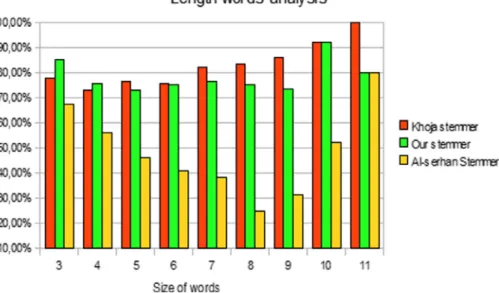
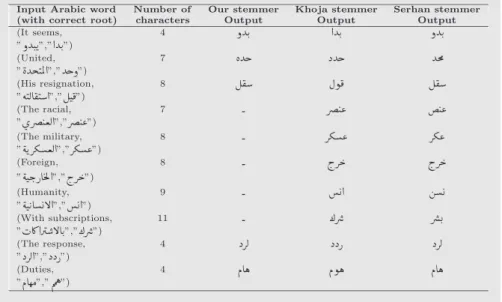
For a deeper analysis, we report results of stemmers for each category of words based on word length. Fig. 7 gives the frequency of each category for the overall corpus. Worth-while to note that words with length 4, 5, 6 or 7 represent 78% of the corpora size.Fig. 8shows, in bar charts, the prediction accuracy of the three stemmers based on word length. First, we can notice that our stemmer and Khoja stemmer outperform Al-serhan stemmer for all categories. Compared to Khoja stemmer, results show that our stemmer gives better prediction accuracy for 3-L and 4-L categories. It is competitive with Khoja stemmer for 5-L, 6-L and 10-L. For the 7-L, 8-L and 9-L categories, Khoja stemmer performs better than our stem-mer. This reveals that we need to analyze the erroneous roots given by our stemmer for these categories. Table 6 shows examples of incorrect results, from our stemmer, that belongs to different categories of length.
Discussion
Errors could be classified into four classes. Consider the three first examples inTable 6. This kind of errors occur when one of the radicals of the correct root is a weak consonant . Indeed, the correct root of the word (United, ‘‘ ”) is (‘‘ ”), with a weak radical at the first position (‘‘ ”). Weak root radicals change into a vowel or are deleted, depending on their vocalic environment. There are several rules with differ-ent conditions. These rules are not supported in our stemmer. The second class of errors is related to quadrilateral roots
Fig. 8 Accuracy of stemmers by words’ length categories.
(i.e. roots with four consonants). For the words (The racial, ‘‘ ”) and (The military, ‘‘ ”), our stemmer fails to get the correct roots because we did not consider patterns formed by quadrilateral roots. For the third class, considering examples (Foreign, ‘‘ ”), (Humanity, ‘‘ ”) and (With subscription, ‘‘ ”), we can easily notice that our stemmer fails also to get the correct roots for words having compound prefixes/suffixes (i.e. more than one prefix/suffix).
In the first and second examples, suffixes (‘‘ ”and ‘‘ ”giving
” ”) are used. In the third example, the prefixes (‘‘ ” and ‘‘ ”giving” ”) are used. This could be explained by the fact that we do composition only once between prefixes, patterns and suffixes transducers (See Section 6.1). The last class of errors is related to roots with geminate radicals. The two last examples in Table 6, (The response, ‘‘ ”) and (Duties, ‘‘ ”), illustrate the cases where the last radical is deleted when using particular templates. Our stemmer could not extract correct roots in such case.
7.3. ATC results
Experiments are performed on the Saudi Press Agency (SPA) dataset (Althubaity et al., 2008) for training and testing the ATC system. As detailed in Table 7, this dataset contains 1526 text documents belonging to one of the six categories: cul-ture, economic, social, general, politics and sport. As men-tioned earlier, stop words, non Arabic letters, symbols and digits were removed. We have used a stratified sampling with
Table 6 Examples of incorrect roots by our stemmer.
Table 7 SPA corpus details.
Categories Training texts Testing texts Total
Culture 201 57 258 Economics 200 50 250 Social 203 55 258 Politics 200 50 250 General 205 50 255 Sports 205 50 255 1214 312 1526
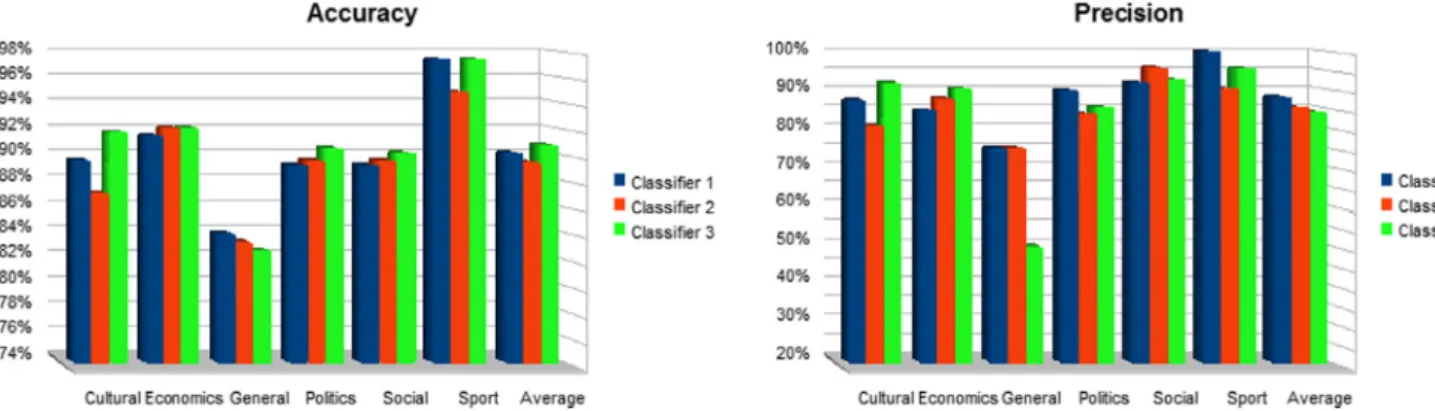
80%of documents for training the classifier and 20%for test-ing. Learning is done using LibSVM implementation (Chang and Lin, 2011), included in Openkernel, with three N-gram kernelsðN¼2;3;4Þ. Since we want to show the effect of root extraction, we report results of the three classifier versions; without root extraction (Classifier 1), with Al-Serhan heavy stemmer (Classifier 2) and with our heavy stemmer (Classifier 3), in terms of accuracy, precision, recall and F1. InFigs. 10, 12and14, we report results in terms of accuracy and precision for the three classifiers with the three kernels (bigrams, 3-grams and 4-grams).Figs. 11, 13 and 15give results in terms of recall and F1 for the same classifiers.
Discussion
Concerning the quality of classification, Fig. 16 shows that best results were reached with 3-gram kernel for accuracy, recall and F1 measures. This can be explained by the fact that over than 80% of Arabic words are built from 3-letter roots.
For the 3-gram kernel, we measure the effect of root extrac-tion on classificaextrac-tion. For most classes, root extracextrac-tion enhances results in terms of accuracy, Recall and F1 (see Figs. 12 and 13). However, for precision, root extraction affects negatively performances (seeFig. 12).
Fig. 11 Recall and F1 of SVM Classification using 2-gram kernel.
Fig. 12 Accuracy and precision of SVM Classification using 3-gram Kernel.
One can argue the best scores observed by sport class by the fact that it uses a specific vocabulary. Poor results are reported for the General class. This is expected given the used words in this kind of documents which are generic. At last, our classifier surpasses other classifiers in most cases.
8. Conclusion
In this work, we introduced a new framework for Arabic word root extraction and Text Classification. It is based on the use of transducers for heavy stemming, and rational kernels for measuring distance between documents. First, our root extrac-tion method uses transducers for modeling Arabic patterns.
Second, rational kernels are used to measure similarity between documents. Investigation and analysis of this frame-work in the context of Arabic Text Classification show that root extraction improves the quality of classifiers in terms of accuracy, recall and F1. But it slightly decreases the precision. 3-gram based classifiers reached the best results. Like that of Al-Serhan, our approach of root extraction does not rely on dictionary, and it gives better results.
In future work, we will focus on the effect of light stemming on the ATC. Other kernels, like words level grams and gappy word grams, will be investigated. For the root extraction, four-letter root will be considered and specific cases where weak consonant appears in roots will be addressed.
Fig. 14 Accuracy and precision of SVM Classification using 4-gram Kernel.
Fig. 15 Recall and F1 of SVM Classification using 4-gram Kernel.
References
Al-Kabi, M.N., Kazakzeh, S.A., Ata, B.M.A., Al-Rababah, S.A., Alsmadi, I.M., 2015. A novel root based Arabic stemmer. J. King Saud Univ. – Comput. Inf. Sci. 27 (2), 94–103.
Al-Nashashibi, M., Neagu, D., Yaghi, A., 2010. Stemming techniques for arabic words: a comparative study. In: Computer Technology and Development (ICCTD), pp. 270–276.
Al-Serhan, H., Shalabi, R.A., Kannan, G., 2003. New approach for extracting arabic roots. In: Proceedings of The 2003 Arab Conf. on Infor. Technology, Alexandria, Egypt, pp. 42–59
Aljlayl, M., Frieder, O., 2002. On arabic search: improving the retrieval effectiveness via light stemming approach. In: ACM Eleventh Conference on Infor. and Knowledge Management, pp. 340–347.
Allauzen, C., Riley, M., Schalkwyk, J., Skut, W., Mohri, M., 2007. OpenFst: a general and efficient weighted finite-state transducer library. In: Proceedings of the Ninth International Conference on Implementation and Application of Automata, (CIAA 2007), vol. 4783 of LNCS. Springer, pp. 11–23,http://www.openfst.org.
Alsaleem, S., 2011. Automated arabic text categorization using SVM and NB. Int. Arab J. e-Technol. 2 (2), 124–128.
Althubaity, A., Almuhareb, A., Alharbi, S., Al-Rajeh, A., Khorsheed, M., 2008. KACST arabic text classification project: overview and preliminary results. In: Proceedings of The 9th IBIMA conference on Information Management in Modern Organizations.
Berstel, J., 1979. Transductions and Context-free Languages. Teubner Studienbu¨cher, Stuttgart.
Buckwalter, T., 2004. Buckwalter Arabic Morphological Analyzer Version 2.0. Linguistic Data Consortium (LDC). University of Pennsylvania, Philadelphia, PA, USA.
Chang, C.-C., Lin, C.-J., 2011. LIBSVM: a library for support vector machines. ACM Trans. Intell. Syst. Technol. 2, 1–27.
Cortes, C., Haffner, P., Mohri, M., 2004. Rational kernels: theory and algorithms. J. Mach. Learn. Res. 5, 1035–1062.
Cortes, C., Kontorovich, L., Mohri, M., 2007. Learning languages with rational kernels. In: Proceedings of the 20th Annual Confer-ence on Learning Theory, COLT’07. Springer-Verlag, Berlin, pp. 349–364.
Darwish, K., 2002. Building a shallow arabic morphological analyzer in one day. In: Proceedings of the ACL-02 Workshop on Computational Approaches to semitic languages. Association for Computational Linguistics, pp. 1–8.
Duwairi, R.M., 2007. Arabic text categorization. Int. Arab J. Inf. Technol. 4 (2), 125–132.
El Kourdi, M., Bensaid, A., Rachidi, T.-E., 2004. Automatic arabic document categorization based on the naive bayes algorithm. In: Proceedings of the Workshop on Computational Approaches to Arabic Script-based Languages, Semitic ’04, pp. 51–58.
Gharib, T., Habib, M., Fayed, Z., 2009. Arabic text classification using support vector machines. Int. J. Comput. App. 16 (4), 192–199.
Ghwanmeh, S., Kanaan, G., Al-Shalabi, R., Rabab’ah, S., 2009. Enhanced algorithm for extracting the root of arabic words. In: Computer Graphics, Imaging and Visualization, 2009. CGIV’09. Sixth International Conference on. IEEE, pp. 388–391.
Habash, N., 2010. Introduction to Arabic Natural Language Process-ing. Synthesis Lectures on Human Language Technologies. Mor-gan & Claypool Publishers.
Hadi, W., Thabtah, F., ALHawari, S., Ababneh, J., 2008. Naive Bayesian and k-nearest neighbour to categorize arabic text data. In: Proceedings of the European Simulation and Modelling Confer-ence. Le Havre, France, pp. 196–200.
Hadni, M., Ouatik, S.A., Lachkar, A., 2013. Effective arabic stemmer based hybrid approach for arabic text categorization. Int. J. Data Min. Knowl. Manage. Process (IJDKP) 3.
Harmanani, H.M., Keirouz, W., Raheel, S., 2006. A rule-based extensible stemmer for information retrieval with application to arabic. Int. Arab J. Inf. Technol. 3 (3), 265–272.
Hmeidi, I., Al-Ayyoub, M., Abdulla, N.A., Almodawar, A.A., Abooraig, R., Mahyoub, N.A., 2014. Automatic arabic text categorization: a comprehensive comparative study. J. Inf. Sci., 1–11
Kanaan, G., Al-Shalabi, R., Ababneh, M., Al-Nobani, A., 2008. Building an effective rule-based light stemmer for arabic language to improve search effectiveness. In: International Conference on Innovations in Information Technology, 2008. IIT 2008. IEEE, pp. 312–316.
Kanaan, G., Al-Shalabi, R., Ghwanmeh, S., Al-Ma’adeed, H., 2009. A comparison of text-classification techniques applied to arabic text. J. Am. Soc. Inf. Sci. Technol. 60 (9), 1836–1844.
Khoja, S., Garside, R., 1999. Stemming arabic text. Technical report, Computing Department, Lancaster University.
Khreisat, L., 2009. A machine learning approach for Arabic text classification using N-gram frequency statistics. J. Informatrics 3 (1), 72–77.
Larkey, L.S., Ballesteros, L., Connell, M.E., 2007. Light stemming for arabic information retrieval. In: Arabic Computational Morphol-ogy. Springer, pp. 221–243.
Mesleh, A., 2008. Support vector machines based arabic language text classification system: feature selection comparative study. In: Sobh, T. (Ed.), Adv. Comput. Inf. Sci. Eng.. Springer, Netherlands, pp. 11–16.
Momani, M., Faraj, J., 2007. A novel algorithm to extract tri-literal arabic roots. In: International Conference on Computer Systems and Applications, 2007. AICCSA’07. IEEE/ACS. IEEE, pp. 309– 315.
Nehar, A., Ziadi, D., Cherroun, H., Guellouma, Y., 2012. An efficient stemming for Arabic Text Classification. In: International Confer-ence on Innovations in Information Technology (IIT), pp. 328–332.
Sawalha, M., 2011. Open-source Resources and Standards for Arabic Word Structure Analysis. PhD, University of Leeds, Leeds.
Sebastiani, F., Ricerche, C.N.D., 2002. Machine learning in automated text categorization. ACM Comput. Surv. 34, 1–47.
Syiam, M., Fayed, Z., Habib, M., 2006. An intelligent system for arabic text categorization. Int. J. Intell. Comput. Inf. Sci. 6 (1), 1– 19.
Taghva, K., Elkhoury, R., Coombs, J.S., 2005. Arabic stemming without a root dictionary. In: ITCC (1), pp. 152–157.
Yaseen, Q., Hmeidi, I., 2014. Extracting the roots of arabic words without removing affixes. J. Inf. Sci. 40 (3), 376–385.