EmbedRank: Unsupervised Keyphrase Extraction using Sentence Embeddings
Kamil Bennani-Smires
1, Claudiu Mus
,at
1, Andreea Hossmann
1, Michael Baeriswyl
1, Martin Jaggi
2,
Artificial Intelligence and Machine Learning Group, Swisscom
1[email protected]
Machine Learning and Optimization Laboratory, EPFL
2[email protected]
Abstract
Keyphrase extraction is the task of automatically selecting a small set of phrases that best describe a given free text document. Supervised keyphrase extraction requires large amounts of labeled train-ing data and generalizes very poorly outside the do-main of the training data. At the same time, unsu-pervised systems have poor accuracy, and often do not generalize well, as they require the input doc-ument to belong to a larger corpus also given as input. Furthermore, both supervised and unsuper-vised methods are oftentoo slowfor real-time sce-narios and suffer fromover-generation.
Addressing these drawbacks, in this paper, we tackle keyphrase extraction from single documents with EmbedRank: a novel unsupervised method, that leverages sentence embeddings. EmbedRank achieves higher F-scores than graph-based state of the art systems on standard datasets and is suit-able for real-time processing of large amounts of Web data. With EmbedRank, we also explic-itly increase coverage and diversity among the se-lected keyphrases by introducing an embedding-based maximal marginal relevance (MMR) for new phrases. A user study including over 200 votes showed that, although reducing the phrases’ seman-tic overlap leads to no gains in F-score, our high diversity selection is preferred by humans.
1
Introduction
Document keywords and keyphrases enable faster and more accurate search in large text collections, serve as condensed document summaries, and are used for various other appli-cations, such as categorization of documents. In particular, keyphrase extraction is a crucial component when gleaning real-time insights from large amounts of Web and social me-dia data, which is a now routine task in companies across the world. In this case, it is essential for the extraction to be fastand for the keyphrases to be disjoint. However, exist-ing systems are complex and slow, and are plagued by over-generation, i.e. extracting redundant keyphrases (e.g., ”Euro-pean Commission” and ”Commission”).
Here, we address both these problems with a new
unsuper-Unsupervised keyphrase extraction has a series of advan-tages over supervised methods. Supervised keyphrase ex-traction always requires the existence of a (large) anno-tated corpus of both documents and their manually selected keyphrases to train on - a very strong requirement in most cases. In addition, supervised methods perform poorly out-side of the domain represented by the training corpus - a big issue, considering that the domain of new documents may not be known at all. Unsupervised keyphrase extraction ad-dresses such information-constrained situations in one of two ways: (a) by relying on in-corpus statistical information (e.g., the inverse document frequency of the words), and the current document; (b) by only using information extracted from the current document.
We propose EmbedRank - an unsupervised method to au-tomatically extract keyphrases from a document, that is both simple andonly requires the current document itself, rather than an entire corpus that this document may be linked to.
Our method relies on notable new developments in text representation learning [Leet al., 2014; Kiros et al., 2015; Pagliardiniet al., 2017], where documents or word sequences of arbitrary length are embedded into the same continuous vector space. This opens the way to computing semantic re-latedness among text fragments by using the induced similar-ity measures in that feature space. Using these semantic text representations, we guarantee the two most challenging prop-erties of keyphrases:informativenessobtained by the distance between the embedding of a candidate phrase and that of the full document; diversity expressed by the distances among candidate phrases themselves.
In a traditional F-score evaluation, EmbedRank clearly outperforms the current state of the art (i.e. complex graph-based methods [Mihalcea and Tarau, 2004; Wan and Xiao, 2008; Rui Wang, Wei Liu, 2015]) on two out of three common datasets for keyphrase extraction; it matches the state of the art on the third dataset. We also evaluated the im-pact ofensuring diversityby conducting a user study, since this aspect cannot be captured by the F-score evaluation. The study showed that users highly prefer keyphrases with the di-versity property.
Finally, to the best of our knowledge, we are the first to present an unsupervised method based on phrase and doc-ument embeddings for keyphrase extraction, as opposed to standard individual word embeddings.
keyphrase extraction and sentence embeddings is presented in Section 2. In Section 3 we present how our method works. An enhancement of the method allowing us to gain a control over the redundancy of the extracted keyphrases is then de-scribed in Section 4. Finally, Section 5 contains the different experiments that we performed.
2
Related Work
A comprehensive, albeit slightly dated survey on keyphrase extraction is available [Hasan and Ng, 2011]. Here, we fo-cus on unsupervised methods, as they are superior in many ways (domain independence, no training data) and represent the state of the art in performance. As EmbedRank relies heavily on (sentence) embeddings, we also discuss the state of the art in this area in the second part of this section.
2.1
Unsupervised Keyphrase Extraction
Unsupervised keyphrase extraction comes in two flavors: dependent [Wan and Xiao, 2008] and corpus-independent.
Corpus-independent methods, including our proposed method, require no other inputs than the one document from which to extract keyphrases. Most such existing methods are graph-based, with the notable exceptions of KeyCluster [Liu et al., 2009] and TopicRank [Bougouin et al., 2013]. In graph-based keyphrase extraction, first introduced with Tex-tRank [Mihalcea and Tarau, 2004], the target document is a graph, in which nodes represent words and edges represent the co-occurrence of the two endpoints inside some window. The edges may be weighted, like in SingleRank [Wan and Xiao, 2008], using the number of co-occurrences as weights. The words (or nodes) are scored using some node ranking metric, such as degree centrality or PageRank [Page, 1998]. Scores of individual words are then aggregated into scores of multi-word phrases. Finally, sequences of consecutive words which respect a certain sequence of part-of-speech tags are considered as candidate phrases and ranked by their scores.
Recently, WordAttractionRank [Rui Wang, Wei Liu, 2015] followed an approach similar to SingleRank, with the differ-ence of using a new weighting scheme for edges between two words, to incorporate the distance between their word embed-ding representation.
[Florescu and Caragea, 2017] use node weights, favoring words appearing earlier in the text.
Departing from the popular graph approach, KeyClus-ter [Liuet al., 2009] introduces a clustering-based approach. The words present in the target document are clustered and, for each cluster, one word is selected as an “exemplar term”. Candidate phrases are filtered as before, using the sequence of part-of-speech tags and, finally, candidates which contain at least one exemplar term are returned as the keyphrases.
TopicRank [Bougouinet al., 2013] combines the graph and clustering-based approaches. Candidate phrases are first clus-tered, then a graph where each node represents a cluster is created. The topN clusters are found using a centrality met-ric and the keyphrases are computed by selecting the most representative member of each cluster. Clustering the can-didate phrases reduces redundancy and improves diversity. However, TopicRank clusters phrases based on the percent-age of shared words, resulting in e.g., “fantastic teacher” and
“great instructor” not being clustered together, despite ex-pressing the same idea.
EmbedRank differs from the aforementioned methods as it represents both the document and all candidate phrases as vectors in a high-dimensional space, relying on state-of-the-art semantic document embedding methods beyond simple averaging of word vectors. In the resulting vector space, we can therefore compute meaningful distances between a can-didate phrase and the document (for informativeness), as well as the semantic distance between candidates (for diversity).
2.2
Word and Sentence Embeddings
Word2Vec [Mikolovet al., 2013] and related methods marked a very impactful advancement in representing words as vec-tors in a continuous vector space. Representing words with vectors in moderate dimensions solves several major draw-backs of the classic bag-of-words representation, including the lack of semantic relatedness between words and the very high dimensionality (size of the vocabulary).
Different methods are needed for representing entire sen-tences or documents. Skip-Thought [Kiroset al., 2015] pro-vides sentence embeddings by means of recurrent neural net-works, trained to predict neighboring sentences. Paragraph Vector [Leet al., 2014] finds paragraph embeddings using an unordered list of paragraphs. The method can be generalized to also work on sentences or entire documents, turning para-graph vectors into more generic document vectors [Lau and Baldwin, 2016].
Sent2Vec [Pagliardiniet al., 2017] uses word n-gram fea-tures to produce sentence embeddings. It produces word and n-gram vectors, which are specifically trained such that they can be additively combined into a sentence vector, as op-posed to general word-vectors. Sent2Vec features much faster inference than Paragraph Vector [Le et al., 2014] or Skip-Thought [Kiros et al., 2015]. Similarly to recent word and document embeddings, Sent2Vec reflects semantic related-ness between phrases when using standard similarity mea-sures on the corresponding vectors. This property is at the core of our method, as we show it outperforms competing embedding methods for keyphrase extraction.
3
EmbedRank: From Embeddings to
Keyphrases
In this and the next section, we introduce and describe our novel keyphrase extraction method, EmbedRank. The method consists of three main steps, as follows: (1) We ex-tract candidate phrases from the text, based on part-of-speech sequences. More precisely, we keep only those phrases that consist of zero or more adjectives followed by one or multi-ple nouns [Wan and Xiao, 2008]. (2) We use sentence em-beddings to represent (embed), both the candidate phrases and the document itself in the same high-dimensional vector space (Sec. 3.1). (3) Werankthe candidate phrases to select the output keyphrases (Sec. 3.2). In addition, in the next sec-tion, we show how to improve the ranking step, by providing a way to tune the diversity of the extracted keyphrases.
3.1
Embedding the Phrases and the Document
State-of-the-art text embeddings (word, sentence, document) have the remarkable property of capturing semantic related-2Dataset Documents Avg tok Avg cand Keyphrases Avg kp Missing kp in doc Missing kp in cand Missing due to cand
Inspec 500 134.63 26.39 4903 9.81 21.52% 39.85% 18.34%
Duc 308 850.02 138.47 2479 8.05 2.18% 12.38% 10.21%
Nguyen 209 8448.55 765.56 2272 10.87 14.39% 30.85% 16.46%
Table 1: The three datasets we use. Columns are: number of documents; average number of tokens per document; average number of unique candidates per document; total number of unique keyphrases; average number of unique keyphrases per document; percentage of keyphrases not present in the documents; percentage of keyphrases not present in the candidates; percentage of keyphrases present in the document, but not in the candidates. These statistics were computed after stemming the candidates, the keyphrases and the document.
dices” are both selected as separate keyphrases, despite ex-pressing the same meaning. This problem can be elegantly solved by once again using our phrase embeddings and their cosine similarity as a proxy for semantic relatedness. We de-scribe our proposed solution to this in the next section.
Summarizing this section, we have proposed an unsuper-vised step-by-step method to extractinformative keyphrases from a single document by using sentence embeddings.
4
EmbedRank++: Increasing Keyphrase
Diversity with MMR
By returning theNcandidate phrases closest to the document embedding, EmbedRank only accounts for the phrase infor-mativeness property, leading to redundant keyphrases.
In scenarios where users directly see the extracted keyphrases (e.g. text summarization, tagging for search), this is problematic: redundant keyphrases adversely impact the user’s experience. This can deteriorate to the point in which providing keyphrases becomes completely useless.
Moreover, if we extract a fixed number of top keyphrases, redundancy hinders the diversification of the extracted keyphrases. In the document from Figure 1a, the extracted keyphrases include{topological shape, topological shapes} and{molecular equivalence number, molecular equivalence numbers, molecular equivalence indices}. That is, four out of the ten keyphrase “slots” are taken by redundant phrases.
This problem bears strong resemblance to search result diversification [Drosou and Pitoura, 2010], where a search engine must provide search results which balance query-document relevance and query-document diversity. One of the simplest and most effective solutions to this is the Maximal Marginal Relevance (MMR) [Goldstein, 1998] metric, which combines in a controllable way the concepts of relevance and diversity. In the following, we show how to adapt MMR to keyphrase extraction, in order to combine keyphrase informa-tiveness with dissimilarity among selected keyphrases.
The original MMR from information retrieval and text summarization is based on the set of all initially retrieved documents,R, for a given input queryQ, and on an initially empty setSrepresenting documents that are selected as good answers forQ.Sis iteratively populated by computing MMR as described in Equation 1, whereDi andDj are retrieved
documents, andSim1andSim2are similarity functions.
MMR:= arg max Di∈R\S " λ·Sim1(Di, Q)−(1−λ) max Dj∈S Sim2(Di, Dj) # , (1)
Whenλ = 1MMR computes a standard, relevance-ranked
list, while whenλ= 0it computes a maximal diversity
rank-ing of the documents inR.
To use MMR here, we adapt the original equation as:
MMR:= arg max
Ci∈C\K "
λ·cosgsim(Ci,doc)−(1−λ) max
Cj∈Kcosgsim(Ci, Cj) #
,
(2)
whereC is the set of candidate keyphrases,K is the set of extracted keyphrases, doc is the full document embedding,
Ci and Cj are the embeddings of candidate phrases i and
j, respectively. Finally,cosgsim is a normalized cosine
sim-ilarity [Mori and Sasaki, 2003], described by the following equations. This ensures that, whenλ = 0.5, the relevance
and diversity parts of the equation have equal importance.
g
cossim(Ci,doc) := 0.5 +
ncossim(Ci,doc)−ncossim(C,doc) σ(ncossim(C,doc))
. (3)
ncossim(Ci,doc) :=
cossim(Ci,doc)− min Cj∈C
cossim(Cj,doc)
max
Cj∈C
cossim(Cj,doc)
(4)
We apply an analogous transformation for the similarities among the candidate phrases themselves.
Summarizing, the method presented in the previous section is equivalent to using our newly defined MMR for keyphrase extraction from Equation (2) withλ = 1. The generalized
version of the algorithm, EmbedRank++, remains the same, except for the last step, where we instead use Equation (2) to perform the final selection of theN candidates, therefore returning simultaneously relevant and diverse keyphrases, tuned by the trade-off parameterλ.
5
Experiments and results
In this section we show that EmbedRank outperforms the graph-based state-of-the-art schemes on the most common datasets, when using traditional F-score evaluation. In ad-dition, we report on the results of a sizable user study show-ing that, although EmbedRank++ achieves slightly lower F-scores than EmbedRank, users prefer the semantically diverse keyphrases it returns to those computed by the other method. We first present the datasets on which we evaluate our method. Then we compare EmbedRank’s performance to the state of the art. Finally, we describe the user study.
5.1
Datasets
We evaluate our methods on three common datasets for keyphrase extraction, summarized in Table 1.
TheInspecdataset [Hulth, 2003] consists of 2 000 short doc-uments selected from scientific journal abstracts. For the 4
N Method Inspec DUC NUS P R F1 P R F1 P R F1 5 TextRank 24.87 10.46 14.72 19.83 12.28 15.17 5.00 2.36 3.21 SingleRank 38.18 23.26 28.91 30.31 19.50 23.73 4.06 1.90 2.58 TopicRank 33.25 19.94 24.93 27.80 18.28 22.05 16.94 8.99 11.75 WordAttractionRank 38.55 23.55 29.24 30.83 19.79 24.11 4.09 1.96 2.65 EmbedRank d2v 41.49 25.40 31.51 30.87 19.66 24.02 3.88 1.68 2.35 EmbedRank s2v 39.63 23.98 29.88 34.84 22.26 27.16 5.53 2.44 3.39 EmbedRank++ s2v (λ= 0.5) 37.44 22.28 27.94 24.75 16.20 19.58 2.78 1.24 1.72 EmbedRankpositionals2v 38.84 23.77 29.49 39.53 25.23 30.80 15.07 7.80 10.28 10 TextRank 22.99 11.44 15.28 13.93 16.83 15.24 6.54 6.59 6.56 SingleRank 34.29 39.04 36.51 24.74 30.97 27.51 5.22 5.04 5.13 TopicRank 27.43 30.8 29.02 21.49 27.26 24.04 13.68 13.94 13.81 WordAttractionRank 34.10 38.94 36.36 25.06 31.41 27.88 5.15 5.12 5.14 EmbedRank d2v 35.75 40.40 37.94 25.38 31.53 28.12 3.95 3.28 3.58 EmbedRank s2v 34.97 39.49 37.09 28.82 35.58 31.85 5.69 5.18 5.42 EmbedRank++ s2v (λ= 0.5) 30.31 34.29 32.18 18.27 23.34 20.50 1.91 1.69 1.79 EmbedRankpositionals2v 32.46 36.61 34.41 32.23 39.95 35.68 13.50 13.36 13.43 15 TextRank 22.80 11.50 15.29 11.25 19.21 14.19 6.14 9.16 7.35 SingleRank 30.91 48.92 37.88 21.20 38.77 27.41 5.42 8.24 6.54 TopicRank 24.51 37.45 29.62 17.78 32.92 23.09 11.04 16.47 13.22 WordAttractionRank 30.74 48.62 37.66 21.82 40.05 28.25 5.11 7.41 6.05 EmbedRank d2v 31.06 48.80 37.96 22.37 40.48 28.82 4.33 5.89 4.99 EmbedRank s2v 31.48 49.23 38.40 24.49 44.20 31.52 5.34 7.06 6.08 EmbedRank++ s2v (λ= 0.5) 27.24 43.25 33.43 14.86 27.64 19.33 1.59 2.06 1.80 EmbedRankpositionals2v 29.44 46.25 35.98 27.38 49.73 35.31 12.27 17.63 14.47
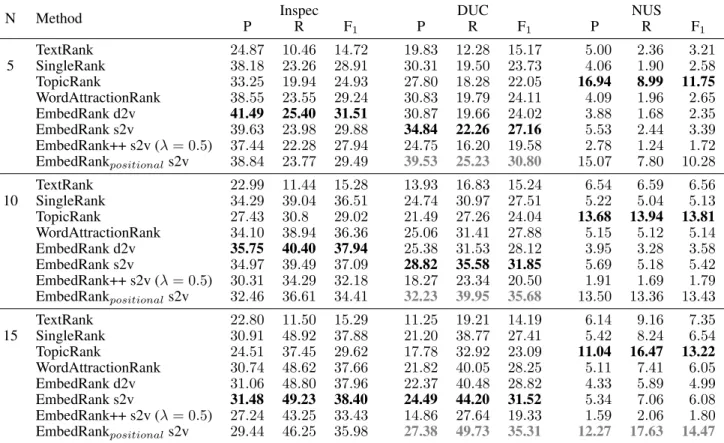
Table 2: Comparison of our method with state of the art on the three datasets. Precision (P), Recall (R), and F-score (F1) at 5, 10, 15 are
reported. Two variations of EmbedRank withλ= 1are presented: s2v uses Sent2Vec embeddings, while d2v uses Doc2Vec.
sake of consistency with previous work on keyphrase ex-traction [Mihalcea and Tarau, 2004; Hasan and Ng, 2010; Bougouinet al., 2013; Wan and Xiao, 2008], we evaluated our methods on the test part of dataset (500 documents). DUC 2001consists of 308 medium length newspaper articles from TREC-9. The documents originate from several news-papers and are organized in 30 topics. Wan and Xiao [Wan and Xiao, 2008] created the dataset, including manual anno-tations. For keyphrase extraction, we used exclusively the text contained in the first<TEXT>tags of the original doc-uments (we do not use titles and other metadata).
Nguyen[Nguyen and Kan, 2007] consists of 211 long doc-uments (full scientific conference papers), of between 4 and 12 pages. Each document has several sets of keyphrases: one created by the authors and, potentially, several others cre-ated by annotators. Following Hasan and Ng [Hasan and Ng, 2010], we evaluate on the union of all sets of assigned keyphrases (author and annotator(s)). We discarded two doc-uments with no assigned keyphrases. This dataset is similar to another one widely used for keyphrase extraction: SemEval. Since our results on SemEval are very similar to Nguyen, we leave them out due to space constraints.
As shown in Table 1, not all assigned keyphrases are present in the documents (missing kp in doc). It is thus im-possible to achieve a recall of 100%. We show in the next
subsection that our method beats the state of the art on short scientific documents and clearly outperforms it on medium length news articles. On long scientific documents,
Topi-cRank [Bougouinet al., 2013] performs better. We hypothe-size that this is due to the use of positional bias: i.e. giving higher relevance to phrases appearing earlier in the document. We confirm this hypothesis by showing that EmbedRank with positional bias matches TopicRank’s performance.
5.2
Performance Comparison and Discussion
We compare EmbedRank s2v and d2v (no diversity) to four state-of-the-art, corpus-independent methods5: Tex-tRank [Mihalcea and Tarau, 2004], SingleRank [Wan and Xiao, 2008], WordAttractionRank [Rui Wang, Wei Liu, 2015], and TopicRank6[Bougouinet al., 2013].For TextRank and SingleRank, we set the window size to
2and to10respectively, i.e. the values used in the respective
papers. We used the same PoS tagged text for all methods. For both underlying d2v and s2v document embedding meth-ods, we use their standard settings as described in Section 3.
We followed the common practice to stem - with the Porter Stemmer [Porter, 1980] - the extracted and assigned keyphrases when computing the number of true positives. As shown in Table 2, EmbedRank performs significantly better than the state of the art on two of the three datasets in terms of precision, recall, and Macro F1score. In the context of typ-ical Web-oriented use cases, most data comes as either very
5
TextRank, SingleRank, WordAttractionRank were imple-mented using the graph-tool library https://graph-tool.
skewed.de. We reset the co-occurence window on new sentence.
References
[Bougouinet al., 2013] Adrien Bougouin, Florian Boudin, and B´eatrice Daille. TopicRank : Graph-Based Topic Ranking for Keyphrase Extraction. Proc. IJCNLP 2013, (October):543–551, 2013.
[Drosou and Pitoura, 2010] Marina Drosou and Evaggelia Pitoura. Search result diversification. SIGMOD Rec., 39(1):41–47, September 2010.
[Florescu and Caragea, 2017] Corina Florescu and Cornelia Caragea. A position-biased pagerank algorithm for keyphrase extraction. In AAAI Student Abstracts, pages 4923–4924, 2017.
[Goldstein, 1998] Jade Goldstein. The Use of MMR , Diversity-Based Reranking for Reordering Documents and Producing Summaries. pages 335–336, 1998. [Hasan and Ng, 2010] Kazi Saidul Hasan and Vincent Ng.
Conundrums in Unsupervised Keyphrase Extraction : Making Sense of the State-of-the-Art. 2010.
[Hasan and Ng, 2011] Kazi Saidul Hasan and Vincent Ng. Automatic Keyphrase Extraction: A Survey of the State of the Art. Association for Computational Linguistics Con-ference (ACL), pages 1262–1273, 2011.
[Hulth, 2003] Anette Hulth. Improved automatic keyword extraction given more linguistic knowledge. In Proceed-ings of the 2003 Conference on Empirical Methods in Nat-ural Language Processing, EMNLP ’03, pages 216–223, Stroudsburg, PA, USA, 2003. Association for Computa-tional Linguistics.
[Kiroset al., 2015] Ryan Kiros, Yukun Zhu, Ruslan Salakhutdinov, Richard S Zemel, Antonio Torralba, Raquel Urtasun, and Sanja Fidler. Skip-Thought Vectors. (786):1–11, 2015.
[Lau and Baldwin, 2016] Jey Han Lau and Timothy Bald-win. An empirical evaluation of doc2vec with practical insights into document embedding generation. ACL 2016, page 78, 2016.
[Leet al., 2014] Quoc Le, Tomas Mikolov, and Tmikolov Google Com. Distributed Representations of Sentences and Documents. ICML, 32, 2014.
[Liuet al., 2009] Zhiyuan Liu, Peng Li, Yabin Zheng, and Maosong Sun. Clustering to Find Exemplar Terms for Keyphrase Extraction. Language, 1:257–266, 2009. [Mihalcea and Tarau, 2004] Rada Mihalcea and Paul Tarau.
TextRank: Bringing Order into Texts. Proceedings of EMNLP, 85:404–411, 2004.
[Mikolovet al., 2013] Tomas Mikolov, Greg Corrado, Kai Chen, and Jeffrey Dean. Efficient Estimation of Word Rep-resentations in Vector Space. pages 1–12, 2013.
[Mori and Sasaki, 2003] Tatsunori Mori and Takuro Sasaki. Information Gain Ratio meets Maximal Marginal Rele-vance. 2003.
[Nguyen and Kan, 2007] Thuy Dung Nguyen and Min-yen Kan. Keyphrase Extraction in Scientific Publications. 2007.
[Page, 1998] L Page. The PageRank Citation Ranking: Bringing Order to the Web. 1998.
[Pagliardiniet al., 2017] Matteo Pagliardini, Prakhar Gupta, and Martin Jaggi. Unsupervised Learning of Sentence Em-beddings using Compositional n-Gram Features. 2017. [Penningtonet al., 2014] Jeffrey Pennington, Richard
Socher, and Christopher D Manning. Glove: Global vectors for word representation. InEMNLP, volume 14, pages 1532–1543, 2014.
[Porter, 1980] Martin F. Porter. An algorithm for suffix strip-ping. Program, 14(3):130–137, 1980.
[Rui Wang, Wei Liu, 2015] Chris McDonald Rui Wang, Wei Liu. Corpus-independent Generic Keyphrase Extraction Using Word Embedding Vectors. 2015.
[Tononet al., 2015] Alberto Tonon, Gianluca Demartini, and Philippe Cudr´e-Mauroux. Pooling-based continuous evaluation of information retrieval systems.Inf. Retr. Jour-nal, 18(5):445–472, 2015.
[Wan and Xiao, 2008] Xiaojun Wan and Jianguo Xiao. Sin-gle Document Keyphrase Extraction Using Neighborhood Knowledge. pages 855–860, 2008.
A
Appendix
A.1
Implementation of the Graph-Based methods
Concerning TopicRank [Bougouinet al., 2013] we used the publicly available package made by the author which is avail-able on Github7.The other graph-based methods (TextRank [Mihalcea and Tarau, 2004], SingleRank [Wan and Xiao, 2008], WordAt-tractionRank [Rui Wang, Wei Liu, 2015]) were implemented using the graph-tool8 library in order to build the graph and perform the PageRank [Page, 1998] computations. For these three methods the co-occurence window was reset when reaching a new sentence.
A.2
WordAttraction
Word Embeddings. We used pre-trained GloVe [Pennington et al., 2014] embeddings trained on Wikipedia 2014 + Giga-word 5 (300-dimensional)9.
Unknown Words.In the case of edges for which one or both words are not present in the pre-trained embeddings, we set the attraction score to1. The remaining weighting scheme is composed only of the dice coefficient. Alternatively, discard-ing these edges resulted in a significantly worse performance on all three datasets.
7https://github.com/boudinfl/pke 8 https://graph-tool.skewed.de 9 https://nlp.stanford.edu/projects/glove/ 8