Review of Last Week
Introduction to the topic of Systems Analysis
Not all systems are computer or tech oriented Review of Client-Server Architecture
Overview of the process Introduction of the Client
Introduction to roles played by the analyst Waterfall Model; Agile Model; others
Project Identification:
Usually prompted by dissatisfaction of an existing way of doing things
Gather data about sense of problems and actual problems from data gathering: Written documents: Emails, memos, previous analyses, anything!
Oral documents: group discussions, individual discussions
Today: we chat about what we should ask the client and then just introduce some ideas. Our time doesn’t permit a lot of time on these topics but you should know about them. You’ll use them in practice. Before using software to help you manage your project, you need to know why.
What questions should we ask our client? [a few ideas; let’s formalize this in class] • Motivations: why this product now? what other attempts have been made
• Expectations: what does the client know about the problem and candidate solutions? • Who are the participants? [Want to know what interests are to be addressed and for
whom]
• [Executive, Administrators, Managers, Builder/Designers, Endusers] • What is already in place?
• What technical/computational issues are there?
• Is there a commitment to a particular platform? What data stores exist already? • Is there an existing systems analysis, data dictionary, etc.
• How committed to the project is the client?
• Something that’ll get started and overthrown by someone else’s efforts?
As we plan, we plan for problems, too. Our goal is to define the parameters of the client’s needs in an initial document for us (system service request) in order to move towards definitive
boundaries of the project (baseline business plan). After the client signs off on these
documents, there is a contract of work. Note that the work you do belongs to the client (“work for hire”) but you gain the know-how, coding, etc.
The analyst guides the client but listens, too. The client retains an analyst because of his/her being “disinterested” in the project [neutral party] and for expertise.
Making decisions and costs:
As a project evolves and is work on, events may happen that cause the client or the
analyst to revise the assessment of work and deadlines. Therefore, we should prioritize what can be done, and when, and how to recover from a setback.
This leads to PERT charts (“Program Evaluation and Review Technique”), “critical path analysis” (kind of a subset), and “Gantt charts” with milestones.
Background: software products: http://www.mindtools.com/critpath.html
How to do it:
List the activities we perform, how long we anticipate doing them, type, and what one activity depends on.
GANTT CHARTS
First notice the graphic representation: the lines start and top; sometimes have names and arrows. This lets us know when to start a task and when it should be finished. It means, also, that we will know how much time we need to get a task ready to start.
Follow-up reading/video: http://www.gantt.com
https://www.youtube.com/watch?v=sA67g6zaKOE
http://www.smartsheet.com/blog/gantt-chart-excel Example:
PERT
Please notice that main activities (not great details) are identified and numbered. Then the activity links between them. Notice, too, that there can be activities that
• are dependent upon the completion of another task [important!]
• are performed concurrently or in parallel [hence the need for white papers to keep other busy groups informed of what’s happening]
• are prioritized, time-dependent, and lead to a final activity.
Follow-up reading: https://support.office.microsoft.com/en-us/article/Create-Visio-PERT-charts-to-plan-projects-and-analyze-dependencies-fe81f477-963e-4977-8e5b-7be634030deb?
CorrelationId=fa27e47c-303f-4a1b-940a-37f149e95587&ui=en-US&rs=en-US&ad=US http://web2.concordia.ca/Quality/tools/20pertchart.pdf
CRITICAL PATH ANALYSIS:
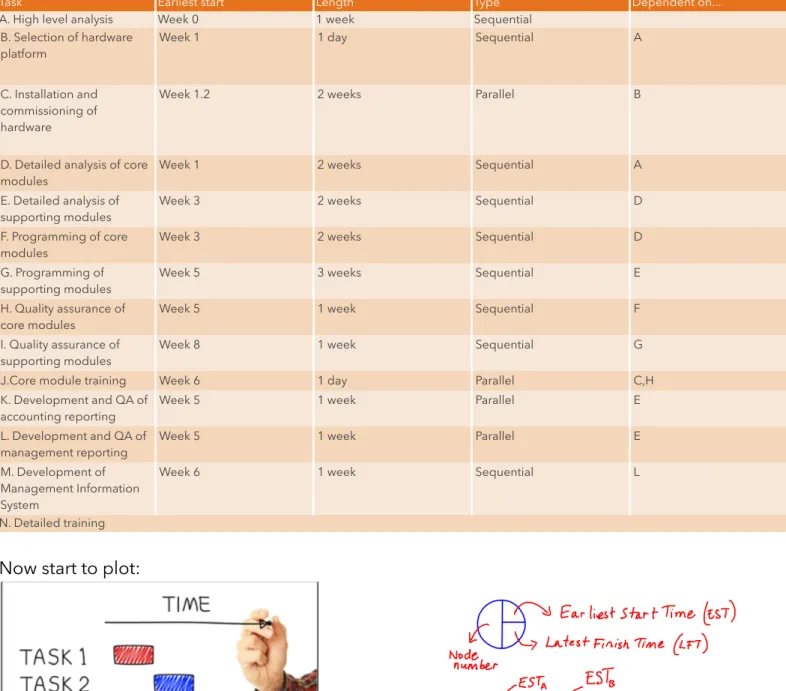
Figure 1. Task List: Planning a custom-written computer project
Now start to plot: Task
A. High level analysis B. Selection of hardware platform
C. Installation and commissioning of hardware
D. Detailed analysis of core modules E. Detailed analysis of supporting modules F. Programming of core modules G. Programming of supporting modules H. Quality assurance of core modules I. Quality assurance of supporting modules J.Core module training K. Development and QA of accounting reporting L. Development and QA of management reporting M. Development of Management Information System N. Detailed training Earliest start Week 0 Week 1 Week 1.2 Week 1 Week 3 Week 3 Week 5 Week 5 Week 8 Week 6 Week 5 Week 5 Week 6 Length 1 week 1 day 2 weeks 2 weeks 2 weeks 2 weeks 3 weeks 1 week 1 week 1 day 1 week 1 week 1 week Type Sequential Sequential Parallel Sequential Sequential Sequential Sequential Sequential Sequential Parallel Parallel Parallel Sequential Dependent on... A B A D D E F G C,H E E L
Sequentially show the chain of activities and dependencies
Other examples: notice that the graphic language is not that important. What is valuable is the activity
planned time to completion
prioritizing the activity [best case, worst case; optimal/acceptable/non-acceptable, etc.]
Main points: activities are linked with estimates of time. There is more than one way to reach the final task.
Follow-up readings: http://www.cimt.plymouth.ac.uk/projects/mepres/alevel/discrete_ch12.pdf http://web.stanford.edu/class/cee320/CEE320B/CPM.pdf
GANTT CHARTS
First notice the graphic representation: the lines start and top; sometimes have names and arrows. This lets us know when to start a task and when it should be finished. It means, also, that we will know how much time we need to get a task ready to start.
[NB: Grant applications expect a Gantt chart.]
Follow-up reading/video: http://www.gantt.com
https://www.youtube.com/watch?v=sA67g6zaKOE http://www.smartsheet.com/blog/gantt-chart-excel
Future Value of Money (FVM), Break-Even Analysis, and Return on Investment (ROI)
Part of determining whether we should execute a project is how much the project will cost and when the client will recoup the costs and benefit. In actual business practice, there is the benefit of depreciation when determining how long a system might be useful (lifetime value).
No doubt you’ve seen this kind of chart:
If a project costs $150,000 to develop (salaries, software, equipment, training, etc.) why should the client use your service? At what point will the project actually not cost money but make the system more efficient (and in most settings, more cost effective).
OUR CLIENT’S PROJECT
We don’t know yet what the client wants, but we do have a hint. The client is planning to change to a third-party “enterprise-wide” solution.
There is a rumor that the Client wants to adopt a CMS and management tool called “WorkBook.” We don’t know for sure but we should nevertheless investigate it.
The point is that the analyst needs to know the alternatives. This is both to be able to discuss openly with the client, but also as part of our “build-or-buy analysis.”
Let’s take a look: http://www.workbook.net Build-or-buy: (environmental scan)
What products seem to fulfill the client’s interests? What technical needs are there:
• what platform?
• what kind of data types are created?
• can these data be exported and imported?
• are there “helper” tools - tools to facilitate converting existing data to the new product? • are there capabilities in the tool that are bound to the operating system?
• are there version interoperability issues? • what kind of training is available?
• who else is using this product?
• how much is the product? [basic software, use licenses, data thruput costs]
• (Oracle example: baseline software + license_cost * users + volume of data * data_cost)
• We believe the client wants an “identity management” system. What does that mean? • Who else is there? [Identity Management]
• http://software.dell.com/solutions/identity-and-access-management/
Notice this interesting government site: http://www.idmanagement.gov/identity-credential-access-management.
Note, too, that domain-specific fields have their own ideas about IMP. Here’s a health care example. You should know about Gartner Research (your clients do). IBM has learned that the best way to sell something is to inform the client (white papers turned into ads):
http://www.gartner.com/it-glossary/identity-and-access-management-iam/
http://www-03.ibm.com/software/products/en/category/identity-access-management