A 100 % RENEWABLE
ELECTRICITY SYSTEM
Climate policy-makers are facing the challenge that greenhouse gas emissions in industrialized countries need to be reduced by 80 to 95 % in order to avert a rise in global temperature by more than 2 °C against the pre-industrial level, which is widely regarded as dangerous. The European Council has politically endorsed this objective in October 2009. Not least because of this target level fixed at the time when the present special report was published, important strategic decisions for the future structure of electricity supply are being discussed and taken in Germany.
Today, energy production accounts for almost 40 % of German greenhouse gas emissions. A consider-able part of conventional power plants will have to be replaced over the next years. This situation provides an opportunity to take advantage of this change to develop a sustainable energy supply. In Germany, there is a broad consensus that in the long run, a sustainable development of the energy sector will require an electricity supply which, in a best-case scenario, is almost completely based on renewable energy sources. In this respect, the time period needed to achieve this goal and the costs of the required transformation of the system have been a subject of controversial discussions.
The present special report by the German Advisory Council on the Environment (Sachverständigenrat für Umweltfragen – SRU) is to make a scientifi-cally supported contribution to forming opinions among politicians and the general public. It refers to the following issues:
Is it possible to ensure security of supply at any hour of the target year 2050 on the sole basis of renewable energy sources?
How much would a fully renewable energy supply cost?
Are bridging technologies required for the transi-tion to a renewable-energy age?
Which are the measures and instruments neces-sary to support the transition to a climate-friendly renewable energy supply?
The following abstract of the essential results of the special report will enable decision-makers to obtain a synoptic view of the answers to these questions.
A 100 % fully
renewable energy
supply is possible,
safe and affordable.
A detailed analysis of the potential of renewable energy sources for electricity production in Ger-many, Europe and North Africa has shown that an energy supply based exclusively on renewable en-ergy sources by 2050 will be possible while taking into account the stringent requirements of nature conservation and avoiding other conflicts of use. The target scenario computations commis-sioned by the SRU differ as to the level of elec-tricity demand for the year 2050 (between 500 and 700 TWh/a for Germany) and the degree of exchange and networking with the neighbour-ing countries. They range from full German self-sufficiency without any exchange to the possibility of electricity exchange with 35 other countries in Europe and North Africa. In the latter scenario, a maximum net import of the national electricity generation of 15 % is assumed. Compared with the target scenarios based on service life extension for nuclear power plants under the energy concept of the German federal government, these assump-tions are on the conservative side. These target scenarios are based on a clearly lower energy consumption of 410 to 430 TWh/a and a markedly higher dependency on electricity imports of 22 to 31 % in 2050. A synoptic view of the eight SRU scenarios calculated is given in Table. All calcula-tions meet the condition that the respective region examined has to achieve a fully renewable energy supply in 2050.
Based on an appropriate expansion of storage and network facilities, the utilizable potential of renew-able energies in Germany and Europe will allow to meet, at any hour, the foreseeable maximum demand for electricity. Thus, the security of supply can be ensured at any time, in spite of variations in energy production from renewable sources. The
technologies available already today, particularly for the use of wind and solar energy, are sufficient to achieve this goal.
For 2050, a portfolio of renewable energies being as cost-effective as possible was calculated in the different scenarios, taking into account a long-term
Demand GE in 2050: 500 TWh
Demand GE in 2050: 700 TWh
Self-sufficiency Scenario 1.a GE 100 % SS-500
Scenario 1.b GE 100 % SS-700
Net self-sufficiency interchange with DK/NO
Scenario 2.1.a
GE-DK-NO 100 % SS-500
Scenario 2.1.b
GE-DK-NO 100 % SS-700
Maximum 15 % net import from DK/NO
Scenario 2.2.a
GE-DK-NO 85 % SS-500
Scenario 2.2.b
GE-DK-NO 85 % SS-700
Maximum 15 % net import from EUNA
Scenario 3.a
GE-EUNA 85 % SS-500
Scenario 3.b
GE-EUNA 85 % SS-700
Table: Eight scenarios for a 100 % renewable electricity supply in 2050 (SRU/SG 2011-1/Tab. 0-1) GE – Germany, DK – Denmark, NO – Norway, EUNA – Europe and North Africa, SS – Self-sufficiency.
Figure 1: Electricity production in Germany and net imports (2050) (Source: SRU/SG 2011-1/Abb. 0-1)
PV 1.a: GE 100 % SS-500 2.1.a: GE-DK-NO 100 % SS-500 2.2.a: GE-DK-NO 85 % SS-500 3.a: GE-EUNA 85 % SS-500 1.b: GE 100 % SS-700 2.1.b: GE-DK-NO 100 % SS-700 2.2.b: GE 85 % SS-700 3.b: GE-EUNA 85 % SS-700 Geothermal
Solid biomass with combined heat and power (CHP)
Onshore wind energy Geothermal with combined heat and power (CHP)
Offshore wind energy Solid biomass Run-of-river stations Biogas with combined heat and power (CHP) Storage hydroelectric
Pump storage systems
Biogas
Solar thermal electricity
Compressed air energy storage (CAES) Net imported electricity
100 200 300 400 500 600 700 800 TWh/a 0
decline in costs of renewable energies owing to the effect of learning curves. Based on such cost optimization, it has been found that wind energy, particularly offshore wind energy, will assume par-amount importance by 2050 in all of the scenarios (Fig. 1). In the different scenarios, the level of solar energy used varies depending on energy demand and the amount of electricity imported. The share of biomass use in energy production does not exceed about 7 % in the network scenarios, mainly owing to possible land use conflicts and relatively high costs of this resource.
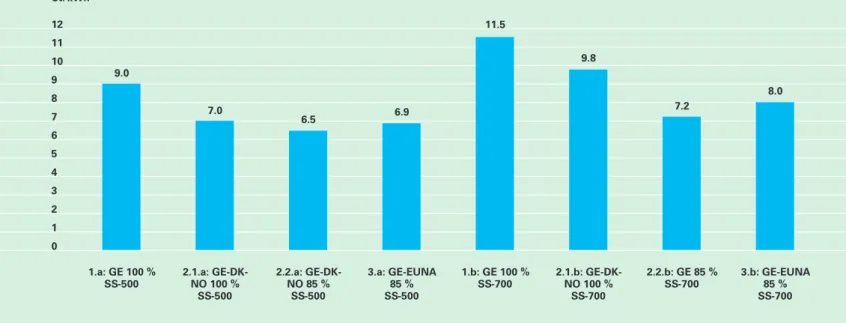
The inflation-adjusted electricity production costs of a fully renewable supply in 2050 will altogether fall below those of a low-carbon conventional energy mix because increasing fuel costs and costs of emission allowances can be avoided. The total costs of full supply by renewables would be below 7 ct/kWh including the costs of international grid and storage capacity expansion. These costs will be the lower the more successful ambitious energy saving and efficiency policies and a use of cost-effective storage technologies, particularly of pumped-storage plants in Scandinavia or the Alpine region will be (Fig. 2).
Transition to renewables would not require
either a significant service life extension or the
construction of new coal-fired power plants.
Neither a service life extension for nuclear powerplants nor the construction of new coal-fired pow-er plants with carbon dioxide capture and storage are required. The capacity of existing conventional power plants, together with a minor expansion of gas turbine power plants will suffice as a bridge to renewable energy supply. This can be
demon-strated even for the restrictive assumption of an average service life of 35 years for all conventional power plants and maintaining the current rate of renewable energy expansion (Fig. 3). The need for base load power plants will decrease in a system with a high share of renewable energies. The high volatility of renewable energies will require a
1.a: GE 100 % SS-500 2.1.a: GE-DK-NO 100 % SS-500 2.2.a: GE-DK-NO 85 % SS-500 3.a: GE-EUNA 85 % SS-500 1.b: GE 100 % SS-700 2.1.b: GE-DK-NO 100 % SS-700 2.2.b: GE 85 % SS-700 3.b: GE-EUNA 85 % SS-700 Ct/kWh 1 2 3 4 5 6 7 8 9 10 11 12 0
Figure 2: Electricity production costs in Germany (2050) (Source: SRU/SG 2011-1/Abb. 0-2) 9.0 7.0 6.5 6.9 11.5 9.8 7.2 8.0
substantially higher level of flexibility on the part of all conventional power plants. To cope with the residual load, the number of shutdowns required and of rapid shutdown and startup procedures will considerably rise. Thus, a permanently available and consistent base load is no longer required.
As a result, both the service life extension for nu-clear power plants and the additional construction of coal-fired power plants will increase the risk of surplus capacities in the system over increasingly longer periods.
Recommendations for action by energy policy
For energy and climate policies, key approaches toa transformation of electricity supply include:
Energy efficiency is the most suitable bridg-ing technology for a transformation to fully renewable energy supply and hence, should be vigorously promoted.
To form the basis and create important eco-nomic incentives for such a transformation, statutory European and national climate pro-tection and decarbonization targets for 2050 should be set and translated into emissions trading policies.
In addition, the conditions for supporting renewable energies have to be enhanced both on the European and national levels in order
to pave the way for a secure and efficient future electricity supply fully relying on renewables.
No new power plants should be constructed which, for technical and economic reasons, fail to meet the requirements for a highly flex-ible electricity production and are incompat-ible with long-term climate protection objec-tives. Moreover, the envisaged service life extension for nuclear power plants is likewise incompatible with the flexibility requirements to be met for the transition to renewables.
Flanking measures required to ensure security of supply during the expansion of renewable energies will include an accelerated and suf-ficiently dimensioned network expansion and
2005 2010 2015 2020 2025 2030 2035 2040 2045 2050 20 40 60 80 100 120 140 160 180
Figure 3: Expansion of electricity production capacities for the transition to a fully renewable energy supply in 2050 (Szenario 2.1.a) (Source: SRU/SG 2011-1/Abb. 0-3)
Aggregate hydro power Onshore wind Offshore wind Aggregate biomass Photovoltaic 0 GW
above all, network conversion. To this aim, investment incentive and network planning modalities have to undergo fundamental changes.
– From the national perspective, Germany’s cooperation with the countries bordering the North Sea is of strategic interest regarding energy policy in order to advance the con-nection and development of Scandinavia’s considerable and comparably cost-effective pumped storage potentials.
Based on the considerations outlined above, the SRU has formulated eight central recommenda-tions for action for German and European energy policies.
1
Climate and energy concept:
sectoral climate protection target
2050 and commitment to 100 %
renewable energies
The yardstick for the medium-term German and European climate protection policies should con-sist in a reduction of greenhouse gas emissions by 80 to 95 % by 2050 in order to avert danger-ous anthropogenic interference with the climate system. Even for a less ambitious climate protec-tion target of up to 80 %, a climate-neutral electric-ity supply is required to be achieved by 2050. For electricity supply, the goal of climate neutrality can be achieved at lower costs than in other sectors such as mobility, heating, agriculture and indus-try. Simultaneously, the objective of a sustainable electricity supply by means of full transformation to renewable energy sources by 2050 should be stipulated in high-ranking programme documents.
2
Energy efficiency by means of
house-hold electricity accounts
Saving electricity may be regarded as the most im-portant bridging technology on the way to a fully renewable supply. This is why the German federal government should set an absolute electricity con-sumption target. A suitable instrument to strength-en market incstrength-entives for such a target could consist in the introduction of household electricity accounts. Household electricity accounts are upper
kWh sales limits for energy suppliers calculated on the basis of the number of households served by these companies. Similar to a cap-and-trade sys-tem, these limits are tradeable and may be harmo-nized with a national consumption target. In this way, energy efficiency would become a strategic business objective of energy suppliers.
3
Continuity and reform for the EEG
The Renewable Energy Sources Act (Erneuerbare-Energien-Gesetz – EEG) has proved to be suc-cessful as a potent and comparatively efficient instrument. The EEG’s two fundamental pillars, i.e. the priority feed-in for renewables (Einspeisevor-rang) and the guaranteed feed-in compensation for non-adjustable renewable energies should be maintained as a basic structure. During the tran-sition period, the conventional power plant fleet should be used for load management in a flexible way and thus, make an essential contribution to the integration of renewables into the system. An onward development of the EEG should be aimed at long-term cost efficiency and portfolio optimiza-tion and, where meaningful, promote the system integration of renewable energies.
For offshore wind energy, tendering models should be considered in the future where compa-nies offer the construction and operation of such facilities at guar anteed feed-in tariffs that are as low as possible. Such approach could improve the linking with grid expansion. In addition, this could strengthen the competition for cost-effective electricity supplies. For wind energy in rural areas, the EEG should be maintained in its current form. Due to considerable prognostic uncertainties with regard to the future demand for photovoltaics (PV) in a cost-effective energy mix, PV support should aim at a minor but stable growth and avoid the development of inefficient excess capacities. In addition to compensation tariffs orienting towards cost reduction, another reasonable measure would consist in an absolute maximum limit for the PV capacities supported. Biomass support should be increasingly aimed at a balancing of power servic-es and the use of rservic-esidual materials and therefore, paid as a market price premium. The amount of such premium should increase with the propor-tion of residual material in the substrate mass
used. However, the bonus for energy from renew-able raw materials (NAWARO-Bonus) should be abolished because of its negative environmental impacts. For other technologies that are still being developed at present, a first option could consist in project promotion from government funds which could be transferred to funding according to EEG principles if such technologies proved to be successful.
4
National plan to develop the
electricity transmission grid by 2030
The SRU suggests the development of a national plan entitled “Stromübertragungsnetz 2030” (The Electricity Transmission Grid 2030). It should, at a high level, establish the needs, define transmis-sion line corridors and discuss alternatives with a 2030 target horizon. This plan should take into ac-count the planning of transmission grid operators, the requirements set by trans-European energy networks and a model of future demand elabo-rated by the Federal Network Agency (Bundes-netzagentur). The plan is to define the required grid expansion on the basis of a transparent and open participation procedure that integrates the Strategic Environmental Assessment and the ap-plicable nature conservation law. It is to concen-trate the superordinate elements of a two-stage technical planning. Detailed planning and project approval will continue to be performed by means of administrative plan approval procedures. In addition to the grid expansion by transmission grid operators, central lines should be tendered in order to be able to safeguard the construction of required connections.
5
No service life extension for nuclear
power plants
During the period of transition to energy sup-ply from renewable sources, there is no need to extend the service life of nuclear power plants. The expansion of renewables and the flexibility reserves of the existing conventional power plant fleet will suffice to meet the electricity demand, i.e. there is no reason to fear that a gap in electricity supply might arise. Due to their limited flexibility, nuclear power plants are unsuitable to serve as a bridging technology to complement renewables.
As a result of the envisaged service life extension, the system conflict between high proportions of volatile renewables and poorly adjustable base load energy will considerably intensify during the 2020ies, eventually leading to high economic costs and risks for investment in renewable energies.
6
Planning the phasing-out of
conventional power plants
An integrated energy policy should synchronize the phasing-out of conventional capacities with the expansion of renewables. It will be helpful that the further expansion of renewables and a more strin-gent European emissions trading regime will result in a decreasing economic attractiveness of new coal-fired power plants. Nevertheless, flanking reg-ulatory measures should be considered that would allow, if required, a control of the construction of new coal-fired plants. In the view of the SRU, an amendment to the Federal Control of Pollution Act (Bundes-Immissionsschutzgesetz – BImschG) establishing CO2 emission limit values is possible under European law. Special measures to acceler-ate the shutting-down of old power plants will not be needed since due to the priority feed-in for re-newables, the latter will serve anyway only to cover the residual load, to an increasing extent. Owing to the long transition periods, there is a considerable scope for planning a socially acceptable structural change of energy supply. In addition, such change should be supported by regional policy.
7
European roadmap for renewable
energies with a 2030 target horizon
The 2009 Renewable Energy Directive (2009/28/EC) has contributed to a perpetuation of renewables expansion on the European level and thus, to a convergence of promotion strategies adopted by the Member States. Moreover, new initiatives for an expansion of the electricity grid have emerged owing to the certainty of orientation associated with the targets and national action plans. This is why the definition of expansion targets should be updated soon, initially with a 2030 horizon. By 2030, a proportion of renewables in energy supply clearly exceeding 50 % may be achieved on the European level. The Directive’s instruments should be proactively used by the German federal
govern-ment for a regional cross-border cooperation to promote expansion. In contrast, a European har-monization of such promotion would constitute an inappropriate objective for the foreseeable future and rather could thwart instrumental innovations.
8
Action plan for offshore connection
and cooperation in the North Sea
region
The North Sea wind energy belt extending from Scotland to Denmark plays an essential strategic
role for the further development of renewables in the EU. Its exploitation will require a coordina-tion of grid planning in the North Sea region and an integration of the Scandinavian pump storage potential in the planning. The federal government should launch clear and binding initiatives and incentives for such integrated capacity and grid planning for the North Sea region. Grid opera-tors should be encouraged to become involved in cooperative projects required to this aim.
By means of the energy and climate protection package adopted in 2008, an important boost has been given to the Europeanization supporting na-tional policies for the expansion of renewable ener-gies. Forward-looking key initiatives such as the Decarbonization and Energy Roadmaps 2050 to be published in 2011, the pan-European high-capacity long distance electricity transmission grid, as well as the further development of the emissions trad-ing system and the Renewable Energy Directive
of-fer further opportunities for a continued support of national policies by means of the European climate and energy policies. A European energy strategy placing particular emphasis on climate protection and renewable energies would have numerous ad-vantages: It would level the playing field in terms of market competition, it would provide access to cheaper energy sources and storage facilities, and it would open up new markets for all enterprises involved in the renewable energy value chain.
Outlook: Future Europeanization of energy and
climate policies
Imprint
Published by:
German Advisory Council on the Environment (SRU) Secretariat: Luisenstraße 46 10117 Berlin Phone: +49 (030) 26 36 96 -104 Fax: +49 (030) 26 36 96 -109 Email: [email protected] Internet: www.umweltrat.de Images:
p. 1: DOTI (1), Bernd Müller (2, 3),
B. Hiss (4), Bernd Müller (5), Regenerative Modell-region Harz (6)
Design
BLOCK DESIGN Kommunikation & Werbung
Printing
Komag mbH
An electronic version of this report and further information are available online at www.umweltrat.de
The Advisory Council on the Environment (SRU) was founded in 1971 to advise the German government. The Council is made up of seven university professors from a range of different environment-related disciplines. This ensures an encompassing and independent evaluation from a natural scientific and technical as well as from an economic, legal and political science perspective.
The Council has currently the following members:
Prof. Dr. Martin Faulstich (Chair), Technische Universität München
Prof. Dr. Heidi Foth (Vice Chair), Universität Halle-Wittenberg
Prof. Dr. Christian Calliess, Freie Universität Berlin
Prof. Dr. Olav Hohmeyer, Universität Flensburg
Prof. Dr. Karin Holm-Müller, Rheinische Friedrich-Wilhelms-Universität Bonn
Prof. Dr. Manfred Niekisch, Goethe Universität Frankfurt and Zoologischer Garten Frankfurt