Covenant Journal of Informatics & Communication Technology. Vol. 7 No. 1, June, 2019
ISSN: p2354-3566 e 2354-3507 DOI: 10.20370/jfca-9t59
An Open Access Journal Available Online
A Review of Cluster Head Selection Schemes in Wireless
Sensor Network for Energy Efficient Routing Protocol
Ibrahim Rahman, Tekanyi A.M.S.
& Abu-Bilal Kabir Ahmad
Department of Communications Engineering
Faculty of EngineeringAhmadu Bello University, Zaria, Nigeria.
.[email protected], [email protected], [email protected]
Received: 9 06.2018 Accepted: 15.01.2019 Date of Publication: June, 2019
Abstract— Energy management in Wireless Sensor Network (WSN) has attracted
much concern due to the fact that the sensors are battery powered, and are usually deployed in hostile and inaccessible environments. With data transmission being the most energy consuming process in the network, several routing protocols based on clustering have been developed for energy efficient data transmission. The challenge of the clustering process in these protocols is the selection of Cluster Heads (CHs). This is due to the use of resource blind random generated number, high cost of network overhead, non-consideration of nodes’ residual energy, and/or location to ensure even distribution of CHs. This paper reviewed energy efficient cluster based routing protocols for WSN and proposed better approaches to mitigate these problems in order to improve network stability and lifetime.
Keywords/Index Terms— WSN, CH, Clustering, Energy efficiency, Network
lifetime.
1. Introduction
With advancements in Micro
Electromechanical Systems (MEMS), development of small sized, low powered and low-cost sensor nodes is
now more than possible. A network of large number of these nodes over wireless link constitutes a Wireless Sensor Network (WSN) (Mahboub et al., 2016). This is depicted in Figure 1.
URL: http://journals.covenantuniversity.edu.ng/index.php/cjict
Figure 1: Wireless Sensor Network (Ma et al., 2016)
The sensor nodes collect physical information from the environment such as temperature, motion, and humidity to mention a few, process, and send it to the sink node, commonly referred to as a Base Station (BS). The BS further
processes and makes the sensed
information available to an end user.
Though motivated by military
application such as battle field surveillance (Raghunandan et al., 2017), the WSN also finds application in civilian environment such as home automation (smart home), traffic control, industrial automation, and are in most cases, deployed in remote and hostile areas (Singh & Kumar, 2013). Sensor nodes in WSN are usually battery powered, and due to the hostile nature of the area of deployment and the large number of nodes in the network, battery recharge or replacement is usually not feasible (Monica et al., 2012). Hence, the efficient use of the limited energy of the WSN is of great importance in its design. To this end, lots of techniques had been developed by various researchers which includes the Clustering technique. This groups the sensor nodes into clusters and
electing for each, a Cluster Head (CH) which locally coordinates its cluster members in order to effectively utilizes the network limited energy. But still, the high cost of network overhead in selecting the CH remains an issue. This paper reviews various clustering based techniques by researchers to improve the efficient use of the limited energy supply of the WSN, highlighting their limitations and suggests possible solutions that may be starting point for further research.
2. Basic Units of a Sensor Node
A typical sensor node consists of the following sub-components:
i. Sensing unit: this deals with sensing of the surrounding for desired information such as temperature, humidity, movement, etc. A node may have multiple sensor for sensing several information. The sensing unit consists of two subunits: sensor and Analog to Digital Converters (ADC). The ADC converts the analog signals collected by the sensor to its digital form.
ii. Processing unit: this unit preprocess the sensed information before transmission. It usually consists of a
URL: http://journals.covenantuniversity.edu.ng/index.php/cjict
microcontroller or microprocessor with memory and provides intelligent controls to the sensor node.
iii. Communication/ Transceiver/
Radio unit: this unit is responsible for data transmission and reception. iv. Power unit: this provides the power
needed for the functioning of the various sub-components of the sensor.
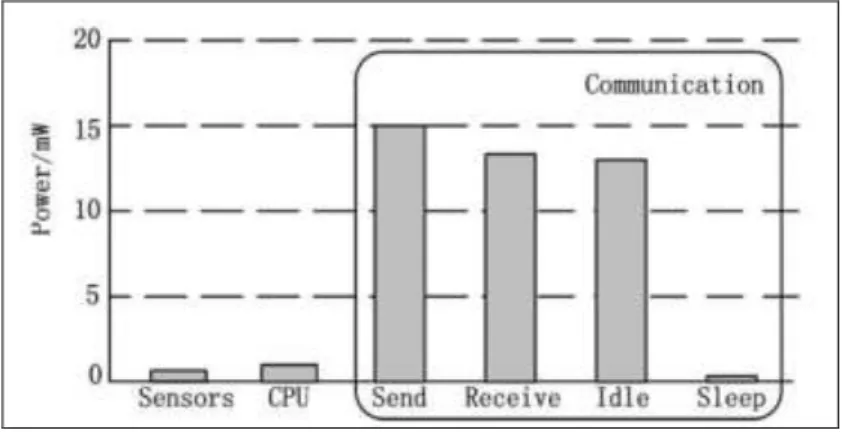
Figure 2 shows the energy consumption of these sub-components and indicates that, the communication sub-component of a sensor node consumes the most of the energy supply of the sensor node.
Hence, an energy efficient
communication protocol is a necessity in the design of a WSN to efficiently utilize its limited energy and improve the network lifetime.
Figure 1: Energy Consumption of the sub-components of a Senor Node (Yan et al., 2016)
The clustering technique is a method of decreasing energy consumption and increasing network lifetime (Ablolfazl et al., 2015). This groups the sensor nodes into clusters with each been supervised by a node elected as the Cluster Head (CH). The CH collects sensed data from its cluster members, aggregates and sends it to the BS. This technique usually consists of two phases: the setup and steady state phases (Jan et al., 2013). During the setup phase, CHs are elected and clusters are formed while data transmission occurs during the steady state phase. Both the setup and steady state phases constitute a round.
3. Classification of Cluster Based Routing Protocol
Clustering routing protocol can either be
a distributed routing protocol or a centralized routing protocol, depending on the manner of CH selection and cluster formation (Jan et al., 2013).
3.1 Distributed Routing Protocol
Also known as self-organizing routing protocol, sensor nodes are designed with enough intelligence to autonomously organize themselves into clusters and elect CHs without the assistance of an external agent. A global knowledge of the network is not needed during operation and hence the network does not experience delay and waste of limited network energy resulting from acquiring global network knowledge. But then, this protocol does not guarantee the number of CHs in the network and may result to the election
URL: http://journals.covenantuniversity.edu.ng/index.php/cjict
of non-optimal number of CHs for energy efficient routing in the network.
3.2 Centralized Routing Protocol
In this protocol, an external agent (usually the BS) assists the sensor nodes, partially or fully, to organize them into clusters and election of CHs, hence it is sometimes referred to as BS assisted routing protocol. The BS serves as a central coordinator of the nodes and requires updates from the sensor nodes to have a global network knowledge. Unlike the distributed routing protocol, the centralized routing protocol does guarantee the number of CHs but does
experience delay and use of
considerable network energy for
updating network status to the BS.
4. Low Energy Adaptive Clustering Hierarchy
The Low Energy Adaptive Clustering Hierarchy (LEACH) is a pioneer clustering routing protocol for WSN (Heinzelman et al., 2000). It balanced energy load among nodes by rotating the role of CH among them thereby improving the network lifetime. CHs in this protocol were probabilistically selected using a threshold given by equation 1.
where:
p is the percentage of total nodes required as CH for energy efficient routing
r is the current round
G is the set of node that haven’t been
elected as CH in the last rounds
In Heinzelman et al., (2002), an analytical approach is given to determine the optimal value of the percentage (p) of the total deployed nodes required as CHs for energy efficient routing.
In becoming a CH, each node generates a random number between zero, and one and compares it with the threshold. All nodes having a number less than the threshold are elected as CHs for the current round. This protocol had gone through several modifications due to some limitations. Most significant is the non-consideration on nodes energy in CHs selection which rise to low energy becoming a CH in the presence of high energy nodes.
5. Review of Energy Efficient CH Selection Schemes
In Barfunga et al., (2013), a cluster based energy efficient routing protocol was proposed to improve network life time. In this protocol, the BS was tasked with the responsibility of CH selection based on the node energy, location, node degree (number of a node’s neighbours), and number of times it had previously been elected as CH. Based on the afore-mentioned parameters, in each round, a list of ten tentative CH nodes was created. Starting with the best candidate at the top, with priority given to the node having lesser values of distance to the BS and number of times it had previously been elected to serve as CH, and higher values of residual energy and node degree. Five of these tentative CHs were selected as the final CHs based on
24 24
URL: http://journals.covenantuniversity.edu.ng/index.php/cjict
the physical distance between the nodes to ensure an even distribution of CH. This protocol assumed that the BS could discover the relative position of the nodes and topology of the network in
current time and showed an
improvement over LEACH in terms of network lifetime. In order to elect CHs in subsequent rounds, the BS required an update of nodes’ residual energy which consumed the limited network energy supply leading to a short network stability and lifetime.
Jan et al., (2013) carried out a modification of the LEACH protocol cluster head selection threshold by considering the energy consumption of the nodes. This showed an improvement in network stability and lifetime. However, in the first round where the energy consumption of the nodes was zero, the threshold evaluated to zero and as such no CH was elected in the first round. Also, after the first round in the early stage of the network, the energy consumed by each node was still very low (almost zero). This resulted to a threshold value which was almost zero and became impossible for a node to generate a random number less than the threshold. Hence, no CH was formed. Mahmood et al., (2013) introduced a modified LEACH (MODLEACH). This protocol introduced an energy efficient CH replacement scheme and a dual transmitting power levels to improve the network throughput and lifetime. A CH once elected, operated for some rounds until its energy fall below a certain threshold before a new selection process was initiated according to LEACH
protocol. This was to reduce overhead for clustering in every round. Also, nodes used different power levels for transmitter amplifier in intra and inter cluster communication with inter cluster communication having the highest. However, nodes in the protocol had to put their receiver in idle state in order to be able to determine when a new cluster head selection process was initiated. This consumed network energy and reduced the lifetime of the network. Nayak et al., (2014) presented a novel cluster head selection method for energy efficient wireless sensor network. In this work, the sensor field was partitioned into regions of diminishing size away from the BS with each region further divided into clusters which remained so throughout the network lifetime. This ensured that clusters were reduced in size with distance away from the BS. Hence, larger cluster spent more energy for intra-cluster communication and less for CH to BS communication since it has more cluster members and close to the BS. Also, smaller cluster spent less energy for intra-cluster communication and more for CH to BS communication since it had less cluster member and was farther away from the BS. This formed a trade-off between the cluster size and distance to BS. The selection of CH was dependent on the nodes residual
energies, average distance to
neighbouring nodes and distance to the BS. The BS computed a CHfactor for each node in a cluster and elected the node having the highest CHfactor as CH for the current round. This protocol showed an improvement in terms of
25
URL: http://journals.covenantuniversity.edu.ng/index.php/cjict
energy consumption and network
lifetime as compared to LEACH. However, it required nodes to send their energy status to the BS in every round for subsequent election of CHs. This required significant network energy and resulted to a short network lifetime. Eshaftri et al., (2015) presented a load-balancing cluster-based protocol. In this protocol, once clusters were formed, load was balanced between the sensor nodes by rotating the role of CH among themselves for a number of rounds before re-clustering. At the beginning of
network deployment, every node
exchanged their information with their neighbour (in order to compute its cost) and then established its probability of becoming a CH. Based on this probability, each could be a CH or tentative-CH. The final CH broadcast its statue within its range and every other member joined the closest CH. Node which was neither CH and had not received any broadcast declared itself as a CH. Each CH then constructed a turn-table for its CM based on their residual energy. The CH in the next round will be the node having the highest residual energy. Hence it is not necessary that re-clustering takes place in every round. Once the first cluster finished the rotating process, it sent a re-cluster message to the BS which was broadcasted to every node to start a new cluster process. Compared to LEACH, this protocol achieved an improvement on the network lifetime. However, every
node dissipated much energy in
updating its residual energy to the CH and it could also lead to large number of
CH when a large number of node do not receive the broadcast sent by CHs and then declared themselves as CH. Also, it required nodes to put their receiver in idle state in order to know when a re-cluster message was sent by the BS. This resulted to a wasteful use of energy.
Gwavava et al., (2015) proposed, yet another LEACH (YA-LEACH) which introduced a vice-CH in each cluster. A node maintained the role of a CH for several rounds (to reduce control messages in cluster formation) until its energy fell below a certain threshold and then it transferred its role as CH and current data to the vice-CH (to avoid data loss) which became the CH till the next cluster formation. This protocol used a centralized approach for cluster formation, determined based on the network information gotten directly from the nodes. In subsequent cluster formation, nodes sent their status through their corresponding CH. Also, the selection of CHs was dependent on their residual energy and location while the vice-CH are selected based on minimum distance from the CH and having the maximum residual energy for the role. This protocol achieved an improved network life time when compared with LEACH but however a reduced stability of the network which was attributed to the extended CH round of operation and hence dissipate energy much faster.
Prince et al., (2016) presented work to solve hot spot problem in a multi-hop cluster based routing protocol by load balancing using clusters of unequal
26 26
URL: http://journals.covenantuniversity.edu.ng/index.php/cjict
sizes, thereby improving network lifetime and stability. The BS divided the sensor field into fixed rectangular clusters of unequal sizes which depended on their distance from the BS. Clusters closest to the BS were smallest in size (having a fix width but a variable length) while those farther away were greatest in size, having a length not greater than the threshold distance of the radio model. This ensured that the inter-hop distance is restricted to ensure free space propagation model at all time. For each cluster, the node having residual energy greater than its cluster average energy and closest to the centroid of the cluster was elected as CH. This protocol also introduced mobile Data Mule (having no power issue) to collect data from the gateway CH (CH closest to the BS) and also gave an improved energy efficiency than existing protocols but due to fixed clustering, some nodes expended more energy communicating with their CH in the presence of closer CHs from neighbouring clusters.
Ellatief et al., (2016) proposed an energy-efficient density-based clustering technique to balance the energy consumption among clusters by the adaptation of transmission range of CH with respect to the node density by defining a set of nodes that borders the sub-regions (clusters) using a border detection technique. This designated nodes as border or interior nodes. CHs in this protocol were elected based on the node degree and level. The technique did not consider the energy of the node implying that a node with a
low residual energy could be assigned the role of a CH.
Singh & Verma, (2017) proposed energy efficient cross layer based adaptive threshold routing protocol for WSN. CHs in this approach were selected based on a weighted factor which was depended on the mean energy of the network and node residual energy. Every node generated a random number which was compared with the weighted factor. Those having a number less than the factor were selected as CHs. The network comprised of heterogeneous nodes having three different energy levels classified as super-advanced node, advanced node, and normal node. This protocol showed an improvement in the network lifetime and stability period but the CHs selection was based on a generated random number which is resource blind. Hence, low energy node could become a CH in the presence of a high energy node leading to a short network stability and lifetime.
Ma et al., (2016) proposed a centralized clustering formation using the BS partially for the CH selection process. Though this protocol used a randomly generated number to select CH, it eliminated the chance of a node with low residual energy to become a CH. This was achieved with the help of the BS which selected a set of nodes based on their energy that were through the CH selection process. These were nodes whose residual energy was greater than the average network energy by a
multiple (determined through
simulation) of the energy consumption
27
URL: http://journals.covenantuniversity.edu.ng/index.php/cjict
per round. If this set of nodes were less than the optimal number of CH, the set was reelected by considering nodes with residual energy greater than average network energy. This protocol showed an improvement in energy efficiency and prolonged network survival time. Its limitation was that it required a high cost of control packets in transmitting nodes energy statue to the BS in every round. Also, the location of these nodes is not considered in CHs selection. This did not allow an even distribution of the CHs, resulting in the high cost of intra cluster communication.
Elshrkawey et al., (2018) presented An Enhancement Approach for Reducing the Energy Consumption in Wireless
Sensor Networks by taking into
consideration the residual energy and initial energies of nodes, average network energy, distance of CHs to BS and the distance of nodes to CH to reduce the chances of low energy nodes becoming a CH. This improved the network lifetime but still, is limited by
the use of resource blind randomly generated number which still result to low energy nodes becoming a CH and also the number of CH is usually above the required for energy efficiency. Jesudurai & Senthilkumar, (2018) proposed an improved energy efficient cluster selection technique in LEACH to improve the throughput and network lifetime. By selecting two CHs for each cluster then decrease the consumption of energy. However, this still retained the limitations of the LEACH protocol as it does not consider the energy of the nodes in the selection processes.
Zahedi, A. (2017) improved the network lifetime of LEACH by taking into consideration residual energy of each node, distance to sink and applying weighting coefficients in the selection of CHs. However, this could not ensure the selection of an optimal number of CHs for energy efficiency as there is no central coordination of the selection process. S/N AUTHOR (YEAR) NETWORK TYPE AND PARAMEN TS USED
ACHIEVEMENT LIMITATION ENERGY EFFICIENCY CLUSTER STABILITY 1. Barfunga et al., (2013) Centralized network. Uses: 1. node residual energy 2. location 3. number of neighbou rs 4. number Improved network lifetime as compared to LEACH. Updates required for CH selection resulted in high network overhead. Medium Medium 28
URL: http://journals.covenantuniversity.edu.ng/index.php/cjict of times previousl y elected as CH. 2. Jan et al., (2013) Distributed network. 1. percentag e of required CH 2. consume d energy 3. number of times previousl y elected as CH. Improved network stability and lifetime as compared to LEACH. Difficulty in electing CH at network deployment due to zero initial consumed up energy. Medium Medium 3. Mahmood et al., (2013) Distributed network. 1. percentag e of required CH 2. number of times previousl y elected as CH. Reduced network overheads in CH selection hence improving network lifetime. Idle state of receivers consumed significant amount of energy. High Low 4. Nayak et al., (2014) Distributed network. 1. residual energies 2. average distance to neighbou rs 3. distance to the BS Improved network lifetime as compared to LEACH. Updates required for CH selection resulted in high network overhead. Medium Medum 5. Eshaftri et al., (2015) Centralized network. 1. Residual energy 2. location Improved network lifetime as compared to LEACH. Updates required for CH selection resulted in high network overhead. Idle state of receivers consumed significant amount of energy. Medium Medium 29
URL: http://journals.covenantuniversity.edu.ng/index.php/cjict
It could also lead high number of CH required for energy efficiency. 6. Gwavava et al., (2015) Centralized network. 1. residual energy 2. location 3. distance Improved network lifetime compared to LEACH. Reduced stability of the network due to the extended CH round of operation High Low 7. Prince et al., (2016) Distributed network 1. Energy 2. Location Improved network lifetime and stability
Due to fixed clustering, some nodes use communicating with their CH in presence of a closer CH in neighbouring cluster Medium High 8. Singh & Verma, (2017) Centralized network. 1. mean network energy 2. node residual energy 3. randomly generated number Improved network lifetime and stability period. Use of randomly generated number which is resource blind could to election of low energy nodes as CH. High High 9. Ma et al., (2016) Centralized network. 1. energy 2. percentag e of required CH 3. randomly generated number. Improve network stability and lifetime in LEACH.
High cost of control packets. Also, the non-consideration of location resulted to an uneven distribution on CH. High Medium 10. Elshrkawey et al., (2017) Distributed 1. residual energy 2. initial energies 3. average network energy, Improved network lifetime in LEACH. Chances of selecting a low energy node as CH and also the selection of sub-optimal number of CHs for energy efficiency. High High 30
URL: http://journals.covenantuniversity.edu.ng/index.php/cjict distance of CHs to BS 4. the distance of nodes to CH 11. Jesudurai & Senthilkum ar, (2018) Distributed network. 1. percentag e of required CH 2. number of times previousl y elected as CH. Improved throughput and network lifetime in LEACH. non-consideration of energy in the selection processes High High 12.` Zahedi, A. (2017) Distributed network. 1. percentag e of required CH 2. residual energy of nodes 3. number of times previousl y elected as CH. 4. Distance to sink 5. Weighted coefficien t Improved network lifetime compared to LEACH. Selection of sub-optimal number of CHs for energy efficiency. Medium Medium 6. Conclusion
This paper discusses the types of cluster based energy efficient routing protocol in WSN. The major difference between the various clustering protocols is in the clustering method with a focus on the CH selection. The aim is to select nodes with high residual energy as CHs in order to avoid nodes from running out of energy quickly thus extending the network stability and lifetime. For better performance of WSN in terms of network stability and lifetime, the
following recommendations are
suggested:
i. The development of a new routing protocol should focus on improving the existing cluster based routing protocols in WSN by optimizing the control messages required in clustering and CH selection
ii. Pre-selection of current and future
tentative CHs at network
deployment in order to avoid nodes from sending updates for each re-clustering and CHs selection.
URL: http://journals.covenantuniversity.edu.ng/index.php/cjict
iii. Metaheuristic and heuristic
optimization tools such as Artificial Fish Swamp Algorithm (AFSA) and Knapsack Algorithm can be tested in modeling the clustering
process in WSN while considering nodes energy distribution and the distribution of CHs in the sensor field.
References
Mahboub, A., Arioua, M., & Ez-Zazi, I. (May, 2016). Multiple zonal approach for clustered wireless sensor networks. In Electrical and
Information Technologies
(ICEIT), 2016 International
Conference. IEEE. 219-224.
Singh V.P. & Kumar H. (July, 2013). Base Station Assisted Routing Protocol for Wireless Sensor Network. International Journal of
Engineering Research &
Technology (IJERT). (2)7, 530 – 536.
Monica R., Savan K., Shivanand K., Raja N. & Seira A. (2012). A study on energy efficient routing protocols in wireless sensor networks. International Journal
of Distributed and Parallel
Systems (IJDPS), 3(3), 311-330.
Heinzelman W. B., Chandrakasan A. P. and Balakrishnan H. (2002) “An application-specific protocol
architecture for wireless
microsensor networks,” IEEE
Transaction Wireless
Communications. 1(4), 1-7. W.R. Heinzelman, A. Chandrakasan and
H. Balakrishna, (2000). Energy-efficient communication protocol
for wireless microsensor
networks. Proceedings of the 33rd Annual Hawaii International Conference on System Sciences.
2, 1-10.
Yan, J., Zhou, M., & Ding, Z. (2016). Recent Advances in Energy-Efficient Routing Protocols for Wireless Sensor Networks: A Review. IEEE Access, 4, 5673-5686.
Ablolfazl A. K., Hamed J. and Javad A. (2015). LEACH and HEED clustering algorithms in wireless sensor network: A qualitative study. Advances in Science and
Technology Research Journal.
9(25), 7-11.
Jan, M. A., Nanda, P., He, X., & Liu, R.
P. (Nov, 2013). Enhancing
lifetime and quality of data in cluster-based hierarchical routing protocol for wireless sensor network. In High Performance Computing and Communications
& 2013 IEEE International
Conference on Embedded and
Ubiquitous Computing
(HPCC_EUC), 2013 IEEE 10th International Conference. IEEE.
1400-1407.
Barfunga, S. P., Rai, P., & Sarma, H. K. D. (2012, July). Energy efficient cluster based routing protocol for Wireless Sensor Networks. In Computer and Communication
Engineering (ICCCE), 2012
International Conference IEEE.
603-607
Jan, M. A., Nanda, P., He, X., & Liu, R.
P. (Nov, 2013). Enhancing
URL: http://journals.covenantuniversity.edu.ng/index.php/cjict
lifetime and quality of data in cluster-based hierarchical routing protocol for wireless sensor network. In High Performance Computing and Communications
& 2013 IEEE International
Conference on Embedded and
Ubiquitous Computing
(HPCC_EUC), 2013 IEEE 10th International Conference. IEEE.
1400-1407.
Mahmood D., Javaid N., Mahmood S., Qureshi S., Memon A. M., &
Zaman T. (October, 2013).
MODLEACH: a variant of
LEACH for WSNs. In Broadband
and Wireless Computing,
Communication and Applications
(BWCCA), 2013 Eighth
International Conference. IEEE.
158-163.
Nayak B. K., Mishra M., Rai S.C. & Pradhan S.K. (2014). A Novel Cluster Head Selection Method for Energy Efficient Wireless Sensor Network. International
Conference on Information
Technology. 53 – 57
Eshaftri, M., Al-Dubai, A. Y.,
Romdhani, I., & Yassien, M. B. (2015, September). A new energy efficient cluster based protocol for wireless sensor networks.
In Computer Science and
Information Systems (FedCSIS),
2015 Federated Conference
IEEE. 1209-1214.
Gwavava, W. T., & Ramanaiah, O. B.
V. (2015, December).
YA-LEACH: Yet another LEACH for wireless sensor networks. In Information Processing (ICIP),
2015 International Conference.
IEEE. 96-101.
Prince B., Kumar, P., Singh, M. P., & Singh, J. P. (2016, March). An energy efficient uneven grid clustering based routing protocol for Wireless Sensor Networks. In Wireless Communications, Signal
Processing and Networking
(WiSPNET), International
Conference. IEEE. 1580-1584.
Ellatief, W. A., Younes, O., Ahmed, H., & Hadhoud, M. (2016, February). Energy efficient density-based clustering technique for wireless sensor network. In 2016 8th
International Conference on
Knowledge and Smart Technology
(KST). IEEE. 196-200
Singh, R., & Verma, A. K. (2017). Energy efficient cross layer based adaptive threshold routing protocol
for WSN. AEU-International
Journal of Electronics and
Communications, 72, 166-173.
Ma, Z., Li, G., & Gong, Q. (2016).
Improvement on LEACH-C
Protocol of Wireless Sensor
Network (LEACH-CC).
International Journal of Future Generation Communication and
Networking. 9(2), 183-192.
Raghunandan, G. H., Rani, A. S., Nanditha, S. Y., & Swathi, G.
(2017, July). Hierarchical
agglomerative clustering based
routing algorithm for overall
efficiency of wireless sensor
network. In Intelligent Computing,
Instrumentation and Control
Technologies (ICICICT), 2017
International Conference on (pp.
1290-1293). IEEE.
Elshrkawey, M., Elsherif, S. M., &
Wahed, M. E. (2018). An
enhancement approach for reducing the energy consumption in wireless sensor networks. Journal of King
Saud University-Computer and
Information Sciences, 30(2),
259-267.
Jesudurai, S. A., & Senthilkumar, A.
(2018). An Improved Energy
Efficient Cluster Head Selection protocol using the double cluster heads and data fusion methods for IoT applications. Cognitive Systems
Research.
Abdulhamid Zahedi (2017). An efficient clustering method using weighting
coefficients in homogeneous
wireless sensor networks.
Alexandria Engineering Journal