c
°Copyright 2009. W. Marshall Leach, Jr., Professor, Georgia Institute of Technology, School of Electrical and Computer Engineering.
Current Sources
Current mirrors are commonly used for current sources in integrated circuit design. This section covers other current sources that are often seen.
FET Current Sources
Figure 1(a) shows two FET current sources, one which uses an n-channel depletion mode MOSFET and the other which uses an n-channel JFET. The equivalent p-channel sources are shown in Fig. 1(b). Remember that the JFET is a depletion mode device. The analysis for the two sources is the same with the exception that the transconductance parameter is denoted byKfor the MOSFET and byβ for the JFET.
Figure 1: MOSFET (depletion mode) and JFET current sources. (a) n-channel. (b) p-channel. For the n-channel device, the MOSFET drain current and gate-source voltage are given by
ID=K(VGS−VT O)2 VGS=−ISRS=−IDRS
The object is to solve forRS for a desired drain current. When the equation forVGSis substituted into the
equation forID, we obtain
ID=K(−IDRS−VT O)2=K(IDRS+VT O)2
This can be solved forRS to obtain
RS =
p
ID/K−VT O ID
where VT O < 0. Note that K = K0(1 +λVDS). If VDS is not specified, an often used approximation is K'K0.
For the n-channel JFET, the drain current is given by
ID=β(VGS−VT O)2
It follows that the MOSFET solution forRS can be used with the substitution ofβ forK to obtain
RS =
p
ID/β−VT O ID
The output resistance is afigure of merit for a current source. Ideally, it should be infinite. The output resistance is the resistance seen looking into the drain of each source. It is given by
rout=rid=r0 µ 1 + RS rs ¶ +RS rs= 1 gm r0= λ−1+VDS ID
wheregm= 2√KID for the MOSFET andgm= 2√βID for the JFET.
For the p-channel devices, the subscripts for the voltages are reversed, e.g. VGS becomeVSG and VDS
becomesVSD.
Example 1 A depletion mode MOSFET has the parameters K0 = 5×10⁻⁴A/V2, λ = 10−4V−1, and
VT O =−2 V. Calculate the value ofRS and rout if the transistor is to be used as a current source with a
currentID= 1.5 mA. AssumeVDS = 8 V. Solution. K=K0(1 +λVDS) = 5.2×10⁻⁴A/V2 RS = p ID/K−VT O ID = 2.47 kΩ r0= λ−1+VDS ID = 13.87 kΩ gm= 2 p KID= 1.766×10⁻³S rs= 1 gm = 566.1Ω rout=rid=r0 µ 1 +RS rs ¶ +RS = 745 kΩ ResistorRS causesrout to be greater than r0 by more than a factor of5.
One-BJT Current Source
Figure 2 shows npn and pnp BJT current sources. The object is to select the resistors in the circuit for a desired collector currentIC.
For the npn device, the steps can be summarized as follows:
(a) Choose a value for RE . It should be small but large enough for good bias stability. It is common to choose RE so that the voltage across it is some multiplenof the base-emitter junction voltageVBE, where
typically1≤n≤4. The largern, the better the current stability. It follows that
IERE = IC
αRE=nVBE =⇒RE=
αnVBE IC
(b) Choose a value for R2. It is usually chosen so that the currentI2 is some multiple m ofIB, where
typicallym≥9. It follows that
I2R2=mIBR2=m
IC
β R2= (n+ 1)VBE =⇒R2=
β(n+ 1)VBE mIC
If m is too small, the uncertainty in IB can cause errors if β is not known precisely or if β drifts with temperature. (c) Solve for R1. I1R1 = (m+ 1)IBR1= (m+ 1) IC β R1=V + −£V−+ (n+ 1)VBE ¤ =⇒ R1=β V+−V−−(n+ 1)V BE (m+ 1)IC
(d) Solve forrout.
rout=ric= r0+re0kRE 1− αRE r0 e+RE r0= VA+VCE IC re0 = R1kR2+rx 1 +β +re
For the pnp device, the subscripts for the voltages are reversed, e.g. VBE becomeVEB andVCE becomes
VEC.
Example 2 A BJT has the parameters β = 100, VA = 75 V, and rx= 40Ω. The transistor is to be used as a current source with a current IC = 1.5 mA,V+= 15 V, andV− =−15 V. Calculate the values ofR1, ,R2, androut ifI1= 10IB (n= 10)andIERE= 2VBE (m= 2). AssumeVBE = 0.65 VandVCE = 8 V.
Solution. RE= αnVBE IC = βnVBE (1 +β)IC = 858Ω R1=β V+−V−−(n+ 1)VBE (m+ 1)IC = 170 kΩ R2= β(n+ 1)VBE mIC = 13 kΩ r0= VA+VCE IC = 55.33 kΩ re0 = R1kR2+rx 1 +β +re= R1kR2+rx 1 +β + αVT IC = 136.5Ω rout =ric= r0+r0ekRE 1− αRE r0 e+RE = 380.4 kΩ
Two-BJT Current Source
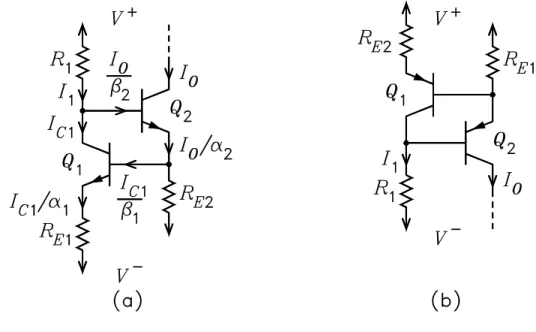
Figure 3 shows npn and pnp two-transistor BJT current sources that are simpler to design. The output current in each is the collector current IO. For the circuit of Fig. 3(a), the following equations can be
written V+−V−=I1R1+VBE2+VBE1+ IC1 α1 RE1 IC1=I1− IO β2 µ IO α2 − IC1 β1 ¶ RE2=VBE1+ IC1 α1 RE1
For the pnp circuit, the subscripts for the voltages are reversed, e.g. VBE becomeVEB.
Figure 3: Two-BJT current sources.
There is a positive feedback effect in these circuits which increases the output resistance seen looking into the collector ofQ1. To see this, consider the small-signal circuit withV+=V−= 0and the collector ofQ1
driven by a small-signal test current sourceit. Ifitis positive, it causes a current toflow throughr01 from its collector to its emitter. This forces the base voltage ofQ2 to increase. This is amplified byQ2 to cause its collector voltage to decrease. This decrease is applied to the base ofQ1 to cause its collector voltage to increase. This feedback effect causes the collector voltage of Q1 to be larger than it would be without the feedback. Because resistance is voltage divided by current, it follows that the resistance seen looking into the collector ofQ1 is increased.
The circuit can be designed by specifying the currentsI1 andIC1 and the resistorRE2. The current I1 must be chosen so that it is much larger than the anticipated base current inQ1. RE2 can be omitted, but it aids in preventing temperature drift of the currents. If it is too large, however, it reduces the gain around the positive feedback loop, thus reducing the output resistance. Typically, RE2 might be chosen to have a value such thatVBE1≤IE1RE1≤4VBE1. ResistorsR1 andRE1are then given by
R1= V+−V−−(V BE1+VBE2)− µ I1− IO β2 ¶ RE1 α1 I1 RE2= VBE1+ IC1 α1 RE1 IO −IC1
Example 3 For V+ = 15 V and V− = −15 V, design the circuit in Fig. 3(a) for an output current
IC1= 1.5 mA.
Solution. If we estimateβ = 100, the base current inQ1is0.015 mA. Let us chooseI1= 20IB2= 0.3 mA. We estimateVBE1=VBE2= 0.65 V. The currentIC1 is given byIC1=I1−IO/β= 0.285 mA. The current
throughRE1 isIE1 =IC1/α= 0.288 mA. If we choose IE1RE1=VBE1, it follows thatRE1,R1, and RE2 are given by RE1= 0.65 0.288 mA = 2.26 kΩ R1= 30−2×0.65−0.285 mA×2.26 kΩ 0.3 mA = 91.2 kΩ RE2= 2×0.65 1.5 mA = 867Ω
Current Sources Using an Op Amp
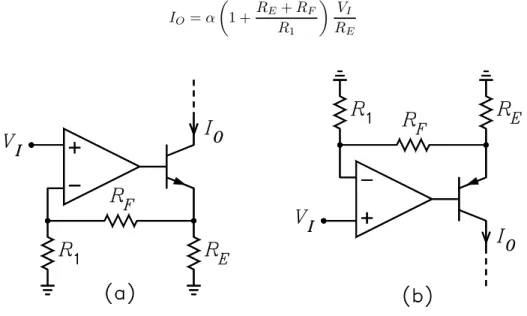
Figure 4 shows two current sources that use an op amp as an error amplifier. The emitter current in each transistor is
IE= IO
α
This current divides betweenRF andRE go cause the voltage at the negative op-amp input to be VN = IC α R1 RE+RF+R1 RE
Because the op amp forcesVN=VI, it follows thatIO is given by IO =α µ 1 + RE+RF R1 ¶ VI RE