STABILIZING
MORNINGSIDE
ACKNOWLEDGEMENTS
We would like to thank Professor Margaret Dewar and Libby Levy for their unwavering support and insight during the completion of STABILIZING MORNINGSIDE. We would also like to thank our advisory committee for their valuable input:
Sam Butler, Director of Planning & Technical Programs, Michigan Community Resources
Eric Dueweke, Resident and Board Member, U-SNAP-BAC and MorningSide neighborhood association
Dara O’Byrne, Convener of Land Use Working Group, Detroit Future City
Carol O’Cleireacain, Deputy Mayor for Economic Policy, Planning, and Strategy; and Debra Pospiech, Office of Deputy Mayor for Economic Policy, Planning, and Strategy, City of Detroit
DaRell Reed, Pastor, Spirit of Love Church
Linda Smith, Executive Director, U-SNAP-BAC
Vincent Tilford, Executive Director, Habitat for Humanity Detroit
We would also like to extend our thanks to the following people and organizations who assisted us by providing their time, effort and experience in shaping STABILIZING MORNINGSIDE:
Zelda Anderson, Resident and President, MorningSide neighborhood association
Jacqueline Bejma, Executive Director, LAND, Inc.
Sandra Cobb, Chief of Community Development, Habitat for Humanity Detroit Jacob Corvidae, Interim Executive Director, EcoWorks
Jackie Grant, Resident and Board Member, MorningSide neighborhood association
Ulysses Jones, Resident and Board Member, MorningSide neighborhood association
Carrie Lewand-Monroe, Senior Advisor, Detroit Land Bank
Paul Phillips, Board Member, MorningSide neighborhood association
Ted Phillips, Executive Director, United Community Housing Coalition
Emily Thompson, Project Coordinator, United Community Housing Coalition Sarida Scott, Executive Director, Community Development Advocates of Detroit Avis Vidal, Professor of Urban Planning, Wayne State University
Rebecca Thompson, Senior Director of Engagement, United Way of Southeast Michigan
Kermit Lind, Clinical Professor Emeritus, Cleveland State University
Alison Goebel, Associate Director, Greater Ohio Policy Center
Jawana Jackson, AmeriCorps Urban Safety Program, Wayne State University
For access to data, we thank Gregory Parrish, Erica Raleigh, and Noah Urban at Data Driven Detroit; Dexter Slusarski at Loveland Technologies; and Danielle Lewinski at Michigan Community Resources (now at Center for Community Progress). We thank Linda Smith for securing funding to cover the expenses of this plan as well as the countless residents of MorningSide who participated in meetings, surveys or questionnaires. This plan would not have been possible without your candor and support.
List of Figures + Tables
Executive Summary
Section 1 I Introduction
Section 2 I The State of MorningSide
Section 3 I Prevent Tax Foreclosure
Section 4 I Renovate Houses
Section 5 I Turn Vacant Lots into Assets
Section 6 I Build Neighborhood Capacity
Section 7 I Implement Action Plan
Appendix A I Source for Figures + Tables
Appendix B I Questionnaire for Homeowners
Appendix C I Neighborhood Enterprise Zone Frequently Asked Questions
Appendix D I List of Potential Nuisance Abatement Program Properties on Three Mile Dr. and Courville St
Appendix E I Potential Investor-Owned Homes with Likely Code Violations
Appendix F I Vacant Land Reuse
Appendix G I Publicly Owned Vacant Lots that could be Sold to Adjacent Owners as Side Lots
2 4 10 16 32 58 78 106 120 148 149 150 162 164 168 170
TABLE OF CONTENTS
LIST OF FIGURES + TABLES
Section 1
Figure 1.1: The MorningSide neighborhood in the City of Detroit
Section 2
Figure 2.1: MorningSide neighborhood + Detroit City population change 2000-2010 Figure 2.2: MorningSide population by age
Figure 2.3: MorningSide median household income 2000 + 2009-2013 Figure 2.4: MorningSide + Detroit housing occupancy rate in 2000 + 2010 Figure 2.5: MorningSide + Detroit homeownership rate in 2000 + 2010 Figure 2.6: MorningSide mortgage foreclosures 2005-2014
Figure 2.7: Average housing sales price in MorningSide Figure 2.8: Tax foreclosures in MorningSide 2002-2015 Figure 2.9: Example of MorningSide housing stock Figure 2.10: Example ofMorningSide housing conditions Figure 2.11: Vacant land on Barham St
Figure 2.12: MorningSide property vacancy status Figure 2.13: John Clark Elementary School Figure 2.14: Habitat for Humanity Detroit house Figure 2.15: Typical homes in MorningSide
Figure 2.16: Detroit Future City concept illustration of Green Residential Figure 2.17: Blight removal illustration
Figure 2.18: City of Detroit Neighborhood Revitilization Strategy Areas Plan
Figure 2.19: Michigan Community Resources MorningSide + East English Village Neighborhood Stabilization Plan
Section 3
Figure 3.1: A tax foreclosed property in MorningSide Table 3.1: Delinquent property tax deferrals + payment plans Table 3.2: Methods for property tax reduction
Figure 3.2: Filing a probate case
Figure 3.3: Tax foreclosure prevention workshop held at the Samaritan Center Figure 3.4: Summary of results of homeowner survey
Figure 3.5: Partners + strategies
Figure 3.6: MorningSide properties with NEZ-Homestead Status
Table 3.3: Figure 3.7: Structure conditions for properties in NEZ status versus properties not in NEZ status Figure 3.8: Average assessor’s of market value and sales price in MorningSide
Figure 3.9: Assessor’s view of market value for MorningSide properties in 2008 Figure 3.10: Sales price for MorningSide properties in 2008
Table 3.3: 2015 poverty guidelines for the 48 contiguous states + the District of Columbia Figure 3.11: Show cause hearing at Conner campus of Wayne County Community College Figure 3.12: Protect yourself from scams and fraud flyer
11 16 16 17 18 18 19 20 21 22 23 24 25 26 27 27 28 28 29 29 33 34 35 36 38 39 43 45 46 47 48 48 52 54 55
Section 4
Figure 4.1: Potential homes to be renovated Table 4.1: Structure condition by occupancy status
Table 4.2: Structure condition by likely owner-occupancy status Table 4.3: Residential renovation programs
Figure 4.2: Snapshot of How should I renovate my home? Guide Table 4.4: Estimated home renovation material costs
Figure 4.3: Initial phase for expansion of Nuisance Abatement Program Figure 4.4: Potential code violating properties
Table 4.5: Housing statistics for immediate target area Table 4.6: Housing statistics for greater target area Figure 4.5: Habitat for Humanity target areas Figure 4.6: U-SNAP-BAC target area options
Section 5
Figure 5.1: MorningSide property vacancy status Figure 5.2: Questionnaire results
Figure 5.3: The vacancy reuse matrix by complexity, labor + amount of vacant land for implementation Figure 5.4: A page from the Vacant Land Reuse Book
Figure 5.5: Vacant Land Reuse program priority areas Figure 5.6: Rain garden reuse rendering
Figure 5.7: Side Lot program priority area Figure 5.8: Community garden reuse rendering Figure 5.9: Lavender field reuse rendering
Figure 5.10: The Green Ventures program priority area Figure 5.11: Green Ventures vacant land ownership Figure 5.12: Greenway reuse rendering
Figure 5.13: Greenway program priority area Figure 5.14: View of Phase I (Mack to Lozier) Figure 5.15: View of Phase II (Lozier to Warren) Figure 5.16: View of Phase III (Warren to I-94)
Section 6
Figure 6.1: April 4, 2015 MorningSide neighborhood association meeting Figure 6.2: AmeriCorps Urban Safety Safe Routes Program Area
Section 7
Figure 7.1: April 22, 2015 Stabilizing MorningSide advisory committee meeting
58 58 58 60 64 66 69 71 72 72 73 75 79 81 82 83 85 86 87 89 90 91 93 96 97 98 100 102 107 109 121
EXECUTIVE SUMMARY
The STABILIZING MORNINGSIDE plan aims to build upon the assets of the MorningSide neighborhood to strengthen its housing market and once again make it a neighborhood of choice. The MorningSide neighborhood is a 1.5-square mile community located on the east side of Detroit, Michigan. Once a stable neighborhood, MorningSide was affected by mortgage foreclosures and is now facing property tax foreclosures. Between 2000 and 2010, the neighborhood population decreased by 27 percent and owner occupancy fell from 65 percent to 60 percent of housing units. Furthermore, housing conditions have declined with most houses in need of renovations or repairs. And lastly, over 20 percent of all properties in the neighborhood are vacant lots.
This plan is the result of a collaborative effort between the University of Michigan Urban and Regional Planning Program, U-SNAP-BAC, the MorningSide neighborhood association, Detroit Future City, Habitat for Humanity Detroit, Michigan Community Resources and the
Mayor’s Office. It provides tools to residents and local organizations as well as city, county and state officials. This plan identifies four goals, each with strategies for achieving the goal.
Tax foreclosures have contributed to the MorningSide neighborhood’s population decline as residents lose their homes. The following are strategies to keep owner occupants in their homes:
• Advocate more convenient ways for residents to pay property taxes, such as by monthly payments, cash payments, phone, mobile app or online.
• Provide one-stop shop for all programs related to property taxes so that owner
occupants have a location or website that provides answers to property tax questions. • Encourage residents to take advantage of Neighborhood Enterprise Zone status, which
provides a reduction in property taxes when owner occupants invest in their homes.
• Ensure property assessments reflect property values so that owner occupants are
paying the appropriate amount of property taxes.
• Simplify the property assessment appeal process by allowing electronic assessments and appeals, providing community computer terminals, clearly stating the appeal process and extending the appeal deadline permanently to March.
• Allow forgiveness for delinquent property taxes through retroactive poverty exemption and property tax exemption for owner occupants over 85 years old.
• Educate homebuyers on fraud and scam prevention through existing homebuyer classes and through information on community organization websites.
MorningSide housing includes historic brick Tudors, bungalows and flats. Renovation of
these houses encourages property upkeep by neighbors, improves aesthetics and has the potential to increase property values. This plan’s strategies are:
• Encourage participation in existing residential renovation programs by providing homeowners with information on assistance that is currently available.
• Educate residents by distributing a Housing Renovation Guide and hosting home renovation workshops that assist residents in understanding the costs and funding options for professional home renovations. Partners can include Habitat for Humanity ReStore, EcoWorks and Brick and Beam Detroit.
• Advocate expansion of the Detroit Land Bank’s Nuisance Abatement Program in
MorningSide to remediate privately owned, unoccupied and blighted structures starting with Three Mile Dr. and Courville St.
• Engage in targeted code enforcement for investor-owned houses so that these can be brought up to code. This includes a focus on larger owners such as Metro Property Group and Artesian Equities, LLC.
• Focus Habitat for Humanity renovation efforts in the Clark School area to improve housing quality in areas where children walk to school. Two target areas are explored.
• Launch U-SNAP-BAC Targeted Renovation Program first on blocks with strong housing
to strengthen confidence in the housing market in those areas. Three possible target areas are identified.
The Housing Renovation Guide details common contractor repairs such as roofing and flooring. It aims to educate homeowners and renters on contractor renovations that save
money, improve quality of life and increase the value of homes.
An opportunity exists to turn vacant lots into assets that will strengthen MorningSide. This plan provides three strategies in the form of actionable programs:
• Take advantage of the Detroit Land Bank’s side lots program as a short-term strategy in areas that have less than 15 percent of their properties as vacant lots. Adjacent owners can purchase and reuse the lots.
• Encourage green ventures, such as a market garden, mushroom farm, lavender field
and solar array system, on adjacent lots as a mid-term strategy in areas with 16 to 30 percent vacant lots. Entrepreneurs can transform vacant land into entrepreneurial businesses.
• Promote the creation of a greenway, focused on mobility, storm water management and recreation, as a long-term strategy in areas with over 30 percent of properties as vacant lots. These larger areas can be transformed into public amenities and managed as public-private partnerships.
The Vacant Land Reuse Program Book details suggestions on how vacant land can be repurposed in productive ways. It illustrates 45 reuses for vacant land in MorningSide and lists the costs, materials and labor to implement the programs.
MorningSide has numerous organizations involved in the neighborhood, but the neighborhood needs to build additional capacity. This plan’s strategies are:
• Encourage the creation of new block clubs and increase participation in existing ones in conjunction with Wayne State University AmeriCorps Urban Safety efforts along the Clark Elementary Safe Routes to School and with the Department of Neighborhoods.
• Strengthen existing organizations and clarify partnerships by working with Community Development Advocates of Detroit on capacity building and system reform. System reform could lead to new roles for existing organizations and alliances with other organizations.
• Increase use of internships, fellowships, volunteers and other opportunities so that organizations can staff high priority projects.
• Plan collaboratively so that all organizations and residents have ownership in the process and outcomes and so that implementation can advance.
The Action Plan outlines tasks for each strategy. Lead and partner organizations have been
identified for each task on an estimated timeline.
This plan provides a starting point for stabilizing the MorningSide housing market. The plan can serve to bring residents and neighborhood organizations together to discuss roles and responsibilities and provide a foundation for community-based planning for MorningSide.
SECTION 1
INTRODUCTION
INTRODUCTION
This plan builds upon the assets of the MorningSide neighborhood to stabilize its residential core and once again make it a neighborhood of choice. The mortgage foreclosure crisis weakened MorningSide resulting in an increase in blighted structures, newly vacant land, investor-owned properties and a continued decline through the current tax foreclosure crisis. This plan is designed to provide residents and local organizations as well as city, county and
state officials with tools to begin addressing these issues. The strategies outlined in this plan
apply to MorningSide but can also aid similar neighborhoods across Detroit.
While these four goals focus on stabilizing housing and keeping residents in MorningSide,
other goals such as building infill housing and assuring neighborhood safety need to be
addressed in the future to strengthen the neighborhood.
GOALS
STABILIZING MORNINGSIDE
Prevent Tax Foreclosure
Turn Vacant Land into Assets
Renovate Existing Homes
Build Neighborhood Capacity
The MorningSide neighborhood is located on the eastside of Detroit, Michigan. It is a
1.5-square mile area bounded by I-94 and Harper Ave. to the north, Whittier Dr. and E. Outer Dr. to the east, Mack Ave. to the south, and Alter Rd. and E. Outer Dr. to the west. The East English Village neighborhood is adjacent to the east, the Chandler Park neighborhood is adjacent to the west; and the City of Grosse Pointe Park is adjacent to the south.
MORNINGSIDE
Figure 1.1: The MorningSide neighborhood in the City of Detroit
Source: United States Census Bureau, 2013; City of Detroit Planning and Development Department, 2012 b. See Appendix for full citations.
This plan is the result of a collaborative effort between the University of Michigan Urban and Regional Planning Program, U-SNAP-BAC, the MorningSide neighborhood association, Detroit Future City, Habitat for Humanity Detroit, Michigan Community Resources and the
Mayor’s Office of the City of Detroit.
U-SNAP-BAC
U-SNAP-BAC (United Streets Networking and Planning; Building A Community) is a consortium of community and business organizations, working together to empower residents to strengthen Detroit’s eastside especially through housing counseling, financial literacy training for homebuyers and management of a rental housing portfolio. U-SNAP-BAC developed owner-occupied and rental housing in MorningSide Commons on the western side of MorningSide, south of Warren Ave.1
Habitat for Humanity Detroit
Habitat for Humanity Detroit is a nonprofit, ecumenical Christian housing ministry that seeks to eliminate substandard housing and homelessness and to make decent shelter a matter of conscience and action. Habitat for Humanity Detroit invites people of all backgrounds, races and religions to build houses together in partnership with families in need.4 Habitat for Humanity Detroit
has built and renovated housing in the western portion of MorningSide south of Warren Ave.
The MorningSide neighborhood association
The MorningSide neighborhood association goals are to plan and work together in volunteer efforts to address neighborhood concerns, meet needs and solve problems; to develop programs and activities to prevent the deterioration of the neighborhood; to promote a safe, healthful and attractive environment; and to educate and promote awareness of programs and services.2
Michigan Community Resources
Michigan Community Resources’ mission is to support and empower nonprofit community organizations in Michigan that serve low-income individuals and neighborhoods, with an emphasis on community economic development, by providing pro bono legal services and planning technical assistance.5 Michigan Community
Resources previously produced a neighborhood stabilization plan for MorningSide and East English Village neighborhoods.
Detroit Future City
Detroit Future City is working with Detroiters to implement the vision created in the Strategic Framework, which was released in January 2013.3
The Strategic Framework categorizes the majority of MorningSide as “Green Residential,” and Detroit Future City is pursuing opportunities to help residents define this categorization and implement relevant changes.
Office of the Deputy Mayor for Economic Development
Office of the Deputy Mayor for Economic Policy, Planning and Strategy aims to address the financial challenges of Detroit. One of the Deputy Mayor’s primary responsibilities is to identify new sources of external funding to make the city less dependent on annual property and income tax revenues. She also works with the Chief Financial Officer in tackling the financial aspects of the city’s emergence from bankruptcy.6
Suggests strategies to prevent tax foreclosures and recommendations regarding the current assessment and appeal processes.
Identifies current conditions.
Recommends strategies to renovate existing homes and prioritize specific
residential areas in the neighborhood.
Provides strategies on how to turn vacant lots into assets and recommendations
for improvements in specific areas of the neighborhood.
Points to ways to build neighborhood capacity and coordinate implementation of the action plan.
Provides a list of strategies from Section 2 through Section 5 and
recommendations on which organizations are best positioned to implement them.
PLAN OUTLINE
Section 2
The State of MorningSide
Section 3
Prevent Tax Foreclosure
Section 4
Renovate Houses
Section 5
Turn Vacant Land into Assets
Section 6
Build Neighborhood Capacity
Section 7
Notes
1. U-SNAP-BAC, “About Us,” accessed March 2015 from http://www.usnapbac.org/about_us. 2. MorningSide, “Who We Are,” accessed March 2015 from http://our-morningside.org/whoweare.html. 3. Detroit Future City, “About,” accessed March 2015 from http://detroitfuturecity.com/about.
4. Habitat for Humanity Detroit, “FAQ,” accessed March 2015 from http://www.habitatdetroit.org/about_us/faq. 5. Michigan Community Resources, “Mission,” accessed March 2015 from http://www.mi-community.org/mission.
SECTION 2
THE STATE OF MORNINGSIDE
SECTION 2
RESIDENTS
-27%
MORNINGSIDE 16,944 2000 2010 12,327-25%
DETROIT 951,270 2000 2010 713,777Figure 2.1: MorningSide neighborhood and Detroit city population change from 2000 to 2010
Source: United States Census Bureau, Census 2000; United States Census Bureau, Census 2010. See Appendix A for full citations.
Figure 2.2: MorningSide population by age
Source: United States Census Bureau, Census 2000; United States Census Bureau, Census 2010. See Appendix A for full citations. 2000 6,358 2010 UNDER 17 4,023 2000 9,696 2010 7,479 17 TO 65 2000 890 2010 825 OVER 65
This section provides an overview of conditions in MorningSide since 2000. Information regarding its people, housing, vacant lots, structure conditions and assets provides an informed understanding of the neighborhood. This information helps in understanding the challenges and opportunities in MorningSide and provides the basis for articulating strategies for strengthening MorningSide.
According to the 2010 United States Census, MorningSide had a population of 12,327. Compared to 2000, its population had decreased by 4,617. This population loss is similar to Detroit’s, which lost about a quarter of its population from 2000 to 2010 (see Figure 2.1). The population loss was due in part to the large numbers of children and working age adults that left the neighborhood (see Figure 2.2).
0.2
0 0.1 Miles
N
Median Household Income $24,853.64 - $34,168.20 $34,168.21 - $47,364.40 $47,364.41 - $60,560.60 $60,560.61 - $73,756.60 $73,756.61 - $86,953.00
MEDIAN HOUSEHOLD INCOME CENSUS 2000
0.2
0 0.1 Miles
N
Median Household Income $20,972.00 - $34,168.20 $34,168.21 - $47,364.40 $47,364.41 - $60,560.60 $60,560.61 - $73,756.60 $73,756.61 - $86,953.00
MEDIAN HOUSEHOLD INCOME ACS 2009-2013
Figure 2.3: MorningSide median household income 2000 + 2009-2013
Source: United States Census Bureau, Census 2000; United States Census Bureau, ACS 2009-2013. See Appendix A for full citations.
As shown in Figure 2.3, median household income decreased. In 2000, MorningSide was a mixed-income neighborhood; by 2010, incomes were much lower.
DETROIT 90% 2000 2010 77% MORNINGSIDE 91% 2000 2010 73%
-18
-13
DETROIT 55% 2000 2010 51% MORNINGSIDE 65% 2000 2010 60%-5
-4
Figure 2.4 MorningSide + Detroit housing occupancy rate in 2000 + 2010
Source: United States Census Bureau, Census 2000; United States Census Bureau, Census 2010. See Appendix A for full citations.
Figure 2.5 MorningSide + Detroit homeownership rate in 2000 and 2010
Source: United States Census Bureau, Census 2000; United States Census Bureau, Census 2010. See Appendix A for full citations.
The housing occupancy rate decreased as well. From 2000 to 2010 the housing occupancy rate in MorningSide declined from 91 percent to 73 percent (see Figure 2.4). The housing occupancy rate in Detroit also decreased; it dropped from 90 percent to 77 percent.
Accompanying a declining housing occupancy rate, homeownership rates in MorningSide fell in the same period. In 2000, the homeownership rate was 65 percent, and in 2010 it was 60 percent. However, in both periods MorningSide’s homeownership rates were higher than Detroit’s, which was 55 percent in 2000 and 51 percent in 2010 (see Figure 2.5).
HOUSING
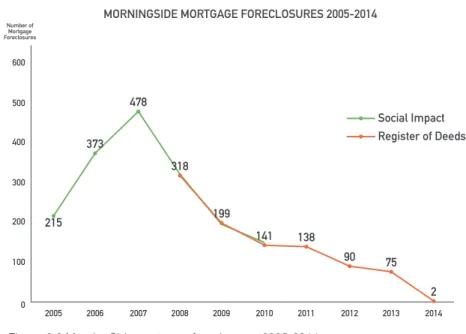
Figure 2.6 MorningSide mortgage foreclosures 2005-2014
Source: Social Compact, 2005-2010; Wayne County Register of Deeds, 2008-2013; RealtyTrac Foreclosure list, 2014. See Appendix A for full citations.
0 100 200 300 400 500 600 Number of Mortgage Foreclosures 2005 2006 2007 2008 2009 2010 2011 2012 2013 2014 215 373 478 318 199 141 138 90 75 2 Social Impact Register of Deeds MORNINGSIDE MORTGAGE FORECLOSURES 2005-2014
A major factor contributing to the neighborhood decline was the large number of mortgage foreclosures, which led to hundreds of residents losing their homes. From 2005 to 2014, approximately 2,000 houses went into mortgage foreclosure, which equaled 46 percent of the 4,354 residential structures in MorningSide as of 2009.1 In 2007 alone, for example,
478 properties (almost 11 percent of residential structures) were foreclosed on because of defaulted home mortgages. However, recent data show that mortgage foreclosure has become less of a concern in MorningSide (see Figure 2.6). In 2014, only two properties in the neighborhood went into mortgage foreclosure.2
Figure 2.7: Average housing sales price in MorningSide
Source: Wayne County Register of Deeds 2008-2013. See Appendix A for full citations. 0 2008 2009 2010 2011 2012 2013 2014 $10,000 $20,000 $30,000 $40,000 $50,000 $60,000 $70,000 $80,000 Sales Price $62,510 $42,717 $26,374 $27,734 $30,046 $28,227 WD QCD DD AVERAGE HOUSING SALES PRICE IN MORNINGSIDE
Deed (DD)
DD (Mortgage type deed) transactions are properties that were previously foreclosed on and sold by financial institutions to private owners or to other financial institutions.
Quit Claim Deed (QCD) QCD is a type of deed where the seller does not guarantee clean title so prices of properties are generally lower.
Warranty Deed (WD)
Warranty deeds, which are typical of most sales with regular mortgages, mean that the seller guarantees clean title.
The mortgage foreclosure crisis and the ensuing recession had a sizable impact on the housing values in MorningSide. Sales data from the Wayne County Register of Deeds were used to calculate the average sales price for three types of transactions: Deed (DD), Quit Claim Deed (QCD), and Warranty Deed (WD) (see Figure 2.7).
Generally, a warranty deed is considered a transaction reflecting the true market value. From
2008 to 2010, the average sales prices for warranty deed transactions decreased by more than half, from $62,510 to $26,374. Housing values likely fell much more due to declines in the years prior to 2005. Detroit Board of Realtors records showed a drop in value of 77 percent from 2003 through 2013 for all of Detroit.3 Furthermore, about 1,900 out of 4,354 (as
of 2009) residential structures changed hands between 2008 and 2013, which equates to about a 44 percent turnover rate.
Figure 2.8: Tax foreclosures in MorningSide 2002-2015
Sources: Why Don’t We Own This? 2015; Wayne County Treasurer, 2014. See Appendix A for full citations.
0 100 200 300 400 500 600 700 2002 2003 2004 2005 2006 2007 2008 2009 2010 2011 2012 2013 2014 2015 Number of Tax Foreclosures 5 20 8 27 53 18 51 115 211 320 476 212 607 436
TAX FORECLOSURES IN MORNINGSIDE 2002-2015
More recently, tax foreclosures have increased in MorningSide (see Figure 2.8). The number of tax foreclosures grew from 18 in 2007 to 607 in 2014.4 The number dipped in 2013 for
unknown reasons; perhaps the Treasurer did not foreclose on vacant lots or perhaps a new electronic auction system could not handle the large volume of properties. Approximately 436 properties (7.8 percent of all properties) are in danger of foreclosure as of March 2015.5 While the final number is likely to be lower, as many homeowners will pay their delinquent taxes or enroll in a payment plan, this number suggests a pressing need to find ways to
prevent tax foreclosures. Also, since the payment plans that kept many property owners out of foreclosure in 2015 only delay payments, the threat to many owners from tax foreclosure will continue.
Figure 2.9: Examples of MorningSide housing stock
Overall, the housing stock in MorningSide has been well maintained. 3,616 out of 4,129 residential structures, or approximately 88 percent, were rated in “good” condition in early 2014 (see Figure 2.10).6 This means that the majority of these structures can be renovated
or repaired. Improving housing conditions helps stabilize MorningSide and assists it in again becoming a neighborhood where many people would choose to live (see Section 4).
Good
No Structure Poor
Suggested Demolition Fair
MORNINGSIDE HOUSING CONDITIONS
3 Mile Balfour Bedfor d E I-94 Barham Courville Audubon Hav erhill Alter Hern Somerset Linville Warren Mack Outer De vonshir e Lak epointe Nottingham Buckingham Frankfort Beaconsfield Cornwall Munich W aybur n Maryland Bremen Southampton Windsor Berkshir e Harper Chats worth Brunswick Outer Lozier Voight E Ford Ser Waveney Rosewood Wallingford Schuper W hittier Chats worth Berkshir e Maryland Chats worth W aybur n Berkshir e Waveney Waveney 0.2 0 0.1 Miles N
Figure 2.10: MorningSide housing conditions
Source: City of Detroit Planning + Development Department, 2012 a, 2014; Detroit Land Bank Authority, 2015; Motor City Mapping, 2014. See Appendix A for full citations.
VACANT LAND
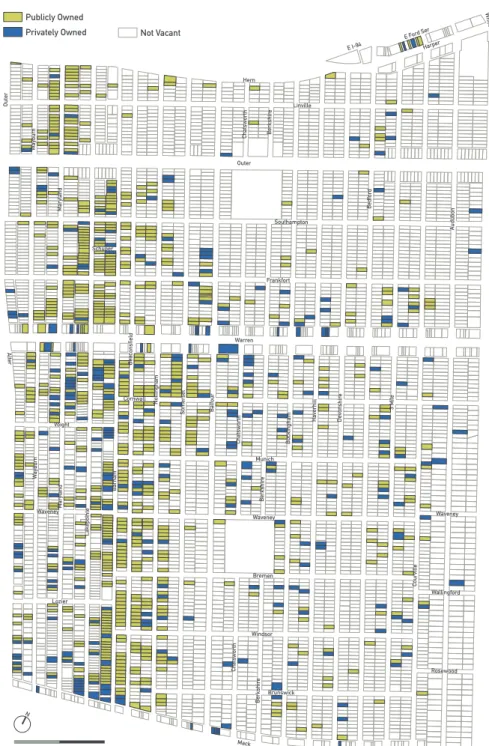
As of January 2015, there were 1,251 vacant lots in MorningSide,7 more than 20 percent of all
parcels in the neighborhood. As Figure 2.12 shows, most of the vacant lots are in the western part of the neighborhood. 1,054 lots are unimproved,8 meaning they show no sign of use or
maintenance; 764 of these are publicly owned.9
The number of vacant lots is likely to increase as many structures are in poor condition. The majority of the publicly-owned deteriorated housing is slated to be demolished. This offers an opportunity to turn these vacant lots into a neighborhood asset (see Section 5).
Publicly Owned
Not Vacant Privately Owned
MORNINGSIDE PROPERTY VACANCY STATUS
3 Mile Balfour Bedfor d E I-94 Barham Courville Audubon Hav erhill Alter Hern Somerset Linville Warren Mack Outer De vonshir e Lak epointe Nottingham Buckingham Frankfort Beaconsfield Cornwall Munich W aybur n Maryland Bremen Southampton Windsor Berkshir e Harper Chats worth Brunswick Outer Lozier Voight E Ford Ser Waveney Rosewood Wallingford Schuper W hittier Chats worth Berkshir e Maryland Chats worth W aybur n Berkshir e Waveney Waveney 0.2 0 0.1 Miles N
Figure 2.12: MorningSide property vacancy status
Source: City of Detroit BSEED, 2015; City of Detroit Planning + Development Department, 2012 a, 2014; Motor City Mapping, 2014. See Appendix A for full citation.
ASSETS
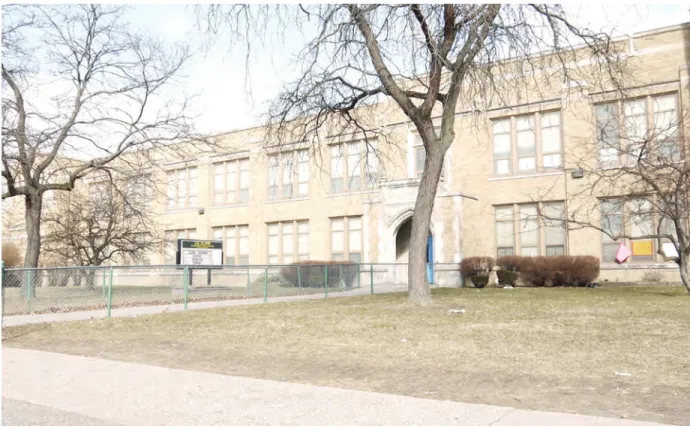
MorningSide is a neighborhood with numerous assets. It has a variety of historic houses, many new homes built by U-SNAP-BAC and Habitat for Humanity Detroit, two elementary schools located within the neighborhood and other strong schools within walking distance.
Many other amenities are accessible, including nine places of worship, five full-service
grocery stores, one farmer’s market, two senior facilities, two hospitals and many restaurants and fast food establishments.10 Moreover, within the neighborhood organizations such as
U-SNAP-BAC, Detroit Habitat for Humanity and the MorningSide neighborhood association work to improve the lives of residents.
Figure 2.15: Typical homes in MorningSide Figure 2.14: Habitat for Humanity Detroit house
EXISTING PLANS
2012 DETROIT STRATEGIC FRAMEWORK PLAN
Every Neighborhood
Has A Future...
Detroit Blight Removal Task Force Plan May 2014
And It Doesn’t
Include Blight
249 DETROIT FUTURE CITY | 2012 U THE LAND USE ELEMENT : THE IMAGE OF THE CITY
G REEN R ES IDE N TI AL TR AD IT IO N A L L OW -D EN SI TY TR AD IT IO NAL M ED IU M-DE N SI TY G REEN MI XED -R ISE NE IG HB O RH O OD L A ND U SE TY PO LOG IES : R ES IDE N TI AL Back to Contents
245 DETROIT FUTURE CITY | 2012 U THE LAND USE ELEMENT : THE IMAGE OF THE CITY
EXISTING DETROIT LAND USE TYPOLOGY EXAMPLES
MIXED-USE TYPOLOGIES
NEIGHBORHOOD CENTER DISTRICT CENTER CITY CENTER LIVE+MAKE
RESIDENTIAL TYPOLOGIES
GREEN RESIDENTIAL LOW-DENSITYTRADITIONAL MEDIUM-DENSITYTRADITIONAL GREEN MIXED-RISE
1. 2. 3. 4.
8. 7.
6. 5.
Image Sources: 1,2) Hamilton Anderson Associates; 3,4) Marvin Shaouni; 5) Hamilton Anderson Associates; 6) Parkerdr, Wikimedia Commons; 7) Marvin Shaouni; 8) Hamilton Anderson Associates
Back to Contents
BLIGHT IS...
...an attractive
nuisance. ...fire damaged or is otherwise dangerous.
...a public nuisance.
...already on Detroit’s BSEED Demolition list. ...has code violations
posing a severe and immediate health or safety threat.
...open to the elements and trespassing.
...has had the utilities, plumbing, heating or sewerage disconnected, destroyed, removed, or rendered ineffective. ...a tax-reverted property. ...owned or is under
the control of a land bank.
DEFINING BLIGHT. The Task
Force’s definition and methodology for classifying property as “blight” incorporates the concepts of physical blight, economic blight, the public’s interest in protecting the health, safety, and general welfare of people in its communities, and the preservation of property values. Michigan law defines a blighted
property as one that meets any
of the following conditions as determined by the applicable “governing body”:
• A public nuisance
• An attractive nuisance (yes, an oxymoron! See below...) • A fire hazard or is otherwise
dangerous
• Has had the utilities, plumbing, heating or sewerage disconnected, destroyed, removed, or rendered ineffective
• A tax-reverted property
• Owned or is under the control of a land bank
• Has been vacant for five consecutive years, and not maintained to code
• Has code violations posing a severe and immediate health or safety threat
Using the State of Michigan’s definition of “blighted property” as a starting point, the Task Force added elements from the Detroit Ordinance governing “dangerous buildings.” The Task Force’s definition includes properties that are:
• Open to the elements and trespassing, and
• On Detroit’s Buildings, Safety Engineering, and Environmental Department (BSEED) Demolition list.
Accordingly, properties that are exposed to the elements, are not structurally sound, are in need of major repairs, are fire damaged, or have essentially been turned into a neighborhood dumping ground, were classified as “blight” by the Task Force. While the Task Force recognizes that there are other aspects that border on any reasonable definition of blight such as graffiti, un-manicured boulevard grass and litter, the scope of this report addresses blight based on the Task Force definition.
DLBA
...has been vacant for 5 consecutive years, and not maintained to code.
1 2 3 4 5
13
CHAPTER 1: INTRODUCTION
12 [ BLIGHT REMOVAL TASK FORCE PLAN]
Detroit Future City Strategic Framework
Detroit Future City Strategic Framework is a comprehensive framework to strategically coordinate, guide and maximize the impact of development efforts. It articulates a vision for Detroit’s future and recommends specific actions for reaching that future.11
Detroit Future City Strategic Framework designates MorningSide a Green Residential area, where the focus is on the use of vacant and underutilized land in response to disinvestment and population loss.
Detroit Blight Removal Task Force Plan
Detroit Blight Removal Task Force Plan was an endeavor by private, philanthropic, nonprofit, federal and state partners together with the city of Detroit to develop a set of recommendations to address the blighted structures in Detroit.12 One of
the task force chairs was Linda Smith, the executive director of U-SNAP-BAC. The recommendations have impacts in MorningSide, primarily through proposed demolitions.
MorningSide also benefits from several existing plans for the neighborhood. This plan seeks
to build on these.
Figure 2.16: Detroit Future City concept illustration of Green Residential
City of Detroit
Neighborhood Revitalization Strategy Areas Plan
THE CITY OF D ETROIT
Housing and Revitalization Department December 31, 2014
Balancing New Technology
COMMITTED TO THE REVITALIZATION OF DETROIT AND ITS NEIGHBORHOODS
I N I T I A T I V E O F D E T R O I T L I S C L E D B Y C O M M U N I T Y L E G A L R E S O U R C E S
Vacant Property Toolbox Second Edition
The City of Detroit Neighborhood Revitalization Strategy Areas Plan
The City of Detroit Neighborhood Revitalization Strategy Areas Plan is an effort to implement the Neighborhood Revitalization Strategy approved by the City of Detroit and to strategically target Community Development Block Grant (CDBG) funds in the five designated Neighborhood Revitalization Strategy Areas (NRSA).13 Part of
MorningSide is in one of the five NRSAs, so it is likely to receive CDBG funds for future projects.
Michigan Community Resources MorningSide and East English Village Neighborhood Stabilization Plan
The Michigan Community Resources MorningSide and East English Village Neighborhood Stabilization Plan, completed in 2011, aims to stabilize the residential areas in these two neighborhoods by reducing vacancy and improving housing conditions.14
In light of the above analysis, the following sections provide recommendations to strengthen the MorningSide neighborhood. The next section discusses strategies to prevent tax foreclosures. Figure 2.18: City of Detroit Neighborhood
Revitalization Strategy Areas Plan
Figure 2.19: Michigan Community Resources MorningSide + East English Village Neighborhood Stabilization Plan
Notes
1. Data Driven Detroit.2009. DetroitResidential PropertySurvey [datafile], received from DataDriven Detroit.
2. RealtyTrac Foreclosure list in MorningSide, Detroit, MI, 2014, accessed from RealtyTrac, accessed February 2015 from http://www.realtytrac.com/mapsearch/mi/ wayne-county/detroit/?address=Detroit%2C%20MI%20&parsed=1&ct=detroit&stc=mi&lat=42.3316802978516&lon=-83.0479965209961.
3. Michigan Board of Realtors, Detroit Board of Realtors Housing Statistics, 2001-2014, accessed January 2015 from http://www.mirealtors.com/Housing-Statistics. 4. Wayne County Treasurer, Detroit Archival Tax Foreclosures 2002-2014 [datafile], received from Data Driven Detroit, 2014.
5. Why Don’t We Own This? 2015, Properties in MorningSide Headed for 2015 Tax Auction As of March 2015 [datafile], received from Loveland Technologies.
6. Motor City Mapping divided structure conditions into four categories—good, fair, poor, suggest demolition; and good means no obvious repairs needed. 7. Ibid.
8. Motor City Mapping, 2014, Property Conditions [datafile], received from Data Driven Detroit.
9. Data Driven Detroit, 2014, Publicly owned property in Detroit [datafile], received from Data Driven Detroit.
10. Michigan Community Resources, “MorningSide and East English Village Neighborhood Stabilization Plan,” 2011, accessed March 2015 from
http://www.mi-community.org/file/VPP---MSEEV---Plan-20110727-sm.pdf.
11. Detroit Future City, Detroit Future City Strategic Framework, 2012, accessed March 2015 from http://detroitfuturecity.com/framework/.
12. Detroit Blight Removal Task Force, 2014, “Every Neighborhood Has a Future, and It Doesn’t Include Blight,” accessed March 2015 from http://report. timetoendblight.org/.
13. City of Detroit Housing and Revitalization Department, “City of Detroit Neighborhood Revitalization Strategy Areas Plan,” 2014. 14. Michigan Community Resources, 2011.
SECTION 3
PREVENT TAX FORECLOSURE
SECTION 3
In MorningSide, tax foreclosures have contributed to the neighborhood’s population decline as residents lose their homes. Each year hundreds of MorningSide’s residential properties face tax foreclosure. This causes more empty homes, which over time are stripped and deteriorate to the point of needing demolition, creating more vacant lots. Addressing this issue and keeping as many residents in their homes as possible is a necessary step in stabilizing the housing market in MorningSide.
Tax foreclosures happen when property owners become several years delinquent on their property taxes and the government takes ownership of their property. Properties in the City of
Detroit that are three or more years delinquent are at risk of being foreclosed and are notified
in the fall prior to the scheduled foreclosure date of March 31. Property owners have until this date to either pay in full all taxes at least three years delinquent to the Wayne County Treasurer or enter into a payment plan. Even after this date, the county allows redemption of the property up until the property is offered at auction in September.
Outlined in this section is a listing of existing programs that can reduce the number of owner-occupants facing foreclosure as well as proposed strategies to lessen the burden of property taxes on MorningSide residents, including ways to reduce the taxes owed and improve the methods for paying property taxes.
INTRODUCTION
STRATEGIES OUTLINE
• Advocate More Convenient Ways for Residents to Pay Property Taxes • Provide One-Stop Shop for All Programs Related to Property Taxes • Encourage Residents to Take Advantage of NEZ Status
• Ensure Property Assessments Reflect Property Values
• Simplify the Property Assessment Appeal Process • Allow Forgiveness for Delinquent Property Taxes • Educate Homebuyers on Fraud and Scam Prevention
Tables 3.1 and 3.2 summarize the programs that are available as of early 2015 to assist homeowners with addressing delinquent property taxes and reducing future property tax bills, respectively. More complete information on each program can be found online at the included web addresses.
EXISTING PROGRAMS
Assistance Program Program Details Program Qualifications Official Information
Distressed Owner Occupancy Extension (DOOE)
Removes property from foreclosure and gives owner until end of calendar year to pay most delinquent year of taxes
Cannot have delinquent taxes more than 3 years old, must be owner occupant of property and must be undergoing hardship (loosely defined) http://www.waynecounty.com/ treasurer/779.htm State Equalized Value Special Payment Agreement (SEV SPA) Reduces maximum delinquent taxes to half of property’s SEV and sets up payment plan with 10% of new value down and monthly payments of about 3% of that value
Must be owner occupant of property with a Principal Residence Exemption (PRE) and must stay current with future taxes and agreed payments to stay in long term payment plan
http://www.waynecounty.com/ treasurer/761.htm Interest Reduction Special Payment Agreement (IRSPA) Reduces interest on delinquent taxes from 18% to 6% and sets up payment plan with 10% of base tax owed down and monthly payments of about 3% of that same base tax
Must be owner occupant of property with a PRE and must stay current with future taxes and agreed payments to stay in long term payment plan
http://www.waynecounty.com/ treasurer/761.htm
Table 3.1: Delinquent property tax deferrals + payment plans
In addition to these programs, United Community Housing Coalition (UCHC) and Michigan
Legal Services provide assistance to residents who are not officially listed as the owner
occupants of their properties and need to deal with probate issues. Such issues are common in the case of residents living in houses that once belonged to their parents or other relatives when the houses were never put in their names or willed to them. These issues must be resolved before residents can qualify for the programs described here. More information on this subject is provided in Figure 3.2.
While all of these programs are available to aid residents in resolving delinquent property taxes and reducing future property tax bills, not all residents are aware of these resources or how to take advantage of them. Other issues also exist with these resources, such as residents’ inability to apply for retroactive poverty exemption and the very short time period in which a property tax assessment can be appealed. The outlined strategies explain how local
Assistance Program Program Details Program Qualifications Official Information
Neighborhood
Enterprise Zone
(NEZ)
Provides an 18-35 percent reduction in property taxes for 6-15 years for properties in an established NEZ
Must have purchased home after Dec. 31 1997, must be owner occupant of property, and must invest a minimum of $500 in the property in 3 years http://www.michigan.gov/ documents/taxes/NEZ_ FAQ_276616_7.pdf Principal Residence Exemption (PRE)
Makes property exempt from a portion of local school operating taxes
Property must be owner’s principal residence and show up as their address on their driver’s license or voter registration card
http://www.michigan.gov/ documents/2368f_2605_7.pdf
Poverty Exemption
Makes property exempt from all property taxes for a year but is not retroactive
Must be owner occupant of property with a PRE, must file a claim each year exemption is sought, must provide income tax returns for all occupants and must meet federal poverty income standards http://www.michigan. gov/documents/treasury/ Bulletin7of2010_322157_7.pdf Disabled Veteran’s Exemption
Makes property exempt from all property taxes for a year but is not retroactive
Must be owner occupant of property with a PRE, must be an honorably discharged veteran or non-remarried surviving spouse and must have been determined as totally disabled or individually unemployable http://www.michigan.gov/ documents/taxes/Disabled_ Veterans_Exemption_ FAQ_082614_466519_7.pdf Appeal of Property Tax Assessment
Has potential to lower property’s SEV which can lead to lower property taxes if taxable value then exceeds SEV
Must file appeal with Property Assessment Board of Review between February 1 and February 15. If not satisfied with decision, can appear before the Board and then contact the Michigan Tax Tribunal
http://www.detroitmi.gov/ How-Do-I/Appeal/Property- Assessment-Appeal-Information
Figure 3.2: Filing a probate case
Source: United Community Housing Coalition, handout at tax foreclosure prevention counseling session, March 2015.
TAX FORECLOSURE PREVENTION PROJECT
FILING A PROBATE CASE
United Community Housing Coalition - Michigan Legal Service
It appears that you may need to file a probate estate. This usually happens when the people living in the home have never transferred the title of the home into the names of the heirs of the last title holder, typically a relative who has passed away. The probate court will eventually provide the heirs with a recordable title to the property in the names of the eligible heirs or devisees (people named in a will). Once you have title, if you also occupy the home, you may be eligible for an extension of time to pay your taxes, or other government assistance.
The probate court process will take several months and usually involves at least 3 court hearings. Once you file a probate case, however, the Wayne County Treasurer may withhold the property from the tax foreclosure court process and may not proceed to auction. Back taxes are still due and must be paid, however and a property might be foreclosed by the Treasurer even if it is in probate. You will be dealing with two cases, one brought by the Treasurer in Circuit Court and one you file in Probate Court. The Tax Foreclosure Prevention Project of the United Community Housing Coalition and Michigan Legal Services will meet with you at our offices to consult with you about your next steps. Due to our limited resources, we are not able to represent you in Probate Court. Please let us know any time your address or telephone number(s) change.
We do not charge for our services, but the Wayne County Probate Court does not waive its fees. In order to begin a probate case, you will need $150 for the filing fee, $12 for a letter of authority, and $80.25 to publish the action if you do not know the addresses of all interested parties +/or if the estate that you are opening is for a person who died less than three years ago. In addition, there will be an inventory fee and some final closing fees needed after you file the case. We will direct you on how, when and where you will have to use the funds.
YOUR APPOINTMENT IN OUR OFFICE IS SCHEDULED FOR: Please bring the following to your appointment:
__________Will (if it exists)
__________Copies of any papers previously filed in any Probate Court dealing with this property (whether or not that case is closed or open)
__________Whatever proof you have that you should be given title to the home you live in, for example: _______Land contract
_______Receipts showing payments to the last owner _______The last recorded deed to the property
(Register of Deeds, 400 Monroe Street, 7th Floor) There is a fee to get a copy
___________Death certificate(s), for anyone who previously owned the property, or had the right to own the property ___________
___________
HEIRS are: Spouse, children, parents of the deceased person.
DEVISEES are: People named to receive benefits in a will who are not heirs
INTERESTED PARTIES: Others who may have an interest in the property, including any creditors of the deceased person.
WE ARE LOCATED AT:
220 BAGLEY, the “Michigan Building”, Suite 900 (on the 9th floor) Michigan Legal Services (313) 964 4130
220 Bagley is located 2 blocks west of Grand Circus Park between Clifford and Grand River, in downtown Detroit You will need to get the value of the house as determined by the Assessor’s Office for the year of the death of the person whose estate is being presented to the Probate Court. There is a $2 fee for this. You can get this information from Room 824 on the “Office Tower” side of the CAYMC on the 8th Floor. Ask the clerk for the “SEV” for the property address for the year of the person’s death.
Also bring with you a list of all known heirs, devisees and interested parties, which includes their names, current addresses and current telephone numbers and their relationship to the deceased person (e.g., “son,” “wife” etc.)
STRATEGIES
ADVOCATE FOR MORE CONVENIENT WAYS FOR RESIDENTS TO PAY PROPERTY TAXES
The City of Detroit is exploring ways that property owners can pay property taxes more
conveniently. As part of this process, city officials are interested in collecting feedback from
residents about what options would be helpful in order to direct their efforts. City residents were surveyed on this issue at three events in the spring of 2015:
• Tax Foreclosure Prevention Workshop at U-SNAP-BAC on March 11
• Tax Foreclosure Prevention Workshop at the Samaritan Center on March 28 • MorningSide neighborhood association monthly community meeting on April 4 Residents were asked if they would be interested in making smaller monthly property tax payments as opposed to the current system of larger semi-annual payments. They were also asked if they preferred any of the following methods of making property tax payments:
• Pay in cash at a nearby location
• Pay in cash at an automated kiosk (like a deposit at an ATM) • Automatic withdrawal from a bank account
• Pay by phone calls, mobile apps or online (requires bank account)
Figure 3.4 summarizes the results of the survey and the questionnaire can be found in
Appendix B. Nearly half of the 66 homeowners surveyed expressed definite interest in having
the option of monthly payments, while only 11 showed no interest. Of the payment options the survey asked about, homeowners showed most interest in paying in cash at a nearby location and paying by phone or online or by using a mobile app. Homeowners were also asked about whether they had applied for NEZ status on their property and the very low number of yes responses emphasizes the importance of encouraging residents who purchased their home after 1997 to take advantage of Neighborhood Enterprise Zone status (described later in this section).
The results of the survey show that City of Detroit officials should further explore the feasibility
of offering the option of monthly property tax payments as well as cash payments at convenient locations across the city and payments by phone or mobile app or online.
Figure 3.4: Summary of results of homeowner survey
MORNINGSIDE RESIDENTS TOTAL RESPONSES: 66 YES: 31 NO: 32 NO ANSWER: 3 YES NO MAYBE DON’T KNOW 30 11 21 4 AUTOMATED KIOSK AUTOMATIC WITHDRAWAL PHONE OTHER IN CASH 22 10 13 28 7 YES NO NOT SURE 5 59 2
PROVIDE ONE-STOP SHOP FOR ALL QUESTIONS RELATED TO PROPERTY TAXES
A single location or website does not exist in the MorningSide neighborhood, or for the City of Detroit, where residents can get answers to their property tax questions. In part because the municipality is responsible for determining assessments and collecting current property taxes and the county is responsible for collecting delinquent property taxes, a resident cannot call on one source to solve all the issues that arise. A consistent message and a location or website where residents can receive answers to their questions are needed. The United Community Housing Coalition (UCHC), United Way for Southeastern Michigan (United
Way), City of Detroit Assessor’s Office and Wayne County Treasurer’s Office are the most
likely organizations to participate in such an effort.1
UCHC’s Tax Foreclosure Prevention Project, in partnership with Michigan Legal Services, assists homeowners of Wayne County with saving their homes from tax foreclosure.2 They
are an advocate for owner occupants and have walk-in hours on Monday, Wednesday and
Friday mornings at their Bagley office. UCHC has also been providing counseling events
in neighborhoods on nights and weekends. With so many residents who are interested in getting a better understanding of how to avoid tax foreclosure, UCHC’s services are in high demand at the beginning of each calendar year. As of early April, UCHC’s tax foreclosure client list for 2015 already consisted of 2,929 individuals.3
In recognition of the increasing number of residents at risk of tax foreclosure in 2015, the United Way got involved in order to better understand the current situation and humanize the tax foreclosure appeal process. They have been working with the Wayne County Treasurer’s
Office, Loveland Technologies, UCHC, and Rock Ventures to notify residents who are at
risk of losing their property, provide volunteers and resources to improve the experience of residents at the Cobo show-cause hearings for hardship delay in tax payments and survey those who attend various property tax foreclosure prevention events across the city. The United Way’s leaders are hoping to develop policy suggestions for Wayne County to revise the process going forward.4
The City of Detroit Assessor’s Office is responsible for providing assessments of properties
in the City of Detroit and collecting current property taxes. In early 2015, the Assessor’s
Office reduced assessments between 5 and 20 percent across the city in order to bring the
assessed value closer to market value.5 The Property Assessment Board of Review hears
appeals to property assessments.
The Wayne County Treasurer’s Office is responsible for collecting delinquent property taxes
and water utility bills that residents owe to the City of Detroit. The staff can assist residents who have delinquent property taxes by signing them up for a stipulated payment agreement.
The Treasurer’s Office announced the extension of the property tax foreclosure deadline by
The following recommends a single location and a website where residents can answer their property tax questions:
Information on websites could be coordinated and current with clear and concise directions on how to resolve
questions and issues resulting from property assessments and taxes:
• UCHC and the United Way could provide more information on their websites, including the forms UCHC provides during its counseling events, as well as a list of phone numbers and addresses to get answers to a variety of questions related to property taxes.
• The Assessor’s Office and Treasurer’s Office could
coordinate their messages and their timelines for property tax-related events. This would enable
residents who are unfamiliar with the process to know which jurisdiction has responsibility for which part of the process. The information could direct residents to the appropriate jurisdiction depending on whether their property taxes are current or delinquent and educate residents on the overall timeline for property tax proceedings.
• All organizations could publicize timely information regarding property tax foreclosure events and other efforts.
Websites
Neighborhood Tax Foreclosure Counseling Centers
UCHC could work with community development corporations, such as U-SNAP-BAC, to staff monthly neighborhood tax foreclosure counseling centers in neighborhoods with many residents at risk of property tax foreclosure. The establishment of a storefront or a
kiosk in an office, within the neighborhood, staffed with
a knowledgeable individual on a regular basis, could point residents in the right direction to get their questions answered or payment plans arranged. Providing a resource for all questions related to property taxes in MorningSide
Northeast Ohio Community and Neighborhood Data for Organizing
(NEO CANDO)
NEO CANDO is a “free and publicly accessible social and economic data system…[that] allows users to access data for the entire 17 county Northeast Ohio region, or for specific neighborhoods within Cleveland.”8
Initially, agencies and organizations were skeptical about releasing their data to this platform even though the information was public; however, now these same agencies and organizations are some of the most active users.9
Data Driven Detroit and Loveland Technologies, with the
support of public sector, non-profit and university partners,
could strengthen their data management presence to provide increased capacity. Data Driven Detroit
“incorporates features of ‘neighborhood data systems’ that have been created in a variety of cities across the country and participate in the National Neighborhood Indicators Partnership.”7 This enables users to better understand the
source of the data and when it was collected. Loveland Technologies has relationships with the United Way,
Assessor’s Office and Treasurer’s Office; however, they
are a private company, and their data management is not as robust, as that of Data Driven Detroit. This causes the user to question the reliability of the data. A combined effort by these two organizations would leverage the data standards embodied by Data Driven Detroit and Loveland Technologies’ existing relationships.
Single Online Data
Repository
could help residents avoid property tax foreclosure. In addition, staff at the new Detroit 0% Home Repair Loans Program intake centers could be trained to provide information to owner-occupants on the property tax payment process.
United Way’s volunteer base and fundraising capacity might help expand a regular schedule of UCHC’s tax
foreclosure prevention events in the first quarter of every
year. This would provide additional aid for residents at risk of property tax foreclosure when a part-time neighborhood
tax foreclosure counseling center may not be sufficient.
Annual First-Quarter Tax Foreclosure Prevention
Updated Websites Neighborhood Counseling Center Online Data
Repository Workshops Task Force
U-SNAP-BAC United Community Housing Foundation United Way Assessor’s Office Treasurer’s Office
Data Driven Detroit
Loveland
Figure 3.5: Partners + strategies
UCHC, United Way, the Assessor’s Office and the
Treasurer’s Office could form a Tax Foreclosure Prevention
Task Force consisting of representatives from each
organization, others as they see fit, to help residents stay
in their homes. While these organizations and others met from September/October 2014 through mid-February 2015, formalizing this effort could ensure its continuation.10
This could include trying new efforts such as having a
representative from the Assessor’s Office present at the Treasurer’s Office during the first quarter of every year to
ensure that residents are aware of all taxes that are due for their property.11 The Mayor’s Office might be a partner
to help organize this effort and bring all parties to the table because of the Mayor’s strong interest in retaining residents.
ENCOURAGE RESIDENTS TO TAKE ADVANTAGE OF NEZ STATUS
The State of Michigan established the Neighborhood Enterprise Zone (NEZ) Program through Public Act 147 of 1992 to provide a tax incentive for the development and rehabilitation of residential housing. The City has designated many NEZs, and the majority of MorningSide is within an NEZ. Being located in an NEZ means that owner occupants or homebuilders or renovators can apply for an 18 to 35 percent reduction in property taxes for up to 17 years if they meet certain criteria (e.g. do major renovations).
There are three types of NEZ Certificates:
• New facility: a new structure or a portion of a new structure that has as its primary
purpose residential housing consisting of one or two units, one of which is or will be occupied by an owner as his or her principal residence. New apartment buildings receive an exemption if they are in the downtown area and have a mixed use purpose.
• Rehabilitated facility: existing structure that has or will have residential units as its
primary purpose. There are specific requirements on the cost and type of improvements
that must be performed.
• Homestead facility: existing residential property that consists of one or two units, one
of which must be occupied as a principal residence, located within a subdivision platted before January 1, 1968. The owner-occupant must have purchased the home after 1997 and commit to making at least $500 in improvements to the property.
For additional detailed information regarding definitions, minimum investments and
application procedures, please see Appendix C. In MorningSide, Habitat for Humanity and
U-SNAP-BAC applied for new facility certificates for their owner-occupied housing projects to
make those houses more affordable.
For MorningSide residents, more relevant certificates are rehabilitated facility and homestead facility certificates. However, among the 2,141 likely owner-occupied structures in
MorningSide as of 2012, only 276 of them had NEZ homestead facility status in 2015 (see Figure 3.6). This means that only about one in eight homeowners have taken advantage of the tax break that is available to them if they purchased their home after 1997.
In NEZ Status
MORNINGSIDE PROPERTIES IN NEZ STATUS
0.2
0 0.1 Miles
N
Figure 3.6: MorningSide Properties with NEZ-Homestead Status
Source: City of Detroit Office of the Assessor, 2014, 2015; City of Detroit Planning + Development Department, 2012 a, 2014. See Appendix A for full citations.
Homeowners with NEZ status pay lower property taxes. An NEZ-H homeowner pays the sum of (1) half the mills for operating purposes for the City of Detroit on the value of the facility, (2) half the mills levied for operating purposes for Wayne County on the value of the facility, (3) the total mills levied for operating purposes for all taxing jurisdictions on the facility except the mills for operating purposes above and (4) the total mills levied by all jurisdictions on the value of the land.12
Properties with an NEZ-homestead facility certificate in MorningSide are in better condition.
As shown in Table 3.7, 98.4 percent of properties with NEZ status are in good condition, while only 92.9 percent of properties without NEZ status are. Also, properties in an NEZ are likely to be more attractive to homebuyers than properties without NEZ status because of the possibility of lower property taxes.
Figure 3.7: Structure conditions for properties in NEZ status versus properties not in NEZ status
Source: Motor City Mapping, 2014; City of Detroit Office of the Assessor, 2014, 2015. See Appendix A for full citations.
WITH NEZ STATUS
HOUSING CONDITION
FAIR
HOUSING CONDITION
GOOD
1,865
WITHOUT NEZ STATUS GOOD FAIR POOR SUGGESTED DEMOLITIONS 276 270 6 1,732 119 11 4
93%
98%
ENSURE PROPERTY ASSESSMENTS REFLECT PROPERTY VALUES
Residential properties in MorningSide have been over-assessed. The average assessor’s view of market value for 2008, 2011, 2013 and 2014 (two times the state equalized value) was computed based on assessor’s data for 2009, 2012, 2014, and 2015 respectively and was compared to the average property sales price (see Section 2).13
Three key observations were drawn from the results in Figure 3.8.
• First, the average assessor’s view of market value has declined from 2008 to 2013, but it has continued to exceed the market value as indicated by warranty deed sales, the most reliable equivalent to sale at full market value.
• Second, the average assessor’s view of market value still likely exceeded the average true market value in 2014 unless the average market value in MorningSide increased by 16.5 percent. Zillow estimated that market values in MorningSide only increased by 4.5 percent from 2013 to 2014, and Trulia estimated that they only increased by 5 percent.14
Figure 3.8: Average assessor’s view of market value + sales price in the MorningSide neighborhood
Sources: Wayne County Register of Deeds, 2008-2013; City of Detroit Office of the Assessor, 2009, 2012, 2014, 2015. See Appendix A for full citations.
0 2008 2009 2010 2011 2012 2013 2014 $10,000 $20,000 $30,000 $40,000 $50,000 $60,000 $70,000 $80,000 $62,510 $42,717 $26,374 $27,734 $30,046 $28,227 $76,556 $49,570 $40,604 $32,934 Assessor’s View of Market Value WD QCD DD AVERAGE HOUSING SALES PRICE IN MORNINGSIDE
• Third, the fact that the average assessor’s view of market value is much higher than DD and QCD sales price reveals that low-value housing is more likely to be over-assessed. A closer examination of the assessor’s view of market value for MorningSide properties in 2008 provides further evidence for this hypothesis. As shown in Figure 3.9, in 2008 the assessor believed that only about 10 percent of the properties in MorningSide were worth less than $30,500. However, comparing the results in Figure 3.9 to sales data for MorningSide properties in 2008 (Figure 3.10) shows that contrary to what the assessor believed, more than 70 percent of the properties sold for less than $30,000 in 2008.
Figure 3.9: Assessor’s view of market value for MorningSide properties in 2008
Source: City of Detroit Office of the Assessor. 2009. See Appendix A for full citations.
Figure 3.10: Sales price for MorningSide properties in 2008
Source: Wayne County Register of Deeds, 2008-2013. See Appendix A for full citations.
0 $500-$10,499 100 200 300 400 500 600 700 800