Revenue Management: Research Overview
and Prospects
JEFFREY I. MCGILL
Queen’s University, School of Business, Kingston, Ontario K7L 3N6, Canada GARRETT J. VAN RYZIN
Columbia University, Graduate School of Business, 412 Uris Hall, New York 10027
This survey reviews the forty-year history of research on transportation revenue management (also known as yield management). We cover developments in forecasting, overbooking, seat inventory control, and pricing, as they relate to revenue management, and suggest future research directions. The survey includes a glossary of revenue management terminology and a bibliography of over 190 references.
I
n the forty years since the first publication on overbooking control, passenger reservations sys-tems have evolved from low level inventory control processes to major strategic information systems. Today, airlines and other transportation companies view revenue management systems and related in-formation technologies as critical determinants of future success. Indeed, expectations of revenue gains that are possible with expanded revenue man-agement capabilities are now driving the acquisition of new information technology [see, for example, GARVEY (1997)]. Each advance in information tech-nology creates an opportunity for more comprehen-sive reservations control and greater integration with other important transportation planning func-tions. There is now a substantial literature of jour-nal articles, technical reports, and conference pro-ceedings describing the practice and theory of revenue management. This paper provides a survey and bibliography of work in this important area.The paper is organized as follows. In Section 1, we outline the history and current nature of the reve-nue management problem and discuss some of the complexities that make solution and implementa-tion so challenging. Secimplementa-tions 2 through 5 contain reviews of revenue management research in four key areas—forecasting, overbooking, seat inventory control, and pricing. Most of this review deals with airline revenue management because the airlines have the longest history of development in revenue
management. In Section 6, we discuss important areas for future research and conclude our review. A glossary of revenue management terminology is pro-vided in an appendix. Terminology used in this sur-vey that can be found in the glossary ishighlighted when first used.
1. REVENUE MANAGEMENT 1.1 Background
We begin with an abbreviated history of revenue management to provide a context for the survey to follow. More detailed accounts of the origins of rev-enue management can be found in BELOBABA
(1987a), SMITH, LEIMKUHLER, and DARROW (1992), CROSS(1995), DUNLEAVY(1995), and VINOD(1995). Before 1972, almost all quantitative research in reservations control focused on controlled overbook-ing.The overbooking calculations depended on pre-dictions of the probability distributions of the num-ber of passengers who appeared for boarding at flight time, so overbooking research also stimulated useful research ondisaggregate forecasting of pas-sengercancellations, no-shows, andgo-shows.Both forecasting and controlled overbooking achieved a moderate degree of success and established a degree of credibility for scientific approaches to reserva-tions control.
In the early 1970s, some airlines began offering restricted discount fare products that mixed
dis-233
Transportation Science 0041-1655 / 99 / 3302-0233 $01.25
count and higher fare passengers in the same air-craft compartments. For example, BOAC (now Brit-ish Airways) offered earlybird bookings that charged lower fares to passengers who booked at least twen-ty-one days in advance of flight departure. This in-novation offered the airline the potential of gaining revenue from seats that would otherwise fly empty; however, it presented them with the problem of de-termining the number of seats that should be pro-tected for late booking, full fare passengers. If too few seats were protected, the airline wouldspillfull fare passengers; if too many were protected, flights would depart with empty seats. No simple rule, like protecting a fixed percentage of capacity, could be applied across all flights because passenger booking behavior varied widely with relative fares, itinerar-ies, season, day of week, time of day, and other factors.
It was evident that effective control of discount seats would require detailed tracking of booking his-tories, expansion of information system capabilities, and careful research and development ofseat inven-tory controlrules. LITTLEWOOD(1972) of BOAC pro-posed that discount fare bookings should be ac-cepted as long as their revenue value exceeded the expected revenue of future full fare bookings. This simple, two fare, seat inventory control rule (hence-forth, Littlewood’s rule) marked the beginning of what came to be calledyield managementand, later, revenue management.In North America, the begin-ning of intensive development of revenue manage-ment techniques dates from the launch of American Airlines’ Super Saver fares in April of 1977, shortly before the deregulation of U.S. domestic and inter-national airlines.
Over the last twenty years, development of reve-nue management systems has progressed from sim-plesingle leg control, throughsegment control, and finally to origin– destination control. Each of these advances has required investment in more sophisti-cated information systems, but the return on these investments has been excellent [see, for example, Smith, Leimkuhler, and Darrow (1992), Cross
(1995)]. In 1999, most of the world’s major air car-riers and many smaller airlines have some level of revenue management capability. Other small air-lines and international airair-lines in newly deregu-lated markets are beginning the development pro-cess.
The success of airline revenue management was widely reported, and this stimulated development of revenue management systems for other transporta-tion sectors and in other areas of the service sector. A sample of related literature is listed in Table I. 1.2 The Airline Revenue Management
Problem
The objective in revenue management is to maxi-mize profits; however, airline short-term costs are largely fixed, and variable costs per passenger are small; thus, in most situations, it is sufficient to seek booking policies that maximize revenues. Also, al-though there is lower risk in accepting a current booking request than in waiting for later possible bookings, booking decisions are repeated millions of times per year; therefore, a risk-neutral approach is justified. All of our discussion in this paper will assume risk-neutral maximization of expected reve-nues as the objective.
Consider the arrival of a booking request that requires seats in an itinerary— one or more flights departing and arriving at specified times, within a specific booking class, at a given fare. The funda-mental revenue management decision is whether or not to accept or reject this booking. DURHAM(1995) reports that a large computer reservations systems must handle five thousand such transactions per second at peak times, thus the decision must be reached within milliseconds of the request’s arrival. Not surprisingly, no current revenue management system attempts full assessment of each booking request in real time. Instead, precomputed aggre-gate control limits are set that will close the system for further bookings of specific types while leaving it open for others. The reservations system can quickly determine the open or closed status of a booking
TABLE I
Revenue Management Research in Non-Airline Service Sectors
Sector References
Automobile rental Geraghty and Johnson (1997), Carol and Grimes (1995)
Broadcasting Cross (1998)
Cruise lines Kimes (1989), Ladany and Arbel (1991), Gallego and van Ryzin (1994) Internet service provision Nair, Bapna, and Brine (1997), Paschalidis and Tsitiklis (1998)
Lodging and hospitality Rothstein (1974), Ladany (1977), Liberman and Yechiali (1977, 1978), Kimes (1989), Bitran and Mondschein (1995), Feng and Gallego (1995), Bitran and Gilbert (1996)
Nonprofit sector Metters and Vargas (1999)
category and report back to an agent or customer without actually evaluating the request.
The accept–reject decision can be restated as a question of valuation: What is the expected displace-ment cost of closing the incredisplace-mental seats in the requested itinerary? To maximize expected reve-nues, the request should be satisfied only if the fare value of the requested itinerary equals or exceeds the expected displacement cost. [See TALLURI and
VANRYZIN(1999b) for an analysis of such displace-ment cost controls.]
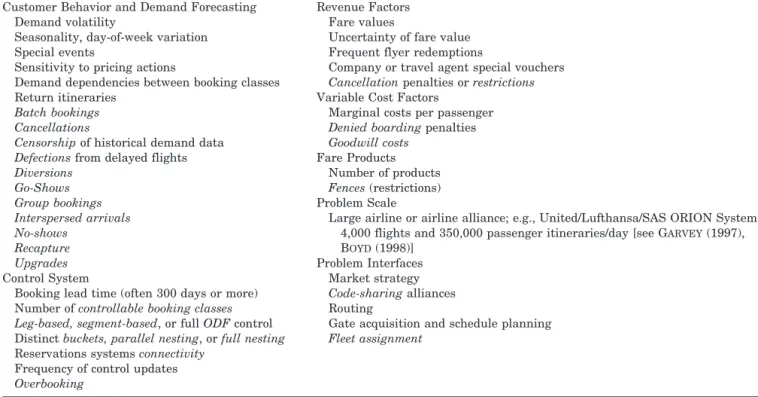
The apparent simplicity of this valuation problem is deceptive—a complete assessment must allow for all possible future realizations of the reservations process that could be influenced by the availability of any of the seats on any of the legs in the booking. Fully traced, this influence propagates across the entire airline network because a booking can dis-place potential bookings that will have subsequent impacts of their own. This influence also propagates forward in time because many affected itineraries will terminate later than the booking being consid-ered. Also, a booking will normally have a return component at a later date with its own set of con-current and downstream effects. Many other factors increase the complexity of the evaluation process. Table II lists some of them.
As can be seen in Table II, the practical
complex-ities of revenue management are daunting—we do not have space here to discuss all of them. As is always true, modeling, theoretical analyses, and im-plementation rely on assuming away many of these complicating factors and approximating others. It is important to remember that such approximations have yielded enormous revenue benefits for airlines and other enterprises.
The performance of a given revenue management system depends, in large part, on the frequency and accuracy of updates to control limits and the number of distinct booking classes that can be controlled. The determination of suitable control limits and characterization of their structural properties over time has been the principal focus of academic re-search, whereas the need for practical and imple-mentable approximations to optimal limits has driven much of the practitioner research.
A readable account of the practical challenges in airline revenue management and related informa-tion systems developments can be found in Secinforma-tions 6 and 7 of JENKINS (1995). Previous research sur-veys of airline operations research and revenue management are available in BELOBABA(1987b) and ETSCHMAIER and ROTHSTEIN (1974). A categoriza-tion of revenue management and more general per-ishable asset revenue managementproblems is pro-vided in WEATHERFORDand BODILY(1992).
TABLE II
Elements of Airline Revenue Management
Customer Behavior and Demand Forecasting Demand volatility
Seasonality, day-of-week variation Special events
Sensitivity to pricing actions
Demand dependencies between booking classes Return itineraries
Batch bookings Cancellations
Censorshipof historical demand data
Defectionsfrom delayed flights
Diversions Go-Shows Group bookings Interspersed arrivals No-shows Recapture Upgrades Control System
Booking lead time (often 300 days or more) Number ofcontrollable booking classes Leg-based, segment-based, or fullODFcontrol Distinctbuckets, parallel nesting, orfull nesting
Reservations systemsconnectivity
Frequency of control updates
Overbooking
Revenue Factors Fare values
Uncertainty of fare value Frequent flyer redemptions
Company or travel agent special vouchers
Cancellationpenalties orrestrictions
Variable Cost Factors
Marginal costs per passenger
Denied boardingpenalties
Goodwill costs
Fare Products Number of products
Fences(restrictions) Problem Scale
Large airline or airline alliance; e.g., United/Lufthansa/SAS ORION System: 4,000 flights and 350,000 passenger itineraries/day [see GARVEY(1997), BOYD(1998)]
Problem Interfaces Market strategy
Code-sharingalliances Routing
Gate acquisition and schedule planning
Graduate theses often contain thorough reviews of past research literature. We are aware of five mas-ter’s theses and twelve doctoral dissertations in rev-enue management or related areas. The master’s theses are those of SA (1987), WILLIAMSON (1988), BOHUTINSKY (1990), SUN (1992), SHAYKEVICH
(1994). The doctoral dissertations are those of ROTH
-STEIN (1968), BELOBABA (1987a), MCGILL (1989), LEE (1990), WONG (1990), WEATHERFORD (1991), WILLIAMSON (1992), CHATWIN (1993), NOONAN
(1993), BOTIMER(1994), LI(1994) and ZHAO(1999). In the following sections, we review revenue man-agement research in four key areas—forecasting, overbooking, seat inventory control, and pricing. Each section contains a listing of references that are relevant to the topic of the subsection and included in the bibliography. For completeness, we have in-cluded published articles, conference proceedings, working papers, industrial technical reports, and graduate theses. We cannot discuss all of the listed works, so limit ourselves to reviewing a subset that are illustrative of the type of work that has been done.
We make no claim to having identified all revenue management publications and regret any omissions. The authors would be delighted to receive copies of or references to any work that has not been in-cluded.
2. FORECASTING
FORECASTING IS ANimportant component of plan-ning in any enterprise; but it is particularly critical in airline revenue management because of the direct
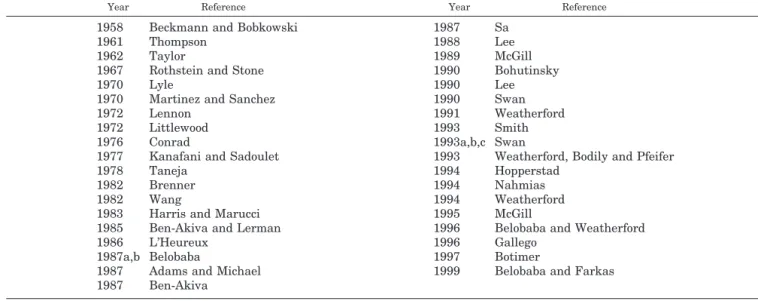
influence forecasts have on the booking limits that determine airline profits. Not surprisingly, publica-tion of approaches to airline forecasting are concur-rent with the literature on overbooking because overbooking calculations depend on predictions of ultimate demand, cancellations, and no-shows. Ta-ble III lists references from the bibliography.
Unfortunately, the disaggregate forecasting re-quired for both overbooking and revenue manage-ment is extremely difficult. The list of passenger behaviors and other complicating factors contained in Table II should make clear the reasons for this difficulty. Simply accounting for the effects of price volatility is a significant challenge in itself—in 1989, there were a reported 30,000 daily price changes in the U.S. domestic airline industry alone [see Wil-liamson (1992, p. 42)].
In the following subsections, we review models for demand distributions, models for arrival processes, uncensoring of demand data, aggregate versus dis-aggregate forecasting, and current practices. 2.1 Models for Demand Distributions
Early descriptions of statistical models of passenger booking, cancellation, and no-show behavior di-rected toward overbooking calculations can be found in BECKMANNand BOBKOWSKI(1958). In that paper, the authors compare Poisson, Negative Binomial, and Gamma models of total passenger arrivals and offer evidence of a reasonable fit for the Gamma distribution to airline data. BECKMANN (1958) uses Gamma distributions to model the components of show-ups and develops an approximate optimality condition for the overbooking level. TAYLOR (1962)
TABLE III
Airline Forecasting Research 1958 –1999
Year Reference Year Reference
1958 Beckmann and Bobkowski 1987 Sa
1961 Thompson 1988 Lee
1962 Taylor 1989 McGill
1967 Rothstein and Stone 1990 Bohutinsky
1970 Lyle 1990 Lee
1970 Martinez and Sanchez 1990 Swan
1972 Lennon 1991 Weatherford
1972 Littlewood 1993 Smith
1976 Conrad 1993a,b,c Swan
1977 Kanafani and Sadoulet 1993 Weatherford, Bodily and Pfeifer
1978 Taneja 1994 Hopperstad
1982 Brenner 1994 Nahmias
1982 Wang 1994 Weatherford
1983 Harris and Marucci 1995 McGill
1985 Ben-Akiva and Lerman 1996 Belobaba and Weatherford
1986 L’Heureux 1996 Gallego
1987a,b Belobaba 1997 Botimer
1987 Adams and Michael 1999 Belobaba and Farkas 1987 Ben-Akiva
determines empirical probability-generating func-tions for booking behaviors that determine show-ups. Allowance is made for single and batch book-ings, cancellations, and go-shows. The generating function is then used to estimate the parameters of a distribution for final show-ups. LYLE(1970)
mod-els demand as composed of a Gamma systematic component with Poisson random errors. This model leads to a negative binomial distribution for total demand, as in Beckmann and Bobkowski (1958), which is then truncated for demand censorship. MARTINEZand SANCHEZ(1970) give a detailed
anal-ysis of booking and cancellation data from Iberia Airlines and discuss a convolution methodology sim-ilar, in part, to Taylor’s approach for obtaining em-pirical demand and cancellation probability distri-butions.
Empirical studies have shown that the normal probability distribution gives a good continuous ap-proximation to aggregate airline demand distribu-tions [see, for example, Belobaba (1987a) and SHLIFERand VARDI(1975)]. Given the central limit theorem and the role of the normal distribution as the limiting distribution for both binomial and Pois-son distributions, this is not surprising. However, many researchers have pointed out that the normal distribution becomes increasingly inappropriate at greater levels of disaggregation. Section 2.4 dis-cusses this more fully.
2.2 Models for Arrival Processes
Many of the references cited above use a model for the stochastic arrival process of individual booking requests to construct distributions of total flight de-mand. In other work that seeks dynamic booking rules, specification of the arrivals process is an es-sential starting point. Examples of stochastic pro-cesses that have been used to model arrivals and the related references are listed in Table IV.
The use of the Poisson process, when appropriate, is useful in dynamic treatments because of the memoryless property of the exponential interarrival
distribution; however, both the homogeneous and nonhomogeneous Poisson processes lead to Poisson cumulative arrival distributions. This is problematic for total demand modeling because thecoefficient of variationof the Poisson distribution is the reciprocal of the square root of the mean. Thus, for example, the coefficient of variation for a booking class with mean demand of 100 would be 0.10 —much lower than the 0.25 to over 1.0 encountered in practice. Fortunately, cumulative arrivals from compound Poisson processes can provide a reasonable fit to the coefficients of variation of real world arrival data. For example, the stuttering Poisson process used by ROTHSTEIN (1968, 1971a) and Beckmann and Bobkowski (1958) is a compound process that allows for batch arrivals at each occurrence of a Poisson arrival event and achieves more realistic variances. 2.3 Uncensoring Demand Data
Data contained in historical booking records are censored by the presence of booking and capacity limits on past demands. SWAN(1990) addresses the downward bias of censoring on late booking data and suggests simple statistical remedial measures. An earlierspill formuladeveloped by Swan has been used for many years by practitioners tounconstrain demand. Lee (1990) presents a detailed stochastic model of passenger arrivals based on a censored Poisson process and develops maximum likelihood methods for estimating the parameters of these models. MCGILL(1995) develops a multivariate mul-tiple regression methodology for removing the ef-fects of censorship in multiple booking classes, and describes a bootstrapping approach to testing for correlations between fare class demands. A treat-ment of censored data in general inventory contexts can be found in NAHMIAS(1994). Smith, Leimkuhler, and Darrow (1992) mention experiments with cen-sored regression at American Airlines, but, as far as we know, there have been no follow-up reports on these experiments.
TABLE IV
Stochastic Process Models for Airline Arrivals 1958 –1999
Arrivals Process Reference
Homogeneous, nonhomogeneous and/or compound Poisson processes
Gerchak, Parlar, and Yee (1985), Alstrup et al. (1986), Lee (1990), Virtamo and Aalto (1991), Stone and Diamond (1992), Sun (1992), Lee and Hersh (1993), Weatherford, Bodily, and Pfeifer (1993), Gallego and van Ryzin (1994), Lautenbacher and Stidham (1999), Subramanian, Lautenbacher, and Stidham (1999), Zhao (1999)
Stuttering Poisson processes Beckmann and Bobkowski (1958), Rothstein (1968, 1971a) Censored Poisson processes Lee (1990)
2.4 Aggregate and Disaggregate Forecasting Traditional regression techniques for aggregate airline forecasting are described in a book by TANEJA
(1978). A more recent account of regression experi-ments with airline data can be found in the master’s thesis of Sa (1987). Sa concludes that use of regres-sion techniques can improve the performance of rev-enue management systems when compared to time series analysis or historical averages. BOTIMER
(1997) discusses the effects of promotional seat sales on forecasting and revenue management.
Williamson (1992) points out that there are thou-sands of potential itineraries across ahub-and-spoke airline network. Some itineraries between major centers are traversed frequently enough that rea-sonable estimates of probabilities for those itinerar-ies can be obtained. Many others are rarely traveled; thus, probabilities for them based on historical data are at or near zero. Unfortunately, taken together, rare itineraries form an important market compo-nent from a revenue standpoint. This is particularly true because their scarcity often reflects the large number of flight legs and correspondingly high rev-enue associated with them. It is unlikely that any way can be devised of predicting the probability of individual rare itineraries. The only recourse is to aggregate such itineraries into larger groups, aver-age their fare values, and seek relative frequencies for the occurrence of any bookings from the group.
Some of the best information on potential book-ings for a given flight is contained in the current booking profiles for the same or similar flights in earlier weeks. The use of such short-term booking information has been discussed by airline practitio-ners: HARRIS and MARUCCI (1983) at Alitalia, L’HEUREUX (1986) at Canadian Airlines Interna-tional, ADAMSand MICHAEL(1987) at Quantas, and Smith, Leimkuhler, and Darrow (1992) at American Airlines. Typical applications use simple smoothing techniques to incorporate partial booking data from related flights at different phases in their booking process.
The doctoral dissertation of Lee (1990) discusses many issues in disaggregate airline demand fore-casting and incorporates censoring in estimation of Poisson models for booking arrival processes.
There has been significant research activity in many disciplines on discrete choice behavior model-ing usmodel-ing, primarily, multinomial logit estimations. A basic reference specifically directed at transporta-tion demand modeling is that of BEN-AKIVA(1987). HOPPERSTAD (1994) discusses the potential of path preference models for detailed prediction of passen-ger behaviors.
GALLEGO(1996) presents a deterministic model of demand behavior under price changes that incorpo-rates diversion and recapture of passengers in dif-ferent booking classes. WEATHERFORD, BODILY, and PFEIFER(1993) incorporate diversion in a stochastic model of booking arrivals for two classes. They use beta functions for the intensity functions of nonho-mogeneous Poisson processes for each class and scale the intensity functions with a Gamma distri-bution for total arrivals.
2.5 Current Practice
Airlines are understandably reluctant to share information about their forecasting methodologies because their revenue management activities are so heavily dependent on accurate forecasting. As far as we know at this time, most disaggregate forecasting systems depend on relatively simple moving average and smoothing techniques augmented with careful analysis of recent booking profiles, as mentioned above. Manual intervention is required on an excep-tion basis for critical markets or to anticipate the impact of changes in prices or other important as-pects of market structure. Regression and time se-ries techniques have proven of some use for forecasts of aggregate demand, but not at the disaggregate level. This mirrors the general state of forecasting methodology in inventory control applications re-ported widely throughout industry.
3. OVERBOOKING RESEARCH
AS DISCUSSED INSECTION 1.1, overbooking has the longest research history of any of the components of the revenue management problem. Table V lists publications in airline overbooking.
Discussions of policy issues relating to passenger overbooking and equitable bumping are found in SIMON (1968, 1972), FALKSON(1969), BIERMANand THOMAS (1975), ROTHSTEIN (1971a, b, 1975, 1985), VICKREY(1972), and NAGARAJAN (1979). These pa-pers are interesting from a historical pa-perspective because they contain suggestions from academic economists, including one Nobel laureate (Vickrey), thatoversoldconditions could be resolved with auc-tions. These suggestions were evidently dismissed as unrealistic by airline managers of the time, but they proved prophetic. The Vickrey paper also con-tains a conceptual description of a multiple fare class reservations system bearing a strong resem-blance to those now in widespread use.
The objective of most of the early technical re-search on airline overbooking was to control the probability ofdenied boardingswithin limits set by airline management or external regulating bodies.
In this setting, an early, nondynamic optimization model for overbooking is that of Beckmann (1958). Statistical models of various levels of sophistication are described by THOMPSON (1961), Taylor (1962), ROTHSTEIN and STONE (1967), Martinez and Sanchez (1970), and Littlewood (1972). An overbook-ing model extended to allow for two fare classes and a two-leg flight is described by Shlifer and Vardi (1975). In part of his Ph.D. dissertation, Belobaba (1987a) discusses the problem of overbooking in multiple fare classes and suggests a heuristic ap-proach to solving the problem. BRUMELLE and MCGILL (1989) present a static formulation of the overbooking problem and show that it is a special case of a general model of the two fare class seat allocation problem. None of these studies allow for the dynamics of the passenger cancellation and res-ervation process subsequent to the overbooking de-cision.
A number of researchers have developed dynamic optimization approaches to the airline overbooking problem and the related problem in the hotel/motel industry. The usual objective in these formulations is to determine a booking limit for each time period before flight departure that maximizes expected rev-enue, where allowance is made for the dynamics of cancellations and reservations in subsequent time periods and for penalties for oversold seats. KOSTEN
(1960) develops a continuous time approach to this problem, but this approach requires solution of a set of simultaneous differential equations that make implementation impractical. Rothstein (1968), in his Ph.D. thesis, describes the first dynamic program-ming (DP) model for overbooking and reviews the results of test runs of the model at American Air-lines. ALSTRUPet al. (1986) describe a DP treatment
of overbooking for a two-class, nonstop flight and describe computational experience with the ap-proach at Scandinavian Airlines. A DP analysis sim-ilar to Rothstein’s but developed for the hotel/motel industry and extended to two fare classes is de-scribed in LADANY (1976, 1977) and LADANY and ARBEL (1991). A control-limit type structural solu-tion to the (one class) hotel overbooking problem is described in LIBERMANand YECHIALI(1977, 1978).
The dissertation of Chatwin (1993) deals exclu-sively with the overbooking problem and provides a number of new structural results. Chatwin’s paper in this issue and CHATWIN(1999b) contain excerpts and refinements based on his dissertation. KARAES
-MANand VAN RYZIN (1998) address the problem of jointly setting overbooking levels when there are multiple inventory classes that can serve as substi-tutes for one another; for example, first class and coach travel service, or compact and full size rental cars.
4. SEAT INVENTORY CONTROL
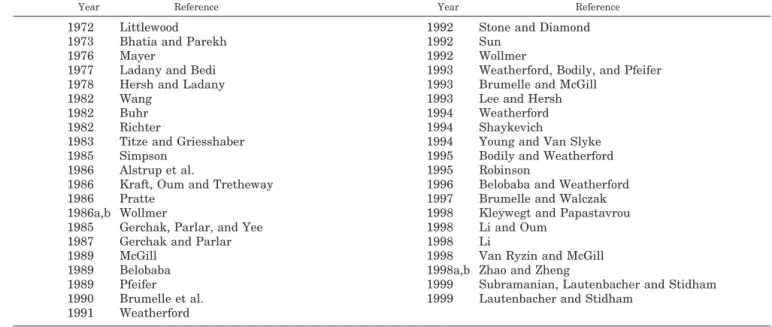
THE PROBLEM OFseat inventory control across mul-tiple fare classes has been studied by many re-searchers since 1972. There is a progression from Littlewood’s rule for two fare classes, to expected marginal seat revenue(EMSR) control for multiple classes, to optimal booking limits for single-leg flights, to segment control and, more recently, to ODF control.Each step in this progression can be viewed as a refinement of the displacement cost valuation discussed in Section 1.2. We review re-search on the single leg and network problems sep-arately below. Table VI list publications on single-leg control.
TABLE V
Overbooking Research 1958 –1999
Year Reference Year Reference
1958 Beckmann 1975 Shlifer and Vardi
1960 Kosten 1979 Nagarajan
1962 Taylor 1983 Ruppenthal and Toh
1964 Deetman 1985 Rothstein
1967 Rothstein and Stone 1986 Alstrup et al.
1968 Rothstein 1987a,b Belobaba
1968 Simon 1989 Alstrup
1969 Falkson 1989 Brumelle and McGill
1971a,b Rothstein 1989 McGill
1972 Andersson 1989 Alstrup
1972 Simon 1993 Chatwin
1972 Vickrey 1995 Dunleavy
1974 Etschmaier and Rothstein 1998 Karaesman and van Ryzin 1975 Bierman and Thomas 1999a,b Chatwin
4.1 Single-Leg Seat Inventory Control
Most early seat inventory control research re-quired most or all of the following simplifying as-sumptions: 1)sequential booking classes; 2) low-be-fore-high farebooking arrival pattern; 3) statistical independence of demands between booking classes; 4) no cancellations or no-shows (hence, no overbook-ing); 5) single flight leg with no consideration of network effects; and, 6) no batch booking.
Littlewood’s rule can be viewed as an early expres-sion of the displacement cost rule for two booking classes under all six assumptions. Derivations of Littlewood’s rule are given by BHATIA and PAREKH
(1973) and, by a different method, RICHTER(1982). MAYER (1976) describes a simulation study of the performance of Littlewood’s rule and offers evidence that, if it is used more than once before flight depar-ture, the rule can perform as well as a more complex DP model in which the low-before-high fare arrival assumption is relaxed. He also suggests that the seat allotment and overbooking analyses can be done independently with little revenue loss. TITZE
and GRIESSHABER(1983) offer additional simulation evidence that Littlewood’s rule is robust to modest departures from the low-before-high fare assump-tion.
Belobaba (1987a) extends Littlewood’s rule to multiple fare classes and introduces the term EMSR for the general approach. The EMSR method does not produce optimal booking limits except in the two-fare case; however, it is particularly easy to implement. McGill (1989) and WOLLMER(1992)
fur-nish evidence that EMSR provides reasonable ap-proximations with typical airline demand distribu-tions. ROBINSON(1995) shows that, for more general
demand distributions, the EMSR method can pro-duce arbitrarily poor results. A later refinement of EMSR, called EMSRb, apparently produces better approximations to optimal booking limits and has been widely implemented. For a description of EM-SRb, seeVAN RYZIN and MCGILL(1998).
Methods for obtaining optimal booking limits for single-leg flights are provided in McGill (1989), CURRY (1990), Wollmer (1992), BRUMELLE and MCGILL(1993). All of these results require
assump-tions 1 through 6. Curry also proposes an approxi-mation for the network problem, a relaxation of as-sumption 5. Brumelle and McGill show that, under all six assumptions, the seat inventory control prob-lem is a monotone optimal stopping probprob-lem (CHOW,
ROBBINS, and SIEGMUND, 1971), and, consequently, thatstatic control limitpolicies are optimal over the class of all control policies for this restricted prob-lem, includingdynamicones. They also characterize optimal booking limits with a set of probability con-ditions that are the same as the EMSR concon-ditions for the first two fare classes but include joint prob-abilities that are lacking from the EMSR method for additional fare classes. Robinson (1995) generalizes the probability conditions to relax the low-before-high fare assumption.
Van Ryzin and McGill (1998) show that, when demand distributions are stationary across multiple flights, the optimality conditions of Brumelle and
TABLE VI
Single-leg Seat Inventory Control 1972–1999
Year Reference Year Reference
1972 Littlewood 1992 Stone and Diamond
1973 Bhatia and Parekh 1992 Sun
1976 Mayer 1992 Wollmer
1977 Ladany and Bedi 1993 Weatherford, Bodily, and Pfeifer
1978 Hersh and Ladany 1993 Brumelle and McGill
1982 Wang 1993 Lee and Hersh
1982 Buhr 1994 Weatherford
1982 Richter 1994 Shaykevich
1983 Titze and Griesshaber 1994 Young and Van Slyke
1985 Simpson 1995 Bodily and Weatherford
1986 Alstrup et al. 1995 Robinson
1986 Kraft, Oum and Tretheway 1996 Belobaba and Weatherford
1986 Pratte 1997 Brumelle and Walczak
1986a,b Wollmer 1998 Kleywegt and Papastavrou
1985 Gerchak, Parlar, and Yee 1998 Li and Oum
1987 Gerchak and Parlar 1998 Li
1989 McGill 1998 Van Ryzin and McGill
1989 Belobaba 1998a,b Zhao and Zheng
1989 Pfeifer 1999 Subramanian, Lautenbacher and Stidham
1990 Brumelle et al. 1999 Lautenbacher and Stidham
McGill (1993) can be exploited in an adaptive sto-chastic approximation method that requires no sep-arate forecasting or uncensoring of demands and no direct reoptimization of protection levels.
LIand OUM(1998) provide a preliminary analysis of the seat allocation problem for two airlines com-peting with identical aircraft and fares on a single-leg route. Their game theoretic formulation demon-strates the existence of equilibrium seat allocations under certain assumptions on the demand distribu-tions.
Belobaba (1987a) proposes an optimality condi-tion for the two fare class problem that allows for the possibility of upgrades from the lower fare class to the higher in the event that the lower class is closed for bookings. PFEIFER(1989) presents a proof of the result. McGill (1989) and BRUMELLE et al. (1990) show that a variant of Littlewood’s rule is optimal for the two fare case when discount and full fare demands are statistically dependent, subject to a mild monotonicity assumption on the nature of the dependency. The upgrade result is obtained as a corollary. They further show that, with the same monotonicity assumption, this problem is a mono-tone optimal stopping problem.
No optimal static control limit policies exist when any assumption other than the low-before-high or independent demand assumptions is relaxed. DP treatments of the single leg problem are presented in Mayer (1976), LADANY and BEDI (1977), STONE
and DIAMOND (1992), Sun (1992), LEE and HERSH
(1993), Shaykevich (1994), YOUNG and VAN SLYKE
(1994), BRUMELLE and WALCZAK (1997, 1998b), ZHAO and ZHENG (1998a), LAUTENBACHER and STIDHAM (1999), SUBRAMANIAN, LAUTENBACHER, and STIDHAM (1999), and Zhao (1999). Space does not permit a review of all of these contributions, and there is some overlap among them. GERCHAK, PAR
-LAR, and YEE (1985) contains the earliest dynamic structural results for this type of problem, but this work is often overlooked because it deals with opti-mal discounting of unsold bagels—a classic example of the generality of revenue management problems. Ladany and Bedi (1977) and HERSH and LADANY
(1978) deal with a two-leg flight; however, we in-clude it as a single-leg model here because their models assume no boarding of passengers at the intermediate stop.
Lee and Hersh (1993) report a generalization of monotonicity results to the batch booking case; how-ever, these results are shown to be in error in Bru-melle and Walczak (1997). Both KLEYWEGTand PA
-PASTAVROU (1998) and VAN SLYKE and YOUNG
(1994) characterize seat inventory control problems as special cases of certain stochastic knapsack
prob-lems. Both address nonmonotonicity of bid-prices (see below) under batch booking.
4.2 Segment and Origin–Destination Control Since the 1980s, network effects in revenue man-agement have become increasingly significant be-cause the expansion of hub-and-spoke networks has dramatically increased the number of passenger itineraries that involve connections to different flights. It has been recognized for some time that revenue management should account for these net-work effects but that this cannot be accomplished effectively with single-leg control. Progress in this area has been impeded not by the lack of approaches to network inventory control so much as by the limitations of older reservations systems. Even if optimal solutions existed for the many hundreds of itineraries that traversed a single leg, those solu-tions had to be mapped into a much smaller number of controllable booking classes. This situation is changing—the most advanced reservations systems are now capable of incorporating network informa-tion, and the emergence ofseamless availabilitywill allow for much finer control of seat availability.
We review, below, four approaches that have been taken to network revenue management. Table VII contains relevant references.
4.2.1 Mathematical Programming Formulations GLOVER et al. (1982) describe a minimum cost network flow formulation for the passenger O–D problem and an implementation at Frontier airlines. Passenger demands are assumed deterministic in this formulation, so the focus of the formulation is on network effects rather than the stochastic elements. DROR, TRUDEAU, and LADANY(1988) propose a sim-ilar deterministic network minimum cost flow for-mulation that allows for cancellations as determin-istic losses on arcs in the network. Wong (1990), in his Ph.D. dissertation, develops a network formula-tion for the single fare class, multiple itinerary prob-lem and extends it to approximations for the multi-ple booking class case. The single fare case and some comparisons of differentcabinassignment methods are discussed in WONG, KOPPELMAN, and DASKIN
(1993). WOLLMER(1986c) proposes a linear program-ming (LP) network formulation that allows for sto-chastic demand by incorporating expected marginal seat values as coefficients in the objective function. Each ODF generates a set of zero– one decision vari-ables for each flight, with a corresponding set of monotonically decreasing objective function coeffi-cients determined by the marginal expected values. Wollmer shows that this formulation can be con-verted to a minimum cost network formulation for
greater efficiency in solution; however, the size of the problem for a typical airline network is ex-tremely large.
One of the drawbacks of these mathematical pro-gramming formulations is that they produce non-nested allocations. The formulations have seen some use for planning purposes but have not been imple-mented for day-by-day seat inventory control. Their main potential seems to be as components of the bid-price approaches that are discussed below.
Curry (1990) describes a combined mathematical programming/marginal analysis formulation for the O–D problem that uses piecewise linear approxima-tions to the revenue function in a linear program that obtains distinct bucket allocations for different O–Ds. The different fare classes for each O–D are then nested, and each O–D nest is separately opti-mized for single-leg, nested booking limits. This ap-proach has been implemented in some revenue man-agement systems.
4.2.2 Segment Control
The earliest implementations of partial O–D con-trol were at the flight segment level. These imple-mentations allow for the revenue value of a multileg itinerary as long as the itinerary does not involve connections between different flights. The motiva-tion for this partial solumotiva-tion to the ODF control problem was the feasibility of exploiting segment-closed indicatorsthat were available in the reserva-tion control system. Descripreserva-tions of these initial de-velopments in O–D control are provided in SMITH
and PENN (1988) and Vinod (1995). The methods available to determine seat/segment allocation rules are similar to those available for the broader O–D control discussed below, so we will defer that discus-sion to there.
4.2.3 Virtual Nesting
The first systems that addressed the broader O–D control problem were developed to accommodate the limited number of controllable booking classes that the CRS provided. Belobaba (1987a), Smith and Penn (1988), Williamson (1988, 1992), and VINOD
(1989, 1995) all outline techniques for clustering ODFs into single-leg booking classes to achieve an approximation to network control. Such methods as-sign ODFs to booking classes on the basis of some measure of their total value to the airline instead of just their fare class. A variety of options are avail-able for the clustering process (often called index-ing), including assignment by total value, assign-ment by estimated leg value (prorated, for example, by leg distance), and assignment by estimated net value after allowance for displacement effects (dual prices from a deterministic network LP). Both Smith and Penn (1988) and Williamson (1988) report on simulation tests of the relative merits of the differ-ent approaches. These two studies reach conflicting conclusions regarding the comparative merits of some of the clustering approaches but agree in the finding that the use of dual prices dominates the other methods.
4.2.4 Bid-Price Methods
Smith and Penn (1988), SIMPSON(1989), and Wil-liamson (1992) incorporate information from LP/net-work models into the detailed accept– deny decision process of seat inventory control. They use dual prices from a deterministic LP model to establish marginal values for incremental seats on different legs in an airline network. Typically, expected de-mands replace random dede-mands as constraints in the LP formulations. The dual prices are summed across legs in a passenger itinerary to establish an
TABLE VII
Origin–Destination Control 1982–1999
Year Reference Year Reference
1982 D’Sylva 1990 Vinod
1982 Glover et al. 1990 Wong
1983 Wang 1991 Phillips, Boyd, and Grossman
1985 Simpson 1991 Vinod
1986a,b Wollmer 1992 Williamson
1987a,b Belobaba 1993 Talluri
1988 Dror, Trudeau and Ladany 1993 Wong, Koppelman, and Daskin
1988 Smith and Penn 1994a,b Talluri
1988 Williamson 1995 Vinod
1988 Wysong 1996 Talluri and van Ryzin
1989 Simpson 1997 Garcia-Diaz and Kuyumcu
1989 Vinod 1999 Ciancimino et al.
1990 Curry 1999a,b Talluri and van Ryzin
approximate displacement cost, orbid-price, for that itinerary. A booking request for a passenger itiner-ary is rejected if the bid price exceeds the fare for the itinerary, and is accepted otherwise. Thus, this ap-proach attempts to directly incorporate the esti-mated displacement cost as a cutoff value for accept-able fares.
The disadvantages and advantages of this ap-proach are discussed in Williamson (1992) and Smith and Penn (1988). A more recent account from a managerial viewpoint can be found in Vinod (1995). Despite potential theoretical drawbacks to the bid-price approach, it has a very convincing ad-vantage—it replaces multiple booking limits and complex nesting schemes with a single bid-price value for each flight leg and a simple rule for reject-ing or acceptreject-ing itinerary requests.
5. PRICING
THERE IS AN EXTENSIVEliterature on airline pricing from an economic perspective that we cannot review here. For the most part, that literature deals with pricing and price competition at an industry level rather than the operational, revenue management decision level. This literature is nonetheless rele-vant to strategic and marketing decisions that are important in revenue management. We discuss here a few examples. Table VIII contains a listing of some relevant articles.
KRETSCH (1995) describes fare management pol-icy from a managerial standpoint. DANA(1998) ex-plains price dispersion as a competitive market re-action to consumers’ uncertainty about travel and the risk of rationing due to capacity constraints. The work explains how airline pricing, which looks like classic second-degree monopoly price discrimina-tion, can, in fact, be the result of a perfectly compet-itive market. DANA (1996) shows that a firm that offers high and low prices and then rations the ca-pacity sold at the low price, as is done in yield
management practice, is in a unique competitive equilibrium. BORENSTEIN and ROSE (1994) provide empirical tests of airline competition and its rela-tionship to the degree of price dispersion observed in fares. They also address the question of whether price dispersion is the result of monopoly or second-degree price discrimination. OUM, ZHANG, and
ZHANG(1993) and OUM (1995) deal with aspects of pricing in deregulated airline markets and the in-fluence ofcode-sharingagreements on international fares.
It is now common for airline practitioners to view pricing as part of the revenue management process. The reason for this is clear—the existence of differ-ential pricing for airline seats is the starting point for revenue management, and price is generally the most important determinant of passenger demand behavior. There is also a natural duality between price and seat allocation decisions, as pointed out in GALLEGOandVANRYZIN(1997). If price is viewed as a variable that can be controlled on a continuous basis, a booking class can be shut down by raising the price sufficiently high. Also, when there are many booking classes available, shutting down a booking class can be viewed as changing the price structure faced by the customer. Treatments of rev-enue management as a dynamic pricing problem can be found in Ladany and Arbel (1991), GALLEGOand
VANRYZIN(1994, 1997), FENGand GALLEGO(1995), and YOU(1999).
The single-leg revenue management problem with two fare classes is essentially equivalent to the much-studied single period inventory ornewsvendor problem. Thus, research on pricing in the single-period inventory setting has some relevance to rev-enue management. LAU and LAU (1988) provide a joint pricing/inventory control analysis for the news-vendor problem. A more general treatment of price, capacity, and technology decisions for profit maxi-mizing firms is provided in GAIMON(1988).
TABLE VIII
Pricing Research 1971–1999
Year Reference Year Reference
1971 Kostyrsky 1994 Gallego and van Ryzin
1981 Dolan and Jeuland 1994 Inzerilli and Jara-Diaz
1984 Reibstein and Gatignon 1994 Li
1988 Lau and Lau 1995 Kretsch
1990 Oram 1995 Oum
1991 Weatherford 1995 Feng and Gallego
1991 Carpenter and Hanssens 1996 Dana
1993 Oum, Zhang, and Zhang 1996 Gallego
1994 Borenstein and Rose 1997 Gallego and van Ryzin
1994 Botimer 1998 Dana
There has been very little published research on joint capacity allocation/pricing decisions in the rev-enue management context. Botimer (1994), in his doctoral dissertation, uses a model for unrestricted demand for airline seats to derive the demand func-tions for restricted fare products by incorporating the cost of restrictions to passengers. He also con-siders modifications to allow for passenger diver-sions. Li (1994) proves that it is optimal to offer relatively small numbers of fare classes (three in one case, four in another) when the restrictions applied to differentiate the fare classes satisfy certain regu-larity conditions. WEATHERFORD (1994) presents a formulation of the simultaneous pricing/allocation decision that assumes normally distributed de-mands, and models mean demand as a linear func-tion of price. The corresponding expressions for total revenue as a function of both price and allocation are extremely complex, and no structural results are obtained. Computational results from a variety of test problems are supplied along with general com-ments on when inclusion of prices as decision vari-ables justifies the greater computational effort re-quired.
Recent work by Gallego (1996) uses a simple de-terministic model to examine pricing and market segmentation decisions. His model takes into ac-count both demand diversion and demand recap-ture. He gives precise conditions to guarantee the optimality of low to high pricing and lower and up-per bounds on the optimal revenue.
6. CONCLUSION AND RESEARCH PROSPECTS
RESEARCH AND DEVELOPMENT of revenue manage-ment systems is far from over. We close our survey with some suggested directions that future research may take in four areas—forecasting, dynamic pro-gramming, ODF revenue management, and systems integration.
6.1 Forecasting
It is difficult to be optimistic about breakthroughs in airline disaggregate forecasting because of the slow progress of effective forecasting technology in less complex areas elsewhere in industry. Nonethe-less, a need for reliable airline demand forecasts at increasingly disaggregate levels will parallel in-creases in sophistication of ODF revenue manage-ment systems. The most promising direction for im-provement of airline forecast accuracy is in detailed empirical studies of the behaviors of different pas-senger types in response to changes in fare product offerings. Tracking of individual behavior of passen-gers who fly frequently could lead to improved
pre-diction of cancellation and no-show behavior in dif-ferent passenger categories. Smith, Leimkuhler, and Darrow (1992) discuss the potential of discrete choice modeling [see, for example, BEN-AKIVA and LERMAN(1985), Lee (1990)]. Much work remains to be done—the potential benefits of sharper forecasts certainly justify substantial investments in forecast-ing methodology and market analysis.
6.2 Implementable Dynamic Programming Approaches
Dynamic formulations of the revenue manage-ment problem are required to properly model real-world factors like cancellations, overbooking, batch bookings, and interspersed arrivals. Unfortunately, DP formulations, particularly stochastic ones, are well known for their unmanageable growth in size when real-world implementations are attempted. Usually, the only hope for dynamic optimization in these settings lies in identification and exploitation of structural properties of optimal or near optimal solutions. Knowledge that an optimal solution must be of a control-limit type or be represented by a monotonic threshold curve can be invaluable in de-velopment of implementable systems. The existing literature has already identified such structures in special cases of the revenue management problem; however, there are difficult areas still requiring work. The inclusion of batch bookings, which influ-ences the regularity properties required for existing structural results, is a particularly critical area for research— batch bookings are common in airline reservations. The work of Young and Van Slyke (1994), Brumelle and Walczak (1997), and Kleywegt and Papastavrou (1998) provide reference points for this line of research.
It seems unrealistic at this time to imagine that exact DP algorithms could be used for real-time revenue management in the airline industry. How-ever, DP can be used in two important ways: first, on an exception basis for flight or network segments that are identified as being particularly critical, and second, as a calibration tool for checking the perfor-mance of less accurate but more efficient solution methods.
Recently developed approximation methods for DP and stochastic programming may be useful in revenue management. Good references for these ap-proximation methods are the books by BERTSEKAS
and TSITSIKLIS (1996) and BIRGE and LOUVEAUX
(1997).
6.3 ODF Revenue Management
Bid-price methods appear to be the most promis-ing method for the ODF revenue management
prob-lem because they are simple to impprob-lement, and there is empirical evidence that they lead to in-creased revenues for airlines. However, at present, it is not known how close the total dual prices are to the true expected displacement costs of booked seats in an itinerary in a large airline network. One sur-prising finding is how well the deterministic dual price approach appears to work despite its obvious drawbacks. Talluri and van Ryzin (1999) provide a number of findings on the accuracy (and potential inaccuracies) of the bid-price technique and furnish some simple counterexamples to its optimality. There is room for further analysis of this approach. A particularly interesting question is how bid prices can be applied to the common batch and group booking problems. For example, even if we assume that the sum of the dual prices along an itinerary are approximately equal to the displacement cost for one seat, it is unlikely that the displacement cost of a batch booking for the same itinerary will be a simple multiple of the individual displacement costs. Assuming that the suitability of bid-prices can be verified, there is an interesting computational chal-lenge in increasing the speed with which the dual prices can be updated. Is it possible to accomplish near real time reoptimizations of the LP model so that dual prices reflect the latest information on fares and bookings in the network?
As mentioned in Williamson (1992), one useful by-product of the dual-price calculation is the iden-tification of flights with unusually high dual prices. Such flights correspond to bottlenecks in the airline network. There is a direct analogy here with the concept of bottleneck in the manufacturing indus-try— bottleneck flights can constrain flows through major segments of the airline network and should be managed intensely. In the industrial setting, the recommended treatment for bottlenecks is: 1) to ex-pand their capacity if possible, and 2) ensure maxi-mum use of the bottleneck by placing buffer inven-tory in front (and sometimes behind) the bottleneck. In the airline setting, the bottleneck capacity can be increased by assignment of more or larger aircraft, and the buffer inventory can be achieved with over-booking. The interesting research question is how to systematically incorporate bottleneck dual price in-formation into overbooking and fleet assignment processes. BERGEand HOPPERSTAD(1993) offer evi-dence that there is significant revenue potential in dynamic fleet assignment.
6.4 Integration with Other Planning Functions
Revenue management decisions are highly inter-dependent with decisions made in other key areas of
airline planning; in particular, pricing, fare product design, fleet assignment, and route planning. For example, although pricing and fare restriction deci-sions occur at a much slower rate than seat inven-tory control decisions, the revenue impact of a pric-ing decision is ultimately determined at the seat allocation level, thus there is a clear need for inte-gration of these two decision processes. Also, as dis-cussed above, dual prices at the seat inventory level are relevant to fleet assignment decisions. They are also relevant to longer-term route planning and market development decisions. [See, for example, DOBSONand LEDERER(1993).] Each of these differ-ent decision levels presdiffer-ent significant theoretical and computational challenges. Mathematical pro-gramming and other optimization techniques have been developed for each of them, but these formula-tions typically treat the problems in isolation.
There is emerging the prospect of an integrated hierarchy of decision systems in which decisions and information obtained at one level are smoothly available to other levels. There are a number of interesting associated research questions. Is there a natural problem/subproblem structure for such an integrated planning system that can exploit decom-position techniques from network optimization and mathematical programming? What information should be exchanged? How frequently? What is the reliability and stability of such a system? There are other areas of interest to revenue management prac-titioners and researchers; for example, the long-term implications of ticket sales or auctioning through the Internet.
It is clear that revenue management will continue to generate interesting applications and research questions for years to come. We hope that this sur-vey will serve as a stimulus for future research in this challenging and important area.
APPENDIX
REVENUE MANAGEMENT GLOSSARY
WE PROVIDE HERE a glossary of the sometimes-con-fusing terminology of revenue management. Our aim in supplying a separate glossary is to avoid needless definitions for readers familiar with reve-nue management while assisting others who are new to the field. Many of the terms described here have different meanings in more general contexts but are presented here with their usual meanings in revenue management.
Aggregation of demand:The level of summariza-tion of passenger demand data. The trend has been toward increasing levels of disaggregation in seat
inventory optimization; however, pricing, forecast-ing, and booking control processes often operate at different levels of aggregation. Possible dimensions for disaggregation include: market, season, month, week, section of week (e.g., midweek versus week-end), day of week, time of day,flight number, book-ing class, fare,flight leg, segment, and itinerary. Arrival pattern:The pattern of arrivals of booking requests. In the airline context, some possible ar-rival patterns are: sequential booking classes, low-before-high fares, orinterspersed arrivals.
Batch booking:(alsomultiple booking, orbulk ar-rival) A booking request that arrives through nor-mal reservation channels for two or more seats to be booked for the same itinerary. Contrast withgroup bookings.
Bid price:A net value (bid-price) for anincremental seaton a particular flight leg in the airline network. Also referred to asminimum acceptable fare, hurdle price, probabilistic shadow price, displacement cost, or probabilistic dual cost.
Bid price control: A method of network seat in-ventory control that assesses the value of an ODF itinerary as the sum of the bid-prices assigned to individual legs in the itinerary. Typically, an ODF request is accepted if its fare exceeds the total bid-prices. Also referred to ascontinuous nesting. Booking class: A category of bookings that share common features (e.g., similar revenue values or restrictions) and are controlled as one class. This term is often used interchangeably withfare classor bucket.
Booking limit:The maximum number of seats that can be sold to a particular booking class. Innested booking systems, booking limits apply to the total number of seats sold to a particular booking class and any lower fare booking classes.
Booking policy: A booking policy is a set of rules that specify at any point during the booking process whether a booking class should be open. In general, such policies may depend on the pattern of prior demands or be randomized in some manner and must be generated dynamically as the booking pro-cess unfolds for each flight. In some circumstances, optimal or approximately optimal booking policies can be defined by a set of fixedprotection levels or threshold curves.
Buckets: This term is used in two related ways. First, in older reservations systems, seats for differ-ent fare classes or groups of classes are pre-assigned to distinct buckets. These seats are available
exclu-sively to bookings in that fare class. This method simplifies reservations control but is clearly unde-sirable from a revenue standpoint because seats could fly empty in a discount bucket even if there is higher fare demand available to fill them. Second, buckets also refer to clusters of different fare classes or ODFs that are grouped together for control pur-poses in avirtual nestingsystem. A single booking limit is set for all classes in the bucket or lower value buckets.
Bulk arrival:Seebatch booking. Bumping:See denied boarding.
Cabin: The physical compartment of an aircraft containing a particular type of seating. For example, an aircraft may be equipped with a first class cabin and a coach cabin, each with different seating and separated by a partition. Multiple fare classes are usually available in each cabin of the aircraft. Cancellations: Returns or changes in bookings that occur early enough in the booking period to permit subsequent rebooking through the reserva-tions system.
Censorship of demand data:Typically, no record can be kept of booking requests that occur after a fare class is closed down. Thus, in booking histories, the number of flights on which demand reached a booking limit can be determined but not the amount by which demand exceeded the limit. Formally, this condition is known as multiple Type I censorship of the data—the censorship points are known (booking limits), but may vary between observations (flights). Code-sharing: It is now relatively common for small groups of domestic and international airlines to form alliances in which the members interlist some or all of their flights. The two character airline designator code from one airline is applied to flight numbers of other alliance airlines so that there is an apparent expansion of participating airlines’ net-works.
Coefficient of variation:The standard deviation expressed as a proportion of the mean of a probabil-ity or relative frequency distribution. Thus a de-mand distributionwith mean demand 100 and stan-dard deviation 40 would exhibit a coefficient of variation of 0.40. Airline demand data typically dis-play coefficients of variation in the range 0.25 to over 1.0, depending on the level of aggregation of the data.
Connectivity (in reservations systems):The de-gree to which the elements of the reservations
sys-tem are electronically interconnected. See seamless availability.
Continuous nesting:(seebid-price control) Controllable booking classes: All early reserva-tions systems and many existing systems offer only a small number of distinct booking categories (five to ten) that can actually be controlled at booking out-lets. Thus, regardless of the number of booking classes or distinct passenger itineraries that can be handled by the revenue management optimization process, the controls in such systems can only be applied to a small number of aggregate booking classes or buckets.
Control limit policy: A structural solution that specifies an upper bound (limit) on the number of seats sold in each fare class (or collection of fare classes) for each time before flight departure. CRS:Computer reservations system.
Defections:It can occur that a confirmed passenger who shows up for a flight switches to a flight with another airline (usually because of a delay in the original flight departure). Defections constitute a relatively small component of lost passengers and are normally counted as part of no-shows. However, they are distinct from no-shows, and any attempt to predict their occurrence requires an estimation of the probability distribution for departure delays. Demand distribution:An assignment of probabil-ities (probability distribution) to each possible level of demand for a flight or booking class. A prelimi-nary estimate of such a demand distribution can be obtained by calculating the proportion of each de-mand level seen on comparable past flights; i.e., a relative frequency distribution.
Demand factor:The ratio of demand over capacity for a flight or booking class. (Contrast with load factor.)
Denied boarding:Turning away ticketed passen-gers when more passenpassen-gers show-up at flight time than there are seats available on the flight, usually as a result of overbooking practices. Denied board-ings can be eithervoluntary, when passengers ac-cept compensation for waiting for a later flight, or involuntary, when an insufficient number of pas-sengers agree to accept compensation. In the latter case, the airline will be required to provide compen-sation in a form mandated by civil aviation law. Disaggregate:Seeaggregation of demand.
Displacement cost: In revenue management, the displacement (or opportunity) cost of a booking
in-cludes all future revenues that may be lost if the booking is accepted. Taken to the extreme, these include the revenue value of potential displaced fu-ture bookings anywhere in the airline network and goodwill costs from those displacements. Assess-ment of the costs and probabilities of such displace-ments should allow for the dynamics of cancellations and overbooking and the expected costs of oversold conditions.
Diversion:The booking of a customer at a fare level lower than one they would have been prepared to pay. This occurs, for example, when a business trav-eler has sufficient advance notice of a trip to book in a discount class intended primarily for leisure trav-elers.Restrictionsare designed to inhibit such diver-sion.
Dual prices (also shadow prices):The marginal value of one additional unit of a constrained re-source, as determined by a mathematical program-ming solution to an optimization model. Dual prices are one source of the marginal seat values used in bid-price control.
Dynamic models: Models that take into account future possible booking decisions in assessing cur-rent decisions. Most revenue management problems are properly modeled as dynamic programming problems.
Expected marginal seat revenue (EMSR): The expected revenue of an incremental seat if held open. This is a similar concept to that of bid-price but generally used in a simpler context.
Expected revenue: The statistical expected reve-nue; that is, the sum of possible revenue values weighted by their probabilities of occurrence. Fare basis code: An alphanumeric encryption of the conditions and restrictions associated with a given fare. Usually several fare basis codes are con-tained in a single fare class.
Fare class:A category of booking with a (relatively) common fare. Typical labels for such classes [see Vinod (1995)] are: F for first class (separate com-partment);Jfor business class,Ufor business class frequent flyer redemption (often separate compart-ment);Yfor full fare coach;B,M,Q,Vfor progres-sively more discounted coach bookings; and T for frequent flyer coach cabin redemptions. Often other fare products (such as travel agent or company trav-elers) are categorized under one of these designa-tions for control purposes.
Fare product:The full set of attributes associated with a specific transportation service. The set
in-cludes the fare as well as any restrictions or benefits that apply to that service at that fare.
Fences:Seerestrictions.
Fleet assignment:Most airlines have a variety of aircraft types and sizes in their fleets. The fleet assignment process attempts to allocate aircraft to routes in the airline network to maximize contribu-tion to profit. There are strong potential linkages between fleet assignment and revenue management processes because aircraft assignments determine leg capacities in the network.
Flight leg:A section of a flight involving a single takeoff and landing (or no boarding or deplaning of passengers at any intermediate stops). Alsoleg. Flight number:A numeric or alphanumeric label for a flight service that involves (generally) a single aircraft departing from an origin airport, possibly making additional scheduled stops at one or more intermediate airports, and terminating at a destina-tion airport.
Full Nesting:Seenested booking.
Global distribution system (GDS): Computer and communications systems for linking booking lo-cations with the computer reservation systems of different airlines. Examples are SABRE, Galileo, and Amadeus.
Goodwill costs:An airline’s rejection of a booking request can affect a customer’s propensity to seek future bookings from that airline. This cost is diffi-cult to assess but is considered particularly acute in competitive markets and with customers who are frequent air travelers. An approximate assessment of the cost of a permanently lost customer is the expected net present value of all future bookings from the customer minus the opportunity costs of those bookings.
Go-show: Passengers who appear at the time of flight departure with a valid ticket for the flight but for whom there is no record in the reservation sys-tem. This no-record situation can occur when there are significant time lags in transferring booking in-formation from reservations sources (e.g., travel agent’s offices) to the CRS or when there are trans-mission breakdowns.
Group bookings: Bookings for groups of passen-gers that are negotiated with sales representatives of airlines; for example, for a large group from one company travelling to a trade show. These should be distinguished from batch bookings.
Hub-and-spoke network: A configuration of an airline’s network around one or more major hubs that serve as switching points in passengers’ itiner-aries to spokes connected to smaller centers. The proliferation of these networks has greatly increased the number of passenger itineraries that include connections to different flights.
Hub bank: A collection of inbound and outbound flights that are scheduled to arrive or depart within a time span that enables convenient passenger con-nections among flights. An airline hub will typically operate with several hub banks throughout the day. Incremental seat: One additional seat, given the number of seats already booked.
Independence of demands:The assumption that demands in one customer category (e.g., booking class or ODF) are statistically independent of de-mands in other categories. It is widely believed that this assumption is not satisfied in practice. See, for example, Hopperstad (1994).
Indexing:The process of assigning individual ODF categories to virtual nesting buckets. Smith, Le-imkuhler, and Darrow (1992) provide details. Interspersed arrivals:Characteristic of an arriv-als process in which booking requests in different booking classes do not arrive in any particular order. (Compare with sequential booking classes.)
Itinerary:For purposes of this paper, an itinerary is a trip from an origin to a destination across one or more airline networks. A complete specification of an itinerary includes departure and arrival times, flight numbers, and booking classes. The term is used ambiguously to include both one-way and round-trip travel. That is, used in the first way, a round-trip involves two itineraries and, in the sec-ond way, one itinerary.
Leg:See flight leg.
Leg based control: An older, but still common, method of reservations control and revenue manage-ment in which limits are set at the flight leg level on the number of passengers flying in each booking class. Such systems are unable to properly control multilegtraffic, although virtual nesting provides a partial solution.
Littlewood’s rule:This simple two-fare allocation rule was proposed by Littlewood (1972). Given aver-age high faref1, average discount fare f2, random full fare demand Y, and s seats remaining, Little-wood’s rule stipulates that a discount seat should be sold as long as the discount fare equals or exceeds