2351-9789 © 2015 The Authors. Published by Elsevier B.V. This is an open access article under the CC BY-NC-ND license (http://creativecommons.org/licenses/by-nc-nd/4.0/).
Peer-review under responsibility of AHFE Conference doi: 10.1016/j.promfg.2015.07.185
Procedia Manufacturing 3 ( 2015 ) 1109 – 1116
ScienceDirect
6th International Conference on Applied Human Factors and Ergonomics (AHFE 2015) and the
Affiliated Conferences, AHFE 2015
Taking the bait: a systems analysis of phishing attacks
David Lacey, Paul Salmon, Patrick Glancy
Centre for Human Factors & Sociotechnical Systems, University of the Sunshine Coast, PO Box 7078, Sippy Downs QLD Australia 4556
Abstract
Phishing attacks are a common feature of online communications. Phishing attacks impact many actors, from individual victims to the corporate and government agencies whose brands are deceptively used. Responding to phishing is big business, driving software security markets, influencing eCommerce uptake and participation, and protecting corporate brand and image. Yet despite its insidious nature and the penetration of phishing throughout online communications, little is known regarding phishing attacks and their responses. This paper is a response to this key knowledge gap, analyzing the tasks and mapping the social interactions of a phishing attack and the associated response. To achieve this, the research team adopted a multi-method approach in examining the underlying functions and interactions involved in a phishing attack and its response by deliberately ‘taking the phishing bait’, interviewing a sample of individuals that had unwittingly responded to phishing attacks, and engaging with organisations that took response measures to such events. This multi-actor engagement provided critical observations and content about the victim experience and interactions with those responsible for the attacks. The research is highly novel in its application of Work Domain Analysis (WDA) to gain an understanding of the functional structure of phishing attacks and the online transactional environment they target as a sociotechnical system. By examining the functional properties of interactions within the research context, the paper provides a unique perspective of phishing and the inter-linkages and dependencies across multiple levels of abstraction from the initial ‘baiting’ to the achievement of overall system objectives by cybercriminals. The findings provide opportunities to enhance phishing prevention and detection methodologies, improve individual resilience to such attacks, and pave the way for future efforts in applying sociotechnical systems methods to the cybercrime environment.
© 2015 The Authors. Published by Elsevier B.V. Peer-review under responsibility of AHFE Conference.
Keywords: Phishing; Sociotechnical systems; Work domain analysis (WDA); Cybercrime; Identity theft
1.Introduction
Phishing as a means to illegally compromise personal information and facilitate its misuse continues to grow in prevalence and sophistication. In 2014 there were more than 120,000 unique phishing attacks worldwide that purported to represent a specific brand or entity, culminating in billions of email transmissions [1]. For the month of
© 2015 The Authors. Published by Elsevier B.V. This is an open access article under the CC BY-NC-ND license (http://creativecommons.org/licenses/by-nc-nd/4.0/).
January 2015, PhishTank, a public anti-phishing reporting service operated by OpenDNS, received in excess of 35,000 validated phishing domains [2]. Symantec estimates that one in every 392 emails communicated worldwide during 2013 were phishing emails, with login credentials for online accounts the primary information target [3]. Whilst there may be financial incentives to overstate or dramatize the threat by some within the information security industry, there is little doubt that phishing continues to present an enduring threat to consumers, firms and government from when it was first identified as a threat to online communications over twenty years ago [4].
In its basic form, phishing combines social engineering and complex attack vectors to create an illusion or deception in the eyes of the email recipient that the legitimacy of what is being offered or asked is not only truthful, but persuasive enough to prompt an action by the recipient in some form. The action may vary, and is almost entirely directed at acquiring or gaining access to personal information. It is this very engagement that is critical for a phishing event to lead to the compromise of personal information and credentials, most typically payment information [3]. Thus the phishing environment is a complex system, one that involves multiple actors, dependent on human computer interaction to either attain or protect the information sought after.
It is also an environment where variants of the phishing methodology draw in legitimate organizations, those that have their brand associated with phishing email content. Not all phishing involves the impersonation of brands. Some phishing emails may simply focus on inheritance offers or lottery winnings. Others, however, direct the bait towards customers of legitimate brands, for example taxation or revenue departments, postal services, online payment system providers and financial institutions. The legitimate brand owner may have no knowledge that their brand is being used to facilitate deceptive conduct. Knowledge transfer between a detecting party and the legitimate corporate or government brand owner may be latent, and for potentially successful criminal endeavors, non-existent. It is clear then that the system underpinning phishing and phishing responses is a complex sociotechnical system. In addition, there appears to be only sparse literature that attempts to describe this system, how human and technical elements interact, and what factors influence the likelihood of success of attempts to mitigate phishing attacks. This paper is a direct response to this, describing the initial phase of a program of research in which the authors are applying sociotechnical systems theory and methods to understand and mitigate phishing attacks. The case study described in this paper examines the specific actions of the ‘phisher’, the criminals that conduct the phishing attacks, and the brand owners or ‘responders’, the entities the victims believe they are genuinely engaging with that opt for a response to such events. Specifically, the first phase of Cognitive Work Analysis [5], Work Domain Analysis (WDA) is used to examine the systemic and multi-agent nature of phishing attacks and response environments
involving corporate and government brands as the ‘bait’ lend themselves to exploring the functional structure of the work domain of interest. Exploring the purposes, functions, physical processes and objects at different levels of decomposition facilities a highly unique view of the phishing attack and response problem. WDA provides as a means to examine the interconnected functions across multiple levels of abstraction [5]. In doing so, the research explores the overarching functions of the criminal and the responding entity within the phishing environment. This novel approach in overlaying the phisher and responder work domains highlights opportunities to explore in detail the critical vectors in common, and ultimately, focal points to enhance early detection and effective response to phishing attacks.
2.Phishing attack and response literature
The origins of phishing can be traced back to 1986 where a first year Cambridge University student wrote a
program called ‘FISHES’ that recorded usernames and passwords by unsuspecting users when they responded to seemingly legitimate university authentication protocols [4]. However it wasn’t until ten years after this event that hackers in the United States responsible for obtaining America On-Line (AOL) usernames and passwords were described as committing phishing by the alt.hacker newsgroup in January 1996 [6]. Perhaps as an extension of the initial United Kingdom ‘FISHES’ experience, the American adaptation of using “ph” in lieu of “f” in describing the
new threat perhaps has its influence with the preferred use of “ph” in North America to described other technology enabled threats, such as phreaking [7].
Research on phishing has almost exclusively been the domain of the information systems, sociology and criminology disciplines. Focus has centered upon the specific merits of detection and prevention tools [12], the impacts of phishing and individual victimization [13], and individual susceptibility to these attacks [14]. There has
been a variety of emphasis on the individual actor within the phishing attack and response scenario, from the effectiveness of organizational email filtering controls, through to the likelihood of victimization through testing the behavioral responses to come from varying phishing-type stimuli. The latter body of research has tended to migrate and extend what has been a substantial foray into online trust and engagement. This literature offers some interesting perspectives on what functions may be required of the phisher to make their attack successful, and conversely, what
representations and knowledge transfer about the ‘real’ website is needed from the responder to educate customers on how to avoided falling victim to a phishing attack. Phishers use what Koehn [16] describes as differing forms of trust that have applicability to the phishing context. The first form of trust conceptualization is goal-based trust, that is trust arising where individuals share a common purpose, such as funds transferred from the phishing email recipient to an alleged hospital or medical practitioner for the purposes of assisting with the recovery of another person. The second form of trust constructed by Koehn is calculative trust where a party gains trust of another where they have made a calculated decision on the costs and benefits, typically influenced by familiarity and reputation. Within a phishing context this often motivates the criminal to use legitimate brands to create familiarity and an
expectation based on a customer’s prior engagement that product or service delivery will occur based on the
customer’s actions. The third form of trust that has applicability to a phishing context that helps to understand its many variations is knowledge-based trust. Perhaps seen as an extension of calculative trust, knowledge-based trust occurs in environments where there is a deeper existing relationship between parties and is used in phishing attacks where a high degree of social engineering has been invested in by the phisher to understand existing knowledge and trust networks of their target audience (for example, purporting to be a distant family member). Trust is fundamental to the success of preventing or achieving the phishing outcome.
A key gap in the literature are studies examining phishing through a systems thinking lens. This is an important gap. Not only does this indicate that our understanding of phishing may be limited, it also suggests that the development of countermeasures and response systems may be ill-informed. In human factors, whereby systems thinking is currently a highly popular research approach, it is widely acknowledged that reductionism, whereby systems are reduced to their parts in order to understand them, is an inappropriate approach for understanding improving a systems behavior. Moreover, attempting to enhance system performance through ‘fixing broken
components’ is known to be a flawed approach [20]. This paper contends that a systems thinking approach based on
human factors theory and methods is an important requirement for phishing system research.
Within human factors and ergonomics the attention on phishing, and cybercrime more broadly, is scant. Carpenter
et al.’s (2007) experimental research findings on improving prevention of unwitting information disclosures online
through the use of written warnings goes some way to examining the user or individual perspective [14]. Whilst not directly attributed to the phishing context, their research has applicability for the responding agent, the legitimate brand owner, in shaping online content for prevention purposes. However the research was restrictive in its
definition of phishing and the methods by which personal information can be acquired. Unlike Carpenter et al’s
definition of phishing that restricts acts to those involving an email that directs an individual to a website whereupon they provide information, the Anti-Phishing Working Group (APWG) reveals a richer technical subterfuge at play during phishing events. The APWG define phishing as being inclusive of acts whereupon the phisher plants
computer viruses and programs on an individual’s Internet enabled device to steal credentials directly, including the
interception of user names and passwords, and in a growing number of instances, keystroke loggers that intercept consumer keyboard inputs. For example, in the third quarter of 2014, APWG revealed that on average 227,000 new malicious files were discovered each day relating to phishing emails [15].
Like its adaptations in name, phishing by its very nature continues to evolve dramatically, with new emergent behaviors arising as systems are modified. What was once a simple means by which an email communication was sent, purporting to be from a legitimate and reputable brand, that coaxed recipients to act in a way that enabled the criminal to acquire personal information and credentials, now features significant diversity in technical sophistication. Phishing emails may now facilitate in the execution of malware that serves a similar purpose to having the phisher collect personal information and credentials via more traditional means. In other instances, the phisher may telephone contact with the email recipient in order to facilitate the remote access of their computer to harvest personal information. The initial email and the trust features contained within has tended to remain
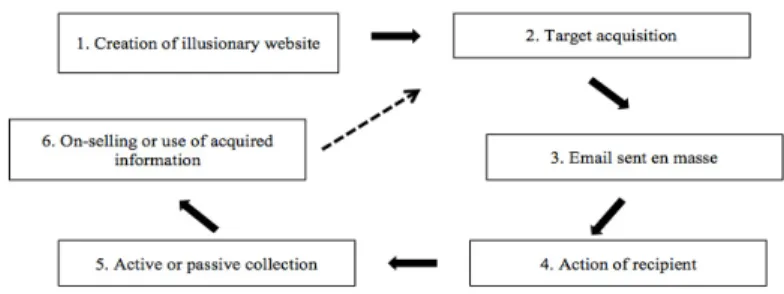
relatively unchanged, what’s evolving are the vectors associated with harvesting the personal information. With the assistance of subject matter experts within a national identity theft support service that respond to phishing attacks, both to the individuals and the firms and government agencies that have had their brands used to deceive, the research team were able to map diagrammatically at Figure 1 their representation of a simple phishing attack model.
The ‘bait’ in the simplistic model of a phishing attack involving legitimate brands relates to the creation of illusionary websites, that is, spoof websites that purport to be legitimate through the impersonation, or identity theft, of a known corporate brand or government agency. Phishers can be quite sophisticated in their targeting and rely on both legitimate and illegitimate means of acquiring the customer details of the real corporate or government agency. A review of APWG trends would suggest that target acquisition as an investment made by the phisher to acquire details on individuals that are most likely to respond, most notably because they are legitimate customers of the impersonated brand, is quite varied [1]. For example, a phisher is not likely to be successful if they were to send an email about a corporate that is not well known or does not have a sufficient customer base. The success of the phish in large part will be on acquiring the right audience for the intended email. In the words of Frank Gorshin ‘the finer
the bait, the shorter the wait’ [7]. Emails are then communicated to the intended audience looking to prompt some form of response, whether it be a response email, a click of a link embedded in the phishing email, or even, a return phone call. The latter was described by the national identity theft support service as a particularly bold measure, and one that as our research progressed, provided unique insights into the behavior of the phishers and opportunity for future research exploration on the criminal-victim interaction. Given the variety of means phishers sought to acquire the targeted personal information and credentials, the simplistic model identified the spectrum as being either passive or active in nature. Passive collection relates to situations where the human interaction in the collection process on the part of the phisher is minimal or non-existent. Such situations cover events where the arrival at the illusionary website by the legitimate customer results in the execution of malware or some other form of virus that collects personal data from the computer of the customer without any further interference or communication with the phisher. Other more human-centric collection models include the capture of personal information whereby both the legitimate customer or victim has to manually add their credentials and personal information via a web-form, or in some instances, engages directly with the phisher via telephone or email. Once these details are acquired by the phisher, the personal information and credentials are said to have been ‘compromised’, but yet to have been
‘misused’ [8]. This is an important conceptualization for researchers of identity theft. Phishing events facilitate identity compromise, which is a necessary precursor to identity misuse, which may or may not even occur or have considerable latent effects. Take for example the theft of credit card information as a common target for phishers. Whilst the email may result in the active provision on the part of the customer of their credit card information, such information is no use to the phisher unless they do typically one of two response actions: (1) use the credit card
information to procure goods or services, such as via ‘card not present’ transactions; or (2) on-sell the acquired data through carder market places to other criminals that look to use such details for future purchases [9]. Put simply, phishing is but one part of a broader identity theft and misuse response. The very same marketplaces that trade in compromised credit card information can also facilitate the trading of targeted email addresses and other valuable socially engineered data, such as driver license and passport information, credit balances, and bank accounting information [9].
Fig. 2. Example of a phishing email using corporate brand.
Figure 2 provides a sample of a phishing email purporting to be sent from Australia’s government owned postal
service, Australia Post. This email was forward to Australia’s national identity theft support service by a customer
who had responded to the email, and only after providing copies of their driver license, passport, and credit card information, became suspicious that the engagement was a disingenuous. The addressee information has been removed. The phishing methodology deployed uses calculative and knowledge-based trust forms as described by Koehn [16]. The calculative trust marker relates the cost-benefit decision of the recipient in weighing up the
financial disincentive of not acting on the prompt for clicking on the “Information about you parcel”. This financial disincentive is explicitly referenced within the text “If your order has not been withdrawn within 30 days, our
Company will charge a storage fee…”. Without clicking on the link, the recipient has no further information about the cost, so cleverly, the act of clicking on the link is one that the recipient would use in assisting with their calculative trust decision-making. The knowledge-based trust markets evident in the phishing email pertain to the brand, Australia Post is the primary provider of domestic and parcel delivery services across Australia. Every postal address in Australia would have a pre-existing relationship with Australia Post. The brand is widely known and has considerable market penetration.
3.Work domain analysis to phishing attacks and response
The research team enlisted the assistance of Australia and New Zealand’s national identity theft support center as Subject Matter Experts (SMEs) in the identification and response across the phishing context. The research
partnership included access to the national identity theft support center’s Research & Analysis Team that actively respond and engage with phishers in understanding new and emerging methods and response requirements, in other
words, ‘taking the bait’ in order to more readily define the domain. The victim support team were also engaged and provided access to case logs from clients (victims of phishing) in exploring the human-computer interactions where trust was established and individual participants responded to the phishing attacks. Understanding the victim experience enabled the research team to better gauge the communication and knowledge networks in existence between phisher, the victim, the legitimate brand owner, and others within the complex system. The Security Response Team within the national center provided access to the processes, documentation and activity logs that enabled the research team to gain a thorough understanding of how the center and its corporate and government partners respond to phishing attacks, and ultimately, the “normal” operating conditions of an online transaction environment. The richness of information collected about the functional domain enabled the research team to explore the applicability of WDA in describing the phishing attack and the online transaction system. Specifically,
through the use of WDA the research team aimed to construct a functional representation of both the phishing attack and online transaction environment, and through its overlay, determine individual and shared constraints, components and affordances [5]. WDA was selected as a preferred sociotechnical systems method for the research study because of its ability to explore purposes and constraints of the environment. The novelty in with this research to explore its applicability in an overlay of a system under normal usage conditions, in other words a legitimate online transaction environment, with a system under a phishing attack condition.
In total 524 separate case files were examined from the National Case Management Center from engagements they had with victims from 1 October to 31 December 2014. Of these cases, phishing attacks as the initial point of compromise were detected for 121 of these matters. Of these cases, the National Case Management Center was able to directly or indirectly (in partnership with the legitimate brand) respond to the phishing emails through either (1) engaging with the phishing site; (2) communicating with the phisher; or (3) taking appropriate measures to remove the phishing website. The multi-dimensional approach to data access and collection enabled the research team to obtain a detailed view of the work domain from the perspective of the phisher (the criminal), as well as the responders, being the national case management center and their corporate and government partners. The utilization of WDA is well proven in contexts involving road safety [17], air traffic control [18], and future technology deployment [19]. Each of these contexts offered similar characteristics to the phishing environment, involving multiple actors, complex interactions, and an overarching opportunity to explore constraints and opportunities for what is possible. Therefore in meeting the study’s aim of exploring the purposes, functions, physical processes and objects at different levels of decomposition in providing a deeper understanding of the phishing attack and response problem.
4.Results and analysis
Utilizing an abstraction hierarchy from documentary analysis of the phishing attack and phishing response domains, the research team establish the overall functional purposes as being centrally related to profit generation, the secure delivery of services, the building of trust and engagement, and knowledge of the market. Interestingly, all of the functional purposes identified are shared by the phishing attack and online transaction environment. For example, even when there was engagement occurring directly between the phisher and the national identity center, where the phisher believed they were engaging with a potential victim, the sociotechnical system functional purpose priority was on the secure delivery of services. The security functional purpose is shared with the online transaction system.
The research team then focused, with the assistance of the SMEs, on the purpose related functions or effects of the system. Here the research team had as its central focus the very functions required to achieve the various functional purposes of the phishing attack system and the online transaction processing system. Unsurprisingly, like
the overall functional purposes, the overlapping of functions between the “attack” environment and the normal
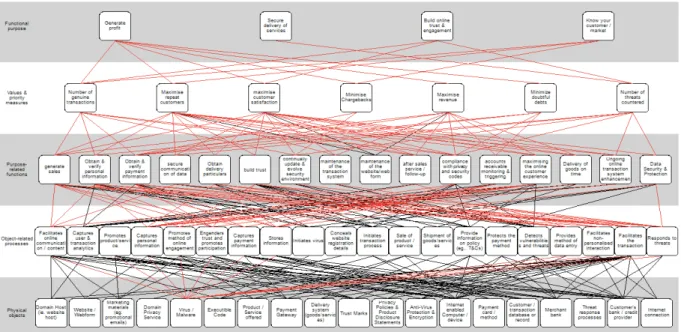
online transaction processing environment were evident. Figure 3 provides an abstraction hierarchy that merges the two conditions and their physical objects, object related processes and values and priority measures to the first two steps in completing the WDA.
The abstraction hierarchy is a complex and chaotic result that was tested with the National Response Center’s SME teams. Whilst the interrelated and interdependent nature of the abstraction hierarchy is evident, a deeper analysis reveals that the successful phishing attack mirrors almost identically the legitimate online transaction processing environment. The National Response Center experts believe the more closely an attack resembles a legitimate condition, the higher the chance of its success. The bottom level of the abstraction hierarchy in Figure 3 shows the physical objects that are used to achieve the functions required for online transactions and likewise phishing attacks. Notably, seventeen of the nineteen physical objects were shared between the phishing attack condition and the legitimate payment processing condition. This paints a clear picture of the difficulties associated with preventing and responding to phishing attacks – the very same artefacts that are used to attract and engage users in online transactions are used to conduct phishing attacks. This striking finding propagates up through the abstraction hierarchy; functions, for example, are key to both activities (e.g. build trust). The evidence of virus/malware and the merchant bank were two physical objects that were only singularly represented. The merchant
Fig. 3. WDA for Phishing Attacks and Online Transaction Processing System.
bank is not necessary as a physical object for the phishing attack environment as the payment information and other credentials can be profited without a merchant bank (unlike a legitimate online payment system). The same can be said of the virus or malware usage in a phishing attack environment –it’s not a physical object requirement under legitimate online transaction environments.
Figure 3 highlights the interdependencies across the multiple levels of abstraction relating to virus and malware physical objects. This condition is evident only in phishing attacks, not within legitimate online transaction processing events. The permeation throughout the sociotechnical system is abundant. Whilst the object related processes or affordances are evident in almost half of the total when overlaid with the legitimate condition, the effects, outcomes and end-state or functional purposes escalate in the inter-linkages, making the values and priority measures, like the functional purposes, shared between legitimate and attack conditions. This observation creates opportunities. Whilst the research has been unable to ascertain whether the associated phishing response environment has evolved dramatically since the eighties and nineties, it’s apparent in the WDA that very little values are specifically directed to preventing and detecting vulnerabilities, such as warning customers of how phishing occurs with specific products, services and brands. A major emphasis within the WDA tends to be on facilitating the transaction, and most importantly, engendering the requisite trust in the system to afford participation (whether legitimate or fraudulent in nature). This may speak to the natural tension confronting business between the need to encourage participation online, versus the need to share knowledge about online risks. The findings may also lend support to the view that legitimate corporate transaction environments may best respond to phishing attack conditions where it innovates and creates alternative payment process opportunities, focuses on virus and malware protection, and importantly, educates consumers about the unique things it requires that can only be legitimized by the legitimate corporate with their customer.
5.Conclusions
Phishing attacks are complex phenomena that occur within complex sociotechnical systems. Their nature, and the nature of the systems in which they occur, demands that a systems approach be taken when attempting to understand and prevent them. This research provided a snapshot of the first of many steps being taken by the co-authors in exploring the opportunities the application of human factors and sociotechnical systems methods can create in
observing the cybercrime environment. The utilization of WDA in overlapping legitimate and criminal conditions within the online transaction system shows promise. The research found considerable overlap across many levels of abstraction. Whilst the focus of the analysis were on the conditions that showed little apparent overlap, the reverse opportunities for analysis equally present. In other words, developing a resilience to phishing attacks could equally draw its attention on the part of the abstraction where there are considerable overlap. This, like the latent effects of legitimate online transaction system innovation on the phishing objects, processes and functions, create new opportunities for future research to test the boundaries and application of human factors and sociotechnical systems methods. Future research to be undertaken as part of this wider program of research involves applying the remaining four phases of CWA to further understand this complex issue and to develop and analytically prototype countermeasures and response strategies.The phishing attack and response environment is a complex system. One that has had little systems focus to date, and one that provides considerable opportunities in better understanding
how and why individuals “take the bait”, and how and why corporates can alter the feeding patterns of the phish
they seek to catch out.
Acknowledgements
The authors would like to acknowledge iDcare, Australia and New Zealand’s national identity support center for their assistance in accessing data critical to undertaking the network analysis. In addition to the expert staff of iDcare, their client experiences have enabled the research team to gain firsthand knowledge of the impacts of phishing on the individual and the complex nature of the online transaction and response environment.
References
[1] Anti-Phishing Working Group, Global Phishing Survey: trends and Domain Name Use in 1H2014, United States, 2015.
[2] OpenDNS. PhishTank Stats January 2015, San Francisco, 2015. Accessed on 2 April 2015. URL: https://www.phishtank.com/stats/2015/01/ [3] Symantec. Internet Security Threat Report 2014. 2013 Trends, Vol.19. United States 2014. Retrieved on April 2 2015. URL:
http://www.symantec.com/security_response/publications/threatreport.jsp
[4] Harriman, D. D.: Password Fishing on Public Terminals. Computer Fraud and Security Bulletin, Elsevier Science Publishers, New York, Jan. 1990, pp. 12–14.
[5] Vincente, K.J.: Cognitive Work Analysis: Toward Safe, Productive, and Health Computer-Based Work, New Jersey, 1999. [6] Anti-Phishing Working Group, Origins of the Word Phishing, Retrieved April 1 2015. URL: http://docs.apwg.org/word_phish.html [7] Gorshin, F. (n.d.). BrainyQuote.com. Retrieved April 2, 2015, URL: http://www.brainyquote.com/quotes/quotes/f/frankgorsh215693.html [8] Lacey, D. ID360 The Identity Economy Proceedings, Beyond virtual and physical borders: Extending the conceptualization of the identity
ecosystem, 2015
[9] Lacey, D. Salmon, P.: HCI International Conference, It’s Dark in There: Using Systems Analysis to Investigate Trust and Engagement in Dark Web Forums, forthcoming
[10] Lapsley, P.: Exploding the phone: The untold story of the teenagers and outlaws who hacked Ma Bell. Grove Press, United States, 2013. [11] Sheng, S. Wardman, B. Warner, G. Cranor, L.F. Hong, J. Zhang, C.: Sixth Conf on Email & Anti-Spam, An Empirical Analysis of Phishing
Blacklists, California, July 16-17, 2009.
[12] Hutchings, A. Hayes, H.: Current Iss. In Crim Just. Routine Activity Theory and Phishing Victimisation: Who Gets Caught in the ‘Net’?.
2009, Vol.20:3, p.433-451
[13] Downs, J.S. Holbrook, M.B. Cranor, L.F.: Proceedings of the second symposium on usable privacy and security, ACM. 2006, pp.79-90. [14] Carpenter, S. Zhu, F. Kolimi, S. App. Egnmcs, Reducing online identity disclosure using warnings. 2014,Vol.45, pp.1137-1342 [15] Anti-Phishing Working Group, Phishing Activity Trends Report 3rd Quarter, 2014 Accessed April 1 2015. URL:
http://docs.apwg.org/reports/apwg_trends_report_q3_2014.pdf
[16] Koehn, D.: Jnl of Bus Ethics. The Nature of and Conditions for Online Trust. 2003, Vol.43. pp.3-19
[17] Salmon, P. Karen, S. Lenne, M. Regan, M.: Australasn Road Sfety Res Pol Educ Conf. Cognitive work analysis and road safety. 2005 [18] Ahlstrom, U.: Jnl of Sfty Res. Work domain analysis for air traffic controller weather displays. 36, no. 2 (2005): pp.159-169.
[19] Crone, D. Sanderson, P.M. Naikar, N.: Prcdngs fo the 47th Ann Meeting of the HF and Ergncs Scty. Using Cognitive Work Analysis to Develop a Capability for the Evaluation of Future Systems. Denver, CO. pp.1938-1942