Masters Theses Student Theses and Dissertations
Spring 2018
Development and Monte Carlo validation of a finite element
Development and Monte Carlo validation of a finite element
reactor analysis framework
reactor analysis framework
Wayne J. Brewster
Follow this and additional works at: https://scholarsmine.mst.edu/masters_theses
Part of the Nuclear Engineering Commons Department:
Department:
Recommended Citation Recommended Citation
Brewster, Wayne J., "Development and Monte Carlo validation of a finite element reactor analysis framework" (2018). Masters Theses. 7756.
https://scholarsmine.mst.edu/masters_theses/7756
This thesis is brought to you by Scholars' Mine, a service of the Missouri S&T Library and Learning Resources. This work is protected by U. S. Copyright Law. Unauthorized use including reproduction for redistribution requires the permission of the copyright holder. For more information, please contact [email protected].
DEVELOPMENT AND MONTE CARLO VALIDATION OF A FINITE ELEMENT
REACTOR ANALYSIS FRAMEWORK
by
WAYNE J. BREWSTER
A THESIS
Presented to the Faculty of the Graduate School of the
MISSOURI UNIVERSITY OF SCIENCE AND TECHNOLOGY
In Partial Fulfillment of the Requirements for the Degree
MASTER OF SCIENCE IN NUCLEAR ENGINEERING
2018
Approved by
Ayodeji Babatunde Alajo, Advisor Xin Liu
ABSTRACT
This study presents the development and Monte Carlo validation of a continuous
Galerkin finite element reactor analysis framework. In its current state, the framework
acts as an interface between the mesh preparation software GMSH and the sparse linear
solvers in MATLAB, for the discretization and approximation of 1-D, 2-D, and 3-D
linear partial differential equations. Validity of the framework is assessed from the
following two benchmarking activities: the 2-D IAEA PWR benchmark; and the 2-D
Missouri Science and Technology Reactor benchmark proposed within this study. The
2-D IAEA PWR multi-group diffusion benchmark is conducted with the following
discretization schemes: linear, quadratic, and cubic triangular elements; linear and
quadratic rectangular elements of mesh sizes 10, 5, 2, 1, 0.5 cm. Convergence to the
reference criticality eigenvalue of 1.02985 is observed for all cases.
The proposed 2-D MSTR benchmark is prepared through translation of an
experimentally validated 120w core configuration MCNP model into Serpent 2.
Validation of the Serpent 2 model is attained from the comparison of criticality
eigenvalues, flux traverses, and two 70-group energy spectrums within fuel elements D5
and D9. Then, a two-group 2-D MSTR benchmark of the 120w core configuration is
prepared with the spatial homogenization methodology implemented within Serpent 2.
Final validation of the framework is assessed from the comparison of criticality
eigenvalues and spatial flux solutions of the diffusion and simplified spherical harmonics
𝑆𝑆𝑆𝑆3 models. The diffusion model resulted in a difference in reactivity of ∆𝜌𝜌= −1673.93
pcm and the 𝑆𝑆𝑆𝑆3 model resulted in a difference of ∆𝜌𝜌=−777.60 pcm with respect to the Serpent 2 criticality eigenvalues.
ACKNOWLEDGMENTS
First off, I would like to thank my advisor Dr. Alajo for giving me the opportunity
to pursue research that truly interests me. I would also like to thank Dr. Gary Mueller and
Dr. Xin Liu for being members of my committee, the faculty of the Nuclear Engineering
Department for providing me an invaluable education, the IT RSS for setting up MCNP
on the cluster, and Dr. Xiaoming He for introducing me to the world of finite elements.
TABLE OF CONTENTS
Page
ABSTRACT ... iii
ACKNOWLEDGMENTS ... iv
LIST OF ILLUSTRATIONS ... viii
LIST OF TABLES ... x
SECTION 1. INTRODUCTION ... 1
1.1. RESEARCH OBJECTIVES ... 6
1.2. FINITE ELEMENT METHODS IN REACTOR PHYSICS ... 7
2. FINITE ELEMENT METHODS FOR ELLIPTIC PDES ... 10
2.1. HOMOGENOUS DIRICHLET POISSON PROBLEM ... 10
2.1.1. Weak Formulation ... 12
2.1.2. Galerkin Formulation ... 13
2.1.3. Matrix Formulation ... 15
2.2. MIXED BOUNDARY CONDITIONS ... 16
2.2.1. Dirichlet/Neumann ... 16
2.2.2. Dirichlet/Robin ... 18
2.3. BASIS FUNCTIONS ... 20
2.3.1. Linear Triangular Element ... 21
2.3.2. Affine Mapping ... 23
2.3.3. Local Basis Functions... 25
3.1.1. Data Structure ... 27
3.1.2. Stiffness Matrix and Load Vector Assembly ... 32
4. NEUTRON TRANSPORT THEORY ... 34
4.1. NEUTRON BOLTZMANN EQUATION ... 34
4.1.1. Angular Neutron Density, Flux, and Current ... 35
4.1.2. Balance Equation ... 37
4.1.3. Integral-Differential Linear Neutron Boltzmann Equation ... 39
4.2. SPHERICAL HARMONICS ... 40
4.2.1.𝑆𝑆1 Equations and the Diffusion Approximation ... 44
4.2.2. Simplified Spherical Harmonics Equations (SPn) ... 49
4.3. MULTI-GROUP DIFFUSION EQUATION ... 52
4.3.1. Finite Element Formulation ... 54
4.3.2. Power Iteration ... 57
5. SERPENT 2: A CONTINUOS-ENERGY MONTE CARLO CODE ... 60
5.1. SPATIAL HOMOGENIZATION METHODOLOGY ... 60
5.1.1. Reaction Rates ... 60
5.1.2. Scattering Matrices ... 62
5.1.3. Diffusion Coefficients ... 63
5.2. HYDROGEN TRANSPORT CORRECTION ... 65
5.2.1. Numerical Hydrogen Transport Correction Curve ... 66
5.2.2. Analytical Hydrogen Transport Correction Curve ... 67
5.2.3. Cumulative Migration Method ... 68
6.1. IAEA 2-D PWR ... 71
6.1.1. Reference Solutions ... 73
6.1.2. Benchmark Results ... 75
6.2. MISSOURI S&T REACTOR ... 85
6.2.1. MCNP Model Description ... 88
6.2.2. Experimental MCNP Model Validation ... 91
6.2.3. Serpent 2 Model Development and Validation Results ... 95
6.2.4. 2-D Benchmark Description ... 106
6.2.5. Benchmark Results ... 110
7. CONCLUSION ... 119
A. BASIS FUNCTIONS ... 123
B. SUPPLEMENTARY 2-D IAEA PWR BENCHMARK PLOTS ... 132
C. SUPPLEMENTARY SERPENT 2 MSTR VALIDATION PLOTS ... 138
D. 2-D MSTR BENCHMARK MULTIGROUP CONSTANTS ... 140
E. SERPENT 2 THERMAL FLUX MAP RELATIVE ERROR ... 143
F. GMSH INPUT: 120W MSTR CONFIGURATION ... 145
BIBLIOGRAPHY ... 154
LIST OF ILLUSTRATIONS
Page
Figure 2.1 Linear triangular reference element ... 22
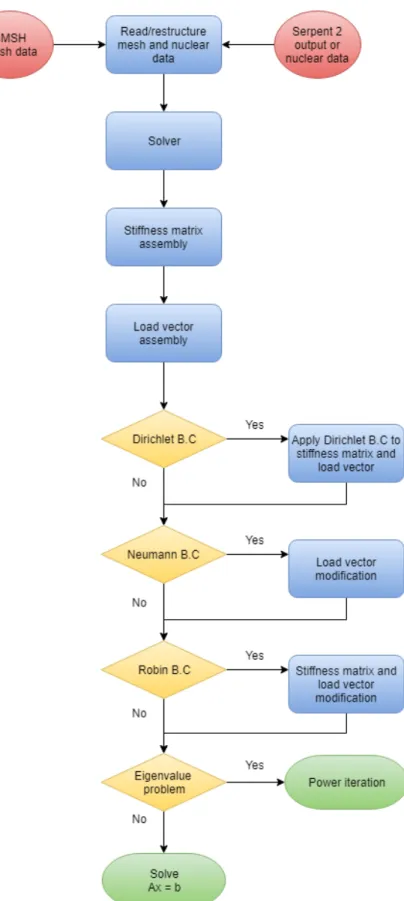
Figure 3.1 Finite element framework flowchart for time independent problems ... 28
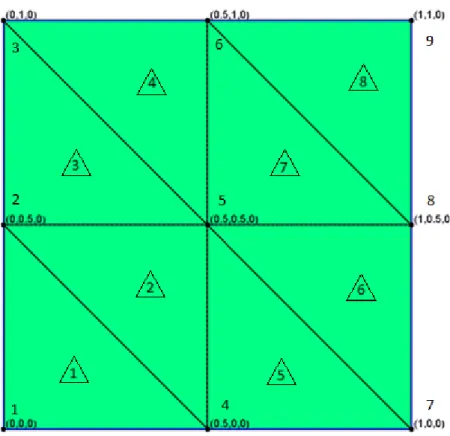
Figure 3.2 Example square mesh with triangular elements ... 29
Figure 4.1 Volume and directional element ... 35
Figure 6.1 IAEA 2-D PWR Benchmark Configuration [35] ... 71
Figure 6.2 IAEA 2-D reference radial flux traverses [35] ... 74
Figure 6.3 IAEA 2-D reference assembly average group 1 flux [35] ... 76
Figure 6.4 IAEA 2-D reference assembly average group 2 flux [35] ... 77
Figure 6.5 Linear triangle h-refinement (top) thermal, (bottom) fast flux traverse [35] ... 80
Figure 6.6 Linear triangle 10cm mesh p-refinement (top) thermal (bottom) fast flux [35] ... 82
Figure 6.7 Quadratic triangle 2cm mesh assembly averaged thermal flux [35] ... 83
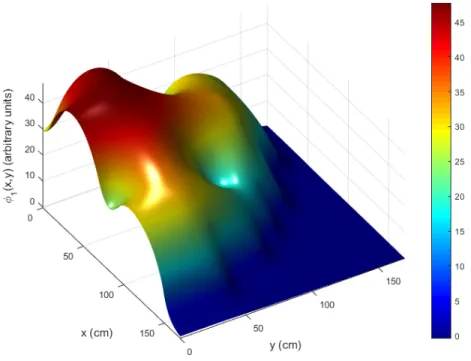
Figure 6.8 Triangle Cubic 1cm mesh: thermal flux map results ... 84
Figure 6.9 Triangle Cubic 1cm mesh: fast flux map results ... 85
Figure 6.10 MSTR core in operation [42] ... 86
Figure 6.11 Fuel Element Schematic [38] ... 87
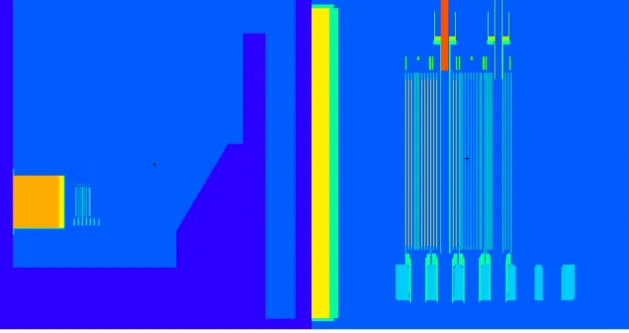
Figure 6.12 MCNP YZ plane (left) entire geometry (right) exploded view of the core ... 89
Figure 6.13 Serpent 2 MSTR model universe structure ... 96
Figure 6.14 MSTR 120W core configuration universe structure ... 98
Figure 6.15 Core mid-plane flux traverse along lattice row D/E (top) thermal, (bottom) fast ... 101
Figure 6.16 Core mid-plane flux traverse along lattice column 5/6 (top)
thermal, (bottom) fast ... 103 Figure 6.17 Serpent 2 spatial flux profile comparison for the lattice divider
along row D/E: (top) top-core plane, (bottom) bottom-core plane ... 105 Figure 6.18 70-group neutron flux in elements (top) D5 and (bottom) D9 ... 107 Figure 6.19 MSTR 2D benchmark geometry ... 109 Figure 6.20 2-D MSTR Benchmark: thermal group scalar flux traverses along
the lattice divider of row D/E ... 113 Figure 6.21 2-D MSTR Benchmark: fast group scalar flux traverses along the
lattice divider of row D/E ... 114 Figure 6.22 2-D MSTR Benchmark: thermal group scalar flux traverses along
the lattice divider of column 5/6 ... 115 Figure 6.23 2-D MSTR Benchmark: fast group scalar flux traverses along the
lattice divider of column 5/6 ... 116 Figure 6.24 2-D MSTR benchmark: relative thermal flux error map between
LIST OF TABLES
Page
Table 6.1 IAEA 2D PWR Benchmark Homogenized Multi-Group Constants
[35] ... 72
Table 6.2 IAEA 2-D reference eigenvalues and inner core maximum thermal flux [35] ... 73
Table 6.3 IAEA 2-D benchmark eigenvalue results ... 79
Table 6.4 MCNP and Serpent material isotopic compositions [36] ... 90
Table 6.5 Serpent 2 validation tally statistics ... 100
Table 6.6 2-D MSTR benchmark eigenvalue results: P0 scattering matrices and no Hydrogen transport correction curve ... 110
Table 6.7 2-D MSTR benchmark eigenvalue results: up to P3 scattering matrices and no Hydrogen transport correction curve ... 111
1.INTRODUCTION
The design and safe operation of a nuclear reactor requires an extensive
characterization of its neutronic properties; thereby, allowing the precise manipulation of
reactivity configurations and the determination of safe operating limits wherein the
delicate balance of criticality is maintained. The most fundamental physical equation
which provides a means to characterize the free motion of neutrons in a nuclear reactor is
the linear neutron Boltzmann equation in which each physical process neutrons are
gained or lost from a seven-dimensional (three in space, two in angle, energy, and time)
phase space volume element forms the balance equation describing the expected neutron
population. Furthermore, the probability of an interaction per path length (macroscopic
cross section) that governs each individual reaction mode (parasitic absorption,
scattering, and fission) is subject to change with the evolution of thermal-hydraulic,
burn-up, and thermo-mechanical conditions. Consequently, nuclear reactors are multi-physical
and multi-scale by nature; therefore, inclusion of all physical models is required for an
accurate characterization of a nuclear reactor system [1], [2].
Ultimately, inclusion and simulation of all the governing physical models is
non-trivial and a computationally expensive task when one considers full core modelling. In
fact, acquisition of high-order, full core, steady-state approximations to the various forms
of the neutron Boltzmann equation is computationally prohibitive and typically reserved
for: (1) small scale simulations; (2) the preparation of benchmarks and multi-group
constants for low-order approximation schemes (spatial homogenization); (3) the
academic setting; and (4) final reactor design analysis. However, the foregoing
analysis and core relicensing because of the frequency in which they are performed and
the high computational cost of these methods. Nevertheless, the high-order solution
methods are the bases for the low-order approximation schemes and can be divided into
two distinct mathematical solution classes: (1) the Monte Carlo method; and (2)
deterministic methods.
The fundamental idea behind the Monte Carlo method is acquisition of expected
value of a random variable through the numerical simulation of randomly sampled
events. Monte Carlo methods are amenable to neutron transport since the physical
processes which govern neutron interactions is inherently stochastic. For neutron
transport, the outcome of each individual neutron is randomly sampled and tracked
throughout the defined geometry. Tallies are scored in the regions of interest such that
various integral estimators provide point, surface, and cell fluxes. Criticality is also
estimated by storing the neutrons generated from fission during the current cycle which
are subsequently used as the source for the next cycle; therefore, changes of the source
sizes over subsequent batches yield the criticality estimate.
The advantage of the Monte Carlo method is the capability to simulate exact
physical processes in an arbitrary level of spatial detail. However, it is critical to note that
with the expected value comes statistical uncertainty. Therefore, it is imperative to ensure
that the conditions of the central limit theorem are met for the results to have significant
meaning. When considering large reactor systems, the foregoing condition requires a
considerable sample population size and batches which result in increased computational
effort. The Monte Carlo method exacerbates the aforesaid computational burden when
time component. Nevertheless, implementation of variance reduction techniques
improves the precision of integral estimators which results in decreased computational
effort such as the case for radiation shielding and general particle transport. The most
notable Monte Carlo codes in use today are: (1) MCNP (Los Alamos National
Laboratory); (2) OpenMC (Massachusetts Institute of Technology); (3) Serpent 2 (VTT
Technical Research Centre of Finland); and (4) TRIPOLI (French Alternatives Energies
and Atomic Energy Commission).
In contrast, deterministic methods rely upon the discretization of the independent
variables wherein the original differential equation is reduced to a linear system. Further
classification of the deterministic methods is based upon the treatment of the angular
dependency in which each solution method takes advantage of distinct mathematical
properties or numerical methods. The method of characteristics takes a unique approach
of reformulation of the integrodifferential form of the neutron Boltzmann equation into
an equivalent characteristic form. In short, the frame of reference shifts from an
observation of a neutron relative to a fixed point in space as opposed to a reference in
space. By projecting characteristic lines over the computational domain, the average
value of the angular flux is computed by integrating over each characteristic track divided
by the tracks total length.
The discrete ordinates method 𝑆𝑆𝑛𝑛 relies upon discretization of the solid angle (angular component) into discrete direction cosines where a quadrature rule permits
integration of the polynomials over the direction cosines. Another method requires
expansion of the angular terms as an infinite spherical harmonics series. Truncation of
harmonics 𝑆𝑆𝑛𝑛 equations. Both the discrete ordinates method and spherical harmonics method require the discretization of the spatial component by either the finite difference
or finite element method. However, the finite element method is more attractive than the
finite difference method because of the former’s amenability to irregular domains and
capability to obtain higher order approximations with a fixed mesh. The finite difference
method requires mesh refinement to improve the order of accuracy and may also produce
non-invertible matrices when applied to non-cartesian geometries.
Limitation of the spherical harmonic series to the order of 𝑛𝑛 = 1, and the elimination of the odd order moment in the even order equation, provides low-order
simplified spherical harmonics equation 𝑆𝑆𝑆𝑆1 analogous to the diffusion equation derived from the neutron continuity equation and Fick’s law. The only difference is the inclusion
of the average cosine scattering angle in the proportionality constant in the 𝑆𝑆𝑆𝑆1 equation. Ultimately, this permits the extension of the 𝑆𝑆𝑆𝑆1 equation to reactors that exhibit
moderate anisotropic scattering. The diffusion/𝑆𝑆𝑆𝑆1 equations are the most widely used transport approximations in nodal, full-core analyses. Where, the method relies upon the
production of multigroup constants by energy condensation and spatial homogenization
of the cross sections using the infinite assembly lattice spectrum obtained by a high-order
transport simulation [3]. Then the global homogeneous flux solution is approximated
from the construction of the homogenized assemblies into the full core domain for nodal
diffusion codes [4], [5].
Typical multi-physics computational paradigms used for production fuel reload
analyses and core relicensing rely on the operator splitting method where the non-linear
codes such that the output of one code is taken as the initial conditions for the next code
where solutions are exchanged between the mono-disciplinary codes until the established
convergence criteria are met. Since the operator splitting method is explicit in time where
the order of accuracy is 𝑂𝑂(𝐻𝐻1), the method requires time steps on the order of the dynamic time scale of the system [6]. Therefore, the operator splitting method is
inefficient when applied to stiff multi-scale systems. This is the case for nuclear reactor
systems since the neutronic time scale is on the order of 10−6 seconds when neglecting delayed neutrons and the heat transfer time scale is on the order of 100 to 101 seconds [1].
Recent advances in Jacobian-Free Newton Krylov (JFNK) subspace solvers and
physics-based preconditioning has led to increased efficiency of implicit time integration
techniques in the simultaneous solution of coupled non-linear equations [7]. However,
due to the mathematical rigor and complexity of coupling multiple physics models in a
unified framework, the research concerning the implementation of such methods is
primarily left to national laboratories, or large university research groups. Where, the
main group whose efforts are focused on the application of the JFNK methods to nuclear
systems is the Multi-Physics Object-Oriented Simulation Environment (MOOSE) team at
the Idaho National Laboratory [8], [9]. Unfortunately, without the ability to readily
modify an already established framework, it is virtually impossible to conduct research in
multi-physics methods development. Therefore, the aim of this research is to establish the
foundation of a general finite element framework where future research can build upon
1.1.RESEARCH OBJECTIVES
The objective of the thesis is the development and Monte Carlo validation of a
diffusion and simplified spherical harmonics finite element reactor analysis framework.
The objective includes the following relevant issues:
A. perform a preliminary 2-D IAEA PWR benchmark. The initial 2-D IAEA
PWR benchmark is the most efficient methodology to obtain initial data to
ascertain whether the proposed finite element framework can be correctly
implemented to the multi-group neutron diffusion equation;
B. develop Serpent 2 model of the MSTR. Previous experimental MCNP
validation of the MSTR model allows the construction of a validation chain
between physical reality and multiple computer codes;
C. validate the Serpent 2 MSTR model to the previously validated MCNP model.
Without validation of the Serpent 2 model, the link between the finite element
framework and physical experiments cease to exist. The foregoing is true
because the preparation of the proposed MSTR benchmark relies upon
Serpent’s global flux solution to preserve the reaction rates in the process of
spatial homogenization and energy condensation of the cross sections and
multi-group constants;
D. preparation of stochastic multi-group parameters using the global flux
distribution for the proposed 2-D MSTR benchmark. Stochastic generation of
multi-group parameters permit the spatial homogenization and energy
condensation using: (1) continuous-energy cross section data: (2) the global
preparation of the 2-D MSTR benchmark in the foregoing manner results in
the minimization of the spatial homogenization errors;
E. validate finite element reactor analysis framework with the 2-D MSTR
benchmark. Validation of the finite element framework will hopefully
demonstrate the capabilities of the framework allowing its application to
reactor analysis. Furthermore, the framework can then serve as a foundation
for further research concerning multi-physics simulation.
1.2.FINITE ELEMENT METHODS IN REACTOR PHYSICS
Application of the finite element method (FEM) to reactor analysis dates to the
1970’s when diffusion codes were primarily based upon the finite difference method
(FDM). Since then, a multitude of papers concerning the application and development of
the FEM in reactor analysis have been published; therefore, it is not possible to cover the
entirety of the FEMs in reactor analysis in this section. Nevertheless, research and
development efforts which highlight the success of the FEM method spanning from the
1970’s till the present day are presented.
One of the first papers concerning this matter demonstrated the applicability of
the FEM method in a 2-D multigroup criticality code FEND [10]. The FEND code was
utilized to approximate criticality eigenvalues and flux eigenvectors for a two-group
in-homogenous test problem with Lagrangian linear triangular and bilinear rectangular
discretization schemes [10]. Semenza et al. concluded that accurate eigenvalues and
eigenvectors were attained with a relatively few nodal points which demonstrates the
auxiliary memory devices for large problems that required a significant amount of nodal
points [10].
Demonstration of the finite element methods utility [10] prompted further
research concerning the efficiency of the method over the low-order finite difference
method for three rector configurations: (1) two-group two-zone reactor; (2) four-group
multizone 1000-MW(e) LMFBR mockup; and (3) two-group loosely coupled
configuration [11]. Results of the study indicate that high-order FEMs were able to
decrease the computational cost of the LMFBR case by a factor of 20 over the finite
difference method with a 30% reduction in memory usage [11]. Furthermore, the FEM
produced accurate results such that any error can be attributed to the diffusion theory
approximation or approximations in the reactor model [11]. If the desired eigenvalue
accuracy was to three decimal places, the high-order FEM yielded speed advantages up to
a 50:1 ratio in the two-group two-zone reactor [11].
Instead of specifying the degrees of freedom as nodal values (Lagrangian finite
elements), Hermitian finite elements specify the degrees of freedom as directional
derivatives. The study by Kang and Hansen applied Hermite polynomials to space,
energy, and time dependent neutron diffusion problems on rectangular meshes [12].
However, they had issues with the representation of singular points. Hebert solved this
issue by utilizing Weierstrass-Erdmann type conditions which permits coupling of the
solution over space regardless of singularities [13]. Hebert also implemented a
mixed-dual variational formulation using Raviart-Thomas-Schneider elements in 3-D hexagonal
geometry. Where, the Raviart-Thomas basis utilizes tensorial products of Legendre
hexagonal 2-D IAEA benchmark and the 2-D/3-D Monju reactor benchmark [14]. The
use of modified Dubiner’s polynomials over hexagonal geometry using a fixed triangular
mesh was also investigated [15]. Each hexagonal lattice was divided into six equilateral
triangles and the order of accuracy was increased by introducing higher-order modified
Dubiner’s polynomials in the expansion.
More recent efforts have been focused on increasing the computational efficiency
of the FEM applied to the multigroup diffusion equation through adaptive mesh
refinement [16]. The proposed adaptive algorithm relies on separate meshes for each
energy group to take advantage of the smoothness of each energy dependent solution.
The calculation starts with a coarse mesh where cell errors are calculated to discern
which regions need refinement or coarsening. Numerical results were obtained for the
two-group 2-D IAEA PWR benchmark, the two-group 2-D OECD-L-336 fuel assembly
benchmark, and a 3-D seven-group problem. Wang concluded that the adaptive
refinement algorithm led to faster solutions times for a given order of accuracy over
uniform mesh refinement. Wang also concluded that the adaptive mesh refinement led to
solution accuracy that was previously impossible, or to the desired accuracy for the first
2.FINITE ELEMENT METHODS FOR ELLIPTIC PDES
The finite element methods are a mathematical tool which permits the
approximation of partial differential equations in variational form over a space V.
Through the discretization of the computational domain Ω into finite elements and the
construction of finite dimensional subspaces 𝑉𝑉ℎ of the space V, the approximate discrete solution can be obtained through the linear combination of undetermined coefficients and
piece-wise polynomial basis functions𝑣𝑣ℎ ∈ 𝑉𝑉ℎ. Typical formulations specify the degrees of freedom of as point values (Lagrange finite elements) or directional derivatives
(Hermite finite elements). However, for the purposes of this thesis, only the continuous
Galerkin method and Lagrangian type of finite elements are considered. Nevertheless,
readers should be aware that other finite element formulations exist, i.e., mixed finite
element methods, discontinuous Galerkin methods. In constructing this chapter, it was
assumed that the reader has limited exposure to functional analysis, so instead of
providing lengthy mathematical proofs, only a summary of their implications is
presented. Interested readers may resort to the citations for a deeper understanding of the
mathematical proofs.
2.1.HOMOGENOUS DIRICHLET POISSON PROBLEM
Consider the second order elliptic Poisson problem:
Where, 𝑓𝑓(𝑟𝑟⃗) and 𝑐𝑐(𝑟𝑟⃗) are known functions on Ω, 𝑔𝑔(𝑟𝑟⃗) is a known function on 𝑑𝑑Ω, and
𝑢𝑢(𝑟𝑟⃗) is the unknown solution. The first step in the finite element formulation is to transform the strong problem into an equivalent weak problem. First, multiply both sides
of the equation by a test function 𝑣𝑣(𝑟𝑟⃗)and integrate over the domain Ω. Note: For clarity, the variables spatial dependence has been omitted.
− � ∇ ∙(𝑐𝑐∇𝑢𝑢)𝑣𝑣𝑑𝑑Ω
Ω =� 𝑓𝑓𝑣𝑣Ω 𝑑𝑑Ω.
(2.2)
Applying Green’s theorem (multi-dimensional integration by parts) to the differential
terms on the LHS.
� ∇ ∙(𝑐𝑐∇𝑢𝑢)𝑣𝑣𝑑𝑑Ω
Ω =�𝑑𝑑Ω(𝑐𝑐∇𝑢𝑢 ∙ 𝑛𝑛�⃗)𝑣𝑣𝑑𝑑𝑑𝑑 − � 𝑐𝑐∇𝑢𝑢∇𝑣𝑣Ω 𝑑𝑑Ω.
(2.3)
The Poisson’s equation becomes,
� 𝑐𝑐∇𝑢𝑢∇𝑣𝑣𝑑𝑑Ω
Ω − �𝑑𝑑Ω(𝑐𝑐∇𝑢𝑢 ∙ 𝑛𝑛�⃗)𝑣𝑣𝑑𝑑𝑑𝑑=� 𝑓𝑓𝑣𝑣Ω 𝑑𝑑Ω.
(2.4)
Since the solution 𝑢𝑢 is given on the boundary 𝑑𝑑Ω by 𝑔𝑔, the test function 𝑣𝑣 is chosen such that 𝑣𝑣 = 0 on 𝑑𝑑Ω. Thus, the strong formulation of the Poisson problem is reformulated into an equivalent weak form (Equation 2.5). Essentially, reformulation of
the strong problem into the weak form relaxes the derivative requirement. It is no longer
required that 𝑢𝑢 be twice differentiable. Instead, weaker requirements have been imposed such that 𝑢𝑢′ exist and be square integrable.
� 𝑐𝑐∇𝑢𝑢∇𝑣𝑣𝑑𝑑Ω
Ω =� 𝑓𝑓𝑣𝑣Ω 𝑑𝑑Ω.
(2.5)
The next step is to find a space V where the derivatives of the functions in this space are
square integrable.
2.1.1.Weak Formulation. A space that satisfies the weak form requirements is
the Sobolev space 𝐻𝐻𝑚𝑚(Ω):
𝐻𝐻𝑚𝑚(Ω) =�𝑣𝑣 ∈ 𝐿𝐿2(Ω): 𝜕𝜕𝛼𝛼1+𝛼𝛼2𝑣𝑣 𝜕𝜕𝜕𝜕𝛼𝛼1𝜕𝜕𝜕𝜕𝛼𝛼2 ∈ 𝐿𝐿
2(Ω),∀𝛼𝛼1+𝛼𝛼2 = 1, … ,𝑚𝑚�, (2.6)
where the Lebesgue 𝐿𝐿𝑝𝑝(Ω) space
𝐿𝐿𝑝𝑝(Ω) =�𝑣𝑣:Ω → 𝑅𝑅:� 𝑉𝑉𝑝𝑝𝑑𝑑𝜕𝜕𝑑𝑑𝜕𝜕
Ω <∞�.
(2.7)
Therefore, the functions 𝑢𝑢 and 𝑣𝑣 must belong to the Sobolev spaces [17]. Thus, the weak formulation: find 𝑢𝑢 ∈ 𝐻𝐻1(Ω) such that ∀𝑣𝑣 ∈ 𝐻𝐻01(Ω), 𝑎𝑎(𝑢𝑢,𝑣𝑣) = (𝑓𝑓,𝑣𝑣). Where, the continuous V-elliptic bilinear and continuous linear form are defined as:
𝑎𝑎(𝑢𝑢,𝑣𝑣) =� 𝑐𝑐∇𝑢𝑢∇𝑣𝑣𝑑𝑑Ω Ω , (2.8) (𝑓𝑓,𝑣𝑣) =� 𝑓𝑓𝑣𝑣𝑑𝑑Ω Ω (2.9)
and are assumed to satisfy the Lax-Milgram lemma [18]. Ultimately, the Lax-Milgram
lemma proves that the variational problem (Eq. 2.5) is well-posed and that its solution
2.1.2.Galerkin Formulation. Since an infinite number of test functions 𝑣𝑣 exist in the space Vsuch that 𝑢𝑢 is a weak solution of the PDE, it is necessary to further impose restrictions on the vector space. One such approach is the Galerkin method which
characterizes a finite dimensional space 𝑈𝑈ℎ to permit approximation of the infinite
dimensional abstract variational problem. Let’s introduce a triangulation 𝑇𝑇 over the set Ω�, where Ω is subdivided into finite elements 𝐾𝐾, that satisfy the following properties: (1)
Ω�=∪𝑘𝑘∈𝑇𝑇𝐾𝐾; (2) for every element 𝐾𝐾 ∈ 𝑇𝑇 the interior of 𝐾𝐾° is non-empty; (3) the
intersection of the element interiors is empty; (4) the boundary of 𝜕𝜕𝐾𝐾 is Lipschitz-continuous; (5) any face of an element 𝐾𝐾 in the triangulation is either a subset of the boundary, or a face of another element [17]. Then for each element within the
triangulation, the polynomial function space is defined as 𝑆𝑆𝑘𝑘= �𝑣𝑣ℎ|𝐾𝐾; 𝑣𝑣ℎ ∈ 𝑈𝑈ℎ�. Lastly, the space 𝑈𝑈ℎ should contain at least one canonical basis where the corresponding basis functions have supports that are small as possible; meaning the set of points in the space
𝑈𝑈ℎ where the basis functions are non-zero is minimized.
Assume a finite dimensional subspace 𝑈𝑈ℎ ⊂𝐻𝐻1(Ω). Then, the Galerkin formula: find 𝑢𝑢ℎ ∈ 𝑈𝑈ℎ such that satisfies the bilinear and linear form 𝑎𝑎(𝑢𝑢ℎ,𝑣𝑣ℎ) = (𝑓𝑓,𝑣𝑣ℎ) ∀𝑣𝑣ℎ ∈
𝑈𝑈ℎ. Where, 𝑎𝑎(𝑢𝑢ℎ,𝑣𝑣ℎ) =� 𝑐𝑐∇𝑢𝑢ℎ∇𝑣𝑣ℎ𝑑𝑑Ω, Ω (2.10) (𝑓𝑓,𝑣𝑣ℎ) =� 𝑓𝑓𝑣𝑣ℎ𝑑𝑑Ω. Ω (2.11)
Let �𝜙𝜙𝑗𝑗�
𝑗𝑗=1 𝑁𝑁𝑁𝑁
be a basis of the continuous piecewise function space 𝑈𝑈ℎ, where 𝑁𝑁𝑁𝑁 is the total number of basis functions. Since 𝑢𝑢ℎ ∈ 𝑈𝑈ℎ = 𝑑𝑑𝑠𝑠𝑎𝑎𝑛𝑛�𝜙𝜙𝑗𝑗�
𝑗𝑗=1 𝑁𝑁𝑁𝑁
, the finite element
solution 𝑢𝑢ℎis a linear combination of the unknown coefficients 𝑢𝑢𝑗𝑗 and known basis functions 𝜙𝜙𝑗𝑗.
𝑢𝑢ℎ =� 𝑢𝑢𝑗𝑗𝜙𝜙𝑗𝑗. 𝑁𝑁𝑁𝑁
𝑗𝑗=1
(2.12)
Due to the finite element space restriction in which the subspace 𝑈𝑈ℎ must contain at least one canonical basis, the basis functions 𝜙𝜙𝑗𝑗 are only non-zero on the finite
elements that share the node 𝑋𝑋𝑘𝑘.
𝜙𝜙𝑗𝑗(𝑋𝑋𝑘𝑘) =𝛿𝛿𝑗𝑗𝑘𝑘= �1,0, 𝑖𝑖𝑓𝑓𝑖𝑖𝑓𝑓𝑗𝑗 ≠ 𝑘𝑘𝑗𝑗= 𝑘𝑘,. (2.13) Then, 𝑢𝑢ℎ(𝑋𝑋𝑘𝑘) =� 𝑢𝑢𝑗𝑗𝜙𝜙𝑗𝑗(𝑋𝑋𝑘𝑘) =𝑢𝑢𝑘𝑘 𝑁𝑁𝑁𝑁 𝑗𝑗=1 . (2.14)
Thus, the coefficient 𝑢𝑢𝑗𝑗 is the approximate solution at the node 𝑋𝑋𝑗𝑗. Next, choose a test function such that 𝑣𝑣ℎ = 𝜙𝜙𝑖𝑖(𝑖𝑖= 1, … ,𝑁𝑁𝑁𝑁). Hence the finite element formulation,
� 𝑐𝑐∇ �� 𝑢𝑢𝑗𝑗𝜙𝜙𝑗𝑗 𝑁𝑁𝑁𝑁 𝑗𝑗=1 � Ω ∙ ∇𝜙𝜙𝑖𝑖𝑑𝑑Ω=� 𝑓𝑓𝜙𝜙𝑖𝑖Ω 𝑑𝑑Ω (2.15) which is equivalent to
� 𝑢𝑢𝑗𝑗�� 𝑐𝑐∇𝜙𝜙𝑗𝑗∙ ∇𝜙𝜙𝑖𝑖 𝑑𝑑Ω Ω �= 𝑁𝑁𝑁𝑁 𝑗𝑗=1 � 𝑓𝑓𝜙𝜙𝑖𝑖 Ω 𝑑𝑑Ω, 𝑖𝑖 = 1, … ,𝑁𝑁𝑁𝑁. (2.16)
Evaluating the integrals for 𝑖𝑖,𝑗𝑗 = 1, … ,𝑁𝑁𝑁𝑁, forms a linear system for the unknown coefficients 𝑢𝑢𝑗𝑗 (finite element solution). In fact, the matrix formed from the inner product on the LHS will be sparse (since most of the integrals will be zero, 𝑖𝑖 ≠ 𝑗𝑗) and always invertible due to the original assumption of a V-elliptic bilinear form in the Lax-Milgram
lemma [18].
2.1.3. Matrix Formulation. Expression of the finite element formulation in
matrix notation will provide the basis for the finite element framework as the code
structure will revolve around evaluating and solving for the components of the matrix
formulation. The inner product on the LHS is the stiffness matrix, where in matrix
notation
𝐴𝐴= �𝑎𝑎𝑖𝑖𝑗𝑗�𝑖𝑖𝑗𝑗=1𝑁𝑁𝑁𝑁 =�� 𝑐𝑐∇𝜙𝜙𝑗𝑗∙ ∇𝜙𝜙𝑖𝑖 𝑑𝑑𝜕𝜕𝑑𝑑𝜕𝜕
Ω �𝑖𝑖.𝑗𝑗=1
𝑁𝑁𝑁𝑁
. (2.17)
The RHS load vector
𝑁𝑁�⃗= [𝑁𝑁𝑖𝑖]𝑖𝑖=1𝑁𝑁𝑁𝑁 =�� 𝑓𝑓𝜙𝜙𝑖𝑖
Ω 𝑑𝑑𝜕𝜕𝑑𝑑𝜕𝜕�𝑖𝑖=1 𝑁𝑁𝑁𝑁
. (2.18)
The unknown vector that contains the finite element solution
𝑋𝑋⃗= �𝑢𝑢𝑗𝑗�𝑗𝑗=1𝑁𝑁𝑁𝑁 . (2.19)
2.2.MIXED BOUNDARY CONDITIONS
Unlike the pure homogenous Dirichlet case, where the boundary conditions are
explicitly imposed after the formulation of the linear system. The natural Neumann and
Robin boundary conditions are handled implicitly during the transformation of the strong
problem into its equivalent weak form. Consequently, extra boundary integrals will be
introduced in the formulations where the boundary integrals are surface integrals for
three-dimensional domains and line integrals for two-dimensional domains. This section
will only demonstrate the derivation of the Dirichlet/Neumann and Dirichlet/Robin
formulations for the Poisson problem. However, the same processes are applied to other
boundary value problems with any combination of mixed boundary conditions.
2.2.1.Dirichlet/Neumann. Consider the second order Poisson problem from the
previous section. Instead of imposing the homogenous Dirichlet boundary condition let’s
define a split boundary with one portion defined by the essential Dirichlet condition and
the other portion with the natural Neumann condition.
� −∇ ∙ 𝑐𝑐∇𝑢𝑢𝑢𝑢 = 𝑔𝑔𝑜𝑜𝑛𝑛=𝑑𝑑Ω𝑓𝑓𝑖𝑖𝑛𝑛/𝛤𝛤1Ω,, ∇𝑢𝑢 ∙ 𝑛𝑛�⃗ =𝑠𝑠𝑜𝑜𝑛𝑛𝛤𝛤1 ⊂ 𝜕𝜕Ω.
(2.20)
Recall that the weak formulation for the Poisson equation is
� 𝑐𝑐∇𝑢𝑢∇𝑣𝑣𝑑𝑑Ω
Ω − �𝑑𝑑Ω(𝑐𝑐∇𝑢𝑢 ∙ 𝑛𝑛�⃗)𝑣𝑣𝑑𝑑𝑑𝑑=� 𝑓𝑓𝑣𝑣Ω 𝑑𝑑Ω.
(2.21)
Since the solution is given by 𝑢𝑢 =𝑔𝑔 on 𝜕𝜕Ω/𝛤𝛤1; a test function is chosen such that 𝑣𝑣 = 0 on 𝜕𝜕Ω/𝛤𝛤1. Therefore, the boundary term in the weak formulation becomes
� (𝑐𝑐∇𝑢𝑢 ∙ 𝑛𝑛�⃗)𝑣𝑣𝑑𝑑𝑑𝑑= � (𝑐𝑐∇𝑢𝑢 ∙ 𝑛𝑛�⃗)𝑣𝑣𝑑𝑑𝑑𝑑 𝛤𝛤1 +� (𝑐𝑐∇𝑢𝑢 ∙ 𝑛𝑛�⃗)𝑣𝑣𝑑𝑑𝑑𝑑 𝜕𝜕Ω/𝛤𝛤1 𝑑𝑑Ω = � 𝑐𝑐𝑠𝑠𝑣𝑣𝑑𝑑𝑑𝑑. 𝛤𝛤1 (2.22)
Substituting the new boundary term back into the problem
� 𝑐𝑐∇𝑢𝑢∇𝑣𝑣𝑑𝑑Ω Ω − � 𝑐𝑐𝑠𝑠𝑣𝑣𝛤𝛤1 𝑑𝑑𝑑𝑑 =� 𝑓𝑓𝑣𝑣𝑑𝑑Ω Ω (2.23) which is equivalent to � 𝑐𝑐∇𝑢𝑢∇𝑣𝑣𝑑𝑑Ω Ω =� 𝑓𝑓𝑣𝑣Ω 𝑑𝑑Ω+� 𝑐𝑐𝑠𝑠𝑣𝑣𝛤𝛤1 𝑑𝑑𝑑𝑑 . (2.24)
Thus, the weak formulation: find 𝑢𝑢 ∈ 𝐻𝐻1(Ω) such that 𝑎𝑎(𝑢𝑢,𝑣𝑣) = (𝑓𝑓,𝑣𝑣) ∀𝑣𝑣 ∈ 𝐻𝐻1(Ω). Where, 𝑎𝑎(𝑢𝑢,𝑣𝑣) =� 𝑐𝑐∇𝑢𝑢∇𝑣𝑣𝑑𝑑Ω Ω , (2.25) (𝑓𝑓,𝑣𝑣) =� 𝑓𝑓𝑣𝑣𝑑𝑑Ω+� 𝑐𝑐𝑠𝑠𝑣𝑣𝑑𝑑𝑑𝑑 𝛤𝛤1 Ω . (2.26)
Without going through the full Galerkin and matrix formulation presented in the
homogenous Dirichlet Poisson section (the procedure is the same except for the inclusion
of the new boundary term) it is evident that the matrix formulation will include the
addition of a new vector to the linear form on the RHS. Assume 𝑈𝑈ℎ ⊂𝐻𝐻1(Ω) then the Galerkin formulation: find 𝑢𝑢ℎ ∈ 𝑈𝑈ℎ such that 𝑎𝑎(𝑢𝑢ℎ,𝑣𝑣ℎ) = (𝑓𝑓,𝑣𝑣ℎ) ∀𝑣𝑣ℎ ∈ 𝑈𝑈ℎ. Where,
𝑎𝑎(𝑢𝑢ℎ,𝑣𝑣ℎ) =� 𝑐𝑐∇𝑢𝑢ℎ∇𝑣𝑣ℎ𝑑𝑑Ω,
Ω (2.27)
(𝑓𝑓,𝑣𝑣ℎ) =� 𝑓𝑓𝑣𝑣ℎ𝑑𝑑Ω+� 𝑐𝑐𝑠𝑠𝑣𝑣ℎ𝑑𝑑𝑑𝑑. 𝛤𝛤1
Ω (2.28)
A test function is chosen such that𝑣𝑣ℎ =𝜙𝜙𝑖𝑖(𝑖𝑖 = 1, … ,𝑁𝑁𝑁𝑁). Hence, the additional term in the matrix formulation which results from the Neumann boundary integral
v �⃗= [v𝑖𝑖]𝑖𝑖=1𝑁𝑁𝑁𝑁 =�� 𝑐𝑐𝑠𝑠𝜙𝜙𝑖𝑖 𝑑𝑑𝑑𝑑 𝛤𝛤1 � 𝑖𝑖=1 𝑁𝑁𝑁𝑁 . (2.29)
Modification of the vector results in 𝑁𝑁�⃗� =𝑁𝑁�⃗+𝑣𝑣⃗ and the linear system of algebraic
equations becomes 𝐴𝐴𝑋𝑋⃗ =𝑁𝑁�⃗�.
2.2.2.Dirichlet/Robin. Consider the following second order Poisson problem
with Dirichlet and Robin boundary conditions:
� −∇ ∙ 𝑐𝑐∇𝑢𝑢𝑢𝑢 = 𝑔𝑔𝑜𝑜𝑛𝑛=𝑑𝑑Ω𝑓𝑓𝑖𝑖𝑛𝑛/𝛤𝛤2Ω,, ∇𝑢𝑢 ∙ 𝑛𝑛�⃗+𝑟𝑟𝑢𝑢 =𝑞𝑞𝑜𝑜𝑛𝑛𝛤𝛤2 ⊆ 𝜕𝜕Ω.
(2.30)
Recall the weak formulation for the Poisson problem:
� 𝑐𝑐∇𝑢𝑢∇𝑣𝑣𝑑𝑑Ω
Ω − �𝑑𝑑Ω(𝑐𝑐∇𝑢𝑢 ∙ 𝑛𝑛�⃗)𝑣𝑣𝑑𝑑𝑑𝑑=� 𝑓𝑓𝑣𝑣Ω 𝑑𝑑Ω. (2.31)
Since the solution is given by 𝑢𝑢 =𝑔𝑔 on 𝜕𝜕Ω/𝛤𝛤2, a test function is chosen such that 𝑣𝑣 = 0 on 𝜕𝜕Ω/𝛤𝛤2; therefore, the boundary term in the weak formulation with ∇𝑢𝑢 ∙ 𝑛𝑛�⃗ =𝑞𝑞 − 𝑟𝑟𝑢𝑢
� (𝑐𝑐∇𝑢𝑢 ∙ 𝑛𝑛�⃗)𝑣𝑣𝑑𝑑𝑑𝑑= � (𝑐𝑐∇𝑢𝑢 ∙ 𝑛𝑛�⃗)𝑣𝑣𝑑𝑑𝑑𝑑 𝛤𝛤2 +� (𝑐𝑐∇𝑢𝑢 ∙ 𝑛𝑛�⃗)𝑣𝑣𝑑𝑑𝑑𝑑 𝜕𝜕Ω/𝛤𝛤2 𝑑𝑑Ω = � 𝑐𝑐(𝑞𝑞 − 𝑟𝑟𝑢𝑢)𝑣𝑣𝑑𝑑𝑑𝑑 =� 𝑐𝑐𝑞𝑞𝑣𝑣𝑑𝑑𝑑𝑑 − � 𝑐𝑐𝑟𝑟𝑢𝑢𝑣𝑣𝑑𝑑𝑑𝑑 𝛤𝛤2 𝛤𝛤2 . 𝛤𝛤2 (2.32)
Substituting the new boundary term back into the weak formulation gives
� 𝑐𝑐∇𝑢𝑢∇𝑣𝑣𝑑𝑑Ω Ω − �� 𝑐𝑐𝑞𝑞𝑣𝑣𝑑𝑑𝑑𝑑 − � 𝑐𝑐𝑟𝑟𝑢𝑢𝑣𝑣𝑑𝑑𝑑𝑑𝛤𝛤2 𝛤𝛤2 �=� 𝑓𝑓𝑣𝑣𝑑𝑑Ω Ω , (2.33) which is equivalent to � 𝑐𝑐∇𝑢𝑢∇𝑣𝑣𝑑𝑑Ω Ω +� 𝑐𝑐𝑟𝑟𝑢𝑢𝑣𝑣𝑑𝑑𝑑𝑑𝛤𝛤2 = � 𝑓𝑓𝑣𝑣𝑑𝑑Ω+� 𝑐𝑐𝑞𝑞𝑣𝑣𝑑𝑑𝑑𝑑 𝛤𝛤2 Ω . (2.34)
Thus, the weak formulation: find 𝑢𝑢 ∈ 𝐻𝐻1(Ω) such that 𝑎𝑎(𝑢𝑢,𝑣𝑣) = (𝑓𝑓,𝑣𝑣) ∀𝑣𝑣 ∈ 𝐻𝐻1(Ω). Where, 𝑎𝑎(𝑢𝑢,𝑣𝑣) =� 𝑐𝑐∇𝑢𝑢∇𝑣𝑣𝑑𝑑Ω Ω +� 𝑐𝑐𝑟𝑟𝑢𝑢𝑣𝑣𝛤𝛤2 𝑑𝑑𝑑𝑑, (2.35) (𝑓𝑓,𝑣𝑣) =� 𝑓𝑓𝑣𝑣𝑑𝑑Ω+� 𝑐𝑐𝑞𝑞𝑣𝑣𝑑𝑑𝑑𝑑. 𝛤𝛤2 Ω (2.36)
Assume 𝑈𝑈ℎ ⊂𝐻𝐻1(Ω). Then the Galerkin formulation: find 𝑢𝑢ℎ ∈ 𝑈𝑈ℎ such that
𝑎𝑎(𝑢𝑢ℎ,𝑣𝑣ℎ) = (𝑓𝑓,𝑣𝑣ℎ) ∀𝑣𝑣ℎ ∈ 𝑈𝑈ℎ. Where,
𝑎𝑎(𝑢𝑢ℎ,𝑣𝑣ℎ) =� 𝑐𝑐∇𝑢𝑢ℎ∇𝑣𝑣ℎ𝑑𝑑Ω
Ω +� 𝑐𝑐𝑟𝑟𝑢𝑢𝛤𝛤2 ℎ𝑣𝑣ℎ𝑑𝑑𝑑𝑑,
(𝑓𝑓,𝑣𝑣ℎ) =� 𝑓𝑓𝑣𝑣ℎ𝑑𝑑Ω+� 𝑐𝑐𝑞𝑞𝑣𝑣ℎ𝑑𝑑𝑑𝑑. 𝛤𝛤2
Ω (2.38)
A test function is chosen such that𝑣𝑣ℎ =𝜙𝜙𝑖𝑖(𝑖𝑖 = 1, … ,𝑁𝑁𝑁𝑁). As a result of the imposition of the Robin boundary condition, two new integrals have arisen. Hence, the additional
terms in the matrix formulation:
w ���⃗ = [w𝑖𝑖]𝑖𝑖=1𝑁𝑁𝑁𝑁 = �� 𝑐𝑐𝑠𝑠𝜙𝜙𝑖𝑖𝑑𝑑𝑑𝑑 𝛤𝛤1 � 𝑖𝑖=1 𝑁𝑁𝑁𝑁 ; (2.39) 𝑅𝑅 = �𝑟𝑟𝑖𝑖𝑗𝑗�𝑖𝑖𝑁𝑁𝑁𝑁,𝑗𝑗=1 = �� 𝑐𝑐𝑟𝑟𝜙𝜙𝑗𝑗𝜙𝜙𝑖𝑖 𝑑𝑑𝑑𝑑 𝛤𝛤2 � 𝑖𝑖,𝑗𝑗=1 𝑁𝑁𝑁𝑁 . (2.40)
The modified matrix and vector are defined as: 𝐴𝐴̃ =𝐴𝐴+𝑅𝑅, and 𝑁𝑁�⃗�=𝑁𝑁�⃗+𝑤𝑤��⃗. Thus, the resulting linear algebraic system is 𝐴𝐴̃𝑋𝑋⃗= 𝑁𝑁�⃗�.
2.3.BASIS FUNCTIONS
Recall from section 2.1 that the unknown solution 𝑢𝑢 to the original Poisson equation can be approximated by a function 𝑢𝑢ℎ through the linear combination of undetermined coefficients 𝑢𝑢𝑗𝑗 and basis functions 𝜙𝜙𝑗𝑗. By partitioning the computational domain into nodal finite elements (Lagrangian elements) 𝐾𝐾 and defining a polynomial basis with small supports over the elements, the basis functions are only non-zero when
they are evaluated on elements adjacent to the node. Thus, 𝑢𝑢𝑗𝑗 is the approximate nodal solution at the node 𝑋𝑋𝑗𝑗. For this to be true, the basis functions must be constructed from the elements nodal values. Since the partitioning of the domain into finite elements is
basis functions on an arbitrary element. To demonstrate this idea, the derivation of the
linear triangular element will be presented. Since the process is the same for other
elements, the higher-order triangular elements, quadrangle elements, and tetrahedral
elements are included in Appendix A.
2.3.1.Linear Triangular Element. Figure 2.1 depicts the characterization of
the reference linear triangular element by its three vertexes. Before specifying the nodal
order let’s introduce the following notation to distinguish between the vertexes of the
reference element and the local element. The vertexes and coordinates associated with the
reference element are denoted by 𝐴𝐴̂𝑖𝑖(𝜕𝜕�,𝜕𝜕�) and the arbitrary local element by 𝐴𝐴𝑖𝑖(𝜕𝜕,𝜕𝜕). Where, 𝑖𝑖 is the node number. Ordering the element vertexes are done in a counter clockwise fashion starting from 𝐴𝐴̂1(0, 0) since the surface normal vector is chosen to be positive when the vector points out of this page. The next step is to construct the linear
Lagrangian reference basis functions 𝜓𝜓�𝑗𝑗(𝐴𝐴̂𝑖𝑖) over the reference element.
The linear Lagrangian interpolation polynomial in two-dimension is defined as:
𝜓𝜓�𝑗𝑗(𝜕𝜕�,𝜕𝜕�) =𝑎𝑎𝑗𝑗𝜕𝜕�+𝑁𝑁𝑗𝑗𝜕𝜕�+𝑐𝑐𝑗𝑗 (2.41)
such that
𝜓𝜓�𝑗𝑗�𝐴𝐴̂𝑖𝑖�=𝛿𝛿𝑖𝑖𝑗𝑗 =�0,1, 𝑖𝑖𝑓𝑓𝑖𝑖𝑓𝑓𝑗𝑗 ≠ 𝑖𝑖𝑗𝑗 =𝑖𝑖,, 𝑓𝑓𝑜𝑜𝑟𝑟𝑖𝑖,𝑗𝑗= 1, 2, 3. (2.42)
By the previous definition of the reference basis function, the following system of
equations is obtained for the coefficients of the first reference basis function when 𝑗𝑗= 1 and 𝑖𝑖 = 1, 2, 3.
Figure 2.1 Linear triangular reference element �0 0 11 0 1 0 1 1� ∙ � 𝑎𝑎1 𝑁𝑁1 𝑐𝑐1�=� 1 0 0�. (2.43)
Solving for the coefficients results in 𝑎𝑎1 =−1,𝑁𝑁1 = −1, and 𝑐𝑐1 = 1. Thus, the first reference basis function is
𝜓𝜓�1(𝜕𝜕�,𝜕𝜕�) =−𝜕𝜕� − 𝜕𝜕�+ 1. (2.44)
Repeating the process to obtain the coefficients for the two remaining basis functions
results yields:
𝜓𝜓�3(𝜕𝜕�,𝜕𝜕�) =𝜕𝜕�. (2.46) 2.3.2.Affine Mapping. Establishing an invertible affine mapping 𝐹𝐹𝑘𝑘 permits the
construction of the local basis functions over an arbitrary element from the previously
derived reference basis functions
𝐹𝐹𝑘𝑘:�𝜕𝜕𝜕𝜕� ∈ 𝑅𝑅2 → 𝐹𝐹𝑘𝑘�𝜕𝜕𝜕𝜕�= 𝑀𝑀𝑘𝑘∙ �𝜕𝜕�𝜕𝜕��+𝑁𝑁𝑘𝑘. (2.47)
Where, 𝑀𝑀𝑘𝑘(𝜕𝜕�,𝜕𝜕�) is an invertible matrix and 𝑁𝑁𝑘𝑘 is a vector in𝑅𝑅2. Essentially, the affine mapping preserves the geometric definition of the element when mapping to and from the
reference and arbitrary local element. Let’s consider the following affine map
𝐹𝐹𝑘𝑘�𝜕𝜕𝑖𝑖𝜕𝜕𝑖𝑖�= �𝑀𝑀𝑀𝑀2111 𝑀𝑀𝑀𝑀2212� ∙ �𝜕𝜕�𝜕𝜕�𝑖𝑖𝑖𝑖�+�𝑁𝑁𝑁𝑁𝑥𝑥𝑦𝑦�. (2.48)
The transformation maps the vertexes of the reference element to the local element
𝐴𝐴̂1 =� 0 0 � → �𝜕𝜕𝜕𝜕11�=𝐴𝐴1, (2.49)
𝐴𝐴̂2 =� 1 0 � → �𝜕𝜕𝜕𝜕22�=𝐴𝐴2, (2.50)
and
𝐴𝐴̂3 =� 0 1 � → �𝜕𝜕𝜕𝜕33�=𝐴𝐴3. (2.51)
To obtain the complete matrix 𝑀𝑀𝑘𝑘 the map is evaluated for the three cases mentioned above. For the first case when 𝑖𝑖= 1 the mapping of Equation 2.49 yields
�𝜕𝜕𝜕𝜕1 1�=�𝑀𝑀 11 𝑀𝑀12 𝑀𝑀21 𝑀𝑀22� ∙ � 0 0�+� 𝑁𝑁𝑥𝑥 𝑁𝑁𝑦𝑦�. (2.52)
�𝑁𝑁𝑁𝑁𝑥𝑥 𝑦𝑦�=�
𝜕𝜕1
𝜕𝜕1�. (2.53)
Evaluation of the other two mappings 𝐴𝐴̂2 → 𝐴𝐴2 and 𝐴𝐴̂3 → 𝐴𝐴3 yields the complete affine mapping
𝐹𝐹𝑘𝑘�𝜕𝜕𝜕𝜕�= �𝜕𝜕𝜕𝜕22− 𝜕𝜕− 𝜕𝜕11 𝜕𝜕𝜕𝜕33 − 𝜕𝜕− 𝜕𝜕11� ∙ �𝜕𝜕�𝜕𝜕��+�𝜕𝜕𝜕𝜕11�. (2.54) Inverting the affine map yields the transformation of a point inside the interior of a local
element (𝜕𝜕,𝜕𝜕) to the reference element (𝜕𝜕�,𝜕𝜕�).
�𝜕𝜕�𝜕𝜕�� =(𝜕𝜕 1 2− 𝜕𝜕1)(𝜕𝜕3− 𝜕𝜕1)−(𝜕𝜕3− 𝜕𝜕1)(𝜕𝜕2− 𝜕𝜕1)� 𝜕𝜕3− 𝜕𝜕1 𝜕𝜕1− 𝜕𝜕3 𝜕𝜕1− 𝜕𝜕2 𝜕𝜕2− 𝜕𝜕1� ∙ �𝜕𝜕 − 𝜕𝜕𝜕𝜕 − 𝜕𝜕11� (2.55)
Thus, the reference element coordinates in terms of the local element vertexes and
interior point coordinates
𝜕𝜕�= ((𝜕𝜕2𝜕𝜕3− 𝜕𝜕1− 𝜕𝜕1)()(𝜕𝜕3𝜕𝜕 − 𝜕𝜕− 𝜕𝜕11) + ()−(𝜕𝜕3𝜕𝜕1− 𝜕𝜕− 𝜕𝜕13)()(𝜕𝜕2𝜕𝜕 − 𝜕𝜕− 𝜕𝜕1)
1), (2.56) 𝜕𝜕� =((𝜕𝜕2𝜕𝜕1− 𝜕𝜕1− 𝜕𝜕2)()(𝜕𝜕3𝜕𝜕 − 𝜕𝜕1− 𝜕𝜕1) + ()−(𝜕𝜕2𝜕𝜕3− 𝜕𝜕1− 𝜕𝜕1)()(𝜕𝜕2𝜕𝜕 − 𝜕𝜕1− 𝜕𝜕1)). (2.57)
It is now permissible to define the local basis functions from the preceding definitions of
2.3.3.Local Basis Functions. The local basis functions defined over an arbitrary
element can be derived from the previously established reference basis functions through
the affine map and chain rule. Let’s consider the 𝑛𝑛𝑡𝑡ℎ element of the set of elements
∑𝑁𝑁𝑛𝑛=1𝐾𝐾𝑛𝑛 where the vertexes of the 𝑛𝑛𝑡𝑡ℎ element are 𝐴𝐴𝑛𝑛1, 𝐴𝐴𝑛𝑛2, and 𝐴𝐴𝑛𝑛3. The coordinates of
the three vertexes are 𝐴𝐴𝑛𝑛𝑖𝑖 = �𝜕𝜕𝑛𝑛𝑖𝑖𝜕𝜕𝑛𝑛𝑖𝑖� for 𝑖𝑖= 1, 2, 3. Then the three local basis functions
over the 𝑛𝑛𝑡𝑡ℎ element are 𝜓𝜓𝑛𝑛𝑖𝑖(𝜕𝜕𝑛𝑛𝑖𝑖,𝜕𝜕𝑛𝑛𝑖𝑖) =𝜓𝜓�𝑖𝑖(𝜕𝜕�,𝜕𝜕�) for 𝑖𝑖= 1, 2, 3. Utilizing the chain rule yields the partial derivatives of the local basis functions of the 𝑛𝑛𝑡𝑡ℎ element in terms of the reference basis functions and the inverse affine map. Recall from the weak formulation of
the Poisson equation that the inner product of the first order derivatives must be
evaluated; therefore, the first order partial derivatives of the local basis functions on the
𝑛𝑛𝑡𝑡ℎ element are 𝜕𝜕𝜓𝜓𝑛𝑛𝑖𝑖 𝜕𝜕𝜕𝜕 = 𝜕𝜕𝜓𝜓�𝑖𝑖 𝜕𝜕𝜕𝜕� 𝜕𝜕𝜕𝜕� 𝜕𝜕𝜕𝜕+ 𝜕𝜕𝜓𝜓�𝑖𝑖 𝜕𝜕𝜕𝜕� 𝜕𝜕𝜕𝜕� 𝜕𝜕𝜕𝜕= 𝜕𝜕𝜓𝜓�𝑖𝑖 𝜕𝜕𝜕𝜕� 𝜕𝜕𝑛𝑛3− 𝜕𝜕𝑛𝑛1 𝐽𝐽 + 𝜕𝜕𝜓𝜓�𝑖𝑖 𝜕𝜕𝜕𝜕� 𝜕𝜕𝑛𝑛1− 𝜕𝜕𝑛𝑛2 𝐽𝐽 , (2.58) and 𝜕𝜕𝜓𝜓𝑛𝑛𝑖𝑖 𝜕𝜕𝜕𝜕 = 𝜕𝜕𝜓𝜓�𝑖𝑖 𝜕𝜕𝜕𝜕� 𝜕𝜕𝜕𝜕� 𝜕𝜕𝜕𝜕+ 𝜕𝜕𝜓𝜓�𝑖𝑖 𝜕𝜕𝜕𝜕� 𝜕𝜕𝜕𝜕� 𝜕𝜕𝜕𝜕= 𝜕𝜕𝜓𝜓�𝑖𝑖 𝜕𝜕𝜕𝜕� 𝜕𝜕𝑛𝑛1− 𝜕𝜕𝑛𝑛3 𝐽𝐽 + 𝜕𝜕𝜓𝜓�𝑖𝑖 𝜕𝜕𝜕𝜕� 𝜕𝜕𝑛𝑛2− 𝜕𝜕𝑛𝑛1 𝐽𝐽 . (2.59)
Where, 𝐽𝐽= (𝜕𝜕𝑛𝑛2− 𝜕𝜕𝑛𝑛1)(𝜕𝜕𝑛𝑛3− 𝜕𝜕𝑛𝑛1)−(𝜕𝜕𝑛𝑛3− 𝜕𝜕𝑛𝑛1)(𝜕𝜕𝑛𝑛2− 𝜕𝜕𝑛𝑛1). The second order partial derivatives of the local basis functions are derived when considering quadratic
interpolation polynomials. Such derivations are included in Appendix along with the
3.FINITE ELEMENT FRAMEWORK
The objective concerning implementation of the finite element method in
computers is to form the linear system of algebraic equations through numerical
evaluation of the integrals set forth by the matrix formulation to solve for the unknown
coefficients (nodal values). Thus, the framework is broken into five main sub routines:
(1) stiffness matrix assembly; (2) load vector assembly; (3) application of Dirichlet
boundary conditions; (4) Neumann boundary condition vector assembly; and (5) Robin
boundary condition matrix and vector assembly. Application of the foregoing modular
approach allows the user to call only the necessary functions required to form the
stiffness matrices and load vectors arising from the matrix formulation of a partial
differential equation. Modularity also allows the ease of development of new
functionalities under the framework. For instance, if a desired problem requires a specific
formulation, or new functionality, the framework can be extended without modification
of prior developments.
Implementation of the FEM framework pursuant the use of MATLAB results in:
(1) simplicity; (2) access to sparse linear solvers; and (3) rapid development time.
However, the downside of the decision to use MATLAB is reduced efficiency and
scalability. Nevertheless, implementation of the framework in MATLAB demonstrates
the framework’s capabilities and potential for further development in a compiled
computer language. In terms of future development, the MATLAB code provides a solid
foundation upon which future algorithms and framework extensions can be tested before
the investment of development time required for their implementation in traditional
development of the FEM framework, the MATLAB code presents the current state of the
framework in the highest possible level thereby minimizing the time required to
understand the inner workings of the framework.
The flowchart in Figure 3.1 illustrates the logical flow of the FEM framework
where each general constituent represents a collection of functions required to carry out
the underlying task. The first step is to prepare the computational domain in the open
source GMSH: a 2D/3D meshing software [20]. A parsing function reads the data output
from GMSH in ASCII format and processes the data into the correct format required by
the FEM framework [20]. Then, the nuclear data is read in from the Serpent 2 output or
by manual specification of the nuclear data. The solver that is developed for a specific
partial differential equation (based on the matrix formulation) calls the stiffness matrix
and load vector assembly routines based upon the number of integrals in the matrix
formulation. After the stiffness matrix and load vector assembly, the framework checks
each individual boundary condition type to discern which boundary condition functions
to call. Lastly, the linear algebraic system is solved for the undetermined coefficients 𝑢𝑢𝑗𝑗. Presentation of the algorithms initially require that the user of the framework fully
understand the data structure upon which the algorithms are built.
3.1.1.Data Structure. Consideration of a simple 2-D square domain (Figure 3.2)
with a side length of 𝑙𝑙= 1 that is centered about the point (0.5, 0.5) allows
demonstration of the data structure. If the computational domain is discretized into
structured triangular elements with ∆𝑥𝑥,𝑦𝑦= 0.5 whose nodal points are represented by linear interpolation polynomials. For this demonstration the nodes are ordered starting
Figure 3.1 Finite element framework flowchart for time independent problems
and would continue until all nodes are ordered in a column wise fashion. Although this
structured node ordering is chosen for demonstration purposes, the framework does not
impose any strict requirements on the node ordering. For instance, node #1 may be the
center node at (0.5, 0.5).
Figure 3.2 Example square mesh with triangular elements
Define two matrices to store the coordinates of all mesh nodes and the global
basis function indices of all the mesh elements: (1) node_coordinates; (2) global_indices.
The 𝑛𝑛𝑡𝑡ℎ column index of the node_coordinates matrix stores the coordinates of the 𝑛𝑛𝑡𝑡ℎ mesh node such that the first row stores the x-coordinate and the second row stores the
y-coordinate. The 𝑗𝑗𝑡𝑡ℎ column of the global_indices matrix stores the global basis function indices of the 𝑗𝑗𝑡𝑡ℎ mesh element. Recall that the node ordering of the reference triangle is
done in a counter-clockwise fashion (see Figure 2.1).; thus, the 𝑘𝑘𝑡𝑡ℎ row of the
global_indices stores the global node index of 𝐴𝐴𝑘𝑘(𝜕𝜕,𝜕𝜕) of the 𝑗𝑗𝑡𝑡ℎ mesh element. The two information matrices for the mesh in Figure 3.2:
𝑛𝑛𝑜𝑜𝑑𝑑𝑛𝑛_𝑐𝑐𝑜𝑜𝑜𝑜𝑟𝑟𝑑𝑑𝑖𝑖𝑛𝑛𝑎𝑎𝑐𝑐𝑛𝑛𝑑𝑑= �𝜕𝜕𝜕𝜕�= �0.0 0.0 0.0 0.5 0.5 0.5 1.0 1.0 1.00.0 0.5 1.0 0.0 0.5 1.0 0.0 0.5 1.0�; 𝑔𝑔𝑙𝑙𝑜𝑜𝑁𝑁𝑎𝑎𝑙𝑙_𝑖𝑖𝑛𝑛𝑑𝑑𝑖𝑖𝑐𝑐𝑛𝑛𝑑𝑑= �1 2 2 3 4 5 5 64 4 5 5 7 7 8 8
2 5 3 6 5 8 6 9�.
For instance, the 7𝑡𝑡ℎ mesh element (column 7 in 𝑔𝑔𝑙𝑙𝑜𝑜𝑁𝑁𝑎𝑎𝑙𝑙_𝑖𝑖𝑛𝑛𝑑𝑑𝑖𝑖𝑐𝑐𝑛𝑛𝑑𝑑) would have the node coordinates 𝐴𝐴1(0.5, 0.5), 𝐴𝐴2(1.0, 0.5), and 𝐴𝐴3(0.5, 1.0).
The information regarding the boundary conditions is stored in a vector and
matrix: (1) boundary_nodes; (2) boundary_edges. For the boundary edges that are
specified with the Dirichlet boundary conditions, the global boundary node index along
those edges are stored in the boundary_nodes vector. If all the boundary edges in the
mesh in Figure 3.2 are specified as Dirichlet, the boundary_nodes matrix is
𝑁𝑁𝑜𝑜𝑢𝑢𝑛𝑛𝑑𝑑𝑎𝑎𝑟𝑟𝜕𝜕_𝑛𝑛𝑜𝑜𝑑𝑑𝑛𝑛𝑑𝑑= (1 4 7 8 9 6 3 2).
Again, the framework does not require any specific order for which the global node index
of the Dirichlet nodes must be stored.
Depending on the dimensionality of a problem, the Neumann and Robin boundary
integrals are surface integral for 3-D and line integrals for 2-D; therefore, the information
needed to evaluate these integrals are stored differently. For the 3-D case, the information
is stored in a matrix boundary_surface whose structure is identical to that of the
surface of a cube the boundary_surface matrix would be identical to the information in
the matrix 𝑔𝑔𝑙𝑙𝑜𝑜𝑁𝑁𝑎𝑎𝑙𝑙_𝑖𝑖𝑛𝑛𝑑𝑑𝑖𝑖𝑐𝑐𝑛𝑛𝑑𝑑.
For the 2-D case where the boundary is an edge, the information is stored in a
matrix boundary_edges. Thus, the matrix for the mesh in Figure 3.2 where all the
boundary edges are Dirichlet except the right-side boundary edge which is specified as
Neumann boundary 𝑁𝑁𝑜𝑜𝑢𝑢𝑛𝑛𝑑𝑑𝑎𝑎𝑟𝑟𝜕𝜕_𝑛𝑛𝑑𝑑𝑔𝑔𝑛𝑛𝑑𝑑= � 1002 1002 6 8 7 8 89 �.
The first row stores the boundary condition identifier (1002 for Neumann and 1003 for
Robin), the second-row stores the mesh element number, and rows three and four store
the beginning and ending global node index of the edge. Note: the start and end nodes of
a boundary edge are ordered in a counter-clock wise fashion.
To handle interface problems that require material dependent constants or
functions; a physical group vector stores the numerical identifier which is used to call the
correct mesh element data when evaluating the matrix formulation integrals. For
demonstration purposes let’s consider the mesh in Figure 3.2 where the mesh is divided
into two regions such that the interface is the line 𝜕𝜕= 0.5. The region to the left of the interface will be region #10 and the region to the right will be region #20. Thus, the
physical-group matrix for this problem is
Here, the 𝑗𝑗𝑡𝑡ℎ column of the 𝑠𝑠ℎ𝜕𝜕𝑑𝑑𝑖𝑖𝑐𝑐𝑎𝑎𝑙𝑙_𝑔𝑔𝑟𝑟𝑜𝑜𝑢𝑢𝑠𝑠 vector corresponds to the global basis indexing of the 𝑗𝑗𝑡𝑡ℎ column of the global_indices matrix.
3.1.2.Stiffness Matrix and Load Vector Assembly. Recall the stiffness matrix
formulation from the Poisson equation in section 2.1.3. Since most of the integrals will be
non-zero, only the integrals for the basis functions that correspond to the local element
need to be numerically evaluated; therefore, the central idea behind the matrix assembler
is to only evaluate the non-zero integrals and assemble them into their corresponding
locations in the stiffness matrix (algorithm 1). For the 𝑗𝑗𝑡𝑡ℎ element 𝐾𝐾𝑗𝑗, there are only 𝑁𝑁𝑙𝑙𝑁𝑁2 non-zero integrals. Where, 𝑁𝑁𝑙𝑙𝑁𝑁 denotes the number of local basis functions that
characterize an element. From the reference linear triangle, recall that a unique basis
function characterizes the three vertexes of the element. Thus, for the linear triangular
element there will be 9 non-zero local integrals to evaluate and assemble into the matrix.
All the information needed to evaluate the integrals and assemble the result into the
correct matrix location is contained within the node_coordinates and global_indices
information matrices.
Algorithm 1 is a general 2D matrix assembler that can evaluate and assemble the
integrals of the basis functions for any combination of partial derivatives and
non-derivatives. To construct the stiffness matrix of the Poisson equation the matrix
assembler would be called twice: (1) to assemble the partial derivatives with respect to x
(𝑟𝑟=𝑠𝑠 = 1 and 𝑑𝑑 =𝑞𝑞 = 0); (2) to assemble the partial derivatives with respect to y (𝑟𝑟=𝑠𝑠 = 0 and 𝑑𝑑 =𝑞𝑞 = 1). Assembling the resulting values and matrix indices in vector form reduces the computational complexity of having to reshuffle an already formed
once to construct the complete matrix. Assembly of the load vector (algorithm 2) follows
the same process as the matrix assembler minus the terms for the trial function.
Algorithm 1: General 2D Matrix Assembler
counter = 1
row = zeros(1,𝑁𝑁𝑙𝑙𝑁𝑁2 ×𝑛𝑛𝑢𝑢𝑚𝑚𝑁𝑁𝑛𝑛𝑟𝑟_𝑚𝑚𝑛𝑛𝑑𝑑ℎ_𝑛𝑛𝑙𝑙𝑛𝑛𝑚𝑚𝑛𝑛𝑛𝑛𝑐𝑐𝑑𝑑); % matrix row index col = zeros(1,𝑁𝑁𝑙𝑙𝑁𝑁2 ×𝑛𝑛𝑢𝑢𝑚𝑚𝑁𝑁𝑛𝑛𝑟𝑟_𝑚𝑚𝑛𝑛𝑑𝑑ℎ_𝑛𝑛𝑙𝑙𝑛𝑛𝑚𝑚𝑛𝑛𝑛𝑛𝑐𝑐𝑑𝑑); % matrix column index val = zeros(1,𝑁𝑁𝑙𝑙𝑁𝑁2 ×𝑛𝑛𝑢𝑢𝑚𝑚𝑁𝑁𝑛𝑛𝑟𝑟_𝑚𝑚𝑛𝑛𝑑𝑑ℎ_𝑛𝑛𝑙𝑙𝑛𝑛𝑚𝑚𝑛𝑛𝑛𝑛𝑐𝑐𝑑𝑑); % integral result forn = 1: number_mesh_elements
vertices = node_coordinates( : , global_indices ( : , n ) );
for𝛼𝛼 = 1:𝑁𝑁𝑙𝑙𝑁𝑁 for𝛽𝛽 = 1:𝑁𝑁𝑙𝑙𝑁𝑁 val(counter) =
∫ 𝑐𝑐
𝜕𝜕 𝑟𝑟+𝑠𝑠𝜓𝜓𝑛𝑛𝑛𝑛 𝜕𝜕𝑥𝑥𝑟𝑟𝜕𝜕𝑦𝑦𝑠𝑠 𝜕𝜕𝑝𝑝+𝑞𝑞𝜓𝜓𝑛𝑛𝑛𝑛 𝜕𝜕𝑥𝑥𝑝𝑝𝜕𝜕𝑦𝑦𝑞𝑞𝑑𝑑𝜕𝜕𝑑𝑑𝜕𝜕
𝐾𝐾𝑛𝑛 row(counter) = global_indices(𝛽𝛽,𝑛𝑛); col(counter) = global_indices(𝛼𝛼,𝑛𝑛); counter=counter+1; end for end for end for end functionAlgorithm 2: General 2D Vector Assembler
b = zeros(number_mesh_nodes,1); forn = 1: number_mesh_elements
vertices = node_coordinates( : , global_indices ( : , n ) );
for𝛽𝛽 = 1:𝑁𝑁𝑙𝑙𝑁𝑁 result =
∫ 𝑓𝑓
𝜕𝜕 𝑝𝑝+𝑞𝑞𝜓𝜓 𝑛𝑛𝑛𝑛 𝜕𝜕𝑥𝑥𝑝𝑝𝜕𝜕𝑦𝑦𝑞𝑞𝑑𝑑𝜕𝜕𝑑𝑑𝜕𝜕
𝐾𝐾𝑛𝑛b(global_indices(𝛽𝛽,n) , 1) = b(global_indices(𝛽𝛽,n ) , 1) + result\
end for end for
4.NEUTRON TRANSPORT THEORY
The primary objective concerning reactor analysis is to ensure the safe,
continuous operation of nuclear reactors subjected to a wide range of operating
conditions. By invoking certain assumptions, the simplification of the Boltzmann
transport equation (initially derived to characterize the transport of microscopic
molecules in a medium) permits its application to the study of neutron transport
processes. Ultimately, the mathematical analysis regarding the free motion of a collection
of neutrons in a medium, provide reactor physicists a means to characterize neutron
distributions and reaction rates. Equipped with this information, reactor physicists can
manipulate reactor designs, and reactivity configurations that result in operating limits
which maximize efficiency and safety under current licensing regulations. The discussion
presented in this chapter is not meant to be exhaustive by any means, but rather serve as
an introduction to the fundamentals of neutron transport theory and the necessary
approximation methods which result in practical mathematical tools for this work.
4.1.NEUTRON BOLTZMANN EQUATION
In the derivation of the neutron transport equation from the Boltzmann equation,
it is necessary to make the following assumptions: (1) neutrons are treated as classical
neutral particles; (2) neutrons travel in straight lines between collisions; (3) compared to
the density of nuclei in a medium, the neutron density is sufficiently small enough to
material properties are isotropic; (5) only the neutron density (collection of particles) are
considered [21]. A phase space volume element 𝑆𝑆�⃗ =�𝑟𝑟⃗,Ω�,𝐸𝐸,𝑐𝑐� (Figure 4.1) which permits the acquisition of the expected number of neutrons in an infinitesimal volume
consists of seven independent variables, 𝑟𝑟⃗ = spatial position, Ω� = angular direction of motion, E = energy, and t = time.
Figure 4.1 Volume and directional element
4.1.1. Angular Neutron Density, Flux, and Current. The expected number of
neutrons at a time 𝑐𝑐+∆𝑐𝑐 in the volume dr about r, within the energy range dE whose direction of motion lie in the differential solid angle dΩ about Ω is the most general description of the angular neutron density function,
𝑁𝑁�𝑟𝑟⃗,Ω�,𝐸𝐸,𝑐𝑐�𝑑𝑑𝑟𝑟⃗𝑑𝑑Ω�𝑑𝑑𝐸𝐸𝑑𝑑𝑐𝑐. (4.1)
Integration of the angular neutron density over all directions yields the neutron density,
𝑛𝑛(𝑟𝑟⃗,𝐸𝐸,𝑐𝑐) = � 𝑁𝑁�𝑟𝑟⃗,Ω�,𝐸𝐸,𝑐𝑐� 4𝜋𝜋
𝑑𝑑Ω. (4.2)
The neutron density is the expected number of neutrons at 𝑟𝑟⃗,with energy 𝐸𝐸 at time t, per unit volume per unit energy. Multiplying the angular density function by the velocity v
that corresponds to their energy E results in the angular neutron flux
𝛷𝛷�𝑟𝑟⃗,Ω�,𝐸𝐸,𝑐𝑐� =𝑣𝑣𝑁𝑁�𝑟𝑟⃗,Ω�,𝐸𝐸,𝑐𝑐�. (4.3) Integration of the angular neutron flux over all directions yields the total neutron flux,
𝜑𝜑(𝑟𝑟⃗,𝐸𝐸,𝑐𝑐) = � 𝛷𝛷�𝑟𝑟⃗,Ω�,𝐸𝐸,𝑐𝑐� 4𝜋𝜋
𝑑𝑑Ω= 𝑣𝑣𝑛𝑛(𝑟𝑟⃗,𝐸𝐸,𝑐𝑐). (4.4)
One can think of the angular neutron flux as the total track length traveled by the
neutrons in the phase space volume element per unit time that relates the reaction rate R,
as neutrons stream through the infinitesimal phase space volume element, to the
macroscopic cross section 𝛴𝛴𝑖𝑖 (probability of interaction i per path length) of the medium.
𝑅𝑅𝑖𝑖�𝑟𝑟⃗,Ω�,𝐸𝐸,𝑐𝑐� = 𝛴𝛴𝑖𝑖(𝑟𝑟⃗,𝐸𝐸)𝜓𝜓�𝑟𝑟⃗,Ω�,𝐸𝐸,𝑐𝑐�. (4.5)
It is also necessary to account for the scattering reactions in which neutrons scatter from
energy E to E′ and direction Ω� to Ω�′ through the differential reaction rate.
![Figure 6.1 IAEA 2-D PWR Benchmark Configuration [35]](https://thumb-us.123doks.com/thumbv2/123dok_us/85649.2509740/82.918.277.686.447.860/figure-iaea-d-pwr-benchmark-configuration.webp)
![Figure 6.3 IAEA 2-D reference assembly average group 1 flux [35]](https://thumb-us.123doks.com/thumbv2/123dok_us/85649.2509740/87.918.190.789.286.919/figure-iaea-d-reference-assembly-average-group-flux.webp)
![Figure 6.4 IAEA 2-D reference assembly average group 2 flux [35]](https://thumb-us.123doks.com/thumbv2/123dok_us/85649.2509740/88.918.198.779.240.845/figure-iaea-d-reference-assembly-average-group-flux.webp)
![Figure 6.6 Linear triangle 10cm mesh p-refinement (top) thermal (bottom) fast flux [35]](https://thumb-us.123doks.com/thumbv2/123dok_us/85649.2509740/93.918.242.703.130.508/figure-linear-triangle-mesh-refinement-thermal-fast-flux.webp)

![Figure 6.10 MSTR core in operation [42]](https://thumb-us.123doks.com/thumbv2/123dok_us/85649.2509740/97.918.376.652.155.528/figure-mstr-core-in-operation.webp)