Preference Learning for Machine Translation
Dissertation of Patrick Simianer
Automatic translation of natural language is still (as of 2017) a long-standing but unmet promise. While advancing at a fast rate, the underlying methods are still far from actually being able to reliably capture syntax or semantics of arbitrary utterances of natural language, way off transporting the encoded meaning into a second language. However, it is possible to build useful translating machines when the target domain is well known and the machine is able to learn and adapt efficiently and promptly from new inputs. This is possible thanks to efficient and effective machine learning methods which can be applied to automatic translation.
In this work we present and evaluate methods for three distinct scenarios: a) We develop algorithms that can learn from very large amounts of data by exploiting pairwise preferences deőned over competing translations, which can be used to make a machine translation system robust to arbitrary texts from varied sources, but also enable it to learn effectively to adapt to new domains of data; b) We describe a method that is able to efficiently learn external models which adhere to őne-grained preferences that are extracted from a constricted selection of translated material, e.g. for adapting to users or groups of users in a computer-aided translation scenario; c) We develop methods for two machine translation paradigms, neural- and traditional statistical machine translation, to directly adapt to user-deőned preferences in an interactive post-editing scenario, learning precisely adapted machine translation systems. In all of these settings, we show that machine translation can be made signiőcantly more useful by careful optimization via preference learning.
“The difference between the right word and the almost right word is the difference between lightning and a lightning bug.ž
[Mark Twain]
First of all I would like to express my gratitude to Stefan Riezler, for introducing me to (statistical) machine translation Ð which I found to be a worthwhile subject to spend one’s professional life with Ð and for encouraging me to write both Master’s and Ph.D. theses on just this topic. I would also like to thank Marcello Federico for hosting an internship whose results turned out to be part of this work, as well as for agreeing to be my second advisor.
During my time at Heidelberg University I was glad to spend time with a number of great people Ð Carolin, Duy, Felix, Gesa, Julia, Julian, Katharina, Kathrin, Laura, Markus, Mayumi, Samuel, Sandra, Sariya, Sascha, and Shigehiko, amongst others.
Luckily, I was also able to spend some time abroad, where I enjoyed great hospitality and was excellently advised Ð in Cambridge, UK by Adrià de Gispert, Gonzalo Iglesias and Bill Byrne, and in Trento, Italy by Marcello Federico and Nicola Bertoldi, with support from theMateCat project.
Of course, my family and friends also played a large role in the completion of this thesis, always giving me strength and support when I needed it the most.
But, above all, I would like to thank my wife Eugenia for her love and support, without none of this would have been possible.
This work has been supported in part by the German Research Foundation (DFG) under the grantsCross-language Learning-to-Rank for Patent Retrieval, andGrounding Statistical Machine Translation in Perception and Action(RI-2221/2-1).
1 Introduction 1
1.1 Preference Learning for Machine Translation . . . 3
1.2 Outline . . . 5
1.3 Research Contributions . . . 7
1.3.1 Previous Publications . . . 8
2 Background 9 2.1 A Very Short History of MT & CAT . . . 11
2.2 Statistical Machine Translation . . . 12
2.2.1 Statistical Formulation of Translation . . . 12
2.2.2 Word-Based Models and Statistical Word Alignment . . . . 16
2.2.3 Phrase-Based Model . . . 20
2.2.4 Digression: Language Modeling . . . 22
2.2.5 Hierarchical Phrase-Based Model . . . 23
2.2.6 Neural Machine Translation . . . 27
2.3 Evaluation of (Machine) Translation . . . 31
2.3.1 Human Evaluation . . . 32
2.3.2 Automatic Evaluation . . . 33
2.3.2.1 Edit Distance-Based Evaluation . . . 33
2.3.2.2 Precision-Based Evaluation . . . 34
2.3.2.3 Correlations with Human Judgments . . . 36
2.3.2.4 System Comparison & Signiőcance Testing . . . . 37
2.4 Linguistic Materials for Machine Translation . . . 38
2.4.1 Data Domains & Characteristics . . . 39
2.4.1.1 News-Style Text . . . 39
2.4.1.2 Patents . . . 40
2.4.1.3 Legal Texts . . . 41
2.4.1.4 Manuals . . . 41
2.4.1.5 Spoken Language . . . 42
2.5 Optimization in Machine Translation . . . 42
2.5.1 Digression: Discriminative Training in Statistical Machine Translation . . . 43
2.5.2 Direct Error Minimization . . . 44
2.5.2.1 Minimum Error Rate Training . . . 44
2.5.3 Structured Prediction . . . 46
2.6 Preference Learning & Ranking . . . 49
2.6.1 Learning to Rank . . . 51
2.6.1.1 Formalization of Information Retrieval . . . 52
2.6.1.2 Ranking Measures . . . 53
2.6.1.3 Loss Functions and Learning . . . 55
3 Learning Preferences from Static Reference Translations 64 3.1 Learning from Static References . . . 64
3.2 Learning to Rank for Statistical Machine Translation . . . 65
3.2.1 Pairwise Ranking for Statistical Machine Translation . . . . 66
3.3 Baseline Algorithm . . . 69
3.4 Experimental Setup . . . 71
3.4.1 Data . . . 71
3.4.2 Machine Translation Systems . . . 74
3.5 Model Features . . . 75
3.5.1 Dense Feature Set . . . 75
3.5.2 Sparse Feature Set . . . 77
3.5.3 Experiments with Features . . . 78
3.6 Setups for Tuning Methods . . . 78
3.6.1 Minimum Error Rate Training . . . 81
3.6.2 Margin-infused Relaxed Algorithm . . . 81
3.6.3 Online Discriminative Training with Pairwise Ranking . . . 82
3.7 Experiments with Synthetic Data . . . 83
3.8 Gold-Standard . . . 84
3.9 Generating Training Data . . . 88
3.9.1 Evaluation . . . 96
3.10 Parallelization . . . 97
3.10.1 Feature Selection, Regularization & Multi-Task Learning . 100 3.10.1.1 Multi-Task Learning . . . 102
3.10.1.2 Asynchronous Parallelization . . . 106
3.10.2 Evaluation . . . 109
3.10.3 Perceptron Variants . . . 111
3.10.3.1 Evaluation . . . 113
3.11 Training on the Bitext . . . 115
3.11.1 Evaluation . . . 117
3.11.2 Efficient Implementation . . . 120
3.12 Further Experiments . . . 121
3.12.1 Comparison to Mira . . . 121
3.12.2 Multi-Task Learning by Regularization . . . 122
3.12.2.1 Experimental Setup . . . 122
3.12.2.2 Evaluation . . . 123
3.12.3 Spoken Language Translation . . . 129
3.12.3.1 German-to-English . . . 129
3.12.3.2 Russian-to-English . . . 133
3.12.3.3 English-to-Russian . . . 133
3.13 Experimental Summary . . . 134
4 Learning Preferences from Post-Edits 139 4.1 Computer-Aided Translation . . . 140
4.2 Post-Editing . . . 142
4.3 Learning from Post-Edits . . . 144
4.4 Online Adaptation . . . 145
4.4.1 Online Learning Protocol . . . 146
4.4.2 Related Works . . . 146
4.4.3 Simulated Post-Editing . . . 148
4.5 Online Adaptation by Reranking . . . 149
4.5.1 Reranking . . . 149
4.5.1.1 Reranking with the Structured Perceptron . . . . 150
4.6 Experiments . . . 152 4.6.1 IT Data . . . 154 4.6.2 Legal Data . . . 157 4.6.3 Patent Data . . . 160 4.6.4 Analysis . . . 162 4.6.4.1 Repetition Rate . . . 163
5 Learning Preferences from Human Interaction 165 5.1 Interactive Machine Translation . . . 165
5.2 Immediate Adaptation from Post-Edits . . . 166
5.2.1 Graphical Post-Editing Interface for Immediate Adaptation 168 5.2.2 Phrase Alignment for Hierarchical Derivations . . . 170
5.3 Adaptation . . . 171
5.3.1 Translation Model Adaptation from User Edits . . . 171
5.3.2 Parameter Adaptation . . . 172
5.3.3 Language Model Adaptation . . . 172
5.3.4 Adaptation Scheme . . . 173
5.4 Implementation of an Online Adaptive Post-Editing System . . . . 173
5.4.1 Client Interface . . . 175
5.4.2 Logging . . . 175
5.4.3 Efficiency . . . 175
5.5 Evaluation in Computer-Aided Translation . . . 178
5.5.1 Measuring Speed . . . 178
5.5.2 Measuring Effort . . . 179
5.6 User Studies . . . 180
5.6.1 User Studies in Computer-Aided Translation . . . 181
5.6.2 Studies on Adaptation . . . 185
5.6.3 Evaluation of User Studies . . . 187
5.7 User Study with the Graphical Interface . . . 188
5.7.1 Data Selection & Machine Translation Model . . . 188
5.7.2 Experimental Design . . . 192
5.7.3 Adaptation: Sanity Check . . . 193
5.7.4 Adaptation: Batch Analysis . . . 195
5.7.5 Adaptation: Case Study . . . 196
5.8 User Study with Neural Machine Translation . . . 198
5.8.1 Adaptation by Fine-Tuning . . . 199
5.8.2 Experimental Design . . . 199
5.8.2.1 Background Model . . . 200
5.8.3 Analysis . . . 201
1 Stratiőed approximate randomization test for machine translation system comparison. Inputs: Test set, number of random restarts r, system outputsAandB, and evaluation metric. Algorithm adapted from [Riezler and Maxwell, 2005]. . . 38 2 Structured perceptron. Inputs: Learning rate η, set of training
examples with sizeN. Algorithm adapted from [Collins and Duffy, 2002]. . . 46 3 Baseline online pairwise ranking algorithm (adapted from [Simianer
et al., 2012]). Inputs: Number of epochsT, parallel training data
I, learning rate η, gold-standard function g(·), pair generation algorithmQ. . . 70 4 The heuristic training data generation of Hopkins and May [2011].
Inputs: k-best listK, gold-standard functiong(·), thresholdδ, and
maximum number of pairsl. . . 91 5 Generating training data using multiple quality levels. The algorithm
requires a single hyperparameterκto determine the quality levels. Inputs: k-best listK, gold-standard function g(·), parameterκ. . . 92
6 Full pairwise sample for training data generation. Inputs: k-best listK, gold-standard functiong(·). . . 94
7 Training data generation by selecting hope and fear translations. Inputs: k-best listK, gold-standard function g(·), model scorem(·). 95 8 Parameter mixing for online pairwise ranking optimization algorithm
(adapted from [Simianer et al., 2012]). Inputs: Number of epochs T, number of shards Z, parallel training data I, learning rate η, gold-standard function g(·), pair generation algorithmQ. . . 98 9 Iterative parameter mixing for online pairwise ranking optimization
(adapted from [Simianer et al., 2012]). Inputs: Number of epochs T, number of shards Z, parallel training data I, learning rate η, gold-standard function g(·), pair generation algorithmQ. . . 99
10 ℓ1regularization with clipping. Algorithm adapted from [Tsuruoka
et al., 2009]. . . 101 11 ℓ1regularization with cumulative penalty. Algorithm adapted from
12 Iterative mixing algorithm with feature selection (adapted from [Simianer et al., 2012]). Inputs: Number of epochsT, number of shardsZ, parallel training data I, learning rate η, gold-standard functiong(·), pair generation algorithmQ, regularization parameterk.107
13 Asynchronous optimization with iterative feature selection,AsyncSGD. Inputs: Number of epochs T, number of workersZ, parallel data I, feature selection frequencyF, number of featuresK, learning rate η, gold-standard functiong(·), pair generation algorithmQ. . . 108 14 Online learning protocol with online adaptation according to
2.1 Inserting the word łonlyž in any of the eight possible positions within the sentence, alters the sentence’s semantics, depending on the position and accordingly on the part of speech the word takes. 10 2.2 Example of a word alignment matrix: The source and target word
positions correspond to rows and columns respectively. Alignment links are visualized by cells with a black background at the according
positions. . . 19
2.3 SCFG Example. . . 24
2.4 Input string as DAG: States are denoted by a number, and edges by a string. The initial state has a bold border, and the accepting state a double border. . . 25
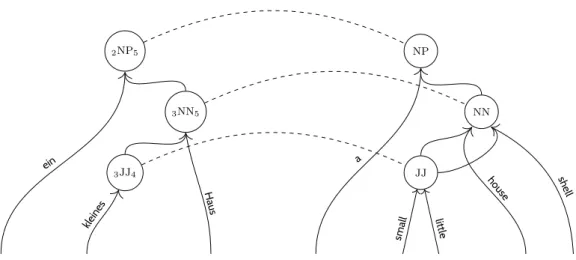
2.5 Example output for a synchronous parse in a hypergraph represen-tation: The source parse is on the left-hand side, and the target on the right-hand side. Nodes on the source side are annotated with their respective source spans. Source-to-target alignment is shown as dashed gray lines. Annotated edges represent terminal nodes. . 26
2.6 POS-tag sequences for two interpretations for the English sentence łWe saw her duck.ž. . . 32
2.7 Two hinge losses and the zero-one loss. . . 59
3.1 Top: Granted US patent US-3386250-A, titled łWater current con-trolling meansž, classiőed under major section E (’Fixed Construc-tions’); Bottom: Granted US patent US-3313250-A, titled łTrap to prevent robbery of a bankž, classiőed under major section G (’Physics’). . . 65
3.2 SCFG rules for translation. . . 77
3.3 Comparing different variants of per-sentence BLEU approximations for the gold-standard function. . . 89
3.4 Visualization of multipartite pairwise ranking. Figure adapted from [Simianer et al., 2012]. . . 93
3.5 ℓ1/ℓ2 regularization enforcing feature selection. Example adapted from [Simianer et al., 2012]. . . 106
3.6 Perceptron variants onNc∗ data. . . 113
3.7 Perceptron variants onWmt13data. . . 114
4.1 Excerpts from abstracts of two distinct, but related patent documents about glow plugs for diesel engines. . . 145 4.2 Sample output of the constrained search algorithm including two
unaligned source and target words. Example adapted from [Bertoldi et al., 2014; Wäschle et al., 2013]. . . 151 4.3 Results for the k-best reranking adaptation on English-to-Italian
ITdata: Positive results are located in the bottom right quadrant, with an increase in the BLEU score and a decrease in TER. Figure adapted from [Bertoldi et al., 2014]. . . 156 4.4 Second set of results for the k-best reranking adaptation on IT
English-to-Italian data. Figure adapted from [Bertoldi et al., 2014]. 157 4.5 Results for thek-best reranking adaptation onLegal
English-to-Italian data. Figure adapted from [Bertoldi et al., 2014]. . . 159 4.6 Second set of results for thek-best reranking adaptation on Legal
English-to-Italian data. Figure adapted from [Bertoldi et al., 2014]. 159 4.7 Results for thek-best reranking adaptation onLegal
English-to-Spanish data. Figure adapted from [Bertoldi et al., 2014]. . . 161 4.8 Results for thek-best reranking adaptation onPatent
English-to-German data. Figure adapted from [Bertoldi et al., 2014]. . . 162 4.9 Results for thek-best reranking adaptation onPatent
German-to-English data. Figure adapted from [Bertoldi et al., 2014]. . . 163 5.1 Partial view of an exemplary use of the graphical PE user interface.
Figure adapted from [Simianer et al., 2016]. . . 169 5.2 Server-client architecture of the online adaptive post-editing interface
with statistical machine translation engine in a graph-based visual-ization with focus on server-side ŕow: Nodes with dark backgrounds represent abstract processes, diamond shaped nodes are junctions, and regular boxes represent processing steps. Figure adapted from [Simianer et al., 2016]. . . 174 5.3 Post-editing user interface with text-based input. Screenshot adapted
from from [Karimova et al., 2017]. . . 177 5.4 Title (underlined) and excerpt containing two sentences of the
ab-stract of patent WO-2007000372-A1. . . 189 5.5 Title and excerpt containing two sentences of the abstract of patent
WO-2007031371-A1. . . 189 5.6 Learning curves for eight translators using the graphical interface in
őve consecutive sessions. . . 192 5.7 Cumulative difference in per-sentence %BLEU between adapted and
the baseline system for both adaptive sessions. . . 193 5.8 Simpliőed server-client architecture which is used for the NMT user
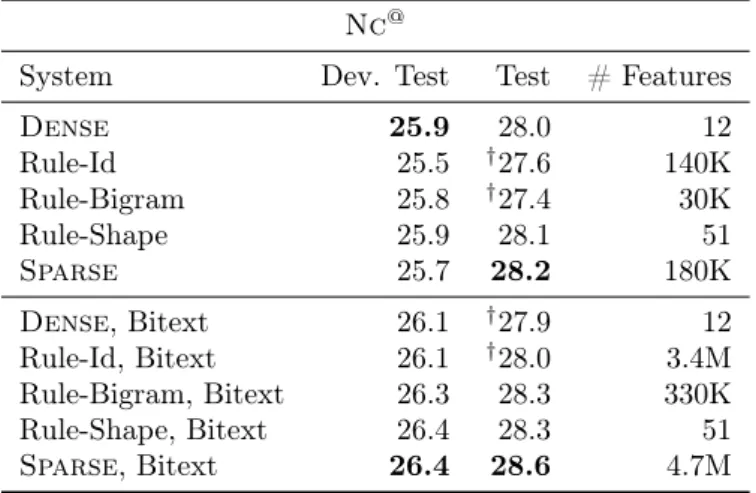
2.1 Top-level sections of the International Patent Classiőcation (IPC). 40 3.1 Statistics for News-commentary (Nc) German-to-English data. . . 71 3.2 Statistics forEuroparl (Ep) German-to-English data. . . 72 3.3 Statistics for WMT’13 (Wmt13) German-to-English data. . . 73 3.4 Statistics for WMT’15 (Wmt15) Russian-to-English data. . . 73 3.5 Comparing Sparse and Dense feature sets on small-scale Nc@
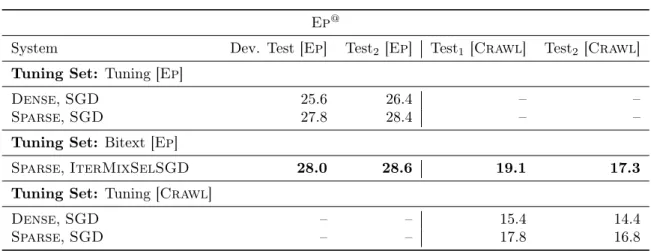
data tuning on a small development (baseline algorithm) set as well as the full bitext (IterMixSGDalgorithm, cf. Section 3.10): Signiőcance is assessed with an approximate randomization test between experiments in the same group, and signiőcant differences, with p <0.05, to the best result (in bold) are denoted by†. Table adapted from [Simianer et al., 2012]. . . 79 3.6 ComparingSparseandDensefeature sets on small-scaleNc∗data,
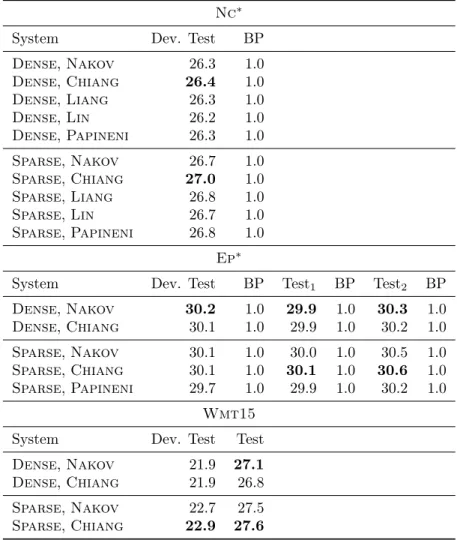
tuning on a single, small development set. . . 79 3.7 ComparingSparseand Densefeature sets on medium-scaleEp∗
data, tuning on a single, small development set. . . 80 3.8 ComparingSparseandDensefeature sets on large-scaleWmt13
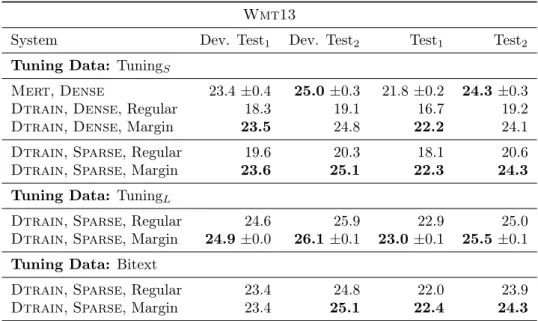
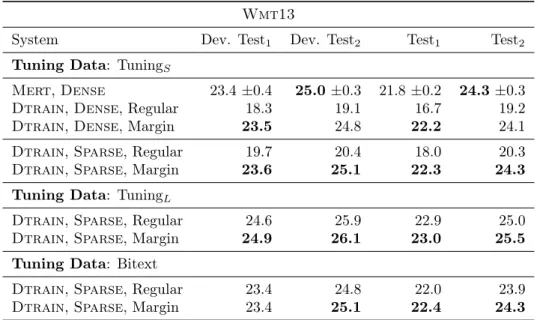
data, tuning on a single, small development set (TuningS). . . 80
3.9 ComparingSparseandDensefeature sets onWmt15data, tuning on a single, small development set as well as the full bitext. . . 80 3.10 Synthetical experiments using theSparsefeature set for both full
and multipartite settings, reporting accuracies on test data and error rates on training data. . . 83 3.11 Synthetical experiments using theDensefeature set for both Full
and multipartite settings, reporting accuracies on test data and error rates on training data. . . 84 3.12 Experiments with different pair selection strategies on a small scale
experiment based on the small data set (Nc∗∗). . . . 96 3.13 Experiments with a structured objective on small and medium scale
data using the Nc∗ and Ep∗ data sets with Dense andSparse features. . . 97
3.14 Comparing different, synchronous parallel optimization schemes on the small Nc@ data set, training on the full bitext with Dense
andSparsefeature sets. Signiőcance is assessed with approximate randomization tests between all experiments in a group, signiő-cant improvements are denoted by the number of the respective algorithms. Table adapted from [Simianer et al., 2012]. . . 110 3.15 Random re-sharding per epoch versus sharding once on the Nc∗
data tuning on the bitext withSparsefeatures. . . 110 3.16 Random re-sharding per epoch versus sharding once on theWmt13
data set using the TuningL data for training. . . 110
3.17 Synchronous and asynchronous parallelized SGD withℓ1/ℓ2
regularization-based feature selection using theSparsefeature set on the TuningL data. . . 111 3.18 Comparing averaged and single best performing weights forDtrain
on development test. . . 113 3.19 Highlighting the performance of training on the bitext onNc∗ data
in comparison toMertand using the margin perceptron loss. . . . 117 3.20 Highlighting the performance of training on the bitext on Ep@,
especially how the learned weights carry over to two out-of-domain test sets. Table adapted from [Simianer et al., 2012]. . . 118 3.21 Highlighting the performance of training on the bitext onWmt15
data in comparison toMertand using the margin perceptron loss. 119 3.22 Highlighting the performance of training on the bitext on the large
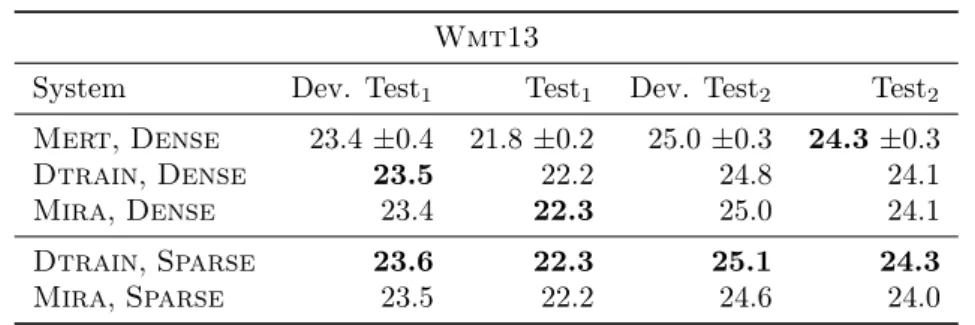
Wmt13data in comparison toMertand using the margin percep-tron loss. . . 119 3.23 Results using theMiraalgorithm in comparison to other methods
onNc∗ data and theDensefeature set. . . 121 3.24 Results using theMiraalgorithm in comparison to other methods
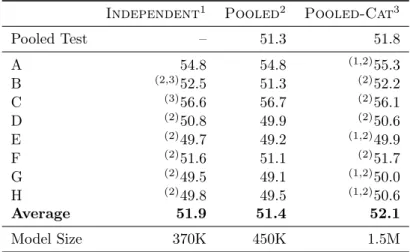
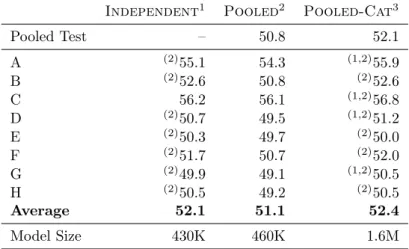
onWmt13data andDenseand Sparsefeature sets. . . 122 3.25 Mert tuning on theIndependent, Pooled, and Pooled-Cat
conőgurations. Signiőcance testing is performed by approximate randomization (comparing results within the same row). Signiő-cantly superior results are denoted by preőxed indexes referring to the respective tuning set ifp <0.05. Table adapted from [Simianer
and Riezler, 2013]. . . 123 3.26 Dtrain tuning with all data sets using the baseline algorithm
(Algorithm 3) andSparsefeatures. Table adapted from [Simianer and Riezler, 2013]. . . 124 3.27 Dtraintuning with all conőgurations using the baseline algorithm
(Algorithm 3),Sparsefeatures andℓ1 regularization as described
3.28 Dtrain tuning with all conőgurations using the baseline algorithm (Algorithm 3),Sparsefeatures and the margin perceptron. Table adapted from [Simianer and Riezler, 2013]. . . 126 3.29 Dtrain tuning with all conőgurations using theIterMixSelSGD
algorithm,Sparse features and the standard perceptron (with two columns replicated from Table 3.26 for comparison). Table adapted from [Simianer and Riezler, 2013]. . . 126 3.30 Dtrain tuning with all conőgurations using theIterMixSelSGD
algorithm, Sparse features and the margin perceptron. Table adapted from [Simianer and Riezler, 2013]. . . 127 3.31 Distribution of IPC classes in % in development data sets for a
Japanese-to-English patent translation task. Table adapted from [Simianer et al., 2013b]. . . 128 3.32 Tuning results for Japanese-to-English patent translation task.
Re-sults in bold are signiőcant improvements over the Mertbaseline withp <0.01. Table adapted from [Simianer et al., 2013b]. . . 128
3.33 Results for German-to-English spoken language translation for IWSLT’13. Table adapted from [Simianer et al., 2013a]. . . 131 3.34 Ablation test for sparse features on German-to-English spoken
lan-guage data (IWSLT’15). Table adapted from [Jehl et al., 2015]. . . 132 3.35 Russian-to-English spoken language translation experiments. Table
adapted from [Simianer et al., 2013a]. . . 133 3.36 English-to-Russian spoken language translation experiments for
IWSLT’13. Table adapted from [Simianer et al., 2013a]. . . 134 3.37 Experimental summary for the German-to-EnglishNc∗ data set. . 135 3.38 Experimental summary for the German-to-EnglishEp∗data set. . 136 3.39 Experimental summary for the German-to-EnglishWmt13data set. 136 3.40 Experimental summary for the Russian-to-EnglishWmt15data set. 137 4.1 Training data for building the phrase-based machine translation
systems for the simulated post-editing experiments with k-best reranking. Table adapted from [Bertoldi et al., 2014]. . . 154 4.2 Statistics for test sets used for simulated post-editing experiments
for IT English-to-Italian system, along with scores for the 1-best results, as well as repetition rates (RR) for the source and target
segments (cf. Section 4.6.4.1). Table adapted from [Bertoldi et al., 2014]. . . 155 4.3 Statistics for test sets used for simulated post-editing experiments
for theLegal English-to-Italian system, along with scores for the 1-best results. Table adapted from [Bertoldi et al., 2014]. . . 158
4.4 Statistics for test sets used for simulated post-editing experiments for theLegalEnglish-to-Spanish system, along with scores for the 1-best results. Set-0 is the concatenation of Set-3–11. Table adapted from [Bertoldi et al., 2014]. . . 160 4.5 Statistics for test sets used for simulated post-editing experiments
for thePatentEnglish-to-German / German-to-English systems, along with scores for the respective 1-best results. Repetition rates are depicted for the English-to-German direction. Table adapted from [Bertoldi et al., 2014]. . . 161 4.6 Repetition rates versus averageRRon sets with degraded translation
quality through reranking (in terms of BLEU or TER). . . 164 5.1 Keyboard and mouse controls for the graphical post-editing interface.176 5.2 Differences of adapted and vanilla systems in corpus-level MT metrics
for all sessions using adaptive MT systems. Averages are depicted in the last row. . . 194 5.3 Results of the estimated linear mixed-effects models with data from
the experiments with the graphical user interface. Table adapted from [Simianer et al., 2016]. . . 195 5.4 Results of the estimated linear mixed-effects model with data from
AI Artiőcial Intelligence
ALPAC Automatic Language Processing Advisory Committee ASR Automatic Speech Recognition
BLEU Bilingual Evaluation Understudy
CAD Computer-Aided Design
CAT Computer-Aided Translation (or: Computer-Assisted Translation) DAG Directed Acyclic Graph
DARPA Defense Advanced Research Projects Agency
DFG Deutsche Forschungsgemeinschaft (German Research Foundation) EPO European Patent Office
FAMT Fully Automatic Machine Translation
FAHQMT Fully Automatic High Quality Machine Translation FAHQT Fully Automatic High Quality Translation
FST Finite-State Transducer
HAMT Human-Aided Machine Translation
HBLEU Human-Targeted BLEU
HTER Human-Targeted Translation Error Rate (Or: . . . Edit Rate) IAMT Interactive Machine Translation
IPC International Patent Classiőcation
IR Information Retrieval
IWSLT International Workshop on Spoken Language Translation KSMR Keystroke and Mouse Action Ratio
KSR Keystroke Ratio
LMEM Linear Mixed-Effects Model MAHT Machine-Aided Human Translation MAP Mean Average Precision
MAR Mouse Action Ratio
MBR Minimum Bayes-Risk
MERT Minimum Error Rate Training MIRA Margin-Infused Relaxed Algorithm
ML Machine Learning
MLE Maximum Likelihood Estimation
MT Machine Translation
NIST National Institute of Standards and Technology NLP Natural Language Processing
NP Non-Deterministic Polynomial-Time
OOV Out-of-vocabulary
PBMT Phrase-Based Machine Translation
PE Post-Editing
PRO Pairwise Ranking Optimization PWR Pause to Word Ratio
RNN Recurrent Neural Network
RR Repetition Rate
SCFG Synchronous Context-Free Grammar SGD Stochastic Gradient Descent
SMT Statistical Machine Translation SVM Support Vector Machine
TER Translation Error Rate (or: Translation Edit Rate)
TM Translation Memory
WFST Weighted Finite-State Transducer WIPO World Intellectual Property Organization
WMT Workshop on Machine Translation (now: Conference on Machine Translation) WPA Next Word Prediction Accuracy
WSCFG Weighted Synchronous Context-Free Grammar WSR Word Stroke Ratio
N,n Variables M Matrix v Vector S Set R Reals N Integers
N+ Positive natural numbers excluding0. Rn Real vector space with dimensionalityn.
S Feature space
X(k,i) Indexirelative to offsetkin a ranking vector or matrix (real indexj =k+i).
S(i) Element at positioniof the (ordered) setS.
vi Componentiof vectorv, or vector with indexiwithin a sequence of vectors. Mij Component and indexi, j in matrixM.
Mi Column iof matrixM. M(j) Rowj of matrixM.
fg,h Function f with a dependency on objectsg andh. | · |p ℓpnorm
||W||p,q ℓp/ℓq matrix norm
iff If and only if.
⟨·,·⟩ Dot product
(·)+ max(0,·)
· Placeholder
All vectors are assumed to be column vectors unless noted otherwise. Notation can be used differently in some contexts.
„Und wenn es auch nur ein kleines und schäbiges Krystall wäre, aber doch eins.“ [Wittgenstein, 1930, Denkbewegungen, a.a.O., S. 21]
Translation is a complex task for humans, but it is a even more daunting task for machines. Much research has been carried out to enable machines to łunderstandž natural language, arguably without a major breakthrough to date (2017) Ð possibly because natural language is tremendously different from what machines are typically able to comprehend. Syntax, pragmatics or semantics of natural language seem to be difficult concepts to capture with the precision that computational processing demands.
Translation between a pair of natural languages1
to be performed automatically by a machine was one of the őrst applications for computers after the second world war and can be considered a seminal work in the őeld of natural language processing (NLP). After some őrst successes, there was a decline in interest, due to the technology seemingly just not being adequate for the problems at hand, which was infamously recorded in the report by the Automatic Language Processing Advisory Committee (ALPAC) [Pierce and Carroll, 1966].
Methods based on statistical modeling breathed new life into the machine translation (MT) research and practice due to their natural capability of dealing with the ambiguities found in natural language. The statistical models of language translation have evolved a lot since then, and today they are a readily available tool in a globalized world for use in a wide range of practical applications.
As powerful as these methods are, the general problem of language and its inherent ambiguity still remains. The statistical models we are concerned with are learned from data, and since language is virtually inőnite2, the data can in any case be only a more or less insufficient sample. To build meaningful models of translation, the data used in (statistical) machine translation (SMT) most commonly originates from texts covering a range of different topics, times, contexts and authors, to maximize coverage and in an attempt to estimate reliable statistics. This poses a new problem: Translations produced with these models tend to represent the lowest common denominator between all the different aspects that constitute the product of translation. In addition, as the sheer combinatorial space that
1
We will call a pair of natural languages simply a language pair, the languages in the pair are referred to as source and target, respective of the translation direction.
2
This statement holds true for the combination of existing vocabulary to coherent utterances (sentences), as well as the production of new items in a language’s vocabulary.
applies in translation is so large, (some) models in SMT pose strong independence assumptions in their choice of translation units3
, which further aggregates the problems. With machine translation modeled by neural networks, it is possible to build richer statistical models, which rectify this problem to some extent, but still not completely.
While overcoming the immanent need for hand-written rules for translation, the statistical models have their own set of problems. The symptoms of these problems can be acceptable if machine translation is just used as a means for getting a general idea4
of a text in foreign language, but they can become a severe problem if a translation is meant for direct human utilization, or if it is used as a starting point for a human translator: Contexts may demand certain wording in order to convey the right meaning, or authors may prefer to translate certain passages differently. As variation is endless, these issues are a constant factor in dealing with statistical models for NLP.
In the literature the topic, genre, and style of a text are broadly referred to as itsdomain [van der Wees et al., 2015]. Domain is an important concept in NLP, as well as machine translation where the goal is to produce a semantically equivalent target-language utterance to a given source input, that was in turn generated in a speciőc context. Capturing the context in translation is difficult as the domain is usually only implicit and its characteristics inherently vague. The alterations in the language going from one domain to another can be manifold: Ambiguities may have to be resolved differently, structural properties such as word order are subject to change, as well as the use of idiomatic expressions. Adapting an existing statistical model to a new domain is calleddomain adaptation, effectively changing a model to better reŕect the current domain of interest.
If machine translation is used as a tool for humans5
e.g. for professional transla-tors, the domain adaptation problem has even higher signiőcance: The event of receivingN different translations when havingN people translate the same source text is quite likely, arguably close to certainty, depending on the source text. This imposes another dimension onto the domain adaptation problem as described before, since preferred wordings and expressions of single authors are delicate to capture and model. Furthermore, certain external requirements regarding terminology and consistency are likely to be postulated in a professional environment. So it may be safe to say, that adaptation of MT in this setting is a different compared to general domain adaptation. We argue that both general domain adaptation, and a more specialized adaptation have to be implemented if the goal is to make MT the most useful tool it can possibly be for human translators.
3
These may be characters, words or phrases depending on the model at hand.
4
What is sometimes called a “gist” or “gisting”.
5
Human-machine interaction in the field of translation is most commonly referred to as computer-aided translation (CAT).
In the simplest case the success of domain adaptation efforts in MT are evaluated in terms of translation quality given a set of prefabricated reference translations. Most often, quality is used in the sense of similarity between translation outputs and these reference translations. In the case of CAT, machine translations may also be evaluated in terms of their utility to a translator, and by derived measures such as translation speed.
In the work presented here, we seek possible remedies or solutions for three problems: a) general translation quality improvements6, by efficiently exploiting large amounts of data from varied sources, learning useful global ranking models e.g. by őnding commonalities in the data, b) a more őne-grained adaptation for a CAT scenario, making use of methods that try to automatically learn speciőc preferences which are given by observed, possibly user- or domain-speciőc data, and c) learning to adapt to individual translators also in a CAT scenario by directly interacting with translators by exploiting the most direct feedback possible.
The problems a), b) and c) are approached as preference learning problems, and more speciőcally as ranking problems, where the goal is to learn a ranking function which adheres externally induced preferences.
We now turn to describe our learning framework which we employ for approaching these problems.
1.1 Preference Learning for Machine Translation
Given an sufficient amount of data, the MT systems discussed in this work are able to generate an elusively large set of translation alternatives for any given utterance7. It is quite likely that an adequate translation is contained in that set, or at least some acceptable translation candidate. However, as evident by the lack of readily available fully automatic high-quality machine translation (FAHQMT), the best translation hypothesis selected by a system as its output is more often than not the wrong choice. There are a number of different reasons for this behavior: Insufficient statistical evidence in the training data of the MT system, impossible required conőguration of translation units, or simply unknown new vocabulary. The most common reasons are howevermodeling-andsearch errors: Due to the huge output space, which renders exact search methods infeasible, traditional machine translation systems heavily rely on independence assumptions and use a simple scoring function for decoding that introduces further approximations throughpruning.
It is a recurring theme in MT, that while the system is theoretically able to
6
The developed method can also be used for efficient domain adaptation, improving domain-specific translation quality, which we also empirically substantiate.
7
produce very good translations for most utterances, it can just not be scored as such by the model or is lost in search, see e.g. the discussions in [Sokolov et al., 2013] or [Och et al., 2004].
Variants of pruning are implemented in the underlying statistical models, as well as the scoring function, that is used to assess the őt of partial translation hypotheses that make up the őnal translation output (a complete hypothesis). In SMT, this scoring function is generally quite simplistic, i.e. a linear model, and it is prone to select globally non-optimal translations due to its local pruning choices. Taking a simpliőed view, the scoring function has to select a number of hypothe-ses from a list of possible extensions at each step of the translation process. In other words, the scoring function produces aranking of the possible (partial) translations. This insight enables the application of a powerful class of algorithms which can be subsumed under the umbrella term preference learning8
. Fundamentally for our work we may learn preferences from correct rankings (the learning-to-rank approach, speciőcally pairwise ranking, see e.g. [Herbrich et al., 1999; Joachims, 2002; Watanabe et al., 2007b; Hopkins and May, 2011]), as well as from structured representations of translations deemed correct (structured prediction approach, see e.g. [Collins, 2002]).
As already mentioned, correctness is a fuzzy concept in translation, which is why we will resort to similarity-based evaluation metrics for the most part of our work, i.e. what we call translation quality. Both pairwise ranking and structured prediction have in common that they are trying to learn a linear scoring function in such a way that the function assigns higher scores to higher quality translations and lower scores to ones of less quality. This in turn should result in overall better quality in the translation output. To put it slightly more formal: In the pairwise ranking approach we learn a scoring function from rankings of translation hypotheses according to a metric of translation quality, which is evaluated w.r.t. some form of reference translations; In the structured prediction approach the objective is focused on separating a single łbestž (or correct) translation and its associated structure from competing translations and their respective structured representations.
We are now in a position to further specify our problem statements with regard to the just outlined proposed learning framework:
a) To improve general translation quality, we seek to learn a robust scoring function from large amounts of data employing a pairwise ranking algorithm for preference learning.
8
Note that we generally use this term from a ranking perspective, see e.g. [Fürnkranz and Hüllermeier, 2003] or [Fürnkranz and Hüllermeier, 2010].
b) In the second approach, turning to a CAT scenario, we seek to improve translation quality following the same general approach as before, but using a structured prediction approach to directly learn from the translations provided by translators, in an attempt to obtain more specialized models with preference learning.
c) Finally, we explore the most direct possible approach for preference learning by requesting and exploiting direct user feedback to MT outputs, which can then be used for adaptation.
Problems b) and c) need further differentiation: In the CAT scenario it is crucial to effectively learn more őne-grained to effectively adapt the translations outputs, which is why we explore adaptation with two different approaches: Engaging in problem b), we learn to prefer user supplied translations over competing translation hypotheses, by using representations of their exact outputs as target structure in the structured prediction approach. This enables a very direct mode of learning. However, in computer-aided translation, we can exploit even őner-grained feedback since there is a human in the loop. By asking for explicit feedback for MT outputs from translators, we are in a position to effectively learn user-speciőc preferences directly. In c) we also investigate adaptation of a neural network based MT system.
The problem a) can be considered as a classical tuning task for SMT. In contrast, problems b) and c) are evaluated as post-editing (PE) tasks9
Ð revealing a reference translation or user-generated translation to the learning algorithm immediately after evaluating the quality of the originally proposed machine translation. Due to the nature of all of these problems, they can be approached using traditional online learning methods.
1.2 Outline
Our work is structured as follows:
In Chapter 2 we provide the necessary background for the used MT approaches as well as preference learning, which we discuss from the learning-to-rank perspective. For SMT, formal introductions for word-, phrase- and hierarchical phrase-based models are presented, with a focus on the latter since it is the model most promi-nently used in our work. Also provided is a formalization of neural machine translation (NMT), which we apply for online adaptation in a PE task. We also formulate brief historical overviews of MT in conjunction with CAT, since research and practical application of both őelds are closely interleaved. Since our work is
9
Problem c) allows however for a different set of methods, since it actually considers a human-in-the-loop.
assessed by measuring relative differences in translation quality, manual transla-tion effort and/or translatransla-tion speed, we provide deőnitransla-tions of various automatic translation metrics, and discuss their relation to human judgments. We further discuss domains in the context of MT, and brieŕy present the different types of natural language data used in this work, followed by a short discussion of general domain adaptation methods in MT. Hereafter follows an in-depth discussion of optimization for SMT, concentrating on applications of discriminative training techniques. We describe other state-of-the art algorithms related to structured prediction and direct error minimization. The algorithms are presented in the context of ranking. Lastly, preference learning as used in this work is őrst described from the perspective of the őeld of information retrieval (IR), concentrating on the problem of learning rankings in the learning-to-rank framework.
After a thorough examination of optimization in SMT, we present our pairwise ranking approach in Chapter 3. The presentation consists of in-depth analyses of all aspects of the algorithm, as well as thorough empirical evaluation. Algorithmic and implementational aspects such as parallelization, asynchronicity, regularization and feature selection are discussed, as well as variants of the underlying trans-lation metric which is used for ranking. We also provide benchmark results on various data sets of the proposed algorithms. This part covers problem statement a). Our őrst work in CAT is presented in Chapter 4, where we propose a struc-tured perceptron for rerankingk-best output of an SMT system, using a feature representation of the actual reference or post-edit as target without resorting to so-called łoraclež translations10 deőned by a surrogate metric [Och and Ney, 2002]. The approach is described in detail, and simulated PE experiments using either reference translations or post-edited data are presented. We also describe the online learning protocol and simulated PE, which our approach is an instance of, and present related works in general reranking for SMT, adaptation methods in CAT and simulated PE. This work covers problem statement b).
In the last chapter discussing original works (Chapter 5), covering problem statement c), we present our approach for learning preferences from explicit user feedback, which is collected from a human-machine interface for PE. We describe the interface, our adaptation approaches and practical issues. In a second line of work, we show how to adapt a neural statistical machine translation system with post-edited translations. We further describe the two user studies we conducted, and appropriate human-targeted evaluation metrics. Our work is put into perspec-tive by contrasting it to a large body of related works. The outcome of the user
10
Oracles in this context are translations contained in the search space which represent the best output a system can possibly produce, given a reference translation.
studies are analyzed with a linear mixed effects model (LMEM), which are also deőned in this chapter along with an overview of evaluation in CAT.
Finally, we brieŕy summarize our work in Chapter 6, and give conclusions and ideas for future directions of work.
1.3 Research Contributions
Our contributions to research in preference learning for machine translation can be summarized as follows:
• Review of optimization techniques in SMT with a focus on scaling of both training data and the feature space, as well as a discussion in the context of ranking algorithms [Chapters 2 & 3];
• We present efficient algorithms for (parallelized) online, gradient-based pair-wise ranking optimization for SMT [Chapter 3];
• Thorough analysis of linear models for pairwise ranking in application to SMT with extensive experimental evaluation of pairwise ranking varying data and feature sets [Chapter 3];
• An application of multi-task learning via regularization for large-scale SMT tuning, which allows training on the full bitext as well as exploitation of commonalities within the data [Chapter 3];
• Development of a novelk-best reranking method for SMT with a structured prediction objective [Chapter 4];
• Evaluation of the aforementioned reranking technique in a simulated PE setting [Chapter 4];
• Adaptation framework for learning from explicit user feedback including manually generated word-alignments, and development of a suitable user interface [Chapter 5];
• A user study contrasting adaptive to non-adaptive statistical machine trans-lation systems, including other state-of-the art adaptation methods [Chapter 5];
• A user study contrasting adaptive to non-adaptive neural machine translation systems [Chapter 5].
1.3.1 Previous Publications
Parts of the research presented here has been previously published and was peer-reviewed.
Ground-laying work for the pairwise ranking optimization as described in Chap-ter 3 has already been carried out during a MasChap-ter’s thesis [Simianer, 2012], of which some of the core őndings are published in [Simianer et al., 2012]. Our őrst works on multi-task learning for parameter optimization in SMT are described in [Simianer et al., 2011] as an extension to the classical Minimum Error Rate Training (MERT) algorithm. Further work in this direction [Simianer and Riezler, 2013], as described in Section 3.12.2, uses a similar setup (patent data divided in parts by manual classiőcation) but utilizes a different algorithmic approach and larger-scale data. Simianer and Riezler [2013] also describe vital extensions to the original algorithms in [Simianer et al., 2012]. The usefulness of the pairwise ranking approach, the proposed algorithmic extensions, multi-task learning, and parameter optimization using the full bitext were thoroughly evaluated in [Simianer et al., 2013a] (transcribed speech data, two language pairs and three translation directions, cf. Section 3.12.3), [Simianer et al., 2013b] (patent data, translating Japanese and Chinese into English, cf. Section 3.12.2.3), and őnally in [Jehl et al., 2015] (transcribed speech data, English-to-German, cf. Section 3.12.3).
The reranking approach to learning preferences from post-edits in Chapter 4, was őrst described in [Wäschle et al., 2013]. A more detailed description of the approach as well as further evaluation can also be found in [Bertoldi et al., 2014]. A short description of our proposed methods for learning directly from user input in statistical machine translation (Chapter 5) is published as [Simianer et al., 2016]. The publication also comprises a description of the conducted user study and the main őndings. A further, different analysis of the user study on neural machine translation is published in [Karimova et al., 2017].
“The only things in my life that compatibly exist with this grand universe are the creative works of the human spirit.ž
[Ansel Adams, An Autobiography, 1985]
Automatic translation has a distinguished place in computer science (or more speciőc NLP): Translation is a difficult1
task even for humans which requires long training, and translations of natural language are in any case meant for direct human consumption Ð it is therefore a daunting task to be carried out by machines. In board games, classical examples for the application of artiőcial intelligence (AI), the number of possible board conőgurations (thesearch space) is typically so high that it is infeasible to explore it completely. There are for example about1045
different legal board conőgurations in the game of chess2
. Natural language and translation in particular however have even worse characteristics: Imagine a 20-word utterance in a source language, which is to be translated into another language that we will call the target language. Now, disregarding context, and assuming a non-realistic 1-1 correspondence in words for source and target languages, a conservative estimate for possible translation candidates per word is say 10.3 We then arrive at2010 possible translations for our original source language sentence,
when assuming that the word order between two languages is monotone (identical), and each word occurs exactly once. The former is however infrequently the case, but even more so when languages are more łdistantž from each other, e.g. even differing in the fundamental subject-object-verb placements4
. Assuming completely free word order, there are(2010)!possible translations, which are absolutely not
manageable in any way. To make matters worse, it is imperative getting word order right Ð see for example the simplistic sentence depicted in Figure 2.1, where the semantics can be varied in dramatically different ways, inserting the adjective onlyat any position within the sentence.
An adequate translation system should be able to correctly transfer the meaning of the sentence to a valid target language utterance. Coming up with an algorithm that handles all these cases is bound to be difficult.
1
Depending however on the subject matter.
2
Cf. https://tromp.github.io/chess/chess.html.
3
This number will be even higher if translation candidates are automatically determined through co-occurrence in a statistical dictionary or phrase-table.
4
Subject (S), object (O), verb (V): SOV (e.g. Latin) — SVO (e.g. English) — VSO (e.g. Arabic) — VOS (e.g. Malagasy) — OVS (e.g. Urarina) — OSV (Yoda from theStar Warsmovie
She told him that she loved him.
Figure 2.1: Inserting the word łonlyž in any of the eight possible positions within the sentence, alters the sentence’s semantics, depending on the position and accordingly on the part of speech the word takes.
The wide range of problems in automatic translation has led to the development of manifold approaches to MT, consolidating different lines of research for the sublime goal of adequate and ŕuent automatically generated translation: Linguistic theories such as syntax and semantics, which are trying to őnd formalizations of language and translation of languages, have been applied for developing and analysing both rule-based and statistical systems; Developments from graph theory are used to encode and efficiently explore the vast number of possible translations for each given source utterance; Probability theory and statistics are used to mathematically grasp the task of translation; ML and optimization are employed as a means for learning efficient models of translation; And lastly, neural networks provide an alternative way of learning the underlying statistical models.
Aside from the technical formulation of the task of translation, there is a human factor which adds further layers of complexity: Since the fragile rule-based or statistical models underlying machine translation need lots of examples or training data for developing or learning appropriate models, it is almost inevitable that many details and nuances that natural language exhibits are bound to be lost when trying to build a general model for each and every application.
Due to these complex issues, up to date (2017), machine translation still suffers from severe limitations preventing its use for many practical automated applications. There is however signiőcant adoption of machine translation in the őeld of CAT, interfacing machine translation and human translators.
In this chapter we őrst give a short history of MT as well as CAT. We then present the different approaches to machine translation that are used in the remainder of this work. We furthermore present methods for evaluating machine translation in the context of reference translations, as well as the data that we use to build the MT systems used in our work. Lastly, we present a range of optimization methods in SMT which are relevant to this work, and describe the fundamentals used in the following chapter.
2.1 A Very Short History of Machine Translation & Computer-Aided Translation
After the Second World War, MT was one of the őrst applications for the recently invented computers5
. From that time, one of the most cited sayings by Warren Weaver was conveyed:
“One naturally wonders if the problem of translation could conceivably be treated as a problem in cryptography. When I look at an article in Russian, I say: ’This is really written in English, but it has been coded in some strange symbols. I will now proceed to decode.ž
[Weaver, 1949]
Laying the ground work for the information theoretic treatment of the translation problem Ð considering MT as a cryptographic problem, translating an encoded sequence of strings to a plain text one through decoding.
However, soon after the őrst conference on machine translation had been held [Hutchins, 1997; Reiŕer, 1954], the idea of computer-aided translation in the form of PE was formulated by Yoshua Bar-Hillel, proving some doubt in the promise of fully automatic machine translation (FAMT).
Contrariwise, because of the Cold War, the interest in the Russian-English language pair was unbroken in the US, and some successes could be acclaimed, for example adequate translations of speciőc scientiőc Russian texts into English [Dostert, 1955].
This lasted until the devastating ALPAC report that was published in the mid 1960s [Pierce and Carroll, 1966], which doubted that FAHQMT could ever be achieved. The report however, explicitly encouraged research in CAT for improving the efficiency of the human translation task.
After this report research in the US slowed down signiőcantly due to reduced funding. Yet, research in other parts of the world continued unaffected, which for example resulted in the interlingua approach to machine translation [Vauquois, 1975]6
, completing the famousVauquois triangle [Vauquois, 1968].
During the 1970’s and 1980’s rule-based MT matured to actual commercial products, for example theSystran rule-based system [Ryan, 1989]. Pre- or post-editing was an integral part of most systems [Wagner, 1985].
The concentration on rule- or interlingua-based systems in MT research was eventually broken in the early 1990’s, where the idea of automatically exploiting parallel sentence-aligned data with statistical models was őrst published in a series of papers now referred to as theIBM models [Brown et al., 1993]. The following research and development activity lead to the immensely practical statistical phrase-based models [Koehn, 2004a; Chiang, 2007], which also were able to produce good
5
The idea of MT was conceived earlier, see e.g. Hutchins [2007] for a more thorough disquisition of MT history.
6
translation results with minimal human intervention. Naturally, since machine translations were becoming better and better, this lead to an increased interest in applications of CAT, not later than empirical studies showed potential in real-world tasks.
Due to advancements in hardware technology, neural networks őnally became feasible in the late 2000’s and, among other things, proved to be the new state-of-the-art in a large number of ML tasks, including various NLP applications. MT was revolutionized shortly after, due to certain advancements in sequence to sequence algorithms for language modeling, exhibiting much enhanced performance and above all ŕuency őrst in hybrid [Devlin et al., 2014] then in fully NMT approaches [Bahdanau et al., 2014] (inter-alia). Due to the performance and the simplicity of these systems as well as their natural őt to certain setups, neural (statistical) machine translation has sparked further development in CAT.
To summarize: The idea of fully automatic, and high quality machine translation has had ups and downs throughout the short history of automatic translation, but the idea of CAT has always been on people’s minds, as it is a natural application of MT for practical purposes.
2.2 Statistical Machine Translation
Methods for MT have been iterated a number of times throughout its history, from simple dictionary-based approaches for direct translation in between languages, over complex methods involving a speciőcally designedinterlingua which is supposed to capture generic semantic concepts, and variations thereof [Vauquois, 1975].
The most successful approach however, providing generally available, useful automatic translation, is the statistical approach. As in other őelds in NLP, statistics cope quite naturally with the ambiguity found in natural language. But since it is such a difficult task, a variety of statistical models of translation have been developed.
We őrst review the general notion of providing a solution to natural language translation in terms of probability theory and statistics, then brieŕy discuss tra-ditional word-based models which serve as the starting point for the more useful phrase-based models. Finally we introduce neural (statistical) MT.
2.2.1 Statistical Formulation of Translation
In the following we will describe the principle ideas of conducting translation in a statistical framework, starting from the classical noisy channel [Brown et al., 1988, 1990, 1993], converging to the modern formulation as structured prediction using a maximum entropy formulation [Och and Ney, 2002].
In statistical machine translation, ideally, we would have a good estimate for any conceivable pair of sentences7
eandf8
of how likely it is that they are translations of each other. Here,eandf are represented by two random variablesE andF, and are associated with a joint probability distributionP
P(E, F). (2.1)
For now we will ignore that this is an obviously overly conődent proposition, and explain how one may arrive at a viable decomposition of that probability.
The general goal in generative modeling is to learn the joint probability distribu-tionP, e.g. in classiőcation over objectsX∈ X and labels Y ∈ Y represented by
random variablesX andY respectively:
P(X, Y). (2.2)
This distribution should satisfy the following constraints: ∑
(x,y)∈{X×Y}
P(X =x, Y =y) = 1, (2.3)
∀(x, y)∈ {X×Y} P(X =x, Y =y)∈[0,1], (2.4) where{X × Y}is the set of all possible pairs of assignments forX and Y9
. In our caseX =E andY =F.
Without a concrete idea of how to estimateP(E, F), we could apply the chain
rule to decomposeP into possibly feasible parts:
P(E, F) =P(E|F)P(F). (2.5) There is no particular interest in estimatingP(F), since we want to be able to
translate any utterance in the foreign language. Therefore we focus on the more interesting conditional probabilityP(E|F).
Going further, using Bayes’ rule, we arrive at a feasible decomposition ofP(E|F): P(E|F) = P(F|E)P(E)
P(F) . (2.6)
7
Implicitly, we defined the principal but intuitive simplification of statistical machine translation: translational equivalence based on sentences.
8
Historicallyeas inEnglishis the target sentence, andf as inFrenchis the source sentence.
9
Note that in natural natural language, i.e. X=EandY =F, these variable are most certainly not independent, thusP(E, F)̸=P(E)P(F).
For translation, we are still not interested inP(F), and since there is no
depen-dence onE, the denominator can simply be dropped10
. This leads us to thenoisy channel11
formulation:
P(E|F)∝P(F|E)P(E). (2.7) This reformulated generative model frees us from the burden of having to esti-mate a single single modelP(E|F), but instead we have two models that we can
build independently. Brown et al. [1990] refer toP(F|E)as thetranslation model,
and toP(E)as thelanguage model. Actual implementations of these two models
will be presented later in this section.
Given a concrete model of the noisy channel P(F|E), as well as a model of
general stringsP(E), we are interested in őnding, for any f, the most probable translatione:ˆ ˆ e = arg maxeP(E=e|F =f) = arg max e P(F =f|E=e)P(E=e). (2.8)
This search is called decoding12
. In the noisy channel model, thearg max
oper-ation can be understood as the attempt of recovering the original message. For P(F =f|E=e)we will writep(f|e)from now on, as well as for all other
probabil-ities.
The translation modelp(f|e)is however still underspeciőed, as there is no direct
connection between the source f and its translation e. The model described in [Brown et al., 1993] introduces the notion of an implicit,hidden alignment between eandf. The translation model becomes:
P(F|E) =∑
a∈A
P(F, A=a|E), (2.9)
10
This is due to the fact that in actual translation, performing anarg maxoperation overP(E|F), P(F)is constant and can thus be dropped.
11
The noisy channel origins from the work on information theory of Shannon [1948] — a message Eis sent through a channel in which it is distorted, resulting in the corrupted messageF. In this view,P(F|E)is the noisy channel, andP(E)is a prior on the “original” message. Church and Gale [1991], Mays et al. [1991] and Kernighan et al. [1990] first introduced this probabilistic view into an NLP task, namely for spelling correction. Before that, the formulation was already used in speech recognition [Bahl et al., 1983; Brown et al., 1994].
12
This term stems from the famous quotation of Warren Weaver, embracing natural language translation as a cryptographic task: “I will now proceed to decode.”
and thus:
P(E|F) =∑
a∈A
P(F, A=a|E)P(E), (2.10) whereAis the set of possible alignments betweenE andF.
The consequence of introducing an alignment betweenE andF is, that it allows to break up the deőnition of translation probability to smaller items, e.g. single words. With this, it is possible to deőne more useful models, as we will discuss in the following section.
The noisy channel formulation for translation is still limited, as noted in [Och and Ney, 2002]:
a) It is not possible to incorporate further models (possibly deőned on a different data set) in a generalized way, sop(e)andp(f|e)have to be excellent, i.e.
close estimates of the true distributions, which is unlikely in practice; b) p(e) and p(f|e) are independent by deőnition, which also applies to their
application in search Ð a weighted approach, balancing the models based on their performance would be more appropriate.
A different approach, which can be naturally developed from the noisy channel approach, is to directly model the conditional distributionP(E|F)with a discrim-inative model. Och and Ney [2002] introduce this idea for MT and propose the use of alog-linear13
model for this purpose.
This model applied to the formulation above results in the following deőnition of the joint distributionP(F, E):
P(F =f, E=e) =p(f, e) =∑exp (logp(f|e) + logp(e))
f′ ∑
e′
exp (logp(f|e) + logp(e)). (2.11)
However, in the log-linear framework, we can directly derive the conditional distributionP(E|F):
P(E=e|F =f) =p(e|f) = ∑exp (logp(f|e) + logp(e))
e′
exp (logp(f|e) + logp(e)), (2.12)
that is, for any given f, we simply seek a distribution over possible values e, using the previously deőnedp(f|e)andp(e)as features. Due to the normalization,
13
we can also add weights w1, w2 to the features, possibly balancing their relative
quality:
P(E=e|F =f) =p(e|f) =∑exp (w1logp(f|e) +w2logp(e))
e′
exp (w1logp(f|e) +w2logp(e))
. (2.13)
This approach can be generalized to use arbitraryfeature functions hi(f, e), with
associated weightswi =w for i = 1. . . M, and usinglogp(f|e) and logp(e) as
feature functions: p(e|f) = exp ∑M i=1wihi(e, f) ∑ e′ exp∑Mi=1wihi(e, f) . (2.14)
Conveniently this equation can be formulated compactly by using a dot product and by introducing afeature mappingfunctionϕ(f, e)that takes a source/translation
pair(f, e)and maps it to a vector14
of features[wi, . . . , wM]T =w: pw(e|f) = exp⟨w, ϕ(e, f)⟩ ∑ e′ exp⟨w, ϕ(e, f)⟩. (2.15)
Thedecision rulefor őnding the optimal ˆefor a givenf is just the denominator:
ˆ e = arg max e p w(e|f) = exp∑Mi=1wihi(e, f) = ∑Mi=1wihi(e, f) = wϕ(e, f). (2.16)
Note that, most commonly in MT, the feature mapϕ(·)is deőned over a triple
(f, e, a)(and thush(f, e, a)), including the alignment betweeneandf. This allows to deőne features of thederivation of a translation. This is due to themaximum approximation used in thearg max computation, which is used to ensure feasibility
of the search problem.
2.2.2 Word-Based Models and Statistical Word Alignment
The so called IBM models introduced by Brown et al. [1993], provide a number of decompositions of the probability distributionP(E|F)(as outlined before) and appropriate procedures for learning the distribution from data.
The central idea of these models is breaking upEandF into sequences of words, and deőning an alignment between them:
14
• e= [0, e1, . . . , el], a vector oflrandom variables representing a target sentence,
as well as a őxed specialNull token at 0,
• f = [f1, . . . , fm], a vector of m random variables representing a source
sentence,
• and an alignmenta= [a1, . . . , am], deőned fromf to e.
With this we can write the translation model as:
p(f1, . . . , fm, a1, . . . , am|e1, . . . , el, m) =p(f,a|e, m), (2.17)
and
p(f|e) =∑
a∈A
p(f,a|e), (2.18)
whereAis the set of all possible(l+ 1)malignment vectors.
The most simple models,IBM model 1 and2, which we describe here, combine a lexical distributiont(f|e)and a distribution over alignmentsu(j|i, l, m),(l, m)∈
N+,i∈ {1, . . . , m}, andj∈ {0, . . . , l}: p(f,a|e, m) = p(a|e, m)p(f|a,e, m) ˆ = m ∏ i=1 u(ai|i, l, m)t(fi|eai). (2.19) Note that the second equation introduces two important independence assump-tions: 1) the alignment only depends on the lengths of the French and English sentences, not on the words, and 2) that the lexical distribution does not depend on the alignment.
In IBM model 1 (M1) the distribution over alignments is uniform, thus:
pM1(f,a|e) = p(m |e) (l+ 1)m m ∏ j=1 t(fj|eaj), (2.20)
assigning the same probability to all alignments.
Since manually word-aligned data is infeasible to produce, the IBM models cannot be simply estimated by using direct maximum likelihood estimation (MLE), i.e.: tML(f|e) = c(f, e) ∑ f′ c(f′, e), (2.21)
wherec(f, e)counts alignments links betweenf andein a word-aligned corpus. Accordingly for the alignment:
uML(j|i, l, m) =
c(j, i, l, m)
∑
jc(j, i, l, m)
, (2.22)
wherec(j, i, l, m)counts all occurrences of parallel sentences of lengthslandm respectively, where the French wordiis aligned to an English wordj.
Therefore the IBM models are estimated using a variant of the expectation maximization algorithm [Dempster et al., 1977].
Decoding, i.e. arg maxep(f|e)p(e), with the IBM models is NP-complete [Knight,
1999], hence approximations are needed [Wang and Waibel, 1997; Riedel and Clarke, 2009; Germann et al., 2001].
A by product of a fully trained word-alignment is the so calledViterbi alignment
ˆ
a, deőned as [Brown et al., 1993]:
ˆ
a= arg max
a∈A
p(f,a|e), (2.23)
which can be generated by selecting:
ˆ
ai = arg max i u(a
i|i, l, m)t(fi|eai) (2.24)
for each positioniin the French sentence. The result (an unique alignment for a given sentence pair) can be visualized in analignment matrix, see Figure 2.2 for an example.
The word-based models are not very useful for actual translation due to the harsh independence assumptions and the comparatively complex word-based decoding. They are however, as we will see in the phrase-based models, a good starting point for more advanced approaches. For this purpose,alignment symmetrization is an important concept, as őrst proposed by Och and Ney [2003]: Since the individual word-alignment models only produce many-to-one alignments15
and not many-to-many alignments, which would be more appropriate for natural language. A simple symmetrization approach is to train two models, p(f|e) and p(e|f), generating
Viterbi alignments from both, and joining the alignments using set operations like union, intersection or derivations thereof16
. The resulting alignment is a proper
15
In the formulation above, each French wordf aligns to exactly one English wordeor the Null token.
16
A popular symmetrization method, referred to asgrow-diag-final-and[Koehn et al., 2003], starts with the intersection and subsequently adds alignment links from the intersection.
Michael assumes that he will stay in the house . M i c h a e l g e h t d a v o n a u s , da s s e r i m H a u s b l e i b t .
Figure 2.2: Example of a word alignment matrix: The source and target word positions correspond to rows and columns respectively. Alignment links are visualized by cells with a black background at the according positions.