Working Paper No. 10
Structural Development Accounting
Gino Gancia, Andreas Müller and Fabrizio Zilibotti
March 2011
University of Zurich
Department of Economics
Working Paper Series
ISSN 1664-7041 (print)
ISSN1664-705X(online)
Structural Development Accounting
Gino Gancia,yAndreas Müllerzand Fabrizio Zilibottix
February 4, 2011
Abstract
We construct and estimate a uni…ed model combining three of the main sources of cross-country income disparities: di¤erences in factor endowments, barriers to technology adoption and the inappropriateness of frontier technologies to local conditions. The key components are di¤erent types of workers, distortions to capital accumulation, directed technical change, costly adoption and spillovers from the world technology frontier. Despite its parsimonious parametrization, our empirical model provides a good …t of GDP data for up to 86 countries in 1970 and 122 countries in 2000. Removing barriers to technology adoption would increase the output per worker of the average non-OECD country relative to the US from 0.19 to 0.61, while increasing skill premia in all countries. Removing barriers to trade in goods ampli…es income disparities, induces skill-biased technology adoption and increases skill premia in the majority of countries. These results are reverted if trade liberalization is coupled with international IPR protection.
JEL Classi…cation: F43, O11, O31, O33, O38, O41, O43, O47.
Keywords: Directed Technology Adoption, Development Accounting, Distance to Frontier, Inappropriate Technologies, Skill-biased Technical Change, Productivity, TFP di¤erences.
We thank Daron Acemoglu, Francesco Caselli, Antonio Ciccone and Michelle Rendall for useful comments. Gino Gancia acknowledges …nancial support from the Barcelona GSE, the Government of Catalonia and the ERC Grant GOPG 240989. Fabrizio Zilibotti acknowledges …nancial support from the ERC Advanced Grant IPCDP-229883.
yCREI and Universitat Pompeu Fabra. Email: [email protected]. zUniversity of Zurich. Email: [email protected].
1 Introduction
New technologies do not di¤use instantaneously, and adoption lags are considered a major determinant of productivity di¤erences across …rms and nations. In a classic paper, Griliches (1957) documents that new more productive seeds of hybrid corn di¤used slowly across US agricultural regions, with a 15-year lag between adoption in Iowa and Alabama, and that their di¤usion was a¤ected by local conditions, such as geography and market potential. The spread of more recent technologies follows a similar pattern. Kiessling (2009) reports evidence of slow adoption of information and communication technology di¤usion both between and within countries. For instance, while personal computers became available in the early 1980s, in 2006 the percentage of the population using computers amounted to 80.6% in US, 36.3% in Spain, 5.6% in China and 2.7% in India. Cross-country studies con…rm that technology adoption depends both on country-speci…c factors and on characteristics of new technologies. For exam-ple, a McKinsey (2001) report on India mentions among the main sources of ine¢ ciencies the fact that …rms are too small to bene…t from the best technologies and that these may require skills that the country does not possess. The importance of local economic conditions is also stressed by Caselli and Wilson (2004), who show that countries import technologies comple-menting their abundant factors, and by Ciccone and Papaioannou (2009), who …nd that human capital fosters the adoption of skilled-labor augmenting technologies. At the aggregate level, there is evidence that di¤erences in technology are a key determinant of cross-country income disparities. A large body of research measuring total factor productivity (TFP) as the Solow residual of an aggregate production function typically …nds the latter to account for roughly 50% of observed di¤erences in output per worker. Beyond being a measure of our ignorance, this residual is nothing but a generic notion of technology, i.e., the mapping from factors to aggregate production.
What all these pieces of evidence suggest is that, if we are to understand income disparities, we need a theory for how di¤erent types of technologies are developed and adopted across countries. In turn, this requires unbundling the concept of TFP into a set of heterogeneous technologies and to identify what country-speci…c factors facilitate the adoption of certain innovations more than others. To this end, a parsimonious description of technology is provided by the following aggregate production function:
Y =K h(ALL)
1
+ (AHH)
1i 1 1
wereY,K,H andLare output, physical capital, skilled and unskilled labor, respectively. The state of technology is identi…ed by the parameters AL and AH, which measure the e¢ ciency
with which the economy uses unskilled and skilled labor, respectively. The parameter , instead, captures the elasticity of substitution between the two types of workers. Given data on factors and a value for , any di¤erences in Y can be generated by allowing technology,AL andAH,
to vary. While accounting exercises based on (1) are certainly useful, the crucial question is to understand how technologies are developed and why they may di¤er across countries. Providing a theoretical answer to these questions and confronting it to the data is the main goal of this paper.
Building on Acemoglu and Zilibotti (2001) (henceforth, AZ01) and Gancia and Zilibotti (2009), we propose a theory of directed technical change and technology adoption that yields a micro-founded version of the aggregate production function (1). In the model, an advanced economy, identi…ed with the US and called for simplicity the North, develops endogenously the world technology frontier, represented by the pair(ALN; AHN). As in models of horizontal
innovation (see Gancia and Zilibotti (2005) for a survey), the world technology frontier is given by the stock of existing machines and, as in models of directed technical change (e.g., AZ01 and Acemoglu 2002), R&D e¤ort can be devoted to develop H- orL-complement machines.1 In the benchmark case, we assume that there is no trade in technology –e.g., due to the lack of international protection of intellectual property rights (IPR) – so that new machines are sold in the North only.2 As a result, the equilibrium skill-bias of the world technology frontier is proportional to the skill-endowment of the North. To capture the advantage of backwardness emphasized, among others, by Nelson and Phelps (1966), and Acemoglu, Aghion and Zilibotti (2006) we assume that all other countries can adopt existing technologies at a cost which is decreasing in their distance from the frontier. Besides this cost, technology adoption - just like innovation - is pro…t-driven and depends on local economic conditions, such as the abundance of complementary factors (K,L and H) and the size of domestic markets. This combination of the theory of directed technical change with international knowledge spillovers allows us
1
The notion of directed technical change stretches back to Kennedy (1964). Acemoglu (1998) constructs a quality-ladder model of directed technical change to study the patterns of wage inequality in the US in the 1970’s and 1980’s.
2We relax this assumption in an extension where we introduce international license contracts on the use of
to build a tractable model of cross-country technology di¤erences suitable for quantitative analysis.
The resulting model yields structural equations that can be used to estimate its two key parameters: the elasticity of substitution between the skilled and unskilled labor, , and the elasticity of the adoption cost to the technology gap, , capturing exogenous barriers to knowl-edge ‡ows. From these estimates, our methodology allows us to tease out the relative impor-tance of two distinct sources of low productivity: technology inappropriateness and disimpor-tance to frontier. To see why, note that when barriers to adoption are very low, a country will operate with the best technologies; yet, to the extent that frontier technologies are highly skill biased they will be of limited use in skill-scarce countries, thereby generating low aggregate produc-tivity. On the contrary, countries well inside the frontier are free to choose a more optimal mix of technologies, so that their low productivity will be mostly explained by barriers to adoption, rather than the skill-technology mismatch.
To estimate the elasticity of substitution between the skilled and unskilled labor, we use time-series data on the skill premium and the relative skill supply in the US (the frontier economy). The second parameter, , measuring barriers to technology adoption, is instead estimated from a micro-founded version of equation (1). That is, given data onY,K, H and
L, we search for the constant (across all adopting countries and also for di¤erent income groups) that minimizes the sum of squared deviations between predicted and observed relative output. Despite the parsimonious parameterization, the …t of the model is remarkably good, indicating that the underlying theory of technological change and di¤usion, which places skill endowment, domestic market size and international spillovers as the cornerstone, is broadly consistent with the data. Similarly to Caselli and Coleman (2006), we …nd that virtually all adopting countries are inside the world technology frontier, that skill scarce countries tend to adopt predominantly unskilled-labor complement innovations and that barriers to adoption are higher in less developed countries. We also …nd evidence that barriers to technology adoption are relatively stable over the period 1970-2000 among non-OECD economies, while they appear to have fallen for OECD countries. The extreme versions of the model, in which each country develops local technologies independently or in which all country share the same technology, are instead rejected by the data. We also compare the …t of the model under alternative speci…cations for the cost of adopting technologies that allow us to vary the strength of market
size e¤ects and under the assumption of free trade in goods.
With our preferred parameterization, we use the model to perform a series of counter-factuals. First, we show that removing barriers to technology adoption would increase gross domestic product per worker (GDP pw) relative to the US from 0.19 to 0.61 for the aver-age non-OECD country and from 0.68 to 0.91 for the averaver-age OECD country. The e¤ect is particularly strong for small countries, which lack the local market size required to bene…t from expensive technologies. Second, we study the e¤ect of institutional changes associated to the process of globalization, focusing on the integration of markets for goods and technology. As noted by AZ01 and Acemoglu (2003), trade liberalization may have triggered skill-biased technical change (SBTC) in the US during the last two decades of the 20th century and this may have ampli…ed cross-country income di¤erences. To illustrate the global impact of this phenomenon, we compute the e¤ect both on the world technology frontier and on adopting countries of removing barriers to trade in goods. As trade with skill-scarce countries increase the relative price of skill-intensive goods in the skill-abundant North, it fosters the incentives to introduce skill-complement technologies. The e¤ect on technology adoption is however am-biguous. On the one hand, the increase in the skill bias of the frontier technology makes the adoption of skill-complement technologies cheaper. On the other hand, the rise in the rela-tive price of low-skill-intensive goods in skill-scarce countries promotes the adoption of less skill-biased technologies. We …nd that, given the estimated parameters, trade would induce most followers to adopt more skill-biased technologies than in the absence of trade. Thus, trade tends to exacerbate the inappropriateness of technologies to the local endowments of non-frontier economies. The result is a global increase in skill premia (a factor of 2.9 for the average country), but also in the cross-country income gap (on average, GDP pw relative to the US falls by 13 percentage points).3 On the contrary, allowing trade in technology too (i.e., the leader can licence its technology to follower countries), by fostering the incentives to in-troduce unskilled-labor complement innovations, reduces wage inequality and induces income convergence worldwide.
The paper contributes to a large literature, surveyed in Caselli (2005), aimed at decom-posing cross-country income disparities into input di¤erences and unmeasured productivity. We depart from earlier works (e.g., Hall and Jones, 1999) by assuming, consistently with all 3We should stress that these very large e¤ects correspond to the extreme experiment of moving from no
available evidence, a less than in…nite elasticity of substitution between workers of di¤erent skill level and by endogenizing productivity. Among more recent contributions, the closest paper is Caselli and Coleman (2006), who also decompose income using the aggregate pro-duction function (1). There are two main di¤erences, however. First, they back out the pair
(AL; AH) using data on input, but also factor prices. On the contrary, our theoretical model
delivers structural equations that can be used to estimate (1) without relying on cross-country factor prices, which are notoriously di¢ cult to obtain for a large sample and not always of high quality. Second, when modelling technology choices, they do not endogenize the world technology frontier. Fadinger (2009) estimates productivity di¤erences across trading countries by …tting both national statistics and the factor content of trade. Yet, he does not endogenize technologies and their di¤usion, while in this paper we do not use information contained in trade data.
The paper is also related to the vast literature on international technology di¤usion. The idea that countries may bene…t from technologies developed elsewhere was …rst put forward by Nelson and Phelps (1966) and then formalized by Barro and Sala-i-Martin (1997), Howitt (2000) and Acemoglu, Aghion and Zilibotti (2006). Empirical evidence of international tech-nology spillovers is provided, among others, by Keller (2004) and Caselli and Wilson (2004). Here, we follow closely the model in Gancia and Zilibotti (2009), to which we add capital accumulation. More importantly, one of the main contributions is to estimate the resulting model. The importance of barriers to technology adoption in explaining cross-county income disparities has been emphasized by Parente and Prescott (1994, 2005). Comin and Hobijn (2010) and Comin, Easterly and Gong (2009) document that major innovations di¤use slowly (on average, they are adopted 47 years after their invention), and that di¤erences in the speed of technology adoption are not only large, but also surprisingly persistent over time.
The fact that technologies originating from advanced countries may be excessively skill biased for the endowments of less developed countries, and that this may act both as a barrier to adoption and as source of low productivity, has been put forward by Atkinson and Stiglitz (1969), Basu and Weil (1998), and AZ01. Our approach is most related to AZ01. The main di¤erence is that they only focus on the case in which all countries share the same technology. In the current model, instead, aggregate productivity in less developed countries is relatively low both because of the technology-skill mismatch identi…ed in AZ01 and because of costly
adoption.
The paper is structured as follows. Section 2 builds the benchmark model of a world economy where a technology leader engages in directed innovation, while a large number of less advanced countries engage in directed technology adoption. It provides a microfoundation for the aggregate production function (1) and illustrates three main sources of low aggregate productivity: lack of capital, distance to frontier and technology inappropriateness. Section 3 extends the model by …rst allowing trade in goods and then in technology (IPR protection) too. Section 4 estimates the model and quanti…es the relative importance of the three sources of income di¤erences. The empirical model is then used to perform counterfactual exercises and sensitivity analysis. Section 5 concludes.
2 The Benchmark Model
In this section, we present a model of directed technical change closely related to Acemoglu, Gancia and Zilibotti (2011) and Gancia and Zilibotti (2009). The key ingredients are di¤erent types of labor (skilled and unskilled workers), cross-country di¤erences in factor endowments and factor-biased (directed) technical progress. In addition, we consider physical capital accu-mulation, which was ignored in previous work. Moreover, we emphasize the distinction between the introduction of frontier technologies (innovation) which is carried out in the "North", and the sluggish process of imitation and adaptation of such technologies to less developed coun-tries (the "South"). We refer to the latter as technology adoption. Adoption is assumed to be cheaper than innovation, creating a laggard advantage. However, since technical change is directed to the factor endowment of the North, the South faces a menu of technologies to imitate that are overly skill biased, given its lower skilled endowment.
2.1 Preferences
The world consists of a technology leader (the North), and a set of non-technological leaders (the South), all populated by in…nitely lived agents endowed with logarithmic preferences. We denote byN the frontier economy and byS2S^=fS1; S2; :::; Snga generic Southern economy.
More formally, the utility function of the representative agent in each country is given by:
UJ =
Z 1
0
whereJ 2 fN; Sgand is the discount rate. The optimal consumption plan satis…es the Euler equation,c_J t=cJ t=rJ t ;where the interest rate rJ t may be di¤erent across countries, since
capital markets are not integrated. We remove time indexes when this is no source of confusion.
2.2 Technology
Final output, used for both consumption and investment, is produced by a representative competitive …rm subject to the following production function:
YJ =KJ Y 1 LJ +Y 1 HJ (1 ) 1 ; (2)
whereKis capital,YLandYH are intermediate goods produced with unskilled and skilled labor,
respectively, and > 1 is the elasticity of substitution between them. Pro…t maximization implies that the rental rate of capital equals the marginal product of capital. More formally, after choosingY as thenuméraire, we haveKJ = YJ=(rJ J);where J is a wedge capturing
distortions which open a gap between the private and social rate of returns to investments. When J = 1;there is no distortion, and the standard condition equating the interest rate to the marginal product of capital holds. Substituting backKJ into (2) yields:
YJ = rJ J 1 Y 1 LJ +Y 1 HJ 1 : (3)
Pro…t maximization implies then the following inverse demand functions:
PHJ = (1 ) rJ J ( 1) (1 ) Y J YHJ 1 and PLJ = (1 ) rJ J ( 1) (1 ) Y J YLJ 1 ; (4)
wherePLandPH are the prices ofYLandYH, respectively. Note thatPHJ=PLJ = [YLJ=YHJ]
1
:
The production function at the sector level is given by:
YLJ =ELJ Z ALJ 0 yLJ(i) 1 di 1 and YHJ =EHJ Z AHJ 0 yHJ(i) 1 di 1 ;
where (AL; AH) is the state vector consisting of the measure of intermediate inputs
pro-duced with unskilled and skilled labor, respectively. The termsELJ (ALJ)
2
1 and EHJ (AHJ)
2
1 are externalities that make the model consistent with the existence of a balanced growth path (see Gancia and Zilibotti (2009) for a discussion of such externalities). Note that the externality vanishes at = 2.
The producers of YL and YH are also competitive. Their pro…t maximization yields the
following relative demand equations:
yLJ(i) yLJ(j) = pLJ(j) pLJ(i) and yHJ(i) yHJ(j) = pHJ(j) pHJ(i) ;
wherepL and pH denote the price of intermediates.
The intermediate good sector is monopolistic, with each producer holding the patent for a single variety. The production function for each intermediate input, yLJ(i) and yHJ(i), is
linear in the type of labor employed,
yLJ(i) =lJ(i) and yHJ(i) =ZhJ(i);
where Z 1 is a parameter that will allow us to match the level of the skill premium in the benchmark case. The industry equilibrium is subject to the resource constraintsRALJ
0 lJ(i)di
LJ and
RAHJ
0 hJ(i)di HJ; where LJ and HJ are assumed to be in …xed supply. As the
monopolists face a demand curve with the constant price elasticity of , it is optimal for them to set prices equal topLJ(i) =pLJ = (1 1= ) 1wLJ and pHJ(i) =pHJ = (1 1= ) 1wHJ=Z;
where wL and wH are the wage of unskilled and skilled workers, respectively. This pricing
formula also implies that pro…ts per …rm are a fraction1= of revenues:
LJ(i) =
pLJlJ(i)
and HJ(i) =
pHJZhJ(i)
: (5)
Using symmetry and labor market clearing yields lJ(i) =LJ=ALJ and hJ(i) = HJ=AHJ,
which in turn allows to express sectorial output as:
YLJ =ALJLJ and YHJ =AHJZHJ: (6)
Note that output in each sector is a linear function of labor and of the state of technology. Plugging (6) into (4) yields the relative price:
~ PJ PHJ PLJ =hA~JZ~hJ i 1 ; (7)
where A~ AH=AL is the skill bias of the technology and ~h H=L is the relative skill
endowment. Note that "tilde" denotes relative (skill-to-unskill) variables. Relative wages and pro…ts can be found using (7), and noting thatpLJLJ =PLJYLJ andpHJZHJ =PHJYHJ:
~ wJ wHJ wLJ =ZPHJ PLJ AHJ ALJ =hZA~J i1 1 h ~ hJ i 1 (8) ~J HJ LJ = PHJ PLJ ZHJ LJ = ~A 1 J Z~hJ 1 1 : (9)
Equation (9) shows that the relative pro…tability, H= L, has two components: a “price e¤ect”,
whereby rents are higher in sectors producing more expensive goods, and a “market size e¤ect”, whereby rents are higher in bigger sectors.
2.3 Innovation in the North
Frontier innovation is carried out in the North, and takes the form of the introduction of new varieties of intermediate inputs. We assume that the development ofany new variety requires a …xed cost of units of the numéraireY. The direction of innovation is endogenous, i.e., each innovator can decide to design a variety that can be used in the H or L sector. As patents are in…nitely lived, the value of a …rm – either VL or VH – is the present discounted value of
its future pro…t stream. Free entry implies that neither VL norVH can exceed the innovation
cost, . Since in a balanced growth path (a steady state) PL,PH and the interest rate r are
constant, then VLN = LN=rN = VHN = HN=rN = ; which implies in turn that ~N = 1:
The equalization of pro…t ‡ows yields the equilibrium skill bias of technology in the North:
~
AN = Zh~N
1
: (10)
Substituting A~N into (8) yields the steady-state skill premium:
~
wN =Z 1 ~hN
2
: (11)
To …nd the growth rate, we note that the interest rate is pinned down by either of the two free entry conditions, e.g.,rN = HN= =PHNZHN=( ):Using (3), (4) and (6) to eliminate
PHN, normalizing N = 1; and using the Euler equation yields the balanced growth rate of
the economy, gN =rN = (1 )1 " LN1+ (ZHN) 1 ( ) 1 #1 1 : (12)
It can be shown that, along the balanced growth path,YN,cN,KN, AHN and ALN all grow
at the rate gN.
2.4 Directed Technology Adoption in the South
Southern countries are assumed to be skill scarce, namely,~hS <~hN for allS2S^, and to start
cost the technologies developed in the North. To begin with, we assume that there is neither trade in goods nor international protection of IPR. Each of these assumption will be relaxed later on. The lack of IPR implies that innovators in the North cannot sell their copyrights to …rms located in the South, so that the only market they have access to is the domestic one. In the absence of trade, the equilibrium conditions in the North are una¤ected by the presence of the South.
The equilibrium conditions of Southern economies are analogous to those of the North, ex-cept for technology adoption, which di¤ers from the innovation process. In particular, Southern countries take the state of the frontier technology,ALN and AHN, as given. Technology
adop-tion is modeled as a costly investment activity similar to innovaadop-tion. Following the earlier literature, we assume that, due to technological spillovers, the cost of adopting a technology in a sector,cLS and cHS, is a negative function of the technological gap in that sector:
cLS = ALS ALN and cHS = AHS AHN ; 0; (13)
where ALN and AHN represent the world technology frontiers in the two sectors. That is,
the farther behind a country is relative to the skill-speci…c frontier, the cheaper it is to adopt technologies in that sector. With this formulation, the total cost of adopting the entire set of
z-complement technologies (with z2 fH; Lg) is: Z AzN 0 AzS AzN dAzS = AzN 1 + :
This expression shows that can be interpreted as an inverse measure of barriers to technol-ogy adoption in the South. All intermediate inputs adopted in the South are sold by local monopolists.
In steady state, free entry implies HS= LS =cHS=cLS:Using this condition together with
equations (9), (10) and (13), we can solve for the skill bias of the technology in the South:
~ AS = Zh~S 1 1+ ~ A1+ N =Z 1h~h S h~N i 1 1+ : (14)
Technology adoption in the South depends on the skill endowment of the North and of the local economy. On the one hand, local skill abundance increases the pro…tability of adopting skill-complement innovations. On the other hand, skill abundance in the North means that the frontier technology is more skill biased, and that skilled technologies are cheaper to imitate. Note also that the skill bias of the technology in the adopting economy is increasing in ,
capturing the speed of technology transfer. In particular, in the limit case of = 0(prohibitive barriers) each economy develops local technologies independently from the world frontier, and the skill abundance in the North becomes irrelevant: A~S = Z~hS
1
. To the opposite case, as ! 1; adoption is free so that the South is using the technology of the North. In this case, it is the local skill endowment that does not matter: A~S = ~AN = Z~hN
1
:The latter is the case analyzed by AZ01.
2.5 Productivity Differences
As long as > 0; a balanced growth path features rS = rN r; with the South and the
North growing at the same rate, in spite of there being neither trade nor factor mobility. The model yields then predictions for steady-state output and productivity di¤erences as functions of factor endowments and of exogenous parameters.
Proposition 1 For any S 2S;^ the steady-state output ratio relative to the frontier is
YS YN = 0 B B B B @ KS KN 2 6 6 4 L ( 1)(1+ ) 1+ S + Z~hN ( 1)2 1+ (ZHS) ( 1)(1+ ) 1+ L ( 1)(1+ ) 1+ N + Z~hN ( 1)2 1+ (ZHN) ( 1)(1+ ) 1+ 3 7 7 5 (1 )(1+ ) ( 1)(1+ ) 1 C C C C A 1+ + fSAU T; (15) where KS=KN = (YS=YN)=( S= N):
Proof. The production function, (2), yields
YS YN = ALS ALN 1 KS KN 2 4L 1 S + ~A 1 S (ZHS) 1 L 1 N + ~A 1 N (ZHN) 1 3 5 (1 ) 1 : (16)
To obtain the equilibrium expression for ALS=ALN;recall …rst that LS LN = cLS = ALS ALN and HS HN = cHS = AHS AHN ; (17)
where the relative pro…ts can be written as
LS LN = PLSYLSALN PLNYLNALS = PLSLS PLNLN ; (18)
using (5) and (6). Next, note that, since the price ofYL equals its marginal product, then:
PLS PLN = ALS ALN KS KN 2 4L 1 S + ~A 1 S (ZHS) 1 L 1 N + ~A 1 N (ZHN) 1 3 5 (1 ) 1 1 LS LN 1 : (19)
Next, (17), (18) and (19) imply that: ALS ALN = LS LN 1 ( + ) K S KN + 2 4L 1 S + ~A 1 S (ZHS) 1 L 1 N + ~A 1 N (ZHN) 1 3 5 1 ( 1)( + ) : (20)
We can now use (20) to substitute awayALS=ALN into (16):
YS YN = LS LN (1 )( 1) ( + ) K S KN 1+ + 2 4L 1 S + ~A 1 S (ZHS) 1 L 1 N + ~A 1 N (ZHN) 1 3 5 (1 )(1+ ) ( 1)( + ) : (21)
Finally, eliminating A~N and A~S from (21) using (10) and (14), respectively, and rearranging
terms, yields (15).
The formula of the output gap (15) resembles the ratio between two identical aggregate constant elasticity of substitution (CES) production functions. This is remarkable, since coun-tries use in fact di¤erent technologies. However, the implied production function di¤ers from standard CES functions such as (1) in two respects: First, it features increasing returns to scale, parameterized by the exponent (1 + )=( + ) >1: Second, the structural parameter implies a particular restriction between thelong-run elasticity of substitution between high-and low-skill labor high-and the "weight" of the CES function, Zh~N
( 1)2 1+
:Given the structural parameters ; ; and Z, the right-hand side of the relative GDP equation is fully determined by the data of capital, low-skill labor and high-skill labor. Dividing both sides by the number of agents (workers) yields an accounting equation for GDP per capita (per worker).
As noted above, income di¤erences depend on a scale e¤ect, namely, larger countries are predicted to beceteris paribus more productive. Interestingly, this e¤ect disappears as barriers to adoption vanish and all countries converge to the technology frontier. Indeed, as ! 1, we have thatA~S !A~N and
lim !1 YS YN = KS KN 2 6 6 4 L 1 S + Z~hN ( 1)2 (ZHS) 1 L 1 N + Z~hN ( 1)2 (ZHN) 1 3 7 7 5 (1 ) 1 ; (22)
which is the equation estimated by AZ01, who also set = 2.
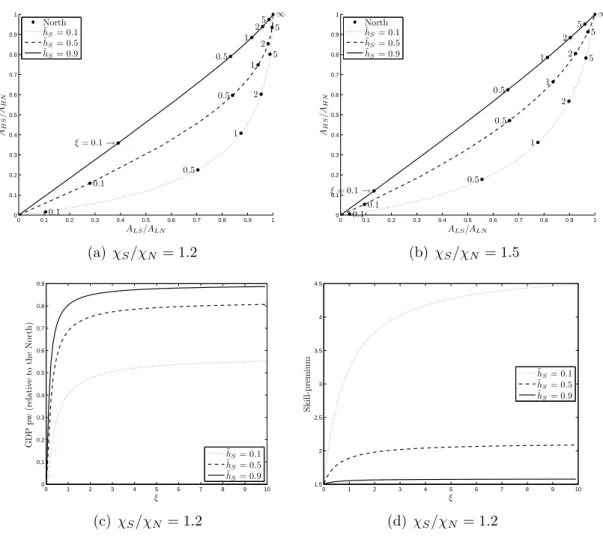
Figure 1 shows how di¤erent parameters a¤ect productivity di¤erences. The …gure depicts economies with equally sized total labor forces and with = 2. The parameters of the North are …xed at ~hN = N = 1; and Z = 1:5;implying that AHN=ALN = 1:5. Then, we consider
Southern economies with di¤erent skill endowments, ~hS, barriers to technology adoption, ,
and investment wedges, S. Panel (a) shows the pattern of technology adoption, i.e., the equi-librium proximity to the frontier in theLandH sector, respectively for di¤erent combinations of and~hS;while holding constant S = 1:2. The …gure plots three curves, each corresponding
to a di¤erent relative skill endowment: h~S = 0:9(highest curve),~hS = 0:5(intermediate curve)
and ~hS = 0:1 (lowest curve). Moving along each curve from left to right yields points with
increasing . Dots single out some particular values of . The parameter a¤ects both the distance to frontier (lower implies a larger gap) and the skill bias of technology adoption. In particular, the lower the more the technology will re‡ect local conditions. As we increase the technology becomes more skill biased, as one can see by drawing rays from the origin through di¤erent dotted points along a line. For large levels of , the technological di¤erences between non-frontier economies with di¤erent endowments become very small, and are all well approximated by the case studied by AZ01 in which all countries adopt immediately the frontier technology. Panel (b) shows the same combination of parameters, but with a larger investment wedge S = 1:5. A larger S reduces technology adoption, especially for countries with higher skill ratios. For example, a country with ~hS = 0:5 and = 2 adopts 85% of the
high-skill and 98% of the low-skill technologies if S = 1:2, while it adopts 80% of the high-skill and 92% of the low-skill technologies if S = 1:5.
Panels (c) and (d) display the e¤ect of and ~hS on output per worker di¤erences and
the skill premium. As in panel (a), the investment wedge is …xed at S = 1:2 and each of the three curves represents a di¤erenth~S. Panel (c) shows that, as long as <2;barriers to
technology adoption are important. However, for larger values of the lion share of productivity di¤erences originates from technology inappropriateness, i.e., the excessive skill bias of frontier technologies. For instance, if ~hS = 0:1 and = 2; removing all barriers would only reduce
18 percent of the distance to the frontier. In contrast, 74 percent of the productivity gap is due to technology mismatch, and 14 percent is due to the investment wedge. Moving back to panel (a), one can note that in this case more than 90 percent of the technologies used by low-skill workers are already in use when = 2and ~hS = 0:1. Thus, slashing barriers triggers
mainly the adoption of high-skill technologies (when = 2 the Southern economy only adopts 60 percent of the high-skill technologies). However, this yields only modest productivity gains since only about 11% of the labor force is skilled.
The skill bias of technology is re‡ected in the wage inequality. The steady-state skill premium is given by w~S = Z 1~h 2 1+ S ~h ( 1)2 1+
N , where w~S is increasing in , ranging from
~ wSj=0 =Z( 1)~h 2 S tow~Sj !1=Z( 1)~h 1 S h ( 1)2
N :Panel (d) of Figure 1 shows the long-run
e¤ect of on wages for alternative relative skill endowments in the South. Increasing induces a rise in the skill premium which is a direct consequence of the previous …nding that a higher relative fraction of high-skill technologies are adopted as increases. Moreover, starting from
= 2 , the rise in the skill premium is steeper in countries with low skill ratios because there are more high-skill technologies left to adopt.
3 Extensions: Trade and IPR
So far, we have only allowed countries to interact through technological spillovers. In this section we extend the analysis …rst to economies that trade in goods and then to economies that, in addition, can import technologies through licensing contracts. We refer to the latter case as full IPR enforcement.
3.1 International Trade
In this section, we assume that the intermediate goodYLandYH can be traded internationally
without frictions. Under free trade, there is a single world price forPL andPH :
~ Pw P w H PLw = YLw YHw 1 (23) where the superscriptw refer to worldwide variables. Hence, Yw
L =ALNLN +Pnj=1ALSjLSj
and YHw = AHNZHN +Pnj=1AHSjZHSj. All equations in section 2.2 continue to hold, with
local prices being now equal to the world price.
Consider, next, the innovation process in the North. The key observation is that the North continues to be the relevant market for new frontier technologies, since there is no IPR protection in the South. The pro…t ‡ows of Northern …rms are, then, LN = PLwLN= and HN = PHwZHN= : In a balanced-growth equilibrium, ~N = 1; which in turn implies that
~
Pw = Z~hN
1
: Using (23) and rearranging terms (see proof below) leads to the following Lemma.
Lemma 1 In a free trade environment, the skill bias of the frontier technology is given by: ~ AN = ~AtradeN Z~hN 1 ^ h > Z ~ hN 1 ; (24) where ^ h 1 +Pnj=1 HHSj N 1+ 1 +Pnj=1 LLSj N 1+ <1: (25)
The skill bias of technology in country S 2S^ is given by
~ AS= ~AtradeS Z~hN 1 ^ h ~ hS ~ hN !1 : (26)
Proof. Using (23) to substitute away P~w from the equationP~w = Z~hN
1 yields: Z~hN = 2 4ZA~N 0 @ Pn j=1 AHSj AHNHSj+HN Pn j=1 ALSj ALN LSj+LN 1 A 3 5 1 :
Solving out for A~N yields:
~ AN = Z~hN 1 0 @1 + Pn j=1 ALSj ALN LSj LN 1 +Pnj=1AAHSj HN HSj HN 1 A A~trade N : (27)
We must now solve for the skill-speci…c distance-to-frontier terms. To this aim, note that, on the one hand, HS= HN = HS=HN and LS= LN = LS=LN. On the other hand, in a
balanced growth path, HS= HN = cHS= and LS= LN = cLS= : Thus, cHS = HS=HN
and cLS = LS=LN:Then, using (13) to eliminatecHS and cLS yields:
AHS AHN = HS HN 1= ; (28) ALS ALN = LS LN 1= : (29)
Plugging (28)-(29) into (27) yields (24). Finally, (26) follows immediately from (24), (28) and (29).
The numerator of (24) is identical to its no-trade counterpart, (10). The denominator is smaller than unity, since Southern economies are skill scarce relative to the North. Thus, trade increases the skill bias of the frontier technology. This result generalizes the …nding of AZ01
to an environment in which technology adoption is costly. Equation (24) also shows that the "trade multiplier" depends on and on the relative market size and skill endowment of the two economies. A~N increases with the di¤erence in the skill endowment between the North and
the South. Trade increases the relative price of the good that is intensive in the factor that is relatively abundant in each country (i.e., P~ in the North) and the e¤ect is larger the more di¤erent factor endowments are. Then, the stronger the increase inP~ in the North relative to the no-trade environment, the larger the skill bias induced by trade. Barriers (i.e., a reduction in ) increaseA~N. The intuition behind this result is that since the frontier technology is skill
biased, technology transfer reduces the di¤erence in e¤ective endowments. In other words, barriers reduce the skill bias of adoption, thereby strengthening the North-South pattern of specialization in production. As a consequence, the price e¤ect is larger when barriers are higher.
The e¤ect of trade on the direction of technology adoption in the South (equation (26)) is instead ambiguous. On the one hand, trade increases the relative price of low-skill-intensive goods in the South, accelerating the adoption of low-skill technologies. On the other hand, the higher skill bias at the frontier makes it cheaper to adopt skilled technologies.4
The following proposition provides an expression for output di¤erences – the analogue of equation (15) –under free trade.
Proposition 2 Assume free international trade in the intermediate goodsYH andYL:For any
S2S;^ the steady-state output ratio relative to the frontier is:
YS YN = KS KN 0 B B @ L 1+ S + (Z~hN) ( 1) (1+ ) ^ h (ZHS) 1+ L 1+ N + (Z~hN) ( 1) (1+ ) ^ h (ZHN) 1+ 1 C C A 1 fStrade; (30) where KS=KN = (YS=YN)=( S= N):
Proof. Rewrite the production function asYJ = (KJ) Y^J
1 ;whereY^J Y^ 1 LJ + ^Y 1 HJ 1 and ^
YLJ and Y^HJ denote the quantities used in …nal production in country J: Due to trade, these
quantities di¤er from the respective local production levels (which we continue to denote by 4More formally,A~trade
S =A~S= ^h 1 h~S=~hN
+1 ( +1)
, showing that trade increases (decreases) the skill bias of technology adoption if is su¢ ciently large (small).
YLJ and YHJ). Balanced trade implies that PY^wY^J =PHJw Y^HJ +PLJw Y^LJ =PHJw AHJZHJ+PLJw ALJLJ; (31) wherePw^ Y = h (PLw)1 + (PHw)1 i1=(1 )
is the same for all countries. Thus, for anyS 2S;^ we can write: YS YN = KS KN ^ YS ^ YN !1 = KS KN Pw HAHSZHS+PLwALSLS PHwAHNZHN +PLwALNLN 1 ; (32)
where the second equality comes from (31) and from the fact thatY^S=Y^N =PY^wY^S= PY^wY^N :
Rearranging terms yields:
YS YN = KS KN ALSLS ALNLN 1 + ~PwA~SZ~hS 1 + ~PwA~ NZ~hN !1 : (33)
Then, using (29) and (23) to eliminateALS=ALN andP~w;respectively, and rearranging terms,
yields (30).
As emphasized in Ventura (2005) and Fadinger (2009), trade a¤ects the shape of countries’ aggregate production possibility frontier. In particular, for given technology, the elasticity of substitution betweenYLS and YHS equivalently, betweenLS(1+ )= and HS(1+ )= is now
in…-nite, instead of , because all countries face the same world prices. The exponent(1 + )= 1
still captures the extent of the scale e¤ect in adoption.
3.2 IPR (Licensing of Technologies)
In this section, we maintain free trade and also allow frontier technologies to be licensed from Northern to Southern (monopolist) …rms in exchange of a perpetual royalty per unit produced in the South. For simplicity, we assume that when a technology is licensed there are no additional adoption costs. While some local …rms could in principle choose to adopt frontier technologies that have not yet been licensed, in equilibrium all technologies will be licensed to the South as soon as they are introduced in the North.5 Thus, no room is left for unlicensed technology adoption. Intuitively, this follows from the assumption that innovators can transfer technologies at zero costs. Therefore, no matter how low the cost of unlicensed adoption is, Northern producers will bid down the license cost and win the race. The discussion is summarized by the following Lemma.
5
After a technology has been licensed to a …rm in countryS;there is no reason for a …rm to pay a cost to produce the same variety, since Bertrand competition would bring the pro…t of the entrant …rst to zero.
Lemma 2 Suppose that Northern producers can license their technology. Then, there exists a unique subgame perfect Nash equilibrium such that the South adopts instantaneously all tech-nologies introduced in the North. All pro…ts made in the Southern market are transferred to Northern …rms as royalties.
Full IPR protection entails both costs and bene…ts for the South. On the one hand, the South must transfer to the North the entire pro…t ‡ow of intermediate producers. On the other hand, the South can adopt immediately all technologies (similar to the case of ! 1 in the benchmark model). In addition, IPR enforcement a¤ects the direction of technical change, reducing the skill bias of the frontier technology. To see this, note that in steady state the present discounted value of the royalties paid by countrySj are'LSj = LSj=r and
'HS = HSj=r: Including royalties, the zero-pro…t conditions for innovation yield:
n X j=1 'LSj = LN r ; and n X j=1 'HSj = HN r :
The equilibrium skill bias,A~N (whereA~S= ~AN);is the determined implicitly by the following
equation: 1 = HN + Pn j=1 HSj LN +Pnj=1 LSj = P w HZHN + Pn j=1PHwZHSj Pw LLN + Pn j=1PLwLSj = ~PwZ~hw; whereh~w HN +Pnj=1HSj = LN + Pn j=1LSj :This yieldsP~ w = Z~hw 1. Then, using
(23), one obtains that A~N = ~AS = ~AIP RN Z~hw
1
, and w~N = ~wS = ~w =Z 1 h~w
2
. That is, there is factor price equalization and both A~IP RN and w~N are now smaller. Moreover,
for givenZ, the skill premium may even turn negative. To prevent this unreasonable outcome, we assume that skilled workers can take unskilled jobs and that a skilled worker produces Z
times as much as an unskilled worker regardless of the sector of employment. This implies that there is a lower bound w~ Z. When this lower bound is binding, the allocation of workers across the two sectors adjusts in order to keepw~=Z. This leads to the following Proposition.
Proposition 3 Assume free international trade in the intermediate goodsYH andYLand IPR
protection (licensing) in the South. For any S2S;^ the steady-state output ratio relative to the frontier is: YS YN = KS KN LS+ ~wHS LN + ~wHN 1 fSIP R; (34) where KS=KN = (YS=YN)=( S= N), ~hw = H+ Pn j=1HSj = L+ Pn j=1LSj and w~ = maxnZ 1(~hw) 2; Zo:
Proof. The argument is parallel to the proof of Proposition 2. When w > Z~ , one obtains the analogue of expression (33),
YS YN = KS KN LS LN 1 + ~PwA~NZ~hS 1 + ~PwA~NZ~hN !1 ; (35)
where the only di¤erences between (33) and (35) is that in the latterALS =ALN and A~N =
~
AS: Next, substituting to P~w and A~N the respective expressions (i.e., P~w = Z~hw
1
and
~
AN = Z~hw
1
); and rearranging terms, leads to (34). When w~ = Z, a similar argument applies after noticing that:
PHwY^HJ +PLwY^LJ PHwY^HN +PLwY^LN = w w HHJ +wwLLJ ww HHN +wwLLN = ZHJ +LJ ZHN +LN :
Cross-country productivity di¤erences are smaller under full IPR. However, it becomes important to draw a distinction between GDP and (Gross National Product) GNP: the GNP of the North now includes the royalties paid by Southern …rms. In general, it is ambiguous whether the GNP ratio increases with IPR. The growth rate of the world economy is unam-biguously larger.
4 Empirical Analysis
In this section, we provide a quantitative assessment of the theory. The strategy is to use the no-trade economy of section 2 as the benchmark for a development accounting exercise. More precisely, we consider a relative production function of the form:
yS yN = S N HN +LN HS+LS fSAU T; (36)
where fSAU T is given by (15).6 Equation (36) allows for exogenous Hicks-neutral TFP di¤er-ences (i.e., the term S= N) that are alien to our theory. Therefore, the success of our theory
is measured by the extent to which the empirical variation in output and productivity can be accounted for without resorting to di¤erences in .
In the spirit of the development accounting literature (e.g., Caselli, 2005), we calibrate the key parameters, whenever this is possible. In particular, we set = 0:35to match the non-labor
6
Recall that, although the countries use di¤erent technologies, our theory is consistent with a common representation of the aggregate CES production function featuring increasing returns to scale.
share of GDP in industrialized countries, calibrate andZ so as to match the time evolution of the skill premium in the frontier economy using the predictions of our theory, and estimate so as to obtain the best …t of cross-country productivity di¤erences in two cross-sections of up to 122 countries (see section 4.4.2 for more discussion). As it is customary, we use the no-trade scenario as the baseline case, and assess how successfully the benchmark model can account for the cross-country productivity distribution in 1970 and 2000. Then, we perform a number of theory-based counterfactuals including: (i) slashing all barriers to technology adoption, (ii) opening up the world economy to free trade, and (iii) allowing, in addition, perfect international IPR enforcement. We study the changes in the long-run distribution of productivity di¤erences that each of these changes would trigger.
4.1 Data Description
Since our analysis focuses on balanced-growth equilibria, we do not attempt to …t high-frequency data, and focus on the distribution of cross-country productivity di¤erences in 1970 and 2000. We assume the US to be the frontier economy, and calibrate andZusing the change in the skill premium and the skill ratio between 1970 and 2000 in the United States from the March Current Population Survey (CPS) cleaned by Autor, Katz, and Kearney (2008).7 Like these authors, we only consider full-time, full-year workers aged 16 to 64 with 0 to 39 years of potential experience. We exclude female workers and workers with earnings below $67 per week in 1982 dollars, as well as workers with allocated earnings. We calculate relative wages as the ratio of the CPS sampling weighted average earnings for di¤erent education levels. In par-ticular, we focus on high school graduates vs. non-high school graduates and college graduates vs. non-college graduates.
The data on output, investment, population and the labor force are from Heston, Summers and Aten (2009). The estimates of the capital stock are generated using the perpetual inventory method (see, e.g., Caselli (2005)). For the relative skill endowment, we use two data sets: Barro and Lee (2010) and Cohen and Soto (2007). These data sets contain information on the fraction of the population aged 25 and above with a high school or a college degree. The stock of skilled and unskilled workers is then simply calculated by multiplying the labor force
7
In practice, we use the observations of 1971 and 2001 since the reported earnings are for the previous year. The two data sets are available online from David H. Autor’s website.
with the corresponding skill fraction in the population. Following Hall and Jones (1999), we perform a natural resource correction on GDP by subtracting the fraction of value added in the mining and quarrying sector according to National Accounts O¢ cial Country Data accessed via UNdata. Because for some countries value added in the mining and quarrying sector is not reported on an annual basis, we linearly interpolate the missing data points for 1970 and 2000 if necessary. We drop Kuwait which is a strong outlier in terms of GDP pw in 1970.8 We end up with a repeated cross-section of 86 (1970) to 122 (2000) countries when using the education data from Barro and Lee (2010), while we have 73 (1970) to 85 (2000) countries when using the data from Cohen and Soto (2007). In an appendix available from our webpages we repeat the analysis restricting the balanced sample of countries for which information is available both in 1970 and 2000 and …nd very similar results.
4.2 Calibration
4.2.1 Elasticity of Substitution
We identify and Z using equation (11) given the evolution of the skill premium in the US. More formally, we set andZ so as to match exactly the equation:
log ( ~wU S;t) = ( 1) log(Z) + ( 2) log ~hU S;t ; (37)
wheret2 f1970;2000g:Hence
= 2 + log ( ~wU S;2000) log ( ~wU S;1970) log ~hU S;2000 log ~hU S;1970
: (38)
The skill premia as well as the skill ratios are taken from the March CPS. As discussed above, we use two alternative measures of skill: secondary and tertiary school. The wage premium for high school graduates over non-high school graduates increased from 1.40 in 1970 to 2.02 in 2000, while the wage premium for college graduates over non-college graduates increased from 1.57 in 1970 to 1.88 in 2000. The ratio of high school graduates over non-high school graduates in the population in working age increased during the same period from 2.59 to 9.30, while the ratio of college graduates over non-college graduates increased from 0.21 to 0.43. Since in 8The inclusion of Kuwait does not change our main results. In Table 8 of the appendix we report the
many OECD economies a large share of the population …nishes secondary school, we regard tertiary education as the most appropriate measure of skill for our theory.
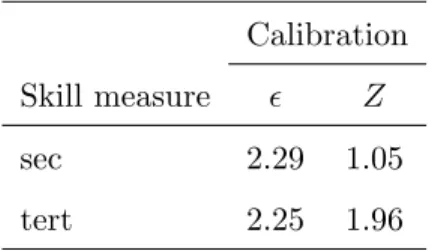
Equations (37)-(38) pin down andZ:Since both the skill ratio and the relative skill supply increased sharply in the United States during 1970–2000, the two equations imply that >2. Table 1 summarizes the baseline calibration for and Z conditional on the skill measure. In the table (and for future reference),sec stands for "secondary school completed" whereastert stands for "tertiary school completed".
Calibration Skill measure Z
sec 2.29 1.05
tert 2.25 1.96
Table 1: Baseline calibration
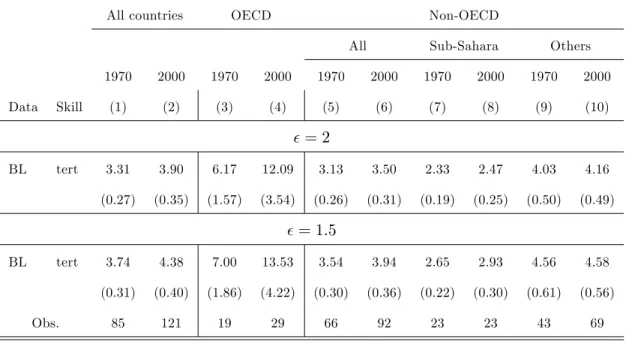
In our model, the parameter has the structural interpretation of a short-run elasticity be-tween high- and low-skill labor. Other studies (e.g., Ciccone and Peri (2005)) provide estimates of such an elasticity of substitution in the interval[1:4;2]. Since our estimate of falls outside of this range, we consider lower values in Section 4.4.1. Note that if we calibrate to lower values, we must allowZ to increase between 1970 and 2000, or else the theory would predict, counterfactually, a decline in the skill premium. In other words, our estimate >2appears to be consistent with the prediction of our theory, whereas lower values of are rejected by our estimation unless we assume that there are other exogenous drivers of skill-biased technical change, captured by an increase inZ.
4.2.2 Barriers to Technology Adoption
Having calibrated ; Z and as described above, we estimate by full information maximum likelihood (FIML) using the following econometric model:
log yS
yU S
= log fSAU T HN +LN HS+LS
+ log"S;
wherefSAU T is given by (15), andlog"S is an i.i.d. normally distributed disturbance with mean
zero.
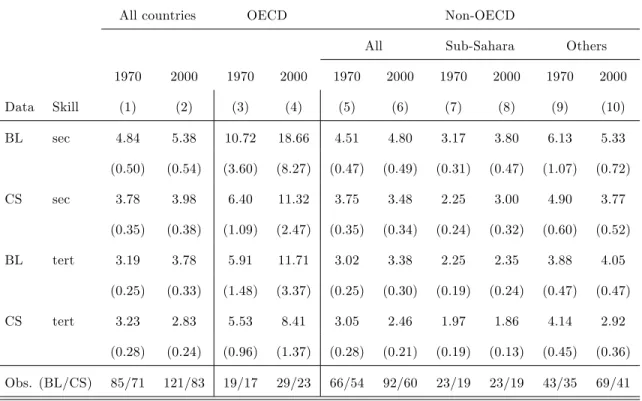
rows refer to di¤erent skill categories (secandtert) and data sets (Barro-Lee (BL) and Cohen-Soto (CS)). Columns 1 and 2 report the point estimate of using the whole sample. Then, we allow to vary between OECD (columns 3 and 4) and non-OECD countries (columns 5 and 6). The results show that is signi…cantly lower in non-OECD countries,9 which is consistent with the interpretation that poor countries have larger barriers. Since there remains a great deal of heterogeneity within non-OECD countries, we split further the subsample into sub-Saharan (columns 7 and 8) and other non-OECD countries (columns 9 and 10).10 The di¤erences in barriers to technology adoption between both the sub-Saharan and other non-OECD countries and OECD and non-OECD countries are in all but one cases highly signi…cant.11
Another pattern emerges from the table: The estimated approximately doubles between 1970–2000 for OECD countries, while there is no big change for non-OECD countries. This suggests that technological integration increased mostly within the set of industrialized coun-tries.
4.2.3 Results
Figure 2 plots the predicted GDP pw (log-di¤erence from the US) against the actual GDP pw for all countries, using educational variables from the Barro-Lee data set and allowing to di¤er across OECD, sub-Saharan and other non-OECD countries, as in Table 2. Panels
9
We classify as OECD all countries that were OECD members in 2000 (same classi…cation in both 1970 and 2000 to limit endogeneity issues). Including only countries that were OECD members in 1970 yields similar results. The estimates for OECD countries are then higher while those for non-OECD countries remain almost unchanged. For instance, the point estimate for OECD countries in the third row of Table 2 would be 6.61 (1.80) in 1970 and 21.50 (10.26) in 2000 instead of 5.91 (1.48) in 1970 and 11.71 (3.37) in 2000.
1 0We do not include Mauritius among the sub-Saharan countries, due to its special geographical and economic
conditions (see Subramanian and Roy 2001). Including Mauritius would not cause dramatic changes in the point estimates. For instance, the third row in Table 2 would read 2.33 (0.20) in 1970 and 2.52 (0.30) for sub-Saharan countries and 3.83 (0.48) in 1970 and 3.94 (0.45) in 2000 for the other non-OECD countries.
1 1In 1970, the point estimate for sub-Saharan countries is lower than the point estimate for the other
non-OECD countries at the 1 percent level of signi…cance across all speci…cations. In 2000, barriers are signi…cantly lower for thetert skill category at the 1 percent (BL) and 5 percent level (CS). For thesec skill category, the di¤erences are signi…cant at the 5 percent for BL and close to the 10 percent level of signi…cance for CS. OECD countries have signi…cantly lower barriers than non-OECD countries at the 1 percent level in 2000 for thetert
skill category, while they are at least lower at the 5 percent level of signi…cance for thesecskill category and in 1970 across all speci…cations.
All countries OECD Non-OECD
All Sub-Sahara Others
1970 2000 1970 2000 1970 2000 1970 2000 1970 2000 Data Skill (1) (2) (3) (4) (5) (6) (7) (8) (9) (10) BL sec 4.84 5.38 10.72 18.66 4.51 4.80 3.17 3.80 6.13 5.33 (0.50) (0.54) (3.60) (8.27) (0.47) (0.49) (0.31) (0.47) (1.07) (0.72) CS sec 3.78 3.98 6.40 11.32 3.75 3.48 2.25 3.00 4.90 3.77 (0.35) (0.38) (1.09) (2.47) (0.35) (0.34) (0.24) (0.32) (0.60) (0.52) BL tert 3.19 3.78 5.91 11.71 3.02 3.38 2.25 2.35 3.88 4.05 (0.25) (0.33) (1.48) (3.37) (0.25) (0.30) (0.19) (0.24) (0.47) (0.47) CS tert 3.23 2.83 5.53 8.41 3.05 2.46 1.97 1.86 4.14 2.92 (0.28) (0.24) (0.96) (1.37) (0.28) (0.21) (0.19) (0.13) (0.45) (0.36) Obs. (BL/CS) 85/71 121/83 19/17 29/23 66/54 92/60 23/19 23/19 43/35 69/41
Table 2: Baseline estimation
(a)-(c) use the secondary school educational measure for years 1970 and 2000, respectively, whereas Panels (b)-(d) use the tertiary education measure for the same years. In an appendix available from our webpages we plot the corresponding …gure that is obtained by imposing a common over the entire sample. Whenever a point lies on the 45-degree line, the theory …ts the data perfectly. Whenever a point lies above (below) the 45-degree line, the model underpredicts (overpredicts) the productivity di¤erences between that country and the US. The …t is altogether good, although there are some outliers, among them, Malta, Cyprus and Hong-Kong which lie signi…cantly below the 45-degree line. This is not surprising, since these countries are classi…ed as non-OECD countries (and thus pooled in the estimation of with poorer economies), although they are very open economies sharing more commonalities with the OECD countries than with the rest of non-OECD countries. Since the estimation forces them to have large barriers, the model largely overpredicts their productivity di¤erence relative to the US. If one merges these three countries with the OECD, they cease to be outliers. Likewise, Bahrain, Barbados, Brunei, Mauritius and Qatar (also below the 45-degree line) are small economies with special characteristics that make them atypical non-OECD economies. Among the countries lying signi…cantly above the 45-degree line, one notices Japan, Korea and
China in year 2000. The large population size and/or the high physical capital per worker are behind this …nding.
It is useful to compare the results with those that would obtain if we estimated productivity di¤erences assuming no barriers to technology adoption, as in AZ01. More formally, we let
! 1 – see equation (22) – while keeping all other parameters unchanged. AZ01 …nd that their model yields a signi…cantly better …t than a neoclassical one-sector model such as the one used by Hall and Jones (1999). Since our model encompasses their speci…cation as a particular case, we can quantify the importance of barriers, separating their e¤ect from that of "inappropriate technology". Figure 3 is the analogue of Figure 2 but letting ! 1. It shows that the model without barriers underestimates signi…cantly the cross-country productivity di¤erences.
To compare the goodness of …t of the two models more formally, we use the statistic proposed by AZ01: <2= 1 n X j=1 log(ySj=yU S) log(c ySj=yU S) 2 = n X j=1 log(ySj=yU S) 2 ;
where log(ySj=yU S) denotes the log-di¤erence in output per worker from the US in the data
and log(c ySj=yU S) the prediction of the model for the same country. <
2 would be equal to
1, if all points were aligned on the 45-degree line. In this case, the model would …t the data perfectly. Note that<2is not a standard R-squared, and can be negative if the …t is su¢ ciently low. Table 3 reports the<2 for the three speci…cations of Table 2, and for comparison also the case of no barriers (column 4). In column 1 all countries are constrained to have the same . In column 2 is allowed to di¤er between OECD and non-OECD countries. Finally, in 3, we also allow to di¤er between sub-Saharan and other non-OECD countries. In all cases, the model with barriers attains a much better …t than the model with no barriers.12 The model with no barriers is also rejected in a formal Wald test.
A concern is that our estimation may imply ALS=AL;U S and/or AHS=AH;U S larger than
unity, violating the assumption that the US is the technology leader in both sectors. To address 1 2The results are not directly comparable with those of AZ01. First their model implies = 2;and they set Z 2 f1:5;1:8g to match the skill premium. Second, they use data for 1990. To make the comparison more direct, we re-estimated our model after calibrating = 2andZ = 1:8;using the two educational measures from BL for the year of 2000. The<2 of the model without barriers is 0.871 and 0.766 usingsecandtert, respectively.
Baseline estimation No barriers (1) (2) (3) (4) Data Skill 1970 2000 1970 2000 1970 2000 1970 2000 BL sec 0.926 0.930 0.929 0.936 0.938 0.938 0.829 0.855 CS sec 0.934 0.944 0.937 0.951 0.953 0.952 0.807 0.856 BL tert 0.905 0.903 0.910 0.913 0.923 0.921 0.690 0.763 CS tert 0.924 0.922 0.927 0.936 0.947 0.942 0.746 0.761 Table 3: Goodness of …t
this concern, Figure 4 plots the implied cross-country distribution of the sectoral productivities,
ALS=AL;U S and AHS=AH;U S, using our estimate of the baseline model in the case of tertiary
education with BL data. The hypothesis that the US is the technology leader is never rejected in the skilled sector. More formally, AHS=AH;U S <1 for all S. This is not surprising. More
interesting, the hypothesis that the US is the technology leader in the low-skill sector is only contradicted in the case of China and India in 2000. This is due to the large market for low-skill technologies available in those two countries. Since it seems empirically implausible that China and India use all technologies currently in use in the US in the low-skill sector, this …nding suggests that the model may exaggerate the role of market size e¤ect in technology adoption. Alternatively, the assumption that large developing economies such as China and India have frictionless internal markets may be incorrect. Altogether, we …nd it reassuring that – with only two (important) exceptions –the assumption that the US is the leader is consistent with our estimation, without the need of imposing any additional restriction.
4.3 Counterfactuals
In this section we use our model as a lab to perform three counterfactual experiments. We assume the economies to be initially in the no-trade steady state of year 2000, and study the long-run e¤ect of institutional changes on cross-country inequality. The three experiments con-sist of, respectively: (i) removing all barriers to technology adoption, (ii) opening up the world economy to frictionless international trade, and (iii) introducing, in addition, full international IPR enforcement. We focus on steady-state e¤ects.
case in which di¤ers between OECD, sub-Saharan and other non-OECD countries (column 3 to 4 and 7 to 10 in Table 2). The parameters ; Z; and are held constant across experiments at the levels of section 4.2 (with the exception of experiment (i) when we let ! 1). Since physical capital is endogenous, we allow the capital-output ratio to respond to institutional changes. We do so by …rst inferring from the observed capital-output ratios the cross-country distribution of the deep parameter (the "investment wedge") in the benchmark no-trade case. Next, we calculate the capital-output ratio that would obtain in each of the counterfactual steady states (no barriers, free trade and trade with full IPR enforcement) assuming no change in : Since our target is to estimate relative productivities, we focus on the distribution of investment wedges relative to the North. For country S such ratio is given by:
S N
= YS=KS
YN=KN
; (39)
where the right hand-side term is the capital-output ratio in the data, and we continue to assume the US to be the frontier economy. Next, letting variables indexed by the superscript
count2 fnobarr; trade; IP Rgdenote theoretical steady-state levels in each counterfactual, we obtain: KScount KNcount = YScount= S YNcount= N = YScount YNcount KS=YS KN=YN : (40)
Replacing KS=KN by KSnobarr=KNnobarr; KStrade=KNtrade and KSIP R=KNIP R, respectively, into
equations (22), (30) and (34), and rearranging terms, yields the steady-state expressions for output and productivity reported in each of the subsections below.
4.3.1 No Barriers
In this section, we experiment with slashing all technology barriers. Such experiment di¤ers from the analysis in Section 4.2.3, as there we treated the no-barrier model as an alternative model and estimated equation (22) taking the capital ratio directly from the data. In contrast, here we infer the from the benchmark case and let capital adjust in each country to the new steady state, as discussed above. The gains in output per worker will be larger for countries with smaller investment wedges, since slashing barriers induces a stronger increase in investments in physical capital in those countries.
We obtain the following counterfactual steady-state output gaps: YSnobarr YNnobarr = KSnobarr KNnobarr 2 6 6 4 L 1 S + Z~hN ( 1)2 (ZHS) 1 L 1 N + Z~hN ( 1)2 (ZHN) 1 3 7 7 5 (1 ) 1 = KS=YS KN=YN 1 2 6 6 4 L 1 S + Z~hN ( 1)2 (ZHS) 1 L 1 N + Z~hN ( 1)2 (ZHN) 1 3 7 7 5 1 ;
whereKS=YS and KN=YN are the observed capital output ratios. Panel (a) in Figure 5 plots
the counterfactual log GDP pw relative to the US,logc(ynobarr
S =yU Snobarr);against the productivity
di¤erences predicted by the benchmark model. There are signi…cant gains for most countries, which are especially large for those with small investment wedges. Among the OECD economies making largest gains, one notices New Zealand, Korea, Hungary, Czech Repulic, Slovak Re-public and Switzerland. On average, the GDP pw relative to the US improves for an OECD country from 0.68 to 0.91 while non-OECD countries increase from 0.19 to 0.61. The e¤ect is particularly strong for small countries, which lack the local market size required to bene…t from expensive technologies (for instance, Cyprus improves from 0.34 to 1.05 while the United Kingdom only increases from 0.68 to 0.77).
4.3.2 Trade
In this section we consider the e¤ects of opening up the world economy to free trade. The coun-terfactual steady-state output di¤erences are given by equation (30), after replacing KS=KN
by KStrade=KNtrade;as given by equation (40). This yields:
YStrade Ytrade N = KS=YS KN=YN 1 L 1+ S + (Z~hN) (" 1) (1+ ) ^ h (ZHS) 1+ L 1+ N + (Z~hN) (" 1) (1+ ) ^ h (ZHN) 1+ :
As discussed in section 3.1, trade increases the skill bias of the frontier technology, while its e¤ect on the skill bias of technology adoption is ambiguous.
Panel (b) in Figure 5 plots logc(yStrade=ytradeU S ) against the predictions of the benchmark model. Cross-country income inequality increases signi…cantly, and so does the distance of most countries from the US frontier. The GDP pw relative to the US decreases for the average
OECD country from 0.68 to 0.41, while the non-OECD countries fall from 0.19 to 0.10. Among the OECD countries that realize the largest losses are Italy, Luxembourg, Austria, France, and Finland. However, it is also important to remind that trade implies an increase in the growth rate of all economies, so a loss in relative terms does not imply a welfare loss.
4.3.3 Trade and IPR
In this section, we focus on trade with perfect IPR protection, following the theoretical analysis of section 3.2. The counterfactual steady-state output di¤erences are given by equation (34), after replacing KS=KN by KSIP R=KNIP R as given by (40). This yields:
YIP R S YNIP R = KS=YS KN=YN 1 LS+ ~wHS LN+ ~wHN ;
where w~ = maxnZ 1(~hw) 2; Zo. As discussed in section 3.2, all countries use now the frontier technology, as in the case of no barriers. However, the frontier technology is now less skill biased. Panel (c) in Figure 5 plots logc(yIP RS =yU SIP R) against the productivity di¤erences predicted by the benchmark model. The results are similar to those in panel (a), but the relative gains of non-frontier economies are larger. Many economies –including most European countries – would now surpass the US. The reason is twofold. First, the skill bias of the technology targets the average world endowment so innovation is too little skill biased for the most skilled rich countries such as the US. Second, many countries have a higher capital output ratio than the US. However, it is important to remember that non-frontier countries must transfer to the US a signi…cant share of their GDP as license fees. So, the di¤erences in GNP may be signi…cantly larger than the di¤erences in GDP.
Overall, these results are in line with AZ01 and Bon…glioli and Gancia (2008), who show in more speci…c models that trade opening with no global IPR protection may induce a wave of technological progress which favors disproportionately the North, while stronger IPR protection in the South can speed up technology transfer and reduce income di¤erences.
4.3.4 Wage Inequality
Finally, we consider the prediction of the theory for the changes in wage inequality in the three counterfactual scenarios relative to the benchmark case. Recallw~S =Z P~S A~S:In autarky,
~
to adoption after letting ! 1. In the free-trade case, prices are equalized worldwide to ~ Pw = Zh~N 1 and A~S = ^h 1 Z~hN 1 ~ hS=~hN 1=
, where ^h is given by (25). Finally, in the case of trade with IPR, we havew~S = max
n
Z 1(~hw) 2; Z
o
, whereh~w is the world
average relative skill endowment.
Figure 6 plots the log-change in the steady-state skill premium for tertiary school against GDP per worker relative to the US when barriers are removed starting from the benchmark steady state equilibrium. Removing barriers implies an increase in the skill premia of non-frontier economies, since costly adoption reduces the skill bias of the technology adoption. The e¤ect is stronger the farther away from the frontier a country is. For the average non-OECD country the skill premium increases by 25 percent, while it rises only by 3 percent among OECD countries. Figure 7 plots the corresponding log-change in the steady-state skill premium when an economy switches to free trade. Opening up to free trade in goods raises the skill premium in skill-abundant countries and lowers it in skill-scarce countries, as predicted by the Stolper-Samuelson theorem. However, by also inducing skill-biased technical change at the frontier, it generates an upward pressure on the skill premium worldwide. As a result, wage inequality increases in the majority of countries, particularly in skill-abundant and low-barriers countries. The conventional result that trade liberalization lowers inequality in skill-scarce countries holds only in the group of economies facing the highest barriers to technology adoption (for instance, in sub-Saharan countries the skill premium falls on average by 42 percent), while wage inequality rises even in India and China.
Finally, when IPR are also protected (no …gure), the relevant market for new technologies becomes the world economy. This promotes the development of low-skill technologies and thus a fall in the skill premium. Moreover, since all countries now use the same technologies, all wages become the same everywhere. Given the large endowment of unskilled labor of the world economy, we …nd that with trade and IPR protectionA~falls so much that the constraint
~
wS Z becomes binding. Thus, in the new steady state wage inequality drops to w~ = Z
in all countries. Before concluding, it is important to emphasize that these large changes in skill premia re‡ect the rather extreme nature of our counterfactual scenarios. The e¤ect of partial integration of the markets for goods and technology would certainly be smaller. It is also important to stress that our model abstracts from di¤erences in labor market institutions and policies which are likely to a¤ect the cross-country pattern of skill premia and its change