Pruning Underachieving Features Early
-Ron Appel [email protected]
Caltech, Pasadena, CA 91125 USA
Thomas Fuchs [email protected]
Caltech, Pasadena, CA 91125 USA
Piotr Doll´ar [email protected]
Microsoft Research, Redmond, WA 98052 USA
Pietro Perona [email protected]
Caltech, Pasadena, CA 91125 USA
Abstract
Boosted decision trees are among the most popular learning techniques in use today. While exhibiting fast speeds at test time, rel-atively slow training renders them impracti-cal for applications with real-time learning requirements. We propose a principled ap-proach to overcome this drawback. We prove a bound on the error of a decision stump given its preliminary error on a subset of the training data; the bound may be used to prune unpromising features early in the training process. We propose a fast train-ing algorithm that exploits this bound, yield-ing speedups of an order of magnitude at no cost in the final performance of the classifier. Our method is not a new variant of Boosting; rather, it is used in conjunction with exist-ing Boostexist-ing algorithms and other samplexist-ing methods to achieve even greater speedups.
1. Introduction
Boosting is one of the most popular learning tech-niques in use today, combining many weak learners to form a single strong one (Schapire,1990;Freund,1995; Freund & Schapire, 1996). Shallow decision trees are commonly used as weak learners due to their simplicity and robustness in practice (Quinlan, 1996; Breiman, Proceedings of the 30th International Conference on Ma-chine Learning, Atlanta, Georgia, USA, 2013. JMLR: W&CP volume 28. Copyright 2013 by the author(s).
1998;Ridgeway, 1999; Kotsiantis,2007). This power-ful combination (of Boosting and decision trees) is the learning backbone behind many state-of-the-art meth-ods across a variety of domains such as computer vi-sion, behavior analysis, and document ranking to name a few (Doll´ar et al.,2012;Burgos-Artizzu et al.,2012; Asadi & Lin,2013), with the added benefit of exhibit-ing fast speed at test time.
Learning speed is important as well. In active or real-time learning situations such as for human-in-the-loop processes or when dealing with data streams, classifiers must learn quickly to be practical. This is our motiva-tion: fast training without sacrificing accuracy. To this end, we propose a principled approach. Our method offers a speedup of an order of magnitude over prior approaches while maintaining identical performance. The contributions of our work are the following:
1. Given the performance on a subset of data, we prove a bound on a stump’s classification error, information gain, Gini impurity, and variance. 2. Based on this bound, we propose an algorithm
guaranteed to produce identical trees as classical algorithms, and experimentally show it to be one order of magnitude faster for classification tasks. 3. We outline an algorithm for quickly Boosting de-cision trees using our quick tree-training method, applicable to any variant of Boosting.
In the following sections, we discuss related work, inspect the tree-boosting process, describe our algo-rithm, prove our bound, and conclude with experi-ments on several datasets, demonstrating our gains.
2. Related Work
Many variants of Boosting (Freund & Schapire,1996) have proven to be competitive in terms of prediction accuracy in a variety of applications (B¨uhlmann & Hothorn, 2007), however, the slow training speed of boosted trees remains a practical drawback. Accord-ingly, a large body of literature is devoted to speeding up Boosting, mostly categorizable as: methods that subsample features or data points, and methods that speed up training of the trees themselves.
In many situations, groups of features are highly cor-related. By carefully choosing exemplars, an entire set of features can be pruned based on the performance of its exemplar. (Doll´ar et al., 2007) propose cluster-ing features based on their performances in previous stages of boosting. (K´egl & Busa-Fekete,2009) parti-tion features into many subsets, deciding which ones to inspect at each stage using adversarial multi-armed bandits. (Paul et al., 2009) use random projections to reduce the dimensionality of the data, in essence merging correlated features.
Other approaches subsample the data. In Weight-trimming (Friedman, 2000), all samples with weights smaller than a certain threshold are ignored. With Stochastic Boosting (Friedman, 2002), each weak learner is trained on a random subset of the data. For very large datasets or in the case of on-line learning, elaborate sampling methods have been proposed, e.g. Hoeffding trees (Domingos & Hulten, 2000) and Fil-ter Boost (Domingo & Watanabe, 2000; Bradley & Schapire,2007). To this end, probabilistic bounds can be computed on the error rates given the number of samples used (Mnih et al.,2008). More recently, Lam-inating (Dubout & Fleuret,2011) trades off number of features for number of samples considered as training progresses, enabling constant-time Boosting.
Although all these methods can be made to work in practice, they provide no performance guarantees. A third line of work focuses on speeding up training of decision trees. Building upon the C4.5 tree-training algorithm of (Quinlan,1993), using shallow (depth-D) trees and quantizing features values into B�N bins leads to an efficientO(D×K×N) implementation where
K is the number of features, and N is the number of samples (Wu et al., 2008; Sharp,2008).
Orthogonal to all of the above methods is the use of parallelization; multiple cores or GPUs. Recently, (Svore & Burges,2011) distributed computation over cluster nodes for the application of ranking; however, reporting lower accuracies as a result. GPU imple-mentations of GentleBoost exist for object detection
(Coates et al., 2009) and for medical imaging using Probabilistic Boosting Trees (PBT) (Birkbeck et al., 2011). Although these methods offer speedups in their own right, we focus on the single-core paradigm. Regardless of the subsampling heuristic used, once a subset of features or data points is obtained, weak learners are trained on that subset in its entirety. Con-sequently, each of the aforementioned strategies can be viewed as a two-stage process; in the first, a smaller set of features or data points is collected, and in the second, decision trees are trained on that entire subset. We propose a method for speeding up this second stage; thus, our approach can be used in conjunc-tion with all the prior work menconjunc-tioned above for even greater speedup. Unlike the aforementioned methods, our approach provides a performance guarantee: the boosted tree offers identical performance to one with classical training.
3. Boosting Trees
A boosted classifier (or regressor) having the form H(x) = �tαtht(x) can be trained by greedily
min-imizing a loss function L; i.e. by optimizing scalar
αt and weak learner ht(x) at each iteration t.
Be-fore training begins, each data samplexiis assigned a
non-negative weightwi (which is derived fromL).
Af-ter each iAf-teration, misclassified samples are weighted more heavily thereby increasing the severity of mis-classifying them in following iterations. Regardless of the type of Boosting used (i.e. AdaBoost, LogitBoost, L2Boost, etc.), each iteration requires training a new
weak learner given the sample weights. We focus on the case when the weak learners are shallow trees. 3.1. Training Decision Trees
A decision treehTREE(x) is composed of a stumphj(x)
at every non-leaf node j. Trees are commonly grown using a greedy procedure as described in (Breiman et al., 1984; Quinlan, 1993), recursively setting one stump at a time, starting at the root and working through to the lower nodes. Each stump produces a binary decision; it is given an input x ∈ RK, and is
parametrized with a polarity p ∈ {±1}, a threshold
τ ∈R, and a feature indexk∈ {1,2, ..., K}:
hj(x)≡pjsign�x[kj]−τj�
[wherex[k] indicates thekth feature (or dimension) ofx] We note that even in the multi-class case, stumps are trained in a similar fashion, with the binary decision discriminating between subsets of the classes.
How-ever, this is transparent to the training routine; thus, we only discuss binary stumps.
In the context of classification, the goal in each stage of stump training is to find the optimal parameters that minimizeε, the weighted classification error:
ε≡Z1 �wi1{h(xi)�=yi}, Z≡
� wi
[where1{...}is the indicator function]
In this paper, we focus on classification error; however, other types of split criteria (i.e. information gain, Gini impurity, or variance) can be derived in a similar form; please see supplementary materials for details. For binary stumps, we can rewrite the error as:
ε(k)= 1 Z � � xi[k]≤τ wi1{yi=+p}+ � xi[k]>τ wi1{yi=−p} �
In practice, this error is minimized by selecting the single best featurek∗ from all of the features:
{p∗, τ∗, k∗}= argmin
p,τ,k
ε(k), ε∗≡ε(k∗)
In current implementations of Boosting (Sharp,2008), feature values can first be quantized into B bins by linearly distributing them in [1, B] (outer bins corre-sponding to the min/max, or to a fixed number of standard deviations from the mean), or by any other quantization method. Not surprisingly, using too few bins reduces threshold precision and hence overall per-formance. We find that B = 256 is large enough to incur no loss in practice.
Determining the optimal threshold τ∗ requires accu-mulating each sample’s weight into discrete bins cor-responding to that sample’s feature value xi[k]. This
procedure turns out to still be quite costly: for each of theKfeatures, the weight of each of theN samples has to be added to a bin, making the stump training operationO(K×N) – the very bottleneck of training boosted decision trees.
In the following sections, we examine the stump-training process in greater detail and develop an in-tuition for how we can reduce computational costs. 3.2. Progressively Increasing Subsets
Let us assume that at the start of each Boosting itera-tion, the data samples are sorted in order of decreasing weight, i.e: wi≥wj ∀i < j. Consequently, we define
Zm, the mass of theheaviestsubset ofmdata points:
Zm≡
�
i≤m
wi [note: ZN≡Z]
Clearly, Zm is greater or equal to the sum of any m
other sample weights. As we increasem, them-subset includes more samples, and accordingly, its mass Zm
increases (although at a diminishing rate).
In Figure 1, we plot Zm/Z for progressively
increas-ing m-subsets, averaged over multiple iterations. An interesting empirical observation can be made about Boosting: a large fraction of the overall weight is ac-counted for by just a few samples. Since training time is dependent on the number of samples and not on their cumulative weight, we should be able to leverage this fact and train using only a subset of the data. The more non-uniform the weight distribution, the more we can leverage; Boosting is an ideal situation where few samples are responsible for most of the weight.
0.3% 1% 3% 10% 30% 100% 0% 20% 40% 60% 80% 100%
Relative Subset Size (m/N)
Re la ti v e S u b se t M a ss ( Zm /Z ) AdaBoost LogitBoost L 2 Boost
Figure 1. Progressively increasing m-subset mass using different variants of Boosting. Relative subset massZm/Z exceeds 90% after only m ≈ 7% of the total number of samplesN in the case of AdaBoost orm/N ≈20% in the case ofL2Boost.
The same observation was made by (Friedman et al., 2000), giving rise to the idea ofweight-trimming, which proceeds as follows. At the start of each Boosting it-eration, samples are sorted in order of weight (from largest to smallest). For that iteration, only the sam-ples belonging to the smallest m-subset such that
Zm/Z≥ηare used for training (whereηis some
prede-fined threshold); all the other samples are temporarily ignored – ortrimmed. Friedman et al. claimed this to “dramatically reduce computation for boosted models without sacrificing accuracy.” In particular, they pre-scribedη= 90% to 99%“typically”, but they left open the question of how to chooseη from the statistics of the data (Friedman et al.,2000).
Their work raises an interesting question: Is there a principled way to determine (and train on only) the smallest subset after which including more samples does not alter the final stump? Indeed, we can prove that a relatively small m-subset contains enough in-formation to set the optimal stump, and thereby save a lot of computation.
3.3. Preliminary Errors
Definition: given a featurek and an m-subset, the best preliminary errorε(k)m is the lowest achievable
training error if only the data points in that subset were considered. Equivalently, this is the reported er-ror if all samples not in thatm-subset aretrimmed.
ε(k)m ≡ 1 Zm � � i≤m xi[k]≤τm(k) wi1{yi=+p(k) m}+ � i≤m xi[k]>τm(k) wi1{yi=−p(k) m } �
[wherep(mk)andτm(k) are optimal preliminary parameters] The emphasis onpreliminaryindicates that the subset does not contain all data points, i.e: m < N, and the emphasis on best indicates that no choice of polarity
por thresholdτ can lead to a lower preliminary error using that feature.
As previously described, given a feature k, a stump is trained by accumulating sample weights into bins. We can view this as a progression; initially, only a few samples are binned, and as training continues, more and more samples are accounted for; hence, ε(k)m may
be computed incrementally which is evident in the smoothness of the traces.
60% 70% 80% 90% 100% 30% 35% 40% 45% 50%
Relative Subset MassZm/Z
Pr el im in a ry Er ro r ε ( k ) m 6.5% 9.3% 10.7% 29.8% 100%
Relative Subset Sizem/N
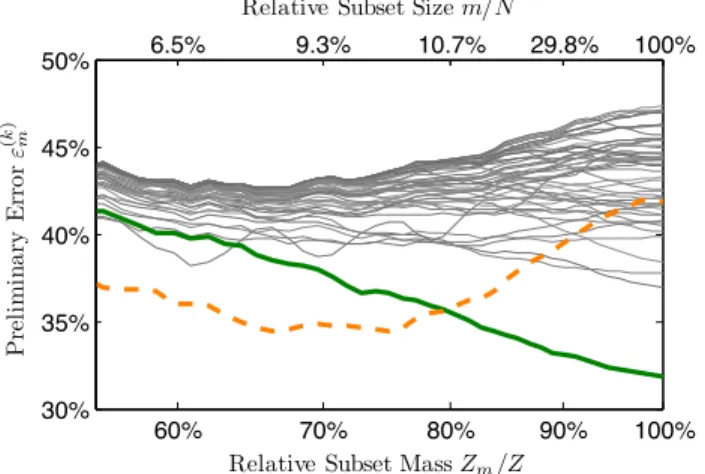
Figure 2. Traces of the best preliminary errors over in-creasingZm/Z. Each curve corresponds to a different fea-ture. The dashed orange curve corresponds to a feature that turns out to be misleading (i.e. its final error dras-tically worsens when all the sample weights are accumu-lated). The thick green curve corresponds to the optimal feature; note that it is among the best performing features even when training with relatively few samples.
Figure 2 shows the best preliminary error for each of the features in a typical experiment. By examining Figure2, we can make four observations:
1. Most of the overall weight is accounted for by the first few samples. (This can be seen by comparing the top and bottom axes in the figure)
2. Feature errors increasingly stabilize asm→N
3. The best performing features at smallerm-subsets (i.e. Zm/Z <80%) can end up performing quite
poorly once all of the weights are accumulated (dashed orange curve)
4. The optimal feature is among the best features for smallerm-subsets as well (solid green curve) From the full training run shown in Figure2, we note (in retrospect) that using anm-subset withm≈0.2N
would suffice in determining the optimal feature. But how can we knowa prioriwhichm is good enough?
60% 70% 80% 90% 100% 0% 20% 40% 60% 80% 100%
Relative Subset MassZm/Z
Pr o b a b il it y optimum among: preliminary top 1 preliminary top 10 preliminary top 10%
Figure 3. Probability that the optimal feature is among theKtop-performing features. The red curve corresponds toK= 1, the purple toK= 10, and the blue toK= 1% of all features. Note the knee-point aroundZm/Z≈75% at which the optimal feature is among the 10 preliminary-best features over 95% of the time.
Averaging over many training iterations, in Figure 3, we plot the probability that the optimal feature is among the top-performing features when trained on only anm-subset of the data. This gives us an idea as to how smallmcan be while still correctly predicting the optimal feature.
From Figure 3, we see that the optimal feature is not amongst the top performing features until a large enough m-subset is used – in this case,Zm/Z≈75%.
Although“optimality”is not quite appropriate to use in the context of greedy stage-wise procedures (such as boosted trees), consistently choosing sub-optimal pa-rameters at each stump empirically leads to substan-tially poorer performance, and should be avoided. In the following section, we outline our approach which determines the optimal stump parameters using the smallest possiblem-subset.
4. Pruning Underachieving Features
Figure 3 suggests that the optimal feature can often be estimated at a fraction of the computational cost using the following heuristic:Faulty Stump Training
1. Train each feature only using samples in them -subset whereZm/Z≈75%.
2. Prune all but the 10 best performing features. 3. For each of un-pruned feature, complete training
on the entire data set.
4. Finally, report the best performing feature (and corresponding parameters).
This heuristic does not guarantee to return the opti-mal feature, since premature pruning can occur in step 2. However, if we were somehow able to bound the er-ror, we would be able to prune features that would provably underachieve (i.e. would no longer have any chance of being optimal in the end).
Definition: a featurekis denotedunderachieving if it is guaranteed to perform worse than the best-so-far featurek� on the entire training data.
Proposition 1: for a featurek, the following bound holds (proof given in Section 4.2): given two subsets (where one is larger than the other), the product of subset mass and preliminary error is always greater for the larger subset:
m≤n ⇒ Zmε(k)m ≤Znε(k)n (1)
Let us assume that the best-so-far error ε� has been determined over a few of the features (and the param-eters that led to this error have been stored). Hence, this is an upper-bound for the error of the stump cur-rently being trained. For the next feature in the queue, even after a smaller (m < N)-subset, then:
Zmε(k)m ≥Zε� ⇒ Zε(k)≥Zε� ⇒ ε(k)≥ε�
Therefore, if: Zmε(k)m ≥Zε� then feature k is
under-achieving and can safely be pruned. Note that the lower the best-so-far error ε�, the harsher the bound; consequently, it is desirable to train a relatively low-error feature early on.
Accordingly, we propose a new method based on com-paring feature performance on subsets of data, and consequently, pruning underachieving features:
Quick Stump Training
1. Train each feature only using data in arelatively smallm-subset.
2. Sort the features based on their preliminary—– errors (from best to worst)
3. Continue training one feature at a time on —– progressively larger subsets, updatingε(k)m
•if it is underachieving, prune immediately. •if it trains to completion, save it as best-so-far. 4. Finally, report the best performing feature (and
corresponding parameters). 4.1. Subset Scheduling
Deciding which schedule ofm-subsets to use is a sub-tlety that requires further explanation. Although this choice does not effect the optimality of the trained stump, it may effect speedup. If the first “relatively small”m-subset (as prescribed in step 1) is too small, we may lose out on low-error features leading to less-harsh pruning. If it is too large, we may be doing unnecessary computation. Furthermore, since the cal-culation of preliminary error does incur some (albeit, low) computational cost, it is impractical to use every
mwhen training on progressively larger subsets. To address this issue, we implement a simple sched-ule: The first m-subset is determined by the param-eter ηkp such thatZm/Z ≈ηkp. M following subsets
are equally spaced out between ηkp and 1. Figure 4
shows a parameter sweep overηkpandM, from which
we fixηkp= 90% andM = 20 and use this setting for
all of our experiments.
ηkp M 0% 10% 20% 30% 40% 50% 60% 70% 80% 90% 100% 1 5 10 20 50 100 200
Figure 4. Computational cost of training boosted trees over a range of ηkp and M, averaged over several types
of runs (with varying numbers and depths of trees). Red corresponds to higher cost, blue to lower cost. The lowest computational cost is achieved atηkp= 90% andM = 20.
Using our quick stump training procedure, we deter-mine the optimal parameters without having to con-sider every sample for each feature. By pruning un-derachieving features, a lot of computation is saved. We now outline the full Boosting procedure using our quick training method:
Quickly Boosting Decision Trees
1. Initialize weights (sorted in decreasing order). 2. Train decision treeht(one node at a time) using
theQuick Stump Trainingmethod. 3. Perform standard Boosting steps:
(a) determine optimalαt(i.e. using line-search). (b) update sample weights given the misclassifica-tion error ofht and the variant of Boosting used. (c) if more Boosting iterations are needed, sort sample weights in decreasing order, increment it-eration numbert, and goto step 2.
We note that sorting the weights in step 3(c) above is an O(N) operation. Given an initially sorted set, Boosting updates the sample weights based on whether the samples were correctly classified or not. All cor-rectly classified samples are weighted down, but they maintain their respective ordering. Similarly, all mis-classified samples are weighted up, also maintaining their respective ordering. Finally, these two sorted lists are merged inO(N).
We now give a proof for the bound that our method is based on, and in the following section, we demonstrate its effectiveness in practice.
4.2. Proof of Proposition 1
As previously defined,ε(k)m is the preliminary weighted
classification error computed using the feature k on samples in them-subset; hence:
Zmε(k)m = � i≤m xi[k]≤τm(k) wi1{yi=+p(k) m}+ � i≤m xi[k]>τm(k) wi1{yi=−p(k) m } Proposition 1: m≤n ⇒ Zmε(k)m ≤Znε(k)n
Proof: ε(k)m is the best achievable preliminary error
on them-subset (and correspondingly, {p(k)m, τm(k)}are
the best preliminary parameters); therefore:
Zmε(k)m ≤ � i≤m xi[k]≤τ� wi1{yi=+p}+ � i≤m xi[k]>τ� wi1{yi=−p} ∀p, τ
Hence, switching the optimal parameters {p(k)m , τm(k)}
for potentially sub-optimal ones{p(k)n , τn(k)} (note the
subtle change in indices):
Zmε(k)m ≤ � i≤m xi[k]≤τn(k) wi1{yi=+p(k) n }+ � i≤m xi[k]>τn(k) wi1{yi=−p(k) n }
Further, by summing over a larger subset (n ≥ m), the resulting sum can only increase:
Zmε(k)m ≤ � i≤n xi[k]≤τn(k) wi1{yi=+p(k) n }+ � i≤n xi[k]>τn(k) wi1{yi=−p(k) n }
But the right-hand side is equivalent toZnε(k)n ; hence:
Zmε(k)m ≤Znε(k)n
Q.E.D.
For similar proofs using information gain, Gini impu-rity, or variance minimization as split criteria, please see the supplementary material.
5. Experiments
In the previous section, we proposed an efficient stump training algorithm and showed that it has a lower expected computational cost than the traditional method. In this section, we describe experiments that are designed to assess whether the method is practical and whether it delivers significant training speedup. We train and test on three real-world datasets and empirically compare the speedups.
5.1. Datasets
We trained Ada-Boosted ensembles of shallow decision trees of various depths, on the following three datasets: 1. CMU-MIT Faces dataset (Rowley et al., 1996); 8.5·103training and 4.0·103test samples, 4.3·103 features used are the result of convolutions with Haar-like wavelets (Viola & Jones, 2004), using 2000 stumps as in (Viola & Jones,2004).
2. INRIA Pedestrian dataset (Dalal & Triggs,2005); 1.7·104 training and 1.1
·104 test samples, 5.1 ·
103 features used are Integral Channel Features
(Doll´ar et al., 2009). The classifier has 4000 depth-2 trees as in (Doll´ar et al.,2009).
3. MNIST Digits (LeCun & Cortes, 1998); 6.0·104
training and 1.0·104test samples, 7.8
·102features
used are grayscale pixel values. The ten-class clas-sifier uses 1000 depth-4 trees based on (K´egl & Busa-Fekete,2009).
5.2. Comparisons
Quick Boosting can be used in conjunction with all previously mentioned heuristics to provide further gains in training speed. We report all computational costs in units proportional to Flops, since running time (in seconds) is dependent on compiler optimizations which are beyond the scope of this work.
(1) (2) T ra in in g L o ss (a ) 109 1010 10−12 10−10 10−8 10−6 10−4 10−2 Computational Cost Tr a in in g L o ss AdaBoost Weight−Trimming 99% Weight−Trimming 90% LazyBoost 90% LazyBoost 50% StochasticBoost 50% Tes t E rro r [A re a O v er R O C ] (a ) 108 109 1010 10−4 10−3 10−2 Computational Cost T es t E rr o r [Ar ea O ve r R O C ] AdaBoost Weight−Trimming 99% Weight−Trimming 90% LazyBoost 90% LazyBoost 50% StochasticBoost 50% T ra in in g L o ss (b ) 1010 1011 10−70 10−60 10−50 10−40 10−30 10−20 10−10 Computational Cost Tr a in in g L o ss AdaBoost Weight−Trimming 99% Weight−Trimming 90% LazyBoost 90% LazyBoost 50% StochasticBoost 50% Tes t E rro r [A re a O v er R O C ] (b ) 109 1010 1011 10−3 10−2 Computational Cost T es t E rr o r [Ar ea O ve r R O C ] AdaBoost Weight−Trimming 99% Weight−Trimming 90% LazyBoost 90% LazyBoost 50% StochasticBoost 50% T ra in in g L o ss (c ) 109 1010 10−50 10−40 10−30 10−20 10−10 Computational Cost Tr a in in g L o ss AdaBoost Weight−Trimming 99% Weight−Trimming 90% LazyBoost 90% LazyBoost 50% StochasticBoost 50% Tes t E rro r [A re a O v er R O C ] (c ) 108 109 1010 10−2 Computational Cost T es t E rr o r [Ar ea O ve r R O C ] AdaBoost Weight−Trimming 99% Weight−Trimming 90% LazyBoost 90% LazyBoost 50% StochasticBoost 50%
Computational Cost Computational Cost
Figure 5. Computational cost versus training loss (left plots) and versus test error (right plots) for the various heuristics on three datasets: (a1,2) CMU-MIT Faces, (b1,2) INRIA Pedestrians, and (c1,2) MNIST Digits [see text for details].
Dashed lines correspond to the “quick” versions of the heuristics (using our proposed method) and solid lines correspond to the original heuristics. Test error is defined as the area over the ROC curve.
In Figure5, we plot the computation cost versus train-ing loss and versus test error. We comparevanilla(no heuristics) AdaBoost, Weight-Trimming withη= 90% and 99% [see Section 3.2], LazyBoost 90% and 50% (only 90% or 50% randomly selected features are used to train each weak learner), and StochasticBoost (only a 50% random subset of the samples are used to train
each weak learner). To these six heuristics, we apply our method to produce six “quick” versions.
We further note that our goal in these experiments is not to tweak and enhance the performance of the clas-sifiers, but to compare the performance of the heuris-tics with and without our proposed method.
AdaBoost WT:99% WT:90% Lazy:90% Lazy:50% Stoch:50% 1 2 4 8 16
Relative Reduction in Test Error
Figure 6. Relative (x-fold) reduction in test error (area over the ROC) due to our method, given a fixed computa-tional cost. Triplets of bars of the same color correspond to the three datasets: CMU-MIT Faces, INRIA Pedestrians, and MNIST Digits.
5.3. Results and Discussion
From Figure5, we make several observations. “Quick” versions require less computational costs (and produce identical classifiers) as their slow counterparts. From the training loss plots (5a1, 5b1, 5c1), we gauge the
speed-up offered by our method; often around an or-der of magnitude. LazyBoost-50% and Quick-StochasticBoost-50% are the least computationally-intensive heuristics, and vanilla AdaBoost always achieves the smallest training loss and attains the low-est tlow-est error in two of the three datasets.
The motivation behind this work was to speed up training such that: (i) for a fixed computational bud-get, the best possible classifier could be trained, and (ii) given a desired performance, a classifier could be trained with the least computational cost.
For each dataset, we find the lowest-cost heuristic and set that computational cost as our budget. We then boost as many weak learners as our budget permits for each of the heuristics (with and without our method) and compare the test errors achieved, plotting the rela-tive gains in Figure6. For most of the heuristics, there is a two to eight-fold reduction in test error, whereas for weight-trimming, we see less of a benefit. In fact, for the second dataset, Weight-Trimming-90% runs at the same cost with and without our speedup.
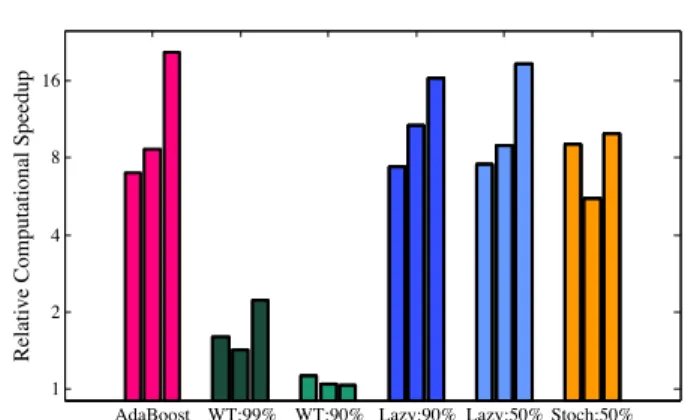
Conversely, in Figure 7, we compare how much less computation is required to achieve the best test er-ror rate by using our method for each heuristic. Most heuristics see an eight to sixteen-fold reduction in com-putational cost, whereas for weight-trimming, there is still a speedup, albeit again, a much smaller one (be-tween one and two-fold).
AdaBoost WT:99% WT:90% Lazy:90% Lazy:50% Stoch:50% 1
2 4 8 16
Relative Computational Speedup
Figure 7. Relative speedup in training time due to our proposed method to achieve the desired minimal error rate. Triplets of bars of the same color correspond to the three datasets. CMU-MIT Faces, INRIA Pedestrians, and MNIST Digits.
As discussed in Section3.2, weight-trimming acts sim-ilarly to our proposed method in that it prunes fea-tures, although it does so naively - without adhering to a provable bound. This results in a speed-up (at times almost equivalent to our own), but also leads to classifiers that do not perform as well as those trained using the other heuristics.
6. Conclusions
We presented a principled approach for speeding up training of boosted decision trees. Our approach is built on a novel bound on classification or regression error, guaranteeing that gains in speed do not come at a loss in classification performance.
Experiments show that our method is able to reduce training cost by an order of magnitude or more, or given a computational budget, is able to train classi-fiers that reduce errors on average by two-fold or more. Our ideas may be applied concurrently with other techniques for speeding up Boosting (e.g. subsampling of large datasets) and do not limit the generality of the method, enabling the use of Boosting in applications where fast training of classifiers is key.
Acknowledgements
This work was supported by NSERC 420456-2012, MURI-ONR N00014-10-1-0933, ARO/JPL-NASA Stennis NAS7.03001, and Moore Foundation.
References
Asadi, N. and Lin, J. Training efficient tree-based mod-els for document ranking. In European Conference on Information Retrieval (ECIR), 2013. 1
Birkbeck, N., Sofka, M., and Zhou, S. K. Fast boosting trees for classification, pose detection, and boundary de-tection on a GPU. In Computer Vision and Pattern Recognition Workshops (CVPRW), 2011. 2
Bradley, J. K. and Schapire, R. E. Filterboost: Regression and classification on large datasets. InNeural Informa-tion Processing Systems (NIPS), 2007. 2
Breiman, L. Arcing classifiers. InThe Annals of Statistics, 1998. 1
Breiman, L., Friedman, J. H., Olshen, R. A., and Stone, C. J. Classification and Regression Trees. Chapman & Hall, New York, NY, 1984. 2
B¨uhlmann, P. and Hothorn, T. Boosting algorithms: Reg-ularization, prediction and model fitting. InStatistical Science, 2007. 2
Burgos-Artizzu, X.P., Doll´ar, P., Lin, D., Anderson, D.J., and Perona, P. Social behavior recognition in continuous videos. In Computer Vision and Pattern Recognition (CVPR), 2012. 1
Coates, A., Baumstarck, P., Le, Q., and Ng, A. Y. Scalable learning for object detection with GPU hardware. In Intelligent Robots and Systems (IROS), 2009. 2
Dalal, N. and Triggs, B. Histograms of oriented gradients for human detection. InComputer Vision and Pattern Recognition (CVPR), 2005. 6
Doll´ar, P., Tu, Z., Tao, H., and Belongie, S. Feature mining for image classification. InComputer Vision and Pattern Recognition (CVPR), June 2007. 2
Doll´ar, P., Tu, Z., Perona, P., and Belongie, S. Integral channel features. InBritish Machine Vision Conference (BMVC), 2009. 6
Doll´ar, P., Appel, R., and Kienzle, W. Crosstalk cascades for frame-rate pedestrian detection. In European Con-ference on Computer Vision (ECCV), 2012. 1
Domingo, C. and Watanabe, O. Scaling up a boosting-based learner via adaptive sampling. In Pacific-Asia Conference on Knowledge Discovery and Data Mining, 2000. 2
Domingos, P. and Hulten, G. Mining high-speed data streams. InInternational Conference on Knowledge Dis-covery and Data Mining, 2000. 2
Dubout, C. and Fleuret, F. Boosting with maximum adap-tive sampling. InNeural Information Processing Systems (NIPS), 2011. 2
Freund, Y. Boosting a weak learning algorithm by major-ity. InInformation and Computation, 1995. 1
Freund, Y. and Schapire, R. E. Experiments with a new boosting algorithm. InMachine Learning International Workshop, 1996. 1,2
Friedman, J., Hastie, T., and Tibshirani, R. Additive lo-gistic regression: a statistical view of boosting. InThe Annals of Statistics, 2000. 3
Friedman, J. H. Greedy function approximation: A gradi-ent boosting machine. InThe Annals of Statistics, 2000.
2
Friedman, J. H. Stochastic gradient boosting. In Compu-tational Statistics & Data Analysis, 2002. 2
K´egl, B. and Busa-Fekete, R. Accelerating adaboost using UCB. KDD-Cup 2009 competition, 2009. 2,6
Kotsiantis, S. B. Supervised machine learning: A review of classification techniques. informatica 31:249–268. In-formatica, 2007. 1
LeCun, Y. and Cortes, C. The MNIST database of hand-written digits, 1998. 6
Mnih, V., Szepesv´ari, C., and Audibert, J. Empirical bern-stein stopping. InInternational Conference on Machine Learning (ICML), 2008. 2
Paul, B., Athithan, G., and Murty, M.N. Speeding up adaboost classifier with random projection. In Interna-tional Conference on Advances in Pattern Recognition (ICAPR), 2009. 2
Quinlan, R. J.C4.5: Programs for Machine Learning. Mor-gan Kaufmann, 1993. 2
Quinlan, R. J. Bagging, boosting, and C4.5. In National Conference on Artificial Intelligence, 1996. 1
Ridgeway, G. The state of boosting. InComputing Science and Statistics, 1999. 1
Rowley, H., Baluja, S., and Kanade, T. Neural network-based face detection. InComputer Vision and Pattern Recognition (CVPR), 1996. 6
Schapire, R. E. The strength of weak learnability. In Ma-chine Learning, 1990. 1
Sharp, T. Implementing decision trees and forests on a gpu. InEuropean Conference on Computer Vision (ECCV), 2008. 2,3
Svore, K. M. and Burges, C. J. Large-scale learning to rank using boosted decision trees. Scaling Up Machine Learning: Parallel and Distributed Approaches, 2011. 2
Viola, P. A. and Jones, M. J. Robust real-time face detec-tion.International Journal of Computer Vision (IJCV), 2004. 6
Wu, J., Brubaker, S. C., Mullin, M. D., and Rehg, J. M. Fast asymmetric learning for cascade face de-tection. Pattern Analysis and Machine Intelligence (PAMI), 2008. 2
Quickly Boosting Decision Trees – Supplementary Material
Ron Appel Thomas Fuchs Piotr Doll´ar Pietro Perona
In the main text of the paper, we prove a bound on the misclassification error on a preliminary subset of the data, given as Proposition 1:
m≤n ⇒ Zmεm≤Znεn
Using this bound, we are able to prune features early and speed up the training of decision trees using the classification error criterion. In this document, we prove the same bound on other common types of stump splitting criteria: information gain, Gini purity, and variance minimization, extending our method for use with regression trees as well as binary or multi-class classification trees.
In a decision tree, an input propagates down the tree (based on the tree parameters) until it reaches a single leaf node. The optimal tree parameters are those that lead to the best error based on the training data. Recall that
an n-subset is the set of n datapoints with the largest weights. We defineρj to be the set of elements in the
n-subset that are assigned to leafjusing the optimal tree parameters (when trained on then-subset). We define
the sum of the weights of elements that belong to that leafj asZρj and the sum of the weights of elements in
ρj with classy asZρyj Zn≡ � i≤n wi Zρj ≡ � i∈ρj wi Zρyj ≡ � i∈ρj wi1{yi=y}
In regression, elements have valuesyi∈Rd and we define the weighted average value of a leaf as:
˜ yρj ≡ 1 Zρj � i∈ρj wiyi
Given an n-subset of data (withn≤N), the preliminary error is computed by summing the error in each leaf,
proportionally weighted by the total mass of samples belonging to that leaf:
εn =
�
j
Zρj
Zn
ερj which we reformulate as: Znεn =
�
j
Zρjερj
Our goal is to show that for each leaf j, the product of preliminary error and subset mass always exceeds that
of a smaller subset. Let uj be the elements inρj that are in anm-subset and ¯uj be the elements that arenot,
wherem≤n: uj ≡ {i|i∈ρj, i≤m}, u¯j ≡ {i|i∈ρj, i > m} [Note that: uj∪u¯j=ρj] Zuj ≡ � i∈uj wi Zuyj ≡ � i∈uj wi1{yi=y} Zu¯j ≡ � i∈u¯j wi Zuy¯j ≡ � i∈u¯j wi1{yi=y}
The optimal tree parameters for them-subset might be different than those for then-subset; hence, the use of
potentially sub-optimal parameters may lead to a worse error. Accordingly, in the following section, we finalize
our proof by showing: Zρjερj ≥Zujεuj ∀j
⇒ Znεn = � j Zρjερj ≥ � j Zujεuj ≥Zmεm Q.E.D.
The following proofs are based on inequalities which are given at the end. Misclassification εn≡ � j Zρj Zn � 1−Z yj ρj Zρj � ⇒ Znεn= � j Zρjερj � �� � (Zρj −Z yj ρj) Zρjερj =Zρj−Z yj ρj = (Zuj +Zu¯j)−(Z yj uj +Z yj ¯ uj) =Zuj−Z yj uj � �� � Zujεuj + Zu¯j −Z yj ¯ uj � �� � Zuj¯ εuj¯ ≥0 Information Gain εn≡ � j Zρj Zn � −� y Zy ρj Zρj ln�Z y ρj Zρj �� ⇒ Znεn = � j Zρjερj � �� � � −� y Zρyjln �Zy ρj Zρj �� Zρjερj =− � y Zy ρjln �Zy ρj Zρj � =−� y (Zy uj+Z y ¯ uj) ln �Zy uj +Z y ¯ uj Zuj +Zu¯j � ≥�−� y Zy ujln �Zy uj Zuj �� � �� � Zujεuj +�−� y Zuy¯jln �Zuy¯j Zu¯j �� � �� � Zuj¯ εuj¯ ≥0
The proof for Information Gain Ratio is a trivial adaptation of the proof above.
Gini Impurity εn ≡ � j Zρj Zn � y Zy ρj Zρj � 1−Z y ρj Zρj � ⇒ Znεn = � j Zρjερj � �� � � Zρj− � y (Zy ρj) 2 Zρj � Zρjερj =Zρj− � y (Zy ρj) 2 Zρj = (Zuj +Zu¯j)− � y (Zy uj +Z y ¯ uj) 2 Zuj +Zu¯j ≥ � Zuj− � y (Zy uj) 2 Zuj � � �� � Zujεuj + � Zu¯j − � y (Zuy¯j) 2 Zu¯j � � �� � Zuj¯ εuj¯ ≥0 Variance Minimization εn≡ � j Zρj Zn � i∈ρj wi Zρj |yi−y˜ρj| 2 ⇒ Znεn = � j Zρjερj � �� � � � i∈ρj wi|yi|2−| Zρjy˜ρj| 2 Zρj � Zρjερj = � i∈ρj wi|yi|2−| Zρjy˜ρj| 2 Zρj = � i∈uj wi|yi|2+ � i∈u¯j wi|yi|2−| Zujy˜uj +Zu¯jy˜u¯j| 2 (Zuj+Zu¯j) ≥ � � i∈uj wi|yi|2−| Zujy˜uj| 2 Zuj � � �� � Zujεuj + � � i∈¯uj wi|yi|2−| Zu¯jy˜u¯j| 2 Zu¯j � � �� � Zuj¯ ε¯uj≥0
Inequalities
For positive scalars a, b≥0 andα, β >0, the following inequality holds: (a+b) ln�a+b α+β � ≤aln� a α+β � +bln� b α+β � =aln�a α· α α+β � +bln�b β · β α+β � =aln�a α � +bln�b β � −�aln�1 + β α � +bln�1 +α β �� � �� � ≥0 ⇒ (a+b) ln�a+b α+β � ≤aln�a α � +bln�b β �
For any vectors (or scalars)a,band positive scalarsα, β >0, the following inequality holds:
|a+b|2 α+β = |a|2+ |b|2 α+β + 2�a,b� α+β = |a|2 α � 1− β α+β � +|b| 2 β � 1− α α+β � +2�a,b� α+β = |a|2 α + |b|2 β − |βa−αb|2 αβ(α+β) � �� � ≥0 ⇒ |a+b| 2 α+β ≤ |a|2 α + |b|2 β


![Figure 5. Computational cost versus training loss (left plots) and versus test error (right plots) for the various heuristics on three datasets: (a 1,2 ) CMU-MIT Faces, (b 1,2 ) INRIA Pedestrians, and (c 1,2 ) MNIST Digits [see text for details].](https://thumb-us.123doks.com/thumbv2/123dok_us/9902351.2483597/7.918.99.802.91.829/figure-computational-training-various-heuristics-datasets-pedestrians-digits.webp)