Ministry of Urban Development Government of India
Nirman Bhawan, Maulana Azad Road, New Delhi 110 011 Phone: 011-23062309, 23061295
www.urbanindia.nic.in Photographs by the W
ater and Sanitation P
rogram Created by W rite Media
HANDBOOK OF
SERVICE LEVEL
BENCHMARKING
HANDBOOK OF
SERVICE LEVEL
BENCHMARKING
SECTION I: Service Level Benchmarking in the Context of Performance Management of Urban Services 9
1.0. Introduction to Service Level Benchmarking 1.1. Need for Service Level Benchmarking
1.2. Performance Parameters for Basic Urban Services 1.3. Roles of Different Stakeholders
1.4. Limitations and Challenges in Implementing Performance Management Systems Using Service Level Benchmarks
1.5. Standardisation of Service Level Benchmarks 1.6. Structure of the Handbook
SECTION II: Service Level Benchmarks 19
2.0. Service Level Benchmarks 2.1 Water Supply Services
2.1.1 Coverage of Water Supply Connections 2.1.2 Per Capita Supply of Water
2.1.3 Extent of Metering of Water Connections 2.1.4 Extent of Non-Revenue Water
2.1.5 Continuity of Water Supply 2.1.6 Quality of Water Supplied
2.1.7 Efficiency in Redressal of Customer Complaints 2.1.8 Cost Recovery in Water Supply Services
2.1.9 Efficiency in Collection of Water Supply-related Charges 2.2 Sewage Management (Sewerage and Sanitation) 2.2.1 Coverage of Toilets
2.2.2 Coverage of Sewage Network Services 2.2.3 Collection Efficiency of the Sewage Network 2.2.4 Adequacy of Sewage Treatment Capacity 2.2.5 Quality of Sewage Treatment
2.2.6 Extent of Reuse and Recycling of Sewage 2.2.7 Efficiency in Redressal of Customer Complaints 2.2.8 Extent of Cost Recovery in Sewage Management 2.2.9 Efficiency in Collection of Sewage Charges 2.3 Solid Waste Management
2.3.1 Household Level Coverage of Solid Waste Management Services 2.3.2 Efficiency of Collection of Municipal Solid Waste
2.3.3 Extent of Segregation of Municipal Solid Waste 2.3.4 Extent of Municipal Solid Waste Recovered
2.3.5 Extent of Scientific Disposal of Municipal Solid Waste 2.3.6 Efficiency in Redressal of Customer Complaints 2.3.7 Extent of Cost Recovery in SWM Services 2.3.8 Efficiency in Collection of SWM Charges 2.4 Storm Water Drainage
2.4.1 Coverage of Storm Water Drainage Network 2.4.2 Incidence of Water Logging/Flooding
SECTION III: Making Service Level Benchmarking Operational 79
3.1. Performance Report Cards 3.1.1 Initiating Performance Reporting 3.1.2 Performance Report Cards
3.2. Sustaining the Performance Management System
ANNEX: Illustrative Performance Report Card 85
Figures and Tables
Figure 1: Performance Management System
BSUP Basic Services to the Urban Poor
CPHEEO Central Public Health and Environmental Engineering Organisation
DMA District Metering Area
FY Financial Year
GIS Geographic Information System
ICAI Institute of Chartered Accountants of India
ILCS Integrated Low Cost Sanitation
JNNURM Jawaharlal Nehru National Urban Renewal Mission
MoUD Ministry of Urban Development
NRW Non-Revenue Water
O&M Operations and Maintenance
PROOF Public Record of Operations and Finance
RWA Resident Welfare Association
SLB Service Level Benchmark
STP Sewage Treatment Plant
SWM Solid Waste Management
ULB Urban Local Body
Units of Measure
lpcd litres per capita per day
m metre
km kilometre
Conversions
Crore = 10,000,000
Secretary
Ministry of Urban Development
Nirman Bhawan
New Delhi
India’s rapid economic growth in the last two decades has been accompanied by increased levels of urbanisation. Our cities, which are engines of growth, are under great strain to meet the growing demands and aspirations of their people.
Recognising the growing importance of improving efficiency in delivery of basic services in our cities, the Government of India has launched a series of initiatives aimed at enabling urban local bodies to meet the unprecedented challenges that they face today. These include schemes such as the Jawaharlal Nehru National Urban Renewal Mission, Urban Infrastructure Development Scheme for Small and Medium Towns, Capacity Building for Urban Local Bodies, National Urban Transport Policy, National Urban Sanitation Policy, National Mission Mode Project on E-governance and credit rating of select municipal bodies.
As part of the ongoing endeavour to facilitate critical reforms in the urban sector, the Ministry of Urban Development has now adopted National Benchmarks in four key sectors—Water Supply, Sewerage, Solid Waste Management and Storm Water Drainage. Investments in urban infrastructure have, however, not always resulted in corresponding improvements in levels of service delivery. There is, therefore, a need for a shift in focus towards service delivery. This is especially the case in water supply and sanitation. It is hoped that the Handbook of Service Delivery Benchmarking developed by the Ministry of Urban Development through a consultative process shall provide a standardised framework for performance monitoring in respect to water supply, sewerage, solid waste management services and storm water drainage, and would enable State level agencies and local level service providers to initiate a process of performance monitoring and evaluation against agreed targets, finally resulting in the achievement of service level benchmarks identified in the Handbook.
The Ministry of Urban Development would facilitate the adoption of these benchmarks through its various schemes and would also provide appropriate support to municipalities that move towards the adoption of these benchmarks. I encourage all State and local level functionaries to use this Handbook in achieving our shared goal of improved service delivery for our citizens.
Secretary (Urban Development) Dr. M. Ramachandran
Joint Secretary
Ministry of Urban Development
Nirman Bhawan
New Delhi
The Ministry of Urban Development initiated an exercise to develop standardised service level benchmarks with respect to basic municipal services in the year 2006. Subsequently, a core group comprising the Institute of Chartered Accountants of India (ICAI), the Public Record of Operations and Finance (PROOF), the Water and Sanitation Program–South Asia (WSP–SA) and Municipal Commissioners of Pune,
Bangalore, Jaipur, Hyderabad and Kolkata was constituted by the Ministry of Urban Development, which developed a draft Handbook of Service Level Benchmarking that was circulated among all the States and other key stakeholders. Based on the comments received, the draft was revised and a National Level Workshop was held in July 2008 for the adoption of benchmarks with respect to basic municipal services related to water supply, sewerage, solid waste management and storm water drainage.
This Handbook is a result of work done over a period of about two years and is designed to enable the systematic and sustained monitoring of services using standardised indicators against agreed targets and benchmarks. It will help effect performance improvements in the identified service sectors by (i) helping local decision-makers identify gaps, plan and prioritise improvement measures; (ii) enabling the identification and transfer of best practice; (iii) enhancing accountability to customers for service delivery levels; (iv) providing a framework that can underlie contracts/agreements with service providers; and (v) making it possible to link decision-making on financial allocations to service outcomes.
It is expected that State governments and cities would adopt this performance monitoring framework at the Urban Local Body (ULB)/parastatal level, and undertake to regularly collate and analyse the performance data to improve the quality of the decision-making process in the sectors identified in this Handbook. Its adoption by all States shall facilitate uniform measurements and reporting systems, which will be of immense help to the management of the service utilities in making the right comparisons aimed at improving the efficiency of the infrastructure. It shall also be of great help in shifting the focus from infrastructure to service delivery.
I would like to sincerely thank all the persons associated with this exercise, especially all the State
Government Secretaries of Urban Development, Municipal Commissioners, WSP–SA, CRISIL, PROOF, ICAI and Technical Cell (Jawaharlal Nehru National Urban Renewal Mission [JNNURM]) in the preparation of this Handbook. I am also grateful for the support received from the Secretary, Urban Development, Dr. M. Ramachandran, who has been the driving force behind this exercise. I indeed hope that this Handbook would mark a watershed in the urban sector.
Joint Secretary (Urban Development)
A.K. Mehta
2.1 Water Supply Services
S. No. Proposed Indicator Benchmark
2.1.1 Coverage of water supply connections 100%
2.1.2 Per capita supply of water 135 lpcd
2.1.3 Extent of metering of water connections 100%
2.1.4 Extent of non-revenue water (NRW) 20%
2.1.5 Continuity of water supply 24 hours
2.1.6 Quality of water supplied 100%
2.1.7 Efficiency in redressal of customer complaints 80%
2.1.8 Cost recovery in water supply services 100%
2.1.9 Efficiency in collection of water supply-related charges 90%
2.2 Sewage Management (Sewerage and Sanitation)
S. No. Proposed Indicator Benchmark
2.2.1 Coverage of toilets 100%
2.2.2 Coverage of sewage network services 100%
2.2.3 Collection efficiency of the sewage network 100%
2.2.4 Adequacy of sewage treatment capacity 100%
2.2.5 Quality of sewage treatment 100%
2.2.6 Extent of reuse and recycling of sewage 20%
2.2.7 Efficiency in redressal of customer complaints 80%
2.2.8 Extent of cost recovery in sewage management 100%
2.2.9 Efficiency in collection of sewage charges 90%
2.3 Solid Waste Management
S. No. Proposed Indicator Benchmark
2.3.1 Household level coverage of solid waste management services 100% 2.3.2 Efficiency of collection of municipal solid waste 100%
2.3.3 Extent of segregation of municipal solid waste 100%
2.3.4 Extent of municipal solid waste recovered 80%
2.3.5 Extent of scientific disposal of municipal solid waste 100%
2.3.6 Efficiency in redressal of customer complaints 80%
2.3.7 Extent of cost recovery in SWM services 100%
2.3.8 Efficiency in collection of SWM charges 90%
2.4 Storm Water Drainage
S. No. Proposed Indicator Benchmark
2.4.1 Coverage of storm water drainage network 100%
SERVICE LEVEL BENCHMARKING IN
THE CONTEXT OF PERFORMANCE
MANAGEMENT OF URBAN SERVICES
1.1
NEED FOR SERVICE
LEVEL BENCHMARKING
Every sector has a few key performance indicators that are understood by most stakeholders in that sector. Similarly, in the urban sector too, there have been a number of performance indicators related to urban management and service delivery that have been defined, measured and reported. However, most initiatives in performance
management so far have been observed to have some key limitations:
aDifferent sets of performance indicators have
been defined under different initiatives;
aThe definition or the assessment method may vary for the same performance indicator, thus inhibiting inter-city or intra-city comparisons;
aMost measurement exercises have been externally driven (by agencies external to the agency responsible for delivery against those
performance parameters), leading to the key issue of ownership of performance reports;
aMost performance measurement initiatives have
not been institutionalised, limiting the benefits of monitoring trends in performance over time; and
aThe process of performance measurement
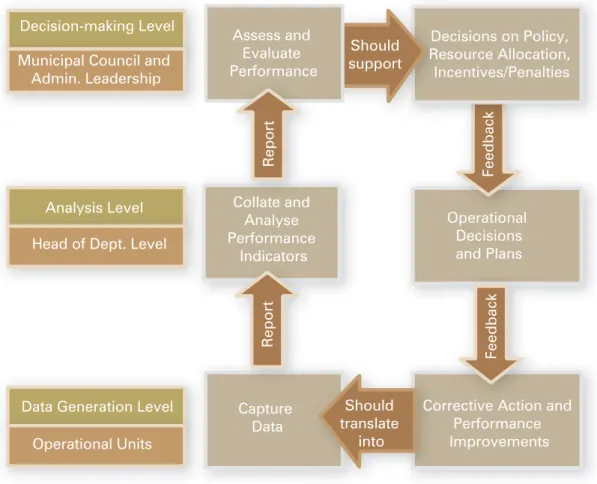
has not been taken forward into performance management (Figure 1).
These limitations mean that systems for measuring performance and taking further action on them have not been institutionalised in urban agencies. It is therefore important that the basic minimum standard set of performance parameters are commonly understood and used by all stakeholders. Depending on the specific need, additional performance parameters can be defined and used.
INTRODUCTION TO SERVICE
LEVEL BENCHMARKING
FIGURE 1:
PERFORMANCE
MANAGEMENT SYSTEM
Measuring service levels of civic agencies implies measuring outcomes, and indirectly also reflects on institutional capacity, financial performance and other parameters. Service level parameters can be measured either from a utility manager’s/planner’s perspective or from a citizen’s or consumer’s perspective. In addition, to facilitate comparison between cities/service delivery jurisdictions, and changes in performance over time, it is important that the performance levels are benchmarked, and monitored against those benchmarks.
It is in this context, that the Ministry of Urban Development (MoUD) has initiated an exercise to define Service Level Benchmarks (SLBs). The MoUD constituted a ‘Core Group for Service Level
Benchmarking,’ comprising experts from various institutions to arrive at the SLBs. Drawing on the experiences of various initiatives in measuring service level performance, the Core Group narrowed down the exercise to four basic urban services to begin with, and arrived at sets of indicators in each. After much deliberation, the indicators, their definitions, means of measurement, frequency and jurisdiction of measurement and reporting, etc., were finalised. The Handbook of Service Level Benchmarking is a ready reckoner to enable Urban Local Bodies (ULBs) and other city level parastatal agencies implement systems for measuring, reporting and monitoring the SLBs.
1.2
PERFORMANCE PARAMETERS
FOR BASIC URBAN SERVICES
Service level performance parameters have been identified for four basic urban services:
aWater Supply; aSewage;
aSolid Waste Management (SWM); and
aStorm Water Drainage
These parameters have been defined primarily from a utility manager’s/planner’s perspective. In other words, the parameters highlight the performance as would be monitored by the leadership/management of ULBs or other civic agencies. These performance measurements will need to be carried out by the service delivery agencies themselves, reported to higher levels of management and also disseminated widely. Clear definitions and methodologies are expected to eliminate bias in measurement and reporting. Performance from a citizen’s or consumer’s point of view is better measured by capturing their
perception, rather than data from the delivery agency. Measuring citizens’ perception can be supplemented by reporting by the agencies themselves, and can offer interesting insights when compared with one another.
Performance parameters should be applied across all cities and regularly used by all stakeholders. Practical considerations will drive frequency of measurement and reporting; and the jurisdiction of measurement and reporting, both critical aspects in performance measurement. Performance will need to be measured at a frequency higher than or at least equal to the frequency at which it will need to
be reported. Frequency should be determined at such an interval at which the variables driving the performance parameter will undergo visible change, and thereby reflect change in performance over different time periods.
Also, to the extent practical, performance should be measured at the smallest geographic jurisdiction as possible. Typically, performance measurements at the electoral ward level will be of significant value to decision-makers, especially elected representatives. Administrative jurisdictions for service delivery departments should ideally be co-terminus with ward boundaries. Service delivery performance at ward levels, when laid out spatially on the city map, may also offer interesting insights. Also from a citizen’s perspective, ‘ward boundaries’ are the sub-ULB level jurisdictions that they can possibly relate to. However, on the other hand, in case of network utilities such as water supply and sewage, all network management data are ideally reported by the Zone/District Metering Area (DMA), which typically represents major branches in the network.
It will therefore be relevant to examine ‘network management’-related performance indicators by Zone/sub-jurisdictions of the network (for example, continuity of water supply), while service delivery as experienced by the citizen is measured by civic wards as the smallest jurisdiction (for example, coverage of water supply connections).
For purposes of internal management of the ULB/utility, performance should be reported at the lowest level of jurisdiction and at maximum frequency possible. However, frequency may reduce and city-wide level performance may be reported to the higher levels of government and other external stakeholders.
1.3
ROLES OF
DIFFERENT STAKEHOLDERS
For the service level performance parameters to be accepted as a standard, all stakeholders will need to play their parts. The roles of different stakeholders and the next steps they will need to pursue are:
aCentral Government: MoUD, Government of India, will take the lead in disseminating these service level performance parameters and building wider acceptance. SLBs will also be institutionalised through the Jawaharlal Nehru National Urban Renewal Mission (JNNURM) and other programmes initiated by MoUD:
SLBs will be an integral part of City Development Planning processes, both for assessment of the current situation, and for setting targets under their plans;
Wherever appropriate, SLBs will be
dovetailed with the commitment on reforms, and the subsequent process of appraisal of reforms;
The relevant SLBs should be part of Detailed Project Reports for concerned sectors, indicating both the current situation and changes the project will bring about. Subsequent processes of implementation monitoring of the project will also evaluate these SLBs; and
Under the JNNURM, support may be extended to enable ULBs and other civic agencies to establish systems in their respective institutions for periodic measurement, reporting and analysis of SLBs.
aState Governments and their Agencies:
State governments and their nodal agencies in the urban sector have a critical role in
driving the performance of ULBs and city level
civic agencies. State governments will need to periodically evaluate the SLBs as an input for its decisions related to policy, resource allocations, providing incentives and penalties, channelising technical and manpower support, and regulatory considerations, among others. The Directorate of Local Bodies/Department of Municipal Administration will need to play a key role in this process through constant inter-city comparisons. These departments should leverage the power of information technology to build and operate systems that periodically capture and report on SLBs. Web-based technologies should be leveraged to manage information flow. For other nodal State level agencies, the SLBs will provide specific inputs for their programmes and interface with the ULBs and other civic agencies. SLBs will also be an important input to the State Finance Commissions in the course of their work.
aUrban Local Bodies: ULBs are the most
important stakeholders for the institutionali-sation of Service Level Benchmarking.
As service delivery institutions, ULBs will find it useful to institutionalise systems for performance management using SLBs. Performance data at the sub-ULB level (Zone or ward level) are particularly useful for the ULB for making appropriate decisions and monitoring performance of the various field units. Benchmarking with other cities within the State, or with similar cities, facilitates a healthy competitive environment for continuous improvement; and
As the principal elected institution for self-governance in the city, ULBs will need to examine performance of other
parastatal civic agencies, even if the ULBs are not directly responsible for service delivery in those areas.
Performance management data using SLBs should be included in the set of information disseminated under mandatory public disclosure, as required by the reforms mandate under JNNURM.
The key next steps for ULBs are to generate
performance reports on SLBs periodically beginning financial year (FY) 2008-09. Data can be captured either regularly through systems on the ground (for example, weighbridges at the composting plant or landfill site, water meters capturing flow at
designated points, demand collection registers for water charges, etc.), or through specific surveys carried out at defined intervals. In parallel, the ULBs will also need to institutionalise systems for the entire cycle of performance management, as depicted in Figure 1. This would imply:
Systems for capturing data: Design and implement data collection systems for data to be captured at the most disaggregated level. Such data will typically be from field level staff such as sanitary supervisors, water pump operators, accounts clerks, etc. Simple data
formats should be designed and provided to them to capture the data and report it upwards within the organisation for collation and determination of the service level performance;
Systems for collation and analysis of performance indicators: Specific persons should be designated with the mandate to collate the data received from the field and generate the performance reports.
Working directly under supervision and guidance from officers at the head of department level, young professionals with good analytical skills and moderate levels of technical skills should be able to execute these tasks;
Systems for assessment and evaluation of performance: In most cases, multiple indicators need to be examined to obtain a holistic picture of service levels in a
particular sector. Performance indicators reported by the department level should be closely examined at the management level of the ULB. Such reviews by the Mayor/ Municipal Commissioner should take place at a defined frequency, say monthly;
Systems for decision-making: All ULBs do have systems for decision-making; however, many decisions end up being considered in the absence of quality data. To address such gaps, systems such as periodically tabling the performance reports in the Council/to the Standing Committees should be instituted. Typically, reporting ward level performance parameters, wherever applicable, will be useful;
Systems for operational decisions and plans: Decisions and plans will need to be periodically reviewed in light of the
performance achieved and follow-on decisions taken up. Additional capital or revenue expenditure may be needed, contracting decisions made, and remedial action taken with respect to deployment of staff, etc. A process of monthly review and follow-up decisions will need to be instituted; and
Systems to take corrective action for performance improvement: To enable the operational staff implement corrective action on the ground, they will need to be
adequately empowered to implement the decisions taken without lengthy approval processes. For networked infrastructure services, as in most urban services, significant efficiency improvements can be brought about through operational improvements without significant capital investment.
A system of incentives and penalties must be instituted to attain targeted performance levels. This is critical for the field functiona-ries to respond in making quick operational improvements. Similarly, the system of penalties for errant staff that has lead to poor performance should be institutionalised.
aOther Parastatal Agencies: The significance of Service Level Benchmarking and the next
steps parastatal agencies need to undertake are very similar to that for ULBs. Parastatal agencies too need to put systems in place for performance management as mentioned above. The need for periodic reporting of SLBs to ULBs concerned and its public disclosure is further highlighted in this case, thereby bringing in higher intensity of accountability of parastatal agencies to elected bodies and the public at large.
aBi-lateral/Multi-lateral Aid Agencies and Other Stakeholders: Various urban governance and infrastructure improvement programmes initiated by bi-lateral and multi-lateral aid agencies can dovetail with and further strengthen this initiative, mainly in two ways:
Enabling State governments and cities in design and implementation of performance management systems, with a focus on the SLBs defined; and
Extensively using the SLBs defined in the design, implementation and monitoring of the urban programmes supported by them. Benchmarking service levels and achieving targets for each of these SLBs can be built into the design of these programmes.
Organisations such as City Managers’ Associations, public administration training institutions, the Office of the Comptroller and Auditor General, other external and internal audit agencies, financial institutions and a whole range of external stakeholders should examine these SLBs in the course of their interactions with the ULBs.
aCitizens and Civil Society: While the SLBs have
not been defined from the citizen’s perspective as such, the parameters considered provide
reasonable indication of performance of the ULB/civic agency. Citizens should engage with ULBs through Area Sabhas, Resident Welfare Associations (RWAs) and other such civil society organisations, in examining the
1.4
LIMITATIONS AND CHALLENGES IN
IMPLEMENTING PERFORMANCE
MANAGEMENT SYSTEMS USING
SERVICE LEVEL BENCHMARKS
It is recognised that this initiative to implement performance management systems using SLBs has a number of limitations. Performance management in ULBs is being catalysed by the Central
Government; however, it is acceptance and capacity at the State and city levels that will sustain this initiative. While this Handbook has attempted to address issues of definition and methodology for Service Level Benchmarking, it is anticipated that a number of complexities will arise in the course of actual implementation. Field level experience in implementing service delivery performance management systems may also throw up the need for monitoring additional parameters. This experience should then provide feedback for improving the SLBs and preparing the second version of this Handbook.
Challenges involved in implementing performance management systems using SLBs will be many. They will include:
aSystems for capturing key data elements
identified for Service Level Benchmarking are not present in many cases at the field level. Ideally data are always captured at the lowest level. Interpreting and understanding performance is always easier at an aggregate level; this is not possible at the disaggregated level, if data have not been captured at that level. Also the data at city/ULB level can be credible and reasonably accurate, only if they have been captured at the lower levels, such as the ward level. For example, if ward level data are captured on
hours of water supply, they can be aggregated at a ULB level. However, if the number of hours is only assessed and reported at the city level, ward-wise variances cannot be examined;
aTo measure input parameters for a performance
indicator, there may be a tendency to measure through ad hoc systems, which can be a one-off exercise. However, to generate data from the field level on a regular basis to sustain periodic performance measurement, sustainable systems need to be put in place;
aIn some cases, there may be resistance of field
staff or other stakeholders to collect and report correct information, as vested interests may be involved. Such vested interests may also want to prevent transparent disclosure of the
performance measured. Such hurdles will need to be overcome;
aAs mentioned earlier, definition and
measurement methodology issues will continue to exist, though they will be refined with experience. Also, some other indicators may seem important or more SLBs may seem to be necessary for interpreting performance; and
aPerformance management will be sustainable only if disclosure, reporting, monitoring and performance management feedback, incentives and disincentives are also brought into the cycle. Else the system of measurement and disclosure of SLBs may not sustain itself.
1.5
STANDARDISATION OF
SERVICE LEVEL BENCHMARKS
Each indicator has been detailed out in a standardised template in the following pages to present the definition and computation
methodology of the selected SLBs (performance indicators). For each selected indicator, the following details have been provided:
aTitle, units and definition: The specific name, the unit of measurement in which the
performance is to be measured, and definition for the indicator is provided;
aData requirements: The specific elements of data that need to be captured are identified, along with the corresponding unit of
measurement. Each data element is described, and point and frequency of data capture are mentioned. The specific formulae that should be used to arrive at the performance indicator are mentioned;
aRationale for the indicator: For each
performance indicator, the overall significance and rationale for assessing and monitoring the performance indicator have been provided. The benchmark value has been specified in most cases;
aReliability of measurement: The performance measurement is only as reliable for meaningful management decisions as the systems that generate the data to compute the performance. Typically, four levels of reliability of data systems have been specified: ‘A’, ‘B’, ‘C’, and ‘D,’ with ‘A’ being of highest reliability and ‘D’ being lowest. Reliability of measurement highlights a hitherto ignored aspect in performance management of urban services—the need to design, implement and institutionalise robust systems and processes that will provide data of high reliability, on a repeat basis, and in a consistent manner. ULBs/ urban utilities are advised to institute systems
corresponding to the level ‘A’ specified. Such a transition will not happen in a short time period. Thus, while performance levels are improved over time, so should the data systems through which data are captured. The goal, therefore, is to reach the benchmark performance level of ‘A’ level reliability of measurement;
aFrequency of measurement: Frequency of
measurement of the performance indicator refers to the frequency at which the performance level will be assessed and not the frequency at which the data elements will be measured. For each indicator, the minimum frequency at which the performance should be measured is
mentioned. It can then be reported at the same frequency or a lower frequency. The frequency at which performance is measured is
critical since:
There should ideally be visible change or potential for changing the performance level between two consecutive time periods. (For example, it may not be possible to change the availability of treatment plant capacity in a few months; therefore it should be
measured and reported on an annual basis. However, hours of water supply may vary with seasons and can be improved during the year, therefore it should be reported at a quarterly and an annual frequency.);
If the time period is set too long, the performance measured cannot effectively feed back into making operational improvements;
If the time period is set too short, significant time will be lost in only measuring and reporting performance; and
Performance cannot be reported at a frequency higher than at which it has been measured.
Performance should be reported more frequently within the organisation, and at
a lower frequency to higher levels of government, for example, performance reports should be tabled to the Standing Committees and Municipal
Councils at monthly or quarterly frequencies. However, they may be reported at annual frequency to State and Central governments; and
aJurisdiction of measurement: This refers to the geographic jurisdiction for which
performance should be measured, and not the point of data collection. Typically, measuring urban service delivery performance at a sub-city level makes more sense for city level
stakeholders, than only city level performance indicators. For instance, for an urban citizen or municipal councillor, it would be useful to know the performance of a particular service in that ward, especially in relation to other wards. Also measuring performance only at the city level will disguise huge differences in service levels that exist between different localities in one city, a phenomenon common in most Indian cities.
Similarly, for stakeholders at the State and Central level, it is useful to have city level performance indicators, as they would be useful to compare and contrast cities. Such information will then be useful for the formulation of State level and national strategies and policy responses.
Measuring performance at a lower level jurisdiction enables aggregation of the data to indicate performance at a larger jurisdiction. Thus, if ward level performance is known for all wards, ULB level performance can also be reported.
Please note that, with respect to geographic jurisdictions for the performance indicators, the terms ‘ULB’ and ‘city’ have been used inter-changeably. This has been done since, in larger cities/urban agglomerations, there are multiple ULBs within the city while in smaller cities, the ULBs typically cover the entire urban boundaries. In many cities, certain services such as water supply and waste water management may be provided and/or managed by a parastatal utility for a larger urban jurisdiction, rather than the limits of the ULB/s. In such cases, the data and
performance indicators may pertain to the jurisdictions of the parastatal utility. Therefore, the unit of ULB/city should be interpreted as appropriate to the given context.
1.6
STRUCTURE OF THE HANDBOOK
Section II of the Handbook provides details regarding each selected SLB. The list of indicators has been chosen after taking into account experiences in pilot initiatives in implementing Service Level Benchmarking across ULBs/utilities. The quality of available data, effort required in data collection and the significance of the indicator has been considered in arriving at this set of indicators.
Section III of the Handbook provides guidance on how Service Level Benchmarking can be
operationalised. Samples of performance reports of SLBs that ULBs/civic agencies can use to set and track their performance improvement are provided.
SERVICE LEVEL
BENCHMARKS
Lists of SLBs have been chosen so as to reflect the multiple facets of service delivery performance. SLBs for which detailed data sheets are provided are:
a2.1 Water Supply Services: As water is a
basic need, emphasis has been laid on performance related to reach and access to quality service, and prevalence and effectiveness of the systems to manage the water supply networks. As financial sustainability is critical for continued effectiveness in service delivery, performance is measured on this aspect too. Indicators selected are:
2.1.1 Coverage of water supply connections 2.1.2 Per capita supply of water
2.1.3 Extent of metering of water connections 2.1.4 Extent of non-revenue water (NRW) 2.1.5 Continuity of water supply
2.1.6 Quality of water supplied 2.1.7 Efficiency in redressal of
customer complaints
2.1.8 Cost recovery in water supply services 2.1.9 Efficiency in collection of water
supply-related charges
a2.2 Sewage Management (Sewerage and
Sanitation): For sewage management, performance related to reach and access of the service, effectiveness of the network and environmental sustainability have been emphasised, apart from financial sustainability of operations. Indicators selected are:
2.2.1 Coverage of toilets
2.2.2 Coverage of sewage network services 2.2.3 Collection efficiency of sewage network 2.2.4 Adequacy of sewage treatment capacity 2.2.5 Quality of sewage treatment
2.2.6 Extent of reuse and recycling of sewage 2.2.7 Efficiency in redressal of
customer complaints 2.2.8 Extent of cost recovery in
sewage management 2.2.9 Efficiency in collection of
sewage charges
a2.3 Solid Waste Management: Performance
related to reach and access, effectiveness of network operations and environmental
sustainability have been considered, apart from financial sustainability of operations. Indicators selected are:
2.3.1 Household level coverage of solid waste management services
2.3.2 Efficiency of collection of municipal solid waste
2.3.3 Extent of segregation of municipal solid waste
2.3.4 Extent of municipal solid waste recovered 2.3.5 Extent of scientific disposal of municipal
solid waste
SERVICE LEVEL
BENCHMARKS
2.0
2.3.6 Efficiency in redressal of customer complaints
2.3.7 Extent of cost recovery in SWM services 2.3.8 Efficiency in collection of
SWM charges
a2.4 Storm Water Drainage: Extent of the
network and effectiveness of the network are
emphasised to assess storm water drainage system performance. As this service does not yield any direct revenues, financial sustainability is not considered. Indicators selected are:
2.4.1 Coverage of storm water drainage network
WATER SUPPLY
SERVICES
2.1
2.1.1
COVERAGE OF
WATER SUPPLY CONNECTIONS
Performance Indicator Unit % Number Number % Definition
Total number of households in the service area that are connected to the water supply network with direct service connections, as a percentage of the total number of households in that service area. Service area implies a specific jurisdiction in which service is required to be provided.
The total number of households (not properties) in the service area should be calculated. The service area refers to either the ward or ULB limits. Cadastre maps supplemented through actual ground level surveys (carried out once in four to five years) should provide these data. Exclusive surveys need not be carried out, and data can be collected during other surveys carried out for property tax, or other such purposes. This will include households which receive municipal water supply at one common point, from where it is stored and distributed to all households (for example, as in apartment complexes). Households supplied water through public standposts or tankers should be excluded. Households completely dependent on other water sources such as borewells, open wells, etc., should not be included.
Coverage = [(b/a)*100]
Data Requirements
Indicator
Household level coverage of direct water supply connections
a. Total number of households in the service area
b. Total number of households with direct water supply connection
Household coverage for water supply connections
Data required for calculating Unit Remarks the indicator
Minimum frequency of measurement Smallest geographical jurisdiction for of performance indicator measurement of performance
Measurement Quarterly Measurement Zone/DMA level
Rationale for the Indicator
The minimum level acceptable standard for water supply service should be a household level water supply connection, that is, a direct piped connection for water supply within the household. Water provision to households (urban poor or otherwise), at common public standposts cannot be
considered as an acceptable/long-term permanent service provision standard. The social costs of not having access to a piped water connection at the household level are significant. Innovative service delivery options may be adopted for delivery of piped water connections to properties with
inappropriate tenure rights (as in many urban slums). It is therefore important to measure this performance indicator, the benchmark value for which should be 100 percent.
Reliability of Measurement
Reliability scale Description of method
Lowest level of reliability (D) Estimation of households covered on the basis of geographical area of the city covered with the pipeline network, as a surrogate indicator for water supply coverage.
Intermediate level (C) Estimation of households covered on the basis of road length in the city covered by the pipeline network, as a surrogate indicator for water supply coverage.
Intermediate level (B) Estimation of households covered computed as the total number of connections (for which data are maintained) as a percentage of the estimated number of households on the basis of population (total population divided by average household size).
Highest/preferred level Calculation based on the actual number of households with direct of reliability (A) service connections (for which data are maintained); and the total
number of households as revealed in ground level surveys. Data are periodically updated on the basis of building units approved, and new household level water connections provided.
2.1.2
PER CAPITA SUPPLY OF WATER
Performance Indicator Unit litres per capita per day (lpcd) litres per month Number Number litres per capita per day (lpcd) lpcd Data Requirements IndicatorPer capita quantum of water supplied
a. Water supplied to the distribution system
b. Population served
c. Number of days in the month
d. Additional information on areas where water is supplied at a rate less than 70 lpcd
Water supplied
Data required for calculating Unit Remarks the indicator
Definition
Total water supplied to consumers expressed by population served per day.
Daily quantities should be measured through metering, and records maintained. The total supply for the month should be based on an aggregate of daily quantum. Only treated water input into the distribution system should be measured. If water is distributed from multiple points, the aggregate of that quantity should be considered. The quantum should exclude bulk water transmission and
distribution losses, as measured through water audit tests. This quantum should include water purchased directly from any other sources and put into the distribution system, if any. Water may have been purchased from neighbouring ULBs, Cantonment Boards, etc. Water supplied in bulk to large water intensive industries/industrial estates should be excluded.
The number of people in the service area served by the utility. While typically the number of residents are considered, if the city has a significant floating population of tourists who temporarily reside in the city, such a population should be included. Tourist population estimates can be reasonably computed on the basis of bed capacity of hotels, and
occupancy rates.
The number of days in the specific month.
The number of people in these service areas served by the utility. The quantity of water supplied to these areas measured through bulk meters or by scientific calculation using flow velocity and head.
Rationale for the Indicator
This frequently used performance indicator provides an overall indication of the adequacy of the water supply to meet the needs of the citizens in the city. Per capita water supplied, expressed in lpcd, indicates the adequacy of the municipal water supply system in being able to source, treat water to potable standards and supply it into the distribution system. Therefore, this indicator should be periodically measured and monitored. Monitoring this on a monthly basis will reveal seasonal variations. The benchmark value for this indicator is 135 lpcd. However, the additional information in respect of the areas where water is supplied at the rate of 70 lpcd should also be indicated. The key limitation of this indicator is that it provides information on a city-wide basis, and does not reveal intra-city variations.
Reliability of Measurement
Reliability scale Description of method
Lowest level of reliability (D) The quantity of water produced is estimated on the basis of assumed pump capacity and efficiencies, and the number of hours of
operation. The population served is calculated on the basis of past census figures, extrapolated to current levels. Reliable estimates of the floating population are not available.
Intermediate level (C) The quantity of water produced is estimated on the basis of measurement of periodic sample surveys of production flows at all bulk production points. Reliable estimates of transmission losses and industrial water consumption are available. The population served is calculated on the basis of past census figures, extrapolated to current levels. Reliable estimates of the floating population are not available. Intermediate level (B) Not applicable.
Highest/preferred level of The quantity of water produced is computed on the basis of
reliability (A) measurement by bulk flow meters at the outlet of the treatment plant and/or at all bulk production points. The quantum of losses and bulk industrial consumption are periodically monitored. The population served is known with reasonable accuracy. Any expansion of municipal limits and other significant factors are measured and factored into the current population computation. The floating population is estimated with reasonable accuracy.
Minimum frequency of measurement Smallest geographical jurisdiction for of performance indicator measurement of performance
2.1.3
EXTENT OF METERING OF
WATER CONNECTIONS
Performance Indicator Unit % Number Number Number Number % Data Requirements Indicator Extent of metering of water connectionsa. Total number of direct service connections
b. Total number of public standposts
c. Number of metered direct service connections
d. Number of metered public standposts
Extent of metering of water connections
Data required for calculating Unit Remarks the indicator
Definition
The total number of functional metered water connections expressed as a percentage of the total number of water supply connections. Public standpost connections should also be included.
This will include households and establishments which receive municipal water supply at one common point, from where it may be stored and distributed for all households (for example, as in apartment complexes). Households completely dependent on other water sources such as bore wells, open wells, etc., should not be included. The total number of public standpost connections, which are currently in use, should be considered. Of the total number of direct service connections (to all categories of consumers), the number of connections which have functional meters, and metered quantities is the basis for billing of water charges.
Typically, public standposts are not metered. However, if some are metered, they should be included.
Extent of metered connections = [(c + d)/ (a + b)]*100
Rationale for the Indicator
While water is a basic need, the supply of potable water to citizens at their doorstep involves significant costs in building, operating and maintaining a system to do so. In a water supply system, the quantum of service provided to citizens is directly measurable, and therefore it is necessary that all the water supplied to all categories of consumers should be metered. Metering will also induce efficiency in use of water, reveal physical and administrative leakages in the system, and enable high-end consumers to be charged for consuming more. Therefore, to introduce a volumetric-based tariff structure for water charges, metering all connections is essential. It is, therefore, important to monitor this indicator, the benchmark value for which is 100 percent.
Reliability of Measurement
Reliability scale Description of method
Lowest level of reliability (D) A few meters have been installed. All installed meters are assumed to be functional and used as the basis for billing water charges.
Intermediate level (C) Meters are installed for only certain categories of consumers. It is assumed all consumers of these categories have meters installed which are functional and used as the basis for billing. Records do not reveal the exact number of connections which are metered. Water is charged on the basis of average readings for the consumer category or on the basis of past trends in most cases.
Intermediate level (B) Databases/records reveal the list of consumers that have meters installed in their water connections. However, there are no clear data on functioning of meters, and no linkage with the billing system that may or may not use metered quantity as the basis for billing. Highest/preferred Billing records and databases clearly identify consumers with meters level of reliability (A) (against specific meter serial number). Billing processes reveal regular
reading of meters and meter readings are the basis for charging consumers. Records on standposts are available. Databases of water connections and meters are complete, and spatially referenced with a geographic information system (GIS) database. There is a mechanism in place to repair meters if found faulty. Processes for installation of new water connections, installation of meters and generation of water bills based on this are interlinked, and the data systems enable such continuity of data flow regarding these.
Minimum frequency of measurement Smallest geographical jurisdiction for of performance indicator measurement of performance
2.1.4
EXTENT OF
NON-REVENUE WATER (NRW)
Performance Indicator Unit % million litres per day (or) month million litres per day (or) month % Data Requirements Indicator Extent of NRWa. Total water produced and put into the transmission and distribution system
b. Total water sold
NRW
Data required for calculating Unit Remarks the indicator
Definition
This indicator highlights the extent of water produced which does not earn the utility any revenue. This is computed as the difference between the total water produced (ex-treatment plant) and the total water sold expressed as a percentage of the total water produced. NRW comprises: a) Consumption which is authorised but not billed, such as public standposts; b) Apparent losses such as illegal water connections, water theft and metering inaccuracies; and c) Real losses which are leakages in the transmission and distribution networks.
Daily quantities should be measured through metering, and records on the transmission and distribution system should be maintained. The total supply for the month should be based on the aggregate of the daily quantum. Only treated water input into the distribution system should be
measured. If water is distributed from multiple points, the aggregate of that quantity should be considered. This quantum should include water purchased directly from any other sources and put into the distribution system, if any. Water may have been purchased from neighbouring ULBs,
Cantonment Boards, etc.
The actual volume of water supplied to customers who are billed for the water provided. Ideally, this should be the aggregate volume of water consumed as per which consumers have been billed. However, in the absence of a complete and functionally effective metering regimen, alternate methods of measurement need to be evolved, with lower but acceptable levels of reliability.
Minimum frequency of measurement Smallest geographical jurisdiction for of performance indicator measurement of performance
Measurement Quarterly Measurement ULB level
Rationale for the Indicator
The reduction in NRW to acceptable levels is vital for the financial sustainability of the water utility. NRW can be reduced through appropriate technical and managerial actions, and therefore monitoring NRW can trigger such corrective measures. The reduction of real losses can be used to meet currently unsatisfied demand or to defer future capital expenditures to provide additional supply capacity. The reduction of NRW is desirable not just from a financial standpoint, but also from the economic and environmental benefits’ point of view. The benchmark value for NRW may be
considered at 20 percent, the levels achieved by most well-performing utilities in developed countries. NRW is also influenced by factors outside the control of the water utility such as the topography of the city, age of the network, length of the network per connection and water use per capita.
Reliability of Measurement
Reliability scale Description of method
Lowest level of reliability (D) The quantity of water produced is estimated on the basis of assumed pump capacity and efficiencies, and the number of hours of
operation. A few meters have been installed in the distribution system and at the consumer end. The quantity of water sold to the category of consumers to whom bills are raised is estimated on the basis of assumed average consumption in that category and the number of consumers in that category.
Intermediate level (C) The quantity of water produced is estimated on the basis of measurement of periodic sample surveys of production flows at all bulk production points. Meters are installed for a select category of consumers, such as commercial and bulk consumers. For other categories of consumers, such as domestic consumers, the number of such consumers and the average consumption per consumer are considered, to arrive at the quantum of water sold.
Intermediate level (B) The quantity of water produced is computed on the basis of
measurement at bulk flow meters at the outlet of the treatment plant and/or at all bulk production points. The quantum of water sold is based on the metered quantity for bulk and commercial consumers. For households, ferrule size (the size of the distribution pipe outlet at the consumer end) of each consumer connection as well as the hours of supply are known, to compute the quantum of water sold.
Highest/preferred level of The quantity of water produced is computed on the basis of
reliability (A) measurement at bulk flow meters at the outlet of the treatment plant and/or at all bulk production points. Metering is undertaken at all key distribution nodes (entry to DMAs) and at the consumer’s end for all categories of consumers. Billing records and databases clearly reveal regular reading of meters and, therefore, the total quantum of water billed to consumers in the given time period (month/bi-monthly).
WATER SUPPLY
Performance Indicator Unit Hours per day Hours Data Requirements DefinitionContinuity of supply is measured as the average number of hours of pressurised water supply per day. Water pressure should be equal to or more than a head of 7 metre (m) at the ferrule point/meter point for the connection (7 m head
corresponds to the ability to supply to a single-storey building).
The number of hours of supply in each operational zone (or DMA) should be measured continuously for a period of seven days. The average of the seven days should be considered for that month. Measurement should exclude hours of supply where the pressure is less than the minimum standards for piped water supply. The zone-wise figures should be averaged out to get city-wise data.
Indicator
Continuity of water supply
Average hours of pressurised supply per day
Data required for calculating Unit Remarks the indicator
Rationale for the Indicator
Almost no Indian city has a continuous (24x7) water supply system, the norm for all cities in the developed world. From a citizen’s perspective, it is desirable to have round-the-clock water supply daily, as it eliminates the need to provide and manage household/establishment level storage, and other resultant inconveniences. Water utilities in most Indian cities provide intermittent and limited number of hours of supply, as a means to manage inadequate supply. A number of studies have demonstrated the negative fallouts of designing and operating a system for intermittent water supply. A number of cities are undertaking substantial investments to improve this service level. It is,
therefore, critical to monitor this indicator on a city-wide basis and move towards the benchmark value of 24 hours.
Reliability of Measurement
Reliability scale Description of method
Lowest level of reliability (D) Estimation of the number of hours based on feedback from field level engineers. Zone-wise data are not available.
Intermediate level (C) Not applicable.
Intermediate level (B) The calculation is based on detailed operational records at each of the valve operating points. Pressure availability at the consumers’ end is assumed to be adequate and meeting the stated norms.
Highest/preferred level of The calculation is based on detailed operational records at each of the reliability (A) valve operating points. Pressure adequacy and the number
of hours of supply at the consumers’ end are assessed on the basis of a statistically valid sample survey, across all zones in the city.
Minimum frequency of measurement Smallest geographical jurisdiction for of performance indicator measurement of performance
2.1.6
QUALITY OF WATER SUPPLIED
Performance Indicator Unit % Number per month Number per month % Data Requirements IndicatorQuality of water supplied
a. Total number of water supply-related complaints received per month
b. Number of samples that meet the specified potable water standards in the month
Quality of water supply
Data required for calculating Unit Remarks the indicator
Definition
The percentage of water samples that meet or exceed the specified potable water standards, as defined by the Central Public Health and
Environmental Engineering Organisation (CPHEEO). The sampling regimen should meet standards and norms laid down.
The actual number of water samples that are taken for testing in the month. Samples should be drawn at both points—outlet of the treatment plant and at the consumer end. The sampling regimen should meet laid down standards and norms.
Of the total number of samples drawn in the month, the number of samples that have met or exceeded the specified potable water standards. All
parameters of the quality standards should be met. Even if one standard is not met, the sample cannot be assumed to have met the standards.
Rationale for the Indicator
The quality of water supplied is as important a performance indicator as other service delivery indicators. Poor water quality can pose serious public health hazards. Water-borne diseases are quite common in Indian cities, particularly among the urban poor. Although, in most cases, the source of water that causes such diseases/epidemics is not the municipal piped water supply, it is very
important to monitor the supply. Therefore, this performance indicator must be regularly monitored, the benchmark value for which is 100 percent.
Reliability of Measurement
Reliability scale Description of method
Lowest level of reliability (D) Sampling is done only at treatment plant outlets. There is absence of a sampling regimen and of required laboratory equipment, and only very basic tests are carried out.
Intermediate level (C) Sampling is done at production and intermediate points along the distribution network, but only for residual chlorine. There is absence of a sampling regimen and of required laboratory equipment, and tests are intermittently carried out through a third party.
Intermediate level (B) Regular sampling is done at the treatment plant outlet and
consumption points. Consumption points are spatially spread across the city. The sampling regimen is well documented and
practiced. Tests include residual chlorine as well as bacteriological tests. The ULB/utility has its own laboratory equipment or easy and regular access to accredited testing centres.
Highest/preferred level Regular sampling is done at the treatment plant outlet and
of reliability (A) consumption points. The sampling regimen is well documented and practiced. Tests include residual chlorine as well as bacteriological tests. The ULB/utility has its own laboratory equipment or easy and regular access to accredited testing centres. A periodic, independent audit of water quality is carried out.
Minimum frequency of measurement Smallest geographical jurisdiction for of performance indicator measurement of performance
2.1.7
EFFICIENCY IN REDRESSAL OF
CUSTOMER COMPLAINTS
Performance Indicator Unit % Number per month Number per month % Data Requirements IndicatorEfficiency in redressal of customer complaints
a. Total number of water supply-related complaints received per month
b. Total number of complaints redressed within the month
Efficiency in redressal of complaints
Data required for calculating Unit Remarks the indicator
Definition
The total number of water supply-related complaints redressed within 24 hours of receipt of complaint, as a percentage of the total number of water supply-related complaints received in the given time period.
The total number of all supply-related complaints from consumers received during the month. Systems for receiving and logging in complaints should be effective and easily accessible to the citizens. Points of customer contact will include common phone numbers, written complaints at ward offices, collection centres, drop boxes, online complaints on the website, etc.
The total number of water supply-related complaints that are satisfactorily redressed within 24 hours or the next working day, within that particular month. Satisfactory resolution of the complaint should be endorsed by the person making the complaint in writing, as a part of any format/proforma that is used to track complaints.
Efficiency in redressal of complaints = [(b/a)*100]
Minimum frequency of measurement Smallest geographical jurisdiction for of performance indicator measurement of performance
Measurement Monthly Measurement Zone/DMA level
Rationale for the Indicator
It is important that, in essential services such as water supply, the ULB/water utility has effective systems to capture customer complaints/grievances, escalate them internally for remedial action and resolve them. While many ULBs/utilities have put in place systems to capture complaints, much more work needs to be done to put in place back-end systems for satisfactory resolution of those
complaints on time. As water supply is an essential service, the benchmark time for redressal is 24 hours or the next working day. It is, therefore, important to monitor this indicator. The benchmark value for this indicator will depend on a number of factors such as the size of the city, age of the network, etc. The benchmark value for this indicator may be set at 80 percent.
Reliability of Measurement
Reliability scale Description of method
Lowest level of reliability (D) Complaints data are not maintained either at the ward or city level. Intermediate level (C) There are multiple mechanisms/means by which consumers can
register their complaints such as by telephone, in person or by writing or e-mail. All complaints received are assumed to be resolved quickly. Intermediate level (B) There are multiple mechanisms/means by which consumers can
register their complaints such as by telephone, in person or by writing or e-mail. However, systems do not exist for aggregating, sorting and tracking the complaints. Data available for some months have been used as a trend to report the figures for some other months.
Highest/preferred level There are multiple mechanisms by which consumers can register their of reliability (A) complaints such as by telephone, in person or by writing or e-mail.
Complaints are segregated into different categories. They are collated through the computer network or other systems, and tracked on a daily basis. The status of redressal of complaints is maintained. Consumers endorse complaints being addressed on the municipal proforma.
2.1.8
COST RECOVERY IN
WATER SUPPLY SERVICES
Performance Indicator Unit % Rs crore per quarter Rs crore per quarter % Data Requirements Indicator
Cost recovery in water supply services
a. Total annual operating expenses
b. Total annual operating revenues
Cost recovery in water supply services
Data required for calculating Unit Remarks the indicator
Definition
The total operating revenues expressed as a percentage of the total operating expenses incurred in the corresponding time period. Only income and expenditure of the revenue account must be considered, and income and expenditure from the capital account should be excluded.
Should include all operating expenses (for the year) such as electricity, chemicals, staff, outsourced operations/staff related to water supply, bulk water purchase costs and other operations and
maintenance (O&M) expenses. Should exclude interest payments, principal repayments and other capital expenses.
Should include all water supply-related revenues (billed) during the corresponding time period, including taxes/cess/surcharges, user charges, connection charges, sale of bulk water, etc. This should exclude capital income such as grants, loans, etc.
Minimum frequency of measurement Smallest geographical jurisdiction for of performance indicator measurement of performance
Measurement Quarterly Measurement ULB level
Rationale for the Indicator
Financial sustainability is critical for all basic urban services. In services such as water supply, benefits received by the consumers are more direct and can be quantified. Therefore, through a combination of user charges, fees and taxes, all operating costs may be recovered. Therefore, this indicator is critical for measuring overall cost recovery, the benchmark value for which is 100 percent. Cost recovery objectives provide a basis for tariff fixation, enable setting targets for revenue mobilisation and cost control in the delivery of water supply services.
Reliability of Measurement
Reliability scale Description of method
Lowest level of reliability (D) There is no segregation of budget heads related to water supply services and sanitation from the rest of the functions of the agency. A cash-based accounting system is practiced. There are no
clear systems for reporting unpaid expenditure, or revenues that are due. Disclosures and reporting are not timely. Audits have a time lag and are not regular.
Intermediate level (C) Not applicable.
Intermediate level (B) Budget heads related to water and sanitation are segregated. Key costs related to water and sanitation are identifiable, although complete segregation is not practiced (for example, electricity costs for water supply services are not segregated from overall electricity costs of the ULB). Key income and expenditure are recognised based on accrual principles. Disclosures are complete and are timely.
Highest/preferred level In case of multi-function agencies such as municipal corporations, the of reliability (A) budget heads related to water and sanitation are clearly separated.
Cost allocation standards for common costs are in place. An accrual-based double entry accounting system is practiced. Accounting standards are comparable to commercial accounting standards with clear guidelines for recognition of income and expenditure.
Accounting and budgeting manuals are in place and are adhered to. Financial statements have full disclosure and are audited regularly and on time.
Minimum frequency of measurement Smallest geographical jurisdiction for of performance indicator measurement of performance
2.1.9
EFFICIENCY IN COLLECTION OF
WATER SUPPLY-RELATED CHARGES
Performance Indicator Unit % Rs crore per annum Rs crore per annum % Data Requirements Indicator
Efficiency in collection of water-related charges
a. Current revenues collected in the given year
b. Total operating revenues billed during the given year
Collection efficiency
Data required for calculating Unit Remarks the indicator
Definition
Efficiency in collection is defined as current year revenues collected, expressed as a percentage of the total operating revenues, for the corresponding time period
Revenues collected for bills raised during the year. This should exclude collection of arrears as inclusion of arrears will skew the performance reflected. Collection efficiency is in fact an indicator of how many arrears are being built up, and therefore only current revenues should be considered.
The total quantum of revenues related to water supply services that is billed during the year. This should include revenues from all sources related to water such as taxes, charges, cess, surcharges, sale of bulk water, etc.
Minimum frequency of measurement Smallest geographical jurisdiction for of performance indicator measurement of performance
Measurement Annually Measurement Zone/DMA level
Rationale for the Indicator
For a water utility, it is not just enough to have an appropriate tariff structure that enables cost recovery objectives but also efficient collection of revenues that are due to the utility. It is also important that the revenues are collected in the same financial year, without allowing for dues to get accumulated as arrears. It is, therefore, critical to monitor this indicator. The benchmark value for collection efficiency may be considered at 90 percent, since it is possible that about 10 percent of the dues may be delayed to the next year.
Reliability of Measurement
Reliability scale Description of method
Lowest level of reliability (D) There is no segregation of arrears versus current year revenue collection. A cash basis of accounting is followed. The accounting code structure does not enable clear segregation of water revenues. Intermediate level (C) Not applicable.
Intermediate level (B) There is clear segregation of current year revenues collection versus arrears collection. However, revenue collection is not matched against the specific bill issued. Overall accrual principles of accounting are followed, and therefore deposits and advances are not included in income and expenditure, respectively.
Highest/preferred level of Collection records are maintained for each billing cycle. Collections reliability (A) are clearly identified against the specific bill which has been issued. Overall accrual principles of accounting are followed, and therefore deposits and advances are not included in income and expenditure, respectively. The accounting code structure also enables monitoring of billing and collections for each ward within the ULB.
SEWAGE MANAGEMENT
(SEWERAGE AND SANITATION)
2.2
2.2.1
COVERAGE OF TOILETS
Performance Indicator Unit % Number Number % Data Requirements Indicator Coverage of toiletsa. Total number of properties with access to individual or community toilets within walking distance in the service area
b. Total number of properties without individual or community toilets within walking distance
Coverage of toilets
Data required for calculating Unit Remarks the indicator
Definition
This indicator denotes the extent to which citizens have access to a toilet (whether individual or community) in a service area. The toilets would include those in the category of residential, commercial, industrial and institutional properties. The service area implies a specific jurisdiction in which the service is required to be provided.
The total number of toilets (as against households) should be assessed. A property may have multiple tenants. A property is considered unique if it is recorded as a unique property in the municipal records. Municipal records should be up-to-date, and preferably backed up by a cadastre map. Only the total number of properties without access to individual or community toilets should be assessed.