Practical Lessons from Predicting Clicks on Ads at
Xinran He, Junfeng Pan, Ou Jin, Tianbing Xu, Bo Liu
∗, Tao Xu
∗, Yanxin Shi
∗,
Antoine Atallah
∗, Ralf Herbrich
∗, Stuart Bowers, Joaquin Quiñonero Candela
1601 Willow Road, Menlo Park, CA, United States
{panjunfeng, oujin, joaquinq, sbowers}@fb.com
ABSTRACT
Online advertising allows advertisers to only bid and pay for measurable user responses, such as clicks on ads. As a consequence, click prediction systems are central to most on-line advertising systems. With over 750 million daily active users and over 1 million active advertisers, predicting clicks on Facebook ads is a challenging machine learning task. In this paper we introduce a model which combines decision trees with logistic regression, outperforming either of these methods on its own by over 3%, an improvement with sig-nificant impact to the overall system performance. We then explore how a number of fundamental parameters impact the final prediction performance of our system. Not surpris-ingly, the most important thing is to have the right features: those capturing historical information about the user or ad dominate other types of features. Once we have the right features and the right model (decisions trees plus logistic re-gression), other factors play small roles (though even small improvements are important at scale). Picking the optimal handling for data freshness, learning rate schema and data sampling improve the model slightly, though much less than adding a high-value feature, or picking the right model to begin with.
1.
INTRODUCTION
Digital advertising is a multi-billion dollar industry and is growing dramatically each year. In most online advertising platforms the allocation of ads is dynamic, tailored to user interests based on their observed feedback. Machine learn-ing plays a central role in computlearn-ing the expected utility of a candidate ad to a user, and in this way increases the ∗
BL works now at Square, TX and YS work now at Quora, AA works in Twitter and RH works now at Amazon.
Permission to make digital or hard copies of all or part of this work for personal or classroom use is granted without fee provided that copies are not made or distributed for profit or commercial advantage and that copies bear this notice and the full citation on the first page. Copyrights for components of this work owned by others than ACM must be honored. Abstracting with credit is permitted. To copy otherwise, or republish, to post on servers or to redistribute to lists, requires prior specific permission and/or a fee. Request permissions from [email protected].
ADKDD’14, August 24 - 27 2014, New York, NY, USA Copyright 2014 ACM 978-1-4503-2999-6/14/08$15.00. http://dx.doi.org/10.1145/2648584.2648589
efficiency of the marketplace.
The 2007 seminal papers by Varian [11] and by Edelman et al. [4] describe the bid and pay per click auctions pioneered by Google and Yahoo! That same year Microsoft was also building a sponsored search marketplace based on the same auction model [9]. The efficiency of an ads auction depends on the accuracy and calibration of click prediction. The click prediction system needs to be robust and adaptive, and capable of learning from massive volumes of data. The goal of this paper is to share insights derived from experiments performed with these requirements in mind and executed against real world data.
In sponsored search advertising, the user query is used to retrieve candidate ads, which explicitly or implicitly are matched to the query. At Facebook, ads are not associated with a query, but instead specify demographic and interest targeting. As a consequence of this, the volume of ads that are eligible to be displayed when a user visits Facebook can be larger than for sponsored search.
In order tackle a very large number of candidate ads per request, where a request for ads is triggered whenever a user visits Facebook, we would first build a cascade of classifiers of increasing computational cost. In this paper we focus on the last stage click prediction model of a cascade classifier, that is the model that produces predictions for the final set of candidate ads.
We find that a hybrid model which combines decision trees with logistic regression outperforms either of these methods on their own by over 3%. This improvement has significant impact to the overall system performance. A number of fundamental parameters impact the final prediction perfor-mance of our system. As expected the most important thing is to have the right features: those capturing historical in-formation about the user or ad dominate other types of fea-tures. Once we have the right features and the right model (decisions trees plus logistic regression), other factors play small roles (though even small improvements are important at scale). Picking the optimal handling for data freshness, learning rate schema and data sampling improve the model slightly, though much less than adding a high-value feature, or picking the right model to begin with.
We begin with an overview of our experimental setup in Sec-tion 2. In SecSec-tion 3 we evaluate different probabilistic linear
classifiers and diverse online learning algorithms. In the con-text of linear classification we go on to evaluate the impact of feature transforms and data freshness. Inspired by the practical lessons learned, particularly around data freshness and online learning, we present a model architecture that in-corporates an online learning layer, whilst producing fairly compact models. Section 4 describes a key component re-quired for the online learning layer, the online joiner, an experimental piece of infrastructure that can generate a live stream of real-time training data.
Lastly we present ways to trade accuracy for memory and compute time and to cope with massive amounts of training data. In Section 5 we describe practical ways to keep mem-ory and latency contained for massive scale applications and in Section 6 we delve into the tradeoff between training data volume and accuracy.
2.
EXPERIMENTAL SETUP
In order to achieve rigorous and controlled experiments, we prepared offline training data by selecting an arbitrary week of the 4th quarter of 2013. In order to maintain the same training and testing data under different conditions, we pre-pared offline training data which is similar to that observed online. We partition the stored offline data into training and testing and use them to simulate the streaming data for on-line training and prediction. The same training/testing data are used as testbed for all the experiments in the paper.
Evaluation metrics: Since we are most concerned with the impact of the factors to the machine learning model, we use the accuracy of prediction instead of metrics directly related to profit and revenue. In this work, we use Normal-ized Entropy (NE) and calibration as our major evaluation metric.
Normalized Entropy or more accurately, Normalized Cross-Entropy is equivalent to the average log loss per impression divided by what the average log loss per impression would be if a model predicted the background click through rate (CTR) for every impression. In other words, it is the pre-dictive log loss normalized by the entropy of the background CTR. The background CTR is the average empirical CTR of the training data set. It would be perhaps more descrip-tive to refer to the metric as the Normalized Logarithmic Loss. The lower the value is, the better is the prediction made by the model. The reason for this normalization is that the closer the background CTR is to either 0 or 1, the easier it is to achieve a better log loss. Dividing by the en-tropy of the background CTR makes the NE insensitive to the background CTR. Assume a given training data set has
N examples with labelsyi∈ {−1,+1}and estimated
prob-ability of clickpiwherei= 1,2, ...N. The average empirical
CTR asp N E=− 1 N Pn i=1( 1+yi 2 log(pi) + 1−yi 2 log(1−pi)) −(p∗log(p) + (1−p)∗log(1−p)) (1)
NE is essentially a component in calculating Relative Infor-mation Gain (RIG) andRIG= 1−N E
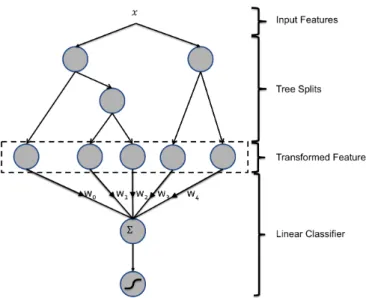
Figure 1: Hybrid model structure. Input features are transformed by means of boosted decision trees. The output of each individual tree is treated as a categorical input feature to a sparse linear classifier. Boosted decision trees prove to be very powerful feature transforms.
Calibration is the ratio of the average estimated CTR and empirical CTR. In other words, it is the ratio of the number of expected clicks to the number of actually observed clicks. Calibration is a very important metric since accurate and well-calibrated prediction of CTR is essential to the success of online bidding and auction. The less the calibration differs from 1, the better the model is. We only report calibration in the experiments where it is non-trivial.
Note that, Area-Under-ROC (AUC) is also a pretty good metric for measuring ranking quality without considering calibration. In a realistic environment, we expect the pre-diction to be accurate instead of merely getting the opti-mal ranking order to avoid potential under-delivery or over-delivery. NE measures the goodness of predictions and im-plicitly reflects calibration. For example, if a model over-predicts by 2x and we apply a global multiplier 0.5 to fix the calibration, the corresponding NE will be also improved even though AUC remains the same. See [12] for in-depth study on these metrics.
3.
PREDICTION MODEL STRUCTURE
In this section we present a hybrid model structure: the concatenation of boosted decision trees and of a probabilis-tic sparse linear classifier, illustrated in Figure 1. In Sec-tion 3.1 we show that decision trees are very powerful input feature transformations, that significantly increase the ac-curacy of probabilistic linear classifiers. In Section 3.2 we show how fresher training data leads to more accurate pre-dictions. This motivates the idea to use an online learning method to train the linear classifier. In Section 3.3 we com-pare a number of online learning variants for two families of probabilistic linear classifiers.
Stochastic Gradient Descent(SGD) algorithm [2] applied to sparse linear classifiers. After feature transformation, an ad impression is given in terms of a structured vectorx= (ei1, . . . ,ein) whereeiis thei-th unit vector andi1, . . . , in
are the values of the n categorical input features. In the training phase, we also assume that we are given a binary labely∈ {+1,−1}indicating a click or no-click.
Given a labeled ad impression (x, y), let us denote the linear combination of active weights as
s(y,x,w) =y·wTx=y n X
j=1
wj,ij, (2)
wherewis theweightvector of the linear click score. In the state of the art Bayesian online learning scheme for probit regression (BOPR) described in [7] the likelihood and prior are given by
p(y|x,w) = Φ s(y,x,w) β , p(w) = N Y k=1 N(wk;µk, σ2k),
where Φ(t) is the cumulative density function of standard normal distribution andN(t) is the density function of the standard normal distribution. The online training is achieved through expectation propagation with moment matching. The resulting model consists of the mean and the variance of the approximate posterior distribution of weight vector
w. The inference in the BOPR algorithm is to compute
p(w|y,x) and project it back to the closest factorizing Gaus-sian approximation of p(w). Thus, the update algorithm can be solely expressed in terms of update equations for all means and variances of the non-zero componentsx(see [7]):
µij ← µij+y· σ2ij Σ ·v s(y,x,µ) Σ , (3) σi2j ← σ 2 ij · " 1−σ 2 ij Σ2 ·w s(y,x,µ) Σ # , (4) Σ2 = β2+ n X j=1 σi2j. (5)
Here, the corrector functionsv andw are given byv(t) :=
N(t)/Φ(t) andw(t) :=v(t)·[v(t) +t]. This inference can be viewed as an SGD scheme on the belief vectorsµandσ.
We compare BOPR to an SGD of the likelihood function
p(y|x,w) = sigmoid(s(y,x,w)),
where sigmoid(t) = exp(t)/(1 + exp(t)). The resulting al-gorithm is often calledLogistic Regression(LR). The infer-ence in this model is computing the derivative of the log-likelihood and walk a per-coordinate depending step size in the direction of this gradient:
wij ←wij +y·ηij·g(s(y,x,w)), (6)
wheregis the log-likelihood gradient for all non-zero com-ponents and given byg(s) := [y(y+ 1)/2−y·sigmoid(s)]. Note that (3) can be seen as a per-coordinate gradient de-scent like (6) on the mean vectorµwhere the step-sizeηij
is automatically controlled by the belief uncertainty σ. In Subsection 3.3 we will present various step-size functionsη
and compare to BOPR.
Both SGD-based LR and BOPR described above are stream learners as they adapt to training data one by one.
3.1
Decision tree feature transforms
There are two simple ways to transform the input features of a linear classifier in order to improve its accuracy. For continuous features, a simple trick for learning non-linear transformations is to bin the feature and treat the bin in-dex as a categorical feature. The linear classifier effectively learns a piece-wise constant non-linear map for the feature. It is important to learn useful bin boundaries, and there are many information maximizing ways to do this.
The second simple but effective transformation consists in building tuple input features. For categorical features, the brute force approach consists in taking the Cartesian prod-uct, i.e. in creating a new categorical feature that takes as values all possible values of the original features. Not all combinations are useful, and those that are not can be pruned out. If the input features are continuous, one can do joint binning, using for example a k-d tree.
We found that boosted decision trees are a powerful and very convenient way to implement non-linear and tuple transfor-mations of the kind we just described. We treat each indi-vidual tree as a categorical feature that takes as value the index of the leaf an instance ends up falling in. We use 1-of-K coding of this type of features. For example, consider the boosted tree model in Figure 1 with 2 subtrees, where the first subtree has 3 leafs and the second 2 leafs. If an instance ends up in leaf 2 in the first subtree and leaf 1 in second subtree, the overall input to the linear classifier will be the binary vector [0,1,0,1,0], where the first 3 entries correspond to the leaves of the first subtree and last 2 to those of the second subtree. The boosted decision trees we use follow the Gradient Boosting Machine (GBM) [5], where the classicL2-TreeBoost algorithm is used. In each learn-ing iteration, a new tree is created to model the residual of previous trees. We can understand boosted decision tree based transformation as a supervised feature encoding that converts a real-valued vector into a compact binary-valued vector. A traversal from root node to a leaf node represents a rule on certain features. Fitting a linear classifier on the binary vector is essentially learning weights for the set of rules. Boosted decision trees are trained in a batch manner.
We carry out experiments to show the effect of including tree features as inputs to the linear model. In this experiment we compare two logistic regression models, one with tree fea-ture transforms and the other with plain (non-transformed) features. We also use a boosted decision tree model only for comparison. Table 1 shows the results.
Tree feature transformations help decrease Normalized En-tropy by more more than 3.4% relative to the Normalized Entropy of the model with no tree transforms. This is a very significant relative improvement. For reference, a typ-ical feature engineering experiment will shave off a couple of tens of a percent of relative NE. It is interesting to see
Table 1: Logistic Regression (LR) and boosted deci-sion trees (Trees) make a powerful combination. We evaluate them by their Normalized Entropy (NE) relative to that of the Trees only model.
Model Structure NE (relative to Trees only) LR + Trees 96.58%
LR only 99.43%
Trees only 100% (reference)
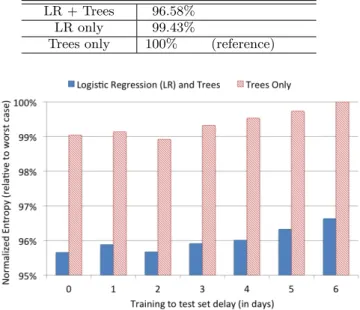
Figure 2: Prediction accuracy as a function of the delay between training and test set in days. Accu-racy is expressed as Normalized Entropy relative to the worst result, obtained for the trees-only model with a delay of 6 days.
that the LR and Tree models used in isolation have compa-rable prediction accuracy (LR is a bit better), but that it is their combination that yield an accuracy leap. The gain in prediction accuracy is significant; for reference, the majority of feature engineering experiments only manage to decrease Normalized Entropy by a fraction of a percentage.
3.2
Data freshness
Click prediction systems are often deployed in dynamic envi-ronments where the data distribution changes over time. We study the effect of training data freshness on predictive per-formance. To do this we train a model on one particular day and test it on consecutive days. We run these experiments both for a boosted decision tree model, and for a logisitic regression model with tree-transformed input features.
In this experiment we train on one day of data, and evaluate on the six consecutive days and compute the normalized entropy on each. The results are shown on Figure 2.
Prediction accuracy clearly degrades for both models as the delay between training and test set increases. For both mod-els it can been seen that NE can be reduced by approxi-mately 1% by going from training weekly to training daily.
These findings indicate that it is worth retraining on a daily basis. One option would be to have a recurring daily job that retrains the models, possibly in batch. The time needed to retrain boosted decision trees varies, depending on factors
such as number of examples for training, number of trees, number of leaves in each tree, cpu, memory, etc. It may take more than 24 hours to build a boosting model with hundreds of trees from hundreds of millions of instances with a sin-gle core cpu. In a practical case, the training can be done within a few hours via sufficient concurrency in a multi-core machine with large amount of memory for holding the whole training set. In the next section we consider an alternative. The boosted decision trees can be trained daily or every cou-ple of days, but the linear classifier can be trained in near real-time by using some flavor of online learning.
3.3
Online linear classifier
In order to maximize data freshness, one option is to train the linear classifier online, that is, directly as the labelled ad impressions arrive. In the upcoming Section 4 we de-scibe a piece of infrastructure that could generate real-time training data. In this section we evaluate several ways of setting learning rates for SGD-based online learning for lo-gistic regression. We then compare the best variant to online learning for the BOPR model.
In terms of (6), we explore the following choices:
1. Per-coordinate learning rate: The learning rate for fea-tureiat iterationtis set to
ηt,i= α β+ q Pt j=1∇ 2 j,i .
α, βare two tunable parameters (proposed in [8]).
2. Per-weight square root learning rate:
ηt,i= α √
nt,i ,
wherent,iis the total training instances with feature itill iterationt.
3. Per-weight learning rate:
ηt,i= α nt,i
.
4. Global learning rate:
ηt,i= α √ t.
5. Constant learning rate:
ηt,i=α.
The first three schemes set learning rates individually per feature. The last two use the same rate for all features. All the tunable parameters are optimized by grid search (optima detailed in Table 2.)
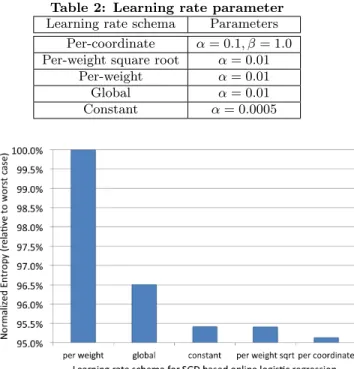
We lower bound the learning rates by 0.00001 for continuous learning. We train and test LR models on same data with the above learning rate schemes. The experiment results are shown in Figure 3.
From the above result, SGD with per-coordinate learning rate achieves the best prediction accuracy, with a NE al-most 5% lower than when using per weight learning rate,
Table 2: Learning rate parameter
Learning rate schema Parameters Per-coordinate α= 0.1, β= 1.0 Per-weight square root α= 0.01
Per-weight α= 0.01 Global α= 0.01 Constant α= 0.0005
Figure 3: Experiment result for different learning rate schmeas for LR with SGD. The X-axis
cor-responds to different learning rate scheme. We
draw calibration on the left-hand side primary y-axis, while the normalized entropy is shown with the right-hand side secondary y-axis.
which performs worst. This result is in line with the conclu-sion in [8]. SGD with per-weight square root and constant learning rate achieves similar and slightly worse NE. The other two schemes are significant worse than the previous versions. The global learning rate fails mainly due to the imbalance of number of training instance on each features. Since each training instance may consist of different fea-tures, some popular features receive much more training in-stances than others. Under the global learning rate scheme, the learning rate for the features with fewer instances de-creases too fast, and prevents convergence to the optimum weight. Although the per-weight learning rates scheme ad-dresses this problem, it still fails because it decreases the learning rate for all features too fast. Training terminates too early where the model converges to a sub-optimal point. This explains why this scheme has the worst performance among all the choices.
It is interesting to note that the BOPR update equation (3) for the mean is most similar to per-coordinate learning rate version of SGD for LR. The effective learning rate for BOPR is specific to each coordinate, and depends on the posterior variance of the weight associated to each individual coordinate, as well as the “surprise” of label given what the model would have predicted [7].
We carry out an experiment to compare the prediction per-formance of LR trained with per-coordinate SGD and BOPR. We train both LR and BOPR models on the same training
Ranker Online Joiner Trainer fea ture s {x} clicks {y} models {x, y} ads
Figure 4: Online Learning Data/Model Flows.
data and evaluate the prediction performance on the next day. The result is shown in Table 3.
Table 3: Per-coordinate online LR versus BOPR
Model Type NE (relative to LR) LR 100% (reference) BOPR 99.82%
Perhaps as one would expect, given the qualitative similarity of the update equations, BOPR and LR trained with SGD with per-coordinate learning rate have very similar predic-tion performance in terms of both NE and also calibrapredic-tion (not shown in the table).
One advantages of LR over BOPR is that the model size is half, given that there is only a weight associated to each sparse feature value, rather than a mean and a variance. De-pending on the implementation, the smaller model size may lead to better cache locality and thus faster cache lookup. In terms of computational expense at prediction time, the LR model only requires one inner product over the feature vec-tor and the weight vecvec-tor, while BOPR models needs two inner products for both variance vector and mean vector with the feature vector.
One important advantage of BOPR over LR is that being a Bayesian formulation, it provides a full predictive distribu-tion over the probability of click. This can be used to com-pute percentiles of the predictive distribution, which can be used for explore/exploit learning schemes [3].
4.
ONLINE DATA JOINER
The previous section established that fresher training data results in increased prediction accuracy. It also presented a simple model architecture where the linear classifier layer is trained online.
This section introduces an experimental system that gener-ates real-time training data used to train the linear classi-fier via online learning. We will refer to this system as the “online joiner” since the critical operation it does is to join labels (click/no-click) to training inputs (ad impressions) in an online manner. Similar infrastructure is used for stream learning for example in the Google Advertising System [1]. The online joiner outputs a real-time training data stream to an infrastructure called Scribe [10]. While the positive
labels (clicks) are well defined, there is no such thing as a “no click” button the user can press. For this reason, an impression is considered to have a negative no click label if the user did not click the ad after a fixed, and sufficiently long period of time after seeing the ad. The length of the waiting time window needs to be tuned carefully.
Using too long a waiting window delays the real-time train-ing data and increases the memory allocated to buffertrain-ing impressions while waiting for the click signal. A too short time window causes some of the clicks to be lost, since the corresponding impression may have been flushed out and la-beled as non-clicked. This negatively affects “click coverage,” the fraction of all clicks successfully joined to impressions. As a result, the online joiner system must strike a balance between recency and click coverage.
Not having full click coverage means that the real-time train-ing set will be biased: the empirical CTR that is somewhat lower than the ground truth. This is because a fraction of the impressions labeled non-clicked would have been la-beled as clicked if the waiting time had been long enough. In practice however, we found that it is easy to reduce this bias to decimal points of a percentage with waiting window sizes that result in manageable memory requirements. In addition, this small bias can be measured and corrected for. More study on the window size and efficiency can be found at [6]. The online joiner is designed to perform a distributed stream-to-stream join on ad impressions and ad clicks uti-lizing a request ID as the primary component of the join predicate. A request ID is generated every time a user per-forms an action on Facebook that triggers a refresh of the content they are exposed to. A schematic data and model flow for the online joiner consequent online learning is shown in Figure 4. The initial data stream is generated when a user visits Facebook and a request is made to the ranker for can-didate ads. The ads are passed back to the user’s device and in parallel each ad and the associated features used in ranking that impression are added to the impression stream. If the user chooses to click the ad, that click will be added to the click stream. To achieve the stream-to-stream join the system utilizes a HashQueue consisting of a First-In-First-Out queue as a buffer window and a hash map for fast random access to label impressions. A HashQueue typically has three kinds of operations on key-value pairs: enqueue, dequeue and lookup. For example, to enqueue an item, we add the item to the front of a queue and create a key in the hash map with value pointing to the item of the queue. Only after the full join window has expired will the labelled impression be emitted to the training stream. If no click was joined, it will be emitted as a negatively labeled example.
In this experimental setup the trainer learns continuously from the training stream and publishes new models period-ically to the Ranker. This ultimately forms a tight closed loop for the machine learning models where changes in fea-ture distribution or model performance can be capfea-tured, learned on, and rectified in short succession.
One important consideration when experimenting with a real-time training data generating system is the need to build protection mechanisms against anomalies that could corrupt the online learning system. Let us give a simple
example. If the click stream becomes stale because of some data infrastructure issue, the online joiner will produce train-ing data that has a very small or even zero empirical CTR. As a consequence of this the real-time trainer will begin to incorrectly predict very low, or close to zero probabilities of click. The expected value of an ad will naturally depend on the estimated probability of click, and one consequence of incorrectly predicting very low CTR is that the system may show a reduced number of ad impressions. Anomaly detec-tion mechanisms can help here. For example, one can auto-matically disconnect the online trainer from the online joiner if the real-time training data distribution changes abruptly.
5.
CONTAINING MEMORY AND LATENCY
5.1
Number of boosting trees
The more trees in the model the longer the time required to make a prediction. In this part, we study the effect of the number of boosted trees on estimation accuracy.
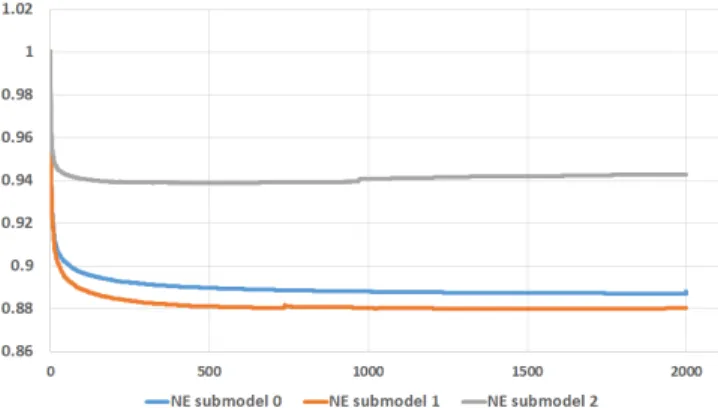
We vary the number of trees from 1 to 2,000 and train the models on one full day of data, and test the prediction per-formance on the next day. We constrain that no more than 12 leaves in each tree. Similar to previous experiments, we use normalized entropy as an evaluation metric. The experimental results are shown in Figure 5. Normalized
en-Figure 5: Experiment result for number of boosting trees. Different series corresponds to different sub-models. The x-axis is the number of boosting trees. Y-axis is normalized entropy.
tropy decreases as we increase the number of boosted trees. However, the gain from adding trees yields diminishing re-turn. Almost all NE improvement comes from the first 500 trees. The last 1,000 trees decrease NE by less than 0.1%. Moreover, we see that the normalized entropy for submodel 2 begins to regress after 1,000 trees. The reason for this phe-nomenon is overfitting. Since the training data for submodel 2 is 4x smaller than that in submodel 0 and 1.
5.2
Boosting feature importance
Feature count is another model characteristic that can influ-ence trade-offs between estimation accuracy and computa-tion performance. To better understand the effect of feature count we first apply a feature importance to each feature.
In order to measure the importance of a feature we use the statistic Boosting Feature Importance, which aims to
cap-ture the cumulative loss reduction attributable to a feacap-ture. In each tree node construction, a best feature is selected and split to maximize the squared error reduction. Since a fea-ture can be used in multiple trees, the (Boosting Feature Importance) for each feature is determined by summing the total reduction for a specific feature across all trees.
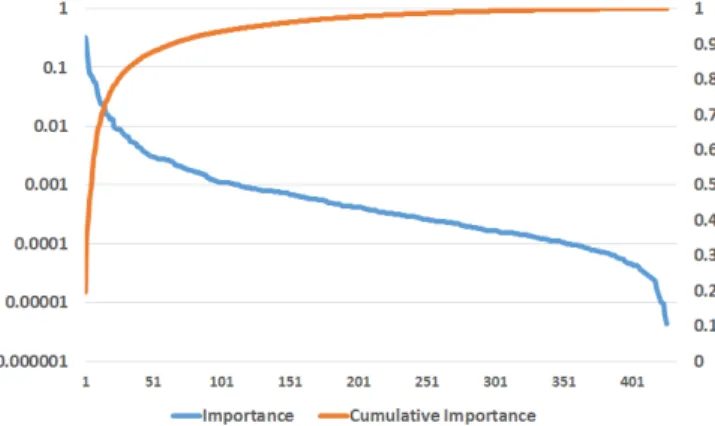
Typically, a small number of features contributes the major-ity of explanatory power while the remaining features have only a marginal contribution. We see this same pattern when plotting the number of features versus their cumu-lative feature importance in Figure 6.
Figure 6: Boosting feature importance. X-axis cor-responds to number of features. We draw feature importance in log scale on the left-hand side primary y-axis, while the cumulative feature importance is shown with the right-hand side secondary y-axis.
From the above result, we can see that the top 10 features are responsible for about half of the total feature importance, while the last 300 features contribute less than 1% feature importance. Based on this finding, we further experiment with only keeping the top 10, 20, 50, 100 and 200 features, and evaluate how the performance is effected. The result of the experiment is shown in Figure 7. From the figure, we can see that the normalized entropy has similar diminishing return property as we include more features.
In the following, we will do some study on the usefulness of historical and contextual features. Due to the data sen-sitivity in nature and the company policy, we are not able to reveal the detail on the actual features we use. Some ex-ample contextual features can be local time of day, day of week, etc. Historical features can be the cumulative number of clicks on an ad, etc.
5.3
Historical features
The features used in the Boosting model can be categorized into two types: contextual features and historical features. The value of contextual features depends exclusively on cur-rent information regarding the context in which an ad is to be shown, such as the device used by the users or the cur-rent page that the user is on. On the contrary, the historical features depend on previous interaction for the ad or user, for example the click through rate of the ad in last week, or the average click through rate of the user.
Figure 7: Results for Boosting model with top fea-tures. We draw calibration on the left-hand side pri-mary y-axis, while the normalized entropy is shown with the right-hand side secondary y-axis.
In this part, we study how the performance of the system depends on the two types of features. Firstly we check the relative importance of the two types of features. We do so by sorting all features by importance, then calculate the per-centage of historical features in first k-important features. The result is shown in Figure 8. From the result, we can see
Figure 8: Results for historical feature percentage.
X-axis corresponds to number of features. Y-axis
give the percentage of historical features in top k -important features.
that historical features provide considerably more explana-tory power than contextual features. The top 10 features or-dered by importance are all historical features. Among the top 20 features, there are only 2 contextual features despite historical feature occupying roughly 75% of the features in this dataset. To better understand the comparative value of the features from each type in aggregate we train two Boost-ing models with only contextual features and only historical features, then compare the two models with the complete model with all features. The result is shown in Table 4.
From the table, we can again verify that in aggregate his-torical features play a larger role than contextual features.
Table 4: Boosting model with different types of fea-tures
Type of features NE (relative to Contextual) All 95.65%
Historical 96.32%
Contextual 100% (reference)
Without only contextual features, we measure 4.5% loss in prediction accuracy. On the contrary, without contextual features, we suffer less than 1% loss in prediction accuracy.
It should be noticed that contextual features are very im-portant to handle the cold start problem. For new users and ads, contextual features are indispensable for a reasonable click through rate prediction.
In next step, we evaluate the trained models with only his-torical features or contextual features on the consecutive weeks to test the feature dependency on data freshness. The result is shown in Figure 9.
Figure 9: Results for datafreshness for different type of features. X-axis is the evaluation date while y-axis is the normalized entropy.
From the figure, we can see that the model with contextual features relies more heavily on data freshness than historical features. It is in line with our intuition, since historical fea-tures describe long-time accumulated user behaviour, which is much more stable than contextual features.
6.
COPING WITH MASSIVE TRAINING DATA
A full day of Facebook ads impression data can contain a huge amount of instances. Note that we are not able to reveal the actual number as it is confidential. But a small fraction of a day’s worth of data can have many hundreds of millions of instances. A common technique used to control the cost of training is reducing the volume of training data. In this section we evaluate two techniques for down sampling data, uniform subsampling and negative down sampling. In each case we train a set of boosted tree models with 600 trees and evaluate these using both calibration and normalized entropy.
6.1
Uniform subsampling
Uniform subsampling of training rows is a tempting ap-proach for reducing data volume because it is both easy to implement and the resulting model can be used with-out modification on both the subsampled training data and non-subsampled test data. In this part, we evaluate a set of roughly exponentially increasing subsampling rates. For each rate we train a boosted tree model sampled at that rate from the base dataset. We vary the subsampling rate in{0.001,0.01,0.1,0.5,1}.
The result for data volume is shown in Figure 10. It is in
Figure 10: Experiment result for data volume. The X-axis corresponds to number of training instances. We draw calibration on the left-hand side primary y-axis, while the normalized entropy is shown with the right-hand side secondary y-axis.
line with our intuition that more data leads to better per-formance. Moreover, the data volume demonstrates dimin-ishing return in terms of prediction accuracy. By using only 10% of the data, the normalized entropy is only a 1% reduc-tion in performance relative to the entire training data set. The calibration at this sampling rate shows no performance reduction.
6.2
Negative down sampling
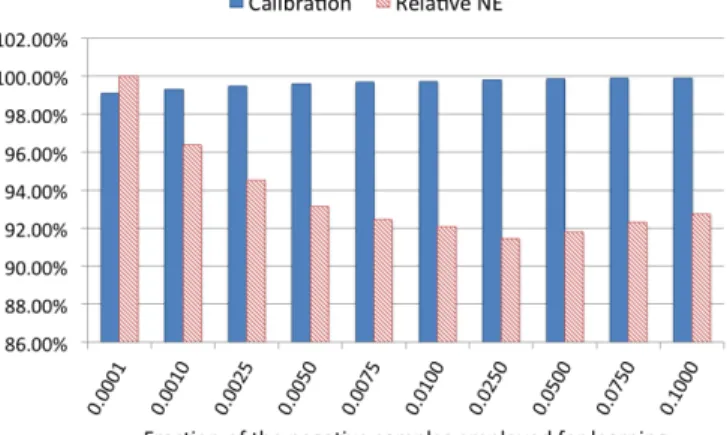
Class imbalance has been studied by many researchers and has been shown to have significant impact on the perfor-mance of the learned model. In this part, we investigate the use of negative down sampling to solve the class imbalance problem. We empirically experiment with different negative down sampling rate to test the prediction accuracy of the learned model. We vary the rate in{0.1,0.01,0.001,0.0001}. The experiment result is shown in Figure 11.
From the result, we can see that the negative down sam-pling rate has significant effect on the performance of the trained model. The best performance is achieved with neg-ative down sampling rate set to 0.025.
6.3
Model Re-Calibration
Negative downsampling can speed up training and improve model performance. Note that, if a model is trained in a data
Figure 11: Experiment result for negative down sampling. The X-axis corresponds to different nega-tive down sampling rate. We draw calibration on the left-hand side primary y-axis, while the normalized entropy is shown with the right-hand side secondary y-axis.
set with negative downsampling, it also calibrates the pre-diction in the downsampling space. For example, if the aver-age CTR before sampling is 0.1% and we do a 0.01 negative downsampling, the empirical CTR will become roughly 10%. We need to re-calibrate the model for live traffic experiment and get back to the 0.1% prediction with q = p+(1−pp)/w wherepis the prediction in downsampling space andwthe negative downsampling rate.
7.
DISCUSSION
We have presented some practical lessons from experiment-ing with Facebook ads data. This has inspired a promisexperiment-ing hybrid model architecture for click prediction.
• Data freshness matters. It is worth retraining at least daily. In this paper we have gone further and discussed various online learning schemes. We also presented infrastructure that allows generating real-time training data.
• Transforming real-valued input features with boosted decision trees significantly increases the prediction ac-curacy of probabilistic linear classifiers. This motivates a hybrid model architecture that concatenates boosted decision trees and a sparse linear classifier.
• Best online learning method: LR with per-coordinate learning rate, which ends up being comparable in per-formance with BOPR, and performs better than all other LR SGD schemes under study. (Table 4, Fig 12)
We have described tricks to keep memory and latency con-tained in massive scale machine learning applications
• We have presented the tradeoff between the number of boosted decision trees and accuracy. It is advantageous to keep the number of trees small to keep computation and memory contained.
• Boosted decision trees give a convenient way of doing feature selection by means of feature importance. One can aggressively reduce the number of active features whilst only moderately hurting prediction accuracy.
• We have analyzed the effect of using historical fea-tures in combination with context feafea-tures. For ads and users with history, these features provide superior predictive performance than context features.
Finally, we have discussed ways of subsampling the training data, both uniformly but also more interestingly in a biased way where only the negative examples are subsampled.
8.
REFERENCES
[1] R. Ananthanarayanan, V. Basker, S. Das, A. Gupta, H. Jiang, T. Qiu, A. Reznichenko, D. Ryabkov, M. Singh, and S. Venkataraman. Photon:
Fault-tolerant and scalable joining of continuous data streams. InSIGMOD, 2013.
[2] L. Bottou. Online algorithms and stochastic approximations. In D. Saad, editor,Online Learning and Neural Networks. Cambridge University Press, Cambridge, UK, 1998. revised, oct 2012.
[3] O. Chapelle and L. Li. An empirical evaluation of thompson sampling. InAdvances in Neural Information Processing Systems, volume 24, 2012. [4] B. Edelman, M. Ostrovsky, and M. Schwarz. Internet
advertising and the generalized second price auction: Selling billions of dollars worth of keywords. In
American Economic Review, volume 97, pages 242–259, 2007.
[5] J. H. Friedman. Greedy function approximation: A gradient boosting machine.Annals of Statistics, 29:1189–1232, 1999.
[6] L. Golab and M. T. ¨Ozsu. Processing sliding window multi-joins in continuous queries over data streams. In
VLDB, pages 500–511, 2003.
[7] T. Graepel, J. Qui˜nonero Candela, T. Borchert, and R. Herbrich. Web-scale bayesian click-through rate prediction for sponsored search advertising in
Microsoft’s Bing search engine. InICML, pages 13–20, 2010.
[8] H. B. McMahan, G. Holt, D. Sculley, M. Young, D. Ebner, J. Grady, L. Nie, T. Phillips, E. Davydov, D. Golovin, S. Chikkerur, D. Liu, M. Wattenberg, A. M. Hrafnkelsson, T. Boulos, and J. Kubica. Ad click prediction: a view from the trenches. InKDD, 2013.
[9] M. Richardson, E. Dominowska, and R. Ragno. Predicting clicks: Estimating the click-through rate for new ads. InWWW, pages 521–530, 2007. [10] A. Thusoo, S. Antony, N. Jain, R. Murthy, Z. Shao,
D. Borthakur, J. Sarma, and H. Liu. Data
warehousing and analytics infrastructure at facebook. InSIGMOD, pages 1013–1020, 2010.
[11] H. R. Varian. Position auctions. InInternational Journal of Industrial Organization, volume 25, pages 1163–1178, 2007.
[12] J. Yi, Y. Chen, J. Li, S. Sett, and T. W. Yan. Predictive model performance: Offline and online evaluations. InKDD, pages 1294–1302, 2013.