PhD Thesis
Optimizing Multimedia Content Delivery
over Next-Generation Optical Networks
Author:
Emanuele
Di Pascale
Supervisor:
Prof. Marco
Ruffini
i
Declaration
I declare that this thesis has not been submitted as an exercise for a degree at this or any other university
and is entirely my own work.
I agree to deposit this thesis in the University’s open access institutional repository or allow the Library
to do so on my behalf, subject to Irish Copyright Legislation and Trinity College Library conditions of
use and acknowledgement.
Signed:
iii
Summary
This thesis analyzes the performance of a Peer-to-Peer (P2P) multimedia content delivery system for a
network architecture based on next-generation Passive Optical Networks (PONs).
A PON is an optical access technology that is able to deliver high bandwidth capacities at a fraction
of the cost of traditional point-to-point fiber solutions; this is achieved by sharing the same feeder fiber
among several customers through the use of optical splitters. Established standards such as GPON
and EPON have a reach from the Central Office of about 20 Km and a fan-out of around 32-64 users.
Next-generation PONs aim to increase this reach, in order to enable the consolidation of central offices;
to increase the split size, in order to help reducing the cost per customer; and to increase the bandwidth
capacity to multiple 10 Gbps channels.
One of the reasons why operators are investing on Fiber-to-the-X (FTTX) solutions is to increase the
capacity of the access section in order to remove what traditionally was the bandwidth bottleneck of the
network. Over the last decade multimedia streaming services have become increasingly popular, with
companies like Netflix, Amazon Prime and many more reaching millions of customers and billions of
revenues. With both the number of active subscribers and the quality of the streamed videos steadily on
the rise, network infrastructures are being put under an increasing strain to support these data-intensive
services. Several reports have shown that the vast majority of the data currently traversing the Internet
on a daily basis is related in one form or another to multimedia content retrieval.
Increasing the capacity in the access is certainly going to remove one of the obstacles to high-definition
streaming of multimedia content. However, as users start to take advantage of the increased bandwidth
allowance granted to them by fiber, the aggregation section of the network (i.e., the core) will start to
suffer; and as we do not have any better technology than fiber, the only way we have to improve core
capacity is to stack up network equipment, a process that is neither efficient nor cost-effective. It is hence
imperative to find alternative solutions that will allow us to support bandwidth-intensive multimedia
services while keeping operators’ costs to a minimum, ensuring that these services are sustainable in the
long term.
One promising strategy consists in placing caches managed by the Internet Service Provider (ISP)
at the edge of the network. Once content has been delivered to a customer, it can be stored and
redis-tributed to other users in the area to minimize bandwidth consumption in the core. More specifically, in
on most Set-Top Boxes (STBs), and by allowing users to cache multimedia content that they requested
for their own personal consumption, we can greatly improve the efficiency of these next-generation
net-works. Indeed, the combined effect of the large symmetric upstream/downstream capacity of PONs and
the customer aggregation brought by long reach feeders greatly increase the efficacy of locality-awareness
– i.e., a strategy by which content requests are redirected to local available sources whenever possible.
More specifically, symmetric access bandwidth means that a single source is in principle sufficient to
provide all the upload capacity that a requester is able to handle; at the same time, the consolidated
architecture that results from bypassing the metro section greatly expands the pool of potential sources
attached to the access section of the requester, thus increasing the chances of a local data transfer.
Furthermore, since the caches are managed by the network operator itself and integrated into the
equip-ment required to connect to the Internet, they are less susceptible to churn and allow for a simpler
implementation of locality-aware policies.
Extensive simulation campaigns, carried out first using a steady-state analyzer and subsequently
through our custom event-driven simulator PLACeS, show that a locality-aware P2P strategy can confine
most multimedia traffic inside the metro/core node from which the requests originated, thus drastically
reducing core bandwidth utilization. An energy consumption model taking into account both static and
dynamic consumption of electronic devices was formulated, showing that locality-aware P2P is able to
reduce the overall power required to run the network and to offer cost-saving opportunities for operators.
In order to implement locality-aware policies for content delivery, we postulate the existence of
an oracle service, whose responsibilities include keeping track of the content of each user cache and
matching requests with a local available source whenever possible. This thesis explores some of the issues
that might arise when designing such a service, and it proposes two proof-of-concept implementations
based on OpenFlow. In particular, the aim of these implementations is to show that such an oracle
could be designed to be transparent to the underlying multimedia applications, allowing it to be used
in conjunction with legacy services that were never expected to be locality-aware. Furthermore, using
OpenFlow allows us to integrate the oracle functionality with the control plane of the operator’s network,
i.e., allowing us to implement redirection policies that can react to anomalous load conditions.
Finally, we present an optimization algorithm to reduce the amount of caching storage required to
implement our proposed P2P solution. The algorithm takes as input the number of requests observed
by the oracle service for previous elements of the catalog, and estimates future request patterns for
elements with the same popularity rank. This information is then used to determine which contents
should be cached at each STB. Our simulations show that such a solution is able to achieve the same
levels of locality of a traditional caching eviction policy (such as Least Frequently Used or LFU) while
reducing the amount of storage required by up to 77%. Even higher storage savings of up to 92% can
be achieved if we are willing to accept a reduction of about 5 to 8% in the percentage of requests served
v
Acknowledgements
First and foremost, many thanks go to my supervisor Prof. Marco Ruffini for giving me a chance when
I wasn’t sure I deserved one, for his endless support during these four years and his ability to come up
with new avenues of investigation whenever I thought there were none left.
Secondly, to Prof. David B. Payne, for pioneering the LR-PON concept that is at the heart of my
thesis, for the very useful insights in the early stages of my research, and for his encouraging words,
always given with a smile.
My deepest thanks go to Prof. Linda Doyle for having put together such an amazing group of talented
people, for being a constant inspiration of what can be achieved with hard work and ingenuity, and for
generally contributing to making CTVR the best working environment EVER.
I would like to thank profusely all the post-docs that have helped me with their insights and their
experience: in no particular order Seamas, Konstas, Baris, Nicola, Johann, Irene, Avishek, Tim, Hamed,
Ahmed and many others. Sometimes a quick tip given over lunch or a coffee break can do miracles.
To “the guys” from the lab, without whom my time here would have been incredibly dull: in
rigorous alphabetical order, Arman, Carlo, Danny, Eamon, Elma, Francisco, Frank, Ioannis, Jacek,
Jasmina, Jessica, Jo˜ao, Johnathan, Justin, Paolo, Pedro, Sandeep. If somebody told me four years ago
that one could have so much fun at work and still be productive I would have not believed it.
Thanks to all of the good friends that stuck with me despite the increasing distance, decreasing spare
time and my constant grumpiness: Marco, Francesca, Alessandro, Giuliana, Amelia, Esther, Giovanni,
Valerio, and all the others. As long as you are part of my life I know everything’s going to be alright.
To the fine folks I’ve met in Dublin, for making this little cold piece of earth lost at sea so much
cozier. To Michele+Claudia+Gaia, Luca, Antonello, Marco/Bob, and everyone else who sat at least
once with me to play board games, tell stories, eat terrible stuff that goes under the name of pizza
around these parts and escape to our secret worlds. To Walter, Esther, Kat, Micky&Micky, and all the
other Couchsurfers that accompanied me on our discovery of Ireland. To Alex, Ana, Gaetano, Luciana,
Stephen, for being generally awesome.
My never-ending gratitude goes to my family, to which I owe everything. To my father Michelangelo,
my mother Ida, my brother Gaetano, for so many things that I cannot possibly begin to list them here,
thank you.
did not know before; for making me “more human”, as someone noted, and at the same time accepting
my cattiness; for loving me the way you do, and for letting me free, as you do. For being the home I
CONTENTS vii
Contents
Contents vii
List of Figures xi
1 Introduction 1
1.1 Overview and Motivations. . . 1
1.1.1 Network-Managed P2P . . . 3
1.2 Key Contributions . . . 4
1.2.1 Simulation Tools for the Study of Large-Scale Multimedia Delivery Services . . . 4
1.2.2 Analysis of Edge Caching in Next-Gen Optical Networks . . . 5
1.2.3 Design of a Peer-to-Peer Multimedia Distribution System . . . 5
1.3 Publications . . . 6
2 Background and Related Work 9 2.1 Next-Generation Optical Networks . . . 9
2.1.1 Network Hierarchies: Core, Metro, Access . . . 9
2.1.2 Passive Optical Networks . . . 10
2.1.3 Long-Reach Passive Optical Networks . . . 13
2.1.4 The DISCUS Architecture. . . 14
2.2 Overview of Network Caching . . . 15
2.2.1 Eviction Policies . . . 16
2.2.2 Freshness and Consistency . . . 17
2.2.3 Web-Caching and Multimedia Caching . . . 18
2.3 Related Work on Multimedia Caching and Delivery . . . 20
2.3.1 Novel Architectures for Multimedia Content Delivery . . . 20
2.3.2 Analysis of the Energy Consumption of Multimedia Caching . . . 32
2.3.3 Popularity Estimation Algorithms for Multimedia Services. . . 35
3 Simulation Methodology 39 3.1 Steady-State Analyzer. . . 40
3.2 PLACeS: An Event-Driven, Flow-Based Simulator . . . 44
3.2.1 Software Development . . . 44
3.2.2 Popularity Evolution. . . 46
3.2.3 Traffic Simulation . . . 48
3.2.4 Simulation Error and Confidence Intervals . . . 52
4 Analysis of Edge Caching 55
4.1 Bandwidth Efficiency . . . 55
4.1.1 Steady-State Analysis . . . 55
4.1.2 Event-Driven VoD Analysis . . . 57
4.1.3 Time-Shifted IPTV Analysis . . . 61
4.1.4 Asymmetric Upstream Capacity. . . 63
4.2 Energy Consumption . . . 64
4.2.1 Steady-State Analysis . . . 64
4.2.2 Event-Driven Analysis . . . 67
5 A Transparent Locality Oracle 73 5.1 Overview . . . 73
5.2 Design Considerations . . . 74
5.3 Related Work . . . 76
5.4 Implementation . . . 77
5.4.1 DNS-based Redirection . . . 77
5.4.2 HTTP-based Redirection . . . 79
5.4.3 Content Tracking . . . 81
5.4.4 Traffic Tunneling . . . 82
5.5 Evaluation . . . 82
6 Caching Storage Optimization 85 6.1 Overview . . . 85
6.2 Optimization Model . . . 86
6.2.1 Variables Definition . . . 86
6.2.2 Problem Formulation . . . 87
6.2.3 Popularity Estimation . . . 88
6.3 Simulation Methodology . . . 90
6.4 Caching Optimization Algorithm . . . 91
6.5 Results . . . 93
7 Conclusions and Future Work 97 7.1 Contributions of this Thesis . . . 97
7.1.1 Development of an Open-Source Simulator . . . 97
7.1.2 Analysis of the Efficiency of Edge Caching . . . 97
7.1.3 Design of a Locality Oracle . . . 98
7.1.4 Optimization of Caching Storage . . . 99
7.2 Future Work . . . 99
7.2.1 Chunking . . . 99
7.2.2 Adaptive Streaming . . . 100
7.2.3 Network-Managed Locality Oracle . . . 100
7.2.4 Improving Caching Optimization . . . 100
CONTENTS ix
Acronyms 103
LIST OF FIGURES xi
List of Figures
1.1 Node consolidation process in next-gen PON-based networks. . . 2
2.1 Diagram of the DISCUS architecture. . . 15
2.2 Zipf and Zipf-Mandelbrot distributions. . . 19
3.1 Snapshot from a simulation experiment in PLACeS. . . 45
3.2 Topology used for the VoD simulations. . . 49
3.3 Topology used for the IPTV simulations. . . 50
4.1 Bandwidth efficiency results for the steady-state analysis, 3-tier network. . . 56
4.2 Bandwidth efficiency results for the steady-state analysis, LR-PON based network. . . . 57
4.3 The two P2P scenarios implemented for the VoD analysis. . . 58
4.4 Bandwidth efficiency results for the VoD study. . . 60
4.5 Locality percentages achieved in the VoD study. . . 60
4.6 Percentage of user requests served by the integrative CDN caches in themixed caching scenario. . . 61
4.7 Bandwidth efficiency results for the IPTV study, for varying values ofp. . . 62
4.8 Bandwidth efficiency results for the IPTV study, for different encoding bitrates. . . 62
4.9 Average generated traffic per user over various core topologies, for the IPTV study. . . . 63
4.10 Diagram of the network interfaces of a metro/core node. . . 65
4.11 Power consumption results for the steady-state analysis. . . 66
4.12 Network components affected by each type of data flow in our dynamic energy consump-tion model. . . 68
4.13 Total daily energy consumption, divided by component. . . 69
4.14 Daily energy consumption per user, divided by payee. . . 70
5.1 Sequence diagram for a hierarchical locality oracle. . . 76
5.2 Flow diagram of the DNS-based redirection method. . . 78
5.3 Flow diagram of the HTTP-based redirection method. . . 80
5.4 Mininet virtual topology used for the evaluation. . . 83
6.1 Caching optimization results over 2 weeks. . . 93
6.2 Caching optimization results for different values ofh. . . 94
6.3 Caching optimization results as a function ofk andp. . . 95
1. INTRODUCTION 1
1
Introduction
This thesis investigates the benefits of a peer-to-peer based locality-aware caching system for on-demand
multimedia distribution. We will show that, compared to state of the art strategies such as Content
De-livery Networks (CDNs) and unicast streaming, our solution is able to reduce core bandwidth utilization,
thus reducing the overall energy consumption of the system and providing cost-saving opportunities for
network operators. Furthermore, we sketch an OpenFlow-based prototype of a Locality Oracle, i.e.,
a service whose function is to track the content of each distributed cache and to transparently match
requests for videos to local available sources. Finally, we propose an optimization strategy to minimize
the cache storage utilization while retaining the high percentages of locally available content achieved
by traditional caching policies.
1.1
Overview and Motivations
Multimedia streaming services have become extremely popular in recent years, also thanks to the
in-creasing deployment of Fiber-To-The-X (FTTX) technologies, which support the capacities required
to deliver a satisfactory Quality of Service (QoS) to customers. Video on Demand (VoD) and IPTV
services have become the biggest sources of Internet traffic (SANDVINE 2013), and this trend is only
going to consolidate as more and more companies enter the fray to compete in this booming market
segment. However, multimedia services still pose a number of challenges to current network
infrastruc-tures. The combination of heavy bandwidth requirements and high concentration of requests during
peak-hours means that serving each user individually (i.e., through unicast) is very costly and inefficient.
Multicasting approaches, on the other hand, need to employ special strategies to merge requests coming
at slightly different times into a single stream; cyclic broadcasting, batching and patching have been
proposed to address this issue, each technique with its own drawbacks (Choi et al. 2012).
Peer-to-Peer (P2P) is another very popular approach to multimedia content delivery. As every new
peer in the system adds its own upstream capacity to the pool of common resources, it is inherently
more scalable and cost-efficient for service providers than client-server approaches. On the other hand,
the efficiency of P2P strategies is limited by the dynamic behavior of peers; because users are free to
join or leave the network at any time, the availability of critical resources in the system cannot be
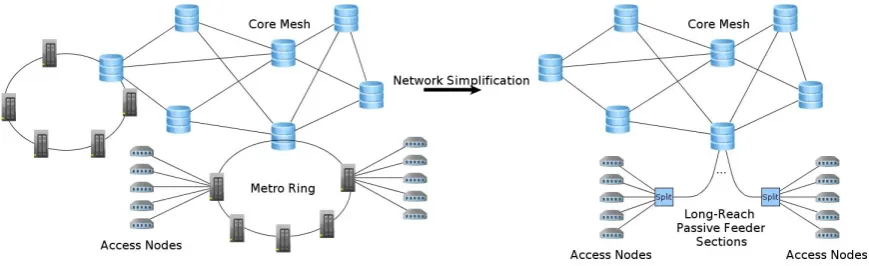
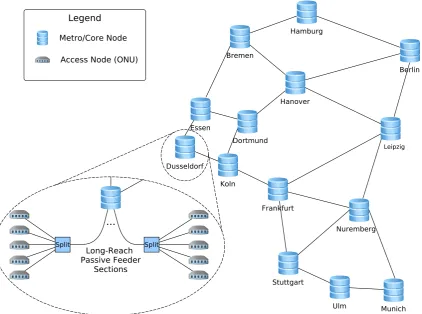
Figure 1.1: Thanks to their long reach, next-generation optical access technologies will enable node consolidation, allowing us to bypass traditional metro rings and aggregate customers through a limited set of metro/core nodes.
However, these limitations can be overcome if P2P exchanges are managed and coordinated by the
network infrastructure itself, rather than by a user application. By using a small portion of the storage
typically present in most customers’ set-top boxes (or adding one when required), network operators and
service providers can easily implement a cost-effective, always-on distributed caching system. The
re-duced gap between upstream and downstream capacity and the increased customer aggregation brought
by current (GPON (ITU-T 2008), EPON (IEEE 2012), XG-PON (ITU-T 2010)) and next-generation
ac-cess technologies (NG-PON2 (ITU-T 2013)), together with the decreasing price of mass storage devices,
make such a network-managed P2P solution very promising. Furthermore, integrating peering
mechan-isms into the network infrastructure would greatly simplify the implementation of locality policies (Dai
et al. 2010), thus improving the bandwidth and cost efficiency of this approach.
One fundamental advantage of locality-aware peer-to-peer based approaches to caching is that they
allow us to turn around traffic as close as possible to the end user, without unnecessarily allocating
network resources in the core. Traditionally, the Internet developed over the years into a hierarchical
network, where a high-speed optical core aggregated traffic through statistical multiplexing, dispatching
it to SDH/SONET metro rings and finally to copper-based access sections. However, FTTX is changing
the rules of the game by greatly simplifying and “flattening” the structure of the network. Due to the
low attenuation of fiber, Passive Optical Networks (PONs) are able to support a longer access reach,
thus allowing us to bypass part or all of the metro transmission infrastructure (see Fig. 1.1).
This is particularly true for Long-Reach PON (Payne 2009), a technology whose aim is to achieve
a reach in excess of 100 Km. This would enable a significant consolidation of the network distribution
nodes: many of the local exchanges and central offices that are now required to support a large-scale
network could be removed, with a consequent reduction of both capital and operational expenditure. The
resulting architecture would only be comprised of a limited number of metro/core nodes, each providing
access over fiber to a large number of users (see for example the DISCUS architecture discussed in
Subsection 2.1.4).
tech-1.1 OVERVIEW AND MOTIVATIONS 3
nology (i.e., optical fiber) is installed in both the access and the core segments of the network. Since
no better transmission technology than fiber currently exists, core bandwidth can only be increased by
stacking more and more communication equipment, a practice that is neither effective nor sustainable
from an economic perspective. Consequently, traffic aggregation in the core becomes less and less
effect-ive – a problem that is aggravated by the high concentration in time of multimedia requests. For these
reasons, while FTTX is effectively removing the bandwidth bottleneck from the access section of the
network, it is also shifting it towards the core. We believe that the synergy of P2P and next-generation
long reach access architectures can solve (or at least strongly mitigate) the problem from an architecture
point of view, rather than from a technology viewpoint. By turning around traffic at the edge of the
network we can reduce the load on core links and thus improve the scalability of the system.
Another important metric is the power consumption associated with each content delivery strategy.
Green ICT has been the subject of many research studies and continues to be a relevant topic.
Peer-to-Peer is often believed to be more power-hungry than solutions based on Content Delivery Networks
(CDN), due to the high power budget associated with many small storage devices in the users’ premises.
However, using P2P does not necessarily requireadditionalstorage devices: most set-top boxes nowadays already come with a hard drive or flash memory to allow for recording of TV shows or to provide a way
to pause live programs. By taking advantage of a small portion of the space available on these drives,
an operator might be able to reduce its energy bill without increasing the overall energy consumption.
1.1.1
Network-Managed P2P
The use of peer-to-peer to deliver multimedia content is certainly not a novelty: from live streaming
application such as PPLive or SopCast to catch-up IPTV applications like the early versions of the
BBC iPlayer, not to mention the large number of movies and TV-series downloaded every day through
BitTorrent and other similar applications, P2P is widely used to disseminate video content both legally
and illegally to millions of users.
Unfortunately, application-layer P2P services like the ones mentioned above have a number of
draw-backs. Firstly, they can only take advantage of a peer’s upload capacity when both its hardware and
the P2P software running on it are turned on; as users continuously and dynamically enter or leave
the P2P overlay network (peer churn), preserving QoS is not a trivial task. Secondly, P2P is typically
very disruptive for Internet Service Providers (ISPs), which are called to cover the costs generated by
the vast quantities of inter-AS traffic generated by these applications (see Section 3.1) without directly
gaining any benefit from them (Dai et al. 2010). This leads to an arms race between ISPs trying to
limit the effectiveness of these applications (e.g., through bandwidth throttling) and their developers
trying to keep P2P exchanges undetected (e.g., through protocol obfuscation).
In this thesis, we investigate the merits of a P2P content delivery service managed by the network
space to content providers interested in reaching its customers) or privately to enter the content delivery
market, like many current operators offering “triple play” services. On one hand, this facilitates the
use of dedicated set-top boxes (STBs), through which we expect to see a greatly reduced peer churn
compared to a purely software-based application (for a discussion on the implications of removing the
always-on assumption for STBs, please refer to Sec. 3.2.5); on the other, we can exploit the knowledge
of the underlying network infrastructure to ensure that data exchange is performed in the most efficient
way, both for the user (e.g., guaranteeing required QoS levels) and for the network (e.g., using
locality-awareness to reduce core traffic and ISP costs).
It is worth noting that ISP-ownership is not strictly required to implement the service described
here. It is possible to envision a cross-layer approach with a P2P application developed by the Service
Provider (e.g., Netflix, Amazon Prime etc.) coordinating with the ISP’s network infrastructure, e.g.,
through the use of the ALTO protocol (Alimi et al. 2013) or similar options. However these approaches,
while technologically mature, are still mostly confined to research environments due to the natural
mistrust between P2P application developers and network operators, with both parties reluctant to
share what they consider sensitive information (Stiemerling & Kiesel 2013). ISP-ownership solves this
issue while at the same time greatly simplifying the design and deployment processes, as the service can
benefit from the full integration with the network management and control planes.
At the same time, there are some economical factors supporting an ISP-run, P2P-based content
delivery system. Next generation PONs will offer upstream capacities which are in principle as large as
their downstream equivalent. For example, a 10 Gbps PON can offer a sustained bandwidth between 160
and 20 Mbps, respectively for split sizes between 64 and 512. It is currently hard to envision applications
that can make extensive use of such upstream bandwidth; this excess upstream capacity (due to the fact
that every device in the access and core network uses bidirectional interfaces with symmetric capacity)
represents a fixed cost which brings no revenue to the operators in the current business model. For this
reason, implementing services that could generate profit by exploiting this dormant capacity seems like
a logical option. Similarly, reserving a portion of the storage space already available on most set-top
boxes for other purposes represents a marginal cost.
1.2
Key Contributions
As a result of our work, the following contributions have been made.
1.2.1
Simulation Tools for the Study of Large-Scale Multimedia Delivery Services
The first step of our work was to assess the efficiency of our proposed solution for content delivery over
a reference network scenario, with 10G symmetric capacity in the access and a consolidated architecture
1.2 KEY CONTRIBUTIONS 5
the target of this access technology. However, due to the large scale of typical on-demand multimedia
services and the lack of any commercial LR-PON deployment, simulation was really the only viable
investigation tool. Even so, simulating the watching patterns of a large number of users over weeks or
months in a reasonable computational time was a significant challenge. Chapter 3 details the steps
that led to the development of PLACeS, the custom event-based network simulator that we designed
and used throughout most of our studies. We will also describe the popularity models that were chosen
to simulate user behavior in the absence of real video usage traces.
Please note that PLACeS has been released as open source software; it can be freely used and/or
modified to support further research in this field.
1.2.2
Analysis of Edge Caching in Next-Gen Optical Networks
The main contribution of our work is an analysis of the bandwidth and energy efficiency of our P2P-based
content delivery strategy over a next-generation PON based network, compared to other state-of-the-art
alternatives such as Content Delivery Networks (CDNs) and Unicast delivery.
The results of our investigations are presented inChapter 4. We show that P2P is able to greatly
reduce core traffic for both Video on Demand (VoD) and time-shifted IPTV services. Furthermore, we
present an energy consumption model to evaluate the potential benefit of our content delivery strategy;
indeed, a reduction in core traffic translates to a lower number of line cards and network interfaces
required in the core, while the increased upstream access traffic generated by peer-to-peer is shown to
be essentially cost-free.
1.2.3
Design of a Peer-to-Peer Multimedia Distribution System
Having shown that locality-aware P2P is a valid solution to the dissemination of multimedia content,
we devoted our attention to the design of such a system, taking into consideration the challenges that
one would face to implement it and proposing solutions to address the issues that might arise.
Locality Oracle Implementation
At the heart of our proposed P2P content distribution system is the so-calledLocality Oracle(LO). The LO is a service with the double responsibility of tracking the content of each user cache and matching
a content request with a local source (when one is available).
While this concept is not entirely new, there are still many considerations to be taken into account
when designing such a service, particularly with regards to its scalability and resiliency. The LO can be
monolithic and centralized, or distributed and hierarchical; deployed at any one of different layers of the
protocol stack, as part of the network architecture, or run as an application on top of the network; it
transparent service that does not require any coordination from the video client. We discuss some of
these choices inChapter 5, where we also present a proof-of-concept implementation of a transparent
OpenFlow-based locality oracle.
Cache Storage Space Optimization
The system that we describe throughout this work is based on the idea of allowing users to cache
whatever content they requested for their personal consumption, and then using this stored content
to serve future requests from other customers. Intuitively this works well because of the Pareto-like
nature of content popularity, with a small percentage of very popular videos being responsible for a very
large percentage of the total traffic. However, given the small capacity of the user caches that might be
set aside for network-managed P2P applications and the large number of users in each Access Section,
chances are that very popular elements are going to be over-replicated, while content on the long-tail
of the popularity curve might be overwritten off the caches - a situation that can potentially lead to
unnecessary unicast re-transmissions.
Furthermore, if we consider a scenario in which the storage space is shared among multiple services
(e.g., in the case of a next-gen game console which is also used to access VoD services), we might
be interested in optimizing the space used for caching even when there is no need to overwrite some
previously cached content.
The question then is, can we exploit the knowledge of user request patterns of the LO to guide the
caching decision process? In other words, can we be smarter about what we decide to cache, so that
the storage occupancy is minimized without sacrificing the percentage of locally-served requests? In
Chapter 6we describe an optimization algorithm that attempts to do just that.
1.3
Publications
• E. Di Pascale, M. Ruffini, ”Cache Storage Optimization for Locality-Aware Peer-to-Peer Multi-media Distribution”,IEEE International Conference on Communications (ICC), London, United Kingdom, 2015 (To Appear).
• E. Di Pascale, D. B. Payne, L. Wosinska, and M. Ruffini, ”Locality-Aware P2P Multimedia Deliv-ery over Next-Generation Optical Networks”,Journal of Optical Communications and Networking (JOCN), Vol. 6, Issue 9, pp. 782-792, 2014.
1.3 PUBLICATIONS 7
• E. Di Pascale, D. B. Payne, and M. Ruffini, ”Impact of Popularity Evolution on P2P-Based VoD Delivery over Next-Generation Optical Access Networks”,IEEE Global Communications Confer-ence, Exhibition and Industrial Forum (GLOBECOM), Atlanta, USA, 2013.
• M. Ruffini, E. Di Pascale, and D. B. Payne, ”Improving High Fidelity multimedia distribution in next-generation optical networks”,15th International Conference on Transparent Optical Networks (ICTON), Cartagena, Spain, 2013. (Invited)
2. BACKGROUND AND RELATED WORK 9
2
Background and Related Work
In this chapter we will explore the background of our work, detailing the relevant literature and showing
how our research fits in this wider context. We start with Section 2.1, where we briefly describe the
advances in next generation passive optical networks, with particular regard to Long-Reach PONs, and
we delineate the DISCUS architecture which is the reference framework for this study. In Section 2.2 we
then give an overview of content caching in telecommunications, the reasons that made it such a popular
solution, and the most typical pitfalls and trade-off that one has to take into account when designing a
caching system. Finally, we conclude in Section 2.3 with a review of the relevant work in literature on
multimedia content delivery and its specific challenges, with particular regards to novel content delivery
strategies, energy consumption studies, and the modeling and forecasting of user behavior in multimedia
systems.
2.1
Next-Generation Optical Networks
In this section we set the scenario for our work by presenting an overview of Passive Optical Networks
(PONs) and their evolution. We introduce basic architectural concepts, briefly describe the existing
PON standards, and discuss the current investigation trends for the next generation of optical access
technologies.
2.1.1
Network Hierarchies: Core, Metro, Access
A typical telecommunication network can generally be divided into three main sub-components: the
core network (also known as the backbone), the metro network, and the access network.
Core networks are used for long-distance transmissions and aggregate traffic coming from the
peri-phery of the network. The requirement for very high capacity and the possibility to share their costs
among a large number of end-users typically mean that state-of-the-art optical technologies are deployed
at the core, such as 100 Gbps coherent transmission over re-configurable Dense Wavelength Division
Multiplexing (DWDM) mesh networks.
Metro networks are at an intermediate level in the hierarchy, providing traffic grooming and
Central Offices (COs) or medium businesses sites, using a range of technologies (SONET/SDH, FC,
Ethernet etc.).
Finally, connectivity to end-users and small businesses is provided through Access networks. These
networks are located very close to the customers and are deployed in large numbers: thus their cost
needs to be kept as low as possible. For this reason, network operators try to minimize their investments
by taking advantage of existing infrastructures: DSL popularity stems from the ubiquitous presence of
twisted copper pairs belonging to the legacy telephone network.
However, as end-users bandwidth requirements steadily increase due to the advent of new services
and technologies, copper-based access technologies are rapidly reaching their limits. New technologies
such as VDSL promise higher bandwidth, but are limited by their very short range (hundreds of meters)
which makes it unfeasible or very costly for network providers operating in sparsely populated areas.
On the other hand, traditional FTTX solutions (Fiber-To-The-X, where the final X can stand for
either Home, Curb, Premises etc.) are traditionally very costly, as they require the deployment of a
large number of dedicated fiber links whose costs would fall entirely on the few users connected through
each of them.
2.1.2
Passive Optical Networks
Passive Optical Networks (PONs) have long been known as a potential solution to these issues. PONs
are essentially FTTX architectures in which a large part of the network is shared between several users.
In its basic implementation, a feeder fiber is deployed from the Optical Line Terminal (OLT) in the
CO to a remote node located close to the end-users; here, a passive splitter is used to connect multiple
Optical Network Units (ONUs) to the OLT. Passive splitters can also be cascaded into multiple stages
to allow for a more efficient fiber deployment. Each ONU can serve one (in the case of FTTH) or more
(FTTC/FTTB) users, allowing for huge cost savings; moreover, the entire path between the OLT and
ONUs only employs passive components, reducing OpEx and CO2 emissions.
Split ratios of traditional commercial PON implementations range between 1:16 and 1:64. While
a high split ratio is obviously desirable as it allows for better cost-savings, it also directly affects the
system power budget and transmission loss. Reach is another key limiting factor of PON networks:
current standards support a maximum distance of about 20 km from the CO to the end-users. For
these reasons, while the concept of PONs has been around since the 1990s, their actual deployment has
only started recently, when the increased requirement for bandwidth and the reduced costs of some key
optical components have made it a viable option.
Standard TDM-PON Infrastructures
The two major standards describing PON implementations are ITU-T G.984 series Gigabit-capable
2.1 NEXT-GENERATION OPTICAL NETWORKS 11
on some specific aspects, these standards bear many similarities. In this paragraph we will describe
their common traits; their respective peculiarities will be detailed further on.
In both GPON and EPON, an OLT is typically connected to the ONUs via a 1:32 passive splitter,
over a maximum distance of 10 to 20 km. Each ONU features one or more ports for voice and client
data connections. At the CO side, multiple OLTs are interconnected via a switch or cross-connect which
is also responsible for the backbone network connection.
The 1.3µm and 1.49µm wavelengths are used respectively for upstream (from ONUs to OLT) and downstream (from OLT to ONUs) traffic. Signals are frame interleaved, with each frame carrying a
unique ONU ID in the frame header to identify its intended recipient/sender. Notice that downstream
transmissions are inherently broadcast transmissions, as the signal is equally split and relayed to every
ONU. On the other hand, upstream transmissions need to rely on a channel access control mechanism
in order to avoid collisions on the shared feeder section. In both GPON and EPON, this is achieved
through a TDM protocol in which the OLT is the arbiter.
This has more implications than it may be immediately evident. For starters, it requires a proper
ranging functionality to be available at the OLT. A typical TDM protocol is implemented through
grant messages sent by the scheduler (in this case the OLT) to allocate a time window to a specific user
(an ONU), based on its specific bandwidth requirements and a given optimization policy. However, as
different ONUs are located at variable distances from the OLT, grant messages will experience different
delays before reaching their intended targets. Taking these delays into account is essential to avoid
potential collisions due to miscalculated RTTs of the grant messages.
Moreover, in a shared channel architecture such as the PON one, idle transmission patterns can
no longer be used to maintain synchronization between the sender and the receiver in between actual
data transfers, thus effectively forcing upstream communications to operate in burst mode. A preamble
is sent before any actual data is transferred, in order to achieve synchronization and adjust decision
thresholds at the OLT (as different distances between ONUs and OLTs also translate to different power
levels at the receiver). Additionally, a guard time is enforced between bursts from different ONUs to
allow the OLT to recover its initial state before the beginning of a new cycle. Both these techniques
introduce additional overhead, limiting bandwidth efficiency.
GPON and EPON comparison
Despite their common basic traits, GPON and EPON differ on many other levels. The most evident is
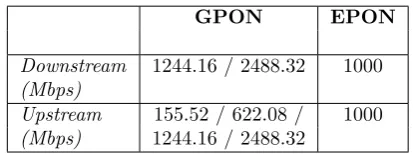
probably the supported bitrates, as shown in Table 2.1.
Another major difference between the two standards lies in the framing of data signals. GPON
divides signals into 125µs frames, then wraps those frames using the so-called GPON Encapsulation Mode (GEM). The purpose of GEM is both to allow for traffic multiplexing (through a 12-bit port ID)
GPON EPON
Downstream 1244.16 / 2488.32 1000 (Mbps)
[image:26.595.168.375.85.162.2]Upstream 155.52 / 622.08 / 1000 (Mbps) 1244.16 / 2488.32
Table 2.1: GPON and EPON supported bitrates.
This mechanism is used both upstream and downstream; virtual upstream frames are composed of data
bursts coming from different ONUs. Special pointers are used in the downstream frame header to assign
time slots for individual ONUs transmissions, allowing the upstream bandwidth to be controlled with a
granularity of 64 kbps. This enables the creation of virtual TDM circuits between OLT and ONUs with
guaranteed bandwidth and fine grain control.
EPON on the other hand was engineered to provide native support for Ethernet frames. As such, its
data frames have variable length; circuit emulation is thus required to implement fixed-bandwidth TDM
circuits. MAC addresses are used to identify both source and destination of the frame. A Multipoint
Control Protocol (MPCP) is used to arbitrate upstream access among ONUs; time slots are assigned
with a 16 ns granularity. Time-stamps in the frame header are used to estimate RTTs for ranging
purposes. Notice that vendors are free to implement their own Dynamic Bandwidth Allocation (DBA)
strategy: MPCP only defines the required interface to achieve access control.
XG-PON and 10G-EPON
To keep up the pace with the continuous increase in bandwidth-intensive services and applications,
both ITU-T and IEEE have been working on new standards able to deliver higher data-rates. These
new systems are called respectively XG-PON (or 10G-PON) and 10G-EPON, and they are essentially a
rate-multiplied (10 Gbps) version of their respective predecessors. However, support for such high data
rates requires some non-trivial design modifications.
Both standards use the L-band (1575 - 1580 nm) for downstream transmissions and the O-minus
band (1260 - 1280 nm) for upstream transmissions, essentially to avoid overlapping with legacy access
technologies. Moreover, both employ Forward Error Correcting (FEC) codes to improve the BER and
lower the power budget, at the cost of some bandwidth overhead – about 13% for the most typical
candidate, a truncated RS(255,223) Reed-Solomon code.
There are many minor differences with respect to the lower rate standards examined earlier on. The
preamble in 10G-EPON has been modified to minimize jitter effects and optimize peak detectors.
Word-alignment was enforced in XG-PON frames to simplify commercial implementations and reserve space
for future extensions. GEM has been revised and expanded to be more flexible and better integrated
2.1 NEXT-GENERATION OPTICAL NETWORKS 13
2.1.3
Long-Reach Passive Optical Networks
Besides increasing the available bitrate, researchers have been working on increasing the coverage of
a PON, i.e., by extending its feeder section and increasing its split ratio; the resulting architectures
typically go under the name of Long-Reach PON (LR-PON) or Super-PON Payne (2009). While we
have already discussed the advantages in terms of cost-savings of an higher split ratio, achieving long
reach would bring the additional benefit of effectively eliminating the need for a metro network. If,
for example, the feeder section could be extended as far as 90-100 km from the metro/core node to
the Local Exchange, then it would be possible to cover the whole of Ireland with as few as 20 metro/
core nodes (including the additional requirement of dual-homing for protection purposes), thus greatly
simplifying network management procedures and drastically reducing Operational Expenditure (OpEx)
Ruffini et al. (2012). Similar results have been shown for the U.K., where the node consolidation brought
by LR-PONs could reduce the over 5600 current local exchanges to about 75 DISCUS nodes Ruffini
et al. (2014).
However, LR-PON still presents several challenges that need to be addressed before they can go
into deployment. More specifically, the increased distance between ONUs and the OLT affects various
aspects of a traditional PON architecture:
• Longer distances mean higher power loss figures, requiring the adoption of active components (i.e., amplifiers) in the field in order to meet the power budget. Thus, while they are still identified
as PONs, these new architectures are not technically completely passive. Besides limiting the
cost-effectiveness of these systems, amplification introduces further complications. For starters,
special care needs to be taken in order to keep Amplified Spontaneous Emission (ASE) effects low
while maintaining a high Signal-to-Noise Ratio (SNR). Furthermore, power level variations due to
the different distances of ONUs from the OLT make traditional Erbium-Doped Fiber Amplifiers
(EDFAs) less attractive, due to their relatively slow speed in adjusting the gain to compensate
these effects. Various solutions - ranging from the implementation of a separate wavelength gain
control system to the adoption of Semiconductor Optical Amplifiers (SOAs) - are being considered
to tackle this problem.
• The low-cost, uncooled transmitters employed in traditional PON ONUs are not designed to be used across the high distances of an LR-PON. Moreover, if WDM is used to accommodate a larger
user base, the temperature-induced wavelength drift of these cheap devices suddenly becomes a
major issue.
• Similarly, a better burst-mode receiver is required at the OLT to accommodate for different propagation attenuation levels of the signals coming from the ONUs. The broader range of DC
levels introduced by the amplifiers, the larger attenuation introduced by high split ratios and long
all contribute to increasing the complexity of the problem.
• Over such long distances, control-plane transmission delays become significant, introducing the need for efficient remote-scheduling solutions to address upstream bandwidth allocation.
• Finally, an increase in the number of users covered by a single LR-PON (be it through longer distance feeder sections, higher split ratios or both) translates into stricter protection requirements
to avoid potential faults that could affect simultaneously thousands of customers.
Despite all of these challenges, LR-PONs represent a very attractive approach to next-generation
access networking. Most of the issues presented above are only related to cost efficiency and power
budget limitations rather than being real show-stoppers. A huge effort is being put in the scientific
community to tackle these issues; it is reasonable to expect researchers to come up with practical
solutions in the near future. For a survey of existing LR-PON demonstrations, please refer to Song
et al. (2010). Furthermore, a survey on the standardization trends of next-generation optical access
systems, including LR-PONs, can be found in Effenberger et al. (2010).
2.1.4
The DISCUS Architecture
DISCUS (Ruffini et al. 2014) is an FP7-funded research project investigating end-to-end solutions for
ubiquitous broadband optical access. The project is coordinated by CTVR through its two PIs – Prof.
David B. Payne and Prof. Marco Ruffini – and as such it represents the architectural vision of the
center for next-generation networking. While my work is not strictly part of DISCUS, it shares similar
motivations and follows almost identical assumptions. As such, DISCUS can be seen as the reference
framework for most of my studies.
One of the main assumptions from DISCUS is that, in order to reduce costs and energy consumption,
network resources should be shared among multiple users. While this is the norm in the core and metro
sections of the network, it usually isn’t the case for the access, where the low capacity of the existing
copper infrastructure led to point-to-point architectural choices. However, technologies like the LR-PON
allow sharing a single high-capacity fiber access among as many as 1024 users, while at the same time
reducing the amount of electronic components typically required in a DSL-based infrastructure.
As mentioned in the previous sections, the longer optical reach of these fibers allows us to reduce the
number of termination points required, thus aggregating a large number of small Central Offices (COs)
into a handful of so-called metro/core (MC) nodes. It is then possible to connect these MC nodes into
fully transparent optical islands, so as to minimize the number of IP switches and electronic converters
required. This helps reducing both the costs and the energy footprint of the considered network.
In short, the DISCUS architecture is based on LR-PON in the access and a collection of flat optical
islands in the core (see Fig. 2.1). However, besides investigating the technical challenges of this proposal,
2.2 OVERVIEW OF NETWORK CACHING 15
Metro/Core (MC) node Metro/Core (MC) node
Metro/Core (MC) node Metro/Core (MC) node
Metro/Core (MC) node Metro/Core (MC) node Metro/Core (MC) node Metro/Core (MC) node ONU
ONU Amplified
splitter Amplified
splitter
Optical Distribution Network (up to ≈10 Km) Optical Distribution Network
(up to ≈10 Km)
1st stage splitting 1st stage splitting 2nd stage splitting
2nd stage splitting
… … … …
3rd stage splitting 3rd stage splitting
ONU ONU … … O LT O LT Protected, dual-homed feeder fiber (over ≈90 Km) Protected, dual-homed
feeder fiber (over ≈90 Km)
[image:29.595.114.534.90.340.2]Optical switch Optical switch Ethernet Ethernet IP router IP router O LT O LT O LT O LT Optical switch Optical switch O LT O LT Ethernet Ethernet O LT O LT O LT O LT IP router IP router Amplified splitter Amplified splitter ONU ONU ONU ONU Optical Island
Figure 2.1: Diagram of the DISCUS architecture.
benefit such an architecture, and to model the services and usage patterns that the network would need
to support.
The target scenario of our studies borrows heavily from the DISCUS architectural view, assuming a
next-generation network deployment based on LR-PON trees with up to 512-1024 users terminating in a
small set of MC nodes. However, in our model these MC nodes are typically interconnected through IP
or OTN links, rather than transparently through all-optical switches; in other words, we forego the flat
optical core, as this aspect is still being investigated in order to assess its feasibility and the dimensions
to which it would be able to scale.
2.2
Overview of Network Caching
In the previous section we briefly described the network architectures supporting the multimedia services
we are interested in studying. Indeed, the focus of this work is essentially on multimedia content caching
and distribution, rather than on the technical aspects of future optical access networks. In the following
paragraphs, we present an overview of network caching and the challenges typically associated with it,
before delving into the literature specifically targeting multimedia caching over next generation networks.
In brief, caching consists in storing replicated copies of data that is assumed to be of interests to end
users, so that future requests for it can be served more efficiently. Typically, caches are located closer
to the users with respect to the origin of the data; the aim of caching can then be either to improve
a smaller number of links to reach its destination), to reduce the load on the origin server (i.e., by
distributing it among a number of cache servers), or a combination of the three.
Whenever a new request is received from a user, the system checks whether the requested content
can be found in the cache; if that’s the case (cache hit), the system proceeds to serve the content directly
from the cache. Otherwise, we say there was acache miss, and the content has to be fetched from the origin server. When this happens, typically the newly requested content is added to the cache, in order
to intercept future requests from other users.
2.2.1
Eviction Policies
Naturally, caching content implies a certain degree of redundancy, as the same data is copied and stored
in multiple locations. There is an obvious trade-off between minimizing the level of redundancy required
and increasing thehit rate of a cache – that is, the probability of having a cache hit on a new request. Replicating the entire catalog available on the origin server would ensure a 100% hit rate, but it would
also be highly wasteful in terms of storage resources. Luckily, in most practical cases that is not required,
as there is usually a modest portion of the catalog that is responsible for the vast majority of the requests
(see Subsection 2.2.3). It is then possible to design caches that are much smaller than the origin server,
and hence can only store a subset of its original catalog, while still being able to greatly reduce cache
misses.
The problem then becomes determining what to store in the cache. Unless the system designer has
some previous information on the future popularity of content, typically caches are instructed to store
every object for which they observe a request – in other words, at every cache miss the requested content
is added to the cache. Whenever there is not enough available space to do that, one (or more) of the
previously cached elements is erased to make room for the new entry. The way in which the element(s)
that need to be deleted are selected is defined by theeviction policy of the cache.
Since the objective of the cache is to maximize its hit rate, most eviction policies try to estimate
the popularity of the elements currently stored in the cache using some simple metric, so that the items
that are less likely to be requested again can be erased. Two of the simplest and most popular eviction
policies are Least Recently Used (LRU) and Least Frequently Used (LFU).
With LRU, each object in the cache has an associated time-stamp relative to its latest request. The
basic assumption of this policy is that an item that has not been requested in a long time might be
no longer relevant or popular, and as such constitutes a good candidate for eviction. The advantage of
this strategy is that it is simple to implement and, for most applications, it works quite well; however,
particularly in multimedia caching systems, this is not always an optimal policy. For example, it is
not uncommon for an “old” element of the catalog to see a sudden increase in popularity – e.g., in the
case of old episodes of a TV series immediately before the release of a new one. More in general, if the
2.2 OVERVIEW OF NETWORK CACHING 17
popular elements with an older time-stamp. The main drawback of LRU, in other words, is that it is
short-sighted, in that it only stores information on the amount of time elapsed since the last access –
with no regards for the actual rate of request of a video element.
LFU tries to address this issue by keeping a history of the frequency with which an element has
been requested. In the last example shown, an element that was recently accessed but received only a
few requests would be prioritized for eviction over some other object which was requested several times,
albeit some time ago. This policy seems to better fit our intuitive idea of what popularity means, but
it is not exempt from drawbacks: since the only relevant metric is the number of times an object has
been accessed, items that were popular in the past will be kept in the cache long after their popularity
has faded, often at the expense of young elements with higher request rates. For this reason, modified
versions of this algorithm have been proposed where the weight of the requests received decreases over
time to account for aging content (LFU-Aging).
The two simple algorithms presented above are just a small sample of the vast variety of strategies
that have been devised over time to improve the efficiency of caches under specific assumptions. For
example, in some applications the difference in popularity between the elements of the catalog could
be marginal compared to their difference in size, and a policy that prioritizes small objects over larger
ones might be more beneficial. Other policies attempt to use previous knowledge of the popularity
distributions of the element in the catalog to make educated guesses on future request patterns – indeed,
that is the principle behind the caching optimization scheme presented in Chapter 6. An exhaustive
coverage of all the caching eviction policies in literature is beyond the scope of this work; the interested
reader can refer to the survey by Podlipnig & B¨osz¨ormenyi (2003). We will however return to this topic
when describing the specific issues of popularity estimation for multimedia caching in Section 2.3.3.
2.2.2
Freshness and Consistency
Storing multiple copies of the same content in different locations of the network becomes particularly
problematic when the data is subject to changes and updates; this introduces the additional problem
of ensuring that the cache data isfresh, or, in other words, up-to-date. A typical example where this problem arises is the caching of dynamic web-pages, like the content of an on-line newspaper; if we
decide to add today’s front-page to the cache, there is only a limited window of time in which that
content is going to be relevant, after which we will need to fetch the updated page from the origin
regardless of whether we have a local copy available.
The problem becomes even more complicated if the objects that we are caching can be modified by
any of the distributed clients that hold a local copy. Without taking specific precautions, chances are
to invalidate the outdated content so that at the next request it will be fetched from the up-to-date
source.
While both of these issues are significant in a generic cache system, none of them really applies to
the focus of our studies, that is, multimedia caching systems. Unlike web pages, videos are usually not
modified over their life span, neither by the publisher (freshness) nor by the consumer (consistency).
The only real issue with multimedia elements is their expiration and consequent retirement from the
catalog, either due to a decrease in relevance or because of limitations in the copyright license of the
publisher. When this happens, however, it is sufficient to instruct all caches to erase any residual copy
of the expired content.
2.2.3
Web-Caching and Multimedia Caching
As shown by the last example in the previous section, different kinds of content often have distinctive
traits that must be taken into account when designing the caching system. This is particularly true for
the popularity distribution of elements in the catalog.
Historically, network caching was introduced to support the World Wide Web and Internet browsing.
Researchers quickly found that the popularity of web pages could be fitted to a Zipf distribution – in
other words, on a log-log graphs mapping the number of average requests for each content based on its
popularity rank, the resulting curve is close to a straight line. Mathematically, if we rank the items in
our catalog sequentially from 1 to N, where lower ranks imply higher popularity, an item with ranki
will be selected with probability
P(i) = 1/i e
PN
n=11/ne
(2.1)
whereeis theexponent parameter of the distribution.
In layman’s terms, this means that, depending on the slope of the popularity curve, a very small
percentage of the content of the catalog is responsible for a very large portion of the user requests. The
20-80 rule, which is often quoted in literature, states that the most popular 20% content will account
for about 80% of the total requests. When this happens, we say that the popularity curve isPareto-like, from the name of the Italian mathematician who first observed this phenomenon.
However, as shown first by Gummadi et al. (2003) and later re-affirmed by Yu et al. (2006), the
popularity of multimedia elements is not correctly modeled by a pure Zipf distribution. Studies on
several traces from real-world deployment of VoD services usually show a lower number of requests for
the most popular elements and a longer tail of low-popularity items compared to what one would have in
a purely Pareto-like distribution. Gummadi et al. Gummadi et al. (2003) speculate that this might be
due to the “fetch-at-most-once” nature of video on-demand catalogs, where most users will only access
a given element once regardless of its popularity; in other words, once a movie has been watched, it is
2.2 OVERVIEW OF NETWORK CACHING 19
100 101 102 103 104 10−5 10−4 10−3 10−2 10−1 100 Rank Probability
Zipf Distribution, exp=1
100 101 102 103 104 10−5 10−4 10−3 10−2 10−1 100 Rank Probability
[image:33.595.119.530.88.301.2]Zipf−Mandelbrot Distribution, exp=1, shift=50
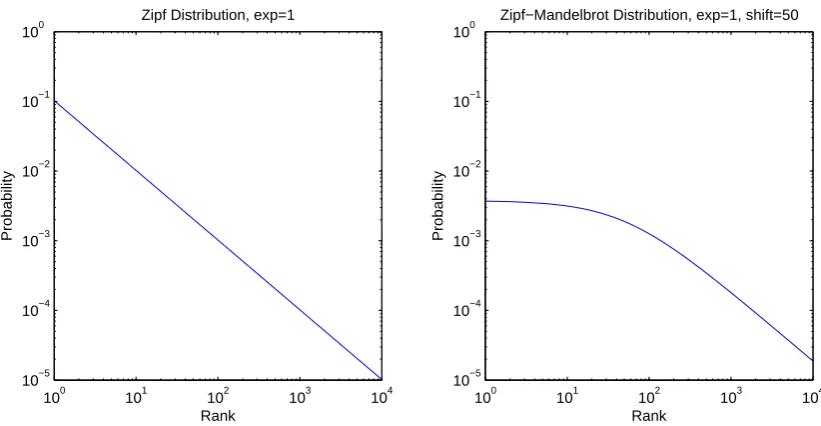
Figure 2.2: Probability mass function graphs of a Zipf distribution with unitary exponent (left) and a Zipf-Mandelbrot distribution with the same exponent and a shift parameter of 50 (right), for a catalog of 104items.
nature of web pages, where popular websites might be accessed several times in a day by the same users.
As a result of this, some researchers suggested that the popularity of multimedia content is better
represented by a Zipf-Mandelbrot distribution – a generalized version of the Zipf distribution with an
additionalshape parameter, whose effect is to reduce the slope of the curve for the lowest ranks. More specifically, according to a Zipf-Mandelbrot distribution of exponenteand shifts, an element of ranki
will be selected with probability
P(i) = 1/(i+s) e
PN
n=11/(n+s)e
(2.2)
Both a Zipf and a Zipf-Mandelbrot distribution are shown in Fig. 2.2, with an exponent of 1 and, for
the Zipf-Mandelbrot case, a shift parameter of 50.
As a consequence of this reduced relevance of the most popular items, multimedia caches tend to
under-perform compared to web caches with the same level of replication (e.g., some percentage of the
catalog size). It is important to keep this in mind when designing a cache system for multimedia content.
Another important difference regards the granularity of caching. Web objects tend to have a limited
size and as such are usually cached as a whole. Multimedia items, on the other hand, can span several
Gigabytes in the case of high definition movies. The storage and transmission of such huge objects can
often lead to inefficiencies, especially when users are only interested in a small portion of the object –
indeed many videos are not watched in their entirety. For these reasons, many multimedia providers
divide their content into multiplechunks, i.e., fixed-size portions which are easier to handle and transmit. The size of these chunks is a sensitive parameter of the system: very large chunks do little in terms of
solving the issues outlined above, while very small chunks introduce a significant overhead in terms of
Throughout our work, in order to simplify our model we do not consider the issue of chunking; in
other words, we will assume that videos are transmitted and cached in their entirety. For an analysis
of the consequences of introducing chunking in our model, please refer to Section 7.2.1.
2.3
Related Work on Multimedia Caching and Delivery
After an overview of the basic concepts behind our thesis, we can now devote our attention to the works
already present in literature. The most relevant papers will be reviewed and divided into three main
sections. We first examine the various strategies and architectures proposed to optimize the network
delivery of multimedia content in Section 2.3.1. In Section 2.3.2 we sample the literature dealing with
the problem of minimizing the energy consumption of multimedia content delivery. Finally, in Section
2.3.3 we cover the publications focusing on the estimation of multimedia content popularity for the
purposes of caching.
2.3.1
Novel Architectures for Multimedia Content Delivery
Following the widespread popularity of video services over the Internet, the problem of how to efficiently
deliver multimedia content to users has been the subject of a very large body of work. We limit our
attention to a sample of the relevant papers published in recent years.
Live-Streaming
Many of the studies in literature focus on live streaming services, i.e., applications where the user is
interested in watching a live program such as a sport event. The peculiar nature of live streaming
introduces both simplifying assumptions and additional constraints. On one hand, all users are
syn-chronized, i.e., they are requesting (roughly) the same portion of the content at the same time; this
obviously simplifies the delivery of content, as the same piece of data is valuable to all of the users. On
the other hand, the live nature of these events means that much stricter timing constraints are in place:
re-buffering events do not simply translate into momentary pauses, but rather in portions of the stream
being missed in order to catch up with the live progression of the video.
Due to the synchronous nature of the streams, most service providers (SPs) select multicast as the
preferred delivery strategy. However, P2P is often used either in conjunction with or in substitution of
multicast, e.g., to reduce the load on the video servers, to enable time-shifting functionalities, or simply
to reduce costs for new SPs. Here we will list some relevant studies that investigate the usage of P2P
in live streaming services.
Cha et al. (2008) propose a P2P-assisted multicast delivery for a telco-managed live IPTV service
2.3 RELATED WORK ON MULTIMEDIA CACHING AND DELIVERY 21
of their joining time. The traces used in the study were taken from an operator using IP multicast over a
DSL-based broadband network. P2P is only used for patching, i.e., to distribute content that was already
broadcasted before the joining time of a user. Meanwhile, the in-sync portion of the stream distributed
through multicast is cached for future use, to minimize the impact of P2P. A similar architecture is
described by Gallo et al. (2009).
Carta et al. (2010) focus on the signaling protocol required to trade chunks between peers in a purely
P2P-based live streaming service. They investigate optimal strategies to minimize queues, reduce delays,
and avoid losses or re-buffering events.
The work by Jin & Kwok (2011) analyzes the impact of both locality awareness and capacity
aware-ness (i.e., prioritizing peers with higher upload capacities) on the effectiveaware-ness of a P2P-based live media
streaming service, both in terms of user experience and ISP costs. The authors show that both strategies,
when not properly mitigated, can hinder efficient chunk dissemination due to clustering effects between
peers. They propose a hybrid neighbor selection strategy to overcome these issues, and they introduce
a Decentralized Network Awareness (DNA) protocol to improve the overlay construction process.
Wu et al. (2011) propose Ration, an algorithm to forecast the amount of bandwidth that a media
server in an ISP network is required to allocate in order to support a live P2P-based streaming channel.
Using an array of dynamic learning techniques (e.g., time series forecasting and dynamic regression),
Ration is reported to be able to dynamically predict the demand in each channel and to proactively
provision optimal server capacities across different channels. Furthermore, since Ration is carried out on
a per-ISP basis, it has full ISP-awareness and is thus able to guide the deployment of server capacities
so to constrain P2P traffic inside ISP boundaries as much as possible.
Bikfalvi et al. (2011) propose a live streaming IPTV architecture using multicast for popular channels
and unicast P2P flows for less popular channels. They argue that while dynamic IP Multicast is in
general more efficient in terms of bandwidth, it carries an overhead in terms of scalability (linked to the
number of forwarding entries to be stored at each core network router) and signaling. They show that,
for unpopular content, the bandwidth overhead of P2P is minimal and thus it represents a valid option
to make the system more scalable.
The paper by Xu Cheng et al. (2012) deals with P2P distribution of User Generated Content (UGC)
over social network services. Only the flash crowd scenario is addressed, since it’s considered the
most problematic. The authors distinguish between so-called storage users, who do not wish to watch
immediately the content they are downloading (e.g., because they’re waiting for it to reach a certain
threshold or maybe downloading it for a later time), and users who are streaming live content. Storage
users are less likely to leave the overlay and thus they are prioritized in the distribution tree (i.e.,
they are placed closer to the source), with the exception of the initial phase of the flash crowd, where
streamers are prioritized through a separate tree (which is later merged with the main one) to ensure