c
UNSUPERVISED FEATURE ANALYSIS FOR HIGH DIMENSIONAL BIG DATA
BY
MINGJIE QIAN
DISSERTATION
Submitted in partial fulfillment of the requirements for the degree of Doctor of Philosophy in Computer Science
in the Graduate College of the
University of Illinois at Urbana-Champaign, 2015
Urbana, Illinois
Doctoral Committee:
Professor Chengxiang Zhai, Chair Professor Jiawei Han
Professor Dan Roth
Abstract
In practice we often encounter the scenario that label information is unavailable due to either high cost of manual labeling or unwillingness of users to label. When label information is not avail-able, traditional supervised learning can not be directly applied so we need to study unsupervised methods which could work well even without supervision.
Feature analysis has been proven effective and important for many applications. Feature analysis is a broad research field, whose research topics includes but are not limited to feature selection, feature extraction, feature construction, and feature composition e.g., in topic discovery the learned topics can be viewed as compound features. In many real systems, it is often necessary and important to do feature analysis to determine which individual or compound features should be used for posterior learning tasks. The effectiveness of traditional feature analysis often relies on labels of the training data examples. However, in the era of big data, label information is often unavailable. In the unsupervised scenario, it is more challenging to do feature analysis.
Two important research topics in unsupervised feature analysis are unsupervised feature se-lection and unsupervised feature composition, e.g., to discover topics as compound features. This would naturally create two lines for unsupervised feature analysis. Also, combined with single-view or multiple-view for the data, we would generate a table with four cells. Except for the single-view feature composition (or topic discovery) where there’re already many work done e.g., PLSA, LDA, and NMF, the other three cells correspond to new research topics, and there is few work done yet. For single view unsupervised feature analysis, we propose two unsupervised feature selection methods. For multi-view unsupervised feature analysis, we focus on text-image web news data and propose a multi-view unsupervised feature selection method and a text-image topic model.
called Robust Unsupervised Feature Selection (RUFS), where pseudo cluster labels are learned via local learning regularized robust NMF and feature selection is performed simultaneously by robust jointl2,1-norm minimization. Outliers could be effectively handled and redundant or noisy features
could be effectively reduced. We also design a (projected) limited-memory BFGS based linear time iterative algorithm to efficiently solve the optimization problem.
We also study how the choice of norms for data fitting and feature selection terms affect the ultimate unsupervised feature selection performance. Specifically, we propose to use joint adaptive loss and l2/l0 minimization for data fitting and feature selection. We mathematically explain
desirable properties of joint adaptive loss and l2/l0 minimization over recent unsupervised feature
selection models. We solve the optimization problem with an efficient iterative algorithm whose computational complexity and memory cost are linear to both sample size and feature size.
For multiple-view unsupervised feature selection, we propose a more effective approach for high dimensional text-image web news data. We propose to use raw text features in label learning to avoid information loss. We propose a new multi-view unsupervised feature selection method in which image local learning regularized orthogonal nonnegative matrix factorization is used to learn pseudo labels and simultaneously robust joint l2,1-norm minimization is performed to select
discriminative features. Cross-view consensus on pseudo labels can be obtained as much as possible. For multi-view topic discovery, we study how to systematically mine topics from high dimen-sional text-image web news data. The application problem is important because almost all news articles have one picture associated. Unlike traditional topic modeling which considers text alone, the new task aims to discover heterogeneous topics from web news of multiple data types. We propose to tackle the problem by a regularized nonnegative constrained l2,1-norm minimization
framework. We also present a new iterative algorithm to solve the optimization problem.
The proposed single-view feature selection methods can be applied on almost all single-view data. The proposed multi-view methods are designed to process text-image web news data, but the idea can be naturally generalized to analyze any multi-view data. Practitioners could run the proposed methods to select features that will be used in posterior learning tasks. One can also run our multi-view topic model to analyze and visualize topics in text-image web news corpora to help interpret the data.
Acknowledgments
First of all, I would like to express my sincere gratitude to my advisor Prof. Chengxiang Zhai for his continuous support to my Ph.D. study and his great supervision and guidance over the past five years. His enthusiasm for research and pursuit of dream motivate me to conquer the fear when I walk through the darkness. His broad knowledge and profound insight always inspire me in all aspects of research.
I appreciate my thesis committee members Prof. Jiawei Han, Prof. Dan Roth, and Dr. Liangjie Hong for their insightful comments and constructive suggestions. Dr. Liangjie Jie Hong was my mentor when I did my summer internship at Yahoo Labs. He led me and triggered my research interests to personalization and recommendation.
I’m also grateful to my friends Prof. Feiping Nie, Prof. Yangqiu Song, and Prof. Quanquan Gu for their invaluable suggestions and inspiring comments on my research papers.
I also want to thank Prof. Shanfeng Zhu in Fudan University for our discussions on multiple research topics on bioinformatics during his visit at UIUC.
I would like to thank Dr. Suju Rajan and Dr. Junling Hu for their supervision for my summer internships at Yahoo Labs and eBay respectively. Their vision and thoughts influence me and help shape my future career in industry.
Many thanks to my fellow labmates in TIMan group including Yue Lu, Yuanhua Lv, Duo Zhang, Hyun Duk Kim, Hongning Wang, Dae Hoon Park, Yanen Li, Huizhong Duan, Xiaolong Wang, Yinan Zhang, Xueqing Liu, Rongda Zhu, Sheng Wang, Shan Jiang, Sean Massung, Chase Geigle, Ismini Lourentzou and many others.
Most importantly, I will always thank my parents Qiushi Li and Zhigang Qian for their encour-agement, without whom I would not be able to overcome the difficulties.
Table of Contents
Chapter 1 Introduction . . . 1
Chapter 2 Related Work . . . 6
2.1 Nonnegative Matrix Factorization Family . . . 10
Chapter 3 Background. . . 13
3.1 Evaluation. . . 14
Chapter 4 Robust Unsupervised Feature Selection. . . 15
4.1 Introduction. . . 15
4.2 Local Learning Regularization. . . 17
4.3 The Objective Function . . . 18
4.4 Optimization Algorithm . . . 20
4.5 Experiments. . . 26
4.6 Summary . . . 32
Chapter 5 Joint Adaptive Loss and l2/l0-norm Minimization for Unsupervised Feature Selection . . . 33
5.1 Introduction. . . 33
5.2 l2/l0-norm and Adaptive Loss . . . 35
5.3 The Objective Function . . . 36
5.4 Optimization Algorithm . . . 37
5.5 Experiments. . . 44
5.6 Summary . . . 49
Chapter 6 Unsupervised Feature Selection for Multi-View Clustering on Text-Image Web News Data . . . 50
6.1 Introduction. . . 50
6.2 Optimization Problem . . . 52
6.3 Experiments. . . 55
6.4 Summary . . . 59
Chapter 7 Text-Image Topic Discovery for Web News Data . . . 60
7.1 Introduction. . . 60
7.2 Problem Formulation. . . 61
7.3 Methodology for Text-Image Topic Discovery . . . 62
Chapter 8 Conclusions and Future Work. . . 80 References . . . 82
Chapter 1
Introduction
Feature analysis has been proven effective and important for many applications in industry. Feature analysis is a broad research field, whose research topics includes but are not limited to feature selection, feature extraction, feature construction, and feature composition e.g., in topic discovery the learned topics can be viewed as compound features. In many real systems, it is often necessary and important to do feature analysis to decide which individual or compound features we should use to represent the data points for learning tasks. The effectiveness of traditional feature analysis often relies on labels of the training data examples. However, in the era of big data, label information are often unavailable due to either high cost of manual labeling or unwillingness of users to label. In the unsupervised scenario, it is more challenging to do feature analysis. This thesis attempts to study feature analysis methods that can work without supervision.
In addition to the scarcity of label information, big data usually faces two other challenges. The first is the curse of dimensionality. There are several undesirable consequences of curse of dimensionality. E.g., the number of the data examples required for training increases exponentially, nearly all of the high-dimensional space is far away from the center, and the majority of the data space is unseen to the target function which reduces the predictive power of a learning model, leading to over-fitting. It is therefore important and necessary to reduce dimensionality. This can be usually achieved by feature selection and feature learning. Feature selection tries to select the most useful features to represent the original data points whereas feature learning aims to learn mapping functions from original features to new representations. Compared to feature learning, one advantage of feature selection is the high interpretability of results since it preserves the physical sense of the original features.
Table 1.1: Overall contributions in this thesis.
Unsupervised Feature Composition Unsupervised Feature Selection discover topics as
”compound features”
Single-View IJCAI 13, IJCNN 15 PLSA [1], LDA [2] and NMF [3] etc.
Multiple-View CIKM 14 ECIR 14
usually composed of multiple views. For example, it is prevalent that web news articles contain both text content and images. The heterogeneity of big data is challenging because different data types have different properties, and pseudo labels learned from different views often conflict with each other. For big data when label information is out of reach, unsupervised feature analysis approaches are needed. For example, unsupervised feature selection for multi-view data is desirable for unsupervised feature selection on data of multiple views, or topic discovery methods for multi-view data are needed to effectively and efficiently mine the latent structures from multi-multi-view data, which would be very helpful to automatically organize the data, analyze the knowledge, and explore the data hidden structure.
This thesis attempts to study two important research topics in unsupervised feature analysis: unsupervised feature selection and unsupervised feature composition, e.g., to discover topics as compound features. This would naturally create two lines for unsupervised feature analysis. Also, combined with single-view or multiple-view for the data, we would generate a table with four cells shown in Table 1.1. Except for the single-view feature composition (or topic discovery) where there’re already many work done e.g., PLSA, LDA, and NMF, the other three cells correspond to new research topics, and there is few work done yet. This thesis attempts to deal with the three new cells in the table by developing novel unsupervised approaches for feature selection, topic discovery, and exploring their applications. We show how feature selection can be done in a unsupervised scenario. We propose unsupervised feature selection methods that don’t rely on labels and could be applied on single view and multiple view data. We also propose a new unsupervised method that could mine the latent structure from multi-view data. Although we use only text-image web news articles for evaluation, the formulation can be naturally extended for general multi-view data. For single-view unsupervised feature selection, we first propose a new unsupervised feature selection method, i.e., Robust Unsupervised Feature Selection (RUFS). Unlike traditional
unsu-pervised feature selection methods such as MCFS [4], UDFS [5] and NDFS [6], pseudo cluster labels are learned via local learning regularized robust nonnegative matrix factorization. During the label learning process, feature selection is performed simultaneously by robust jointl2,1 norms
minimization. Since RUFS utilizesl2,1 norm minimization on processes of both label learning and
feature learning, outliers and noise could be effectively handled and redundant or noisy features could be effectively reduced. Our method adopts the advantages of robust nonnegative matrix fac-torization, local learning, and robust feature learning. In order to make RUFS scalable, we design a (projected) limited-memory BFGS based iterative algorithm to efficiently solve the optimization problem of RUFS in terms of both memory consumption and computation complexity. Experimen-tal results on six benchmark real world data sets show that RUFS outperforms the state-of-the-art methods in terms of both clustering and classification settings.
We also want to study how the choice of norms for data fitting and feature selection terms affect the ultimate unsupervised feature selection performance. Specifically, we propose to use joint adaptive loss and l2/l0 minimization for data fitting and feature selection. We mathematically
explain desirable properties of joint adaptive loss andl2/l0 minimization over recent unsupervised
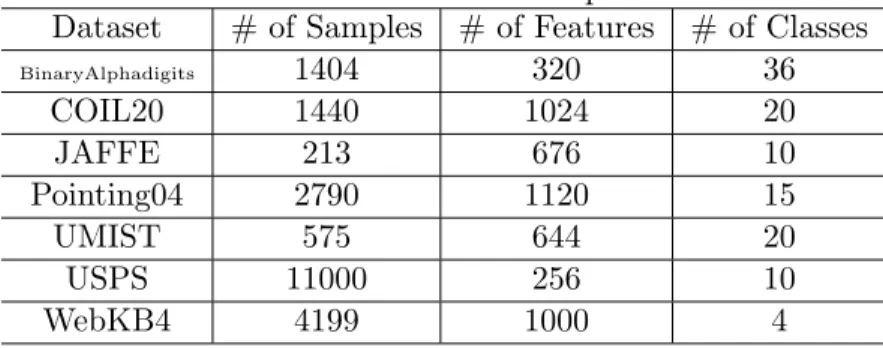
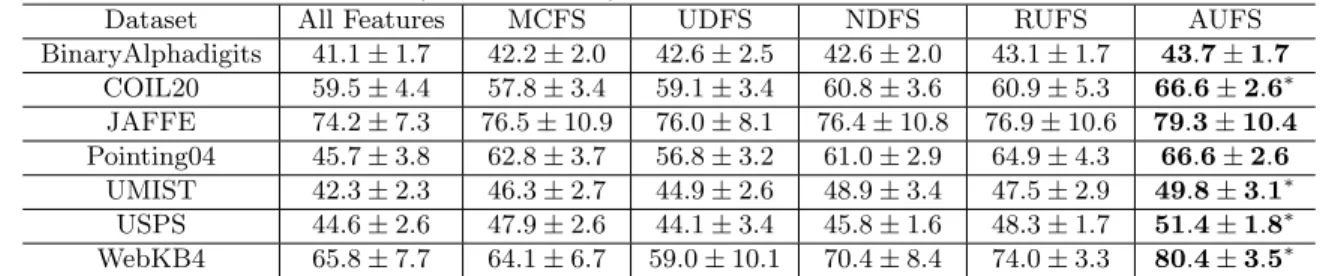
feature selection models. We solve the optimization problem with an efficient iterative algorithm and prove that all the expected properties of unsupervised feature selection can be preserved. We also show that the computational complexity and memory use is only linear to the number of instances and square to the number of clusters. Experiments show that our algorithm outperforms the state-of-the-arts on seven real world benchmark data sets.
For multiple-view unsupervised feature selection, we propose a more effective unsupervised fea-ture selection approach for high dimensional multi-view data. Although we use text-image web news data for evaluation due to the prevalence of this kind of data nowadays, the idea of the pro-posed method can be naturally generalized to analyze any multi-view data. The fact that unlabeled high-dimensional text-image web news data are produced every day presents new challenges to un-supervised feature selection on multi-view data. State-of-the-art multi-view unun-supervised feature selection methods such as AUMFS [7] and MVFS [8] learn pseudo class labels by spectral analysis, which is sensitive to the choice of similarity metric for each view. For text-image data, the raw text itself contains more discriminative information than similarity graph which loses information during
construction, and thus the text feature can be directly used for label learning, avoiding information loss as in spectral analysis. We propose a new multi-view unsupervised feature selection method in which image local learning regularized orthogonal nonnegative matrix factorization is used to learn pseudo labels and simultaneously robust joint l2,1-norm minimization is performed to select
discriminative features. Cross-view consensus on pseudo labels can be obtained as much as possible. We systematically evaluate the proposed method in multi-view text-image web news datasets. Our extensive experiments on web news datasets crawled from two major US media channels: CNN and FOXNews demonstrate the effectiveness of the new method over state-of-the-art multi-view and single-view unsupervised feature selection methods.
Single-view feature composition (topic discovery) has been well studied in the last decade, so we focus on multi-view topic discovery. We study how to systematically mine topics from high dimensional text-image web news data. We formally propose a new application problem: unsupervised text-image topic discovery. The application problem is important because almost all news articles have one picture associated. Unlike traditional topic models like PLSA [1] and LDA [2] which consider text alone, the new task aims to discover heterogeneous topics from web news of multiple data types. The heterogeneous topic discovery is challenging because different media data types have different characteristics and structures, and a systematic solution that can integrate information propagation and mutual enhancement between data of different types in a principled way is not trivial, especially when no supervision information is available. We propose to tackle the problem by a regularized nonnegative constrainedl2,1-norm minimization framework. We also
present a new iterative algorithm to solve the optimization problem. To objectively evaluate the proposed method, we collect two real world text-image web news datasets. Experimental results show the effectiveness of the new approach.
The proposed single-view feature selection methods can be applied on almost all single-view data. The proposed multi-view methods are designed to process text-image web news data, but the idea can be naturally generalized to analyze any multi-view data. Practitioners could run the proposed methods to select features that will be used in posterior learning tasks. E.g., we can do unsupervised feature selection in the first phase to select a subset of features which is used to represent the data points as input of posterior learning systems. One can also apply our multi-view
Chapter 2
Related Work
Feature selection has attracted increasing attention in recent years, and many feature selection algorithms have been proposed, which can be grouped into three families: filter, wrapper, and embedded methods. Filter methods [9][10][11][12][13][14][5] select a subset of features by leveraging statistical properties of data, and are usually performed before applying classification algorithms. For wrapper methods [15][16][17], feature selection is wrapped in a learning algorithm and the classification performance on selected features is taken as the evaluation criterion. Embedded approaches [18][19][20] perform feature selection when training the models. Wrapper and embedded methods couples feature selection with built-in classifiers tightly, which lead to less generality and extensive computation. We thus adopt the filter approach in this thesis.
From the perspective of label availability, feature selection algorithms can also be classified into supervised feature selection and unsupervised feature selection. Supervised feature selection methods, such as [10][21][22][23], are usually able to effectively select good features since labels of training data, which contain the essential discriminative information for classification, can be used. However, in unsupervised scenario, label information is unavailable directly, which makes the task of feature selection more challenging.
Several unsupervised feature selection algorithms are proposed recently. A commonly used criterion in unsupervised feature learning is to select features best preserving data similarity or manifold structure constructed from the whole feature space [11][12][4], but they fail to incorporate discriminative information implied within data, though it has been shown to be important in data analysis [24]. Earlier unsupervised feature selection algorithms evaluate the importance of each feature individually and select feature one by one [11][12], with a limitation that correlation among features is neglected pointed by [22][4] which applied two-step approaches, i.e., spectral regression
to unsupervised feature selection. [25] is also related to unsupervised feature selection. It proposes a row-wise sparse subspace learning method to improve subspace learning performance. Modern unsupervised feature selection algorithms perform feature selection by simultaneously exploiting discriminative information and feature correlation. Unsupervised Discriminative Feature Selection (UDFS) [5] aims to select the most discriminative features for data representation, where manifold structure is also considered. However, its orthogonal constraint on the feature selection projection matrix is unreasonable since feature weight vectors are not necessarily orthogonal with each other in nature. Nonnegative Discriminative Feature Selection (NDFS) [6] performs nonnegative spectral analysis and feature selection simultaneously. One factor that is ignored in both UDFS and NDFS is that data is usually not ideally clean, and outliers or noise often exist in it. UDFS and NDFS are not robust and are vulnerable to outliers or noise. Another deficiency of UDFS and NDFS is that their computation complexity is cubic to the number of features which severely limits their applicability on high dimensional data, e.g., text data and genetic data.
Since the most discriminative information for feature selection is usually encoded in labels, it is very important to predict a good cluster indicators as pseudo labels for unsupervised feature selection [6]. Another important factor which effects the performance of feature selection is the consideration of outliers and noise [21]. Real data is usually not ideally distributed, outliers and noise often appear in the data, thus it is important or even necessary to consider robustness for unsupervised feature selection.
There are also some unsupervised feature selection method proposed on multi-view data recently. State-of-the-art unsupervised feature selection methods [7,8] for multi-view data use spectral clus-tering across different views to learn the most consistent pseudo class labels and simultaneously use the learned labels to do feature selection. More specifically, Adaptive Unsupervised Multi-view Feature Selection (AUMFS) [7] uses spectral clustering on a combined data similarity graph from different views to learn the labels that have most consensus across different views, and then usel2,1
-norm regularized robust sparse regression to learn one weight matrix for all the features of different views to best approximate the cluster labels. [8] presents a new unsupervised multi-view feature selection method called Multi-View Feature Selection (MVFS). MVFS also uses spectral clustering on the combined data similarity graph from different views to learn the labels, but learn one weight
matrix for each view to best fit the learned pseudo class labels by joint squared Frobenius norm (fitting term) andl2,1-norm (rowise sparsity-inducing). Both [7] and [8] share the disadvantage that
they’re sensitive to the combined data similarity graph, especially when there are quite a number of unrelated and noisy features in the feature space, and there is information loss during graph construction.
Now we describe related work on topic discovery from both single-view and multi-view perspec-tives. Topic discovery/modeling/mining is a popular research area in information retrieval, data mining and knowledge management, which discovers meaningful latent patterns (e.g., metadata, topics, and events that are instances of topics). Topic mining is very useful and has a promising perspective for web applications, especially in an era of fast growth of web information such as multimedia news, web blogs, social network and twitters.
Although a number of topic mining methods have been proposed, including both generative models [26, 2] and discriminative models [3, 27], they mainly focus on discovering topics from a single type of data, i.e., text data. There are two groups of approaches for text based topic mining. The first group tries to build generative probabilistic topic models to learn the latent topic con-cepts. The representative works in this line are Probabilistic Latent Semantic Analysis (PLSA) [26] and Latent Dirichlet Allocation (LDA) [2].
PLSA models each word in a document as a sample from a mixture model, where the mixture components are multinomial random variables that represent topics. Each document is represented as a list of mixing weights for these mixture components and thereby reduced to a probability distribution on a fixed set of topics. This distribution is the reduced representation associated with the document. PLSA suffers from over-fitting problems since its number of parameters grows linearly with the number of documents.
To address the over-fitting problems of PLSA, LDA was proposed, which assumes that the prob-ability distributions of documents over topics are generated from the same Dirichlet distribution. In this sense, LDA can be seen as Bayesian PLSA. The basic idea is that documents are represented as random mixtures over latent topics, where each topic is characterized by a distribution over words. Many further extensions of PLSA and LDA have been proposed (see, e.g., [28,29]).
This line of work assumes that the latent topic information lies in the input data matrix. By approximating the data matrix by a multiplication of several matrices components under some constraints, a topic model matrix can be learned. Thus, documents can be approximately repre-sented by a linear combination of topic vectors. The advantage of matrix-factorization based topic mining methods is the high flexibility and avoidance of independent assumptions.
Nonnegative matrix factorization (NMF) [3] is an important branch in this family, which tries to find a good matrix factorization using a multiplication of two nonnegative matrices.
In multimedia field there have been some studies working on combined text and visualized features for web document retrieval, image clustering, image classification and image retrieval. In [30], latent semantic indexing (LSI) [31] is used, together with textual and visual features, for content-based web document retrieval. LSI seeks to find the latent correlation between terms and documents and obtains a good approximation of document features in order to get a better retrieval performance. However, it cannot discover interpretable topics (positively weighted term vectors). The number of singular values is chosen to be the one getting the best retrieval results, not necessarily the number of topics (In [30], 12 highest singular values were chosen whereas the number of topics is 4). Besides, the negative components for the latent semantic vectors are not reasonable for topic representation. Some image clustering works [32,33] also utilize text features to help clustering image collections, however, they aim to optimize the image clustering performance rather than explicitly learn a joint text-image topic representation. Reference [34] exploits the link structure of the web graph to learn an image-classification model for multimedia data. However, their work does not attempt to discover subtopics buried in text data, and their target is different from our task in that the semantic topic is implicitly learned in the image-classifier whereas we focus on explicitly learning a good topic representor. Recently, text information is used for several image retrieval works [35, 36], however, their task is different from ours, and their work cannot discover joint text-image topics.
There have also been some works on automatic image annotation [37, 38]. In these works, image regions are taken as visual words, and a generative model is then constructed under some assumptions of independence for generating the pair of an image and its caption. Their task is also different from ours. The automatic image annotation aims to find a generative model to fit
the image region and its annotation, our task is to discover coherent topics within a text-image collection, and our framework can incorporate any type of data though in this work we focus on text-image domain for simplicity.
Multi-view learning, which aims to learn better models to cluster data in multiple views, is a ma-chine learning research area that can be applied for multi-view topic discovery, but state-of-the-art multi-view learning methods cannot do this task very well. Co-trained multi-view spectral clus-tering [39] iteratively uses the spectral embedding from one view to constrain the similarity graph used for the other view. However, this approach heavily relies on similarity graph for each view and completely ignores the detailed information, which may badly hurt the clustering performance due to loss of discriminative information. Also it’s not straight forward to generate multi-view topic representation via this approach. [40] proposes to generalize K-means for multi-view data cluster-ing. However, its performance tends to be dominated by the worst domain since the algorithm will assign large weight to the domain with the largest approximation error as will be demonstrated in the experiment later. There’re also some heterogeneous data co-clustering work [41][42], however they require some supervision information. For example, [41] require user specified must-link and cannot-link constraint in the central type, and [42] require user preference before clustering. Be-sides, although heterogeneous co-clustering methods appear to be able to tackle our problem, they do not aim to explicitly learn representative and interpretable multi-view topics from heterogenous web news data. The major goal of our work is to provide an effective multi-view learning approach to discover text-image topics from web news data without any supervision.
Now we have described the related works for the thesis topic. Because the idea of NMF plays an important role in almost all thesis work, we will elaborate it in the next section so that it would be easier for readers to understand the objective functions throughout this thesis.
2.1
Nonnegative Matrix Factorization Family
NMF and its regularized variations are widely used methods in the field of machine learning [3], data mining [27] [43] [44] [45] [46], and information retrieval [47] [48]. This group of methods try to find a good matrix factorization using a multiplication of two nonnegative matrices. It can be shown
to be equivalent to spectral clustering [49]. In the area of topic mining, NMF is closely related to PLSA [26]. It has been shown in [50] [51] that if KL divergence cost function is used other than squared errors, the objective function of PLSA is identical to that of NMF except for a constant, which means that NMF multiplicative update algorithm and the EM algorithm for training PLSA are alternative approaches to optimize the equivalent objective functions. For important NMF extensions proposed in literature, please refer to [27,44,45,46,52,41,53].
The general form of regularized NMF can be formulated as below:
min F≥0,G≥0 X−FGT 2 F +F(G) +G(F). (2.1)
Here F and G can be any linear or quadratic convex functions with finite lower bound (e.g., l1-norm, Frobenius norm, and graph Laplacian regularization) , and they are general enough to
cover existing and potential regularization terms. We use alternate updating technique to get a local optimum. Given fixed nonnegativeF, the optimization problem of Gis
min G≥0 X−FGT 2 F +F(G). (2.2)
Likewise, given fixed G, the optimization problem of F is
min F≥0, XT −GFT 2 F +G(F). (2.3)
We see from Eq.(2.2) and Eq.(2.3) that onceGis solvedFcan be solved following the same rule by replacement of counterpart matrices. In literature, there are several algorithms to solve NMF. The original work use multiplicative update methods [3]. There are other multiplicative update methods proposed in [27, 44]. Recently, several methods are proposed based on the Alternating Nonnegative Least Squares(ANLS) framework suggested by [54]. This framework has been proved to converge to stationary points by [55] so long as each nonnegative least square sub-problem can be solved exactly. Among these methods are projected gradient method [56], active set method [57], projected Newton method [58], and modified active set method called Block-Pivot [59]. Now, the state-of-the-art technique is to use coordinate descent methods, which update one variable at a
time. Coordinate descent methods have been tested efficient for NMF in [60,61] and can be made successful in large scale problems.
2.1.1 Robust Nonnegative Matrix Factorization Using l2,1-norm
One of the most important drawbacks of standard NMF is that it is prone to outliers since standard NMF uses squared residue error for each data point. Thus a few outliers with large errors may dominate the objective function due to the squared residue errors, which may further lead to unexpected effect on the base matrix and label indicator matrix. Thus it is very necessary to present robust NMF formulation and discuss its properties. One strategy to consider outliers in NMF is using the 12,1-norm [62], which can be formulated as
minkX−FGk2,1 s.t. F≥0, G≥0. (2.4)
Note that here l2,1-norm is used in the objective function so that only absolute residue errors
are to be minimized thus it’s harder for outliers to dominate the objective function. Experiments on a bunch of benchmark datasets show that the robust NMF provides more faithful basis factors and consistently better clustering results as compared to standard NMF [62].
For optimization, similar to [27, 52] auxiliary functions are proposed to derive multiplicative updating rules for the basis matrix and label indicator matrix in the original paper. However, the optimization strategy is limited in that the optimization approach cannot be directly applied to cases where regularization terms are involved. We will propose later in the thesis a more general optimization strategy that is able to solve both robust NMF and its regularized variants.
We will extensively applyl2,1-norm in this thesis. In the first chapter, we use it to learn a robust
label indicator matrix in label learning and robust feature selection. While in the second chapter, we use it to learn robust topic vectors and robust topic assignment matrix.
Chapter 3
Background
Throughout this thesis, matrices are written as boldface capital letters and vectors are denoted as boldface lowercase letters. For a matrix M ∈ Rr×p, its i-th row, j-th column are denoted by mi,mj respectively. kMkF ∆ = s r P i=1 p P j=1 m2
ij is the Frobenius norm ofMand Tr [M]
∆ = r P i=1 miiis the
trace of MifMis square. For any matrix M∈ Rr×p, its l
2,1-norm is defined as kMk2,1= r X i=1 v u u t p X j=1 m2ij = r X i=1 mi 2. (3.1)
Assume that we have nsamplesX ={xi}ni=1. LetX= [x1,· · ·,xn]T denote the data matrix with
each row being a data feature vector, in whichxi∈ Rd is the feature descriptor of thei-th sample.
Suppose thesendata samples are sampled fromcclasses and denoteY= [y1,· · · ,yn]T ∈ {0,1}n×c,
where yn ∈ {0,1}c×1 is the cluster indicator vector for sample xi. The scaled cluster indicator
matrix [5][6]Gis defined as
G= [g1,· · ·,gn]T =Y YTY
−12
, (3.2)
wheregi is the scaled cluster indicator of xi. We thus have
GTG= YTY− 1
2YTY YTY−12
=Ic, (3.3)
whereIc∈ Rc×c is an identity matrix.
For multi-view learning, letXv ∈ Rn×dv denote the data matrix in thev-th view where thei-th
row xiv ∈ Rdv is the feature descriptor of the i-th instance in the v-th view. For text-image web
3.1
Evaluation
For clustering and unsupervised feature selection, two widely used evaluation metrics to measure clustering performance, i.e., Normalized Mutual Information (NMI) and accuracy (ACC) are used in this thesis.
Given a clustering result, NMI is estimated by
N M I= Pc k=1 Pc m=1nk,mlog n·nk,m nkˆnm q Pc k=1nklognnk Pc m=1nˆmlognˆnm , (3.4)
where nk denotes the number of data contained in the cluster Dk (1≤ k≤c), ˆnm is the number
of data belonging to the ground truth class Lm (1≤m≤c), andnk,m denotes the number of data
that are in the intersection between the cluster Dk and the class Lm. A larger NMI indicates a
better clustering result.
Denote qi as the clustering results and pi as the ground truth label of xi. ACC is defined by
ACC =
Pn
i=1δ(pi, map(qi))
n (3.5)
where δ(x, y) = 1 if x=y;δ(x, y) = 0 otherwise, and map(qi) is the best mapping function that
permutes clustering labels to match the ground truth labels using the Kuhn-Munkres algorithm. A larger ACC indicates better performance. Both ACC and NMI range between 0 and 1.
Chapter 4
Robust Unsupervised Feature
Selection
In this chapter, we study the problem of feature selection in unsupervised learning from the single-view perspective. We propose a new model by considering the outliers in both labeling learning and feature learning. Additionally, in order to make the proposed method scalable, we design a (projected) limited-memory BFGS based iterative algorithm to efficiently solve the optimization problem in terms of both memory consumption and computation complexity.
4.1
Introduction
The curse of dimensionality is a common phenomenon in many areas, such as pattern recognition, text mining, computer vision [63,64], and bio-informatics. In practice, not all features are relevant and important to the learning task, many of them are often correlated, redundant, or even noisy sometimes [10][14], which may result in adverse effects such as over-fitting, low efficiency and poor performance. It is therefore important and necessary to reduce dimensionality. This can be usually achieved by transformation to a low dimensional space [65][25] or feature selection. In this chapter, we focus on feature selection, which aims to select discriminative and highly related features and eliminate unrelated, redundant, and noisy features with little or no supervision based on certain criteria.
During recent years, feature selection has attracted increasing attention, and many feature selec-tion algorithms have been proposed, which can be grouped into three families: filter, wrapper, and embedded methods. Filter methods [9][10][11][12][13][14][5] select a subset of features by leveraging statistical properties of data, and are usually performed before applying classification algorithms. For wrapper methods [15][16][17], feature selection is wrapped in a learning algorithm and the classification performance on selected features is taken as the evaluation criterion. Embedded
ap-proaches [18][19][20] perform feature selection when training the models. Wrapper and embedded methods couples feature selection with built-in classifiers tightly, which lead to less generality and extensive computation. We thus adopt the filter approach in this paper.
From the perspective of label availability, feature selection algorithms can also be classified into supervised feature selection and unsupervised feature selection. Supervised feature selection methods, such as [10][21][22][23], are usually able to effectively select good features since labels of training data, which contain the essential discriminative information for classification, can be used. However, in unsupervised scenario, label information is unavailable directly, which makes the task of feature selection more challenging.
Several unsupervised feature selection algorithms are proposed recently. A commonly used criterion in unsupervised feature learning is to select features best preserving data similarity or manifold structure constructed from the whole feature space [11][12][4], but they fail to incorporate discriminative information implied within data, though it has been shown to be important in data analysis [24]. Earlier unsupervised feature selection algorithms evaluate the importance of each feature individually and select feature one by one [11][12], with a limitation that correlation among features is neglected pointed by [22][4] which applied two-step approaches, i.e., spectral regression to unsupervised feature selection. [25] is also related to unsupervised feature selection. It proposes a row-wise sparse subspace learning method to improve subspace learning performance. Modern unsupervised feature selection algorithms perform feature selection by simultaneously exploiting discriminative information and feature correlation. Unsupervised Discriminative Feature Selection (UDFS) [5] aims to select the most discriminative features for data representation, where manifold structure is also considered. However, its orthogonal constraint on the feature selection projection matrix is unreasonable since feature weight vectors are not necessarily orthogonal with each other in nature. Nonnegative Discriminative Feature Selection (NDFS) [6] performs nonnegative spectral analysis and feature selection simultaneously. One factor that is ignored in both UDFS and NDFS is that data is usually not ideally clean, and outliers or noise often exist in it. UDFS and NDFS are not robust and are vulnerable to outliers or noise. Another deficiency of UDFS and NDFS is that their computation complexity is cubic to the number of features which severely limits their applicability on high dimensional data, e.g., text data and genetic data.
Since the most discriminative information for feature selection is usually encoded in labels, it is very important to predict a good cluster indicators as pseudo labels for unsupervised feature selection [6]. Another important factor which effects the performance of feature selection is the consideration of outliers and noise [21]. Real data is usually not ideally distributed, outliers and noise often appear in the data, thus it is important or even necessary to consider robustness for unsupervised feature selection.
In light of all these factors, we propose a new unsupervised feature selection algorithm, i.e., Robust Unsupervised Feature Selection (RUFS). We perform robust clustering and robust feature selection simultaneously to select the most important and discriminative features for unsupervised learning. Specifically, cluster indicators are generated by local learning regularized robust non-negative matrix factorization, which is also a novel robust clustering method itself but we focus on unsupervised feature selection in this paper. Local learning [46] is used in robust clustering which incorporates both discriminative information and the geometric structure and is good at clustering data on manifold. We impose an orthogonal constraint on the cluster indicator matrix to ensure that the learned cluster indicators are much closer to the true cluster labels. We then simultaneously perform robust feature selection using learned cluster indicators. RUFS exploits the discriminative information and feature correlation in a joint framework. Aiming at feature selection, jointl2,1 norms minimization is utilized to learn a robust feature selection matrix which
is sparse in rows. In order for the proposed RUFS be practical for real world applications, we present a (projected) limited-memory BFGS based iterative algorithm to solve the optimization problem of RUFS. Experiments on different real world datasets show that the RUFS outperforms the state-of-the-arts.
4.2
Local Learning Regularization
According to [66], searching a good predictorfin a global way might not be a good strategy because the function set f(x) may not contain a good predictor for the entire input space. However, it is much easier to produce good predictions on some local regions of the input space and it is usually more effective to minimize prediction cost for each region. [46] introduced a good way to construct
the local predictors, and we will use it as our local learning regularization term.
Denoting N (xi) as the neighborhood of xi, the local learning regularization aims to minimize the sum of prediction errors between the local prediction from N(xi) and the cluster assignment of xi: J = K X k=1 n X i=1 f k i (xi)−gik = K X k=1 n X i=1 k T i (Ki+niλI)−1gik−gik = K X k=1 n X i=1 α T i gki −gik = TrGTLG (4.1)
wherefik(xi) is the locally predicted label fork-th cluster fromN (xi),λis a positive parameter,Ki
is the kernel matrix defined on the neighborhood ofxi, i.e., N (xi), with size ofni,ki is the kernel
vector defined betweenxiandN(xi),gki is the cluster assignments ofN (xi),L= (A−I)T(A−I),
I∈ Rn×n is an identity matrix, andA∈ Rn×n is defined by
Aij = αij, if xj ∈ N(xi) 0, otherwise . (4.2)
4.3
The Objective Function
In this section, we present the objective function of the proposed Robust Unsupervised Feature Selection (RUFS) algorithm. To select discriminative features for unsupervised learning, learning accurate pseudo cluster labels is very important. NDFS [6] uses spectral clustering to predict the labels. In this work, however, we propose to utilize local learning regularized robust nonnegative matrix factorization with orthogonal constraint to learn the pseudo cluster labels. The reason is three-fold. First, since spectral clustering relies on similarity matrix computed from the original feature space. Thus unrelated or noisy features will have an adverse effect on clustering and hence-forth hurt feature selection performance. Although nonnegative matrix factorization [67] decom-poses the data matrix in the original feature space, the adverse effect will be mainly accumulated
in the learned cluster centers and won’t hurt the indicators severely. Second, a robust cluster-ing algorithm that considers outliers and noise usually improves the clustercluster-ing performance [62]. Third, researchers [66][68][46] have shown that local learning is more effective than learning a good predictor in a global way since the function set may not contain a good predictor for the entire input space. Thus we use the local learning regularization to encode the discriminative informa-tion and the geometric structure via local predictors, which results in good clustering performance particularly on data embedded on manifold.
Our proposed robust clustering via local learning differs from [62] in that local learning is involved during the clustering procedure and an orthonormal constraint is imposed on the indicator matrix so that arbitrary scaling and trivial solutions could be avoided and more ideal pseudo cluster labels could be learned.
Given the proposed robust clustering with local learning, RUFS aims to solve the following optimization problem: min F,G,W kX−GFk2,1+νTr GTLG +αkXW−Gk2,1+βkWk2,1 s.t. G∈ Rn+×c,G=Y YTY− 1 2,F∈ Rc×d + , (4.3)
where ν, α, β ∈ R+ are parameters. Robust feature selection is performed through jointly min-imizing the last two terms (joint l2,1 norms minimization), which is able to handle outliers and
noise in data. The l2,1 norm imposed on the feature selection matrix W guarantees the property
of sparseness in rows. More specifically, wj shrinks to zero if the j-th feature is less correlated to the pseudo labels G. We can thus filter out the features corresponding to zero rows of W when performing feature selection.
SinceYby definition is a 0 or 1 matrix, the optimization of Eq. (4.3) is an NP-hard problem [69]. A commonly used strategy is to relax it to continuous values while keeping the key property, we thus constrainG to be orthonormal by columns, and the original optimization problem is relaxed
to min F,G,W kX−GFk2,1+νTr GTLG+αkXW−Gk2,1+βkWk2,1 s.t. G∈ Rn+×c,GTG=Ic, F∈ Rc+×d,W∈ Rd×c, (4.4)
where the first two terms learn the pseudo cluster labels using robust orthogonal nonnegative matrix factorization via local learning regularization while the last two terms simultaneously learn the feature selection matrix by joint l2,1 norms minimization.
By solving optimization problem (4.4), we learn three components of the robust unsupervised feature selection model, i.e., the pseudo cluster labels G which is very close to the ideal scaled label indicators, the cluster centersFin the original whole feature space, and the feature selection matrix (or projection matrix for regression) W which is sparse in rows.
4.4
Optimization Algorithm
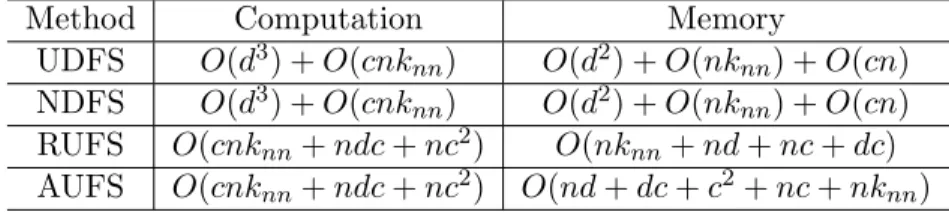
In the era of big data, high dimensional data is prevalent and the number of features is usually very high (otherwise, we may not need feature selection), for example, text data, genetic data, or image data with high resolution. In such cases, both UDFS and NDFS will be prohibitively slow since they share the computation complexity of O d3 and memory complexity of O d2. For practical use of unsupervised feature selection, we require algorithms to be able to handle large number of features and large number of data examples which are not only computationally efficient but also save memory.
Limited-memory quasi-Newton methods [70] are among the best candidates for solving large scale optimization problems when Hessian matrices cannot be computed at a reasonable cost or are not sparse. These methods maintain simple and compact approximations of Hessian matrices using only a few vectors that represent the approximations implicitly. Despite these modest storage requirements, they often yield an acceptable (albeit linear) rate of convergence. In this section, we present an iterative algorithm to efficiently solve Eq. (4.4) using L-BFGS [71] and projected
L-BFGS [72] methods.
To solve RUFS, we first rewrite the optimization problem as follows
min F,G,W kX−GFk2,1+νTr GTLG +βkWk2,1+αkXW−Gk2,1+ζ 4 GTG−Ic 2 F s.t. G∈ Rn+×c,F∈ R+c×d,W ∈ Rd×c (4.5)
whereζ is a parameter to control the orthogonality condition. In practice,ζ should be large enough to insure the orthogonality satisfied. We first define the objective function
L (G,F,W) =kX−GFk2,1+νTrGTLG+αkXW−Gk2,1+βkWk2,1+ζ 4 GTG−Ic 2 F , (4.6) denoting r1 = x1−g1F 2, . . . ,kx n−gnFk 2 T , r2 = x1W−g1 2, . . . ,kx nW−gnk 2 T , r3 = h w1 2, . . . , w d 2 iT ,
the partial derivatives ofL (G,F,W) w.r.t.G,F,and W can be obtained
∇GL = (GF−X)FT [r1⊗11×c] + 2νLG+α(G−XW)[r2⊗11×c] +ζG GTG−Ic
, ∇FL = GT[(GF−X)[r1⊗11×d]],
∇WL = αXT [(XW−G)[r2⊗11×c]] +βW[r3⊗11×c],
of problem (4.5) satisfy the Kuhn-Tucker conditions ∂L ∂Gik = 0 if Gik >0; ∂L ∂Gik ≥0 if Gik = 0 ∂L ∂Fkj = 0 if Fkj >0; ∂L ∂Fkj ≥0 if Fkj = 0 ∂L ∂Wjk = 0 . (4.7)
The projection operator
[TΩM]ij = Mij if Xij >0 min{Mij,0} if Xij = 0 (4.8)
can be helpful because (G∗,F∗,W∗) is a solution of problem (4.5) if and only if
TRn×c + ∇G ∗, T Rc×d+ ∇F ∗,∇W∗=0. (4.9)
Given a toleranceτ, an approximate solution to problem (4.5) is any matrix triplet (G,F,W) such that TRn×c + ∇G, TRc×d + ∇F,∇W ≤τ. (4.10)
In next subsection, we will present a limited-memory BFGS based alternating iterative algorithm to efficiently solve problem (4.5).
4.4.1 Limited-memory BFGS
Recall that each step of the BFGS method has the form
xk+1 =xk−αkHk∇fk, (4.11)
whereαk is the step length and Hk is the inverse Hessian approximation. Since Hk will generally
be dense, the cost of storing and manipulating it is prohibitive when the number of variables is large. To circumvent this problem, limited-memory BFGS computes a modified version of Hk
implicitly by storing a certain number (say, m) of most recent correction pairs {si,yi} using a
two-loop recursive procedure to compute the product Hk∇f efficiently [70] shown in Algorithm1.
The limited-memory BFGS algorithm can thus be stated formally shown in Algorithm 2.
Algorithm 1 L-BFGS two-loop recursion
H0k= s T k−1yk−1 yT k−1yk−1I q← ∇fk for i=k−1, k−2, . . . , k−m do αi ←ρisTi q q←q−αiyi end for r←H0kq for i=k−m, k−m+ 1, . . . , k−1do β ←ρiyTi r r←r+si(αi−β) end for return Hk∇fk=r Algorithm 2 L-BFGS
Input: Staring pointx0 and an integer m >0
k←0
repeat
Compute pk← −Hk∇fk using a two-loop recursion
Compute xk+1←xk+αkpk, whereαk is chosen to
satisfy the Wolfe conditions
if k > m then
Discard the vector pair {sk−m,yk−m} end if
Save sk←xk+1−xk,yk← ∇fk+1− ∇fk
k←k+ 1
until k∇fkk ≤τ Output: xk
When nonnegative constraints are imposed, a projected version of limited-memory BFGS algo-rithm is required. There are various projected limited-memory BFGS algoalgo-rithms, here we choose BMLVM algorithm [72] for its faster speed than L-BFGS-B [73] and ease of use.
4.4.2 RUFS Algorithm
Algorithm 3 BMLVM
Input: Staring pointx0 and an integer m >0
k←0
repeat
Compute pk← −Hk∇fk using a two-loop recursion if hTΩ(Hk∇fk),∇fki>0then
pk← −TΩ(Hk∇fk) else
pk← −TΩ∇fk end if
Compute xk+1←[xk+αkpk]+, whereαk is chosen
to satisfy the Wolfe conditions
if k > m then
Discard the vector pair {sk−m,yk−m} end if Save sk←xk+1−xk,yk←TΩ∇fk+1−TΩ∇fk k←k+ 1 until kTΩ∇fkk ≤τ Output: xk Algorithm 4 RUFS Input: X∈ Rn×d, ν, α, β, c,andp
Construct L from Eq. (4.1) Initialize G0 (e.g., by K-means)
Initialize F0 ← h GTG−1 GTXi + Initialize W0 k←0 repeat
FixingGk, computeWk+1 from
Algorithm2 given Gk,Wk, α, β
FixingFk and Wk+1, compute Gk+1 from
Algorithm3 given Gk,Fk,Wk+1L, ν,and α
FixingGk+1, computeFk+1 from
Algorithm3 given Gk+1,Fk k←k+ 1 until TRn×c + ∇Gk, TR c×d + ∇Fk,∇Wk ≤τ
Output: Sort all dfeatures according to kwjkk2 in descending order and select the top p ranked
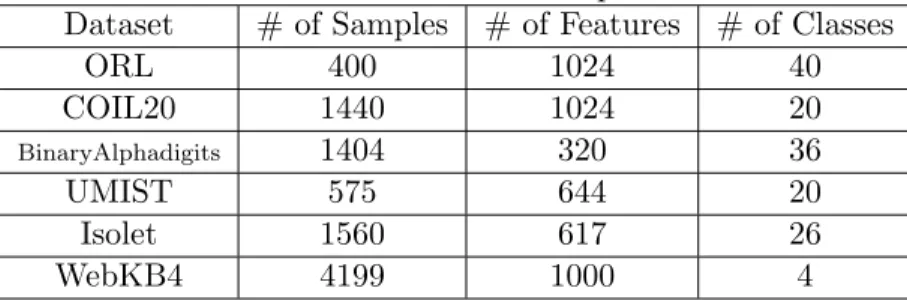
Table 4.1: Dataset Description.
Dataset # of Samples # of Features # of Classes
ORL 400 1024 40 COIL20 1440 1024 20 BinaryAlphadigits 1404 320 36 UMIST 575 644 20 Isolet 1560 617 26 WebKB4 4199 1000 4
be shown to be locally and q-linearly convergent [74].
4.4.3 Complexity Analysis
The two-loop recursion scheme requires O(4tmdc) for computing W and F and O(4tmnc) for computing G, we thus have O(4tm(2d+n)c) scaler multiplications where t is the total number of inner iterations of Algorithm 4. Computing partial gradients w.r.t. G, F, and W are tG ∗
O(3ndc+cnknn),tF∗O(2ndc), andtW∗O(2ndc) respectively, wheretAis the total number of inner
iterations of Algorithm 4 computing matrix A. Evaluation of objective function values requires about #lineSearchIter ∗O(cnknn +ndc +nc2), where knn is the number of nearest neighbors
when constructing the sparse adjacency matrix for computing the local learning regularization matrix. The computation of projection operation can be ignored compared to the computation of gradients and objective function values because only boolean operations are performed. The memory complexity of RUFS isO(nknn+nd+nc+dc). Note that both UDFS and NDFS require
O(d2) +O(nknn) +O(cn) memory cost and O(d3) +O(cnknn) computation complexity, which will
be prohibitively slow when the original feature sizedis very large.
Since the computational complexity and memory cost of RUFS is linear to the feature size d and the data size n, the proposed method can be run on big data. The only restriction is the requirement that data and intermediate matrices should be stored in memory since it is a sequential and iterative algorithm. In this case, one can use Apache Spark1 to process big data as it supports cyclic data flow and in-memory computing.
1
4.5
Experiments
In this section, we conduct experiments to evaluate RUFS. Following previous unsupervised feature selection work [4][5][6], we only evaluate the performance of RUFS for feature selection on clustering due to space limit.
4.5.1 Datasets
The evaluation is performed on 6 benchmark real world datasets including ORL (AT&T)2, COIL203, Binary Alphadigits4, UMIST5, Isolet16, and WebKB4 [46]. Detailed information is summarized in Table4.1.
4.5.2 Visualization of Selected Features by RUFS
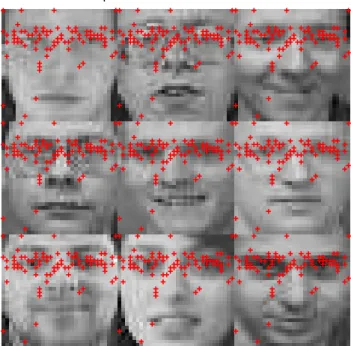
As an illustration, we show top 80 features selected by RUFS on the ORL data set in Figure 4.1. We see that pixels around the eyes, nose, and lips are selected. Actually these features are also important for a human to recognize face. From the figure, we see that unsupervised feature indeed is capable of selecting important features for representing an object.
4.5.3 RUFS Helps Classification
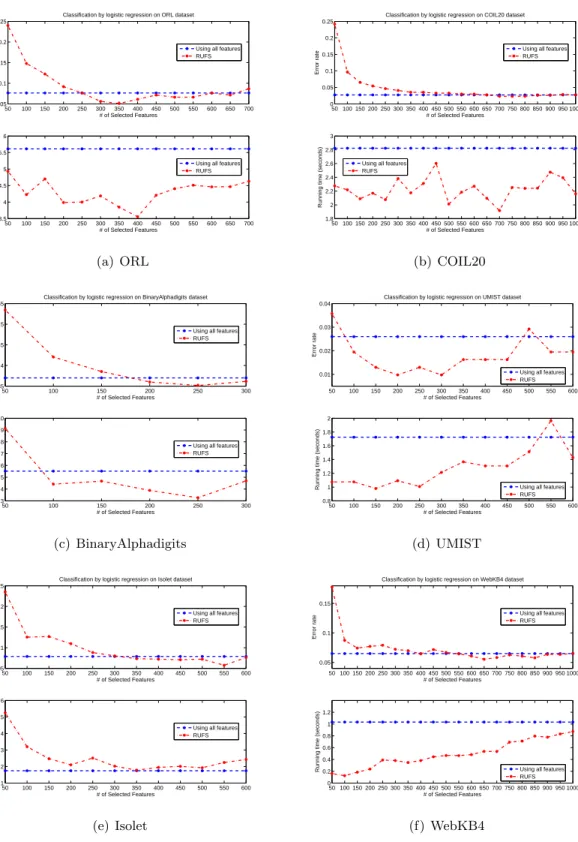
One important question is if unsupervised feature selection can improve classification, which usually required label information for training. We found that RUFS can further improve classification accuracy. For all six real world benchmark datasets, we randomly selected half for training and the remaining half for test. We did unsupervised feature selection by RUFS with α = 10, β = 10, and ν = 10 on all data examples ignoring the labels and plot the accuracy and running time of multi-class logistic regression using different number of top features selected by RUFS on all six real world benchmark datasets in figure 4.2. The figure shows that RUFS improves the classification accuracy and usually reduces the running time for training the classifiers on all six
2 http://www.cl.cam.ac.uk/research/dtg/attarchive/facedatabase.html 3http://www.cad.zju.edu.cn/home/dengcai/Data/MLData.html 4 http://www.cs.nyu.edu/∼roweis/data.html 5http://www.sheffield.ac.uk/eee/research/iel/research/face 6 http://archive.ics.uci.edu/ml/datasets/ISOLET
Top 80 features on ORL dataset
Figure 4.1: Top 80 selected features by RUFS on ORL dataset.
real world benchmark datasets. The lowest error rate could be achieved with an appropriate number of feature chosen between 50 and the feature size. Too few features gives a very poor accuracy because not all important features are selected. On the opposite side, too many features also leads to sub-minimal error rate because irrelevant or noisy features are selected which undermines the classifier.
4.5.4 Compared Methods
We compare RUFS with the following unsupervised feature selection algorithms. 1. Baseline: All original features are adopted.
2. LS: Laplacian Score [11] which selects features that best preserve the local manifold structure. 3. MCFS: Mutli-Cluster Feature Selection [4] where features are selected using spectral
50 100 150 200 250 300 350 400 450 500 550 600 650 700 0.05 0.1 0.15 0.2 0.25
Classification by logistic regression on ORL dataset
Error rate
# of Selected Features
Using all features RUFS 50 100 150 200 250 300 350 400 450 500 550 600 650 700 3.5 4 4.5 5 5.5 6
Running time (seconds)
# of Selected Features
Using all features RUFS (a) ORL 50 100 150 200 250 300 350 400 450 500 550 600 650 700 750 800 850 900 950 1000 0 0.05 0.1 0.15 0.2 0.25
Classification by logistic regression on COIL20 dataset
Error rate
# of Selected Features
Using all features RUFS 50 100 150 200 250 300 350 400 450 500 550 600 650 700 750 800 850 900 950 1000 1.8 2 2.2 2.4 2.6 2.8 3
Running time (seconds)
# of Selected Features Using all features
RUFS (b) COIL20 50 100 150 200 250 300 0.35 0.4 0.45 0.5 0.55
Classification by logistic regression on BinaryAlphadigits dataset
Error rate
# of Selected Features
Using all features RUFS 50 100 150 200 250 300 3 4 5 6 7 8 9 10
Running time (seconds)
# of Selected Features
Using all features RUFS (c) BinaryAlphadigits 50 100 150 200 250 300 350 400 450 500 550 600 0.01 0.02 0.03 0.04
Classification by logistic regression on UMIST dataset
Error rate
# of Selected Features
Using all features RUFS 50 100 150 200 250 300 350 400 450 500 550 600 0.8 1 1.2 1.4 1.6 1.8 2
Running time (seconds)
# of Selected Features
Using all features RUFS (d) UMIST 50 100 150 200 250 300 350 400 450 500 550 600 0.05 0.1 0.15 0.2 0.25
Classification by logistic regression on Isolet dataset
Error rate
# of Selected Features
Using all features RUFS 50 100 150 200 250 300 350 400 450 500 550 600 1 2 3 4 5 6
Running time (seconds)
# of Selected Features
Using all features RUFS (e) Isolet 50 100 150 200 250 300 350 400 450 500 550 600 650 700 750 800 850 900 950 1000 0.05 0.1 0.15
Classification by logistic regression on WebKB4 dataset
Error rate
# of Selected Features
Using all features RUFS 50 100 150 200 250 300 350 400 450 500 550 600 650 700 750 800 850 900 950 1000 0 0.2 0.4 0.6 0.8 1 1.2
Running time (seconds)
# of Selected Features
Using all features RUFS
(f) WebKB4
Figure 4.2: Classification error rate under different number of top selected features by multi-class logistic regression on all six real world benchmark datasets.
Table 4.2: Clustering Results (ACC%±std) of Different Feature Selection Algorithms.
Dataset All Features Laplacian Score MCFS UDFS NDFS RUFS ORL 51.1±3.2 47.2±2.5 49.7±3.7 51.3±3.0 52.3±3.2 53.4±3.8 COIL20 60.4±4.5 56.4±4.6 60.9±4.7 59.8±4.4 59.7±3.3 62.0±3.2 BinaryAlphadigits 41.0±2.1 42.3±1.8 41.8±2.3 42.4±1.8 42.4±1.7 42.7±1.7 UMIST 41.7±2.5 44.1±2.7 45.4±2.6 45.3±2.4 48.2±3.6 49.1±3.2 Isolet 59.7±3.6 56.2±3.7 56.9±4.7 56.2±3.8 63.0±4.6 64.5±3.2 WebKB4 69.2±8.6 49.1±7.9 59.5±9.6 60.1±5.8 69.2±6.7 74.2±2.5
Table 4.3: Clustering Results (NMI%±std) of Different Feature Selection Algorithms.
Dataset All Features Laplacian Score MCFS UDFS NDFS RUFS ORL 74.0±1.9 71.5±1.2 73.7±1.8 73.4±1.6 74.9±1.9 75.1±1.8 COIL20 76.3±1.8 71.8±2.0 74.9±2.2 74.7±1.6 76.0±1.6 77.0±2.2 BinaryAlphadigits 57.6±1.3 58.5±0.9 58.3±1.2 58.8±0.9 58.6±0.8 59.4±1.0 UMIST 63.9±1.8 65.9±1.4 66.6±1.7 65.2±1.6 66.5±2.2 68.8±2.4 Isolet 75.9±1.6 73.1±1.5 73.1±1.4 72.8±1.8 78.6±1.6 78.9±1.1 WebKB4 46.7±3.1 29.2±11.5 37.4±15.3 34.5±5.2 45.3±4.9 49.5±2.9
information and feature correlations simultaneously and considers the manifold structure as well.
5. NDFS: Nonnegative Discriminative Feature Selection [6] where features are selected by a joint framework of nonnegative spectral analysis andl2,1-norm regularized regression.
4.5.5 Experiment Setup
Following previous work, two widely used evaluation metrics, i.e., Accuracy (ACC) and Normalized Mutual Information (NMI) are used in this chapter.
There are some parameters to be set. Following previous work, for LS, MCFS, UDFS, NDGS, and RUFS, we fix k= 5 for all the datasets to specify the neighborhood size. To fairly compare different unsupervised feature selection methods, we tune the parameters for all methods by a “grid-search” strategy from
10−6,10−4, . . . ,104,106 . The number of selected features are set as {50,100,150, . . .300} for all datasets. Best clustering results from the optimal parameters are reported for all the algorithms. In the evaluation, we use K-means to cluster samples based on the selected features. Since K-means depends on initialization, following previous work, we repeat clustering 20 times with random initialization for each setup. The average results with standard deviation are reported.
50100 150200 250300 0.1 1 10 100 1000 0 20 40 60 Feature # ACC for BinaryAlphadigits (β = 10)
α 50100 150200 250300 0.1 1 10 100 1000 0 20 40 60 Feature # ACC for BinaryAlphadigits (α = 10)
β 50100 150200 250300 0.1 1 10 100 1000 0 20 40 60 80 Feature # NMI for BinaryAlphadigits (β = 10)
α 50100 150200 250300 0.1 1 10 100 1000 0 20 40 60 80 Feature # NMI for BinaryAlphadigits (α = 10)
β
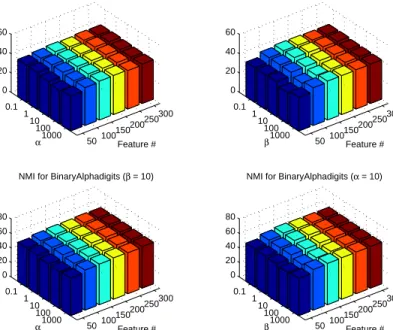
Figure 4.3: ACC and NMI of RUFS with differentα,β and feature numbers while keepingν = 10. Table 4.4: Average Running Time (seconds).
Dataset UDFS NDFS RUFS COIL20 42.4 50.4 32.2
WebKB4 112.9 281.3 86.1 4.5.6 Results and Discussion
We list the experimental results of different methods in Table 4.2and Table 4.3. We observe from the clustering results that feature selection is important and effective. Not only can number of features be significantly reduced which makes posterior processing more efficient, but clustering performance can also be greatly improved. A new observation is that robust analysis is important for unsupervised learning. Consideration of outliers and noise usually improves the performance of feature selection, which has also been observed in supervised scenario. At last, RUFS achieves the best performance. This can be mainly explained by the following reasons. First, joint learning is performed between robust label learning and robust feature selection. Second, local learning is exploited which results in more accurate pseudo labels. Third, outliers and noise are considered dur-ing processes of both label learndur-ing and feature learndur-ing, so that more accurate and discriminative pseudo labels can be obtained.
We also study the sensitiveness of parameters. We only report the results on BinaryAlphadigits dataset withν= 10 (sensitiveness under other values ofν is similar) on Figure4.3. The experimen-tal results show that our method is not very sensitive to α and β with wide ranges. However, the performance is relatively sensitive to the number of selected features, which is still an open problem. For practitioners, we suggest using a validation set with ground truth under an affordable cost to tune the parameters by e.g. grid search. Also different users may label the data points differently, we can group the users by their ways of labeling and ask similar users to construct the validation set to tune parameters that work best for them.
We finally compare the running time of UDFS, NDFS, and RUFS in Table 4.4on COIL20 and WebKB4 datasets (other datasets have either a smaller sample size or a smaller feature size). The calculations are performed using an Intel(R) Core(TM) i7 CPU M620 @ 2.67GHz with 4.00GB memory and 64-bit Windows 7 operating system. The empirical results in Table4.4are consistent with the theoretical analysis.
4.5.7 Limitation
Please be noted that the reason why the small-scale public benchmark datasets are used in the experiments is because researchers in the literature usually compare algorithms on these datasets. One advantage of using these datasets is that it is easier for people to assess and compare different methods. Another advantage is that it doesn’t require expensive distributive system for evaluation, which would allow more researchers to test the algorithms. However, since the experiments are conduct on small-scale datasets, the algorithms’ performance rank might not be exactly the same on large scale datasets. But it can be qualitatively argued that the proposed method would still be superior to the baseline methods because the distribution of outliers on large scale datasets would be similar if it is not exactly the same to these small-scale benchmark real world datasets. For example, the distribution of outliers of a large scale ORL dataset will be highly expected to be similar to the small scale ORL dataset used in this experiment. For quantitative validation, experiments on large-scale datasets need to be done before conclusions could be made on large-scale datasets, which is a promising research direction for future work.
4.6
Summary
In this chapter, we propose a new robust unsupervised feature selection approach called RUFS, which jointly performs robust label learning via local learning regularized robust orthogonal non-negative matrix factorization and robust feature learning via joint l2,1-norms minimization. To
make RUFS be applicable for large scale feature selection tasks, we present a (projected) limited-memory based iterative algorithm to solve it. Experimental results on different real world datasets validate the effectiveness of the proposed method. The proposed method deals with single view data. In the next chapter, we will study how the choice of norms for data fitting and feature selection terms affects the ultimate unsupervised feature selection performance.
Chapter 5
Joint Adaptive Loss and
l
2
/
l
0
-norm
Minimization for Unsupervised
Feature Selection
In the last chapter, we studied unsupervised feature selection from single-view perspective. We’ve seen that the use ofl2,1-norm play an important role. In this chapter, we study how choice of norms
for data fitting and feature selection affects the ultimate unsupervised feature selection performance.
5.1
Introduction
Theoretically speaking, understanding the fundamental aspects of unsupervised feature selection methods is important, because it would provide theoretical and empirical guidance on the design of unsupervised feature selection algorithms, this motivates us to study the desirable properties of models for unsupervised feature selection and propose a new model which meets all properties.
The state-of-the-art unsupervised feature selection methods have three defects. First, [5,6,75] use l2,1-norm to select features. But one disadvantage of l2,1-norm is that it over-penalizes large
weights. As is known, important features usually have larger weights. Good feature selection methods try to get a trade-off between data approximation and joint sparsity of feature weights. However, over-penalizing features with large weights might hurt data approximation performance, and force the algorithm to deviate the learned weights from the true feature weights. An ideal feature selection function should have two properties. (1) It should have the sparsity-inducing property. (2) It should equally penalize large weights and small weights, leading to a fair competi-tion between different features. We see that tradicompeti-tionally favored norms such asl1-norm,l2,1-norm,
andl∞,1-norm are sparsity-inducing convex models that satisfy the first property but fail to comply
with the second property.
Second, the data fitting term is also very important for feature selection for the feature weights are learned from minimizing regularized fitting error. A good fitting term should satisfy two
properties. (1) It should enable the fitting model to approximate normal examples as much as possible. (2) It should impose small penalty on large loss on outliers. However, the squared Frobenius norm [6] only satisfies the first property thus is not robust for outliers, whereas l2,1
-norm [75] only satisfies the second one, thus is sensitive to small loss, i.e., it penalizes more for small loss than squared Frobenius norm.
Based on the observation and reasoning mentioned above, we propose a new unsupervised feature selection method, i.e. Adaptive Unsupervised Feature Selection with explicit l2/l0-norm
(AUFS). We propose to use l2/l0-norm (Rigorously, it is not a norm. People use norm for
con-venience in the literature.) to do feature selection instead of traditional l2,1-norm and use the
adaptive loss to penalize the approximation error instead of squared Frobenius norm andl2,1-norm.
The advantage ofl2/l0-norm is that it not only has the sparsity-inducing property, but also equally
penalizes large weights and small weights. Thus it leads to smaller approximate error and avoids forcing the algorithm to favor small weights. Adaptive loss could achieve a good balance between small loss on normal data examples and large loss on outliers. Actually, when the parameter changes from 0 to∞, the adaptive loss term varies froml2,1-norm to squared Frobenius norm. For
label learning, we use nonnegative orthogonal constrained spectral clustering. We propose to di-rectly solve the nonnegative orthogonal constrained optimization problem by applying the Lagrange multiplier theory. We derive and present an efficient iterative al