In: FMCO 2005, LNCS 4111, pp. 115–137. 1
Smallfoot: Modular Automatic Assertion
Checking with Separation Logic
Josh Berdine1, Cristiano Calcagno2, and Peter W. O’Hearn31
Microsoft Research 2
Imperial College, London 3 Queen Mary, University of London
Abstract. Separation logic is a program logic for reasoning about pro-grams that manipulate pointer data structures. We describe Smallfoot, a tool for checking certain lightweight separation logic specifications. The assertions describe the shapes of data structures rather than their de-tailed contents, and this allows reasoning to be fully automatic. The presentation in the paper is tutorial in style. We illustrate what the tool can do via examples which are oriented toward novel aspects of separa-tion logic, namely: avoidance of frame axioms (which say what a proce-dure does not change); embracement of “dirty” features such as memory disposal and address arithmetic; information hiding in the presence of pointers; and modular reasoning about concurrent programs.
1
Introduction
Separation logic is a program logic geared toward specifying and verifying proper-ties of dynamically-allocated linked data structures [35], which has lead to much simpler by-hand specifications and program proofs than previous formalisms. Specifications in separation logic are “small”, in that a specification of a pro-gram component concentrates on the resources relevant to its correct operation (its “footprint”), not mentioning the resources of other components at all [32]. In this paper we describe Smallfoot, an experimental tool for checking certain separation logic specifications.
The aim of the tool was simple: we wanted to see whether the simplicity of the by-hand proofs in separation logic could be transferred to an automatic setting. Smallfoot uses lightweight assertions that describe the shapes of data structures rather than their detailed contents; this restriction allows the rea-soning to be fully automatic. The input language allows first-order procedures with reference and value parameters, essentially as in [17], together with oper-ations for allocating, deallocating, mutating and reading heap cells. Smallfoot requires pre- and post-conditions for the procedures, and loop invariants. It also supports annotations for concurrency, following a concurrent extension of sepa-ration logic [31, 11].
In [5] we defined the symbolic execution mechanism and proof procedure that lie at the heart of Smallfoot, but we did not there show how they could be used to prove programs. The purpose of this paper is the opposite: to show what the
tool can do, without exposing its innards. We proceed in a tutorial style. We describe in an informal way how the proof rules of [32, 35, 31] are used in the tool, in conjunction with the execution mechanism, but we do not give a fully formal description or a repeat of the techniques of [5]. For a full understanding of exactly how Smallfoot works familiarity with [32, 35, 31, 5] is essential. But we have tried to make the presentation relatively self-contained, and we hope that many of the main points can be gleaned from our examples and the discussion surrounding them.
We begin in the next section by introducing Smallfoot with three examples. The purpose of this work is to explore separation logic’s modularity in an au-tomatic setting, and that is the subject of all three examples. We will discuss some of the features of Smallfoot as we go through the examples, and highlight some of the issues for automation that guided its design. A description of the input language and some central points in the verification condition mechanism is then given in Sections 3 and 4. Several further examples are given in Section 5, and we conclude with a discussion of related and future work.
We stress that Smallfoot is limited in various ways. Its input language has been designed to match the theoretical work on separation logic, rather than an existing widely-used language; our purpose was to experiment with the logic, rather than to produce a mature end-user tool. Beyond the basic primitives of separation logic, Smallfoot at this point includes several hardwired predicates for singly-, doubly-, and xor-linked lists, and for trees, but not (yet) a mechanism for arbitrary inductive definitions of data structures. We included xor lists just to illustrate how reachability does not feature in separation logic; we have not incorporated more general address arithmetic. Smallfoot cannot handle all of the more advanced algorithms that have been the subject of by-hand proofs in sep-aration logic, particularly graph algorithms [40, 6, 7]. Further, it does not have specifications for full functional correctness. Extensions in some of these direc-tions would necessitate abandoning the automatic aspect, relying on interactive proof. Those are areas for further work.
2
Smallfoot in Three Nutshells
We begin with a warning: you should suspend thinking about the global heap when reading separation logic specifications, otherwise the logic can seem coun-terintuitive. Rather than global heaps you can think of heaplets, portions of heap. An assertion talks about a heaplet rather than the global heap, and a spec [P]C[Q] says that ifC is given a heaplet satisfyingP then it will never try to access heap outside ofP (other than cells allocated during execution) and it will deliver a heaplet satisfyingQif it terminates. (Of course, this has implications for how C acts on the global heap.) This heaplet reading may seem a simple point, but we have found that separation logic’s “local way of thinking” can lead to confusions, which arise from reverting to thinking in terms of the global heap. So we will return to this point several times below.
2.1 Local Specifications and Framing Consider a procedure for disposing a tree:
disp_tree(p) [tree(p)] { local i,j;
if (p = nil) {} else {
i :=pl; j :=pr; disp_tree(i); disp_tree(j); dispose(p); } } [emp]
This is the expected procedure that walks a tree, recursively disposing left and right subtrees and then the root pointer. It uses a representation of tree nodes with left and right fields, and the empty tree is represented by nil.
This Smallfoot program includes a precondition and postcondition, corre-sponding to a partial correctness specification:
[tree(p)] disp_tree(p) [emp]
(We use square instead of curly brackets, despite treating partial correctness, to maintain consistency with Smallfoot’s concrete syntax.) This is an example of the small specifications supported by separation logic: it talks only about the portion of heap relevant to the correct operation of the procedure. In particular,
tree(p) describes a heaplet whereppoints to a tree,and where there are no junk cells, cells not in the tree. This “no junk cells” part is necessary to be able to conclude emp, that the heaplet on termination is empty.
Smallfoot discovers a proof of this program by symbolic execution. The proof in the else branch corresponds to the proof steps:
[(p7→l:x, r:y)∗tree(x)∗tree(y)] i :=pl; j :=pr; [(p7→l:i, r:j)∗tree(i)∗tree(j)] disp_tree(i); [(p7→l:i, r:j)∗tree(j)] disp_tree(j); [p7→l:i, r:j] dispose(p); [emp]
After we enter the else branch we know thatp6=nil so that, by unrolling,pis an allocated node that points to left and right subtrees occupying separate storage. Then the roots of the two subtrees are loaded into i and j. Notice how the next proof steps follow operational intuition. The first recursive call removes the left subtree, the second call removes the right subtree, and the final instruction removes the root pointer p. The occurrences of the separating conjunction ∗in these assertions ensure that the structures described, the two subtrees and root pointer, occupy separate memory, as is necessary if an operation that removes one of them is not to affect one of the others. This verification is carried out using the specification ofdisp_treeas an assumption, as in the usual treatment of recursive procedures in Hoare logic [17].
In the if branch we use an implicationtree(p)∧p=nil⇒emp, which relies on the “no junk” character of the treepredicate.
The assertions in this proof use very little of separation logic; they are all of the formΠ∧Σwhere Π is a pure boolean condition andΣis a∗-combination of heap predicates. All of the assertions in Smallfoot are of this special form (together with conditionals over them), and this enables a symbolic execution mechanism where∗-conjuncts are updated in-place.
There is a hidden part in the proof outline just given: in the two procedure calls the preconditions at the call sites do not match the preconditions for the overall specification ofdisp_tree. For example, for the second call the assertion at the call site is (p7→l:i, r:j)∗tree(j) while the procedure spec would suggest that the precondition should just betree(j) (after renaming of the parameter). This is where the local way of thinking comes in. The specification ofdisp_treesays that a heaplet satisfyingtree(j) is transformed into one satisfyingemp. The input heaplet need not be the whole heap, we can effect this transformation on a heap-let that lives inside a larger heap, and then slot the result into that larger heap. In separation logic, this pulling out and slotting in is described using the ∗ connective. Generally, a heaplet hsatisfies P∗Q if it can be split into two disjoint heapletshP andhQthat satisfyPandQ. The above narrative for the call
disp_tree(j)tells us to take (p7→l:i, r:j)∗tree(j), pull out the heaplet description
tree(j), transform it toemp, and slot that back in, obtaining (p7→l:i, r:j)∗emp. Then, we can use an identity P∗emp ⇔P.
Separation logic has an inference rule (the frame rule) [P]C[Q]
[R∗P]C[R∗Q]
(whereCdoesn’t assign toR’s free variables) which lets us do “pull out, perform local surgery, slot in” in a proof. To automatically generate proofs using this rule, which was implicitly applied in the steps in the proof for the else branch above, we need a way to infer frame axioms. If we are given an assertion at a call site and a procedure precondition, we must find the leftover part (which lets us do the “pull out” step). Often, this leftover part can be found by simple pattern matching, as is the case in thedisp_treeexample, but there are other cases where pattern matching will not do. Technically, Smallfoot uses a method of extracting frame axioms from incomplete proofs in a proof theory for entailments [5]. 2.2 Processes that Mind Their Own Business
Concurrent separation logic [31] has the following rule for parallel composition: [P]C[Q] [P0]C0[Q0]
[P∗P0]CkC0[Q∗Q0]
where C does not change variables free in P0, C0, Q0, and vice versa. The idea of this rule is that the specifications [P]C[Q] and [P0]C0[Q0] describe all the resources that C and C0 might access, that they mind their own business; so,
if we know that the resources are separate in the precondition, then we can reason about the concurrent processes independently. A simple example of this is a parallel composition of two heap alterations on different cells, where the∗ in the precondition guarantees that xandy are not aliases:
[x7→c: 3 ∗ y7→c: 3] [x7→c: 3] xc :=4 [x7→c: 4] [y7→c: 3] yc :=5 [y7→c: 5] [x7→c: 4 ∗ y7→c: 5]
The local thinking is exercised more strongly in concurrent than in sequential separation logic. A points-to fact x7→c: 3 describes a heaplet with a single cell x that is a record with ac field whose value is 3. As far as the left process is concerned, reasoning is carried out for a heaplet with a single cell, its heaplet, and similarly for the right. In the global heap, though, it is not the case that there is only one cell; there are at least two! The two views, local and more global, are reconciled by the form of the concurrency rule.
To apply the concurrency rule automatically we need a way to get our hands on the preconditions of the constituent processes. We could do this in several ways, such as by requiring an annotation with eachk, or by introducing a “named process” concept which requires a precondition but no postcondition. We settled on requiring the constituents of a k to be procedure calls; because procedures come with pre/post specs we can use their preconditions when applying the concurrency rule. The postconditions are not strictly necessary for automating the concurrency rule. We made this choice just to avoid multiplying annotation forms. A Smallfoot program corresponding to the above example, but where we create the two separate cells, is:
upd(x,y) [x7→] {xc :=y;} [x7→c:y] main() {
x :=new(); y :=new(); xc :=3; yc :=3; upd(x,4) k upd(y,5);
} [x7→c: 4∗y7→c: 5]
In the precondition ofupdthe assertionx7→indicates thatxpoints to something. It denotes a singleton heaplet in which xis the only allocated or defined cell. The postcondition describes a singleton heaplet where the c field of locationx hasy as its contents.
When a pre- or post-condition is left out, as the pre formainis in this program, it defaults toemp. Also, Smallfoot accepts a collection of procedures as input, one optionally “main”.
In contrast, when we change the main program to main() {
x :=new(); xc :=3; y :=x; upd(x,4) k upd(y,4);
then Smallfoot flags an error; sincexandy are aliases, there is no way to split the heap into two parts, giving one symbolic cell to each of the constituent processes. In general, if a Smallfoot program has a race — where two processes may attempt to access the same cell at the same time — then an error is reported. (More precisely, any such attempted parallel accesses must be wrapped in critical sections which specify atomicity assumptions for accesses.)
Our description of how the proof is found for sequentialdisp_treeis almost the same for a parallel variant, which Smallfoot proves using the concurrency rule: par_disp_tree(p) [tree(p)] { local i,j; if (p =nil) {} else { i :=pl; j :=pr; par_disp_tree(i) k par_disp_tree(j); dispose(p); } } [emp]
The reader’s reaction todisp_treeandpar_disp_treemight be: aren’t they rather trivial? Well, yes, and that is part of the point. For contrast, consider par_disp_tree in the rely/guarantee formalism [21, 27], which is rightly cele-brated for providing compositional reasoning about concurrency. In addition to a precondition and a postcondition saying that the nodes in the tree are deallo-cated, we would have to formalize two additional assertions:
Rely No other process touches my tree tree(p); and Guarantee I do not touch any storage outside my tree.
Although compositional, as this example demonstrates the relies and guarantees can be rather global, and can complicate specifications even in simple examples when no interference is present. The Smallfoot specification for this procedure is certainly simpler.
2.3 Process Interaction and Heaplet Transfer
Process interaction in Smallfoot is done with conditional critical regions (ccrs) [18]. The programming model is based on “resources” r and ccr statements withrwhen(B){C}.ccrs for common resourcermust be executed with mutual exclusion, and each has a guard which must hold before execution.
Data abstractions can be protected withccrs by wrapping critical regions around code that accesses a data structure. A more daring form of concurrency is when several processes access the same piece of state outside of critical sec-tions [31]. In separation logic it is possible to show that daring programming idioms are used consistently. An example is a pointer-transferring buffer: in-stead of copying a (perhaps large) portion of data from one process to another, a pointer to the data is sent. Typically, the sending and receiving processes access the pointer without synchronization.
A toy version of this scenario is the following code snippet using buffer op-erationsputandget:
x :=new(); put(x); get(y;); dispose(y);
This creates a new pointer in the left process and then places it in the buffer. The right process then reads out the pointer and disposes it. We would typically want to fill the pointer contents in the left process before sending it, and to do something with those contents in the right. The point is that to reason about thedisposein the right process we must know thatyis not dangling after we do the getoperation. It is useful to use the intuition of “permission to access” to describe this [9, 8]: the permission to access the pointer moves from the first to the second process along with the pointer value. Further, when permission transfers it must disappear from the left process or else we could mistakenly justify a further dispose(x) in the left process, after the put. In conjunction with the dispose(y)in the right process that would disastrously lead to a double-disposal that we must rule out.
This is where the local way of thinking helps. An assertion at a program point describes a heaplet, which represents a local permission to access, instead of a global heap.put(x) will have preconditionx7→and postconditionemp, the idea being that the heaplet forxflows out of the left process and into the buffer. Theemppostcondition ensures that, even if the value of xremains unchanged, the local knowledge that x is not dangling (the permission) is given up, thus preventing further disposal. At this point the global heap is not empty, but the heaplet/permission for the left process is. get(y;) will have precondition emp
and postconditiony7→, connoting that the heaplet (the permission) materializes in the second process.
A Smallfoot program encoding this scenario is: resource buf (c) [ifc=nilthen emp elsec7→] init() { c :=nil; }
put(x) [x7→] { with buf when(c=nil) { c :=x; } } [emp]
get(y;) [emp] { with buf when(c6=nil) { y :=c; c :=nil; } } [y7→] putter() { x :=new(); put(x); putter(); }
getter() { get(y;); /* use y */ dispose(y); getter(); } main() { putter() k getter(); }
In the ccr model resource names are used to determine units of mutual exclusion. Different ccrs with r when(B) {C} for the same resource name r cannot overlap in their executions. Accrcan proceed with its bodyConly when its boolean condition B holds. A resource declaration indicates some private variables associated with the resource (in this case c) and an invariant that describes its internal state.
When we have resource declarations as here aninitprocedure is needed for initialization; when we do not have a resource declaration, the initialization can be omitted. Theinitprocedure is run beforemain; it’s job is to set up the state that is protected by the named resource, by establishing the resource invariant. In this code the omitted preconditions and postconditions are all (by default)
emp, except the post of init which is (by default) the resource invariant (the assertion in the resource declaration). The putand get operations are encoded using little critical regions. The resource buf has an invariant which describes its heaplet: it says that ifc=nil then the buffer has no permission, else it holds permission to access c. The put operation can fire only when c=nil, and so because of the invariant we will know at that point that buf’s heaplet is emp. The assignmentc:=xchanges thebufstate so that the only way for the invariant to be true is ifc7→; the permission to access the pointer (at this point denoted by bothcandx) flows into the buffer. Furthermore, theputoperation cannot have x7→as its postcondition because separation is maintained between the resource invariant and the heaplet assertions for the two processes. A similar narrative can be given about howgeteffects a transfer from the buffer to thegetter process. In fact, the annotations in this code are more than is strictly needed. If we were to inline put andget, then Smallfoot would verify the resulting code. We separated out these operations only to display what their specifications are.
What makes this all work is an inference rule [(P∗Rr)∧B]C[Q∗Rr]
[P]withrwhen(B){C}[Q]
whereRris an invariant formula associated with resourcer. This rule is used to
verify theputandgetprocedures, and the concurrency rule is then used for the composition ofputterandgetter. Even though the program loops, the fact that it gets past Smallfoot ensures that no pointer is ever disposed twice (without an intervening allocation), that there is no race condition, and that the resource invariant is true when not in the middle of a critical section.
Besides the separation between resource and process enforced using∗, this rule (which stems originally from [18]) is wonderfully modular: the precondition and postconditionPandQof accrdo not mention the invariantRrat all. This
allows reasoning about processes in isolation, even in the presence of interaction.
3
The Input Language
3.1 Annotated ProgramsA Smallfoot program consists of sets of resource declarations resourcer(~xr)Rr
where~xrandRrare resourcer’s protected variables and invariant; and procedure
declarations
where procedure f’s parameters~pare passed by reference and~v by value, and assertionsPf andQf aref’s pre- and post-conditions. In this formal description
the preconditions and postconditions have to be included, but we repeat that in the tool if a pre or post is left out then it is emp by default. Assertions are described later; commands are generated by:
E::=x|nil|c|ExorE B ::=E=E|E6=E
S::=x:=E|x:=Et|Et:=E|x:=new()|dispose(E) C::=S|C;C|if(B){C}else{C} |while(B) [I]{C}
| f(~x;E~)|f(~x;E~)kf(~x;E~)|withrwhen(B){C}
There is the additional evident constraint on a program that in any procedure callf(~y;E~) or regionwithrwhen(B){C}the variablef/rmust be defined in a procedure/resource declaration.
Smallfoot programs are subject to certain variable restrictions, which are needed for the soundness of Hoare logic rules; for example, that variable aliasing and concurrent races for variables (not heap cells) are ruled out. These conditions are, in general, complex and unmemorable; they may be found in [4].
3.2 Assertions and Specifications
The assertions are ∗-combinations of heap predicates and ∧-combinations of pure boolean facts, together with conditionals over these. Conditionals are used rather than disjunctions because they preserve the “preciseness” property that is needed for soundness of concurrent separation logic [11]. The heap predicates include the points-to relation, the tree predicate, a predicate for singly-linked list segments and one for xor-linked lists. (We also have conventional doubly-linked lists in Smallfoot, but do not include any examples for them in this paper.)
P, Q, R, I::=Π∧Σ|ifBthenP elseP H ::=E7→ρ|tree(E)|ls(E, E) Π::=B1∧ · · · ∧Bn|true|false | xlseg(E, E, E, E)
Σ::=H1∗ · · · ∗Hn|emp ρ::=t1:E1, . . . , tn:En
The model assumes a finite collection Fields (from which the ti are drawn),
and disjoint sets Loc of locations and Values of non-addressable values, with nil∈Values. We then set:
Heapsdef= Loc*fin (Fields→Values∪Loc)
Stacksdef= Variables→Values∪Loc
In this heap model a location maps to a record of values. The formulaE7→ρcan mention any number of fields in ρ, and the values of the remaining fields are implicitly existentially quantified.
For s ∈ Stacks, h ∈ Heaps, the key clauses in the satisfaction relation for assertions are as follows:
sE=F def iffJEKs=JFKs sE6=F def iffJEKs6=JFKs sΠ0∧Π1 def iffsΠ0andsΠ1 s, hE07→t1:E1, . . . , tk:Ek def
iff h= [JE0Ksr] wherer(ti) =JEiKsfori∈1..k s, hemp
def iffh=∅ s, hΣ0∗Σ1
def
iff∃h0, h1. h=h0∗h1ands, h0Σ0ands, h1Σ1 s, hΠ∧Σ
def
iffsΠ ands, hΣ
For pure assertions Π we do not need the heap component in the satisfaction relation. h =h0∗h1 indicates that the domains of h0 and h1 are disjoint, and that his their graph union. The semantics JEKs ∈ Values of expressions is as expected. We will not provide semantic definitions of the predicates for trees and lists now, but give inductive characterizations of them later.
Each commandC determines a relation:
JCK: (Stacks×Heaps)←→(Stacks×Heaps)∪ {fault}
The fault output occurs when a command attempts to dereference a dangling pointer. For example,xtl:=yproduces a fault when applied to states, h, where s(x) is not a location in the domain ofh. We will not give a formal definition of JCK; when considering concurrency it is especially intricate [11]. The interpreta-tion of Hoare triples is:
[P]C[Q] holds if, whenever given a state satisfying P, C will not pro-duce a fault and, if it terminates, will deliver a state satisfyingQ. More mathematically:s, hP∧(s, h)JCKσ =⇒ σ6= fault∧σQ
This interpretation guarantees thatCcan only access heap which is guaranteed to exist by P. For, if C were to alter heap outside of an assertion P, then it would fault when that heap was deleted, and that would falsify [P]C[Q].
4
Verification Condition Generation
Smallfoot chops an annotated program into Hoare triples for certain symbolic instructions, that are then decided using the symbolic execution mechanism of [5]. Execution reduces these triples to entailments P `Q. These entailments are usually called verification conditions; we will use the same terminology for the output of the chopping phase, before the execution phase.
4.1 Verification Conditions
A verification condition is a triple [P]SI[Q] whereSI is a “symbolic instruction”:
A symbolic instruction is a piece of loop-free sequential code where all procedure calls have been instantiated tojsrinstructions of the form [P]jsr~x [Q]. This form plays a central role in Smallfoot. We use it not only to handle procedure calls, but also for concurrency and for entry to and exit from a critical region.
Semantically, [P]jsr~x[Q] is a “generic command” in the sense of [38]. It is
the greatest relation satisfying the pre- and post-condition, and subject to the constraint that only the variables in~xare modified. An adaptation of generic commands which requires the relation to agree on local and pull out/slot in interpretations of triples, can be found in [33].
Overall, what the execution mechanism does for [P]SI[Q] is start withP and run over statements inSI generating postconditions. For each postconditionP0 thus obtained, it checks an entailmentP0`Qusing a terminating proof theory.
We will not give a detailed description of the symbolic execution mechanism, referring to [5] for the details. (We remark that the presentation there does not include conditional assertionsif BthenPelseQ, but these are easily dealt with.) Instead, we will describe how the mechanism works in a particular case, in the else branch of thedisp_treeprogram.
When we take that branch we have to establish a triple [p6=nil∧tree(p)]C[emp]
where C is the command in the else branch, with procedure calls instantiated tojsrinstructions. Applying the tree unroll rule yields
[p6=nil∧(p7→l:i0, r:j0)∗tree(i0)∗tree(j0)]C[emp]
for fresh variables i0 and j0. After the first two assignment statements in C we are left with:
[p6=nil∧(p7→l:i, r:j)∗tree(i)∗tree(j)]
([tree(i)]jsr[emp]) ;([tree(j)]jsr[emp]) ;dispose(p) [emp]
To apply [tree(i)]jsr[emp] we have to find a frame axiom, using the frame rule from earlier, and it is just (p7→l:i, r:j)∗tree(j). Similarly, in the next step we obtain p7→l:i, r:j as the frame axiom, and finally we dispose p. (Frame infer-ence is not always so easy; for example, ccr examples later require a certain amount of logical reasoning beyond pattern matching.) This leaves us with an easy entailment:
p6=nil∧emp`emp
4.2 VCGen
For each procedure declarationf(~p;~v)[P]C[Q] we generate a set of verification conditions vcg(f,[P]C[Q]). The formal definition can be found in [4], and here we illustrate how it applies to thepar_disp_treeand heaplet transfer examples presented in Sections 2.2 and 2.3.
Recall the specification ofpar_disp_tree: [tree(p)]par_disp_tree(p) [emp]. So for a callpar_disp_tree(i),vcgconsiders a single generic command:
[tree(i)]jsr[emp]
which indicates that the net effect of calling par_disp_tree on i is to con-sume a tree starting from i, produce no heap, and modify no (nonlocal) vari-ables in the process. Using this straight-line command, and the similar one for the call par_disp_tree(j), the net effect of the recursive parallel function calls par_disp_tree(i) k par_disp_tree(j) is to consume trees starting at i and j, produce no heap, and modify no variables. This is the core of the verification condition ofpar_disp_tree, and is expressed by the straight-line command:
[tree(i)∗tree(j)]jsr[emp]
With this, the whole body ofpar_disp_tree is expressed by a conditional com-mand, and sopar_disp_tree’s singlevcis obtained by tacking on the pre- and post-conditions:
[tree(p)]
ifp=0thenelsei :=pl;j :=pr;([tree(i)∗tree(j)]jsr[emp]) ;dispose(p) [emp]
Thisvcis then discharged by symbolic execution, which propagates the precon-dition forward through the command and then checks (for each branch of the execution) that the computed postcondition entails the specified one.
For the heaplet transfer example, theinitprocedure must establish the re-source invariant from preconditionemp, yieldingvc:
[emp]jsr[ifc=nilthen emp elsec7→]
For brevity, if we inlineput andgetinputter andgetter: putter() [emp] {
local x;
x :=new();
with buf when(c=nil) {
c :=x; } putter(); } [emp]
getter() [emp] { local y;
with buf when(c6=nil) {
y :=c; c :=nil; } dispose(y);
getter(); } [emp]
The crux of thevcs of these functions is the straight-line command which expresses the ccrcommands. Forgetterthis is:
[emp]jsr[(ifc=nilthen emp elsec7→)∧c6=nil] ; y:=c;c:= nil
The generic commands for ccr entry and exit act as resource transformers. Recalling that the resource invariant for buf is (if c=nilthen emp elsec7→), the initial generic command expresses that upon entry into theccr, the guard holds and resource invariant is made available to the body. Notice how the invariant is obtained starting fromemp as a precondition, “materializing” inside theccr as it were. Then the body runs, and the final generic command expresses that the body must reestablish the resource invariant prior to exiting the ccr.
Theccrinputterworks similarly, but illustrates resource transfer on exit: [emp]jsr[(ifc=nilthen emp elsec7→)∧c=nil] ;
c:=x
[if c=nilthen emp elsec7→]jsrc [emp]
The use of emp in the postcondition, considering that x6=nil since xwill have just been allocated, effectively deletes the invariantc7→from consideration, and the cell pointed-to byc will not be accessible to the code following theccr.
Thevcs forputterandgetterare then: [emp]
x:=new(); [emp]
jsr
[(ifc=nilthen emp elsec7→)∧c=nil]; c:=x;
[ifc=nilthen emp elsec7→]jsrc[emp]; [emp]jsr[emp]
[emp]
[emp] [emp]
jsr
[(ifc=nilthen emp elsec7→)∧c6=nil]; y:=c;
c:= nil;
[ifc=nilthen emp elsec7→]jsrc [emp];
dispose(y); [emp]jsr[emp] [emp]
Note that, as usual, when verifying a recursive procedure, the procedure’s spec-ification is assumed. Here, this means that each recursive call is replaced by a generic command with the procedure’s pre- and post-conditions.
The main command is then a parallel function call: putter(); getter();
which gives the additional verification condition: [emp] ([emp]jsr[emp]) [emp]
Note that in both of these examples, no analysis of potential interleavings of the executions of parallel commands is needed. Given the resource invariants, the concurrent separation logic treatment of ccrs allows us to just verify a few triples for simple sequential commands.
5
Further Examples
5.1 More on TreesThe specification of disp_treedoes not use ∗, even though the proof does. An example that uses∗in its spec is:
copy_tree(q;p) [tree(p)] { local i,j,i’,j’;
if (p =nil) { q :=p; } else {
i :=pl; j :=pr;
copy_tree(i’;i); copy_tree(j’;j);
q :=new(); ql :=i’; qr :=j’; } } [tree(q)∗tree(p)]
The tree predicate that we use is not sensitive to the contents of the tree, only the fact that it is a tree. So, if incopy_treethe final two steps were
ql :=j’; qr :=i’;
then we would actually have an algorithm for rotating the tree, though it would satisfy the same spec. If, on the other hand, we mistakenly point back into the old tree
ql :=i; qr :=j;
then an error is reported; we do not have separation on termination. The tree predicate that we have used here is one that satisfies
tree(E)⇐⇒(E=nil∧emp)∨(∃x, y.(E7→l:x, r:y) ∗ tree(x)∗ tree(y)) where x and y are fresh. The use of the ∗ between E7→l:x, r:y and the two subtrees ensures that there are no cycles, the ∗ between the subtrees ensures that there is no sharing (it is not a dag), and the use ofemp in the base case ensures that there are no cells in a memory satisfyingtree(E) other than those in the tree. The fact that the specification does not mention any data field is what makes this a shape specification, insensitive to the particular data.
This definition oftree(E) is not something that the user of Smallfoot sees; it is outside the fragment used by the tool (it has a quantifier). Reasoning inside the tool essentially uses rolling and unrolling of this definition. For instance, the proof step where we entered the else branch uses an entailment
p6=nil∧tree(p)` ∃x, y.(p7→l:x, r:y)∗tree(x)∗tree(y)
together with stripping the existential (generating fresh variables) when the right-hand side is subsequently used as a precondition.
5.2 Linked Lists
We now give an example, using lists, that cannot be handled using simple (un)rolling of an inductive definition. We work with linked lists that use field tl
for the next element. The predicate for linked-list segments is the least satisfying the following specification.
A complete linked list is one that satisfiesls(E,nil).
Consider the following Smallfoot program, where the pre and post use com-plete lists only, but the loop invariant requires a genuine segmentls(x, t). (One would use genuine segments in pres and posts for, e.g., queues.):
append_list(x;y) [ls(x,nil)∗ls(y,nil)] { if (x =nil) { x :=y; }
else {
t :=x; u :=ttl;
while (u 6=nil) [ls(x, t)∗t7→tl:u∗ls(u,nil)] {
t :=u; u :=ttl; }
ttl :=y; } } [ls(x,nil)]
The most subtle part of reasoning in this example comes in the last step, which involves a triple
[ls(x, t)∗t7→tl: nil∗ls(y,nil)] ttl :=y; [ls(x,nil)] We use a symbolic execution axiom
[A∗x7→f:y]xf:=z[A∗x7→f:z]
to alter the precondition in-place, and then we use the rule of consequence with the entailment
ls(x, t)∗t7→tl:y∗ls(y,nil)`ls(x,nil)
of the postcondition. This entailment does not itself follow from simple unrolling of the definition of list segments, but is proven in the proof theory used within Smallfoot by applying the inductive definition to concludels(t,nil) fromt7→tl:y∗
ls(y,nil), and then applying a rule that encodes the axiom
ls(E1, E2)∗ls(E2,nil)`ls(E1,nil)
It is this axiom that does not follow at once from list rolling and unrolling; in the metatheory it would require a proof by induction.
Generally, for each hardwired inductive predicate Smallfoot uses a collection of such rules that are consequences of induction, but that can be formulated in a way that does not require enumeration of inductive hypotheses. The proof theory we have obtained in this manner is complete as well as terminating for entailments involving lists and trees [5].
This ability to prove inductive properties is one of the characteristics which sets this approach apart from Alias Types [39] and its descendants. Alias Types includes coercions to roll and unroll inductive types, but (as far as we under-stand) consequences of induction must be witnessed by loops.
A final comment on this example. In the loop invariant we did not include a ∗-conjunctls(y,nil), which would indicate that the loop preserves the listness of y. The reason we did not include this is thaty’s list is outside the footprint of the loop; Smallfoot discovers it as a frame axiom.
5.3 Information Hiding
The following describes a toy memory manager, which maintains binary cons cells in a free list. When the list is empty, the alloc(x;) operation callsnewin a way similar to how malloc()might call a system routine sbrk() to request additional memory.
resource mm (f) [ls(f,nil)] init() { f :=nil; } alloc(x;) [emp] {
with mm when(true) {
if(f = nil) { x :=new(); } else { x :=f; f :=xtl; } } } [x7→]
dealloc(y) [y7→] { with mm when(true) { ytl :=f; f :=y; } } [emp] The use of ccrs provides mutual exclusion, so that several calls to alloc or dealloc in different process will not interfere. The real point of the exam-ple, though, is information hiding. Because of the modularity of the ccr rule, the interface specifications for alloc and dealloc do not mention the free list at all. Furthermore, the specification of dealloc forces permission to access a deallocated cell to be given up, and this is essential to prevent incorrect usage.
For example, the little main program
main() { alloc(z;); dealloc(z); ztl :=z; }
is flagged as an error by Smallfoot, because the precondition toztl :=zwill be
emp; we must know thatzpoints to something to do a dereference, this program would tie a cycle in the free list.
However, the reason that this program is ruled out is not just because the invariant it violated, it is because the cell z (now in the free list) cannot be touched at all after dealloc(z). For example, if we were to replaceztl :=zby
ztl :=nil then the free list would not be corrupted in the global state, but the example still would not pass Smallfoot; it breaks abstraction by dereferencing a cross-boundary pointer, into the free list abstraction.
The effect of this information hiding can be seen more strongly by replacing the occurrences of newand dispose in the pointer-transferring buffer with calls to the homegrown memory manager.
putter() { alloc(x;); put(x); putter(); }
getter() { get(y;); /* use y */ dealloc(y); getter(); }
If we replace the putter and getter procedures from Section 2.3 with these, include joint initialization of the two resources
init() { f :=nil; c :=nil; }
and leave everything else the same, then the code verifies. If we did not use the ccr rule to hide resource invariants, we would have to “thread” the free list
through the buffer code, forcing us to alter the specifications ofput andgetby includingls(f,nil) in their preconditions and postconditions.
5.4 XOR-deqs
For our final example we considerdeqs – double-ended queues – implemented using an xor-linked list. Recall that an xor-linked list is a compact representation of doubly-linked lists where, instead of using separate fields to store previous and next nodes, their bitwise exclusive or is stored in one field [23]. Besides their entertainment value, using xor lists here demonstrates how Smallfoot does not depend on reachability. The fact that the separation logic triple [P]C[Q] asserts that execution ofC in states described byP will not access any other locations (except possibly locations newly allocated by C) does not depend on whether other such locations are reachable or not. We will also allow concurrent access to thedeq, though that aspect is of secondary importance for the example.
The following predicate describes xor-linked list segments:
xlseg(E1, F1, E2, F2) def
iff (E1=F1∧E2=F2∧emp)
∨(E16=F1∧E26=F2∧ ∃x.(E17→l: (E2xorx))∗xlseg(x, F1, E1, F2))
In reading this definition it helps to think of a picture: E2 xor F1 F2 E1 xor xor
The basic idea is that a resource will own the deq represented as an xor list, while processes accessing the two ends will hold dummy nodes back and
frontwhich will be used for putting elements in thedeq. Operations for getting from thedeqwill release nodes into the calling processes. The resource declara-tion and invariant are as follows; addideclara-tionally, an initializadeclara-tion is needed (code omitted) which sets up the pictured postcondition.
resource xdeq(n,p) [front=p∧back=n∧xlseg(f, n, p, b)] init() { ... } [(front7→l:prevxorf)∗(back7→l:nextxorb)]
In this invariant it helps to consider the picture above: heaps cells corresponding to the nodes n andp (and hence front andback) are not held in the deq, but rather are pointers into the processes that hold them as dummy nodes.
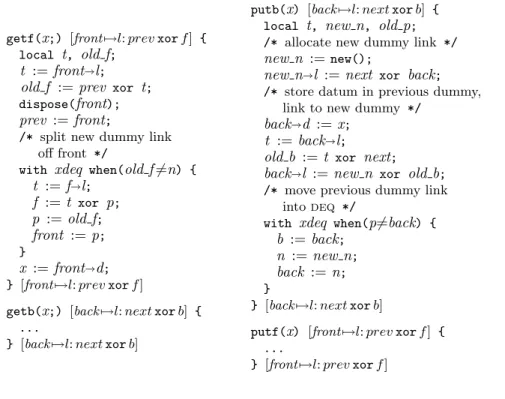
There are four procedures for accessing thedeq: in Table 1 we show the code for putting on the back and getting from the front, and the specifications only for the other two (their code is similar).
What thegetfprocedure does is dispose the dummy node frontit currently has, replacing it with the first node f that is in the deq. This is done by an
Table 1 xor-linkeddeqaccessors
getf(x;) [front7→l:prevxorf] { local t, old f;
t :=frontl;
old f :=prev xor t; dispose(front);
prev :=front;
/* split new dummy link off front */
with xdeq when(old f6=n) {
t :=fl; f :=t xor p; p :=old f; front :=p; } x :=frontd; } [front7→l:prevxorf]
getb(x;) [back7→l:nextxorb] { ...
} [back7→l:nextxorb]
putb(x) [back7→l:nextxorb] { local t, new n, old p; /* allocate new dummy link */
new n :=new();
new nl :=next xor back; /* store datum in previous dummy,
link to new dummy */
backd :=x;
t :=backl;
old b :=t xor next;
backl :=new n xor old b; /* move previous dummy link
intodeq */
with xdeq when(p6=back) {
b :=back;
n :=new n;
back :=n; }
} [back7→l:nextxorb]
putf(x) [front7→l:prevxorf] { ...
} [front7→l:prevxorf]
ownership transfer, within a critical region, similar to what was done in the pointer-transferring buffer in Section 2.3. Note that, althoughfront7→l:prevxorf is true at the beginning and end of the procedure, it is false at intermediate points. Similarly, the putb procedure stores a new item in the d field of its dummy node back, and then effects an ownership transfer where this node gets swallowed into the deq data structure. The crucial point is that the accesses x:=frontdandbackd:=xof the data fields occur outside of critical sections. It is this that allows these accesses to be done in parallel.
[Aside: There is one limitation of Smallfoot that this example shows: in the putb procedure we include a test (p6=back) which happens to be true in any execution. This condition is an additional annotation that Smallfoot needs to verify the code. The difficulty is that two processes may be allocating nodes concurrently, and the allocated nodes will indeed be different, but our current assertions do not allow us to say so, locally. We say “current” because if we change the memory model to allow “existence permissions” [7, 8] then it is pos-sible to do away with the extra annotation in a by-hand proof; we have not, though, incorporated existence permissions into Smallfoot as of yet.]
To show these procedures working, we set up two parallel processesprocfand procbwhich nondeterministically choose whether to do a put or get operation on
the two ends of the deq. (Thenondet keyword was not in the formal grammar for Smallfoot before, but it is in the tool and is implemented by talking both branches of a conditional in symbolic execution.)
procf(x) [front7→l:prevxorf] { if(nondet) { getf(x;); /* usex */ } else { /* produce anx */ putf(x); } procf(x); } [false]
procb(x) [back7→l:nextxorb] { if(nondet) { getb(x;); /* usex */ } else { /* produce anx */ putb(x); } procb(x); } [false] main() procf(42) k procb(13);
Smallfoot verifies the resulting program using a terminating proof theory for facts about xor lists. It involves basic identities for xor, together with adaptations of the rules in [5] for list segments. Again, this example could not be verified without consequences of induction that go beyond rolling and unrolling of an inductive definition, and Smallfoot uses several such for xor lists, akin to the axiom described in Section 5.2.
This is a variant of classic algorithms which allow concurrent access to two ends of a queue. As usual, we could allow multiple processes at each end of the queue by using mutexes to rule out concurrent accesses from the same end.
6
Conclusions and Related Work
Before discussing related work we mention some of Smallfoot’s limitations. First, even when a program’s preconditions and postconditions can be ex-pressed using Smallfoot assertions, we will not be able to verify it if its (loop and resource) invariants cannot be expressed. An example of this is Parkinson and Bornat’s proof [34] of the non-blocking stack of Michael [26]. (Parkinson has verified a different non-blocking algorithm which is included amongst the exam-ples on our web pages, but we are unable to express the invariant for Michael’s algorithm.)
Incidentally, although Brookes has shown that concurrent separation logic rules out races [11], this should not be taken to mean that it cannot be used on programs that are normally considered racy. Generally, one can use littleccrs to explicitly notate statements that are considered atomic, or one could use some other notation (e.g., “atomic”) with the same proof methodology, and that is what Parkinson and Bornat have done in [34].
Second, Smallfoot uses a strict separation model, which does not allow shar-ing of read access. As a consequence it cannot handle, e.g., a readers and writers program, which is proven in [8] using a less strict “counting permissions” model of separation logic. Adding permission accounting is on our to-do list.
Third, it would be straightforward to include inductive definitions, if we were content to just roll and unroll them. However, then very many interesting
programs would not verify. Several examples in this paper involving linked lists required properties to be proven at both ends, and these would not be verifiable using rolling and unrolling alone. A direction for future research is to find a class of inductive definitions and to classify consequences of induction that can be included in a terminating proof theory.
The most closely related works to Smallfoot are the Pointer Assertion Logic Engine [28] and Alias Types [39] and its relatives (e.g. [13, 9]). PALE is stronger than Smallfoot in the range of predicates it considers, based on graph types. The state of development of Smallfoot is more directly comparable to the first version of PALE [20], which was for linked lists only, and we hope to encom-passes some graph structures in the future. Conversely, PALE does not check frame conditions on recursive calls, and this (intentionally) leads to unsound-ness, whereas the treatment of framing is a focus of Smallfoot. Also, PALE does not deal with concurrency. Early on in the Smallfoot development we considered whether we could translate a fragment of separation logic into the fragment of monadic second-order logic that PALE is based on. For some specific assertions it is possible but we were unable to find a general scheme. The decidability of fragments of monadic second-order logic is brittle, and can be broken by adding features. Most importantly, we were unable to see how to give a compositional interpretation of∗.
With regard to Alias Types, there are many similarities. Most importantly, both approaches use a substructural logic or type theory for heaps. We believe it is fair to say that the annotation burden in Smallfoot is considerably less than in Alias Types, owing mainly to inference of frame axioms. Alias Types were aimed at intermediate languages, so that is not a criticism of them. Another difference is that Alias Types use a range of inductive predicates, while we only use several specific predicates. However, our proof theory uses strong and sometimes com-plete inductive properties, such as are needed when working at both ends of a linked list.
The shape analysis of Sagiv, Reps and Wilhelm [37] provides a powerful ver-ification technique for heaps. The biggest problem with the approach is that it is non-modular, in that an update to a single abstract heap cell can necessitate changing the whole abstract heap (some steps to build in modularity have been taken in [36]). We considered whether we could use ideas from shape analy-sis within a single procedure, and leverage ∗’s modularity for interprocedural and concurrent analysis. Again, we had great difficulty dealing with∗ composi-tionally, and further difficulties with thedisposeinstruction. But investigations continue; if this direction worked out it would give us access to a much wider range of abstractions (using “canonical abstraction” [37]).
We are often asked: why did you not just give a deep (semantic) embedding of separation logic in a predicate logic, and then use a general theorem prover, instead of constructing your own proof method? The short answer is that the deep embedding leads to nested quantifiers in the interpretation of ∗, and this is an impediment to automation; attempts so far along these lines have proven to be highly non-automatic. Of course it would be valuable to construct a deep
embedding and develop a range of tactics and make use of general purpose provers, but that is for separate work.
Work on ESC and Spec# has resulted in important advances on modular heap verification [16, 3]. Ideas of ownership and inclusion have been used to classify objects, and give a way of avoiding frame axioms, intuitively related to work on ownership types and semantics [12, 1]. Methods based on fixed own-ership structures have been described (e.g., [25, 14]), but fixed structures are inflexible, e.g., having difficulty dealing with ownership transfer examples (like our pointer-transferring buffer or memory manager), except possibly under dra-conian restrictions (such as unique-pointer restrictions). A recent emphasis has been on using ownership assertions that refer to auxiliary fields that may be al-tered, and this leads to added flexibility [2, 24], including transfer. New schemes are being invented to extend the basic idea, such as a “friends” concept that lets invariants reach across hierarchical ownership domain [30]. We refer to David Naumann’s survey paper for a fuller account of and further references to re-search in this area [29].
In contrast, separation logic does not require a hierarchical ownership struc-ture to ensure locality or encapsulation. Assertions just describe heaplets, por-tions of state, and an assertion encapsulates all of the state that a command is allowed to change. Still, there appear to be some similarities between the owner-ship assertion approaches and the reasons for why separation logic works mod-ularly [41, 33]; there seem to be, in particular, remarkably similar intuitions un-derlying a recent ownership-invariant system for concurrency [19] and concurrent separation logic [31]. A careful comparison of their models could be worthwhile. Modular reasoning about concurrent programs has also received much atten-tion, often based on the fundamental work of Jones, Misra and Chandy [21, 27]. Our remarks at the end of Section 2.2 apply also in any comparison between Smallfoot and tools based on rely/guarantee (e.g. [15]). Our remarks should not be taken to be an ultimate argument for separation logic over rely/guarantee, and it would be interesting to attempt to marry their strong points (easy treat-ment of independence, powerful treattreat-ment of dependence). We should add that the criticisms we made echo comments made by Jones himself [22].
Smallfoot is written in OCaml, and all of the examples in this paper verified in a few milliseconds on an ordinary laptop. We have not included a timing table or other experimental results, because for the small examples we have considered the interpretation of such results would be questionable, except that if the verifications had taken minutes or hours and not milliseconds then that would have been a negative indication. The source code for the current version of Smallfoot (v0.1), together with the examples from this paper and several others, is available for download from the address given in reference [4].
Acknowledgments.Thanks to Matthew Parkinson, who wrote lots of little programs that tested the tool and pointed out a number of bugs. All three au-thors were partially supported by the EPSRC. During Berdine’s stay at Carnegie Mellon University during 2003, his research was sponsored by National Science Foundation Grant CCR-0204242.
References
1. A. Banerjee and D.A. Naumann. Ownership confinement ensures representation independence for object-oriented programs. Journal of the ACM, 52(6):894–960, 2005. Preliminary version in POPL’02.
2. M. Barnett, R. DeLine, M. Fahndrich, K.R.M. Leino, and W. Schulte. Verification of object-oriented programs with invariants.Journal of Object Technology, 3(6):27– 56, 2004.
3. M. Barnett, K.R.M. Leino, and W. Schulte. The Spec# programming system: An overview. InCASSIS’04 post-proceedings, 2004.
4. J. Berdine, C. Calcagno, and P.W. O’Hearn. Verification condition generation and variable conditions in Smallfoot. Available from
http://www.dcs.qmul.ac.uk/research/logic/theory/projects/smallfoot/index.html. 5. J. Berdine, C. Calcagno, and P.W. O’Hearn. Symbolic execution with separation
logic. In3rd APLAS, pages 52–68, 2005.
6. L. Birkedal, N. Torp-Smith, and J.C. Reynolds. Local reasoning about a copying garbage collector. In31st POPL, pages 220–231, 2004.
7. R. Bornat, C. Calcagno, and P. O’Hearn. Local reasoning, separation, and aliasing. Presented at2nd SPACE Workshop, 2004.
8. R. Bornat, C. Calcagno, P. O’Hearn, and M. Parkinson. Permission accounting in separation logic. 32nd POPL, 59–70, 2005.
9. J. Boyland. Checking interference with fractional permissions. In10th SAS, pages 55–72, 2003.
10. P. Brinch-Hansen, editor. The Origin of Concurrent Programming. Springer-Verlag, 2002.
11. S.D. Brookes. A semantics for concurrent separation logic. Theoretical Computer Science, to appear.Preliminary version inCONCUR’04, 2006.
12. D. Clarke, J. Noble, and J. Potter. Simple ownership types for object containment. In15th ECOOP, pages 53–76, 2001.
13. R. DeLine and M. F¨ahndrich. Enforcing high-level protocols in low-level software. In8th PLDI, pages 59-69, 2001.
14. W. Dietl and P. M¨uller. Universes: Lightweight ownership for JML. Journal of Object Technology, 2006.
15. C. Flanagan, S.N. Freund, and S. Qadeer. Thread-modular verification for shared-memory programs. In11th ESOP, pages 262-277, 2002.
16. C. Flanagan, K.R.M. Leino, M. Lillibridge, G. Nelson, J.B. Saxe, and R. Stata. Extended static checking for Java. In9th PLDI, pages 234 - 245, 2002.
17. C.A.R. Hoare. Procedures and parameters: An axiomatic approach. In E. En-geler, editor,Symposium on the Semantics of Algorithmic Languages, volume 188 ofLecture Notes in Mathematics, pages 102–116. Springer-Verlag, 1971.
18. C.A.R. Hoare. Towards a theory of parallel programming. InOperating Systems Techniques, Acad. Press, pages 61-71. Reprinted in [10], 1972.
19. B. Jacobs, K.R.M. Leino, F. Piessens, and W. Schulte. Safe concurrency for ag-gregate objects with invariants. In3rd SEFM, 2005.
20. J. Jenson, M. Jorgensen, N. Klarkund, and M. Schwartzback. Automatic verifi-cation of pointer programs using monadic second-order logic. In4th PLDI, pages 225-236, 1997.
21. C.B. Jones. Specification and design of (parallel) programs. IFIP Conf., 1983. 22. C.B. Jones. Wanted: A compositional approach to concurrency. In A. McIver and
23. D.E. Knuth. The Art of Computer Programming, Volume I: Fundamental Algo-rithms. Addison Wesley, 2nd edition, 1973.
24. K.R.M. Leino and P. M¨uller. Object invariants in dynamic contexts. In 18th ECOOP, pages 491-516, 2004.
25. K.R.M. Leino, A. Poetzsch-Heffter, and Y. Zhou. Using data groups to specify and check side effects. In9th PLDI, pages 246 - 257, 2002.
26. M.M. Michael. Hazard pointers: Safe memory reclamation for lock-free objects. IEEE TPDS, 15(6):491–504, 2004.
27. J. Misra and K.M. Chandy. Proofs of networks of processes.IEEE Trans. Software Eng., 7(4):417–426, 1981.
28. A. M¨oller and M.I. Schwartzbach. The pointer assertion logic engine. In8th PLDI, pages 221-231, 2001.
29. D.A. Naumann. Assertion-based encapsulation, invariants and simulations. In3rd FMCO, pages 251-273, 2005.
30. D.A. Naumann and M. Barnett. Friends need a bit more: Maintaining invariants over shared state. In7th MPC, pages 54-84, 2004.
31. P.W. O’Hearn. Resources, concurrency and local reasoning. Theoretical Computer Science, to appear.Preliminary version inCONCUR’04, 2006.
32. P.W. O’Hearn, J.C. Reynolds, and H. Yang. Local reasoning about programs that alter data structures. In15th CSL. pages 1-19, 2001.
33. P.W. O’Hearn, H. Yang, and J.C. Reynolds. Separation and information hiding. In31st POPL, pages 268-280, 2004.
34. M. Parkinson and R. Bornat. Exploiting linearisability in program logic. Draft paper, 2005.
35. J.C. Reynolds. Separation logic: A logic for shared mutable data structures. In 17th LICS, pages 55-74.
36. N. Rinetzky, J. Bauer, T. Reps, M. Sagiv, and R. Wilhelm. A semantics for procedure local heaps and its abstractions. In32nd POPL, pages 296–309, 2005. 37. M. Sagiv, T. Reps, and R. Wilhelm. Parametric shape analysis via 3-valued logic.
ACM TOPLAS, 24(3):217–298, 2002.
38. J. Schwarz. Generic commands—A tool for partial correctness formalisms. The Computer Journal, 20(2):151–155, 1977.
39. D. Walker and J.G. Morrisett. Alias types for recursive data structures. In 3rd Types in CompilationWorkshop, pages 177-206, 2001.
40. H. Yang. An example of local reasoning in BI pointer logic: the Schorr-Waite graph marking algorithm. Presented at1st SPACE Workshop, 2001.
41. H. Yang and P.W. O’Hearn. A semantic basis for local reasoning. In5th FOSSACS, pages 402–416, 2002.