Prototype Knowledge Management System with Quality Function
Deployment Method: a Case Study at K Software House
Tutik Lestari*, Sofian Lusa**, Arni Retno Mariana***, Nunung Nurmaesah****
*(Department of Science of Technologies, Faculty of Technology and Information, Universitas Budi Luhur, Jakarta, Indonesia) **(Department of Science of Technologies, Faculty of Technology and Information, Universitas Budi Luhur, Jakarta, Indonesia)***(Department of Science of Technologies, Faculty of Technology and Information, Universitas Budi Luhur, Jakarta, Indonesia)
****(Department of Science of Technologies, Faculty of Technology and Information, Universitas Budi Luhur, Jakarta, Indonesia)
---
************************
---Abstract:
The management of human resource development in K sofware house is done in several ways, starting from new recruitment process, employee training, employee placement, employee development, and employee retention. After the training process, the following issues were found: First, the lack of enthusiasm of experienced senior employees on issues facing new employees. Second, after 1 week of basic training, the challenge faced by the new employee was identified and the impact of client satisfaction was not achieved. And finally, K does not yet have the media to share knowledge. The results of the model research yield the priority of making KMS prototype, such as: background of dominant white website, dominant black base font, preferably available dashboard menu, input your knowledge, approval knowledge, graphics, dominant head blue sea, black dominant menu, sea. The test result using UAT stage 75% with good result. This result is seen based on the criteria of functionality related to menu availability and recording employee knowledge. Menu related efficiency based on authorization level, and ease of progress update knowledge, interesting presentation of graph reports and easy access to various platforms.
Keywords —Knowledge Management System, Model Quality Function Deployment, User
Acceptance Test
---
************************
---I. INTRODUCTION
The high competition of Information Technology (IT) business requires companies to implement business processing strategies and business process efficiency.
Failure in IT projects, prompted many software development companies to implement project management. The lack of documentation on previous projects requires that the project team re-analyze the problems occurring, which in turn leads to the project timeline and the inefficiency of the project's operational budget.
In Indonesia, in February 2017 recorded a decrease in the percentage of un-employment rate of 5.33%. When compared with the unemployment rate in August 2016 which has a percentage of 6.18%. Of the total percentage of Indonesia
slow-moving employment population, there are still a small number of workers contributing to the importance of the transfer of knowledge. One effort that can be done by the software developers in Indonesia is to apply knowledge management. In the routine that occurred in the company found the following problems: First, not yet optimal transfer of knowledge that is in the company due to low awareness of senior employees in terms of transferring knowledge owned to junior employees. Second, when an employee has exhausted his / her term of office, then the knowledge of the employee will be lost. This will be detrimental to the company because the employee replacement will experience the process starting from scratch again in gathering knowledge and experience. Not a lot of this process takes a long time, which should work on the software project can be completed more
quickly. Third, when the occurrence of employee movement, the employees have difficulty in carrying out their duties, because the knowledge of employees who served before when on duty has not been documented and still in the minded employees. Fourth, after the process of providing basic training for 1 (one) week, identified the challenges faced by new employees so that the impact of not achieving client satisfaction.
Based on exposure to the above facts, it can be concluded K sofware house not have a medium to share knowledge of the entire process of project management. From the results of identification and analysis, the writer tries to propose a design of KMS prototype model suitable to be implemented in K sofware house. In performing KMS analysis and design, the author uses Quality Function Deployment (QFD) model and tested by User Acceptance Test (UAT).
Based on the analysis outlined in the background, it is concluded that the identification of the problems that become the reference and need special attention is as follows: Firstly, not yet optimal transfer of knowledge that is in the company due to transferring knowledge owned to junior employees. Secondly, when an employee has expired his tenure, then the knowledge of the employee will be lost. This will be detrimental to the company because the employee's substitute will experience the process starting from scratch again in gathering knowledge and experience. Thirdly, occurrence of employee movement, the employees have difficulty carrying out their duties because the knowledge of employees who served before when on duty has not been documented and still in the minded employees. Identify the challenges faced by new employees so that the impact does not achieve client satisfaction.
II. LITERATURE REVIEW
A. Knowledge Management System
Understanding knowledge management system proposed by Rainer & Cegielski (2013) in the form of dynamically enhanced knowledge from time to time. Knowledge in effective KMS is never completed because changes in the environment and knowledge must be updated to reflect these changes.
B. Quality Function Deployment (QFD) Model
QFD is used to improve understanding of customers and to develop products, services and processes in a way that is more customer-oriented (Rampersad, 2006).
The following describes several service quality dimensions in the QFD model (Paryani et al, 2010):
1. Tangibles, is the physical aspects of the service, including the appearance of physical facilities, equipment, personnel and communication services.
2. Reliability, is the ability to provide services as promised, fast and accurate to the customer. 3. Responsiveness, is the willingness to serve
customers by providing services that are fast and responsive.
4. Assurance, that is the ability, knowledge and courtesy to generate trust and confidence to the customer.
5. Empathy, is the willingness to give individual attention to the customer.
C. Matrix House of Quality
The Matrix House of Quality (HoQ) is the best known form of QFD representation (Gaspersz, 2004). This matrix consists of two main parts, the horizontal part of the matrix that contains information and relates to the customer and is called the customer table, the vertical part and the matrix contains the technical information as a response to the customer input and called the technical table.
D. Metode Prototyping
Prototyping method is a mechanism to identify the needs of the software to be produced (Pressman, 2005). This prototyping method between developers and customers can interact and exchange ideas during the system development process.
E. Study Overview
The study review contains descriptions of theories, findings and other research materials derived from reference materials to serve as the foundation for research activities.
(QFD)". In this research it is argued that customer involvement in infrastructure maintenance activities is a complex process due to various parameters of decision making. With reference to maintenance basics in manufacturing and other discipline sciences, QFD can help users who have dynamic needs considering changes in the environment around them. The dynamic thing is overcome with repeated surveys and short interviews, indicators that can predict customer response can be valuable tools to help the QFD decision-making process.
F. Research Concept
The occurrence of repetition of activities and similar analysis on projects that require the project team to re-analyze the problems that occur so that sometimes leads to the timeline of project and inefficiency of project operational costs. It can be underscored that the initial conditions of each existing problem have an adverse effect on the unorganized science in project management and also some of the problems that often occur in project management in software development firms to be used as research objects. Then after the initial conditions are identified, a problem is formulated from the problem. To answer the problem formulation, used some research methodology in the form of QFD model with data collection method of Voice of Costumer and interview and questionnaire stage so as to produce requirement and output design system and impact the presence of knowledge management system. It is then incorporated in the form of KMS prototype application which is the solution at the root of the existing problem so it is expected to be used in the process of project management so that the result of project implementation can support the creation, transfer and application of KMS prototype application and help improve the effectiveness of employee performance of K sofware house.
G. Hypothesis
Based on the concept framework that has been described above, then formulated some temporary hypothesis (temporary answer) with the statement is as follows: It is assumed that the design of effective and suitable KMS model to assist in alleviating the needs of employees in K is the Quality Fucntion
Deployment (QFD) model using the Voice of Customer data gathering (VoC) as the basis for supporting the preparation of the requirements on the system to be developed. It is suspected that the design of this KMS prototype can be applied by using prototype with web based. It is suspected that the KMS prototype testing process is using User Acceptance Test (UAT).
III. METHODS
All paragraphs must be indented. All paragraphs must be justified, i.e. both left-justified and right-justified.
With qualitative method will condition of knowledge management at K at this time and conducted analysis of the factors that influence the formation of knowledge management. K sofware house has 220 employees, and will be surveyed by taking samples. Here's the calculation using Slovin formula:
n = N / ( 1 + N e² ) = 220 / (1 + 220 x 0,10²) = 68,75 ≈ 69.
Information:
n: number of samples N: number of population
e: limit tolerance error (error tolerance)
Thus, the required number of samples is 69 employees. The number of respondents will be 69 employees will be divided into 64 employees based on questionnaires, and 5 employees based on question and answer
by direct interview method in 5 division representatives (implementer, software developer, software designer, software maintenance and quality assurance).
IV. DISCUSSIONS
Based on the data that has been collected and Analysis of research techniques, the authors analyzed the data to be made into a prototype model of knowledge management system, then the steps that are defined at the beginning are the characteristics of the respondents. From the data obtained, the characteristics of respondents can be seen in the following table:
TABLE I
Based on Profile Description Working Period >4 Years
Grade Minimum Supervisor
TABLE III
PROFILE RESPONDENT
After determining the characteristics of respondents and preparing the data of respondents, the authors continue this research to the analysis of the results of observation.
Analysis of User Needs
Based on the general analysis of the activities undertaken at each stage of the project implementation in the software development company, it can be identified as described in the following table:
TABLE IIIII
ANALYSIS OF USER NEEDS
From the results above, the authors continue the next stage of research to formulate KMS prototype model made by mapping and convert the results of interviews and questionnaires that have been collected and analyzed. Here are the results of the analysis of questionnaires that have been done using analysis tools Analysis tools available in monkey surveys.
TABLE IVV
RESULTS OF QUESTIONNAIRE ANALYSIS
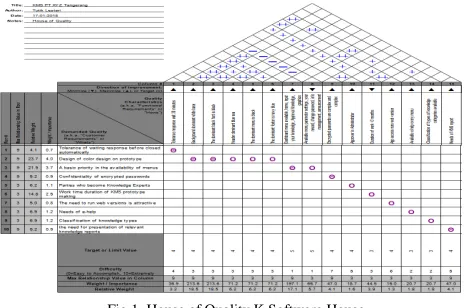
After getting the result from the survey analysis from the questionnaire, then the writer performs the translation stage of the questionnaire result into priority analysis based on user requirement with
QFD model assisted House of Quality (HoQ) calculation to get the result of requirement.
Fig 1. House of Quality K Software House
Based on the results of House of Quality (HoQ) Based on
Profile
Remark Tota
l
% from 69 Respondent
Gender Male 39 56%
Female 31 54%
Delegation of Division
Implementor 32 46% Software Developer 15 21% Software
Maintenance
18 26%
Software Desainer 8 11% Quality Assurance 11 16%
Working Period
1 Year 16 23%
2 Years 30 43%
3 Years 16 23%
>4 Years 8 11%
Requirement Weight
What is the tolerance of the response you want in this KMS prototype before it is closed automatically?
0,69
Needs analysis in designing the existing color design template on KMS prototype.
4,0
Priority needs analysis of the menu that becomes the basic requirement in making prototype.
3,69
Requirement analysis of encrypted password encryption access.
0,88
Needs analysis indicates who becomes Knowledge Expert.
1.05
Time requirement analysis given in KMS prototype work.
1,28
The prototype needs analysis runs the web version attractively.
0,84
Analysis of the need for availability of e-Help in each menu.
1,16
Analysis of the need for classification of the types of knowledge available later.
1.16
Requirement analysis of presentation of relevant knowledge report.
0.88
Requirement QFD
Criteria
Impact of KM Priority needs analysis of the menu that
becomes the basic requirement in making prototype.
Tangible Discovery
Analysis of the need for classification of the types of knowledge available later.
Reability Discovery
Requirement analysis of encrypted password encryption access.
Assurance Discovery
Needs analysis in designing the existing color design template on KMS prototype.
Tangible Capture
Analysis the availability needs of e-Help in each menu.
Responsive Capture
Analysis of the need for authority who becomes Knowledge Expert.
Assurance Sharing
Requirement analysis of presentation of relevant knowledge report.
Reability Sharing
The prototype needs analysis runs the web version attractively.
Responsive Application
What is the tolerance of the response you want in this KMS prototype before it is closed automatically?
Emphaty Application
that has been done calculations, the authors can sort the priorities that can be used as a reference in the development of this KMS prototype, the following results:
Fig 2. Analysis Results House of Quality
After obtaining the results of the analysis based on House of Quality (HoQ) calculations, the writer can proceed to the stages of system requirement identification which includes the analysis of system needs based on functional and non-functional system.
Quality of Software
K sofware house has 220 employees, and conducted a survey. Here's the calculation using Slovin formula:
n = N / ( 1 + N e² ) = 220 / (1 + 220 x 0,10²) = 68,75 ≈ 69.
Information:
n: number of samples N: number of population
e: limit tolerance error (error tolerance)
TABLE V
OVERALL SOFTWARE QUALITY LEVEL
Thus, the required number of samples is 69 employees. However, after the spreading of the questionnaire, the participation rate of respondents has not met the initial requirements of only 20 employees, in other words the author only managed to get 29% of the 69 employees who the author targets.
Summary of Software Quality Testing Results After the prototype is tested its quality using UAT, then obtained a calculation of value on each criterion. To see the results of the test as a whole, can be seen in the following table:
Based on the above test results, it can be concluded that the software quality level to support the process of developing KMS prototype as a whole is included in the criteria of Good value with the percentage of 75%. Results This is seen based on the criteria of functionality related to menu
Criteria
% Actual
Score % Score Ideal
Criteri a Value
Fungsionality
Does this KMS prototype look
appropriate to your needs? 81 100 Good Are the KMS prototype menus able to
support your performance function? 59 100 Enough What is the rate of this KMS prototype
in recording employee knowledge? 57 100 Enough
Usability
Is the KMS prototype easy to use and understood for the novelty process in knowledge management?
83 100 Good
Efficiency
Are the menu that appears, is appropriate to be separated based on the level of each user?
81 100 Good
Is this overall KMS efficient enough to
support performance improvement? 73 100 Enough
Convenience
Does this KMS prototype help view
updates updates? 82 100 Good Does this KMS prototype have the ease
of presenting interesting graph reports? 84 100 Good Does this prototype provide easy access
to the overall knowledge of various platforms?
73 100 Good
Subtotal Score 673 900 Good
Average (%Score ideal / %Actual
availability and recording employee knowledge. Menu related efficiency based on authorization level, and ease of progress update knowledge, interesting presentation of graph reports and easy access to various platforms. Thus, K can overcome the problems encountered and improve the efficiency of employee performance.
V. CONCLUSIONS
Based on the analysis in this study, the authors can conclude several things, namely:
a. The research focuses on the approach of Quality Function Deployment (QFD) method of data collection method of Voice of Customer (VoC) in the form of questionnaires survey and information depth stage through interviews with respondents directly related to research in K.
b. Research use prototype method to produce KMS prototype this form of view based on web based application. The prototype builds on the results of several research variables in the QFD model that bring together the needs of employees by prioritizing the technical needs of system infrastructure. The results of the research produce the priority of making KMS prototype, such as: background of dominant white website, dominant black base font, preferably available dashboard menu, input your knowledge, approval knowledge, graphic, dominant head blue sea, dominant menu black. c. KMS prototype is tested with User Acceptance
Test (UAT) stage. The respondents of K are given an opportunity to test the application
again, and the results are then documented into the UAT Minutes Form.
ACKNOWLEDGMENT
The authors are grateful to the Faculty of Computer Science (Fasilkom), Budi Luhur University Indonesia for funding this research study under the Grant GRS140392.
REFERENCES
[1] Anand and Apurva. (2004). Understanding Knowledge Management: a Literature Review. M.N. National Institute of Technology, Uttar Pradesh, India.
[2] Awad, Elias M., Ghaziri, and Hasan M. (2003). Knowledge Management. Pearson Education,New Jersey.
[3] Becerra, Fernandez, et al. (2003). Knowledge Management: Challanges, Solution and Technologies. Pearson Education, New Jersey.
[4] Bolar, A. Aman, Tesfamariam, and Rehan Sadiq. (2017). ‘Framework for prioritizing infrastructure user expectations using Quality Function Deployment (QFD)’. International Journal of Sustainable Built Environtment. Elsevier. UK. Viewed 28 August 2017.
[5] Cohen, Lou. (1995). Quality Function Deployment, How to make QFD Work for You, Addison-Wesley Publishing Company, New York. [6] Davidson, Carl and Philip Voss. (2003). Knowledge Management and
Introduction to Creating Competitive Advantage from Intellectual Capital, Vision Books, New Delhi.
[7] Dehe, Benjamin, and David Bamford. (2017). ‘Quality Function Deployment and operational design decisions - a healthcare
infrastructure development case study’, Production Planning & Control, viewed August 25 2017,
http://dx.doi/org/10/1080/09537287.2017.1350767.
[8] Dennis, Alan et al. (2012). System Analysis and Design UML Version 2.0 And Object Oriented Approach. USA : John Willey & Kevin Inc. [9] Irma Becera-Fernandez, Avelino Gonzalez, and Rajiv Sabherwal.
(2005). Knowledge Management Challenges, Solution and Technology, Pearson Prenctice Hall, New Jersey.
[10] Newman, B. (1991). An Open Discussion of Knowledge Management, Archives of American Art.
[11] Nonaka, I., and Takeuchi, H. (1995). The Knowledge-Creating Company: How Japanese Companies Create the Dynamics of Innovation New York. Oxford University Press.
[12] Nonaka, I., Takeuchi, H., and Umemoto. (1996). K. A Theory of Organizational Knowledge Creation.
[13] Pressman, B., (2005). Software Engineering, McGraw-Hill.
[14] Sevilla, Consuelo G. et. al. (2007). Research Methods. Rex Printing Company. Quezon City.