Preparation and Characterization of Thalidomide
Hyroxy Propyl
-Cyclodextrin Inclusion Complex
G. Mary Metilda* and J. Prema Kumari1
*Assistant Professor in Chemistry, CSI. Institute of Technology, Thovalai
1Associate Professor in Chemistry,
Scott Christian college and Research Centre, Nagercoil. email: [email protected], [email protected]
(Received on: March 14, 2018)
ABSTRACT
Thalidomide is used as a anti- cancer drug. It is a poorly water soluble drug and possess several dissolution related problems. Solubility of a drug plays a very important role in dissolution and hence absorption of drug which ultimately affects its bioavailability. In order to increase its solubility in water, inclusion complex of Thalidomide with Hyroxypropyl--cyclodextrin(HPα-CD) was prepared. The physicochemical characterization of Thalidomide HPα-CD inclusion complex was performed using UV-Visible, Emission Spectroscopy, FTIR, 1H- NMR, SEM and Phase
solubility studies. The results showed that formation of solid inclusion complex of HPα-CD –Thalidomide could possibly improve the dissolution characteristics of Thalidomide and would provide better bioavailability as compared to conventional dosage form.
Keywords: Thalidomide, Hyroxypropyl --Cyclodextrin, FTIR, 1H -NMR, and SEM.
INTRODUCTION
Cyclodextrins are oligosaccharides which have received increasing attention in the pharmaceutical field because of their ability to form inclusion with many lipophilic drugs thus changing their physicochemical and biopharmaceutical properties.1-2
Thalidomide is a anticancer drug used as a treatment of cancers multiple myeloma3, complication of leprosy, for some symptoms of HIV/AIDS, Crohn's disease, sarcoidosis, graft versus-host disease, rheumatoid arthritis and a number of skin conditions that have not responded to usual treatment4-8. Thalidomide is practically insoluble in water. The poor aqueous solubility of the drug gives difficulties in pharmaceutical formulation and may lead to a variable bioavailability. The objective of the present study was to investigate the physicochemical properties and the possibility of improving the solubility and dissolution rate of Thalidomide with HPα-CD.
EXPERIMENTAL STUDIES
Materials and Methods
Thalidomide was purchased from United Biotech Private Limited, New Delhi and HPα-Cyclodextrin was purchased from Sigma Alrich.
Preparation of Inclusion complex
Drug solution was added to the different concentrations of HPα-CD solution and the absorption spectral measurements were carried out with systronic double beam spectrophotometer 2203 SMART and emission studies carried out with JASCO spectroflurometer FP-8200, FIST-DST lab, Scott Christian College, Nagercoil.
Phase solubility study
This study was carried out according to Higuchi and Corners(1965). The excess amount of drug (more than 0.052g in 10 ml) was added to various concentrations of HPα-CD and shaken for 48 hrs to attain the equilibrium condition. Afterwards the samples were filtered and analysed with UV- deflection at a wavelength at 294.25nm. The apparent solubility constant Kst was calculated9. Kst =Slope/intercept(1-slope).
Preparation of solid inclusion complex:
Accurately weighed drug and HPα-CD solution was mixed and stirred for 48 hrs in a magnetic stirrer. The complex was obtained as a white powder and that was used for the following characterization studies.
Fourier Transform Infrared spectroscopic analysis: The FT-IR spectra of pure drug, pure HPα-CD and inclusion complexes were taken by using 7600 FTIR Spectrophotometer (Shimadzu corporation).
Scanning Electron Microscopy: The drug, HPα-CD and inclusion complex were morphologically analyszed with JEOL-JSM-6390LV scanning microscope, STIC, Cochin.
RESULTS AND DISCUSSION
Absorption and Emission Spectrophotometric Study
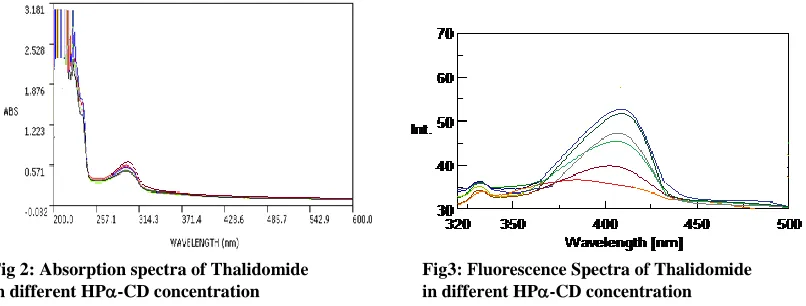
The fig: 2, shows the UV-Vis Spectrocopy of the inclusion complex. As the HPα-CD concentration increases the absorbance as well as the wavelength increases (293.6 to298.4nm), similarly, fig:3 shows the fluorescence spectra of the inclusion complex, the HPα-CD concentration increases the intensity as well as the wavelength increases (388 to 415nm). So both are having bathochromic shift or red shift. This proves that the drug molecule dissolve in HPα-CD and included with the HPα-CD cavity.
Fig 2: Absorption spectra of Thalidomide Fig3: Fluorescence Spectra of Thalidomide in different HP-CD concentration in different HP-CD concentration
Table:1 Absorption maxima (nm) and fluorescence maxima (nm) of Thalidomide in different
HP-CD concentration
S .No HP -CD co n ce n tr a tio n Absorption 0
1
A
A
Emission 01
I
I
𝟏 [𝑯𝑷𝜶 − 𝑪𝑫] m a x (n m ) Abso rb a n ce m a x (n m ) Intensity 1 2 3 4 5 6 0 0.002 0.004 0.006 0.008 0.01 293.6 296.8 298.0 298.4 298.4 298.4 0.472 0.490 0.492 0.500 0.542 0.564 55.56 50.0 35.71 14.29 10.87 388 408 410 410 414 415 37.49 42.91 46.41 48.17 51.83 53.90 0.1845 0.1121 0.0936 0.0697 0.0609 500 250 166.667 125 100They exhibit good linearity. These implied that the inclusion complexes have a stiochiometry of 1:1. The value of formation constant (K) is 43.5 for absorption and 187.5 for emission.
Fig 4 : Plot of 𝟏
𝑨−𝑨𝒐 Vs
𝟏
[𝑯𝑷𝜶−𝑪𝑫] Fig 5 : Plot of
0
1
I I
Vs 𝟏
[𝑯𝑷𝜶−𝑪𝑫]
Phase solubility study
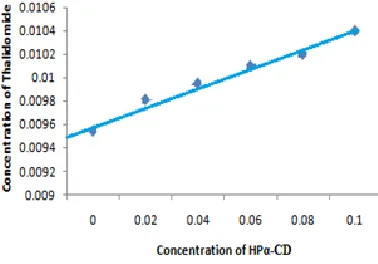
The aqueous solubility of the drug increases as a function of HPα-CD concentration. The phase solubility diagram of Thalidomide in the presence of HPα-CD can be classified as AL type. The apparent solubility constant Kst value was 95 M-1 which indicates that the Thalidomide and HPα-CD forms a soluble complex at 1:1 ratio.
Fig 6: Phase Solubility diagram forThalidomide HPα–CD Complex
FT-IR Spectrocopy
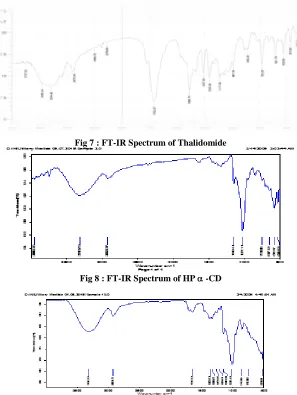
Fig 7 : FT-IR Spectrum of Thalidomide
Fig 8 : FT-IR Spectrum of HP -CD
Fig 9: FT-IR Spectrum of Inclusion complex HP-CD with Thalidomide
1H-NMR study of the complex
Fig 10:1H-NMR Spectra of HPα-CD
Fig 11: 1H-NMR spectra of Thalidomide
Table 2 : Chemical shifts (ppm) for the Protons of HP-CD and inclusion complex
H1 H2 H3 H4 H5
HP-CD 4.990 3.481 3.956 3.370 3.824
Inclusion Complex 5.104 3.387 4.471 3.313 3.630
Fig 12: 1H-NMR spectra of inclusion complex
Scanning Electron Microscopic study
SEM images in fig:13 indicate that the spherical structures appeared in the original morphology of HP α-CD, Thalidomide disappeared and tiny aggregates of amorphous pieces of irregular size was appeared. Here the reduced particale size increased surface area and the close contact between the hydrophilic carrier and Thalidomide might be responsible for the enhanced drug solubility.
(a) (b) (c)
CONCLUSION
Thalidomide - HPα-CD complex (1:1) prepared by inclusion method showed increases in solubliity and dissolution rate in comparision with the plain drug. FTIR, 1H-NMR, and SEM studies confirmed the formation of inclusion complex. The apparent solubility constant value obtained from phase solubility study is an evidance for the increased solubility rate. These techniques would be used to develop fast release formulations of Thalidomide and increase its bio- availability.
REFERENCES
1. Singh Ramnik, Bharti Nitin, Madan Jyotsana, S.N.Hirmath., Characterization of cyclodextrin inclusion complexes. J. of Pharm. Sci. and Tech, 2(3): 171-183 (2010). 2. Loftsson Thorsteinn, Dominique Duchone., Cyclodextrin and their pharmaceutical
applications, Elsevier, 329: 1-11 (2007).
3. Bielenberg DR D’Amore P.A., Judah Folkman’s contrinbution to the inhibition of angiogenesis, Lymphat Res Biol. 6(3-4): 203-207 (2008).
4. Folkman. J., Angiognesis –dependent diseases, Semin Oncol 28 (6) :536-542 ( 2001). 5. Judah Folkman, A pioneer in the study of angiogenesis. Angiogenesis 11:3-10 (2008). 6. Buonsenso.D., Serranti.D., Valentini.P., Management of central nervous system
tuberculosis in children:light and shade. European review for med and pharma. Sciences: 14(10): 845-853 (2010).
7. Van Toorn. R., Solomons. R., Update on the diagnosis and management of tuberclous meningitis in children. Seminars in Pediatric Neurology, 21(1): 8-12 (2014).
8. Silverman.W.A., The schizophrenic career of a monster drug. Pediatrics, 110:6-404 (2002).
9. Brewster.M.E., Loftson.T., Cyclodextrin as pharmaceutical solubilizer, Adv. Drug Del.