INTRODUCTION
This article touches two popular aspects of mod-ern computer sciences. Nowadays, artificial intel-ligence (AI) is one of the fastest improving areas of information technologies. Many global compa-nies are trying to outdo each other in implementing. AI solutions are employed for everyday life tasks, e.g. Tesla is implementing algo-rithms for autonomous cars [19], while Ama-zon is working on a virtual assistant called Al-exa (cloud-based voice service that allows you to use your voice to control smart devices, ask about real-time information and even talk with it) [15]. Google, apart from having its own Al-exa (Google Assistant), works on various dif-ferent projects; however, this is just a tip of an iceberg. There are many other important play-ers in the game, such as Apple or Microsoft. Machine learning (ML) gives us multiple possibilities of implementing the solutions that we were unheard of 50 years ago. Unfortunately, this approach requires high computational com-plexity, which usually results in long time of computing. This is the moment when Parallel
Computing (PC) gives us a lot of opportunities. What is more, we can combine ML and PC and re-ceive extremely powerful as well as fast tools, e.g. for data mining, image and pattern recognition [1].
In the range of intelligent systems and ML development, we have a typical task concerning running some perceptron algorithm with various parameters. After performing calculations, it of-ten turns out that there are difficulties with ob-taining proper results in a short time due to the high computational complexity. The genesis of the research undertaken and presented today is the attempt to simplify and shorten ML process-es. In fact, a relatively simple improvement of the learning process is possible by applying PC in ML algorithm, which was the idea for this paper. Optimization will be shown on the example of perceptron algorithm and Open Multi-Processing (OpenMP) standard that allows building concur-rency platforms for shared-memory parallel and multi-threaded processing. The software con-structed using this standard is characterized by the following advantage: the process of convert-ing a serial sequential source code into a parallel one is easy and only involves input of suitable
Optimization of Machine Learning Process Using Parallel Computing
Michał K. Grzeszczyk
11 Faculty of Electronics and Information Technology, Warsaw University of Technology, Nowowiejska 15/19, 00-665 Warsaw, Poland, e-mail: [email protected]
ABSTRACT
The aim of this paper is to discuss the use of parallel computing in the supervised machine learning processes in order to reduce the computation time. This way of computing has gained popularity because sequential computing is often insufficient for large scale problems like complex simulations or real time tasks. After presenting the foun -dations of machine learning and neural network algorithms as well as three types of parallel models, the author briefly characterized the development of the experiments carried out and the results obtained. The experiments on image recognition, ran on five sets of empirical data, prove a significant reduction in calculation time compared to classical algorithms. At the end, possible directions of further research concerning parallel optimization of calcula-tion time in the supervised perceptron learning processes were shortly outlined.
Keywords: parallel computing, machine learning, perceptron, neural networks, OpenMP
Volume 12, Issue 4, December 2018, pages 81–87
https://doi.org/10.12913/22998624/100341
Research Journal
Accepted: 2018.11.05compiler instructions for quick conversion to a parallel version of a program [9].
The aim of this paper is to discuss the use of PC in the supervised ML processes to reduce the computation time. PC has gained popularity be-cause sequential computing is often insufficient for large scale problems like complex simulations or real time tasks. After presenting the foundations of ML and neural network algorithms as well as three types of parallel models (shared memory, distributed memory and hybrid model), the de-velopment of the experiments carried out (on 5 empirical data sets) and the obtained results were briefly characterized. At the end, possible direc-tions of further research concerning parallel opti-mization of calculation time in the supervised per-ceptron learning processes were shortly outlined.
PERCEPTRON AND MACHINE LEARNING
Automatic learning is taxonomically divided into two groups: supervised and unsupervised learning. Supervised learning assumes that dur-ing the process of learndur-ing an algorithm receives a pair: sample data (specifically a vector) and ex-pected output value (class to which the sample data should be classified) [18], an example of which is perceptron [16]. Then, based on the data samples and their desired value, the algorithm tries to create classifiers that would correctly clas-sify unknown data sample. Unsupervised learn-ing (often called clusterlearn-ing) is contrary to this model. It helps to find new, previously unknown common patterns in the data samples without classifying them beforehand.
As far as terminology is concerned, all fea-ture vectors of the data samples are considered in representation space (E). Each data sample is identified by the class it belongs to (C = {0,1, ..., C}). When a new object that needs to be correctly classified appears, a classifier is needed (G: E → C). The classifier is built on data samples and its goal is to classify data samples correctly – as many times as possible. Every classifier consists of C discriminant functions (DFs):
gc : E → R, 0 ≤ c < C
Classification rule of each data sample (x) is as follows [6]:
ĉ = argmax gc(x), 0 ≤ c < C
The classifier is called linear when all its DFs are linear. Let x be a feature vector of a data sample (x = (1, x1, ..., xD)t) and ac be the vector
of coefficients of linear discriminant functions (LDF) of class c (ac = (ac0, ac1, ..., acD)t). Then: gc(x) = actx
Perceptron is the example of algorithm for building LDFs [7].
The main loop of the perceptron (line 3 in algorithm 1) iterates until convergence (all data samples are classified correctly) or until maxi-mum number of iterations has been reached. The inner loop (line 5) iterates over all data samples. The class of each data sample is known, because perceptron is a supervised learning algorithm [8] (in that case the class of the data sample (xn) is marked as c’). Then the value ( discriminantVal-ue) of the gc’ applied to the xn is counted. The in-nermost loop iterates over all classes. If the class (c) that is currently analysed is not the same as c’ (line 10) and value of the gcapplied to xnplus b (margin parameter) is greater than the discrimi-nantValue, it means that a classification error occurred. In that case, we need to update gcby subtracting from it the feature vector of sx multi-plied by α (learning rate parameter). If at least one classification error appeared, we need to update the weight vector of class c’ as well (this time by adding αxn). This is an example of a very simple neural network.
Perceptron has three parameters that are passed to it during execution: α (learning rate), b (margin) and K (maximum number of iterations). Analysing the influence of each of them of the re-sult of the perceptron one may notice that the pa-rameter α does not have an impact on the quality of the result, it only determines how fast weight vectors are changing (in general the greater α, the smaller number of iterations). This parameter should always be greater than 0. Data samples are linearly separable when there is a possibility of creating such weight vectors that each data sam-ple is classified correctly.
The most important parameter is margin. For linearly separable data, the set b = 0 sometimes can be too small to create good quality of the results. However, if b is greater than 0 and large enough, decision regions for each class will be clearly sep-arated. For non-linearly separable data set b = 0 does not guarantee quality result. For large K and large margin, good quality results can be obtained (only a few samples would be misclassified) [14].
computer (software and hardware) implementa-tion and various applicaimplementa-tions, and useful in gen-eralizing knowledge acquired from empirical data [11].
OPENMP IN PARALLEL COMPUTING
Contrary to traditional sequential computa-tions, PC solves problems concurrently. Many classic algorithms can often be executed in paral-lel but that sometimes requires a change of the data structures or redesigning the algorithm. PC has gained popularity because sequential comput-ing is often insufficient for large scale problems like complex simulations or real time tasks.There are three types of parallel models: shared memory, distributed memory model and hybrid model. In the first one, each processor has access to the whole memory (single computers implement this concept through threads) [12], while in the second one, each processor has its own local memory space. In that case, processors have to communicate with each other through messages to cooperate, just like processes in the operating systems. Therefore, they are used for applying distributed memory model in a single computer. Sometimes, a hybrid model is imple-mented – different units working in shared mem-ory model are integrated as if they were part of distributed memory model [13].
OpenMP is a standardised application pro-gramming interface (API) for shared memory parallel processing [4]. It is developed by most of the largest software and hardware companies such as IBM, Intel or Oracle. It supports most op-erating systems and languages such as: C, C++ or Fortran. The greatest advantages of OpenMP are: simplicity, portability and flexibility. This technology works in a fork-join model for multi-threading [2]. During the execution of a parallel program, the master thread executes sequential parts and if a parallel region appears, the master thread populates slave threads and solves tasks with them in parallel. Then, all the threads are synchronized, and the master thread continues working on the sequential part, and the situation repeats. Because of the fact of using shared mem-ory model mutual exclusion functionality is also provided in the standard.
The usage of OpenMP on a simple example is quite straightforward (alg. 2). In order to ex-ecute a loop in parallel, a special directive needs to be placed above the loop initialization, thanks to which different iterations will be distributed among the available threads. Using the pragma directive, one can easily customize the param-eters of parallelization.
no data dependencies between them). The condi-tions stating independency for two tasks (Tn and Tm executed one after another) are [3]:
1. Input Tm ∩ Output
T
(no flow dependency)2. Input Tn ∩ Output
T
(noanti-dependency)
3. Output Tm ∩ Output
T
(no output dependency)If Bernstein’s conditions are fulfilled, it is possible to run two tasks in parallel without the risk of race conditions.
EXPERIMENTS
While running perceptron, a decision about input parameters has to be made. However, to make the decision about parameters, the data samples have to be analysed. It is simpler and more efficient to run perceptron couple of times with parameters from different orders of magni-tude and then to compare results (alg. 3). In this article, the parameter K will be considered as constant and equal 200. This value is reasonable with many examples. For other two parameters perceptron will be run many times with different values (a,b ∈{0.1, 1, 10, 100, 1000, 10000}).
The time of execution of the perceptron al-gorithm depends on the data set, for the exam-plary data sets, it does not exceed 10 seconds. However, because of running the program with different variations of parameters, the execution time increases dramatically. Computations need to be parallelized to decrease it. In order to decide whether a loop is able to be executed in paral-lel, it has to be analysed by deciding whether it fulfils Bernstein’s Conditions or not. When the
loops are nested, only one loop can be parallel-ized with OpenMP. The strategy is to choose the most outer loop because by that the best efficien-cy is acquired.
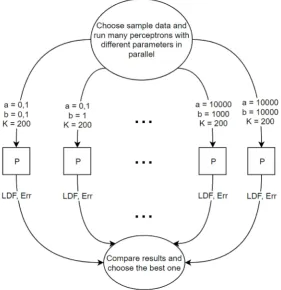
In the perceptron algorithm (alg. 1) only the innermost loop can be parallelized as there are no data dependencies inside it. Two other loops do not fulfil the first Bernstein’s Condition since there are many flow dependencies, especially with all gc variables. In the sequential algorithm, previ-ous loop iterations recount (write) them, while the following read from them and re-count them. Parallelizing the most inner loop would not be ef-ficient (specifically with few classes) due to the synchronization time of threads [17]. However, if perceptron is executed many times, different exe-cutions can be parallelized (Fig. 1). The necessary variables would be made private for each thread – both of the loops from alg. 3 can be parallelized. As stated earlier, the outer loop will be chosen, and results of each perceptron will be stored, in text files. For each execution final LDFs will be stored as well as number of misclassified samples from the training and testing data sets accordingly (training set is 70% of whole randomly shuffled data set, the rest is testing set). The comparison of results is not the aim of this paper.
The experiment was conducted on 5 data sets, courtesy of School of Informatics at Universitat Politecnica de Valencia:
• OCR14x14 – 1000 samples for digits recogni-tion (196 features per sample),
• expressions – 225 facial expressions (4096 features per sample, 5 classes – surprise, hap-piness, sadness, anguish and displeasure), • gauss2D – 4000 samples representing a
bidi-mensional Gaussian distribution of 2 classes that are equally-probable,
Algorithm 3. Perceptron multi-execution
• gender – 2836 facial expressions (1280 fea-tures per class) classified by gender,
• videos – 7985 basket and non-basket videos (2000 features per class) computed from local-feature histograms.
Perceptron was implemented in C language for compatibility with OpenMP. The experiments were performed on a computer characterized by: Ubuntu 16.04, Intel Core i7–6700HQ 2.6 GHz, 4 cores, 8 logical cores and 16 GB RAM.
RESULTS
The results achieved in the experiments are presented in Tab. 1. The parallelized loop was executed maximally with 6 threads, because it has only 6 iterations throughout the experi-ment. Running the algorithm with more than 6 threads would result in the situation that some of them would always stay idle and only take part in the synchronization of threads and increas-ing the execution time. The table presents times of execution of each example data set for 1 to 6 threads (p ∈ {1, ..., 6}). Decreasing time of ex-ecution for an increasing number of threads can be observed. In order to present more clearly
the influence of parallelizing on the time of ex-ecution two additional parameters are presented (Speed-up and Efficiency).
Speed-up shows how the parallel algorithm gains the speed with respect to its sequential version. Here, it is counted as a ratio between time of execution with one thread and time of ex-ecution with p threads [20].
𝑆𝑆(𝑝𝑝) =
𝑡𝑡(1)
𝑡𝑡(𝑝𝑝)
Efficiency is a parameter denoting the us
-age of parallel units by an algorithm [5].
𝐸𝐸(𝑝𝑝) =
𝑆𝑆(𝑝𝑝)
𝑝𝑝
The ideal efficiency of 100% was unreachable, because of the unpredictable load distribution be-tween threads, depending on randomly shuffled data samples and different times of convergence according to the parameters. It is important to notice the data access time – the more threads try to access data, the larger overhead with com-parison to the sequential algorithm. Speed-up and efficiency for shorter times of executions of se-quential algorithms (OCR14x14, gauss2D) were worse than the others because of the
sation time of the threads which exposes itself more for shorter executions. For other example data sets, the results are more satisfying. Taking into account all of the above, the results achieved in the experiments can be interpreted as positive.
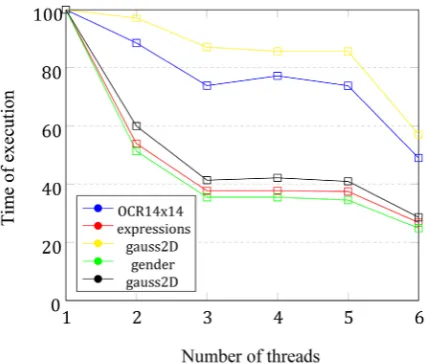
In Fig. 2 the normalized execution times of perceptron for different data sets are presented. It can be noticed that improvement in the time of execution appears when the number of iterations is divisible by the number of threads. In such situ-ations, all of the threads were active. In the case of 4 and 5 threads, there is no possible distribu-tion of 6 iteradistribu-tions among them without some of them remaining idle for some time. This results in the lack of improvement or even deterioration of the execution time due to the longer synchroniza-tion of threads. Perceptron obtained good qual-ity results for each of the data sets. If the training samples were linearly separable, perceptron was converging for some of the executions with
dif-ferent parameters, which would have been chosen as the best ones. Otherwise, it was not converg-ing; however, some of the results for each of the data sets were good for comparison and deciding which one to choose.
CONCLUSIONS
In this paper it was proven that PC can be efficiently used for the improvement of reaching good quality results of supervised learning. The experiments on image recognition, run on five sets of empirical data, clearly state a significant reduction in the calculation time, compared to classical algorithms. Future investigations can cover redesigning perceptron for application of PC with the aid of MPI protocol [10] for distrib-uted memory systems. Many neural network al-gorithms are possible to parallelize, and extensive studies are being carried out in this field. By ap-plying parallel optimization, better results can be achieved and new applications of neural networks for everyday life problems can be reached.
Acknowledgements
The author would like to thank Lecturers from School of Informatics at Universitat Politecnica de Valencia for sharing the knowledge and data sets necessary for writing this article.
REFERENCES
1. Abu-Aisheh Z., Raveaux R., Ramel J. -Y., Mar-tineau P., A parallel graph edit distance algorithm Expert Systems with Applications, Volume 94, 15 March 2018, 41–57.
Table 1. Results from experiments
OCR14x14 Expressions Gauss2D Gender Videos
Samples (n) 1000 225 4000 2836 7985
Features 197 4096 2 1280 2000
Classes 10 5 2 2 2
t(1) (s) 6.135 25.819 0.070 43.206 657.495
t(2) (s) 5.434 13.923 0.068 22.176 394.441
t(3) (s) 4.534 9.738 0.061 15.335 272.166
t(4) (s) 4.739 9.736 0.060 15.333 277.438
t(5) (s) 4.532 9.676 0.060 14.919 269.351
t(6) (s) 3.007 6.928 0.040 10.740 188.172
S(6) 2.04 3.73 1.75 4.02 3.49
E(6) (%) 34.00 62.11 29.17 67.05 58.24
2. Akhter S., Roberts J., OpenMP: A Portable So-lution for Threading. OpenMP provides an easy method for threading applications without burden-ing the programmer, 2010, http://drdobbs.com/ high-performance-computing/225702895 (access: September 2018).
3. Bernstein A. J., Program Analysis for Parallel Pro-cessing, IEEE Transactions on Electronic Comput-ers, EC-15, 1996, 757–762.
4. Bhugul A. M., International Journal of Computer Science and Mobile Computing, Vol. 6, Issue2, February, 2017, 90–94.
5. Colombet L., Desbat L., Speedup and efficiency of large-size applications on heterogeneous networks, Theoretical Computer Science, Volume 196, Issues 1–2, 6 April 1998, 31–44.
6. Devroye, L., Gyorfi, L., Lugosi, G., A probabilistic theory of pattern recognition. Springer: New York, 1996.
7. Duda R. O., Stork D. G., Hart P. E., Pattern Clas-sification, New York: John Wiley & Sons 2001. 8. Freund, Y., Schapire, R. E., Large margin
classi-fication using the perceptron algorithm. Machine Learning. 37 (3), 1999, 277–296.
9. Głowacz A., Pietroń M., Implementation of Digi -tal Watermarking Algorithms in Parallel Hardware Accelerators, International Journal of Parallel Programming, October 2017, Volume 45, Issue 5, 2017, 1108–1127.
10. Gropp W., Lusk E., Doss N., Skjellum A., A high-performance, portable implementation of the MPI message passing interface standard, Parallel Computing. Volume 22, Issue 6, September, 1996, 789–828.
11. Grzeszczyk T. A., Neural Networks Usage in the Evaluation of European Union Cofinanced Proj
-ects, Foundations of Management, Volume 2, Issue 1, 2010, 7–20.
12. Inderpal S., Review on parallel and distributed computing. Scholars Journal of Engineering and Technology, 1(4), 2013, 218–25.
13. Kang S. J., Lee S. Y., Lee K. M., Performance com-parison of OpenMP, MPI, and MapReduce in prac-tical problems, Adv. Multimedia, 2015, 1–9. 14. Mohri M., Rostamizadeh A., Perceptron Mistake
Bounds, 2013, arXiv preprint, https://arxiv.org/ abs/1305.0208 (access: September 2018).
15. Moore R. K. Nicolao M., Toward a Needs-Based Ar-chitecture for ‘Intelligent’ Communicative Agents: Speaking with Intention, Frontiers in Robotics and AI, Volume: 4, Article Number: 66, Dec 2017. 16. Rosenblatt, F., The perceptron: A probabilistic
model for information storage and organization in the brain. Psychological Review, 65(6), 1958, 386–408.
17. Russo A., Sabelfeld, A., Securing Interaction be-tween Threads and the Scheduler in the Presence of Synchronization, The Journal of Logic and Alge-braic Programming, Volume 78, Issue 7, August– September 2009, 593–618.
18. Sathya, R. and Abraham, A., Comparison of Super-vised and UnsuperSuper-vised Learning Algorithms for Pattern Classification. International Journal of Ad -vanced Research in Artificial Intelligence, 2, 2013, 34–38.