54
Performance & Investigation on Bituminous
Mixes Using Natural Fibre
Akash Budhwar
1, Pardeep
21
M. Tech. Student, Department of Civil Engineering, Sat Priya Group of Institutions, Rohtak, Haryana
2
Asst. Professor, Department of Civil Engineering, Sat Priya Group of Institutions, Rohtak, Haryana
ABSTRACT
A bituminous paving mixture is a mixture of coarse aggregate, fine aggregate and bitumen mixed in suitable proportion to result strong and durable mix to withstand traffic load. In this paving mix, normally cement and stone dust are used as filler material. An examination has been completed in this investigation to investigate the utilization of fly cinder, a result of a coal based warm power plant in bituminous clearing blends. For examination, control blends with bond and stone residue have additionally been considered. Marshall test has been considered with the end goal of blend configuration just as assessment of clearing blends. Other execution tests, for example, roundabout rigidity and held security have additionally been completed. It is seen that the blends with fly slag as filler show possibly second rate properties contrasted with control blends and fulfill wanted criteria determined by an a lot higher edge. Henceforth, it has been prescribed to use fly slag any place accessible, decreasing the expense of execution, yet in addition mostly comprehend the fly fiery debris usage and transfer issues. Watchwords: bituminous solid, Marshall properties, ideal bitumen content, roundabout elasticity, hold soundness.
INTRODUCTION
Aggregates bound with bitumen are conventionally used all over the world in construction and maintenance of surface course of a flexible pavement. The surface course ordinarily contains bituminous blends involving coarse total, fine total and filler warmed to reasonable temperature, blended completely with warmed bitumen at required thickness and after that compacted. The bituminous blend might be thick reviewed, hole evaluated or consistently reviewed. Bituminous cement (BC) is a very much evaluated blend containing coarse total (50-60%), fine total (40-half), filler (6-10%), bitumen (5-6%) of all out mass of blend. One of the significant worries of blend plan of bituminous blend is the sort and measure of filler utilized which may influence the exhibition of the blend. Different examinations have been led to think about the properties of mineral filler; by and large the material passing 0.075mm IS strainer, to assess its impact on execution of black-top clearing blend regarding consistency, void filling, Marshall Stability and blend quality. Various examinations have been utilized various sorts of fillers in different kinds of clearing blends which are displayed quickly underneath. Despite the fact that the filler particles are little in size, it is very much recorded that filler applies a huge impact on the attributes and execution of black-top solid blend. Great pressing of the coarse totals, fine totals, and filler gives a solid spine to the blend (Zulkati et al., 2011). Higher filler fixations result in more grounded asphalt inferable from better black-top cohesivity and better interior soundness. Be that as it may, an over the top measure of filler may debilitate the blend by expanding the measure of black-top expected to coat the totals (Kandhal et al., 1998).
When all is said in done, kind of filler, sort of stabilizer, measure of stabilizer influence not just ideal bitumen content (OBC) of clearing blends yet in addition influence the property like Marshall steadiness, elasticity, hold solidness of blends. Likewise OBC of thick evaluated blend is under stone network black-top (Brown and Mallick, 1994). An examination on property of eight unique kinds of mineral filler materials in Europe demonstrated that the filler quality does not influence the presentation of blend (Mogawer and Stuart, 1996). W
55
reasoned that adjusted SMA is better thought about than ordinary SMA (Wu et al., 2007). SMA arranged with metropolitan strong waste incinerator (MSWI) fly fiery debris as a fractional substitution of fine total or mineral filler and Basic Oxygen Furnace (BOF) Slag as a major aspect of coarse total with polyester fiber of 6.35 mm long got from reused crude materials, PG 76-22 bitumen in the blend and performed Marshall and super clear strategy for structure and discovered it's reasonableness for use in the SMA blend (Xue et al., 2009). Four kinds of mechanical side-effect squanders filler to be specific, limestone as reference filler, clay waste residue, coal fly fiery remains, and steel slag residue expands the solidness and weariness life of Stone Mastic Asphalt (SMA) Mixtures (Muniandy and Aburkaba, 2011).
Waste glass control as mineral filler on Marshall property of bituminous by contrasting and bituminous where lime stone, common Portland concrete was taken as filler with shifting substance (4-7%). Ideal glass power substance was found 7%. By utilizing glass control as filler in bituminous its dependability increments up to 13%, stream worth reductions, thickness additionally diminishes as contrast with bituminous contains lime stone and concrete filler (Jony et al., 2011). From above writing it is discovered that exceptionally constrained examination has been done on thick evaluated blends with fly fiery debris as filler. Fly fiery debris is one of the significant waste side-effects of coal based warm power stations. At spots around such plants, fly fiery remains isn't just inexhaustibly accessible, it discovers little use, for which it makes genuine waste transfer issues. Henceforth, in this investigation, an endeavor has been made to investigate the utilization of fly fiery remains, which is generally passing 0.075 mm sifter and has been viewed as filler in bituminous clearing blends by examining different central designing properties.
LITERATURE REVIEW
According to IRC Guidelines, (2016) Road fatalities in India during the year 2015 devoured very nearly 1,42,379 lives Pavement comprises of more than one layer of changed material bolstered by a layer called sub level. By and large asphalt is two kind adaptable asphalt and unbending asphalt. Adaptable asphalts are in this way named because of the total asphalt structure diverts, or flexes, to a lower spot stacking. An adaptable asphalt structure is at times made out of the numerous layers of texture. Each layer gets the heaps from the on high of layer, spreads them out then passes on these heaps to following layer underneath.
Stone Matrix Asphalt (SMA)
Stone framework black-top (SMA), for the most part alluded to as stone mastic black-top, could be a hole evaluated HMA initially created in Europe to amplify rutting opposition and toughness in genuine rush hour gridlock street. SMA contains a high coarse total substance that interlocks to make a stone skeleton that opposes lasting misshapening. The stone skeleton is packed with a mastic of bitumen and filler to that strands ar extra to supply sufficient steadiness of bitumen and to stop seepage of cover all through transport and arrangement. Average SMA organization comprises of 70−80% coarse mixture,8−12% filler, 6.0−7.0% folio, and 0.3 percent fiber. The distortion safe capacity of SMA originates from a coarse stone skeleton giving extra stone-on-stone contact than with standard thick reviewed black-top (DGA) blends. Improved folio durability could be an aftereffects of higher bitumen content, a thicker bitumen film, and lower air voids content.
56 Fig.1: SMA Surface
Fig.2: SMA Lab Sample
Open-Graded Mixes
Dissimilar like dense-graded mixes and SMA, an open-graded HMA mixture is intended to be water pervious. Open-graded mixes use solely crushed stone (or gravel) and a tiny low proportion of factory-made sands. The two commonest open-graded mixes are:
Open-graded Friction Course (OGFC). Generally 15% air voids and no most air voids fixed.
57 OGFC – Used for surface courses solely. They cut back tire sprinkle/splash in wet climate and for the most part lead to smoother surfaces than thick evaluated HMA. Their high air voids cut back tire-street commotion by up to five hundredth. ATPB – Used as a voidance layer beneath thick evaluated HMA, SMA or PCC
Material utilized total (squashed stone or rock and made sands), black-top fastener (with modifiers). OGFC is costlier per ton than thick evaluated HMA, anyway the unit weight of the blend once set up is lower, that part counterbalances the higher per-ton cost. The open degree makes pores inside the blend, that are fundamental to the blend's right perform. Something that will in general stop up these pores, similar to low-speed traffic, over the top soil on the course will corrupt execution.
Fig 3: OGFC Lab Sample
58 MATERIALS AND METHODOLOGY
For preparation of dense graded bituminous mixtures, the grading of aggregates was adopted as per MORTH (2013) for bituminous concrete given below (Table-1). Coarse aggregates consist of stone chips up to 4.75 mm IS sieve collected from a local source. Its specific gravity found in the laboratory was 2.75. Other physical properties of coarse aggregate are given below (Table-2).
Table-1: Adopted aggregate gradation.
Table-2: Physical properties of aggregates.
Fine total includes stone cleans with portions passing 4.75 mm and held on 0.075 mm IS sifter were gathered from a neighborhood smasher. Its particular gravity was observed to be 2.65. The segment of totals passing 0.075 mm is known as filler. Ordinarily, concrete and stone residue are utilized as filler in bituminous blends. So as to investigate the utilization of fly slag a fine waste result of warm power station in bituminous clearing blend, the equivalent gathered from nearby source has been utilized. For examination perspective, bond and stone residue gathered from nearby sources have additionally been utilized in this investigation. The particular gravities of concrete, stone and fly slag utilized in this examination were observed to be 3.1, 2.7 and 2.2, individually.
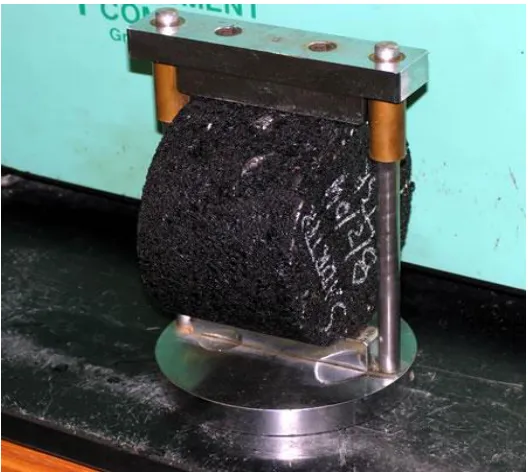
Marshall Test
59 Indirect tensile test (IDT)
In this test a compressive burden is connected on a barrel shaped Marshall example along a vertical polar plane through two bended stacking pieces of 75mm long, 13 mm wide and 13 mm tallness; having inside distance across same as that of Marshall test. The static backhanded elasticity of a given example was resolved utilizing ASTM D 6931 (2012) at temperature change from 50 C to 400 C at augmentation of 50 C. For this test the examples were set up at their particular OBC. The IDT was determined utilizing the condition given in ASTM D 6931 (2012).
RESULTS AND DISCUSSIONS
In this Paper Result and Observation of test carried out in past section is given, dissected and talk about. This part is part into 5 areas. first area is manages parameter utilized for investigation. Second area manages count of Optimum folio Content (OBC) of BC where bond, fly fiery debris, stone residue is utilized as filler. Third area manages computation of Optimum folio Content (OBC) and Optimum Fiber content (OFC), Marshall Properties of BC with or while not utilizing fiber. Fourth area manages estimation of Optimum folio Content (OBC) and Optimum Fiber content (OFC), Marshall Properties of SMA with or while not utilizing fiber. Fifth area manages consequences of Drain down check and Static Indirect Tensile Stress and static Creep check.
Parameters Usesd
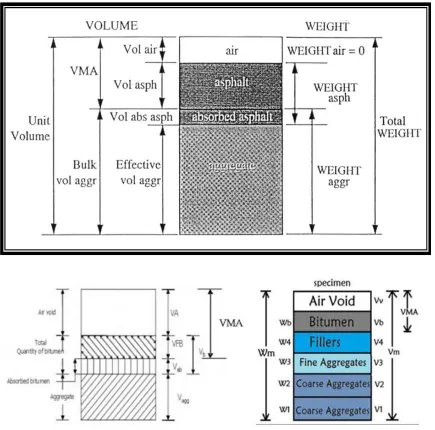
Based on volume considered in evaluating relative density of an aggregate, some definitions of relative density are planned. As per Das A. and Chakroborty P. (2010); the definitions and different formulae employed in calculations hereafter are as follows:
4.1.1 Bulk Specific Gravity Of aggregate (Gsb)
Gsb =
Magg(Mass of aggregate )
vol of (agg .mass +airvoid in agg .+absorb bitumen )
4.1.2 Effective specific gravity of aggregate(Gse)
Gse =
Magg(Mass of aggregate) vol of (agg. mass + airvoid in agg)
Mb = mass of bitumen used in mix and Gb= specific gravity of bitumen
4.1.3 Apparent Specific Gravity (Ga)
Ga=
Magg vol of agg. mass
4.1.4 Theoretical Maximum Specific Gravity of Mix (Gmm)
Gmm =
Mmix
vol of (mix − air voids)
4.1.5 Bulk Specific Gravity of Mix (Gmb)
Gmb =
Mmix bulk vol of mix
4.1.6 Air Voids (VA)
VA = (1 −Gmb Gmm) × 100
4.1.7 Voids In Mineral Aggregates (VMA)
VMA = (1 −Gmb × Ps
Gmm ) × 100
Where Ps = percentage of aggregate present by total mass of mix
4.1.8 Voids Filled With Bitumen (VFB)
60 Fig 5: Phase Diagram of Bituminous Mix
CONCLUSIONS
In this research facility think about, the impact of fly fiery remains, a loss result of coal based warm power station, as filler on thick evaluated bituminous cement (BC) clearing blends as far as different designing properties, has been explored. For correlation purposes, fillers typically utilized, similar to customary Portland bond (OPC) and stone residue have likewise been considered independently as control examples. From the consequences of Marshall Tests and other execution tests directed to investigate the appropriateness of fly fiery debris as filler in BC blends, the accompanying ends have been drawn. ƒ Maximum Marshall Stability and unit weight esteems are seen by bond pursued by stone residue and fly-slag filler. Obviously, the consequences of the stream worth demonstrate the turn around patterns. Anyway it has been seen that the variety is ostensible and at ideal bitumen content the blends fulfill all the Marshall criteria. ƒ
61
debris, which is an additional bit of leeway. ƒ It is seen that the estimation of held dependability (RS) for blends arranged with concrete as filler offers most astounding held solidness worth pursued by stone residue and fly powder filler. Notwithstanding, the varieties are so little to be viewed as noteworthy and all the blends fulfill the base held dependability esteem prerequisite for example 75%. It implies all the blends incorporating that with fly fiery debris as filler have generally excellent protection from dampness actuated harms.
REFERENCES
[1]. Das A., Deol, M. S. Ohri S. and Pandey B. B.(2004). “Evolution of non-standard bituminous mix – a study on Indian specification”, The International Journal of Pavement Engineering, Vol 5(1), pp. 39-46.
[2]. Das A. and Chakroborty P. (2010), “Principles of Transportation Engineering”, Prentice Hall of India, New Delhi, pp 294-299.
[3]. H. Jony Hassan, Y. Jahad Israa (2010), “The Effect of Using Glass Power filler on Hot Asphalt Concrete Mixture Properties”, Engg and Technology journal, vol.29, Issue1, pp44-57.
[4]. IS: 2386 (1963), “Methods of Test for Aggregates for Concrete (P - I): Particle Size and Shape”, Bureau of Indian Standards, New Delhi.
[5]. IS: 2386 (1963), “Methods of Test for Aggregates for Concrete (P-IV): Mechanical Properties”, Bureau of Indian Standards, New Delhi.
[6]. IS: 2386 (1963), “Methods of Test for Aggregates for Concrete (P-III): Specific Gravity, Density, Voids, Absorption, Bulking”, Bureau of Indian Standards, New Delhi.
[7]. ASTM D 6931 (2007), “Indirect Tensile (IDT) Strength for Bituminous Mixtures”.
[8]. ASTM D 1559 (1989), “Test Method for Resistance of Plastic Flow of Bituminous Mixtures Using Marshall Apparatus”.
[9]. Bradley J. Putman and Serji N. Amirkhanian (2004), “Utilization of Waste Fiber in Stone Matrix Asphalt Mixtures”, Resources, Conservation and Recycling, Volume 42, Issue 3, pp 265-274.