Seyed Navid Resalat 1, Valiallah Saba 2*
* Corresponding Author: Valiallah Saba, PhD
Address: Radiation Research Center, Faculty of Paramedicine, AJA University of Medical Sciences, Tehran, Iran. Tel: +98 (21) 34822438 Fax: +98 (21) 88632961
E-mail: [email protected]
A Study of Various Feature Extraction Methods on a Motor
Imagery Based Brain Computer Interface System
Introduction: Brain Computer Interface (BCI) systems based on Movement Imagination
(MI) are widely used in recent decades. Separate feature extraction methods are employed
in the MI data sets and classified in Virtual Reality (VR) environments for real-time
applications.
Methods: This study applied wide variety of features on the recorded data using Linear
Discriminant Analysis (LDA) classifier to select the best feature sets in the offline mode.
The data set was recorded in 3-class tasks of the left hand, the right hand, and the foot motor imagery.
Results: The experimental results showed that Auto-Regressive (AR), Mean Absolute
Value (MAV), and Band Power (BP) features have higher accuracy values,75% more than
those for the other features.
Discussion: These features were selected for the designed real-time navigation. The
corresponding results revealed the subject-specific nature of the MI-based BCI system; however, the Power Spectral Density (PSD) based α-BP feature had the highest averaged
accuracy.
A B S T R A C T
Key Words:
Electroencephalography,
Brain-Computer Interface (BCI),
Automatic data processing
1. Introduction
rain Computer Interface (BCI) is a new communication channel between brain and computer. Although this communication is available for everyone, the disabled and paralyzed patients use it the most. Using this interface, the brain activities are recorded from the scalp in a specified physiological state. Then, they are translated to appropriate external commands in a com-puter. Different modalities of Electroencephalography (EEG), Magneto-encephalography (MEG), and func-tional Magnetic Resonance Imaging (fMRI) are used in BCI, which the former is more applicable due to its
lower experimental cost and a spontaneous and evoked signals are used in EEG-based BCIs. Usually, 5 differ-ent methods are defined in the context of the BCI us-ing the above signals. The mental task, the Movement Imagination (MI) and the Slow Cortical Potential (SCP) methods employ the spontaneous signals, whereas the visual evoked potential and the P300 methods employ the evoked ones (Chin et al., 2010; Resalat, S. N. et al., 2012). MI, also known as motor imagery, is one of the most enjoyable methods of the BCI systems because of its voluntarily generated signals by the subject without external stimulation, even when it is accompanied with the virtual reality. Virtual Reality (VR) is a graphical in-terface (medium), which is defined in terms of special
B
Article info:
Received: 28 February 2015 First Revision: 02 June 2015 Accepted: 21 June 2015
collection on technological hardware, including com-puter, head-mounted monitors, usually headphones, and motion sensing electrodes. Most current VR environ-ments are visual experiences, but some are based on the sound simulations through the headphones. VR is often used to describe a wide variety of applications com-monly associated with immersive, highly visual, and 3D environments (Jingkun et al., 2010). All in all, VR in MI-based BCI could be a graphical interface designed in a computer to not only attract the subjects but also send feedback signals to notify them of their recent MI whether it is performed correctly or not.
For an individual, performing motor imagery consists of imagining the movement on the limbs. Therefore, the resulting signals contain specific temporal and spectral features, which make the movement easy to recognize. For example, the left hand imagination decreases the power of the β rhythm of the EEG over the right mo-tor cortex. Therefore, detecting this decrement could be translated into left hand imagination. This phenomenon appears when the subject imagines the right hand move-ment. In MI-based BCI, once the MI is detected, the cor-responding command will get associated and executed (Lecuyer et al., 2008). An MI task is analyzed by the frequency component of the EEG signals (Ming et al., 2009). A VR-based MI is performed by the entropy fea-ture and, an MI-based BCI is administered by the use of EEG powers in α and β rhythms (Leeb R. et al., 2007).
To analyze and detect desired information in EEG signals, different features and classifiers are used. For decoding and classification of objects through task-ori-ented EEG signals, Taghizadeh-Sarabi et al. used 3 dif-ferent wavelets namely Daubechies 4, Haar, and Sym-let2 for feature extraction method. Selected features were classified by the one-against-one Support Vector Machine (SVM) multi-class classifier. The results in-dicated that symlet 2 had higher performance than the two other methods (Taghizadeh-Sarabi et al., 2015). In another study, Daliri proposed a new kernel approach based on the Earth Mover's Distance (EMD) for EEG signal classification. The results showed that the new kernel method was very effective, and could classify the data with higher accuracy than traditional methods (Daliri, 2013). There are many other studies in the field of BCI while selecting the best feature and classifier is the main purpose of them (Hashemi et al., 2013; Re-salat, S. N. et al., 2015).
In this work, the performance of several widely used features were examined and compared to specify the best features. The effective features over different
fea-ture sets such as statistical feafea-tures, the frequency am-plitudes and components, entropy and band powers, auto-regressive, moving average, discrete cosine, and sine transform were investigated using a VR environ-ment in an MI-based BCI system. In addition, this work, we revealed a military VR for paralyzed veterans due to lack of such VR.
In section two, the materials and the methods used in this study are introduced. Section three presents the experimental results and in section four we discuss the results and make a conclusion of this entire study.
2. Methods
In this research, we implemented a thorough study of different feature sets, which are mostly used in MI-based BCI systems, with the Linear Discriminant Anal-ysis (LDA) classifier. LDA was selected due to its fast-est response time among the other available classifiers (Resalat S. N. et al., 2015; Scherer et al., 2008).
2.1. Electrode montage and the subjects
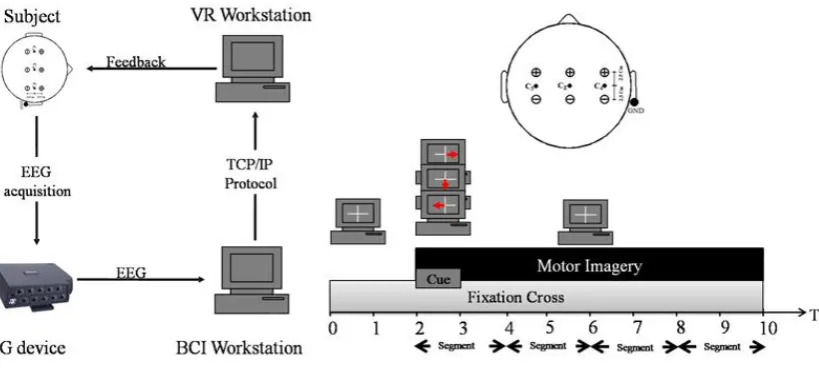
The participants were selected from university stu-dents studying postgraduate degree, master of science (MSc); they were in good health condition with no his-tory of diseases. Five male right-handed subjects with the mean age of 25.6±2.3 years participated in the ex-periments. The study were carried out in the Biomedical Engineering Laboratory of the Science and Research, Branch of the Azad University. All of the subjects were informed about the experiments and signed the consent form. Three channels were positioned at C3, Cz and C4 according to the international 10-20 system for EEG recording and the ground electrode was placed on the right ear lobe. EEG signal acquisition was performed by ProComp Infiniti™ device. The impedance of the elec-trodes, which were less than 1KΩ, was intentionally measured to ensure the well-recorded data (Ron-An-gevin et al., 2005). The sampling frequency of the EEG recording system was 256 Hz. Figure 1 (a) displays the positions of the positive to the negative electrodes.
2.2. Experimental groups
hand, right hand, and feet were introduced to the sub-jects. It should be noted that all subjects were familiar with the tasks due to their previous experiences. These familiarity reduced the training time of the experiments in offline processing, therefore the navigation took place in real-time application.
To acquire the EEG-based MI signals, designing of an experimental protocol was necessary. Usually this step includes several runs and each run includes several trials. A trial timing of a typical experimental protocol with 3 different cues is illustrated in Figure 1 (c). In this proto-col, a fixation cross was displayed to the subject indicat-ing the restindicat-ing period. Next, a beep sound was played to alert the subject. Then, a red cue was displayed to the subject indicating the type of MI the subject should per-form.
For example, in Figure 1 (c), a red cue toward right, left, and down asks the subject to perform left hand, right hand, and foot motor imagery, respectively. It should be noted that, each trial lasted for 10 seconds and 36 number of trials, producing 6-minute data, was considered 1 run. Finally,each subject performed 6 runs and accomplished the proposed experiments within 3 sessions. In order to avoid the subject's bias toward the cues and trials, the type of movement imagination was selected randomly. Thus, with the help of a designed protocol, related MI signals were acquired for further processing and feature extraction. The experimental protocol of trials was simu-lated with virtual reality toolbox of MATLAB and was shown to the subject in VR workstation.
2.3. Signal analysis
The signal analysis consisted of two phases of feature extraction and classification, which are described as fol-lows:
From each trail, four 2-s segments using rectangular window with no overlap were taken out (Figure 1) and 12 different features were applied to each 2-s segmented trial of the recorded EEG, which are described as fol-lows:
Mean Absolute Value (MAV): This feature computes the absolute value of all values in a specified window and then determines the mean of the resultant values, which is calculated as follows:
Where, n is the number of samples in each segment.
Fast Fourier Transform (FFT): The sorted FFT ampli-tude and the sorted FFT component of the segmented signal are defined as features.
The Auto-Regressive (AR) Model: Forward-backward Autoregressive (AR) model of order m is developed and the resulting coefficients are used as signal features. The AR Model is as follows:
Figure 1. (a) The position of the electrodes in the experimental setup; (b) The proposed BCI design for navigation in the virtual environment; (c) Timing of each trial in offline processing.
1
1
Mean absolute Value n | ( ) |i i f x n =
=
∑
1 2
( )
( 1)
( 2) ...
m(
)
tIn Equation 2, αi s are the AR coefficients, m is the model order and Et is an additive white noise with a zero mean and finite variance (Pineda et al., 2003).
Moving Average (MA) Model: In time series analysis, the moving average (MA) model is a common approach for modeling univariate time series models as:
Where, µ is the mean of the series, the θ1, …, θq are the model parameters and the ε(t), …, ε(t-q) are white noise error terms. The value of q is the model order.
The Auto-Regressive-Moving-Average (ARMA) model: ARMA (m, q) refers to the model with m autoregressive and q moving-average terms. This model contains the AR(m) and MA(q) models:
Alpha-Band Power (α-BP): This feature is computed using Short Time Fourier Transform (STFT), Power Spectral Density (PSD), and FFT in a frequency bandwidth of 8 Hz to 12 Hz.
Entropy: the concept of entropy is known from Shannon’s theory. It is a measure of the uncertainty (randomness) of the feature vectors. It is defined as follows:
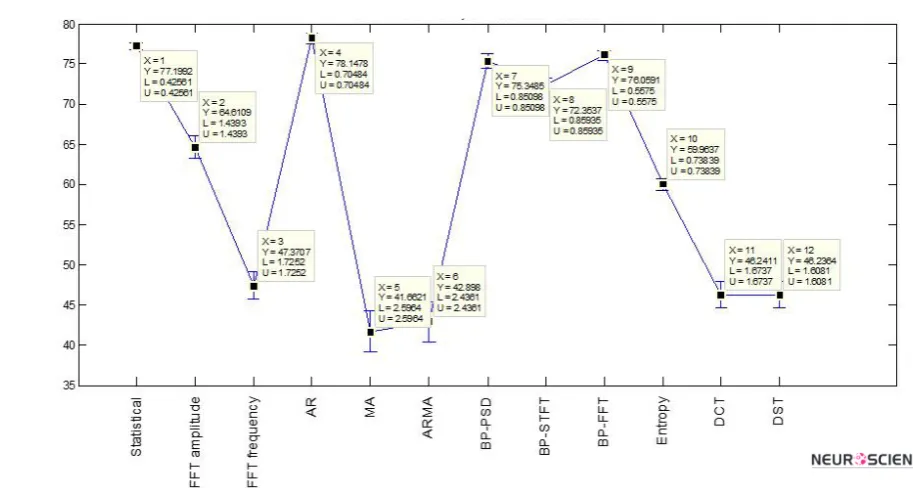
Figure 2. The accuracy of different feature extraction methods for LDA classifier obtained with 10×10 fold cross-validation strategy; X is the index of feature extraction method, Y is the accuracy, L and U are the lower limit and the upper limit of the accuracy defined by the standard deviation, respectively.
1 1
( ) ( ) m i ( ) q i ( )
i i
X t ε t a X t i θ ε t i
= =
= +
∑
− +∑
−( )ln ( ) x
H= −
∫
p x p x dx1 2
( ) ( )
( 1)
( 2) ...
q(
)
X t
=
ε
t
+
θ ε
t
− +
θ ε
t
− + +
θ ε
t q
− +
µ
Figure 3. Different snapshots of the virtual environment, in the (a) beginning of the main position, (b) end of the main position, (c) beginning of the second main position.
Where, p(x) is the estimate distribution of the features that exhibit the highest possible randomness.
Discrete Cosine Transform (DCT): Given N input sam-ples x(0), x(1), …, x(N-1) in a segmented signal, the cor-responding DCT is computed as follows:
where α( )k = N1 if k=0, otherwise α( )k = N2
Discrete Sine Transform (DST): The DST feature of a segmented signal is defined as follows:
The Linear Discriminant Analysis (LDA) classifier is used to classify the whole data set for all subjects. It uses a hyperplane to separate the different classes. For a two-class problem, the class of a feature vector depends on which side of the hyperplane the vector is. LDA presumes a normal distribution of the data, with equal covariance matrices for both classes. The separating hy-perplane is obtained by seeking the projection that max-imizes the distance between the two classes’ means and minimizes the inter-class variance (Leeb R. et al., 2007). The accuracy of LDA is calculated with the 10×10 fold cross-validation strategy. This strategy divides the data into 10 folds while considering 9 of them for training and the other one for testing the classifier. The outputs of the testing phases are averaged within 10 iterations so that in each of them, the testing fold varies. Finally, this procedure repeats for 10 epochs and the accuracy is averaged within these epochs.
3. Results
In this section, the results of the various feature extraction methods described in the previous section are presented. Results are reported in terms of the accuracy of the LDA classifier, with the 10×10 fold cross-validation strategy. As Figure 2 shows, the MAV (the statistical), AR, α- BP-PSD, and α-BP-FFT features outperform other feature extrac-tion methods and have accuracies above 75%. Therefore, 4 different virtual environment navigation based on these 4 kinds of feature extraction methods were performed. The subjects were asked to navigate the same route in the virtu-al environment 4 times while the feature extraction method in each experiment was different. The movement imagina-tion of the left hand, right hand, and foot corresponds to moving left, right, and forward in the virtual environment, respectively. This correspondence exists unless the subject reaches to a place, which the enemies can be seen. In this situation, the foot motor imagery corresponds to shooting.
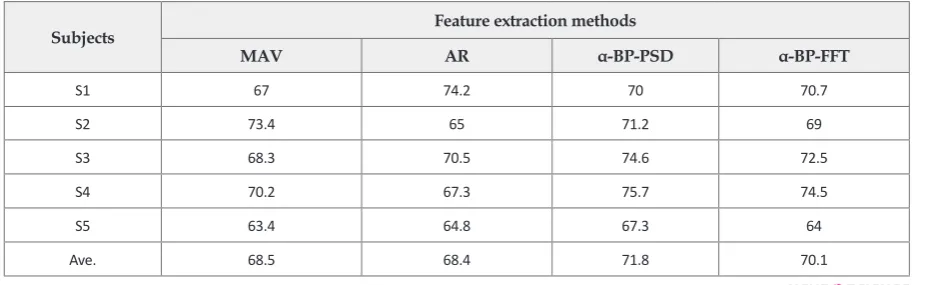
Different snapshots of the simulated virtual environment are shown in Figure 3. There are some main positions in the virtual environment, based on which the EEG signals of the subject will be classified. A sample position can be seen in the Figure 3 (a). As it can be seen,there are also two arrows at the bottom of the screen to show feedback to the subject. If the output of the classifier was true, the green arrow would start to fill by green color, and if the output of the classifier was false, the red arrow would start to fill by red color. If the green arrow filled, the subject would start to move as shown in Figure 3 (b). The new main posi-tion is shown in Figure 3 (c). Results of the navigaposi-tion of the subjects in the virtual environment are tabulated in the Table 1. All subjects were able to navigate in the virtual en-vironment, and as can be seen in the Table 1, for different subjects, different feature extraction methods work well, i.e. the feature extraction methods are subject-specific.
Table 1. Classification results for different feature extraction methods and subjects.
Subjects Feature extraction methods
MAV AR α-BP-PSD α-BP-FFT
S1 67 74.2 70 70.7
S2 73.4 65 71.2 69
S3 68.3 70.5 74.6 72.5
S4 70.2 67.3 75.7 74.5
S5 63.4 64.8 67.3 64
Ave. 68.5 68.4 71.8 70.1
1
0
(2 1)
( ) ( ) ( )cos( ), 0,1,..., 1
2 N
n
n k
y k k x n k N
N π α − = + =
∑
− −2 ( 1)( 1)
( , ) sin( ), , 0,1,..., 1
1 1
k n
S k n k n N
N N
π + +
= = −
4. Discussion
There are many various feature extraction methods that could be used in MI based BCI. In this work, the performance of the most widely used methods were examined and compared with each other to specify ap-propriate methods. To do so, different feature extraction methods such as MAV, sorted FFT amplitude and com-ponent, AR, MA, ARMA, α-BP, DCT, and DST using the LDA classifier on an MI-based BCI system were developed. It should be noted that our preliminary study revealed that MAV feature had higher accuracy rate compare to the other statistical features such as mean, standard deviation, second, third,and fourth cumulants and moments. This is the same for 7 sorted frequency components and 10 sorted frequency amplitudes among the other combinations. Moreover, AR(5), MA(10), and ARMA(1, 10) had the highest accuracy over the other orders in each corresponding method. Finally, the first 8DST and the first 6DCT coefficients outperformed the other number of selected coefficients. As it can be seen in Figure 2, AR with the model order of 5 outperformed the other available features. This amount of accuracy is almost high enough in a 3-class classification. Beside the AR order, the MAV, α-BP using PSD, and FFT had also accuracies higher than 75%.
Therefore, these 4 feature sets were selected for the re-al-time application, which its environment is displayed by the images of Figure 3. These figures, from the left, guide the subjects to navigate to the right or to the left using the arrows as the feedback sign. When the target was selected, the foot motor imagery was considered for shooting. The same 5 subjects in offline analysis car-ried this real-time application and their corresponding accuracies are shown in Table 1. As it can be seen, in real-time application, the overall accuracy was lower than that in the offline mode. This could be due to the graphical VR that distracted the full attention of the sub-jects and the lower length of the segments in the online approach, which was 2 seconds for each segment.
However, in real-time application, the α-BP feature us-ing PSD could be selected as the best feature in MI-based application. Moreover, the accuracy of the subjects var-ies among the features. For example, the accuracy of the S1 was the highest using the AR method while the accu-racy of the S2 was the best with MAV feature. Therefore, the accuracy of the MI-based BCIs is subject-specific. In this study, a virtual environment was simulated to show the subject a virtual reality-based feedback while per-forming 3 movement imageries of left hand, right hand,
and feet. The results indicated that the subjects were able to navigate into the virtual environment.
References
Chin, Z. Y., Ang, K. K., Wang, C., Guan, C. (2010). Online per-formance evaluation of motor imagery BCI with augmented-reality virtual hand feedback. IEEE International Conference on Engineering, Medicine and Biology Society (EMBC), (pp. 3341-3344). Buenos Aires: Argentina.
Daliri, M. R. (2013). Kernel earth mover's distance for eeg clas-sification. Clinical EEG and Neuroscience, 44(3), 182-187.
Hashemi, A., Saba, V., Resalat, S. N. (2013). Real time driver’s drowsiness detection by processing EEG signals stimulated with external flickering light. Basic and Clinical Neuroscience, 5(1) 22-27.
Jingkun, L., Guizhi, X., Jianrong, G., Feng, Z., & Xiuyan, F. (2010). Analysis of virtual simulation environment for driv-ing behavior based on imagdriv-ing movements. International Conference on Networking and Digital Society (ICNDS), (pp. 246-248). Wenzhou: China.
Lecuyer, A., Lotte, F., Reilly, R. B., Leeb, R., Hirose, M., Slater, M. (2008). Brain-computer interfaces, virtual reality, and vid-eogames. Computer,41(10), 66-72.
Leeb, R., Friedman, D., Müller-Putz, G. R., Scherer, R., Slater, M., & Pfurtscheller, G. (2007). Self-paced (asynchronous) BCI control of a wheelchair in virtual environments: a case study with a tetraplegic. Computational Intelligence and Neuroscience, 12, 1-8.
Leeb, R., Lee, F., Keinrath, C., Scherer, R., Bischof, H., & Pfurtscheller, G. (2007). Brain–computer communication: motivation, aim, and impact of exploring a virtual apart-ment. IEEE Transactions on Neural Systems and Rehabilitation Engineering, 15(4), 473-482.
Lou, B., Hong, B., Gao, X., Gao, S. (2008). Bipolar electrode se-lection for a motor imagery based brain–computer interface.
Journal of Neural Engineering, 5(3), 342-348.
Ming, D., Zhu, Y., Qi, H., Wan, B., Hu, Y., Luk, K. (2009). Study on EEG-based mouse system by using brain-computer inter-face. IEEE International Conference on Virtual Environments, Human-Computer Interfaces and Measurements Systems (VEC-IMS) (pp. 236-239). Hong Kong: China.
Pineda, J. A., Silverman, D. S., Vankov, A., Hestenes, J. (2003). Learning to control brain rhythms: making a brain-computer interface possible. IEEE Transactions on Neural Systems and Rehabilitation Engineering, 11(12), 181-184.
Resalat, S. N., Saba, V., Afdideh, F., & Heidarnejad, A. (2012). High-speed SSVEP-based BCI: study of various frequency pairs and inter-sources distances. IEEE-EMBS International Conference on Biomedical and Health Informatics (BHI), (pp. 220-223). Hong Kong: China.
Interna-tional Symposium on Artificial Intelligence and Signal Processing
(AISP), (pp. 343-347). Shiraz: Fars.
Resalat, S. N., & Saba, V. (2015). A practical method for driver sleepiness detection by processing the EEG signals stimu-lated with external flickering light. Signal, Image and Video Processing, 9(3), 1-7.
Ron-Angevin, R., Diaz Estrella, A., Reyes-Lecuona, A. (2005). Development of a brain-computer interface (BCI) based on virtual reality to improve training techniques. Applied Tech-nologies in Medicine and Neuroscience, 9, 13-20.
Scherer, R., Lee, F., Schlögl, A., Leeb, R., Bischof, H., & Pfurtscheller, G. (2008). Toward self-paced brain–computer communication: navigation through virtual worlds. IEEE Transactions on Biomedical Engineering, 55(2),675-682.
Taghizadeh-Sarabi, M., Daliri, M. R., & Niksirat, K. S. (2014). Decoding objects of basic categories from electroencephalo-graphic signals using wavelet transform and support vector machines. Brain Topography, 28(1), 33-46.