Journal of Pharmaceutical Technology, Research and Management Vol 4, No. 2, November 2016 pp. 147–159
DOI:10.15415/jptrm.2016.42010
Improvement of Learning and Memory of Mice
by Plumbagin
D DHINGRA* AND S PARSHAD
Department of Pharmaceutical Sciences, Guru Jambheshwar University of Science and Technology, Hisar -125 001 (Haryana), India.
Email: [email protected]
Received: July 7, 2016 | Revised: August 16, 2016 | Accepted: Oct. 17, 2016 Published online: November 02, 2016
The Author(s) 2016. This article is published with open access at www.chitkara.edu.in/publications
Abstract: Roots of Plumbago zeylanica have been reported to improve learning and memory of mice, but the effect of plumbagin on learning and memory of mice and the possible mechanisms for its effect on memory have not been explored till date. So the present study was designed to evaluate the effect of plumbagin on learning and memory of Swiss young male albino mice. Plumbagin (4, 8, 16 mg/kg, p.o.) and physostigmine (0.1 mg/kg,i.p.) per se were administered for 15 successive days to separate groups of mice. Behavioral parameters of learning and memory were recorded using Morris water maze. Acetylcholinesterase activity was estimated in brain of mice. Effect of plumbagin on scopolamine (0.4 mg/kg, i.p.) and diazepam (1 mg/kg, i.p.)-induced amnesia was also investigated. Locomotor activities of mice were also recorded. Plumbagin (8 and 16 mg/kg) and physostigmine significantly improved learning and memory of mice, as indicated by decrease in escape latency during training and increase in time spent in target quadrant of Morris water maze during retrieval. The drugs did not show any significant effect on locomotor activities of mice. Memory improving activity of plumbagin (16 mg/kg) was equivalent to physostigmine. Plumbagin significantly reversed scopolamine- and diazepam- induced amnesia in mice. Plumbagin and physostigmine also significantly reduced brain acetylcholinesterase activity of mice. In conclusion, plumbagin significantly improved memory of mice possibly through inhibition of brain acetylcholinesterase activity and through involvement of GABA-benzodiazepine pathway. Thus, plumbagin may be explored further for management of cognitive dysfunction.
Dhingra, D
Parshad, S 1. INTRODUCTION
Learning is acquisition of new knowledge and skills, whereas memory is retention and retrievals of facts composed of experiences (Kumar et al., 2012). Alzheimer’s disease is a progressive neurodegenerative disorder characterized by the gradual onset of dementia. It is characterized by gradually progressive decline in cognitive function, with deficits especially in memory retrieval (Kalaria et al., 2008). The primary cause of Alzheimer’s disease appears to be reduction in cholinergic activity. Acetylcholinesterase enzyme (AChE) plays a key role in the regulation of the cholinergic system and hence, inhibition of AChE is a most promising target for the treatment of Alzheimer’s disease (Lu et al., 2010). A number of cholinesterase inhibitors like donepezil, rivastigmine, tacrine and rivastigmine etc. are in practice for the treatment of various cognitive disorders (Ellis, 2005). However, the adverse effects associated with anti-cholinesterase drugs (rivastigmine, galantamine, donepezil) include anorexia, nausea, vomiting, diarrhoea, and insomnia (Kavirajan and Schneider, 2007). Physostigmine, a cholinesterase inhibitor, improved memory of Alzheimer’s disease patients (Mohs et al., 1985). But this drug has a short half-life and requires complex forms of administration (Filho and Birks, 2001). So there is a need to discover new drugs with better efficacy and having less adverse effects. Plants have been used since ancient times in traditional medicinal systems for the treatment of memory dysfunction. Bacopa monniera, commonly called as Brahmi, has been proven to be clinically effective in treatment of cognitive disorders (Pase et al., 2012). The bioactive compounds isolated from plants such as galantamine (Raskind et al., 2000), huperzine alpha (Zhang et al., 2002), etc. have been reported to be effective for treatment of cognitive deficits in patients of dementia.
Plumbagin, an active constituent of Plumbago zeylanica roots, has been reported to possess various pharmacological activities such as antioxidant (Kumar et al., 2013), neuroprotective (Son et al., 2010), antiparkinsonian (Choi et al., 2012), anti-inflammatory (Lou et al., 2010) and antidepressant (Dhingra and Bansal, 2015). Plumbago zeylanica roots have been reported to improve learning and memory of mice (Mittal et al., 2010), but the effect of plumbagin on learning and memory of mice has not been explored till date. Therefore, the present study was designed to investigate the effect of plumbagin on learning and memory of mice by employing behavioral models.
Improvement of Learning and Memory of Mice by Plumbagin Swiss male albino mice, weighing around 25-30 g, were purchased from
Disease Free Small Animal House, Lala Lajpat Rai University of Veterinary and Animal Sciences, Hisar (Haryana, India). Female mice were not included in the study because estrogens (female sex hormones) have been found to have memory improving effect (Harburger et al., 2007), so we excluded female mice and used only male mice. Animals were housed separately in groups of 6 - 7 per cage (Polycarbonate cage size: 29×22×14 cm) under proper laboratory conditions with alternating light and dark cycle of 12 h each. The animals had free access to food and water, except food was withdrawn 2 h before and 2 h after drug administration. The animals were acclimatized for at least five days before behavioral experiments which were carried out between 09:00 and 17:00 h. The experimental protocol was approved by Institutional Animals Ethics Committee (IAEC) and animal care was taken as per the guidelines of Committee for the Purpose of Control and Supervision of Experiments on Animals (CPCSEA), Ministry of Environment and Forests, Government of India.
2.2 Drugs and chemicals
Plumbagin (Sigma-Aldrich, St. Louis, USA); physostigmine (Hi-Media Laboratories, Mumbai); Carboxy methyl cellulose (CDH- Central Drug House, New Delhi); Scopolamine hydrobromide (Sigma-Aldrich, St. Louis, USA);Acetylcholine iodide; 5, 5’-dithiobis-2- nitrobenzoic acid (Hi-Media laboratories Pvt. Ltd., Mumbai); Acetyl thiocholine iodide (Hi-Media laboratories Pvt. Ltd., Mumbai) were used in the present study.
2.3 Selection of doses
Doses of various drugs were selected on the basis of literature, i.e. 4, 8 and 16 mg/kg for plumbagin (Sivakumar et al., 2005), 0.4 mg/kg for scopolamine (Dhingra et al., 2004), 0.1 mg/kg for physostigmine (Sharma and Kulkarni, 1992).
2.4 Vehicle
Plumbagin was dissolved in 1% w/v carboxy methyl cellulose (CMC) solution. Scopolamine hydrobromide was dissolved in normal saline.
2.5 Laboratory model employed for evaluation of effect of plumbagin on learning and memory of mice
Dhingra, D
Parshad, S The procedure and parameters for testing learning and memory of mice using Morris water maze were followed as reported earlier (Domange et al., 2013; Morris, 1984; Park and Singh, 2007). Briefly, Morris water maze for mice consisted of a circular pool (60 cm in diameter, 25 cm in height) filled to a depth of 20 cm with water maintained at 25° C. The water was made opaque with non-toxic white colored dye (Pidilite Ltd., Maharashtra, India). Two threads were fixed at right angle to each other on rim of the pool to divide the tank into four equal quadrants. Four quadrants were designated as Q1, Q2, Q3 and Q4. A submerged platform (with top surface 6 cm × 6 cm and painted in white) was placed inside the target quadrants (Q4 in present study) of this pool 1 cm below surface of water. The position of platform was kept at the same place throughout the training session. Each animal was subjected to four consecutive trials each day with a gap of 5 min for four consecutive days (starting from 11th day of drug administration to 14th day), during which they were allowed to escape on to the hidden platform and to remain there for 20 sec. During the training session, the mouse was gently placed in one of the quadrants, facing the wall of pool with drop location changing for each trial, and allowed 120 sec to locate submerged platform. If the mouse failed to find the platform within 120 s, it was guided gently on to the platform and allowed to remain there for 20 s. Escape latency (EL) is the time taken by the animal to move from the starting quadrant to find the hidden platform in the target quadrant. From 11th day to 14th day of training session, EL was recorded for each animal. Each animal was subjected to training trials for four consecutive days, the starting position was changed with each exposure as mentioned below and target quadrant (Q4 in the present study) remained constant throughout the training period.
Day 1 Q 1 Q 2 Q 3 Q 4
Day 2 Q 2 Q 3 Q 4 Q 1
Day 3 Q 3 Q 4 Q 1 Q 2
Day 4 Q 4 Q 1 Q 2 Q 3
Improvement of Learning and Memory of Mice by Plumbagin taken not to disturb the relative location of water maze with respect to other
objects in the laboratory.
2.5.2 Measurement of locomotor activity
Locomotor activities of control and drug-treated animals were measured for a period of 5 min using photoactometer (INCO, Ambala, India) (Dhingra et al., 2012).
2.6 Biochemical estimation 2.6.1 Collection of brain sample
After recordings behavioral parameters on 15th day using Morris water maze, the animals were sacrificed on 16th day by cervical dislocation. Whole brain was carefully removed from the animals. For preparation of brain homogenate, the fresh whole brain was weighed first and then homogenized in 10 volumes of 0.1 M phosphate buffer (pH 8) using a glass homogenizer. The homogenate was centrifuged at 3000 rpm for 10 min at 4°C using refrigerated centrifuge (Remi, Mumbai). The resultant cloudy supernatant liquid was used for the estimation of brain acetyl cholinesterase activity.
2.6.2 Estimation of brain acetylcholinesterase activity
Brain acetyl cholinesterase activity was estimated by the method as reported earlier (Ellman et al., 1961). 0.4 ml of brain homogenate was added into a test tube containing 2.6 ml of phosphate buffer. 5,5-dithiobis-2-nitrobenzoic acid reagent (0.1 ml) was added to the above mixture and absorbance was noted at 412 nm. Then 0.02 ml of acetylcholine iodide solution was added and again absorbance was noted 15 min thereafter. Change in absorbance per minute was calculated. The following formula was used to calculate rate of hydrolysis of substrate:
R= Change in absorbance/min × 5.74 × 10⁻⁴/ C 0
R= Rate of hydrolysis of acetylcholine iodide/ min/ mg tissue C0= weight of tissue homogenate in mg/ml.
2.7. Experimental protocol
2.7.1 Groups for Morris water maze
Dhingra, D
Parshad, S administration from 11th day to 14th day. On 15
th day, time spent in target quadrant (TSTQ) was noted 120 min after the drug administration. In case of animals administered with physostigmine, EL and TSTQ was noted after 30 min of drug administration.
Groups 6 and 7 (n = 6 each): CMC (1% w/v) and plumbagin (16mg/kg, p.o.) respectively were administered for 15 successive days. EL was recorded 120 min after drug administration from 11th day to 14th day. On 15th day, scopolamine (0.4 mg/kg) was injected 30 min after oral administration of plumbagin (16mg/kg) and TSTQ was noted 45 min after injection of scopolamine.
Groups 8 and 9 (n = 7 each): CMC (1% w/v) and plumbagin (16mg/kg, p.o.) respectively were administered for 15 successive days. EL was recorded 120 min after drug administration from 11th day to 14th day. On 15th day, diazepam (1 mg/kg, i.p.) was injected 30 min after oral administration of plumbagin (16 mg/kg) and TSTQ was noted 45 min after injection of diazepam. 2.7.2 Groups for locomotor activity
Groups 10 to14 (n=6 each group): CMC (1%w/v), plumbagin (4, 8 and 16 mg/ kg,p.o.) and physostigmine (0.1 mg/kg,i.p.), respectively were administered for 15 successive days. Locomotor activity was measured on 15th day using actophotometer (INCO, Ambala).
2.7.3 Groups for biochemical estimation
Brain acetylcholinesterase activity was measured 24 hour after behavior testing on animals of groups 1 to 5.
2.8 STATISTICAL ANALYSIS
All the results are expressed as Mean ± S.E.M. Data were analyzed by analysis of variance (ANOVA) followed by Tukey’s post hoc test in Graph Pad Instat version 3.05. p< 0.05 was considered as significant
3. RESULTS
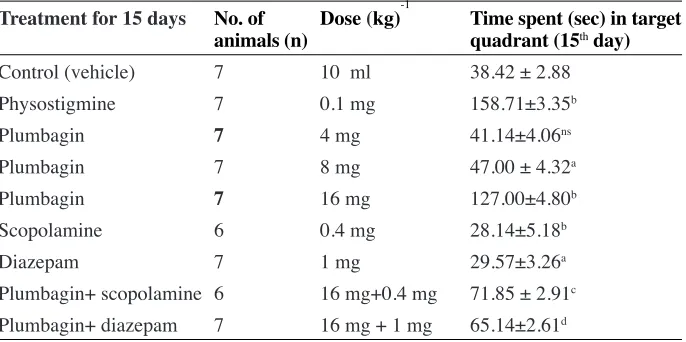
3.1 Effect of plumbagin and other drugs employed on escape latency (EL) and time spent in target quadrant (TSTQ) of mice using Morris water maze Decrease of EL and increase of TSTQ by mice in Morris water maze indicates improvement of learning and memory and vice versa. Physostigmine (0.1mg/ kg, i.p.) and highest dose (16 mg/kg, p.o.) of plumbagin per se administered for
Improvement of Learning and Memory of Mice by Plumbagin Table 1: Effect of plumbagin and physostigmine on escape latency (EL) of mice
using Morris Water Maze.
Treatment
for 15 days Dose (Kg-1) Escape latency (sec)
Day-11
Escape latency (sec) Day-12
Escape latency (sec) Day-13
Escape latency (sec) Day-14
Control (vehicle) 10ml 95.32 ± 1.35 94.00 ± 1.53 92.68 ± 1.36 90.62 ± 5.45 Physostigmine 0.1mg 51.96 ± 5.58a 48.67 ± 1.42a 55.39 ±1 .82a 42.07 ± 1.45a
Plumbagin 4 mg 94.53 ±1.81ns 89.07 ± 2.37ns 78.96 ± 1.88a 68.75 ± 1.44a
Plumbagin 8 mg 85.82 ± 1.00ns 81.00 ± 0.512ns 53.39 ± 1.51a 42.14 ± 1.46a
Plumbagin 16 mg 51.94 ± 2.13a 57.90 ± 1.99a 57.87 ± 2.04a 57.31 ± 1.31a n=7 each group. Values are expressed as Mean ± SEM. Data was analyzed by one-way ANOVAfollowed by Tukey’s Post-hoc test.
F (4, 30) = 58.946; p<0.0001 (Day 11) F (4, 30) = 125.53; p<0.0001 (Day 12) F (4, 30) = 99.395; p<0.0001 (Day 13) F (4, 30) = 55.057; p<0.0001 (Day 14)
a = p< 0.001; as compared to control group; ns =non-significant
Table 2: Effect of plumbagin and other drugs employed on time spent in target quadrant (TSTQ) of Morris Water Maze.
Treatment for 15 days No. of
animals (n) Dose (kg)
-1
Time spent (sec) in target quadrant (15th day)
Control (vehicle) 7 10 ml 38.42 ± 2.88
Physostigmine 7 0.1 mg 158.71±3.35b
Plumbagin 7 4 mg 41.14±4.06ns
Plumbagin 7 8 mg 47.00 ± 4.32a
Plumbagin 7 16 mg 127.00±4.80b
Scopolamine 6 0.4 mg 28.14±5.18b
Diazepam 7 1 mg 29.57±3.26a
Plumbagin+ scopolamine 6 16 mg+0.4 mg 71.85 ± 2.91c Plumbagin+ diazepam 7 16 mg + 1 mg 65.14±2.61d
Values are expressed as Mean ± SEM. Data was analyzed by one-way ANOVA followed by Tukey’s Post-hoc test.
F (8, 54) = 1016.7; p<0.0001
Dhingra, D
Parshad, S increased TSTQ by mice on 15
th day as compared to the control, thus showed significant improvement of learning and memory. The lowest dose (4 mg/kg,
p.o.) and middle dose (8 mg/kg, p.o.) of plumbagin significantly decreased EL on 13th and 14th days; and did not significantly affect EL on 11th and 12thdays. Middle dose (8 mg/kg, p.o.) of plumbagin also significantly increased TSTQ as compared to vehicle treated control. Scopolamine (0.4 mg/kg i.p.) and diazepam (1 mg/kg, i.p.) per se administered on 15th day significantly decreased TSTQ by mice, indicating their amnesic effects. Plumbagin (16 mg/kg, p.o.) significantly reversed scopolamine-and diazepam-induced amnesia as compared to respective scopolamine and diazepam treated groups (Tables 1 and 2).
3.2 Effect of plumbagin and physostigmine on brain AChE activity of mice
Table 3: Effect of plumbagin and physostigmine on brain AChE activity of mice. Treatment for 15 days Dose (kg)-1 Acetylcholinesterase activity
(mol/l per min × 10-6/g of tissue) Control (1% w/v CMC) 10 ml 0.057 ± 0.005
Physostigmine 0.1 mg 0.0185 ± 0.002a
Plumbagin 4 mg 0.043 ± 0.005a
Plumbagin 8 mg 0.025 ± 0.001a
Plumbagin 16 mg 0.022 ± 0.003a
n=6 each group. Values are expressed as Mean ± SEM. Data was analyzed by one-way ANOVA followed by Tukey’s Post-hoc test.
F (4, 25) =21.211; p<0.0001 a= p<0.01 as compared to control;
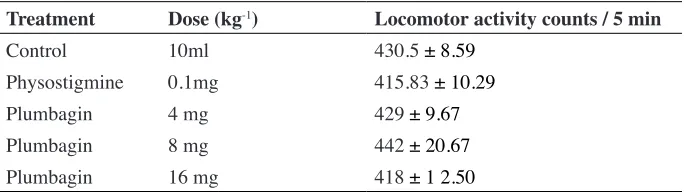
Table 4: Effect of plumbagin and physostigmine on locomotor activity of mice. Treatment Dose (kg-1) Locomotor activity counts / 5 min
Control 10ml 430.5 ± 8.59
Physostigmine 0.1mg 415.83 ± 10.29
Plumbagin 4 mg 429 ± 9.67
Plumbagin 8 mg 442 ± 20.67
Plumbagin 16 mg 418 ± 1 2.50
n= 6 each group. Values are expressed as Mean ± SEM. Data was analyzed by one-way ANOVA followed by Tukey’s Post-hoc test.
Improvement of Learning and Memory of Mice by Plumbagin Administration of plumbagin (8 and 16 mg/kg) and physostigmine per se for
15 consecutive days produced a significant decrease in brain AChE activity as compared to control group. The lowest dose of plumbagin (4 mg/kg) did not produce significantly decrease in AChE activity as compared to control group (Table 3).
3.3 Effect of plumbagin and physostigmine on locomotor activity of mice. Plumbagin (4, 8 and 16 mg/kg) and physostigmine per se administered for 15 consecutive days did not significant affect locomotor activity of mice as compared to vehicle treated control (Table 4).
4. DISCUSSION
In the present study, plumbagin (16mg/kg) administered for 15 successive days significantly improved learning and memory of mice. Memory improving effect of plumbagin was comparable to physostigmine, a well known anticholinesterase nootropic drug. Morris water maze was employed as a behavioral model for evaluation of learning and memory. Plumbagin significantly decreased EL during training and it significantly increased TSTQ during retrieval, indicating improvement of learning and memory. It did not show any significant change on locomotor activities of mice as compared to the vehicle treated control, so this compound did not produce any motor effects. Thus, memory enhancing effect of plumbagin is specific and not false positive. Out of the three doses (4, 8 and 16 mg/kg, p.o.) of plumbagin, highest dose (16 mg/kg) produced better (p<0.001) memory enhancing effect in mice as compared to middle dose of (8 mg/kg) (p <0.05), whereas lowest dose (4 mg/kg) did not show significant memory improving effect. Hence, the highest dose (16 mg/kg) of plumbagin was employed for elucidating its probable mechanisms of memory improving activity.
Dhingra, D
Parshad, S inhibition of GABA-benzodiazepine pathway. Acetylcholine is considered as the most important neurotransmitter involved in the regulation of cognitive functions (Hasselmo, 2006). Selective loss of cholinergic neurons and / or decreased synthesis of acetylcholine were reported to be a characteristic feature of dementia of Alzheimer’s disease type (Watanabe et al., 2009). Drugs that reduce cholinergic function such as muscarinic receptor antagonist, scopolamine cause profound memory impairments in animals and humans (Deutsch and Rocklin, 1967). In the present study, scopolamine significantly impaired memory of mice. Plumbagin (16 mg/kg, p.o.) administered for
15 successive days significantly reversed scopolamine-induced amnesia in mice. Reversal of scopolamine-induced amnesia by plumbagin indicated the possible facilitation of cholinergic transmission. Plumbagin (16 mg/ kg) also significantly reduced brain AChE activity in mice as compared to the control. This suggests that the memory enhancing effect of plumbagin might be due to inhibition of AChE, leading to increase in brain acetylcholine levels. Acetylcholine is considered to be the most important neurotransmitter involved in the regulation of cognitive functions. Cognitive dysfunction has been shown to be associated with impaired cholinergic transmission and the facilitation of central cholinergic transmission resulting in improved memory. The degeneration and dysfunction of cortical cholinergic neurons is closely associated with cognitive deficits of Alzheimer’s disease (Bartus et al., 1982; Coyle et al., 1983; Watanabe et al., 2009). Thus, the drugs which enhance cholinergic function can be used for treatment of dementia closely related to Alzheimer’s disease. Physostigmine (0.1 mg/kg, i.p.) injected for
15 successive days significantly improved memory of mice.The memory enhancing effect of physostigmine is in line with the earlier studies (Bekker et al., 2007). The memory improving effect of plumbagin was comparable to physostigmine.
5. CONCLUSION
Improvement of Learning and Memory of Mice by Plumbagin REFERENCES
[1] Bartus, R.T., Dean, R.L., Beer, B., Lippa, A.S. (1982). The cholinergic hypothesis of geriatric memory dysfunction. Science, 217: 408–14. DOI: 10.1126/science.7046051 [2] Bekker, A., Haile, M., Gingrich, K., Wenning, L., Gorny, A., Quartermain, D., Blanck,
T. (2007). Physostigmine reverses cognitive dysfunction caused by moderate hypoxia in adult mice. Neurosurgical Anesthesiology, 105(3): 739–743. DOI: 10.1213/01.
ane.0000265555.57472.49
[3] Choi, S.Y., Son, T.G., Park, H.R., Jang, Y.J., Oh, S.B., Jin, B., Lee, J. (2012). Naphthazarin has a protective effect on the 1-Methyl-4-phenyl-1,2,3,4-tetrahydropyridine-induced Parkinson’s disease model. Journal of Neuroscience Research, 90: 1842–1849. DOI:
10.1002/jnr.23061
[4] Coyle, J.T., Price, D.L., DeLong, M.R. (1983). Alzheimer’s disease: a disorder of cortical cholinergic innervation. Science, 219: 1184–1190. DOI: 10.1126/science.6338589 [5] Dhingra, D., Bansal, S. (2015). Antidepressant-like activity of plumbagin in unstressed
and stressed mice. Pharmacological Reports, 67(5): 1024-1032. DOI: 10.1016/j. pharep.2015.03.001
[6] Dhingra, D., Parle, M., Kulkarni, S.K. (2004). Memory enhancing activity of Glycyrrhiza
glabra in mice. Journal of Ethnopharmacolology, 91: 361–65. DOI: 10.1016/j.
jep.2004.01.016
[7] Dhingra, D., Joshi, P., Gupta, A., Chhillar, R. (2012). Possible involvement of monoaminergic neurotransmission in antidepressant-like activity of Emblica officinalis
fruits in mice CNS. Neurosciences and Therapeutics, 18(5): 419–425. DOI:
10.1111/j.1755-5949.2011.00256.x
[8] Deutsch, J.A., Rocklin, K.W. (1967). Amnesia induced by scopolamine and its temporal variations. Nature, 216: 89–90. DOI:10.1038/216089b0
[9] Domange, C., Schroeder, H., Violle, N., Peiffer, J., Canlet, C., Paris, A., Priymenko, N. (2013). Mining the brain metabolome to understand behavioural disruptions induced in mouse fed Hypochoeris radicata (L.), a neurotoxic plant for horse. Neurotoxicology, 38: 74–83. DOI: 10.1016/j.neuro.2013.06.005
[10] Ellis, J.M. (2005). Cholinesterase inhibitors in the treatment of dementia. Journal of American Osteopathology Association, 1053: 145–158.
[11] Ellman, G.L., Courtney, K.D., Andres, V. Jr., Feather-Stone, R.M. (1961). A new and rapid colorimetric determination of acetylcholinesterase activity. Biochemical Pharmacology, 7: 88–95. DOI: 10.1016/0006-2952(61)90145-9
[12] Filho, J.M.J.C., Birks, J. (2001). Physostigmine for dementia due to Alzheimer’s disease. Cochrane Database of Systematic Reviews, 2: 10. DOI: 10.1002/14651858.CD001499
[13] Harburger, L.L., Bennett, J.C., Frick, K.M. (2007). Effects of estrogen and progesterone on spatial memory consolidation in aged females. Neurobiology Aging, 28: 602-10.
DOI:10.1016/j.neurobiolaging.2006.02.019
[14] Hasselmo, M.E. (2006) The Role of Acetylcholine in Learning and Memory. Current Opinion in Neurobiology, 16: 710–715. DOI: 10.1016/j.conb.2006.09.002
Dhingra, D
Parshad, S [16] Kalaria, R.N.,Maestre, G.E., Arizaga, R., Friedland, R.P., Galasko, D., Federation of Neurology Dementia Research Group. Alzheimer’s disease and vascular et al.(2008). World dementia in developing countries: prevalence, management, and risk factors. Lancet Neurolology, 7(9): 812–826. DOI: 10.1016/S1474-4422(08)70169-8.
[17] Kavirajan, H., Schneider, L.S. (2007). Efficacy and adverse effects of cholinesterase inhibitors and memantine in vascular dementia: a meta-analysis of randomised controlled trials. Lancet Neurology, 69: 782–792. DOI: 10.1016/S1474-4422(07)70195-3
[18] Kumar, H., More, S.V., Han, S.D., Choi, J.Y., Choi, D.K. (2012). Promising therapeutics with natural bioactive compounds for improving learning and memory — a review of randomized trials. Molecules, 17: 10503–10539. DOI: 10.3390/molecules170910503 [19] Kumar, S., Gautam, S., Sharma, A. (2013). Antimutagenic and antioxidant properties of
plumbagin and other naphthoquinones. Mutation Research, 755: 30–41. DOI: 10.1016/j. mrgentox.2013.05.007
[20] Lou, P., Wong, F.Y., Ge, L., Zhang, F.Z., Liu, Y., Liang, L., et al., (2010). Anti-inflammatory
and analgesic effect of plumbagin through inhibition of nuclear factor-beta activation. Journal of Pharmacology and Experimental Therapeutics, 335(3): 735–742. DOI: 10.1124/ jpet.110.170852
[21] Lu, S.H., Wu, J.W., Liu, H.L., Zhao, J.H., Liu, K.T., Chuang, C.K. et al., (2011) The
discovery of potential acetylcholinesterase inhibitors: a combination of pharmacophore modeling, virtual screening, and molecular docking studies. Journal of Biomedical Sciences, 18: 8–20. DOI: 10.1186/1423-0127-18-8
[22] Mohs, R.C., Davis, B.M., Johns, C.A., Mathe, A.A., Greenwald, B.S., et al. (1985).
Oral physostigmine treatment of patients with Alzheimer’s disease. American Journal of Psychiatry, 1421: 28–33. DOI: 10.1176/ajp.142.1.28
[23] Mittal, V., Sharma, S., Pawan, J.K., Anil, H.M.J. (2010). Plumbago zeylanica roots: A
potential source for improvement of learning and memory. International Journal of Pharmacy and Bioallied Sciences, 6: 1-6.
[24] Morris, R. (1984). Developments of a water-maze procedure for studying spatial learning in the rat. Journal of Neuroscience Methods, 11(1): 47-60. DOI:
10.1016/0165-0270(84)90007-4
[25] Parle, M., Dhingra, D. (2003). Ascorbic Acid: a promising memory-enhancer in mice. Journal of Pharmacological Sciences, 93: 129-135. DOI: 10.1254/jphs.93.129
[26] Parle, M., Singh, N. (2007). Reversal of memory deficits by atorvastatin and simvastatin in rats. Yakugaku Zasshi, 127: 1125-1137.
[27] Pase, M.P., Kean, J., Sarris, J., Neale, C., Scholey, A.B., Stough, C. (2012). The cognitive-enhancing effects of Bacopamonnieri: a systematic review of randomized, controlled human clinical trials. Journal of Alternative and Complementary Medicine, 18(7):
647-652. DOI: 10.1089/acm.2011.0367
[28] Raskind, M.A., Peskind, E.R., Wessel, T., Yuan, W. (2000). Galantamine in AD: A 6-month randomized, placebo-controlled trial with a 6-month extension. The Galantamine USA-1 Study Group. Neurology, 54(12): 2261-2268. DOI: 10.1212/WNL.55.5.744
Improvement of Learning and Memory of Mice by Plumbagin [30] Singh, N., Sharma, A., Singh, M. (1998). Possible mechanism of alprazolam-induced
amnesia in mice. Pharmacology, 56: 46-50. DOI: 10.1159/000028181
[31] Sivakumar, V., Prakash, R., Murali, M.R., Devaraj, H., Niranjali, D.S. (2005). In vivo
micronucleus assay and GST activity in assessing genotoxicity of plumbagin in Swiss albino mice. Drug and Chemical Toxicology, 28(4): 499-507. DOI: 10.1080/01480540500263019
[32] Son, T.G., Camandola, S., Arumugam, T.V., Cutler, R.G., Telljohann, R.S., Mughal, M.R., et al. (2010). Plumbagin, a novel Nrf2/ARE activator, protects against cerebral ischemia.
Journal of Neurochemistry, 112(5): 1316-1326. DOI: 10.1111/j.1471-4159.2009.06552.x [33] Watanabe, T., Yamagata, N., Takasaki, K., Sano, K., Hayakawa, K., Katsurabayashi, S.
et al. (2009). Decreased acetylcholine release is correlated to memory impairment in the
Tg2576 transgenic mouse model of Alzheimer’s disease. Brain Research 1249: 222-228.
DOI: 10.1016/j.brainres.2008.10.029