co
Computer-Controller Interface
PE
R
IODICALS SEC 1263399045
5
" ;
3
2
21SkRa:
0104
180 W SAN CARLOS Sf
*01271
SAN
JOSF CA
95113
<;1
/' /
SCIENCE
&
TECHNOLOGY
May
,
1971
Vol
.
20,
No
.5
IN THIS ISSUE:
The I nformation Revolution - And the Bill of Rights
Programming and Mini-Computer Costs
Cost Savings Possible in Data Preparation
Peter Denning, 29, is an Assistant Professor of Electrical Engineering at Princeton. He's also an ACM
member and chairman of our
committee on special interest groups and committees (SIGs/SICs). He wasn't always as active in ACM.
"I joined in 1965 while working on my thesis," says Peter. "Mainly for technical material and a chance to meet other computer professionals. In 1968, I was asked to edit the Operating Systems (SIGOPS) news-letter. I got involved and quickly
Nf
01
in
m
te
al
toe
lea SIC
"Sp
AC
go
tee
co thl on
"f\ L
c:
..
San Jose
Public Library
FOR OVERTIME A CHARGE OF 5 CENTS A DAY
Careful usage of books is expected and any soiling damage or los8 is to be paid for by the borrower. '
it up, to cover less 's need stronger
leader-~ should have don't , like performance i computer architecture."
} is involved in ACM, I most respected
I the computer field.
19 his career. Sharing I making a contribution :er profession.
Announcement
815 Washington St., Newtonville, Mass. 02160 invites your subscription to:
'The C&A Notebook on
COMMON SENSE. ELEMENTARY AND ADVANCED
devoted to research, development, exposition, and illustration of the most important (or one of the most important) of all branches of knowledge, i.e., the subject of
WHAT IS GENERALLY TRUE AND IMPORTANT =
+
+
+
+
Purposes:
to help you (and us and anybody) avoid pitfalls to prevent mistakes before they happen
to display new paths around old obstacles
to apply in practical situations the observations and wisdom of great scientists and wise me
+
+
+
+
to point out new solutions to old problems to stimulate one's resourcefulness
to increase one's accomplishments to improve one's capacities
Editor: Edmund C. Berkeley For additional information see in the April issue the editorial on page 6 and the article pages 27-31.
- - - (may be copied' on any piece of paper)
-To: Computers and Automation
815 Washington St., Newtonville, Mass. 02160
Yes, please enter my subscription to "The C&A Notebook on Common Sense, Elementary and Advanced" ~( ) as a READER, subscription $12 a year (24 issues)
Please enroll me~(
) as a PARTICIPATOR, subscription $6 a year (24 issues)
In order to be a participator, I AGREE to send to the C&A Notebook reasonable contributions to this pro-ject of at least 400 words per month -- of notes, comments, ideas, concepts, principles, examples, anec-dotes, proverbs, etc. (Note: Only 10 days grace period!) Please send me a description of "reasonable contributions".
Please send me as free premiums for subscribing:
1. Riqht Answers -- a Short Guide to Obtaining Them 4. Strategy in Chess
2. The Empty Column 5. The Barrels and the Elephant 3. The Golden Trumpets of Yap Yap 6. The Arqument of the Beard
) I enclose $ _ _ _ _ ) Please bill me. ) Please bill my orqanization.
Returnable in 7 days for full refund if not satisfactory (if in salable condition)
Name Title ______________________________________________ __
Organization __________________________________________________________________________________________ _
Address (including zip) ______________________________________________________________________________ ___
Signature ___________________________________________________________ Purchase Order No. ________________ __
Vol. 20, No.5
May, 1971
Editor Edmund C. Berkeley
Assistant Editors Linda Ladd Lovett Neil D. Macdonald
Software Editor
Advertising Director
Art Directors
Contributing Editors
Advisory Committee
Fulfillment Manager
Edilor;alOffices
AdtJertis;ng Contact
Stewart B. Nelson
Bernard Lane Ray W. Hass Daniel T. Langdale
John Bennett Moses M. Berlin Andrew D. Booth John W. Carr III Ned Chapin
Alston S. Householder Leslie Mezei
Ted Schoeters Richard E. Sprague
James J. Cryan Alston S. Householder Bernard Quint
William J. McMillan
Berkeley Enterprises, Inc. 815 Washington St., Newtonville, Mass. 02160 617-332-5453
THE PUBLISHER Berkeley Enterprises, Inc. 815 Washington St., Newtonville, Mass. 02160 617-332-5453
Computers and Automation is published monthly (except two issues in June) at 815 Washington .St., Newtonville, Mass. 02160, by Berkeley En·
terprises, Inc. Printed in U.S.A.
Subscription rates: United States, 11 monthly
i~sues and two issues in June (one of which is a directory issue) - $18.50 for 1 year, $36.00 for 2 years; 12 monthly issues (without directory issue in June) - $9.50 for 1 year; $18.00 for 2 years. Canada, add 50¢ a year for postage; foreign, add $3.50 a year for postage. Address all U.S. subscription mail to: Berkeley Enterprises, Inc., 815 Washington St., Newtonville, Mass. 02160. Second Class Postage paid at Boston, Mass. Postmaster: Please, send all forms 3579 to Berkeley Enterprises, Inc., 815 Washington St., Newtonville, Mass. 02160. CD Copyright 1971, by Berkeley En-terprises, Inc.
Change of address: If your address changes, please send us both your new address and your old address (as it appears on the magazine address imprint and allow three weeks for the change to be made.
COnlputers
and automation
The magazine of the -design, applications, and implications
of information process'ing systems.
The Computer Industry
13 PROGRAMMING AND MINI-COMPUTER COSTS [A]
30
31
19
38
by David R. Ellis, Director of Programming, Interdata
How to "properly" program a mini-computer; i.e. how to implement software and documentation that yields a mini-mum cost solution (including performance, testing, training, and maintenance) to some particular task.
PLAYING GAMES WITH A COMPUTER [A]
by James R. Palmer, Technical Staff, Hughes Aircraft Co.
How an effective educational game to teach factory ope~ion
was designed employing a computer - and is successfully uSed at a cost of less than $9 per team to play the game.
ESSENTIAL COMPUTER CONCEPTS FOR TOP MANAGEMENT[A] by Frank J. Gabriel and the Editor
An inventory of sl ightly over 100 computer concepts,
pro-posed In order for top management
t~mputers.
COST SAVINGS POSSIBLE IN DATA PREPARATION by William J. Primavera, Burroughs Corp.
[A]
A report on critical factors, including machine utilization, error control, pre-preparation of source data, etc.
THE GROWTH OF THE COMPUTER INDUSTRY [F]
by James B. Hunter, President, Digital Scientific Corp.
Computers and Earthquakes
33 RESTORATION OF SERVICE AFTER EARTHQUAKE [F]
by D. L. Talley, Redcor Corp.
33 UNINTERRUPTIBLE POWER SUPPLY PROTECTED NASA
COMPUTER DURING EARTHQUAKE [F]
by Robert R. Bentley, General Electric
Computers and Government
21
37
MAYBE THE COMPUTERS CAN SAVE US AFTER ALL by Edward You rdon
[A]
A proposal for a privately owned and operated National I nfor-mation Bureau which would serve as a central source of infor-mation for anyone on any subject of reasonable interest.
LIFE SUPPORT AND WAR CONTROL SYSTEMS FOR PLANET EARTH
by Howard Kurtz, War Control Planners
[A]
Compu ters and Socie ty
8 THE INFORMATION
REVOLUTlON-AND THE BI LL OF RIGHTS [A]
by Jerome B. Wiesner, Provost, and President-Elect, Mass. Inst. of Tech.
36 LYING BY THE UNITED STATES GOVERNMENT:
AN "ACCEPTABLE LEVEL"? [A]
by Edmund C. Berkeley, Editor, Computers and Auto~a!ion Apparently the truthful battle toll of American soldiers destroyed by -the war in Vietnam, which the computers in the Pentagon ought to report, is not 54,000 but over 200,000.
7 WHY THE PUBLIC DISLI KES COMPUTERS [F]
by Leroy Pope, The News, Framingham, Mass.
55 THOMAS J. WATSON FELLOWSHIPS AWARDED TO 70
STUDENTS FROM 34 COLLEGES [F]
by Robert O. Schulze, Thomas J. Watson Foundation
32 $290,000 Awarded in Libel Damages to an Insurance Broker Suing Retail Credit Co., from Computerworld
34 "A Data Bank for Narcotics Addicts" - Comment by Bruce Madsen
33 "To Help Liberate One's Mind from Newspeak" - Comment by M. L. Huber and the Editor
Computers, Science, and Assassinations
27 THE ASSASSINATION OF PRESIDENT KENNEDY: The Spatial Chart of Events in Dealey Plaza
by Robert B. Cutler, Architect
[G]
[F]
[F]
[A]
The chart, first published in May 1970, is revised and brought up to date.
34 THE DEATH OF WALTER REUTHER by Terrell L. Elrod and the Editor
The Golden Trumpet
54 Stop Expressing Political Polemics, by John Culleton
54 Don't Blame President Nixon
by James E. Crow and H. Irvin Smith
[A]
[G]
[G]
54 Masquerading as a Computer Journal, by Patrick M. Cooney [G]
54 Surprise, Delight, and Support for Your Views and Concerns [G] by John R. Macleod
34 C&A Provokes Thin~ing, by Vincent K. Roach [G] 55 Publishing Courage, by Robert W. Carter [G]
55 Oasis of Truth, by Mrs. Grace P. Vale [G]
Cornputers and Puzzles
26 Numbles, by Neil Macdonald
39 Problem Corner, by Walter Penney, COP
The Unemployed Compu ter Professional
6 How an Unemployed Computer Professional Might Start His Own [C]
[C]
Business and Earn a Reasonable Income as His Own Employer [E] by Edmund C. Berkeley, Editor, Computers and Automation
Announcemen ts
3 The C&A Notebook on Common Sense, Elementary and Advanced [N]
18 The Ninth Annual Computer Art Contest [N]
Fron t Cover Pic ture
The front cover shows some electronic circuit boards which form the "backbone" of computer-controlled automated warehouses and manufacturing plants. Such boards provide a link or interface between computers and the control systems which run materials through large factories and ware-houses. The boards translate "slow" signals of 1/50 second from equipment into microsecond sig-nals suitable for computers. The boards shown are from Cutler-Ham-mer Industrial Systems Division, Milwaukee, Wisc.
Departments
40 Across the Editor's Desk 40 Appl ications
41 Educations News 42 Research Frontier 42 Miscellaneous 53 Advertising Index 39 Calendar of Coming
Events
50 Monthly Computer Census
48 New Contracts 49 New Installations 43 New Products and
Services
Key
fAl - Article
[Cl - Monthly Column
[El - Editorial
[Fl - Readers' Forum
[G] - The Golden Trumpet
EDITORIAL
How an Unemployed Computer Professional Might
Start His Own Business and Earn a Reasonable Income as His Own Employer
It seems to me that many an unemployed computer professional could, if he wished, start his own business, and after a period of something like two to six months earn a reasonable income as his own employer.
He might thus attain the pleasant state of NEVER AGAIN being able to be fired. He might even ask himself "If I could work at whatever I wanted, what would I do?" And he might choose work which is closely in accordance with his deepest desires.
Important qualifications are needed however in order for that first statement above to be true:
• Not all unemployed computer professionals, only some, could do this (the others probably should not try);
• The usual entrepreneurial requirements (common sense, perseverance, keen observation, honesty, caution, shrewdness, etc.) must be met; • Good business practices must be learned and
fol-lowed (the median life of a small business is, I understand, about five years);
• In
the early stages, both hard work and continual close attention, usually for over 60 hours a week, will be necessary;• The choice of products and services to be offered is a critical question that has to be solved well; etc.
Contrary to what many people may think, "ample financing" at the start of a new business - for example, enough money to rent an office, buy furniture, and hire several people for several months before obtaining any sales - is I think not usually desirable. To be able to do this with other people's money (investors' money, for example) has a tendency to encourage wasteful and economically unsound business operation. Bad habits for both persons and busi-nesses are hard to change: it is better not to acquire them.
But the large number of successful small businesses (carpenter, gift shop, salesman, copying service, electrician, shoe repair, record and music shop, real estate office, ... ) reveals how common are the qualities of the entrepreneur, the businessman. Even in a socialist country like the Soviet Union, the one-man business with no employees is a legal activity. Note that extensive formal education is often unnecessary.
The computer profession like a computer itself has much input and much output. Many computer professionals have come into the computer field directly from other fields and without much specialized education. They have previously been in fields such as education, or management, or mathematics, or electrical engineering, or systems design. Similarly, a great many computer professionals may, and
6
will, leave the field for other occupations such as manager, engineer, administrator, lawyer, or entrepreneur. This edi-torial is a plug for becoming an entrepreneur.
In
fact there is little reason why many computer profes-sionals need continue to be computer profesprofes-sionals. It does not require seven years of specialized education to learn to be a computer professional - as it does to become a medical doctor. At least some persons with talent can become adequate computer professionals in about two months of assiduous learning and some practice on a computer. And, for many people, a computer or data processor is not hard to understand - not much harder to understand than a machine that will knit socks, or a machine that will weave a pattern in cloth.If a computer person decides to change his main occupa-tion to entrepreneur, what should he produce or offer for sale?
There are a great many products and services whicr consumers want, probably more than a million kinds. There are a great many varieties of manufacturing and service organizations which produce these products and services, from those which consist of one man and almost no capital equipment to those which consist of thousands of persons and tens of millions of dollars worth of capital equipment. However, it is not true that all the competitive advan-tages lie with the big organization. Many kinds of laws such as Parkinson's Law, the Peter Principle, etc., work to the disadvantage of the big organization. And the big organiza-tion which may be effective in year N may be almost the opposite in year N plus 3 - after some key people have left or retired or other changes have occurred: witness the Penn Central.
In
regard to products or services in the computer field, I have noticed at least three items which could have a large market. Also, so far as I know, nobody at present provides them. These are: (1) a negative line feed (Le., a line rollback) on typewriter-like keyboard output from a com-puter (such as a teletype); (2) a non-standard typing key-board (such as the Dvorak keykey-board) which could save 30% to 50% of human time inputting information into a com-puter; and (3) methods of computer-assisted documenta-tion of computer programs, which I believe could rescue upwards of a billion dollars worth of computer programs for which effective documentation is almost nonexistent.Outside of the computer field, I have noticed several dozen products and services which it seems to me that many consumers would eagerly buy if the price were reasonable. One example is an electric clock with a non-breakable plastic case. This would avoid the usual built-in obsolescence of the usual electric alarm clock, which breaks
READERS' FORUM
WHY THE PUBLIC DISLIKES COMPUTERS
Leroy Pope From liThe News" Framingham-Natick, Mass. Jan. 8, 1971
A bachelor, leaving a hospital, is handed a bill for delivery of a baby.
A New Yorker keeps getting bills from the Motor Vehicle Violation Bureau for a parking ticket he paid three months ago, and each month the fine goes up $5.
An accountant loses his checkbook and the bank advises changing his account number. Within three weeks, the bank refuses to honor instructions to make automatic monthly accounts from either the old account number or the new one!
Another bank sends a statement to a depositor in-forming him cheerfully it has paid all ~is monthly bills -and has credited his account with the total instead of deducting it!
Literally thousands of persons across the country are infuriated and confused each month by such mistakes apparently made by computers. Credit card and other billing mistakes cause the most anguish.
"Others are terribly annoyed because they constantly see the computer as an invader of privacy that knows more about you than you want anyone to know," says Felix Kaufman, partner in the accounting firm of Lybrand, Ross Bros. & Montgomery.
"But the real reason so many people hate computers is that they are the first machines in history to really move in on our intellectual and emotional lives," Kaufman said.
"The computer can't think and certainly can't feel. Yet it gets involved in both intellectual and emotional decision making - such as casting horoscopes and computerized
when it is knocked off the bedside table, and falls on the floor. I once asked General Electric to make such a clock; they refused.
What qualifications do I have that I might speak as an authority on this subject? One is experience.
In 1948, 23 years ago, I resigned from a safe, salaried job in a large life insurance company home office, where I was doing actuarial and methods work, and I started in business for myself, with a part-time secretary. I have now had therefore 23 years of experience operating and running a small business; and we have met over 500 payrolls on time. The business has had ups and downs, and narrow' squeaks; but I am still an eighty percent owner of Berkeley Enter-prises Inc.; we have always had enough money in the bank. to pay all our debts as they fell due. We have made a flock of mistakes, and have learned lessons from most of them. Certain misfortunes we have seen no way to avoid, but we
COMPUTERS and AUTOMATION for May, 1971
dating services," he explained.
An insurance company cancels a motorist's liability policy on the basis of a computer "throwout." Of course this is a human decision by an executive to throw out all of a certain class of policyholders. "But the computer gets the blame, and, in a sense, justly so," said Kaufman. "If the company didn't have all its policy data stored in a com-puter executives would have to hunt up and weigh every case individually before cancelling."
The computer thus becomes, in the public mind, either a Machiavellian intelligence or a colossal blunderer. It is neither, it is a slave that does exactly what it is told to do at amazing speed.
Nearly all so-called computer errors are human errors. A few are machine errors, mistakes of peripheral reading and printing machines not the computer itself.
Take the bachelor startled at being handed a bill for having a baby. Two human errors were involved. The key puncher transposed the code number for his minor opera-tion into the code number for a baby case.
"But the programmer made the original mistake. He forgot to program an automatic red light in case an obstetrical or gynecological charge turned up for a male patient," said Kaufman.
People started hating computers when the banks began using numbers instead of names to control checking ac-counts. Women in particular resented it, according to Kaufman.
The bright ray in the computer cloud is the act of programming. While relatively young and error prone, it should get better. "Better programming," says Kaufman "eventually will reduce errors and overcome public dislike of the computer."
have adapted to the limitations they have placed upon us.
If any computer person who reads this editorial is a subscriber to "Computers and Automation", is unem-ployed, is seriously interested in trying to develop a small business of his own, and is willing to send us certain data about his aptitudes, we will send him:
(1) a list. of several dozen products and services for which we have observed a need;
(2) some further remarks and guidelines drawn from our experience and thoughts on the subject of operating one's own business.
For further information, see the details of this offer on page 29.
Edmund C. Berkeley
THE INFORMATION REVOLUTION
- AND THE BILL OF RIGHTS
"The great danger is that we could become 'information bound', because
each step in the development of an 'information tyranny' appeared to be
constructive and useful. I suspect that it would be much easier to guard
against a malicious oppressor than to avoid being slowly but increasingly
dominated by an information Frankenstein of our own creation. "
Dr. Jerome B. Wiesner, Provost and President-Elect Massachusetts Institute of Technology
Cambridge, Mass. 02139
The way in which we use and control the great new capabilities being created by the information revolution will shape the future character of our society; it may be said, indeed, to be shaping it already. Technology has been providing mankind with new tools and new opportunities for a long Line and, in response, society has evolved new institutions and has changed its physical form. Sometimes these responses have been comfortable and swift, as in the case of the telephone and radio, at other times, they have been halting and painful, requiring repeated trials with many errors to find a new eqUilibrium that was comfortable for the socie ty.
Knowledge IS Power
For a long time, the rate of technological progress was sufficiently slow to enable society to adapt to the required change without permanent distortion of values. The pace of change is now very swift. We say "time is shorter now", and that is why we are faced with our present problem. To make the matter particularly urgent, information threatens to undo that subtle balance achieved in the Constitution between the people and the state which avoids anarchy on the one hand and tyranny on the other. Nowhere is it more true that "knowledge is power". Information technology puts vastly more power into the hands of government and the private interests that have the resources to use it. To the degree that the Constitution meant for the power to be in the hands of the "governed", the widespread collection of personal information poses a threat to the Constitution itself. There is also no doubt that technology can be and has been used to assist in the violation of the Bill of Rights. But it must be remembered that the violations are made by humans, not by machines. To my non-legal mind, there is even the question of whether the Bill of Rights, drafted in a Simpler time, is adequate to protect man in his relation to the modern state and, whether there isn't a need for additional amendments providing protection for the indi-vidual against possible new infringements of his liberties.
Based on a statement delivered to the Constitutional Rights Sub-Committee of the Senate Judiciary Sub-Committee on March 11, 1971.
8
Because many of our difficulties stem from the unfore-seen side effects of technology or from the misuses of technological capabilities, there is a growing resentment and antagonism toward science and technology. There is also a widespread feeling that mankind would be better served if we could retreat to a simpler time. Given the present size of the world's population and the complexities of modern society, this hardly seems possible. In fact, I am firmly convinced that only through the sophisticated and careful use of technology can we create a truly decent society. In this circumstance, we must learn to manage technological change effectively for the common good. This, it seems to me, is the particularly important and urgent task of the Congress. Many committees of the Congress are concerned with aspects of this problem (such as the present hearings on the SST), but there is little focus on the overall task.
1984 Could Come Unnoticed
Modern information technology provides the potential to add to our general well-being and to enhance human freedom and dignity if properly used by extending our muscles, brainpower and material resources. Yet it also threatens to ensnarl us in a social system in which controls could essentially eliminate human freedom and individual privacy. Improperly exploited computer and communica-tion technology could so markedly restrict the range of individual rights and initiatives that are the hallmark of a free society and the foundations of human dignity as to eliminate meaningful life as we appreciate it. In other words, 1984 could come to pass unnoticed while we applauded our technical achievements.
Frankenstein of our own creation. (Though we should recognize, I believe, that an effective means of citizen surveillance and intimidation could also provide attractive opportunities for a would-be dictator.)
Control of Information
Present and growing capabilities for surveillance and control are made possible by modern communication and computational techniques. It is very clear that such capabil-ities, through data-centralization and manipulation, will continue to grow at an ever increasing rate as our under-standings of communications, computation and cognitive processes expand. At the same time, it is obvious that means for effective record keeping, information gathering, and data processing are essential needs of a modern society. The problem is to determine how to reap the maximum assistance from modern technology in running a better society and at the same time, how to keep it from dominating us.
In order to do this, we may have to adopt some stern measures in the form of very strict controls on who can do what with private information about any individual in the society. The present capabilities in information collection have already lead to clear-cut infringements of citizens· rights. In fact, even without technological assistance, there have been serious violations of the Constitutional protec-tions by many agencies of the government and by many private organizations. Furthermore, the awareness of secur-ity dossiers has inhibited many people in their political activities.
What Kind of Society Are We Building?
There is one specific point which I would like to stress. The issue of constitutional rights is but one dramatic aspect of the major problem of our time; namely: given so many options by a rapidly developing technological capability, what kind of a society are we going to allow to be created for ourselves and for our descendents? We live at a moment in history - I believe a unique moment - when the decisions we make, the paths we take, will shape the future of man's world for a long time to come. Technology allows us exciting opportunities for shaping a world to our liking, but it also poses the possibilities of a disastrous misstep. People everywhere have begun to appreciate that the thoughtless applications of technology on a large scale, done with the best of intentions and for the most constructive purposes, can frequently have largescale destrucconstructive -at least, very unpleasant - side effects. We have slowly come to realize that we can intervene into the workings of the physical world on a scale and in ways that actually threaten man's survival on this planet: Fortunately, there is a widespread reaction against such careless actions;witness the growing concern for the environment and the growing disenchantment with war, particularly nuclear war, as an instrument of foreign policy.
The Effects of Small-scale vs. Large-scale Applications
We are also beginning to understand that we can affect man's social and psychological environments in equally disturbing ways. We have learned one particularly impor-tant lesson about all of this. It is that technological I innovations that are wholly constructive when employed on a small or moderate scale can, with increased and constant
application, have such serious impact on the environment or on the society that massive efforts are required to offset their disastrous side effects. Sometimes a technical innova-tion can affect both the physical and psychological environ-ments. The automobile, electric power and the aeroplane all illustrate this point.
The early manufacturers of automobiles hardly antici-pated that their machines would produce the Los Angeles smog, the blight of our cities, or the malaise of the suburbs. And even today, the individual user of a bit of technology such as the automobile, a pesticide or a polluting detergent clearly believes that his personal gain greatly outweighs the environmental hazards that his small transgression pro-duces. On the other hand, it is perfectly obvious that citizens of our country are sufficiently concerned about these problems to be willing to legislate against pollution even at the price of considerable inconvenience and cost. They are ready to spend substantial sums of money for less destructive products and large sums to undo the environ-mental damage from the past.
Weapons Control
An important lesson can be learned too from our efforts to control weapons systems. It is much easier to stop the application of a specific piece of technology or a specific technique or a new strategy before it has been developed or widely applied, than after the fact. For example, it was relatively straightforward for the United States and the Soviet Union to agree to prohibit the introduction of nuclear weapons in outer space or on the ocean sea beds because these weapons did not exist. In contrast, it has proven impossible to curtail the emergence of anti-ballistic missile systems, even in the face of widespread agreement that they can't be effective, because they do exist and the decision to halt their development and deployment is contrary to the interests of large groups of people. It is perfectly obvious that this is a generally applicable the-orem. If we want to avoid traumas from the 'mis-application of technology in the future, we should learn to recognize the inherent environmental or social threats in an early stage of a new technological development. I think that this point is particularly important in the matter of preserving privacy and freedom. The motto "eternal vigilance is the price of liberty" applies here with special meaning.
Surveillance of People
Modern electronic aids are not required for the opera-tion of a comprehensive surveillance operaopera-tion. In fact, the very effective security systems run by the Defense Depart-ment and the FBI during and after World War II made only modest use of electronic information storage and retrieval. But such systems were consequently quite expensive and also limited in the number of people that they could watch over closely. They freEiuently bogged down when presented with too much information. Large-scale data systems now operated by government bureaus and even private credit bureaus maintain files on tens of millions of people with no difficulty whatsoever. Furthermore, as you know, intercon-necting communication networks allow information in sep-arate files to be coordinated and centralized with great ease. In addition, as the software for data analysis becomes more sophisticated, it will be possible to simulate patterns of behavior for individuals and social groups and attempt to predict or anticipate their behavior with the purpose of
maintaining better surveillance on individuals who, in one sense or another, might represent a threat to someone having access to the data system.
In a way, this was what the Army was doing when it selected anti-war organizers, speakers and demonstrators for particular attention. Apparently, their system was not very effective and it was detected before it could become a substantial threat to the freedom of the individuals involved and to the nation as a whole, but nonetheless, it is an indication of the threat to privacy and freedom that does exist.
Who Is Under Surveillance?
In fact, I wonder if the full extent of that Army surveillance system has really been exposed? When I was President Kennedy's Science Adviser, I found that it was frequently very difficult to find out the full scope of similar organizations. I have participated in anti-Vietnam war demonstrations, I have spoken at them, I have marched in them, and I have wondered lately whether I am being watched as a threat, as a dangerous enemy of the realm. How do I know if I am under continuous surveillance?
The answer is, I don't know. I doubt that anyone is aware of the full extent of the surveillance and information collection activities that go on in this nation.
Many people, myself included, have long operated on the assumption that our activities are being monitored. I have also operated under the premise that I should not allow myself to be inhibited by such a possibili ty. I do this because I have great confidence in the basic integrity of the safeguards built into the administrative and judicial system of the country. If I lacked such confidence and did not feel that I could defend myself, were there to be unjust conclusions or accusations, I would undoubtedly feel much more severely restricted.
Students Do Feel Inhibited
I know that many, many students are afraid to partic-ipate in political activities of various kinds which might attract them because of their concern about the conse-quences of having a record of such activi ties appear in a central file. They fear that at some future date, it might possibly cost them a job, or at least make their clearance for a job difficult to obtain. I don't kno~ to what extent these student fears have any justification, but I can tell you that they are real fears and that they frequently have caused students to back away from activities which at-tracted them. I might add here that I am not referring to confrontations or planned violence, but participation in seminars, political study groups, etc., that were seriously questioning governmental and social arrangements or pol-icies.
Technical Safeguards Are Not Enough
There are those who hope that new technology can redress these invasions of personal autonomy, existing or prospective, that information technology makes possible, but I don't share this hope. To be sure, it is possible and desirable to provide technical safeguards against unautho-rized access to data banks or information transmission systems.
It is even conceivable that computers could be pro-grammed to have their memories fade with time and to eliminate specific identity when the information was being
processed to provide social profiles, etc., and such safe-guards are highly desirable, but the basic safesafe-guards cannot be provided by new inventions. They must be provided by the legislative and legal system of this country. We must face the need to provide adequate guarantees to individual privacy.
Specific Needs
I am a communications specialist, not a legal expert, and consequently, I hesitate to propose specific legislation. However, I have spent considerable time thinking about the issues involved and I would like to mention several specific needs which I see. These are:
1) A watchdog authority, perhaps an independent agency, possibly a division of the General Ac-counting Office, perhaps the FCC, to review regu-larly the public and private information gathering and processing activities within the country. The agency should have the authority to examine the nature and extent of such activities and should report its findings to the Congress and the public. 2) Congress should set rigid limitations on permissible surveillance activities and establish much stronger safeguards than now exist against misuse of data-file information.
3) Action should be taken as quickly as is feasible to re-establish public confidence in the sanctity of the boundaries of an individual's physical and psychological living space. This will require a number of steps. Outlawing some activities such as the free exchange of private information, collect-ing data not needed by an agency, etc., will help a good deal. Acknowledging publicly the extent of permissible surveillance and by whom is also important. Requiring disclosure of non-security type data to the concerned individual seems possi-ble in many situations. In the few situations where this will not work, as in national security matters, judicial controls should be strong.
4) Technical means of insuring data security and safeguarding privacy should be developed vigorous-ly and their use required.
A Balance Between Threats to Freedom - and Freedom
PROGRAMMING AND MINI-COMPUTER COSTS
"Computer ads and brochures often supply many words and few useful facts
about software. Documentation on the subject often uses jargon and
symbolism that makes it dlfficult for the novice to read. In fact there are few
criteria available today to enable anyone to objectively compare the quality
of existing software. Yet the dlfference between a costly and a cost-effective
use of mini-computers depends on software. "
David R. Ellis
Interdata, Inc. 2 Crescen t Place Oceanport, N.J. 07757
Minicomputers are gaining in popularity and acceptance at a phenomenal rate. One reason is the apparent get-something-for-nothing appeal that stems from computers with greater and greater power getting less and less expen-sive. While it is true that computer hardware costs are falling at a rapid rate because of technological advances, it is not always true that the cost of putting these computers to use is falling proportionately. In fact, the opposite is often the case.
Minicomputers of today provide the engineer an un-precedented opportunity to implement or improve an endless variety of data collection, automatic test, and control tasks which otherwise would be handled in a more expensive, manual fashion which is subject to errors. The difference between a costly and a cost-effective use of minicomputers for such applications depends on program-ming. Minicomputers must be programmed to handle each specified application with specific software. However, the hardware characteristics of many minicomputer systems -the computer architecture, memory size, and peripheral devices - do not lend themselves to easy generation of software. In fact, some minis are downright difficult to program. When applying a mini therefore, the application engineer must give careful attention to programming re-quirements.
David R. Ellis received a BSEE degree from Purdue University, and an MSEE and EE degree from the Massachusetts Institute of Technology. He joined Interdata in 1967, and is presently the Director of Programming. He has been active in the development of operating systems and systems software for mini-computers since 1964.
This article discusses the minicomputer software situa-tion and sets down some guidelines for proper progamming. The phrase "proper programming" means implementing software and documentation that yields a minimum cost solution to some task, the specifications for which must cover operating performance, testing, training and mainte-nance requirements.
Sources of Software
The prospective buyer or user with an application problem to solve must ultimately face up to the question: How do I obtain the software necessary for my application? From a computer vendor? From an independent supplier? Or must I write the programs myself? Before trying to answer the questions, let one fact be made clear - the low dollar figures for minicomputers that are quoted in adver-tisements and news releases do not normally include the specific application software needed to solve your particu-lar problem.
System Software
What is normally included in the price of the hardware is a set of the appropriate "system software" programs asso-ciated with that computer, such as:
a. Symbolic Assembler b. Fortran Compiler (if any)
c. Other language processors (like Algol, Cobol, if any)
d. Operating Systems (i.e. DOS, RTOS, if any) e. Math Library
f. Utility routines (i.e. program loader, debug pro-gram, editor, conversion routines.)
The system software programs do not handle any appli-cation problems by themselves. Rather, they serve as tools which help the user to create the types of programs which can be used for specific applications. For example, the use of a minicomputer for process control requires additional programs which read the analog or digital inputs at a proper rate, perform control calculations appropriate to the pro-cess being controlled, and generate proper control signals to the valves or actuators which control the process. These programs could be generated with the assistance of the system software programs by someone who understands the process control environment.
A program preparation sequence using the assembler might run as follows:
a. Enter bootstrap loader into memory. b. Enter program loader into memory. c. Load the editor program.
d. Use the editor program to create source tapes of the user's programs.
e. Load the symbolic assembler.
f. Assemble the source tapes, which convert the symbolic language into binary machine language, punching binary object tapes.
g. Load the assembled binary object tapes into memory.
h. Test and debug the object programs using a debug program.
i. Repeat steps as necessary until the new programs are satisfactory to the user.
An exception to the statement that system programs are always provided with the minicomputer hardware occurs with those manufacturers that have unbundled, which means simply that they charge for the system software separately from and in addition to the charge for the hardware. Very few mini manufacturers are unbundled, but the buyer must watch for separate pricing policies.
Application Programs
To adapt a mini to your specific application, then, you must acquire application programs. Whether these should be purchased from the vendor, purchased from an inde-pendent organization such as a software house, or written by yourself depends on many factors. When dealing with the manufacturer, one factor is how many computers you will need. If several machines are involved, the manufac-turer may be interested in producing your application software. On the other hand, if only one computer installa-tion is involved, the manufacturer may not consider it economically feasible to write specific application software. Another significant factor is how closely your application conforms to what other people have done in previous situations. If your job, or a very similar one, has been solved many times before, you stand a much better chance of finding an interested supplier who will provide the needed software at a reasonable price.
Pre-Canned Packages
There are also companies who offer pre-canned packages that claim to solve certain general problems. Examples of application packages are as follows:
14
1. IDACS-S from Digital Equipment Corporation for industrial data acquisition and control.
2. DC2 from Fisher Controls Corporation for pro-cess control applications.
3. Key Logic from Redcor for keypunch to disc data collection tasks.
4. FFT from INTERDAT A for on-line Fast Fourier Transform calculations.
5. HP 2000 Series from Hewlett Packard for gen-eral purpose in-house time sharing systems. 6. The 270X from INTERDATA for 360
front-end communications handling.
An obtainable application package might provide a com-plete program which performs some entire end-user func-tion, or it might provide a partial solution to a problem, requiring the buyer to make extensive changes or additions.
It is seldom clear from the designation or the descriptive literature just how complete an application package really is, or how it is tailored to one's needs. Application software claims need to be scrutinized carefully. To procure the proper application software, you have to know what ob-tainable packages are available, as well as the considerations involved in developing the system yourself.
The Development Process
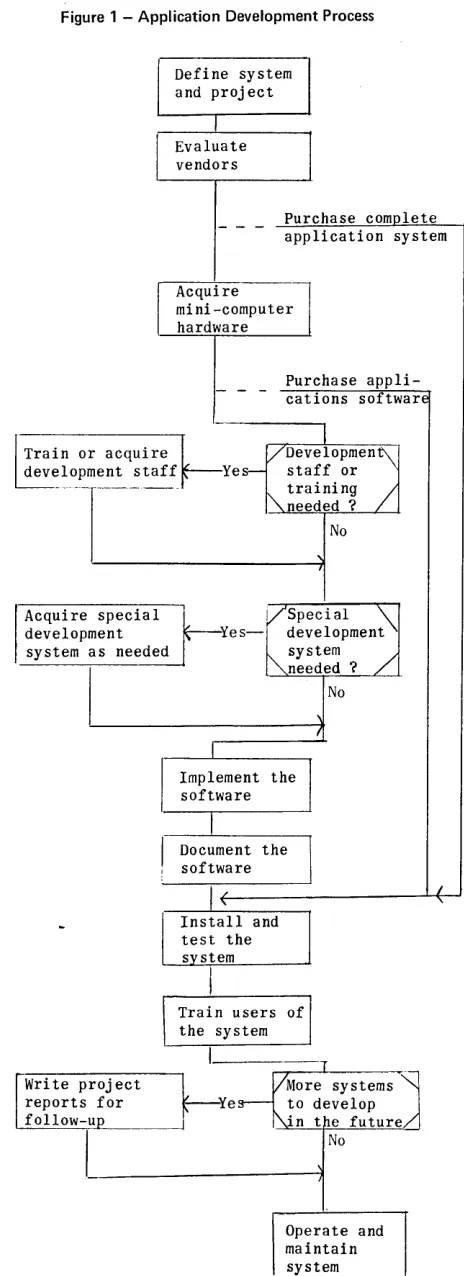
Here are the steps to follow in a typical development process for a minicomputer application system:
1. Define the system and the project. 2. Evaluate vendors.
3. Acquire minicomputer hardware.
4. Train or acquire the development staff, if neces-sary.
5. Acquire a special development system, if neces-sary.
6_ Design, write, assemble and test the software. 7. Document the software (for training, operation
and maintenance). S. Install and test the system.
9. Train users of the system (on operation and maintenance ).
10. Write project reports for follow-up on other development projects as needed.
In reality, the steps in such a process are iterative in nature, and overlapping in time. For discussion purposes, it is helpful to show them as discrete steps which proceed sequentially. If either the entire application system or the application software is purch~sed, rather than just the minicomputer hardware, then the development process changes somewhat. (See Figure 1.) The actual purchase of the minicomputer hardware (step 3) is but one step in ten. The cost of the hardware may in fact be a small part of the total cost, depending on how much time and effort is required to satisfy the other nine steps. While mini-computer prices have tended to shrink, the cost of people's time or talent has increased; as a result, the ratio of total system costs to hardware costs has risen dramatically.
approxi-Figure 1 - Application Development Process
Purchase com lete application system
Acquire mini-computer hardware
Purchase appli-cations softwar
I
Train or acquiredev~ ~~~~~~-=-~taff
No
I
Acquire s p e c i J l I I development --Yes--system as needed
I
~N~o
Train users of the system
Operate and maintain system
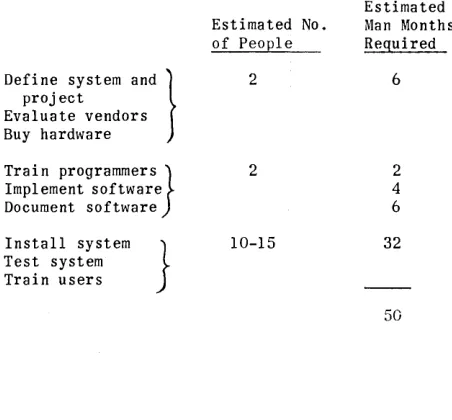
mately six mari months. The software costs, for training the programmers, implementing and documenting, may be large or small depending on the number and experience level of the people involved. Let's assume that two programmers are involved who need one month each of training, two months each for implementation, and three months each for docu-mentation. Total software costs would then be approxi-mately 12 man months.
Installation, Testing, and Training
Then comes the installation, testing, and training of users of the system. In an industrial operation, these tasks may involve many people, particularly if the automatic testing relates directly to company operations. For exam-ple, 10-15 people may be involved for two to three months, which means that from 20-45 man months might be required. Let us assume for this example that 32 man months is a good estimate. Total labor required, then, is 6
+
12+
32 = 50 man months. These figures are summa-rized in Figure 2. Assuming for the sake of round numbers that labor costs $1000 per month, then the development costs for the system are approximately $50,000, or twice the cost of the hardware.What does all this have to do, you might wonder, with "proper programming." In the above example, the esti-mated software development costs are only $12,000. How-ever, the labor expenses for the installation, testing and training of the system, which amounts to $32,000 are a direct function of the quality of the programs and docu-ments produced during the software development phase. Therefore, proper programming in the first stage is essential to minimize the TOTAL system development cost, not just the software development cost.
It is worth noting that the software development effort follows (or should follow) the definition phase of a project. A good application and project specification should define the requirements for each phase of the project. For exam-ple, a need for good training material and tutorial docu-ments for use by manufacturing personnel should be identified at the outset of the project, since this defines the type of software documentation required. A good defini-tion, therefore, is fundamental to the success of a project. It is certainly necessary before a computer can be pro-grammed properly for a particular application.
Programming Considerations
Computer ads and brochures often supply many words and few useful facts about software. Documentation on the subject often uses jargon and symbolism that makes it difficult for the novice to read. There are few criteria available today to enable anyone to objectively compare the quality of existing software. Here are some guidelines for preparing programs properly.
Software Purchase
[image:13.612.40.272.116.754.2]Figure 2 - Estimated labor for development of hypothetical industrial test system
Defin~
system and} proJ ectEvaluate vendors Buy hardware
Train programmers} Implement software Document software
Install system } Test system Train users
Estimated No. of People
2
2
10-15
Hardware Selection
Estimated Man Months Required
6
2 4 6
32
50
The prospective purchaser of a mini is confronted with a bewildering array of vendors, and a wide range of products from which to choose. Often the cost tradeoffs for various items in the minicomputer product line are not obvious. For example, should the system have 8
KBI
or 16 KB of memory? Should the buyer consider magnetic tape rather than paper tape? Is the Multiply/Divide option worth the money? There are no universal answers to these questions. It IS generally true that the smaller the hardware configura-tion, the more difficult to develop programs, and the more dollars required to write the necessary software. For exam-ple, if the application program requires about 8 KB of core memory, the buyer might opt for this memory size in an effort to save $3K to $4K in the cost of the computer, rather than buy a 16 KB memory. However, the 8KB
memory may not support the compiler for that computer model. Therefore, all programs will have to be written in assembly language, which may require additional training for the programmers.
Furthe'r, to get the program into 8 KB may require extensive optimization and recoding of the programs. If more than three to four man months of programming effort results from the choice of this memory size, it costs the buyer more money in the long run. The same applies to selection of a Multiply/Divide option, or Floating-point option, or other instruction set options that may be available. In general, scrimping on the cost of the hardware can be penny-wise and pound-foolish for the buyer, unless many machines are required.
Determining the best amount of memory for a particular application can be a difficult problem. One criterion is to get enough core to support the system programs (such as the Fortran compiler) on the chosen minicomputer. Another criterion is to get enough memory to support the
1 KB means kilo byte, where byte is an 8-bit unit of memory
16
largest amount of programs and data that must co-exist in memory at one time. Note that some minicomputers use a portion of core memory for dedicated functions, such as interrupt pointers. The area in memory reserved for these purposes is not available for program storage, and should be deducted when estimating the amount of memory available for programs and data.
If the right memory size for the end use is insufficient to allow program preparation, then some other method must be found to develop software for the application system. Some alternatives in this case are:
1. Buy an additional system for development pur-poses only.
2. Buy enough time on another computer of that model to develop the programs.
3. Use an assembler, if one is available, that runs on a 360 or some larger machine for purposes of devel-opment. (This approach may prove satisfactory for program assemblies, but program debugging may be difficult or impossible.)
4. Buy the necessary software outright.
Qualities of System Software
Most mlm vendors supply a fairly standard set of systems software programs with the computer: assemblers, compilers, program loaders. Once the software development begins in the chosen mini, these programs become very important, since they are the tools with which the program-mers must work to implement the desired result. While difficult to measure quantitatively, there are good and bad characteristics of system programs, and they should be assessed during vendor evaluation. The software character-istics to examine are as follows:
1. Documentation. This is the means by which your programmers will" learn how to use the system. The documents should be clear and concise. For the novice programmer, some tutorial material should be available. The operation of system programs, and the computer for that matter, should be straightforward in design and easy to use.
2. Performance. The- programs should be well-tested and perform consistent with their claimed oper-ating characteristics. Evidence of testing may be hard to come by, but if the performance of a compiler is of interest to a user, it is not unreason-able to ask the vendor how it was tested.
[image:14.612.64.290.68.278.2]INTERDATA Model 5, and the 2005A Real-Time Executive for the Hewlett Packard 2116.
4. Vendor Support. Most programs provided by com-puter manufacturers are subject to revisions, changes or improvements as more and more users have an opportunity to use the program. It is the responsibil-ity of the manufacturer to inform the customers of these revisions and changes. Some companies convey news regarding changes or improvements through a newsletter to their user group.
Programmer Training
If programmers must be trained to use the new mini then the effort required to explain the new machine should be explored. This is another aspect of computer evaluation which is difficult to quantify. An important factor is the availability of some well-written training material slanted toward the novice programmer. More important than this, however, is choosing a minicomputer with a straightforward design. Intricate complexities in a machine, such as fixed or relative memory paging or an involved addressing scheme, can slow down both learning and software development efforts.
Another factor in training concerns the type of docu-mentation required for the project. Traditionally, English has been a much more difficult language to master than Fortran, and minicomputers offer no simple solution to the documentation problem. If well-written documents are required to explain the application system to its users, then it is important to get someone on the project who can write, as well as program. This move may require some extra training effort at the start of a project, but the long-range benefits to the users make this wise.
Choice of Language
Assembly language is still the cornerstone of most minicomputer software systems. For many functions, such as interrupt handling, input/output procedures for unusual devices, or optimatization for time-critical cases, assembly language is essential. In almost every application, some assembly language programs are used, and knowledge of the assembly language is required.
Some higher-level, or problem-oriented languages, such as Fortran, Basic, or Algol, are available, but not many others are in use today on minicomputers. The lack of numerous problem-oriented languages is a major distinction between minicomputers and larger computers such as IBM 360, CDC 6600, B5500.
The need for Fortran or an equivalent language on the mini is critical when the application program involves many arithmetic calculations. The job of programming an arith-metic expression such as:
using 16-bit fixed-point add/subtract/multiply/divide in-structions can be an enormous job, particularly if much numerical precision is required. For problems involving such calculations, use of a higher-level language is a must.
Because many application systems involve both arith-metic calculations and I/O peculiarities, it is important that
the mini's system software allows the user to intermix programs written on different language levels. Also., it pays the buyer to get those machine features, such as floating-point arithmetic instructions, that assist both the pro-grammer and the system software itself in getting the job done efficiently. Floating-point instructions, for example, make the compiler more efficient, the arithmetic programs much smaller, and execution times much faster.
Optimization
In programming, memory space and execution time represent tradeoffs in a program design. That is, the smaller a program is made, using subroutine or interpretive tech-niques, the slower it will execute. Similarly, for faster execution times, more memory space is needed. Without delving into the theoretical justification for this
ph~nom
enon, let the user be aware that techniques which attempt to nest or pack programs too tightly into core memory tend to slow down program execution. A caution flag should be waved if a programmer advocates a special technique such as interpretive coding for packing more and more programs into less and less core. Another disadvantage of excessiveprogra~ packing (space optimization) is that program logic become.s difficult to follow, difficult to test, difficult to document, and difficult to change. In general, the best approach is to insure that sufficient core is available to write straightforward programs that do not employ tricks or devious methods.
For time optimization, meaning minimizing the execu-tion time, it is best to write programs in assembly language using straight-line code, with as few branches and sub-rou tine calls as possible.
Testing the System
Thorough testing of a system is often necessary, but not always possible. A communications concentrator system, for . example, may not get all facets of the program testing untIl the system is functioning on-line. At that time, it may not be possible to generate at will all possible error conditions, so the program's error detection and recovery may go untested. One alternative to this situation is to build special test equipment which simulates the real-world ?rocess. T~e testing procedures should be defined as early
In the project as possible. One technique is to build trace
points, loop counters, and special debugging messages into the program to aid in the testing process. These can be removed later to make the debugged program smaller. Where testing is difficult, dealing with a vendor that knows the application area, and has working installations in the field, can be a big help.
Program Maintenance
Maintenance activities include:
a. The analysis of the system for service purposes if the system should develop a malfunction. b. The correction of the system if an error in its
design is uncovered.
c. The changing of the system if a new or different operating feature is desired.
minor changes in the system. Depending on who will maintain the system, and under what conditions, mainte-nance documentation may be trivial or it may be monu-mental.
In general, a clean, well-commented listing which ex-plains the internal design of the program is essential to perform any maintenance. Other documents, such as flow charts, diagrams and descriptive information may be re-quired, depending on the application.
A final thought on maintenance is that the use of a minicomputer with straightforward architecture and simple addressing mechanisms does more to simplify the mainte-nance function than all the flow charts in the world.
Software: Make or Buy
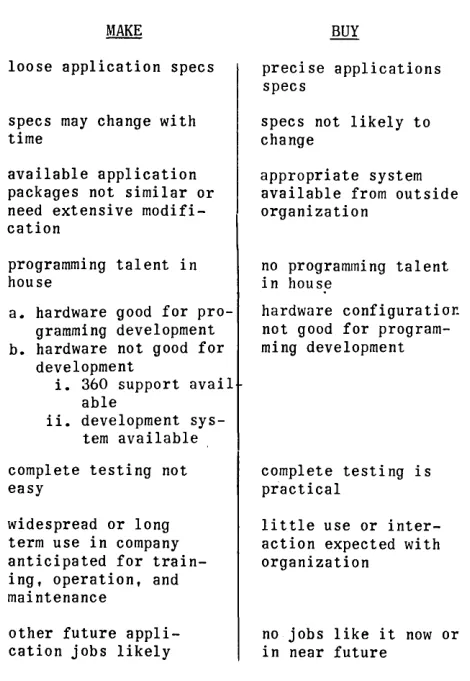
Again, proper programming requires at the outset, a good project and design spec that defines the requirements for system performance, testing, training, and maintenance. Given the existence of such a specification, the prospective user of a minicomputer system has to determine what vendors can satisfy his needs - either with a complete "turnkey" system, or an application software package to supplement some standard mini, or just a plain mini with its library of system software to help the user write his own application programs. Even if some vendors offer a com-plete system, or an application software package that meets the requirements, the user should consider the cost trade-. offs of making or buying the softwaretrade-. Figure 3 provides a
summary of factors which affect the make-or-buy decision.
Figure 3 - Factors for Make or Buy Decision
loose application specs
specs may change with time
available application packages not similar or need extensive modifi-cation
programming talent in house
a. hardware good for pro-gramming development b. hardware not good for
development
i. 360 support avail able
ii. development sys-tem available.
complete testing not easy
widespread or long term use in company anticipated for train-ing, operation, and maintenance
other future appli-cation jobs likely
precise applications specs
specs not likely to change
appropriate system available from outside organization
no programming talent in house
hardware configuratior. not good for program-ming development
complete testing is practical
little use or inter-action expected with organization
no jobs like it now or in near future
If all the conditions in the right-hand column of Figure 3 are satisfied, the user should buy the system from a qualified vendor. If all the conditions in the left-hand column are applicable, then the user should develop the software himself. If some conditions on the right and some on the left are met, then the prolipective buyer must evaluate the factors and establish priorities before making the decision.
Conclusion
Software needs are of prime consideration when evalu-ating a minicomputer application. Falling prices of mini-computer hardware do not necessarily mean that the software costs are falling; in fact, the converse is often true. Programming is getting easier, due to more and better system software available from vendors, but there are potential pitfalls in selecting a vendor. Application pro-grams with fancy names, or sophisticated operating systems may not help you - the end user - at all. Therefore, to minimize software costs, choose a mini that has good programming characteristics, has good quality system soft-ware available, and an established company behind the product, for support. Making that choice can get the programming off to a good start. The proper programming effort then requires the user to fully specify all the phases of the job to be done - from developing, to training, to operating, to maintaining the system. Good programs are those which satisfy all needs, both short term and long, at
minimum cost. D
You are invited to enter our
~~d
COMPUTER ART CONTEST
the special feature of the August, 1971 issue of
computers
and automation
GUIDELINES FOR ENTRY
1. Any interesting and artistic drawing, design or sketch made by computer (analog or digital) may be entered.
2. Entries should be submitted on white paper in black ink for best reproduction. Color entries are acceptable, but they may be published in black and white.
3. The preferred size of entry is 8Y2 x II inches (or smaller); the maximum acceptable size is 12Y2 x 17 inches.
4. Each entry should be accompanied by an explanation in three to five sentences of how the drawing was programmed for a computer, the type of computer used, and how the art was produced by the computer.
There are no formal entry blanks; any letter submitting and de-scribing the entry is acceptable. We cannot undertake to return artwork, and we ask that you NOT send originals.
The winning entry will appear on the cover of our August issue - more than 25 entries will be published inside, and other entries
will be published later in other issues.
[image:16.613.55.290.430.771.2]