1 INTRODUCTION
Why do employees leave their jobs? What makes them willing to stay? What ties them to the organization? What pushes them away? researchers are still wondering and investigating the reasons behind employees’ decisions to leave or to stay. e costs incurred by organizations as a result of employees leaving their jobs are aggregate. Employees depart organizations carrying the knowledge and experience with them. Accordingly, the costs of workforce mobility are becoming a major issue of concern. Organizations are exerting collective efforts towards the retention of talented and qualified workforce. e consequences of employees quitting their jobs are direct and indirect as; recruitment, selection, training and above all the losses of know-how acquired through the learning curves of work processes. retaining talent is a key success indicator not only for people oriented organizations but also to all organizations. Employers seize every opportunity to save the direct and the indirect costs of employees’ leaving the organization. Qualified and talented workforce is the organizational critical resource through which competitive advantage is developed. As such uncontrolled employees’ leaves interrupt social and communication networks as well as reducing the level of commitment and unity of those who stay (mobley, 1982; Staw 1980). is study explores selected antecedents of job embeddedness literature namely; role ambiguity, training, and demographics (age groups, gender and education). Private Banks in Egypt were targeted and self-administered questionnaires were distributed among employees working in the head offices of these banks. results and discussion as well as managerial implications were addressed.
Journal of HUMAN RESOURCE MANAGEMENT
www.jhrm.eu • iSSN 2453-7683
Exploring job embeddedness' antecedents
Ghadeer mohamed Badr ElDin Aboul-Ela
A B ST r AC T
Employees are the key resources of organizational success. Developing and maintaining job embeddedness is a cornerstone success in the workplace. e purpose of this research study is to analyze selected antecedents of job embeddedness. role ambiguity, training, and demographics (age groups, gender and education) were identified from the extant literature as the selected antecedents for this study. An in-depth statistical analysis of the job embeddedness sub-dimensions was conducted in relation to the selected antecedents. Questionnaires were administered among the employees working in the private banks in Egypt. results revealed a negative relationship between role ambiguity and job embeddedness, a positive relationship between training and job embeddedness, elder employees held higher level of embeddedness compared to young employees, females possessed higher level of embeddedness compared to males, and no significant differences among the various education levels and job embeddedness.
job embeddedness, role ambiguity, training, gender differences, age
K E Y W O r D S
J E L C o d e : m 1 2
manuscript received 27 October 2017, Accepted 19 December 2017
CONTACT iNfOrmATiON:
2 LITERATURE REVIEW
2.1 JOB EMBEDDEDNESS
The origins of job embeddedness was first addressed by Granovetter (1985) as an emphasis of how social interactions influence economic activities in sociology literature. Sociologists viewed job embeddedness as the process by which social relations influence and constrain economic action (Granovetter, 1985; Uzzi, 1997). According to this perspective, it is a binding barrier that restricts and constraints employees from leaving the organization. it is the tie up force that could keep employees away from leaving the organization. On the contrary, job embeddedness in the Organization Behavior literature focuses on employees staying on the job with the potential of decreasing the opportunity to leave. Job embeddedness is “a broad set of influences on employee’s decision to stay on the job” (Holtom & inderrieden, 2006a, p.319). Job embeddedness represents a mix of variables that influence an employee’s decision to remain or leave the organization. it is like a high dam that keeps employees far away from leaving or quitting the organization. in the original conceptualization of job embeddedness (mitchell, Holtom, Lee, Sablynski & Erez, 2001) expressed the influences of job embeddedness as a web or a net in which a person gets stuck and identified two main sub- dimensions namely; work-related forces that tie an individual to the organization (link, fit, sacrifice) and community-related factors that bind the employee to his/her surrounding community. This 2x3 matrix generated six dimensions of job embeddedness construct (links – organization, fit – organization, sacrifice – organization) and (links – community, fit – community, sacrifice – community). The three dimensions; link, fit and sacrifice determine the extent to which employees are connected to their organizations and community (Oyler, 2007). Shocks were addressed by (mitchell et.al. 2001a) as the events and the reasons behind employees leaving their jobs. The readiness to leave the organization when a “shock-event” occurs relies mainly on the level of employee’s attachment to the organization and the degree of satisfaction that he/she finds. The researcher defines job embeddedness as a multi-dimensional construct that promotes an employee’s retention to the organization. The three main dimensions/influences that constitute job embeddedness are links; fit and sacrifice are explained hereafter.
• Links:“formal or informal connections between an employee and institutions or people” (Holtom et al., 2006a, p.319). Links are the employees’ formal and informal ties to other individual or groups at work. ese ties hold them back from departing (mitchelle et al., 2001). e job links include links that may foster staying (Allen, 2006); through the adoption of normative pressures (maertz, Stevens & Campion, 2003). Employees suffer from costs of rearrangement of links upon leaving their jobs as they suffer in their homes and lives. Examples of links include; close relationships with family and friends, marital status, number of children who require care, hobbies, tenure in the organization, degree of workplace friendship, and tenure in the current position.
• Fit:represents the sense of feeling compatible with the job and the working environment. Oyler (2007) addressed fit as the degree of harmony between the individual and the organization. A better fit means a higher level of satisfaction and commitment (Holtom, mitchell & Lee, 2006b). in this respect, employees’ convictions, career plans and goals as well as future orientation must be consistent with organization culture, job knowledge and skills.
• Sacrifice:“the perceived costs of material or psychological benefits that are forfeited by organizational departure (Holtom et al., 2006a, p.319-320). Sacrifice is what holds employees from departing as they are likely to encounter loss of physical and psychological benefits by leaving the organizations or communities. Sacrifice includes personal loss of leaving good connections, compensation offerings, the things that employees give up on like loss of travel opportunities, overseas training, and a supportive boss (Shaw, Delery, Jenkins & Gupta, 1998). Several outcomes of job embeddedness have been addressed in the literature as organization citizenship behavior (Lee, mitchell, Sablynski, Burton & Holtom, 2004; Sekiguchi, Burton & Sablynski, 2008; Wijayanto & Kismono, 2004), job performance (Holtom et.al., 2006a), in-role and extra-role performance, counterproductive behavior and absenteeism (Lee, Burch & mitchell, 2014; Lee et al., 2004; Ng & feldman, 2009), perceived organizational support and supervisor support (Giosan, Holtom & Watson, 2005). it is worth mentioning that intention to leave has been conceptualized as one of the significant outcomes of job embeddedness (Holtom & O’Neil, 2004; Lee et.al, 2004; Sun, Zhao, Yang, & fan, 2012).
2.2 ROLE AMBIGUITY
frustrated employees as they tend to feel lost among the required tasks and duties could trap employees into trial and error behavior patterns to meet the desired targets leading to lower levels of performance (rizzo et.al., 1970).
2.3 TRAINING
Training presents a prime opportunity to expand the knowledge base of all employees. Training is an indicator of management commitment to quality performance (Babakus, Yavas, Karatepe & Avci, 2003; Karatepe & Karadas, 2012). Training has been always viewed as the organization continued attempt to enhance the development of its employees on both the personal and the organizational perspectives. it is a common strategy for retention and stability (Shaw, Delery, Jenkins & Gupta, 1998). Providing the necessary training creates knowledgeable staff that possesses new skills which in return improve production, reduce production costs, reduce mistakes, build confidence, and create a better working environment.
3 RESEARCH METHODOLOGY
3.1 RESEARCH OBJECTIVE
is study aims to analyze the antecedents of job embeddedness construct namely; role ambiguity, training and demographics (age, gender and education).
3.2 PROCEDURE
e researcher collected data from employees working in the head offices of the private banks in Cairo, Giza and Alexandria governorates, Egypt. e management heads of these banks were contacted through a signed letter that elaborated the purpose of the study and requested the permission of data collection through the questionnaires. Top management agreed to distribute the questionnaires electronically over the emails. in order to minimize the common method variance (CmV) issues, (Podsakoff, mackenzie & Podsakoff, 2012; Podsakoff, macKenzie, Lee & Podsakoff, 2003) ex-ante procedural remedies were adopted. CmV remedies included stating on the questionnaire clearly the reassurance of anonymity and confidentiality of collected information, all the statements were positively stated in order to reduce apprehension, mixing the order of questionnaire questions, and improving the scale items by providing examples and illustrations.
3.3 PARTICIPANTS
e private banks were the selected sector for the purpose of the study as it represents one of the most significant sectors to the Egyptian economy. An insight on previously published data about private banks revealed that most of the employees working in this sector share a relative degree of homogeneity particularly in the educational background as well as relatively similar salaries and compensation packages. e total numbers of employees working in the head offices in Cairo, Giza and Alexandria governorates is 3500 employees. Due to the inability to reach the total population, proportion stratified random sample was used. A number of 800 questionnaires were distributed. e returned complete and valid responses were 600 questionnaires with a response rate 75 %.
3.4 RESEARCH MEASURES
All the research constructs were measured by well-established scales used in the extant research. Job embeddedness was measured by (Holtom et al., 2006a) composite scale that combines separate empirical indicators into a single measure. is scale was selected for the purpose of the study as composite measures are good reflectors of complex concepts more adequately than single indicators. Training was measured by (Boshoff & Allen, 2000) scale. While, role ambiguity was assessed by (rizzo et al., 1970) scale.
3.5 RESEARCH HYPOTHESES
role ambiguity). is study focuses on analyzing these selected antecedents of job embeddedness and its sub-dimensions.
AGE
Wang and Shi (2007) studied the relationship between age and job embeddedness and found that employees aged (41-50) possessed the lowest levels of job embeddedness, while (Griffeth et al., 2010) found that young people are more likely to enjoy a high level of risk-taking than elder people thus, they hold a lower level of job embeddedness towards their organizations. e researcher agrees with the research findings of (Griffeth et al., 2010); hence the first hypothesis is developed as:
H1: It is expected that young employees will hold a lower level of job embeddedness compared to elder employees.
GENDER
females have been viewed to be less attached to their organizations than males. Griffeth et al. (2000) found no significant differences held among males and females in terms of the level of job embeddedness they possessed. Ng and feldman (2011) found that women had higher perceptions of organizational embeddedness than men. e researcher perceives the findings of (Ng & feldman, 2011) to be more applicable on the Egyptian organizations; hence the second hypothesis is posed as:
H2: It is expected females will enjoy a higher level of job embeddedness than males
EDUCATION
Employees who possessed high levels of education tend to be less attached to their jobs. is is attributed to the likelihood of increasing their opportunities of open career gates. royalty (1998) explained that education creates broad-minded and career driven employees that in return reduces the level of attachment and ties to a given organization.
H3: It is expected that there will be a negative relationship between education and job embeddedness.
ROLE AMBIGUITY
role ambiguity is one of the factors that could lead to exasperated employees with a sense of feeling unaware of the expected outcomes. it has been shown to be negatively related to turnover and job embeddedness (Griffeth et al., 2000) specifically the organizational dimension of job embeddedness.
H4: It is expected that there will be a negative relationship between role ambiguity and job embeddedness.
TRAINING
Training is the process of enhancing the skills, capabilities and knowledge of employees for doing a particular job. Training process molds the thinking of employees and leads to enhancing their quality performance. it is continuous and never ending process in nature. Previous studies showed a positive relationship between training and job embeddedness (Bergiel, Nguyen, Clenney & Taylor, 2009; Davidson, mcPhail & Barry, 2011; Poulston, 2008; Yang, Wan & fu, 2012).
H5: It is expected that there will be a positive relationship between training and job embeddedness.
4 STATISTICAL RESULTS AND ANALYSIS
is section presents the statistical results of the research hypotheses. All the research hypotheses are analyzed with regard to the dimensions of job embeddedness (fit, Link and Sacrifice).
Table 1: Demographic characteristics of the study
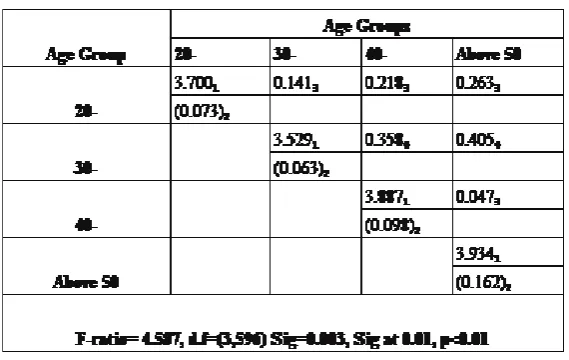
Hypothesis Number One: It is expected that young employees will hold a lower level of job embeddedness compared to elder employees.
One-way ANOVA test results are presented in the Table 2:
Table 2. results of one-way ANOVA (Age groups and job embeddedness)
1: denote the mean value for each group 2: denote the standard error (S.E) for each group
3: Denote the mean differences between two intersected groups 4: Denote the existing differences between two groups
• Based on the above results and through running Tukey test, differences among the different age groups are seen specifically within the groups (40-) and (Above 50) with regard to the level of job embeddedness held among them.
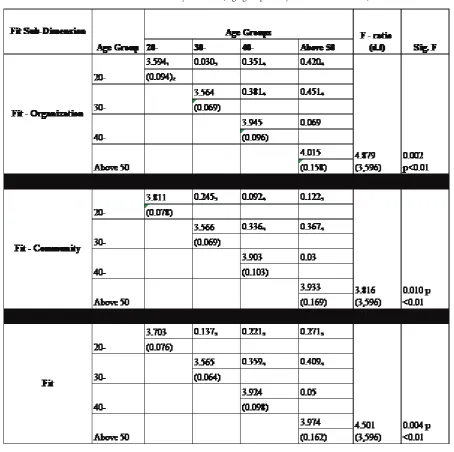
Table 3: results of one-way ANOVA (Age groups and job embeddedness-fit)
1: Denote the mean value for each group 2: Denote the standard error (S.E) for each group
3: Denote the mean differences between two intersected groups 4: Denote the existing differences between two groups
Results of Age Groups and Job Embeddedness-Links Sub-dimension
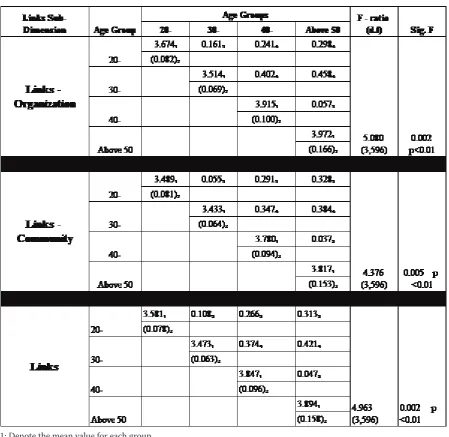
Table 4: results of one-way ANOVA (Age groups and job embeddedness-links)
1: Denote the mean value for each group 2: Denote the standard error (S.E) for each group
3: Denote the mean differences between two intersected groups 4: Denote the existing differences between two groups
Results of Age Groups and Job Embeddedness-Sacrifice Sub-dimension
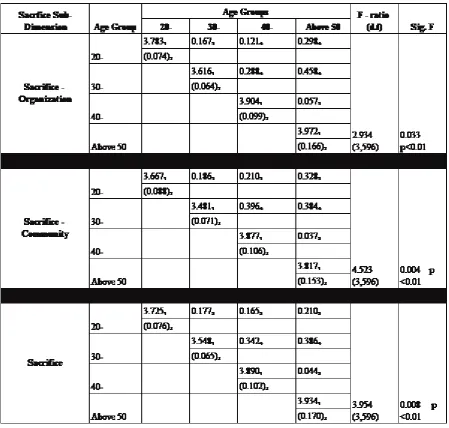
Table 5: results of one-way ANOVA (age groups and job embeddedness-sacrifice)
1: Denote the mean value for each group 2: Denote the standard error (S.E) for each group
3: Denote the mean differences between two intersected groups 4: Denote the existing differences between two groups
• Based on the above results and through running Tukey test, differences among the different age groups are present specifically within the groups (30- / 40- and above 50).
e statistical results and as presented in Tables (2, 3, 4 & 5) it is concluded that there is a difference among the age groups in the level of job embeddedness held. Accordingly, the first hypothesis can be accepted.
Hypothesis Number Two: It is expected females will enjoy a higher level of job embeddedness than males.
Table 6: results of T-test gender and job embeddedness
from the previous Table 6 the mean values show that females enjoy a higher level of job embeddedness compared to males.
Results of Gender and Job Embeddedness-Fit sub-dimension
Table 7: results of T-test (gender and job embeddedness-fit)
• All the results show that females possessed a higher level of Job-Embeddedness-fit sub-dimension compared to males.
Results of Gender and Job Embeddedness-Links Sub-dimension
Table 8: results of T-test (gender and job embeddedness-links)
Results of Gender and Job Embeddedness-Sacrifice Sub-dimension
Table 9: results of T-test (gender and job embeddedness-sacrifice)
• All the results show that females possessed a higher level of Job -Embeddedness-Sacrifice sub-dimension compared to males.
Based on the statistical results and as shown in Tables (6, 7, 8 & 9) indicate that there is a difference among males and females in the level of job embeddedness held. Accordingly, the second hypothesis can be accepted. Hypothesis Number ree: It is expected that there will be a negative relationship between education and job embeddedness.
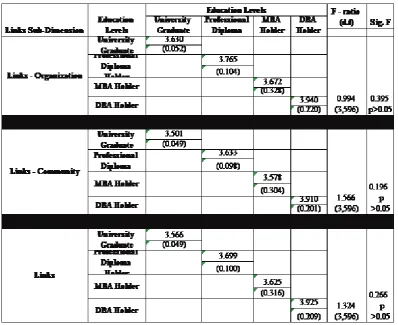
One-way ANOVA test was used to test this hypothesis. Table 10 shows the results of the relationship between the level of education and Job –Embeddedness construct.
Table 10: results of one-way ANOVA for education level and job-embeddedness
Results of Education Levels and Job Embeddedness-Fit Sub-dimension
Table 11: results of T-test (education levels and job embeddedness-fit)
• results of Table 11 show no significant difference between the various education levels and job-embeddedness-fit.
Results of Education Levels and Job Embeddedness-Links Sub-dimension
• results of Table 12 show no significant difference between the various education levels and job-embeddedness-links.
Table 13: results of T-test (education levels and job embeddedness- sacrifice)
• results of Table 13 show no significant difference between the various education levels and job-embeddedness-Sacrifice.
e statistical results and as presented in Tables (10, 11, 12 & 13) reveal no significant difference across all the educational levels and job embeddedness including all its sub-dimensions. Accordingly, the third hypothesis can be rejected.
Hypothesis Number Four: It is expected that there will be a negative relationship between role ambiguity and job embeddedness.
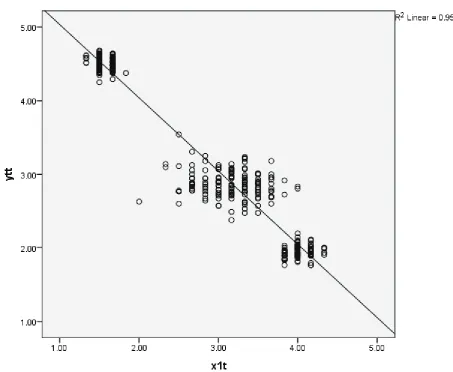
figure 1: Scatter diagram – the effect of role ambiguity on job embeddedness
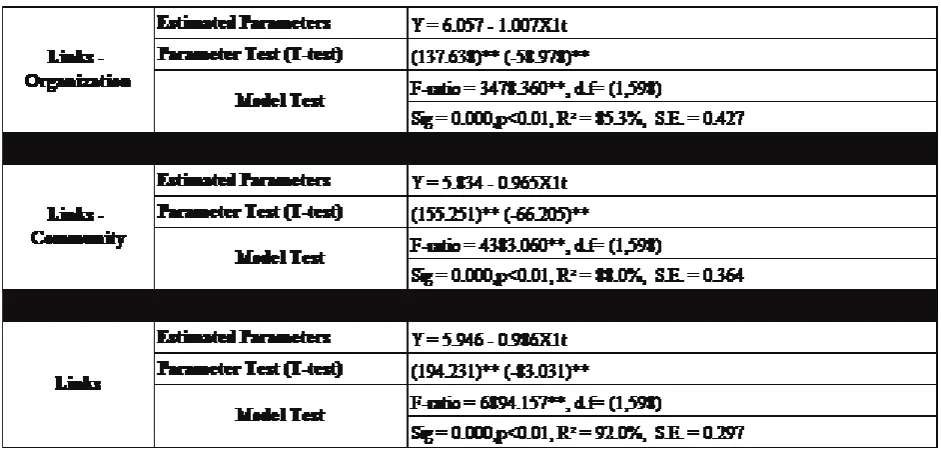
e results shown in the previous figure 1 indicate that there is a negative linear relationship with (r²= 95.5). is is further elaborated in Table 14:
Table 14: Simple regression analysis – role ambiguity and job embeddedness
Results of Role Ambiguity and Job Embeddedness-Fit Sub-dimension
e following Table 15 shows the results of simple regression analysis with respect to Job Embeddedness-fit (sub-dimension). ere is a negative relation with r²=92.2%.
Table 15: Simple regression analysis – role ambiguity and job embeddedness – fit
**: significance at 0.01
Results of Role Ambiguity and Job Embeddedness-Links Sub-dimension
e following Table 16 shows the results of simple regression analysis with respect to Job Embeddedness-Links (sub-dimension). it is seen that there is a negative relation with r²=92%.
Table 16: Simple regression analysis – role ambiguity and job embeddedness – links
Results of Role Ambiguity and Job Embeddedness-Sacrifice Sub-dimension
e following Table 17 shows the results of simple regression analysis with respect to Job Embeddedness-Sacrifice (sub-dimension). it is concluded that there is a negative relation with r²=92.2%.
Table 17: Simple regression analysis – role ambiguity and job embeddedness – sacrifice
**: significance at 0.01
Based on all the results presented in Tables (14, 15, 16, and 17) hypothesis number four can be accepted. Hypothesis Number five: it is expected that there will be a positive relationship between training and job embeddedness.
Simple regression analysis was used to test the effect of training on job embeddedness. e following scatter diagram (figure 2) shows the shape of the effect whereby the x-axis represents Job embeddedness and the y-axis represents training.
e results shown in the previous figure 2 indicate that there is a positive linear relationship with (r²= 93.4%). is is further elaborated in Table 18:
Table 18: Simple regression analysis – training and job embeddedness
**: significance at 0.01
Results of Training and Job Embeddedness-Fit Sub-dimension
e following Table 19 shows the results of simple regression analysis with respect to Job Embeddedness-fit (sub-dimension). ere is a positive relation with r²=86.5%.
Table 19: Simple regression analysis – training and job embeddedness – fit
Results of Training and Job Embeddedness-Links Sub-dimension
e following Table 20 shows the results of simple regression analysis with respect to Job Embeddedness-Links (sub-dimension). it is seen that there is a positive relation with r²=92.4%.
Table 20: Simple regression analysis – training and job embeddedness – links
**: significance at 0.01
Results of Role Ambiguity and Job Embeddedness-Sacrifice Sub-dimension
e following Table 21 shows the results of simple regression analysis with respect to Job Embeddedness-Sacrifice (sub-dimension). it is seen that there is a positive relation with r²=91.2%.
Table 21: Simple regression analysis – training and job embeddedness – sacrifice
**: significance at 0.01
5 DISCUSSION
is research aimed at analyzing selected job embeddedness antecedents namely; role ambiguity, training, and demographic characteristics (age, gender and education). Previous literature studies were analyzed and accordingly research hypotheses were posed. Self-administered questionnaires were developed using sound, and valid scales among employees working in the private banking sector in Egypt. results revealed a negative relationship between role ambiguity and job embeddedness, a positive relationship between training and job embeddedness, elder employees held higher level of embeddedness compared to young employees, females possessed higher level of embeddedness compared to males, and no significant differences among the various education levels and job embeddedness. is study makes an important contribution to the job embeddedness literature through exploring several antecedents in relation to the sub-dimensions of job embeddedness especially within the Egyptian domain. e findings lend a weight to the concept that employees do consider the sub-dimensions of job embeddedness separately.
results revealed that older employees held a higher level of job embeddedness when compared to young employees. is was obvious among the three job embeddedness sub-dimensions (fit, link and sacrifice). is result agrees with the findings of (Griffeth et al., 2010). e researcher views the results to be coherent with previous research suggestions. Older people don’t attempt to accommodate changes in their jobs or communities easily. Change gets to be difficult to approach especially if they feel fitting and linked with their organizations and communities. e willingness and the ability to sacrifice current jobs decreases and hence embeddedness acts as a tie that locks them to their organizations. On the other hand, young employees tend to accept new trails and career opportunities. ey can cope easier with life changing pace and the notion of ‘change is the only constant’. As such fitting and linking themselves to the organization is not strong enough compared to older employees and their readiness to sacrifice is higher.
As for the gender, results showed that females enjoy a higher level of job embeddedness for the three sub-dimensions compared to males. is result is tied to the oriental Egyptian culture that tends to impose more obligations on women with regard to work-family balance. family commitments are the first priorities for many women and financial obligations also tie them up to their jobs. As such stability in the job is a psychological tie specifically if the job is a private sector whereby security on the job is not guaranteed. e sense of link to the job is well-established once they feel fitting particularly if the community and family endorses this. males on the other hand, enjoy a higher level of freedom to move across organizations especially if they can find jobs with higher organizational positions and better payment. e community supports males to move freely even if their move is overseas as their obligations are more financial than operational towards their families and communities. is elevates their readiness to move across jobs regardless of fit, link or sacrifice dimensions.
it was found that no significant differences among the various educational levels and job embeddedness sub-dimensions. is result disagrees with previous findings of royalty (1998). e researcher perceives these results to be attributed to the fact that private banks in Egypt tend to offer minimum promotional opportunities and payment differences among the various educational degrees. Growth and promotion are based on performance rather than on educational degree progress. is is also apparent as most of the employees are university graduates compared to professional diploma holders, mBA holders and DBA holders. e ties to the organization and the community will not vary as employees don’t feel tangible or morale differences among the various educational degrees.
results indicated training to be positively related to job embeddedness and its sub-dimensions. e highest effect was on (link-organization), followed by (sacrifice-organization) and then (fit-community) sub-dimension. is supports the idea of valuing the workforce and investing in employees will improve loyalty, increase their tie-up forces to the organization and foster employees’ attitudes towards staying with the organization for long. Training had the highest impact on (link –organization) is a coherent objective of training exercise as employees feel connected and linked to their organizations especially when the organization is concerned with improving their skills. is was followed by the willingness to sacrifice after acquiring new skills and with the organizational expenditure on their intellectual skills. Last is to feel a sense of (fit-community) whereby employees feel proud to share with the community their organizational investment in them.
6 MANAGERIAL IMPLICATIONS
Organizations should foster the generation of job embeddedness across its all sub-dimensions (fit, link and sacrifice). e following are some proposed recommendations to management and decision-makers inside organizations: 1. recognize performance among young and elder employees equally as this will help young employees to feel a
sense of appreciation and attachment towards the organization.
2. Offer equal development and growth opportunities among all employees.
3. Applaud the results of females and males equally. A sense of equality specifically among females is perceived to be of a real tangible return.
4. Disseminate transparency practices among all the organizational goals and objectives communicated to employees. is provides a real boost towards magnifying job embeddedness.
5. it is hard to stay positive without being fueled! Training is the fuel of positive attitudes towards the organization. it promotes organizational willingness to enhance employees’ intellectual skills.
6. Envision education across all the board as it is the key driver of self-development and the compelling path towards building valuable job embeddedness and appreciation.
7 RESEARCH LIMITATIONS AND FUTURE STUDIES
Due to cost constraints the study was adopted on Cairo, Giza and Alexandria governorates, Egypt only. it is recommended that the research could be extended to other governorates within Egypt to gain a better insight for the generalization of the results. future research could extend to include several other antecedents to enrich the existing academic literature specifically in the middle East region.
8 CONCLUSION
is research study aimed at analyzing selected antecedents of job embeddedness in the private banking sector in Cairo, Egypt. Questionnaires were distributed relying on previously published scales. Statistical analysis were conducted and results revealed a negative relationship between role ambiguity and job embeddedness, a positive relationship between training and job embeddedness, elder employees held higher level of embeddedness compared to young employees, females possessed higher level of embeddedness compared to males, and no significant differences among the various education levels. Discussion and managerial implications were developed based on the research findings.
Acknowledgement
REFERENCES
Allen, D. G. (2006). Do organizational socialization tactics influence newcomer embeddedness and turnover?.
Journal of Management,32(2), 237-256. Doi: 10.1177/0149206305280103
Babakus, E., Yavas, U., Karatepe, O. m., & Avci, T. (2003). The effect of management commitment to service quality on employees’ affective and performance outcomes.Journal of the Academy of Marketing Science,31(3), 272-286.DOi: 10.1177/0092070303031003005
Bergiel, E. B., Nguyen, V. Q., Clenney, B. f., & Stephen Taylor, G. (2009). Human resource practices, job embedded-ness and intention to quit.Management Research News,32(3), 205-219. Doi: 10.1108/01409170910943084 Boshoff, C., & Allen, J. (2000). The influence of selected antecedents on frontline staff ’s perceptions of service
recovery performance. International Journal of Service Industry Management, 11(1), 63-90. Doi: 10.1108/09564230010310295
CG Davidson, m., mcPhail, r., & Barry, S. (2011). Hospitality Hrm: past, present and the future.International Journal of Contemporary Hospitality Management,23(4), 498-516. Doi: 10.1108/09596111111130001
Giosan, C., Holtom, B., & Watson, m. (2005). Antecedents to job embeddedness: The role of individual, organiza-tional and market factors.Journal of Organizational Psychology,5(1), 31-44.
Granovetter, m. (1985). Economic action and social structure: The problem of embeddedness.American Journal of Sociology,91(3), 481-510. Doi: 10.1086/228311
Griffeth, r. W., Hom, P. W., & Gaertner, S. (2000). A meta-analysis of antecedents and correlates of employee turnover: Update, moderator tests, and research implications for the next millennium.Journal of Management,
26(3), 463-488. Doi: 10.1177/014920630002600305
Holtom, B. C & O’Neill, B.S. (2004). Job embeddedness: A theoretical foundation for developing a comprehensive nurse retention plan.Journal of Nursing Administration, 34(5), 216–227.DOi: 10.1097/00005110-200405000-00005
Holtom, B. C., mitchell, T. r., Lee, T., & Tidd, S. (2006, August). Less is more: Validation of a short form of the job embeddedness measure and theoretical extensions. inAnnual meeting of the Academy of Management, Atlanta
Holtom, B. C., & inderrieden, E. J. (2006). integrating the unfolding model and job embeddedness model to better understand voluntary turnover.Journal of Managerial Issues,18(4), 435-452.
Kahn, r. L., Wolfe, D. m., Quinn, r. P., Snoek, J. D., & rosenthal, r. A. (1964).Organizational stress: Studies in role conflict and ambiguity.New York, Wiley.
Karatepe, O. m., & Karadas, G. (2012). The effect of management commitment to service quality on job embed-dedness and performance outcomes. Journal of Business Economics and Management,13(4), 614-636. Doi: 10.3846/16111699.2011.620159
Katz, D., & Kahn, r. L. (1978).The social psychology of organizations(Vol. 2). New York: Wiley.
Lee, T. W., mitchell, T. r., Sablynski, C. J., Burton, J. P., & Holtom, B. C. (2004). The effects of job embeddedness on organizational citizenship, job performance, volitional absences, and voluntary turnover.Academy of Management Journal,47(5), 711-722.Doi: 10.2307/20159613
Lee, T.W., Burch, T.C., and mitchell, T.r. (2014). The story of why we stay: A review of job embeddedness.Annual Review of Organizational Psychology and Organizational Behavior 1(1), 199–216.
maertz, C. P., Stevens, m. J., & Campion, m. A. (2003). A turnover model for the mexican maquiladoras.Journal of Vocational Behavior,63(1), 111-135.Doi: 10.1016/S0001-8791(02)00023-4
mitchell, T. r., Holtom, B. C., Lee, T. W., Sablynski, C. J., & Erez, m. (2001). Why people stay: Using job embed-dedness to predict voluntary turnover.Academy of Management Journal,44(6), 1102-1121. Doi: 10.2307/3069391 mobley, W. H. (1982). Some unanswered questions in turnover and withdrawal research.Academy of Management
Review,7(1), 111-116.Doi: 10.5465/Amr.1982.4285493
Ng, T. W., & feldman, D. C. (2009). Occupational embeddedness and job performance.Journal of Organizational Behavior,30(7), 863-891. Doi:10.1002/job.580
Oyler, J. D. (2007).Core Self-Evaluations and Job Satisfaction: The Role of Organizational and Community Embed-dedness. faculty of Virginia Polytechnic institute and State University. Unpublished Doctoral Dissertation
Podsakoff, P.m., mackenzie, S.B. and Podsakoff, N.P. (2012) Sources of method Bias in Social Science research and recommendations on How to Control it.Annual Review of Psychology, 63, 539-569. http://dx.doi.org/10.1146/an-nurev-psych-120710-100452
Podsakoff, P.m., macKenzie, S.B., Lee, J.Y., & Podsakoff, N.P. (2003). Common method Biases in Behavioral research: A Critical review of the Literature and recommended remedies.Journal of Applied Psychology, 88(5), 879-903. DOi:10.1037/0021-9010.88.5.879
Poulston, J. (2008). Hospitality workplace problems and poor training: a close relationship. International Journal of Contemporary Hospitality Management, 20(4), 412-427. Doi: /10.1108/09596110810873525
rizzo, J. r., House, r. J., & Lirtzman, S. i. (1970). role conflict and ambiguity in complex organizations. Adminis-trative Science Quarterly, 15(2), 150-163. Doi: 10.2307/2391486
royalty, A. B. (1998). Job-to-job and job-to-Non employment turnover by gender and education level. Journal of Labor Economics,16(2), 392-433. Doi: 10.1086/209894
Sekiguchi, T., Burton, J. P., & Sablynski, C. J. (2008). The role of job embeddedness on employee performance: the interactive effects with leader–member exchange and organization based self esteem.Personnel Psychology,
61(4), 761-792. Doi: 10.1111/j.1744-6570.2008.00130.x
Shaw, J. D., Delery, J. E., Jenkins, G. D., & Gupta, N. (1998). An organization-level analysis of voluntary and invol-untary turnover.Academy of Management Journal,41(5), 511-525. Doi:10.2307/256939
Staw, B. m. (1980). The consequences of turnover.Journal of occupational Behaviour,1(4),253-273.
Sun, T., Zhao, X. W., Yang, L. B., & fan, L. H. (2012). The impact of psychological capital on job embeddedness and job performance among nurses: a structural equation approach.Journal of Advanced Nursing,68(1), 69-79.DOi: 10.1111/j.1365-2648.2011.05715.x
Uzzi, B. (1997). Social structure and competition in interfirm networks: The paradox of embeddedness. Adminis-trative Science Quarterly,42(1), 35-67. Doi: 10.2307/2393808
Wijayanto, B.r., and Kismono, G. (2004). The Effect of Job Embeddedness on Organizational Citizenship Behaviour: mediating role of Sense of responsibility.Gadjah Mada International Journal of Business,6(3), 335-354.